高中英语语法核心知识点详解(讲义)
Part 22 句式篇——直接与间接引语和插入语
22.1 直接与间接引语 Direct and Indirect Speech
1. 不同成分的转换
(1) 人称变化
1) 在直接引语变间接引语时,如果从句中的主语是第一人称或
被第一人称所修饰,从句中的人称要按照主句中主语的人称而变
化。
Lily said, "I must go to work."
→ Lily said she must go to work.
丽丽说她必须去工作。
2) 若从句中的主语及宾语是第二人称,或被第二人称所修饰,
从句中的人称要跟引号外的主句的宾语一致。如果引号外的主句没
有宾语,也可以用第一人称。
He asked to me, "How is your mother now?"
→ He asked me how my mother was then.
他问我我的母亲多大年纪了。
3) 如果从句的主语及宾语是第三人称或被第三人称所修饰,从
句中的人称一般不需要变化。
My teacher said, "she is a good student."
→ My teacher said she was a good student.
我的老师说她是一名好学生。
(2) 时态变化
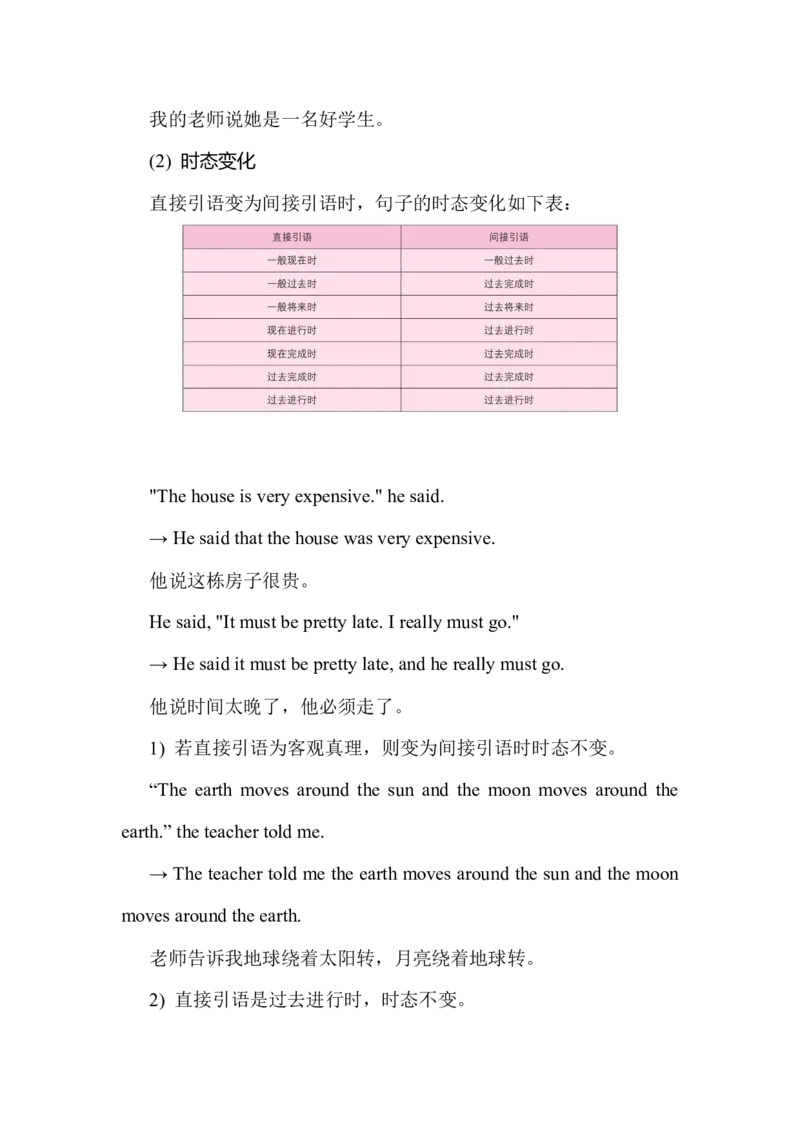
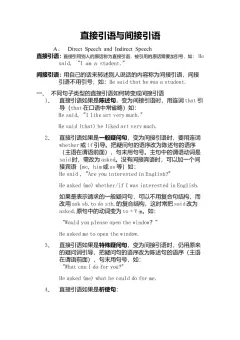
直接引语变为间接引语时,句子的时态变化如下表:
"The house is very expensive." he said.
→ He said that the house was very expensive.
他说这栋房子很贵。
He said, "It must be pretty late. I really must go."
→ He said it must be pretty late, and he really must go.
他说时间太晚了,他必须走了。
1) 若直接引语为客观真理,则变为间接引语时时态不变。
“The earth moves around the sun and the moon moves around the
earth.” the teacher told me.
→ The teacher told me the earth moves around the sun and the moon
moves around the earth.
老师告诉我地球绕着太阳转,月亮绕着地球转。
2) 直接引语是过去进行时,时态不变。
Tom said, "John, where were you going when I met you in the street?"
→ Tom asked John where he was going when he met him in the
street.
汤姆在街上遇见约翰,并且问约翰去哪里。
3) 直接引语中有具体的过去某年, 某月, 某日作状语,变为间接
引语时,时态不变。
Lily said, "I was born on April 1, 1986."
→ Lily said she was born on April 1, 1986.
丽丽说她出生于1986 年4 月1 日。
4) 直接引语如果是一般现在时,表示反复出现或习惯性的动
作,变间接引语,时态不变。
He said, "I go to school at six every morning."
→ He said he goes to school at six every morning.
他说他每天早晨六点钟去上学。
5) 如果直接引语中含有since, when, while 引导的表示过去时间
的状语从句,在变为间接引语时,只改变主句中的谓语动词,从句
的一般过去时则不变。
My uncle said to me, "I have worked in this city since my boss came
here."
→ My uncle told me that he had worked in this city since his boss
came here.
我的叔叔告诉我自从他老板来这里他就在这个城市工作。
6) 如果直接引语中含有情态动词must, need, had better 以及情态
动词的过去式could, might,should, would 在变为间接引语时,这些情
态动词没有时态的改变。
Peter said, "You had better come here today."
→ Peter said I had better go there that day.
皮特说我那天最好去那里。
He said, "You mustn't smoke in the room."
→ He said I mustn't smoke in the room.
他说我不能在这个房间吸烟。
(3) 时间状语,地点状语,指示代词和动词的变化
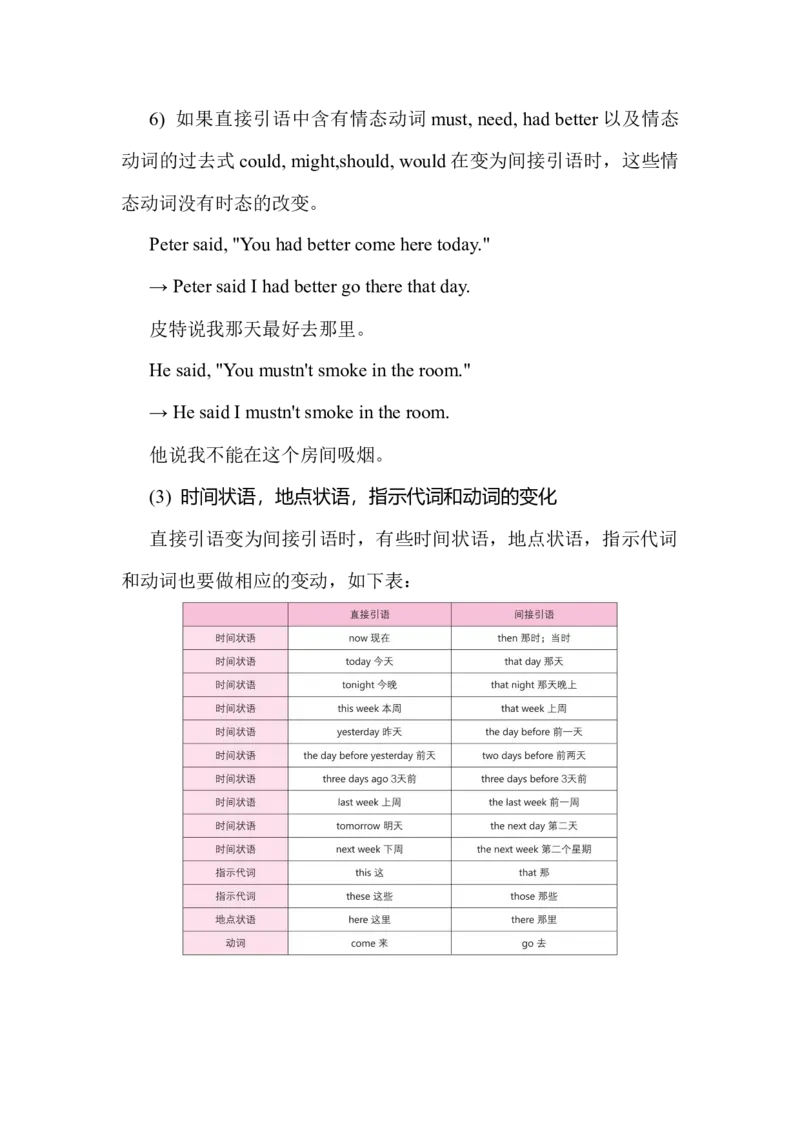
直接引语变为间接引语时,有些时间状语,地点状语,指示代词
和动词也要做相应的变动,如下表:
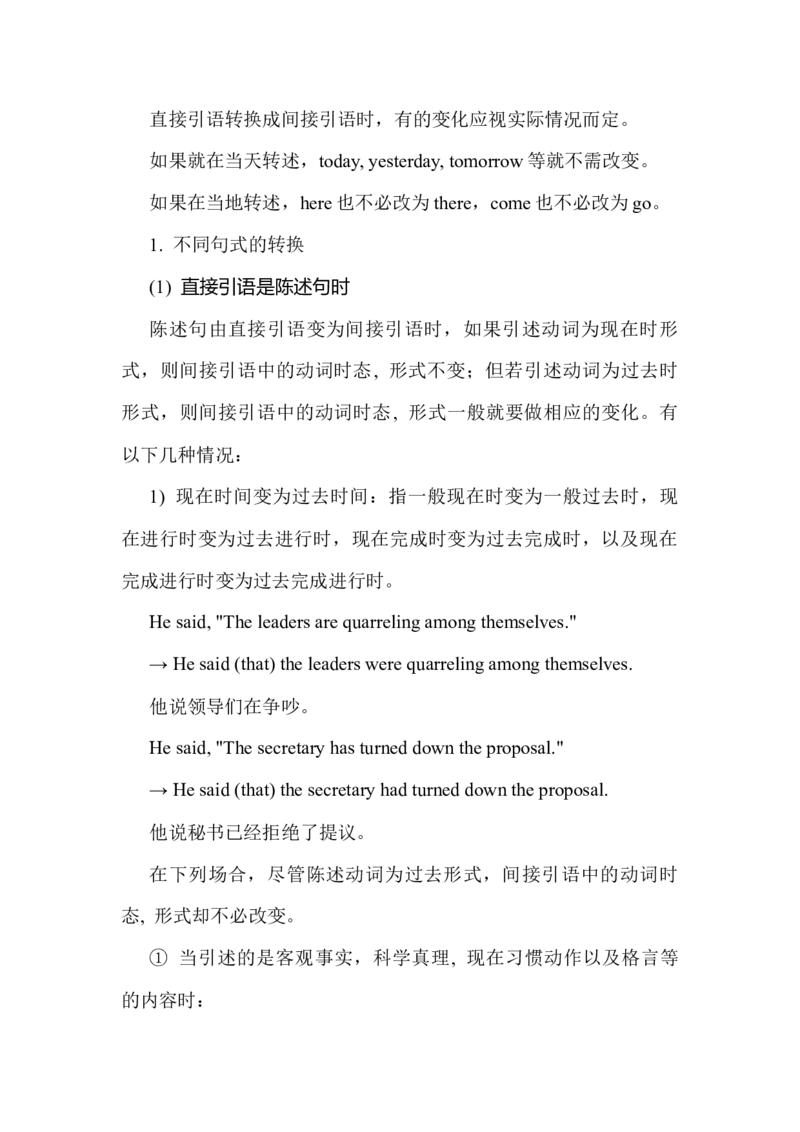
直接引语转换成间接引语时,有的变化应视实际情况而定。
如果就在当天转述,today, yesterday, tomorrow 等就不需改变。
如果在当地转述,here 也不必改为there,come 也不必改为go。
1. 不同句式的转换
(1) 直接引语是陈述句时
陈述句由直接引语变为间接引语时,如果引述动词为现在时形
式,则间接引语中的动词时态, 形式不变;但若引述动词为过去时
形式,则间接引语中的动词时态, 形式一般就要做相应的变化。有
以下几种情况:
1) 现在时间变为过去时间:指一般现在时变为一般过去时,现
在进行时变为过去进行时,现在完成时变为过去完成时,以及现在
完成进行时变为过去完成进行时。
He said, "The leaders are quarreling among themselves."
→ He said (that) the leaders were quarreling among themselves.
他说领导们在争吵。
He said, "The secretary has turned down the proposal."
→ He said (that) the secretary had turned down the proposal.
他说秘书已经拒绝了提议。
在下列场合,尽管陈述动词为过去形式,间接引语中的动词时
态, 形式却不必改变。
① 当引述的是客观事实,科学真理, 现在习惯动作以及格言等
的内容时:
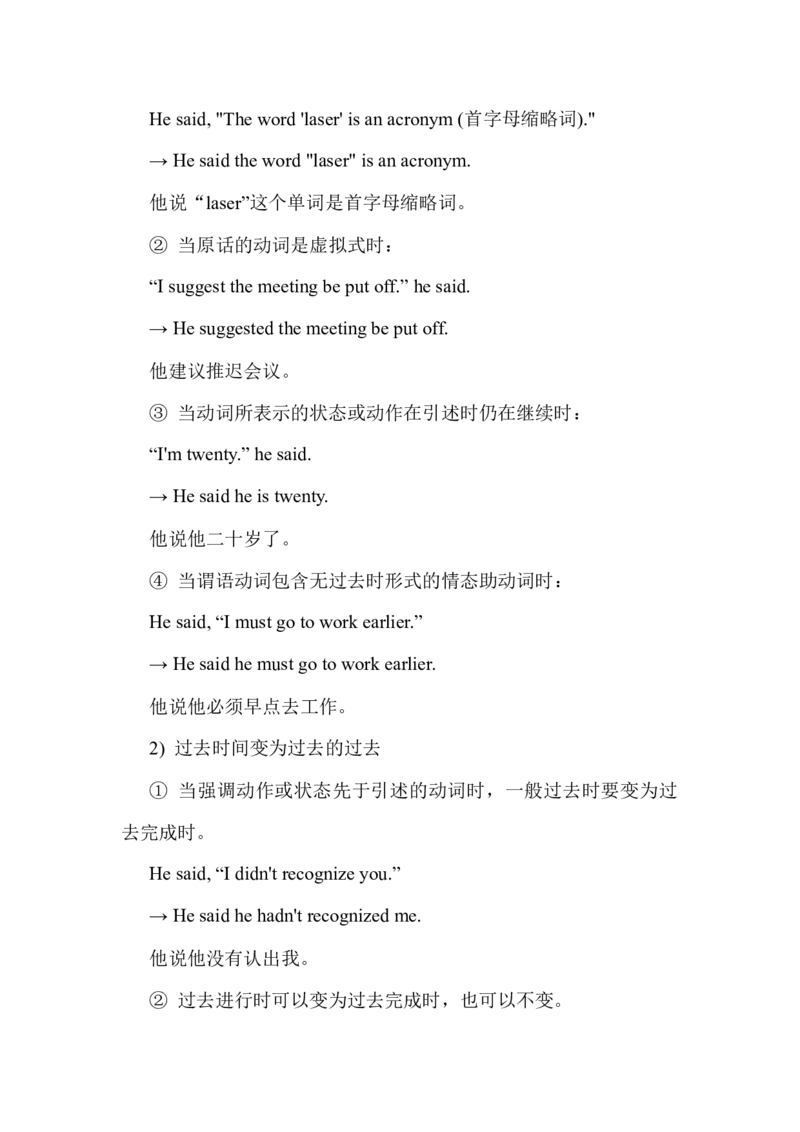
He said, "The word 'laser' is an acronym (首字母缩略词)."
→ He said the word "laser" is an acronym.
他说“laser”这个单词是首字母缩略词。
② 当原话的动词是虚拟式时:
“I suggest the meeting be put off.” he said.
→ He suggested the meeting be put off.
他建议推迟会议。
③ 当动词所表示的状态或动作在引述时仍在继续时:
“I'm twenty.” he said.
→ He said he is twenty.
他说他二十岁了。
④ 当谓语动词包含无过去时形式的情态助动词时:
He said, “I must go to work earlier.”
→ He said he must go to work earlier.
他说他必须早点去工作。
2) 过去时间变为过去的过去
① 当强调动作或状态先于引述的动词时,一般过去时要变为过
去完成时。
He said, “I didn't recognize you.”
→ He said he hadn't recognized me.
他说他没有认出我。
② 过去进行时可以变为过去完成时,也可以不变。
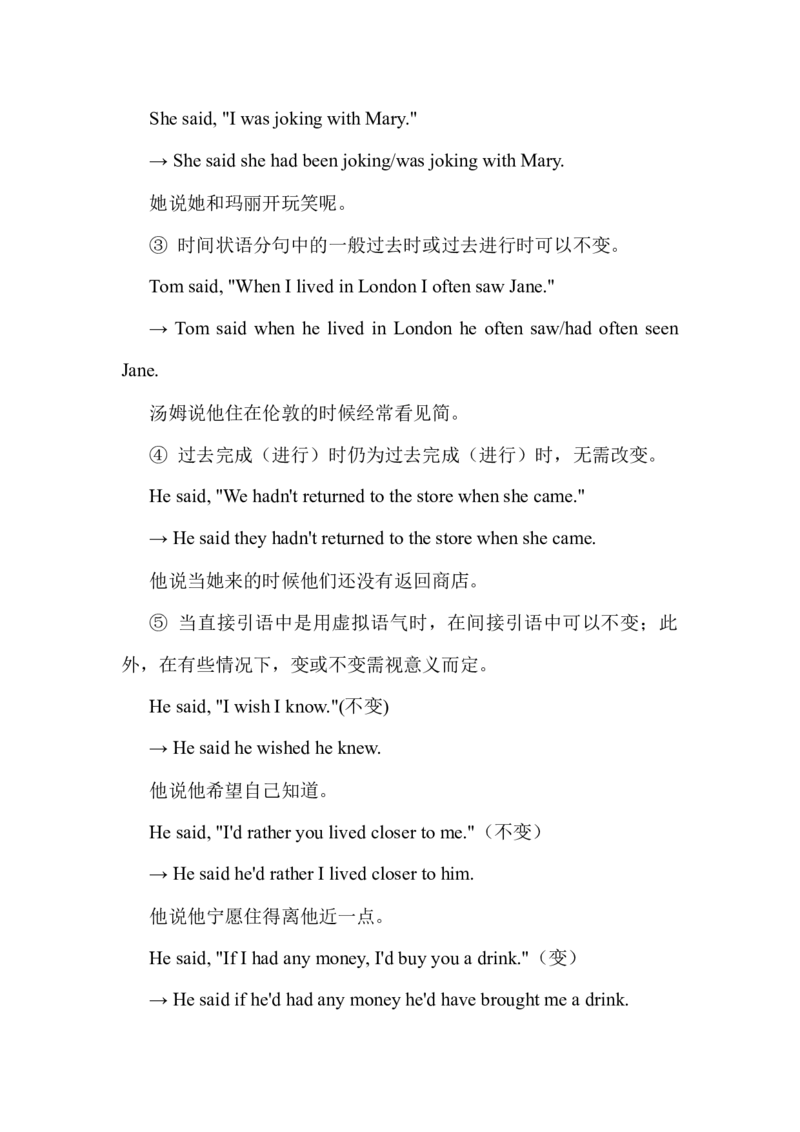
She said, "I was joking with Mary."
→ She said she had been joking/was joking with Mary.
她说她和玛丽开玩笑呢。
③ 时间状语分句中的一般过去时或过去进行时可以不变。
Tom said, "When I lived in London I often saw Jane."
→ Tom said when he lived in London he often saw/had often seen
Jane.
汤姆说他住在伦敦的时候经常看见简。
④ 过去完成(进行)时仍为过去完成(进行)时,无需改变。
He said, "We hadn't returned to the store when she came."
→ He said they hadn't returned to the store when she came.
他说当她来的时候他们还没有返回商店。
⑤ 当直接引语中是用虚拟语气时,在间接引语中可以不变;此
外,在有些情况下,变或不变需视意义而定。
He said, "I wish I know."(不变)
→ He said he wished he knew.
他说他希望自己知道。
He said, "I'd rather you lived closer to me."(不变)
→ He said he'd rather I lived closer to him.
他说他宁愿住得离他近一点。
He said, "If I had any money, I'd buy you a drink."(变)
→ He said if he'd had any money he'd have brought me a drink.
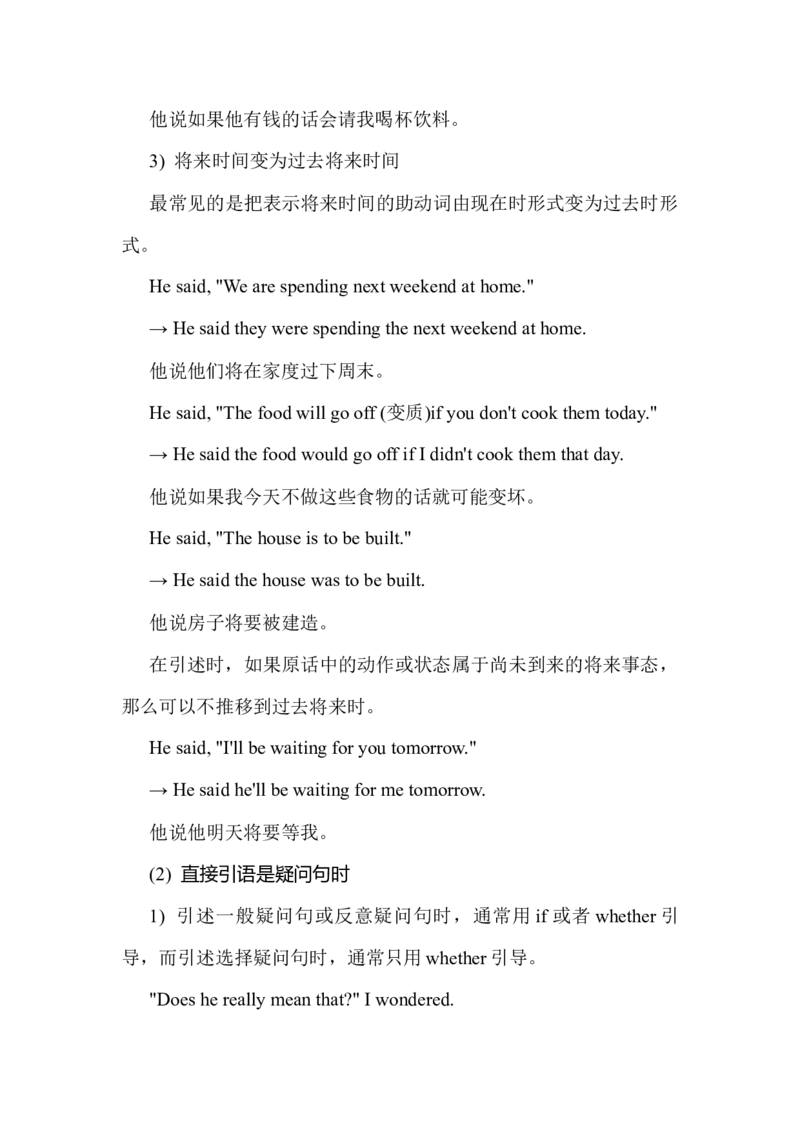
他说如果他有钱的话会请我喝杯饮料。
3) 将来时间变为过去将来时间
最常见的是把表示将来时间的助动词由现在时形式变为过去时形
式。
He said, "We are spending next weekend at home."
→ He said they were spending the next weekend at home.
他说他们将在家度过下周末。
He said, "The food will go off (变质)if you don't cook them today."
→ He said the food would go off if I didn't cook them that day.
他说如果我今天不做这些食物的话就可能变坏。
He said, "The house is to be built."
→ He said the house was to be built.
他说房子将要被建造。
在引述时,如果原话中的动作或状态属于尚未到来的将来事态,
那么可以不推移到过去将来时。
He said, "I'll be waiting for you tomorrow."
→ He said he'll be waiting for me tomorrow.
他说他明天将要等我。
(2) 直接引语是疑问句时
1) 引述一般疑问句或反意疑问句时,通常用if 或者whether 引
导,而引述选择疑问句时,通常只用whether 引导。
"Does he really mean that?" I wondered.
→ I wondered whether/if he really meant that.
我怀疑他是否是那个意思。
She asked, "They live in group, don't they?"
→ She asked whether/if they lived in group.
她问他们是否住在一起。
I asked him, "Will you stay at home or go to a film tonight?
→ I asked him whether he would stay at home or go to a film that
night.
我问他今天晚上将在家还是去看电影。
2) 特殊疑问句变为由原来的疑问词引导的宾语从句。
He asked, "Which chair shall I sit in?"
→ He asked me which chair he should sit in.
他问我他应该坐哪把椅子上。
3) 有的疑问句徒具形式,实际上并非提出询问,而是表示请求,
提议, 建议, 劝告等意义。引述此类疑问句时,应借助于其他表达手
段。
① 表示请求, 劝告时,通常用“ask, advise, want 等 + 宾语 +
不定式”结构。
He said, "Would you buy me some books?"
→ He asked me to buy him some books.
他让我给他买一些书。
He said, "Why don't you call her first?
→ He advised me to call her first.
他建议我首先应该给她打电话。
② 有些表示建议时,通常用“suggest + -ing 分词”的结构,或
者用that 引导的从句,其中should 可省略。
He said, "Shall we get the tickets first?"
→ He suggested (us) getting the tickets first
→ He suggested that we (should) get the tickets first.
他建议我们首先应该去取票。
"Why don't you send it back to the factory?" he asked.
→ He suggested sending it back to the factory.
→ He suggested that I (should) send it back to the factory.
他建议我应该把它退回给工厂。
③ 表示提议时,通常用“offer + 不定式”的结构。
He said, "Shall I post them to you?"
→ He offered to post them to me.
他主动提出给我邮寄它们。
(3) 直接引语是祈使句时
1) 引述祈使句多半采用“动词 + 宾语 + 不定式”的结构。常
见的引述动词有ask, tell, beg, urge,order, warn, advise, remind 等。
He said, "Be careful with the dog."
→ He warned me to be careful with the dog.
他警告我小心那条狗。
The teacher said to him, "Don't leave the door open."
→ The teacher told him not to leave the door open.
老师告诉他不要开着门。
2) 引述表示命令的祈使句时,可以用“动词 + that 从句”结
构,从句中谓语动词通常为“be to +不定式”或者“have got to + 不
定式”。
He said, "Don't run too fast."
→ He told me that I wastn't to run too fast.
他告诉我不要跑得太快。
He said, "Fill in this form."
→ He said I had got to fill in this form.
他告诉我必须填写这个表格。
3) 引述表示建议, 劝告的祈使句时,可以用“suggest, say + that
从句”或者“suggest + -ing 分词结构”等。
He said, "Let's stay here till the storm has passed."
→ He suggested that we (should) stay there till the storm had passed.
→ He suggested us staying there till the storm had passed.
他建议我们在暴风雨过去之前不要离开那里。
4) 引述表示提议, 建议的祈使句时,也可以用“offer + 不定
式”结构。
They said, "Let us make supper for you."
→ They offered to make supper for me.
他们提出要给我做午饭。
He said, "Let me give you a lift home."
→ He offered to give me a lift home.
他提出要我搭便车回家。
(4) 直接引语是感叹句时
1) 以what, how 或者that 为被引述分句的引导词。
He said, "What a lovely day it is!"
→ He remarked what a lovely day it was.
→ He remarked that it was a lovely day.
他说今天是个好天气。
He said, "How well he looks!"
→He said how well he looked.
→He exclaimed that he looked well.
他说他看起来很好。
2) 根据原句意义加以改写,使之变为含义相当的陈述句。
He said, "Congratulations!"
→ He congratulated me.
他恭喜我。
He said, "How kind of you!"
→ He acknowledged my kindness.
他认识到了我的善良。
He said, "What a nuisance!"
→ He exclaimed with annoyance.
他烦躁地大声叫嚷着。
22.2 插入语 Parentheses
插入语指的是插在句子中的一个词, 短语或从句,其作用是用来
补充含义,或解释说明。插入语独立性强,一般用标点符号将其与
其他句子成分隔开。插入语在句中与其他部分没有语法上的联系,
将它删掉之后,句子结构仍然完整。因此,有的语法学家将其归为
独立成分。
插入语在句中的作用,主要是用来表示说话人对某事物的看法,
态度和推测。有时起到解释, 说明的作用,有时表示总结,有时起
强调的作用,有时可以用来引起对方的注意和思考,还可以起转移
话题或说明事由的作用,也可以承上启下,使句子与前面的语句衔
接的更为紧密。
1. 词组插入语
(1) 形容词或形容词短语作插入语
常用作插入语的形容词或形容词短语有:
true 真的, wonderful 太好了, worst still 更糟糕的是, sure enough
果然, strange 奇怪的是, most
important of all 最重要的是, strange to say 说来奇怪等。
True, it would be too bad.
真的,太糟了。
Wonderful, we have won again.
太好了,我们又赢了。
Worse still, the lion could even carry off the baby in its mouth.
更糟糕的是,狮子一口就可以夺去这个孩子的生命。
Strange, there is nobody in the classroom.
很奇怪,教室里没人。
Strange to say, he hasn't got my letter up to now.
说来也奇怪,他到现在还没有收到我的信。
Most important of all, we must learn all the skills.
最重要的是,我们必须掌握所有的技巧。
(2) 副词或副词短语作插入语
副词或副词短语用作插入语,这类插入语一般放在句首或句尾,
也可以放在句中。
常用的副词或副词短语有:
indeed 的确, surely 无疑, however 然而, frankly 坦率地说,
obviously 显然, naturally 自然地, fortunately 幸好, strangely 奇怪,
briefy 简单地说, honestly 老实说, though 虽然/ 可是, besides 此外,
exactly 确切地说, still 尽管如此/依然, otherwise 另外/否则, luckily
(happily) for sb 算某人幸运等。
When he got there, he found, however, that the weather was too bad.
可是到了那儿之后他发现,那儿的天气太糟了。
Honestly, I don't need it at the moment.
老实说,我现在不需要它。
You'll be able to pass the coming exam, surely.
你一定会通过将来的考试的。
Two middle-aged passengers fell into the sea. Unfortunately, neither
of them could swim.
两个中年乘客跌入大海,不幸的是,他们都不会游泳。
Otherwise, he would still be at home.
不然的话,他还会在家的。
Luckily for you, I happen to have the key.
你很运气,我正好带了钥匙。
(3) 介词短语作插入语
介词短语作插入语,这类插入语一般放在句首,有时也可放在句
中。
常用的介词短语有:
in a way 在某点上/在某种程度上, for example 例如, of course 当
然, as a matter of fact 事实上, by the way 顺便, as a result 结果, on the
contrary 相反, on the other hand 另一方面, in my opinion/view 依我看
来, in general 一般说来, in a sense 在某种意义上, in short 简言之, in
conclusion 最后/总之, above all/first of all 首先, to my surprise 使我吃
惊的, to her regret 令她遗憾的是, in fact 事实上, in addition 另外, in
a word 总而言之, in other words 换句话说, in that case 如果是那样的
话, as a rule 通常等。
In a way, I think we both won in the game.
从某种意义上来说,我认为在这场比赛中我们都赢了。
Above all, you must follow your teacher's advice.
首先,你要遵从老师的建议。
In my opinion, he is an honest boy.
依我看,他是个诚实的男孩。
In short, we should not stop halfway.
简言之,我们不能半途而废。
As a result, they suffered heavy losses.
结果,他们遭受了严重损失。
On the contrary, we should strengthen our ties with them.
相反,我们还应加强和他们的联系。
Your performance in the driving test didn't reach the required
standard, in other words, you failed.
你的驾驶表现没有达到必须的标准,换句话说,你没有通过驾驶
考试。
(4) 现在分词短语作插入语
常用作插入语的分词短语有:generally speaking 一般而言,
judging from/by... 根据……判断,talking of... 谈到, strictly speaking 严
格地说, generally considering 一般认为, considering 考虑到/因为是,
putting it mildly 说得客气一点等。
Judging from his face, he must be ill.
从他的脸色看,他一定是病了。
Generally speaking, dogs can run faster than pigs.
一般来说,狗比猪跑得快。
Considering his age, he did very well.
从年龄考虑,他干得挺不错。
Frankly speaking, I don't like the job.
坦率地说,我不喜欢这份工作。
Talking of singing, will you go to the concert with me tonight?
说到唱歌,你今晚愿意和我一块去音乐会吗?
(5) 过去分词短语作插入语
Painted white, we like the house better.
漆成白色,我们更喜欢这套房子。
注 之所以称它为插入语,是由于这种过去分词是独立的,没有
逻辑主语。
(6) 动词不定式作插入语
常用作插入语的不定式有:to be sure 自然, 当然, 果然, to be
frank 坦率地说, to tell you the truth 说实话, so to speak 可以说, to
speak of 值得一提的是, to be short 简单地说, to begin
with 首先等。
To be frank, I don't quite agree with you.
坦率地说,我不太同意你的意见。
That's a wonderful idea, to be sure.
这个主意好极了,的确。
To tell you the truth, I am not very interested in going to the show.
说实在的,我不太想去看演出。
To be frank with you, I have no money to spare.
坦白地说,我没有存下钱。
(7) 代词词组作插入语
常用作插入语的代词词组有:all the same 尽管如此, all told 总
共, all in all 总的来说等。
His crew was reduced to twenty-four all told.
他的船员减少到总共24 人。
All in all, they have had a wonderful time today.
总的来说,他们今天过得很愉快。
2. 句子插入语
(1) 从句作插入语
常用作插入语的从句有:
if so 假如这样的话, if not 不然的话/否则, if any 即便要, if I may
say so 如果我可以这么说的话/要我说, if you don't mind 如果你不介
意的话, as you know 正如你所知, as you say 正如你所说, if you like
如果你喜欢的话, if you please 如果你愿意的话, if necessary 如果有
必要的话, if convenient 如果方便的话, as it happens 碰巧来到/恰好
出现等。
If I may say so, we know nothing about it.
正如我所说的,我们对它一无所知。
This man, as you know, is good for nothing.
正如你知道的,这个人一无是处。
You can, if you please, come to join us in the game.
如果你愿意,你可以加入我们的游戏。
(2) 短句作插入语
用简短的句子结构作插入语,它们常置于句中或句末。
这类简短的句子有:
I am sure 我可以肯定地说, do you know 你知道吗, you see 你明
白, I'm afraid 恐怕, it is said 据说, I suppose/I think/believe/hope 我猜
测/我想/我相信/我希望, what's more 而且/此外, what's worse 更糟糕
的是, that is to say 也就是说, what is important 重要的是等。
I believe, China will catch up with the developed countries sooner or
later.
我确信,中国迟早会赶上发达国家。
It's a great mistake, I think, not to accept their proposal.
我看,不接受他们的建议是个大错误。
The old man, it is said, was an artist but people hardly know anything
about this aspect of his life.
据说,这位老人曾是个艺术家,可是人们对他这方面的生活几乎
一无所知。
It is so nice to hear from her. Believe it or not, we last met more than
thirty years ago.
收到她的来信真是太好了。信不信由你,我们最后一次见面那可
是30 多年前的事了。
有时候,标点符号也可以用来引入插入语。
He was (strange as it seems) an excellent sportsman.
他(尽管还显得令人不解)是个出色的运动员。
He was-to me at least, if not to you-a figure that was worth having
pity on.
至少我觉得如此,即使你不这样认为,他是一个值得同情的人。
疑问句的插入成分,也可以认为是“插入语”。
这种疑问句(有的语法书也称为“混合疑问句”或“连锁疑问
句”)常用来征求对方对某一疑问点的看法, 判断, 认识, 猜度或请
求对方重复一遍说过的话。口语中出现频率极高。
常用动词有say, suppose, guess, believe, consider, think, imagine
等。
句中的插入成分,一般为倒装语序且不用任何标点,而且整个疑
问句应当保持陈述语序。
① What should I do first.
我首先要做什么?
What do you think I should do first?
你认为我首先要做什么?(被插入的疑问句原来为倒装语序,插
入后成为陈述语序)
② Who is singing?
谁在唱歌?
Who do you think is singing?
你认为谁在唱歌?(被插入的疑问句原来就是陈述语序,不需要
做调整)
③ How long would she stay here?
她要在这儿待多久?
How long did you say she would stay here?
依你看她会在这儿待多久?
④ When will they be back?
他们什么时候回来?
When do you suppose they'll be back?
你认为他们什么时候会回来?
⑤ How old was she?
她多大了?
How old did you think she was?
你认为她有多大?