高考英语语法词汇专项突破:11 直接引语和间接引语六大要点全解读+巩固练习+答案
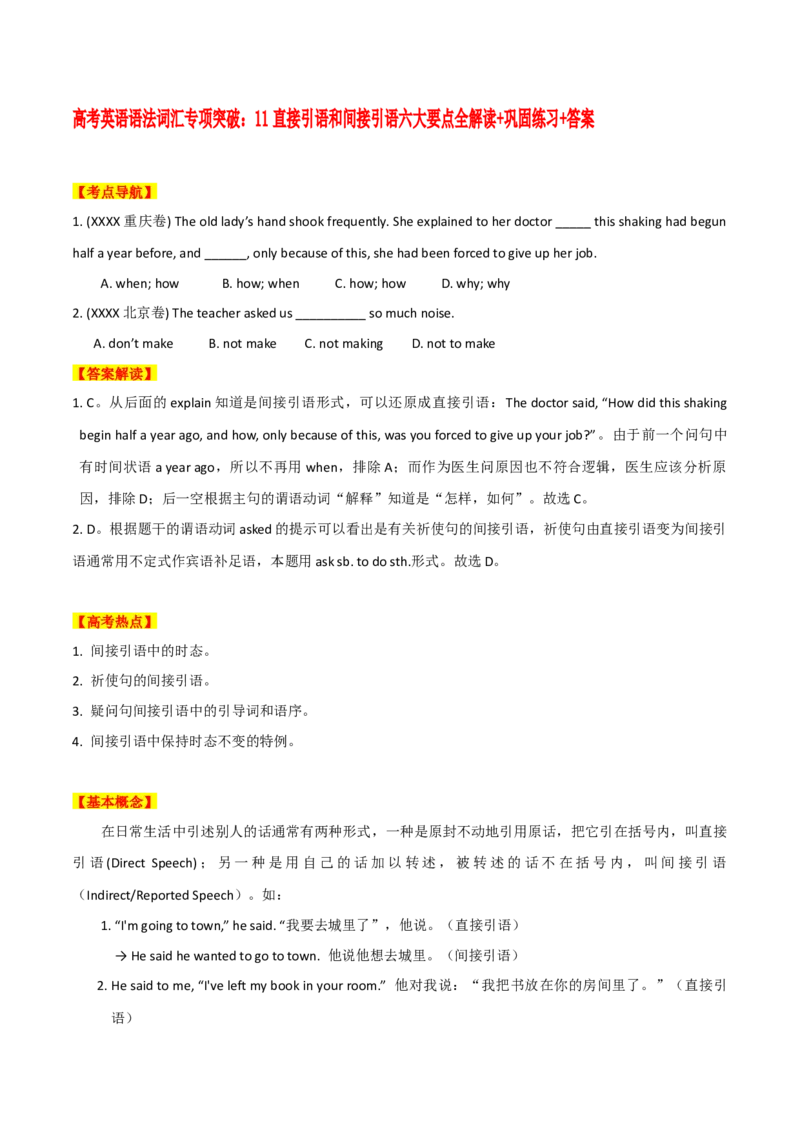
【考点导航】
1. (XXXX重庆卷) The old lady’s hand shook frequently. She explained to her doctor _____ this shaking had begun
half a year before, and ______, only because of this, she had been forced to give up her job.
A. when; how B. how; when C. how; how D. why; why
2. (XXXX北京卷) The teacher asked us __________ so much noise.
A. don’t make B. not make C. not making D. not to make
【答案解读】
1. C。从后面的explain知道是间接引语形式,可以还原成直接引语:The doctor said, “How did this shaking
begin half a year ago, and how, only because of this, was you forced to give up your job?”。由于前一个问句中
有时间状语a year ago,所以不再用when,排除A;而作为医生问原因也不符合逻辑,医生应该分析原
因,排除D;后一空根据主句的谓语动词“解释”知道是“怎样,如何”。故选C。
2. D。根据题干的谓语动词asked的提示可以看出是有关祈使句的间接引语,祈使句由直接引语变为间接引
语通常用不定式作宾语补足语,本题用ask sb. to do sth.形式。故选D。
【高考热点】
1. 间接引语中的时态。
2. 祈使句的间接引语。
3. 疑问句间接引语中的引导词和语序。
4. 间接引语中保持时态不变的特例。
【基本概念】
在日常生活中引述别人的话通常有两种形式,一种是原封不动地引用原话,把它引在括号内,叫直接
引语(Direct Speech);另一种是用自己的话加以转述,被转述的话不在括号内,叫间接引语
(Indirect/Reported Speech)。如:
1. “I'm going to town,” he said. “我要去城里了”,他说。(直接引语)
→ He said he wanted to go to town. 他说他想去城里。(间接引语)
2. He said to me, “I've left my book in your room.” 他对我说:“我把书放在你的房间里了。”(直接引
语)→ He told me that he had left his book in my room.他告诉我他把书放在我的房间里了。(间接引语)
【考点解读】
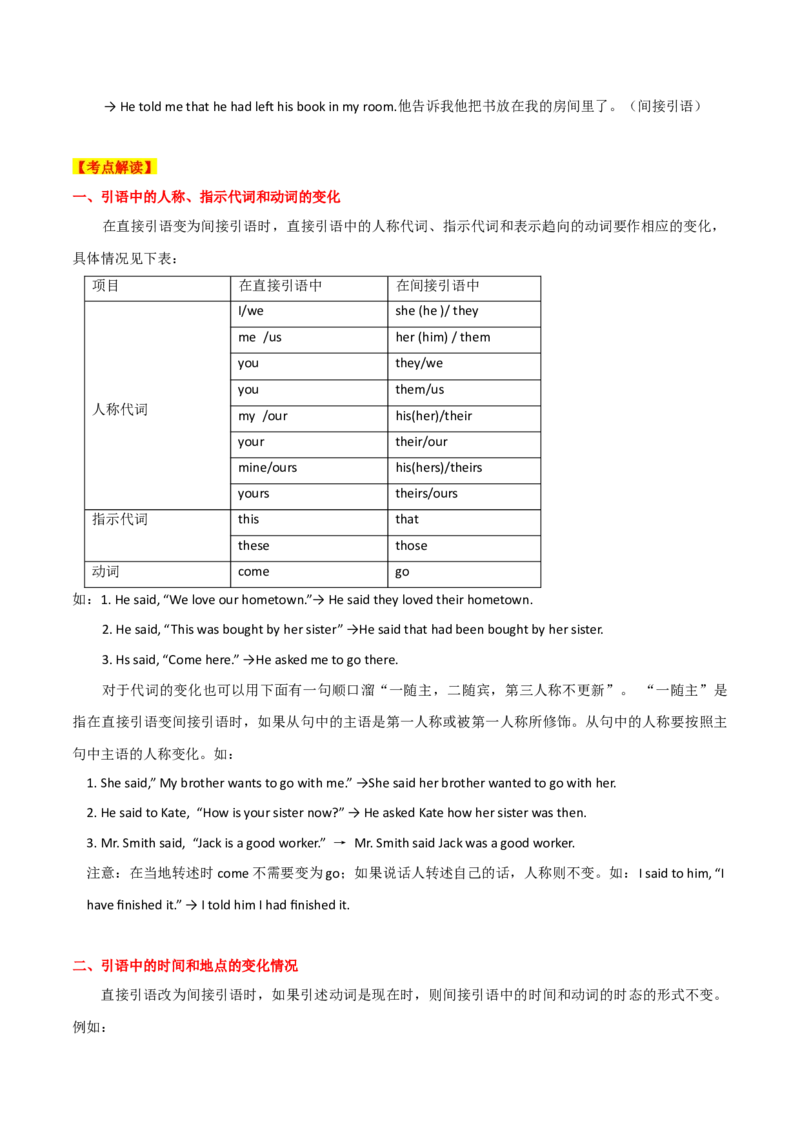
一、引语中的人称、指示代词和动词的变化
在直接引语变为间接引语时,直接引语中的人称代词、指示代词和表示趋向的动词要作相应的变化,
具体情况见下表:
项目 在直接引语中 在间接引语中
I/we she (he )/ they
me /us her (him) / them
you they/we
you them/us
人称代词
my /our his(her)/their
your their/our
mine/ours his(hers)/theirs
yours theirs/ours
指示代词 this that
these those
动词 come go
如:1. He said, “We love our hometown.”→ He said they loved their hometown.
2. He said, “This was bought by her sister” →He said that had been bought by her sister.
3. Hs said, “Come here.” →He asked me to go there.
对于代词的变化也可以用下面有一句顺口溜“一随主,二随宾,第三人称不更新”。 “一随主”是
指在直接引语变间接引语时,如果从句中的主语是第一人称或被第一人称所修饰。从句中的人称要按照主
句中主语的人称变化。如:
1. She said,” My brother wants to go with me.” →She said her brother wanted to go with her.
2. He said to Kate, “How is your sister now?” → He asked Kate how her sister was then.
3. Mr. Smith said, “Jack is a good worker.” → Mr. Smith said Jack was a good worker.
注意:在当地转述时come不需要变为go;如果说话人转述自己的话,人称则不变。如:I said to him, “I
have finished it.” → I told him I had finished it.
二、引语中的时间和地点的变化情况
直接引语改为间接引语时,如果引述动词是现在时,则间接引语中的时间和动词的时态的形式不变。
例如:She says, “I’ll never forget the moment.”→ She says that she’ll never forget the moment.
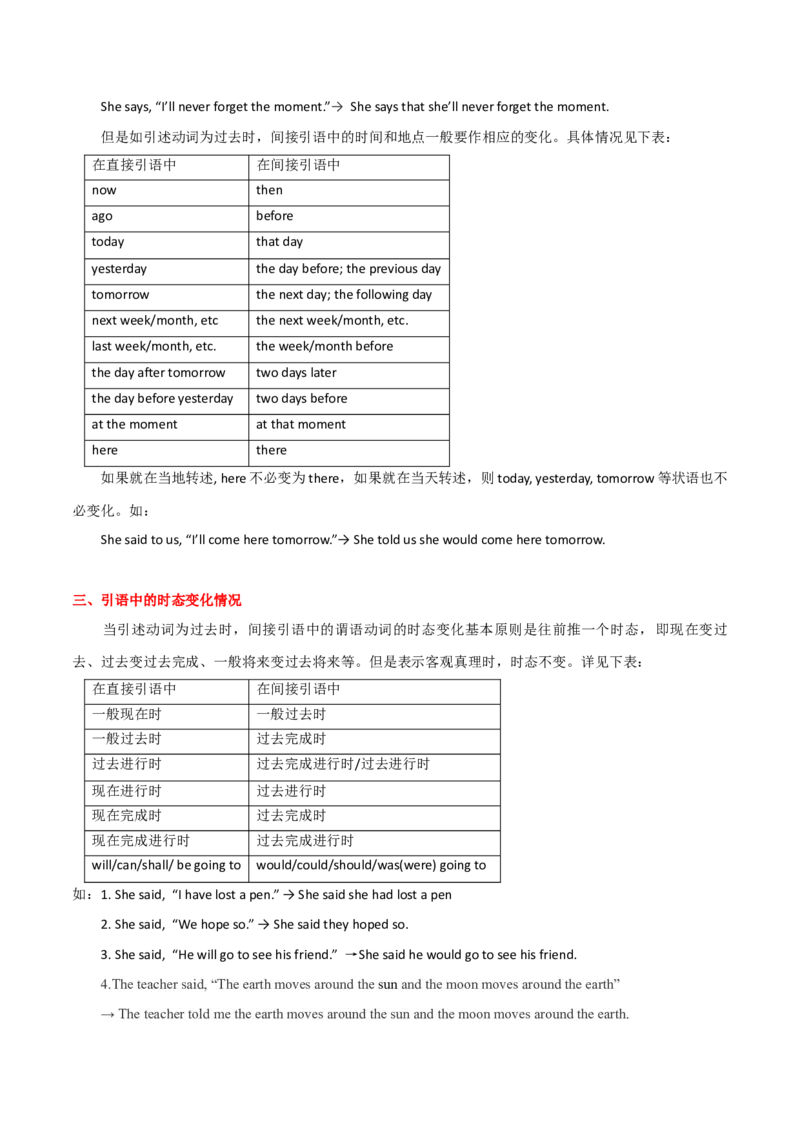
但是如引述动词为过去时,间接引语中的时间和地点一般要作相应的变化。具体情况见下表:
在直接引语中 在间接引语中
now then
ago before
today that day
yesterday the day before; the previous day
tomorrow the next day; the following day
next week/month, etc the next week/month, etc.
last week/month, etc. the week/month before
the day after tomorrow two days later
the day before yesterday two days before
at the moment at that moment
here there
如果就在当地转述, here不必变为there,如果就在当天转述,则today, yesterday, tomorrow等状语也不
必变化。如:
She said to us, “I’ll come here tomorrow.”→ She told us she would come here tomorrow.
三、引语中的时态变化情况
当引述动词为过去时,间接引语中的谓语动词的时态变化基本原则是往前推一个时态,即现在变过
去、过去变过去完成、一般将来变过去将来等。但是表示客观真理时,时态不变。详见下表:
在直接引语中 在间接引语中
一般现在时 一般过去时
一般过去时 过去完成时
过去进行时 过去完成进行时/过去进行时
现在进行时 过去进行时
现在完成时 过去完成时
现在完成进行时 过去完成进行时
will/can/shall/ be going to would/could/should/was(were) going to
如:1. She said, “I have lost a pen.” → She said she had lost a pen
2. She said, “We hope so.” → She said they hoped so.
3. She said, “He will go to see his friend.” →She said he would go to see his friend.
4.The teacher said, “The earth moves around the sun and the moon moves around the earth”
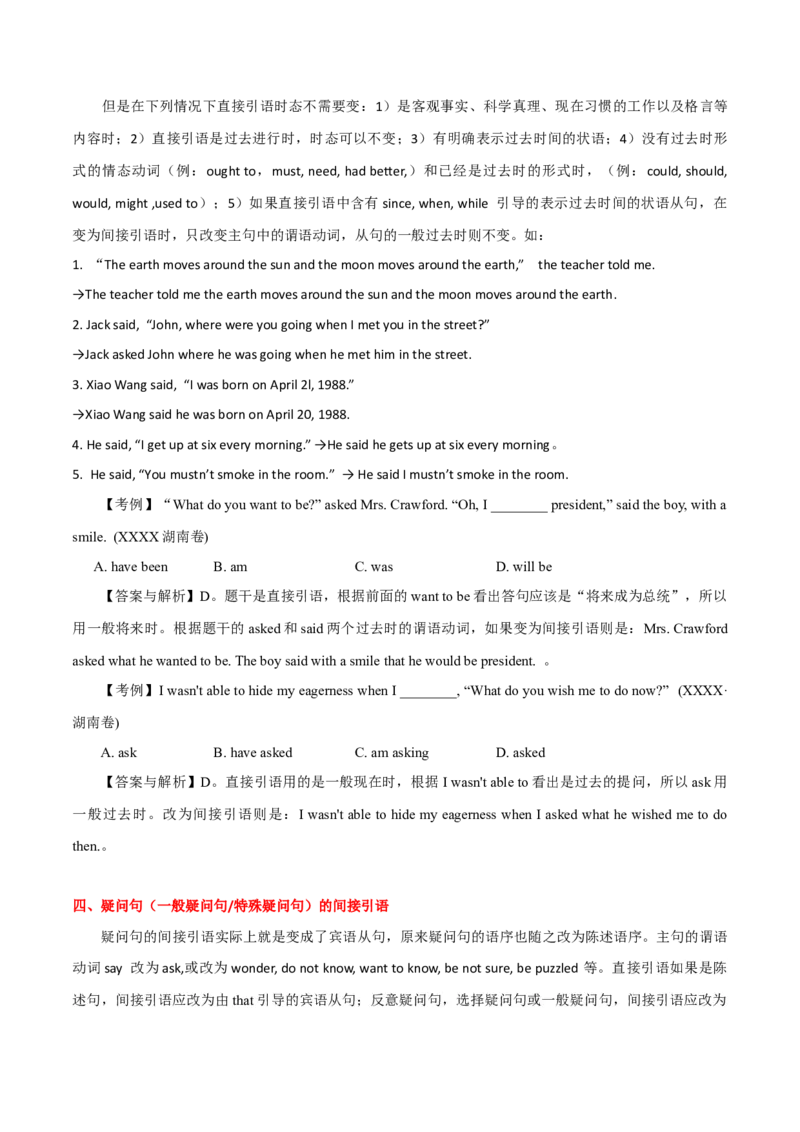
→ The teacher told me the earth moves around the sun and the moon moves around the earth.但是在下列情况下直接引语时态不需要变:1)是客观事实、科学真理、现在习惯的工作以及格言等
内容时;2)直接引语是过去进行时,时态可以不变;3)有明确表示过去时间的状语;4)没有过去时形
式的情态动词(例:ought to,must, need, had better,)和已经是过去时的形式时,(例:could, should,
would, might ,used to);5)如果直接引语中含有since, when, while 引导的表示过去时间的状语从句,在
变为间接引语时,只改变主句中的谓语动词,从句的一般过去时则不变。如:
1. “The earth moves around the sun and the moon moves around the earth,” the teacher told me.
→The teacher told me the earth moves around the sun and the moon moves around the earth.
2. Jack said, “John, where were you going when I met you in the street?”
→Jack asked John where he was going when he met him in the street.
3. Xiao Wang said, “I was born on April 2l, 1988.”
→Xiao Wang said he was born on April 20, 1988.
4. He said, “I get up at six every morning.” →He said he gets up at six every morning。
5. He said, “You mustn’t smoke in the room.” → He said I mustn’t smoke in the room.
【考例】“What do you want to be?” asked Mrs. Crawford. “Oh, I ________ president,” said the boy, with a
smile. (XXXX湖南卷)
A. have been B. am C. was D. will be
【答案与解析】D。题干是直接引语,根据前面的want to be看出答句应该是“将来成为总统”,所以
用一般将来时。根据题干的asked和said两个过去时的谓语动词,如果变为间接引语则是:Mrs. Crawford
asked what he wanted to be. The boy said with a smile that he would be president. 。
【考例】I wasn't able to hide my eagerness when I ________, “What do you wish me to do now?” (XXXX·
湖南卷)
A. ask B. have asked C. am asking D. asked
【答案与解析】D。直接引语用的是一般现在时,根据I wasn't able to看出是过去的提问,所以ask用
一般过去时。改为间接引语则是:I wasn't able to hide my eagerness when I asked what he wished me to do
then.。
四、疑问句(一般疑问句/特殊疑问句)的间接引语
疑问句的间接引语实际上就是变成了宾语从句,原来疑问句的语序也随之改为陈述语序。主句的谓语
动词say 改为ask,或改为wonder, do not know, want to know, be not sure, be puzzled 等。直接引语如果是陈
述句,间接引语应改为由that引导的宾语从句;反意疑问句,选择疑问句或一般疑问句,间接引语应改为由whether或if引导的宾语从句;特殊问句,间接引语应该改为由疑问词引导的宾语从句。疑问句主要分
以下三种情况:1)一般疑问句或反意疑问句变为 if (whether)引导的宾语从句 2)选择疑问句变为
whether….or 宾语从句。3)特殊疑问句变为由原来的疑问词引导的宾语从句。如:
1. She said, “Do you often come here to surf the Internet?”
→She asked me if (whether) I often went there to surf the Internet.
2. I asked him, “Will you watch TV or go to a film tonight?”
→I asked him whether he would watch TV or go to a film that night.
3. He said, “Why didn’t you stop her?” →He asked why I hadn’t stopped her.
【考例】Tom asked the candy makers_______ they could make the chocolate easier to break into small
pieces. (改编自XXXX·安徽卷)
【答案与解析】if/whether。题干是间接引语,根据asked看出后面的宾语从句是由直接引语的一般疑
问句变来的,所以用if或whether引导。还原成直接引语则是:Tom asked the candy makers, “Can you make
the chocolate easier to break into small pieces? ”
五、陈述句和感叹句的间接引语
陈述句的间接引语为that引导的宾语从句(口语中that可以省略),主句的引述动词主要有say ,tell,
repeat, explain, think, add, declare, deny, insist, remind, complain, announce, admit, believe, suggest, remark
等。感叹句间接引语为what 或how 引导,也可以用that 引导。如:
He said, “You are younger than I.” → He said (that) I was younger than him.
He said, “What a lovely house!” → He remarked what a lovely house it was.
→ He remarked that it was a lovely house.
六、祈使句的间接引语
如果引述的是祈使句,我们通常用带有不定式to的复合宾语形式来表示这个请求、建议或命令。引述
动词主要有tell, ask, order, warn等。否定形式是在to前直接加not。以“Let‘s”开头的祈使句,变为间接引
语时,通常用“suggest +动名词(或从句)。它没有时态的变化。其它的变化和直接引语是陈述句的情况
相同。如:
1. He said, “Don’t make so much noise, boys.” →He told the boys not to make so much noise.
2.The teacher said to the students, “Don’t waste your time.” → The teacher told the students not to waste their
time.3. He said,“Get everything ready in two hours.” →He ordered us to get everything ready in two hours.
【典题1】Mrs. Smith warned her daughter _____ after drinking.
A. never to drive B. to never drive C. never driving D. never drive
解读 :选 A 。根据语境可以看出原直接引语为 Mrs. Smith said to her daughter, “Don’t drive after
drinking.”,因此是一个命令型直接引语,间接引语应使用 tell/ask/order/warn… sb. (not/never) to do sth.句子
结构。故选A。
【典题2】 The boy wanted to ride his bicycle in the street, but his mother told him ______.
A. not to B. not to do C. not do it D. do not to
解读:选A。后半句还原为直接引语就是but his mother said to him, “Don’t ride your bike in the street.” 这
是一个表示要求或命令的直接引语。根据不定式省略原则知道to 后do要去掉。故选A。
【考例】It was the middle of the night when my father woke me up and told me _______ (watch) the
football game. (改编自XXXX江西卷)
【答案与解析】to watch。tell 跟不定式作宾语补足语,还原成直接引语则是:…and said, “Watch the
football game.”。
【考例】—What a mistake!
—Yes.I had suggested his ______ (do) it another way, but without success. (改编自XXXX·四川卷)
【答案与解析】doing。
【考例】My mom suggests that we eat out for a change this weekend. (改编自XXXX陕西卷12)
A. should B. might C. could D. would
【答案与解析】A。suggest表示“建议”,宾语从句用虚拟语气should do形式。还原成直接引语则
是:My mom says, “Let’s eat out for a change this weekend.”。
有时为了语言显得生动、灵活一些或表达得更准确,还可以用下列动词,如:advise sb (not) to do sth.,
promise sb. to do sth., remind sb. to do sth., suggest doing (that sb. should do sth.)等。如:
1. She said, “Don’t leave your watch.” → She reminded me not to leave my watch.
2. He said, “Give it back to you this afternoon.” →He promised me to give it back to me that afternoon.
3. “Let's go to the theatre.” he said. → He suggested going to the theatre.
【典题】The patient was warned ____ oily food after the operation.
A. to eat not B. eating not C. not to eat D. not eating
解读:选C。 通过分析语境逻辑可推断出原直接引语为 The doctor said to the patient, “Don’t eat oily food
after the operation.” 该句为命令型直接引语,否定形式在to前直接加上not。故选C。注意:引语中祈使句的呼语可改成宾语,如果祈使句的引语中有 please ,变为间接引语时则要去掉。
如:
The mother said, “Tom, get up early, please.”→ The mother asked Tom to get up early.
【牛刀小试】
一、从所给的A、B、C、D四个选项中选出最佳答案。
1. He ordered us _________ everything ready in two hours.
A. getting B. get C. to getting D. to get
2. --- Let's ask her about it.
--- What did he say?
--- He suggested ________ her about it.
A. we asking B. we to ask C. us asking D. us to ask
3. Last night it was very hot, so he wanted to sleep outside, but his mother told him ______.
A. not to B. don’t to C. not to do D. don’t to do
4. “You’ve already got well, haven’t you?” she asked.
→She asked ________.
A. if I have already got well, hadn’t you B. whether I had already got well
C. have I already got well D. had I already got well.
5. They asked me to have a drink with them. I said that it was at least ten years since I ______ a good drink.
A. had enjoyed B. was enjoying C. enjoyed D. had been enjoying
6. It is said that he _______ to Australia to improve his English next year.
A. would be sent B. will be sent C. had been sent D. sends
7. Can you tell me _____the railway station?
A. how I can get to B. how can I get to C. where I can get to D. where can I get to
8. I. Having seen the film, he said what a wonderful film he ______.
A. saw B. has seen C. had seen D. would see
9. Can you tell me____?
A. who is that gentleman B. that gentleman is who
C. who that gentleman is D. whom is that gentleman
10. On his way home from Beijing he told me he ________ Beijing again.
A. had visited B. has visited C. would visit D. will visit11. I asked my lawyer _____say in court.
A. what I should B. what should I C. how I should D. how should I
12. Last night at twelve o’clock, he phoned me and said he _______ TV.
A. still watches B. was still watching C. has still watched D. had still watched
13. That man insisted that he ____ there.
A. should send B. would be sent C. be sent D. sent
14. I wonder if she ____us, but I think if she ____us we will be able to complete the take ahead of time.
A. helps; helps B. will help; has helped C. helps; will help D. will help; helps
15. He asked me ________ with me.
A. what the matter is B. what the mater was
C. what’s the matter D. what was the matter
16. Jim asked Lucy ________ feed their cat.
A. didn't forget to B. isn't forget to C. not to forget to D. not forget to
17. He asked me again the next day.
A. to go there B. to please go there C. to come there D. to come here please
Keys: 1-5 DCA BA 6-10 BACCC 11-15 A BCDD 16-17 CA
二、根据上一句完成下一句的句型转换,每空一词。
1. She said to me, “I’m studying English these days.”
→She told me ________ ______ _______ _______ English _______ days.
2. “Shall we meet at the theatre?” he said.
→He suggested _______ _______ ________ at the theatre.
→He suggested our _________ at the theatre.
3. He asked, “Which one do you like best?”
→He asked _______ _______ ______ ________ best.
4. This morning he said, “I’m leaving for Beijing tomorrow.”
→This morning he said that _______ ________ ________ for Beijing ________.
5. He said, “Will you do it?” and I said, “Yes.”
→He asked _______ _______ _______ _______ it and I said that _______ ________.
6. The teacher said, “Light travels much faster than sound.”
→The teacher said _______ _______ much faster than sound.
7. “Have they tasted the mixture?” he asked.→He asked ________ _______ _______ ________ the mixture.
Keys:
1. that she was studying; those 2. we should meet; meeting 3. which one I liked
4. he was leaving; tomorrow 5. if I would do; I would 6. light travels
7. if they had tasted
三、在横线上填上适当的词或用括号内所给动词的适当形式填空。
1. Eye doctors suggest that a child’s first eye exam _____ (be) at the age of six months old.
2. Most environmental problems exist because enough measures for preventing them _______ (not take) in the
past.
3. So far, English ________ (study) for 3 years by us.
4. More than 100 tractors _______ (produce) by the end of last year.
5. The person who owns the gun may try to deny(否认) that he has used it. But anyone seeing the smoke knows
the gun has just ______ (fire).
6. By last December three ships _______ (build) by them.
7. she added, it ______ (steal) from her desk at school more than a year before.
8. I asked her _______ many English books she would read the next term.
9. He asked her _______ was the matter with her.
10. Peter said that it was a fine day and asked me______(go) to the country for a picnic with him.
11. He said Columbus _______ (discover) America in 1492.
12. The policeman warned the children ______ (not play) football in the middle of the street.
13. He says that he likes singing and_______ he wants to be a singer.
14. She said that their bus _________ (arrive) in five minutes.
15. He asked me _________ I had any difficulty with my pronunciation.
16. He said that practice ________ (make) perfect.
Keys:
1. should be/be 2. were not taken 3. has been studied
4. had been produced 5. been fired 6. had been built
7. had been stolen 8. how 9. what
10. to go 11. discovered 12. not to play
13. that 14. would arrive 15. whether/if 16. makes四、 从A、B、C、D四个选项中选出可以填入句中空白处的最佳答案。
1. My mother_____ me that I should finish my homework first and then I could go out and play with my friends.
A. said B. explained /C. told D. agreed
2. Li ping's father asked him if he remembered what his aunt had told him _____.
A. that night B. this night C. the night ago /D. the night before
3. He asked me ____.
A. how would the weather be like tomorrow /B. what the weather would be like the next day
C. how the weather would be like tomorrow D. what would the weather be like the next day
4. I believe that on the first night I went to Gatsby's house I was one of the few guests who _______.
A. have actually invited B. actually invited
/C. had actually been invited D. would actually be invited
5. She asked ________.
A. whether I have already got well, B. whether have I already got well
/C. if I had already got well D. that I had already got well.
6. So far all the preparations for the task ________, and we're ready to start.
A. was completed B. have completed C. will have completed /D. have been completed
7. By the end of last year, another new gymnasium _______ in my hometown, Beijing.
A. was built B. had built /C. had been built D. built
8. She said _________.
/A. what a lovely day it was B. it was what a lovely day
C. how a lovely day it was D. how lovely a day was it
9. He said that when he _________ a child, he usually played football after school.
/A. was B. had been C. is D. has been
10. Mrs. Smith felt less worried when she learned that her husband ______.
A. has been saved /B. had been saved C. has been saved D. was saving
五、 根据汉语提示完成下列句子。
1. 小王说,他出生于1994年2月18日。
Xiao Wang said he _______________.
2. 汤姆说昨天的这个时候他们正在进行一个会议。(hold)Tom said that they _______________that time the day before.
3. 他问玛丽是否已被送进医院。(send)
He asked _______________.
4. 这书已译成多种语言。(translate)
The book _______________ many languages.
5. 已经多次告诉你不要触摸这些照片。(tell)
You _______________ the pictures.
6. 他说这些书将发给学生。(give)
He said that the books _______________ to the students.
7. 有人建议她吃这种药。(advise)
She was _______________.
8. 他说他的第一位老师至少十年前就去世了。
He said his first teacher_______________.
9. 到去年末,大约二百万个汉字翻译成了英语。
____________, about 2 million Chinese characters _______________ English .
10. 警察发现该房已被非法闯入,很多东西失窃。(break into)
The police found that the house_______________ and a lot of things _____________.
11. 这个城市已经发生了很大变化,已建了很多工厂。(take place, set up)
Great changes_______________ in the city, and a lot of factories _______________.
12. 当飓风结束时,有多少建筑物被摧毁?(destroy)
How many buildings_______________ when the hurricane ended?
13.当他到学校的时候,第一课时已经结束了。(finish)
By the time he got to the school, the first period_________.
14. 老师来之前教室根本没有打扫。(clean)
The classroom _______________ before the teacher came.
15. 媒体报道说,在地震中有1,000人死亡。(kill)
The media reported more than 1,000 people_______________ in the earthquake.
Keys: I. 1—5 CDBCC 6—10 DCAAB
II. 1. was born on February 18, 1994
2. were holding a meeting
3. if /whether Mary had been sent to hospital4. has already been translated into
5. have been told many times not to touch
6. would be given
7. advised to take the medicine
8. had died at least 10 years before
9. By the end of last year, had been translated into
10. had been broken into , stolen
11. have taken place,have been set up
12. had been destroyed
13. had been finished
14. hadn’t been cleaned
15. had been killed