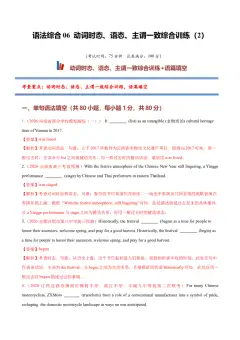
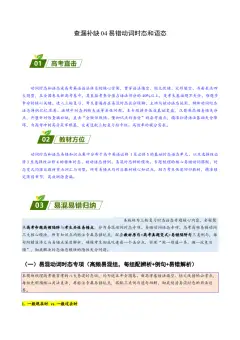
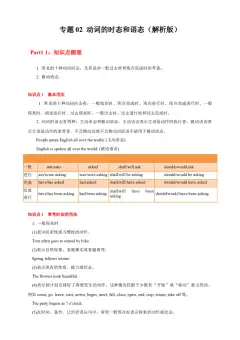
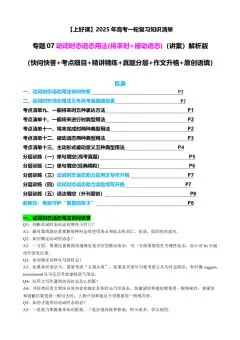
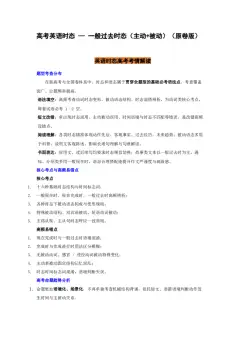
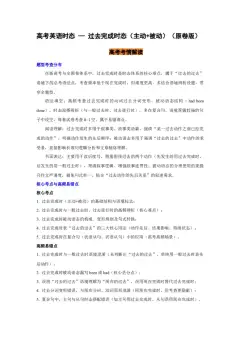
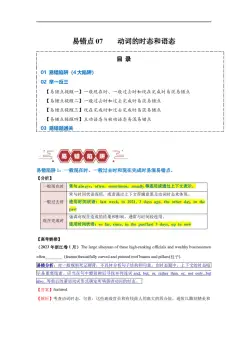
衔接点06 动词时态
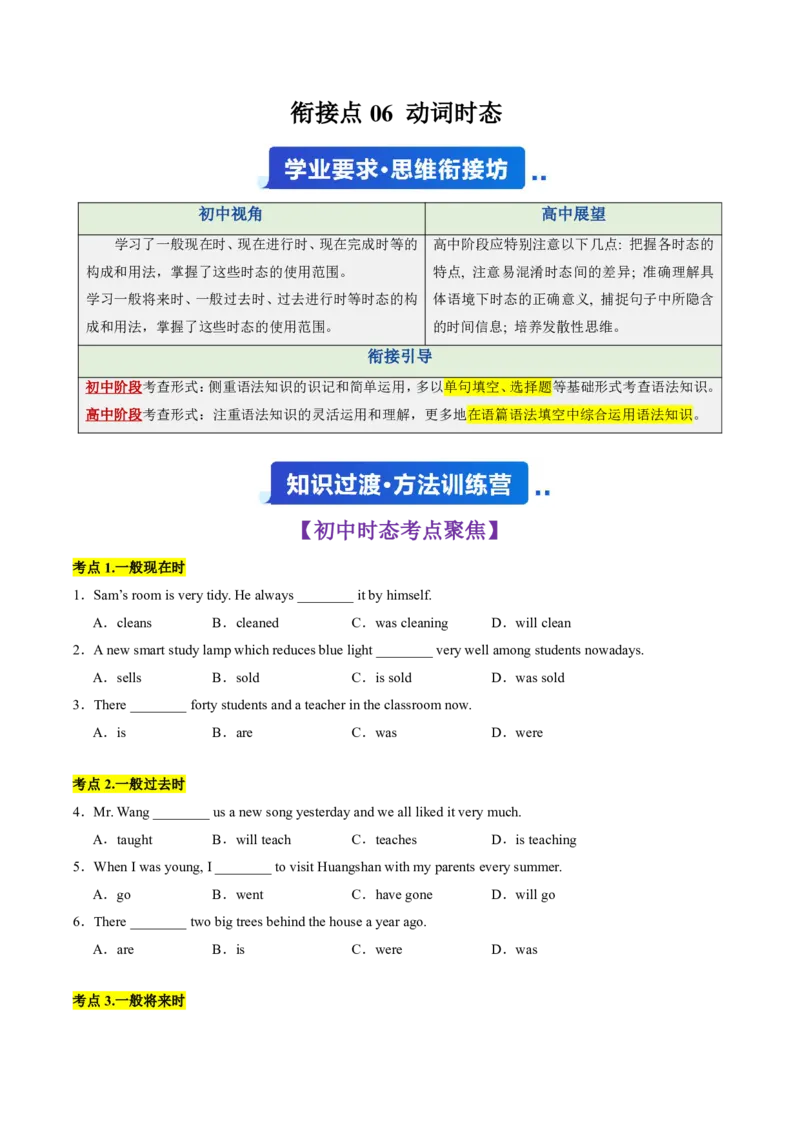
初中视角
高中展望
学习了一般现在时、现在进行时、现在完成时等的
构成和用法,掌握了这些时态的使用范围。
学习一般将来时、一般过去时、过去进行时等时态的构
成和用法,掌握了这些时态的使用范围。
高中阶段应特别注意以下几点: 把握各时态的
特点, 注意易混淆时态间的差异; 准确理解具
体语境下时态的正确意义, 捕捉句子中所隐含
的时间信息; 培养发散性思维。
衔接引导
初中阶段考查形式:侧重语法知识的识记和简单运用,多以单句填空、选择题等基础形式考查语法知识。
高中阶段考查形式:注重语法知识的灵活运用和理解,更多地在语篇语法填空中综合运用语法知识。
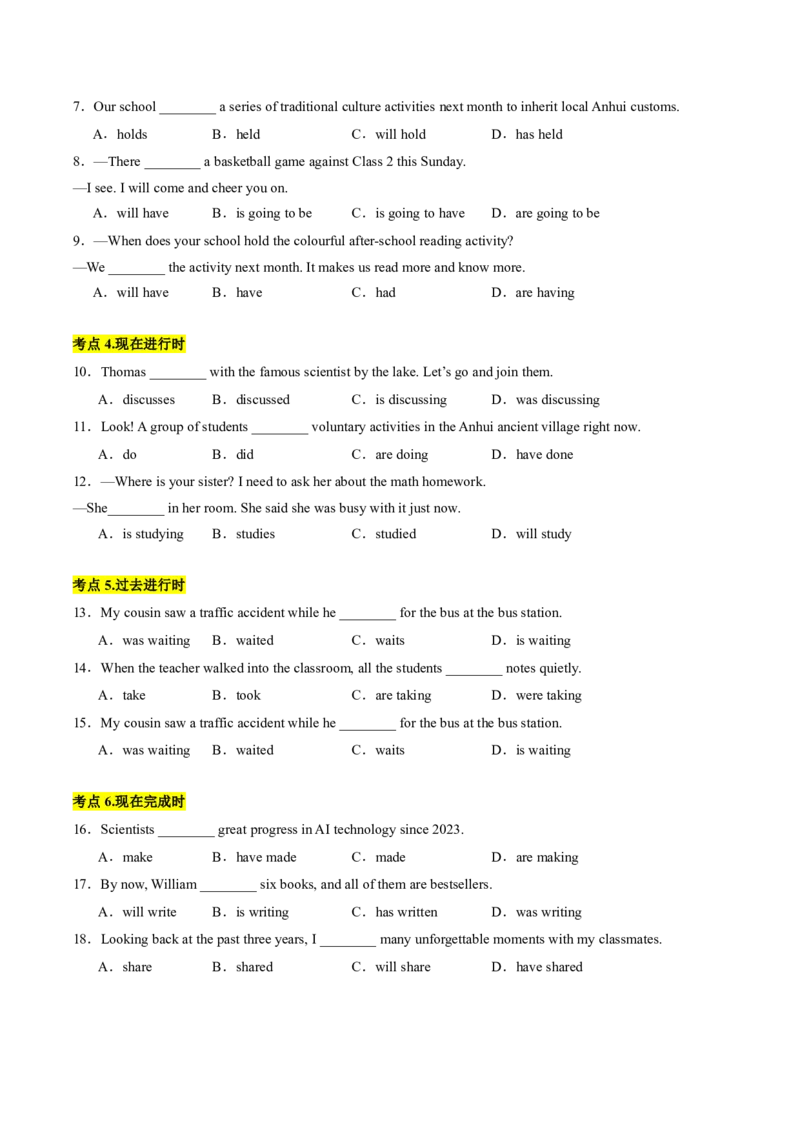
【初中时态考点聚焦】
考点1.一般现在时
1.Sam’s room is very tidy. He always ________ it by himself.
A.cleans
B.cleaned
C.was cleaning
D.will clean
2.A new smart study lamp which reduces blue light ________ very well among students nowadays.
A.sells
B.sold
C.is sold
D.was sold
3.There ________ forty students and a teacher in the classroom now.
A.is
B.are
C.was
D.were
考点2.一般过去时
4.Mr. Wang ________ us a new song yesterday and we all liked it very much.
A.taught
B.will teach
C.teaches
D.is teaching
5.When I was young, I ________ to visit Huangshan with my parents every summer.
A.go
B.went
C.have gone
D.will go
6.There ________ two big trees behind the house a year ago.
A.are
B.is
C.were
D.was
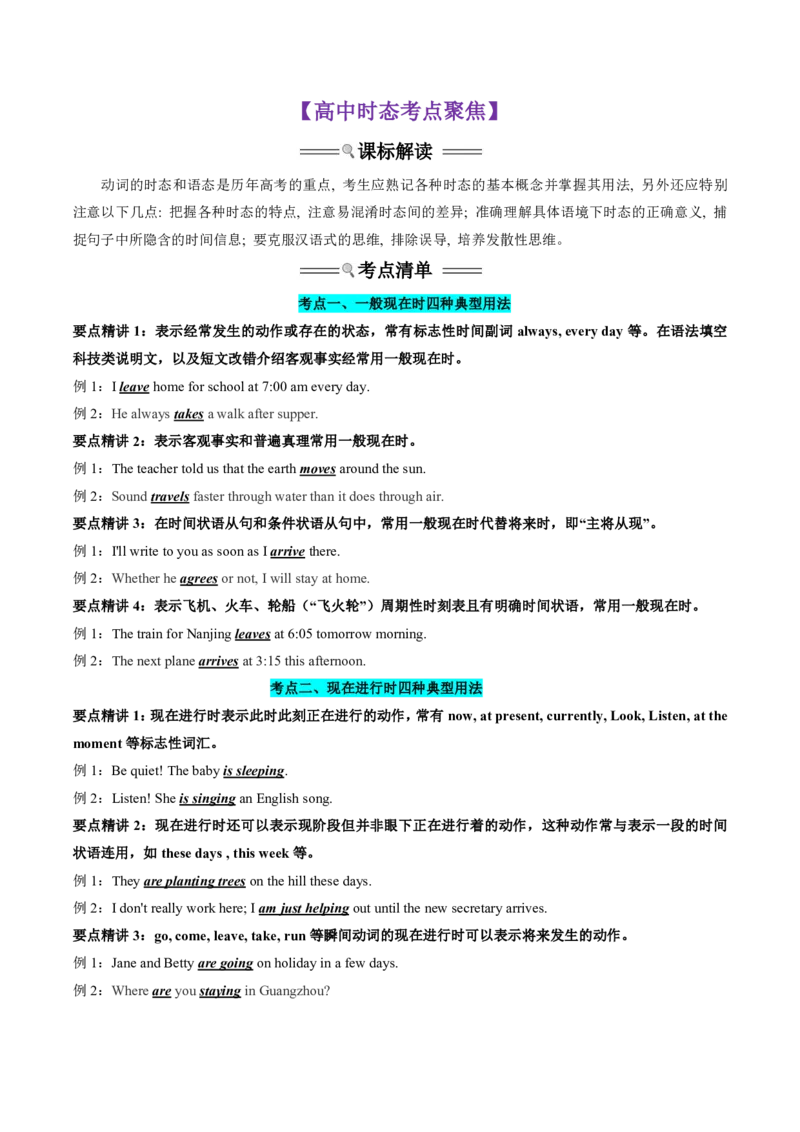
考点3.一般将来时
7.Our school ________ a series of traditional culture activities next month to inherit local Anhui customs.
A.holds
B.held
C.will hold
D.has held
8.—There ________ a basketball game against Class 2 this Sunday.
—I see. I will come and cheer you on.
A.will have
B.is going to be
C.is going to have
D.are going to be
9.—When does your school hold the colourful after-school reading activity?
—We ________ the activity next month. It makes us read more and know more.
A.will have
B.have
C.had
D.are having
考点4.现在进行时
10.Thomas ________ with the famous scientist by the lake. Let’s go and join them.
A.discusses
B.discussed
C.is discussing
D.was discussing
11.Look! A group of students ________ voluntary activities in the Anhui ancient village right now.
A.do
B.did
C.are doing
D.have done
12.—Where is your sister? I need to ask her about the math homework.
—She________ in her room. She said she was busy with it just now.
A.is studying
B.studies
C.studied
D.will study
考点5.过去进行时
13.My cousin saw a traffic accident while he ________ for the bus at the bus station.
A.was waiting
B.waited
C.waits
D.is waiting
14.When the teacher walked into the classroom, all the students ________ notes quietly.
A.take
B.took
C.are taking
D.were taking
15.My cousin saw a traffic accident while he ________ for the bus at the bus station.
A.was waiting
B.waited
C.waits
D.is waiting
考点6.现在完成时
16.Scientists ________ great progress in AI technology since 2023.
A.make
B.have made
C.made
D.are making
17.By now, William ________ six books, and all of them are bestsellers.
A.will write
B.is writing
C.has written
D.was writing
18.Looking back at the past three years, I ________ many unforgettable moments with my classmates.
A.share
B.shared
C.will share
D.have shared
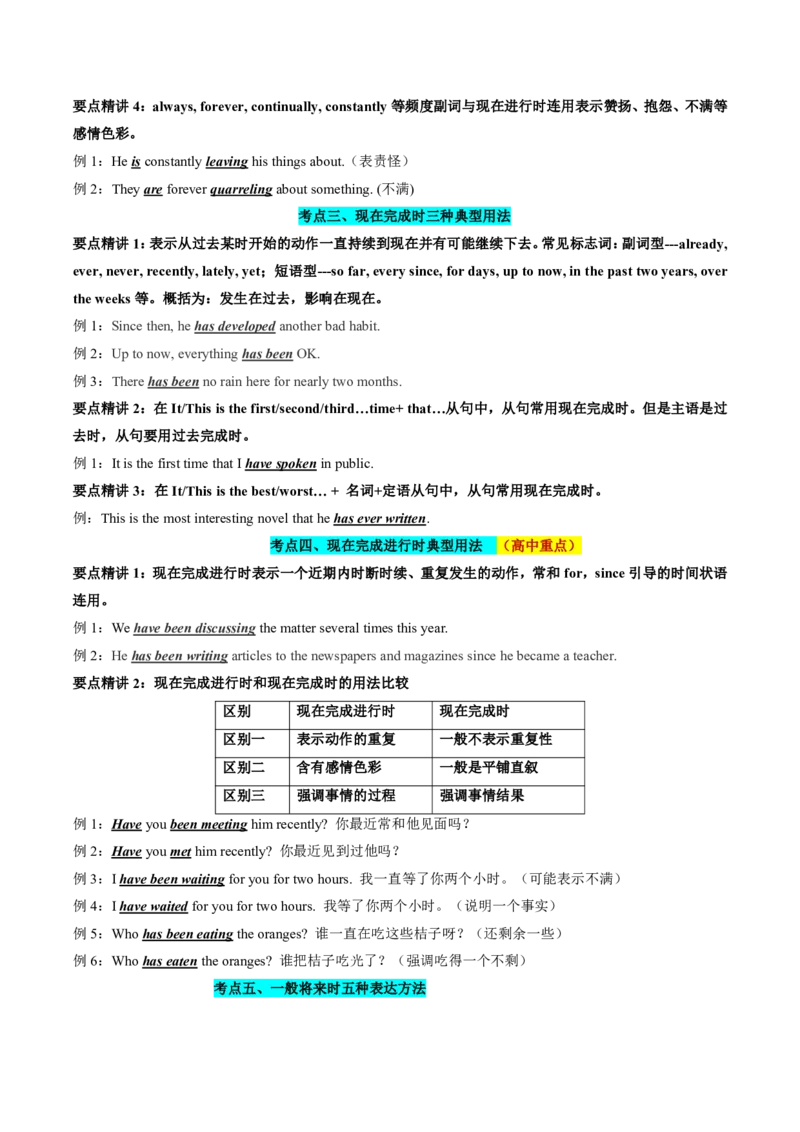
【高中时态考点聚焦】
课标解读
动词的时态和语态是历年高考的重点, 考生应熟记各种时态的基本概念并掌握其用法, 另外还应特别
注意以下几点: 把握各种时态的特点, 注意易混淆时态间的差异; 准确理解具体语境下时态的正确意义, 捕
捉句子中所隐含的时间信息; 要克服汉语式的思维, 排除误导, 培养发散性思维。
考点清单
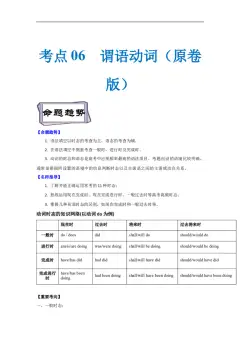
考点一、一般现在时四种典型用法
要点精讲1:表示经常发生的动作或存在的状态,常有标志性时间副词always, every day 等。在语法填空
科技类说明文,以及短文改错介绍客观事实经常用一般现在时。
例1:I leave home for school at 7:00 am every day.
例2:He always takes a walk after supper.
要点精讲2:表示客观事实和普遍真理常用一般现在时。
例1:The teacher told us that the earth moves around the sun.
例2:Sound travels faster through water than it does through air.
要点精讲3:在时间状语从句和条件状语从句中,常用一般现在时代替将来时,即“主将从现”。
例1:I'll write to you as soon as I arrive there.
例2:Whether he agrees or not, I will stay at home.
要点精讲4:表示飞机、火车、轮船(“飞火轮”)周期性时刻表且有明确时间状语,常用一般现在时。
例1:The train for Nanjing leaves at 6:05 tomorrow morning.
例2:The next plane arrives at 3:15 this afternoon.
考点二、现在进行时四种典型用法
要点精讲1:现在进行时表示此时此刻正在进行的动作,常有now, at present, currently, Look, Listen, at the
moment 等标志性词汇。
例1:Be quiet! The baby is sleeping.
例2:Listen! She is singing an English song.
要点精讲2:现在进行时还可以表示现阶段但并非眼下正在进行着的动作,这种动作常与表示一段的时间
状语连用,如these days , this week 等。
例1:They are planting trees on the hill these days.
例2:I don't really work here; I am just helping out until the new secretary arrives.
要点精讲3:go, come, leave, take, run 等瞬间动词的现在进行时可以表示将来发生的动作。
例1:Jane and Betty are going on holiday in a few days.
例2:Where are you staying in Guangzhou?
要点精讲4:always, forever, continually, constantly 等频度副词与现在进行时连用表示赞扬、抱怨、不满等
感情色彩。
例1:He is constantly leaving his things about.(表责怪)
例2:They are forever quarreling about something. (不满)
考点三、现在完成时三种典型用法
要点精讲1:表示从过去某时开始的动作一直持续到现在并有可能继续下去。常见标志词:副词型---already,
ever, never, recently, lately, yet;短语型---so far, every since, for days, up to now, in the past two years, over
the weeks 等。概括为:发生在过去,影响在现在。
例1:Since then, he has developed another bad habit.
例2:Up to now, everything has been OK.
例3:There has been no rain here for nearly two months.
要点精讲2:在It/This is the first/second/third…time+ that…从句中,从句常用现在完成时。但是主语是过
去时,从句要用过去完成时。
例1:It is the first time that I have spoken in public.
要点精讲3:在It/This is the best/worst… + 名词+定语从句中,从句常用现在完成时。
例:This is the most interesting novel that he has ever written.
考点四、现在完成进行时典型用法
(高中重点)
要点精讲1:现在完成进行时表示一个近期内时断时续、重复发生的动作,常和for,since 引导的时间状语
连用。
例1:We have been discussing the matter several times this year.
例2:He has been writing articles to the newspapers and magazines since he became a teacher.
要点精讲2:现在完成进行时和现在完成时的用法比较
区别
现在完成进行时
现在完成时
区别一
表示动作的重复
一般不表示重复性
区别二
含有感情色彩
一般是平铺直叙
区别三
强调事情的过程
强调事情结果
例1:Have you been meeting him recently? 你最近常和他见面吗?
例2:Have you met him recently? 你最近见到过他吗?
例3:I have been waiting for you for two hours. 我一直等了你两个小时。(可能表示不满)
例4:I have waited for you for two hours. 我等了你两个小时。(说明一个事实)
例5:Who has been eating the oranges? 谁一直在吃这些桔子呀?(还剩余一些)
例6:Who has eaten the oranges? 谁把桔子吃光了?(强调吃得一个不剩)
考点五、一般将来时五种表达方法
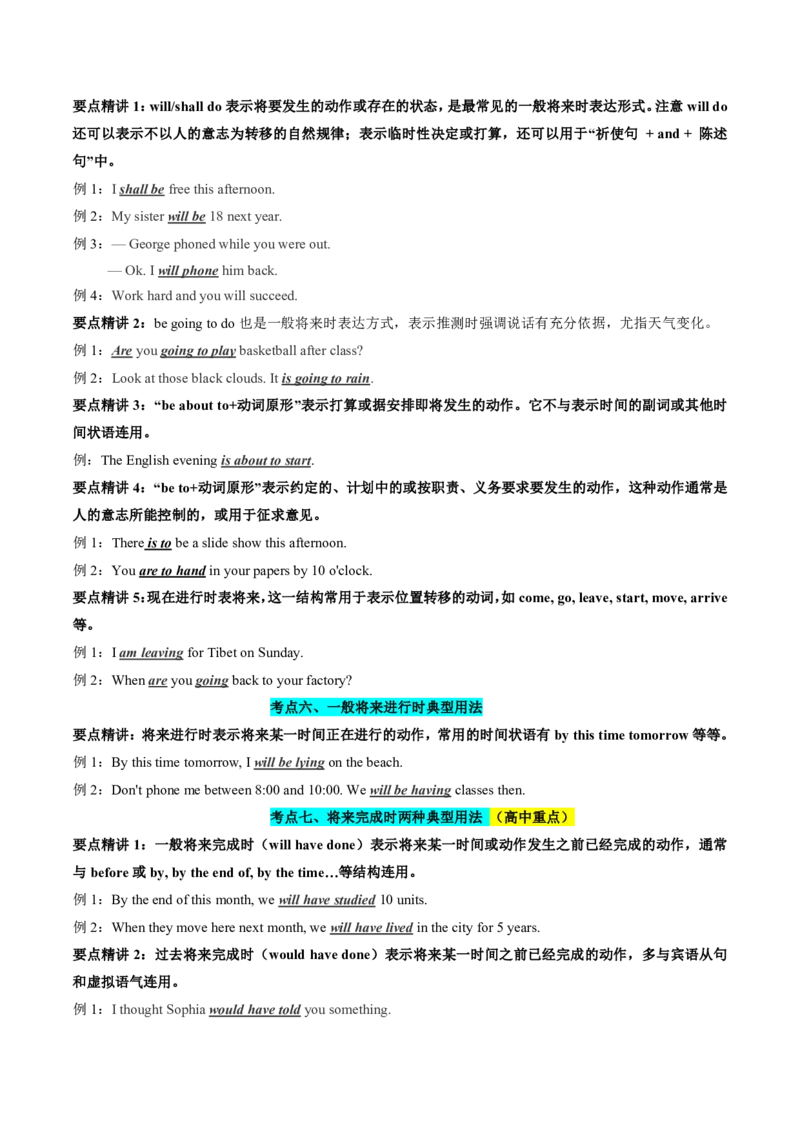
要点精讲1:will/shall do 表示将要发生的动作或存在的状态,是最常见的一般将来时表达形式。注意will do
还可以表示不以人的意志为转移的自然规律;表示临时性决定或打算,还可以用于“祈使句+ and + 陈述
句”中。
例1:I shall be free this afternoon.
例2:My sister will be 18 next year.
例3:— George phoned while you were out.
— Ok. I will phone him back.
例4:Work hard and you will succeed.
要点精讲2:be going to do 也是一般将来时表达方式,表示推测时强调说话有充分依据,尤指天气变化。
例1:Are you going to play basketball after class?
例2:Look at those black clouds. It is going to rain.
要点精讲3:“be about to+动词原形”表示打算或据安排即将发生的动作。它不与表示时间的副词或其他时
间状语连用。
例:The English evening is about to start.
要点精讲4:“be to+动词原形”表示约定的、计划中的或按职责、义务要求要发生的动作,这种动作通常是
人的意志所能控制的,或用于征求意见。
例1:There is to be a slide show this afternoon.
例2:You are to hand in your papers by 10 o'clock.
要点精讲5:现在进行时表将来,这一结构常用于表示位置转移的动词,如come, go, leave, start, move, arrive
等。
例1:I am leaving for Tibet on Sunday.
例2:When are you going back to your factory?
考点六、一般将来进行时典型用法
要点精讲:将来进行时表示将来某一时间正在进行的动作,常用的时间状语有by this time tomorrow 等等。
例1:By this time tomorrow, I will be lying on the beach.
例2:Don't phone me between 8:00 and 10:00. We will be having classes then.
考点七、将来完成时两种典型用法(高中重点)
要点精讲1:一般将来完成时(will have done)表示将来某一时间或动作发生之前已经完成的动作,通常
与before 或by, by the end of, by the time…等结构连用。
例1:By the end of this month, we will have studied 10 units.
例2:When they move here next month, we will have lived in the city for 5 years.
要点精讲2:过去将来完成时(would have done)表示将来某一时间之前已经完成的动作,多与宾语从句
和虚拟语气连用。
例1:I thought Sophia would have told you something.
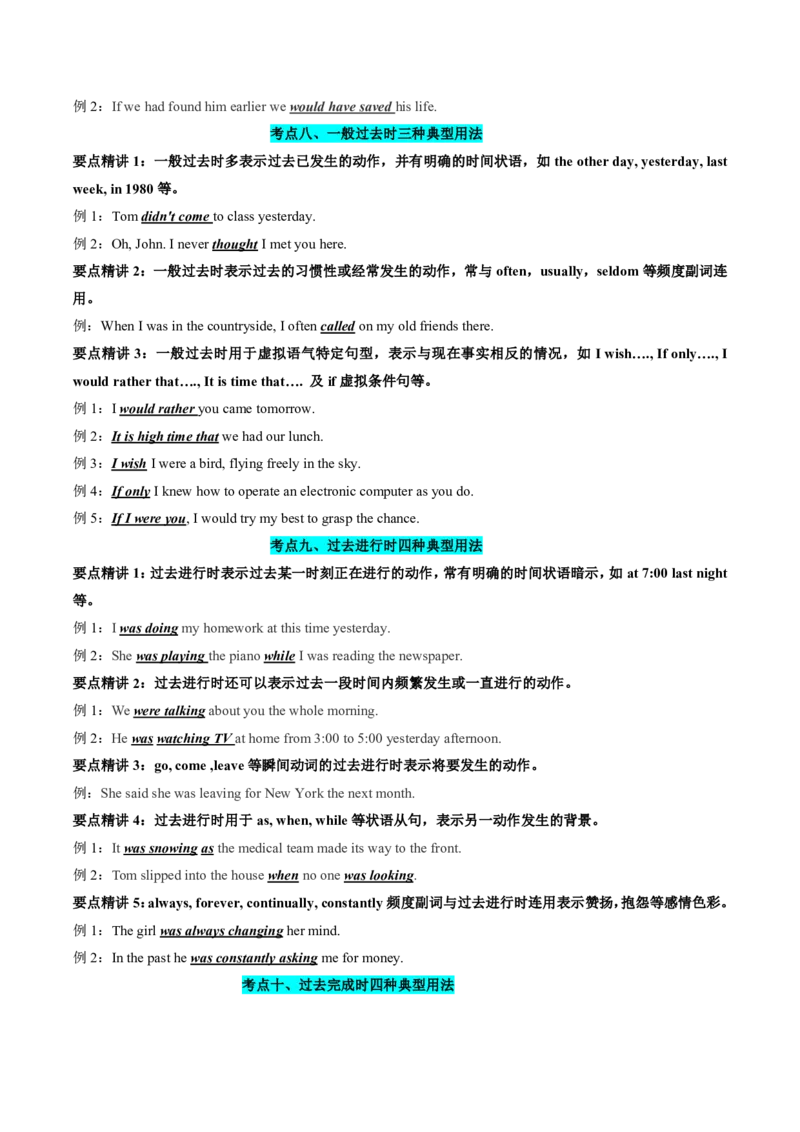
例2:If we had found him earlier we would have saved his life.
考点八、一般过去时三种典型用法
要点精讲1:一般过去时多表示过去已发生的动作,并有明确的时间状语,如the other day, yesterday, last
week, in 1980 等。
例1:Tom didn't come to class yesterday.
例2:Oh, John. I never thought I met you here.
要点精讲2:一般过去时表示过去的习惯性或经常发生的动作,常与often,usually,seldom 等频度副词连
用。
例:When I was in the countryside, I often called on my old friends there.
要点精讲3:一般过去时用于虚拟语气特定句型,表示与现在事实相反的情况,如I wish…., If only…., I
would rather that…., It is time that…. 及if 虚拟条件句等。
例1:I would rather you came tomorrow.
例2:It is high time that we had our lunch.
例3:I wish I were a bird, flying freely in the sky.
例4:If only I knew how to operate an electronic computer as you do.
例5:If I were you, I would try my best to grasp the chance.
考点九、过去进行时四种典型用法
要点精讲1:过去进行时表示过去某一时刻正在进行的动作,常有明确的时间状语暗示,如at 7:00 last night
等。
例1:I was doing my homework at this time yesterday.
例2:She was playing the piano while I was reading the newspaper.
要点精讲2:过去进行时还可以表示过去一段时间内频繁发生或一直进行的动作。
例1:We were talking about you the whole morning.
例2:He was watching TV at home from 3:00 to 5:00 yesterday afternoon.
要点精讲3:go, come ,leave 等瞬间动词的过去进行时表示将要发生的动作。
例:She said she was leaving for New York the next month.
要点精讲4:过去进行时用于as, when, while 等状语从句,表示另一动作发生的背景。
例1:It was snowing as the medical team made its way to the front.
例2:Tom slipped into the house when no one was looking.
要点精讲5:always, forever, continually, constantly 频度副词与过去进行时连用表示赞扬,抱怨等感情色彩。
例1:The girl was always changing her mind.
例2:In the past he was constantly asking me for money.
考点十、过去完成时四种典型用法
要点精讲1:过去完成时表示某一动作或状态在过去某一时间之前或过去某一动作之前已经完成。句中常
用by, by the end of, be the time…引导的时间状语或以before, until, when, than 等词引导的内含一般过去时
的时间状语从句。概括为:过去的过去。
例1:By 5:00 yesterday morning we had done that work.
例2:I had learnt 5000 words before I entered the university.
要点精讲2:intend, mean, hope, want, plan, suppose, expect, think 等动词的过去完成时可以用来表示一个
本来打算做而未做的事。
例1:They had wanted to help but couldn't get here in time.
例2:I had intended to call on you, but was prevented from doing so.
要点精讲3:在It was the first/second/third…time that…句型中,that 引导的定语从句要用过去完成时。
例1:This was the first time they had met in thirty-nine years.
例2:It was the fourth time she had shopped online for hours.
要点精讲3:在hardly/scarcely … when…和no sooner… than…句型中,主句常用过去完成时。
例1:She hardly had gone to bed when the bell rang.
例2:No sooner had they left the building than a bomb exploded.
要点精讲4:过去完成时用于虚拟语气特定句型,表示与过去事实相反的情况,如I wish…., If only…., I
would rather that….及if 虚拟条件句等。
例1:I wish that I had seen her yesterday.
例2:I felt as though we had known each other for years.
例3:If only I had known her earlier!
例4:I would rather I hadn't seen that film yesterday.
例5:If it had not rained this morning, I should have gone shopping.
考点十一、过去将来时三种典型用法
要点精讲1:一般过去将来时是由“should/would + 动词原形”构成,表示从过去的某一时间来看将来要发
生的动作,多用于主从复合句中。
例1:He said they would arrange a party.
例2:He asked me yesterday when I should leave for Paris.
要点精讲2:用于was/were about to do…when…句型,表示:正要……这时发生另一件事。was/were to do
也可以用于过去将来时。
例:I was about to start when it suddenly began to rain.
要点精讲3:过去将来时用于虚拟语气特定句型,表示与将来事实相反的情况,如I wish…., If only…., I
would rather that….及if 虚拟条件句等。
例1:I wish he would go with me to the cinema tonight.
例2:If I had a chance to study abroad, I would study at Cambridge University.
一、单句语法填空
1.The plane
(take) off at 10:10, which means you need to hurry because there’s only ten minutes left. (所
给词的适当形式填空)
2.The first or last phrase spoken
(be) memorised better than the conversation as a whole. (所给词的适
当形式填空)
3.The Chinese solar calendar
(divide) the year into 24 solar terms. (所给词的适当形式填空)
4.She is still
(suffer) from the pain of losing her home in the wildfire. (所给词的适当形式填空)
5.The teacher, along with his students
(visit) the museum now. (所给词的适当形式填空)
6.Unfortunately, wild animals are being over hunted, and some of them
(die) out. (所给词的适当形
式填空)
7.He
(seek) to explain his idea clearly, but few people in the audience could really understand him.
(所给词的适当形式填空)
8.The man
(escape) from the room last night. (所给词的适当形式填空)
9.A strong feeling of warmth
(strike) all of us when we saw the smiles on their faces. (所给词的适当
形式填空)
10.He said his train
(leave) at 6 p.m., so he had to hurry. (所给词的适当形式填空)
11.They
(leave) when the bell started ringing. (所给词的适当形式填空)
12.He
(explore) more possibilities for a changing world in the coming years. (所给词的适当形式填
空)
13.The symptoms of flu may be unpleasant, but they
(disappear) within a few days. (所给词的适当形
式填空)
14.Look at those clouds. I expect that it
(rain) this afternoon. (所给词的适当形式填空)
15.This is one of the few software companies that
(develop) more than ten popular web applications
since 2025. (所给词的适当形式填空)
16.It’s said that this old tree in the village
(stand) for over 500 years. (所给词的适当形式填空)
17.There
(be) golden ages of invention throughout history. (所给词的适当形式填空)
18.It was the first time I
(see) him so angry and passionate. (所给词的适当形式填空)
19.There
(be) a number of failures before they eventually found a way to clone a monkey successfully.
(所给词的适当形式填空)
20.She hoped that she
(become) a doctor one day. (所给词的适当形式填空)
二、完成句子
21.People often feel _____________.
人们经常觉得自己太忙了, 没有时间做志愿服务。
22.The small apartment ________ ________ (属于) my father and me, and it was all we had. (根据汉语提示完成
句子)
23.The careless driver __________ (闯红灯) and crashed into another car that had the right of way. (根据汉语提
示完成句子)
24.We __________. Where is the nearest filling station?
我们马上没汽油了。最近的加油站在哪里?
25.我们所有人都期待在国庆节有一个假期。
All of us are ________ a holiday on National Day.
26.我们接到通知说领导们很快要来我们学校。
We were informed that the leaders ________________ our school soon.
27.________________ for the bus, I met her.
等公共汽车的时候,我遇见了她。
28.得知你将去国外深造,我写信告知你一些必要的注意事项。
Learning that you ________, I’m writing to inform you of some necessary do’s and don’ts.
29.He has broken one of his legs. As a result, he ________ (将不得不离开) school for three months. (根据汉语提
示完成句子)
30.Your story is perfect; I’ve never ______________ (听过比这更好的故事). (根据汉语提示完成句子)
三、语篇填空(时态专练)
The Dragon Dance is a form of traditional dance in Chinese culture. It 1.
(spread) all over China
and to the whole world so far.
Traditionally,dragons 2.
(make) of wood. However,in modern times,dragons 3.___ (be)
much lighter because they are made of lighter materials like plastics. The length of dragons can be from 25 to 35
meters for acrobatic(杂技的) models,and up to 50 to 70 meters for the larger parade(游行) styles because people
believe that the longer the dragon is ,
the more luck it4.
(bring) to the community. A small
organization cannot run a very long dragon because it 5.
(require) great human power,much money
and special skills.
The Dragon Dance itself 6.
(begin) during the Han Dynasty. And it
7.
(start) by the Chinese who had shown great respect for the dragon. It was already a popular event
during the Song Dynasty.
At that time,it 8.
(become) a popular activity like the Lion Dance. People could often see it
during some important festivals. In the Qing Dynasty,the Dragon Dance Team of Fuzhou 9.
(invite)
to put on a show in Beijing. And the emperor 10.
(speak) highly of it.
一、语法填空
阅读下面短文,在空白处填入1 个适当的单词或括号内单词的正确形式。
The Forbidden City: A Living Museum
The Forbidden City,
1
(locate) in the heart of Beijing, is one of the most famous museums in the
world. It served as the imperial palace for 24 emperors during the Ming and Qing dynasties.
2
(build) between 1406 and 1420, the Forbidden City covers 720,000 square meters and has over
9,000 rooms. It
3
(be) a UNESCO World Heritage Site since 1987.
The Forbidden City is not just a museum of ancient
4
(building). It houses over 1.8 million cultural
relics, including paintings, ceramics, and jade. Only about 1%
5
(display) at any given time due to the
large number.
In recent years, the Forbidden City
6
(become) a cultural phenomenon. Its cultural creative products
(文创产品) — from lipsticks to phone cases — are wildly popular
7
young people. The museum has also
launched apps and online tours to reach a
8
(wide) audience.
“We want to make history come alive,” says the museum’s director. “The Forbidden City is not a
9
(die) place. It is a living museum that continues
10
(inspire) people today.”
二、阅读理解
I was floating on cloud nine because my first children’s book had just been published. Eager to share the joy,
I arrived thirty minutes early for my monthly writers’ meeting at the library. While I was waiting in the dim hallway,
a big man wearing a cowboy hat and leather boots approached me with a warm smile.
Sensing my excitement, the gentleman politely asked how I was doing. His simple question opened the
floodgates of my enthusiasm. I told him everything about my book and even pushed a promotional poster in his
face, reading it to him as if he couldn’t understand it on his own. Had I been in my right mind, I might have
realized I was frightening a stranger with my extreme excitement. However, the man seemed genuinely interested,
studying the text carefully and encouraging me to cherish such happy moments. He made me feel like I could
accomplish anything.
When the meeting finally started, I was shocked to see the “hallway gentleman” standing behind the
platform. He was Dusty Richards — a famous award-winning writer who had authored dozens of books! I had been
babbling about my little book to a writing superstar. Dusty fascinated the audience with his stories and passion for
the craft. Before leaving, he made eye contact with me and gave me a thumbs-up, as if to say, “Go get ’em. ”
Sadly, Dusty passed away in an accident not long after. However, I will never forget his kindness. He treated
a stranger like a lifetime friend and an equal. Never before had I met someone who was so sincerely pleased in
another’s success. Today, whenever I face rejections or doubts, I think of Dusty’s twinkling eyes in that dim
hallway. His image always drove away my negative thoughts and encourages me to keep moving ahead. Truly,
encouragement is like water to the soul; it makes everything grow.
11.What do we know about the author from the first two paragraphs?
A.She was proud of her poster.
B.She was lost in her excitement.
C.She felt afraid of the stranger.
D.She was admiring of the man.
12.Which of the following best describe Dusty?
A.Creative and reliable.
B.Modest and ambitious.
C.Kind and encouraging.
D.Humorous and determined.
13.What do the underlined words “babbling about” mean in paragraph 3?
A.Talking casually about.
B.Speaking excitedly about.
C.Explaining carefully about.
D.Whispering nervously about.
14.What does the author’s experience show?
A.Nothing is impossible.
B.Every cloud has a silver lining.
C.Enthusiasm makes a difference.
D.Encouragement can go a long way.