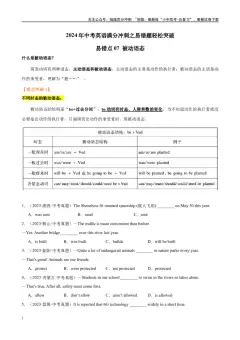
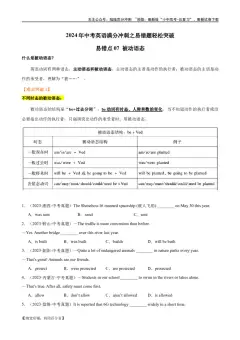
衔接点07
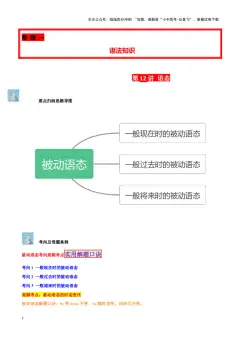
被动语态
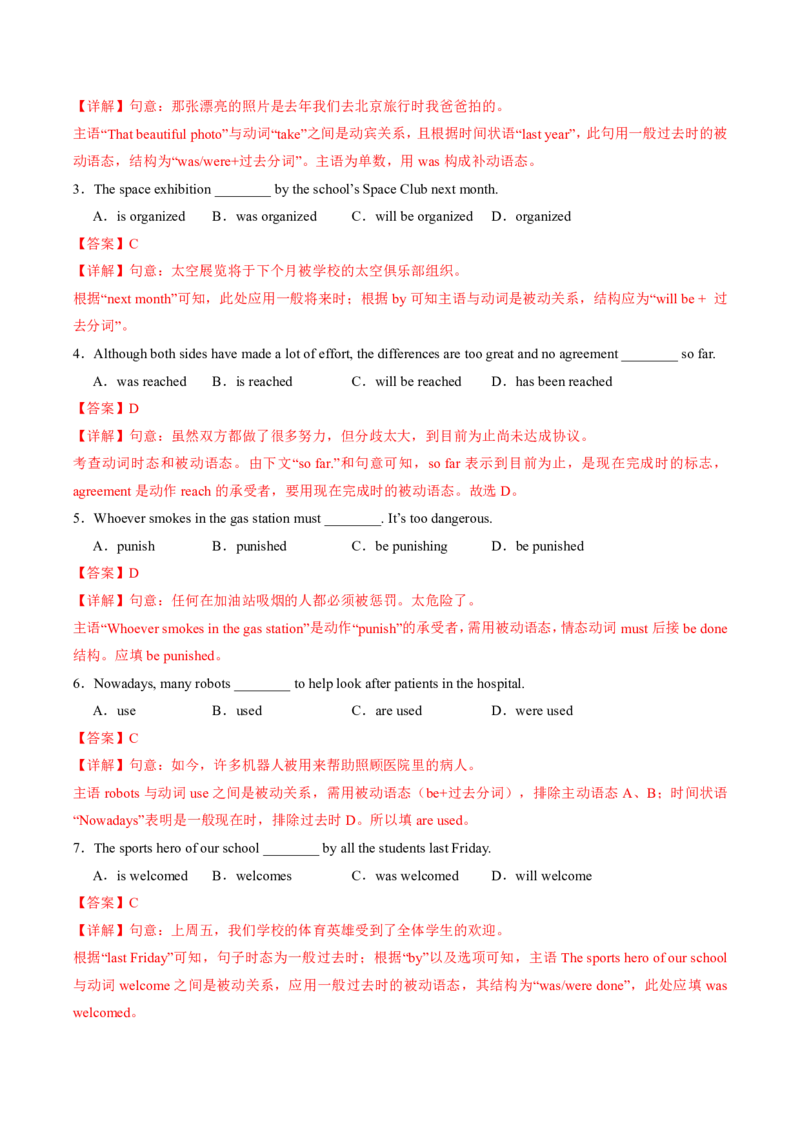
初中视角
高中展望
初中阶段主要学习一般现在时、一般过去时、一般将
来时、现在完成时、过去完成时及含有情态动词的被
动语态用法。
高中阶段在初中基础上还需掌握过去将来时、现
在进行时、过去进行时、将来完成时的被动语态
用法;及get +done 等也可表示被动。。
衔接引导
初中阶段考查形式:侧重语法知识的识记和简单运用,多以单句填空、选择题等基础形式考查语法知识。
高中阶段考查形式:注重语法知识的灵活运用和理解,更多地在语篇语法填空中综合运用语法知识。
【初中被动语态考点聚焦】
1.Nowadays, the ideas of working with AI ________ by more people in all walks of life.
A.accept
B.accepted
C.are accepted
D.were accepted
【答案】C
【详解】句意:如今,与人工智能共事的理念被各行各业越来越多的人所接受。
主语the ideas 与动词accept 之间是被动关系,需用被动语态结构be + 过去分词;时间状语Nowadays 提示
句子时态为一般现在时;主语为复数,be 动词用are。
2.That beautiful photo ________ by my dad during our trip to Beijing last year.
A.take
B.took
C.was taken
D.is taken
【答案】C
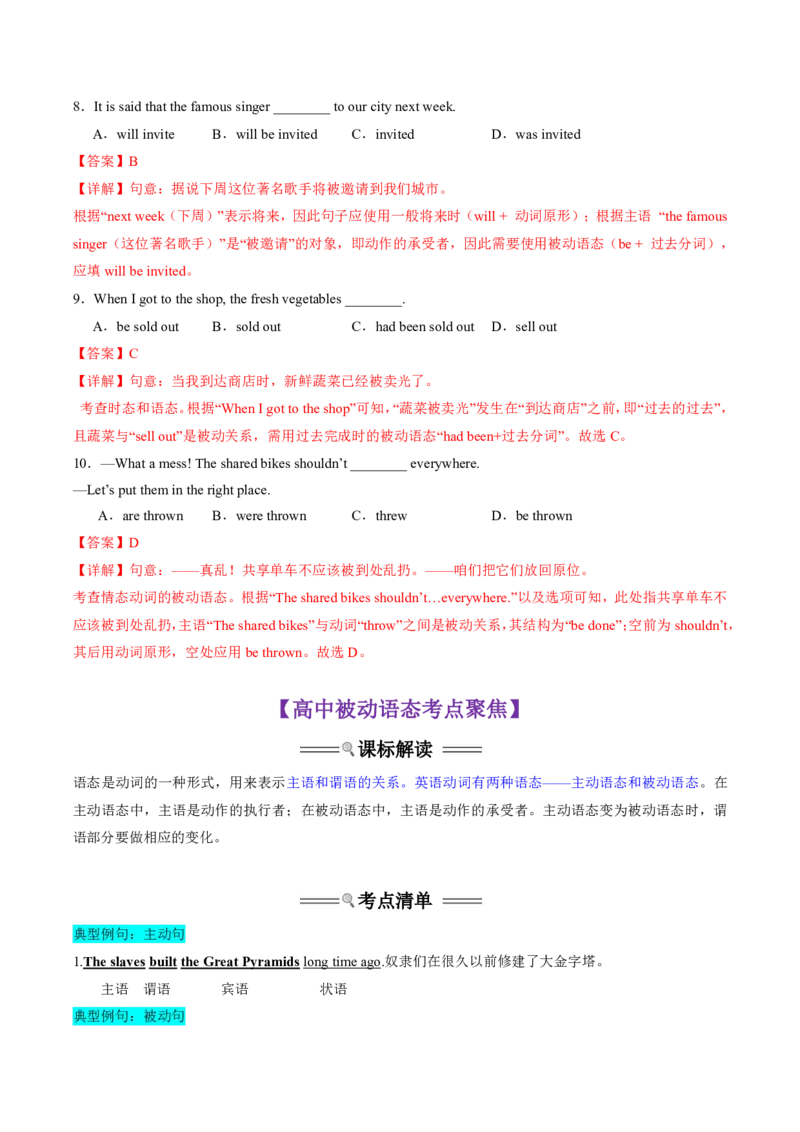
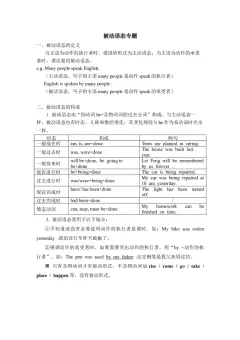
时态
被动语态结构
例句
一般现在时
am/is/are+done
The classroom is cleaned every day.
一般过去时
was/were+done
The kite was made by him.
一般将来时
will/shall be+done 或者
am/is/are + going to be +done
Trees will be planted tomorrow.
含有情态动词
情态动词+be+done
Anything here can't be touched.
【详解】句意:那张漂亮的照片是去年我们去北京旅行时我爸爸拍的。
主语“That beautiful photo”与动词“take”之间是动宾关系,且根据时间状语“last year”,此句用一般过去时的被
动语态,结构为“was/were+过去分词”。主语为单数,用was 构成补动语态。
3.The space exhibition ________ by the school’s Space Club next month.
A.is organized
B.was organized
C.will be organized
D.organized
【答案】C
【详解】句意:太空展览将于下个月被学校的太空俱乐部组织。
根据“next month”可知,此处应用一般将来时;根据by 可知主语与动词是被动关系,结构应为“will be + 过
去分词”。
4.Although both sides have made a lot of effort, the differences are too great and no agreement ________ so far.
A.was reached
B.is reached
C.will be reached
D.has been reached
【答案】D
【详解】句意:虽然双方都做了很多努力,但分歧太大,到目前为止尚未达成协议。
考查动词时态和被动语态。由下文“so far.”和句意可知,so far 表示到目前为止,是现在完成时的标志,
agreement 是动作reach 的承受者,要用现在完成时的被动语态。故选D。
5.Whoever smokes in the gas station must ________. It’s too dangerous.
A.punish
B.punished
C.be punishing
D.be punished
【答案】D
【详解】句意:任何在加油站吸烟的人都必须被惩罚。太危险了。
主语“Whoever smokes in the gas station”是动作“punish”的承受者,需用被动语态,情态动词must 后接be done
结构。应填be punished。
6.Nowadays, many robots ________ to help look after patients in the hospital.
A.use
B.used
C.are used
D.were used
【答案】C
【详解】句意:如今,许多机器人被用来帮助照顾医院里的病人。
主语robots 与动词use 之间是被动关系,需用被动语态(be+过去分词),排除主动语态A、B;时间状语
“Nowadays”表明是一般现在时,排除过去时D。所以填are used。
7.The sports hero of our school ________ by all the students last Friday.
A.is welcomed
B.welcomes
C.was welcomed
D.will welcome
【答案】C
【详解】句意:上周五,我们学校的体育英雄受到了全体学生的欢迎。
根据“last Friday”可知,句子时态为一般过去时;根据“by”以及选项可知,主语The sports hero of our school
与动词welcome 之间是被动关系,应用一般过去时的被动语态,其结构为“was/were done”,此处应填was
welcomed。
8.It is said that the famous singer ________ to our city next week.
A.will invite
B.will be invited
C.invited
D.was invited
【答案】B
【详解】句意:据说下周这位著名歌手将被邀请到我们城市。
根据“next week(下周)”表示将来,因此句子应使用一般将来时(will + 动词原形);根据主语“the famous
singer(这位著名歌手)”是“被邀请”的对象,即动作的承受者,因此需要使用被动语态(be + 过去分词),
应填will be invited。
9.When I got to the shop, the fresh vegetables ________.
A.be sold out
B.sold out
C.had been sold out
D.sell out
【答案】C
【详解】句意:当我到达商店时,新鲜蔬菜已经被卖光了。
考查时态和语态。根据“When I got to the shop”可知,“蔬菜被卖光”发生在“到达商店”之前,即“过去的过去”,
且蔬菜与“sell out”是被动关系,需用过去完成时的被动语态“had been+过去分词”。故选C。
10.—What a mess! The shared bikes shouldn’t ________ everywhere.
—Let’s put them in the right place.
A.are thrown
B.were thrown
C.threw
D.be thrown
【答案】D
【详解】句意:——真乱!共享单车不应该被到处乱扔。——咱们把它们放回原位。
考查情态动词的被动语态。根据“The shared bikes shouldn’t…everywhere.”以及选项可知,此处指共享单车不
应该被到处乱扔,主语“The shared bikes”与动词“throw”之间是被动关系,其结构为“be done”;空前为shouldn’t,
其后用动词原形,空处应用be thrown。故选D。
【高中被动语态考点聚焦】
课标解读
语态是动词的一种形式,用来表示主语和谓语的关系。英语动词有两种语态——主动语态和被动语态。在
主动语态中,主语是动作的执行者;在被动语态中,主语是动作的承受者。主动语态变为被动语态时,谓
语部分要做相应的变化。
考点清单
典型例句:主动句
1.The slaves built the Great Pyramids long time ago.奴隶们在很久以前修建了大金字塔。
主语
谓语
宾语
状语
典型例句:被动句
2.The Great Pyramids
were built
(by the slaves)
long time ago.
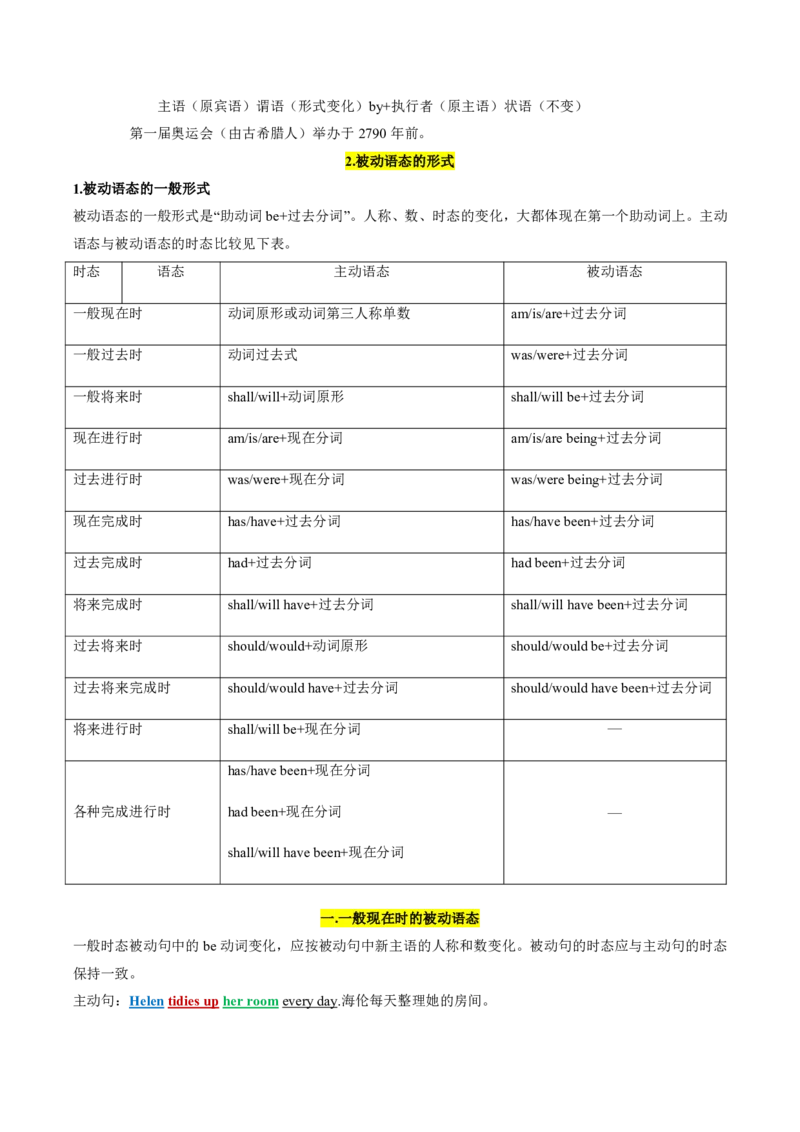
主语(原宾语)谓语(形式变化)by+执行者(原主语)状语(不变)
大金字塔在很久以前被(奴隶们)修建。
1.主动语态转换为被动语态
如果想熟练地将主动句转换为被动句,首先必须了解主动句的结构,清楚句子的成分,然后遵循下列步骤
进行转换。
①原主动语态中的宾语→转换为被动语态的主语
②原主动语态中的动词→改为被动形式,即“be+过去分词”
说明:第一步容易出错,要特别注意。这时be 动词的人称和数要随着新的主语(原主动句中的宾语)而变。
在第二步中,be 动词的时态要与原来主动句的时态保持一致。be 动词后面的过去分词就是原来主动句中的
动词的过去分词。
③原主动语态中的主语→如果需要,就放在by 后面
原主动语态中的主语,如有需要,就放在by 后面,以宾格形式出现以指明动作的执行者(因为by 是介词,
后需跟宾格作宾语)。如没有必要,可省略。
④原主动语态中的其他成分,如定语、状语→保持不变
主动句:Thomas Edison invented the light bulb in 1879.
主语
谓语
宾语
状语
托马斯·爱迪生在1879 年发明了电灯泡。
被动句:The light bulb
was invented
(by Thomas Edison)
in 1879.
主语(原宾语)谓语(形式变化)by+执行者(原主语)状语(不变)
电灯泡由托马斯·爱迪生发明于1879 年。
①原主动句中的宾语the light bulb 变为被动句中的主语。
②谓语动词的时态不变,均为一般过去时,它的形式由invented 变为was invented。
③原主动句中的主语,即动作invented 的执行者Thomas Edison,在被动句中可以由介词by 引出,也可以
省略。
④状语in 1879 的位置不变。
主动句:Mr.Wang delivered this speech.王先生做了演讲。
主语
谓语
宾语
被动句:This speech
was delivered
by Mr.Wang.这个演讲是王先生做的。
主语(原宾语)谓语(形式变化)by+执行者(原主语)
主动句:The ancient Greeks held the first Olympic Games 2790 years ago.
主语
谓语
宾语
状语
古希腊人于2790 年前举办了第一届奥运会。
被动句:The first Olympic Games
were held
(by the ancient Greeks) 2790 years ago.
主语(原宾语)谓语(形式变化)by+执行者(原主语)状语(不变)
第一届奥运会(由古希腊人)举办于2790 年前。
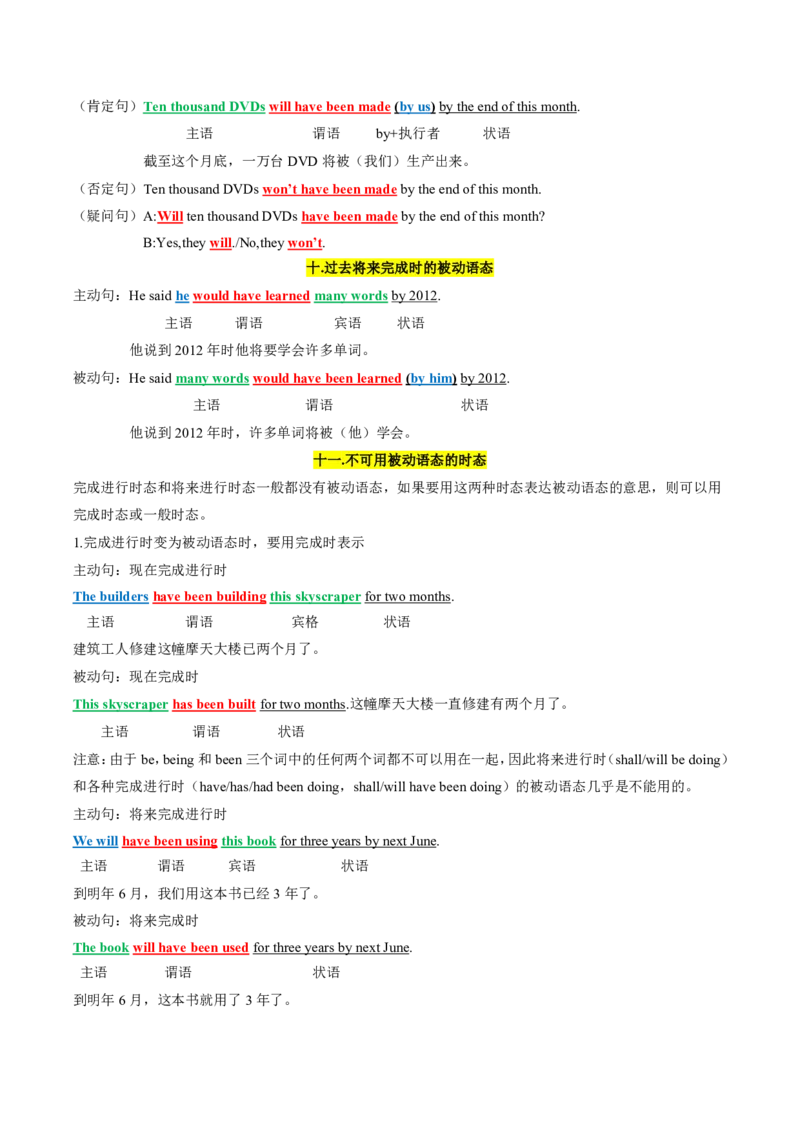
2.被动语态的形式
1.被动语态的一般形式
被动语态的一般形式是“助动词be+过去分词”。人称、数、时态的变化,大都体现在第一个助动词上。主动
语态与被动语态的时态比较见下表。
时态
语态
主动语态
被动语态
一般现在时
动词原形或动词第三人称单数
am/is/are+过去分词
一般过去时
动词过去式
was/were+过去分词
一般将来时
shall/will+动词原形
shall/will be+过去分词
现在进行时
am/is/are+现在分词
am/is/are being+过去分词
过去进行时
was/were+现在分词
was/were being+过去分词
现在完成时
has/have+过去分词
has/have been+过去分词
过去完成时
had+过去分词
had been+过去分词
将来完成时
shall/will have+过去分词
shall/will have been+过去分词
过去将来时
should/would+动词原形
should/would be+过去分词
过去将来完成时
should/would have+过去分词
should/would have been+过去分词
将来进行时
shall/will be+现在分词
—
各种完成进行时
has/have been+现在分词
had been+现在分词
shall/will have been+现在分词
—
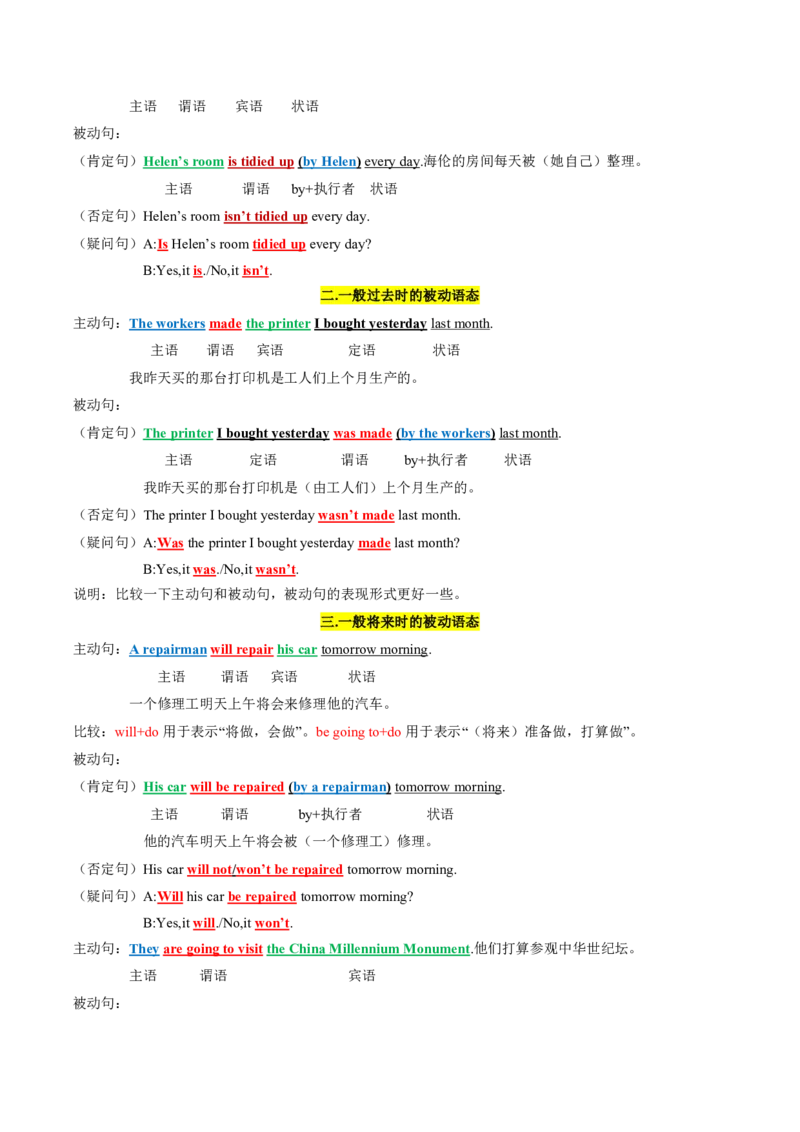
一.一般现在时的被动语态
一般时态被动句中的be 动词变化,应按被动句中新主语的人称和数变化。被动句的时态应与主动句的时态
保持一致。
主动句:Helen tidies up her room every day.海伦每天整理她的房间。
主语
谓语
宾语
状语
被动句:
(肯定句)Helen’s room is tidied up (by Helen) every day.海伦的房间每天被(她自己)整理。
主语
谓语
by+执行者
状语
(否定句)Helen’s room isn’t tidied up every day.
(疑问句)A:Is Helen’s room tidied up every day?
B:Yes,it is./No,it isn’t.
二.一般过去时的被动语态
主动句:The workers made the printer I bought yesterday last month.
主语
谓语
宾语
定语
状语
我昨天买的那台打印机是工人们上个月生产的。
被动句:
(肯定句)The printer I bought yesterday was made (by the workers) last month.
主语
定语
谓语
by+执行者
状语
我昨天买的那台打印机是(由工人们)上个月生产的。
(否定句)The printer I bought yesterday wasn’t made last month.
(疑问句)A:Was the printer I bought yesterday made last month?
B:Yes,it was./No,it wasn’t.
说明:比较一下主动句和被动句,被动句的表现形式更好一些。
三.一般将来时的被动语态
主动句:A repairman will repair his car tomorrow morning.
主语
谓语
宾语
状语
一个修理工明天上午将会来修理他的汽车。
比较:will+do 用于表示“将做,会做”。be going to+do 用于表示“(将来)准备做,打算做”。
被动句:
(肯定句)His car will be repaired (by a repairman) tomorrow morning.
主语
谓语
by+执行者
状语
他的汽车明天上午将会被(一个修理工)修理。
(否定句)His car will not/won’t be repaired tomorrow morning.
(疑问句)A:Will his car be repaired tomorrow morning?
B:Yes,it will./No,it won’t.
主动句:They are going to visit the China Millennium Monument.他们打算参观中华世纪坛。
主语
谓语
宾语
被动句:
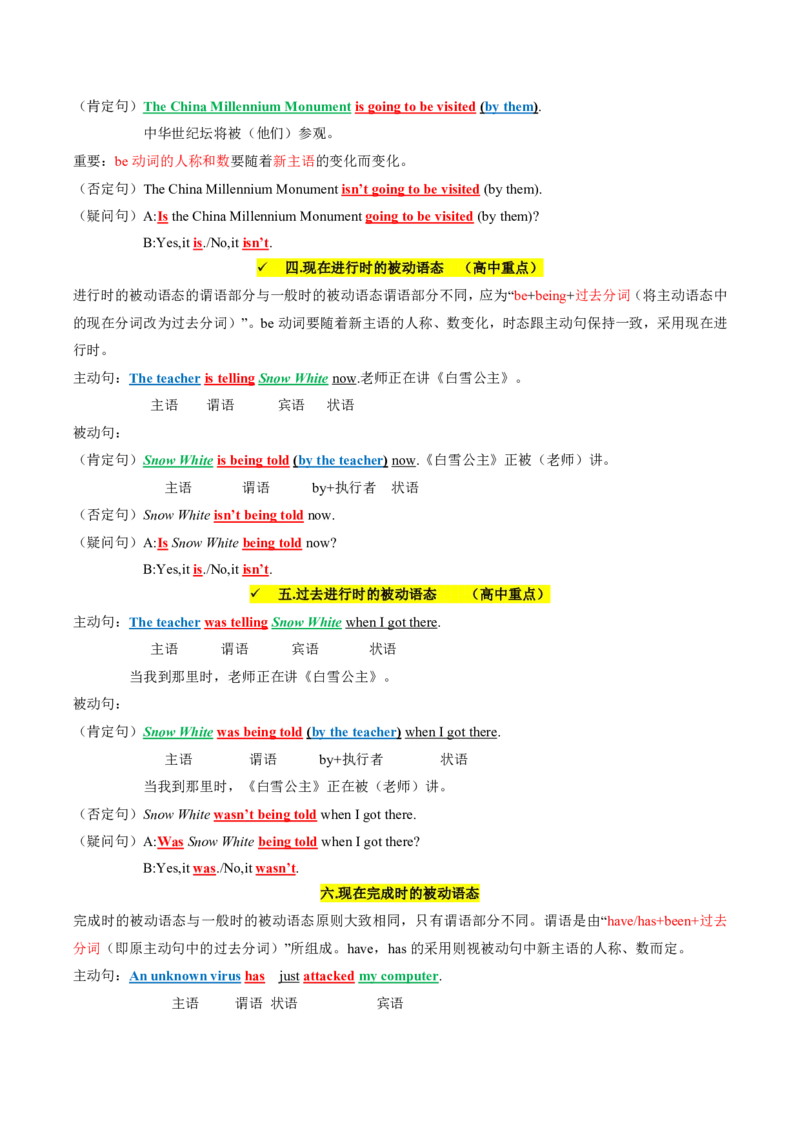
(肯定句)The China Millennium Monument is going to be visited (by them).
中华世纪坛将被(他们)参观。
重要:be 动词的人称和数要随着新主语的变化而变化。
(否定句)The China Millennium Monument isn’t going to be visited (by them).
(疑问句)A:Is the China Millennium Monument going to be visited (by them)?
B:Yes,it is./No,it isn’t.
四.现在进行时的被动语态
(高中重点)
进行时的被动语态的谓语部分与一般时的被动语态谓语部分不同,应为“be+being+过去分词(将主动语态中
的现在分词改为过去分词)”。be 动词要随着新主语的人称、数变化,时态跟主动句保持一致,采用现在进
行时。
主动句:The teacher is telling Snow White now.老师正在讲《白雪公主》。
主语
谓语
宾语
状语
被动句:
(肯定句)Snow White is being told (by the teacher) now.《白雪公主》正被(老师)讲。
主语
谓语
by+执行者
状语
(否定句)Snow White isn’t being told now.
(疑问句)A:Is Snow White being told now?
B:Yes,it is./No,it isn’t.
五.过去进行时的被动语态
(高中重点)
主动句:The teacher was telling Snow White when I got there.
主语
谓语
宾语
状语
当我到那里时,老师正在讲《白雪公主》。
被动句:
(肯定句)Snow White was being told (by the teacher) when I got there.
主语
谓语
by+执行者
状语
当我到那里时,《白雪公主》正在被(老师)讲。
(否定句)Snow White wasn’t being told when I got there.
(疑问句)A:Was Snow White being told when I got there?
B:Yes,it was./No,it wasn’t.
六.现在完成时的被动语态
完成时的被动语态与一般时的被动语态原则大致相同,只有谓语部分不同。谓语是由“have/has+been+过去
分词(即原主动句中的过去分词)”所组成。have,has 的采用则视被动句中新主语的人称、数而定。
主动句:An unknown virus has
just attacked my computer.
主语
谓语状语
宾语
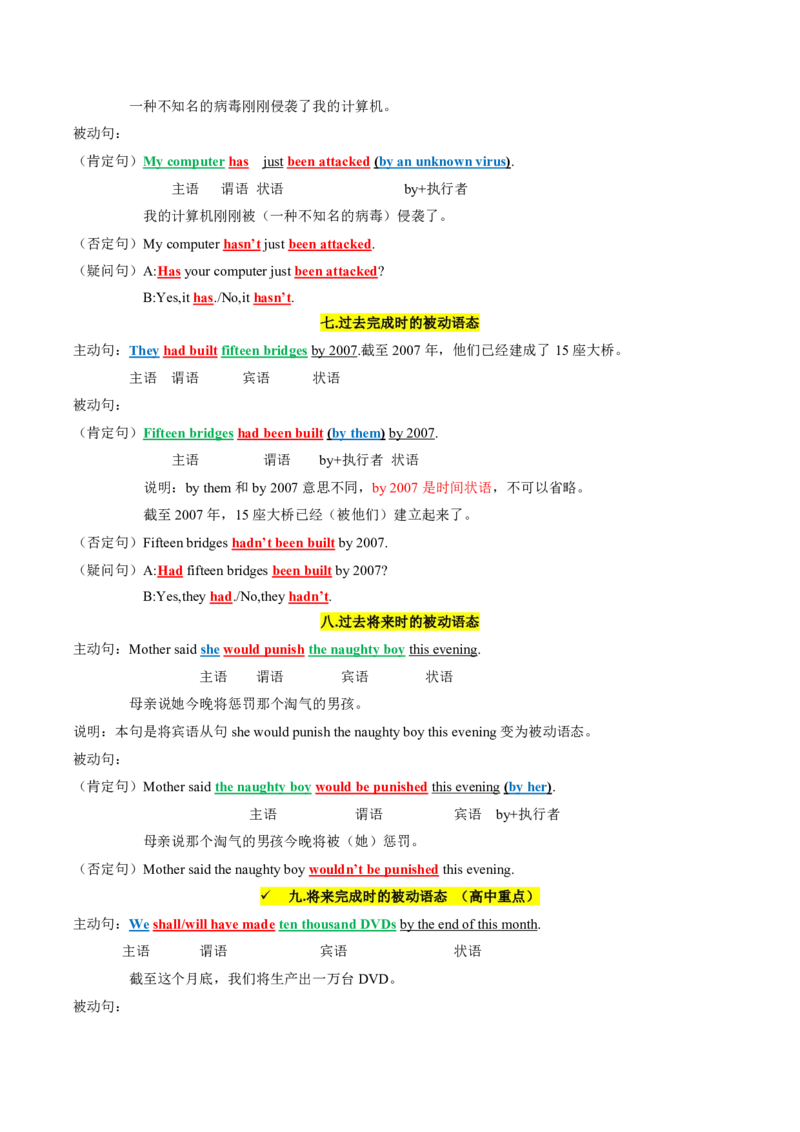
一种不知名的病毒刚刚侵袭了我的计算机。
被动句:
(肯定句)My computer has
just been attacked (by an unknown virus).
主语
谓语状语
by+执行者
我的计算机刚刚被(一种不知名的病毒)侵袭了。
(否定句)My computer hasn’t just been attacked.
(疑问句)A:Has your computer just been attacked?
B:Yes,it has./No,it hasn’t.
七.过去完成时的被动语态
主动句:They had built fifteen bridges by 2007.截至2007 年,他们已经建成了15 座大桥。
主语
谓语
宾语
状语
被动句:
(肯定句)Fifteen bridges had been built (by them) by 2007.
主语
谓语
by+执行者状语
说明:by them 和by 2007 意思不同,by 2007 是时间状语,不可以省略。
截至2007 年,15 座大桥已经(被他们)建立起来了。
(否定句)Fifteen bridges hadn’t been built by 2007.
(疑问句)A:Had fifteen bridges been built by 2007?
B:Yes,they had./No,they hadn’t.
八.过去将来时的被动语态
主动句:Mother said she would punish the naughty boy this evening.
主语
谓语
宾语
状语
母亲说她今晚将惩罚那个淘气的男孩。
说明:本句是将宾语从句she would punish the naughty boy this evening 变为被动语态。
被动句:
(肯定句)Mother said the naughty boy would be punished this evening (by her).
主语
谓语
宾语
by+执行者
母亲说那个淘气的男孩今晚将被(她)惩罚。
(否定句)Mother said the naughty boy wouldn’t be punished this evening.
九.将来完成时的被动语态(高中重点)
主动句:We shall/will have made ten thousand DVDs by the end of this month.
主语
谓语
宾语
状语
截至这个月底,我们将生产出一万台DVD。
被动句:
(肯定句)Ten thousand DVDs will have been made (by us) by the end of this month.
主语
谓语
by+执行者
状语
截至这个月底,一万台DVD 将被(我们)生产出来。
(否定句)Ten thousand DVDs won’t have been made by the end of this month.
(疑问句)A:Will ten thousand DVDs have been made by the end of this month?
B:Yes,they will./No,they won’t.
十.过去将来完成时的被动语态
主动句:He said he would have learned many words by 2012.
主语
谓语
宾语
状语
他说到2012 年时他将要学会许多单词。
被动句:He said many words would have been learned (by him) by 2012.
主语
谓语
状语
他说到2012 年时,许多单词将被(他)学会。
十一.不可用被动语态的时态
完成进行时态和将来进行时态一般都没有被动语态,如果要用这两种时态表达被动语态的意思,则可以用
完成时态或一般时态。
1.完成进行时变为被动语态时,要用完成时表示
主动句:现在完成进行时
The builders have been building this skyscraper for two months.
主语
谓语
宾格
状语
建筑工人修建这幢摩天大楼已两个月了。
被动句:现在完成时
This skyscraper has been built for two months.这幢摩天大楼一直修建有两个月了。
主语
谓语
状语
注意:由于be,being 和been 三个词中的任何两个词都不可以用在一起,因此将来进行时(shall/will be doing)
和各种完成进行时(have/has/had been doing,shall/will have been doing)的被动语态几乎是不能用的。
主动句:将来完成进行时
We will have been using this book for three years by next June.
主语
谓语
宾语
状语
到明年6 月,我们用这本书已经3 年了。
被动句:将来完成时
The book will have been used for three years by next June.
主语
谓语
状语
到明年6 月,这本书就用了3 年了。
2.将来进行时变为被动语态时,要用一般将来时表示
主动句:将来进行时
You will be doing the experiment here at this time next Monday.
主语
谓语
宾语
状语
下周一的这个时候,你将正在这儿做实验。
被动句:一般将来时
The experiment will be done here at this time next Monday.
主语
谓语
状语
这个实验下周一的这个时候将在这儿做。
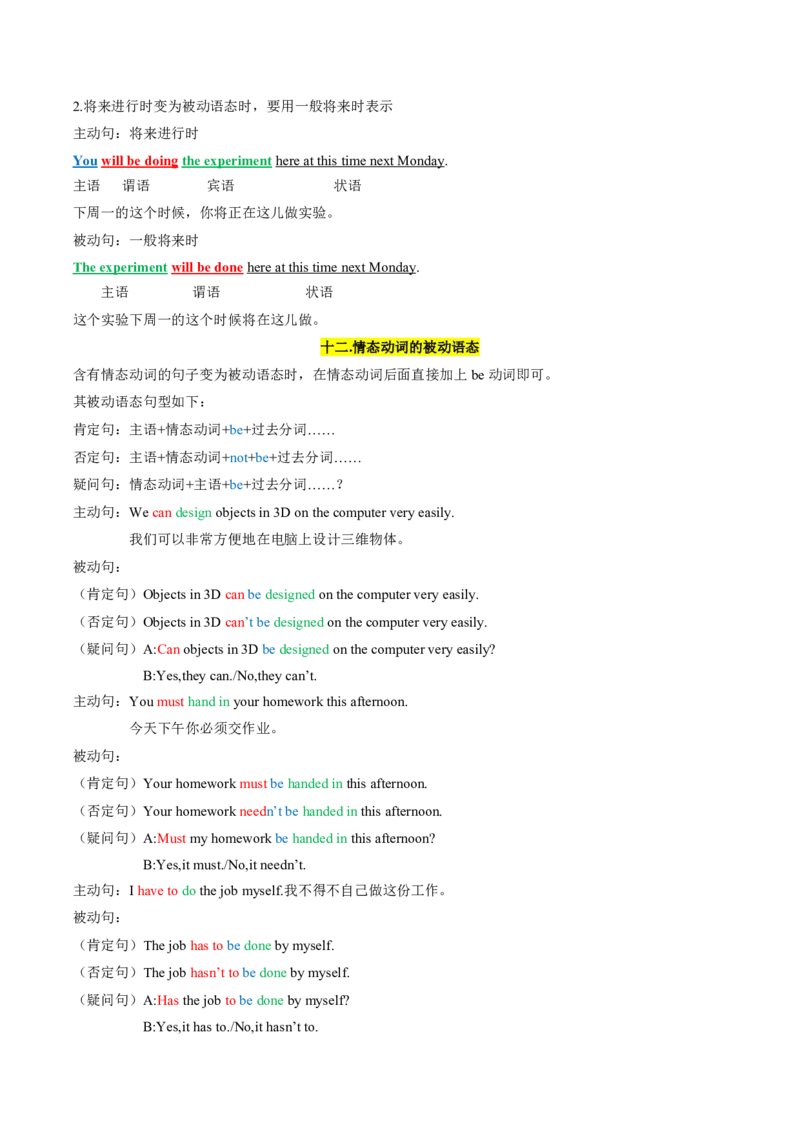
十二.情态动词的被动语态
含有情态动词的句子变为被动语态时,在情态动词后面直接加上be 动词即可。
其被动语态句型如下:
肯定句:主语+情态动词+be+过去分词……
否定句:主语+情态动词+not+be+过去分词……
疑问句:情态动词+主语+be+过去分词……?
主动句:We can design objects in 3D on the computer very easily.
我们可以非常方便地在电脑上设计三维物体。
被动句:
(肯定句)Objects in 3D can be designed on the computer very easily.
(否定句)Objects in 3D can’t be designed on the computer very easily.
(疑问句)A:Can objects in 3D be designed on the computer very easily?
B:Yes,they can./No,they can’t.
主动句:You must hand in your homework this afternoon.
今天下午你必须交作业。
被动句:
(肯定句)Your homework must be handed in this afternoon.
(否定句)Your homework needn’t be handed in this afternoon.
(疑问句)A:Must my homework be handed in this afternoon?
B:Yes,it must./No,it needn’t.
主动句:I have to do the job myself.我不得不自己做这份工作。
被动句:
(肯定句)The job has to be done by myself.
(否定句)The job hasn’t to be done by myself.
(疑问句)A:Has the job to be done by myself?
B:Yes,it has to./No,it hasn’t to.
注意:对这句话的回答不能写为:(误)B:Yes,it has.(误)B:No,it hasn’t.
主动句:All of us ought to obey the rule.我们所有的人都应该遵守这项制度。
被动句:
(肯定句)The rule ought to be obeyed (by all of us).
(否定句)The rule ought not be obeyed (by all of us).
(疑问句)A:Ought the rule to be obeyed (by all of us)?
B:Yes,it ought to./No,it oughtn’t to.
一、单句语法填空
1.Great progress
(make) in rural areas since the strategy was put forward. (所给词的适当形式填
空)
【答案】has been made
【详解】句意:自从该战略提出以来,农村地区取得了巨大进步。由时间状语since the strategy was put forward
可知,用现在完成时;且主语great progress 与make 之间为被动关系,用现在完成时的被动语态;主语great
progress 为不可数名词,谓语用has been made。
2.The new evidence must
(admit) before the final judgment is made. (所给词的适当形式填空)
【答案】be admitted
【详解】句意:在做出最终判决之前,新的证据必须被采纳。主语The new evidence 与动词admit 之间是
被动关系;情态动词must 后接动词原形,被动结构为must be + 过去分词。
3.The seeds that
in spring by the farmers usually bring in a good harvest in autumn. (sow) (所给词的适
当形式填空)
【答案】are sown
【详解】句意:农民们春天播种下的种子,往往在秋天迎来丰收。空处为定语从句的谓语,陈述客观事实,
使用一般现在时,主语that,指代复数名词the seeds,与sow“播种”为被动关系,需用被动语态,主语为复
数,be 动词用are,sow 的过去分词为sown。
4.Tom was
(admit) into Peking University. (所给词的适当形式填空)
【答案】admitted
【详解】句意:汤姆被北京大学录取了。主语与谓语构成被动关系,结合上文Tom was 可知为一般过去时
的被动语态。
5.This problem
(solve) already, so we don’t need to discuss it again. (所给词的适当形式填空)
【答案】has been solved
【详解】句意:这个问题已经解决,所以我们不需要再讨论它了。根据副词already 可知,空处应使用现在
完成时,表示动作对现在的影响;solve 与单数主语This problem 之间为被动关系,应使用被动词态,因此
空处应填入现在完成时被动语态has been solved。
6.Though he
(punish) for being late yesterday, he was late for school again this morning. (所给词的适
当形式填空)
【答案】was punished
【详解】句意:尽管他昨天因为迟到受到了惩罚,今天早上他上学又迟到了。主语he 与动词punish 之间为
被动关系,且时间状语yesterday 表明动作发生在过去,因此用一般过去时的被动语态was punished。
7.Tu Youyou
(award) a Nobel Prize for her discovery of artemisinin.
【答案】
was
awarded
【详解】句意:屠呦呦因发现青蒿素而被授予诺贝尔奖。此处描述的是过去发生的事情,且主语Tu Youyou
与award 之间是被动关系,应用一般过去时的被动语态,主语Tu Youyou 是单数,be 动词用was。
8.Many old buildings
(repair) now to protect the local culture. (所给词的适当形式填空)
【答案】are being repaired
【详解】句意:许多古建筑如今正在被修缮,以保护当地文化。now 与现在进行时连用,主语buildings 与
repair 是被动关系,应用现在进行时的被动语态:am/is/are being done;且主语buildings 复数,用are being
repaired。
9.As high school students, we
(expect) to obey school rules and respect our teachers. (所给词的适当形
式填空)
【答案】are expected
【详解】句意:作为高中生,我们被要求遵守校规、尊敬师长。设空处为谓语,主语we 与动词expect 之间
为被动关系,应用被动语态;句子陈述客观事实,用一般现在时,主语为we,be 动词用are,expect 的过
去分词为expected。
10.The new comedy
(put) on during the art festival next month. (所给词的适当形式填空)
【答案】will be put
【详解】句意:这部新喜剧将于下个月艺术节期间上演。此处为谓语动词,根据句意以及时间状语next month
可知,此处为一般将来时,The new comedy 与put on 为被动关系,所以此处用一般将来时的被动语态,所
以谓语动词为will be put。
11.The new food festival
(promote) through social media from tomorrow. (所给词的适当形式填空)
【答案】will be promoted
【详解】句意:这场新的美食节从明天起将通过社交媒体进行宣传。此处为谓语动词,时间状语from tomorrow
表将来,The new food festival 与promote 为被动关系,因此使用一般将来时的被动语态,所以谓语动词为
will be promoted。
12.The room
(clean) by my sister at the moment. (所给词的适当形式填空)
【答案】is being cleaned
【详解】句意:此刻我姐姐正在打扫房间。at the moment 与现在进行时连用;且room 和clean 是被动关系,
应用现在进行时的被动语态,基本结构为:am/is/are + being done,表示“正在被”,主语是名单数,be 动词
使用is。
13.The problem
(discuss) at the meeting right now. (所给词的适当形式填空)
【答案】is being discussed
【详解】句意:此刻会议上正在讨论这个问题。right now 与现在进行时连用;且problem 和discuss 是被动
关系,应用现在进行时的被动语态,基本结构为:am/is/are + being done,表示“正在被”。
14.The manager said the project
(complete) by the end of the month. (所给词的适当形式填空)
【答案】would be completed
【详解】考查时态语态。句意:经理表示,该项目将于本月底完工。主句said 为一般过去时,project 与complete
是被动关系,由by the end of the month 可知,句子用过去将来时的被动结构would be done。故填would be
completed。
15.All the money we got from this activity would be
(donate) to charity. (所给词的适当形式填空)
【答案】donated
【详解】考查语态。句意:我们从这次活动中获得的所有资金都将捐赠给慈善机构。主语与谓语构成被动
关系,结合上文would be 可知为过去将来时的被动语态。故填donated。
16.The customer suggested that the package
(deliver) before noon. (所给词的适当形式填空)
【答案】should be delivered/be delivered
【详解】句意:这位顾客建议包裹在中午之前送达。此处suggest 表示建议,其后宾语从句要用虚拟语气,
从句谓语用“(should)+动词原形”,主语the package 与deliver为被动关系,所以谓语动词为(should) be delivered。
17.The incredible backflip must
(practice) thousands of times. (所给词的适当形式填空)
【答案】have been practiced
【详解】句意:这个绝妙的后空翻必定已经练习过数千次了。此处为谓语动词,根据句意,此处表示对过
去事情的肯定推测,动作早已完成,backflip 与practice 为被动关系,情态动词must 后用完成式的被动形式,
即have been practiced。
18.The doctor, together with his colleagues,
(appoint) to lead the medical team next month. (所给词的
适当形式填空)
【答案】will be appointed
【详解】句意:这位医生将与他的同事们一起,于下个月被任命为医疗团队的负责人。由next month 可知,
句子时态是一般将来时,The doctor, together with his colleagues 和appoint 之间是逻辑动宾关系,因此空格处
用一般将来时的被动语态will be appointed。
19.He
(equip) with rich experience and a calm mind, which helped him overcome various difficulties.
(所给词的适当形式填空)
【答案】was equipped
【详解】句意:他具备丰富的经验和冷静的头脑,这帮助他克服了各种困难。固定搭配be equipped with,
表示“配备有;具备”;由后文helped 可知,句子使用一般过去时表示过去的情况,主语He 为单数,be 动
词应用was。
20.All at once, the sky
(cover) with dark clouds and we were in a terrible storm. (所给词的
适当形式填空)
【答案】
was
covered
【详解】句意:突然,天空被乌云笼罩,我们遭遇了一场可怕的风暴。由后句were 可知,此处描述的是过
去发生的事情,应用一般过去时,且主语the sky 与cover 之间是被动关系,应用被动语态,主语the sky 是
单数,be 动词用was。
二、完成句子
21.到目前为止,我们城市许多老房子已被修缮。
Many old houses ________ ________ ________ in our city so far.
【答案】
have
been
repaired/restored
【详解】设空处为谓语,主语houses 与修缮为被动关系,结合标志词so far 可知用现在完成时的被动语态
have been done,结合句意“修缮”可用repair 或restore,主语复数,助动词用have。
22.火灾被认为是从楼上的一个房间里开始燃起的。(be thought to have done sth. )
The fire_____________ in an upstairs room.
【答案】is thought to have started
【详解】根据句意可知,此处意为“被认为是……燃起的”,根据所给要求“be thought to have done sth”可知,
应表达为is thought to have started,在句中作谓语动词,主语为The fire,为单数,且此处陈述客观事实,故
应用一般现在时is thought to have started。
23.这个团队由五名成员组成。
The team is _____________ _____________ of five members.
【答案】
made
up
【详解】be made up of...是固定短语,意为“由……组成”。
24.她的时间全被她的三个孩子占用了。
Her time ____________________ her three children.
【答案】is fully occupied with
【详解】考查动词短语。中英文句子对比可知,空处应填“全被……占用了”,可用短语be fully occupied with,
句子描述的是客观事实,应用一般现在时,主语her time 为不可数名词,be 动词应用is。
25.近年来,社交媒体对青少年的影响引起了广泛关注。
In recent years, ________ ________about the impact of social media on teenagers
【答案】
widespread concern
has been raised
【详解】“广泛的关注”用名词短语widespread concern,作主语,“引起”用动词raise,结合时间状语in rencent
years 可知,句子应用现在完成时,主语和raise 是被动关系,应用被动语态have/has been raised,concern 不
可数,助动词用has。
26.电影结束时,每个人都已感动得热泪盈眶。
By the end of the film, everyone ________________ to tears.
【答案】had been moved
【详解】句意:到电影结束时,每个人都已感动得热泪盈眶。“by the end of + 过去时间”表示“到过去某个时
间为止”,常与过去完成时连用。everyone 与move 之间是被动关系,即“每个人被感动”,所以要用过去完
成时的被动语态。过去完成时的被动语态结构为“had been + 过去分词”,move 的过去分词是moved,所以
填had been moved。
27.这部兼具思想性与影响力的著作,被公认为环保领域的一座重要里程碑。(regard)
This insightful and influential book ________________ in the field of environmental protection.
【答案】is widely regarded as a crucial milestone
【详解】“被公认是……”用短语be widely regarded as,句子陈述客观事实,用一般现在时,主语book 是第
三人称单数,be 用is。“一座重要的里程碑”用a crucial milestone 作宾语。
28.现在机器人被广泛应用于工厂的许多重复性任务中,这大大减轻了工人的工作负担。
Robots ________ many repetitive tasks in factories now, ________ has greatly reduced workers’ workload.
【答案】
are employed in
which
【详解】“被应用于”为“be employed in”,句子描述现在的情况,用一般现在时,主语Robots 是复数,所以
用are employed in,在句中作谓语;第二个空引导非限制性定语从句,指代前面整个句子Robots are employed
in many repetitive tasks in factories now,在从句中作主语,用关系代词which 引导该从句。
29.这座历史建筑已矗立了三百余年,至今仍保存完好。
The historical building has stood for over 300 years and ________.
【答案】is still well preserved
【详解】根据汉语提示可知,此处表示“至今仍被完好保存”,“保存”用动词preserve,在句中作谓语,此处
陈述一般事实,所以用一般现在时,且该动词和主语之间为被动关系,所以需用一般现在时的被动语态,
主语The historical building 为单数,be 动词用is,“完好”用副词well,修饰动词preserve,“仍然”用副词still。
30.我学到的是成长的真正意义,从那时起我被激励要更加努力学习。(inspire)
I learned the true meaning of growing up and from then on I ________________.
【答案】was inspired to work harder
【详解】空处为“被激励要更加努力学习”;“激励”用动词inspire 表示,inspire sb. to do sth.意为“激励某人做
某事”,本句中I 和inspire 之间是被动关系,且learned 表明事情发生在过去,inspire 用一般过去时的被动
语态was inspired。“更加努力学习”用work harder,用动词不定式作补语。
三、语篇填空(被动语态专练)
"Great things take time," my teacher told me when I was refused. "If you keep trying, you
1
(praise) for
your hard work sooner or later."
After I finished high school, I planned to work as a part-time journalist. My articles
2
(submit) to three
local newspapers, but none of them was accepted. I felt upset, but my teacher encouraged me not to give up.
One week later, a short story I wrote
3
(choose) by a magazine. I was so excited! From then on, I kept
writing every day. More works
4
(publish) one after another. Up to now, I
5
(offer) chances to write for
several famous platforms. Last month, I
6
(invite) to write a column for a well-known newspaper.
Now I often tell my friends: "If you stick to your dream, you
7
(support) by those around you. Every
effort you make
8
(notice) finally. Even if you
9
(laugh) at now, don’t lose heart. Success
10
(achieve) by those who never stop trying."
【导读】
本文讲述了作者坚持写作梦想,从被拒绝到成功获得专栏写作机会的励志故事,考查一般现在、
一般过去、一般将来、现在完成时的被动语态。
1.
will be praised
if 条件状语从句遵循主将从现,主语you 与praise 为被动关系,表示“你终将因努
力被表扬”,用一般将来时被动语态。
2.
were submitted
主语articles 与submit 为被动关系,全文以过去时为主,复数主语用were,意为“稿
件被投递”,填were submitted。
3.
was chosen
主语story 与choose 为被动关系,过去时态,单数主语用was,表“短篇小说被选中”,
填was chosen。
4.
were published
主语works 与publish 为被动关系,描述过去经历,复数主语用were,意为“作品
被发表”,填were published。
5.
have been offered
时间状语up to now(到目前为止)是现在完成时标志,主语I 与offer 为被动关
系,用现在完成时被动语态,表“我已被给予机会”。
6.
was invited
last month 为过去时间,主语I 与invite 为被动关系,用一般过去时被动语态,意为“我
被邀请写专栏”,填was invited。
7.
will be supported
if 条件句主将从现,主语you 与support 为被动关系,表“你会被身边人支持”,
用一般将来时被动语态。
8.
will be noticed
主语effort 与notice 为被动关系,finally 表将来,意为“努力终将被看见”,用一般
将来时被动语态。
9.
are laughed
now 表示一般现在时,固定搭配be laughed at(被嘲笑),主语you 对应are,填are
laughed。
10. is achieved
陈述客观真理,主语success 与achieve 为被动关系,不可数名词用is,意为“成功由坚
持者获得”,填is achieved。
一、语法填空
阅读下面短文,在空白处填入1 个适当的单词或括号内单词的正确形式。
The giant panda
1
(love) by people throughout the world. Chinese scientists
2
(recent) had
a chance to study a wild female panda with a newborn baby. She was a very
3
(care) mother. For 25days,
she never left her baby, not even to find something
4
(eat)! She would not let any other pandas come near.
She licked the baby constantly to keep it clean. Any smell might attract natural
5
(enemy) that would try to
eat the little comforting panda. The mother held the baby in her front paws much the way a human does.
6
it cried, she rocked it back and forth and gave it little comforting pats. The mother continued to care for the young
panda
7
more than two years. By that time, the panda no longer needed
8
(it) mother for food.
However, it stayed with her and learned about the ways of the forest. Then, after two and a half years, the mother
9
(drive) the young panda away. It was time for her to have a new baby,
10
it was also time for the
young panda to be independent.
【答案】
1 .is loved
2 .recently
3 .caring/careful
4 .to eat
5 .enemies
6 .When/If
7.for
8.its
9.drove
10.and
【分析】文章是记叙文。主要讲述了中国科学家对大熊猫的观察和研究。
1.考查被动语态。句意:大熊猫深受全世界人民的喜爱。panda 与love 之间处于被动关系。根据题意和介
词by,故填is loved。
2.考查副词。句意:中国科学家最近有机会研究一只野生雌性熊猫和一个刚出生的小熊猫。副词作状语。
根据题意,故填recently。
3.考查形容词。句意:她是个非常细心的母亲。修饰名词mother 且由副词very 修饰用形容词。根据题意,
故填caring/careful。
4.考查动词不定式。句意:25 天来,她从未离开过她的孩子,甚至不去找吃的!动词不定式作定语修饰
something。根据题意,故填to eat。
5.考查名词复数。句意:任何气味都会吸引那些试图去抓小熊猫的天敌。天敌不止一个,故应使用名词复
数。根据题意,故填enemies。
6.考查状语从句。句意:当/如果小熊猫哭时,她来回摇晃着,轻轻拍小熊猫。when 引导时间状语,或由
if 引导条件状语从句。根据题意,故填when/if。
7.考查介词。句意:这位母亲继续照顾这只小熊猫两年多。for+时间段(表示一段时间)。根据题意,故
填for。
8.考查形容词性物主代词。句意:到那时,熊猫不再需要它的妈妈找来吃的。根据句意,修饰名词mother
用形容词性物主代词,故填its。
9.考查动词时态。句意:两年半后,母亲会把小熊猫赶走。文章使用一般过去时描述事情,根据题意,故
填drove。
10.考查连词。句意:现在是她生孩子的时候了,也是小熊猫独立的时候了。前后为并列句,根据题意,
故填and。
二、阅读理解
A
People with fixed mindsets believe that:●Skill,
intelligence and talents are natural.
●Failure is shameful and should be avoided.
●Some people are naturally good at things while
others not.
●You are not in control of your abilities.
People with growth mindsets believe
that:●You have the capacity to learn and
grow your skills.
●Failure is a valuable lesson.
●People who are good at something are
good because they build that ability.
●You are in control of your abilities.
have a desire to look smart, so tend to:—Avoid
challenges.
—Give up easily.
—See effort as fruitless or worse.
—Ignore useful negative feedback.
—Feel threatened by the success of others.
have a desire to learn, so tend
to:—Embrace challenges.
—Persist in the face of setbacks.
—See effort as the path to mastery.
—Learn from criticism.
—Find lessons and inspiration in the
success of others.
As a result, they may stay at the same level
early and achieve less than their full potential.
As a result, they reach ever-higher levels
of achievement.
Change can be tough, but I’ve never heard anyone say it wasn’t worth it. Did changing to
a growth mindset solve all my problems? No. But I know that I have a different life
because of it—a richer one.
11.The book “mindset” is intended to _________.
A.tell readers that two different mindsets lead to different results
B.illustrate that people with different mindsets hold different beliefs
C.help readers believe people act differently when facing challenges
D.persuade people to learn to change so as to enjoy a more fruitful life
12.Generally speaking, people with fixed mindsets are mostly _________.
A.successful
B.straightforward
C.intelligent
D.narrow-minded
13.A person with a growth mindset is likely to say _________.
A.“If I win, I’ll be somebody; if I lose, I’ll be nobody.”
B.“To be good at sports, you need to be naturally gifted.”
C.“Learn techniques and skills and practice them regularly, and you will always improve.”
D.“You have a certain level of ability in sports and you cannot really do much to change it.”
【答案】11.D
12.D
13.C
【导语】文章主要介绍了“mindset”这本书。
【详解】11.推理判断题。根据文中两个表格内容“People with fixed mindsets believe that(固定心态的人认为)”
和“People with growth mindsets believe that(拥有成长型心态的人相信)”可知,本文通过两种不同心态的人进
行对比,最后得出结论,根据表格最后“Change can be tough, but I’ve never heard anyone say it wasn’t worth it.
Did changing to a growth mindset solve all my problems? No. But I know that I have a different life because of
it—a richer one.(改变是艰难的,但我从未听任何人说不值得。转变成长型思维模式能解决我所有的问题吗?
不。但我知道,我有一个不同的生活,因为它——一个更丰富的生活)”可知,《心态》一书的目的是说服人
们学会改变,才能享受更丰硕的人生。
12.推理判断题。根据表格中间左边部分have a desire to look smart, so tend to 下的“Feel threatened by the
success of others.(对他人的成功感到威胁)”可推知,固定心态的人一般是心胸狭窄的。
13.推理判断题。根据表格上面右边部分People with growth mindsets believe that 下的“You have the capacity to
learn and grow your skills.(你有能力学习和提高自己的技能)”以及中间部分have a desire to learn, so tend to 下
的“See effort as the path to mastery.(把努力看作是通往精通的道路)”结合选项可推知,C 项“Learn techniques
and skills and practice them regularly, and you will always improve.(学习技术和技巧,并经常练习,你就会不断
进步)”是一个拥有成长型思维模式的人可能会说的。
B
A video of a German man named Uwe Brutzer who opened a bakery (面包店) in China using workers with
hearing disability (残疾) spread on social media on Tuesday, touching many Chinese netizens. The video has had
over 30,000 comments and over 110 million views. After the video was published, Brutzer’s bakery was soon
crowded with people all over the country.
Born in Germany, Uwe Brutzer and his wife came to China as part of a program by Hunan Disabled Person’s
Federation to help children with hearing disability in 2002. “I was looking for a chance to help disabled people and
I saw this program,” said Brutzer.
They decided to stay after spending some time with children here. To better help children in need, they learned
Chinese sign language. Then they decided to open a store. “At first we sold flowers. Then we found that a bakery
might be a better choice because we could make more money. So we opened this one in 2011. I hired a professional
German baker and invited her to China to teach my students for four years,” Brutzer said. A child they helped years
ago is now one of the workers in the bakery.
The cut in income was the biggest challenge for Brutzer during the COVID-19 outbreak. He had to close the
store for safety reasons but he still paid all the workers as usual.
“I want to stay in China as long as I can and teach more and more disabled people so that they can make a living
here.” Brutzer added.
14.How did so many people learn about the bakery?
A.From a TV program.
B.From the chat of local people.
C.Through a video on social media.
D.From the comments of customers.
15.What did the children in the store learn?
A.Sign language.
B.Baking skills.
C.Performing art.
D.Planting flowers.
16.What does the underlined word “cut” in Paragraph 4 probably mean?
A.Share.
B.Wound.
C.Reduction.
D.Disappearance.
17.Which of the following best describes Brutzer?
A.Talented and frank.
B.Caring and generous.
C.Brave and humorous.
D.Confident and responsible.
【答案】14.C
15.B
16.C
17.B
【导语】文章讲述德国友人布鲁策来华帮扶听障群体,开办面包店传授烘焙手艺,疫情停业仍照发工资,
立志留在中国帮助更多残疾人谋生。
【详解】14.细节理解题。根据第一段“A video of a German man named Uwe Brutzer who opened a bakery (面
包店) in China using workers with hearing disability (残疾) spread on social media on Tuesday, touching many
Chinese netizens.(周二,一段德国男子乌韦・布鲁策在中国开办雇佣听障员工面包店的视频在社交媒体上走红,
感动了众多中国网友。)”可知,人们是通过社交媒体上的视频了解到这家面包店的。
15.细节理解题。根据第三段“I hired a professional German baker and invited her to China to teach my students
for four years,(我聘请了一位专业的德国烘焙师来到中国,教我的学生长达四年)”可知,店里的孩子们学习的
是烘焙技艺。
16.词句猜测题。根据第四段“The cut in income was the biggest challenge for Brutzer during the COVID-19
outbreak. He had to close the store for safety reasons but he still paid all the workers as usual.(疫情期间,收入cut
是布鲁策面临的最大挑战。他因安全原因不得不停业,但依旧照常给员工发工资。)”可知,这里指收入减少
也照常给员工发工资,所以cut 此处意为“减少”,与Reduction 同义。
17.推理判断题。根据第二段“I was looking for a chance to help disabled people and I saw this program,(我一直
想找机会帮助残疾人,然后看到了这个项目,)”以及第四段“He had to close the store for safety reasons but he
still paid all the workers as usual.(他因安全原因不得不停业,但依旧照常给员工发工资。)”可知,布鲁策心地
善良、关爱他人且慷慨大方。