高中英语语法核心知识点详解(讲义)
Part 15 语态篇 Voices
15.1

被动语态的构成Formation of the Passive Voice
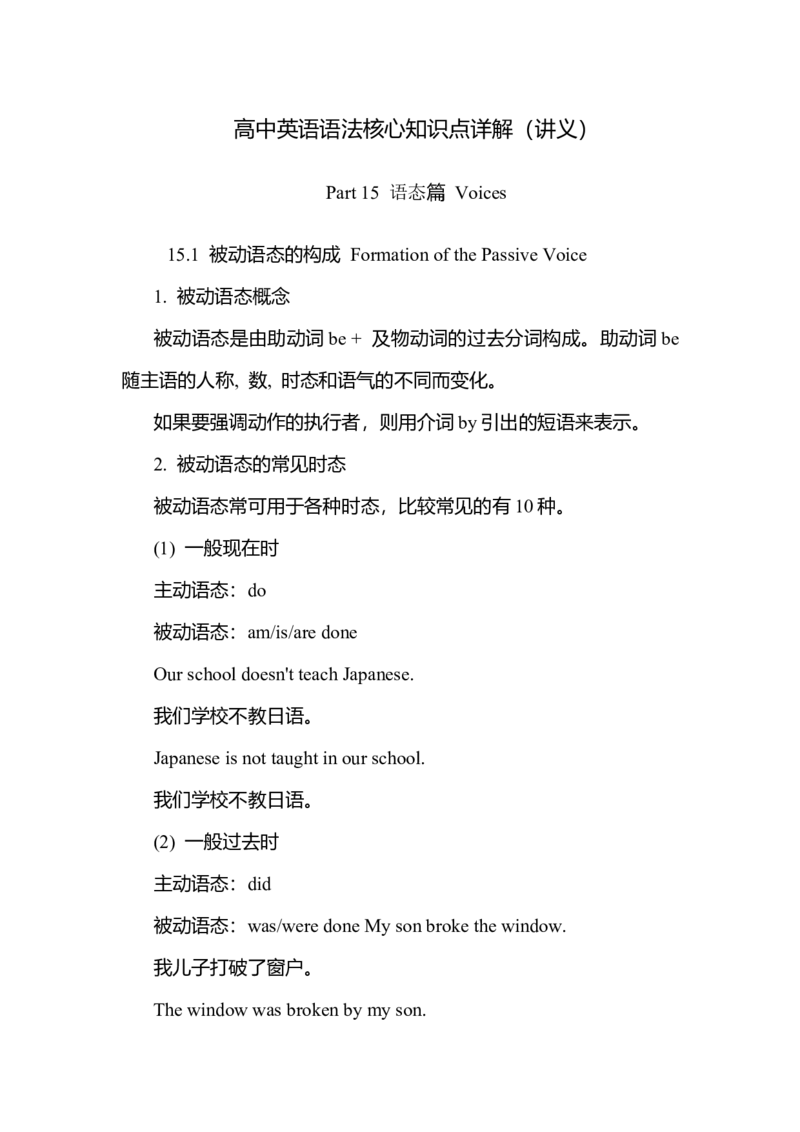
1. 被动语态概念
被动语态是由助动词be + 及物动词的过去分词构成。助动词be
随主语的人称, 数, 时态和语气的不同而变化。
如果要强调动作的执行者,则用介词by 引出的短语来表示。
2. 被动语态的常见时态
被动语态常可用于各种时态,比较常见的有10 种。
(1) 一般现在时
主动语态:do
被动语态:am/is/are done
Our school doesn't teach Japanese.
我们学校不教日语。
Japanese is not taught in our school.
我们学校不教日语。
(2) 一般过去时
主动语态:did
被动语态:was/were done My son broke the window.
我儿子打破了窗户。
The window was broken by my son.
窗户是我儿子打破的。
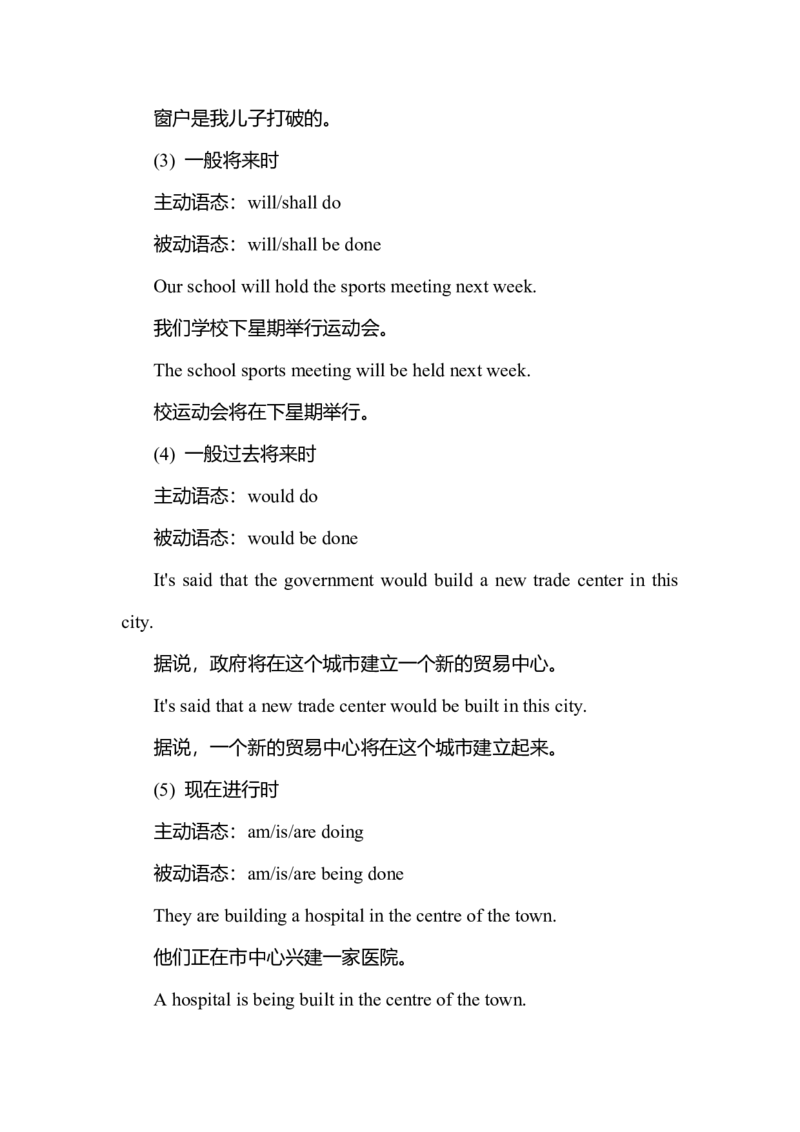
(3) 一般将来时
主动语态:will/shall do
被动语态:will/shall be done
Our school will hold the sports meeting next week.
我们学校下星期举行运动会。
The school sports meeting will be held next week.
校运动会将在下星期举行。
(4) 一般过去将来时
主动语态:would do
被动语态:would be done
It's said that the government would build a new trade center in this
city.
据说,政府将在这个城市建立一个新的贸易中心。
It's said that a new trade center would be built in this city.
据说,一个新的贸易中心将在这个城市建立起来。
(5) 现在进行时
主动语态:am/is/are doing
被动语态:am/is/are being done
They are building a hospital in the centre of the town.
他们正在市中心兴建一家医院。
A hospital is being built in the centre of the town.
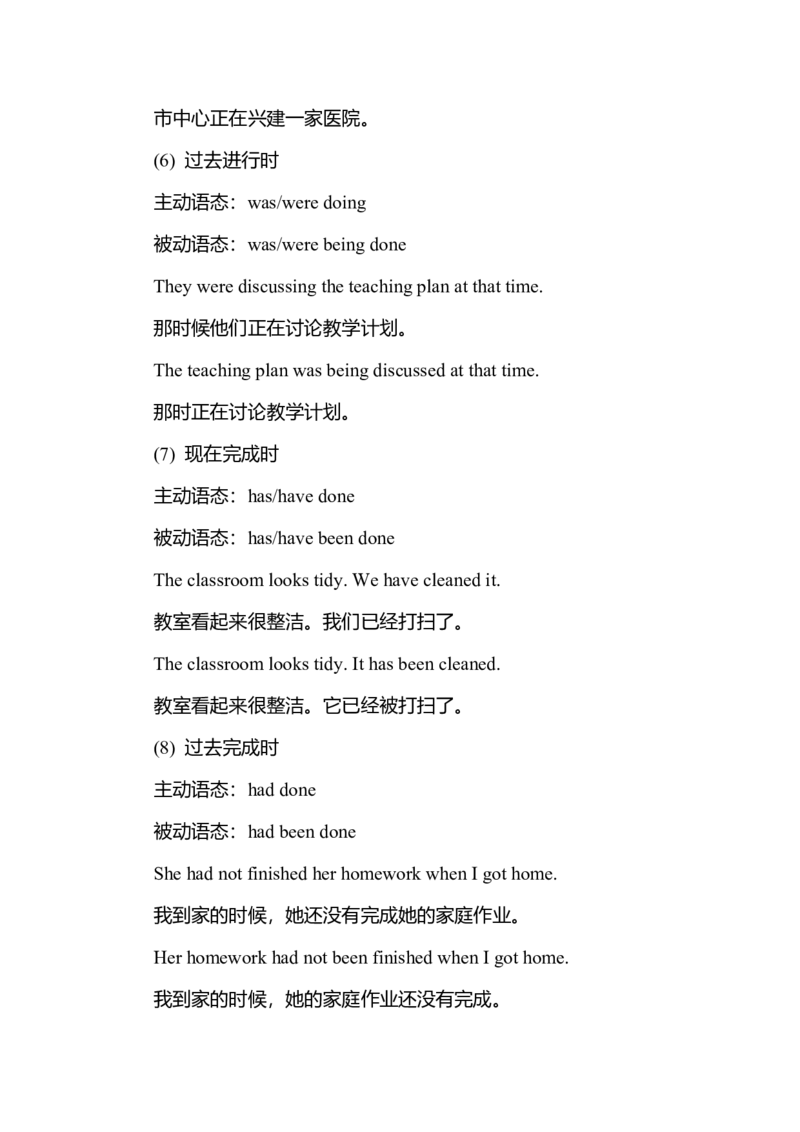
市中心正在兴建一家医院。
(6) 过去进行时
主动语态:was/were doing
被动语态:was/were being done
They were discussing the teaching plan at that time.
那时候他们正在讨论教学计划。
The teaching plan was being discussed at that time.
那时正在讨论教学计划。
(7) 现在完成时
主动语态:has/have done
被动语态:has/have been done
The classroom looks tidy. We have cleaned it.
教室看起来很整洁。我们已经打扫了。
The classroom looks tidy. It has been cleaned.
教室看起来很整洁。它已经被打扫了。
(8) 过去完成时
主动语态:had done
被动语态:had been done
She had not finished her homework when I got home.
我到家的时候,她还没有完成她的家庭作业。
Her homework had not been finished when I got home.
我到家的时候,她的家庭作业还没有完成。
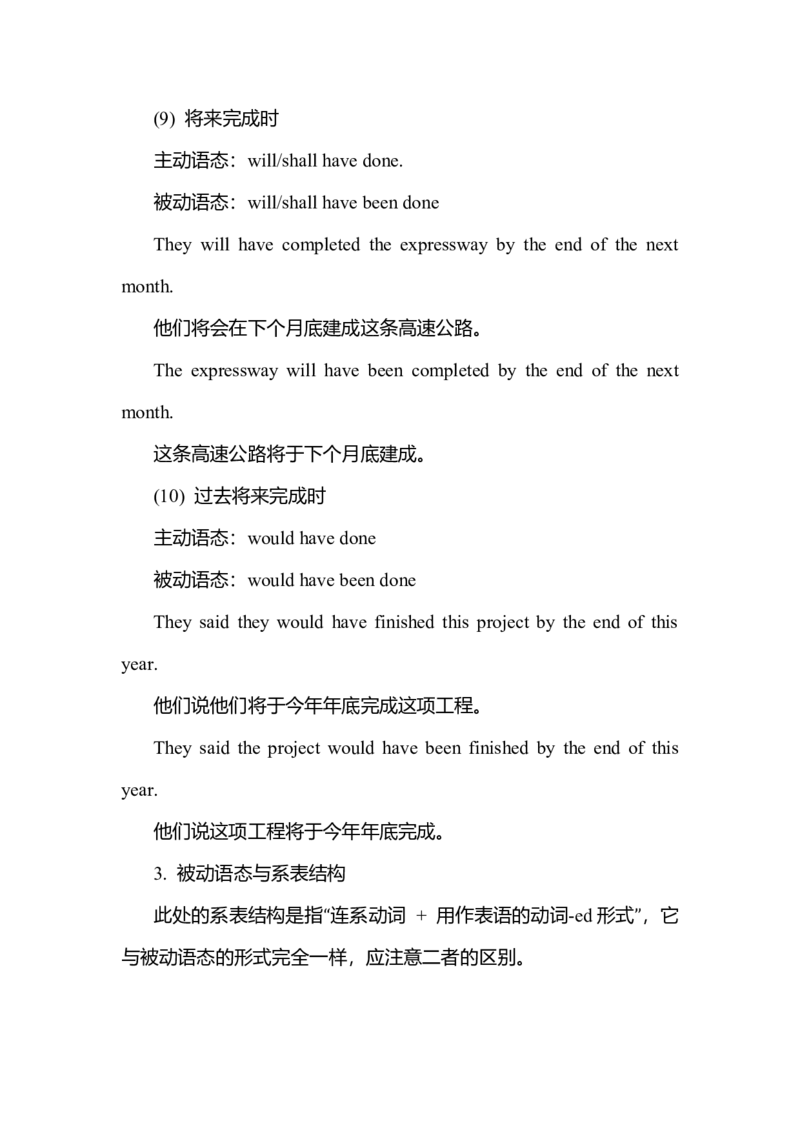
(9) 将来完成时
主动语态:will/shall have done.
被动语态:will/shall have been done
They will have completed the expressway by the end of the next
month.
他们将会在下个月底建成这条高速公路。
The expressway will have been completed by the end of the next
month.
这条高速公路将于下个月底建成。
(10) 过去将来完成时
主动语态:would have done
被动语态:would have been done
They said they would have finished this project by the end of this
year.
他们说他们将于今年年底完成这项工程。
They said the project would have been finished by the end of this
year.
他们说这项工程将于今年年底完成。
3. 被动语态与系表结构
“

此处的系表结构是指连系动词+ 用作表语的动词-ed
”
形式,它
与被动语态的形式完全一样,应注意二者的区别。
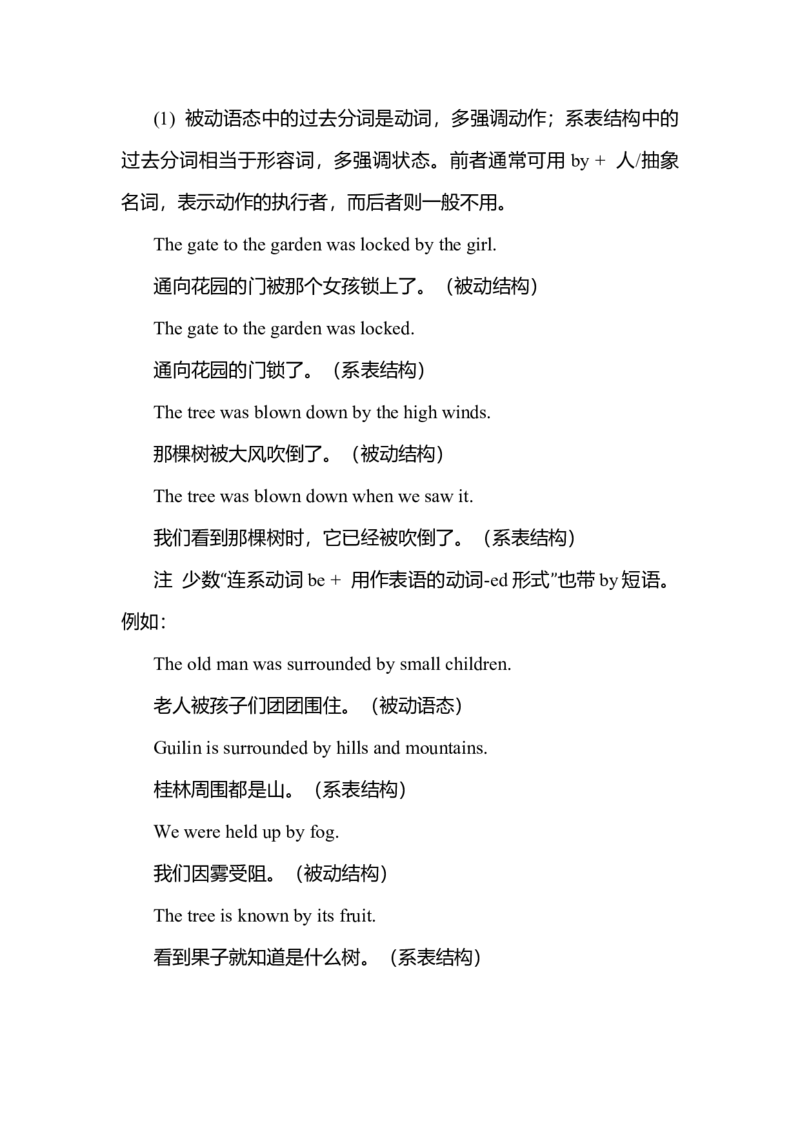
(1) 被动语态中的过去分词是动词,多强调动作;系表结构中的
过去分词相当于形容词,多强调状态。前者通常可用by + 人/抽象
名词,表示动作的执行者,而后者则一般不用。
The gate to the garden was locked by the girl.
通向花园的门被那个女孩锁上了。(被动结构)
The gate to the garden was locked.
通向花园的门锁了。(系表结构)
The tree was blown down by the high winds.
那棵树被大风吹倒了。(被动结构)
The tree was blown down when we saw it.
我们看到那棵树时,它已经被吹倒了。(系表结构)
注
“
少数连系动词be + 用作表语的动词-ed
”
形式也带by 短语。
例如:
The old man was surrounded by small children.
老人被孩子们团团围住。(被动语态)
Guilin is surrounded by hills and mountains.
桂林周围都是山。(系表结构)
We were held up by fog.
我们因雾受阻。(被动结构)
The tree is known by its fruit.
看到果子就知道是什么树。(系表结构)
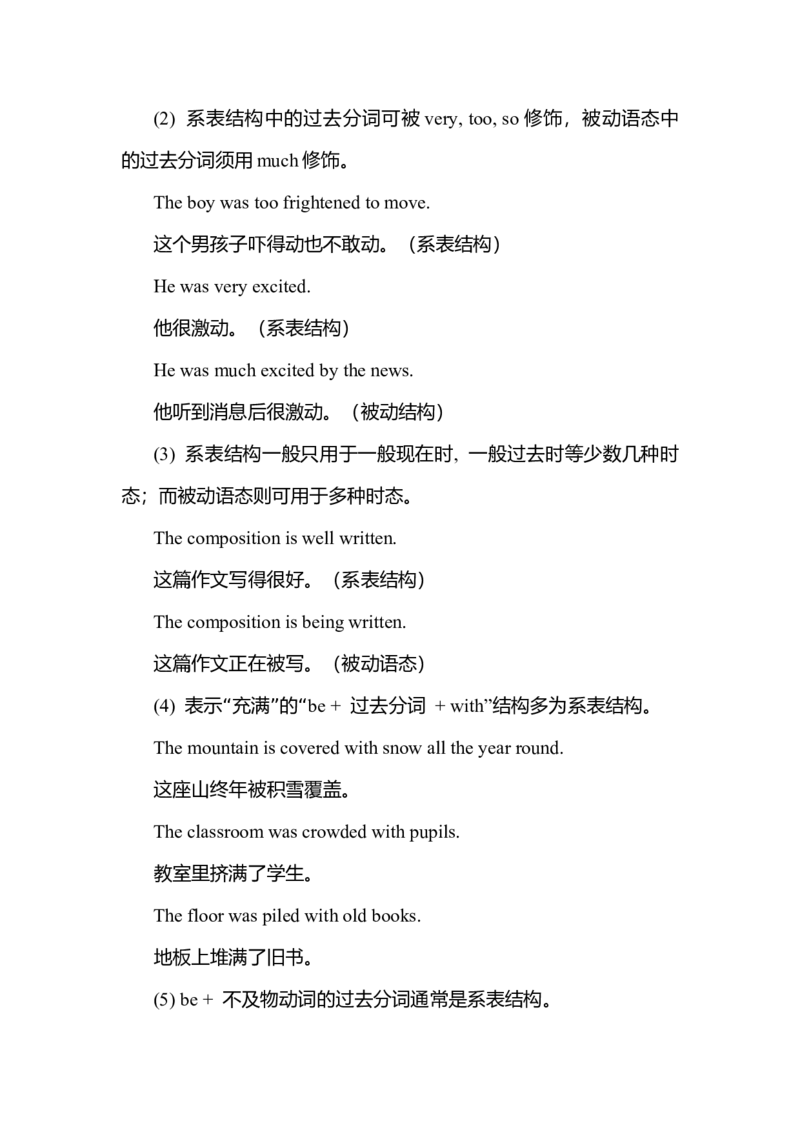
(2) 系表结构中的过去分词可被very, too, so 修饰,被动语态中
的过去分词须用much 修饰。
The boy was too frightened to move.
这个男孩子吓得动也不敢动。(系表结构)
He was very excited.
他很激动。(系表结构)
He was much excited by the news.
他听到消息后很激动。(被动结构)
(3) 系表结构一般只用于一般现在时, 一般过去时等少数几种时
态;而被动语态则可用于多种时态。
The composition is well written.
这篇作文写得很好。(系表结构)
The composition is being written.
这篇作文正在被写。(被动语态)
(4)
“
”
“
表示充满的be +

过去分词+ with”结构多为系表结构。
The mountain is covered with snow all the year round.
这座山终年被积雪覆盖。
The classroom was crowded with pupils.
教室里挤满了学生。
The floor was piled with old books.
地板上堆满了旧书。
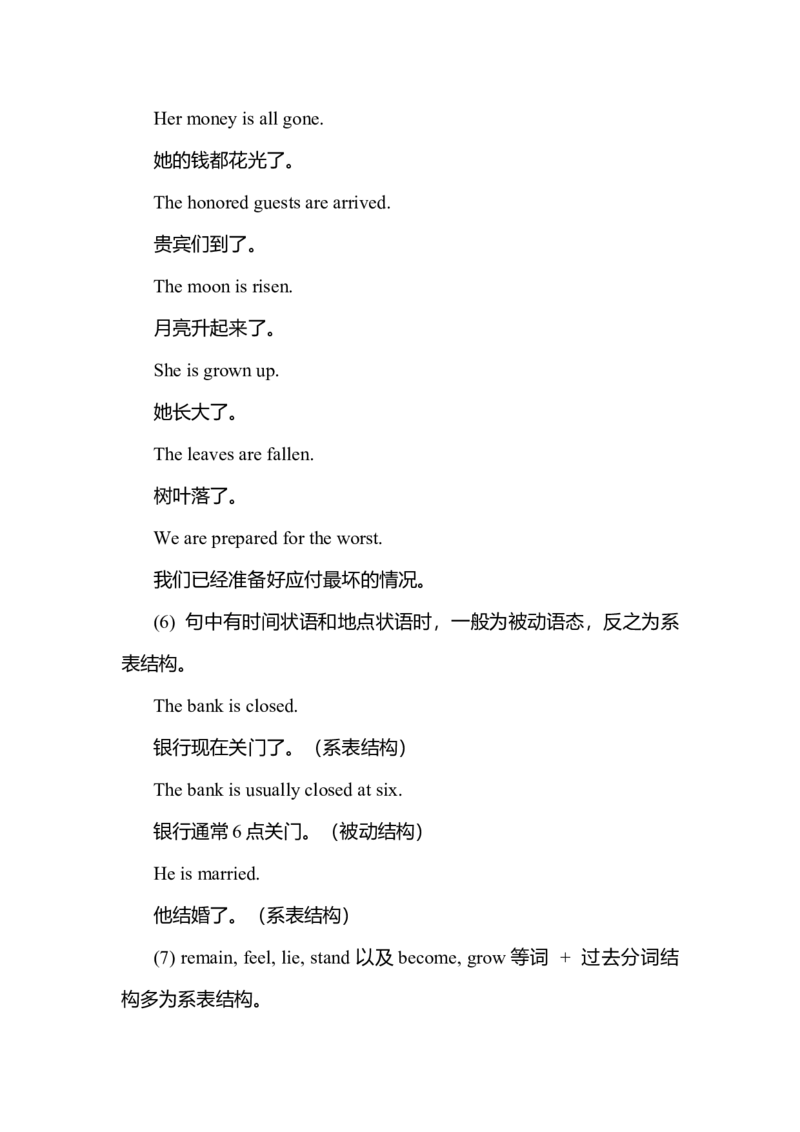
(5) be + 不及物动词的过去分词通常是系表结构。
Her money is all gone.
她的钱都花光了。
The honored guests are arrived.
贵宾们到了。
The moon is risen.
月亮升起来了。
She is grown up.
她长大了。
The leaves are fallen.
树叶落了。
We are prepared for the worst.
我们已经准备好应付最坏的情况。
(6) 句中有时间状语和地点状语时,一般为被动语态,反之为系
表结构。
The bank is closed.
银行现在关门了。(系表结构)
The bank is usually closed at six.
银行通常6 点关门。(被动结构)
He is married.
他结婚了。(系表结构)
(7) remain, feel, lie, stand 以及become, grow

等词+ 过去分词结
构多为系表结构。
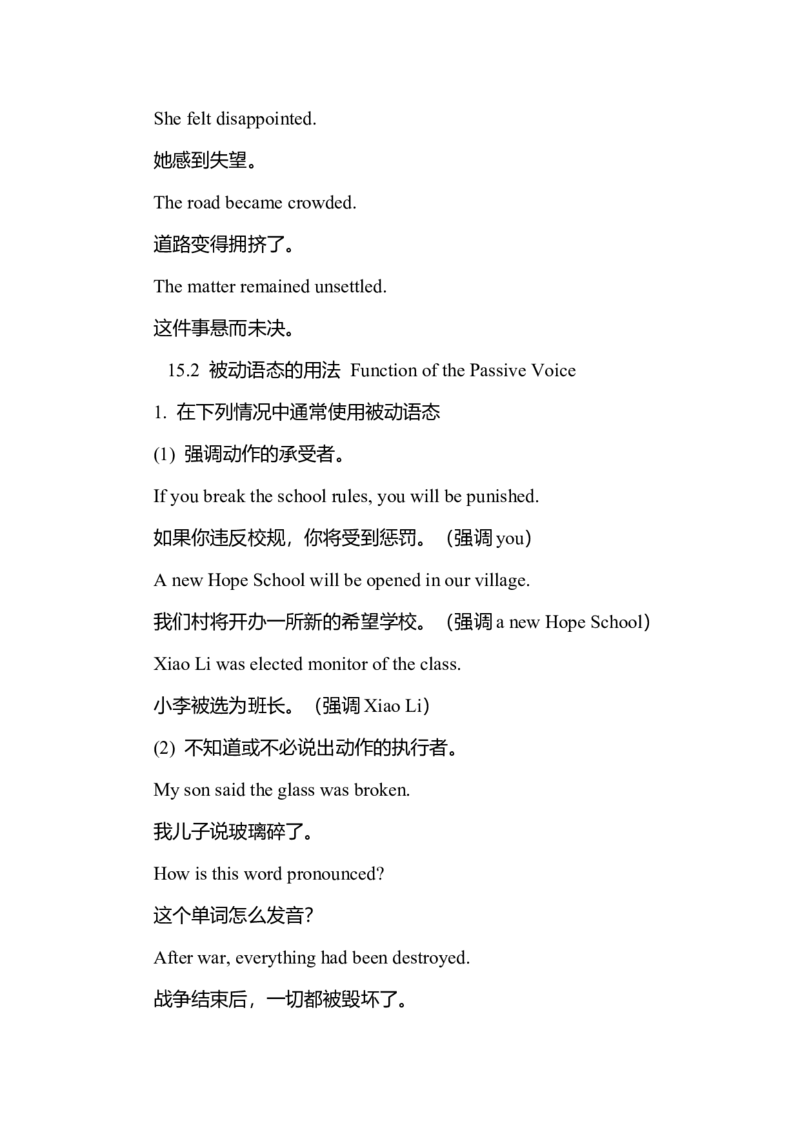
She felt disappointed.
她感到失望。
The road became crowded.
道路变得拥挤了。
The matter remained unsettled.
这件事悬而未决。
15.2

被动语态的用法Function of the Passive Voice
1. 在下列情况中通常使用被动语态
(1) 强调动作的承受者。
If you break the school rules, you will be punished.
如果你违反校规,你将受到惩罚。(强调you)
A new Hope School will be opened in our village.
我们村将开办一所新的希望学校。(强调a new Hope School)
Xiao Li was elected monitor of the class.
小李被选为班长。(强调Xiao Li)
(2) 不知道或不必说出动作的执行者。
My son said the glass was broken.
我儿子说玻璃碎了。
How is this word pronounced?
这个单词怎么发音?
After war, everything had been destroyed.
战争结束后,一切都被毁坏了。
(3) 动作的执行者不是人,而是无生命的事物。
The bridge was washed away by the flood.
桥被洪水冲走了。
Many accidents were caused by careless driving.
许多事故都是开车不小心造成的。
(4) 为了表示委婉或礼貌,避免提及动作执行者或说话者自己。
You've been told many times not to make the same mistake.
你已被多次告知不要犯同样的错误。
Everybody is expected to obey the following rules.
希望大家遵守以下规定。
The control room could not be entered without permission.
未经许可,勿入控制室。
(5) 修辞的需要。
He appeared on the stage and was warmly applauded by the
audience.
他出现在舞台上,赢得了观众的热烈掌声。
The old professor gave a lecture on American history and was well
received.
这位老教授作了一个有关美国历史的讲座,受到了大家的热烈
欢迎。
(6) 有些动词常用被动语态。
He was born in this small village.
他出生在这个小村庄。
The mountain is surrounded by water.
这座山被水环绕。
2. 被动语态中常用的介词
(1) by 表示动作的执行者或施加者。
By whom was the book written?
这本书是谁写的?
These tasks were assigned by the leader.
这些任务是领导布置的。
(2) with 表示用某种工具。
In China, noodles are eaten with chopsticks.
在中国,面条用筷子食用。
The wolf was killed with a gun.
狼被枪打死了。
(3) of 表示用某种材料制成(看得出原材料)。
The table is made of wood.
这张桌子是用木头做的。
The house is made of stone.
房子是用石头建成的。
(4) from 表示源于某种物质(看不出原材料)。
Flour is made from wheat.
面粉是由小麦制成的。
Good wine is made from grain.
好酒是粮食制成的。
(5) 其他介词。
You are wanted on the phone.
有电话找你。
He is known to everybody.
大家都认识他。
3. “get +
”
过去分词结构的被动语态
“
被动语态除常用be +
”
“
过去分词结构外,还可用get + 过去分
”
词结构。
这种结构强调动作的结果,而非动作本身,常用来表示突发性
的,出乎意料的偶然事件。
而且多用在口语中,其后的动作执行者(即by 短语)一般不表
示出来。
The boy got hurt on his way home from work.
这个男孩在下班回家的路上受伤了。
Finally his bike got repaired.
最后他的自行车得到了修理。
As I passed by, my skirt got caught on a nail.
我经过的时候,我的裙子被钉子挂住了。
注 “get + -ed
”
分词还可用于谈论自己做的事,是主动的,而不
是被动的行为。例如:
get dressed 穿衣服
get divorced 离婚
get engaged 订婚
get confused 迷惑不解
get lost 迷路
get washed 洗脸
get married 结婚
4. “seem/appear +
”
过去分词结构的被动语态
She seemed annoyed by his words.
她似乎被他的话搞得很恼火。
The house appears deserted.
这房子好像没人居住了。
注
“
并不是所有的be +
”
过去分词结构中的be 都能被get 或
seem, appear 等词代替。例如:
(×)I got born in a small village.
(√)I was born in a small village.
我出生在一个小村庄。
(×)The old woman got offered a large sum of money.
(√)The old woman was offered a large sum of money.
这位老妇人获得了一大笔钱。
(×)Jack got caught cheating in the exam.
(√)Jack was caught cheating in the exam.
杰克考试作弊被抓住了。
5. 少数动词的主动语态有时可以表被动
These vases sell quite well.
这些花瓶销售得相当好。
The song sounds very beautiful.
这首歌听上去很悦耳。
类似的动词还有:read 读起来, clean 擦起来, wash 洗起来, write
写起来。
My watch needs cleaning. (=My watch needs to be cleaned.)
我的表需要清理。
类似need 这样用法的动词还有:want, require, deserve, do, owe
等。
15.3

主动变被动Conversion into the Passive Voice
英语中被动语态比汉语中用的多,是因为中国人思维的着眼点
在动作的施动者,英美人思维的着眼点在动作的承受者。
中国人常这样说:I expect you to be there on time.
我希望你准时到那里。
英美人常这样说:You are expected to be there on time.
希望你准时到那里。
由于英语句子的结构不同,因而主动语态变成被动语态的方式
也各不相同。
1. “

主语+

谓语+

间接宾语+
”
直接宾语主动句变被动句
在这个句型中,谓语动词有两个宾语。变成被动语态时,一般
将指人的间接宾语转化成主语,但有时也可将指物的直接宾语转化
成主语。
He told her a long story.
他给她讲了一个长故事。(主动结构)
She was told a long story.
她听了一个长故事。(被动结构)
A long story was told to her.
有人给她讲了一个长故事。(被动结构)
My father bought me a computer last week.
上周我父亲给我买了一台电脑。(主动结构)
I was bought a computer by my father last week.
上周我父亲给我买了一台电脑。(被动结构)
A computer was bought for me by my father last week.
上周我父亲给我买了一台电脑。(被动结构)
注 用直接宾语作被动语态的主语时,通常要在间接宾语前加上
适当的介词(如to, for, of 等),以加强间接宾语的语气。例如:
They awarded him the Nobel Prize.
他们授予他诺贝尔奖。(主动结构)
The Nobel Prize was awarded to him.
诺贝尔奖被授予给他。(被动结构)
The host had caught us some fish.
主人给我们捉了一些鱼。(主动结构)
Some fish had been caught for us by the host.
主人给我们捉了一些鱼。(for 不可省)(被动结构)
2. “

主语+

谓语+

宾语+
”
宾语补足语主动句变被动句
在这个句型中,谓语动词后有一个宾语和一个宾语补足语,变
成被动语态时,宾语转化成主语,宾语补足语也随之变为主语补足
语。
All the villagers painted the houses white.
所有村民都把房子涂成了白色。(主动结构)
The houses were painted white by all the villagers.
房子被所有的村民都涂成了白色。(被动结构)
They kept us waiting for a long time.
他们让我们等了很长时间。(主动结构)
We were kept waiting for a long time.
我们等了很长时间。(被动结构)
We regarded him as the best doctor in the town.
我们认为他是城里最好的医生。(主动结构)
He was regarded as the best doctor in the town.
他被认为是城里最好的医生。(被动结构)
注 有些使役动词和感官动词,如make, see, hear, watch, notice,
observe, listen to 等,在主动结构中跟不带to 的动词不定式作宾语补
足语,在变为被动结构时,不定式应加上to。例如:
We heard him say good-bye to his friends.
我们听见他向朋友们道别。
He was heard to say good-bye to his friends.
有人听到他向朋友们道别。
3. 含有情态动词的主动句变被动句
“

含有情态动词的谓语变成被动语态时,用情态动词+ be
done”构成,例如下表所示:
This thing must be done as soon as possible.
这件事必须尽快做。
What's done cannot be undone.
覆水难收。
These stairs are very dangerous. They should be repaired.
这些楼梯很危险,应该修理了。
Cross the road very carefully. Look both ways, or you might be
knocked down.
过马路要非常小心,要看两边,不然会被车撞倒的。
People had to be reminded of the danger that night.
那天晚上必须提醒人们注意危险。
4. 含有be going to do 和be to do 等结构的主动句变被动句
含有be going to do 和be to do 等结构的句子,变被动语态时,分
别用be going to + be done 和be to + be done。在这两种结构中,be 只
有一般现在时和一般过去时两种形式。
The problem is going to be discussed at the meeting.
这个问题将在会上讨论。
This new film is to be shown on TV next week.
这部新电影下周将在电视上放映。
5. 含有宾语从句的主动句变被动句
(1) 带有宾语从句的句子变成被动语态时,通常用it 来作被动句
的形式主语,宾语从句保留不变。
They said that he had gone abroad to study English.
他们说他出国学英语去了。(主动结构)
It was said that he had gone abroad to study English.
据说,他出国学英语去了。(被动结构)
We haven't decided when we should go camping.
我们还未决定什么时候去野营。(主动结构)
It hasn't been decided when we should go camping.
什么时候去野营尚未决定。(被动结构)
(2) 带有宾语从句的句子变成被动语态时,可以把从句的主语变
为被动句的主语,而把从句的谓语部分变为不定式短语。
We believed that he would succeed.
我们相信他会成功。(主动结构)
He was believed to succeed.
人们相信他会成功。(被动结构)
Father expected that I should become an engineer.
父亲希望我成为一名工程师。(主动结构)
I was expected (by my father) to become an engineer.
我被(父亲)期望成为一名工程师。(被动结构)
6. 祈使句的被动语态
肯定的祈使句的被动语态结构:Let +

宾语+ be + 过去分词。
否定的祈使句的被动语态结构:Don't + let +

宾语+ be + 过去
分词(或Let +

宾语+ not + be+ 过去分词)。
把课桌搬到屋里去。
Move the desks into the room. (主动语态)
Let the desks be moved into the room.(被动语态)
不要相信她。
Don't trust her.(主动语态)
Don't let her be trusted.(被动语态)
Let her not be trusted.(被动语态)
7. 动词短语构成的被动语态
一般情况下,只有及物动词才能跟宾语,而不及物动词不能跟
宾语,所以只有及物动词才有被动语态,不及物动词则没有被动语
态。但有些不及物动词后面跟介词或副词后,变成一个动词短语,
相当于一个及物动词,因此就可以有被动语态。
The nurses in this hospital look after the patients very well.
这个医院的护士们照顾病人很周到。(主动结构)
The patients are well looked after by the nurses in this hospital.
病人在这所医院里被护士们照料得很周到。(被动结构)
They have put off the meeting till next Saturday.
他们把会议推迟到下个星期六。(主动结构)
The meeting has been put off till next Saturday.
会议已推迟到下周六了。(被动结构)
注 短语动词转换为被动语态时,通常被看做是一个动词,后面
的介词或副词不能拆开或省略。例如:
So far no correct conclusion has been arrived at.
截止到目前还没有正确结论。
All the rubbish should be got rid of.
所有的垃圾都该扔掉。
All the important matters have now been attended to.
所有重要的事情都得到了处理。
8. 双重被动结构
双重被动结构指的是句中谓语动词和其后的不定式均为被动结
构,句子的主语既是谓语动词的承受者,同时又是不定式动作的承
受者。例如:
They asked us to discuss the problem at once.
他们要求我们马上讨论这个问题。(主动结构)
The problem was asked to be discussed at once.
这个问题被要求马上讨论。(双重被动)
She offered to buy a recorder for me.
她提出要给我买一台录音机。(主动结构)
A recorder was offered to be bought for me.
有人提出要给我买一台录音机。(双重被动)
The teacher ordered that we should take the desk away.
老师要求我们把课桌搬走。(主动结构)
The desk was ordered to be taken away.
课桌被要求搬走。(双重被动)
9. 不能变为被动语态的结构
(1) 受动词的限制。
1) 表示状态的及物动词,只能用于主动语态。
have, own, cost, lack, want, become, resemble, fail, last, benefit,
hold 等作谓语时,该句则不能变为被动句。
The little girl resembles her mother.
这个小女孩像她妈妈。
He lacks self-confidence.
他缺乏自信。
This boardroom can hold 200 people.
这个会议室能容纳200 人。
2) 当动词get, take
“
表示懂得,
”
知道,owe
“
”
表示欠,cost 表
“
示使失去(生命,
”
健康等)
时,没有被动语态形式。
Do you get me?
你明白我的意思吗?
How do you take this passage?
这篇文章你怎么理解?
I owe 50 pounds to you.
我欠你50 英镑。
His careless driving cost his life.
他的粗心驾驶使他丧了命。
3) 当及物动词have
“
表示吃饭, 患病, 明白,
”
知道等时,没有被
动语态形式。
Would you have a cup of tea?
你要喝杯茶吗?
She had a bad cold yesterday, and now she is feeling much better.
昨天她得了重感冒,现在好多了。
(2) 受宾语的限制。
1) 当宾语前带有主语的形容词性物主代词时,谓语动词通常不
能转换为被动语态。
I could not believe my eyes when I saw him still alive.
看到他还活着,我简直不相信自己的眼睛。
The doctor shook his head and then went out without any words.
医生摇了摇头,一句话也没说就出去了。
注 动词的宾语是身体的一部分,一般不可变为被动语态,但也
有例外。例如:
He fixed his eyes on the oil painting.
他把目光锁定在这张油画上。(主动语态)
His eyes were fixed on the oil painting.
他的目光被这张油画吸引住了。(被动语态)
2) 当宾语是相互代词, 反身代词或具有类似相互代词的关系
时,动词不能用被动语态形式。
He absented himself from a meeting yesterday.
昨天的会议他缺席了。
For years the two sisters looked after one another.
多年来两姐妹互相照顾。
3) 当宾语是同源宾语时,通常不能转换成被动语态。
He laughed a hearty laugh.
他由衷地笑了笑。
She dreamed a sweet dream.
她做了一个美梦。
4) 当宾语起状语作用,表示数量, 重量, 大小或程度时,不能用
被动语态。
This kind of dictionary costs ten dollars.
这种字典价值10 美元。
The case weighs twenty kilos.
这箱子重20 公斤。
5) 如果enter, leave, reach 的宾语是地点, 国家机关等,不能改为
被动语态。
My brother left the army in 2003.
我哥哥2003 年退伍。
The man entered the hall without saying anything.
这个男人一句话没说就进入了大厅。
6) 如果宾语是动词不定式或动词的-ing 形式时,谓语动词一般
不能变成被动语态。
He admitted having done wrong.
他承认做错了。
He has decided to go and study abroad.
他已决定出国留学。
7) 含有would rather 或情态动词dare 的句子,不能改为被动语
态。
I would rather do it now.
我宁可现在就做这件事。
He dare not do it.
他不敢做那件事。
8) 另外,不可拆开的短语动词,如take place, lose heart, belong
to, consist of 等,也不能改为被动语态。
The house belongs to my brother.
房子是我弟弟的。
注 以下所示是常见的不能变为被动语态的动宾词组:
catch a cold 感冒eat one's words 食言
keep silence 保持安静keep watch 守望
lose heart 丧失信心lose patience 失去耐心
make a face 做鬼脸make bed 铺床
make room for
……
为
腾出地方
speak one's mind 表明见解
take office 就职
take one's leave 请假
take place 发生
make up one's mind 决心
take notes 作笔记
take one's time 从容不迫;别着急
take one's place 就位
take up arms 拿起武器