专题 08 自然生态(原卷版)
【材料来源:BBC Jun. 18,2024】
This Ecuadorian forest thrived amid
deforestation after being granted legal rights
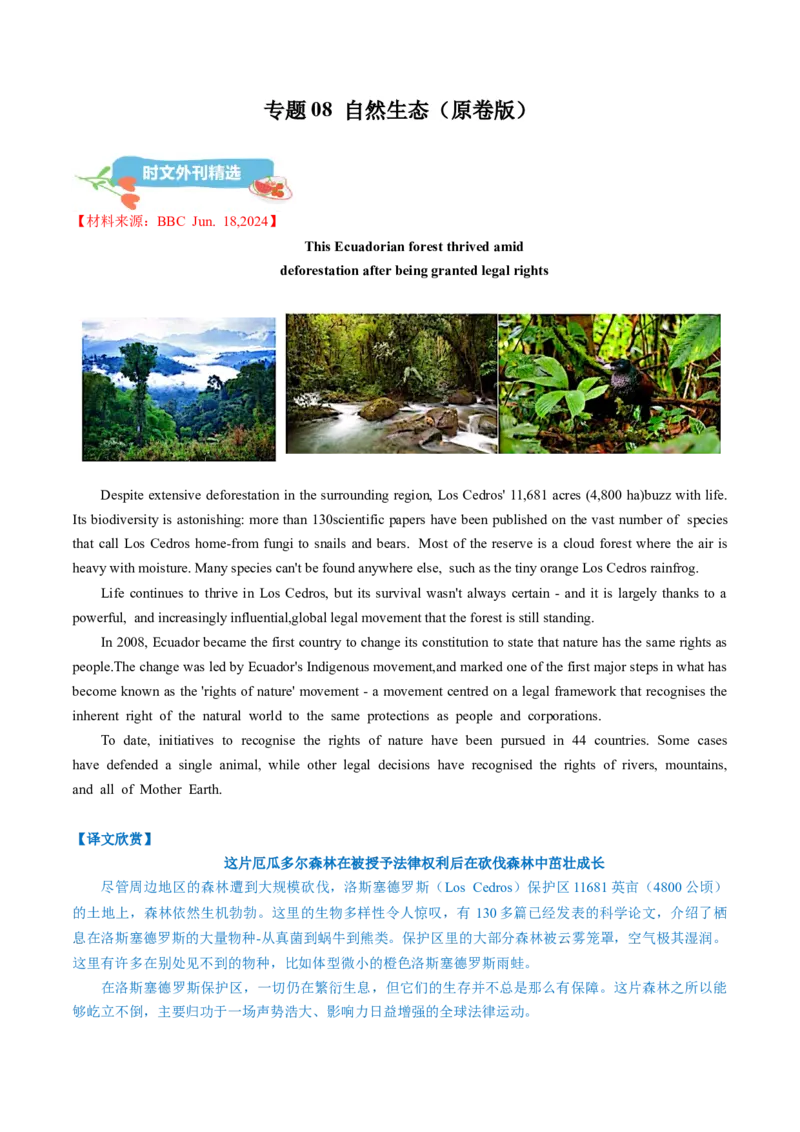
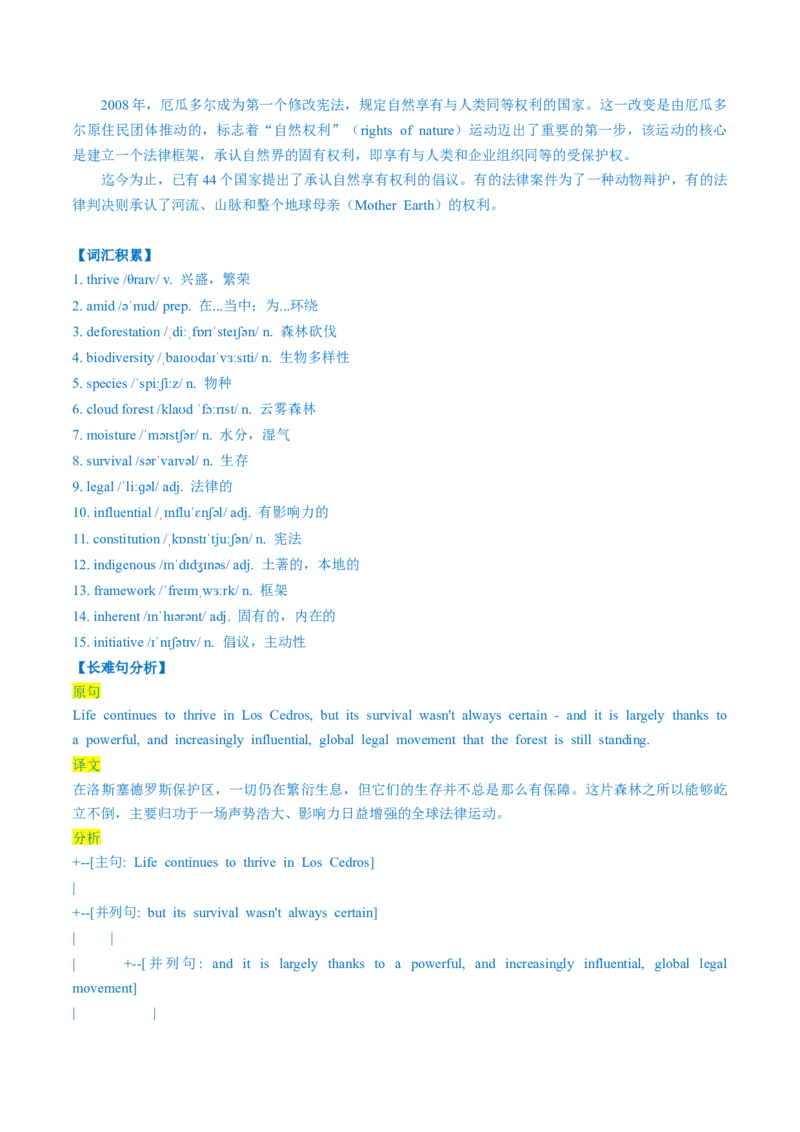
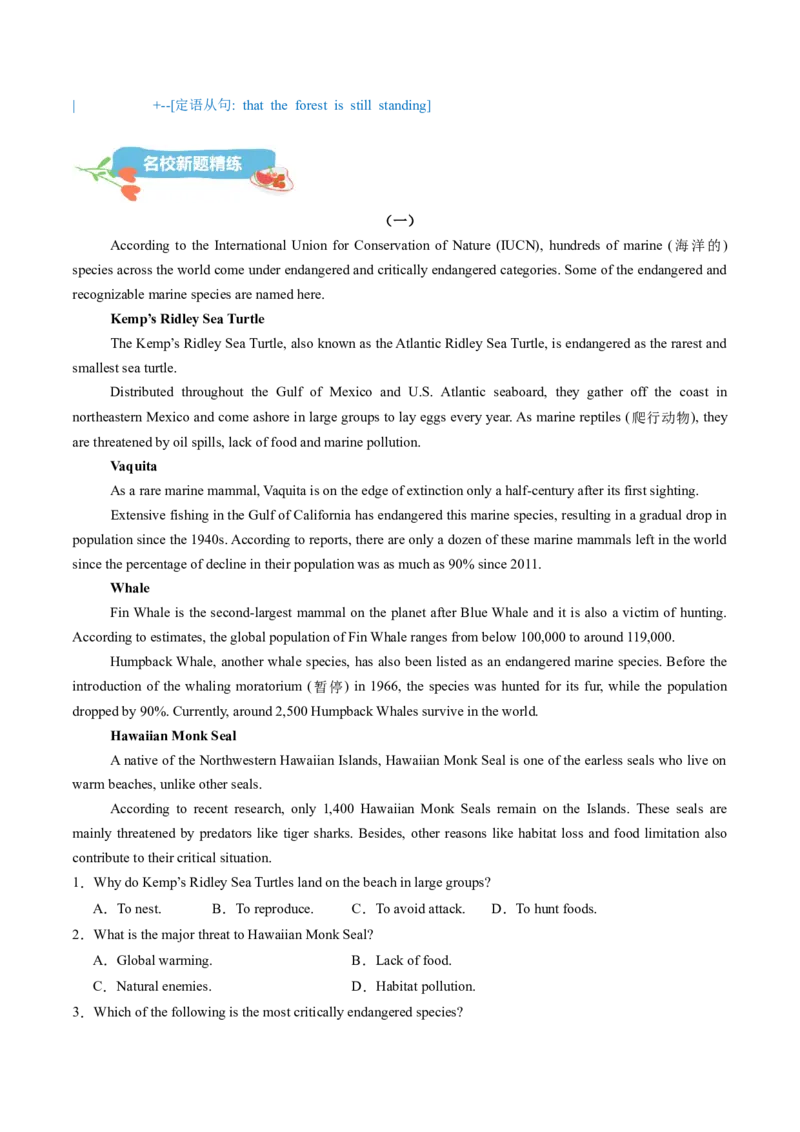
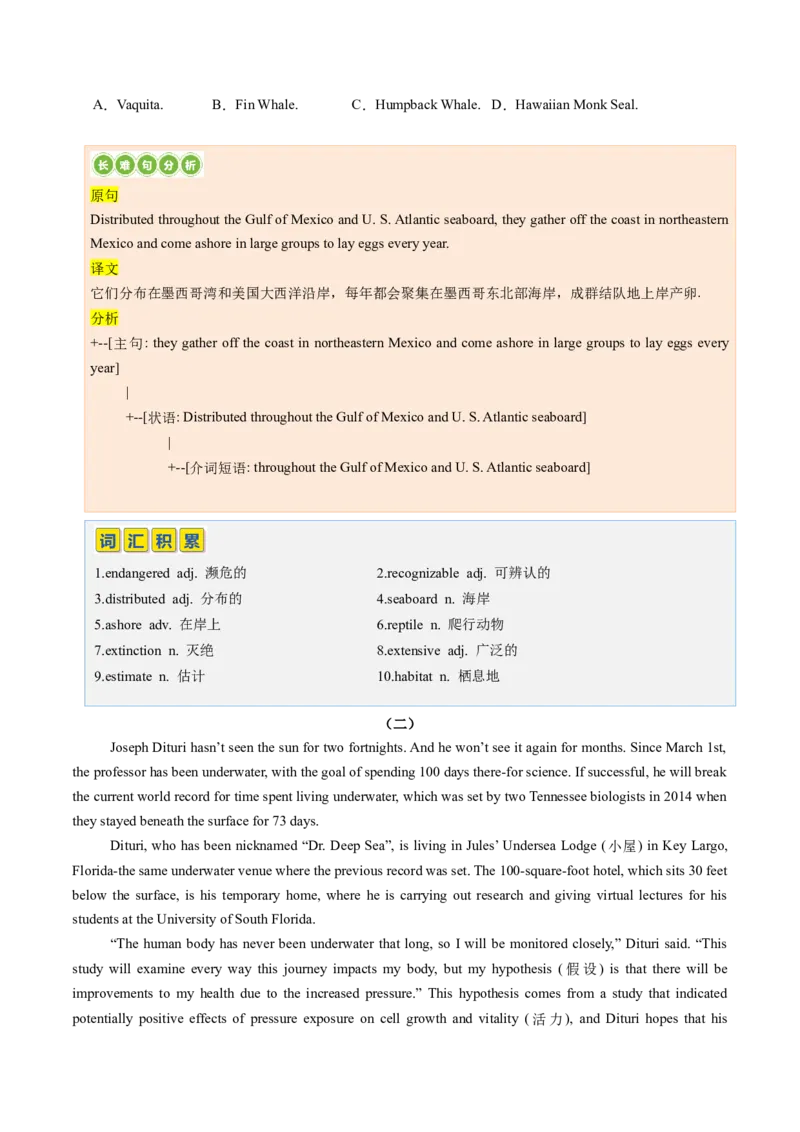
Despite extensive deforestation in the surrounding region, Los Cedros' 11,681 acres (4,800 ha)buzz with life.
Its biodiversity is astonishing: more than 130scientific papers have been published on the vast number of species
that call Los Cedros home-from fungi to snails and bears. Most of the reserve is a cloud forest where the air is
heavy with moisture. Many species can't be found anywhere else, such as the tiny orange Los Cedros rainfrog.
Life continues to thrive in Los Cedros, but its survival wasn't always certain - and it is largely thanks to a
powerful, and increasingly influential,global legal movement that the forest is still standing.
In 2008, Ecuador became the first country to change its constitution to state that nature has the same rights as
people.The change was led by Ecuador's Indigenous movement,and marked one of the first major steps in what has
become known as the 'rights of nature' movement - a movement centred on a legal framework that recognises the
inherent right of the natural world to the same protections as people and corporations.
To date, initiatives to recognise the rights of nature have been pursued in 44 countries. Some cases
have defended a single animal, while other legal decisions have recognised the rights of rivers, mountains,
and all of Mother Earth.
【译文欣赏】
这片厄瓜多尔森林在被授予法律权利后在砍伐森林中茁壮成长
尽管周边地区的森林遭到大规模砍伐,洛斯塞德罗斯(Los Cedros)保护区11681英亩(4800公顷)
的土地上,森林依然生机勃勃。这里的生物多样性令人惊叹,有 130多篇已经发表的科学论文,介绍了栖
息在洛斯塞德罗斯的大量物种-从真菌到蜗牛到熊类。保护区里的大部分森林被云雾笼罩,空气极其湿润。
这里有许多在别处见不到的物种,比如体型微小的橙色洛斯塞德罗斯雨蛙。
在洛斯塞德罗斯保护区,一切仍在繁衍生息,但它们的生存并不总是那么有保障。这片森林之所以能
够屹立不倒,主要归功于一场声势浩大、影响力日益增强的全球法律运动。2008年,厄瓜多尔成为第一个修改宪法,规定自然享有与人类同等权利的国家。这一改变是由厄瓜多
尔原住民团体推动的,标志着“自然权利”(rights of nature)运动迈出了重要的第一步,该运动的核心
是建立一个法律框架,承认自然界的固有权利,即享有与人类和企业组织同等的受保护权。
迄今为止,已有44个国家提出了承认自然享有权利的倡议。有的法律案件为了一种动物辩护,有的法
律判决则承认了河流、山脉和整个地球母亲(Mother Earth)的权利。
【词汇积累】
1. thrive /θraɪv/ v. 兴盛,繁荣
2. amid /əˈmɪd/ prep. 在...当中;为...环绕
3. deforestation /ˌdiːˌfɒrɪˈsteɪʃən/ n. 森林砍伐
4. biodiversity /ˌbaɪoʊdaɪˈvɜːsɪti/ n. 生物多样性
5. species /ˈspiːʃiːz/ n. 物种
6. cloud forest /klaʊd ˈfɔːrɪst/ n. 云雾森林
7. moisture /ˈmɔɪstʃər/ n. 水分,湿气
8. survival /sərˈvaɪvəl/ n. 生存
9. legal /ˈliːɡəl/ adj. 法律的
10. influential /ˌɪnfluˈɛnʃəl/ adj. 有影响力的
11. constitution /ˌkɒnstɪˈtjuːʃən/ n. 宪法
12. indigenous /ɪnˈdɪdʒɪnəs/ adj. 土著的,本地的
13. framework /ˈfreɪmˌwɜːrk/ n. 框架
14. inherent /ɪnˈhɪərənt/ adj. 固有的,内在的
15. initiative /ɪˈnɪʃətɪv/ n. 倡议,主动性
【长难句分析】
原句
Life continues to thrive in Los Cedros, but its survival wasn't always certain - and it is largely thanks to
a powerful, and increasingly influential, global legal movement that the forest is still standing.
译文
在洛斯塞德罗斯保护区,一切仍在繁衍生息,但它们的生存并不总是那么有保障。这片森林之所以能够屹
立不倒,主要归功于一场声势浩大、影响力日益增强的全球法律运动。
分析
+--[主句: Life continues to thrive in Los Cedros]
|
+--[并列句: but its survival wasn't always certain]
| |
| +--[并列句: and it is largely thanks to a powerful, and increasingly influential, global legal
movement]
| || +--[定语从句: that the forest is still standing]
(一)
According to the International Union for Conservation of Nature (IUCN), hundreds of marine (海洋的)
species across the world come under endangered and critically endangered categories. Some of the endangered and
recognizable marine species are named here.
Kemp’s Ridley Sea Turtle
The Kemp’s Ridley Sea Turtle, also known as the Atlantic Ridley Sea Turtle, is endangered as the rarest and
smallest sea turtle.
Distributed throughout the Gulf of Mexico and U.S. Atlantic seaboard, they gather off the coast in
northeastern Mexico and come ashore in large groups to lay eggs every year. As marine reptiles (爬行动物), they
are threatened by oil spills, lack of food and marine pollution.
Vaquita
As a rare marine mammal, Vaquita is on the edge of extinction only a half-century after its first sighting.
Extensive fishing in the Gulf of California has endangered this marine species, resulting in a gradual drop in
population since the 1940s. According to reports, there are only a dozen of these marine mammals left in the world
since the percentage of decline in their population was as much as 90% since 2011.
Whale
Fin Whale is the second-largest mammal on the planet after Blue Whale and it is also a victim of hunting.
According to estimates, the global population of Fin Whale ranges from below 100,000 to around 119,000.
Humpback Whale, another whale species, has also been listed as an endangered marine species. Before the
introduction of the whaling moratorium (暂停) in 1966, the species was hunted for its fur, while the population
dropped by 90%. Currently, around 2,500 Humpback Whales survive in the world.
Hawaiian Monk Seal
A native of the Northwestern Hawaiian Islands, Hawaiian Monk Seal is one of the earless seals who live on
warm beaches, unlike other seals.
According to recent research, only 1,400 Hawaiian Monk Seals remain on the Islands. These seals are
mainly threatened by predators like tiger sharks. Besides, other reasons like habitat loss and food limitation also
contribute to their critical situation.
1.Why do Kemp’s Ridley Sea Turtles land on the beach in large groups?
A.To nest. B.To reproduce. C.To avoid attack. D.To hunt foods.
2.What is the major threat to Hawaiian Monk Seal?
A.Global warming. B.Lack of food.
C.Natural enemies. D.Habitat pollution.
3.Which of the following is the most critically endangered species?A.Vaquita. B.Fin Whale. C.Humpback Whale. D.Hawaiian Monk Seal.
原句
Distributed throughout the Gulf of Mexico and U. S. Atlantic seaboard, they gather off the coast in northeastern
Mexico and come ashore in large groups to lay eggs every year.
译文
它们分布在墨西哥湾和美国大西洋沿岸,每年都会聚集在墨西哥东北部海岸,成群结队地上岸产卵.
分析
+--[主句: they gather off the coast in northeastern Mexico and come ashore in large groups to lay eggs every
year]
|
+--[状语: Distributed throughout the Gulf of Mexico and U. S. Atlantic seaboard]
|
+--[介词短语: throughout the Gulf of Mexico and U. S. Atlantic seaboard]
1.endangered adj. 濒危的 2.recognizable adj. 可辨认的
3.distributed adj. 分布的 4.seaboard n. 海岸
5.ashore adv. 在岸上 6.reptile n. 爬行动物
7.extinction n. 灭绝 8.extensive adj. 广泛的
9.estimate n. 估计 10.habitat n. 栖息地
(二)
Joseph Dituri hasn’t seen the sun for two fortnights. And he won’t see it again for months. Since March 1st,
the professor has been underwater, with the goal of spending 100 days there-for science. If successful, he will break
the current world record for time spent living underwater, which was set by two Tennessee biologists in 2014 when
they stayed beneath the surface for 73 days.
Dituri, who has been nicknamed “Dr. Deep Sea”, is living in Jules’ Undersea Lodge (小屋) in Key Largo,
Florida-the same underwater venue where the previous record was set. The 100-square-foot hotel, which sits 30 feet
below the surface, is his temporary home, where he is carrying out research and giving virtual lectures for his
students at the University of South Florida.
“The human body has never been underwater that long, so I will be monitored closely,” Dituri said. “This
study will examine every way this journey impacts my body, but my hypothesis (假设) is that there will be
improvements to my health due to the increased pressure.” This hypothesis comes from a study that indicated
potentially positive effects of pressure exposure on cell growth and vitality (活力), and Dituri hopes that hisunderwater experience could reveal ways to combat age-related diseases and lengthen lifespan.
As part of his research, Dituri is investigating the effects of living in a high-pressure environment for an
extended period. To keep water from entering the lodge, air must constantly be pumped into the space to create a
pressure about 1.6 times higher than that of the Earth’s surface. Therefore, it can’t be achieved in his own right.
Before the journey, Dituri had undergone psychosocial, psychological and medical tests. He continues to
undergo testing during and after his 100 days at the lodge. “The mental health part of this is important, because I’m
in an isolated and limited environment,” he said.
Beyond research, the project is also a chance to cultivate children’s enthusiasm for exploring the science
field. Dituri invites about 40 children to stay with him for 24 hours at a time and teach them to dive. To him, this
outreach is what makes the whole project worth it-more than the chance for a world record.
4.What do we know about Dituri’s experiment from the text?
A.It is scheduled to end on July 9th.
B.It has been on for nearly a month.
C.Its aim is just to break the world record.
D.It is conducted where two Tennessce biologists settled.
5.What is Dituri’s attitude toward the impact the increased pressure has on health?
A.Doubtful. B.Cautious. C.Hopeful. D.Unclear.
6.Which scene possibly happens in the course of Dituri’s living underwater?
A.He pumps the air into the lodge. B.He instructs invited children to dive.
C.He analyzes his own psychosocial tests. D.He experiments in a spacious lodge.
7.Why does Dituri invite children to experience the underwater life?
A.To arouse their eagerness for science. B.To case his loneliness and isolation.
C.To set a world record at full stretch. D.To prove the value of his experience.原句
This study will examine every way this journey impacts my body, but my hypothesis is that there will be
improvements to my health due to the increased pressure.
译文
这项研究将检验这次潜水过程对我身体各方面的影响,但我假设由于增大的水压,我的健康状况会有
所改善。
分析
+--[主句: This study will examine every way this journey impacts my body]
|
+--[并列句: but my hypothesis is that there will be improvements to my health due to the increased
pressure]
|
+--[宾语从句: that there will be improvements to my health due to the increased pressure]
|
+--[原因状语: due to the increased pressure]
1.fortnight n. 两星期 2.underwater adj. 在水下的
3.current adj. 目前的 4.temporary adj. 临时的
5.hypothesis n. 假设 6.combat v. 与...战斗
7.extended adj. 延长的 8.pressure n. 压力
9.isolated adj. 隔离的 10.cultivate v. 培养
(三)
The male western tanager (唐纳雀) looks like a little flame, while females are less showy, a dusty yellow. In
the spring, they prepare to move thousands of miles to the Mountain West of Central America, flying through
grasslands, deserts, and occasionally, suburban yards.
To fuel them on their lengthy journey, western tanagers fill up on insects and berries. But as global climate
change causes spring to start earlier, birds such as western tanagers are arriving at their destination after what’s
known as “green-up”, when flowers begin blooming and insects emerge. According to a study published in early
March in the journal PNAS, this kind of timing mismatch between migrants (迁移动物) and their food sources,
which is happening across North America, could have serious consequences for migratory birds’ survival. “In
discussing climate change, we often focus on warming,” says Scott Loss, a co-author of the study. “But the lengthand timing of seasons — like when winter ends and spring begins — are some of the most dramatic effects of
climate change.”
Loss and his colleagues used satellite imagery from 2002 to 2021 to calculate the average start of spring
green-up along the typical migration routes of 150 North American bird species, then compared that timing with the
current green-up. They found that spring is indeed beginning earlier along birds’ migration routes. “By contrary,
previous studies have mainly focused on songbirds in Eastern North America,” says Morgan Tingley, an
ornithologist at UCLA, “but this new investigation shows that bird species in the West and at different levels of the
food web might be just as vulnerable (脆弱的).”
“Part of it is knowing which species are vulnerable to various threats,” Loss says. “This adds to the
knowledge about vulnerability of a wide range of bird species.” And he hopes that the information will serve to
highlight the urgent need to lower greenhouse-gas emissions as fast as possible. “It’s really important, if we can’t
address climate change immediately, to try to stop habitat loss as much as we can.”
8.What may pose a direct threat to western tanagers’ survival?
A.Global warming. B.The duration of changing seasons.
C.Loss of habitats due to human activities. D.Decreased access to foods during migration.
9.What is unique about the new study on birds like western tanagers?
A.It covers a wider geographic range. B.It reveals the decline in bird populations.
C.It centers on the adaptation of bird species. D.It ensures the existence of a timing mismatch.
10.What does Loss suggest we do to safeguard migratory birds?
A.Lessen the effects of climate change. B.Preserve ecosystems for bird species.
C.Address emissions and habitat loss. D.Expand researches on threats to birds.
11.Where is the text most likely from?
A.A scientific journal. B.A bird-watching guidebook.
C.A website about climate change. D.A magazine about wildlife conservation.原句
According to a study published in early March in the journal PNAS, this kind of timing mismatch between
migrants (迁移动物) and their food sources, which is happening across North America, could have serious
consequences for migratory birds’ survival.
译文
根据3月初发表在《美国科学院院刊》上的一项研究,这种迁移动物和它们的食物来源之间的时间不
匹配,正在北美各地发生,可能会对候鸟的生存产生严重后果。
分析
+--[ 主 句 : this kind of timing mismatch between migrants and their food sources could have serious
consequences for migratory birds’ survival]
|
+--[状语: According to a study published in early March in the journal PNAS]
|
+--[定语从句: which is happening across North America]
|
+--[先行词: timing mismatch]
1.migrate v. 迁移 2.suburban adj. 郊区的
3.fuel v. 加燃料 4.lengthy adj. 长期的
5.mismatch n. 不匹配 6.dramatic adj. 显著的
7.satellite imagery n. 卫星图像 8.ornithologist n. 鸟类学家
9.vulnerability n. 脆弱性 10.greenhouse-gas n. 温室气体
(四)
Cut into the trunk of a pine tree, and you will see a familiar series of concentric (同中心的) rings. But not all
trunks tell the same story. A study published in November reveals that the world’s oldest trees had a very different
structure.
Some 370 million years ago, cladoxylopsid trees stood at least eight meters tall, covered by branches instead
of leaves. Today their rare remains reveal little about their insides; in most cases their inner structures had rotted
before the trees fossilize, and storms had filled them with sand. But the recent find of two well-preserved fossils in
China has exposed the trees’ inner workings — which are like no other species studied before.
The cladoxylopsid tree was empty inside. Around the edges were thick, vertical strands (缕) containing
xylem (木质部), a plant tissue that conducts water and mineral salts from the roots to all other parts. Modern treesadd new layers of multiple xylem as they grow, creating a woody trunk with a single set of concentric rings. But in
cladoxylopsids, “each strand of xylem had its own growth rings,” says scientist Christopher M. Berry of Cardiff
University in Wales.
Over a tree’s lifetime the strands would weave and cross. “It’s just incredibly complex,” Berry says. He
likens these networks of flexible tissues and structures to the Eiffel Tower—if tower could grow, extend and split
itself apart over time.
Although the cladoxylopsid tree has no living descendants today, it is very important. Brigitte Meyer-
Berthaud, a scientist, explains that these trees were among “the major carbon reservoirs of the Paleozoic”, a time
period from 542 million to 251 million years ago. Cladoxylopsids made up our planet’s first forests, capturing
carbon from the atmosphere and playing a part in adjusting Earth’s climate. Given this fact, maybe we should study
these trees for the forests.
12.What makes it hard to study cladoxylopsid trees?
A.Their thick leaves. B.Their amazing height.
C.Their poorly preserved remains. D.Their fossilized inner structures.
13.What do we know about cladoxylopsid trees?
A.They had many separate growth rings.
B.Their solid cores contributed to their growth.
C.They had a single set of regular concentric rings.
D.Their roots needed more mineral salts than water.
14.Why does the author mention “the Eiffel Tower” in paragraph 4?
A.To stress the beauty of the Eiffel Tower.
B.To prove the economic status of the tree.
C.To disclose how limited the tree’s lifetime is.
D.To show how complex the tree’s networks are.
15.Why should we study cladoxylopsid trees?
A.They were the only trees present during the Paleozoic era.
B.They helped scientists better protect rich historical culture.
C.They played a significant role in shaping the Earth as it is.
D.They determined the carbon content in the Earth’s atmosphere.原句
Cladoxylopsids made up our planet’s first forests, capturing carbon from the atmosphere and playing a part in
adjusting Earth’s climate.
译文
克拉多桉木树成为了地球上的第一批森林,它们从大气中吸收碳,并在调节地球气候方面发挥了作用。
分析
+--[主句: Cladoxylopsids made up our planet’s first forests]
|
+--[伴随状语: capturing carbon from the atmosphere and playing a part in adjusting Earth’s climate]
1.concentric adj. 同中心的 2.reveal v. 揭示
3.cladoxylopsid n. 枝蕨类植物 4.fossilize v. 使成化石
5.preserved adj. 保存完好的 6.expose v. 暴露
7.conduct v. 传导 8.mineral salt n. 矿物盐
9.layer n. 层 10.reservoir n. 储存
(五)
As the seasons are starting to change around the world, the animal kingdom is on the move. Animal
migration is one of nature's great wonders, but how do animals know when it is time to set off on their journey, or
where they need to go? Once they've worked out their destination, how do they know how to get there? 16
.
Migration is a behavioral pattern where animals travel from one habitat to another in search of something. It
happens seasonally, and usually involves a return journey. These journeys can be by land, sea or air. 17 .
Animals like gazelles, wildebeests and zebras migrate in huge herds during dry seasons to look for fresh grass to eat
and water to drink.
Animals also migrate because of the weather. Around 50 bird species leave the UK each winter to avoid the
cold. 18 . They're either searching for a mate, looking for somewhere to lay their eggs or finding the best
place to raise their young. For example, humpback whales travel to warmer waters each winter to raise their calves.
19 , but how do they know when it is time to head off? For those who migrate to look for something
to eat, scientists think shortages of food could be a sign that it's time to begin their journey. Others might be able to
recognize when winter is coming because they can see that the days are getting shorter.
So how do they know where to go? Some use the stars and the sun to help them navigate while others rely on
landmarks like rivers and mountains to show them where they are. 20 . Wildebeests are thought to followthe smell of rain.
A.Below are some ways they get there
B.Animals have their reasons for migrating
C.Scientists have been puzzled by these questions for many years
D.It's also possible for animals to sniff their way to their destination
E.Some birds travel to the UK to escape extreme cold further north
F.One of the main reasons behind animal migration is the search for food
G.For some animals, it's the need to reproduce that sends them on their journey
1.behavioral adj. 行为的 2.pattern n. 模式
3.seasonal adj. 季节性的 4.herd n. 兽群
5.navigate v. 导航 6.landmark n. 地标
7.extreme adj. 极端的 8.puzzled adj. 困惑的
9.reproduce v. 繁殖 10.destination n. 目的地
(六)
I was always interested in biology. However, it wasn’t until I saw a 21 about cave diving in senior
high school, in which I watched divers pass by urchins (海胆), that I realized I wanted to 22 cave
animals. The video didn’t mention the 23 in those underwater houses, but I 24 they must be
there. More than just naming them, I wanted to learn about their 25 , which meant I needed to study them
in their 26 habitat.
Cave diving requires special 27 . In this photo taken during a sampling trip in March in Belize, you
can see that I was carrying lights and navigation tools, and bringing extra air tanks. I was using a net and test tubes
to collect tiny and nearly 28 animals floating in the water. Since then, I’ve come to 29 that
caves are full of life: shrimps, sea stars and urchins, all 30 the low-light environments.
Although underwater caves might seem far removed from surface environments, research has shown that
these worlds are 31 in many ways. If pollutants get underground, they can 32 affect
many ecosystems.
The cave ecosystem is suffering from climate change. If we didn’t take action to 33 these
amazing caves, they could be gone before we have the 34 to fully understand them. And everything
that makes them unique would 35 , too.
21.A.film B.story C.paper D.book
22.A.adopt B.feed C.rescue D.study
23.A.caves B.creatures C.views D.divers
24.A.believed B.dreamed C.doubted D.disagreed
25.A.photos B.ecology C.names D.news26.A.artificial B.shallow C.modern D.natural
27.A.time B.equipment C.information D.space
28.A.starving B.valuable C.invisible D.dying
29.A.deny B.promise C.learn D.imagine
30.A.adapting to B.appealing to C.breaking up D.clearing up
31.A.created B.mirrored C.linked D.interpreted
32.A.suddenly B.barely C.originally D.negatively
33.A.conserve B.explore C.decorate D.construct
34.A.permission B.desire C.decision D.chance
35.A.happen B.return C.disappear D.begin
1.biology n. 生物学 2.cave diving n. 洞穴潜水
3.urchin n. 海胆 4.navigation n. 导航
5.ecosystem n. 生态系统 6.pollutant n. 污染物
7.equipment n. 设备 8.ecology n. 生态
9.negatively adv. 消极地 10.conserve v. 保护
(一)
(2024·全国甲卷)Animals can express their needs using a lot of ways. For instance, almost all animals
have distinct vocals (声音) that they rely on to either ask for help, scare away any dangerous animals or look for
shelter. But cats are special creatures who possess amazing vocalization skills. They are able to have entire
conversations with humans using meows and you're able to interpret it. If a pet cat is hungry, it will keep meowing
to attract attention and find food. However, when a cat is looking for affection, they tend to produce stretched and
soft meows. Meowing starts as soon as a baby cat is brought to life and uses it to get the mother's attention and be
fed.
Cats have many heightened senses, but their sense of smell is quite impressive. They use their noses to assess
their environment and look out for any signs of danger. They will sniff out specific areas before they choose a place
to relax. However, another way the cats are able to distinguish between situations is by looking for familiar smells.
Your cat will likely smell your face and store the smell in its memory and use it to recognize you in the future.
That's why most pet cats are able to tell immediately if their owners were around any other cats, which they don't
usually like.
Dogs are known for their impressive fetching habit, but cats take this behavior up a notch. Many cats will
find random objects outside and bring them to their owners. This is a very old habit that's been present in all kindsof predators (食肉动物). Cats bring gifts for their owners to show they love you. These adorable little hunters are
just doing something that it's been in their nature since the beginning of time. So just go along with it!
1.What can be learned about cats' meowing from the first paragraph?
A.It's a survival skill. B.It's taught by mother cats.
C.It's hard to interpret. D.It's getting louder with age.
2.How does a pet cat assess different situations?
A.By listening for sounds. B.By touching familiar objects.
C.By checking on smells. D.By communicating with other cats.
3.Which best explains the phrase "take. . . up notch" in paragraph 3?
A.Perform appropriately. B.Move faster. C.Act strangely. D.Do better.
4.What is a suitable title for the text?
A.Tips on Finding a Smart Cat B.Understanding Your Cat's Behavior
C.Have Fun with Your Cat D.How to Keep Your Cat Healthy
(二)
(2023·全国乙卷)Indoor plants might look as if they just sit around not doing much, but in many ways
they are the unsung heroes of the home. 5 , but studies have shown that they can promote people’s
wellbeing by improving their mood (心情), reducing stress and helping their memory. What’s more, indoor plants
are easy to look after and are not very expensive.
What are indoor plants?
Indoor plants, also known as houseplants or pot plants, are plants that like to grow indoors. Many of these
species (物种) are not ideally suited to growing outside in the UK, especially in the winter. 6 .
Why are indoor plants good for you?
Will Spoelstra, who works at the Royal Botanic Gardens, says, “ 7 . I find during the winter months,
plants around the house can really lift your mood.” Several studies have backed this up and found that indoor plants
can improve creativity, focus and memory. There is also research showing that pot plants can clean the air around
them by removing harmful gases, such as carbon dioxide. They also remove some harmful chemicals from paints or
cooking. 8 .
Which plants can you grow?
Aloe vera, peace lilies and spider plants are some of the species that are easy to grow indoors. You can buy
plants from supermarkets, garden centres or online. Younger plants are often cheaper than fully grown ones, and
you get to care for them as they mature — which is part of the joy of owning plants. “ 9 ,” Spoelstra says.
“It can bring a new interest and focus into people’s lives and help to make the link between home and nature.”
A.All plants are different
B.Not only do they look beautiful
C.There are many benefits to growing plants indoors
D.Instead, they grow better inside, where it is warmerE.Plants like peace lilies and devil’s ivy are among the best
F.Changing the pot of your plant from time to time will also help
G.Learning about the requirements of each plant can be very rewarding
(三)
(2023·浙江1月卷)The sun was beginning to sink as I set off into the Harenna Forest. I was on my way
to 10 a unique honey harvest. Here, in south-east Ethiopia, hand-carved beehives(蜂箱)are placed in the
11 . Reaching them to get the honey is difficult—and often 12 .
I 13 beekeeper Ziyad over a wide stretch of grassland before entering a thick jungle. Ziyad began
preparations. He 14 handfuls of damp tree leaves, wrapped them with string, and 15 the
bunch to create a torch(火把). Then, with one end of a rope tied to his waist and the other end around the trunk of a
tree, Ziyad began 16 . He stopped every few minutes to move the 17 higher up the tree trunk.
18 , Ziyad got close to the hive which was around 20 metres above the ground. Sitting on a branch,
he 19 towards it and blew smoke from his torch into a tiny hole in the hive. Suddenly, Ziyad let out a
sharp cry. Within seconds, he’d 20 the trunk and was back on the ground.
It was too 21 to collect the honey. A cool summer had delayed 22 . Baby bees
were still in the honeycombs(蜂巢). The adult bees were 23 and kept attacking as Ziyad escaped from
the tree. He had to wait for the right 24 to go back up.
10.A.share B.collect C.celebrate D.witness
11.A.courtyards B.fields C.treetops D.caves
12.A.urgent B.dangerous C.expensive D.pointless
13.A.searched B.recognised C.followed D.invited
14.A.gathered B.cleaned C.dropped D.checked
15.A.shook B.lit C.measured D.decorated
16.A.jumping B.talking C.testing D.climbing
17.A.hives B.leaves C.rope D.honey
18.A.Finally B.Surprisingly C.Naturally D.Immediately
19.A.backed B.dived C.shouted D.inched
20.A.cut off B.gone up C.slid down D.held onto
21.A.high B.early C.fast D.close
22.A.hatching B.training C.sowing D.trading
23.A.curious B.hungry C.bored D.angry
24.A.moment B.equipment C.person D.order
(2023·浙江1月卷)阅读下面材料,根据其内容和所给段落开头语续写两段,使之构成一篇完整的短文。I was invited to a cookout on an old friend’s farm in western Washington. I parked my car outside the farm
and walked past a milking house which had apparently not been used in many years. A noise at a window caught
my attention, so I entered it. It was a hummingbird (蜂鸟), desperately trying to escape. She was covered in spider-
webs (蛛网) and was barely able to move her wings. She ceased her struggle the instant I picked her up.
With the bird in my cupped hand, I looked around to see how she had gotten in. The broken window glass
was the likely answer. I stuffed a piece of cloth into the hole and took her outside, closing the door securely behind
me.
When I opened my hand, the bird did not fly away; she sat looking at me with her bright eyes. I removed the
sticky spider-webs that covered her head and wings. Still, she made no attempt to fly. Perhaps she had been
struggling against the window too long and was too tired? Or too thirsty?
As I carried her up the blackberry-lined path toward my car where I kept a water bottle, she began to move. I
stopped, and she soon took wing but did not immediately fly away.
Hovering (悬停), she approached within six inches of my face. For a very long moment, this tiny creature
looked into my eyes, turning her head from side to side. Then she flew quickly out of sight.
During the cookout, I told my hosts about the hummingbird incident. They promised to fix the window. As I
was departing, my friends walked me to my car. I was standing by the car when a hummingbird flew to the center
of our group and began hovering. She turned from person to person until she came to me. She again looked directly
into my eyes, then let out a squeaking call and was gone. For a moment, all were speechless. Then someone said,
“She must have come to say goodbye.”
注意:
1. 续写词数应为 150 左右;
2. 请按如下格式在答题纸的相应位置作答。
A few weeks later, I went to the farm again.
____________________________________________________________________________________________
____________________________________________________________________________________________
____________________________________________________________________________________________
____________________________________________________________________________________________
________________________________________________________________________________
I was just about to leave when the hummingbird appeared.
____________________________________________________________________________________________
____________________________________________________________________________________________
____________________________________________________________________________________________
____________________________________________________________________________________________
________________________________________________________________________________