热点话题01   传染病的防治——基孔肯雅热
目录
时文精读------------------------------------------------------------精选外刊原创阅读理解
  【原创·阅读理解】
【课标词汇积累】
【课标词汇训练】
【参考译文】
好题精练----------------------------------------------------------精选名校及联考话题专练
【阅读理解】
【7 选5】
【完形填空】
【语法填空】
【话题·导语】
文章讲述了基孔肯雅热的传播途径,控制方法及人们日常生活中应该注意的事项。
【原文·时文阅读】
(文章来源:https://apnews.com/article/china-chikungunya-outbreak-mosquito-dengue-fever-
dcd1d67ce75e72118b5d5dcd3750d902)
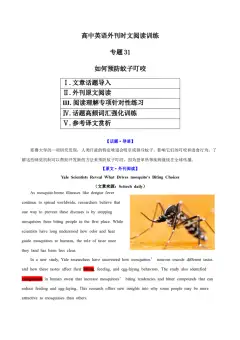
China is experiencing an outbreak of chikungunya, a mosquito-borne infection, with thousands of cases
reported in the south.
Chikungunya fever cases jumped to 4,014 on Friday, representing a rapid rise in numbers since authorities
started tracking cases two weeks ago, according to public records released by health departments in districts in
Foshan. The city in China’s southern province Guangdong has been heavily impacted by the surge in infections.
The chikungunya outbreak remains “quite severe,” Sun Yang, deputy director of the National Center for
Disease Control and Prevention, said at a news conference on Wednesday in Foshan.
Chikungunya is spread to people by the bites of infected mosquitoes. It causes fever and severe joint pain, but
deaths are rare, according to the World Health Organization.
读时文精读
The Chinese Center for Disease Control and Prevention has issued various advisories on how to prevent
chikungunya fever and dengue fever, a similar disease also spread by mosquitoes. Physical protection barriers, such
as screen doors, mosquito nets for beds and mosquito repellent on exposed skin, was recommended. It said that the
epidemic was “imported” without specifying from where.
The Chinese agency also called for people who have symptoms like fever, rash and joint pain to see a doctor.
Shunde district in Foshan, where 90% of the cases are located, is famous for its Cantonese food, and sees
many visitors each year.
Patients who tested positive for chikungunya fever stayed in hospital beds covered by mosquito nets,
according to photos shown on state-run broadcaster CCTV.
Local media reports said on Thursday that local authorities had almost doubled the number of mosquito-proof
isolation beds to 7,220 to meet the growing demand.
Authorities in Guangdong are urging residents to make sure there’s no standing water in their homes, such as
in flowerpots, coffee machines or spare bottles. The Health Commission in Foshan stated on Thursday that a fine
of up to 10,000 yuan ($1,400) could be applied if violations are found.
The Beijing CDC said on Tuesday that the city occasionally experiences imported cases of chikungunya
fever.
There are two chikungunya vaccines that have received regulatory approvals in several countries and/or have
been recommended for use in populations at risk, but the vaccines are neither widely available nor in widespread
use, according to WHO.
China had its first chikungunya spike in 2010 with 253 cases in Dongguan, a nearby city in the same
province, according to the Guangdong provincial CDC. Several cases were found in years since then, but they
weren’t widespread.
The country’s first case was imported in 1987, according to research papers and media reports.
【原创·阅读理解】
1.Which of the following is spread by mosquitoes?
A. joint pain
B.high fever
C. dengue fever
D.rash
2.Which city has been heavily impacted by the infections?
A. Foshan
B.Dongguan
C.Beijing
D.Guangzhou
3.Which is not the correct way to control the chikungunya?
A.screen doors
B.mosquito nets
C.mosquito repellent
D.surgical mask
4.Which of the following can be found, you will be fined?
A.drinking water
B.flowerpots with standing water
C.kitchen sink
D.washing basin
【课标词汇积累】
1.represent v.代表, 象征
 ● This graph represents the average scores of our class in math.
 这张图表代表了我们班数学的平均分。
2.track n.小道, 跑道, 足迹, 路径 v.跟踪, 追踪…的动向, 跟踪摄影, 留下足迹
  ●We should track our study progress to see where we need improvement.
 我们应该跟踪学习进度,看看哪里需要改进。
3.impact n.影响, 作用, 冲击力; v.对…有影响, 冲击, 撞击
●Lack of sleep can have a negative impact on your exam performance.
  睡眠不足会对考试成绩产生负面影响。
4.spread v.开展, 伸开, 传播, 涂, 分摊; n.散布, 广泛
   ●The rumor about the exam being canceled quickly spread among students.
  关于考试取消的谣言在学生中迅速传播。
5.severe adj.十分严重的, 极为恶劣的, 严厉的, 苛刻的
 ●The teacher gave a severe warning to students who cheated on the test.
  老师对考试作弊的学生发出了严厉警告。
6.infect v.传染, 使感染(计算机病毒/情感), 影响
  ●His enthusiasm for physics infected the whole class.
 他对物理的热情感染了整个班级。
7.similar adj.类似的
 ● The two math problems are similar, so if you solve one, you can solve the other.
  这两道数学题相似,所以如果你会做一道,另一道也能做。
8.isolation n.隔离, 隔离状态, 孤独, 孤立状态
 ●Studying in isolation without discussing with classmates can be less effective.
 独自学习而不和同学讨论,效果可能较差。
9.recommend v.推荐, 介绍, 劝告,建议, 使受欢迎
 ●The teacher recommended a few useful apps for learning English.
老师推荐了几个有用的英语学习应用。
10.occasionally adv.偶尔, 偶然, 有时候
   ●We occasionally have surprise quizzes in English class.
  我们英语课上偶尔会有突击小测验。
【课标词汇训练】
根据语境,从上面的“课标词汇”中选用合适的单词及其正确形式将句子补充完整。
1.She was chosen to _____________ our school in the national debate competition.
2.The teacher uses an app to _____________ students' homework completion.
3.The new teaching method has made a big _____________ on our learning.
4.We should _____________ our study time evenly instead of cramming at the last minute.
5.The _____________ competition for top universities makes students study harder.
6.A positive attitude can _____________ others and make the classroom more lively.
7.Many students have _____________ difficulties in understanding this concept.
8.During the pandemic, some students felt lonely due to _____________ from friends.
9.I _____________ reviewing your notes every day instead of just before exams.
10.Even though he studies hard, he _____________ takes breaks to relax.
【参考译文】
中国正经历基孔肯雅热疫情暴发,这种由蚊子传播的疾病在南方地区已报告数千例。根据佛山市卫生部门
公布的公共记录显示,截至周五,基孔肯雅热病例数已攀升至4014 例,较两周前开始追踪病例以来的数字呈
现快速增长态势。广东省会佛山受到感染激增的严重影响。国家疾病预防控制中心副主任孙阳周三在佛山举行
的新闻发布会上表示,此次基孔肯雅热疫情仍“相当严峻”。世界卫生组织指出,该病毒通过受感染蚊虫叮咬
传播,可引发发热和严重关节疼痛,但致死率较低。中国疾控中心已发布多项关于预防基孔肯雅热和登革热
(同为蚊媒疾病)的指南,建议采取物理防护措施,如安装纱门、使用蚊帐及涂抹驱蚊剂。该机构称此次疫情
属于“输入性”传播,但未具体说明来源地。同时呼吁出现发热、皮疹和关节疼痛等症状者及时就医。佛山顺
德区作为广东美食之都,每年吸引大量游客前来,目前集中了90%的病例。根据央视播出的画面显示,确诊基
孔肯雅热的患者都躺在蚊帐覆盖的病床上。地方媒体周四报道称,为满足日益增长的需求,广东省当局已将防
蚊隔离床位数量增加近一倍至7220 张。当地卫生部门呼吁居民注意家中积水问题,比如花盆、咖啡机或备用
瓶等容器。佛山市卫生健康委员会周四表示,若发现违规行为可处以最高1 万元(约合1400 美元)罚款。北
京市疾控中心周二指出,该市偶有输入性基孔肯雅热病例。世界卫生组织数据显示,目前有两种获多国监管批
准或推荐用于高危人群的疫苗,但尚未广泛普及。广东省疾控中心透露,中国首例基孔肯雅热疫情出现在
2010 年,当时邻近的东莞地区报告了253 例。此后虽有零星病例,但未形成大规模传播。据研究论文和媒体报
道,中国首例输入性病例可追溯至1987 年。
Passage1 阅读理解
(2025·四川省绵阳市大联考高三下学期第三次诊断性测试)
Scientists in Brazil are releasing genetically modified (改良的) mosquitoes to contain the massive outbreak
of dengue fever, a mosquito-borne illness. More than a million cases of the viral infection have been reported in the
first two months of 2024, twice more than what were reported in the same period in 2023. In February, Rio de
Janeiro declared the outbreak a public health emergency after the city recorded more than 42,000 cases of the
disease.
In Brazil, the disease is constantly circulating. Between 2003 and 2019, more than 11 million cases were
reported in the country, with peak transmission normally occurring during the annual rainy season from October to
May. Unusually, large outbreaks occur roughly every three to four years. Only one in four people infected with the
dengue virus develop mild symptoms, which generally clear within two to seven days. However, the disease can
sometimes progress and become severe, leading to hospitalization and possibly death.
Faced with a rising number of dengue cases, health authorities in Brazil are testing alternative approaches to
control the spread of the disease, including the use of genetically modified mosquitoes, a solution proposed by
biotech company Oxitec.
The company breeds male Aedes aegypti mosquitoes—the species that spreads the dengue fever virus to
humans—that are genetically modified to carry a gene that kills any female offspring they spawn (产卵). Dengue
fever is spread through the bites of female A.aegypti mosquitoes, so releasing these modified mosquitoes into a
region can help reduce the number of pests that can spread the virus to people. The eggs of Oxitec’s modified male
练好题精练
mosquitoes are placed in boxes and then hatched with the addition of water.
The modified mosquitoes “complete the cycle inside these boxes in about ten days and the adult insects
come out to do their work,” Natalia Ferreira, Oxitec’s general manager said. The approach can reduce A.aegypti
population numbers by up to 90 percent in regions where the genetically modified mosquitoes are released. There
have been concerns that these genetically modified mosquitoes sometimes produce offspring that can survive to
pass on their genes to native insects. But so far, there’s no evidence to suggest this could harm humans.
1.Why are genetically modified mosquitoes being released in Brazil?
A.To get rid of mosquitoes.
B.To increase the biodiversity.
C.To reduce dengue fever cases.
D.To improve mosquito genes.
2.What can we learn from Paragraph 2?
A.Hot and dry weather speeds up the virus transmission.
B.25% of the infected people develop severe symptoms.
C.There is an outbreak of dengue fever every four years.
D.Dengue fever is widespread and reappearing in Brazil.
3.How do the modified mosquitoes work?
A.By killing live female mosquitoes.
B.By cutting down on female offspring.
C.By stopping mosquitoes from hatching.
D.By relieving the infectious symptoms.
4.What concerns people about the modified mosquitoes?
A.They affect local species.
B.They increase dengue cases.
C.They are a threat to humans.
D.They grow too fast to control.
【长难句分析】
【文章原句】Faced with a rising number of dengue cases, health authorities in Brazil are testing alternative
approaches to control the spread of the disease, including the use of genetically modified mosquitoes, a solution
proposed by biotech company Oxitec.
【句式分析】 这个句子是一个包含多个修饰成分的复杂句,"Faced with a rising number of dengue
cases"
过去分词短语作原因状语,to control the spread of the disease 是目的状语,a solution proposed by biotech
company Oxitec.是同位语。
【翻译】面对登革热病例的增加,巴西卫生当局正在测试控制疾病传播的替代方法,包括使用转基因蚊子,
这是生物技术公司Oxitec 提出的解决方案。
Passage2 阅读理解
(2025·浙江省衢州、丽水、湖州三地市高三下学期4 月教学质量检测(二模))
As the proverb says, a straw shows which way the wind blows. A new study published by the U. S. Centers
for Disease Control and Prevention (CDC) shows that the H5N1 bird flu virus is probably circulating undetected in
domestic animals in many parts of the country and may be infecting unaware vets (兽医).
In the health agency’s Morbidity and Mortality Weekly Report, a group of researchers from the CDC, the
Ohio Department of Health and the American Association of Bovine Practitioners reported the results of analysis
they conducted on 150 cow vets from 46 states and Canada. They found that three of them had antibodies for the
H5N1 bird flu virus in their blood. However, none of the infected vets recalled having any symptoms, including
conjunctivitis, or pink eye, the most commonly reported symptom in human cases.
Seema Lakdawala, a microbiologist at Emory University in Atlanta, who was not involved in the research,
said she was surprised that only 2% of the vets surveyed tested positive for the antibodies, considering another
CDC study showed that 17% of dairy workers sampled had been infected. But she said she was even more
surprised that none of them had known they were infected or that they had worked with infected animals.
“These surprising results indicate that serum surveillance (血清检测) studies are important to inform risk of
infections that are going unnoticed,” she said. “Vets are on the front line of the outbreak, and increased biosafety
practices like respiratory and eye protection should reduce their exposure risk.”
Jennifer Nuzzo, director of the Pandemic Center at Brown University, described the study as “good and bad
news study.” “On the one hand, we see concerning evidence that there may be more H5N1 outbreaks on farms than
being reported,” she said, “On the other hand, I’m reassured that there isn’t evidence that infections among vets
have been widespread.”
However, John Korslund, a U. S. Department of Agriculture scientist, said that finding H5N1 antibodies in
the blood of vets was an “interesting but very imprecise way to measure state cattle incidence, so we need follow-
up study.”
5.Why is the proverb in paragraph l mentioned?
A.To describe a fact.
B.To introduce the study.
C.To explain an issue.
D.To present an opinion.
6.What is paragraph 2 mainly about?
A.The findings of the analysis.
B.The symptoms of the vets.
C.The causes of H5N1 bird flu.
D.The basic logic of the study.
7.What surprised Seema Lakdawala the most?
A.The infected vets’ unawareness of the issue.
B.The 17% infection rate among dairy workers.
C.The high number of positive test results in vets.
D.The risk of unrecognized infections in cows and vets.
8.What aspect should be improved in the follow-up study?
A.The size of the tested group.
B.The individual samples.
C.The data analysis procedure.
D.The measuring method.
【词汇积累】
1.proverb n.谚语,格言, 话柄  2.domestic adj.国内的, 家用的, 喜爱家庭生活的, 驯养的; n.家佣,家政工
3.analysis n.分析(报告) 4.symptom n.症状, 征兆
5.vet vt.审查, 诊疗, 检查; vi.当兽医; n.老兵 6.involve  v.包含,涉及, (使)加入, 表明…
7.imprecise adj.不精确的,不确定的, 含糊不清
Passage 3  7 选5
(2025·广西普通高等学校招生押题卷(一))
Bird flu: What threat to humans?
There are lots of different types of bird flu and most are harmless to people. Some can potentially spread
from birds to people if there is prolonged and close contact.
How do people get it?
The biggest risk comes from prolonged and close contact with infected birds.

 1

 . Bird flu cannot
usually be passed from human to human. Scientists are concerned that the virus may one day mutate (变异) and
acquire the ability to spread in people.
What are the symptoms?
The symptoms in humans are similar to those of other types of flu: a temperature, cough, headache, chills,
aching muscles and a runny or blocked nose and sneezing.

 2

 , and usually about three to five days after
coming into contact with the virus.
What’s the treatment?
If it’s thought that you might have symptoms of bird flu, you’ll be advised to stay at home, or you’ll be cared
for in hospital in isolation from other patients. Doctors can prescribe antiviral medicines to help prevent
complications.

 3

 .


 4

 ?
You can reduce your risk of infection by washing your hands regularly (particularly after going to the toilet
and before handling food) and using a tissue when you need to cough or sneeze (and turning away from others if
they are coughing/sneezing).
You can feed wild ducks and birds, but make sure you wash your hands thoroughly afterwards. Do not go
near sick or dead birds.
Can I still eat chicken?


 5

 . Poultry and eggs can be safely eaten as long as they are handled hygienically and cooked
thoroughly.
A.How can we avoid it
B.How can we prevent the spread of it
C.These symptoms can come on suddenly
D.You are advised to consult doctors when not feeling yourself
E.Painkillers such as paracetamol can also help with the symptoms
F.The virus is easily destroyed by cooking so there is no reason to worry
G.This means farmers who need to handle poultry are more likely to catch it
Passage 4 完形填空
(2025 届江苏省苏锡常镇高三下学期二模)
When five-year-old Betsy had a fever, the doctor put it down to a virus. But Betsy’s mother Charlotte had a
1      that something was very wrong. So she     2      the doctor again and blood tests were arranged.
Days later, Charlotte received a call asking her to take Betsy to hospital to be given the     3       ·
Panic     4      , and her body was trembling until she got to the hospital.With her husband Christian, a horse
5       , they went into a room where they received the terrible news.
She knew it was going to be bad,      6      it still hit her like a bus. Betsy had leukemia (白 血病) and she was
immediately     7      to hospital.
Within two days,chemotherapy (化疗) had started. The treatment was long and tiring and the first six weeks
were particularly
  8
  . Just six weeks into Betsy's
  9
   , Kitty’s Light, the racehorse trained by her dad, won
the Scottish Grand National,

 10


 the family to experience happiness in the darkest of times. It was just the
thing the family needed. After that Betsy would try to make it to the races to
  11

  Kitty’s Light. It changed
things for them, and gave them a(n)     12
      .….something to look forward to.
Now Betsy is in the maintenance phase. Her hair is growing
  13

  too; she is able to play with her older
sister.
Kitty’s Light has completely changed their outlook on everything and they are now determined to find     14

in everyday life. It could be something as simple as sitting in the sunshine with the girls,
  15

  activities like
birthdays or Kitty’s Light’s success.
1.A.plan
B.suggestion
C.burden
D.feeling
2.A.approached
B.thanked
C.told
D.blamed
3.A.warning
B.result
C.support
D.medicine
4.A.set up
B.set back
C.set aside
D.set in
5.A.rider
B.seller
C.trainer
D.feeder
6.A.for
B.but
C.or
D.while
7.A.admitted
B.sent
C.transferred
D.rushed
8.A.smooth
B.relaxing
C.strange
D.difficult
9.A.disease
B.exercise
C.treatment
D.examination
10.A.following
B.allowing
C.signaling
D.requiring
11.A.cheer on
B.look for
C.chase after
D.play with
12.A.ambition
B.focus
C.measure
D.challenge
13.A.up
B.apart
C.back
D.on
14.A.change
B.difference
C.success
D.pleasure
15.A.family
B.business
C.sports
D.community
Passage 5 语法填空
(2025·甘肃省天水市麦积区新梦想高考复读学校模拟预测(B))
阅读下面短文,在空白处填入1 个适当的单词或括号内单词的正确形式。
Back in

 1

  late 1700s, long before people understood the reason behind immunity, farmers and
doctors in rural areas of Britain noticed that dairymaids (挤奶女工) and other people who got a mild disease called
cowpox (牛痘) seldom caught its fearsome cousin, smallpox (天花). Was there a connection? Some decided there
was and inserted (嵌入的) material from the cowpox into an incision they cut on the arm of healthy people, thus
somehow

 2

  (protect) them from smallpox. In 1798, a doctor named Edward Jenner published the results of
his experiments using this procedure, earning

 3

  (he) fame as the “Father of Immunology”.
Scientists later figured out that cowpox somehow protected one from smallpox. When people caught
cowpox, their bodies made special cells

 4

  (call) antibodies. They fought the disease. That’s not all. They
stayed in the blood

 5

  case the disease ever returned. Because cowpox and smallpox are fairly similar, if a
person was later exposed to the more serious disease, antibodies were ready

 6

  (fight) it too.
That knowledge helped scientists develop vaccines. The term vaccination originated from Latin. They
contain the viruses, weakened, dead or modified (改良的). Injected into the blood, they trick the immune system
into making antibodies.

 7

  the body ever meets with those same

 8

  (virus), even at full strength, the
antibodies make short work of them.
Vaccination prior to

 9

  (expose) to the virus is ideal. But a vaccination given within three days of
exposure will

 10


  (complete) prevent or significantly modify smallpox in the majority of people and given
within the first four to seven days will likely offer some protection or soften the disease.