热点话题02  诺贝尔医学奖揭晓——崇尚科学家
精神
目录
时文精读------------------------------------------------------------精选外刊原创语法填空
  【原创·语法填空】
【课标词汇积累】
【课标词汇训练】
【参考译文】
好题精练----------------------------------------------------------精选名校及联考话题专练
【阅读理解】
【阅读7 选5】
【完形填空】
【语法填空】
【话题·导语】
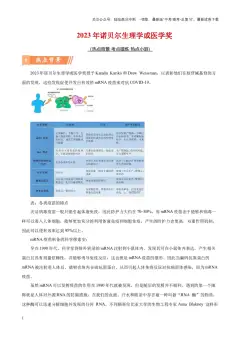
三位诺贝尔奖得主因发现外周免疫耐受而获得医学奖。
【原文·时文阅读】
文章来源:https://english.news.cn/20251006/5b44b305c81a48b2a305702955760f28/c.html
STOCKHOLM, Oct. 6 (Xinhua) -- Mary E. Brunkow, Fred Ramsdell, and Shimon Sakaguchi were awarded
the 2025 Nobel Prize in Physiology or Medicine on Monday for their discoveries concerning peripheral immune
tolerance(外周免疫耐受).
"Their discoveries have been decisive for our understanding of how the immune system functions and why we do
not all develop serious autoimmune diseases," said Olle Kampe, chair of the Nobel Committee.
The Nobel Assembly at Sweden's Karolinska Institute said the trio's work has had far-reaching clinical
implications, paving the way for new treatments for autoimmune diseases and cancer, and potentially improving the
success of transplantations.
读时文精读
Brunkow, born in 1961, is a senior program manager at the Institute for Systems Biology in the United States.
Ramsdell, born in 1960, serves as a scientific advisor at Sonoma Biotherapeutics, also in the United States.
Sakaguchi, born in 1951, is a professor at the Immunology Frontier Research Center of Osaka University in Japan.
The laureates will share the prize sum of 11 million Swedish kronor (about 1.17 million U.S. dollars).
The Nobel Prize in Physiology or Medicine has been awarded since 1901. Last year's prize went to American
scientists Victor Ambros and Gary Ruvkun for discovering microRNA and its role in gene regulation.
【原创·语法填空】
STOCKHOLM, Oct. 6 (Xinhua) -- Mary E. Brunkow, Fred Ramsdell, and Shimon Sakaguchi were awarded
the 2025 Nobel Prize in Physiology or Medicine on Monday for their discoveries 1._______(concern)
peripheral immune tolerance(外周免疫耐受)."Their discoveries have been 2._______(decide) for our
understanding of how the immune system functions and 3._______we do not all develop serious autoimmune
diseases," said Olle Kampe, chair of the Nobel Committee.
The Nobel Assembly at Sweden's Karolinska Institute said the trio's work has had far-reaching clinical
implications, 4._______(pave)the way for new treatments for autoimmune diseases and cancer, and 5._______
(potential)improving the success of transplantations.
Brunkow, born in 1961, is a senior program 6._______(manage) at the Institute for Systems Biology in
the United States. Ramsdell, born in 1960, serves 7._______ a scientific advisor at Sonoma Biotherapeutics, also
in the United States. Sakaguchi, born in 1951, is 8._______ professor at the Immunology Frontier Research Center
of Osaka University in Japan.
The laureates will share the prize sum of 11 million Swedish kronor (about 1.17 million U.S. dollars).
The Nobel Prize in Physiology or Medicine 9._______( award) since 1901. Last year's prize went to American
scientists Victor Ambros and Gary Ruvkun for discovering microRNA and 10._______(it) role in gene
regulation.
【课标词汇积累】
1.award n.奖,奖赏, 报酬,薪水, 加薪, 授予v.授予, 奖励, 裁定
The university will award scholarships to students who demonstrate outstanding academic performance and
community involvement.
(大学将向表现优异且积极参与社区活动的学生颁发奖学金。)
2.tolerance n.宽容,容忍, 限度, 耐药量,耐药性
Teachers should promote tolerance in the classroom by encouraging students to respect diverse opinions.
(教师应通过鼓励学生尊重不同观点来促进课堂上的包容性。)
3.function n.功能, 函数, 因变量, 宴会; v.工作, 发挥功能
The school library’s primary function is to provide resources that support both academic and independent
learning.
(学校图书馆的主要功能是提供支持学术和自主学习的资源。)
4.far-reaching adj.影响深远的, 有广泛影响的
Social media has far-reaching effects on students’ mental health and academic focus.
(社交媒体对学生的心理健康和学习专注力有深远影响。)
5.senior adj.级别/地位高的,高水平的; n.较年长的人
Senior students are often invited to mentor freshmen, sharing their experiences about balancing studies and
extracurricular activities.
(高年级学生常被邀请指导新生,分享他们平衡学习和课外活动的经验。)
6.scientific adj.科学(上)的, 细致严谨的
The school’s scientific equipment, like microscopes and lab kits, enhances hands-on learning in biology
classes.
(学校的科学设备,如显微镜和实验套件,增强了生物课的实践学习。)
7.share v.共有,合用, 分享,有共同之处 n.(应得或应承担的)一份, 股份
Study groups allow students to share notes and clarify difficult concepts together.
(学习小组让学生可以共享笔记并一起厘清难点。)
8.regulation n.管理, 控制, 规章, 规则; adj.规定的,必须穿戴的,必须使用的
The new school regulation requires all science projects to include ethical considerations.
(新校规要求所有科学项目必须包含伦理考量。)
9.serious adj. 严重的, 令人担忧的, 重要的, 严肃的, 认真的, 庄重的, 大量的Universities
expect serious commitment from students, especially in research-oriented programs.
(大学期望学生认真投入,尤其是在研究型项目中。)
10.clinical adj.临床的, 不带感情的, 简陋的
Medical students gain clinical experience by interning at hospitals under supervision.
(医学生通过在监督下医院实习获得临床经验。)
【课标词汇训练】
根据语境,从上面的“课标词汇”中选用合适的单词及其正确形式将句子补充完整。
1.Her research on renewable energy earned her an _____________ from the national science foundation.
(她关于可再生能源的研究为她赢得了国家科学基金会的奖项。)
2.Developing _____________  for failure is crucial for students to persist in challenging subjects like
mathematics.
(培养对失败的容忍度对学生坚持学习数学等挑战性学科至关重要。)
3.Understanding how the brain _____________ can help students develop better study habits.
(了解大脑如何运作可以帮助学生培养更好的学习习惯。)
4.The professor’s lecture on climate change had a _____________ impact, inspiring many students to pursue
environmental science.
(教授关于气候变化的讲座影响深远,激励了许多学生投身环境科学。)
5.The _____________ researcher’s guidance was invaluable to the team’s success in the national science
competition.
(这位资深研究员的指导对团队在全国科学竞赛中的成功至关重要。)
6.A _____________ approach to problem-solving involves forming hypotheses, conducting experiments, and
analyzing data.
(科学的问题解决方法包括提出假设、进行实验和分析数据。)
7.The guest speaker encouraged students to _____________ their innovative ideas at the tech conference.
(特邀嘉宾鼓励学生在科技会议上分享他们的创新想法。)
8.Strict _____________ of screen time helps students maintain focus during online classes.
(严格规范屏幕时间有助于学生在网课期间保持专注。)
9.A _____________ attitude toward plagiarism is essential to maintain academic integrity.
(对抄袭的严肃态度对维护学术诚信至关重要。)
10.The _____________ psychology course teaches students how to assess mental health conditions through
case studies.
(临床心理学课程通过案例研究教授学生如何评估心理健康状况。)
【参考译文】
瑞典卡罗林斯卡学院诺贝尔奖委员会宣布,玛丽·E·布伦科、弗雷德·拉姆斯代尔和西蒙·坂口因
发现外周免疫耐受机制荣获2025 年诺贝尔生理学或医学奖。瑞典卡罗林斯卡学院诺贝尔奖委员会主席奥
勒·坎佩表示:“他们的研究为理解免疫系统运作机制及解释为何并非所有人都会患上严重自身免疫性疾病
提供了关键性突破。”
该奖项指出,三位科学家的研究成果具有深远的临床应用价值,不仅为自身免疫疾病和癌症治
疗开辟了新路径,还可能提升器官移植成功率。
布伦科(1961 年生)现任美国系统生物学研究所高级项目主管;拉姆斯代尔(1960 年生)担任
美国索诺玛生物治疗公司科学顾问;坂口(1951 年生)是日本大阪大学免疫学前沿研究中心教授。三位获
奖者将共同分享1100 万瑞典克朗(约合117 万美元)的奖金。
自1901 年起设立的诺贝尔生理学或医学奖,去年由美国科学家维克多·安布罗斯与加里·鲁夫肯
因发现微小RNA 及其在基因调控中的作用而获得殊荣。
Passage1 阅读理解
(2026·河南省百所名校高三上学期开学)
Most of us grow up believing that the colors we see around us form the complete palette (调色板) of the
world. Yet a team of researchers at the University of California, Berkeley, has challenged that assumption by
revealing a color that had never before entered human vision.
Ren Ng, a professor of electrical engineering and computer science, together with Austin Roorda, a professor
of vision science, made this groundbreaking work possible. Their team developed an experimental platform named
Oz, capable of stimulating individual photoreceptor cells (感光细胞) in the retina (视网膜) with extraordinary
precision. Instead of merely presenting familiar shades, Oz creates signals in a way that generates entirely novel
visual experiences.
The scientists likened their exploration to a journey into a brand-new territory. They found themselves face
to face with something brilliant and wholly unfamiliar. By directing finely tuned laser beams onto M cone cells—
the receptors typically associated with perceiving green—they discovered a color beyond anything nature provides.
This striking new color was named “olo” by lead author James Carl Fong.
Ng admitted that he initially expected something like the “greenest green” imaginable. Instead, what
appeared was a blue-green that didn’t match any standard color. Only five people have been able to witness it,
练好题精练
because running Oz requires extreme precision and strict safety measures. The system must account for the eye’s
constant micro-movements while keeping laser exposure within safe limits.
Far from being a mere curiosity, this discovery raises profound questions about human perception. If
technology can find “olo”, how many other hidden colors might await discovery? Consider tetrachromacy (四色视
觉), a rare condition enabling certain individuals—mostly women—to see hundreds of millions of colors invisible
to most people. Ng wonders if a vast, unexplored area of color could exist beyond our current understanding where
colors like “olo” are only the start.
1.What can we know about the Oz platform?
A.It generates artificial cells.
B.It causes new colors to emerge.
C.It is named after its creator.
D.It works like humans’ retinas.
2.What is special about the color “olo”?
A.It is a common color found in nature.
B.It is the greenest green that can be imagined.
C.It is a color that doesn’t match any standard one.
D.It can only be seen by people with tetrachromacy.
3.Why is tetrachromacy mentioned?
A.To describe how the Oz system operates.
B.To stress the unique vision power of women.
C.To explain the principle behind the experiment.
D.To illustrate the possibility of discovering unseen colors.
4.What is the best title for the text?
A.A Breakthrough in Human Vision
B.How Did Scientists Find a New Cell?
C.The Discovery of a Never-Before-seen Color
D.Could There Be More Colors We Cannot See?
【词汇积累】
1.challenge n.挑战, 比赛邀请, 质疑; v.对…怀疑, 挑战,考验 2.assumption n.假定, 承担, 获得 3.reveal v.
揭示, 展示 4.electrical adj.用电的, 供电的, 电能的 5.groundbreaking adj.开创性的,突破性的
6.extraordinary adj.非凡的, 非常奇特的, 特别的 7.generate v.生(儿、女)( generate 的第三人称单数 ),
(通过物理或化学过程)发生, 生成, 引起 8.curiosity n.好奇心, 求知欲 9.initially adv.开始, 最初
10.invisible adj.看不见的,无形的
Passage2 阅读理解
(2026·江西省吉安市上进联考红十校联盟高三上学期开学)
Parkinson’s law states: “Work expands so as to fill the time available for its completion.” In other words,
things become harder to complete when more time is given to complete them as the build-up to the task becomes
stressful and frightening.
Parkinson’s law is not a scientific principle. Instead, it is simply an observation of a phenomenon many
people including scientists have experienced rather than dug into. As first described by CyrilNorthcote Parkinson in
a 1955 humor essay published in The Economist, it can explain the expansion of organizations. However, it can
also be a helpful way to think about other types of work, including personal productivity.
The complexity of a task tends to grow when more time is distributed for its completion. When you find
yourself finishing the task, you might feel a sense of relief but also wonder why the project became so much more
of a burden in your mind than it was in real life. The “extra time” that the task requires often isn’t related to the task
itself — it’s mental stress caused by worrying about getting it done.
In Parkinson’s original example, a woman’s task for the day was just to mail a postcard. As a result of having
the entire day to complete the simple task, the amount of work and time required expanded to fill the whole day.
The fictional woman spent a half-hour searching for her reading glasses. Writing the postcard took another two
hours. More time was spent finding a stamp, writing the address, and walking the postcard to the post office.
One reason why this phenomenon happens lies in how people tend to approach tasks. Research indicates that
when people start a new project, they tend to focus on how much time they have available to do it instead of how
much time the task would take to complete. While Parkinson’s law is a phenomenon that can lead to wasted time
and inefficient work, it doesn’t have to be a problem if you’re aware of it.
5.Why does Parkinson’s law fail to be a scientific principle?
A.It lacks profound research.
B.It serves certain enterprises.
C.It has shallow implications.
D.It aims to uncover an issue.
6.What does paragraph 3 mainly discuss about Parkinson’s law?
A.Its present situation.
B.Its underlying logic.
C.Its mental influence.
D.Its unnoticed worth.
7.What does Parkinson’s original example imply?
A.Looking for glasses didn’t matter.
B.Mailing a postcard took two hours.
C.Categorizing tasks consumed time.
D.Task expands to fill available time.
8.What might be discussed in the follow-up text?
A.Views on deadline setting.
B.Modes of task assignment.
C.Difficulties in high outputs.
D.Tips for time management.
【长难句分析】
【文章原句】Research indicates that when people start a new project, they tend to focus on how much time they
have available to do it instead of how much time the task would take to complete.
【句式分析】 这个句子是一个复合句,包含多个分句和修饰成分。that 后是宾语从句,when people start a
new project 是宾语从句中的时间状语从句,how much time they have available to do it 是宾语从句中的宾语从句,
instead of 前后是并列关系,how much time the task would take to complete 仍然是宾语从句。
【翻译】研究表明,当人们开始一个新项目时,他们倾向于关注他们有多少时间去做它,而不是任务需要多
少时间来完成。
Passage 3 阅读七选五
(2026·江苏省南京市六校联合体高三上学期8 月学情调研考试)
阅读下面短文,在空白处填入1 个适当的单词或括号内单词的正确形式。
With data shaping everything from healthcare breakthroughs to the latest entertainment trends, data scientists
are at the heart of some of the most exciting innovations happening right now.

 1
In the simplest terms, data scientists are the problem-solvers of the digital age. They collect, analyze and
interpret complex datasets to help businesses solve real-world problems.

 2

  Whether it’s uncovering
hidden patterns in customer data, improving product quality or helping businesses make smarter decisions, data
scientists are always deeply engaged in it.
Data scientists are highly skilled in coding.

 3

  It’s also used to automate repetitive tasks, freeing up
time for more creative work. While not every task will involve coding, it’s still a core skill that enables data
scientists to obtain insights efficiently and effectively. It’s the foundation upon which they build the models and
tools that power business innovations.


 4

  With more and more data being generated every day, skilled data professionals are more popular
than ever. This rapid growth is driven by the increasing need for data to inform smarter decision-making across
every industry. Roles in the field span a wide range, including machine learning engineer, data analyst, quantitative
researcher and business intelligence specialist.
With AI moving at lightning speed, it’s natural to wonder if data scientists could one day be replaced by AI.
While AI can automate repetitive tasks like data preparation, it doesn’t have the critical thinking and strategic
decision-making that human data scientists bring to the table.

 5

  If you have a passion for coding and get
excited about turning data into real-world solutions, data science might just be your perfect match.
A.Are data scientists in demand?
B.Coding isn’t just for creating instructions.
C.The life of a data scientist is anything but dull.
D.They excel at turning raw data into actionable insights.
E.So, rather than replacing data scientists, AI will help them.
F.But what is it actually like to be a data scientist in today’s world?
G.However, their work could not always lead to practical solutions.
Passage 4 完形填空
(2025·四川省巴中市高三下学期三模)
When I studied in my high school, I did an experiment about how the temperature affected the growth of a
plant. That experiment made me

 1

  that science teaches us the domino effect ( 多米诺效应) in the
environment. It teaches people our

 2

  so we know where we are from. That day I

 3

  decided to
be a scientist and that will be my greatest ambition in life. Ever since that day I have studied harder

 4

  in
all my science-related subjects. After school I do much research on how I can become a

 5

  scientist in the
future.
One of my

 6

  in becoming a scientist is Barbara McClintock. She has been awarded the 1983
Nobel Prize in Physiology or Medicine. At 25 she already had her PhD in botany and after that she started her
7

  as the leader in the development of maize cytogenetics (玉米细胞遗传学) and she was

 8

  to that
research for the rest of her life.
If I am lucky and given the

 9

  to achieve my ambition as a scientist, I want to be like Doctor
McClintock. She

 10


  something that helped the other scientists

 11


  the thing about
genetics that did not just help her generation but also the future generation.
I know I will be able to achieve my

 12


  as long as I put my heart and perseverance into it. If I am
lucky enough to achieve my goal, I will share my

 13


  with all the kids who also love science and want
to become scientists. My future will be as

 14


  as the stars in the night sky. My future is still far but I
will make the most of all in the

 15


  to achieve my greatest ambition of becoming a scientist.
1.A.recognize
B.suspect
C.treasure
D.wonder
2.A.root
B.school
C.study
D.development
3.A.lazily
B.easily
C.resolutely
D.partly
4.A.potentially
B.particularly
C.separately
D.suitably
5.A.popular
B.content
C.outstanding
D.careful
6.A.persuasions
B.creations
C.generations
D.inspirations
7.A.experience
B.career
C.science
D.compliment
8.A.addicted
B.dedicated
C.attached
D.linked
9.A.freedom
B.reason
C.opportunity
D.privilege
10.A.scheduled
B.heard
C.predicted
D.discovered
11.A.figure out
B.head out
C.carry out
D.stand out
12.A.reward
B.fame
C.platform
D.ambition
13.A.determination B.information
C.fortune
D.brightness
14.A.qualified
B.shining
C.brave
D.proud
15.A.mind
B.lecture
C.heart
D.present
Passage 5 语法填空
(2025·甘肃省天水市模拟预测(B))
阅读下面短文,在空白处填入1 个适当的单词或括号内单词的正确形式。
Back in

 1

  late 1700s, long before people understood the reason behind immunity, farmers and
doctors in rural areas of Britain noticed that dairymaids (挤奶女工) and other people who got a mild disease called
cowpox (牛痘) seldom caught its fearsome cousin, smallpox (天花). Was there a connection? Some decided there
was and inserted (嵌入的) material from the cowpox into an incision they cut on the arm of healthy people, thus
somehow

 2

  (protect) them from smallpox. In 1798, a doctor named Edward Jenner published the results of
his experiments using this procedure, earning

 3

  (he) fame as the “Father of Immunology”.
Scientists later figured out that cowpox somehow protected one from smallpox. When people caught
cowpox, their bodies made special cells

 4

  (call) antibodies. They fought the disease. That’s not all. They
stayed in the blood

 5

  case the disease ever returned. Because cowpox and smallpox are fairly similar, if a
person was later exposed to the more serious disease, antibodies were ready

 6

  (fight) it too.
That knowledge helped scientists develop vaccines. The term vaccination originated from Latin. They
contain the viruses, weakened, dead or modified (改良的). Injected into the blood, they trick the immune system
into making antibodies.

 7

  the body ever meets with those same

 8

  (virus), even at full strength, the
antibodies make short work of them.
Vaccination prior to

 9

  (expose) to the virus is ideal. But a vaccination given within three days of
exposure will

 10


  (complete) prevent or significantly modify smallpox in the majority of people and given
within the first four to seven days will likely offer some protection or soften the disease.