本测试报告为SHL官网免费练习报告,类别为性格测试。个人所有,请勿扩散。
鉴于广大社聘高大尚的OFFER都需要这个SHL测试,文库大量应届的测试资料,
本人在SHL官网亲测,报告贡献给各位,请勿完全模拟,职位和雇主不同,差异很大。
中文版免费测试入口已经关闭,估计国人作弊太多被迫叫停,其他语言都可以进行
练习测试,题目200个小题,也是最符合于最不符合,不过是4选项,还有较符合和较
不符合可选。各位有时间可以对应各自测试类别深入研究。
有问题沟通请联系文末Mail.
Good Luck~~~~
Prepare yourself for a
Competency Based Interview
www.ceb.shl.com
Name
Mr. jason Dell
Date
22 April 2014
This report has been prepared as part of an SHL Research project and is not commercially available. It is not intended to provide
information for selection procedures.Introduction
This report is designed to help you prepare for a Competency Based Interview.
Competency Based Interviews are increasingly being used by employers as they
have been shown to help make selection decisions more objective and effective.
"Competencies" refer to the job-related behaviours that good performers display;
and a Competency Based Interview aims to measure how likely you are to exhibit
these behaviours.
The questionnaire that you recently completed is designed to identify which of
these behaviours come easily to you and which ones you might find more difficult,
or have to work harder to achieve. This insight into your likely strengths and
weaknesses should aid your preparation for an interview.
Structure of this report
This report divides competencies that influence performance across many different
jobs into 8 broad areas. Each area is described in terms of its relevance and
importance to particular job functions. You can see examples of jobs where this
competency area is most relevant; and examples of what it means to demonstrate
this competency, or "what good looks like" are also listed.
For each competency area your potential has been assessed based on the
responses you gave to the questionnaire and is presented in terms of the likelihood
that this area is one of your strengths.
We have also included some example questions related to the 8 competency areas
that you might be asked in your job interview. Competency Based Interviews
usually involve situation-based questions, which target the specific behaviours that
you have displayed in a previous situation that are related to this competency. To
succeed in such an interview, you’ll need to have strong and relevant examples
which illustrate your behaviours in the past.
Prepare yourself for a Competency Based
22 April 2014 Interview Mr. jason Dell 2 of 13
© 2014 SHL, a part of CEB. All rights reserved.Your Competency Potential Report
When considering the description of your competency potential, it is important to
remember that it's based on the answers you gave and represents the way you
see your own behaviour, rather than how your behaviour might be seen by
someone else. The questionnaire is not infallible and, as with all questionnaires, its
accuracy depends on how honest and candid you were when you completed it.
This report summarises your potential in 8 broad areas of competence. It gives an
indication of your likely strengths and areas which you may require development.
It is important to remember that none of these behaviours are static and a low
score means that the behaviour is less likely to come naturally to you, but can
quite possibly become one of your strengths if you work on it!
Report Key
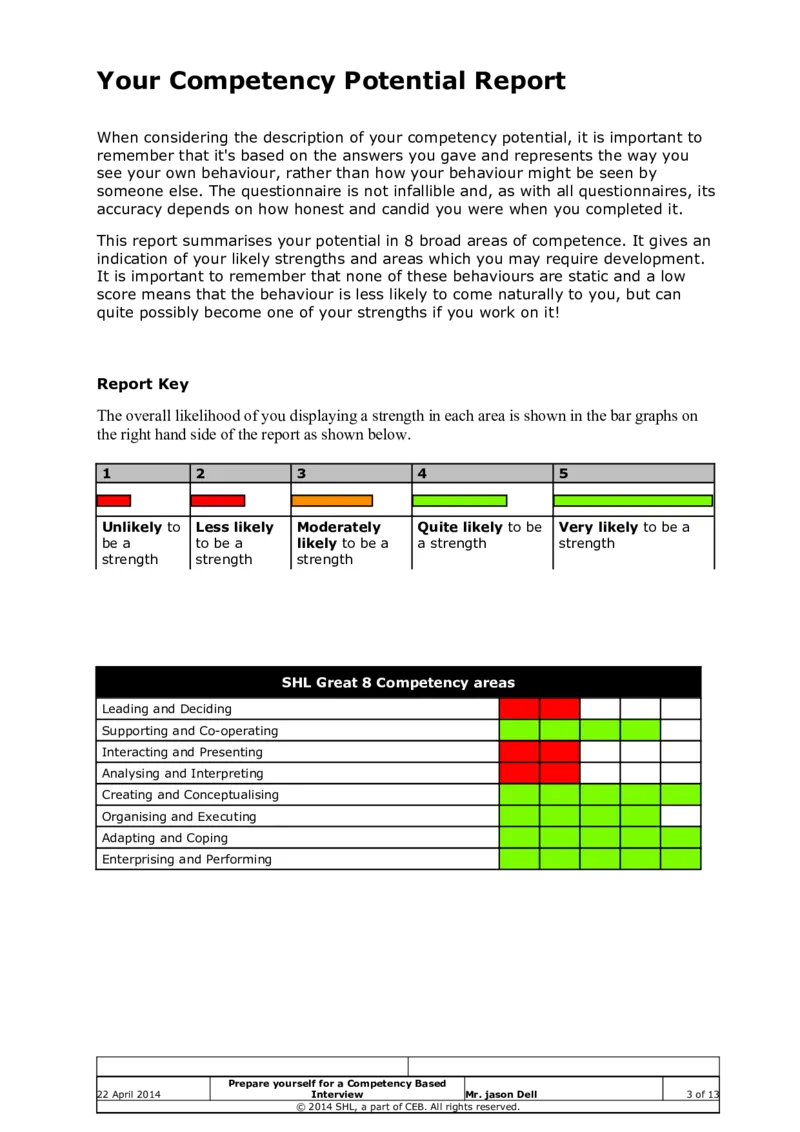
The overall likelihood of you displaying a strength in each area is shown in the bar graphs on
the right hand side of the report as shown below.
1 2 3 4 5
Unlikely to Less likely Moderately Quite likely to be Very likely to be a
be a to be a likely to be a a strength strength
strength strength strength
SHL Great 8 Competency areas
Leading and Deciding
Supporting and Co-operating
Interacting and Presenting
Analysing and Interpreting
Creating and Conceptualising
Organising and Executing
Adapting and Coping
Enterprising and Performing
Prepare yourself for a Competency Based
22 April 2014 Interview Mr. jason Dell 3 of 13
© 2014 SHL, a part of CEB. All rights reserved.Competency Potential Summary
The table below shows a summary of your competency potential in the 8 competency areas
assessed. Descriptions and example interview questions for these 8 competency areas can be
found on the next few pages of this report.
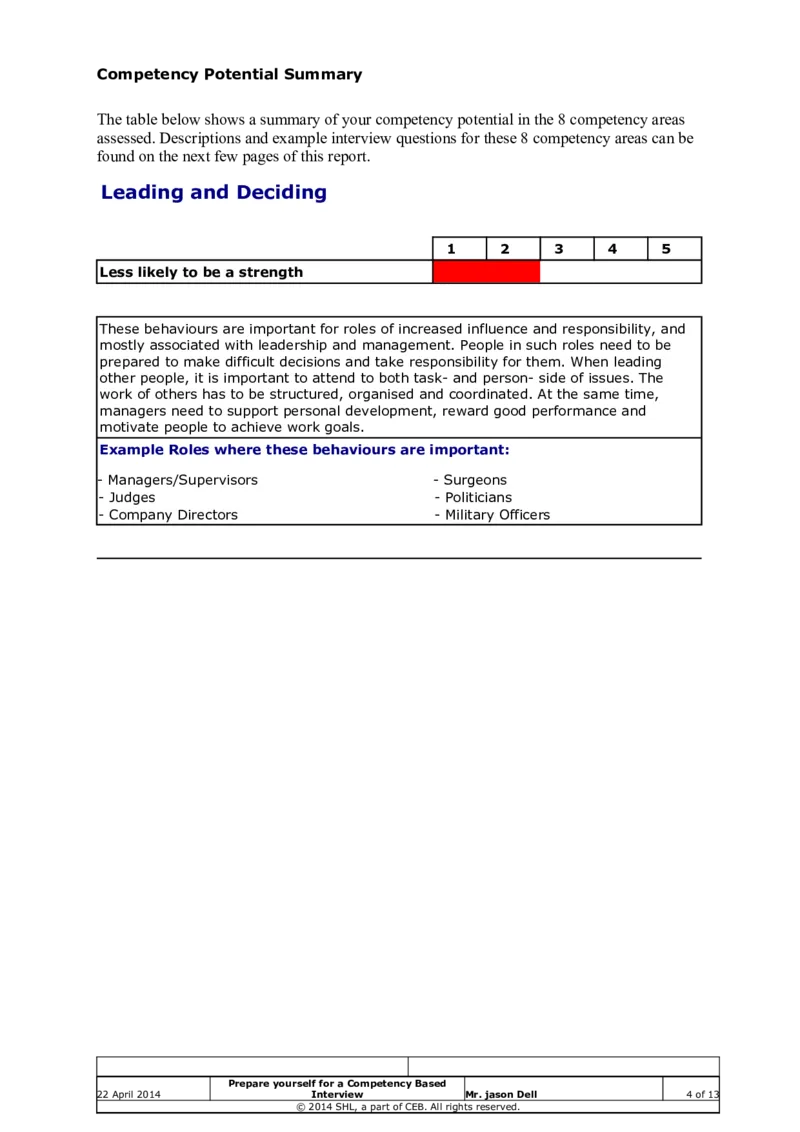
Leading and Deciding
1 2 3 4 5
Less likely to be a strength
These behaviours are important for roles of increased influence and responsibility, and
mostly associated with leadership and management. People in such roles need to be
prepared to make difficult decisions and take responsibility for them. When leading
other people, it is important to attend to both task- and person- side of issues. The
work of others has to be structured, organised and coordinated. At the same time,
managers need to support personal development, reward good performance and
motivate people to achieve work goals.
Example Roles where these behaviours are important:
- Managers/Supervisors - Surgeons
- Judges - Politicians
- Company Directors - Military Officers
Prepare yourself for a Competency Based
22 April 2014 Interview Mr. jason Dell 4 of 13
© 2014 SHL, a part of CEB. All rights reserved.What Good Looks Like:
- Acts decisively and takes responsibility.
- Is prepared to make difficult decisions and take calculated risks.
- Empowers, develops and motivates others.
- Defines roles and responsibilities and coordinates others.
- Recognises and rewards good performance and builds effective teams.
Example Interview Questions:
Outline a situation that required you to take a particularly quick and definitive
decision.
- What factors did you take into account when making your decision?
- How comfortable were you at having to make such a quick decision?
- How might your decision have been different if you had had more time to consider the
issues involved?
Tell me about a time when you had to take charge of a group of people in order
to achieve a particularly important outcome.
- How did it come about that you took this leadership role?
- How did others respond to you in this role?
- How would you describe your leadership style in this situation and how effective was it
on this occasion?
Give me an example of something you have done to bring out the best in
another person or when you created a learning opportunity for someone.
- How successful were you in your endeavour?
- What does empowerment mean to you as a manager?
- What skills would you like to improve to aid you to manage and set up learning
opportunities?
Prepare yourself for a Competency Based
22 April 2014 Interview Mr. jason Dell 5 of 13
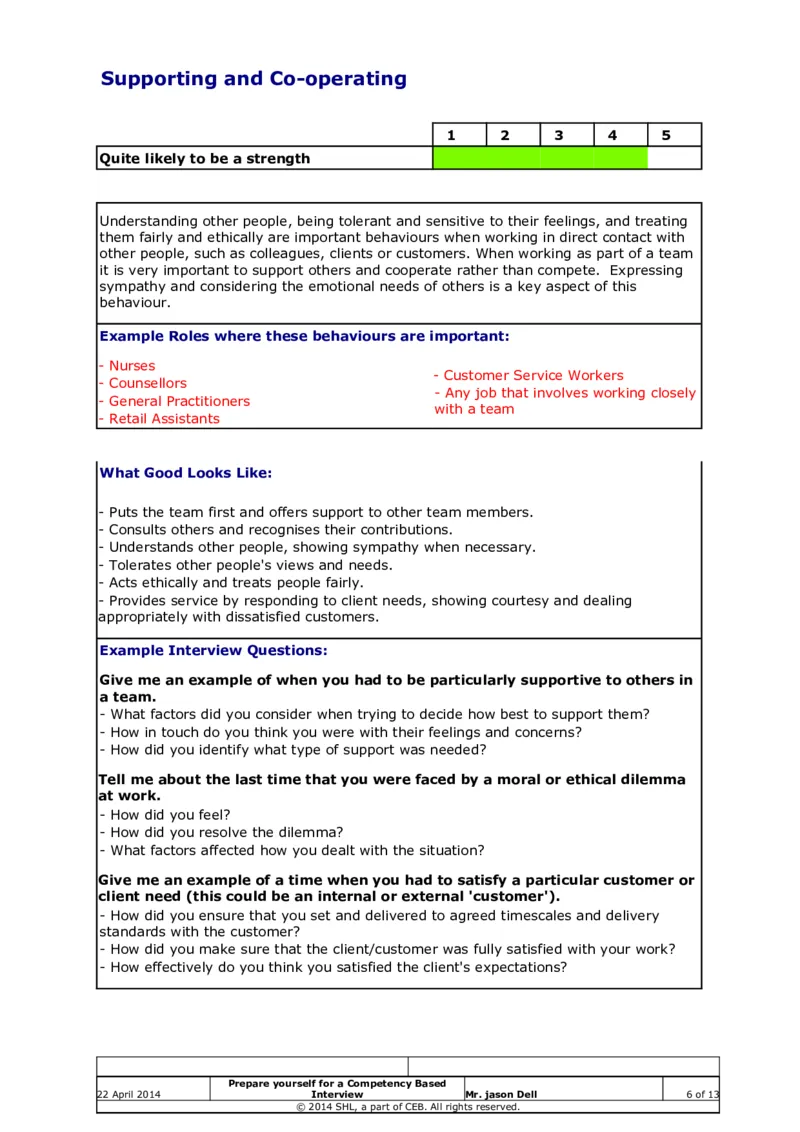
© 2014 SHL, a part of CEB. All rights reserved.Supporting and Co-operating
1 2 3 4 5
Quite likely to be a strength
Understanding other people, being tolerant and sensitive to their feelings, and treating
them fairly and ethically are important behaviours when working in direct contact with
other people, such as colleagues, clients or customers. When working as part of a team
it is very important to support others and cooperate rather than compete. Expressing
sympathy and considering the emotional needs of others is a key aspect of this
behaviour.
Example Roles where these behaviours are important:
- Nurses
- Customer Service Workers
- Counsellors
- Any job that involves working closely
- General Practitioners
with a team
- Retail Assistants
What Good Looks Like:
- Puts the team first and offers support to other team members.
- Consults others and recognises their contributions.
- Understands other people, showing sympathy when necessary.
- Tolerates other people's views and needs.
- Acts ethically and treats people fairly.
- Provides service by responding to client needs, showing courtesy and dealing
appropriately with dissatisfied customers.
Example Interview Questions:
Give me an example of when you had to be particularly supportive to others in
a team.
- What factors did you consider when trying to decide how best to support them?
- How in touch do you think you were with their feelings and concerns?
- How did you identify what type of support was needed?
Tell me about the last time that you were faced by a moral or ethical dilemma
at work.
- How did you feel?
- How did you resolve the dilemma?
- What factors affected how you dealt with the situation?
Give me an example of a time when you had to satisfy a particular customer or
client need (this could be an internal or external 'customer').
- How did you ensure that you set and delivered to agreed timescales and delivery
standards with the customer?
- How did you make sure that the client/customer was fully satisfied with your work?
- How effectively do you think you satisfied the client's expectations?
Prepare yourself for a Competency Based
22 April 2014 Interview Mr. jason Dell 6 of 13
© 2014 SHL, a part of CEB. All rights reserved.Interacting and Presenting
1 2 3 4 5
Less likely to be a strength
In order to win people round to a particular point of view, as in sales-related roles, it is
important to make a good first impression, be confident, convincing and have good
presentation skills. More broadly, to interact successfully with others and build
productive relationships, one needs to be adaptable, take time to build and maintain
people networks, and deal tactfully with any disagreements.
Example Roles where these behaviours are important:
- Sales Agents
- Public Relations Managers
- Marketing Managers
- Management Consultants
- Lawyers/Barristers
- Estate Agents
- Recruitment Consultants
What Good Looks Like:
- Quickly establishes lasting and useful relationships with people.
- Successfully negotiates, mediates and persuades.
- Communicates and presents effectively, adapting style to suit the listener(s).
Example Interview Questions:
Tell me about a time when you found it difficult to build an effective working
relationship with a customer or colleague.
- How did you deal with this?
- What efforts did you make to understand the situation from other people's
perspective?
- To what extent did your relationship change?
Describe a situation where you had difficulty persuading someone around to
your point of view.
- Why did you try to persuade him/her?
- How successful were you?
- What did you do to try and persuade them and what would you do differently next
time?
Tell me about a time when you have had to present ideas or information in a
formal setting to others (such as a presentation to a group of people).
- How did you feel during the presentation?
- How did you decide what style to adopt in the presentation?
- How do you feel the presentation went, and what feedback did you receive?
Prepare yourself for a Competency Based
22 April 2014 Interview Mr. jason Dell 7 of 13
© 2014 SHL, a part of CEB. All rights reserved.Analysing and Interpreting
1 2 3 4 5
Less likely to be a strength
These behaviours are important for roles requiring good analytical skills. When working
with information or solving problems, it is important to evaluate and review critically
and produce solutions that are rational, practical and based on evidence.
Communicating information and ideas effectively in writing and sharing expertise with
others is essential for knowledge to disseminate through an organisation.
Example Roles where these behaviours are important:
- Economists - Computer Scientists
- Physicists - Actuaries
- Political Analysts - IT Analysts
- Engineers - Business Analysts
- Statisticians
What Good Looks Like:
- Gathers information and evaluates it critically
- Makes rational judgements and produces solutions to problems.
- Writes in an engaging style and adapts writing style to suit the intended reader.
- Shares information and expertise with others.
- Actively seeks to develop job knowledge and skills and to learn about the organisation
and its market.
Example Interview Questions:
Describe a judgement that you have had to make that required you to be
especially rational and objective.
- To what extent did your final judgement differ from your own initial view of the
situation?
- How typical was this of your usual approach when analysing issues or problems?
- What information did you collect to ensure that you remained objective?
What type of written documents do you produce in your current (most recent)
role?
- Which of these do you find most difficult or challenging to produce and why?
- How much do you enjoy this aspect of your work?
- How do you decide how to structure your written work and the level at which to pitch
it?
- What feedback have you received about your written communication at work?
When was the last time you attended any kind of training?
- What did it involve?
- How did you apply the information?
- What feedback did you receive after the training?
Prepare yourself for a Competency Based
22 April 2014 Interview Mr. jason Dell 8 of 13
© 2014 SHL, a part of CEB. All rights reserved.Creating and Conceptualising
1 2 3 4 5
Very likely to be a strength
Creativity and imagination are crucial for tasks and roles that require producing
something new and original. It is not only creativity that drives innovation, but also
providing the right environment for new ideas to flourish. All areas of work have
emerging knowledge or technology, and it is important to be open to these new ideas
and be keen to learn. Concentrating on the big picture and thinking about the long term
are also important for achieving ambitious, long term objectives.
Example Roles where these behaviours are important:
- Fashion Designers - Web Developers
- Product Designers - Biochemists
- Architects - Physicists
- Choreographers - Strategy Consultants
- Creative Writers
What Good Looks Like:
- Generates new ideas and readily considers new or unconventional approaches.
- Anticipates future trends and imagines future possibilities.
- Has a clear vision of long term goals and develops strategy to achieve them.
Example Interview Questions:
Give me an example of when you have shown creativity.
- Talk me through the processes that you went through when generating ideas or
alternatives. How many alternatives did you generate?
- How did you decide which idea or alternatives to apply in practice?
- How well did your idea(s) work in practice?
Give me an example of a time when you used a less common approach to work.
- Why did you choose to follow this approach?
- Why do you think your approach was different?
- What was the end result?
To what extent has your current (or previous) role allowed you to think
strategically?
- Describe the time-scales under which you typically plan and operate.
- How much do you enjoy planning in the longer term?
- Describe your role in a strategic planning process in which you have been involved.
- How do you go about balancing day-to-day issues with those that are more long term?
Prepare yourself for a Competency Based
22 April 2014 Interview Mr. jason Dell 9 of 13
© 2014 SHL, a part of CEB. All rights reserved.Organising and Executing
1 2 3 4 5
Quite likely to be a strength
All employers want people who are organised, conscientious, committed, follow rules
and can be relied upon to work on a task independently. These qualities are particularly
important for busy roles where accurate and reliable execution is the key. When
planning and managing projects, or scheduling and organising events, it is important to
prioritise, multitask and use time effectively. Delivering work of high quality requires
commitment, effort and an eye for detail.
Example Roles where these behaviours are important:
- Auditors
- Personal Assistants
- Computer Systems Administrators
- Facilities Managers
- Project Managers
- Health and Safety Inspectors
- Aviation Inspectors
- Production Managers
- Accountants
What Good Looks Like:
- Works towards high standards and constantly monitors and improves own
performance.
- Develops realistic and achievable plans breaking work down into manageable parts.
- Works systematically, setting objectives and prioritising effectively.
- Uses time efficiently and monitors progress against deadlines and milestones.
- Is committed to excellence and the organisation.
- Accepts direction and complies with rules.
- Is dependable and works well autonomously.
Example Interview Questions:
What is the most challenging project or piece of work that you have had to
organise?
- How did you structure the project and your planning of it?
- What made this project so challenging?
- Looking back, how could you have been better prepared or organised?
Give me an example of when you had to work to an important deadline.
- Why was this deadline so important and what did you do to ensure it was met?
- To what extent did you meet the deadline and all that it required?
- What feedback did you receive afterwards?
Can you tell me about a time when it was essential that you followed clear
policies or procedures?
- How typical is it for you to follow rules and procedures in a situation like this?
- How successful were you in following these policies and procedures closely?
- How do you feel when operating in areas that do not have such clear policies and
procedures?
Prepare yourself for a Competency Based
22 April 2014 Interview Mr. jason Dell 10 of 13
© 2014 SHL, a part of CEB. All rights reserved.Adapting and Coping
1 2 3 4 5
Very likely to be a strength
Most organisations go through periods of change or high pressure and some jobs are
likely to involve uncertain or stressful situations on a regular basis. Adjusting and not
feeling threatened in unfamiliar environments requires flexibility and the acceptance of
change as a normal part of life. Effectively coping with pressure, setbacks or criticism
requires the ability to stay calm, view things positively and switch off from work when
relaxing.
Example Roles where these behaviours are important:
- Police Detectives - Sales Managers
- Umpires/Referees - Fire Service Worker
- Mental Health Counsellors - Expatriate Workers
What Good Looks Like:
- Adapts and responds well to change.
- Remains composed and effective in ambiguous or uncertain situations.
- Works productively under pressure and relaxes outside work.
- Keeps emotions under control and maintains a positive attitude despite setbacks.
- Uses criticism constructively and does not dwell on unfair criticism.
Example Interview Questions:
What is the greatest change that you have had to adapt to recently?
- How was the need for change identified and what was its impact upon you?
- How much variety do you like in your day-to-day work role?
- What do you view as the benefits (and any disadvantages) of the changes?
Describe a situation when you had to work under a high degree of pressure.
- How did you feel while you were under this amount of pressure?
- Do you think others would have noticed a change in your behaviour during this time?
- What did you do to help you cope with this pressure and what might you do differently
if this situation arose again?
Tell me about a time when you were unfairly criticised.
- Why do you think this happened?
- How did you respond?
- What was the outcome?
Prepare yourself for a Competency Based
22 April 2014 Interview Mr. jason Dell 11 of 13
© 2014 SHL, a part of CEB. All rights reserved.Enterprising and Performing
1 2 3 4 5
Very likely to be a strength
Demanding and results-oriented roles need "go-getting" and driven people, who are
ambitious and constantly stretch themselves to achieve goals. People who work hard,
persist and push themselves to the limit are generally the top performers in any
organisation. In addition to drive, thinking commercially is a key behaviour for
generating new business and maximising revenues.
Example Roles where these behaviours are important:
- Sales Agents - Treasurers
- Stockbrokers - Bankers
- Financial Officers - Any target/results orientated job
- Retail Buyers
What Good Looks Like:
- Works energetically and enthusiastically and shows persistence.
- Acts on own initiative and seeks new challenges and demanding goals.
- Thinks commercially, prioritising financial considerations and actively seeking
opportunities for new business.
Example Interview Questions:
Describe some particularly stretching targets that you have worked towards.
- How were these targets set?
- How motivating do you find targets like this?
- How successful were you in reaching them?
To what extent does your current (previous) role require you to take a
commercial view of the organisation’s performance?
- What personal targets do you have in relation to commercial success?
- How, and to what extent, do you measure your own performance against these kinds
of factors?
- How important is this in terms of your motivation?
Give me an example of a time when you spotted a good business opportunity.
- What was this opportunity?
- Why did you think it was worthwhile?
- What was the outcome?
Prepare yourself for a Competency Based
22 April 2014 Interview Mr. jason Dell 12 of 13
© 2014 SHL, a part of CEB. All rights reserved.ABOUT THIS REPORT
The report herein is generated from the results of a questionnaire answered by the
respondent(s) and substantially reflects the answers made by them. Due consideration
must be given to the subjective nature of questionnaire-based ratings in the interpretation
of this data.
This report has been generated electronically - the user of the software can make
amendments and additions to the text of the report.
SHL Group Limited and its associated companies cannot guarantee that the contents of this
report are the unchanged output of the computer system. We can accept no liability for the
consequences of the use of this report and this includes liability of every kind (including
negligence) for its contents.
This report has been prepared by SHL as part of an SHL Research project and is not
commercially available. It is not intended to provide information for selection procedures.
www.ceb.shl.com
© 2014 SHL, a part of CEB. All rights reserved. SHL and OPQ are trademarks of SHL Group
Limited which is registered in the United Kingdom and other countries.
The SHL Universal Competency Framework is protected by copyright © 2004 - 2014, SHL
Group Limited, and is trade mark of SHL Group Limited.
被测试人: Jason Dell (nickname)
行业: IT
年龄:30Y
雇主:HW
职位:IT PD Mr
联系交流:wangjx1984@gmail.com
Prepare yourself for a Competency Based
22 April 2014 Interview Mr. jason Dell 13 of 13
© 2014 SHL, a part of CEB. All rights reserved.