Welcome Unit
目标导航
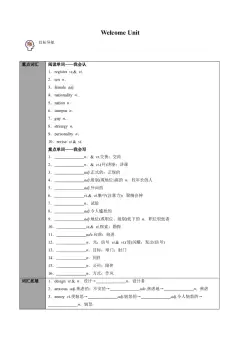
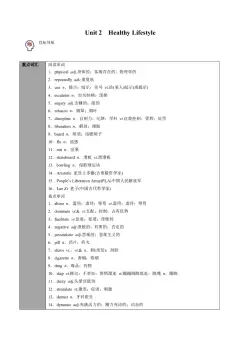
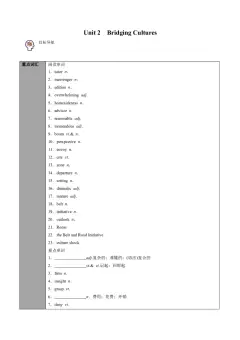
重点词汇 阅读单词——我会认
1.register vt.& vi.登记;注册
2.sex n.性别
3.female adj.女(性)的;雌的
4.nationality n.国籍;民族
5.nation n.国家
6.campus n.校园
7.guy n.小伙子
8.strategy n.策略;策划
9.personality n.性格;个性
10.revise vt.& vi.修改;修订;复习
重点单词——我会写
1.exchange n.& vt.交换;交流
2.lecture n.& vi.(开)讲座;讲课
3.formal adj.正式的;正规的
4.senior adj.级别(或地位)高的 n.较年长的人
5.outgoing adj.外向的
6.concentrate vi.& vt.集中(注意力);聚精会神
7.experiment n.试验
8.awkward adj.令人尴尬的
9.junior adj.地位(或职位、级别)低下的 n.职位较低者
10.explore vt.& vi.探索;勘探
11.forward adv.向前;前进
12.flash n.光;信号 vi.& vt.(使)闪耀;发出(信号)
13.goal n.目标;球门;射门
14.partner n.同伴
15.company n.公司;陪伴
16.style n.方式;作风
词汇拓展 1.design vt.& n.设计→designer n.设计者
2.anxious adj.焦虑的;不安的→anxiously adv.焦虑地→anxiety n.焦虑
3.annoy vt.使恼怒→annoyed adj.恼怒的→annoying adj.令人恼怒的→annoyance n.恼怒
4.frighten vt.使害怕→frightened adj.惊吓的→frightening adj.令人害怕的5.impress vt.给……留下深刻的好印象→impression n.印象;感想→impressive adj.令人印
象深刻的
6.confident adj.自信的→confidence n.信心;信任
7.organise vt.组织;筹备→organisation n.组织;团体→organiser n.组织者
8.improve vi.& vt.改进;改善→improvement n.提高;改善
9.curious adj.好奇的→curiously adv.好奇地→curiosity n.好奇
重点词组 1.at last终于;最终
2.make an impression留下好印象
3.what if要是……会怎么样呢?
4.concentrate on集中精力于
5.leave...alone不打扰;不惊动
6.junior high school(美国)初级中学
7.look forward to盼望;期待
8.take notes记笔记
重点句型 1.I found most of my classmates and teachers friendly and helpful.
我发现我的大多数同学和老师都很友好,而且乐于助人。
2.I believe I will make new friends here,and there’s a lot to explore at senior high.
我相信在这里我会交到新朋友,而且,在高中有好多东西要去探索。
3.Tim writes his parents an email every week and tells them what happened on the ship.
蒂姆每周给他的父母发邮件并且告诉他们船上发生了什么事。
4.There’s always something exciting to do.
总有一些刺激的事情要做。
5.Studying and doing homework seem much more fun when you are at sea!
当你在海上的时候,学习和做作业似乎有趣得多!
知识精讲
知识点01 design n. 设计;设计方案 vt. 设计;筹划
(1)design sth. for 为……设计某物
be designed to do ... 旨在做……,用于做……
归纳
(2)make designs for ... 为……做设计
拓展
by design (=on purpose) 故意地(反义短语:by accident/by chance偶然地)
(3)designer n. 设计者①Our school invited two engineers to design_a_language_lab_for_us.
我们学校邀请了两位工程师为我们设计一个语言实验室。
②Project Hope is_designed_to_help those children who drop out of school because of poverty.
希望工程旨在帮助那些因为贫困而辍学的孩子。
③An Italian architecture designer is to make_designs_for the new bridge.
一位意大利建筑设计师打算为这座新桥进行设计。
(1)单句语法填空
①They asked me to design a poster ________ the campaign.
②The programme is designed ________ (help) people who have been out of work for a long time.
③People wanted to know who this talented ________ (design) was.
【答案】①for ②to help ③designer
(2)单句写作
①Whether this happened ____________ (有意安排) or by chance is unknown.
②This course ______________________ (专为……设计) beginners like you, focusing on listening and speaking
practice.
【答案】①by design ②is specially designed for
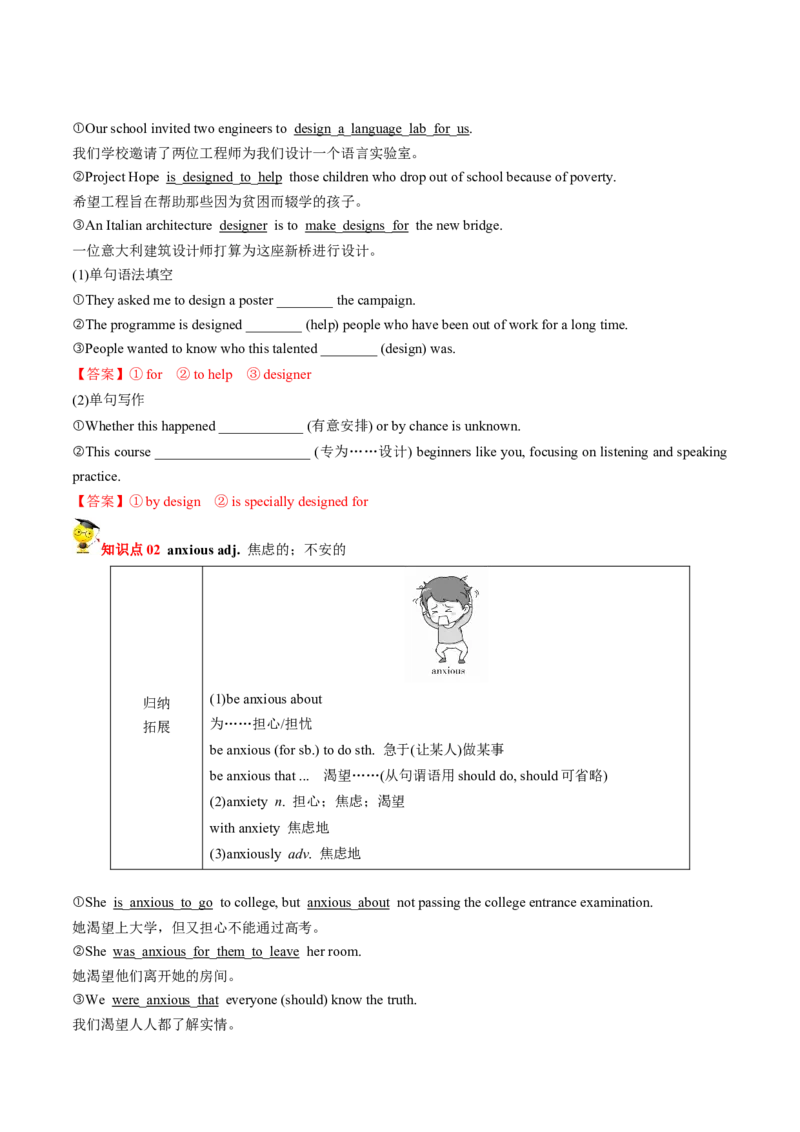
知识点02 anxious adj. 焦虑的;不安的
归纳 (1)be anxious about
拓展 为……担心/担忧
be anxious (for sb.) to do sth. 急于(让某人)做某事
be anxious that ... 渴望……(从句谓语用should do, should可省略)
(2)anxiety n. 担心;焦虑;渴望
with anxiety 焦虑地
(3)anxiously adv. 焦虑地
①She is_anxious_to_go to college, but anxious_about not passing the college entrance examination.
她渴望上大学,但又担心不能通过高考。
②She was_anxious_for_them_to_leave her room.
她渴望他们离开她的房间。
③We were_anxious_that everyone (should) know the truth.
我们渴望人人都了解实情。④Watching him climb up the cliff, everybody was breathless with_anxiety.
看着他往悬崖上爬,大家都捏一把汗。
(1)单句语法填空
①It's natural for parents to be anxious ________ their children's future.
②If you are worried about your health, share your ________ (anxious) with your doctor.
③He was most anxious ________ (find) a job so as not to have to depend on others.
【答案】①about ②anxiety ③to find
(2)单句写作
①我很好,不要担心我的身体。
I'm fine, don't __________________ about my health.
②他忧心忡忡地等待着有关该事故的更多消息。
He waited ____________________ for more news about the accident.
【答案】①be anxious/worried/concerned ②anxiously/with anxiety
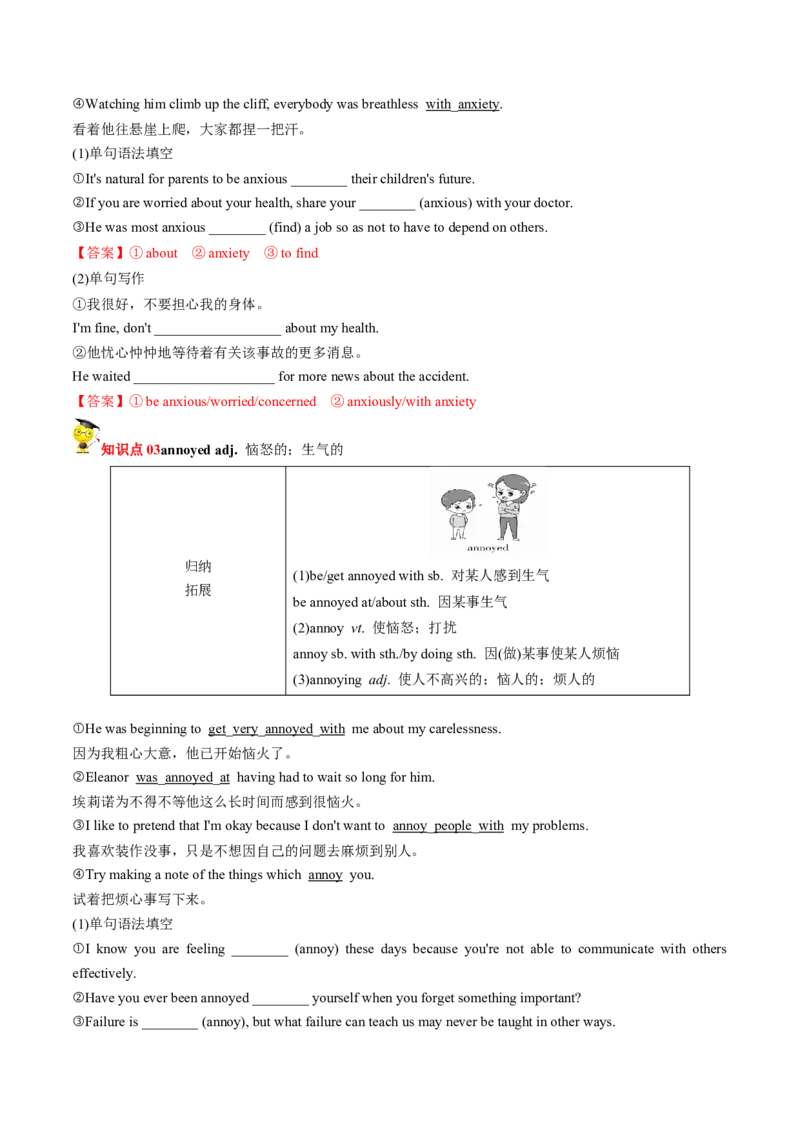
知识点03annoyed adj. 恼怒的;生气的
归纳
(1)be/get annoyed with sb. 对某人感到生气
拓展
be annoyed at/about sth. 因某事生气
(2)annoy vt. 使恼怒;打扰
annoy sb. with sth./by doing sth. 因(做)某事使某人烦恼
(3)annoying adj. 使人不高兴的;恼人的;烦人的
①He was beginning to get_very_annoyed_with me about my carelessness.
因为我粗心大意,他已开始恼火了。
②Eleanor was_annoyed_at having had to wait so long for him.
埃莉诺为不得不等他这么长时间而感到很恼火。
③I like to pretend that I'm okay because I don't want to annoy_people_with my problems.
我喜欢装作没事,只是不想因自己的问题去麻烦到别人。
④Try making a note of the things which annoy you.
试着把烦心事写下来。
(1)单句语法填空
①I know you are feeling ________ (annoy) these days because you're not able to communicate with others
effectively.
②Have you ever been annoyed ________ yourself when you forget something important?
③Failure is ________ (annoy), but what failure can teach us may never be taught in other ways.【答案】①annoyed ②with ③annoying
(2)单句写作
我生气我自己那么轻易就让步了。
I was __________________________ giving in so easily.
【答案】annoyed with myself for
知识点04 impress vt.使钦佩;给……留下深刻的好印象
①We were_impressed_by the new teacher's rich knowledge and humorous talk.
新老师渊博的知识、风趣的谈吐给我们留下了深刻的印象。
②I am very impressed_with the new airport.
新机场给我留下了很深的印象。
③He has told me his plans and he's made_a_good_impression_on me.
他已经把他的计划告诉我了,从而给我留下了好印象。
④The bridge is not as impressive as some guides would have you believe.
这座大桥并不像有些导游说的那么雄伟。
(1)单句语法填空
①Even so, she impressed the world ________ courage and strong desire to succeed.
②What ________ (impress) me most was that whenever he appeared in front of others he often wore a big smile.
③My first ________ (impress) of him was that he was a kind and thoughtful young man.
【答案】①with ②impressed ③impression
(2)单句写作
我父亲向我强调努力工作的重要意义。
My father ________________________ me.
【答案】impressed the value of hard work on/upon
知识点05 What if no one talks to me?要是没有人和我说话怎么办?
What if ... ?
(1)意为“如果……将怎么办?”,可以看作是“What will
归纳
happen if ... ?”的省略形式;
拓展
(2)还可表示“即使……又有什么关系?”,可以看作是“What
does it matter if ... ?”的省略形式。
①What_if anything should happen to the child?
万一这孩子出了差错怎么办?
②So what_if sometimes they stayed rather late? It doesn't mean anything.
因此,即便有时他们熬夜到很晚,那又怎样?那也说明不了什么。
句型转换
①What if she finds out that you've lost her book?→__________________ she finds out that you've lost her book?
②What if he has much money?
→________________ he has much money?
【答案】①What will happen if ②What does it matter if
知识点06 concentrate vi.& vt. 集中(注意力);聚精会神
归纳
拓展 (1)concentrate on sth. 集中精力于某事
concentrate sth. on sth./on doing sth. 集中……于/做某事
concentrate one's attention on 把注意力集中在……上
(2)concentration n. 集中;专心
concentrated adj. 全力以赴的;集中的;浓缩的
①I can't concentrate_on my studies with all that noise going on.吵闹声不绝于耳,我无法集中精力学习。
②We should concentrate_our_attention_on the teachers' lecture, thus we can make great progress.
我们应该把注意力集中在老师的讲课上,这样我们才能取得很大的进步。
③This book requires a great deal of concentration.
这本书需要全神贯注才能读懂。
单句语法填空
①________ (concentrate) on your study, and you will make greater progress.
②According to the survey, three in ten drivers have experienced an accident for lack of ________ (concentrate)
while driving.
③I decided to concentrate all my attention ________ finding somewhere to live.
【答案】①Concentrate ②concentration ③on
语法精讲
Grammar 简单句的八种基本句型特点:谓语动词是不及物动词,本身能表达完整的意思,后面不需接宾语,但有时后跟状语修饰动
词。状语一般由副词、介词短语、分词和分词短语、名词、不定式或相当于副词的词或短语来担当。其位
置一般放在句末,但也可放在句首或句中。
The rain stopped.雨停了。
The time passed quickly.时间过得很快。
The old man walks in the park every morning.那个老人每天早上在公园里散步。
特点:动词不能表达一个完整的意思,必须加上一个表明主语的身份、特征、类属、状态等的表语。
系动词除了be动词之外,还有:
①表示感官的动词:feel, appear, look, smell, taste, sound等;
②表示状态延续的动词:remain, stay, keep, continue等;
③表示转变、变化的动词:become, get, turn, go, run, fall, come, grow等。My sister is a nurse.我姐姐是个护士。
I feel quite hungry. 我感觉很饿。
Leaves turn yellow in autumn.秋天树叶变黄了。
特点:谓语动词是及物动词,不能表达完整的意思,其后必须要接一个宾语,即动作的承受者。作宾
语的可以是:名词、代词、动词不定式、疑问词+动词不定式、动词-ing形式和从句等。有时宾语后会
接副词、介词短语、不定式等作状语。
We are learning English.我们正在学习英语。
I don't know how to get there.我不知道怎么去那儿。
I like to stay at home on Sundays.星期天我喜欢待在家里。
特点:谓语动词后接有两个宾语,这两个宾语都是动作的对象或承受者,其中指人的是间接宾语,指
物的是直接宾语。当间接宾语放在直接宾语之后时,其前通常需要加介词for或to。
Her mother bought her a skirt.她妈妈给她买了一条裙子。
Mr Li told an interesting story to us.李先生给我们讲了一个非常有趣的故事。
名师点津 常跟双宾语的动词:①需借助于to的动词:bring, give, lend, hand, offer, pass,
promise, return, send, show, teach, tell, write等;②需借助于for的动词:buy, call, cook,
choose, draw, find, get, make, order, sing, save, spare等。
特点:谓语动词后虽然已接有一个宾语,但意思还不完整,必须再加上另外一个成分(宾语补足语)对
宾语进行补充说明。可以用作宾语补足语的有名词、形容词、不定式、动名词、分词、介词短语等。
The news made us very sad.那个消息令我们非常难过。
The teacher asked us to answer the question.老师叫我们回答那个问题。
I heard my name called.我听到有人在叫我的名字。
名师点津 用it作形式宾语,而将真正的宾语放到宾语补足语的后面以使句子结构平衡,是英语常用
的结构。即:“主语+谓语+it+宾补+真正的宾语”。it作形式宾语,通常和下列动词连用:consider,
think, make, find, believe, feel, guess, imagine, judge, prove, see, suppose, take等。
特点:There be ... 意思是“有”,表示“人或事物的存在”或“某地有某物”。There be ... 属倒装结
构,后面的名词是句子的主语。There be中的be有时可以是lie, stand, used to be, seem to be, appear to be
等。
There are two people waiting outside.有两个人正在外面等候。
There happened to be nobody around.碰巧周围没有人。
随堂演练
Ⅰ.选出下列句子属于哪种句子结构
①S+V ②S+V+O ③S+V+P ④S+V+IO+DO
⑤S+V+O+OC ⑥S+V+Ad ⑦S+V+O+Ad⑧There be ...
1.Time flies.( )
2.He enjoys reading.( )
3.The sun keeps us warm.( )
4.The dinner smells good.( )
5.The red sun rises in the east.( )
6.There are 45 students in our class.( )
7.This is an English-Chinese dictionary.( )
8.I want to have a cup of tea very much.( )
9.Would you please pass me the dictionary?( )
10.She cooked her husband a delicious meal.( )
【答案】1.① 2.② 3.⑤ 4.③ 5.⑥ 6.⑧ 7.③8.⑦ 9.④ 10.④
写作园地
本单元的写作任务是应用文类别中的“学生自我介绍”写作。在写作时需要注意的是,要对个人信息
进行筛选,分好主要点和次要点,不能一味地把自己的所有信息都放在作文中。
一、基本结构
1.第一部分——学生的基本信息。
2.第二部分——学习生活的趣事或难题。
3.第三部分——朋友相处情况。(还可以写关于家庭方面的内容。)
二、注意事项
1.写作文体:自我介绍写作属于应用文。
2.主体时态:文章通常以一般现在时为主,也可以根据需要适当使用其他时态。
3.主体人称:第一人称。
一、开头常用语
1.May I introduce myself? My name is ... 我来自我介绍一下吧,我叫……
2.Attention! A teenage boy is coming to you.注意!一个青少年男孩正向你走来。
3.Hi! I'm come from ... High School.你好!我是来自……高中。
二、正文常用语
1.When I was 15, I weighted 100kg.我15岁时,体重达到了100公斤。
2.A strange, quiet girl.一个古怪、寡言的女孩。
3.I like playing team sports such as football and rugby.我喜欢玩足球、橄榄球之类的团队运动项目。
4.square up to sb./sth.勇敢地面对某人/某事
三、结尾常用语
1.All in all ... 总而言之……2.Last but not least ... 最后一个,但并不是不重要……
3.We must try our best to study.我们必须努力学习。
假定你是李华。下学期你将作为交换生(exchange student)去加拿大一所高中学习,住在Lynn家里。请
给Lynn写一封邮件,内容包括:
1.介绍自己;
2.告知到达时间;
3.询问应做何准备。
注意:1.词数80左右;
2.可以适当增加细节,以使行文连贯。
【答案】
Dear Lynn,
I'm Li Hua, an exchange student from China. Glad to know that I'll be staying with your family while studying
at a local senior high school. Learning this information, I feel extraordinarily excited because I can have the chance
to communicate with you natives. I will arrive in Toronto on August 20th and get to your place late that afternoon. I
wonder if you could give me some advice so that I can get myself better prepared for my stay in Canada.
Looking forward to seeing you.
Yours sincerely,
Li Hua
总评 该作文覆盖了所有的内容要点:作了自我介绍,有了到达时间并询问准备事项;全文无任何语
法错误,而且准确使用了较复杂的语法结构和难度较大的词汇;并且有效使用了语句间的连接成分,全文
结构紧凑。
[亮点呈现]
Learning this information, I feel extraordinarily excited中非谓语动词的使用使得文章言简意赅;I wonder
if you could give me some advice so that I can get myself better prepared for my stay in Canada. 一句中宾语从句
和结果状语从句的使用使得句式多样化,文章生动而流畅,体现了作者驾驭句式的能力。
分层提分
题组A 基础过关练
Ⅰ.单词拼写(根据汉语提示或首字母提示写单词)
1.The of the expert is so boring that it doesn’t attract me at all.2.We all miss you and are looking to your early recovery.Get plenty of rest and take good care of
yourself.
3.The old man only has a pet dog to keep him (陪伴).
4.Leave him alone! He is doing an important (实验).
5.You must (登记) if you intend to vote for the president.
6.What him most was that he had received no apology.
7.To his delight,his new roommate is and friendly.
8.With all the noise going on,he can’t on solving the maths problem.
9.Columbus discovered America but did not (探索) the new continent.
10.With the sun setting,the young couple walked slowly on (校园),hand in hand.
【答案】
1.lecture 2.forward 3.company4.experiment5.register6.annoyed 7.outgoing 8.concentrate 9.explore10.campus
Ⅱ.词形变化填空(用括号内所给词的适当形式填空)
1.The students (exchange) notes with each other after the inspiring lecture.
2.The road needs to (design) for all the people,not only the cars.
3.Whether he is at school or at work,a person is more likely to succeed if he is (confidence).
4.There’s been a great (improve) in his history and literature this term.
5.The letter wasn’t addressed to me but I opened it out of (curious).
6.After an (anxiety) wait,Audrey was told that her son was safe.
7.It is so (frighten) a film that I will never see it again.
8.I am aware that the (organise) of the book leaves something to be desired.
9.Ruling parties have lost ground in (nation) and local elections.
10.I can understand your (annoy)—I’d be furious if she ever treated me like that.
【答案】
1.exchanged2.bedesigned3.confident4.improvement5.curiosity6.anxious7.frightening8.national9.national10.annoya
nce
Ⅲ.经典句型仿写(每小题2分,共10分)
1.我发现这篇文章中的大多数句子又长又难。
in this article.
2.我相信明天会更好。
I believe .
3.蒂姆每周给他的父母写信并且告诉他们一些有趣的事情。
Tim every week and .
4.总是有许多的作业要做。
.
5.和他聊天很有趣。
.【答案】
1.I found most of the sentences long and difficult
2.that tomorrow will be better
3.writes his parents a letter tells them some interesting things
4.There is always lots of homework to do
5.Talking with him is very interesting.
题组B 能力提升练
Ⅰ.课文语法填空
It was 1. first day of Han Jing’s senior high school.She was not outgoing,and she was anxious to
make a good 2. (impress) on others.Her math class 3. (give) by a friendly teacher.When 4.
(have) chemistry class,a guy always tried to talk to her so that she couldn’t concentrate 5. the
experiment.She really wanted to be left alone.The day 6. Han Jing had thought she would feel awkward
or frightened turned out to be a great one.7. she missed her friends from junior high school,she was 8.
(confidence) that she would make new 9. (friend).There was so much 10. (explore) at senior
high.
【 答 案 】 1.the 2.impression3.was given4.having5.on 6.when 7.Although/Though8.confident9.friends10.to
explore
用本单元所学词汇完成下列短文,然后翻译短文并背诵该短文。
Max is an exchange student from the UK.The first day,after a welcome speech in the lecture hall,he
went to 1. his personal information,which included name,sex,nationality,email,etc.He was
curious about everything new in the campus ,whose style of design was very special.There was a lot for him
to explore .Though he was outgoing,he was quite annoyed because he didn’t know whether to greet in a
formal way or not .He felt
2. and anxious.And he was frightened that he would give others a bad impression.When having the
first class,he lost confidence for he couldn’t understand his teacher. His partner told him to concentrate on
the meaning of whole sentences.Another strategy is to take notes.With the 3. of the female partner,
he set a new goal.He looked forward to joining an organisation to 4. himself.His dream will come
true.
【答案】1.register 2.awkward 3.company 4.improve
题组C 培优拔尖练
阅读理解
A
First day at school
It was my first day at school in London and I was half-excited and half-frightened. On my way to school Iwondered, what questions the other boys would ask me and practiced all the answers, “I am nine years old. I was
born here but I haven't lived here since I was two. I was living in Farley. It's about thirty miles away. I came back to
London two months ago.” I also wondered if it was the rule for boys to fight strangers like me, but I was tall for my
age. I hoped they would decide not to risk it.
No one took any notice of me before school. I stood in the centre of the playground, expecting someone to say
“hello”, but no one spoke to me.
My teacher was called Mr Jones. There were 42 boys in the class, so I_didn't_stand_out there, either, until the
first lesson of the afternoon. Mr Jones was very fond of Charles Dickens, so he asked several boys if they knew
Dickens' birthplace, but no one guessed right. A boy called Brian, the biggest in the class, said, “Timbuktu”,
and Mr Jones went red in the face. Then he asked me. I said, “Portsmouth”, and everyone stared at me because
Mr Jones said I was right. This didn't make me very popular, of course. “He thinks he's clever,” I heard Brian
say.
After that, we went out to the playground to play football. I was in Brian's team, and he obviously had Dickens
in mind because he told me to go in goal. No one ever wanted to be the goalkeeper.
“He's big enough and useless enough,” Brian said when someone asked him why he had chosen me.
As the boy kicked the ball hard along the ground to my right, I threw myself down quickly and saved it. All
my team crowded round me. My bare knees were grazed and bleeding. Brian took out a handkerchief and offered it
to me.
“Do you want to join my gang (team)?” he said.
At the end of the day, I was no longer a stranger.
篇章导读:本文是一篇记叙文。作者转入一所新的学校,起初担心自己不能被同学们接受,后来通过一场
足球赛,作者终于融入了这个新的班集体。
1.Which question didn't the writer prepare to answer?
A.How old are you?
B.Where are you from?
C.Do you want to join my gang?
D.When did you come back to London?
【答案】C 细节理解题。根据第一段中的“ ... ‘I am nine years old. I was born here but I haven't lived here
since I was two. I was living in Farley. It's about thirty miles away. I came back to London two months ago.’”可
知,作者没准备回答“Do you want to join my gang?”这一问题,故选C。
2.We can learn from the passage that ________.
A.boys were usually unfriendly to new students
B.the writer was not greeted as he expected
C.Brian praised the writer for his cleverness
D.the writer was glad to be a goalkeeper
【答案】B 细节理解题。根据第二段中的“I stood in the centre of the playground, expecting someone to say
‘hello’, but no one spoke to me.”可知,当时没有人搭理作者,这与他的预期不一样,故选B。3.The underlined part “I didn't stand out” in Paragraph 3 means that the writer was not ________.
A.reliable B.nervous
C.important D.noticeable
【答案】D 细节理解题。根据上文的“There were 42 boys in the class”可知,班上男孩众多,作者并不引
人注目。
4.The writer was offered a handkerchief because ________.
A.he was in Brian's team
B.he was no longer a new comer
C.he was beginning to be accepted
D.he pushed a player in the other team
【答案】C 推理判断题。根据文章最后一句“At the end of the day, I was no longer a stranger.”可知,作者
被同学们接纳了。
B
Japanese high school students either walk or ride bicycles if the distance is not too far. In other cases, students
must take public buses and trains. After junior high school, students attend high schools based on their high school
entrance examination scores. So some students travel a long distance to attend the school.
◆________
The schoolday begins at 8:30. Then students assemble in their homeroom classrooms for the day's studies.
Each homeroom class has an average of 40-45 students. Students stay in their homeroom classrooms for most of
the schoolday. Only for physical education, laboratory classes, or other subjects requiring special facilities (设备)
do students move to different parts of the school. Between classes and at lunchtime, classrooms can be noisy,
lively places. Some schools may have a cafeteria (自助餐厅), but most do not. In most schools, students bring a
box lunch from home, prepared by the mother in the early morning hours.
Japanese high school students spend 240 days a year at school, 60 days more than American students. Students
in high schools take three years' studying of each of the following subjects: maths, social studies, Japanese, science,
and English. Other subjects include physical education, music, art, and moral studies. All the students in one grade
level study the same subjects. Given the number of required subjects, electives (选修课) are few.
◆Afterschool activities
Club activities take place after school every day. Students can join only one club, and they rarely change clubs
from year to year, so the clubs are relatively stable. Clubs are made up of sports clubs (baseball, soccer, judo,kendo, etc.) and culture clubs (English, broadcasting, science, etc.). New students usually are encouraged to select a
club shortly after the school year begins in April. Clubs meet for two hours after school each day and many clubs
continue to meet during school vacations.
篇章导读:本文是一篇说明文,主要介绍了日本高中学生的学校生活和课外活动情况。
5.Most Japanese high school students often have lunch ________.
A.in restaurants
B.in school cafeterias
C.at home
D.in homeroom classrooms
【答案】D 细节理解题。根据第二段中的“In most schools, students bring a box lunch from home”可知,大
多数高中的学生从家里带午饭,故排除A、C两项;再根据第二段中的“Between classes and at lunchtime,
classrooms can be noisy, lively places ... but most do not.”可知,学生是在教室吃午饭。故选D。
6.What does the underlined word “rarely” in the fourth paragraph mean?
A.Always. B.Never.
C.Seldom. D.Often.
【答案】C 词义猜测题。根据画线词后的“so the clubs are relatively stable”可知,此处表示学生们很少一
年一年地换俱乐部,rarely意为“很少”,与C项“不常,很少”意思一致。故选C。
7.From the passage we can know that ________.
A.there are fewer than 40 students in each homeroom in Japanese high schools
B.students must stay in homeroom classrooms for physical education
C.there are few subjects for students to choose except the required ones
D.there will not be any club activity during school vacations
【答案】C 推理判断题。根据第二段可知,日本的高中每班通常有40至45名学生,故A项错误;根据
第二段中的“Only for physical education ... do students move to different parts of the school.”可知,学生上体育
课、实验课等是不在教室上的,故B项错误;根据文章的最后一句可知,很多俱乐部在假期期间正常活
动,故D项错误;根据第三段最后一句“Given the number of required subjects, electives (选修课) are few.”可
知,除了必修课之外,学生的选修课很少。故选C。
8.What may the best subtitle for the second and third paragraphs be?
A.At School. B.In Class.
C.Subjects. D.Homeroom Classes.
【答案】A 推理判断题。根据第二、三段所涉及的内容(班级规模、在校吃午饭、上学天数、所学科目等)
可知,第二段和第三段这两部分主要讲的是学生在校的情况,故A项正确。同时正好与第二个小标题“课
外活动”相承接。
Ⅱ 七选五
根据短文内容,从短文后的选项中选出能填入空白处的最佳选项。选项中有两项为多余选项。
How to Handle Being the New Kid at School
Being the new kid at school can be a terrible experience! It might seem like everybody else knows exactly howto act. But remember you aren't alone. Actually, everybody is nervous on their first day and you can fit right in with
the help of the following tips.
Plan ahead the night before. __1__ Lay out your first day outfit (全套服装), pack a lunch, and make sure you
have all your school supplies ready to go. Planning ahead can help you get a good night's sleep and feel less
nervous about your first day.
__2__ Make sure your clothes are cleaned and pressed and that you've showered, brushed your teeth. If you're
hoping to attract friends with similar interests, try wearing a shirt with your favorite show, musician, or sports team
on it. __3__
Do your best to stay calm and positive. It's normal to feel nervous or anxious when you're the new kid at
school. If you feel nervous, start by taking some deep breaths. __4__ You can listen to music that makes you feel
calm or happy. Try imagining a good first day in your mind instead of keeping thinking about things that could go
wrong.
__5__ Don't come in on the first day with your head hanging down, your shoulders lowered, and your eyes on
the floor. Walk with your head held up, your back straight, and a bright expression on your face. Make eye contact
with other people, and smile if they look at you or speak to you.
A.Choose clothes that make you feel great.
B.Use your body language to show confidence.
C.Introduce yourself to your teachers and classmates.
D.This can be an easy way to start a talk and break the ice a little.
E.You should keep talking and let people know that you are friendly.
F.Remember that everyone is the new kid at some point and that it's not a big deal.
G.You'll feel less worried if everything is ready before you wake up for your first day.
【答案】篇章导读:本文是一篇说明文。作者就孩子们如何愉快地度过开学第一天介绍了一些窍门。
1.G 根据上文“Plan ahead the night before.”可知,前一天晚上提前做准备,故G项“你在第一天醒来之
前,如果一切都准备好,你会减少焦虑”承接上文,符合文意。
2.A 下文“Make sure your clothes are cleaned and pressed and that you've showered, brushed your teeth.”说明
了选择什么样的衣服,故A项“选择你感觉好的衣服”符合文意。
3.D 上文“If you're hoping to attract friends with similar interests, try wearing a shirt with your favorite show,
musician, or sports team on it.”讲了如何吸引有相同兴趣的朋友,故D项“这是一种开始谈话和打破沉默的
容易的方法”符合文意。
4.F 上文“If you feel nervous, start by taking some deep breaths.”和下文“You can listen to music that makes
you feel calm or happy.”都讲了缓解紧张的方法,该空承上启下,故F项“记得每个人在某个时刻都是一名
新生,没什么大不了”符合文意。
5.B 本段主要讲了使用肢体语言,故B项“使用你的身势语表现你的自信”符合文意。