Unit 3 Could you please clean your room?(人教版)
人与自我 :做人与做事 劳动习惯与技能,热爱劳动
目录 内容
板块一 话题词汇积累
板块二 话题谚语小知识
板块三 话题经典小故事
板块四 话题时文阅读
板块五 话题题型训练
动词 照顾:care
努力:strive 学习:learn
坚持:persist 培养:cultivate
投入:devote 行动:act
改善:improve 付出:contribute
完话成题:词
com
汇
p
积
lete
累
名词
管理:manage 习惯:habit
协作:cooperate 劳动:labor
创造:create 努力:effort
解决:solve 责任:responsibility
克服:overcome 技能:skill
尊重:respect 能力:ability 目标:goal 坚韧的:resilient
挑战:challenge 细心的:careful
成功:success 务实的:pragmatic
经验:experience 独立的:independent
耐心:patience 有决心的:determined
专注:focus 有毅力的:persistent
坚持:persistence 高效的:efficient
合作:cooperation 乐观的:optimistic
奉献:dedication 副词
态度:attitude 努力地:hard-working
勤奋:diligence 认真地:seriously
自律:self-discipline 积极地:actively
形容词 耐心地:patiently
努力的:hard-working 专注地:focusedly
认真的:serious 高效地:efficiently
勤奋的:diligent 持续地:consistently
负责的:responsible 果断地:decisively
专注的:focused 灵活地:flexibly
积极的:positive 独立地:independently
耐心的:patient 迅速地:quickly
有创造力的:creative 踏实地:steadily
自律的:self-disciplined
话题谚语小知识
"Hard work beats talent when talent doesn't work hard."
“天赋不努力,努力胜过天赋。”
"The harder you work for something, the greater you'll feel when you achieve
it."
“你为某事付出越多的努力,成就时的感觉就越伟大。”
"Success is the sum of small efforts, repeated day in and day out."
“成功是日复一日的微小努力的总和。” "Don’t watch the clock; do what it does. Keep going."
“不要看着钟表,做它做的事,继续前行。”
"The only place where success comes before work is in the dictionary."
“唯一成功排在工作之前的地方就是字典。”
"A journey of a thousand miles begins with a single step."
“千里之行始于足下。”
"Nothing worth having comes easy."
“任何值得拥有的东西都不会轻易得到。”
"Labor is the ladder through which human dignity and creative excellence are
expressed."“劳动是人类尊严和创造性卓越的阶梯。”
"You reap what you sow."
“种瓜得瓜,种豆得豆。”
"The early bird catches the worm."
“早起的鸟儿有虫吃。”
"Patience, persistence, and perspiration make an unbeatable combination for
success."“耐心、坚持和努力汗水构成了成功无敌的组合。”
labor is essential and glorious in our daily life.
劳动是最光荣的,是生活中必不可少的重要部分。
话题经典小故事 ——May Day (五一劳动节)
May Day, a holiday that belongs to every hard cultivator. Every year on May 1, we celebrate
the hard work and great contributions of workers in various ways.
五一劳动节,一个属于每一个辛勤耕耘者的节日。每年的 5月1日,我们都
会以各种方式来庆祝劳动者的辛苦付出与伟大贡献。
五一劳动节的来源
International Labor Day, also known as "International Labor Day" and "International Workers'
Day, May Day", is a national holiday in more than 80 countries around the world. It's on May 1st
every year. It is a holiday shared by working people all over the world.
国际劳动节又称“五一国际劳动节”“国际示威游行日”(International
Workers' Day,May Day),是世界上80多个国家的全国性节日。定在每年的五月一日。它
是全世界劳动人民共同拥有的节日。This stanza comes from the worker's big strike of American Chicago. On May 1 in 1886,
Chicago of 20 in order to fight for practicing eight hours to work to make but hold the big strike,
many ten thousand workers pass by hard of bloodshed conflict, acquired the victory finally.
劳动节此节源于美国芝加哥的工人大罢工。1886年5月1日,芝加哥的20多万工人为
争取实行八小时工作制而举行大罢工,经过艰苦的流血斗争,终于获得了胜利。
In July 1889, the Second International, led by Friedrich Engels, held a congress in Paris. The
meeting passed a resolution to provide for a march of international workers on May 1, 1890, and
decided to make May 1 the day of the International Labor Day. In December 1949, the Government
Administration Council of the Central People's Government made a decision to determine May 1 as
Labor Day.
1889年7月,由弗里德里希·恩格斯领导的第二国际在巴黎举行代表大会。会议通过决
议,规定1890年5月1日国际劳动者举行游行,并决定把5月1日这一天定为国际劳动节。
中央人民政府政务院于1949年12月作出决定,将5月1日确定为劳动节。
The Chinese people celebrate the activity of the Labor Day and can trace back to to 1918.Is a
year, etc. of some knowledge members of revolution at Shanghai, Suzhou ground sends forth to
introduce toward crowd"51" of handbill. On May 1 in 1920, worker's crowd of etc. of Peking,
Shanghai, Guangzhou city goes into the street to hold the huge parade of threatening force and hold
a meeting. After new China establish, our country in December of 1949 will"51" settle for the legal
Labor Day.
中国人民庆祝劳动节的活动可追溯至1918 年。是年,一些革命的知识分子在上海、
苏州等地向群众散发介绍“五一”的传单。1920年5月1日,北京、上海、广州等城市的
工人群众走上街头举行了声势浩大的游行、集会。新中国成立后,我国于1949 年12月将
“五一”定为法定的劳动节。
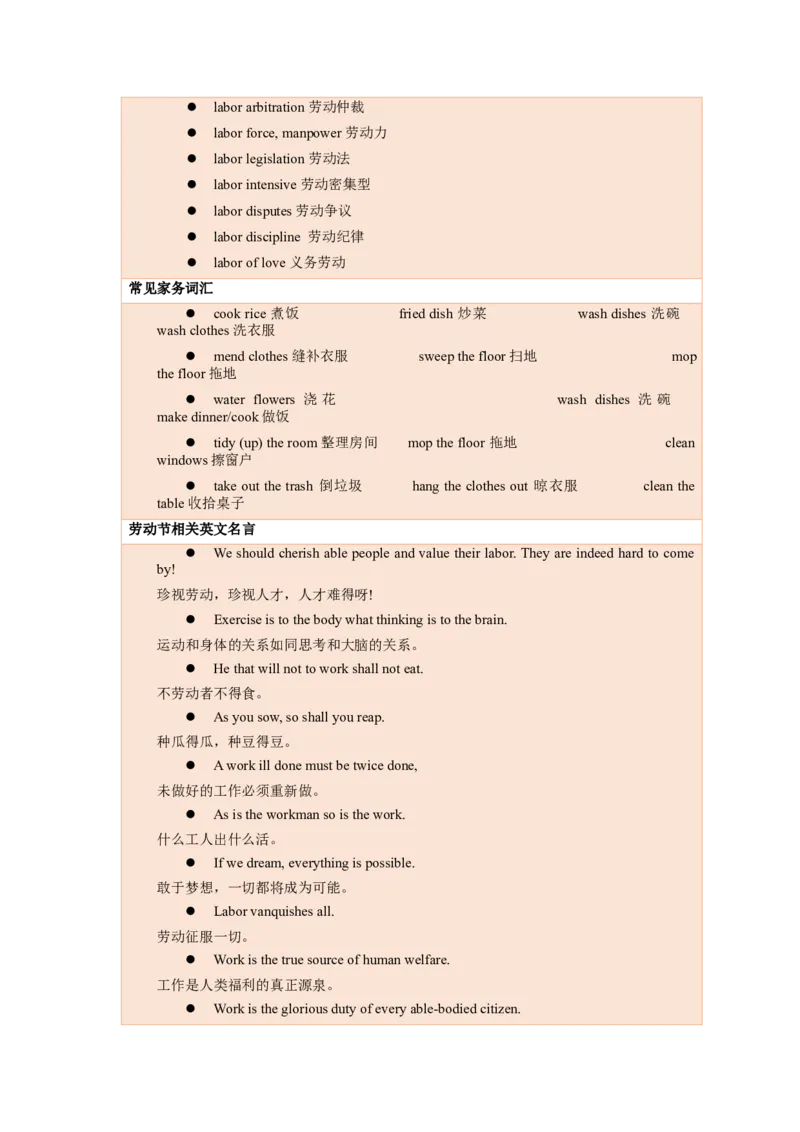
劳动节相关词汇
Labor for public good 公益劳动
labor and social security 劳动保障
fruit of labor 劳动成果
Labor contract law 劳动合同法
physical work / manual work 体力劳动
manpower demand forecasting 人才需求预测
systems engineering for manpower 人才系统工程
Labor and Social Security Bureau 劳动和社会保障 labor arbitration 劳动仲裁
labor force, manpower 劳动力
labor legislation 劳动法
labor intensive 劳动密集型
labor disputes 劳动争议
labor discipline 劳动纪律
labor of love 义务劳动
常见家务词汇
cook rice 煮饭 fried dish 炒菜 wash dishes 洗碗
wash clothes 洗衣服
mend clothes 缝补衣服 sweep the floor 扫地 mop
the floor 拖地
water flowers 浇 花 wash dishes 洗 碗
make dinner/cook做饭
tidy (up) the room整理房间 mop the floor 拖地 clean
windows擦窗户
take out the trash 倒垃圾 hang the clothes out 晾衣服 clean the
table 收拾桌子
劳动节相关英文名言
We should cherish able people and value their labor. They are indeed hard to come
by!
珍视劳动,珍视人才,人才难得呀!
Exercise is to the body what thinking is to the brain.
运动和身体的关系如同思考和大脑的关系。
He that will not to work shall not eat.
不劳动者不得食。
As you sow, so shall you reap.
种瓜得瓜,种豆得豆。
A work ill done must be twice done,
未做好的工作必须重新做。
As is the workman so is the work.
什么工人出什么活。
If we dream, everything is possible.
敢于梦想,一切都将成为可能。
Labor vanquishes all.
劳动征服一切。
Work is the true source of human welfare.
工作是人类福利的真正源泉。
Work is the glorious duty of every able-bodied citizen.话题经典小故事 ——The Story of the Old Carpenter《老木匠的故
事》
劳动是一切具有劳动能力公民的光荣职责。
从前,有一位技艺精湛的老木匠,他在财主家工作了许多年,打造出了无数精美坚固
的房屋。
Once upon a time, there was a highly skilled old carpenter who had worked for a wealthy
landlord for many years and had built numerous exquisite and sturdy houses.
如今,老木匠年纪渐大,打算退休,过上悠闲的生活。
Now, as the old carpenter was getting on in years, he planned to retire and lead a leisurely
life.
财主得知老木匠要离开,心中十分不舍。
When the wealthy landlord learned that the old carpenter was about to leave, he was very
reluctant to part with him.
他深知老木匠的手艺高超,便恳请老木匠再为他建造一座房子,作为最后的告别之作。
Knowing the old carpenter's superb craftsmanship, he earnestly requested the old carpenter to
build one more house for him as a final farewell work.
老木匠虽然答应了,但心思早已不在工作上。
The old carpenter agreed, but his mind was no longer on the work.
他想着即将到来的退休生活,满心期待,干活时也不再像以往那般用心。
He was looking forward to his upcoming retirement life with full anticipation and no longer
worked with his usual dedication.
在建造房子的过程中,老木匠没有像往常一样精心挑选材料,而是随手拿了一些质量
较差的木材和工具。
During the process of building the house, instead of carefully selecting materials as he used to,
the old carpenter casually picked up some poor - quality wood and tools.
他干活的速度倒是很快,可每一个环节都显得敷衍了事,完全没有了往日的严谨与专
注。
He worked quickly, but every step seemed perfunctory, completely lacking his former rigorand concentration.
没过多久,房子就建好了。
Before long, the house was built.
这座房子从外表看似乎和其他房子并无区别,但只有老木匠自己知道,这座房子存在
着诸多隐患。
From the outside, this house seemed no different from others, but only the old carpenter himself
knew that there were many hidden problems in this house.
房子建好后,财主带着家人来到了新房前。
After the house was completed, the wealthy landlord came to the new house with his family.
他微笑着对老木匠说:“老师傅,您为我工作了这么多年,这座房子是我送给您的
礼物,希望您能在这里安享晚年。
”He smiled at the old carpenter and said, "Master, you have worked for me for so many years.
This house is a gift from me to you. I hope you can enjoy your old age here."
老木匠听后,顿时愣住了。
Upon hearing this, the old carpenter was stunned.
他看着自己匆匆建成的房子,心中充满了悔恨。
Looking at the house he had built in a hurry, his heart was filled with remorse.
如果他当初能认真对待,这座房子本可以成为他晚年舒适的住所,可如今却因为自己
的疏忽,让它成了一个劣质的作品。
If he had taken it seriously at the beginning, this house could have been a comfortable residence
for his old age. But now, due to his negligence, it had become an inferior work.
他后悔自己没有珍惜这最后的机会,没有以一贯的高水准完成工作。
He regretted that he hadn't cherished this last opportunity and hadn't completed the work with
his usual high standards.
从那以后,老木匠只能住在自己亲手建造的这座并不完美的房子里,时刻提醒自己做
事要始终如一,不能有丝毫懈怠。
From then on, the old carpenter could only live in this imperfect house he had built with his
own hands, constantly reminding himself to be consistent in doing things and never slack off.
这个故事告诉我们:人生的每一件事都是为自己而做,要做就做到最好。
This story tells us that every single thing in life is done for ourselves. If we do something, we
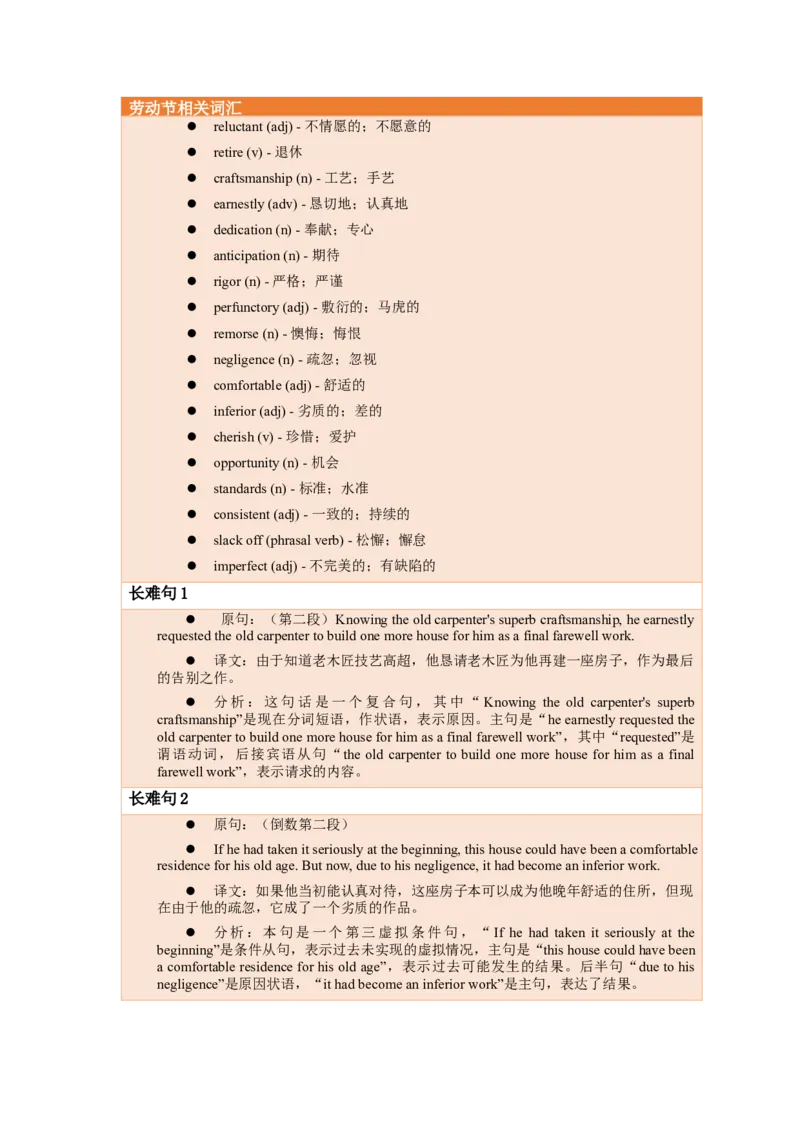
should strive to do it to the best of our ability.劳动节相关词汇
reluctant (adj) - 不情愿的;不愿意的
retire (v) - 退休
craftsmanship (n) - 工艺;手艺
earnestly (adv) - 恳切地;认真地
dedication (n) - 奉献;专心
anticipation (n) - 期待
rigor (n) - 严格;严谨
perfunctory (adj) - 敷衍的;马虎的
remorse (n) - 懊悔;悔恨
negligence (n) - 疏忽;忽视
comfortable (adj) - 舒适的
inferior (adj) - 劣质的;差的
cherish (v) - 珍惜;爱护
opportunity (n) - 机会
standards (n) - 标准;水准
consistent (adj) - 一致的;持续的
slack off (phrasal verb) - 松懈;懈怠
imperfect (adj) - 不完美的;有缺陷的
长难句1
原句:(第二段)Knowing the old carpenter's superb craftsmanship, he earnestly
requested the old carpenter to build one more house for him as a final farewell work.
译文:由于知道老木匠技艺高超,他恳请老木匠为他再建一座房子,作为最后
的告别之作。
分析:这句话是一个复合句,其中“Knowing the old carpenter's superb
craftsmanship”是现在分词短语,作状语,表示原因。主句是“he earnestly requested the
old carpenter to build one more house for him as a final farewell work”,其中“requested”是
谓语动词,后接宾语从句“the old carpenter to build one more house for him as a final
farewell work”,表示请求的内容。
长难句2
原句:(倒数第二段)
If he had taken it seriously at the beginning, this house could have been a comfortable
residence for his old age. But now, due to his negligence, it had become an inferior work.
译文:如果他当初能认真对待,这座房子本可以成为他晚年舒适的住所,但现
在由于他的疏忽,它成了一个劣质的作品。
分析:本句是一个第三虚拟条件句,“If he had taken it seriously at the
beginning”是条件从句,表示过去未实现的虚拟情况,主句是“this house could have been
a comfortable residence for his old age”,表示过去可能发生的结果。后半句“due to his
negligence”是原因状语,“it had become an inferior work”是主句,表达了结果。时文阅读 01—“毛衣奶奶”陈蝶飞
Chen Diefei, who is 69 years old,has been making knitwear(针织衣物)for children in the
past five years. She 1 (live) with her family in Ningbo, Zhejiang.
In 2018, Grandma Chen went into hospital because 2 lung cancer(肺癌). During her
hospital stay, she learned from others that some children in Guizhou lived a difficult life 3
didn't have warm clothes to wear. She felt that she should do something. So, she began knitting
sweaters, gloves and scarves for those children.
Her neighbors and friends brought her 4 (difference) kinds of yarn(纱线) after they
learned about her kind act. Grandma Chen made sure to make full use of every bit of the yarn. At
first, her family worried that she might get too tired, but she 5 (win) their support(支持) in the
end.
Every day, Grandma Chen starts to knit at about 9 o'clock after 6 (have) breakfast. When
she gets tired, she looks out of the window to relax. It 7 (usual) takes her five to seven days to
knit a sweater. Five years passed, and Grandma Chen has knitted 201 sweaters, 64 8 (pair) of
gloves and132 scarves.
A net user said, "Your 9 (kind) brings love and warmth. You are the 10 (beautiful)
grandma.”
长难句解析
原句:(第三段最后一句)At first, her family worried that she might get too tired, but
she won their support in the end.
译文:起初,她的家人担心她会太累,但她最终赢得了他们的支持。
分析:本句是一个由but连接的并列复合句。在第一个分句中, that she might get
too tired 是that引导的宾语从句,作worried的宾语。时文阅读 02—美国最后一位灯塔看守人退休
Built in 1716,Boston Light on Little Brewster Island is the oldest lighthouse in the US. It's also
the last lighthouse with a keeper in the US. As the 70th keeper of Boston Light, the now 72-year-
old Sally Snowman began working on the island in 2002. The first 69 were all men.
In the summer of 1961, Sally's father brought her to the island for a picnic. She said, "When I
looked up at the lighthouse, I said to my father,“Daddy, when I grow up, I want to get married out
here.'”
In 1994, Sally and James Thomson began volunteering at Boston Light. In the same year, the
two got married on the island. They then spent five years learning about the history of Boston Light
and wrote a book about it together. Because of the book Sally got the job as a keeper of Boston
Light.
In December of 2023, Sally retired(退休).“Sadly, my job is coming to an end!”said Sally,
America's last lighthouse keeper. She hopes she can keep working at Boston Light as a guide. Like
the sign outside the keeper's house, Sally wants the world to know.“We will leave the light on for
you.”
1.What can we know from the first paragraph?
A. Sally was 72 years old in 2002.
B. The 60th keeper of Boston Light was a man.
C. Many lighthouses have keepers in the US now.
D. Boston Light is the largest lighthouse in America.
2.When Sally went to Little Brewster Island for the first time, she
A. hoped to live there B. wanted to be a keeper of it
C. wished to get married there D. decided to write a book about it
3.What's the book written by Sally and James about?
A. The skills of building lighthouses. B. Great keepers of Boston Light.
C. Amazing lighthouses in the US. D. The history of Boston Light.
4.Which of the following is TRUE?
A. Sally loves Boston Light very much.
B. Sally will work as the only guide at Boston Light.
C. Sally became a keeper of Boston Light because of her father.D. Sally felt relaxed about stopping working as a keeper of Boston Light.
话题题型训练板块
阅读理解A
My parents do 10 hours' housework a week. My mother does most of the housework, like
cooking and folding the clothes. My father can only do the washing, sweep the floor and take
out the trash. He really needs to learn how to do housework.
Linda, 14
My mother and my father each do 50% of the housework. My mother does the washing
and cleans the living room. My father makes the bed and drives me to school.
Celina, 13
My father doesn't do a lot but he tries to help. Hehangs up the clothes after my mother
does the washing and my mother is happy that he always gives her a hand.
Paul, 16
My mother is a doctor. She is busy with her work every day, so she has little time to do
housework. In fact she isn't good at doing housework. So my father has to do most of it.
Sometimes my grandmother comes to help.
Bill, 15
1.Linda's father doesn't ____ at home.
A.do the washing B.take out the trash
C.sweep the floor D.fold the clothes
2.How does Celina go to school?
A.By bike. B.By bus. C.By car. D . By
subway.
3.The underlined phrase "hangs up" means ____ in Chinese.
A.闲逛 B.晾晒 C.熨烫 D.清洗
4.Whose father does most of the housework?
A.Linda's. B.Celina's. C.Paul's. D.Bill's.
5.Which of the following is TRUE according to the passage?
A.Linda is one year older than Celina but one year younger than Bill.
B.Celina's father needs to learn how to do housework.
C.Paul's mother is angry with his father because he never helps her with housework.
D.Bill's grandmother helps Bill with his schoolwork.
阅读理解BAfter a long week in my boarding school(寄宿学校), Friday finally came. As usual, I went
home excitedly after school with my big suitcase.
When I opened the door, my cousin threw her arms around me. She just came all the way from
Germany(德国) to visit my family. Then she saw my luggage(行李)and looked very interested. She
thought I brought gifts for her. But when she opened it, she found it was full of a whole week's dirty
laundry and smelled very terrible. This was because in order to have more time to study, I would
usually take my dirty clothes home and ask my mom to wash them.
"German students always do the laundry by themselves, "my cousin said in a low voice. Not
until that day did I truly know the difference between Chinese and foreign students. Take German
students as an example, they usually have a chore list, and housework is normal for them.
Feeling ashamed, I decided to make a change. I told my parents not to help me with my clothes.
The next day, I got up early to wash them. It took me more than an hour to do it. Although I was worn
out, I got a strong feeling of satisfaction when the smell of clean clothes pervaded(弥漫)the house.
After my cousin got over her jet lag, I proudly showed her what I did. As you can imagine, she
smiled sweetly.
6.The writer's cousin was interested in the luggage because _____.
A.she saw such a suitcase for the first time
B.she saw some dirty clothes in it
C.she found the suitcase smelled terrible
D.she thought the writer brought her gifts
7.Why did the writer bring a whole week's laundry back home?
A.Because she/he didn't like to do the laundry.
B.Because she/he forgot to wash them that week.
C.Because she/he wanted to spend more time on study.
D.Because her/his mom asked her/him to do so.
8.What does the underlined phrase "worn out" in Paragraph 4 probably mean?
A.Excited. B.Tired. C.Satisfied. D.Busy.
9.What can you infer according to the end of the passage?
A.The cousin thought the writer did a good job in the end.
B.The cousin would do the laundry for the writer.
C.The writer would have no time to do homework.D.The writer would visit the cousin in Germany some time.
阅读理解C
Teens will finally grow up some day, leaving their parents and facing life's difficulties alone,
so they should learn basic (基本的) life skills and develop good working habits.
The government (政府) has been trying to pay attention to (关注) the importance of hard-
working spirit education(劳动教育). But it seems that people haven't cared much about it in recent
years. Many teens do not value (重视) the
importance of working hard. There is a teenage girl named Nancy. She never helps out around
the house. Once her mother was on vacation for a week, leaving her alone at home. When her mother
came home from vacation, she could not find a clean dish or a clean shirt.
Schools play an important role in teaching students about the value of working hard, Primary
and middle schools should provide students with courses on hard-working spirit every week. To our
joy, some schools have provided each class with a small place outside to plant their favorite
vegetables. For example, No.38 Middle School in Hefei, set up a 500-square-meter farm on an open
platform (露天平台) of their teaching building. Each class is asked to grow and pick vegetables
there.
Parents should also encourage (鼓励) children to learn how to do chores at home. Teens should
learn one or two life skills every year. These skills can include cooking, washing their own clothes
and tidying their rooms. The basic skills may help teens to solve the problems they will meet in the
future.
10.The example of Nancy in the second paragraph shows ____.
A.Nancy is too busy to help out around the house
B.many teens do not value the importance of working hard
C.Nancy's parents don't want her to help with chores at home
D.Nancy is a hard-working girl
11.The following are life skills for students EXCEPT ____.
A.playing computer games B.washing clothes
C.cooking D.cleaning the bedroom
12.Which of the following is NOT true?
A.Schools should teach students the value of working hard.
B.Parents should encourage their children to do chores at home.C.The government never pays attention to hard-working spirit education.
D.Some schools teach students how to grow vegetables.
13.What is the best title of the passage?
A.Family Education B.School Education
C.Hard-working Spirit Education D.Doing Housework
阅读理解D
I have just finished my job as a teacher in France and there are a few weeks before I will start my
new job in my hometown. 1 I am having a good time. However, living with my parents also
brings some problems. Luckily, I have some rules to solve them.
2
Most people think privacy (隐私) is very important in their lives. If you want your parents to knock
(敲) on the door before they come into your room, you should do the same thing before you enter their
room. Only in this way can you show them the importance of knocking.
Do some chores.
3 But if you choose to do chores before your parents ask you to do so, you will feel in
control of your own time. Also, you can choose the chores that you like to do.
Don't always criticize (指责).
It's easy for you to criticize your parents because you know they love you the most. 4
But that doesn't mean you should do like that. You should be polite to them and talk with them in a nice
way.
5
Sometimes arguments (争吵) happen between you and your parents because it's difficult to get on
well with everyone all the time. But once the arguments finish, try to say sorry to your parents as soon
as possible.
根据短文内容,从方框中选择合适的句子填入文中空缺处,使短文完整、通顺。其中
有一个句子是多余的。
A. Everyone knows that chores are not fun.
B. And you know they will always love you no matter (不论) what you say.
C. Now I'm living with my parents after five years of being away.
D. Say sorry.
E. Find someone interesting to talk to.
F. Always knock.完形填空
As students, we are always busy studying. Many of us get used to having supper as soon as
we get home from 15 . . Not all children like to do the housework. They think doing the
housework is their parents' job.
In fact, doing the housework isn't a 16 . thing. Firstly, it's a good way to relax ourselves.
Many children 17 . to spend much time watching TV or playing computer games when they
are tired. As a result, they usually get more tired. But doing the housework is 18 . . It is easy
and it can let our tense(紧张的) mind relax. Secondly, doing some housework can 19 . our
care for our parents. We know our parents are 20 . tired after a day's work. They will feel
happy 21 . we can help them clean the floor or cook supper. Thirdly, we can find it very 22 .
to do the housework. I'm sure you must be glad to see the bright dishes and the clean rooms. At the
same time, learning 23 . to do the housework is a great thing.
So 24 . your best to do the housework from now on! You will get a lot from it.
15.A.work B.park C.office D.school
16.A.bad B.good C.busy D.free
17.A.dislike B.learn C.ask D.like
18.A.normal B.different C.tiring D.popular
19.A.show B.leave C.become D.stay
20.A.nearly B.hardly C.usually D.never
21.A.unless B.if C.although D.before
22.A.boring B.dirty C.interesting D.difficult
23.A.how B.what C.when D.where
24.A.try B.bring C.work D.listen
Most of us probably don't like doing housework. And most of us think that 25 .
(clean) the bathroom or cooking dinner for the family makes us tired. However, the fact is that
someone has to 2 6 . (do) it. Our parents do most of 2 7 . housework. Is it 2 8 .
(real) fair?
Doing housework is really not as 29 . (bad) as it sounds. If we all do our part, it
30 . (seem) less annoying (令人烦躁的). Why should your mother have to wash
your dirty clothes? You are able 3 1 . (take) care of yourself. Doing some housework
will show that you 3 2 . (become) more and more independent.Some of us may think that we are too busy to do housework. But most parents work all day
and are expected
3 3 . (keep) a clean house! Dividing(分担)housework among the whole family
will make everyone's job much 3 4 . (easy).
Please remember: Learning to do housework can provide you with valuable skills (宝贵的技
能) for the future.
写作
35.在上周的英语课上,同学们就“孩子是否应当在家做家务”为主题组织了一场讨
论。请你根据下表提供的信息,将讨论的结果整理成文。
赞成观点 反对观点
⒈ 培养独立能力,学会照顾 ⒈ 来自学校的压力太大;
自己;
⒉ 浪费时间,没有必要现在学习,长大了自
⒉ 懂得公平合理性的理念; 然会做;
⒊ 环境干净、整洁,人人有 ⒊ 提供一个干净、舒适的。环境是父母的
责。 事。
你的观点:……
注意:①词数:100词左右(短文的开头已写好,不计入总数);
②短文须包括表中所有内容要点,并阐明自己的观点,不要逐句翻译,可适当发挥,
使短文连贯、通顺。
Nowadays many children don't like doing chores. Last week, we had a discussion about it.
First, .
.
.
.
.
.
.
.
.