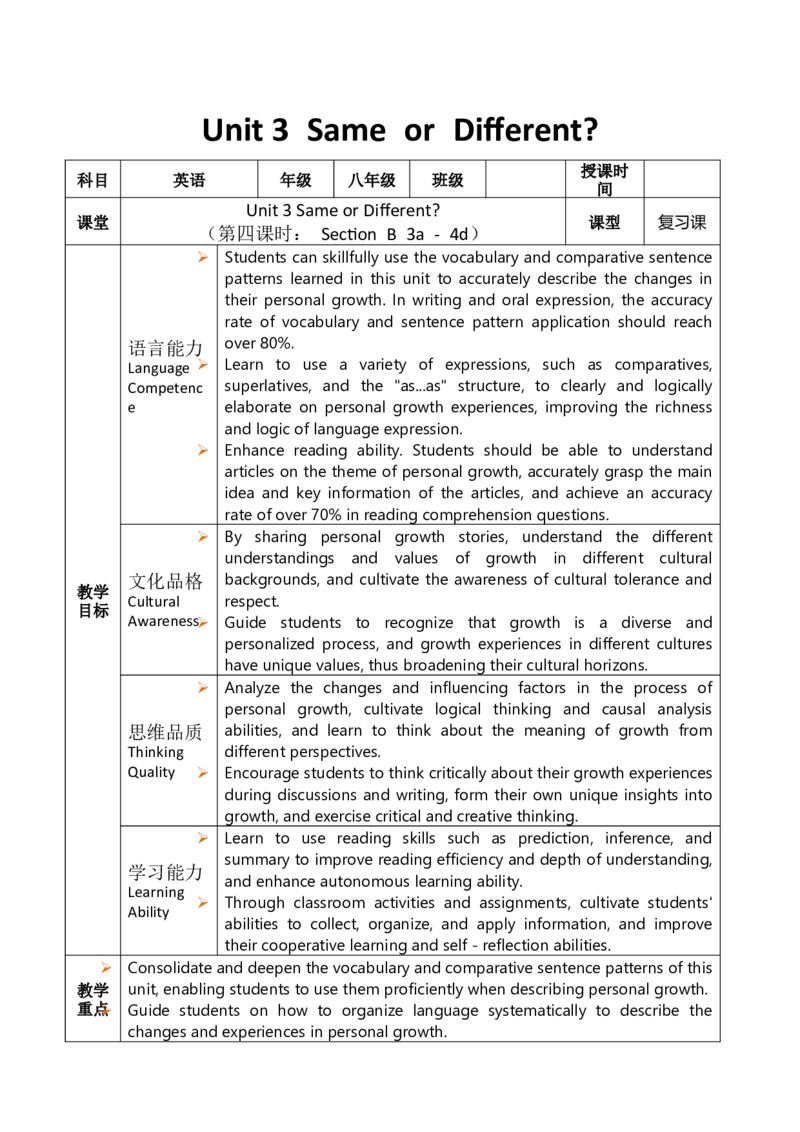
Unit 3 Same or Different?
授课时
科目 英语 年级 八年级 班级
间
Unit 3 Same or Different?
课堂 课型 复习课
(第四课时: Section B 3a - 4d)
Students can skillfully use the vocabulary and comparative sentence
patterns learned in this unit to accurately describe the changes in
their personal growth. In writing and oral expression, the accuracy
rate of vocabulary and sentence pattern application should reach
语言能力 over 80%.
Language Learn to use a variety of expressions, such as comparatives,
Competenc superlatives, and the "as...as" structure, to clearly and logically
e elaborate on personal growth experiences, improving the richness
and logic of language expression.
Enhance reading ability. Students should be able to understand
articles on the theme of personal growth, accurately grasp the main
idea and key information of the articles, and achieve an accuracy
rate of over 70% in reading comprehension questions.
By sharing personal growth stories, understand the different
understandings and values of growth in different cultural
文化品格 backgrounds, and cultivate the awareness of cultural tolerance and
教学
Cultural respect.
目标
Awareness Guide students to recognize that growth is a diverse and
personalized process, and growth experiences in different cultures
have unique values, thus broadening their cultural horizons.
Analyze the changes and influencing factors in the process of
personal growth, cultivate logical thinking and causal analysis
思维品质 abilities, and learn to think about the meaning of growth from
Thinking different perspectives.
Quality Encourage students to think critically about their growth experiences
during discussions and writing, form their own unique insights into
growth, and exercise critical and creative thinking.
Learn to use reading skills such as prediction, inference, and
summary to improve reading efficiency and depth of understanding,
学习能力
and enhance autonomous learning ability.
Learning
Through classroom activities and assignments, cultivate students'
Ability
abilities to collect, organize, and apply information, and improve
their cooperative learning and self - reflection abilities.
Consolidate and deepen the vocabulary and comparative sentence patterns of this
教学 unit, enabling students to use them proficiently when describing personal growth.
重点 Guide students on how to organize language systematically to describe the
changes and experiences in personal growth. Improve students' reading ability of articles on the theme of personal growth and
help them master reading skills.
Help students flexibly use multiple grammatical structures and vocabulary when
expressing their personal growth experiences, and avoid monotonous expressions
教学
and errors.
难度
Guide students to think deeply about the connotation of growth and demonstrate
profound and personalized viewpoints in writing and discussions.
教具
Multimedia equipment, PPT courseware, printed reading materials
准备
教学方法
教学内容及过程
及手段
Step 1. Review and Lead - in (5 minutes)
Use PPT to display some pictures depicting people's characteristics and
changes. Randomly select students to describe them using the comparative
and superlative vocabulary learned before, reviewing the vocabulary and
sentence patterns from previous lessons.
The teacher asks, "What have we learned about making comparisons? How can
we describe the differences between people?" Guide students to review the key
knowledge of this unit and pave the way for the new lesson.
Step 2. Reading Training (12 minutes)
Skimming: Present the reading material in 3a. Let students quickly skim the
article and answer the question "What is the main idea of Rose's post?" to
cultivate students' ability to obtain the main idea of the article.
Intensive Reading: Read the article again. Instruct students to read intensively
with questions like "How are Lily and Lucy different? How do they help Rose?"
Ask students to find and mark the key information in the article. After reading,
organize students into groups for discussion. The teacher walks around each
group, offering necessary guidance and assistance as students share the
information they found.
Language Knowledge Learning: In combination with the reading article, explain
the key vocabulary and phrases that appear in it, such as "reach for" and "touch
one's heart". Use examples to help students understand their usage. At the
same time, guide students to pay attention to the comparatives and other
descriptive languages used in the article and analyze their expressive effects.
Step 3. Oral Expression (10 minutes)
Group Discussion: Divide students into groups. Based on the article content
and their own experiences, students discuss questions like "What kind of
friends do you think are true friends? How have your friends influenced you?"
Encourage students to actively participate in the discussion and share their
views and experiences. Group Report: Each group selects a representative to report the group's
discussion results to the whole class. Students from other groups listen
carefully and can ask questions or provide supplements. The teacher
summarizes and evaluates the reports of each group, guiding students to
further think about the relationship between friendship and personal growth.
Oral Practice: The teacher creates a situation, such as "Imagine you are
introducing your best friend to others. What will you say?" Let students
practice speaking, using the learned vocabulary and sentence patterns to
describe their friends and the influence their friends have on them. The teacher
walks around, providing students with timely feedback and guidance to help
them improve their oral expression skills.
Step 4. Writing Practice (10 minutes)
Writing Guidance: Based on the reading article and oral discussion content,
guide students to do a writing exercise. Give the writing topic, such as "My
Growth with Friends". Help students sort out their writing ideas and list the
writing points, such as describing their friends' characteristics, experiences of
getting along with friends, and the influence of friends on their growth.
Student Writing: Let students write according to the points they listed. Require
them to use the learned vocabulary, sentence patterns, and grammar
knowledge, and try to make their sentences smooth and expressions clear. The
teacher walks around to observe students' writing situations, provides timely
guidance and help, and encourages students to express their ideas boldly.
Presentation and Evaluation: Invite some students to share their compositions.
Other students listen carefully and evaluate, putting forward suggestions from
aspects such as content integrity, language accuracy, grammar correctness, and
expression fluency. The teacher finally makes a summary evaluation, affirms the
students' advantages, points out the existing problems, and gives the direction
for improvement.
Step 5. Class Summary and Homework Assignment (3 minutes)
Class Summary: Review the key content of this lesson with students, including
the key information in the reading article, the main viewpoints of the oral
discussion, and the key points and precautions in the writing exercise.
Emphasize the importance of friendship in personal growth, and encourage
students to cherish friendship, learn from their friends' strengths, and grow
together.
Ask students to revise their compositions according to the evaluation opinions in
class and neatly copy the revised compositions in their exercise books.
布置
Preview the content of the Project section, think about the changes they have
作业
experienced since entering junior high school, and prepare for the classroom
activities in the next lesson.1. Key Vocabulary and Phrases
reach for touch one's heart
2. Writing Points
Describe friends' characteristics
板书
Narrate experiences of getting along
设计
Elaborate on the influence of friends on one's growth
3. Reading Skills
Skim to obtain the main idea
Scan to find key information