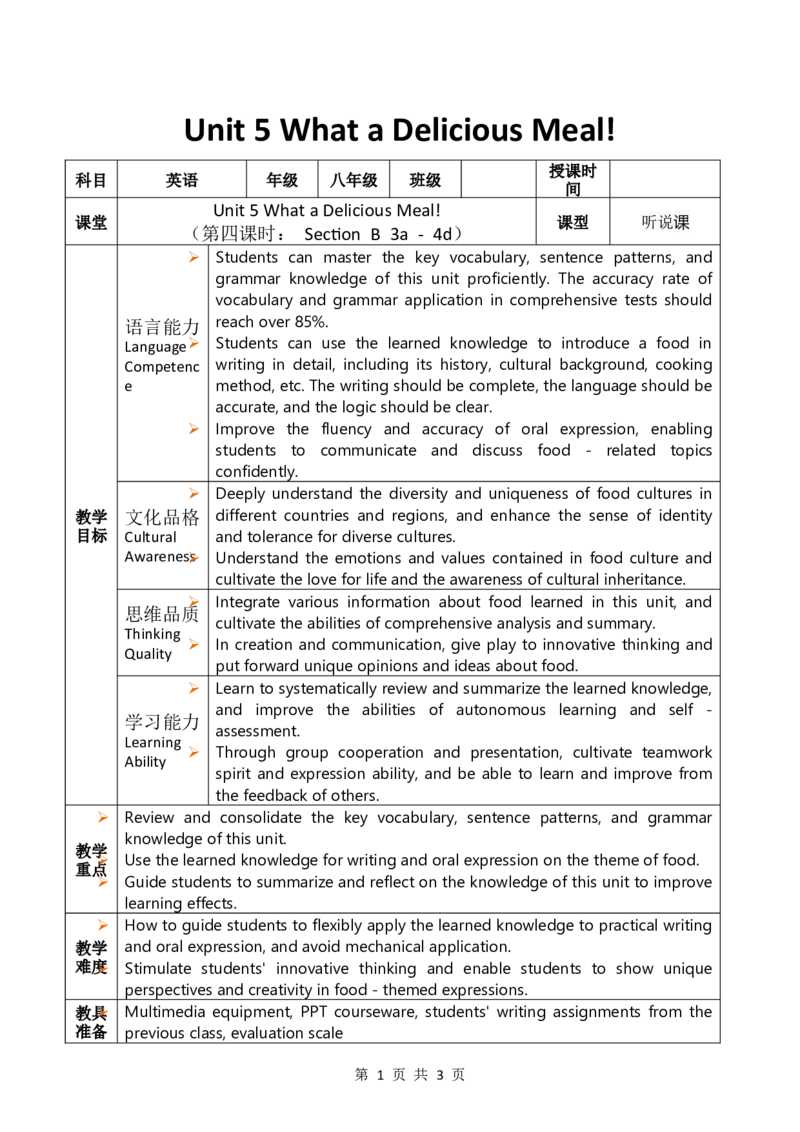
Unit 5 What a Delicious Meal!
授课时
科目 英语 年级 八年级 班级
间
Unit 5 What a Delicious Meal!
课堂 课型 听说课
(第四课时: Section B 3a - 4d)
Students can master the key vocabulary, sentence patterns, and
grammar knowledge of this unit proficiently. The accuracy rate of
vocabulary and grammar application in comprehensive tests should
语言能力 reach over 85%.
Language Students can use the learned knowledge to introduce a food in
Competenc writing in detail, including its history, cultural background, cooking
e method, etc. The writing should be complete, the language should be
accurate, and the logic should be clear.
Improve the fluency and accuracy of oral expression, enabling
students to communicate and discuss food - related topics
confidently.
Deeply understand the diversity and uniqueness of food cultures in
教学 文化品格 different countries and regions, and enhance the sense of identity
目标 Cultural and tolerance for diverse cultures.
Awareness Understand the emotions and values contained in food culture and
cultivate the love for life and the awareness of cultural inheritance.
Integrate various information about food learned in this unit, and
思维品质
cultivate the abilities of comprehensive analysis and summary.
Thinking
In creation and communication, give play to innovative thinking and
Quality
put forward unique opinions and ideas about food.
Learn to systematically review and summarize the learned knowledge,
and improve the abilities of autonomous learning and self -
学习能力
assessment.
Learning
Through group cooperation and presentation, cultivate teamwork
Ability
spirit and expression ability, and be able to learn and improve from
the feedback of others.
Review and consolidate the key vocabulary, sentence patterns, and grammar
knowledge of this unit.
教学
Use the learned knowledge for writing and oral expression on the theme of food.
重点
Guide students to summarize and reflect on the knowledge of this unit to improve
learning effects.
How to guide students to flexibly apply the learned knowledge to practical writing
教学 and oral expression, and avoid mechanical application.
难度 Stimulate students' innovative thinking and enable students to show unique
perspectives and creativity in food - themed expressions.
教具 Multimedia equipment, PPT courseware, students' writing assignments from the
准备 previous class, evaluation scale
第 1 页 共 3 页教学方法及手
教学内容及过程
段
Step 1. Review (5 minutes)
The teacher shows some pictures related to the food in this unit through
the PPT. Randomly select students to describe the foods in the pictures in
English to review the key vocabulary and sentence patterns.
Conduct a simple grammar quiz. Give some sentences containing the
grammar points of this unit (such as exclamatory sentences, imperative
sentences, etc.) and let students rewrite or fill in the blanks to check
students' mastery of grammar knowledge.
Step 2. Writing Revision (10 minutes)
Distribute students' writing assignments from the previous class. Let
students revise according to the teacher's correction comments. The
teacher reminds students to pay attention to grammar mistakes,
vocabulary usage, sentence structure, and content integrity.
Organize students for peer review. Each group member exchanges their
compositions and evaluates them according to the evaluation scale from
aspects such as content, language, and structure, and gives specific
suggestions and scores.
Invite some students to share their gains and problems in the process of
revising their compositions. The teacher summarizes and gives guidance.
Step 3. New Writing Task (12 minutes)
Assign a new writing task: Ask students to write an article titled "An
Unforgettable Food Experience", describing an unforgettable food -
tasting experience, including the name of the food, its appearance, taste,
the dining scene, the mood at that time, and the reasons why this
experience left a deep impression.
The teacher gives the writing ideas and framework. For example, students
can adopt a general - specific - general structure, introducing the topic at
the beginning, describing the process of the food - tasting experience in
detail in the middle, and summarizing the significance of this experience
at the end. At the same time, remind students to use the vocabulary,
sentence patterns, and rhetorical devices learned in this unit to make the
article more vivid and interesting.
Students start writing. The teacher walks around and provides individual
guidance, encouraging students to express their ideas boldly.
Step 4. Oral Presentation (10 minutes)
Each student makes an oral presentation within the group, sharing their
第 2 页 共 3 页writing content. Group members listen carefully and give evaluations and
feedback.
Each group selects a representative to present to the whole class. After the
presentation, other students can ask questions and express their opinions.
The teacher gives a summary evaluation, affirming students'
performances, and at the same time pointing out existing problems and
improvement directions.
Step 5. Self - Check and Summary (5 minutes)
Let students complete the exercises in the Self - Check part, including
vocabulary spelling, grammar filling, sentence translation, etc., to self -
check their mastery of the knowledge of this unit.
The teacher summarizes the key content of this unit with students,
reviewing the key points of vocabulary, sentence patterns, grammar, and
cultural knowledge. Encourage students to continue to expand their food
- culture knowledge after class and improve their comprehensive English -
using ability.
Seriously revise and improve the writing assignment in class, print or copy it neatly
in the composition book, with neat handwriting and standard format.
布置 Make a hand - written newspaper about food culture, collect relevant pictures and
作业 text materials, and display the special foods of different countries or regions.
Preview the content of the next unit and understand the new theme and
vocabulary.
1. Review of Key Vocabulary:
List the key vocabulary of this unit
2. Review of Key Sentence Patterns:
板书
设计 Summarize key sentence patterns such as exclamatory sentences and
imperative sentences
3. Writing Key Points:
Writing ideas, structure, and precautions
第 3 页 共 3 页