2025-2026 学年高一英语上学期第一次月考卷 01(人教版 2019)
(考试时间:120 分钟 试卷满分:150 分)
考生注意:
1.答题前,请务必将自己的姓名、准考证号用黑色字迹的签字笔或钢笔分别填写在试题卷和答题纸规
定的位置上。
2. 答题时,请按照答题纸上“注意事项”的要求,在答题纸相应的位置上规范作答,在本试题卷上的作
答一律无效。
3.难度系数:0.65。
4.考试结束后,将本试卷和答题卡一并交回。
第一部分 听力(共两节,满分 30 分)
注意,听力部分答题时请先将答案标在试卷上,听力部分结束前你将有两分钟的时间将答案转涂到答
题卡上。
第一节(共 5 小题;每小题 1.5 分,满分 7.5 分)
听下面 5 段对话。每段对话后有一个小题,从题中所给的 A、B、C 三个选项中选出最佳选项,并标在
试卷的相应位置。听完每段对话后,你都有 10 秒钟的时间来回答有关小题和阅读下一小题。每段对话仅读
一遍。
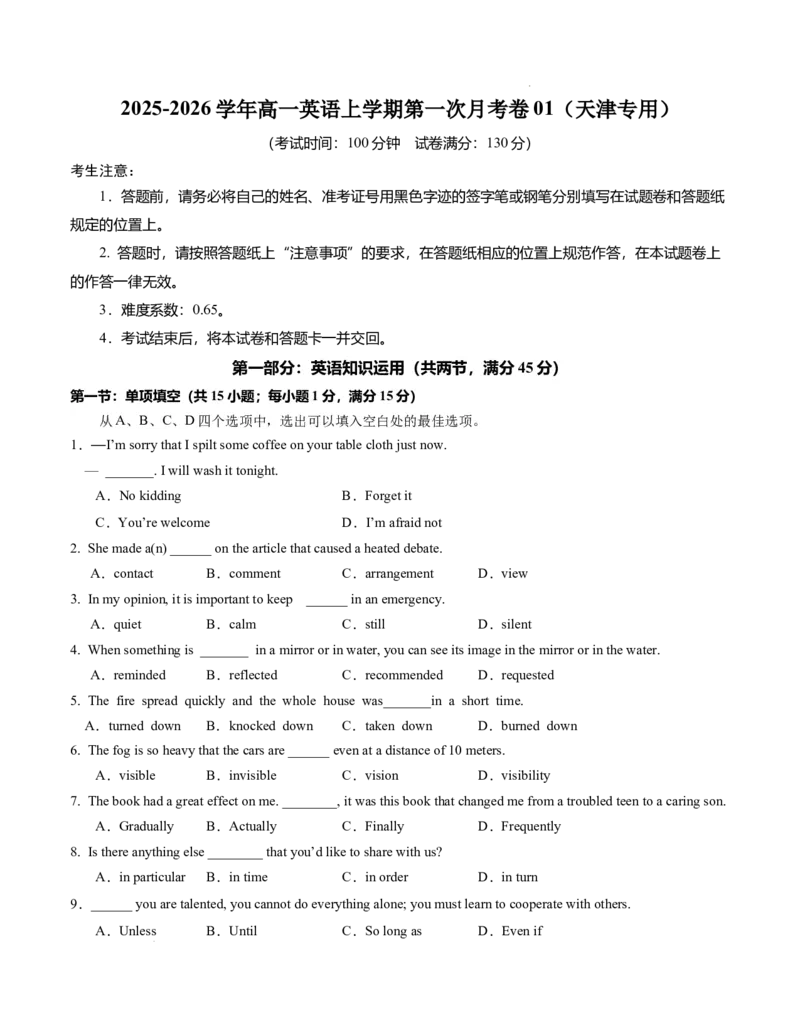
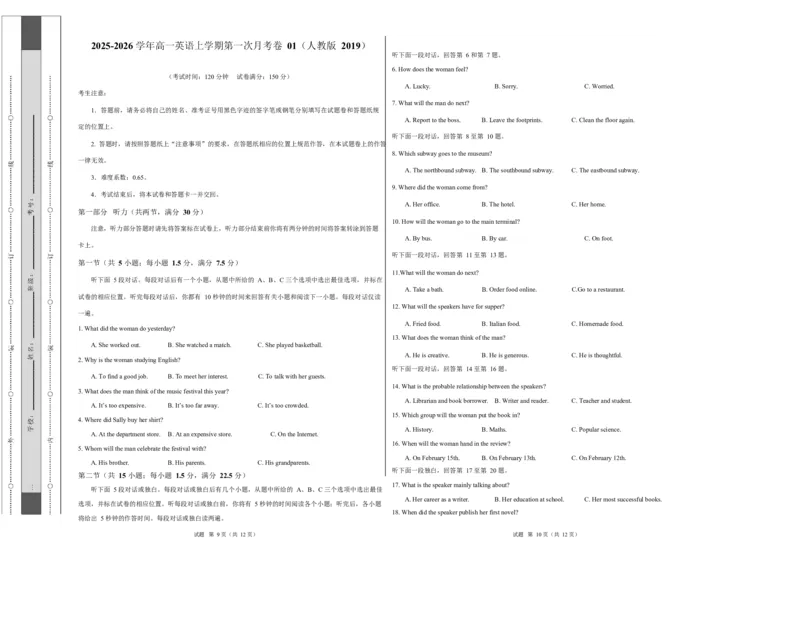
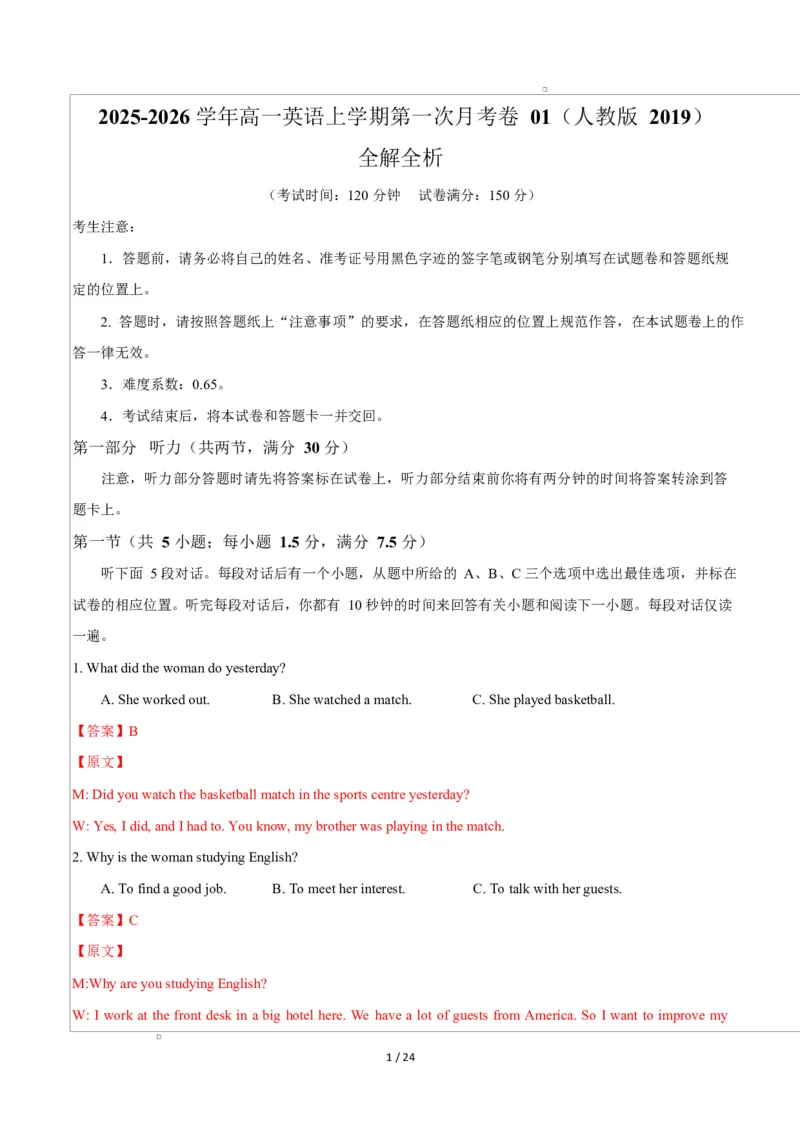
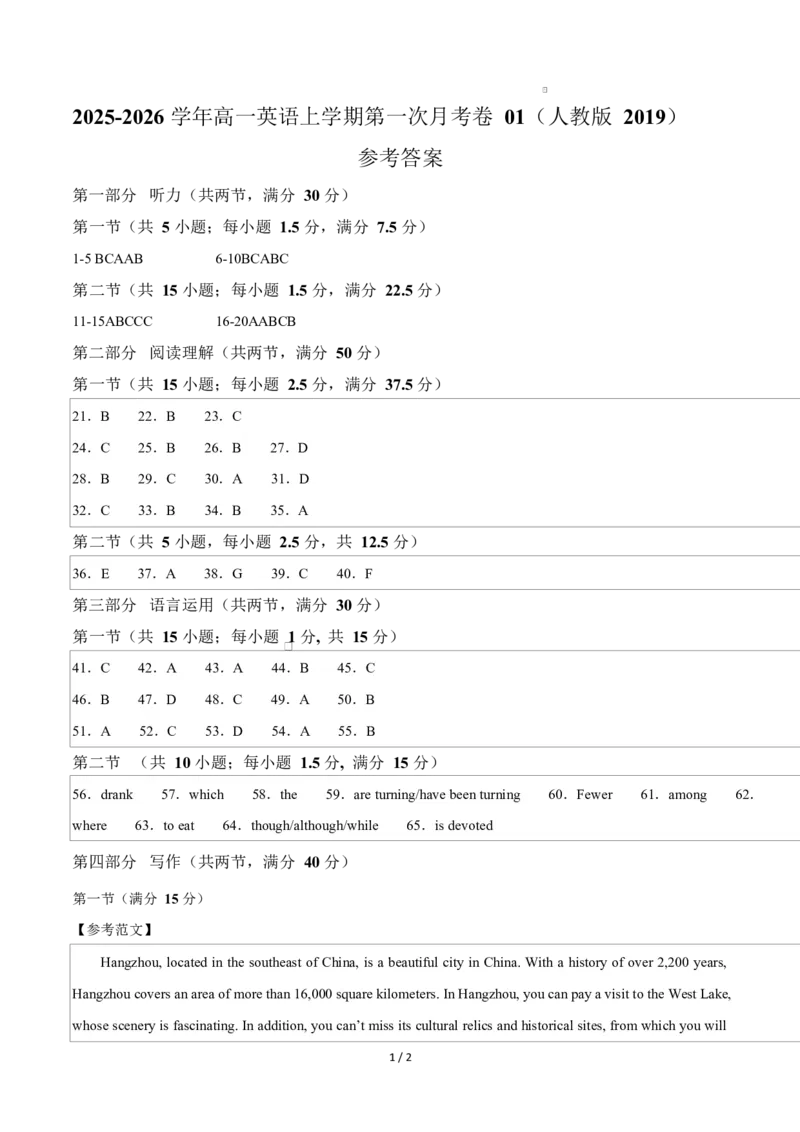
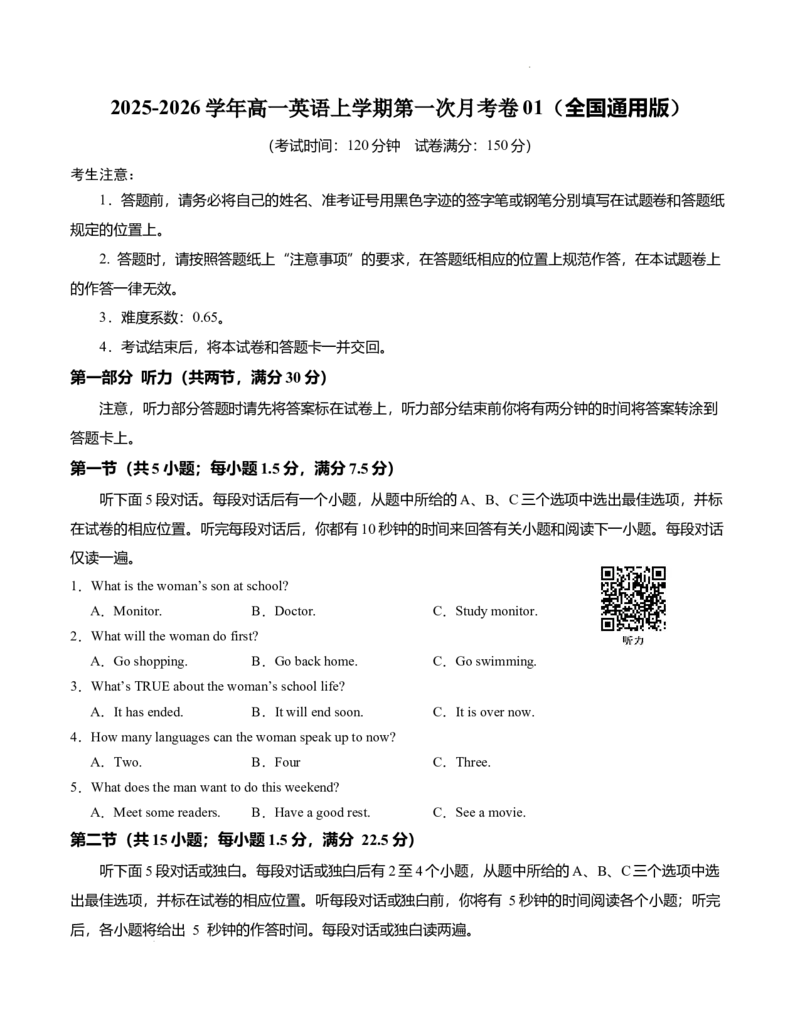
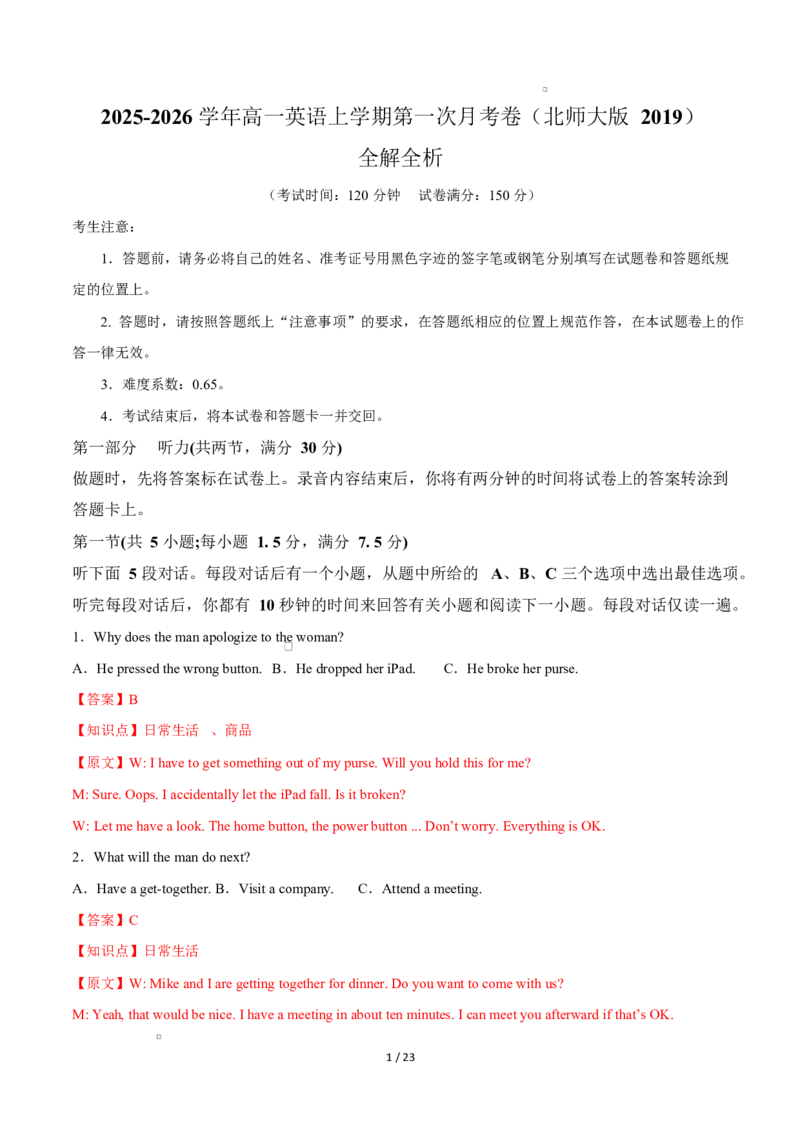
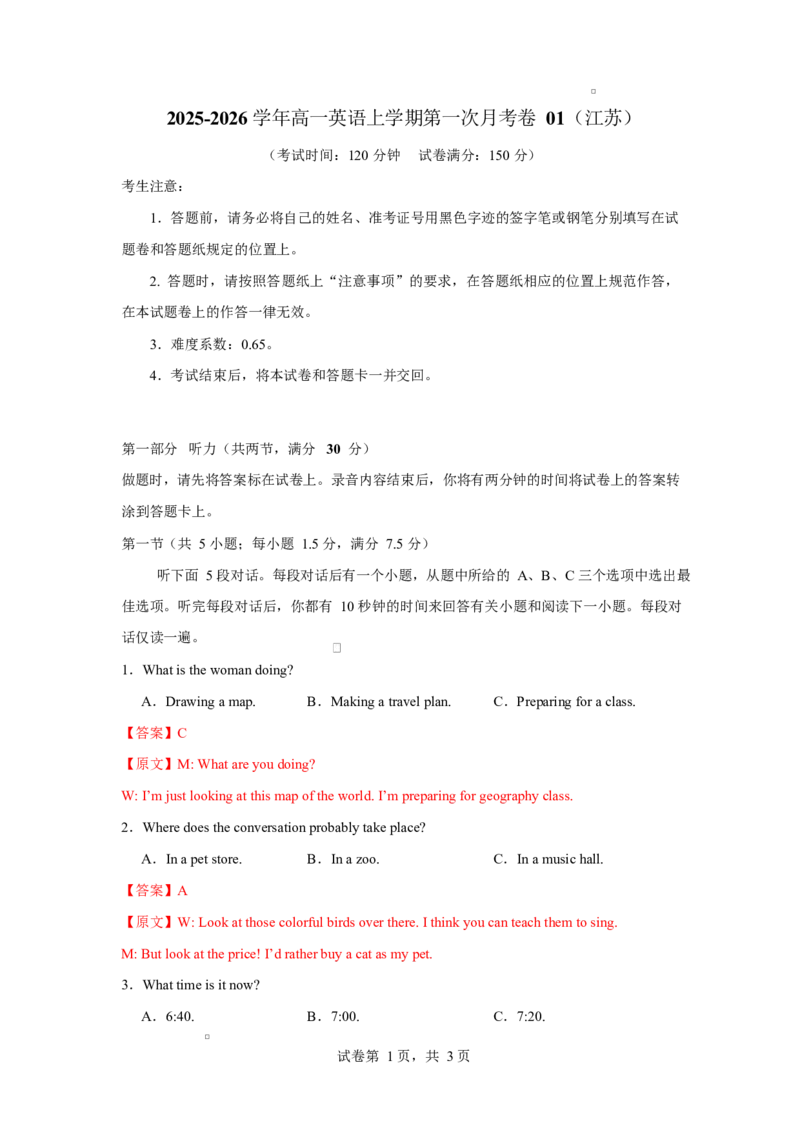
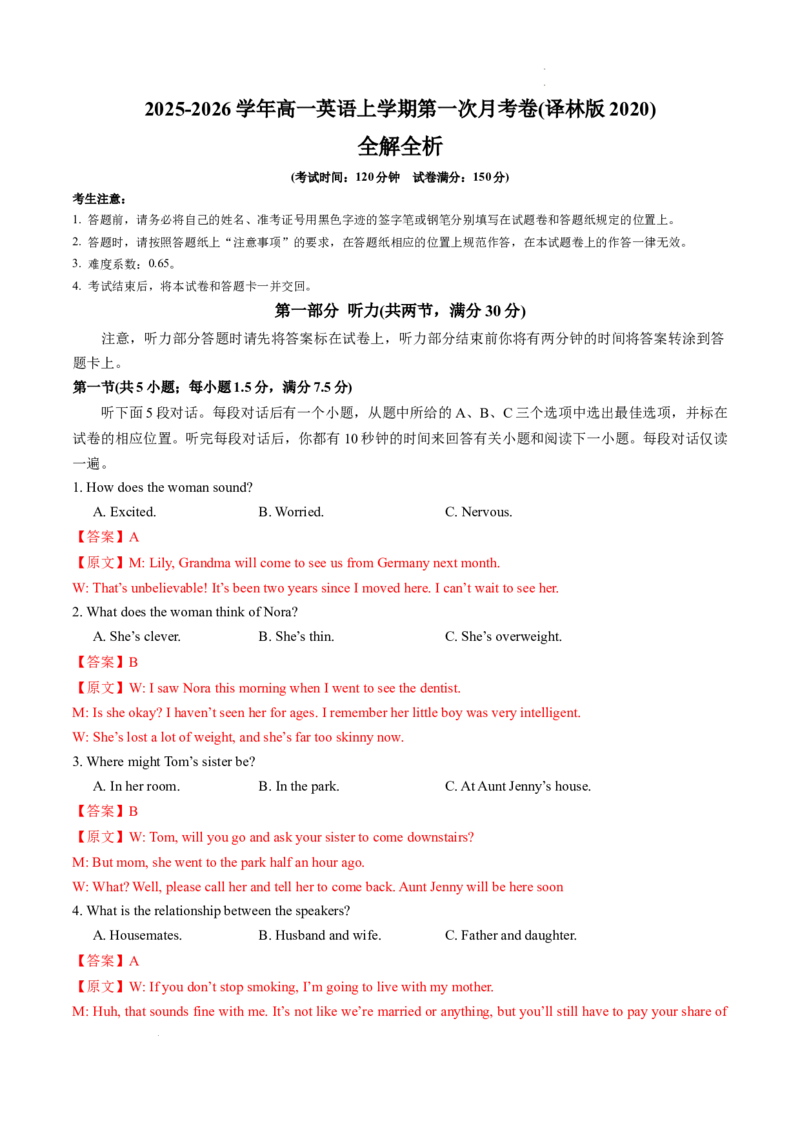
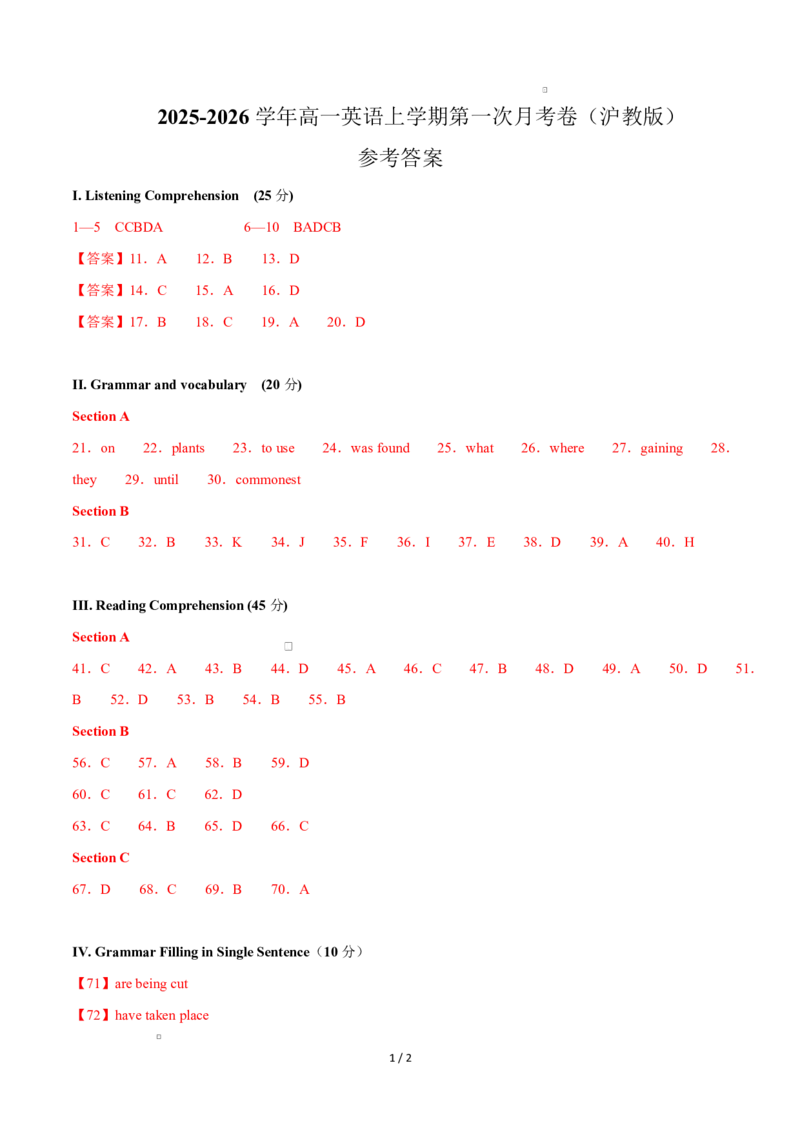
1. What did the woman do yesterday?
A. She worked out. B. She watched a match. C. She played basketball.
2. Why is the woman studying English?
A. To find a good job. B. To meet her interest. C. To talk with her guests.
3. What does the man think of the music festival this year?
A. It’s too expensive. B. It’s too far away. C. It’s too crowded.
4. Where did Sally buy her shirt?
A. At the department store. B. At an expensive store. C. On the Internet.
5. Whom will the man celebrate the festival with?
A. His brother. B. His parents. C. His grandparents.
第二节(共 15 小题;每小题 1.5 分,满分 22.5 分)
听下面 5 段对话或独白。每段对话或独白后有几个小题,从题中所给的 A、B、C 三个选项中选出最佳
选项,并标在试卷的相应位置。听每段对话或独白前,你将有 5 秒钟的时间阅读各个小题;听完后,各小
1/12题将给出 5 秒钟的作答时间。每段对话或独白读两遍。
听下面一段对话,回答第 6 和第 7 题。
6. How does the woman feel?
A. Lucky. B. Sorry. C. Worried.
7. What will the man do next?
A. Report to the boss. B. Leave the footprints. C. Clean the floor again.
听下面一段对话,回答第 8 至第 10 题。
8. Which subway goes to the museum?
A. The northbound subway. B. The southbound subway. C. The eastbound subway.
9. Where did the woman come from?
A. Her office. B. The hotel. C. Her home.
10. How will the woman go to the main terminal?
A. By bus. B. By car. C. On foot.
听下面一段对话,回答第 11 至第 13 题。
11.What will the woman do next?
A. Take a bath. B. Order food online. C.Go to a restaurant.
12. What will the speakers have for supper?
A. Fried food. B. Italian food. C. Homemade food.
13. What does the woman think of the man?
A. He is creative. B. He is generous. C. He is thoughtful.
听下面一段对话,回答第 14 至第 16 题。
14. What is the probable relationship between the speakers?
A. Librarian and book borrower. B. Writer and reader. C. Teacher and student.
15. Which group will the woman put the book in?
A. History. B. Maths. C. Popular science.
16. When will the woman hand in the review?
A. On February 15th. B. On February 13th. C. On February 12th.
听下面一段独白,回答第 17 至第 20 题。
17. What is the speaker mainly talking about?
A. Her career as a writer. B. Her education at school. C. Her most successful books.
2/1218. When did the speaker publish her first novel?
A. In 1987. B. In 1992. C. In 1996.
19. What did the speaker study in the university?
A. Writing skills. B. Publishing. C. Law.
20. Which novel won a prize?
A. Sunset. B. The Ballet Dancer. C. The List.
第二部分 阅读理解(共两节,满分 50 分)
第一节(共 15 小题;每小题 2.5 分,满分 37.5 分)
阅读下列短文,从每题所给的 A、B、C、D 四个选项中选出最佳选项,并在答题卡上将该选项涂黑。
A
After I bought my new guitar, I started looking for apps to teach me how to use it. Finally, I chose Beginner
Guitar Songs. Marty Schwartz, who is an amazing guitar teacher, showed me how to hold the guitar and then
introduced how to play easy chords (和 弦 ) to me. I quickly progressed through Beginner Lesson Series and
advanced to Important Guitar Chords.
Two days later, I was ready to learn more chords. I found Guitar Lessons from Howcast. There are over 140
video lessons. I spent most of the day learning chords. Every day, I added a new chord and then reviewed the ones I
had learned. By the end of the first week I had learned about ten chords. By the end of the second week, I had
learned about fifteen chords. The app also taught me how to play scales (音阶). I learned the Pentatonic scale and
the Blues scale. At that time, I felt like I was ready to dive into some music.
I also enjoyed GuitarJamz where I found more lessons from Marty Schwartz. Besides, I downloaded Blues
Guitar Licks Lessons and Solo Guitar Lessons. Marty had hundreds of lessons for free on his YouTube channel. I
watched, learned and experimented to see what I could do.
Then, I felt that some of my favourite classic rock songs were pretty easy. As I expected, now I can play
America’s A Horse with No Name — two chords, The Beatles’s Let it Be — four chords, and Cat Stevens’s
Peace Train — four chords.
Over the next few weeks I still watched YouTube videos and used chromatic Tuner. I also downloaded guitar
sheet music through Songsterr Plus. This guitar learning app showed me how to read guitar tablature (奏法乐谱)
and chord diagrams.
21. Why did the author start looking for apps after buying a new guitar?
A. To sell the guitar online. B. To learn how to use it.
3/12C. To find guitar sheet music. D. To share guitar lessons.
22. How many video lessons does Guitar Lessons from Howcast have?
A. Over 100. B. Over 140. C. About 15. D. Hundreds of.
23. What can we know about the author’s learning tools?
A. He only used apps to learn guitar.
B. He never used a tuner during practice.
C. He used YouTube videos in his learning.
D. He paid for all the guitar lessons he took.
B
For the first time in Canada, surgeons have successfully carried out the first stage of a procedure involving
implanting (植入) a tooth into the eyes of people with a type of severe blindness in the hopes of restoring their
vision.
Known as “tooth-in-eye” surgery, the operation was recently carried out in three patients with severe corneal
(角膜的) blindness. Tooth-in-eye surgery aims to change that in two surgeries. This first step is the creation of the
implant. This requires the removal of one of the patient’s teeth, which is shaved down into a square-like shape with
a hole drilled into it that will hold a plastic optical lens (光学透镜). The shaped tooth is then placed inside the
patient’s cheek, where it stays for around three months to develop new tissue and a blood supply.
Once that’s happened, in the second stage, surgeons remove the implant from the cheek and put it into the eye,
where the plastic lens allows light through, restoring the patient’s vision. “It’s like replacing the windscreen on a
car when it’s totally frosted over,” Dr Greg Moloney, who led the Canadian surgeries, told the Vancouver Sun.
It might sound a bit unpleasant to put someone’s tooth in their eye, but it actually makes a lot of sense; both
the fact that teeth are super hard and that it’s the patient’s own tooth increase the chances that the implant will last
long term. “The procedure isn’t completely risk-free, but there is no risk of rejection, because we’re using part of
the patient’s own body.”
The patients are set to experience the second surgery later this year. One of those patients, Gail Chapman, was
the first to receive the initial surgery and was hopeful of what the procedure could mean for her future. While this
was a Canadian first, tooth-in-eye surgery is far from new. It’s been around since the 1960s, when it was pioneered
by Italian Professor Benedetto Strampelli, and was later improved into the procedure that it is today.
24.What is involved in the first stage of the “tooth-in-eye” surgery?
A.Placing the plastic lens in the eye.
4/12B.Restoring the patient’s eyesight partly.
C.Removing a patient’s tooth for the implant.
D.Moving the implant from the cheek to the eye.
25.What is the key role of the plastic optical lens in the second-stage surgery?
A.To fix the tooth in the eye.
B.To help the eye receive light.
C.To reduce the pain of the patient.
D.To accelerate the treatment process.
26.Why does the surgery use the patient’s own tooth?
A.To simplify the surgical procedure.
B.To reduce the risk of implant rejection.
C.To lower the cost of the entire surgery.
D.To make the implant look more natural.
27.What does the author think of the “tooth-in-eye” surgery?
A.The surgery has been improved a little.
B.There is a serious danger of infection during the surgery.
C.The surgery will become popular in Canada.
D.The surgery dates back over fifty years.
C
As one of the fashions in education in recent memory, you’ve certainly heard of the flipped classroom (翻转课
堂). It is a type of blended learning where students are introduced to knowledge at home and practice using it at
school. This is the opposite of the more common practice of introducing new content at school, then giving
homework and projects to be completed by the students independently at home.
In this blended learning model, face-to-face communication is mixed with independent study—usually
through videos and e-dictionaries. In a common flipped classroom setting, students might watch pre-recorded
videos at home, then come to school to do the homework armed with questions and at least some background
knowledge.
The idea behind the flipped classroom is to rethink when students can use the resources they need most. If the
problem is that students need help with the work rather than being introduced to the new thinking behind the work,
then the solution the flipped classroom takes is to reverse the traditional teaching method.
5/12In a flipped classroom, students watch online lectures (线 上 讲 座 ), review online course materials, read
physical or digital texts, and take part in an online discussion at home. What happens at school includes skill
practice, in-person or face-to-face discussions with classmates, presentations, experiments, peer (同行) review, and
so on. It allows students to stop, look up words online, and rewatch, creating a ready-made library for student
review.
Of course, it’s not that simple. There are some disadvantages of a flipped classroom. Just like in a regular
classroom, success depends greatly on the quality of teachers, the clarity of conversations, and the quality of given
courses, tests, and instructions. Further, fairness is still a major issue, and it doesn’t fix the outdated method most
educational systems take to courses.
28.What does the flipped classroom feature?
A.More dependence on hobbies. B.Technology-assisted learning.
C.Parent-child cooperation. D.Less focus on textbooks.
29.What does the underlined word “reverse” mean in paragraph 3?
A.Research. B.Examine. C.Change. D.Shape.
30.What is the advantage of the flipped classroom?
A.It gives personalized experiences. B.It develops creativity in students.
C.It builds trust among peers. D.It simplifies learning steps.
31.Why is the flipped classroom criticized?
A.It fails to change teachers’ thinking. B.It hardly improves students’ grades.
C.It causes unclear dialogues. D.It only touches the surface.
D
Instant noodles are a favorite quick meal when people don’t want to cook. Picture eating them while watching
TV on a stormy night—pure comfort! But many believe they’re just junk food that harms health. The truth is,
whether they’re unhealthy depends entirely on how you prepare them.
The main issue isn’t the noodles themselves, but the common way people make them: pouring boiling water
over dried noodles and adding all the salty seasoning packets. These flavor packets contain high levels of salt and
artificial additives (人工添加剂), making this version unbalanced and unhealthy.
Actually, plain instant noodles aren’t terrible. They’re fried during production (which adds some oil and
calories), but they fill you up well and provide quick energy when you’re hungry. To make them healthier, cook
them properly: boil the noodles first, drain excess starchy (含有淀粉的) water, then use fresh water or broth (肉汤).
6/12Crucially, use only half the seasoning packet to reduce salt. Add vegetables like spinach or carrots and protein like
an egg or tofu while cooking. This boosts vitamins and protein while cutting sodium (钠). This transforms them
into a balanced meal!
So, are instant noodles junk food? If prepared lazily with all the seasoning and no extras, yes. But when
cooked with less seasoning plus veggies and protein, they become a decent occasional meal. Remember: the secret
is variety. Enjoy them once or twice a week as part of a diverse diet, and they won’t harm your health. They’re far
less scary than people think—just upgrade your cooking method!
32.What determines if instant noodles are unhealthy?
A.Their quick cooking time.
B.The time of eating.
C.The preparation method.
D.The junk food label.
33.What is the major cause of unhealthy instant noodles?
A.The dried noodles.
B.The flavor packets.
C.Using boiling water.
D.People avoiding cooking.
34.What is the main purpose of the third paragraph?
A.Warn about health dangers.
B.Give cooking instructions.
C.Argue noodles are harmless.
D.List harmful additives.
35.What is the suitable title for the passage?
A.Instant Noodles: Not All Waste.
B.Instant Noodles: How to Cook?
C.Instant Noodles: Eat Sometimes.
D.Instant Noodles: What we know?
第二节(共 5 小题,每小题 2.5 分,共 12.5 分)
阅读下面短文, 从短文后的选项中选出可以填入空白处的最佳选项。选项中有两项为多余选项。
Having a good relationship with your roommate is important. 36 If you and your roommates make the
7/12effort, a peaceful and happy home is in your future.
Before starting the journey to find a roommate, it’s important to make sure you will get along. Take a moment
to think about your living preferences before making a decision. Getting along doesn’t mean you and your
roommate have to share all of the same interests or be best friends. 37
Once you’ve found a friendly roommate, the next key step for a warm living environment is to set clear rules
through a roommate agreement. This document should include rights and responsibilities, covering rent payments,
chores, and privacy. 38 Besides, agreeing on personal space rules also makes sure both of you feel
comfortable at home.
Achieving a fair way of dealing with money also helps avoid arguments. This includes dividing the cost of
rent, bills, and other shared costs in a way that everyone agrees on. Dividing rent equally (平 等 地 ) among
roommates is nice. 39 In this case, it might be better to decide each person’s rent flexibly (灵活地).
40 . Creating an environment where open and regular communication is welcomed is key to solving
problems before they get worse. One way of keeping communication clear is to have regular “check-in” meetings.
They provide roommates with time to talk about home things, share problems in a helpful manner, and celebrate
successes or share personal news.
A.Your lifestyles and values just have to be similar.
B.A friendly atmosphere depends on how you think.
C.However, one’s room might have more advantages.
D.You can include what you want to list in the agreement.
E.Living with others may seem hard, but it doesn’t have to be.
F.Communication is the basis of good roommate relationships.
G.Clear discussions about money and chore sharing prevent fights.
第三部分 语言运用(共两节,满分 30 分)
第一节(共 15 小题;每小题 1 分,共 15 分)
阅读下面短文,从每题所给的 A、B、C、D 四个选项中选出可以填入空白处的最佳选项。
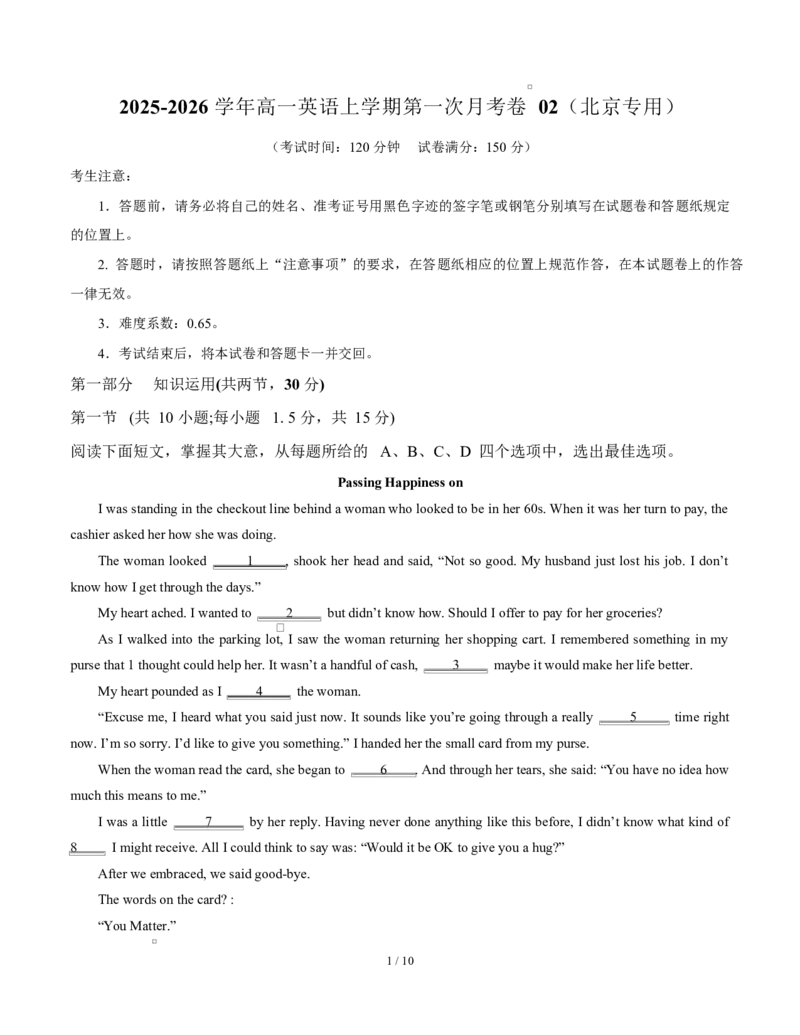
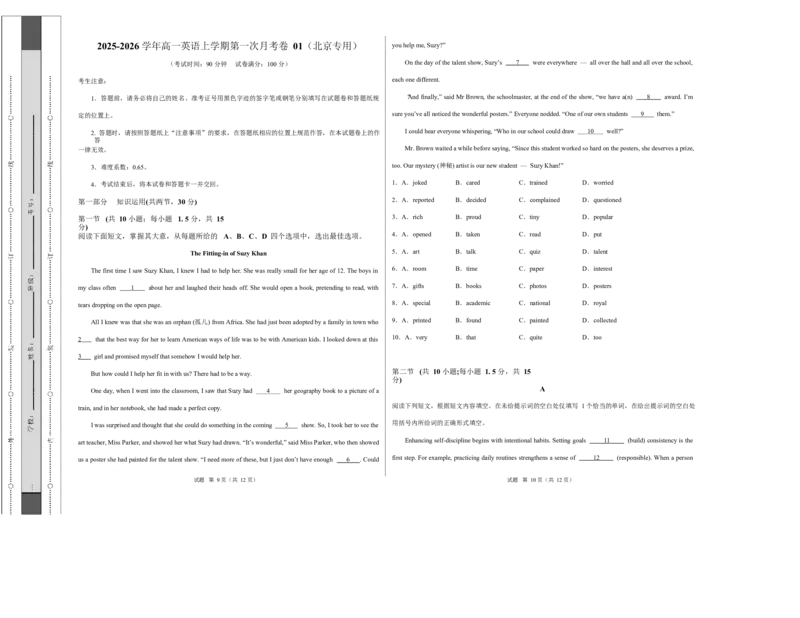
The school sports meeting was just three days away, and the classroom was filled with talk of races and relays.
Tom had never been much of an athlete, but when his classmate Lucy 41 him to join the 400-meter race,
he couldn’t say no.
“I’ll never win,” Tom mumbled as they walked to the track for practice. Lucy patted his shoulder. “It’s not
about winning. It’s about 42 your best.”
8/12The track was busy with students warming up — jumping, stretching, and sprinting. Tom felt his legs
43 as he lined up for his first practice run. When the coach blew the whistle, he took off, but his steps felt
heavy. By the end, he was gasping for air, far behind the others.
“Not bad for a start,” Lucy said, handing him a water bottle. “You just need to 44 .”
Over the next two days, Tom practiced every afternoon. He 45 how to breathe properly and pace
himself. Lucy ran beside him, cheering him on. “Faster! You can do it!” she shouted.
On the morning of the sports meeting, the sun shone brightly, and the stands were packed with students. Tom’s
heart 46 as he put on his running shoes. His classmates gathered around him. “We’re all rooting for you!”
they said.
The 400-meter race was about to begin. Tom stepped onto the track, his eyes fixed on the finish line. The
starter’s gun 47 , and the runners shot forward. Tom kept his eyes down, focusing on his stride. At the
halfway mark, his legs began to burn, but he 48 on.
“Go, Tom! Go!” he heard Lucy scream. He looked up and saw his classmates waving signs. With a burst of
energy, he sprinted toward the finish line. He didn’t win—he came in fifth—but the crowd erupted in cheers as he
crossed.
Lucy ran up to him, grinning. “That was amazing! You 49 your personal best!” Tom smiled, wiping
sweat from his forehead. He felt a sense of 50 he’d never known before.
Later, as they watched the award ceremony, Lucy said, “See? I told you it would be worth it.” Tom nodded.
He’d learned that 51 doesn’t always mean coming first. Sometimes, it’s about facing your 52
and trying your hardest.
That evening, Tom’s mom noticed the 53 on his face. “You look happy,” she said. “I had a great
day,” Tom replied. “I joined a race, and I didn’t win, but I 54 myself.”
His mom hugged him. “That’s the best 55 you could ask for.”
41.A.ordered B.begged C.invited D.forced
42.A.doing B.finding C.making D.showing
43.A.shake B.relax C.grow D.rest
44.A.quit B.practice C.wait D.hide
45.A.taught B.wondered C.learned D.forgot
46.A.broke B.raced C.stopped D.failed
47.A.rang B.fell C.broke D.fired
9/1248.A.walked B.fought C.kept D.turned
49.A.beat B.missed C.remembered D.checked
50.A.sadness B.pride C.fear D.humor
51.A.success B.kindness C.courage D.honesty
52.A.friends B.teachers C.fears D.dreams
53.A.tear B.sweat C.dirt D.smile
54.A.surprised B.protected C.thanked D.lost
55.A.gift B.prize C.lesson D.memory
第二节 (共 10 小题;每小题 1.5 分,满分 15 分)
阅读下面短文, 在空白处填入 1 个适当的单词或括号内单词的正确形式。
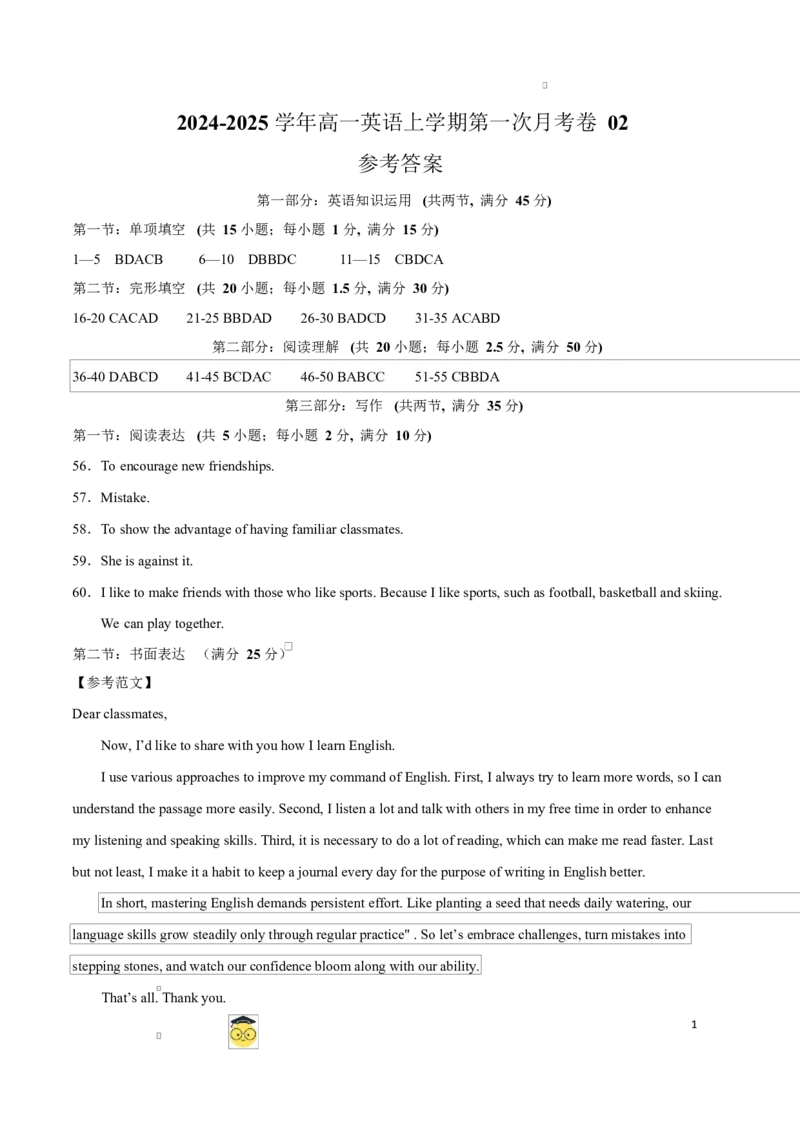
When I was a child, my family would always sit down together for meals. My favourite was among the
simplest: spaghetti pomodoro, pasta in tomato sauce. We ate fresh vegetables and fruit, and, starting in our teenage
years, 56 (drink) a glass of red wine. We ate together. I enjoyed a few slices of prosciutto and practised
a wide variety of outdoor sports. This centuries-old Mediterranean(地中海) diet kept me fit, 57 turned
out to be good not just my personal well-being, but for the planet’s health too.
In 2020, we will celebrate 58 tenth anniversary of UNESCO’s designation (指定) of this
Mediterranean diet as a “Cultural Heritage of Humanity”. But unfortunately, Italians 59 (turn) away
from their traditional healthy diet. We have started to eat more fast food and have increased our portions. 60
(few) Italians enjoy social meals with family and friends. Italian children were 61 the most
overweight in a recent study of 30 countries by the WHO.
Poor nutrition is a global problem, not just an Italian one. The fact that it’s hitting Italy, the land 62
the Mediterranean diet originated, represents a dangerous contradiction-- one of many affecting the world of food.
After years of decline, hunger is back on the rise. Globally, some 821 million people still do not have enough
63 (eat). Yet 64 the poor south hungers, the rich north gorges: some 2 billion people are
overweight. We waste one-third of global food production. Livestock consume an estimated two-thirds of all the
land that 65 (devote) to agriculture and contribute about half of farming-related greenhouse-gas
emissions.
第四部分 写作(共两节,满分 40 分)
第一节(满分 15 分)
为了让更多的外国游客了解中国文化,欣赏中国美丽的自然风光,感受中国发生的巨大变化,某外文
10/12杂志社将出版一本英语小册子来介绍中国的旅游景点。该杂志社邀请你为该小册子写一篇英语短文来介绍
杭州,内容包括:
1.杭州的位置(中国东南部)、面积(16,000 多平方公里)及历史(2,200 多年)等;
2.杭州的旅游特色(自然风景、传统文化、特色小吃等);
3.希望更多的游客来杭州参观。
注意:1.80 词左右;2.可适当增加细节,以使行文连贯。
____________________________________________________________________________________________
____________________________________________________________________________________________
____________________________________________________________________________________________
____________________________________________________________________________________________
____________________________________________________________________________________________
____________________________________________________________________________________________
第二节(满分 25 分)
阅读下面材料,根据其内容和所给段落开头语续写两段,使之构成一篇完整的短文。
My family just moved here from St. Louis. It was my first day at a new high school and the very day of soccer
tryouts (选拔赛). Soccer is my life, played soccer, went to soccer games, and watched soccer on television with
Mom and Dad. They even got me a magazine about soccer.
We left very early in the morning, planning to be at our new home before classes began. If everything had
gone perfectly, there would have been time for me to find my new classes, meet people, and even warm up before
the tryouts.
However, while we were driving to my new home, our car suddenly stopped working on the highway under
the hot sun. We waited anxiously for two hours for a rescue, only to spend another two hours arranging for a rental
car. The whole time, my heart was pounding with worry, afraid that I would miss the tryouts.
Finally, we arrived at the new school. The moment I got out of the cat, I rushed towards the headmaster’s
office to report, out of breath. “Oh, Tina I think you’re too late for the tryouts. Coach Turner said they’d end at 3
pm,” said Headmaster Morgan. She glanced up at the clock and shook her head, “They’re almost finished.” Feeling
defeated, I bit my lower lip and held back tears. All of a sudden, I saw the latest soccer magazine in my backpack.
At that moment, my favorite words from the magazine rang in my head good player never gives up, even when the
game seems lost.”
注意:
11/121. 续写字数应为 150 词左右;
2. 请按如下格式在答题卡的相应位置作答。
“I’m so sorry, but our car broke down,” I explained to the headmaster.
____________________________________________________________________________________________
____________________________________________________________________________________________
____________________________________________________________________________________________
____________________________________________________________________________________________
____________________________________________________________________________________________
“Three minutes,” Coach Turner said, rolling a soccer ball toward me.
____________________________________________________________________________________________
____________________________________________________________________________________________
____________________________________________________________________________________________
____________________________________________________________________________________________
____________________________________________________________________________________________
12/12