2026 年普通高等学校招生全国统一考试
英语试题解析与深度研究
说明:根据考生回忆整理
A 篇
主要介绍了介绍 SoFi Stadium 体育馆近期赛事与观赛实用信息,并且提供了一个表格,表格中
讲解了四场比赛,介绍了比赛双方,共 8 支球队和 4 个宾馆。
(泰勒·斯威夫特在 SoFi Stadium 完成过时代巡回演唱会北美站收官连演,创纪录演唱会电影
全程取景于此,她也是首位启用这座场馆巨幕全开、自费为粉丝打造顶级视听体验的歌手,还
计划 2026 年在此开启告别巡演首站演出。)
B 篇
主要讲述了一个小孩问妈妈小说里某个词组的含义,妈妈让小孩用词典查,而小孩让妈妈用手
机查。这件事情让妈妈回忆起自己小时候有个很喜欢的词典,但是大一的时候词典被偷了,但
是自己大二,大三,大四的时候依旧每天会学习新词,最终认识到查词用手机是词典并不重要,
重要的是要有一颗学习的心。
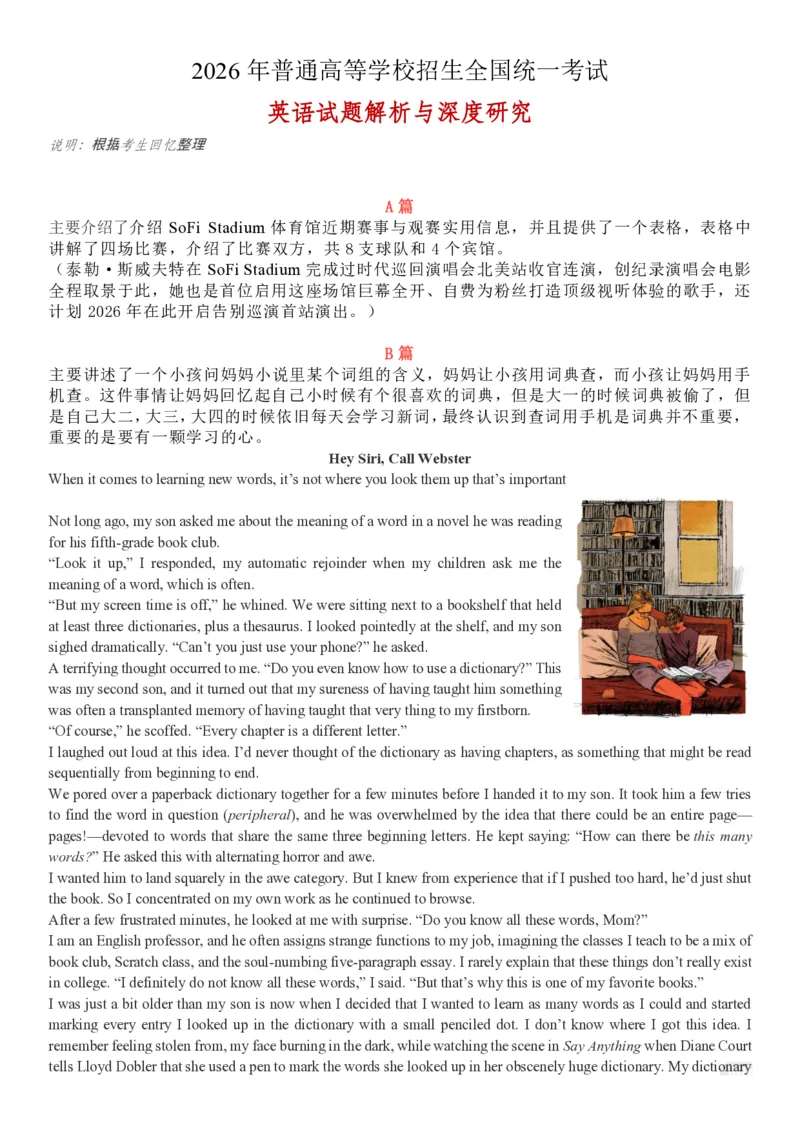
Hey Siri, Call Webster
When it comes to learning new words, it’s not where you look them up that’s important
Not long ago, my son asked me about the meaning of a word in a novel he was reading
for his fifth-grade book club.
“Look it up,” I responded, my automatic rejoinder when my children ask me the
meaning of a word, which is often.
“But my screen time is off,” he whined. We were sitting next to a bookshelf that held
at least three dictionaries, plus a thesaurus. I looked pointedly at the shelf, and my son
sighed dramatically. “Can’t you just use your phone?” he asked.
A terrifying thought occurred to me. “Do you even know how to use a dictionary?” This
was my second son, and it turned out that my sureness of having taught him something
was often a transplanted memory of having taught that very thing to my firstborn.
“Of course,” he scoffed. “Every chapter is a different letter.”
I laughed out loud at this idea. I’d never thought of the dictionary as having chapters, as something that might be read
sequentially from beginning to end.
We pored over a paperback dictionary together for a few minutes before I handed it to my son. It took him a few tries
to find the word in question (peripheral), and he was overwhelmed by the idea that there could be an entire page—
pages!—devoted to words that share the same three beginning letters. He kept saying: “How can there be this many
words?” He asked this with alternating horror and awe.
I wanted him to land squarely in the awe category. But I knew from experience that if I pushed too hard, he’d just shut
the book. So I concentrated on my own work as he continued to browse.
After a few frustrated minutes, he looked at me with surprise. “Do you know all these words, Mom?”
I am an English professor, and he often assigns strange functions to my job, imagining the classes I teach to be a mix of
book club, Scratch class, and the soul-numbing five-paragraph essay. I rarely explain that these things don’t really exist
in college. “I definitely do not know all these words,” I said. “But that’s why this is one of my favorite books.”
I was just a bit older than my son is now when I decided that I wanted to learn as many words as I could and started
marking every entry I looked up in the dictionary with a small penciled dot. I don’t know where I got this idea. I
remember feeling stolen from, my face burning in the dark, while watching the scene in Say Anything when Diane Court
tells Lloyd Dobler that she used a pen to mark the words she looked up in her obscenely huge dictionary. My dictionarywas also obscenely huge, the kind with onionskin paper and gold leaf on the cutaway thumb tab for each letter. Diane’s
dictionary was covered in Xs; mine was filled with graphite—a strange, silvery Morse code dotting its pages.
The dictionary was a gift for my 13th birthday. Books, especially new books, were hallowed in my house. Although
neither of my parents was able to go to college, they both made clear that my education was a family priority. This
dictionary seemed like an embodiment of what I’d need to know to get into college one day. And so I took to measuring
my progress. In her book Grit: The Power of Passion and Perseverance, the psychologist Angela Duckworth argues
that this inclination toward self-challenge is far more important as a measure of success than talent or intelligence. I
agree that my impulse to set goals and my tendency to work harder than the next person have been more helpful in my
life than any score I ever received on an IQ test or the SAT. But mostly, I marked up my dictionary because I enjoyed
the process, took pleasure in the visual tabulation. I didn’t set out to learn every word. I did it for the experience, for the
pleasure of participation, not the result, a rare thing in those days. I continued to make these pencil marks for years, and
when I did finally go off to college, I packed that dictionary in my suitcase.
My dictionary was also obscenely huge, the kind with onionskin paper and gold leaf on the cutaway thumb tab for each
letter. Diane’s dictionary was covered in Xs; mine was filled with graphite—a strange, silvery Morse code dotting its
pages.
After my son finished his homework that evening, I reshelved the paperback dictionary. He did not place a dot by his
word, and since that day, I haven’t seen him take the dictionary down once. I have, however, heard him ask Siri to define
many more words. I try not to let this scare me, and yet, I worry that things are too easy for my children, that asking Siri
to define words instead of hunting for them on their own in a paper dictionary will soften and ultimately dull their brains.
I want to keep them sharp, but I don’t know how to do this in today’s world, where every single definition of every
single word is only a voice query away.
A few days later, my son asked me about my dictionary, the one I marked up. He wanted to see it. A small pain gripped
my chest at the memory. “The book is gone,” I said.
The dictionary was stolen at the end of my freshman year of college. I had used the book to prop open my old double-
hung dorm window, and someone walking by just plucked it from the sill when I wasn’t looking.
“That’s so sad,” he said. “I wish I could see all the words you know.”
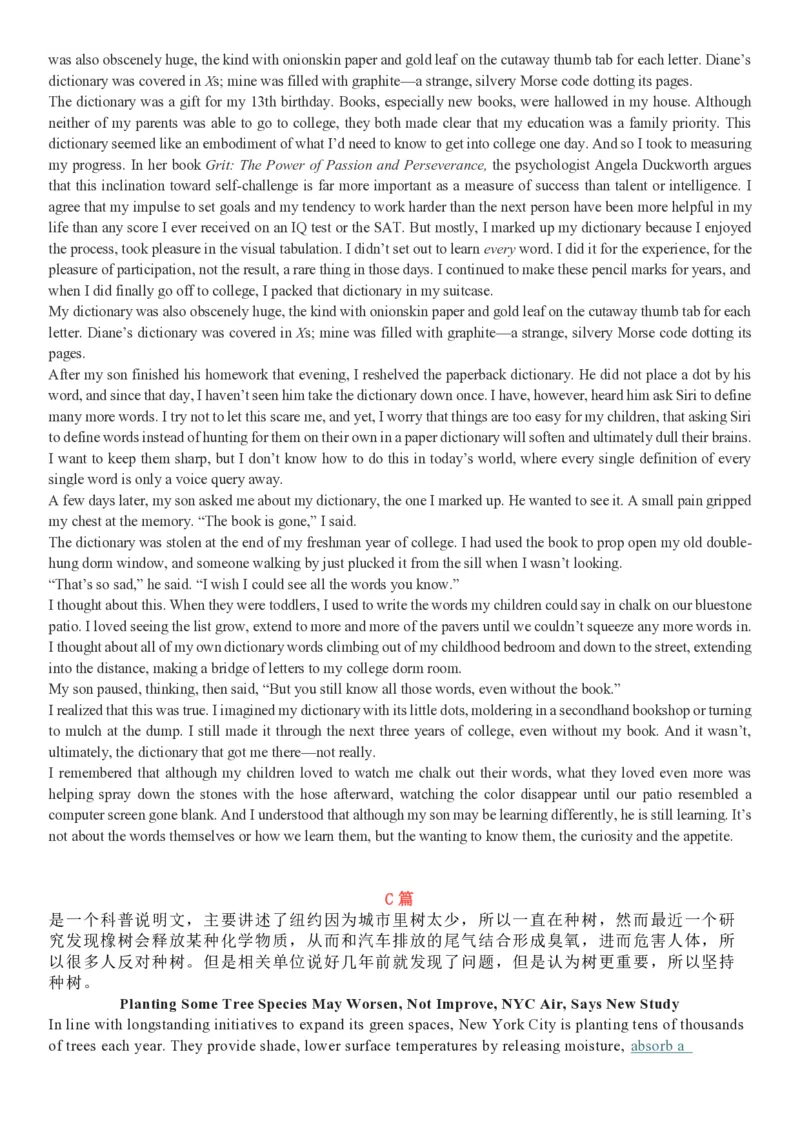
I thought about this. When they were toddlers, I used to write the words my children could say in chalk on our bluestone
patio. I loved seeing the list grow, extend to more and more of the pavers until we couldn’t squeeze any more words in.
I thought about all of my own dictionary words climbing out of my childhood bedroom and down to the street, extending
into the distance, making a bridge of letters to my college dorm room.
My son paused, thinking, then said, “But you still know all those words, even without the book.”
I realized that this was true. I imagined my dictionary with its little dots, moldering in a secondhand bookshop or turning
to mulch at the dump. I still made it through the next three years of college, even without my book. And it wasn’t,
ultimately, the dictionary that got me there—not really.
I remembered that although my children loved to watch me chalk out their words, what they loved even more was
helping spray down the stones with the hose afterward, watching the color disappear until our patio resembled a
computer screen gone blank. And I understood that although my son may be learning differently, he is still learning. It’s
not about the words themselves or how we learn them, but the wanting to know them, the curiosity and the appetite.
C 篇
是一个科普说明文,主要讲述了纽约因为城市里树太少,所以一直在种树,然而最近一个研
究发现橡树会释放某种化学物质,从而和汽车排放的尾气结合形成臭氧,进而危害人体,所
以很多人反对种树。但是相关单位说好几年前就发现了问题,但是认为树更重要,所以坚持
种树。
Planting Some Tree Species May Worsen, Not Improve, NYC Air, Says New Study
In line with longstanding initiatives to expand its green spaces, New York City is planting tens of thousands
of trees each year. They provide shade, lower surface temperatures by releasing moisture, absorb asurprising amount of airborne carbon, scrub out soot and other floating pollutants, and provide wildlife
habitat along with just plain beauty. What could go wrong?
Actually, something could go wrong, according to a new study. Oaks and sweetgums, which currently
account for a majority of the city’s trees, produce huge amounts of volatile compounds called isoprenes.
Harmless by themselves, isoprenes interact rapidly with polluting nitrogen oxides emitted by vehicles,
buildings and industry to form ground-level ozone―a prime factor in many respiratory ailments, especially
chronic bronchitis and asthma.
The research, carried out by scientists at the Columbia Climate School’s Lamont-Doherty Earth
Observatory and other institutions, found that if the city maintains past species patterns in new plantings,
isoprene production in Manhattan in coming decades will go up by about 140%, and resulting summer ozone
levels as much as 30%. In Queens, which has the most room of any borough for more trees, isoprene
production could quadruple, with corresponding increases in peak ozone; the other boroughs are somewhere
in between. The study was just published in the journal Environmental Science & Technology.
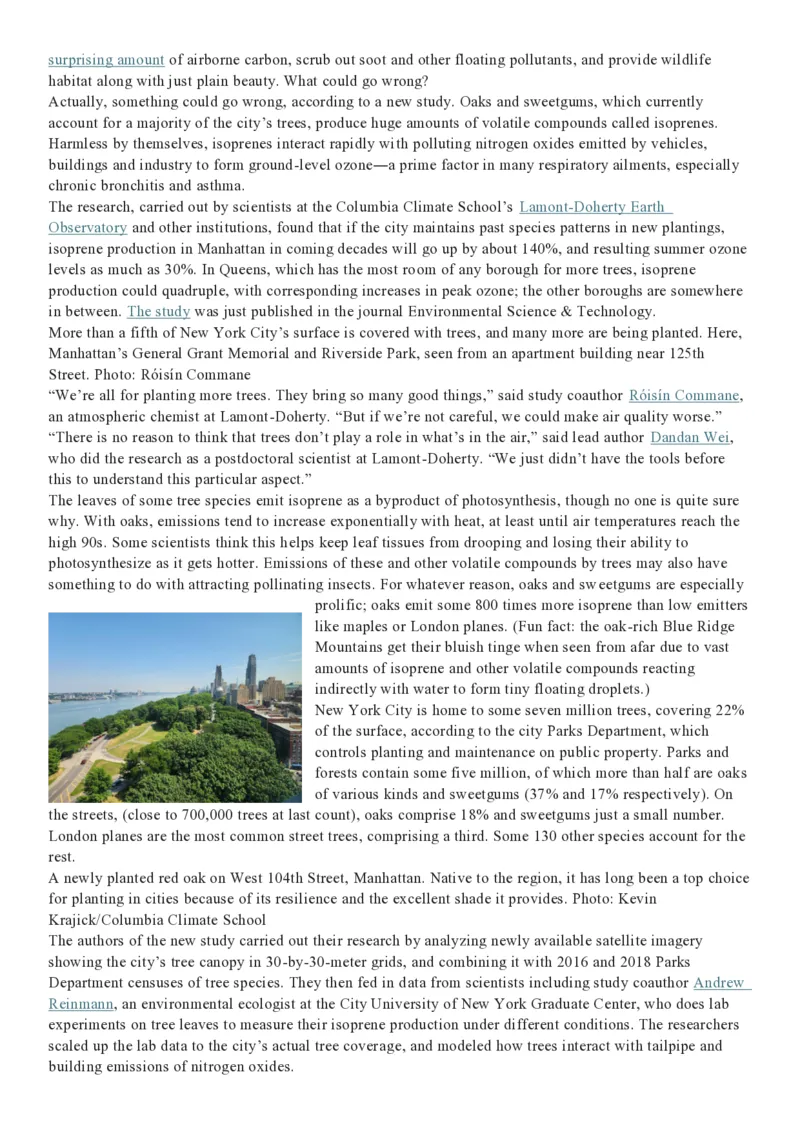
More than a fifth of New York City’s surface is covered with trees, and many more are being planted. Here,
Manhattan’s General Grant Memorial and Riverside Park, seen from an apartment building near 125th
Street. Photo: Róisín Commane
“We’re all for planting more trees. They bring so many good things,” said study coauthor Róisín Commane,
an atmospheric chemist at Lamont-Doherty. “But if we’re not careful, we could make air quality worse.”
“There is no reason to think that trees don’t play a role in what’s in the air,” said lead author Dandan Wei,
who did the research as a postdoctoral scientist at Lamont-Doherty. “We just didn’t have the tools before
this to understand this particular aspect.”
The leaves of some tree species emit isoprene as a byproduct of photosynthesis, though no one is quite sure
why. With oaks, emissions tend to increase exponentially with heat, at least until air temperatures reach the
high 90s. Some scientists think this helps keep leaf tissues from drooping and losing their ability to
photosynthesize as it gets hotter. Emissions of these and other volatile compounds by trees may also have
something to do with attracting pollinating insects. For whatever reason, oaks and sweetgums are especially
prolific; oaks emit some 800 times more isoprene than low emitters
like maples or London planes. (Fun fact: the oak-rich Blue Ridge
Mountains get their bluish tinge when seen from afar due to vast
amounts of isoprene and other volatile compounds reacting
indirectly with water to form tiny floating droplets.)
New York City is home to some seven million trees, covering 22%
of the surface, according to the city Parks Department, which
controls planting and maintenance on public property. Parks and
forests contain some five million, of which more than half are oaks
of various kinds and sweetgums (37% and 17% respectively). On
the streets, (close to 700,000 trees at last count), oaks comprise 18% and sweetgums just a small number.
London planes are the most common street trees, comprising a third. Some 130 other species account for the
rest.
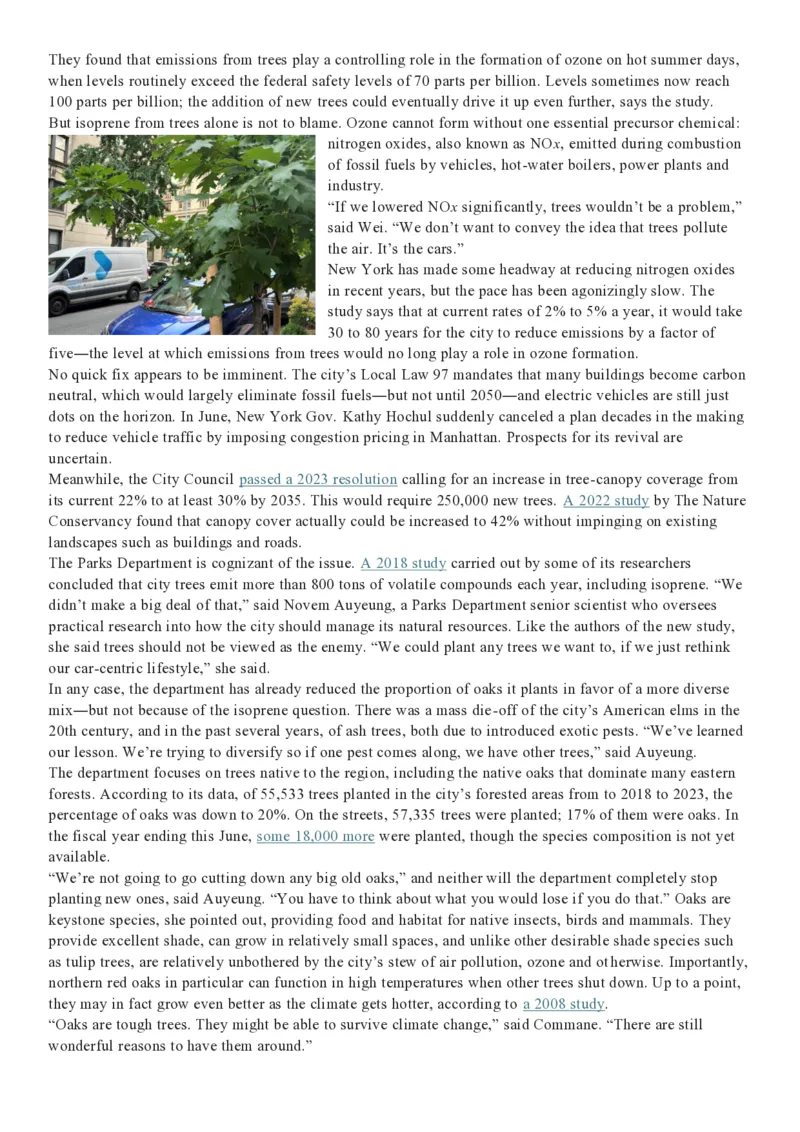
A newly planted red oak on West 104th Street, Manhattan. Native to the region, it has long been a top choice
for planting in cities because of its resilience and the excellent shade it provides. Photo: Kevin
Krajick/Columbia Climate School
The authors of the new study carried out their research by analyzing newly available satellite imagery
showing the city’s tree canopy in 30-by-30-meter grids, and combining it with 2016 and 2018 Parks
Department censuses of tree species. They then fed in data from scientists including study coauthor Andrew
Reinmann, an environmental ecologist at the City University of New York Graduate Center, who does lab
experiments on tree leaves to measure their isoprene production under different conditions. The researchers
scaled up the lab data to the city’s actual tree coverage, and modeled how trees interact with tailpipe and
building emissions of nitrogen oxides.They found that emissions from trees play a controlling role in the formation of ozone on hot summer days,
when levels routinely exceed the federal safety levels of 70 parts per billion. Levels sometimes now reach
100 parts per billion; the addition of new trees could eventually drive it up even further, says the study.
But isoprene from trees alone is not to blame. Ozone cannot form without one essential precursor chemical:
nitrogen oxides, also known as NOx, emitted during combustion
of fossil fuels by vehicles, hot-water boilers, power plants and
industry.
“If we lowered NOx significantly, trees wouldn’t be a problem,”
said Wei. “We don’t want to convey the idea that trees pollute
the air. It’s the cars.”
New York has made some headway at reducing nitrogen oxides
in recent years, but the pace has been agonizingly slow. The
study says that at current rates of 2% to 5% a year, it would take
30 to 80 years for the city to reduce emissions by a factor of
five―the level at which emissions from trees would no long play a role in ozone formation.
No quick fix appears to be imminent. The city’s Local Law 97 mandates that many buildings become carbon
neutral, which would largely eliminate fossil fuels―but not until 2050―and electric vehicles are still just
dots on the horizon. In June, New York Gov. Kathy Hochul suddenly canceled a plan decades in the making
to reduce vehicle traffic by imposing congestion pricing in Manhattan. Prospects for its revival are
uncertain.
Meanwhile, the City Council passed a 2023 resolution calling for an increase in tree-canopy coverage from
its current 22% to at least 30% by 2035. This would require 250,000 new trees. A 2022 study by The Nature
Conservancy found that canopy cover actually could be increased to 42% without impinging on existing
landscapes such as buildings and roads.
The Parks Department is cognizant of the issue. A 2018 study carried out by some of its researchers
concluded that city trees emit more than 800 tons of volatile compounds each year, including isoprene. “We
didn’t make a big deal of that,” said Novem Auyeung, a Parks Department senior scientist who oversees
practical research into how the city should manage its natural resources. Like the authors of the new study,
she said trees should not be viewed as the enemy. “We could plant any trees we want to, if we just rethink
our car-centric lifestyle,” she said.
In any case, the department has already reduced the proportion of oaks it plants in favor of a more diverse
mix―but not because of the isoprene question. There was a mass die-off of the city’s American elms in the
20th century, and in the past several years, of ash trees, both due to introduced exotic pests. “We’ve learned
our lesson. We’re trying to diversify so if one pest comes along, we have other trees,” said Auyeung.
The department focuses on trees native to the region, including the native oaks that dominate many eastern
forests. According to its data, of 55,533 trees planted in the city’s forested areas from to 2018 to 2023, the
percentage of oaks was down to 20%. On the streets, 57,335 trees were planted; 17% of them were oaks. In
the fiscal year ending this June, some 18,000 more were planted, though the species composition is not yet
available.
“We’re not going to go cutting down any big old oaks,” and neither will the department completely stop
planting new ones, said Auyeung. “You have to think about what you would lose if you do that.” Oaks are
keystone species, she pointed out, providing food and habitat for native insects, birds and mammals. They
provide excellent shade, can grow in relatively small spaces, and unlike other desirable shade species such
as tulip trees, are relatively unbothered by the city’s stew of air pollution, ozone and otherwise. Importantly,
northern red oaks in particular can function in high temperatures when other trees shut down. Up to a point,
they may in fact grow even better as the climate gets hotter, according to a 2008 study.
“Oaks are tough trees. They might be able to survive climate change,” said Commane. “There are still
wonderful reasons to have them around.”The study was funded by the National Oceanic and Atmospheric Administration , with additional support
from the New York State Energy Research and Development Authority.
D 篇
是一个社会实验研究,主要研究欣赏艺术作品对认知水平的影响。研究者找一堆人参加画廊,
对 A 组的要求是看看即可,对 B 组的要求则是需要对每一幅作品给出自己的评价和打分。最后
对这两组人进行抽象思维的测试,研究发现给艺术打分的人抽象思维会更好,从而得出艺术思
维的提升是欣赏艺术带来的。
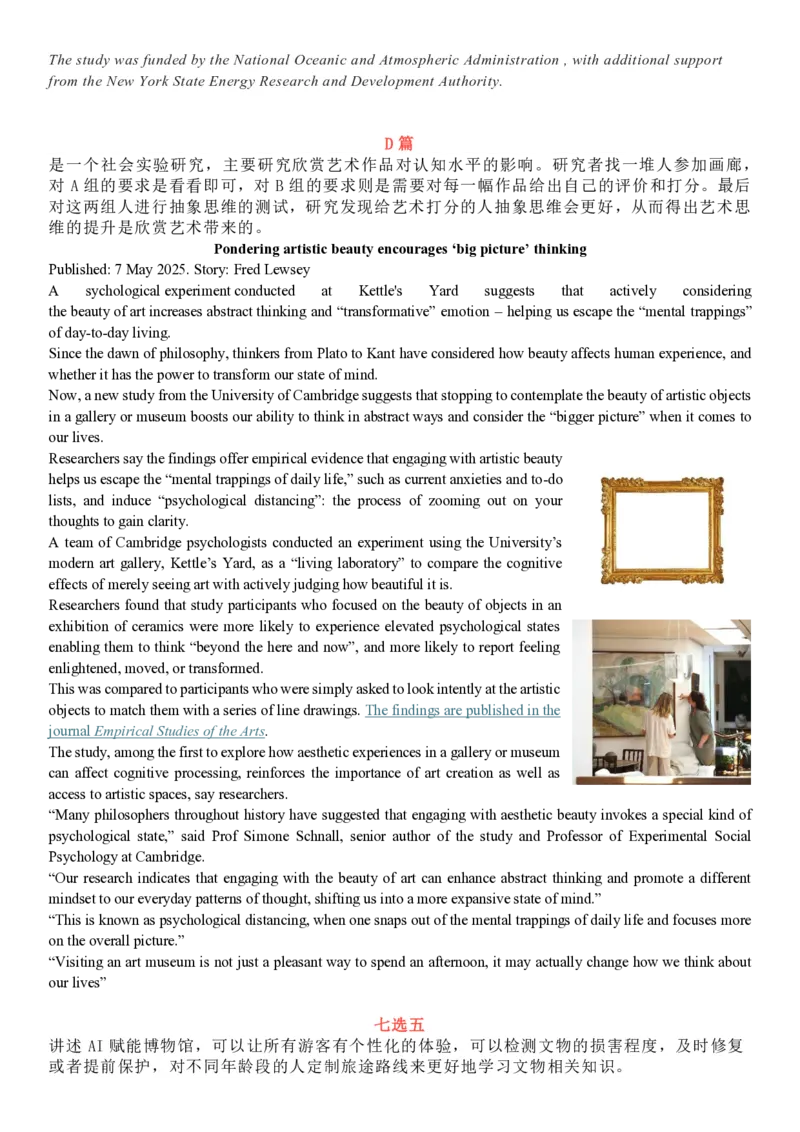
Pondering artistic beauty encourages ‘big picture’ thinking
Published: 7 May 2025. Story: Fred Lewsey
A sychological experiment conducted at Kettle's Yard suggests that actively considering
the beauty of art increases abstract thinking and “transformative” emotion – helping us escape the “mental trappings”
of day-to-day living.
Since the dawn of philosophy, thinkers from Plato to Kant have considered how beauty affects human experience, and
whether it has the power to transform our state of mind.
Now, a new study from the University of Cambridge suggests that stopping to contemplate the beauty of artistic objects
in a gallery or museum boosts our ability to think in abstract ways and consider the “bigger picture” when it comes to
our lives.
Researchers say the findings offer empirical evidence that engaging with artistic beauty
helps us escape the “mental trappings of daily life,” such as current anxieties and to-do
lists, and induce “psychological distancing”: the process of zooming out on your
thoughts to gain clarity.
A team of Cambridge psychologists conducted an experiment using the University’s
modern art gallery, Kettle’s Yard, as a “living laboratory” to compare the cognitive
effects of merely seeing art with actively judging how beautiful it is.
Researchers found that study participants who focused on the beauty of objects in an
exhibition of ceramics were more likely to experience elevated psychological states
enabling them to think “beyond the here and now”, and more likely to report feeling
enlightened, moved, or transformed.
This was compared to participants who were simply asked to look intently at the artistic
objects to match them with a series of line drawings. The findings are published in the
journal Empirical Studies of the Arts.
The study, among the first to explore how aesthetic experiences in a gallery or museum
can affect cognitive processing, reinforces the importance of art creation as well as
access to artistic spaces, say researchers.
“Many philosophers throughout history have suggested that engaging with aesthetic beauty invokes a special kind of
psychological state,” said Prof Simone Schnall, senior author of the study and Professor of Experimental Social
Psychology at Cambridge.
“Our research indicates that engaging with the beauty of art can enhance abstract thinking and promote a different
mindset to our everyday patterns of thought, shifting us into a more expansive state of mind.”
“This is known as psychological distancing, when one snaps out of the mental trappings of daily life and focuses more
on the overall picture.”
“Visiting an art museum is not just a pleasant way to spend an afternoon, it may actually change how we think about
our lives”
七选五
讲述 AI 赋能博物馆,可以让所有游客有个性化的体验,可以检测文物的损害程度,及时修复
或者提前保护,对不同年龄段的人定制旅途路线来更好地学习文物相关知识。How Are Museums Using Artificial Intelligence
Museums, once quiet places filled with history, are now full of digital excitement. Every year, over 1 billion
people visit museums around the world. These institutions now face the challenge of preserving artifacts
while also engaging a tech-savvy generation.
Artificial intelligence (AI), known for self-driving cars and futuristic robots, is becoming a key player in the
cultural sector. AI is more than just a trend; it's transforming the museum experience.
Using machine learning and advanced algorithms, museums create personalized visitor journeys, protect
delicate collections, and reveal hidden stories. AI-powered virtual guides customize visits based on
individual interests, and predictive analytics enhance exhibits. From interactive chatbots to augmented
reality overlays, AI is redefining the museum visit for everyone.
In this article we will explore how AI is changing the way we experience and interact with museums
AI-Powered Personalized Experiences
Today's museum visitors want more than just a walk through static exhibits. They want engagement,
personalization, and a deeper connection to the stories behind the artifacts. Artificial Intelligence (AI) is
making this possible, transforming the museum experience into a dynamic, personalized adventure. This not
only delights visitors but also encourages them to return and fosters a deeper appreciation for cultural
institutions.
Smart Recommendations
When you visit a museum, AI-powered recommendation engines can create a personalized itinerary based
on your interests. By analyzing data such as visitor demographics, past behavior, exhibit popularity, and
contextual information, these algorithms can suggest exhibits, artworks, and events that will resonate with
you. This makes your visit feel both surprising and personal, enhancing your satisfaction and curiosity to
discover more.
Interactive Chatbots & Virtual Guides
AI-powered chatbots and virtual guides are replacing old-fashioned audio guides and brochures. These
digital companions engage visitors in conversations, share historical anecdotes, and offer context-sensitive
insights. They can even tailor their responses to the visitor's age and knowledge level, creating a
personalized learning experience for everyone.
Augmented Reality (AR) Overlays
One of the most visually impressive uses of AI in museums is augmented reality (AR) overlays. By pointing
their smartphones or tablets at exhibits, visitors can see a hidden layer of digital information. Historical
figures can step out of paintings, artifacts can reveal their intricate details, and static displays can come to
life with animation. AR not only makes exhibits more visually appealing but also deepens understanding and
engagement, providing a memorable experience that visitors are likely to share and revisit.
AI in Museum Operations & Collections
AI is transforming museums not just in visitor interactions but also in managing collections, preserving
artifacts, and improving operations, making them more efficient and effective.
Preservation & Restoration
Museums care for priceless artifacts that can deteriorate over time. AI helps by analyzing high-resolution
images to detect early signs of decay, such as cracks or discoloration, which may not be visible to the naked
eye. This early detection allows for timely intervention and restoration, ensuring the longevity of these
cultural treasures. AI also predicts future deterioration patterns, helping museums take preventative
measures and optimize preservation strategies.
Digitization & Cataloging
Many museums have more artifacts than they can display. AI speeds up digitization and cataloging by
analyzing and tagging images, documents, and audio recordings quickly and accurately. This creates
comprehensive digital archives that aid in research and preservation. Additionally, museums can share these
digital collections online, reaching a global audience and making cultural heritage more accessible.
Predictive AnalyticsAI also improves museum operations by analyzing historical data and real-time inputs like weather,
holidays, and social media trends to predict visitor traffic patterns. This helps museums plan staffing levels
to ensure enough guides and personnel are available during peak hours, enhancing visitor experiences.
Moreover, predictive analytics assist in scheduling events and exhibitions strategically to maximize
attendance and revenue. By understanding visitor preferences and predicting popular exhibits, museums can
optimize ticket sales and tailor marketing campaigns. This data-driven approach also helps manage
resources efficiently, from gift shop inventory to maintenance schedules, ensuring smooth museum
operations.
Accessibility & Inclusion Through AI
Museums are more than just places to store artifacts; they are spaces for learning, engagement, and cultural
exchange. AI is helping make these experiences accessible and inclusive for everyone, regardless of their
backgrounds, abilities, or language preferences.
Real-time Translation
Museums attract visitors from all over the world, speaking different languages. AI-powered translation tools
help break down language barriers, allowing visitors to engage with exhibits, educational materials, and
historical texts in their preferred language. Whether it's translating signs in real-time, offering audio guides
in multiple languages, or using chatbots that converse in many tongues, AI ensures language is no longer a
barrier to cultural understanding.
Image Recognition & Descriptions
Visually impaired visitors often face challenges in museums. AI is changing this by using image recognition
technology to analyze exhibits and generate detailed audio descriptions. This allows visually impaired
individuals to "see" through their ears, opening up a world of art, history, and culture. Additionally, AI
creates alternative text descriptions for images on museum websites and digital platforms, making online
content accessible to screen readers and other assistive technologies.
Personalized Learning
Museums are important for children and families, not just adults. AI enhances the educational aspect of
museums by tailoring learning experiences to different age groups and learning styles. Interactive exhibits
powered by AI can adjust their content and difficulty level based on the user's age and responses. AI can
also analyze visitor data to identify knowledge gaps and recommend additional materials, ensuring each
visitor leaves the museum with a deeper understanding and appreciation of the subject matter.
The Future of AI in Museums
AI is advancing rapidly, and its influence on museums is growing. This future promises exciting
possibilities, ethical challenges, and transformative experiences.
AI-Generated Art
AI can now create paintings, sculptures, and music that rival human works. Museums are debating how to
include these pieces in their collections. Should AI art be displayed with traditional art or in a separate
space? These questions are challenging our definition of art.
Ethical Considerations
AI brings ethical concerns. Algorithms can reflect biases from their training data, risking the reinforcement
of stereotypes or exclusion of some views. Museums are collaborating with AI ethicists to develop fair
algorithms. Visitor data collection also raises privacy issues. Clear policies on data handling are essential to
protect visitors' information.
Predictions
AI will continue to revolutionize museums. Virtual reality exhibits could transport visitors to distant lands
and historical eras. AI-powered curators might create dynamic exhibitions tailored to individual interests. As
AI advances, we can expect even more innovative applications. The future museum will blend technology
and culture, creating experiences that educate, inspire, and captivate.
ConclusionAI is changing museums by creating personalized experiences, preserving important artifacts, and making
cultural heritage accessible to everyone. With interactive guides and augmented reality, AI is transforming
how we experience art and history. Museums are now dynamic spaces where technology and culture meet.
There's still much more to come. The future may bring AI-generated art and immersive virtual exhibits.
What do you think about AI in museums? Share your experiences and predictions in the comments below!
Let's keep the conversation going about how this technology is reshaping our cultural institutions.
完形填空
语篇讲述主人公离开故乡小镇后的感悟,传递出对乡土文化独特价值的深刻认识,以及对成
长经历与故土滋养的真挚感恩。
What Growing Up In A Small Town Teaches You About Life
When I was two years old, my family moved from Cincinnati to a little town in northeast Ohio called Cortland. The
realization that people only really knew Ohio for the three C’s – Cleveland, Cincinnati, or Columbus (not Cortland!) –
came quickly when I decided to go to school in central Pennsylvania. The truth is, I never considered myself
“Midwestern” until I left Ohio. You’d think that people would realize that we were neighboring states, but the people
at my “East Coast” school thought of Ohio as a whole different world. Half of my peers didn’t even realize I lived a
mere three and a half hours away. “Do you have to fly home? Do you live on a farm? Is there even anything in Ohio
worth seeing?” The questions are never-ending. I was a unicorn in their eyes, a novelty. Or, on second thought, maybe
just a country hick. Don’t even get me started on the “pop” versus “soda” debate…
As I grow older, I’m more and more thankful for my small town roots. Sure, my friends and I loved to complain about
how bored we were in the middle of nowhere, but as I finish up my junior year of college, I’m convinced that it
took leaving our small town to realize how much we actually did love it and what exactly we loved about it.
We grew up amongst corn fields, spent summers by Mosquito Lake, and
learned to ride our bike on the hill with the rest of the kids in the
neighborhood. We played kick ball and Red Rover in the empty lot down
the street, caught snapping turtles in the creek and snakes in the shared
vegetable garden behind the fence, and spent many an afternoon exploring
the woods behind our houses. We counted the days until the county fair,
prayed for snow days (inside out pj’s and ice cubes in the toilet, anyone?),
we’re forced into corn hole competitions by our dads, never viewed burnt
out headlights as anything other than padiddles, and have all run a red light at some point at one of the five stoplights
in town. I might be showing my affinity toward the midwest lifestyle, but all of these things taught have taught me
important life lessons.
For one, the pace of life isn’t anxiety provoking and people really value connecting to each other. That means that
you do more than just talk to your next door neighbors – in a lot of cases, they’re truly an extension of your family. So
much of this lifestyle revolves around being outside and knowing the ins and outs of the town, being present and
mindful of your surroundings is a critical part of the culture. The gift of being able to grow up slowly is another
invaluable treasure that I was given by my small town. Sure, there will always be a little bit of “keeping up with the
Jones’,” or rather the “advanced” girls, but I never felt pressure to rush through my childhood or to act older than I
was – heck, I was still playing with American Girl dolls in middle school!
As I move through my college years, I look forward to the visits to my little hometown. A huge perk has been the
memories that I made with the people that I was lucky enough to know, and maybe wouldn’t have if our school
district didn’t have just one building for each the elementary, middle, and high schools. There were no more than 130
kids in my public school graduating class and we had known each other since kindergarten. My life would be so
different without the midwestern friendliness and hospitality that I’ve been exposed to through the years and which
has acted as my compass growing up. I am grateful for the experience that I had growing up and know that wherever
my next adventure takes me, I can trust my small town roots to lead me in the right direction.语法填空
语法填空语篇聚焦中国传统“大集”的起源与功能,描绘了集市上美食飘香、人群熙攘、物
产丰富的场景,展现中国乡土社会的繁荣景象与独特风情。
Open-air markets bolster Beijing's street vending economy
Sellers get a fair chance to do brisk business as the lively atmosphere draws shoppers young and old
Shoppers browse products at the market. WEI XIAOHAO/CHINA DAILY
The Shahe Market in suburban Beijing covers an area of 120,000 square meters and is among the Chinese
capital's largest open-air markets. It attracts thousands of shoppers when it opens every Wednesday, Friday
and Sunday.
The unique selling point of the market is that people find everything they need here — and more, Guo said.
And he is absolutely right.
The market not just offers daily necessities such as fruits and vegetables, street food and antique items, one
might also spot vendors selling katydids, which are large, typically green, long-horned nocturnal
grasshoppers that are kept as pets by many people.
"Everything is so down-to-earth here, which is in stark contrast to the modern city life in Beijing. It is a fond
reminder of my childhood days- the good times I spent with my family at the open-air markets near my
native village in Gansu province," Guo said.
Daji, which translates as a "big market or fair", is
typically held on specific dates based on the lunar
calendar, such as dates ending with five or seven. It is
also a common practice to hold daji ahead of or during
traditional Chinese holidays such as the Spring Festival
holiday. Visiting such fairs is popularly termed as ganji,
which literally means "chasing the market".
These markets or fairs evolved from the folk custom of
trading in goods, which can be traced back to the Han
dynasties (206 BC-AD 220).
Open-air fairs becomes attractive for young Chinese
Marketgoers line up to buy snacks at a daji in Hanchuan, Hubei Province, on November 17, 2023 (XINHUA)
Dazzling arrays of seasonal ingredients, enthusiastic calls from vendors lined up along the bustling street,
shoppers jostling each other in crowds, and wafting cook smoke rising between the stalls… Dajis, or big
open-air fairs, similar to farmer's markets, used to be regular events for trading goods, mostly produce and
cooked food, which only took place in rural areas. Now, they are enjoyed by urbanites as well as rural
residents.
Previously seen as a shopping heaven for the frugal older generations, now these markets are becoming
increasingly popular among younger people, who are abandoning big shopping malls in favor of this more
lively and economical ways of living.
Thriving fairs
Dajis typically take place on specific dates of the lunar calendar, for example, on dates with five or seven as
the last digit. It is also common for them to be held on traditional Chinese holidays such as the Spring
Festival, also known as the Chinese New Year, and Mid-Autumn Festival, as well as other local festivals.
The exact dates and frequency of dajis vary from region to region.Dajis evolved from the folk custom of trading goods, which can
be traced back to the Han Dynasty (202 B.C.-A.D. 220). In the
old days, due to inconvenient transportation and underdeveloped
communication, it was challenging for households to exchange
items to meet their needs for daily necessities. As a solution,
people made agreements to gather at a specific location on a
particular day. They would trade their surplus items for the goods
they needed. In addition to being venues for buying and selling,
dajis are an occasion for people to socialize and enjoy
entertainment.
Residents from surrounding areas flock to these markets. They follow enticing aromas to food stalls, where
they indulge in bowls of steamed dumplings or hot noodle soup. They engage in casual conversations with
the stall owners, sharing stories of their daily lives. Afterward, they purchase some fresh fruit and
vegetables from local farmers, priced far lower than those in supermarkets, and embark on their journey
back home.
Wang Yang, a 30-year-old Beijing professional who was born and raised in a rural area of Pingdingshan,
Henan Province, said one of his fondest childhood memories is going to dajis with his family around the
Spring Festival holiday and buying candies and new clothes. "There were also performances like folk operas
and dances, and even game machines carried on trucks for us to play. It was family quality time for pure
fun," he told Beijing Review.
Wang said that the dajis in city suburbs nowadays are not as bustling or entertaining as the ones in his
hometown, but people can still find a good bargain on a variety of goods—fruit, vegetables, fresh fish,
snacks, clothing, shoes, hats, antiques, calligraphy and paintings—all giving a taste of the authentic local
lifestyle.
Dajis also attract travelers and help boost local tourism. In Guiyang, Guizhou Province, where several ethnic
groups reside and ethnic culture thrives, the local tourism authority hosts market fairs featuring ethnic
snacks and artworks. This helps promote the region's intangible cultural heritage to visitors.
These markets have also evolved variants in cities, such as those dedicated to books, fashionable clothes,
technological products, as well as cultural and creative products catering to younger people. Instead of
taking place in suburban areas, these city markets are often held near major business districts, shopping
malls or tourist sites. Most of the vendors are young people.
However, dajis also face challenges, including maintaining sanitation and food hygiene, ensuring fair trading
and preventing crowds from causing traffic congestion, which require continuous efforts by regulatory
authorities and market organizers.
A handicraft stall selling Spring Festival gifts at a daji in Suzhou, Jiangsu Province, on January 6
(CNSPHOTO)
A place for the mind
Through promotion on social media, dajis have also become places for young people, especially college
students and those new to the workforce, to hang out.
Wang Siying, a sophomore student from a university in Beijing, usually gets up early in the morning on the
days when Shahe Daji in the city's suburban Changping District is held. One of the most renowned market
fairs in the district, if not the city, it covers an area of approximately 70,000 square meters and has over
2,000 stalls. It usually opens three times a week and 10 hours a day from 7 a.m.
Visiting the market every week has become a habit for Wang Siying. When she arrives, she typically heads
straight to the fruit and vegetable section. The produce is usually transported directly from the fields and is
usually swarmed by customers before it can even be unloaded from the trucks. Not only is the produce fresh,
the prices are also only half what they would be in the city center.Wang Siying also likes browsing the antique section. Although
she doesn't really buy much, "It's interesting to listen to the stall
owners talking about the origins and use of those antiques," she
told Beijing Review. Born in a city in Shandong Province, Wang
Siying said dajis help her get in touch with the rural lifestyle and
gain more life skills, like how to select the sweetest strawberries.
Nine-to-fiver Wang Yang also likes to go to dajis but for slightly
different reasons from Wang Siying. "They are a break from the
fast-paced and stressful working life," he said. "The vendors'
calls are more like soothing white noise."
Also, as most products at the markets are cheaper than those in groceries or supermarkets, especially when
buying in bulk, shopping at dajis can save him more than 1,000 yuan ($139) a month. "Besides, taking a
long walk through the market is also a kind of exercise. So it's good for both the body and soul, and the
wallet."
原题呈现(题目存在偏差)
Thriving fairs
Dajis typically take place on specific dates of the lunar calendar, for example, on dates with five or seven as
the last digit. It is also common for them 1.(hold) on traditional Chinese holidays such as the Spring Festival,
also known as the Chinese New Year, and Mid-Autumn Festival, as well as other local festivals. The exact
dates and 2.(frequent) of dajis vary from region to region.
Dajis evolved from the folk custom of trading goods, 3.____ can be traced back to the Han Dynasty (202
B.C.-A.D. 220). In the old days, due to inconvenient transportation and underdeveloped communication, it
was challenging for households 4.(exchange) items to meet their needs for daily 5.(necessity). As a solution,
people made agreements to gather at a specific location on a particular day. They would trade their surplus
items for the goods they needed. In addition to 6.____(be) venues for buying and selling, dajis are an
occasion for people to socialize and enjoy entertainment.
Residents from surrounding areas flock to these markets. They follow enticing aromas to food stalls, where
they indulge in bowls of steamed dumplings or hot noodle soup. They engage in casual conversations with
the stall owners, 7.(share) stories of their daily lives. Afterward, they purchase some fresh fruit and
vegetables from local farmers, priced far 8.(low) than those in supermarkets, and embark on their journey
back home.
Wang Yang, a 30-year-old Beijing professional who was born and raised in a rural area of Pingdingshan,
Henan Province, said one of his fondest childhood memories 9.(be) going to dajis with his family around the
Spring Festival holiday and buying candies and new clothes. "There were also performances like folk operas
and dances, and even game machines carried on trucks for us to play. It was family quality time for pure
fun," he told Beijing Review, 10. well-known English-language magazine in China.
小作文
文报“Campus Life”栏目正在征稿,邀请同学们讨论未来大学生活中不同方面的重要性排序。请你从
学习(Study)、睡眠(Sleep)、社交(Socializing)三个方面,给出你认为合理的优先级顺序,并阐述理由,
写一篇短文投稿。注意:
1、写作词数应为 80 个左右:
2、请按题目要求完成写作,格式规范。
参考范文
Dear editor,
When college life is around the corner, it's important to rank study, sleep and socializing in order of
importance.
Why do we work so hard to go to college? Because we expect to STUDY morein an academic atmosphere.
After study comes SLEEP. Without good sleep, no goodhealth is guaranteed; without good health, there isno potential to explore and research.Finally, we can't ignore SOCIALIZING. We're all adults in college. As
social beings,we must socialize with all walks of life. By doing so, we can prepare ourselves forfuture
teamwork, generating brilliant ideas and creative products.To balance the three aspects is hard, but we have
to make a choice. What's your priority?
Yours sincerely,
Li Hua
读后续写
一个女孩为找男友过圣诞节途中遇暴风雪、车子被困后,一对善良夫妻给予帮助还提供了修车服务的
故事。
TRAVERSE CITY — Residents of Northern Michigan say that they’re grateful for random acts of kindness
they’ve seen following the brutal snow and ice storm.From helping move a car to offering a place to sleep,
locals say they’ve seen their community step up to help those in need.Karin Chrostek is a mother who works
at Munson Health. She says that after a 12-hour shift on Monday, she went to pick up her son east of
Traverse City.Chrostek’s car became stuck in a neighborhood she was unfamiliar with, multiple miles from
her son.Chrostek says shes was helped by a father and son, who worked to shovel the snow around her
car.“They were armed with shovels, and they started digging out. I did what I could with my snow scraper,
my good mittens and my jacket,” she said.While the three of them worked, conditions remained dangerous.
Chrostek says another stranger from the neighborhood offered to host her for the night, which Chrostek took
her up on.
“We kind of talked about the storm and the state of things, and we both kind of reaffirmed that this was a
step forward in terms of redemption of humanity,” she said.
Chrostek says that tough moments like these show how the community is often there to step up and help
others.
“Honestly, without the three of them, I would still be stuck,” she said. “So I picked up my son this morning,
and it was victorious, and we both came home and took naps. Just happy to be here.” Numerous strangers
have also been seen helping out stuck cars, either with equipment or a simple push.
Two of those helpers are Brooklyn and Kayden from Sault Ste. Marie. They say they’ve helped 20 to 30
people in need of driveway shoveling or assistance with their car.
“It feels very good to help out people,” Kayden said. “If i was stuck in a ditch, I’d more than want a truck to
come help pull me out or offer to help.”
They said they decided to help out while visiting from the UP, and even purchased some new equipment
today to use. “Any time we see somebody struggling, like an older person struggling with shoveling snow,
we’ll pull over and just say, ‘Hey, can we give you a hand with that?’” Kayden said.
Authorities are recommending that anyone who is able to stay home continue to do so.
原文精准翻译
特拉弗斯城讯 —— 密歇根州北部的居民们表示,在这场猛烈的冰雪风暴过后,人们目睹了诸多暖心
的善举,内心满是感激。
从帮忙推车到提供留宿之处,当地居民称,整个社区的人们都挺身而出,向身处困境的人伸出援手。
卡琳・赫罗斯泰克是芒森医疗中心的一名工作人员。她讲述,周一结束 12 小时轮班工作后,她驱车
前往特拉弗斯城东部接儿子。不料车辆在一处陌生街区陷入积雪,此地距离她的儿子还有数英里之
遥。
卡琳说,一对父子主动上前帮忙,奋力铲除车辆周边的积雪。“他们拿着铁锹埋头清理积雪,我也拿
出除雪铲,戴好厚实的手套、裹紧外套,尽自己所能搭把手。” 她说道。
三人合力铲雪时,户外的恶劣状况并未好转。随后,社区里另一位陌生人邀请卡琳当晚暂住家中,她
接受了这份善意。
“我们聊起这场暴风雪和当下的处境,两人都感慨,这些善意之举让我们重新看到了人性的美好。”
卡琳说道。她认为,危难时刻最能体现社区邻里守望相助的温情。“说实话,如果没有这三位好心人,我至今还被困在原地。后来我顺利接到了儿子,平安回到家中,休整休息,能安然脱险实在万
幸。”
暴风雪中,还有许许多多陌生人主动救助受困车辆,有人拿出专业工具,也有人仅仅上前合力推车。
来自苏圣玛丽的布鲁克林与凯登便是其中两位热心人,他们已经帮助了数十名被积雪困住的路人。
“伸出援手的感觉特别美好。倘若我身陷困境,也十分盼望能有人向我施以援手。”
二人表示,他们本是前来此地探亲,看到风雪中的窘境便决定留下来帮忙,当天还特意购置了新的救
援工具。“每当我们看到有人艰难跋涉,尤其是被积雪困住的老人,都会停车上前询问是否需要帮
助。”
相关部门提醒,条件允许的居民尽量留在家中,不要外出。
续写任务要求
请根据所给材料内容和段落开头语续写两段,使之构成一篇完整的短文。续写词数应为 150 左右
第一段开头:The couple suggested that Emily take a train to meet her boyfriend.
第二段开头:Three days later, Emily came back to pick up her car.
读后续写命题改制逻辑
1、母本筛选:选取真实新闻 “暴风雪陌生人互助”,契合高考 “正能量主题”。
2、叙事重构:
人物:将原新闻主角改为 Emily,新增 “见男友” 动机,聚焦个体故事。
情节:截取 “被困→铲雪留宿” 核心冲突,删去无关细节。
3、难度适配:精简篇幅、简化句式,适配高中生词汇与阅读水平。
4、留白定向:在 “留宿脱困” 节点设置分割点,通过两段段首句引导续写方向,既承接原文善意主
题,又给考生合理创作空间。
写作思路指导
第一段
描写 Emily 听到建议后的犹豫(担忧车辆),看到恶劣天气后决定听从建议;夫妇驾车送她前往车
站,途中讲述社区互助的故事;Emily 内心逐渐温暖,理解安全的重要性;最终在车站与男友相见,
分享此番奇遇。
第二段
描写暴风雪停歇,雪后晴朗的景象,街头邻里互助清雪的画面;Emily 发现车辆已维修完毕,再次遇
见好心夫妇与两位年轻助人者;她送上礼物表达感谢,并加入铲雪队伍;结尾升华主题:善意会传
递,灾难拉近了人与人的距离。
高分写作技巧
运用高级词汇与句式
a glimmer of hope(一丝希望)
the kindness that melts the ice(融冰的善意)
pay it forward(传递善意)等。
参考范文
Paragraph 1
The couple suggested that Emily take a train to meet her boyfriend. Emily hesitated for a moment, worrying
about her car left on the road. But looking at the raging snowstorm outside, she finally agreed. The kind
couple drove her to the railway station on the way, telling her many warm stories about neighbors helping
each other during storms. On the train, Emily felt a warm glow in her heart. When she saw her boyfriend
waiting anxiously at the platform, she ran into his arms and told him about the kind strangers who had saved
her.
Paragraph 2
Three days later, Emily came back to pick up her car. The storm had gone completely, and bright sunshine
spread over the snow-covered streets. She spotted the couple working with Brooklyn and Kayden, and her
car was parked nearby, perfectly repaired. Emily gave them a heartfelt thank-you gift and immediately
joined their team, shoveling snow for an elderly neighbor. As she worked, she realized that kindness is
contagious, and this storm had brought the community closer than ever before.