Lesson 2 Chinese Government
中国政府
The Chinese Communist Party is the ruling party of the People's Republic of China. China possesses a multi-
party, consultative system of government that operates under the leadership of the Communist Party.
According to the Chinese Constitution, all citizens eighteen years of age and older have the right to vote and to
run for office.
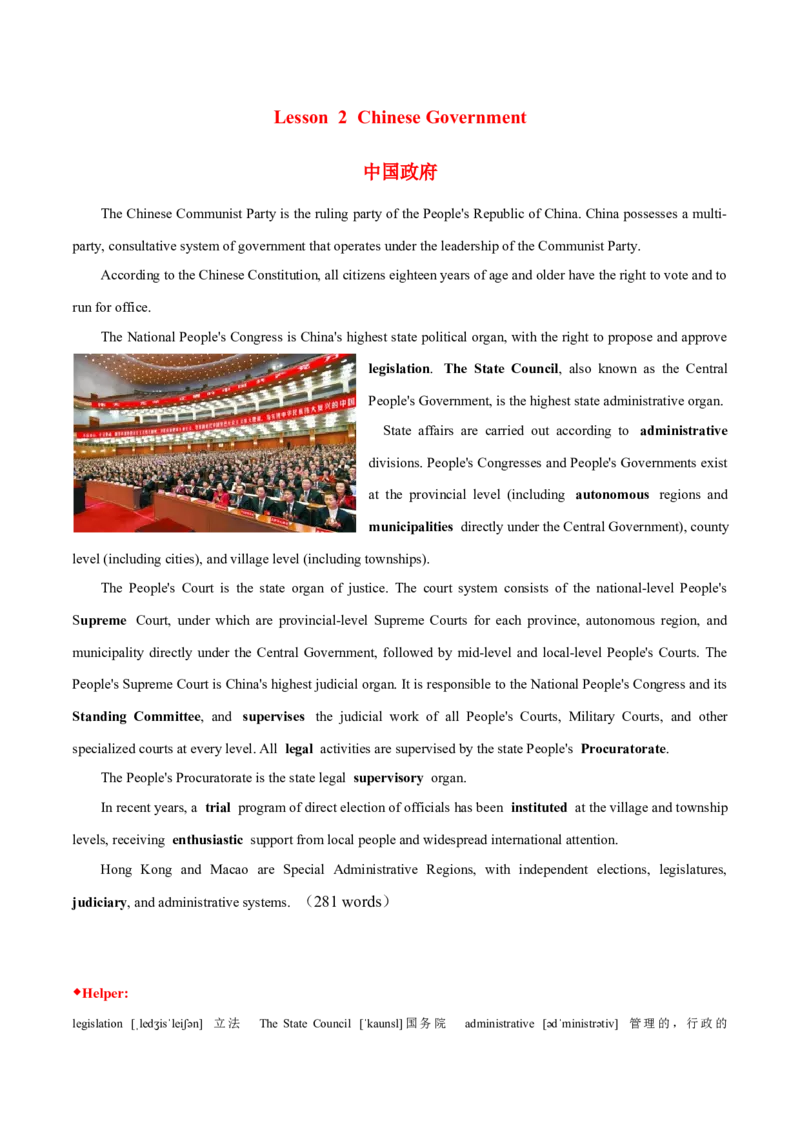
The National People's Congress is China's highest state political organ, with the right to propose and approve
legislation. The State Council, also known as the Central
People's Government, is the highest state administrative organ.
State affairs are carried out according to administrative
divisions. People's Congresses and People's Governments exist
at the provincial level (including autonomous regions and
municipalities directly under the Central Government), county
level (including cities), and village level (including townships).
The People's Court is the state organ of justice. The court system consists of the national-level People's
Supreme Court, under which are provincial-level Supreme Courts for each province, autonomous region, and
municipality directly under the Central Government, followed by mid-level and local-level People's Courts. The
People's Supreme Court is China's highest judicial organ. It is responsible to the National People's Congress and its
Standing Committee, and supervises the judicial work of all People's Courts, Military Courts, and other
specialized courts at every level. All legal activities are supervised by the state People's Procuratorate.
The People's Procuratorate is the state legal supervisory organ.
In recent years, a trial program of direct election of officials has been instituted at the village and township
levels, receiving enthusiastic support from local people and widespread international attention.
Hong Kong and Macao are Special Administrative Regions, with independent elections, legislatures,
judiciary, and administrative systems. (281 words)
◆Helper:
legislation [ˌledʒisˈleiʃən] 立法 The State Council [ˈkaunsl]国务院 administrative [ədˈministrətiv] 管理的,行政的autonomous [ɔ:ˈtɒnəməs] 自治的 municipality [mju:ˌnisi'pæləti] 自治市,直辖市 supreme [su:ˈpri:m] 最高的, 至高的
judicial organ [dʒu:ˈdiʃəl ˈɔ:ɡən] 司法机构 Standing Committee [kəˈmiti] 常务委员会 supervise [ˈsju:pəvaiz] 监督 legal
[ˈli:ɡəl] 法律的 procuratorate ['prɒkjʊəreitərit] 检察院 supervisory [ˌsju:pə'vaizəri] 监督的; 管理的 trial [ˈtraiəl] 试验
的;[法]审讯的 institute [ˈinstitju:t] 建立,开始,着手 enthusiastic [inˌθju:ziˈæstik] 热心的,热情的 judiciary [dʒʊ'diʃəri]
司法的
◆Chinese Brief Introduction:
中华人民共和国政府,通称中国政府,是中华人民共和国中央政府和地方政府的总称。1949年10月1
日,毛泽东在北京宣告中华人民共和国中央人民政府成立。1954年9月27日颁布首部宪法,实行人民代
表大会制度后, 全国人民代表大会是最高国家权力机关,全国人大及其常委会是中华人民共和国法律的
立法机关。中华人民共和国国务院即1954年后的中央人民政府,统领全国各级行政机关,是最高国家行政
机关。地方各级人民政府与当地同级人民法院、人民检察院合称一府两院,都接受当地同级人民代表大会
及其常务委员会的监督。
◆Exercise:
I. Questions:
1. How old is a Chinese citizen when he has the right to vote and to run for office?
2. What is the highest state administrative organ?
3. What is the state organ of justice?
4. Which are the two Special Administrative Regions mentioned in the text?
II. Written work:
根据以下提示,用英语写一篇介绍香港的短文,字数100字左右。
香港位于中国的东南部,面积1106平方公里,人口约734万,被称为“东方明珠”。1842年鸦片战
争后,当时的中国政府被迫将香港割让给英国。1997年她已回到祖国的怀抱。
参考词汇:明珠 pearl,鸦片 opium
Lesson3 Chinese People 中国人民China is a unified nation consisting of many different ethnic groups. Fifty-six different ethnic groups make up
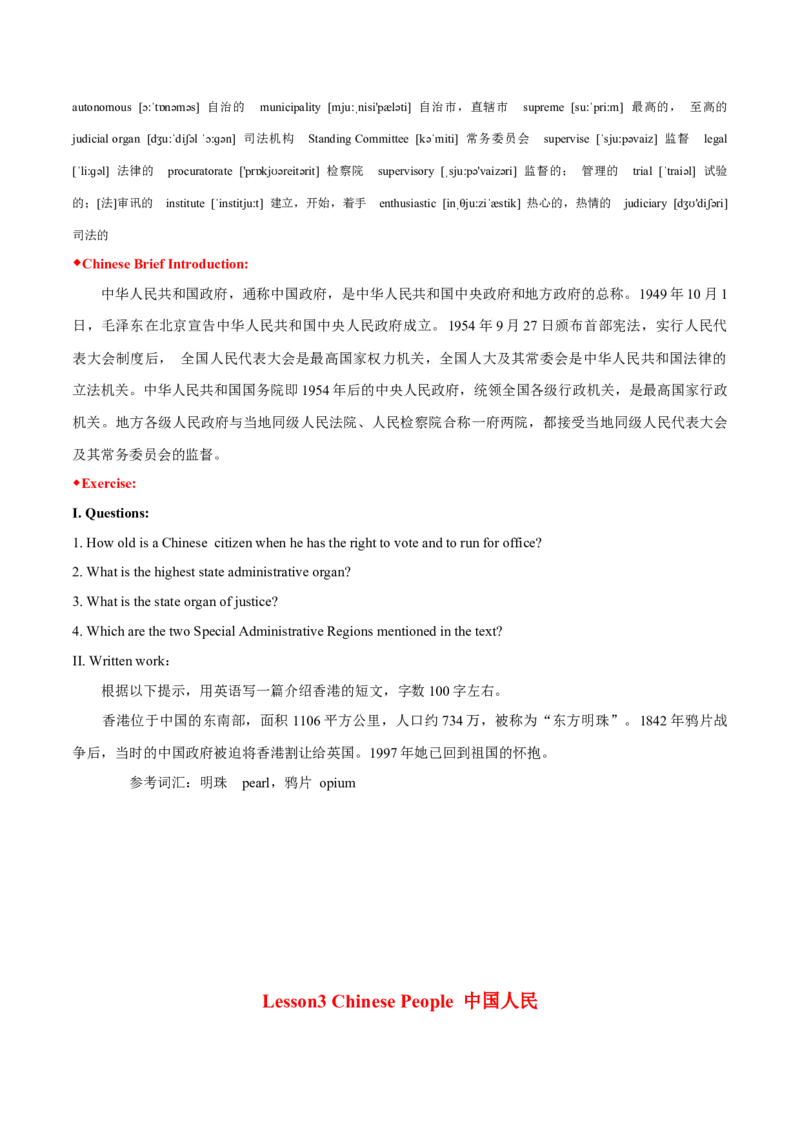
the great Chinese national family. Because the Han people accounts for more than
ninety percent of China's population, the remaining fifty-five groups are generally
referred to as "ethnic minorities." Next to the majority Han, the Mongolian, Hui,
Tibetan, and Uygur peoples comprise the largest ethnic groups. Although China's
ethnic minorities do not account for a large portion of the population, they are
distributed over a vast area, living in every corner of China.
Particularly since the achievement of China's opening and reform policy, the central government has increased
investment in minority areas and accelerated their opening to the outside
world. This has resulted in a rise of economic development in these areas. Each
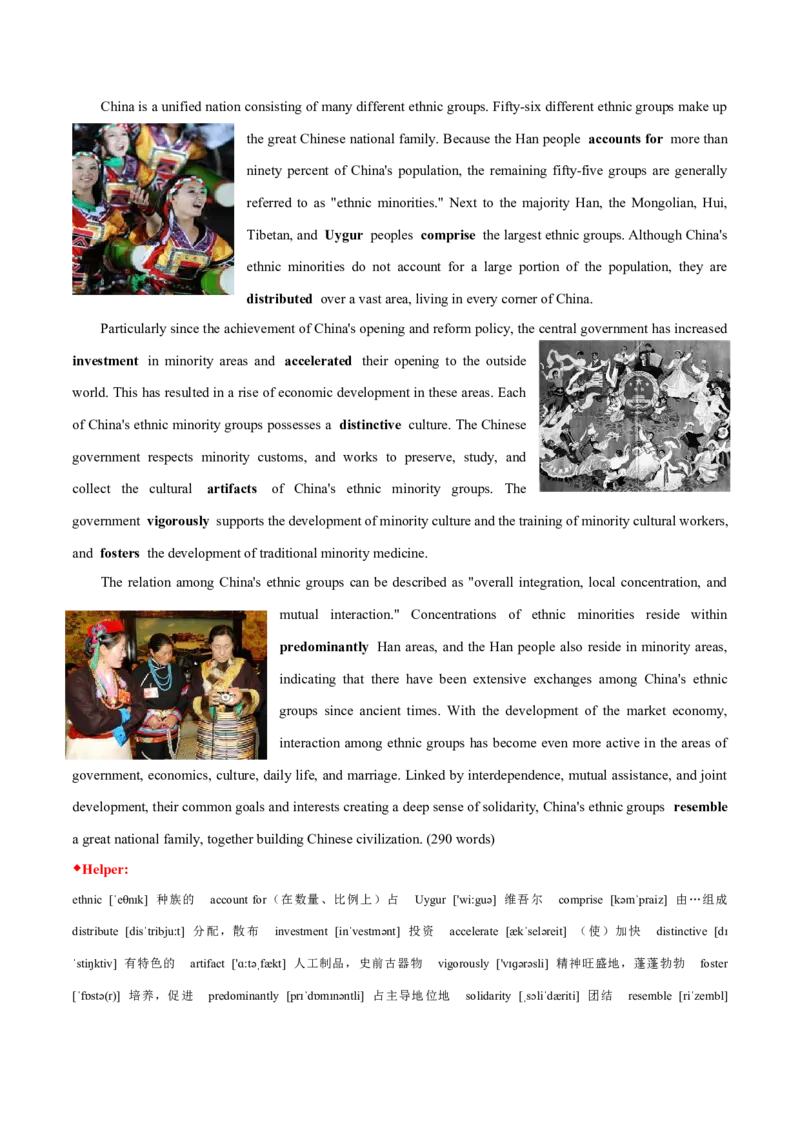
of China's ethnic minority groups possesses a distinctive culture. The Chinese
government respects minority customs, and works to preserve, study, and
collect the cultural artifacts of China's ethnic minority groups. The
government vigorously supports the development of minority culture and the training of minority cultural workers,
and fosters the development of traditional minority medicine.
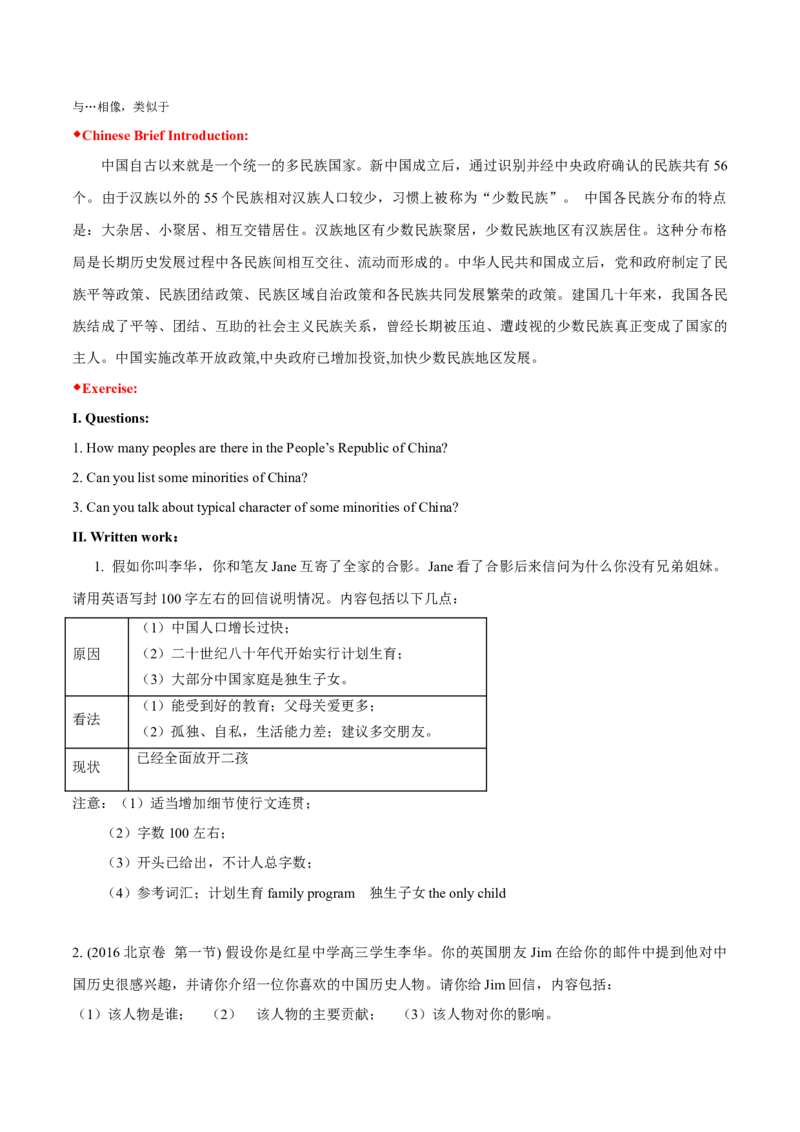
The relation among China's ethnic groups can be described as "overall integration, local concentration, and
mutual interaction." Concentrations of ethnic minorities reside within
predominantly Han areas, and the Han people also reside in minority areas,
indicating that there have been extensive exchanges among China's ethnic
groups since ancient times. With the development of the market economy,
interaction among ethnic groups has become even more active in the areas of
government, economics, culture, daily life, and marriage. Linked by interdependence, mutual assistance, and joint
development, their common goals and interests creating a deep sense of solidarity, China's ethnic groups resemble
a great national family, together building Chinese civilization. (290 words)
◆Helper:
ethnic [ˈeθnɪk] 种族的 account for(在数量、比例上)占 Uygur ['wi:guə] 维吾尔 comprise [kəmˈpraiz] 由…组成
distribute [disˈtribju:t] 分配,散布 investment [inˈvestmənt] 投资 accelerate [ækˈseləreit] (使)加快 distinctive [dɪ
ˈstiŋktiv] 有特色的 artifact ['ɑ:təˌfækt] 人工制品,史前古器物 vigorously ['vɪɡərəsli] 精神旺盛地,蓬蓬勃勃 foster
[ˈfɒstə(r)] 培养,促进 predominantly [prɪˈdɒmɪnəntli] 占主导地位地 solidarity [ˌsɔliˈdæriti] 团结 resemble [riˈzembl]与…相像,类似于
◆Chinese Brief Introduction:
中国自古以来就是一个统一的多民族国家。新中国成立后,通过识别并经中央政府确认的民族共有56
个。由于汉族以外的55个民族相对汉族人口较少,习惯上被称为“少数民族”。 中国各民族分布的特点
是:大杂居、小聚居、相互交错居住。汉族地区有少数民族聚居,少数民族地区有汉族居住。这种分布格
局是长期历史发展过程中各民族间相互交往、流动而形成的。中华人民共和国成立后,党和政府制定了民
族平等政策、民族团结政策、民族区域自治政策和各民族共同发展繁荣的政策。建国几十年来,我国各民
族结成了平等、团结、互助的社会主义民族关系,曾经长期被压迫、遭歧视的少数民族真正变成了国家的
主人。中国实施改革开放政策,中央政府已增加投资,加快少数民族地区发展。
◆Exercise:
I. Questions:
1. How many peoples are there in the People’s Republic of China?
2. Can you list some minorities of China?
3. Can you talk about typical character of some minorities of China?
II. Written work:
1. 假如你叫李华,你和笔友Jane互寄了全家的合影。Jane看了合影后来信问为什么你没有兄弟姐妹。
请用英语写封100字左右的回信说明情况。内容包括以下几点:
(1)中国人口增长过快;
原因 (2)二十世纪八十年代开始实行计划生育;
(3)大部分中国家庭是独生子女。
(1)能受到好的教育;父母关爱更多;
看法
(2)孤独、自私,生活能力差;建议多交朋友。
已经全面放开二孩
现状
注意:(1)适当增加细节使行文连贯;
(2)字数100左右;
(3)开头已给出,不计人总字数;
(4)参考词汇;计划生育family program 独生子女the only child
2. (2016北京卷 第一节) 假设你是红星中学高三学生李华。你的英国朋友 Jim在给你的邮件中提到他对中
国历史很感兴趣,并请你介绍一位你喜欢的中国历史人物。请你给Jim回信,内容包括:
(1)该人物是谁; (2) 该人物的主要贡献; (3)该人物对你的影响。注意:
(1)词数不少于50;(2)开头和结尾已给出,不计入总词数。
3. 阅读下面材料,在空白处填入适当的内容(1个单词)或括号内单词的正确形式。
As we all know,Hangzhou, a beautiful city, won the bid ( 1 ) September 16th 2015. Thus, it will be the
third Chinese city ( 2 ) (host) the games.
Hangzhou is a beautiful city with a long history. Hosting the Asian Games will give it a new look. ( 3 )
the event will cost the government a lot, the benefits are easy for us to see. To the citizens in Hangzhou, the best
part of it is that it will give us the chance to watch world-class matches and ( 4 ) (compete) close to home.
Secondly, there is no doubt ( 5 ) the event will attract more visitors to enjoy ( 6 ) (visit) this wonderful
city. At the same time, it is good for the development of the tourism. Meanwhile, as the construction goes on, more
roads ( 7 ) (build) and the Metro system will be expanded, ( 8 ) can reduce traffic jams.
In the next few years, Hangzhou will try its best to prepare ( 9 ) for the big show. ( 10 ) splendid
Hangzhou is waiting to see you in 2022.
Suggested Answers2. Chinese Government
II. Written work:
Hong Kong lies in the southeast of China. She has an area of 1,045k㎡ and has a population of more than 6
million and is well-known as “the Pearl of the East”.
In 1842, the then Chinese government was forced to give up Hong Kong to Britain after the Opium War, and the
people in Hong Kong suffered a lot.
After the return of Hong Kong to China in 1997, the people of Hong Kong are united more with the Chinese
people in mainland China, and they will work hard to make her more beautiful.
3. Chinese People
II. Written work:
1.Dear Jane,
Thank you for your letter and the photo of your family. Now I am writing to tell you why I am the only child
in my family.
As you know, the population of China is growing very fast. In order to control the rapid increase of population,
in the 1980s the government of China began to put into practice the family programme---- one child for each
couple. As a result, most families have only one child. The child in the family can get more love from the family
and chances to get better education. On the other hand, the only child is selfish, and not so independent. Sometimes
they feel lonely. I think, every the only child like me should learn to make more friends. To our delight and relief,
the universal two-child policy has been carried out since January 1, 2016.
Hope that we write more often.
Best wishes!
Yours,
Li Hua
2. Dear Jim,
It’s great to hear from you. I feel proud to know your interest in
Chinese history. As for my favourite figure in Chinese history, it must be Wei Yuan, a great thinker in the late Qing
Dynasty. He, in his book Haiguotuzhi (Maps and Records of the World), introduced modern technologies and ideas
to China. That opened our eyes to the world. In fact, he inspires me to major in English in college and to be a
bridge between China and the world.
Interested in knowing more? I can find you some books! Just let me know.
Cheers!Yours,
Li Hua
3. (1)on(2)to host(3)Though/although(4)competitions(5)that (6)visiting(7)will be built
(8)which (9)itself(10)A