1 / 28
学科网(北京)股份有限公司
学科网(北京)股份有限公司
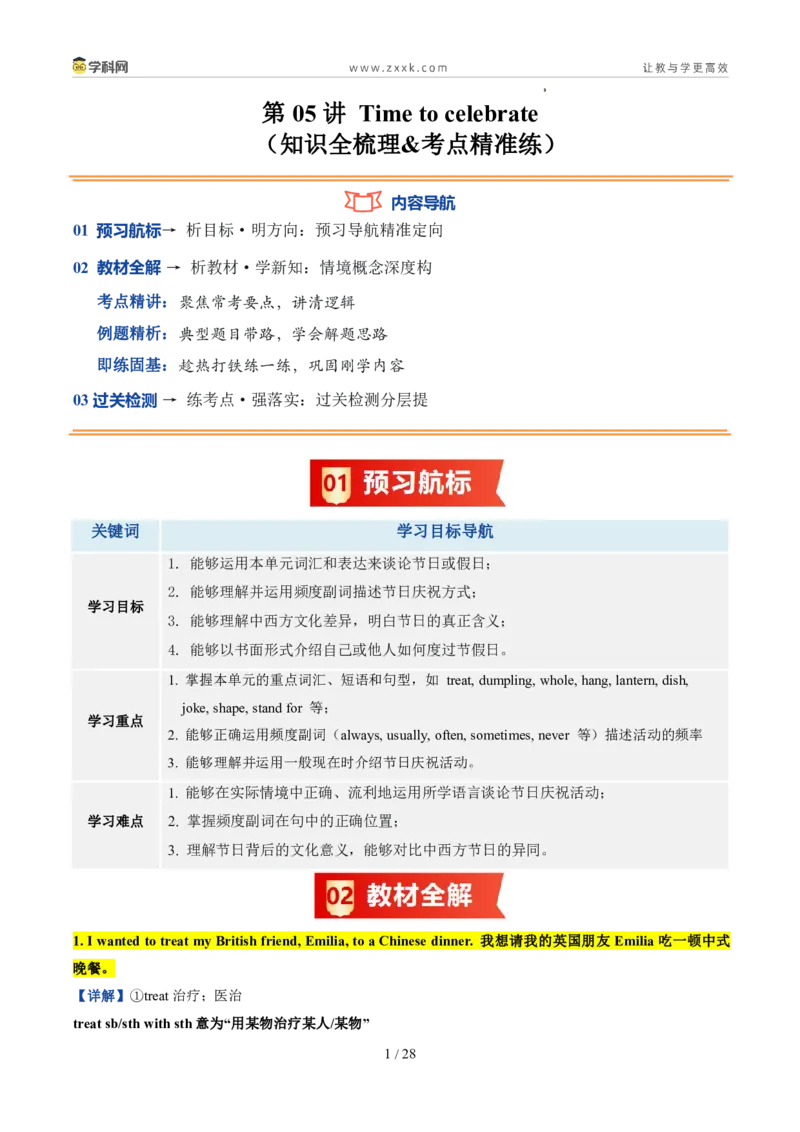
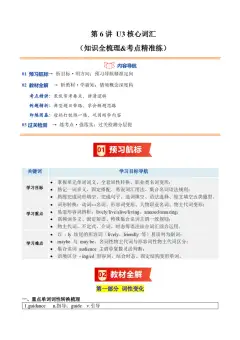
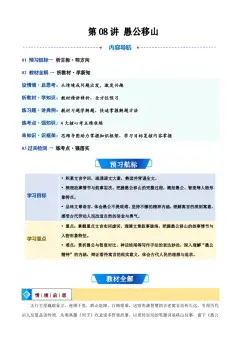
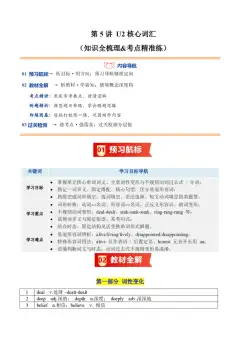
第05 讲Time to celebrate
(知识全梳理&考点精准练)
内容导航
01 预习航标→析目标·明方向:预习导航精准定向
02 教材全解→析教材·学新知:情境概念深度构
考点精讲:聚焦常考要点,讲清逻辑
例题精析:典型题目带路,学会解题思路
即练固基:趁热打铁练一练,巩固刚学内容
03 过关检测→练考点·强落实:过关检测分层提
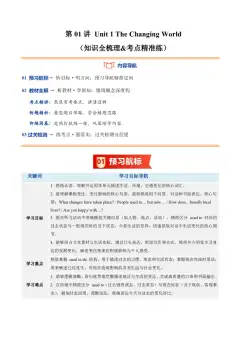
关键词
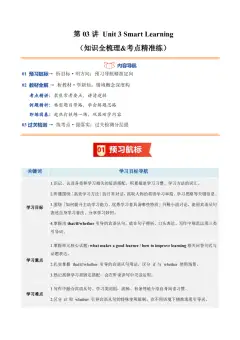
学习目标导航
学习目标
1. 能够运用本单元词汇和表达来谈论节日或假日;
2. 能够理解并运用频度副词描述节日庆祝方式;
3. 能够理解中西方文化差异,明白节日的真正含义;
4. 能够以书面形式介绍自己或他人如何度过节假日。
学习重点
1. 掌握本单元的重点词汇、短语和句型,如treat, dumpling, whole, hang, lantern, dish,
joke, shape, stand for 等;
2. 能够正确运用频度副词(always, usually, often, sometimes, never 等)描述活动的频率
3. 能够理解并运用一般现在时介绍节日庆祝活动。
学习难点
1. 能够在实际情境中正确、流利地运用所学语言谈论节日庆祝活动;
2. 掌握频度副词在句中的正确位置;
3. 理解节日背后的文化意义,能够对比中西方节日的异同。
1. I wanted to treat my British friend, Emilia, to a Chinese dinner. 我想请我的英国朋友Emilia 吃一顿中式
晚餐。
【详解】①treat 治疗;医治
treat sb/sth with sth 意为“用某物治疗某人/某物”
2 / 28
学科网(北京)股份有限公司
学科网(北京)股份有限公司
Nowadays,malaria can be treated with drugs.如今,疟疾可以用药物治疗。
②treat 作及物动词,意为“对待;看待”。treat sb as/like/to be..把某人当成/看作……
She treats me like one of the family.她把我当作家人看待。
The teacher treats his students as his own children.这位老师把他的学生当作他自己的孩子。
They treated us with kindness.他们好心对待我们。
③treat sb to sth 意为“用某物款待某人”
We treated Mum to lunch at the restaurant.我们请妈妈在这家饭店吃午饭。
【拓展】My treat. 我请客。
Let's go for ice cream. It's my treat! 我们去吃冰淇淋吧,我请客!
【典例】(25-26 七年级上·全国·单元测试)My uncle often ______ us ______ a big meal when we visit him.
A. treats; to
B. treats; with
C. treats; for
D. treat; to
【答案】A
【详解】句意:当我们去看望叔叔时,他经常请我们吃大餐。考查固定搭配treat sb to sth,意为“请某人
吃……”。主语My uncle 为第三人称单数,谓语动词用treats。故选A。
【即练1】
1.(25-26 七年级下·四川宜宾·期中)Ella is a ________ girl. She ________ everyone with respect.
A.polite; shows
B.politely; treat
C.polite; treats
2.(24-25 七年级下·湖北孝感·期中)Be polite and treat others ________ respect.
A.with
B.to
C.of
D.in
3.(24-25 七年级上·天津河北·期末)I wanted to treat Emilia ________ Chinese dinner. She is a nice girl.
A.in
B.with
C.to
D.by
【即练2】
1.(25-26 七年级下·重庆沙坪坝·期中)Our teachers always encourage us ________(treat) others with kindness.
2.(24-25 七年级下·全国·单元测试)Our teachers are so kind ________ (treat) us as their own kids.
3.(24-25 七年级下·重庆北碚·阶段检测)He always speaks loudly to his family members and treats them
________ (polite).
【即练3】
1.(25-26 七年级下·全国·课后作业)有礼貌,相互尊重。
Be polite and treat ________ ________ with respect.
2.(25-26 七年级下·江苏南京·期末)它们跳跃的身姿,堪称一场视觉盛宴。(treat)
Their jumps were ________________.
3.(24-25 七年级下·全国·课后作业)人类没有在善待树木。
Humans are not treating trees ________ ________ ________ ________.
2. However, I just couldn’t make it. 然而,我最终还是没能成功。
【详解】(1) make it 成功或达到目标
3 / 28
学科网(北京)股份有限公司
学科网(北京)股份有限公司
I believe I have the talent to make it.
我相信我有获得成功的才干。
The doctors think he's going to make it.
医生认为他能挺过去。
【知识拓展】
make it clear that 弄清楚; 明确表示; 表明; 搞清晰
She made it clear that she was not interested in the proposal.
她明确表示她对那个提议不感兴趣。
.however (副词)然而;不过;但是
(2) However (副词)然而;不过;但是
(1) 表示让步,意为“无论如何”“不管怎样”,修饰形容词或副词,词序为:however+形容词或副词+主语+谓语。
However cold it is, he always goes swimming.不管天气多冷,他总是去游泳。
(2) 表示转折,意为“但是”等。可位于句首、句中或句末,常用逗号与句子其它成分隔开。
My room is small, however, it's comfortable.我的房间很小,但却很舒服。
【典例1】(25-26 七年级下·黑龙江哈尔滨·期中)I enjoy ________ books in the library on weekends. It makes
me ________.
A.read; relaxing
B.reading; relaxes
C.reading; relax
【答案】C
【详解】句意:我喜欢周末在图书馆看书。它使我放松。
reading 是动名词;relax 是动词原形;relaxes 是第三人称单数形式。enjoy doing sth.表示“喜欢做某事”,第一
空填动名词reading;make sb. do sth.表示“使某人做某事”,第二空填动词原形relax。
【典例2】(2023 八年级·安徽·专题练习)The room was very small; ______, it was very clean and tidy.
A.though
B.because
C.moreover
D.however
【答案】D
【详解】句意:这个房间非常小,然而,它非常干净和整洁。
考查副词辨析。though 不过,然而;because 因为;moreover 再者;however 然而。空前“The room was very
small”讲这个房间很小,这是它的缺点;空后“it was very clean and tidy.”讲这个房间又干净又整洁,这是它
的优点,句意出现转折,并且此空位于句首,所以此空应填“however”。故选D。
【即练1】
1.(24-25 七年级上·江苏无锡·阶段检测)I want to buy this white shirt for my brother. It makes ________
handsome.
A.him look
B.him looks
C.him to look
D.he look
2.(25-26 八年级上·江苏泰州·期末)The members of the team took the match ________ and practised hard.
________, it was not so easy for them to win.
4 / 28
学科网(北京)股份有限公司
学科网(北京)股份有限公司
A.seriously; However
B.happily; Instead
C.clearly; Moreover
D.quietly; Therefore
3.(26-27 七年级上·全国·课后作业)Singing makes Peter ________, so he spends much time on it every day.
A.happily
B.happy
C.sad
D.sadly
【即练2】
1.(26-27 七年级上·全国·课后作业)Music always ________ (make) him happy.
2.(25-26 七年级下·全国·随堂练习)He likes reading. _________, he seldom has free time. (however)
3.(25-26 七年级下·全国·单元测试)Too much pressure makes students feel ________ (stress).
【即练3】
1.(26-27 七年级上·全国·课后作业)You can make tea with corn silk. (改为一般疑问句并作肯定或否定回答)
一般疑问句:_________________________________________
肯定回答:_______________ 否定回答:_______________
2.(26-27 七年级上·全国·课后作业)我最喜欢的科目是音乐,因为它让我快乐。
My favourite subject is music ________ it makes me ________.
3.(25-26 七年级下·全国·单元测试)我想和你去那里。但是,我太累了。(however)
________________
3. Sometimes, she cooks for me. 有时候,她会为我做饭。
【详解】cook V.煮,烧
【常见搭配】cook for sb 为某人做饭
cook sb sth=cook sth for sb. 为某人做饭
My mother always cooks me delicious food. 我妈妈总是给我做美味的食物。
My mother always cooks delicious food for me.
【拓展】cook 可数名词厨师
辨别:cooker 可数名词,厨具,炉子
His father is a good cook.
【典例】(26-27 七年级上·全国·课后作业)—Let me help you ________ the food.
—Thank you.
A.to cooking
B.cook
C.cooking
D.cooks
【答案】B
【详解】句意:——让我帮你做饭吧。——谢谢你。
to cooking 结构错误;cook 做饭(动词原形);cooking 做饭(现在分词/动名词);cooks 做饭(第三人称
单数形式)。help sb. (to) do sth.意为“帮助某人做某事”,后接动词原形或带to 的不定式。应填cook。
【即练1】
1.(26-27 七年级上·全国·单元测试)— What ________ your mother ________ in the kitchen?
— It must be chicken. Can’t you smell it?
A.does; cook
B.did; cook
C.is; cooking
D.will; cook
2.(25-26 七年级下·全国·课后作业)—It’s so delicious! Did you buy the food at a restaurant?
—No, my mom did. My mother is a good ________, and she enjoys ________ delicious meals for the family every
5 / 28
学科网(北京)股份有限公司
学科网(北京)股份有限公司
day. The ________ is working perfectly in our kitchen.
A.cooker; cooking; cook
B.cook; cooking; cooker
C.cooking; cooker; cook
D.cooker;cook;cook
3.(25-26 七年级下·全国·单元测试)—How nice the fish tastes!
—Does it? Do you know who ________ it? It’s me!
A.is cooking
B.will cook
C.cooks
D.cooked
【即练2】
1.(26-27 七年级上·江苏·小升初衔接)Smell! Who ________ (cook) nice food?
2.(25-26 七年级下·全国·课后作业)My grandma cooks very ________ (good).
3.(24-25 七年级下·浙江湖州·阶段检测)Please tell Jeff ________ (cook) at home.
【即练3】
1.(25-26 七年级下·全国·单元测试)My mother cooks dinner every evening.(改为否定句)
My mother ________ ________ dinner every evening.
2.(25-26 七年级上·全国·单元测试)Mom cooks in the kitchen. (改为否定句)
Mom ________ ________ in the kitchen.
3.(25-26 七年级上·全国·随堂练习)My mother is cooking lunch for us. (就划线部分提问)
_________ ________ ________ lunch for you?
4. I often watched Grandma cook, but I never cooked anything myself. 我经常看奶奶做饭,但自己却从未尝
试过烹饪。
【详解】watch
V.表示观看某事物(尤其是指观看电视电影或体育比赛等)
We like watching TV in our free time. 在我们业余时间我们喜欢看电视。
watch sb. do:看见了全过程(动作已完成)。强调的是“我目睹了这件事的整个经过”。
watch sb. doing:看见了正在进行的片段(动作未结束)。强调的是“我看到的时候,他正在做那个动作”。
I watched him cross the street.
我看见他穿过了马路。—— 强调:我看完了他从这边走到那边的整个过程,他现在已经在对岸了。
I watched him crossing the street.
(我看见他正在过马路。—— 强调:我看到他的时候,他正走在马路中间,还没走到对面。至于他最后过
完了没有,不知道。)
【典例】(26-27 七年级上·江苏·小升初衔接)It’s seven o’clock in the evening. Tom’s mother ________ a book
about clothes.
A.reads
B.is watching
C.is reading
【答案】C
【详解】句意:现在是晚上七点,汤姆的妈妈正在看一本关于服饰的书。
具体时刻“It’s seven o’clock”提示动作此刻正在发生,需使用现在进行时(be doing);固定搭配read a book
表示看书,主语Tom’s mother 为第三人称单数,be 动词用is,read 的现在分词是reading。
6 / 28
学科网(北京)股份有限公司
学科网(北京)股份有限公司
【即练1】
1.(25-26 七年级下·全国·单元测试)She ________ TV every evening, but now she ________ a book.
A.watches; reads
B.watches; is reading
C.is watching; reads
D.is watching; is reading
2.(25-26 七年级下·全国·单元测试)My sister ________ TV at the moment. She ________ a leaf poster.
A.doesn’t watch; makes
B.isn’t watching; is making
C.isn’t watch; is make
D.not watches; making
3.(24-25 七年级上·天津蓟州·阶段检测)—I often watch talk shows on TV.
—I enjoy ________ the news. I hope to find out what’s going on around the world.
A.watching
B.to watch
C.watch
D.watched
【即练2】
1.(25-26 八年级下·江苏无锡·期中)The young mother was standing at the window watching her child ________
(cross) the busy street all by himself for the first time.
2(25-26 八年级下·全国·单元测试)I’m interested in ________ (watch) English educational videos.
3.(25-26 八年级下·全国·单元测试)The students ________ (watch) a funny cartoon in the classroom last
Wednesday afternoon.
【即练3】
1.(25-26 八年级下·全国·课后作业)You should be ________ of your things in public. (watch)
2.(25-26 八年级下·山东济南·阶段检测)She often watches her mother ________ (cook) but she can’t cook
anything herself.
3.(25-26 八年级下·全国·单元测试)Young people enjoy ________ (watch) both old and modern cartoons.
5. It was midnight in China, time for dumpling. 中国正值午夜,正是吃饺子的时候。
【详解】(1) time for sth 到做某事的时间
【常见搭配】It's time for sth
到做某事的时间;
It’s time for sb. to do sth
到某人做某事的时间了
It’s time to do sth
到做某事的时间
It’s time for lunch. 到吃午饭的时间了。
It’s time to have lunch.
It’s time for me to have lunch. 到我吃午饭的时间了。
【拓展】与time 相关的短语
on time 按时
in time
及时
all the time
一直
from time to time 有时
(2) 反身代词的用法:
1)反身代词不能作主语,但可作主语同位语,放在主语后或句末。如:
The box itself is not so heavy.(主语同位语)
箱子本身并不重。
7 / 28
学科网(北京)股份有限公司
学科网(北京)股份有限公司
2)反身代词可以作宾语的同位语。如:
You may go and ask the teacher himself.(宾语的同位语)
3)反身代词可以作介词的宾语。
常用结构:by oneself 全靠自己;say to oneself 自言自语
如:
Take good care of yourself.照顾好你自己。
4)反身代词作动词的宾语:
enjoy oneself 玩得高兴
help oneself(to)随便用……
hurt oneself 伤害自己
teach oneself 自学
get oneself dressed 自己穿衣
seat oneself 就座
记忆口诀:反身代词表自身,句中可作三成分;动介后面用作宾,表示动作回自身;
句中强调同位语,主语宾语后面跟;系动be 后作表语,这个用法要牢记.
【典例1】(24-25 七年级上·安徽淮北·开学考试)It’s time for my brothers and ________ homework.
A.me to do
B.me doing
C.I to do
D.I doing
【答案】A
【详解】句意:是我和我的兄弟们做家庭作业的时候了。
考查代词辨析和动词不定式的用法。me 我,宾格;I 我,主格;to do 动词不定式;doing 现在分词。for 是
介词,后接人称代词宾格,排除C 项和D 项;It’s time to do sth.“到了该做某事的时候了”,是固定用法,排
除B 项。故选A。
【典例2】(24-25 七年级下·北京顺义·期中)— I will go to the zoo with my parents next Sunday.
—________.
A.Enjoy yourself B.Good luck
C.Congratulations
D.Help yourself
【答案】A
【详解】句意:——我下周日要和我的父母去动物园。——玩得开心。
考查交际用语。Enjoy yourself 祝你玩得开心;Good luck 祝你幸运;Congratulations 祝贺;Help yourself 随
便吃。根据“I will go to the zoo with my parents next Sunday.”可知,对方下周日要和父母去动物园,表达祝愿
对方开心快乐。故选A。
【即练1】
1. (24-25 八年级上·广东深圳·课后作业)The retired couple (退休夫妇) have decided to go to college. It’s time
for ________ to begin a new life.
A.they
B.them
C.their
D.theirs
2.(22-23 七年级上·全国·单元测试)I always have a good time at school.
A.enjoy oneself
B.take part in
C.go to school
D.enjoy myself
3.(24-25 八年级下·江苏泰州·期中)—Where is my English book, Mum? I searched for it everywhere.
8 / 28
学科网(北京)股份有限公司
学科网(北京)股份有限公司
—There! It’s under your nose ________.
A.all the time
B.at one time
C.at that time
D.at times
【即练2】
1.(2026 八年级下·天津·专题练习)到我伸出援手的时候了。
It was time for me to _______ my help.
2.(24-25 七年级下·上海浦东新·期中)Taking deep breaths can help to ________ yourself. [rɪˈlæks]
3.(20-21 八年级上·全国·课后作业)是时候考虑一下我们的暑假计划了。
It's time to ________ ________ our plans for the summer vacation.
【即练3】
1.(21-22 八年级下·上海徐汇·阶段检测)It is twelve o’clock now. We can open the presents.(保持句意基本不
变)
It is time for us ________ ________ the presents now.
2.(22-23 八年级下·全国·单元测试)It’s time for breakfast. (改为同义句)
It’s time ____ ____ ____.
3.(24-25 七年级上·全国·单元测试)Could you ________ (介绍) yourself first?
6. Are you joking? Isn't that against the law? 你在开玩笑吗?这难道不是违法的吗?
【详解】(1) joke 作不及物动词,意为“说笑话;开玩笑";joke 也可作名词,意为“笑话;玩笑”。
●He likes joking,but he doesn't do well in telling jokes.他喜欢开玩笑,但是他不擅长讲笑话。联想拓展含有joke
的常见短语
①play a joke on sb 开某人的玩笑
●Everyone may play a joke on others on April Fool's Day.在愚人节所有人都可能开别人的玩笑。
②make a joke(out)of sth 拿某事开玩笑
●It's an important question.Don't make a joke of it.这是一个重要的问题。不要拿它开玩笑。
看图背例句
He likes to play a joke on his son.他喜欢开他儿子的玩笑。
(2)本句是否定疑问句。表示反问、责备,或表达说话人的看法或惊异的情绪,意为“难道……不……吗?”
常用结构:Be/助动词/情态动词的否定形式+主语+其他?
Isn’t he from South Africa? 难道他不是来自南非吗?
Don’t you drive to work?
难道你不开车上班吗?
(3)against 作介词,常见用法如下
①意为“(在比赛或战斗中)对(某人或某事物)”,常与play、fight 等词连用。
The soldiers fought against the enemy bravely.士兵们勇敢地与敌人交战。
②意为“反对;违背”,其反义词为for。
They are strongly against the idea 他们强烈反对这个主意。
③表示位置,意为“靠着:倚着”。
9 / 28
学科网(北京)股份有限公司
学科网(北京)股份有限公司
He stood leaning against the wall.他站着斜靠在墙上。
④表示“碰;撞”。
The rain beat against the windows.雨点击打着窗户。
⑤表示“逆”。
We are rowing against the current.我们划船逆流而上。
【典例1】(24-25 七年级下·全国·单元测试)My brother is a firefighter. He often ________ jokes to his
workmates.
A.tell
B.tells
C.telling
D.told
【答案】B
【详解】句意:我哥哥是一名消防员。他经常跟他的同事开玩笑。
考查动词时态。根据“often”可知,本句时态是一般现在时,主语He 是单数第三人称,谓语动词用三单形式
tells。故选B。
【典例2】(24-25 七年级上·上海虹口·期中)The government made a promise to continue fighting __________
terrorism __________ the control of the island.
A.for; against
B.against; for
C.for; with
D.against; to
【答案】B
【详解】句意:政府承诺继续打击恐怖主义,以控制该岛。
考查介词辨析。for 为了;against 反对;with 带有;to 朝着。根据“The government made a promise to continue
fighting…terrorism…the control of the island.”可知,此处指政府承诺继续打击恐怖主义,以控制该岛,fight
against sth.“为反对……而斗争”,固定搭配,第一个空应用against;第二个空应用介词for“为了”,表目的。
故选B。
【即练1】
1. (20-21 七年级·全国·假期作业)My best friend is a funny boy. He often ________ jokes to make me
________.
A.tells, laugh
B.tell, laugh
C.says, to laugh
D.says, laugh
2.(22-23 九年级上·全国·课后作业)It’s impolite to laugh at, stare at or play _____on disabled people .
A.fun
B.jokes
C.chances
D.parts
3.(2018·安徽·中考真题)Our class are much sure to win the basketball game ______ Class Three.
A.of
B.in
C.against
D.from
【即练2】
1.(24-25·七年级上全国·单元测试)She was laughing and ________ (joke) with the children.
2.(25-26 七年级上·全国·课后作业)I can tell you some ________(joke).
3.(24-25 九年级上·河北保定·期中)We should never do anything against the ________ (法律).
【即练3】
10 / 28
学科网(北京)股份有限公司
学科网(北京)股份有限公司
1.(24-25 七年级上·全国·单元测试)不要和你的老师开玩笑。
Don’t ________ jokes ________ your teacher.
2.(25-26 七年级下·全国·课前预习)企鹅聚集在一起,保护自己抵御寒冷多风的天气。
Penguins stay together to ________ ________ against the cold and windy weather.
3. (22-23 七年级下·河北保定·期末)play against, team, we, another, will
____________________.
7. The smell of the dishes and our laughter filled the room.菜的香味和我们的笑声充满了整个房间。
【详解】(1)smell n.气味;臭味;嗅觉;嗅,闻;v.有……气味,发出......的气味;闻出,闻到
Where's that smell coming from?
那种气味是哪里来的?
There's an awful smell in here.
这里有股很难闻的味道。
Dogs have a keen sense of smell.
狗的嗅觉很灵敏。
Can you smell something burning?
你有没有闻到什么东西烧焦了?
(2)①A fill B=B be filled with A B 里充满了A
Tears filled her eyes.=Her eyes were filled with tears.她的双眼噙满了泪水。
②fill A with B 用B 填满A
He poured some juice into her glass,and then filled his own glass with coffee.他往她的玻璃杯里倒了些果汁,然
后往他自己的玻璃杯里倒满了咖啡。
③be filled with...=be full of...充满……
Their faces were filled with happiness.=Their faces were full of happiness.他们的脸上充满了幸福。
④fill up(使)填满;充满
Shall I fill the car up?要我给车加满油吗?
【拓展】filling 作名词,意为“(补牙用的)填料;馅”。
【典例1】(24-25 七年级下·全国·单元测试)The food ________ the apple pie. It smells so_________.
A.smells, good
B.smells like, good
C.smells, well
D.smells like, well
【答案】B
【详解】句意:食物闻起来像苹果派。它闻起来很好。
考查动词短语和形容词的用法。smells 闻起来,动词三单形式;good 好的,形容词;smells like 闻起来像;
well 好,副词。根据“The food...the apple pie.”可知此处表示“闻起来像”,用“smells like”;根据“smells so...”
可知此处smell 是系动词,后面用形容词“good”。故选B。
【典例2】(24-25 八年级上௭安徽黄山௭期末)—Would you please fill the cup ________ some coffee and give
it to me?
11 / 28
学科网(北京)股份有限公司
学科网(北京)股份有限公司
—OK. Wait for a few minutes.
A.of
B.for
C.with
D.by
【答案】C
【详解】句意:——请你在杯子里装满咖啡然后把它给我好吗?——好的。等几分钟。
考查介词辨析。of 表示所属关系,“……的”;for 为了;with 有,用;by 通过。根据语境可知,此处表达的
是在杯子里装满咖啡,“fill...with...”是固定短语,意为“用……装满……”,所以应该用with。故选C。
【即练1】
1.(26-27 七年级上·江苏·小升初衔接)Someone ________ smoking in the room. Can you ________ it?
2.(24-25 八年级下·甘肃武威·期末)The little girl’s schoolbag ________ books. It’s too heavy for her.
A.are filled with B.is filled of
C.is full of
D.is full with
3.(24-25 七年级上·全国·单元测试)—Dad, can I fill the box ________ my model planes?
—I’m afraid not. It’s full ________ my books..
A.of, with
B.with, of
C.of, of
D.with, with
【即练2】
1. (24-25 七年级下·山东德州·期中)The egg soup ________ (smell) so good that everyone wanted to have a
bit of it.
2.(22-23 七年级上·全国·课后作业)Air has no smell. (变成同义句)
Air ________ not ________ smell.
3. The room was ________ (fill) with laughter when we finished the task together.
【即练3】
1.(25-26 七年级下·全国·课后作业)The family trip filled us with happiness.
一般疑问句:__________________
肯定回答:__________________
否定回答:__________________
2.(25-26 七年级下·全国·单元测试)The glass is filled with water. (改为同义句)
The glass ________ ________ ________ water.
3.(22-23 七年级上·河北张家口·期中)smell,can,nose,with,I,my
________________________________________________.
8. I felt like I was back home. 我感觉就像回到了家一样。
【详解】feel like 感觉像;其后常接名词(短语)或从句
She made me feel like a child. 她让我感觉自己像个孩子。
I felt like I was a fish in the pool. 我感觉自己像池塘里的一条鱼。
【典例】(25-26 七年级上·安徽蚌埠·期末)A cup of warm tea always makes me ________ like I’m back home.
A.to feel
B.feel
C.feeling
D.feels
【答案】B
12 / 28
学科网(北京)股份有限公司
学科网(北京)股份有限公司
【详解】句意:一杯热茶总是让我感觉像回到了家一样。
固定结构make sb. do sth.,意为“使某人做某事”,其中make 作为使役动词,后面需要接不带to 的动词不定
式(即动词原形)作宾语补足语。
【即练1】
1.(25-26 七年级上·江苏南通·阶段检测)The boy likes reading. Reading books ________ him ________ happy.
A.makes; feel
B.make; feels
C.makes; feels
D.make; feel
2.(24-25 七年级上·全国·单元测试)—What’s the matter?
—I am so hot and don’t feel like ________ anything.
A.to eat
B.ate
C.eat
D.eating
3. (24-25 八年级上·陕西西安·阶段检测)—What do you plan to do this weekend?
—I don’t ________ having a trip. I ________ to stay at home.
A.feel like; would like
B.sound like; would like
C.feel like; look like
D.sound like; feel like
【即练2】
1. (2025 七年级上·全国·专题练习)Now he is ________ (feel) like a big football star
2. (24-25 七年级下·湖北孝感·期末)It feels like a ________ [‘mædʒIkl] place when you are at Mount
Huangshan.
3. (24-25 七年级上·全国·课后作业)A cup of warm tea always makes me ________(feel) like I’m back home.
【即练3】
1. (24-25 八年级上·云南昆明·期中)Tom didn’t pass the exam yesterday. He _________ saying nothing. (feel
like)
2. (24-25 七年级上·全国·课后作业)我们想在波士顿待更长时间。
We feel like ________ ________ in Boston.
3. (24-25 七年级上·全国·单元测试)我感觉我像一只小鸟。(feel like)
__________________________________________________________.
9. Because it always take place on the fifth day of the fifth lunar month. 因为这一活动始终在农历五月初五
举行。
【详解】take place 发生;出现;举行尤指根据安排或计划某事发生、某物出现或举行某活动
The film festival will take place in October.
【辨析】happen 多指发生意外事故,不幸的事,表示事情的发生带有偶然性
(1)what happened? 发生了什么?
We can only guess what happened? 我们只能猜测发生了什么?
(2)happen to do sth 碰巧做某事
I happened to be out when you called. 你打电话时,我刚巧出去了。
【典例】(25-26 七年级上·全国·单元测试)— ________ does the World Cup ________?
—Every four years.
13 / 28
学科网(北京)股份有限公司
学科网(北京)股份有限公司
A.How long, take apart
B.How often, take off
C.How many times, take care of
D.How often, take place
【答案】D
【详解】句意:——世界杯多久举行一次?——每四年一次。
考查疑问词和动词短语辨析。How long 问时长;How often 问频率;How many times 问次数。根据答语“Every
four years”可知问的是频率,排除A、C。take apart 拆开;take off 起飞;take place 举行。世界杯应搭配“take
place”。故选D。
【即练1】
1.(24-25 八年级上·全国·课后作业)Where
the match
?
A.is; take place
B.did; take place
C.was; happened
D.was; happen
2.(25-26 七年级下·全国·课后作业)A few interesting activities will ________ in the playground this Saturday.
Would you like to ________ them?
A.take place; take part in
B.take place; join
C.happen; join in
D.take the place; take part in
【即练2】
1.(24-25 七年级上·全国·课后作业)The sports meeting ________ (take place) last week.
2.(21-22 八年级下·全国·单元测试)How often ________ the Olympic Games ________ (take) place?
【即练3】
1.(23-24 八年级下·广东深圳·期中)When and where did that car accident take place?
A.start
B.happen
C.leave
D.follow
2.(25-26 七年级上·全国·单元测试)I hope the sports meeting _________ (take) place next weekend.
10. Which taste do you prefer? 您更喜欢哪种口味?
【详解】prefer
动词
更喜欢;钟爱(= like... better)
过去式:preferred
现在分词:preferring
①prefer sth 更喜欢某物
I prefer apples.
我更喜欢苹果。
②prefer doing/ to do sth 更喜欢做某事
She preferred living/ to live with her mother. 她更喜欢与她的妈妈住在一起。
③prefer(doing) sth to (doing) sth
喜欢……胜过……(to 介词,后接名词、代词或动词-ing 形式)
He prefers riding a bike to driving. 与开车相比,他更喜欢骑自行车。
④prefer to do sth rather than do sth
宁愿做某事也不愿做某事
I prefer to read magazines rather than watch TV. 我宁愿看杂志也不愿看电视。
【典例】(24-25 七年级下·广东广州·期中)Jim prefers ________ to ________. She goes for a run every morning.
A.play football, swim
B.playing football, swim
C.play football, swimming
D.playing football, swimming
【答案】D
14 / 28
学科网(北京)股份有限公司
学科网(北京)股份有限公司
【详解】句意:比起游泳,吉姆更喜欢踢足球。他每天早上都会去跑步。
考查动名词作宾语。结合句意可知,“prefer doing sth to doing sth”是固定搭配,表示“比起做某事(后者),
更喜欢做某事(前者)” ,这里两个空都需要用动名词形式。“play”的动名词是“playing” ,“swim”的动名
词是“swimming”。故选D。
【即练1】
1.(25-26 七年级下·全国·单元测试)—Which do you ________, playing the piano or drawing?
—I prefer drawing.
A.like
B.prefer
C.enjoy
2.(23-24 七年级下·广东深圳·期末)—How about going climbing tomorrow afternoon?
—Well, I feel tired. I prefer to go to watch a movie.
A.like...better
B.want...most
C.know...better
【即练2】
1.(25-26 八年级下·江苏无锡·期中)When I was a child, I ________ (prefer) reading adventure novels to science
fiction books.
2.(24-25 七年级上·全国·课后作业)I ________ (prefer) tea to coffee.
3. (23-24 七年级下·广东深圳·期末)He ________ (prefer) singing to dancing when he was at an early age.
【即练3】
1.(24-25 七年级上·全国·课后作业)Lucy ________ (study) many subjects at school and she ________ (prefer)
maths.
2.(20-21 七年级上·上海虹口·期末)I suggested that we play a game outdoors, but they ________ (prefer)
________(watch) TV at home rather than go out.
11. For Chinese people, festivals usually mean a break from work and happy family reunions. 对于中国人
来说,节日通常意味着放下工作,享受家庭团聚的欢乐时光。
【详解】(1)mean 作及物动词,意为“意思是;表示….…的意思”,其后常接名词、动名词、动词不定式或
宾语从句。其形容词形式为meaningful 和meaningless,二者互为反义词,分别意为“有意义的”和“无意义的”。
The red light means"stop".红灯意味着“停止”。
【辨析】mean doing sth 与mean to do sth 的用法区别
mean doing sth 意为“意味着做某事”,此处mean 意为“意味着”。
My new job will mean travelling all over the world.我的新工作将意味着周游世界。
mean to do sth 意为“打算做某事”,此处mean 意为“打算;意欲”。
I didn't mean to upset you.我没打算让你伤心。
(2) break[breik]n.短暂的假期;休假
①break 可作名词,意为“休息”,也可表示工作或学习当中的“短暂的假期;休假”,常用于短语take breaks/take
a break,意为“休息”。
They worked for ten hours without a break.他们工作了10 个小时,没有休息。
15 / 28
学科网(北京)股份有限公司
学科网(北京)股份有限公司
Let’s take a break from the training. 让我们暂停训练,休息一下。
②break 还可以作及物动词,意为“使破碎;违犯;违背”,后面可以直接跟宾语. broke(过去式)--broken(过
去分词)
I have to break the window to get into the room.我不得不打破窗户进入房间。
③break 的形容词形式是broken,意为“破碎的;损坏的”。
Mind the broken glass.当心碎玻璃。
【拓展】break out 爆发; 突然发生
break in 打断; 强行进入; 破门而入
break down 分解; 出故障
break up 终止; 分手; 中止
break off 折断; 断绝; 中断; 突然停止
break through 突破; 突围; 冲破; 取得突破陛成就
【典例1】(25-26 七年级下·全国·随堂练习)—What does “fail” mean?
—It means not ______.
A.winning
B.to win
C.succeed
D.successful
【答案】A
【详解】句意:——“fail”是什么意思?——它的意思是不获胜。
winning 获胜;to win 去获胜;succeed 成功;successful 成功的。mean doing sth.意为“意味着/意思是”,mean
to do sth.意为“打算”。此处是解释单词“fail”的含义,应用“mean doing”结构,空白处需填动名词。故填winning。
【典例2】(25-26 八年级下·全国·单元测试)You should ________ the big task into several small steps.
A.break down
B.break off
C.break out
D.break into
【答案】A
【详解】句意:你应该把这项大任务分解成几个小步骤。
break down 分解;break off 中断;break out 爆发;break into 闯入。根据“the big task into several small steps”
可知,是把大任务分解成小步骤,故选A。
【即练1】
1.(25-26 八年级下·全国·课后作业)—________ does “pasteurized” mean?
—It means the milk has gone through a heating process.
A.What
B.Why
C.How
D.When
2.(25-26 八年级下·黑龙江哈尔滨·阶段检测)I didn’t mean ________ with my parents. So I said sorry to them.
They said they wouldn’t be angry with me because they loved me so much.
A.arguing
B.to argue
C.argue
3.(26-27 八年级上·全国·单元测试)He succeeded in ________ (break) the school running record last term.
A.break
B.breaking
C.to break
16 / 28
学科网(北京)股份有限公司
学科网(北京)股份有限公司
【即练2】
1.(26-27 七年级上·全国·课后作业)There is a 20-minute morning ________ (break).
2.
(26-27 七年级上·全国·单元测试)The students talked about the ________ (mean) of life in the Chinese lesson..
3.(25-26 八年级下·全国·单元测试)This fable is very ________ (meaning).
【即练3】
1.(25-26 七年级下·江苏泰州·阶段检测)Look! My glass is ________ (break). I’d like to buy a new one.
2.(25-26 七年级下·贵州毕节·阶段检测)保持健康也意味着每晚都要睡足觉。
Staying healthy also means________ ________ ________ every night.
3.(24-25 八年级上·重庆·阶段检测)The meaning of “Taikonaut “is Chinese astronauts. (对划线部分提问)
________ is the ________ of “Taikonaut”?
12. This makes her tired and thirsty .这让她又累又渴
【详解】make 及物动词
使
①make sb./sth.+形容词使某人/某物处于某种状态
Books can make me happy. 书能使我快乐。
.
②make sb.+名词使某人成为……
Our teacher makes Jack our monitor. 我们老师让杰克当我们的班长。
③make sb do sth 使某人做某事
My mother makes me do homework. 我妈妈让我做作业。
【典例】
(26-27 七年级上·全国·课后作业)Reading makes Janusz ________ relaxed and he can write good stories.
A.feel
B.to feel
C.feeling
D.feels
【答案】A
【详解】句意:阅读让Janusz 感到放松,他能写出好故事。
根据“make sb. do sth.”结构可知,make 后接省略to 的不定式(动词原形)作宾语补足语,故选feel。
【即练1】
1.(26-27 七年级上·全国·课后作业)Many people enjoy ________ mooncakes on the Mid-Autumn Festival.
A.make
B.makes
C.to make
D.making
2.(26-27 七年级上·全国·单元测试)Dealing with a difficult situation can make you ________.
A.smart
B.worried
C.decided
D.polite
3.(25-26 七年级上·安徽六安·期中)He is really funny, and he often makes his friends ________.
A.laugh
B.play
C.run
D.listen
【即练2】
1.(26-27 七年级上·全国·课后作业)Work in groups. ________ (make) your own weekly timetable.
2.(26-27 七年级上·江苏·小升初衔接)Look! My parents ________ (make) a fruit salad together.
17 / 28
学科网(北京)股份有限公司
学科网(北京)股份有限公司
3.(25-26 七年级上·北京朝阳·阶段检测)Speaking in front of the class makes me feel n________.
【即练3】
1.(25-26 七年级下·全国·单元测试)Let’s ________(make) a plan for our trip.
2.(24-25 七年级下·山东东营·阶段检测)If you see the cartoon film, it will make you ________.
A.laugh
B.to laugh
C.laughing
D.laughs
13. But she never regrets her decision to be an ER doctor. 但她从未后悔过选择成为一名急诊医生。
【详解】regret ①n.遗憾,惋惜
She looked back on the past without regret.
她回首往事毫无遗憾。
②regret v.懊悔,惋惜;对......感到抱歉,对......感到遗憾; -regretting现在分词-regretted过去分词
If you don't do it now, you'll only regret it.
你如果现在不做,以后一定会后悔的。
【拓展】regret to do对将要做的事表示遗憾; 对要做的事表示后悔
I regret to tell you that you didn’t pass the exam.
很遗憾的通知您,您没有通过测试。
regret doing对做过的事表示遗憾、后悔
They regretted not taking umbrellas with them.他们后悔没带雨伞。
【典例】(24-25 七年级上·天津河北·期末)—I regret ________ you that you are fired for dishonesty.
—Oh, no! I regret ________ to you, Mr. Blaine. Can you give me a second chance?
—I’m afraid not.
A.to tell; lying
B.telling; to lie
C.to tell; to lie
D.telling; lying
【答案】A
【详解】句意:——我很遗憾地告诉你,你因为不诚实而被解雇了。——噢,不!布莱恩先生,我很抱歉
对你说谎。你能再给我次机会吗?——我恐怕不能。
考查regret to do 和regret doing 的区别。“regret to do”是对即将要做的事感到抱歉,“regret doing”是对已经做
过的事感到后悔,根据“you are fired for dishonesty”可知是将要告知被解雇这件事,那要用“regret to do”,填
“to tell”;根据后面“Can you give me a second chance?”可知是后悔说了谎,那要用“regret doing”,填“telling”。
故选A。
【即练1】
1.(25-26 七年级下·全国·课后作业)I regretted ________ your advice.
A.not taking
B.not to take
C.didn’t take
D.don’t take
2.(24-25 七年级上·全国·单元测试)My father gave up ________ and he never regretted ________ that.
A.smoking, doingB.smoking, to do
C.to smoke, to do
D.to smoke, doing
3.(24-25 七年级上·全国·单元测试)—Did you lie to your mother when you were a child?
—Yes. But now I think I was wrong. I really regret ________ that silly thing to Mum.
18 / 28
学科网(北京)股份有限公司
学科网(北京)股份有限公司
A.doing
B.to do
C.do
D.does
【即练2】
1.(24-25 七年级上·全国·单元测试)Marry cried and said that she regretted ________ (refuse) his apology (道歉).
2.(22-23 八年级下·全国·单元测试)I _______ (regret) coming to his party.
3.(25-26 七年级上·辽宁大连·期末)She never regrets her ________ [dɪˈsɪʒn] to be a doctor.
【即练3】
1.(25-26 七年级下·全国·课后作业)He regretted ________ her when they were at college. (misunderstand)
2.(24-25 七年级上·全国·课后作业)Mary ________ (regret) talking back to her mother.
3.(24-25 七年级上·全国·单元测试)Daming regrets ________ (laugh) at others.
14. I make the most of every minute with my family. 我充分利用与家人共度的每一分钟。
【详解】make the most of sth. 充分利用某事物= make good use of sth.或put sth. to good use
She makes the most of time to learn English. 她充分利用时间学英语。
Happiness is the ability to make the most of what you have.
幸福就是充分享用你所拥有的一切的能力。
【典例】(2026·广西·七年级单元测试)We should ______ the most of every minute in class.
A. take
B. make
C. get
D. have
【答案】B
【解析】“make the most of”为固定短语,意为“充分利用”,句中“should”后接动词原形,故选B。
【即练1】
1.(2026·江苏·七年级期末)You should ______ the most of your free time to read more books.
A. take
B. have
C. make
D. do
2. (2026·福建·七年级期中) It’s important for us to ______ the most of our school life and learn as much as we
can.
A. take
B. make
C. get
D. have
3.(2026·江苏·七年级期中)We should ______ the old clothes to good use instead of throwing them away.
A. put
B. take
C. make
D. get
【即练2】
1.(2026·山东·七年级单元测试)We should make the most of every chance ______ (learn) English.
2. (2026·湖南·七年级期中)We should make the______ (much) of every minute to prepare for the final exam.
3.(2026·山东·七年级单元测试)The waste paper can ______ (put) to good use if we recycle it.
【即练3】
1.(20-21 七年级上·广东广州·阶段检测)大多数初中生能够充分利用自己的业余时间。
Most of the Junior students are able to _________ _________ _________ _________ their free time.
2.(2026·广东·七年级期中)我们应该好好利用这些旧书。
We should ______ these old books ______ ______ ______.
19 / 28
学科网(北京)股份有限公司
学科网(北京)股份有限公司
15. I'm very thankful for their support. 我非常感谢他们的支持。
【详解】thankful
形容词
感激的;感谢的
(1)be thankful for sth. 因某事而心存感激
I was thankful for her help. 我感谢她的帮助。
(2)be thankful to sb. 对某人心存感激
Tom is thankful to his teachers. 汤姆对他的老师们心存感激。
(3)be thankful to sb. for sth. 因某事而对某人心存感激
I am thankful to my parents for my education.
(4)be thankful to do sth. 对做某事感到欣慰
We are thankful to finish the work on time. 我们很欣慰按时完成了工作。
【典例】(2026·广东·七年级期中)I am thankful ______ my parents ______ their love and support.
A. to; for
B. for; to
C. to; to
 D. for; for
【答案】A
【解析】“be thankful to sb. for sth.”为固定搭配,意为“因某事而感谢某人”,to 后接人,for 后接事物,故选
A。
【即练1】
1.(2026·浙江·七年级月考)We are thankful ______ our teachers ______ helping us with our studies.
A. for; to
B. to; for
C. to; to
D. for; for
2.(25-26 八年级下·全国·单元测试)We are ________ to you for your timely help.
A.grateful
B.thankful
C.appreciative
D.all the above
3.(2023·安徽宿州·模拟预测)—Here’s the book you need.
—Thank you! You’re really ________.
A.thankful
B.helpful
C.honest
D.patient
【即练2】
1.(2026·湖北·七年级期中)We are thankful to our teachers for ______ (help) us so much.
2.(2024 九年级下·广东·专题练习)我们应该感谢那些邮递员的努力,他们帮助农村的人们收到他们在网上
购买的产品。
We should _______ ______ ______ those postmen’s efforts to help people in the countryside receive products that
they buy online.
3. (2026·四川·七年级期末)She is always thankful ______ herparents for their support.
【即练3】
1.(2026·安徽·七年级期中)我很感谢我的朋友们对我的帮助。(完成句子)
I am very ______ ______ my friends ______ their help.
2.(2026·江西·七年级期末)
We are thankful to our classmates for their kindness.(对划线部分提问)
20 / 28
学科网(北京)股份有限公司
学科网(北京)股份有限公司
______ ______ you thankful to for their kindness?
16. They give up their family time to answer the call of duty. 他们牺牲家庭时光,响应职责召唤。
【详解】(1) give up 放弃
可跟名词(短语)代词或动词-ing 形式作宾语。
We should never give up hope. 我们应该永远不放弃希望。
The doctor advised him to give up smoking. 医生建议他戒烟。
(2) answer the call of... 响应……的号召/召唤
All the people answer the call of our Party. 所有人都响应我们党的号召。
【动词】回答;应门
Can you answer the question? 你能回答这个问题吗?
Would you answer the door, please? 请你去开门好吗?
【名词】答案
Write your answers on the paper, please. 请把你的答案写在纸上。
【典例1】
(24-25 九年级上·江苏盐城·期中)Although Spud Webb ________ many times, he never ________ and
kept trying.
A.refused; gave up
B.refuses; gives up
C.was refused; gave in
D.was refused; gave up
【答案】D
【详解】句意:虽然斯伯特·韦伯被拒绝了很多次,但他从未放弃,一直在努力。
考查被动语态和动词短语。gave up 放弃;give in 屈服。本句时态为一般过去时,主语Spud Webb 是动作
refuse“拒绝”的承受者,第一空要用一般过去时的被动语态“was/were+动词过去分词”,主语为第三人称单数,
be 动词用was;根据“kept trying”可知,此处指从未放弃,第二空应用gave up。故选D。
【典例2】(25-26 八年级上·天津河北·阶段检测)Mary is shy. She is afraid ________ questions in front of all the
classmates.
A.answering
B.answered
C.answer
D.to answer
【答案】D
【详解】句意:Mary 很害羞。她害怕在全班同学面前回答问题。
考查形容词短语。根据“is afraid”可知,考查be afraid to do sth.“害怕做某事”,所以填动词不定式,故选D。
【即练1】
1. (23-24 八年级下·全国·课堂例题)Whenever I face challenges, my mother always encourages me not
________.
A.to give up
B.to give away
C.give up
D.give away
2.(25-26 七年级上·全国·课堂例题)The young man refused ________ the question.
A.answer
B.to answer
C.answering
D.answered
3.(20-21 八年级下·河北石家庄·阶段检测)—I find ________ difficult to learn English well. I want to drop it.
—English is very important in our daily life. Never ________.
21 / 28
学科网(北京)股份有限公司
学科网(北京)股份有限公司
A.this; give it up B.that; give up it
C.one; give up it
D.it; give it up
【即练2】
1.(25-26 七年级下·全国·单元测试)Don’t let them ________ (give) up their dreams easily.
2.(25-26 七年级下·全国·课后作业)“You have no choice but to give up ________ (smoke),” the doctor said.
3.(25-26 七年级下·甘肃白银·期中)I called you last night, but nobody ________ (answer).
【即练3】
1.(25-26 七年级下·全国·单元测试)give up, never, your dream, should, you (.)
_______________________________
2. (24-25 七年级上·全国·课后作业)He often answers our questions about science. (同义句转换)
He often gives us ______________________ about science.
3.(24-25 七年级上·全国·单元测试)当你面临困难时,不要轻易放弃。(give up)
____________________
17. 频率副词
【详解】在英文中用来表示动作频率的词被称为“频度副词”,例如:usually/sometimes/always/等,
这些词在程度上有区别。
1. 意义:
表示动作发生的次数、频率的副词。
常用频度副词的频率排序:always 总是(100%)>usually 通常(80%)>often 经常(60%)>sometimes 有
时(40%)>seldom 几乎不(10%)>never 从不(0%)
2.
频度副词出现的位置(用法):
1.频度副词通常放在实意动词之前(1),be 动词之后(2),如果句子中出现情态动词或助动词,
则放在情态动词、助动词与实意动词之间(3)如:
I always do homework in the afternoon.(1)
He is never kind to us.(2)
She can never know your secret.(3)
2. 频度副词的特殊位置:表示次数的频度副词,如once, twice,可以放在动词后或句末(4);
有的频度副词也可放在句首表示强调(5)
3. sometimes 位置比较灵活,放在句首、句中、句末都可(5)
如:
The car broke down twice.(4)
Sometimes I go fishing with my dad.(5)
3.
常用频度副词注意事项:
(1) seldom 意为“很少”,这个副词表示否定意义,动作几乎不会发生。如:
22 / 28
学科网(北京)股份有限公司
学科网(北京)股份有限公司
He seldom has breakfast. 他很少吃早餐。
(2) hardly 具有否定意义,表示“几乎不、简直不”,除非特殊情况,否则不会发生。如:
The boy is so young that he could hardly understand it. 这个孩子太小了,不可能懂得这件事。
(3)never 意为“从不”表示动作不会发生.例如:
I never go to school by taxi.我从不坐出租车去上学。
4.
句型转换和其他频度用词:
(1)[句型转换]
疑问句:用how often 对频率进行提问。如:
-How often do you go swimming?
-I sometimes go swimming.
-How often does she play the piano?
-She plays the piano every day.
(2)[其他表示频率的单词或词组]
1. 表示某事发生的次数:
once(一次)、twice(两次),三次及三次以上都用具体数词加times,如three times(三次)、ten times
(十次)。
如果某事经常发生,可用“a”加一个表示时间段的词,表示此事在一段时间内发生的次数。如:
Joey and I meet twice a week.
She does sports three times a month.
2. 表示某事每隔一段时间发生:
every day(每天)、every week(每周)、every month(每月)every other day(每隔一天)、every other week
(每隔一周)、every other year(每隔一年)……
【典例】(26-27 七年级上·全国·课后作业)I ________ tried a salty zongzi before, so this year I will try one.
A.always
B.often
C.never
D.sometimes
【答案】C
【详解】句意:我以前从未尝过咸粽子,所以今年我要尝一个。
always 总是;often 经常;never 从未;sometimes 有时。根据“so this year I will try one”可知,因为以前从未
尝过,所以今年打算尝试,never 符合语境。
【即练1】
1. (26-27七年级上·全国·课后作业)—Do you always go to bed at 9:30? —No, I __________ go to bed at 10. (用
“有时”)
A.always
B.usually
C.sometimes
D.never
2.(26-27 七年级上·全国·单元测试)I________listen to others before I speak. I think it’s polite.
A.never
B.seldom
C.sometimes
D.usually
23 / 28
学科网(北京)股份有限公司
学科网(北京)股份有限公司
3.(25-26 七年级下·全国·单元测试)My parents ________ go to the cinema. They prefer watching TV at home.
A.seldom
B.often
C.always
D.usually
【即练2】
1.(26-27 七年级上·全国·课后作业)He __________ (很少) watches TV because he is busy.
2.(26-27 七年级上·全国·课后作业)__________ (有时) we go to the park on weekends.
3.(26-27 七年级上·全国·课后作业)I ________ (总是) read for half an hour before bed.
【即练3】
1.(25-26 七年级下·全国·课后作业)刘姗很关心自己的牙齿,几乎从不吃糖果。
Liu Shan cares about her teeth very much and _______ _______ _______ candies.
2.(25-26 七年级下·陕西·期中)李伟每天起得很早,所以他上学从不迟到。
Li Wei gets up early every day, so he ________ for school.
3.(25-26 七年级下·全国·单元测试)我们总是认真打扫教室。
We ________ ________ our classroom carefully.
18. 一般现在时
【详解】
一、一般现在时的概念
(1)一般现在时是表示经常或反复发生的动作,常与always,sometimes,often,usually,every day/ week/
Sunday, never,seldom 等时间状语连用。如:
I often watch TV with my parents in the evening. 我经常在晚上与我的父母一起看电视。
(2)表示人或事物的特征、状态。如:
Tom is strong.
Tom 很强壮。
(3)表客观事实。如:
The sun rises from the east and sets in the west.
太阳东升西落。
二、一般现在时的基本用法:
一般现在时的构成及句式变化主要有含be 动词和实义动词两种句型。
三、一般现在时的特殊疑问句:
(1)特殊疑问词+be (am\is\are)+主语+其他
What's the main idea of the passage?
这篇文章的主旨是什么?
Who is interested in the project?谁对这个项目感兴趣?
(2)特殊疑问词+do+主语(非第三人称单数)+动词原形+其他?
What do you usually eat for breakfast? 你早餐通常吃什么?
肯定句
否定句
一般疑问句
含有be 动词
主语+be(am/is/are)+其他
主语+be not+其他
Be+主语+其他?
含有实义动词
主语+实义动词+其他
主语+don’t\doesn’t+动词原形+其他
Do/Does+主语+动词原形+其他?
24 / 28
学科网(北京)股份有限公司
学科网(北京)股份有限公司
(3)特殊疑问词+does+主语(第三人称单数)+动词原形+其他?
What does Renee teach now? Renee 现在教什么?
四、动词原形变为动词第三人称单数变化规则
动词的第三人称单数形式的变化规则与名词变复数的规则大致一致。
不规则变化:have—has;be—is
规则
例词
一般在动词词尾加-s
play — plays
like — likes
read — reads
以s ,x , sh ,ch , o 结尾的动词加-es
注:以o 结尾的动词加es”中,除go 和do 外,
还有do →does
go — goes
wash — washes
watch —watches
brush — brushes
以辅音字母加y 结尾的动词,把y 改成i 再加-es
fly — flies
cry — cries
study — studies
carry — carries
【典例】(25-26 七年级上·山东日照·期中)— Does Jim watch TV at home?
— Yes, he often _________ football games on TV.
A.watch
B.watches
C.to watch
D.watching
【答案】B
【详解】句意:——吉姆在家看电视吗?——是的,他经常在电视上看足球比赛。
watch 是动词原形,常用于一般现在时中主语为非第三人称单数的情况;watches 是watch 的第三人称单数
形式,用于一般现在时主语为第三人称单数的情况;to watch 是动词不定式,不能在句中单独充当谓语;
watching 是现在分词,无法独立作谓语。根据句中的often 可判断句子为一般现在时,句子主语he 是第三
人称单数,谓语动词需使用第三人称单数形式,应填watches。
【即练1】
1.(26-27 七年级上·全国·暑假作业)How ________ Bobby ________ to school?
A.does; goes
B.does; go
C.do; go
D.do; goes
2.(26-27 七年级上·全国·暑假作业)—Listen! Who ________ in the next room?
—It must be Mary. She often ________ songs there.
A.is singing; sings
B.sings; is singing
C.is singing; is singing
D.sings; sings
3.(26-27 七年级上·全国·课后作业)Mum always ________ a big lunch with Grandma on Sundays.
A.make
B.makes
C.making
D.to make
【即练2】
1.(26-27 七年级上·全国·单元测试)Millie _________ (have) a new friend called Kitty.
2.(26-27 七年级上·全国·单元测试)Amy ________ (swim) very well. She is in the swimming team.
25 / 28
学科网(北京)股份有限公司
学科网(北京)股份有限公司
3.(26-27 七年级上·全国·单元测试)We _________ (be) interested in science.
【即练3】
1.(26-27 七年级上·全国·暑假作业)Listen! The girl ________ (play) the piano. She ________ (play) it every
afternoon. But she ________ (not play) it yesterday afternoon.
2.(26-27 七年级上·全国·单元测试)她每天都练习弹钢琴。
She _________ playing the piano _________ _________.
3.(26-27 七年级上·全国·单元测试)丹尼尔擅长数学。
Daniel _________ _________ _________ Maths.
一、单词拼写
1. My mother often t______ (款待)us to delicious food during the Spring Festival.
2. I r______(后悔) leaving my homework at home. Now I can't hand it in.
3. Which colour do you p______(更喜欢), red or blue?
4. The flowers s______ (闻起来)sweet in spring.
5. What does this sign m______(意思是)?
二、单项选择
1. The school sports meeting ______ in October every year.
A. take place   B. takes place   C. take places
D. is taking place
2. I ______ eat junk food because it's bad for my health.
A. always
B. usually
C. never
D. sometimes
3. —Can you ______ this question in English?
—Sorry, it's too difficult for me.
A. answer
B. ask
C. make
D. treat
4. We should ______ the most of our time to study hard.
A. take
B. make
C. get
D. have
5. My mother always ______ breakfast for us before we get up.
A. cook
B. cooks
C. is cooking
D. cooked
三、用所给词的适当形式填空
1. She ______ (cook) dinner for her family every evening.
2. The box is ______ (fill) with books. It's too heavy.
3. I ______ (regret) telling her the truth. She was very sad.
4. I ______ (prefer) tea to coffee. What about you?
5. She ______ (give) up smoking last year.
四、完成句子
1. 那难道不是违法的吗?
26 / 28
学科网(北京)股份有限公司
学科网(北京)股份有限公司
______ ______ ______ the law?
2. 我们应该充分利用每一分钟。
We should ______ ______ ______ ______ every minute.
3. 该睡觉了。
______ ______ ______ ______ bed.
4. 我今天不想去游泳。
I ______ ______ ______ swimming today.
5. 母亲做的汤闻起来很香。
The soup ______ by my mother ______ delicious.
四、阅读理解
A
(26-27 七年级上·全国·单元测试)On New Year’s Eve (跨年), people in Italy (意大利) throw (扔) old
things out of their houses. So there are chairs, beds, clothes and plates in the streets.
In Spain (西班牙), in the evening, people get together in the streets with their families and friends. Everyone
brings a bag of grapes. When midnight comes, people start eating the grapes. They usually eat twelve grapes
because they can bring them good luck for each month of the new year.
In Japan (日本), people eat noodles on New Year’s Eve. This food means longevity(长寿). Early the next
morning, some families climb Mount Fuji (富士山). There they watch the first sunrise (日出) of the new year.
In Britain, some people spend the evening at home with their family, or have a party with friends at their
houses. Others go to a pub or a large public place to celebrate.
1.Where do people in Spain welcome New Year?
A.In their houses. B.In the shops.
C.In the parks.
D.In the streets.
2.People in ________ like to enjoy the first sunrise of the new year.
A.Italy
B.Japan
C.Britain
D.Spain
3.Some people in Britain welcome New Year by ________.
A.having a party B.eating noodles
C.throwing old things D.eating grapes
4.How many countries are mentioned (提到) in the passage?
A.Three.
B.Four.
C.Five.
D.Six.
5.Which is the best title of the passage?
A.Special Food for New Year’s Eve
B.Popular Places to Visit on New Year’s Eve
C.New Year’s Eve in Different Countries
D.How to Welcome New Year in Italy
B
(24-25 七年级上·江苏扬州·阶段检测)In China, the 12th month of the lunar calendar (农历) is called
27 / 28
学科网(北京)股份有限公司
学科网(北京)股份有限公司
Layue. The month is full of interesting festivals and traditions.
The Laba Festival is the first festival in this month. From this day on, people begin to get ready for the
Chinese New Year.
On the Laba Festival, people have hot Laba porridge. There are usually eight things in the porridge, like rice,
red beans, and some nuts. The porridge is not just rich in nutrition that is good for people, but also a hope for the
coming of the Chinese New Year.
Laba porridge is not the only nice food in Layue. Laba garlic (腊八蒜) is popular in the north. People begin
to put garlic in vinegar (醋) from that day on, and eat it with dumplings during the Chinese New Year. While in the
south, people like making sausages (香肠).
Xiaonian is usually on the 23rd or 24th day of the last lunar month. Traditionally, it is an important day when
people offer sacrifices (祭品) to the Kitchen God who looks after the family.
Cleaning the house is also an important thing to do to prepare for the Chinese New Year. It means sweeping
away the dust of the old year and welcoming a new start. Now, the last thing for you to do is to wait for the coming
Chinese New Year.
6.What do people usually do to celebrate the Laba Festival?
①People celebrate Xiaonian on that day.
②They usually have porridge with eight things in it.
③People in the north make Laba garlic.
④People in the south make sausages.
⑤People clean the house.
A.②③④
B.①②⑤
C.②③⑤
D.①②③
7.What does the underlined word “nutrition” in paragraph 3 mean in Chinese?
A.风味
B.色泽
C.谷物
D.营养
8.Why do people clean the house before the Chinese New Year according to the passage?
A.Because their houses are dirty and need cleaning.
B.Because people want to get their good luck back again.
C.Because people need to ask friends to visit their houses.
D.Because people look forward to something new in the coming year.
9.Which of the following is TRUE according to the passage?
A.People from all over the world celebrate the Laba Festival.
B.People do some cleaning to get ready for the Chinese New Year.
C.People make Laba garlic on the Laba Festival and eat it on Xiaonian.
D.Layue usually begins on 1st December and ends on 31st December.
六、完形填空
(25-26 七年级上·安徽合肥·期末)Chinese New Year is a very important festival in China. Chinese people
28 / 28
学科网(北京)股份有限公司
学科网(北京)股份有限公司
like to be with their family at that time. They usually cook many kinds of delicious foods. Then they have a big
1
in the evening.
The Chinese like to eat dumplings during the
2
. Dumplings have a history of about 1,800 years.
They are really very
3
in China. Chinese people usually make dumplings
4
meat and
vegetables. There are also some interesting stories about dumplings. Sometimes Chinese people
5
a coin
(硬币) in one of the dumplings. If someone eats the dumpling with the coin, he will be very
6
next year.
The Chinese think it can bring good luck to
7
.
Fish is
8
kind of lucky food for the Chinese. For Chinese, the ‘fish’ (鱼, yú)
9
like the
‘surplus’ (余, yú). The Chinese like to have a surplus at the end of the year because they think if they save some
money at that time, they can
10
more money next year.
If you come to China, don't forget to taste dumplings.
1.A.cake
B.breakfast
C.lunch
D.dinner
2.A.class
B.meeting
C.festival
D.family
3.A.popular
B.useful
C.interesting
D.different
4.A.for
B.with
C.in
D.from
5.A.use
B.send
C.borrow
D.put
6.A.healthy
B.lucky
C.strong
D.clever
7.A.her
B.you
C.us
D.them
8.A.other
B.another
C.each
D.some
9.A.sounds
B.looks
C.feels
D.smells
10.A.arrive
B.mix
C.make
D.spend
夸克群
群满加Q
秘塔
QQ群
AI
【温馨提示】本页为广告页,打印前可以把这页删掉
群
满
或
未
通
过
:
请
至
左
侧
资
料
库
文
档
获
取
最
新
二
维
码
防失联渠道二:https://link3.cc/xbjf
防失联渠道一