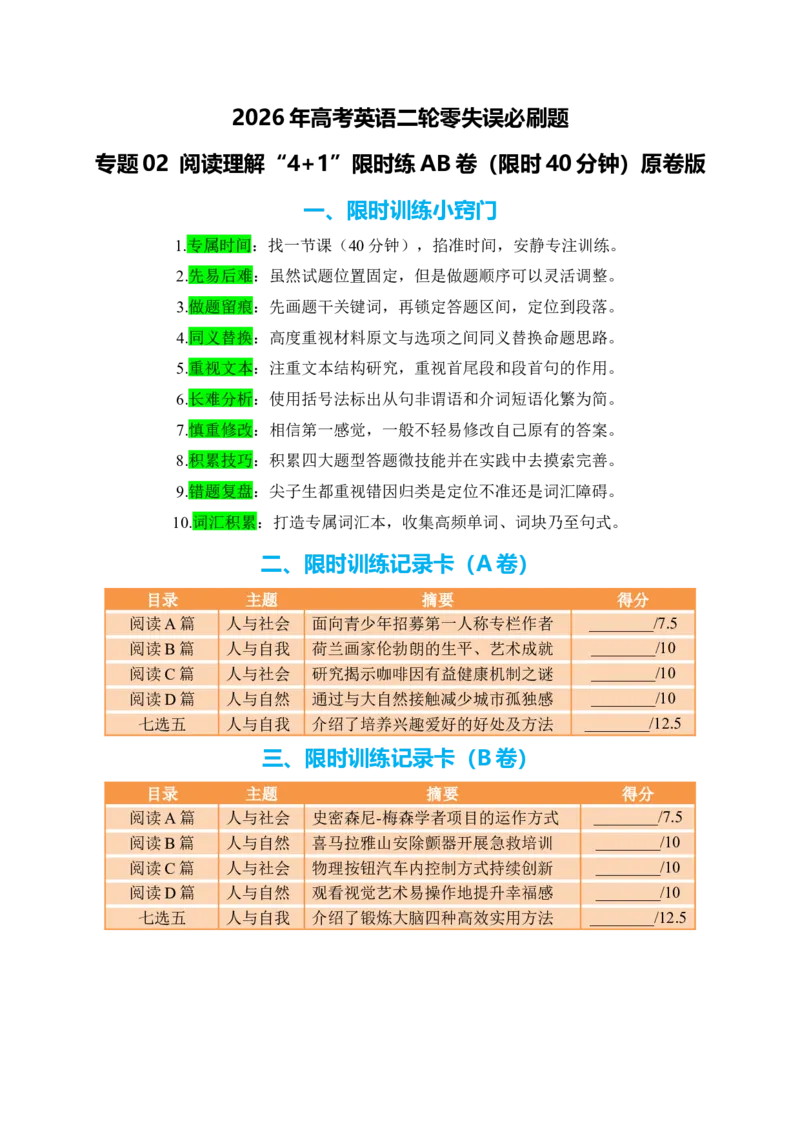
2026 年高考英语二轮零失误必刷题
专题 02 阅读理解“4+1”限时练 AB 卷(限时 40 分钟)原卷版
一、限时训练小窍门
1.专属时间:找一节课(40分钟),掐准时间,安静专注训练。
2.先易后难:虽然试题位置固定,但是做题顺序可以灵活调整。
3.做题留痕:先画题干关键词,再锁定答题区间,定位到段落。
4.同义替换:高度重视材料原文与选项之间同义替换命题思路。
5.重视文本:注重文本结构研究,重视首尾段和段首句的作用。
6.长难分析:使用括号法标出从句非谓语和介词短语化繁为简。
7.慎重修改:相信第一感觉,一般不轻易修改自己原有的答案。
8.积累技巧:积累四大题型答题微技能并在实践中去摸索完善。
9.错题复盘:尖子生都重视错因归类是定位不准还是词汇障碍。
10.词汇积累:打造专属词汇本,收集高频单词、词块乃至句式。
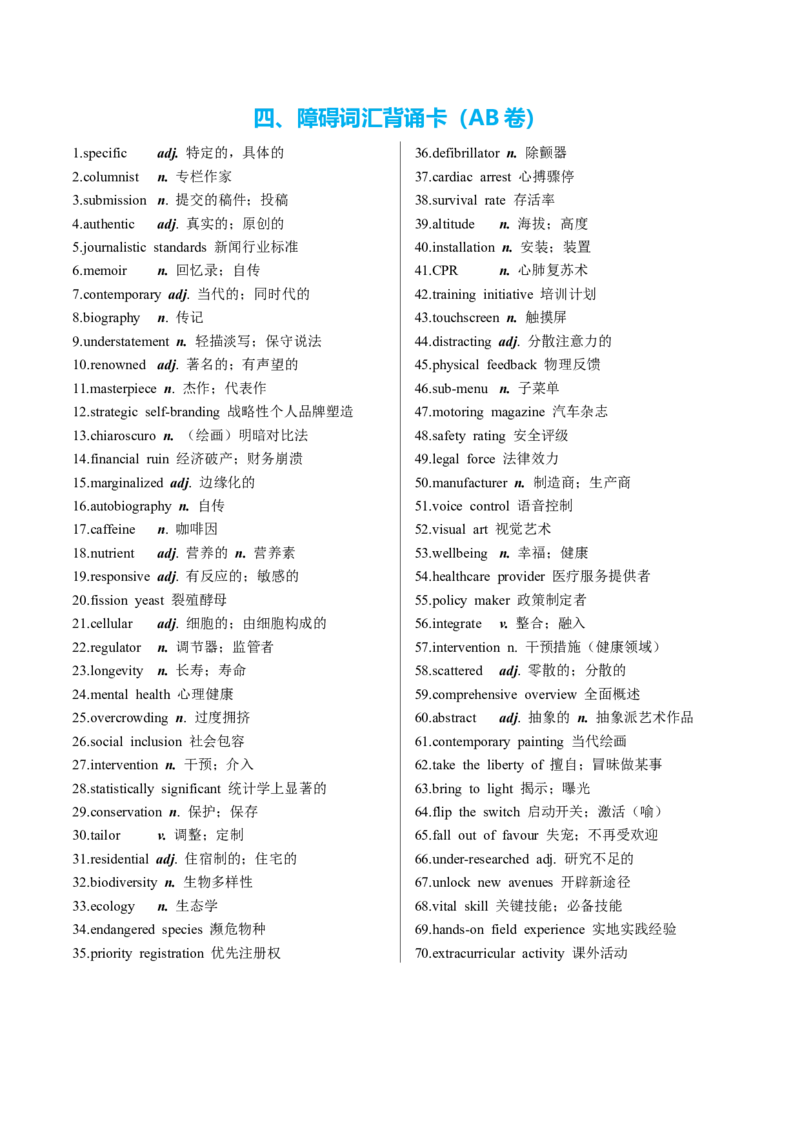
二、限时训练记录卡(A 卷)
目录 主题 摘要 得分
阅读A篇 人与社会 面向青少年招募第一人称专栏作者 ________/7.5
阅读B篇 人与自我 荷兰画家伦勃朗的生平、艺术成就 ________/10
阅读C篇 人与社会 研究揭示咖啡因有益健康机制之谜 ________/10
阅读D篇 人与自然 通过与大自然接触减少城市孤独感 ________/10
七选五 人与自我 介绍了培养兴趣爱好的好处及方法 ________/12.5
三、限时训练记录卡(B 卷)
目录 主题 摘要 得分
阅读A篇 人与社会 史密森尼-梅森学者项目的运作方式 ________/7.5
阅读B篇 人与自然 喜马拉雅山安除颤器开展急救培训 ________/10
阅读C篇 人与社会 物理按钮汽车内控制方式持续创新 ________/10
阅读D篇 人与自然 观看视觉艺术易操作地提升幸福感 ________/10
七选五 人与自我 介绍了锻炼大脑四种高效实用方法 ________/12.5四、障碍词汇背诵卡(AB 卷)
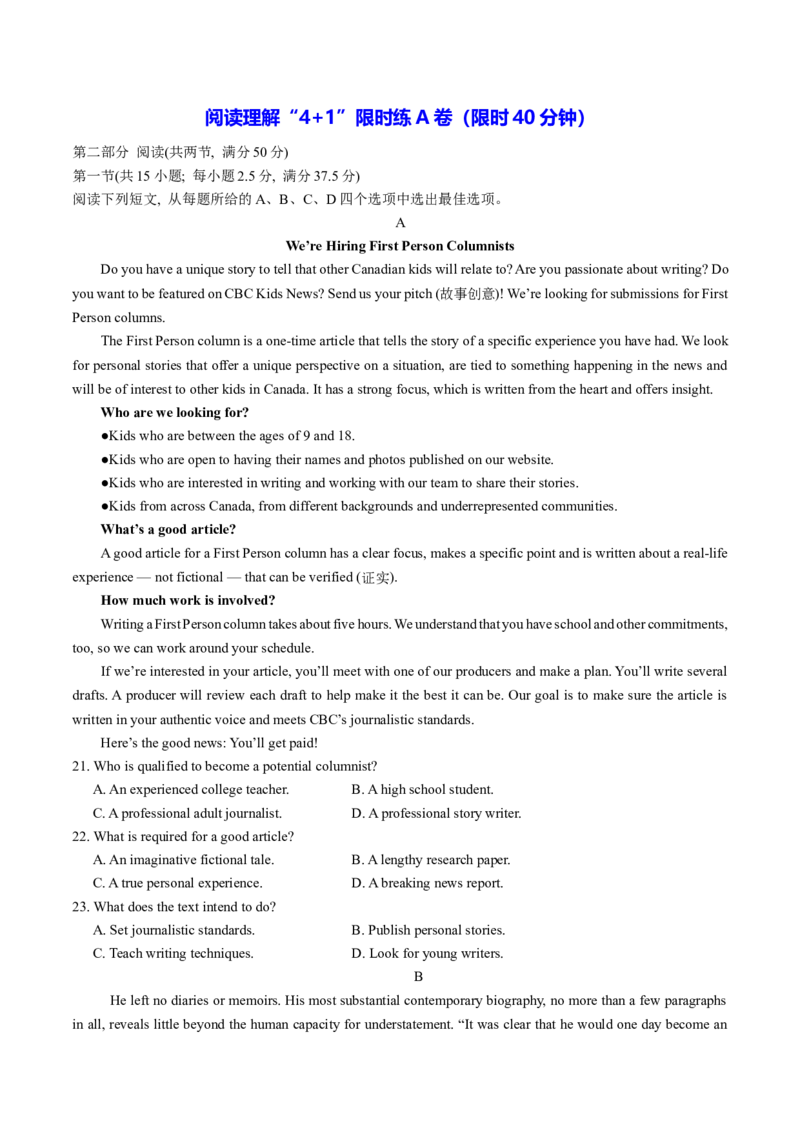
1.specific adj. 特定的,具体的 36.defibrillator n. 除颤器
2.columnist n. 专栏作家 37.cardiac arrest 心搏骤停
3.submission n. 提交的稿件;投稿 38.survival rate 存活率
4.authentic adj. 真实的;原创的 39.altitude n. 海拔;高度
5.journalistic standards 新闻行业标准 40.installation n. 安装;装置
6.memoir n. 回忆录;自传 41.CPR n. 心肺复苏术
7.contemporary adj. 当代的;同时代的 42.training initiative 培训计划
8.biography n. 传记 43.touchscreen n. 触摸屏
9.understatement n. 轻描淡写;保守说法 44.distracting adj. 分散注意力的
10.renowned adj. 著名的;有声望的 45.physical feedback 物理反馈
11.masterpiece n. 杰作;代表作 46.sub-menu n. 子菜单
12.strategic self-branding 战略性个人品牌塑造 47.motoring magazine 汽车杂志
13.chiaroscuro n. (绘画)明暗对比法 48.safety rating 安全评级
14.financial ruin 经济破产;财务崩溃 49.legal force 法律效力
15.marginalized adj. 边缘化的 50.manufacturer n. 制造商;生产商
16.autobiography n. 自传 51.voice control 语音控制
17.caffeine n. 咖啡因 52.visual art 视觉艺术
18.nutrient adj. 营养的 n. 营养素 53.wellbeing n. 幸福;健康
19.responsive adj. 有反应的;敏感的 54.healthcare provider 医疗服务提供者
20.fission yeast 裂殖酵母 55.policy maker 政策制定者
21.cellular adj. 细胞的;由细胞构成的 56.integrate v. 整合;融入
22.regulator n. 调节器;监管者 57.intervention n. 干预措施(健康领域)
23.longevity n. 长寿;寿命 58.scattered adj. 零散的;分散的
24.mental health 心理健康 59.comprehensive overview 全面概述
25.overcrowding n. 过度拥挤 60.abstract adj. 抽象的 n. 抽象派艺术作品
26.social inclusion 社会包容 61.contemporary painting 当代绘画
27.intervention n. 干预;介入 62.take the liberty of 擅自;冒昧做某事
28.statistically significant 统计学上显著的 63.bring to light 揭示;曝光
29.conservation n. 保护;保存 64.flip the switch 启动开关;激活(喻)
30.tailor v. 调整;定制 65.fall out of favour 失宠;不再受欢迎
31.residential adj. 住宿制的;住宅的 66.under-researched adj. 研究不足的
32.biodiversity n. 生物多样性 67.unlock new avenues 开辟新途径
33.ecology n. 生态学 68.vital skill 关键技能;必备技能
34.endangered species 濒危物种 69.hands-on field experience 实地实践经验
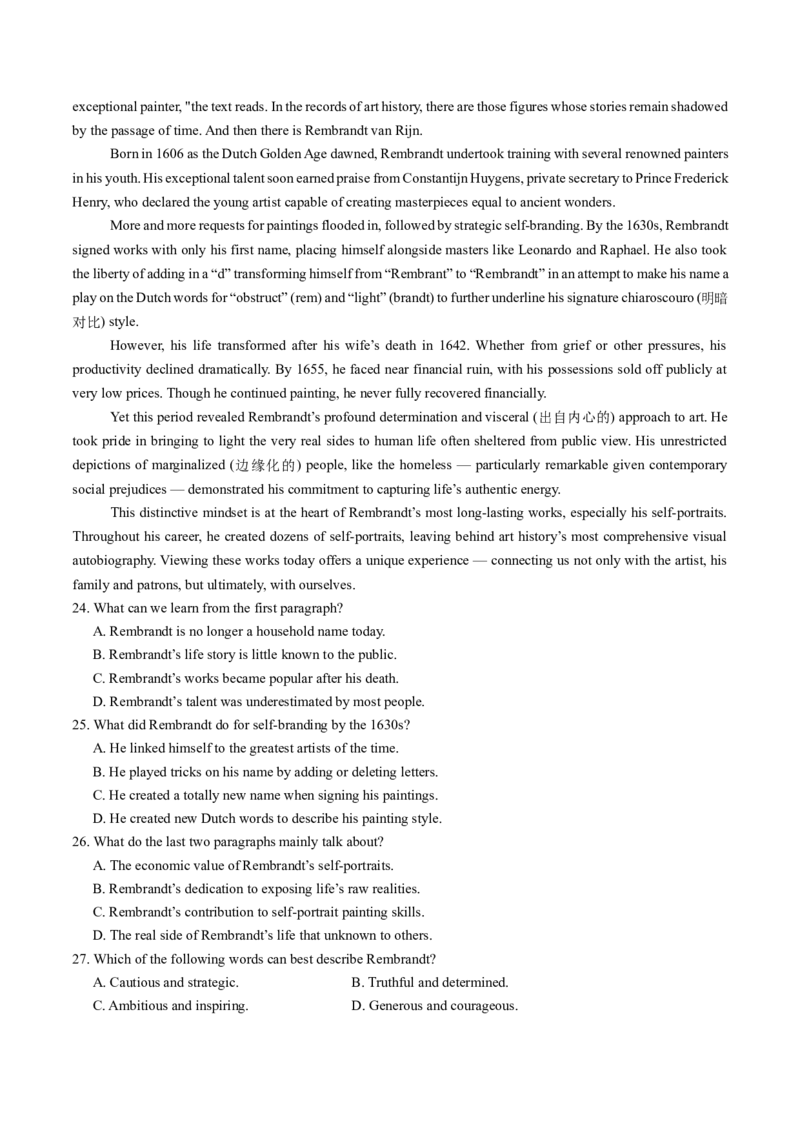
35.priority registration 优先注册权 70.extracurricular activity 课外活动阅读理解“4+1”限时练A卷(限时40分钟)
第二部分 阅读(共两节, 满分50分)
第一节(共15小题; 每小题2.5分, 满分37.5分)
阅读下列短文, 从每题所给的A、B、C、D四个选项中选出最佳选项。
A
We’re Hiring First Person Columnists
Do you have a unique story to tell that other Canadian kids will relate to? Are you passionate about writing? Do
you want to be featured on CBC Kids News? Send us your pitch (故事创意)! We’re looking for submissions for First
Person columns.
The First Person column is a one-time article that tells the story of a specific experience you have had. We look
for personal stories that offer a unique perspective on a situation, are tied to something happening in the news and
will be of interest to other kids in Canada. It has a strong focus, which is written from the heart and offers insight.
Who are we looking for?
●Kids who are between the ages of 9 and 18.
●Kids who are open to having their names and photos published on our website.
●Kids who are interested in writing and working with our team to share their stories.
●Kids from across Canada, from different backgrounds and underrepresented communities.
What’s a good article?
A good article for a First Person column has a clear focus, makes a specific point and is written about a real-life
experience — not fictional — that can be verified (证实).
How much work is involved?
Writing a First Person column takes about five hours. We understand that you have school and other commitments,
too, so we can work around your schedule.
If we’re interested in your article, you’ll meet with one of our producers and make a plan. You’ll write several
drafts. A producer will review each draft to help make it the best it can be. Our goal is to make sure the article is
written in your authentic voice and meets CBC’s journalistic standards.
Here’s the good news: You’ll get paid!
21. Who is qualified to become a potential columnist?
A. An experienced college teacher. B. A high school student.
C. A professional adult journalist. D. A professional story writer.
22. What is required for a good article?
A. An imaginative fictional tale. B. A lengthy research paper.
C. A true personal experience. D. A breaking news report.
23. What does the text intend to do?
A. Set journalistic standards. B. Publish personal stories.
C. Teach writing techniques. D. Look for young writers.
B
He left no diaries or memoirs. His most substantial contemporary biography, no more than a few paragraphs
in all, reveals little beyond the human capacity for understatement. “It was clear that he would one day become anexceptional painter, "the text reads. In the records of art history, there are those figures whose stories remain shadowed
by the passage of time. And then there is Rembrandt van Rijn.
Born in 1606 as the Dutch Golden Age dawned, Rembrandt undertook training with several renowned painters
in his youth. His exceptional talent soon earned praise from Constantijn Huygens, private secretary to Prince Frederick
Henry, who declared the young artist capable of creating masterpieces equal to ancient wonders.
More and more requests for paintings flooded in, followed by strategic self-branding. By the 1630s, Rembrandt
signed works with only his first name, placing himself alongside masters like Leonardo and Raphael. He also took
the liberty of adding in a “d” transforming himself from “Rembrant” to “Rembrandt” in an attempt to make his name a
play on the Dutch words for “obstruct” (rem) and “light” (brandt) to further underline his signature chiaroscouro (明暗
对比) style.
However, his life transformed after his wife’s death in 1642. Whether from grief or other pressures, his
productivity declined dramatically. By 1655, he faced near financial ruin, with his possessions sold off publicly at
very low prices. Though he continued painting, he never fully recovered financially.
Yet this period revealed Rembrandt’s profound determination and visceral (出自内心的) approach to art. He
took pride in bringing to light the very real sides to human life often sheltered from public view. His unrestricted
depictions of marginalized (边缘化的) people, like the homeless — particularly remarkable given contemporary
social prejudices — demonstrated his commitment to capturing life’s authentic energy.
This distinctive mindset is at the heart of Rembrandt’s most long-lasting works, especially his self-portraits.
Throughout his career, he created dozens of self-portraits, leaving behind art history’s most comprehensive visual
autobiography. Viewing these works today offers a unique experience — connecting us not only with the artist, his
family and patrons, but ultimately, with ourselves.
24. What can we learn from the first paragraph?
A. Rembrandt is no longer a household name today.
B. Rembrandt’s life story is little known to the public.
C. Rembrandt’s works became popular after his death.
D. Rembrandt’s talent was underestimated by most people.
25. What did Rembrandt do for self-branding by the 1630s?
A. He linked himself to the greatest artists of the time.
B. He played tricks on his name by adding or deleting letters.
C. He created a totally new name when signing his paintings.
D. He created new Dutch words to describe his painting style.
26. What do the last two paragraphs mainly talk about?
A. The economic value of Rembrandt’s self-portraits.
B. Rembrandt’s dedication to exposing life’s raw realities.
C. Rembrandt’s contribution to self-portrait painting skills.
D. The real side of Rembrandt’s life that unknown to others.
27. Which of the following words can best describe Rembrandt?
A. Cautious and strategic. B. Truthful and determined.
C. Ambitious and inspiring. D. Generous and courageous.C
Caffeine has long been linked to potential health benefits, including reduced risk of age-related diseases. But,
until now, how it works inside our cells, and what exactly is its connection with nutrient and stress responsive gene
and protein networks have remained a mystery. In new research on fission yeast (裂殖酵母), a single-celled organism
surprisingly similar to human cells, researchers found that caffeine affects ageing by employing an ancient cellular
energy system.
A few years ago, the same research team found that caffeine helps cells live longer by acting on a growth
regulator called Target of Rapamycin (TOR). TOR is a biological switch that tells cells when to grow, based on how
much food and energy is available. This switch has been controlling energy and stress responses in living things for
over 500 million years.
But in their latest study, the scientists made a surprising discovery: Caffeine doesn’t act on this growth switch
directly. Instead, it works by activating another important system called AMPK, a cellular fuel gauge (能量监测器)
that is evolutionarily conserved in yeast and humans.
“When your cells are low on energy, AMPK kicks in to help them cope,” explains Dr Charalampos, the study’s
senior author. “Importantly, our results show that caffeine helps turn on that switch.”
Using their yeast model, the researchers showed that caffeine’s effect on AMPK influences how cells grow,
repair their DNA, and respond to stress — all of which are tied to ageing and disease.
“These findings help explain why caffeine might be beneficial to health and longevity (长寿),” said Dr John-
Patrick, a postdoctoral research scientist leading this study. “And they open up exciting possibilities for future research
into how we might flip these effects more directly — with diet, lifestyle, or new medicines.”
28. What is the main purpose of the new research mentioned in the first paragraph?
A. To find new use of caffeine in medicine.
B. To identify how caffeine influences cell ageing.
C. To explore the history of caffeine consumption.
D. To compare human cells with fission yeast cells.
29. What does TOR serve as?
A. A sign of ageing. B. An energy source.
C. A cellular fuel gauge. D. A growth command center.
30. What aspect does John-Patrick state about the research in the last paragraph?
A. Its economic benefits. B. Its characteristics.
C. Its disadvantages. D. Its potentials.
31. What can be the best title for the text?
A. Your Morning Coffee Flips an Ancient Longevity Switch
B. Fission Yeast Is Surprisingly Similar to Human Cells
C. The Yeast Model Unlocks Ageing’s Hidden Pathways
D. AMPK Is Conserved in Yeast and Humans for Long
D
Loneliness is significant mental health concern and can raise risk of death by 45% and contact with nature in
cities significantly reduces feelings of loneliness, according to a team of scientists.The study is the first to assess how the environment can affect loneliness. It used real-time data, collected via
a smartphone app, rather than relying on people’s memory of how they were feeling.
The research found that feelings of overcrowding increased loneliness by an average of 30%. But when people
were able to see trees or hear birds, feelings of loneliness fell by 28%. Feelings of social inclusion also cut loneliness by
21% and when these feelings coincided (巧合) with contact with nature, the beneficial effect was boosted by a
further 18%.
The findings pointed to interventions to reduce loneliness. The researchers said, “Specific measures that
increase social inclusion — and contact with nature should be taken, especially in thickly populated cities.” Time
spent in nature is known to boost well-being, with woodland walks estimated to save the UK at least £185m a year
in mental health costs, for example.
The research collected data from urban citizens across the world using the Urban Mind search app. More than
750 people provided 16,600 of these assessments. The participants were self-selecting and so it did not provide a
representative sample of the wider populations. But when the researchers took age, education, and occupation into
account, the benefits of nature contact and feelings of social inclusion on loneliness remained strongly statistically
significant. Johanna Gibbons, part of the research team, said, “Cities are probably the only habitat that is increasing
at a high rate. So we should be creating urban habitats where people can thrive (兴旺).”
32. What’s the text mainly about?
A. The mental problems of living in big cities.
B. Reducing loneliness in cities via contact with nature.
C. Developing urban habitats at a high speed.
D. Research on how to get rid of loneliness in nature.
33. How was the research conducted?
A. By relying on people’s memory.
B. By surveying 750 participants.
C. By collecting data through a Smartphone app.
D. By checking a worldwide representative sample.
34. What can we learn from Paragraph 4?
A. Many big cities take the lead in the research.
B. Time spent indoors improves people’s well-being.
C. Woodland walks greatly reduce social contact with people.
D. Interventions to reduce loneliness benefit the UK financially.
35. What can be inferred about the research?
A. The findings are statistically markable.
B. It offers a wide range of samples globally.
C. The carefully selected participants are Defiable.
D. Many factors are considered except education.
第二节(共5小题; 每小题2.5分, 满分12.5分)
阅读下面短文, 从短文后的选项中选出可以填入空白处的最佳选项。选项中有两项为多余选项。
Challenging, fun and engaging hobbies have the power to make us happier and healthier. 36 Hereis how you can start and discover things you don’t yet know you’ll like.
Start small. Ease in to figure out if it’s right for you. For instance, sign up for a one-time dance class rather
than a set of eight. 37 Say you enjoy learning to swim, but the next step is competing, and you don’t
want to do that. Just stop there — you have spent enough of the day pushing yourself.
38 When you were a kid, what did you want to be when you grew up? The answer could lead you
to an appealing hobby. Revisiting activities you loved when you were young is a really helpful place to start. Those
little things that once made you lose track of time often hold clues to what still excites you.
Ask yourself how you want to feel. 39 They can help you clear your mind and relax. Consider how
exactly you want an activity to make you feel. If you long for a break from overthinking, knitting could be a good
choice to relax you. If you want to be socially connected, joining a book club can let you interact with others and
build warm connections.
Keeping an open mind, even if it doesn’t seem your thing. We’re wired as humans to be curious and open, but
in a very burned-out world, we forget that. So next time someone hands you a flier or invites you to tag along to an
event, seize the opportunity. 40
A. Take a trip back in time.
B. Hobbies present an escape.
C. Think about your future career.
D. Plus, they often foster connections with others.
E. Your skills improve as you practise new hobbies.
F. It’s also smart to resist the pressure to overcommit.
G. It could be something you never imagined you’d love.阅读理解“4+1”限时练B卷(限时40分钟)
第二部分 阅读(共两节, 满分50分)
第一节(共15小题; 每小题2.5分, 满分37.5分)
阅读下列短文, 从每题所给的A、B、C、D四个选项中选出最佳选项。
A
Smithsonian-Mason Scholars Program (SMSC)
This is an excellent program for incoming college freshmen with a real passion for conservation.
How It Works
This scholarship program helps you tailor your college studies to become a leader in the conservation field.
Incoming freshmen at George Mason University who qualify will receive an invitation. Begin your degree program
at Mason on campus, with courses that will prepare you for studying conservation biology.
Who’s Qualified?
Candidates for our SMSC are selected from incoming applicants to Mason and are evaluated on the following
criteria:
●academic achievement in high school
●college application essays
●letters of recommendation
●participation in extracurricular activities
●standardized test scores
●Rising college freshmen in any major, by invitation only.
What You’ll Learn
SMSC offers three full-time residential programs in conservation biology that integrate directly into your degree
plan at Mason, no matter your major. You choose when to attend, either fall or spring of your junior or senior year.
Through this one-of-a-kind opportunity, you’ll get hands-on field experience working with rare and endangered
species. You’ll become a member of Smithsonian’s world-famous community of conservationists where scientists,
educators, and animal keepers will serve as your mentors (导师).
Choose one of three semester programs to suit your interests and academic schedule:
●Conservation, Biodiversity and Society
Offered in fall or spring to students with at least 45 undergraduate credits
Includes weekly work with a conservation expert
●Wildlife Ecology and Conservation
Offered in fall only to students with at least 60 undergraduate credits and an upper-level ecology course
Includes a five-week independent research experience under the guidance of conservation mentor
●Endangered Species Conservation
Offered in spring only to students with at least 60 undergraduate credits and an upperlevel ecology course
Includes a five-week independent research experience under the guidance of conservation mentors
●Additional Benefits
Private tours of our endangered species research facility
Priority registration for our popular, week-long summer field courseAccess to seminars (研讨会) with world-famous researchers and scientists
21. Who is the Smithsonian-Mason Scholars Program designed for?
A. High school students. B. First-year college students.
C. World-famous researchers. D. Outstanding scientists.
22. What is a required condition to join the program?
A. Passing an entrance exam. B. Being invited by the university.
C. Having prior field experience. D. Majoring in conservation biology.
23. Which is a benefit of joining the program?
A. Early summer course registration.
B. Private tours of Smithsonian museums.
C. Access to seminars with college seniors.
D. Acceptance into the graduate school of Mason.
B
As the founder of Code Blue CPR, Sullivan dedicates himself to teaching the vital skills of CPR and using
defibrillator (除颤器), both at home and globally. Earlier this year, the old man set out on an inspiring journey to the
Himalayas, where he installed (安装) what he proudly calls the world’s highest defibrillator. In the challenging
environment of Qomolangma, where climbers face numerous risks, the timely use of a defibrillator can significantly
boost survival rates from cardiac arrest (心搏骤停), increasing the chances from 8% to over 50% within the first
three minutes.
To ensure the defibrillator was fully operational, Sullivan climbed to an impressive altitude of over 18,000 feet
before descending to a nearby village at around 17,000 feet for the installation. He returned from this incredible
adventure on April 30th and was thrilled to learn just weeks later that the device had successfully saved a 30-year-
old French woman who had suffered a cardiac arrest.
“It was the proudest moment of my life when I learned what had happened,” said Sullivan. A Sherpa (夏尔巴
人) informed him of the successful use of the defibrillator. He hopes it will inspire others to understand the importance
of having access to such lifesaving equipment.
During his time in Nepal, Sullivan also took the opportunity to share his knowledge of CPR and defibrillator
training with local villagers, many of whom had never received such instruction before. Now back in the UK, he is
busy preparing to present a training initiative to the government aimed at equipping 1.2 million children across
London with essential CPR skills.
Sullivan conceives a future where every school is equipped with a defibrillator and where every student,
teacher, and staff member is trained to save lives. He emphasized the need for widespread training. He gave an
example: Once, around 30 people watching nearby couldn’t help a person in cardiac arrest because they lacked the
necessary knowledge.
24. Why did Sullivan install the defibrillator in the Himalayas?
A. To advertise his new defibrillator.
B. To lift climbers’ survival chances.
C. To promote his CPR training company.
D. To test the device in extreme conditions.
25. What did the author want to show by mentioning the French woman’s survival?
A. Sullivan’s effort paid off. B. Climbing mountains was risky.
C. There were too few defibrillators. D. Sullivan’s journey was adventurous.
26. What did Sullivan do when staying at Nepal?A. He provided CPR training for locals.
B. He inspired people to extend CPR.
C. He presented a training initiative.
D. He installed defibrillators across the country.
27. What does the underlined word “conceives” mean in the last paragraph?
A. Witnesses. B. Announces. C. Imagines. D. Doubts.
C
Do you usually spot the touchscreen first when checking out a new car? For years, almost every new car sold
has a high-tech screen that controls everything. Even safety features like automatic lane-keeping are sometimes
screen-controlled. But is it really safe?
If scrolling down the screen of a smartphone while driving is distracting and then doing likewise with your
car’s is probably risky too. Drivers know the location of physical controls and press buttons without taking their eyes
off the road. A touchscreen offers no physical feedback, making the operation much harder. And because screens have
to do so many things, it often takes a few steps through several sub-menus to find the right setting.
In 2022, Vi Bilagare, a Swedish motoring magazine, measured how long it took drivers to do things like
changing the temperature while driving at 110 kilometers per hour. It compared 11 cars with touchscreens to a single
older model with real buttons. In the old cars, drivers were able to do all their tasks within about 10 seconds, while
the worst-performing modern car took 45 seconds. Even in the best-performing modern cars, testers still took several
seconds longer than in the old car.
Another study, done in 2024 by researchers in Norway, used tracking cameras to compare how long drivers
were distracted while performing different tasks on a touchscreen. Even the quickest job like changing the temperature
meant three and a half seconds, on average, of not looking at the road.
New rules from Euro NCAP, an organization that provides safety ratings for cars sold in Europe, will give no
car a full five-star score unless certain crucial functions are controlled by real switches. Euro NCAP’s safety guidelines
have no legal force, but carmakers use its ratings as a selling point.
Traditional carmakers have begun restoring some buttons to their new models. But innovation never stops.
Even as touchscreens are falling out of favour, many manufacturers are turning their attention to voice control —
though that is a subject for another story.
28. What is an advantage of physical buttons over touchscreens?
A. They are cheaper to produce and replace.
B. They are easier to see in bright sunlight.
C. They can be operated without looking at them.
D. They allow control of a wider range of functions.
29. Which took the longest time in the 2022 study?
A. The model running at 110 km/h.
B. The old model with real buttons.
C. The best-performing modern car.
D. The worst-performing modern car.
30. How does the author prove his argument in the passage?
A. By showing different research results.B. By telling his own driving experience.
C. By comparing the actions of car drivers.
D. By mentioning the rules of an organization.
31. What can we learn from the last paragraph?
A. Safety features will be smarter.
B. Touchscreens will be abandoned.
C. Voice control will dominate the market.
D. In-car control will innovate continually.
D
The simple act of looking at a piece of visual art can boost your wellbeing, a new research study has found,
and this benefit can be gained in a hospital setting as well as an art gallery. Artworks which were included in the
review include famous pieces such as The Scream by Edvard Munch, The Starry Night by Vincent Van Gogh, and
other pieces of modern and contemporary art.
The authors of the review have called on healthcare providers and policy makers to integrate art into mental
health strategies as a low-cost and easily-accessible resource.
Previous research has suggested that viewing art might influence mood or stress, but the research had a narrow
range and was not consistent. This study examined decades of scattered (零散的) research, providing for the first
time a clear and comprehensive overview of when, where and why art viewing is used to promote wellbeing.
The review of 38 previously published studies covering a total of 6,805 participants was conducted by a team
of psychologists from University of Vienna, Trinity College Dublin, and Humboldt University of Berlin.
The study found that viewing art could improve wellbeing. The benefit was observed in a variety of locations
—in museums and galleries as well as clinics and hospital settings and also through the medium of virtual reality. A
wide range of art types including abstract, modern and contemporary paintings, photography and sculpture were
found to boost wellbeing.
“People often think of art as a luxury, but our research suggests that viewing art—whether as a hobby or as a
targeted health intervention— can meaningfully support wellbeing,” said McKenzie Trupp, lead author of the study.
Claire Howlin, Assistant Professor, School of Psychology, Trinity, added, “While the mental health benefits of
creating art have been widely explored, the impact of viewing art has been under-researched and undervalued.” Yet
visual art is present and accessible in everyday spaces— museums, galleries, hospitals, and at home. Understanding
its effects can unlock new avenues for promoting wellbeing through everyday encounters with art.
32. What can be inferred about the previous research on viewing art?
A. It was limited and inconsistent. B. It was extensive and sufficient.
C. It was systematic and practical. D. It was complete and convincing.
33. What can we conclude about the new research study?
A. It focused on famous artworks like The Scream.
B. It covered 38 new studies with 6,805 participants.
C. It was conducted by psychologists from three universities.
D. It is the first study to explore the link between art and wellbeing.
34. What is an important finding of the new study?A. Virtual reality can also let people enjoy art.
B. Modern art instead of ancient art can boost wellbeing.
C. Viewing art in art galleries is beneficial to people most.
D. Creating art has more mental health benefits than viewing art.
35. What is the best title for the text?
A. Art: A luxury in Life B. The Role of Art in Hospitals
C. Viewing Art: A Path to Wellbeing D. The History of Famous Artworks
第二节(共5小题; 每小题2.5分, 满分12.5分)
阅读下面短文, 从短文后的选项中选出可以填入空白处的最佳选项。选项中有两项为多余选项。
How to Exercise Your Brain
Whether you’re trying to get your brain back into shape or you just want to keep it as strong as it is now, there
are some things you can do to exercise your brain. 36
Read as much as you can. Reading is great brain exercise. You can read newspapers, magazines or books but
just keep in mind that the more challenging the text is, the more of a workout your brain will get. 37 Try
reading books that will teach you something new, such as books about history or another subject that interests you.
Increase your vocabulary. You can also learn new words from a word-a-day calendar or dictionary. 38
Try writing a new word someplace where you will see it often, such as on a whiteboard in your kitchen or on a sticky
note on your desk. Choose a word that is challenging to spell and use to get the most out of this daily exercise.
Learn a new language. 39 Even if you only learn a few new words or phrases in a language, this
exercises the part of your brain that stores language information, even making you better at speaking your own
language.
40 Learning how to play a musical instrument or learning how to sing is a great way to challenge
your brain because this will engage you in a long-term learning experience. You can take lessons, use videos to teach
yourself, or join a group such as choir (合唱团) with music.
A. Join an interest group.
B. Here are some tips to help you.
C. Learn to play a musical instrument.
D. It will improve your social connections.
E. This exercises the language part of your brain.
F. Like any exercise, start small and work your way up.
G. It’s a great way to keep learning new things and challenging your brain.