文档文本内容
1
大招课内部资料
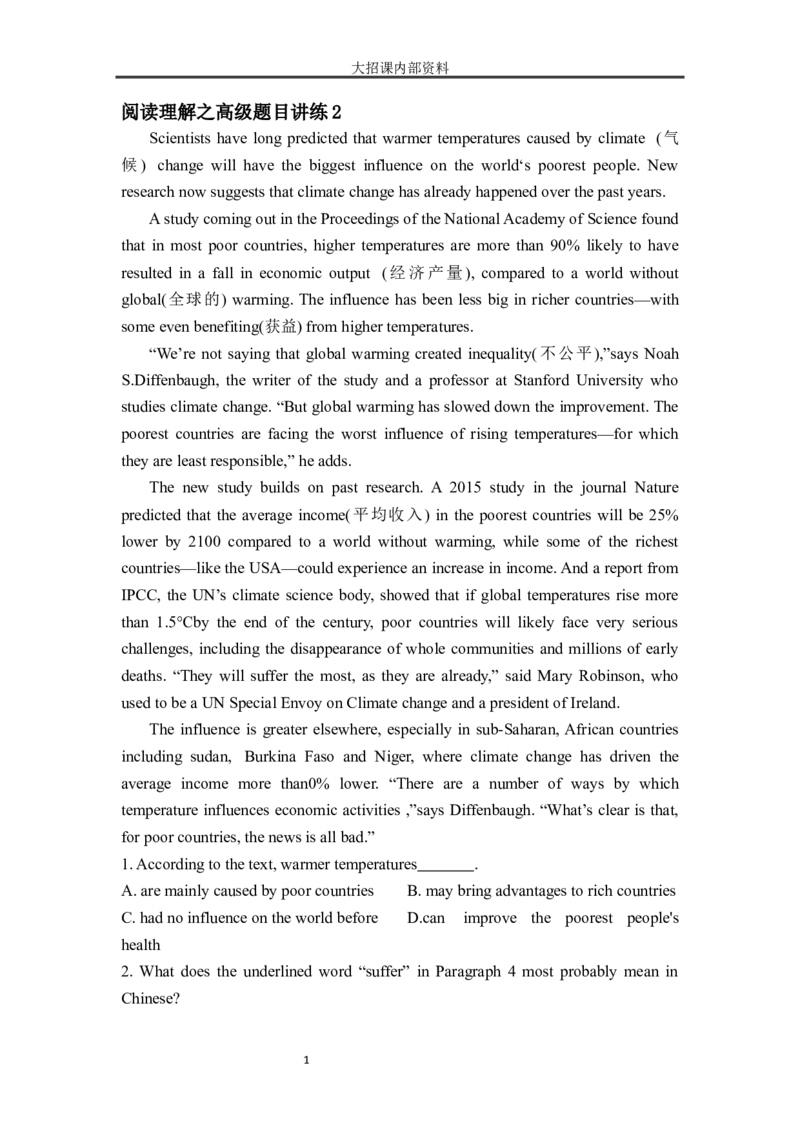
阅读理解之高级题目讲练2
Scientists have long predicted that warmer temperatures caused by climate (气
候) change will have the biggest influence on the world‘s poorest people. New
research now suggests that climate change has already happened over the past years.
A study coming out in the Proceedings of the National Academy of Science found
that in most poor countries, higher temperatures are more than 90% likely to have
resulted in a fall in economic output ( 经济产量), compared to a world without
global(全球的) warming. The influence has been less big in richer countries—with
some even benefiting(获益) from higher temperatures.
“We’re not saying that global warming created inequality( 不公平),”says Noah
S.Diffenbaugh, the writer of the study and a professor at Stanford University who
studies climate change. “But global warming has slowed down the improvement. The
poorest countries are facing the worst influence of rising temperatures—for which
they are least responsible,” he adds.
The new study builds on past research. A 2015 study in the journal Nature
predicted that the average income(平均收入) in the poorest countries will be 25%
lower by 2100 compared to a world without warming, while some of the richest
countries—like the USA—could experience an increase in income. And a report from
IPCC, the UN’s climate science body, showed that if global temperatures rise more
than 1.5℃by the end of the century, poor countries will likely face very serious
challenges, including the disappearance of whole communities and millions of early
deaths. “They will suffer the most, as they are already,” said Mary Robinson, who
used to be a UN Special Envoy on Climate change and a president of Ireland.
The influence is greater elsewhere, especially in sub-Saharan, African countries
including sudan, Burkina Faso and Niger, where climate change has driven the
average income more than0% lower. “There are a number of ways by which
temperature influences economic activities ,”says Diffenbaugh. “What’s clear is that,
for poor countries, the news is all bad.”
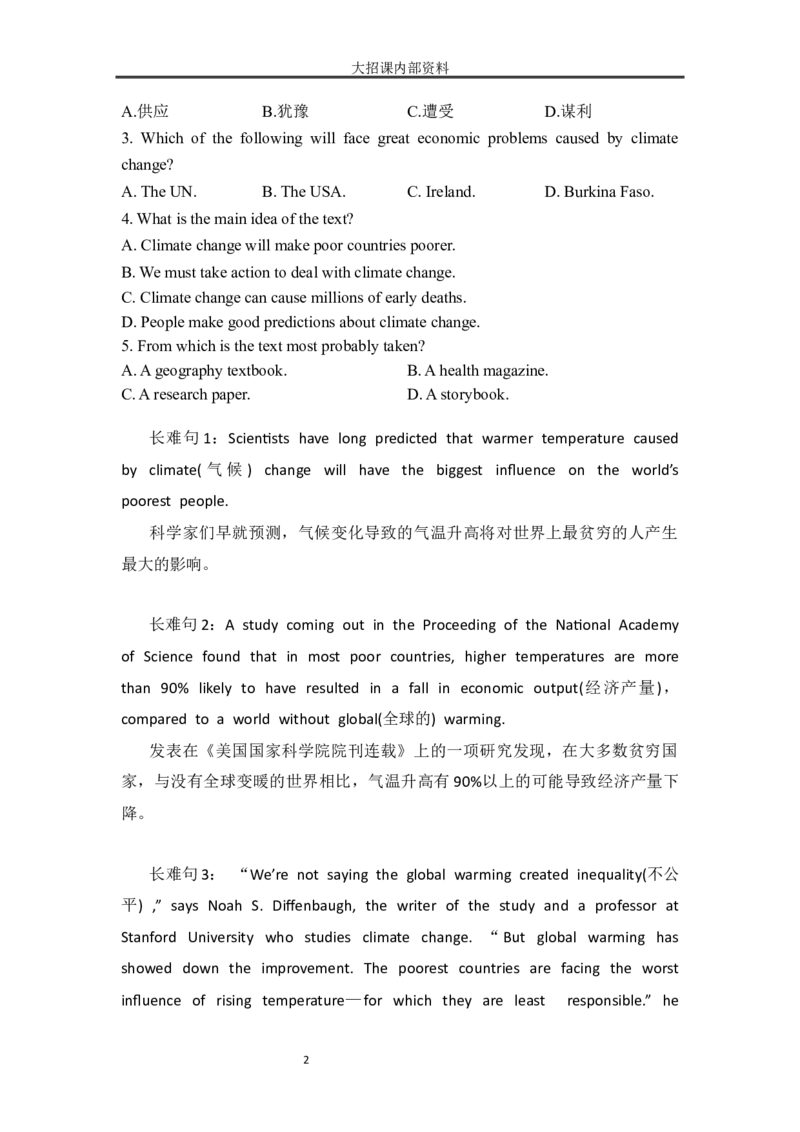
1. According to the text, warmer temperatures       .
A. are mainly caused by poor countries
B. may bring advantages to rich countries
C. had no influence on the world before
D.can improve the poorest people's
health
2. What does the underlined word “suffer” in Paragraph 4 most probably mean in
Chinese?
2
大招课内部资料
A.供应
B.犹豫
C.遭受
D.谋利
3. Which of the following will face great economic problems caused by climate
change?
A. The UN.
B. The USA.
C. Ireland.
D. Burkina Faso.
4. What is the main idea of the text?
A. Climate change will make poor countries poorer.
B. We must take action to deal with climate change.
C. Climate change can cause millions of early deaths.
D. People make good predictions about climate change.
5. From which is the text most probably taken?
A. A geography textbook.
B. A health magazine.
C. A research paper.
D. A storybook.
长难句1:Scientists have long predicted that warmer temperature caused
by climate( 气候) change will have the biggest influence on the world’s
poorest people.
科学家们早就预测,气候变化导致的气温升高将对世界上最贫穷的人产生
最大的影响。
长难句2:A study coming out in the Proceeding of the National Academy
of Science found that in most poor countries, higher temperatures are more
than 90% likely to have resulted in a fall in economic output(经济产量),
compared to a world without global(全球的) warming.
发表在《美国国家科学院院刊连载》上的一项研究发现,在大多数贫穷国
家,与没有全球变暖的世界相比,气温升高有90%以上的可能导致经济产量下
降。
长难句3: “We’re not saying the global warming created inequality(不公
平) ,” says Noah S. Diffenbaugh, the writer of the study and a professor at
Stanford University who studies climate change. “ But global warming has
showed down the improvement. The poorest countries are facing the worst
influence of rising temperature— for which they are least  responsible.” he
3
大招课内部资料
adds.
这项研究的作者、斯坦福大学研究气候变化的教授诺亚·迪芬鲍说:“我们
并不是说全球变暖造成了不公平,但全球变暖减缓了这种改善。”他补充说:
“最贫穷的国家正面临着气温上升带来的最严重影响—而他们对此负有最小的
责任。”
长难句4:The new study builds on past research. A 2015 study in the
journal Natural predicted that the average income(平均收入)  in the poorest
country will be 25% lower by 2100 compared to a world without warming,
while some of the richest country— like the USA— could experience an
increase income.
这项新研究已过去的研究为基础。2015 年《自然》杂志上的一项研究预
测,到2100 年,最贫穷国家平均收入将比没有气候变暖的世界低25%,而一些
最富裕的国家(如美国) 的收入可能会增加。