衔接点11
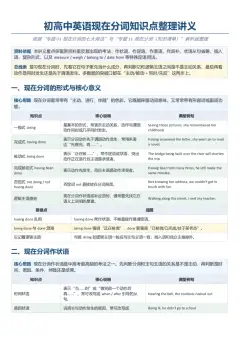
分词
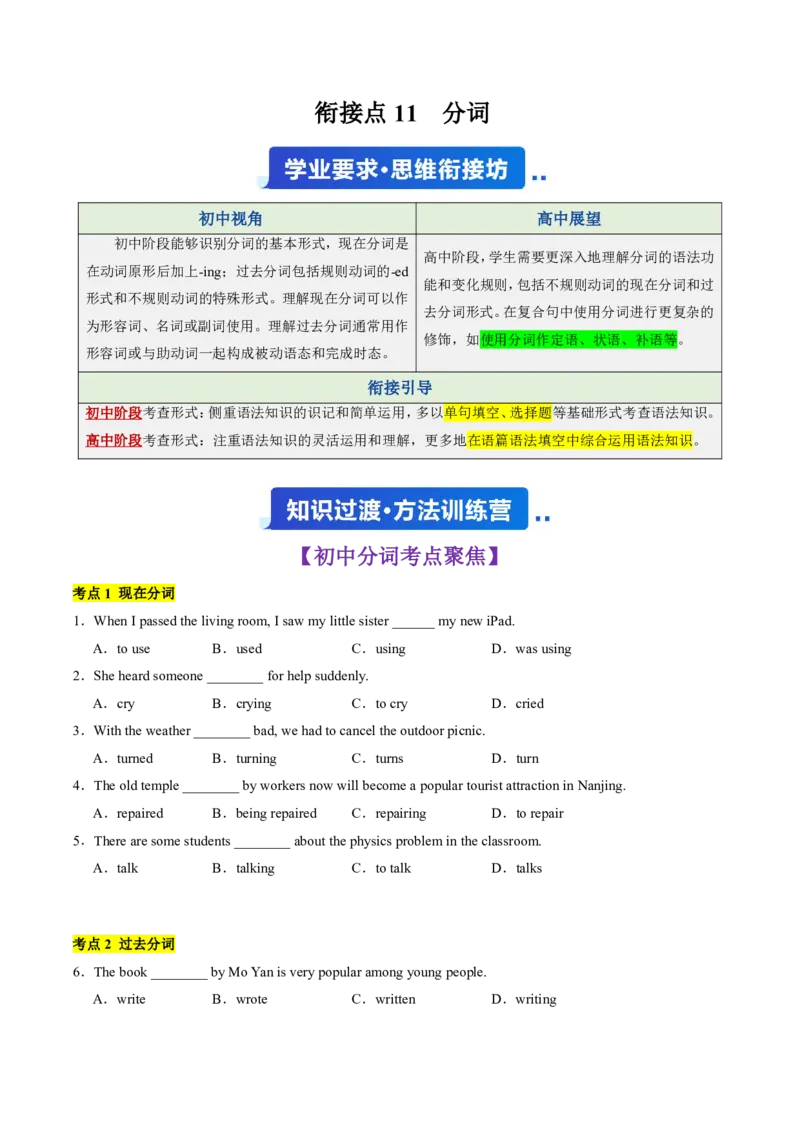
初中视角
高中展望
初中阶段能够识别分词的基本形式,现在分词是
在动词原形后加上-ing;过去分词包括规则动词的-ed
形式和不规则动词的特殊形式。理解现在分词可以作
为形容词、名词或副词使用。理解过去分词通常用作
形容词或与助动词一起构成被动语态和完成时态。
高中阶段,学生需要更深入地理解分词的语法功
能和变化规则,包括不规则动词的现在分词和过
去分词形式。在复合句中使用分词进行更复杂的
修饰,如使用分词作定语、状语、补语等。
衔接引导
初中阶段考查形式:侧重语法知识的识记和简单运用,多以单句填空、选择题等基础形式考查语法知识。
高中阶段考查形式:注重语法知识的灵活运用和理解,更多地在语篇语法填空中综合运用语法知识。
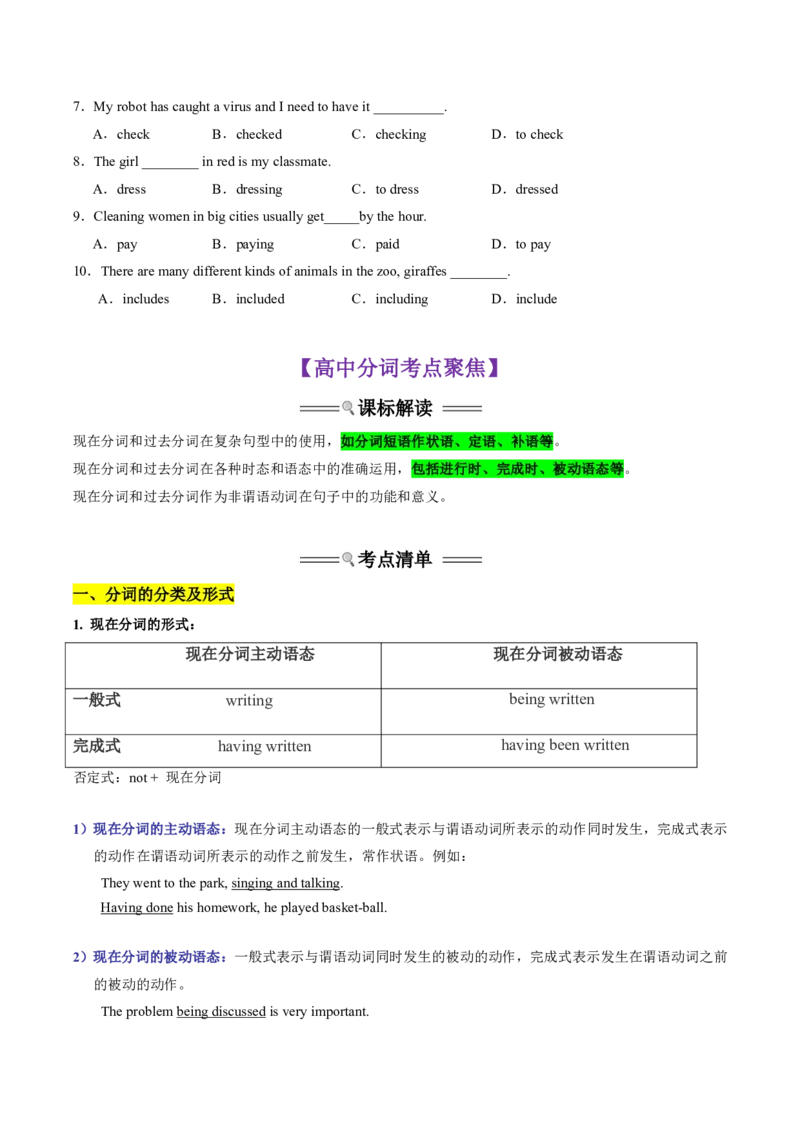
【初中分词考点聚焦】
考点1 现在分词
1.When I passed the living room, I saw my little sister ______ my new iPad.
A.to use
B.used
C.using
D.was using
2.She heard someone ________ for help suddenly.
A.cry
B.crying
C.to cry
D.cried
3.With the weather ________ bad, we had to cancel the outdoor picnic.
A.turned
B.turning
C.turns
D.turn
4.The old temple ________ by workers now will become a popular tourist attraction in Nanjing.
A.repaired
B.being repaired
C.repairing
D.to repair
5.There are some students ________ about the physics problem in the classroom.
A.talk
B.talking
C.to talk
D.talks
考点2 过去分词
6.The book ________ by Mo Yan is very popular among young people.
A.write
B.wrote
C.written
D.writing
7.My robot has caught a virus and I need to have it __________.
A.check
B.checked
C.checking
D.to check
8.The girl ________ in red is my classmate.
A.dress
B.dressing
C.to dress
D.dressed
9.Cleaning women in big cities usually get_____by the hour.
A.pay
B.paying
C.paid
D.to pay
10.There are many different kinds of animals in the zoo, giraffes ________.
A.includes
B.included
C.including
D.include
【高中分词考点聚焦】
课标解读
现在分词和过去分词在复杂句型中的使用,如分词短语作状语、定语、补语等。
现在分词和过去分词在各种时态和语态中的准确运用,包括进行时、完成时、被动语态等。
现在分词和过去分词作为非谓语动词在句子中的功能和意义。
考点清单
一、分词的分类及形式
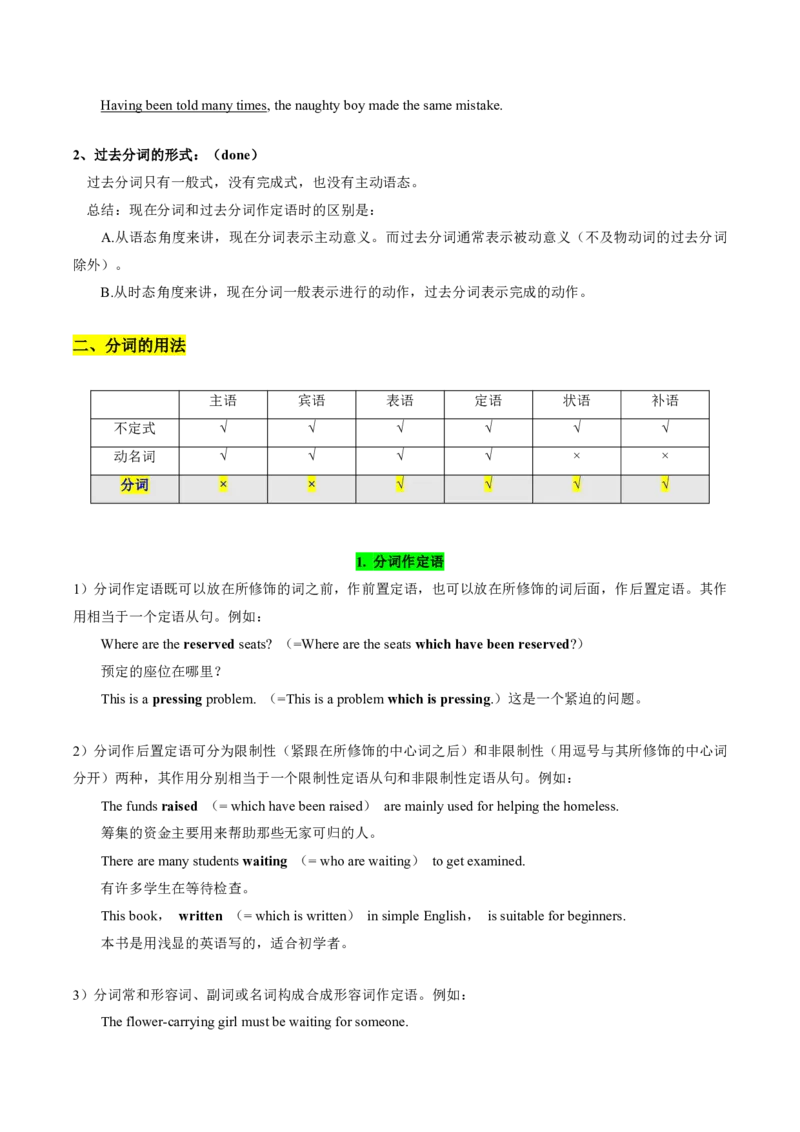
1. 现在分词的形式:
现在分词主动语态
现在分词被动语态
一般式
writing
being written
完成式
having written
having been written
否定式:not + 现在分词
1)现在分词的主动语态:现在分词主动语态的一般式表示与谓语动词所表示的动作同时发生,完成式表示
的动作在谓语动词所表示的动作之前发生,常作状语。例如:
They went to the park, singing and talking.
Having done his homework, he played basket-ball.
2)现在分词的被动语态:一般式表示与谓语动词同时发生的被动的动作,完成式表示发生在谓语动词之前
的被动的动作。
The problem being discussed is very important.
Having been told many times, the naughty boy made the same mistake.
2、过去分词的形式:(done)
过去分词只有一般式,没有完成式,也没有主动语态。
总结:现在分词和过去分词作定语时的区别是:
A.从语态角度来讲,现在分词表示主动意义。而过去分词通常表示被动意义(不及物动词的过去分词
除外)。
B.从时态角度来讲,现在分词一般表示进行的动作,过去分词表示完成的动作。
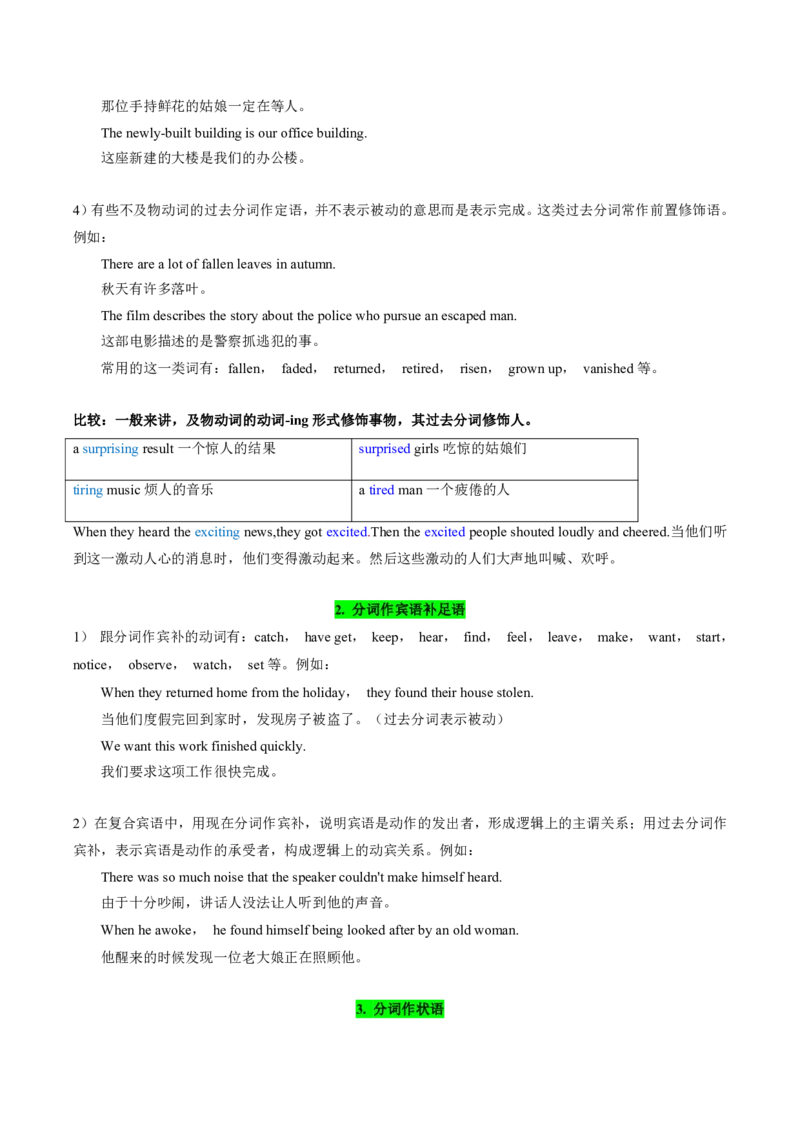
二、分词的用法
主语
宾语
表语
定语
状语
补语
不定式
√
√
√
√
√
√
动名词
√
√
√
√
×
×
分词
×
×
√
√
√
√
1. 分词作定语
1)分词作定语既可以放在所修饰的词之前,作前置定语,也可以放在所修饰的词后面,作后置定语。其作
用相当于一个定语从句。例如:
Where are the reserved seats? (=Where are the seats which have been reserved?)
预定的座位在哪里?
This is a pressing problem. (=This is a problem which is pressing.)这是一个紧迫的问题。
2)分词作后置定语可分为限制性(紧跟在所修饰的中心词之后)和非限制性(用逗号与其所修饰的中心词
分开)两种,其作用分别相当于一个限制性定语从句和非限制性定语从句。例如:
The funds raised (= which have been raised)are mainly used for helping the homeless.
筹集的资金主要用来帮助那些无家可归的人。
There are many students waiting (= who are waiting)to get examined.
有许多学生在等待检查。
This book,written (= which is written)in simple English,is suitable for beginners.
本书是用浅显的英语写的,适合初学者。
3)分词常和形容词、副词或名词构成合成形容词作定语。例如:
The flower-carrying girl must be waiting for someone.
那位手持鲜花的姑娘一定在等人。
The newly-built building is our office building.
这座新建的大楼是我们的办公楼。
4)有些不及物动词的过去分词作定语,并不表示被动的意思而是表示完成。这类过去分词常作前置修饰语。
例如:
There are a lot of fallen leaves in autumn.
秋天有许多落叶。
The film describes the story about the police who pursue an escaped man.
这部电影描述的是警察抓逃犯的事。
常用的这一类词有:fallen,faded,returned,retired,risen,grown up,vanished 等。
比较:一般来讲,及物动词的动词-ing 形式修饰事物,其过去分词修饰人。
a surprising result 一个惊人的结果
surprised girls 吃惊的姑娘们
tiring music 烦人的音乐
a tired man 一个疲倦的人
When they heard the exciting news,they got excited.Then the excited people shouted loudly and cheered.当他们听
到这一激动人心的消息时,他们变得激动起来。然后这些激动的人们大声地叫喊、欢呼。
2. 分词作宾语补足语
1)跟分词作宾补的动词有:catch,have get,keep,hear,find,feel,leave,make,want,start,
notice,observe,watch,set 等。例如:
When they returned home from the holiday,they found their house stolen.
当他们度假完回到家时,发现房子被盗了。(过去分词表示被动)
We want this work finished quickly.
我们要求这项工作很快完成。
2)在复合宾语中,用现在分词作宾补,说明宾语是动作的发出者,形成逻辑上的主谓关系;用过去分词作
宾补,表示宾语是动作的承受者,构成逻辑上的动宾关系。例如:
There was so much noise that the speaker couldn't make himself heard.
由于十分吵闹,讲话人没法让人听到他的声音。
When he awoke,he found himself being looked after by an old woman.
他醒来的时候发现一位老大娘正在照顾他。
3. 分词作状语
1)分词或分词短语作状语时,可以表示时间、原因、让步、条件、方式或伴随状况。通常可转换成相应的
状语从句;表示方式或伴随状况的可以转换成并列句或非限制性定语从句。例如:
Confined to bed (= Because she was confined to bed),she needed to be waited on in everything.
她卧病在床,什么事都需要人伺候。(作原因状语)
Having only book knowledge (= If you only have book knowledge),you will not be able to work well.
如果只有书本知识,你就不可能做好工作。(作条件状语)
They stood there waiting for the bus. (=They stood there and waited for the bus.)
他们站在那里等公共汽车。(作方式状语)
(1)、表示时间,分词短语一般至于句首。
多数情形下,分词动作发生于谓语动作之前,有时候分词动作和谓语动作同时发生。
e.g. Having watered the garden, he began to mow the lawn.(分词动作发生于谓语动作之前)
Riding in the street during the rush hours, you must be careful.(分词动作和谓语动作同时发生)
(2)、表示原因,分词短语可置于句首或句末,有时还可以置于主谓之间。
e.g. Not knowing what to do next, I want to ask for your advice.
(3)、表示条件,通常放在句首
e.g. Given more time, I would be able to complete it.
(4)、表示让步,通常放在句首
e.g. Having lived in Canada for three years, he still can`t speak English well.
(5)、表结果,一般只放在句末。
e.g. I went home, finding the door locked
(6)、表伴随状况,补充说明或方式,分词短语置于句首或句末均可。
e.g. He came running breathless and told me the results.
2)现在分词和过去分词作状语时的用法比较
不管是现在分词还是过去分词作状语,如果单独作状语,其逻辑主语必须和主句的主语一致。分词作
状语通常可以转换成一个相应的状语从句,如果状语从句中的谓语动词为被动结构,就用过去分词;如果
状语从句中的谓语动词为主动结构,就用现在分词。有时为了强调,分词前可带连词when,while,if,though,
as if,unless 等一起作状语,以便使句子的意思更清楚、更连贯。例如:
Working hard (If you work hard),you will succeed.
如果你努力,你会成功的。
Defeated (= Though he was defeated),he remained a popular boxer.
虽然他被击败了,但他仍然是一个受人喜爱的拳击手。
4. 分词的独立结构
1)分词作状语时,要特别注意其逻辑主语必须和谓语动词的主语一致。否则,分词必须有自己的主语,这
种带主语的分词被称为分词的独立结构,或叫独立主格。在句中作状语,表示时间、原因、条件等。例如:
The project finished, they had a two weeks' leave.
完成那个计划后,他们休了两周假。
He being absent, nothing could be done.
由于他缺席,什么事也没法干。
2)独立结构有时也可以用“with/ without + 名词(或代词的宾语)+ 分词”的结构,表示伴随状况。例如:
They sat there silently,(with)their eyes fixed on the lake.
他们静静地坐在那里,眼睛看着湖面。
With him helping me, I felt lucky.
有他的帮助,我感到很幸运。
拓展1:
过去分词作表语,逻辑主语是句子的主语,常位于be 动词或remain, sound, feel 等系动词之后;“get+过
去分词”结构也是被动语态。
例1:Though he was a new man, he got accustomed to the way of life here very soon.
例2:Tom sounds very interested in the job, but I'm not sure whether he can manage it.
be+动词的过去分词”,有时是系表结构,而不是被动语态,因为此时的过去分词已经形容词化了。常用于
系表结构的过去分词有:
astonished 感到吃惊的
educated 受过教育的
excited 兴奋的
fallen 落下的
frightened 受惊的
gone 过去的,消失的
interested 感兴趣的
known 著名的
learned 有学问的
mistaken 误解的,弄错的
retired 退休的
returned 已归来的
risen 升起来的
upset 心烦的
My watch is gone.我的手表不见了。
It’s not my fault.You are mistaken.这不是我的过错,你误会了。
拓展2:
部分动词常用于“be+过去分词+介词”结构,可以用作谓语、主语或状语
be absorbed in 被……吸引,专注于
be lost in 迷失在……中
be dressed in
穿着……
be caught/trapped/stuck in
被困在……
be occupied in 忙碌于……
be located/situated in 坐落在……
be equipped/furnished with 被配备……
be loaded/burdened with 担负着……
be faced with 面临着……
be accustomed/used to doing 习惯于做某事
be devoted/committed to doing 致力于做某事
be addicted to doing 对……上瘾
例:Absorbed in reading, Tom didn’t even notice his mom come in.
一、单句语法填空
1.You’d better get the car battery
(charge) before it runs out. (所给词的适当形式填空)
2.
(face) with so many challenges, the team decided to change their strategy. (所给词的适当形式填
空)
3.The man
(appoint) as the new manager will take office next Monday. (所给词的适当形式填空)
4.
(frighten) by the dog, the little girl cried loudly. (所给词的适当形式填空)
5.Though time is limited, I think I’ll get the work
(finish) on time.(所给词的适当形式填空)
6.
(encourage) by his teacher, he worked harder than before. (所给词的适当形式填空)
7.It was so cold that they kept the fire
(burn) all night. (所给词的适当形式填空)
8.With the manager
(admit) his mistake, the whole team felt relieved and moved on. (所给词的适当
形式填空)
9.I could hear him constantly
(complain) about the noisy environment next door. (所给词的适当形
式填空)
10.
(work) on the project for three days, the team finally found a solution. (所给词的适当形式填空)
11.The heavy rain poured for three hours,
(lead) to a serious flood in the low-lying areas. (所给词的
适当形式填空)
12.His design enables smoother movement through water,
(reduce) impact on the delicate underwater
ecosystems. (所给词的适当形式填空)
13.
(work) on his homework since morning, Tom decided to watch a movie for a rest. (所给词的适当形
式填空)
14.
(not receive) a reply, he decided to send them another email. (所给词的适当形式填空)
15.I felt someone
(clap) me on the shoulder when I was waiting for the bus. (所给词的适当形式填空)
16.People
(throw) rubbish at will are a headache for the whole community. (所给词的适当形式填空)
17.The boy ran away with his dog
(follow) him. (所给词的适当形式填空)
18.Being careless with small things often causes mistakes,
(result) in unnecessary trouble and regret.
(所给词的适当形式填空)
19.Those
(devote) themselves to public welfare deserve our highest praise. (所给词的适当形式填空)
20.Chinese people give high regard to calligraphy, an art form
(originate) from the Shang Dynasty of
ancient China. (所给词的适当形式填空)
二、完成句子
21.The careless driver was caught on camera __________ (闯红灯) at a busy intersection, causing a near-miss
accident with a pedestrian who was crossing legally. (根据汉语提示完成句子)
22.Children love to see colorful ________ ________ (挂灯笼) everywhere. (根据汉语提示完成句子)
23.________________(晚上参观伦敦), we are a bit like in a dream. (根据汉语提示完成句子)
24.The valuable Chinese vase ________ (属于) my grandmother was broken by my little brother by accident. (根
据汉语提示完成句子)
25.Exhausted from the day’s activities, he quickly fell asleep, _________ __________ (梦想着) coming
adventures. (根据汉语提示完成句子)
26.I’m sorry to make you ________________ (让你等我这么长时间). (根据汉语提示完成句子)
27.There are some citizens ____________ (站在……前面) the painting. (根据汉语提示完成句子)
28.As we know, a lot of things ________________ (在过去被认为不可能的) are common today. (根据汉语提示
完成句子)
29.The place _________ _____ (被……环绕/包围) plants is good for our health. (根据汉语提示完成句子)
30.He raised his voice to make ____________ (让人听到他说话). (根据汉语提示完成句子)
三、语篇填空(分词专练)
1 (see) from the top of the hill, our school looks beautiful. The students 2 (sit) under the tree are talking about
their coming holiday.3 (inspire) by his teacher’s words, Tom makes up his mind to improve his weak subjects. He
found his homework 4 (finish) before dinner yesterday.The game is very 5 (excite), so all the players feel 6
(encourage). I saw some boys 7 (play) basketball on the playground when I passed by.8 (walk) along the street, I
noticed a broken bike 9 (lie) beside the road. 10 (tire) from daily study, I still stick to taking exercise every evening.
一、语法填空
阅读下面短文,在空白处填入1 个适当的单词或括号内单词的正确形式。
The UK, which is also referred
1
as Britain or Great Britain, is a
2
(fascinate) country
with a long history. It is made up of four countries — England, Scotland, Wales and Northern Ireland. The four
countries
3
(belong) to the UK use the same currency and military defence, but they also have some
differences, such as different legal
4
(system) and national days. The UK was once taken over by four
groups of people, who had
5
great influence on the culture of this country in many ways. For example,
the Romans,
6
came in the first century, built many towns and roads all over the country. The
Anglo-Saxons
7
(introduce) the beginnings of the English language. The Vikings left behind the names
of many locations and the Normans had castles
8
(build) all around England. If you have known the
history and geography of this country, you will not
9
(confuse) by what these different names mean.
Studying the history of the country will make your visit much
10
(enjoyable).
二、阅读理解
I have always been indecisive and scared of wasting money. When it came to travel, this meant I was eager
for someone to tell me where to go, what to see and what to eat. Before any holiday or day out, I’d already explored
the area on Google Earth, watched videos on social media, and read online reviews. I knew exactly where I was
going before I’d even left my house.
Then it struck me that, in trying to plan the perfect day, I had forgotten what makes these experiences joyful:
spontaneity ( 随性). Even on holiday, every day was planned in great detail — and it was ruining the fun of
travelling. Without realising, I’d turned travelling into work.
So, a year ago, I made a change. I banned myself from reading reviews and excessive planning for a trip to
Barcelona. Instead, I chose an area I wanted to explore. Once I was there, that was it. I couldn’t rely on my phone,
which meant no Google Maps, no Tripadvisor, and no TikTok.
It wasn’t easy at first. I felt a bit lost without my phone while wandering through unknown neighbourhoods.
But that’s exactly why it’s so fun. Going in unprepared opens you up to surprises. Without being glued to directions,
I noticed more of my surroundings. I wandered into museums I’d never heard of and explored interesting side
streets.
Now, it’s the only way I’ll travel. Sometimes, I’ll find myself down a dead end, and sometimes the place I
choose isn’t great. But for every miss, there are many more hits. The places I returned to were ones I’d found on
my own.
Travelling without planning has made me more comfortable with making decisions. Trying to have the
perfect holiday is no longer the point; it’s about living in the present and making good memories.
11.What did the author do before traveling?
A.Make simple plans and enjoy surprises.
B.Rely on his phone during the whole trip.
C.Gather detailed information online in advance.
D.Ask friends where to go, what to see and what to eat.
12.What caused the author to make the change in his travel style?
A.He found travelling physically tiring.
B.He could no longer depend on his phone.
C.He wanted to spend less money on travel.
D.He realized planning reduced the fun of travel.
13.What kind of person is the author now?
A.Shy and dependent.
B.Strict and organized.
C.Adventurous and open-minded.
D.Careless and irresponsible.
14.What is the best title for the text?
A.The Importance of Travel Planning
B.An Unforgettable Trip to Barcelona
C.How to Avoid Phone Use While Travelling
D.From Overplanning to Enjoying Travelling