衔接点18
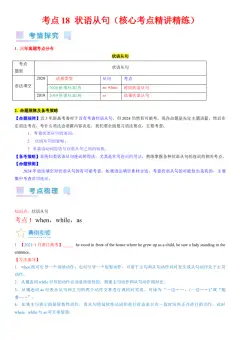
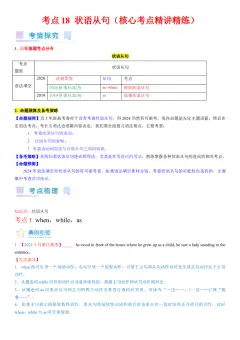
状语从句
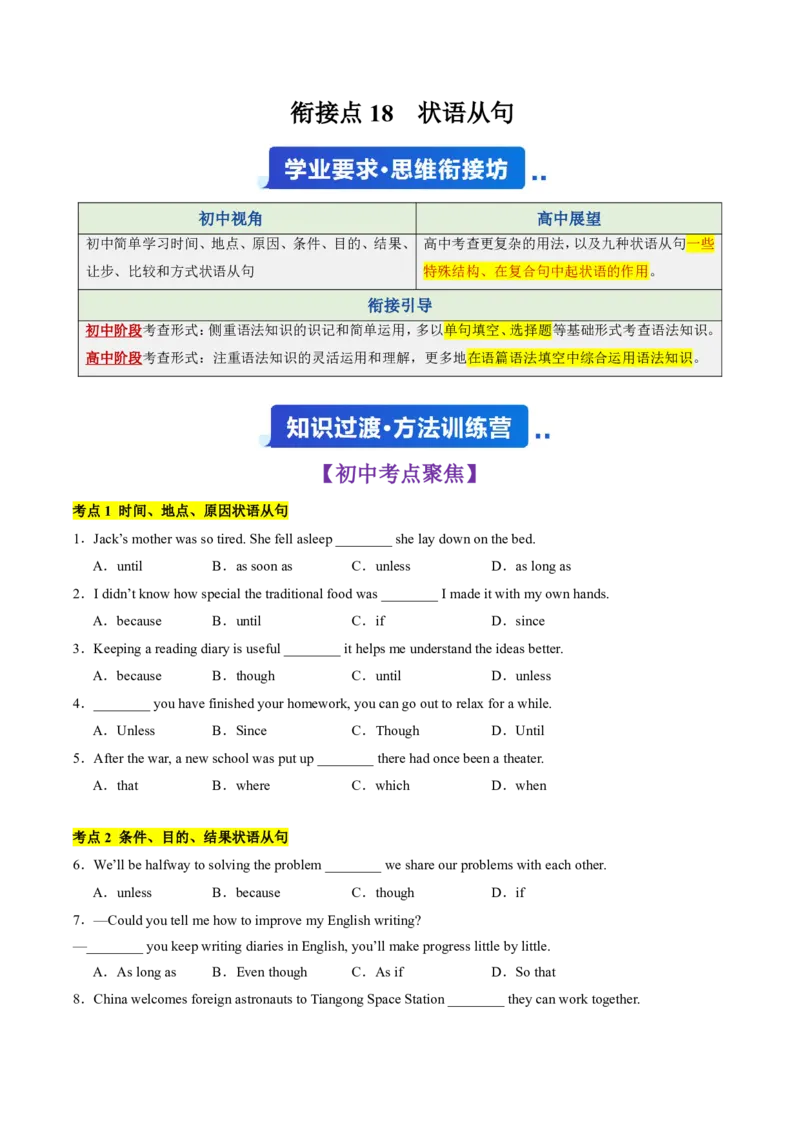
初中视角
高中展望
初中简单学习时间、地点、原因、条件、目的、结果、
让步、比较和方式状语从句
高中考查更复杂的用法,以及九种状语从句一些
特殊结构、在复合句中起状语的作用。
衔接引导
初中阶段考查形式:侧重语法知识的识记和简单运用,多以单句填空、选择题等基础形式考查语法知识。
高中阶段考查形式:注重语法知识的灵活运用和理解,更多地在语篇语法填空中综合运用语法知识。
【初中考点聚焦】
考点1 时间、地点、原因状语从句
1.Jack’s mother was so tired. She fell asleep ________ she lay down on the bed.
A.until
B.as soon as
C.unless
D.as long as
2.I didn’t know how special the traditional food was ________ I made it with my own hands.
A.because
B.until
C.if
D.since
3.Keeping a reading diary is useful ________ it helps me understand the ideas better.
A.because
B.though
C.until
D.unless
4.________ you have finished your homework, you can go out to relax for a while.
A.Unless
B.Since
C.Though
D.Until
5.After the war, a new school was put up ________ there had once been a theater.
A.that
B.where
C.which
D.when
考点2 条件、目的、结果状语从句
6.We’ll be halfway to solving the problem ________ we share our problems with each other.
A.unless
B.because
C.though
D.if
7.—Could you tell me how to improve my English writing?
—________ you keep writing diaries in English, you’ll make progress little by little.
A.As long as
B.Even though
C.As if
D.So that
8.China welcomes foreign astronauts to Tiangong Space Station ________ they can work together.
A.although
B.if
C.until
D.so that
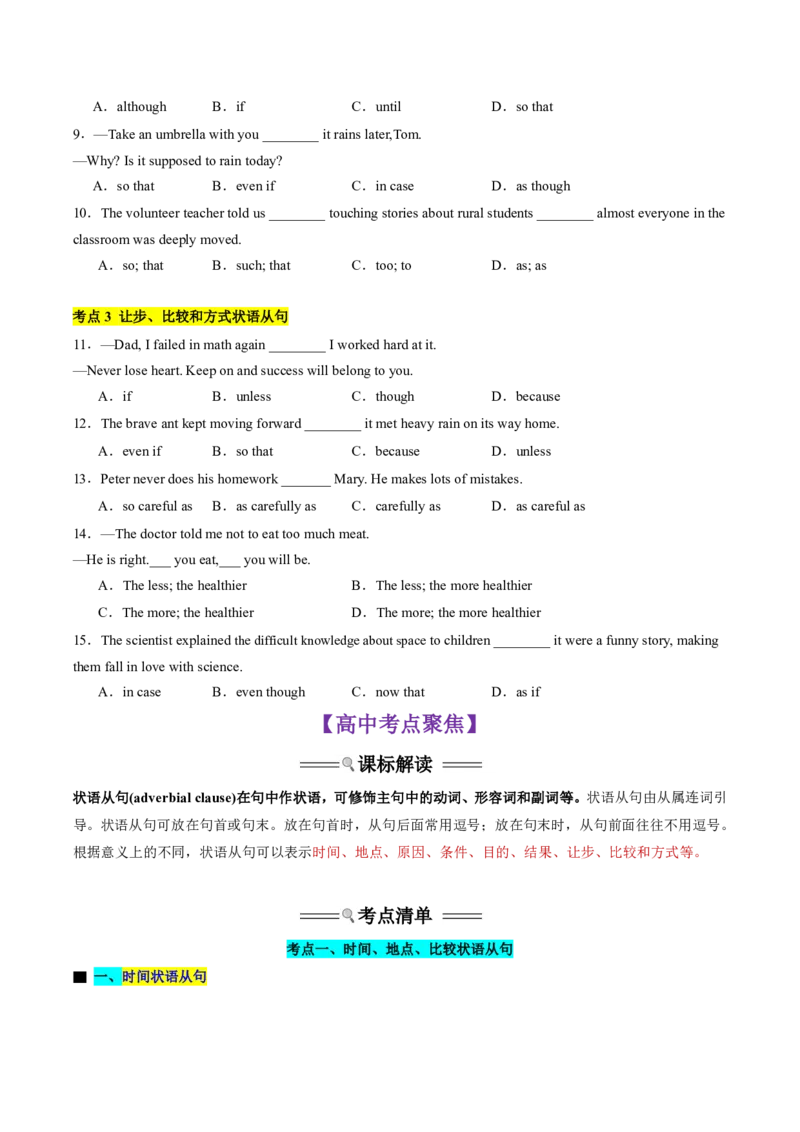
9.—Take an umbrella with you ________ it rains later,Tom.
—Why? Is it supposed to rain today?
A.so that
B.even if
C.in case
D.as though
10.The volunteer teacher told us ________ touching stories about rural students ________ almost everyone in the
classroom was deeply moved.
A.so; that
B.such; that
C.too; to
D.as; as
考点3 让步、比较和方式状语从句
11.—Dad, I failed in math again ________ I worked hard at it.
—Never lose heart. Keep on and success will belong to you.
A.if
B.unless
C.though
D.because
12.The brave ant kept moving forward ________ it met heavy rain on its way home.
A.even if
B.so that
C.because
D.unless
13.Peter never does his homework _______ Mary. He makes lots of mistakes.
A.so careful as
B.as carefully as
C.carefully as
D.as careful as
14.—The doctor told me not to eat too much meat.
—He is right.___ you eat,___ you will be.
A.The less; the healthier
B.The less; the more healthier
C.The more; the healthier
D.The more; the more healthier
15.The scientist explained the difficult knowledge about space to children ________ it were a funny story, making
them fall in love with science.
A.in case
B.even though
C.now that
D.as if
【高中考点聚焦】
课标解读
状语从句(adverbial clause)在句中作状语,可修饰主句中的动词、形容词和副词等。状语从句由从属连词引
导。状语从句可放在句首或句末。放在句首时,从句后面常用逗号;放在句末时,从句前面往往不用逗号。
根据意义上的不同,状语从句可以表示时间、地点、原因、条件、目的、结果、让步、比较和方式等。
考点清单
考点一、时间、地点、比较状语从句
▇一、时间状语从句
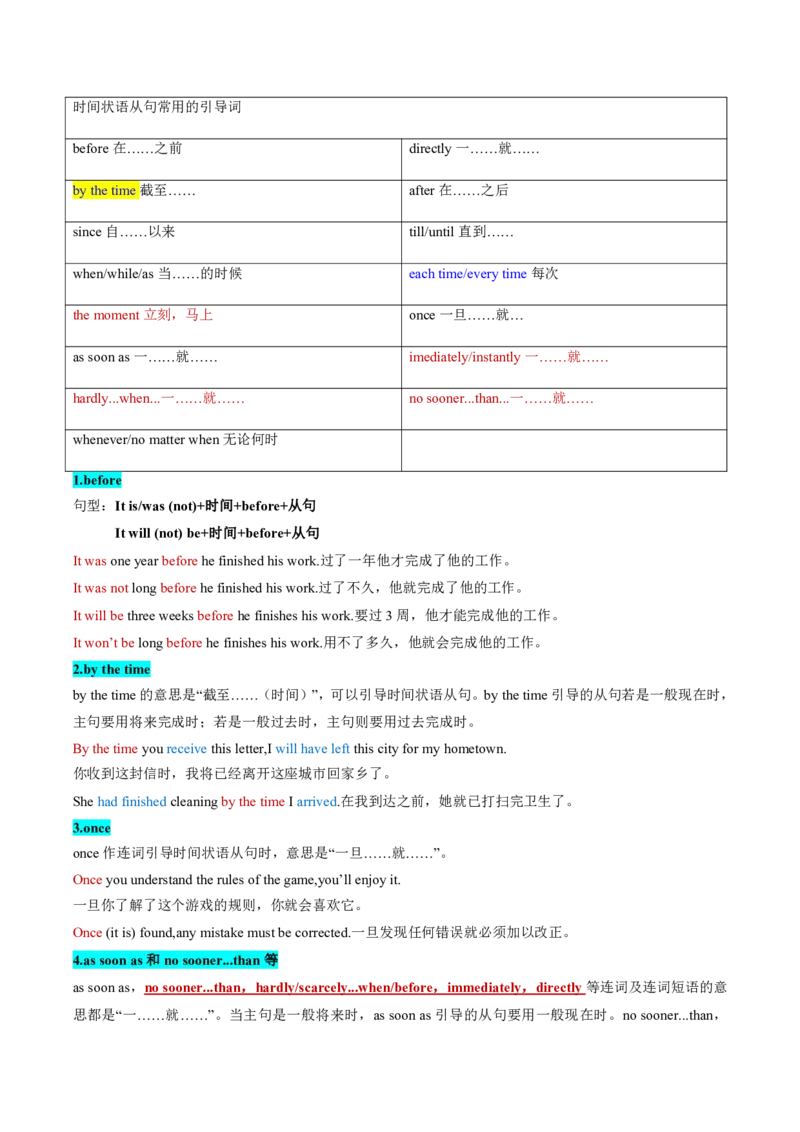
时间状语从句常用的引导词
before 在……之前
directly 一……就……
by the time 截至……
after 在……之后
since 自……以来
till/until 直到……
when/while/as 当……的时候
each time/every time 每次
the moment 立刻,马上
once 一旦……就…
as soon as 一……就……
imediately/instantly 一……就……
hardly...when...一……就……
no sooner...than...一……就……
whenever/no matter when 无论何时
1.before
句型:It is/was (not)+时间+before+从句
It will (not) be+时间+before+从句
It was one year before he finished his work.过了一年他才完成了他的工作。
It was not long before he finished his work.过了不久,他就完成了他的工作。
It will be three weeks before he finishes his work.要过3 周,他才能完成他的工作。
It won’t be long before he finishes his work.用不了多久,他就会完成他的工作。
2.by the time
by the time 的意思是“截至……(时间)”,可以引导时间状语从句。by the time 引导的从句若是一般现在时,
主句要用将来完成时;若是一般过去时,主句则要用过去完成时。
By the time you receive this letter,I will have left this city for my hometown.
你收到这封信时,我将已经离开这座城市回家乡了。
She had finished cleaning by the time I arrived.在我到达之前,她就已打扫完卫生了。
3.once
once 作连词引导时间状语从句时,意思是“一旦……就……”。
Once you understand the rules of the game,you’ll enjoy it.
一旦你了解了这个游戏的规则,你就会喜欢它。
Once (it is) found,any mistake must be corrected.一旦发现任何错误就必须加以改正。
4.as soon as 和no sooner...than 等
as soon as,no sooner...than,hardly/scarcely...when/before,immediately,directly 等连词及连词短语的意
思都是“一……就……”。当主句是一般将来时,as soon as 引导的从句要用一般现在时。no sooner...than,
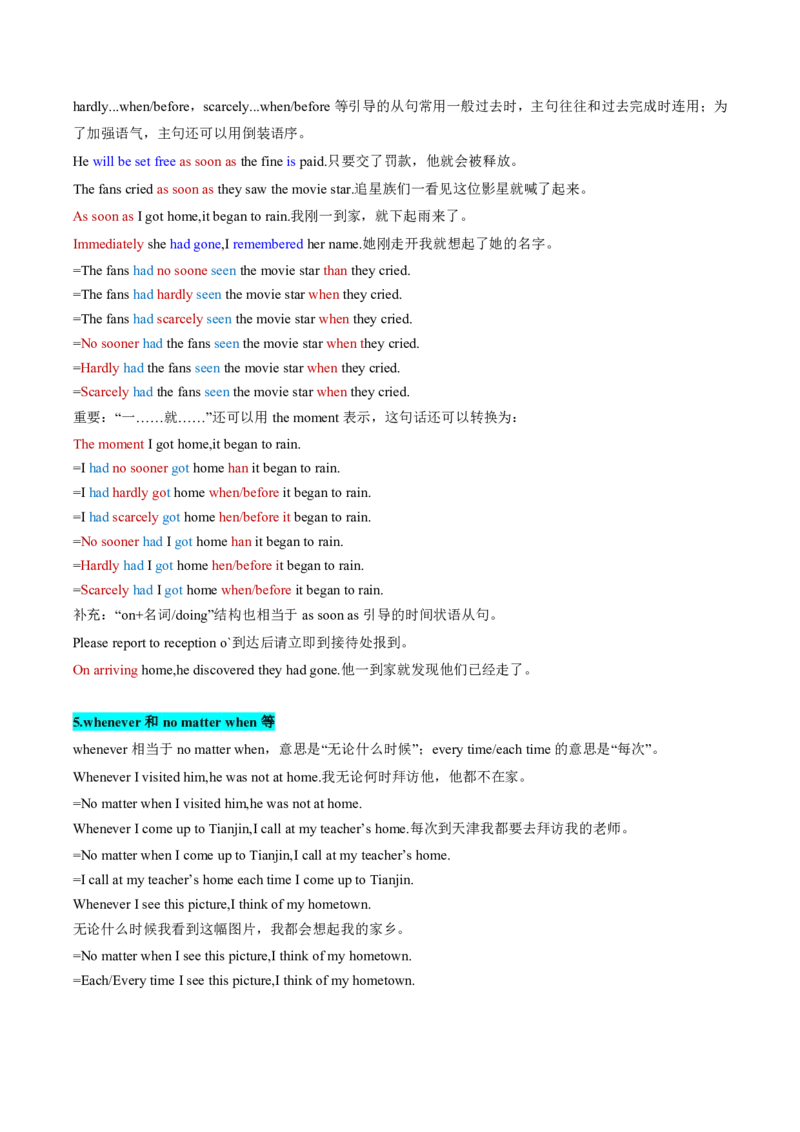
hardly...when/before,scarcely...when/before 等引导的从句常用一般过去时,主句往往和过去完成时连用;为
了加强语气,主句还可以用倒装语序。
He will be set free as soon as the fine is paid.只要交了罚款,他就会被释放。
The fans cried as soon as they saw the movie star.追星族们一看见这位影星就喊了起来。
As soon as I got home,it began to rain.我刚一到家,就下起雨来了。
Immediately she had gone,I remembered her name.她刚走开我就想起了她的名字。
=The fans had no soone seen the movie star than they cried.
=The fans had hardly seen the movie star when they cried.
=The fans had scarcely seen the movie star when they cried.
=No sooner had the fans seen the movie star when they cried.
=Hardly had the fans seen the movie star when they cried.
=Scarcely had the fans seen the movie star when they cried.
重要:“一……就……”还可以用the moment 表示,这句话还可以转换为:
The moment I got home,it began to rain.
=I had no sooner got home han it began to rain.
=I had hardly got home when/before it began to rain.
=I had scarcely got home hen/before it began to rain.
=No sooner had I got home han it began to rain.
=Hardly had I got home hen/before it began to rain.
=Scarcely had I got home when/before it began to rain.
补充:“on+名词/doing”结构也相当于as soon as 引导的时间状语从句。
Please report to reception o`到达后请立即到接待处报到。
On arriving home,he discovered they had gone.他一到家就发现他们已经走了。
5.whenever 和no matter when 等
whenever 相当于no matter when,意思是“无论什么时候”;every time/each time 的意思是“每次”。
Whenever I visited him,he was not at home.我无论何时拜访他,他都不在家。
=No matter when I visited him,he was not at home.
Whenever I come up to Tianjin,I call at my teacher’s home.每次到天津我都要去拜访我的老师。
=No matter when I come up to Tianjin,I call at my teacher’s home.
=I call at my teacher’s home each time I come up to Tianjin.
Whenever I see this picture,I think of my hometown.
无论什么时候我看到这幅图片,我都会想起我的家乡。
=No matter when I see this picture,I think of my hometown.
=Each/Every time I see this picture,I think of my hometown.
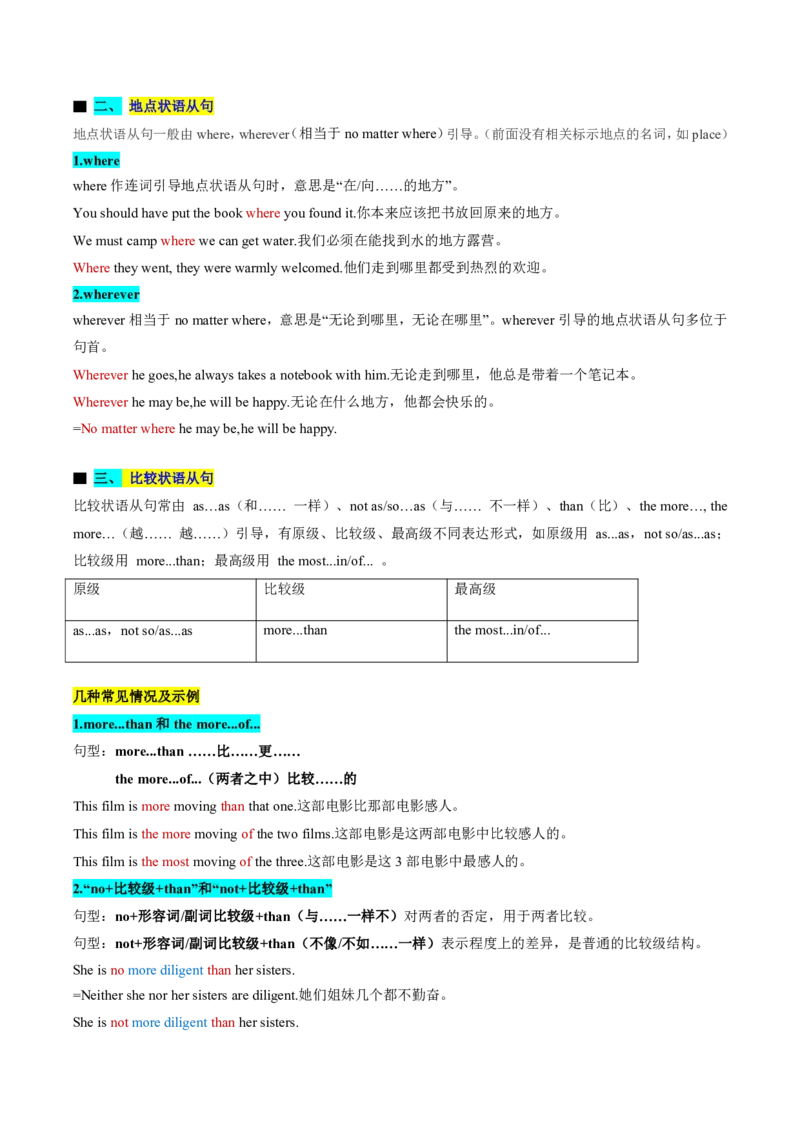
▇二、地点状语从句
地点状语从句一般由where,wherever(相当于no matter where)引导。(前面没有相关标示地点的名词,如place)
1.where
where 作连词引导地点状语从句时,意思是“在/向……的地方”。
You should have put the book where you found it.你本来应该把书放回原来的地方。
We must camp where we can get water.我们必须在能找到水的地方露营。
Where they went, they were warmly welcomed.他们走到哪里都受到热烈的欢迎。
2.wherever
wherever 相当于no matter where,意思是“无论到哪里,无论在哪里”。wherever 引导的地点状语从句多位于
句首。
Wherever he goes,he always takes a notebook with him.无论走到哪里,他总是带着一个笔记本。
Wherever he may be,he will be happy.无论在什么地方,他都会快乐的。
=No matter where he may be,he will be happy.
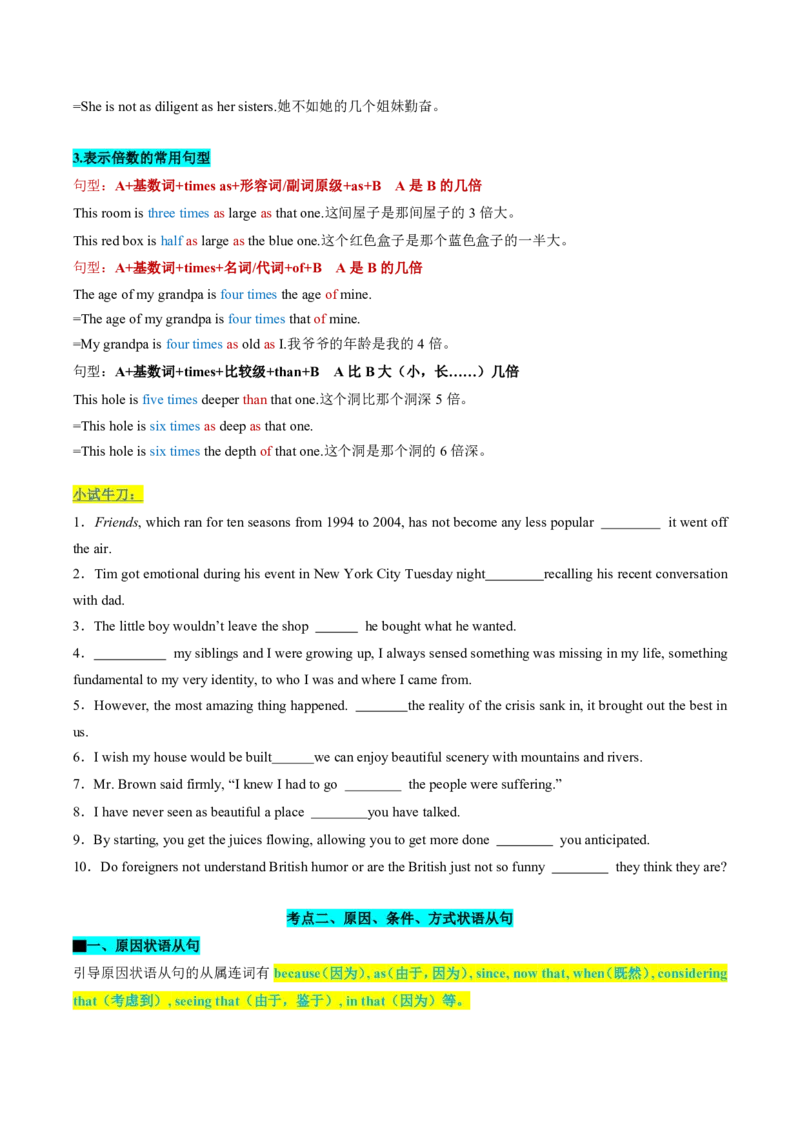
▇三、比较状语从句
比较状语从句常由as…as(和…… 一样)、not as/so…as(与…… 不一样)、than(比)、the more…, the
more…(越…… 越……)引导,有原级、比较级、最高级不同表达形式,如原级用as...as,not so/as...as;
比较级用more...than;最高级用the most...in/of... 。
原级
比较级
最高级
as...as,not so/as...as
more...than
the most...in/of...
几种常见情况及示例
1.more...than 和the more...of...
句型:more...than ……比……更……
the more...of...(两者之中)比较……的
This film is more moving than that one.这部电影比那部电影感人。
This film is the more moving of the two films.这部电影是这两部电影中比较感人的。
This film is the most moving of the three.这部电影是这3 部电影中最感人的。
2.“no+比较级+than”和“not+比较级+than”
句型:no+形容词/副词比较级+than(与……一样不)对两者的否定,用于两者比较。
句型:not+形容词/副词比较级+than(不像/不如……一样)表示程度上的差异,是普通的比较级结构。
She is no more diligent than her sisters.
=Neither she nor her sisters are diligent.她们姐妹几个都不勤奋。
She is not more diligent than her sisters.
=She is not as diligent as her sisters.她不如她的几个姐妹勤奋。
3.表示倍数的常用句型
句型:A+基数词+times as+形容词/副词原级+as+B
A 是B 的几倍
This room is three times as large as that one.这间屋子是那间屋子的3 倍大。
This red box is half as large as the blue one.这个红色盒子是那个蓝色盒子的一半大。
句型:A+基数词+times+名词/代词+of+B
A 是B 的几倍
The age of my grandpa is four times the age of mine.
=The age of my grandpa is four times that of mine.
=My grandpa is four times as old as I.我爷爷的年龄是我的4 倍。
句型:A+基数词+times+比较级+than+B
A 比B 大(小,长……)几倍
This hole is five times deeper than that one.这个洞比那个洞深5 倍。
=This hole is six times as deep as that one.
=This hole is six times the depth of that one.这个洞是那个洞的6 倍深。
小试牛刀:
1.Friends, which ran for ten seasons from 1994 to 2004, has not become any less popular
it went off
the air.
2.Tim got emotional during his event in New York City Tuesday night
recalling his recent conversation
with dad.
3.The little boy wouldn’t leave the shop
he bought what he wanted.
4.
my siblings and I were growing up, I always sensed something was missing in my life, something
fundamental to my very identity, to who I was and where I came from.
5.However, the most amazing thing happened.
the reality of the crisis sank in, it brought out the best in
us.
6.I wish my house would be built
we can enjoy beautiful scenery with mountains and rivers.
7.Mr. Brown said firmly, “I knew I had to go
the people were suffering.”
8.I have never seen as beautiful a place
you have talked.
9.By starting, you get the juices flowing, allowing you to get more done
you anticipated.
10.Do foreigners not understand British humor or are the British just not so funny
they think they are?
考点二、原因、条件、方式状语从句
▇一、原因状语从句
引导原因状语从句的从属连词有because(因为), as(由于,因为), since, now that, when(既然), considering
that(考虑到), seeing that(由于,鉴于), in that(因为)等。
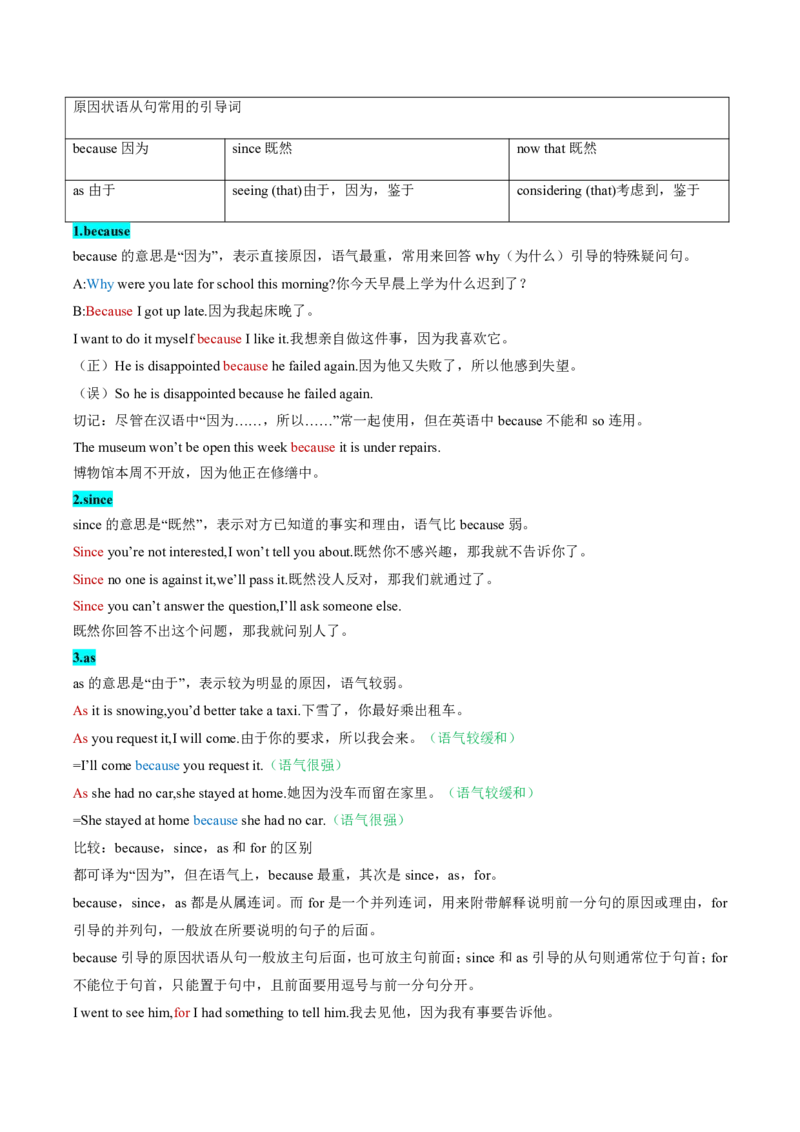
原因状语从句常用的引导词
because 因为
since 既然
now that 既然
as 由于
seeing (that)由于,因为,鉴于
considering (that)考虑到,鉴于
1.because
because 的意思是“因为”,表示直接原因,语气最重,常用来回答why(为什么)引导的特殊疑问句。
A:Why were you late for school this morning?你今天早晨上学为什么迟到了?
B:Because I got up late.因为我起床晚了。
I want to do it myself because I like it.我想亲自做这件事,因为我喜欢它。
(正)He is disappointed because he failed again.因为他又失败了,所以他感到失望。
(误)So he is disappointed because he failed again.
切记:尽管在汉语中“因为……,所以……”常一起使用,但在英语中because 不能和so 连用。
The museum won’t be open this week because it is under repairs.
博物馆本周不开放,因为他正在修缮中。
2.since
since 的意思是“既然”,表示对方已知道的事实和理由,语气比because 弱。
Since you’re not interested,I won’t tell you about.既然你不感兴趣,那我就不告诉你了。
Since no one is against it,we’ll pass it.既然没人反对,那我们就通过了。
Since you can’t answer the question,I’ll ask someone else.
既然你回答不出这个问题,那我就问别人了。
3.as
as 的意思是“由于”,表示较为明显的原因,语气较弱。
As it is snowing,you’d better take a taxi.下雪了,你最好乘出租车。
As you request it,I will come.由于你的要求,所以我会来。(语气较缓和)
=I’ll come because you request it.(语气很强)
As she had no car,she stayed at home.她因为没车而留在家里。(语气较缓和)
=She stayed at home because she had no car.(语气很强)
比较:because,since,as 和for 的区别
都可译为“因为”,但在语气上,because 最重,其次是since,as,for。
because,since,as 都是从属连词。而for 是一个并列连词,用来附带解释说明前一分句的原因或理由,for
引导的并列句,一般放在所要说明的句子的后面。
because 引导的原因状语从句一般放主句后面,也可放主句前面;since 和as 引导的从句则通常位于句首;for
不能位于句首,只能置于句中,且前面要用逗号与前一分句分开。
I went to see him,for I had something to tell him.我去见他,因为我有事要告诉他。
4.now what,seeing that 和considering that
now that 的意思是“既然”,seeing that 的意思是“由于,因为,鉴于”,considering that 的意思是“考虑到,鉴
于”。
Now that they have taken matters into their hands,the pace of events has quickened.
他们既然已着手自己来处理问题,事态的进展也就加快了。
Now tha you are a man,you must not do such a thing.既然你是个男子汉,就不要做这样的事了。
Now that you are well,you can work.既然你已经好了,你可以工作了。
Seeing that he’s been off sick all week,he is unlikely to come today.
由于他请病假整整一周了,所以今天不太可能来。
She knows quite a lot about it,onsidering (that) she is very young.
鉴于她年龄小,她懂得的已经很多了。
▇二、条件状语从句
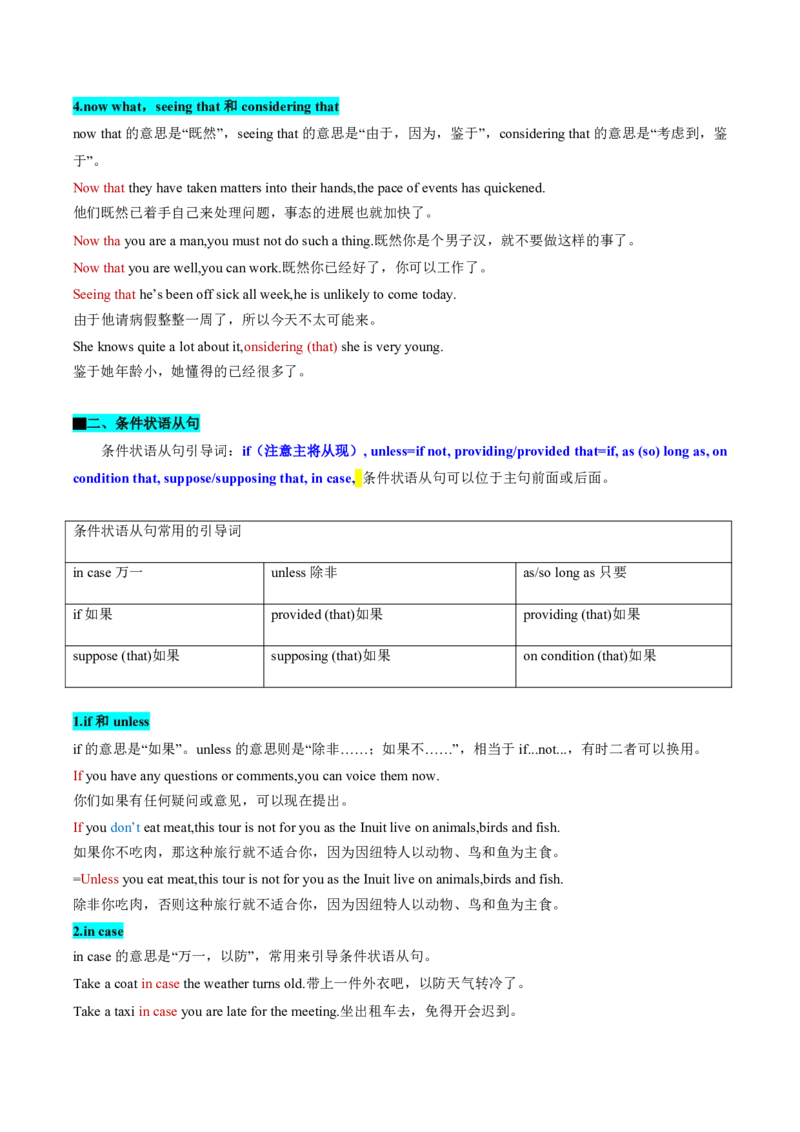
条件状语从句引导词:if(注意主将从现), unless=if not, providing/provided that=if, as (so) long as, on
condition that, suppose/supposing that, in case, 条件状语从句可以位于主句前面或后面。
条件状语从句常用的引导词
in case 万一
unless 除非
as/so long as 只要
if 如果
provided (that)如果
providing (that)如果
suppose (that)如果
supposing (that)如果
on condition (that)如果
1.if 和unless
if 的意思是“如果”。unless 的意思则是“除非……;如果不……”,相当于if...not...,有时二者可以换用。
If you have any questions or comments,you can voice them now.
你们如果有任何疑问或意见,可以现在提出。
If you don’t eat meat,this tour is not for you as the Inuit live on animals,birds and fish.
如果你不吃肉,那这种旅行就不适合你,因为因纽特人以动物、鸟和鱼为主食。
=Unless you eat meat,this tour is not for you as the Inuit live on animals,birds and fish.
除非你吃肉,否则这种旅行就不适合你,因为因纽特人以动物、鸟和鱼为主食。
2.in case
in case 的意思是“万一,以防”,常用来引导条件状语从句。
Take a coat in case the weather turns old.带上一件外衣吧,以防天气转冷了。
Take a taxi in case you are late for the meeting.坐出租车去,免得开会迟到。
3.as long as 和so long as
as long as 和so long as 的意思都是“只要”。
I’m sure we are safe as long as (we are) in his care.我深信只要在他的保护下,我们就会平安无事。
As/So long as we don’t lose heart,we’ll find a way to overcome the difficulty.只要我们不灰心,我们就能找到克
服困难的办法。
You can go to see the film as/so long as you arrive at the cinema on time.你可以去看这场电影,只要你能按时到
达电影院。
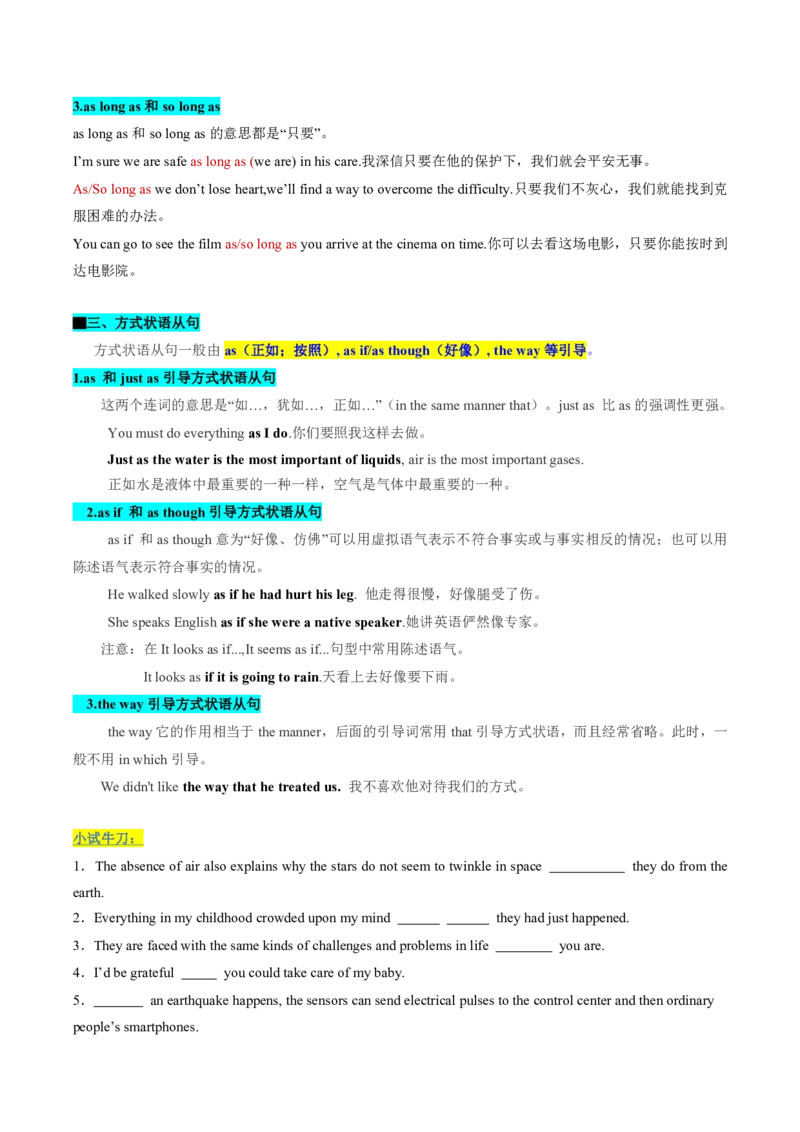
▇三、方式状语从句
方式状语从句一般由as(正如;按照), as if/as though(好像), the way 等引导。
1.as 和just as 引导方式状语从句
这两个连词的意思是“如…,犹如…,正如…”(in the same manner that)。just as 比as 的强调性更强。
You must do everything as I do.你们要照我这样去做。
Just as the water is the most important of liquids, air is the most important gases.
正如水是液体中最重要的一种一样,空气是气体中最重要的一种。
2.as if 和as though 引导方式状语从句
as if 和as though 意为“好像、仿佛”可以用虚拟语气表示不符合事实或与事实相反的情况;也可以用
陈述语气表示符合事实的情况。
He walked slowly as if he had hurt his leg. 他走得很慢,好像腿受了伤。
She speaks English as if she were a native speaker.她讲英语俨然像专家。
注意:在It looks as if...,It seems as if...句型中常用陈述语气。
It looks as if it is going to rain.天看上去好像要下雨。
3.the way 引导方式状语从句
the way 它的作用相当于the manner,后面的引导词常用that 引导方式状语,而且经常省略。此时,一
般不用in which 引导。
We didn't like the way that he treated us. 我不喜欢他对待我们的方式。
小试牛刀:
1.The absence of air also explains why the stars do not seem to twinkle in space
they do from the
earth.
2.Everything in my childhood crowded upon my mind
they had just happened.
3.They are faced with the same kinds of challenges and problems in life
you are.
4.I’d be grateful
you could take care of my baby.
5.
an earthquake happens, the sensors can send electrical pulses to the control center and then ordinary
people’s smartphones.
6.You can write anything relevant
long as it’s interesting.
7.A small car is big enough for a family of three
you need more space for baggage.
8.
you call me to say you’re not coming, I’ll see you at the same place where we met last time.
9.
you are addicted to computer games, it’s hard for you to focus your mind on your study.
10.Many students lost marks in the exam simply
they didn’t read the questions carefully.
考点三、让步、结果、目的状语从句
▇一、让步状语从句
让步状语从句由though,although,as,even if (though),however,whatever,whoever,whenever,no matter
+wh 词,等引导。
让步状语从句常用的引导词
though/although 虽然
no matter+疑问词(who/what/when/which/where/how)无论
even if/even though 即使
whoever/whatever/whenever/whichever/wherever/however 无论
1.even if, even though, although,though 引导的让步状语从句
这四个词(词组)都有“虽然、即使、尽管”的意思。even if 和even though 带有较强的意味,语气比
although 和though 强。though 比although 通俗,但不如although 正式,都不能和but 连用,但可以和yet, still
或nevertheless 连用。可以放在主句前面也可以放在主句后面。even if,even though 所接的句子常用虚拟语
气。
Although journalism seems like a good profession, I would prefer to be a teacher.
虽然新闻业好像是一个很好的职业,但是我更喜欢当老师。
Although he is considered a great writer, his works are not widely read.
虽然有人认为他是一个大作家,但是他的作品读得并不广泛。
We won’t give up even if we should fail ten times.
即使是我们失败十次,我们也不会放弃。
He might have given you more help, even though he was very busy.
尽管他很忙,他可能给了你更多的帮助。
2.as 或though 引导让步状语从句(高二讲解部分倒装时会更好地掌握)
形容词
+ as/though+ 主语+谓语
副词
动词
名词
(1).由as 或though 引导让步状语从句用倒装语序
Much as I have traveled, I have never seen anyone who's as capable as John.
我虽然取得地方多,但是我从来没见过像约翰这么能干的人。
(2).如果表语为单数可数名词,这个名词不带冠词
12-year-old girl as she is, she has had a good command of English.她虽然只是个12 岁的女孩,但是她
已经熟知英语。
Child as he is, he knows a lot.虽然他还是个孩子,却懂的很多。
(3).如果句中谓语包含情态动词或助动词,则将实意动词放在as 之前
Try as I might, I couldn't lift the stone.我使多大劲儿也搬不动这块石头。
Praised as he was, he remained modest.他虽然受到表扬,但仍然保持着谦虚。
(4).如果句中谓语仅有实意动词,则将实意动词(原形)放在as 之前,并在主语后面加助动词do, does,
did 或will。
Torture her as they did, the enemy got nothing out of her.虽然敌人拷打她,却没有能从她嘴里得到什么。
Fail as he did, he would never give up.尽管他失败了,但他决不会放弃。
注意:如果在这种情况下,句中谓语有副词修饰,则将副词放在as 之前。
Again and again as he failed, he didn't lose heart.他虽然多次失败,但仍不灰心丧气。
Much as I admire his courage, I don't think he acted wisely.
我虽然佩服他的勇气,但是我认为他这样做是不明智的。
总结:倒装是把表语提前;没有表语时,将状语提前;没有状语时,将部分谓语提前
3.由no matter+ wh 词和由疑问词+ever 引导让步状语从句
由no matter 引导,表示“不管;无论”;由疑问词+ever 引导,表示“不管,不论”。这类词有:whatever,
whichever,whoever,however,whenever,wherever 等,他们相当于no matter+ what(which,who,how,
when,where),都不能与but,so,and 等并列连词同时使用。
We’ll have to finish the job, however(no matter how) long it takes.
No matter what(Whatever) you do, don't tell him that I told you this.
No matter how pure the water looks, I prefer not to drink it.
No matter where (Wherever) you go, I would keep you company.
4.由whether...or...引导让步状语从句
由whether...or...引导让步状语从句表示“不论……还是”,提供两种对比的情况。
I shall go, whether you come with me or stay at home.
不论你和我一起来还是留在家中,我都要前往。
▇二、结果状语从句
1.so…that..., such…that...引导结果状语从句
So difficult did I feel it to live in an English-speaking country that I determined to learn English well.
The film was so wonderful that we wanted to see it again.
He spoke for such a long time that people began to fall asleep.
2.so…that...与such…that...的区别
这两种结构都可引导结果状语从句。so 是副词,后接形容词或副词;such 是形容词,后接名词。
(1).单数名词
在so...that 与such...that 中间出现的是单数名词,且该名词前有形容词修饰时,这两种结构可互换,但
要注意它们的词序不同:such+ a/an+形容词十名词=so+形容词+a/an+名词。
She is such a good teacher that all of us love her.= She is so good a teacher that all of us love her.她是一
位很好的老师,我们都敬爱她。
(2).不可数名词或复数可数名词
如果被修饰的是不可数名词或复数可数名词时,一般须用such...that。
He made such rapid progress that before long he began to write articles in English.他进步很快,不久就
开始用英语写文章。(不可数名词)
They are such interesting books that we all want to read them.这些书是那么有趣以致我们都想读一读。
(复数可数名词)
(3).名词前有many, much, little, few 修饰时
如果不可数名词或复数可数名词前有many,much,little,few 修饰时,则用so…that。
I’ve had so many falls that I’m black and blue all over.我摔了好多次跤,周身青一块紫一块的。
George had so little money that he had to get a job.乔治没有钱,所以他不得不找工作干。
They are such little children that they can’t do anything.他们是小孩,什么事情都干不了。
▇三、目的状语从句
引导目的状语从句的从属连词有so that, in order that, in case, for fear that 等。
1.so that, in order that 引导的目的状语从句
从句中的谓语动词前常有情态动词may、might、can、could、will, would 等。
John shut everybody out of the kitchen so that he could prepare his grand surprise for the party.
约翰把其他人关在厨房外,目的是能够为晚会烹饪出人意料的东西。
These men risk their lives in order that we may live more safely.
这些人甘冒生命危险,是为了让我们活得更安全些。
2.lest, for fear that 和in case 引导目的状语从句
这三个连词词组的意思是“以防,以免”。lest 的从句一般要用虚拟语气,形式是“should+动词原形”或
省掉should。for fear that 和in case 从句一般用虚拟语气,但有时也可以用陈述语气。
I obeyed her lest she should be angry. 我得顺着她,免得她生气。
Take a hat with you in case the sun is very hot. 倘若太阳很利害,你就把帽子戴上。
小试牛刀:
1.No matter
we are, we are able to keep in contact with loved ones with all sorts of communication
software. (用适当的词填空)
2.Jane is determined to live a fulfilling life no matter
the future holds. (用适当的词填空)
3.I don’t think I can afford them
I like the color. (用适当的词填空)
4.Weak
I am in English for the moment, I am confident that I can catch up. (用适当的词填空)
5.We students should always manage to spare some time to exercise,
busy we are. (用适当的词填空)
6.
technology is used to help us, we should not allow it to take over our lives. (用适当的词填空)
7.Hard
she tries, she can hardly avoid mistakes in her homework. (用适当的词填空)
8.The Great Wall is
well--known a tourist attraction that lots of tourists visit it every year. (用适当的
词填空)
9.I developed
a strong interest in stage design that I realized I wanted to spend the rest of my life doing
it. (用适当的词填空)
10.The teacher thinks we’re so smart
we ought to have no trouble learning it.(用适当的词填空)
一、单句语法填空
1.Only
we learn to live in harmony with nature can we stop being a threat to wildlife and to our
planet. (用适当的词填空)
2.So he thought, and he felt himself going
he started; I will try it once again. (用适当的词填空)
3.How long do you suppose it is
that famous basketball player last participated in an international
competition, where he showcased his amazing skills and won numerous honors? (用适当的词填空)
4.He always parks his car
he can see it from the window, just to make sure it’s safe. (用适当的词填空)
5.We like to visit nice, quiet places far away from the city and go walking
there are no shops, crowds
or the tube.
6.The use of several avatars can also be a risk,
people can use avatars to cheat others. (用适当的词填
空)
7.The meeting was put off
several key members had unexpected scheduling conflicts. (用适当的词填
空)
8.Now
we are all part of the global village, everyone becomes a neighbour. (用适当的词填空)
9.Mark needs to learn Chinese
his company is opening a branch in Beijing. (用适当的词填空)
10.Introducing you to areas such as biology, urban farming, and environmental science
that you
can explore the field of agriculture. (用适当的词填空)
11.Smart apartments will include voice-activated controls and automatic fall-detection sensors
residents with limited mobility need emergency assistance. (用适当的词填空)
12.I’ll find a way to improve on my own so
I can make the team the next year. (用适当的词填空)
13.There are birds which kick their young out at an early stage
they can produce new chicks.
(用适当的词填空)
14.They are
little children that they can not understand what you say sometimes. (用适当的词填空)
15.The Great Wall is
well--known a tourist attraction that millions of people visit it every year.
(用适当的词填空)
16.If not treated, the disease can damage the lungs to such an extent
a person can not breathe properly.
(用适当的词填空)
17.
you warm up properly before running, you might injure your muscles or joints. (用适当的词填空)
18.
we can reduce the use of plastic products, the living environment of sea animals will be greatly
improved. (用适当的词填空)
19.You can borrow the car
you drive carefully and return it on time. (用适当的
词填空)
20.My eyes were glued to the little screen
I walked down the street, had dinner with friends or lay in
bed at night.(用适当的词填空)
21.She warned her parents of the danger,
at first they just thought she was joking. (用适当的词填空)
22.
happens, we should always try to see the good side of things. (用适当的词填空)
23.We learn that
much we try to please, some people are never going to love us. (用适当的词填空)
24.Young
he is, he is mature in his way of dealing with things. (用适当的词填空)
25.
difficulties we may meet with, we will stick to our dreams and never give up. (用适当的词填空)
26.This is a story about how the writer got confused about a Mexican word
she had a good
command of Spanish. (用适当的词填空)
27.Please proceed with the experiment exactly
I demonstrated yesterday, and record all the data
carefully. (用适当的词填空)
28.Everything in my childhood crowded upon my mind
they had just happened. (用适当的词填
空)
29.While there was not so much homework
I was used to, life in the UK was still challenging. (用适当的
词填空)
30.They encourage each other as much
they can when they train. (用适当的词填空)
二、完成句子
1.
, I fell asleep.
我闭上眼睛就睡着了。
2.
,_the majority of people believe that education is a lifetime study.
说到教育,大部分人认为教育是终生的学习。
3.Jim answered the phone
.
吉米一边走一边回电话。
4.
, the manager came out.
正当我们疑惑该做什么的时候,经理走了出来。
5.
they went, they were warmly welcomed.
他们走到哪里都受到热烈的欢迎。
6.
(既然) everyone is here, let's begin the meeting. (根据汉语提示完成句子)
7.
(既然) we are all part of the global village, everyone becomes a neighbour. (根据汉
语提示完成句子)
8.
(尽管下大雨), the football match continued as scheduled. (根据汉语提示完成句子)
9.Sometimes we are
we forget to find the beauty in life.
有时, 我们如此繁忙以至于忘记去发现生活中的美。
10.Tom 对理科感兴趣,而他弟弟更喜欢艺术。(while)
Tom is interested in science,
.
一、语法填空
阅读下面短文,在空白处填入1 个适当的单词或括号内单词的正确形式。
The Great Wall of China is one of the most famous landmarks in the world. It was built over several
dynasties
1
(protect) the northern borders of China from invasions. The earliest sections date back to the
7th century BC, but the most well-known parts
2
(construct) during the Ming Dynasty (1368-1644).
The wall stretches more than 20,000 kilometers across deserts, mountains, and grasslands. It is not a single
continuous wall, but a series of fortifications (防御工事)
3
(connect) by watchtowers and barracks.
4
(visit) the Great Wall, one can truly appreciate the wisdom and hard work of the ancient Chinese people.
Today, the Great Wall is a UNESCO World Heritage Site and attracts millions of tourists each year. However,
some sections are
5
danger of collapsing due to natural erosion and human activities. The Chinese
government has taken measures
6
(preserve) this cultural treasure. For example, visitors are not allowed
to carve their names on the wall, and restoration work
7
(carry) out regularly.
There is a famous Chinese saying: “You are not a true man
8
you have climbed the Great Wall.”
This saying encourages people to overcome
9
(difficult) and pursue their goals. In fact, the spirit of the
Great Wall — resilience and determination — is still
10
(deep) valued by the Chinese people today.
二、阅读理解
Whether you shop for food in a traditional grocery store or a big-box store, most of your options are junk
foods. Terms on food packaging like “low fat,” “gluten-free,” “keto-friendly” and “a good source of fiber” don’t
answer the fundamental question: Is this food good for me? There is little reliable guidance available for people
who don’t have the time, patience or skill to analyze the nutrition labels (标签).
But what we really need is a bold (大胆的) move that would be to prevent people from food that’s bad for
them: a warning sign that a high-sugar soda or breakfast cereal product, for example, is an unhealthy choice.
Chile, Mexico, Brazil and dozens of other countries have worked to change food labeling. Research has
suggested that these labels can help people understand nutritional quality and change their purchasing habits.
Finally, the goal of the labels is to improve nutrition and reduce the consumption of over-processed foods.
After Chile adopted several rules in 2016, researchers found that the consumption of drinks high in sugar and
sodium declined by nearly 25 percent. In Uruguay a survey published in 2020 assessing the early effects of
nutritional warnings found that 58 percent of participants who noticed the warning changed their decisions about
buying a product. Of those who changed their decisions, 17 percent said they chose a similar product with fewer
warnings, and 18 percent decided not to buy a similar product at all.
In the United States, new labeling laws will be much more challenging to take effect. As you might expect,
food producers will surely try to stop warning labels from being required. They are arguing that these plans would
be costly and that those costs would be passed on to consumers. But research conducted soon after Chile’s food
labeling and advertising law passed showed no effects on total employment, with negligible effects on wages (工资)
and profit, even as consumer consumption of unhealthy foods declined.
To be clear, this is just one of many steps toward providing all Americans with a healthy diet. But knowable
front-of-package labeling is one of the best levers (杠杆) available to policymakers, and it is already working
elsewhere. It can work here, too.
11.What does paragraph 1 focus on?
A.The lack of nutrition.
B.The problem with labels.
C.The shortage of food.
D.The doubt about package.
12.What do the examples of Chile and Uruguay show?
A.The consumption of over-processed foods has been stopped.
B.People in the two countries have better nutrition awareness.
C.Food producers there work well with the government.
D.Warning labels can effectively change people’s buying behavior.
13.What does the underlined word “negligible” mean in paragraph 5?
A.Obvious.
B.Lasting.
C.Insignificant.
D.Undesired.
14.What’s the author’s attitude towards adopting warning labels in the United States?
A.Unclear.
B.Opposed.
C.Doubtful.
D.Supportive.