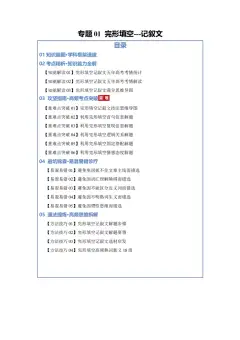
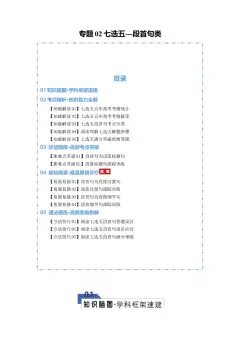
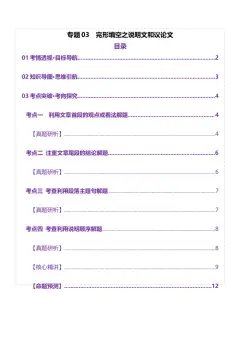
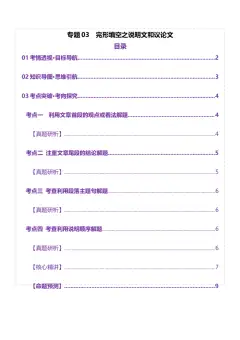
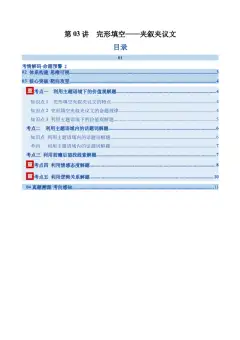
专题 03 完形填空---说明文
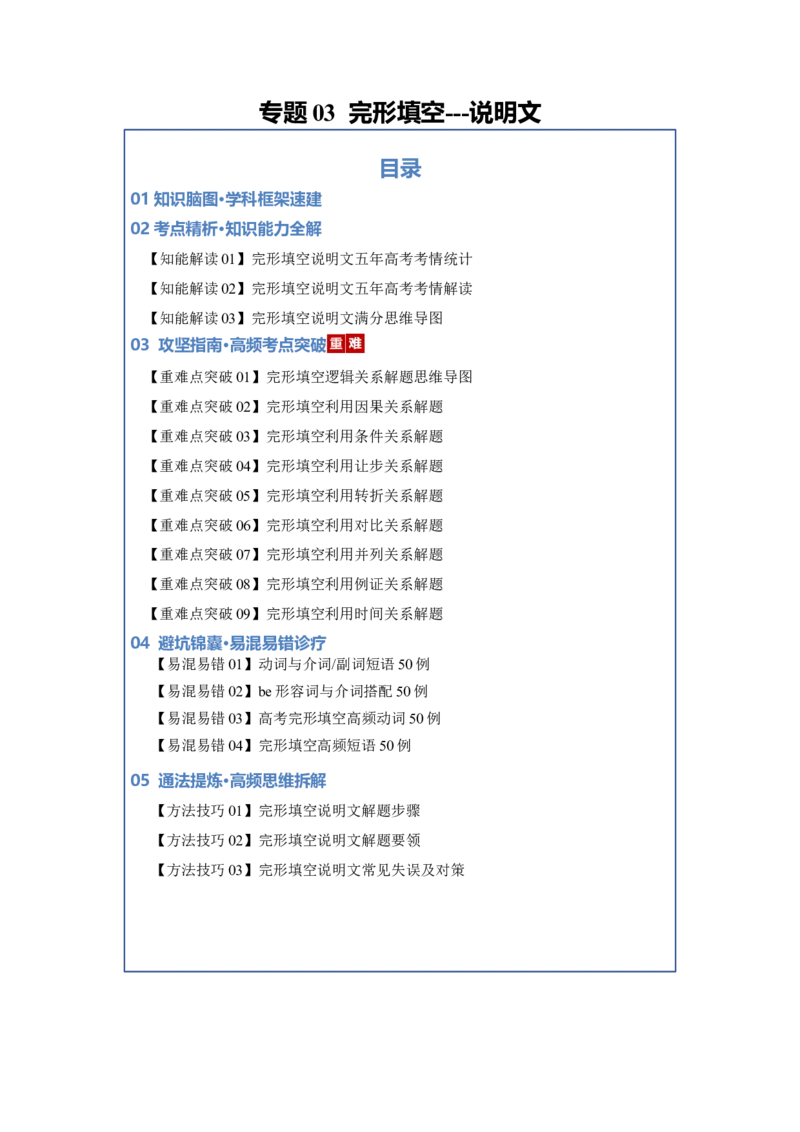
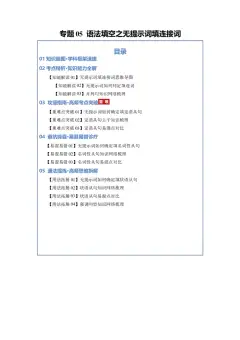
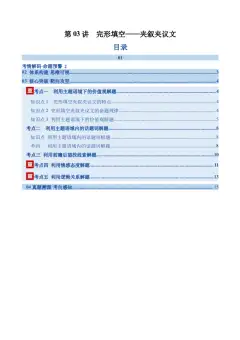
目录
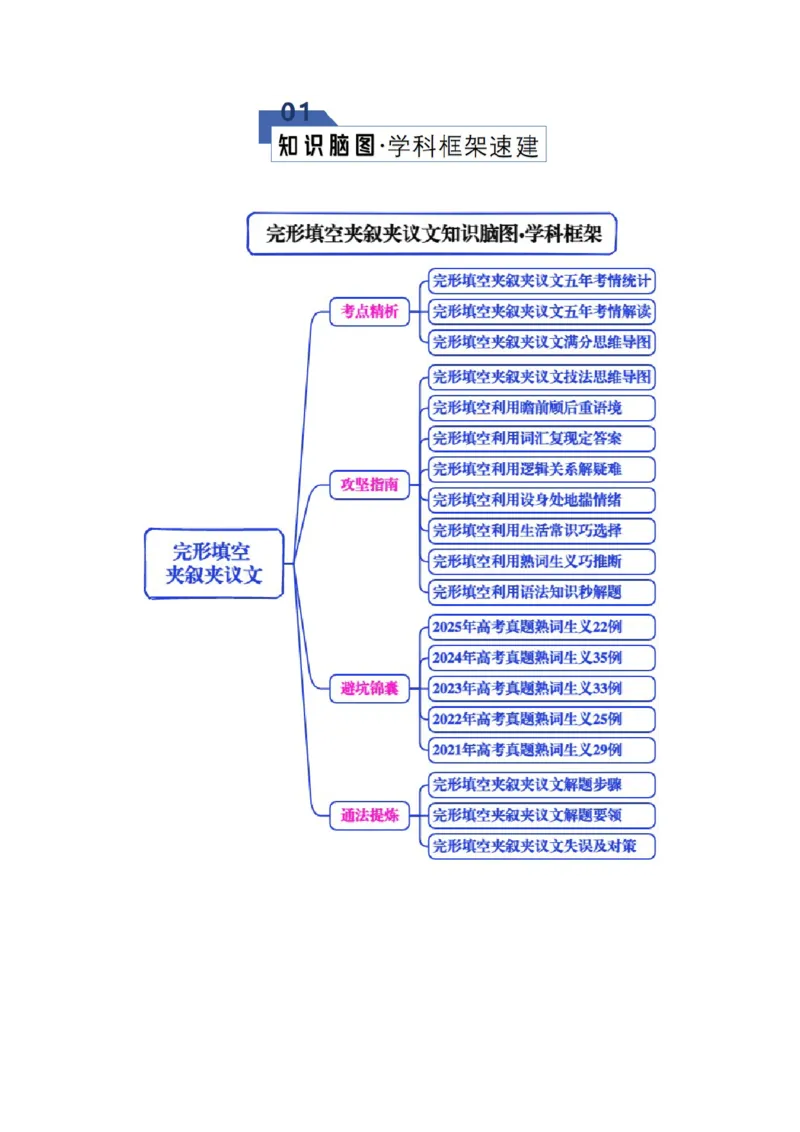
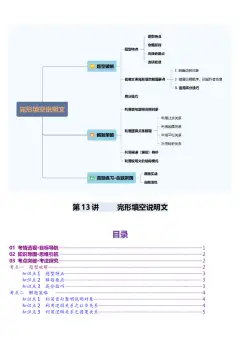
01知识脑图·学科框架速建
02考点精析·知识能力全解
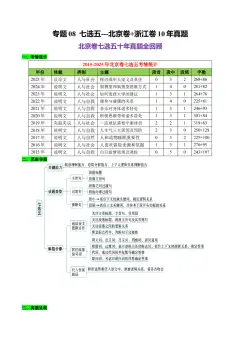
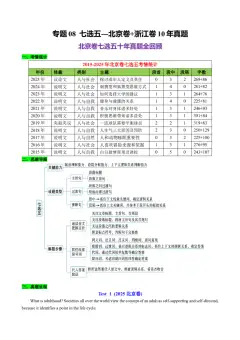
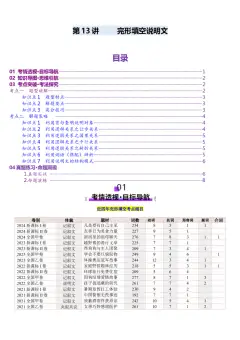
【知能解读01】完形填空说明文五年高考考情统计
【知能解读02】完形填空说明文五年高考考情解读
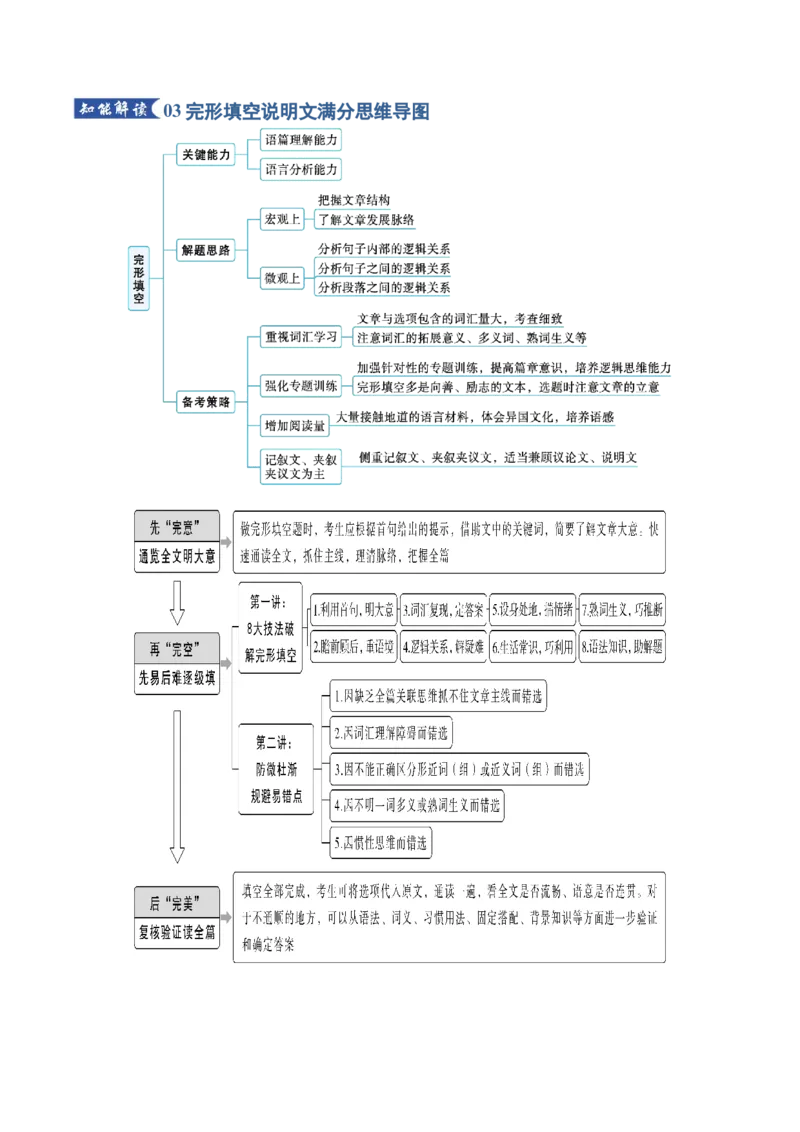
【知能解读03】完形填空说明文满分思维导图
03 攻坚指南·高频考点突破
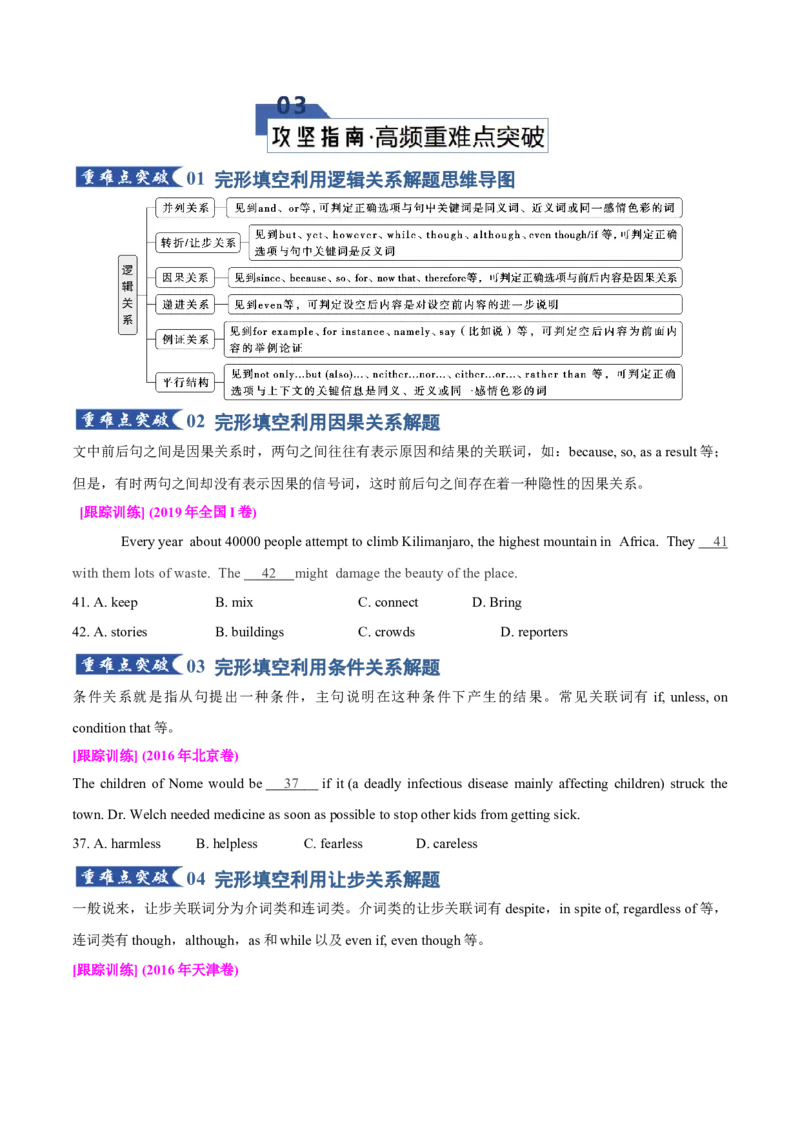
【重难点突破01】完形填空逻辑关系解题思维导图
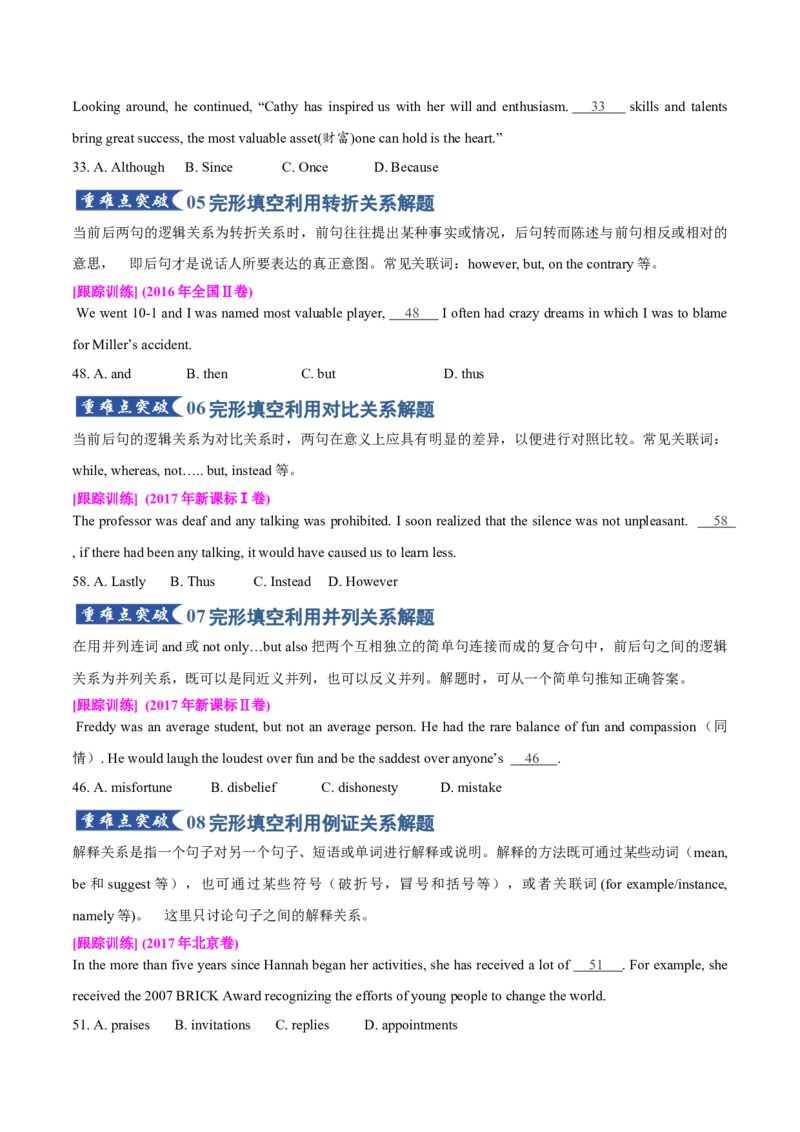
【重难点突破02】完形填空利用因果关系解题
【重难点突破03】完形填空利用条件关系解题
【重难点突破04】完形填空利用让步关系解题
【重难点突破05】完形填空利用转折关系解题
【重难点突破06】完形填空利用对比关系解题
【重难点突破07】完形填空利用并列关系解题
【重难点突破08】完形填空利用例证关系解题
【重难点突破09】完形填空利用时间关系解题
04 避坑锦囊·易混易错诊疗
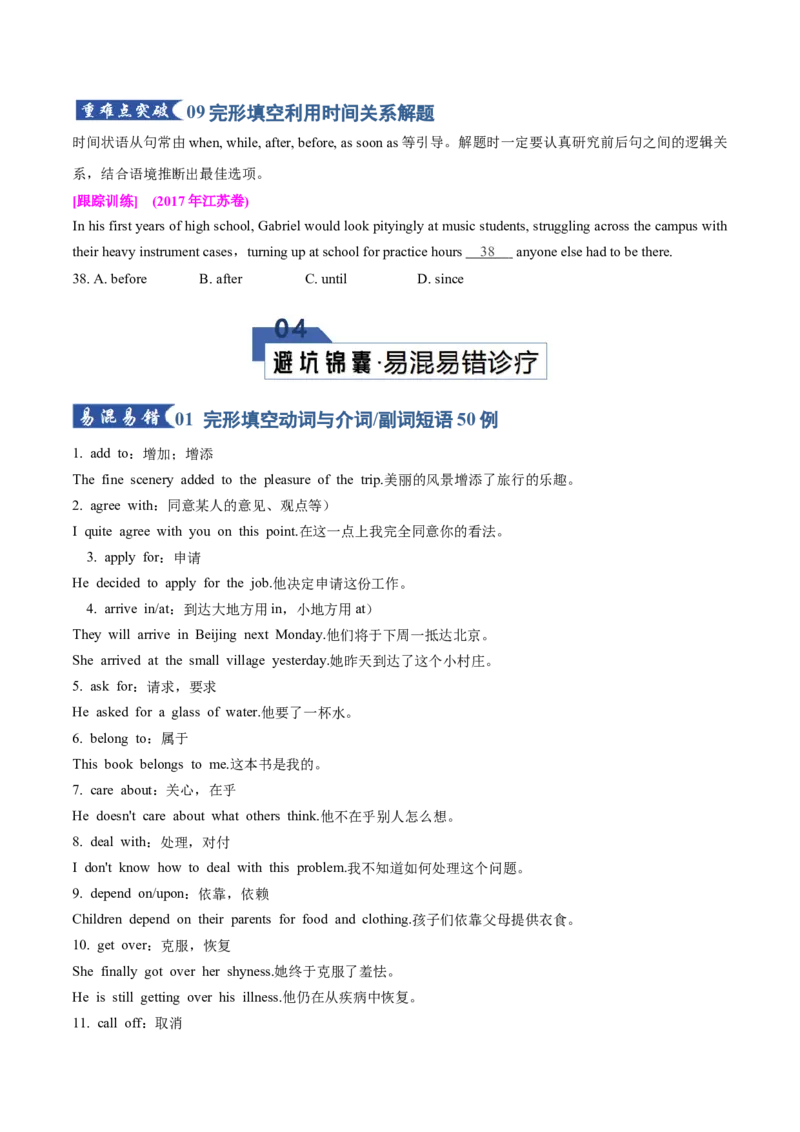
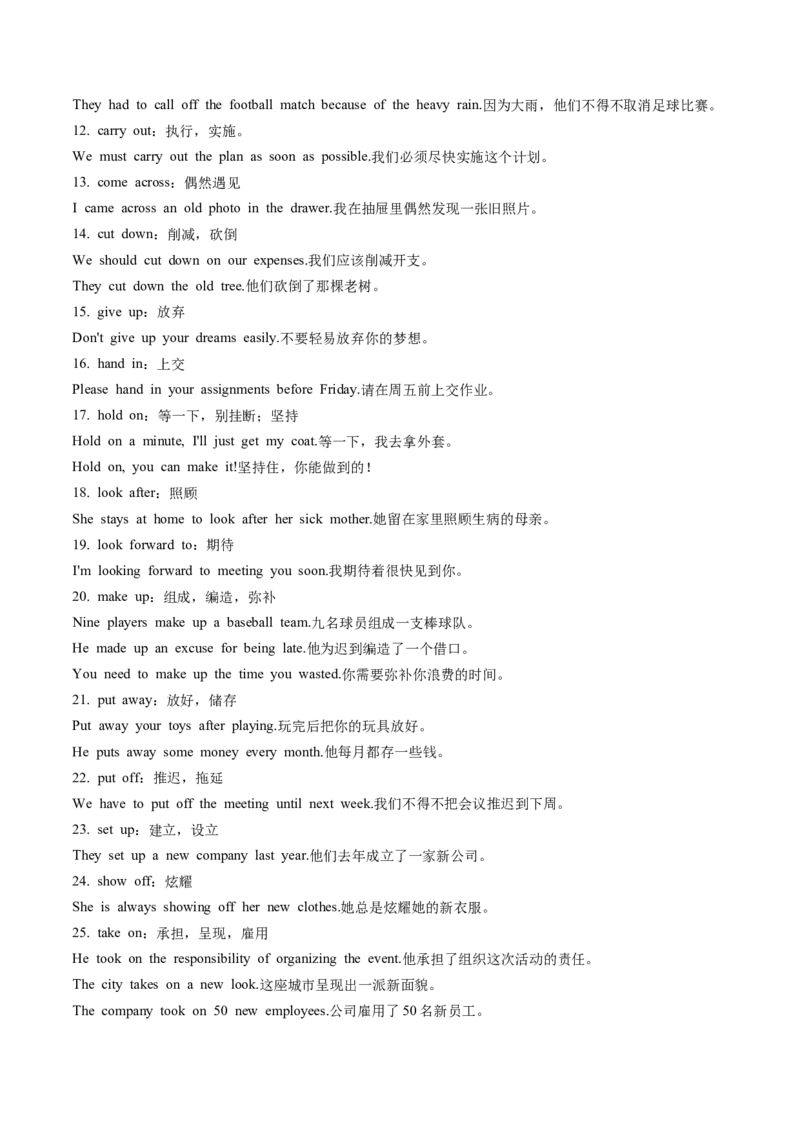
【易混易错01】动词与介词/副词短语50例
【易混易错02】be形容词与介词搭配50例
【易混易错03】高考完形填空高频动词50例
【易混易错04】完形填空高频短语50例
05 通法提炼·高频思维拆解
【方法技巧01】完形填空说明文解题步骤
【方法技巧02】完形填空说明文解题要领
【方法技巧03】完形填空说明文常见失误及对策01完形填空说明文五年高考考情统计
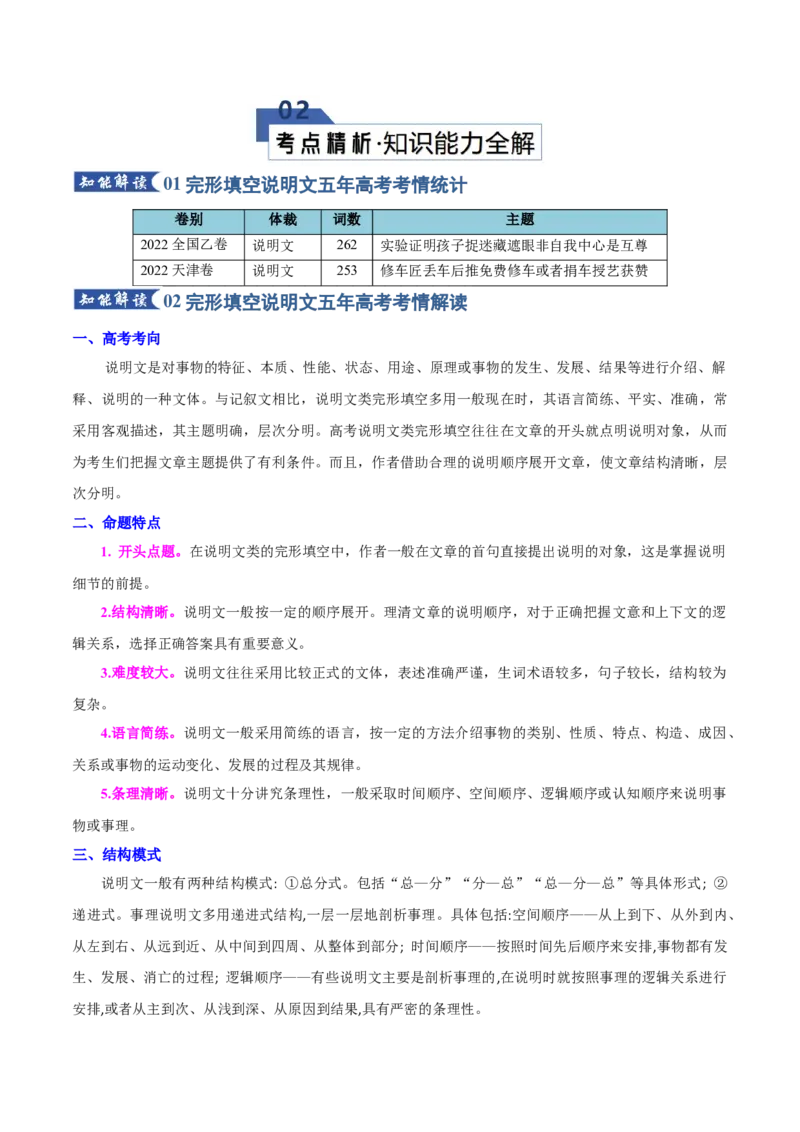
卷别 体裁 词数 主题
2022全国乙卷 说明文 262 实验证明孩子捉迷藏遮眼非自我中心是互尊
2022天津卷 说明文 253 修车匠丢车后推免费修车或者捐车授艺获赞
02完形填空说明文五年高考考情解读
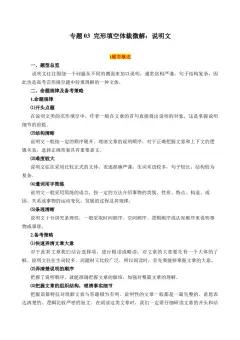
一、高考考向
说明文是对事物的特征、本质、性能、状态、用途、原理或事物的发生、发展、结果等进行介绍、解
释、说明的一种文体。与记叙文相比,说明文类完形填空多用一般现在时,其语言简练、平实、准确,常
采用客观描述,其主题明确,层次分明。高考说明文类完形填空往往在文章的开头就点明说明对象,从而
为考生们把握文章主题提供了有利条件。而且,作者借助合理的说明顺序展开文章,使文章结构清晰,层
次分明。
二、命题特点
1. 开头点题。在说明文类的完形填空中,作者一般在文章的首句直接提出说明的对象,这是掌握说明
细节的前提。
2.结构清晰。说明文一般按一定的顺序展开。理清文章的说明顺序,对于正确把握文意和上下文的逻
辑关系,选择正确答案具有重要意义。
3.难度较大。说明文往往采用比较正式的文体,表述准确严谨,生词术语较多,句子较长,结构较为
复杂。
4.语言简练。说明文一般采用简练的语言,按一定的方法介绍事物的类别、性质、特点、构造、成因、
关系或事物的运动变化、发展的过程及其规律。
5.条理清晰。说明文十分讲究条理性,一般采取时间顺序、空间顺序、逻辑顺序或认知顺序来说明事
物或事理。
三、结构模式
说明文一般有两种结构模式: ①总分式。包括“总—分”“分—总”“总—分—总”等具体形式; ②
递进式。事理说明文多用递进式结构,一层一层地剖析事理。具体包括:空间顺序——从上到下、从外到内、
从左到右、从远到近、从中间到四周、从整体到部分; 时间顺序——按照时间先后顺序来安排,事物都有发
生、发展、消亡的过程; 逻辑顺序——有些说明文主要是剖析事理的,在说明时就按照事理的逻辑关系进行
安排,或者从主到次、从浅到深、从原因到结果,具有严密的条理性。03完形填空说明文满分思维导图01 完形填空利用逻辑关系解题思维导图
02 完形填空利用因果关系解题
文中前后句之间是因果关系时,两句之间往往有表示原因和结果的关联词,如:because, so, as a result等;
但是,有时两句之间却没有表示因果的信号词,这时前后句之间存在着一种隐性的因果关系。
[跟踪训练] (2019年全国I卷)
Every year about 40000 people attempt to climb Kilimanjaro, the highest mountain in Africa. They 41
with them lots of waste. The 42 might damage the beauty of the place.
41. A. keep B. mix C. connect D. Bring
42. A. stories B. buildings C. crowds D. reporters
03 完形填空利用条件关系解题
条件关系就是指从句提出一种条件,主句说明在这种条件下产生的结果。常见关联词有 if, unless, on
condition that等。
[跟踪训练] (2016年北京卷)
The children of Nome would be 37 if it (a deadly infectious disease mainly affecting children) struck the
town. Dr. Welch needed medicine as soon as possible to stop other kids from getting sick.
37. A. harmless B. helpless C. fearless D. careless
04 完形填空利用让步关系解题
一般说来,让步关联词分为介词类和连词类。介词类的让步关联词有despite,in spite of, regardless of等,
连词类有though,although,as和while以及even if, even though等。
[跟踪训练] (2016年天津卷)Looking around, he continued, “Cathy has inspired us with her will and enthusiasm. 33 skills and talents
bring great success, the most valuable asset(财富)one can hold is the heart.”
33. A. Although B. Since C. Once D. Because
05完形填空利用转折关系解题
当前后两句的逻辑关系为转折关系时,前句往往提出某种事实或情况,后句转而陈述与前句相反或相对的
意思, 即后句才是说话人所要表达的真正意图。常见关联词:however, but, on the contrary等。
[跟踪训练] (2016年全国Ⅱ卷)
We went 10-1 and I was named most valuable player, 48 I often had crazy dreams in which I was to blame
for Miller’s accident.
48. A. and B. then C. but D. thus
06完形填空利用对比关系解题
当前后句的逻辑关系为对比关系时,两句在意义上应具有明显的差异,以便进行对照比较。常见关联词:
while, whereas, not….. but, instead等。
[跟踪训练] (2017年新课标Ⅰ卷)
The professor was deaf and any talking was prohibited. I soon realized that the silence was not unpleasant. 58
, if there had been any talking, it would have caused us to learn less.
58. A. Lastly B. Thus C. Instead D. However
07完形填空利用并列关系解题
在用并列连词and或not only…but also把两个互相独立的简单句连接而成的复合句中,前后句之间的逻辑
关系为并列关系,既可以是同近义并列,也可以反义并列。解题时,可从一个简单句推知正确答案。
[跟踪训练] (2017年新课标Ⅱ卷)
Freddy was an average student, but not an average person. He had the rare balance of fun and compassion(同
情). He would laugh the loudest over fun and be the saddest over anyone’s 46 .
46. A. misfortune B. disbelief C. dishonesty D. mistake
08完形填空利用例证关系解题
解释关系是指一个句子对另一个句子、短语或单词进行解释或说明。解释的方法既可通过某些动词(mean,
be和suggest 等),也可通过某些符号(破折号,冒号和括号等),或者关联词(for example/instance,
namely等)。 这里只讨论句子之间的解释关系。
[跟踪训练] (2017年北京卷)
In the more than five years since Hannah began her activities, she has received a lot of 51 . For example, she
received the 2007 BRICK Award recognizing the efforts of young people to change the world.
51. A. praises B. invitations C. replies D. appointments09完形填空利用时间关系解题
时间状语从句常由when, while, after, before, as soon as等引导。解题时一定要认真研究前后句之间的逻辑关
系,结合语境推断出最佳选项。
[跟踪训练] (2017年江苏卷)
In his first years of high school, Gabriel would look pityingly at music students, struggling across the campus with
their heavy instrument cases,turning up at school for practice hours 38 anyone else had to be there.
38. A. before B. after C. until D. since
01 完形填空动词与介词/副词短语50例
1. add to:增加;增添
The fine scenery added to the pleasure of the trip.美丽的风景增添了旅行的乐趣。
2. agree with:同意某人的意见、观点等)
I quite agree with you on this point.在这一点上我完全同意你的看法。
3. apply for:申请
He decided to apply for the job.他决定申请这份工作。
4. arrive in/at:到达大地方用in,小地方用at)
They will arrive in Beijing next Monday.他们将于下周一抵达北京。
She arrived at the small village yesterday.她昨天到达了这个小村庄。
5. ask for:请求,要求
He asked for a glass of water.他要了一杯水。
6. belong to:属于
This book belongs to me.这本书是我的。
7. care about:关心,在乎
He doesn't care about what others think.他不在乎别人怎么想。
8. deal with:处理,对付
I don't know how to deal with this problem.我不知道如何处理这个问题。
9. depend on/upon:依靠,依赖
Children depend on their parents for food and clothing.孩子们依靠父母提供衣食。
10. get over:克服,恢复
She finally got over her shyness.她终于克服了羞怯。
He is still getting over his illness.他仍在从疾病中恢复。
11. call off:取消They had to call off the football match because of the heavy rain.因为大雨,他们不得不取消足球比赛。
12. carry out:执行,实施。
We must carry out the plan as soon as possible.我们必须尽快实施这个计划。
13. come across:偶然遇见
I came across an old photo in the drawer.我在抽屉里偶然发现一张旧照片。
14. cut down:削减,砍倒
We should cut down on our expenses.我们应该削减开支。
They cut down the old tree.他们砍倒了那棵老树。
15. give up:放弃
Don't give up your dreams easily.不要轻易放弃你的梦想。
16. hand in:上交
Please hand in your assignments before Friday.请在周五前上交作业。
17. hold on:等一下,别挂断;坚持
Hold on a minute, I'll just get my coat.等一下,我去拿外套。
Hold on, you can make it!坚持住,你能做到的!
18. look after:照顾
She stays at home to look after her sick mother.她留在家里照顾生病的母亲。
19. look forward to:期待
I'm looking forward to meeting you soon.我期待着很快见到你。
20. make up:组成,编造,弥补
Nine players make up a baseball team.九名球员组成一支棒球队。
He made up an excuse for being late.他为迟到编造了一个借口。
You need to make up the time you wasted.你需要弥补你浪费的时间。
21. put away:放好,储存
Put away your toys after playing.玩完后把你的玩具放好。
He puts away some money every month.他每月都存一些钱。
22. put off:推迟,拖延
We have to put off the meeting until next week.我们不得不把会议推迟到下周。
23. set up:建立,设立
They set up a new company last year.他们去年成立了一家新公司。
24. show off:炫耀
She is always showing off her new clothes.她总是炫耀她的新衣服。
25. take on:承担,呈现,雇用
He took on the responsibility of organizing the event.他承担了组织这次活动的责任。
The city takes on a new look.这座城市呈现出一派新面貌。
The company took on 50 new employees.公司雇用了50名新员工。26. turn down:拒绝;调低音量等
He turned down the invitation.他拒绝了邀请。
Please turn down the radio.请把收音机音量调低。
27. turn up:出现;调高音量等
He didn't turn up at the party.他没有在聚会上出现。
Turn up the TV, I can't hear clearly.把电视音量调高,我听不清楚。
28. work out:解决;算出;锻炼
I worked out the problem finally.我终于解决了这个问题。
Can you work out this math problem?你能算出这道数学题吗?
He works out in the gym every day.他每天都在健身房锻炼。
29. figure out:弄清楚;想出
I can't figure out what he meant.我不明白他是什么意思。
We need to figure out a way to solve this.我们得想出一个办法来解决这个问题。
30. go through:经历;通过;仔细检查
She has gone through a lot of hardships.她经历了许多艰难困苦。
He went through the examination successfully.他成功通过了考试。
Please go through your papers carefully before handing them in.交卷前请仔细检查试卷。
31. fall behind:落后
If you don't study hard, you will fall behind your classmates.如果你不努力学习,你会落后于你的同学。
32. fall in love with:爱上
He fell in love with her at first sight.他对她一见钟情。
33. get rid of:摆脱,除掉
We should get rid of bad habits.我们应该改掉坏习惯。
34. hold back:阻挡;隐瞒;抑制情感等
The heavy rain held us back.大雨阻挡了我们。
Don't hold back your feelings.不要抑制你的感情。
He held back some important information.他隐瞒了一些重要信息。
35. knock at/on:敲门、窗等
Someone is knocking at the door.有人在敲门。
36. look through:浏览;仔细查看
I looked through the newspaper this morning.我今天早上浏览了报纸。
Please look through your luggage carefully.请仔细检查你的行李。
37. pass on:传递;转交
Please pass on the message to your sister.请把这个消息转告你妹妹。
Pass on the book to the next student.把书传给下一个学生。
38. put aside:储存;把……放在一边He puts aside some money for his future.他为自己的将来存了些钱。
Put aside your differences and work together.把你们的分歧放在一边,共同努力。
39. take part in:参加
We all took part in the school sports meeting.我们都参加了学校运动会。
40. catch up with:赶上,追上
I have to work hard to catch up with my classmates.我必须努力学习才能赶上我的同学。
41. come up with:想出,提出主意、计划等
He came up with a good idea.他想出了一个好主意。
42. cut off:切断;中断;隔绝
The flood cut off the village from the outside world.洪水使这个村庄与外界隔绝。
Our water supply was cut off.我们的供水被切断了。
43. bring about:导致,引起
The new policy brought about many changes.新政策带来了许多变化。
44. bring up:抚养,养育;提出
She was brought up by her grandparents.她是由祖父母抚养长大的。
He brought up a new topic at the meeting.他在会议上提出了一个新话题。
45. carry on:继续
Carry on with your work, don't stop.继续你的工作,别停下来。
46. get along with:与……相处
He gets along well with his colleagues.他和同事相处得很好。
47. get off:下车;脱下衣服等
I get off the bus at the next stop.我在下一站下车。
Get off your coat and make yourself at home.脱下外套,别拘束。
48. give in:屈服,让步
Don't give in to difficulties easily.不要轻易向困难屈服。
49. keep up with:跟上,不落后
It's hard to keep up with the latest technology.很难跟上最新的技术发展。
50. make out:辨认出;理解
I can hardly make out the words on the blackboard.我几乎看不清黑板上的字。
I can't make out what he is saying.我不明白他在说什么。
02 完形填空be形容词与介词搭配50例
1. be absent from:缺席……
She was absent from the meeting yesterday. 她昨天缺席了会议。
2. be angry with:生某人的气
My father was angry with me because I failed the exam.我父亲因为我考试不及格而生我的气。3. be busy with:忙于
He is always busy with his work.他总是忙于工作。
4. be noted for:因……而著名
Hangzhou is noted for its beautiful scenery.杭州以其美丽的风景而闻名。
5. be acquainted with:熟悉……
I am acquainted with the author of this book. 我认识这本书的作者。
6. be ashamed of:为…… 感到羞愧
He is ashamed of his rude behavior. 他为自己的粗鲁行为感到羞愧。
7. be capable of:有能力做……
She is capable of solving this difficult problem. 她有能力解决这个难题。
8. be composed of:由…… 组成
The team is composed of five experienced doctors. 这个团队由五名经验丰富的医生组成。
9. be content with:满足于……
He is content with a simple life. 他满足于简单的生活。
10. be dependent on:依赖……
Young children are dependent on their parents. 年幼的孩子依赖父母。
11. be accustomed to:习惯于
She is accustomed to the local food.她习惯了当地的食物。
12. be aware of:意识到
We should be aware of the importance of protecting the environment.我们应该意识到保护环境的重要性。
13. be familiar with:对……熟悉
He is familiar with this area.他对这个地区很熟悉。
14. be grateful to:对……感激
I am grateful to my parents for their support.我感激父母的支持。
15. be harmful to:对……有害
Smoking is harmful to your health.吸烟有害健康。
16. be loyal to:对……忠诚
He is loyal to his friends.他对朋友很忠诚。
17. be relevant to:与……相关
What you said is not relevant to the topic.你所说的与主题无关。
18. be similar to:与……相似
Your dress is similar to mine.你的裙子和我的相似。
19. be free from:不受…… 影响
We should keep the air free from pollution. 我们应保持空气不受污染。
20. be disappointed with:对……感到失望
I was disappointed with the movie.我对这部电影很失望。21. be popular with:受到某人的欢迎或喜欢
This singer is very popular with young people.这位歌手很受年轻人的欢迎。
22. be patient with:对某人有耐心
Teachers should be patient with their students.老师应该对学生有耐心。
23. be fed up with:对……极其厌倦
I'm fed up with his complaints.我听腻了他的抱怨。
24. be fond of:喜欢
She is fond of dancing.她喜欢跳舞。
25. be guilty of:犯有……罪
He was found guilty of theft.他被判定犯有盗窃罪。
26. be short of:缺少
We are short of water in this area.这个地区缺水。
27. be sure of:确信
I'm sure of his success.我确信他会成功。
28. be worthy of:值得
This book is worthy of being read.这本书值得一读。
29. be allergic to:对……过敏
She is allergic to pollen.她对花粉过敏。
30. be close to:靠近;接近
My house is close to the school.我家离学校很近。
31. be devoted to:致力于;奉献给
He is devoted to his work.他致力于他的工作。
32. be equal to:等于;能胜任
This task is not equal to his ability.这项任务超出了他的能力范围。
I don't think he is equal to the job.我认为他不能胜任这份工作。
33. be opposed to:反对
Many people are opposed to the new policy.许多人反对这项新政策。
34. be polite to:对……有礼貌
We should be polite to others.我们应该对别人有礼貌。
35. be rude to:对……粗鲁
Don't be rude to your elders.不要对长辈粗鲁。
36. be curious about:对……好奇
Children are always curious about the world around them.孩子们总是对周围的世界充满好奇。
37. be familiar to:为……所熟悉
This song is familiar to most people.大多数人都熟悉这首歌。
38. be keen on:热衷于;喜爱He is keen on playing chess.他热衷于下棋。
39. be sensitive to:对……敏感
She is sensitive to criticism.她对批评很敏感。
40. be suitable for:适合
This book is suitable for children.这本书适合儿童。
41. be thankful for:因……而感激
I'm thankful for your help.我感激你的帮助。
42. be true of:适用于;符合于
This rule is true of all cases.这条规则适用于所有情况。
43. be guilty of:犯有…… 罪;对…… 感到内疚
He was found guilty of theft. 他被判犯有盗窃罪。
She is guilty of lying to her friend. 她对向朋友撒谎感到内疚。
44. be amazed at:对……感到惊讶
We were amazed at his performance.我们对他的表演感到惊讶。
45. be excited about:对……感到兴奋
The children are excited about the trip.孩子们对这次旅行感到兴奋。
46. be bored with:对……感到厌烦.
I'm bored with this movie.我对这部电影感到厌烦。
47. be disappointed in/with:对……感到失望
She was disappointed in/with the result.她对结果感到失望。
48. be rich in:富含…….
This area is rich in natural resources.这个地区自然资源丰富。
49.be lacking in:缺乏……
The project is lacking in sufficient funds. 这个项目缺乏足够的资金。
50.be independent of:独立于……
After graduation, she became independent of her family. 毕业后,她不再依赖家人。
03高考完形填空高频动词50例
1.abandon vt. 遗弃 9.allocate vt. 分配
2.accompany vt. 陪伴;为…伴奏 10.analyze vt. 分析
3.acquire vt. 获得 11.appeal vi. 呼吁;有吸引力;上诉
4.admit vt. 承认;准许进入 12.appoint vt. 委派,任命
5.adjust vt. 调节,适应 13.assess vt. 评估
6.adopt vt. 采用;收养 14.assume vt. 假定
7.advocate vt. 提倡,主张 15.attach vt. 附,系,贴
8.afford vt. 承受得起;买得起 16.attempt vt. 企图,尝试17.average vt. 平均 34.contradict vt. 反驳;矛盾
18.bargain vi. 讨价还价 35.convince vt. 使信服;说服
19.bathe vt.使沐浴(在光线里) 36.deliver vt. 递送;发表
20.bear vt. 忍受;承受 37.declare vt. 宣告;申报;声明
21.bite vt. 咬;叮,蜇 38.deny vt. 否认;拒绝承认
22. bother vt. 打扰 39.dismiss vt. 解散
23.betray vt. 背叛 40.disturb vt. 扰乱;妨碍
24.budget vt. 预算 41.donate vt. 捐赠;捐献
25.calculate vt. 计算,估计 42.drag vt. 拖,拉
26.clarify vt. 阐明,澄清 43.define vt. 给…… 下定义
27.confirm vt. 确认,证实 44.deserve vt. 值得
28.crash vi. 碰撞;撞击 45.distinguish vt. 辨别,分清
29.cancel vt. 取消,撤销 46.distribute vt. (有计划地)分发
30.claim vt. 要求;宣称,断言 47.encounter vt. 遭遇;邂逅
31.commit vt. 犯(罪);承诺 48.evaluate vt. 评估
32.comprehend vt. 理解 49.expand vt. 扩大
33.compromise vi. 妥协;让步 50.expose vt. 揭露;暴露
04 完形填空高频短语50例
1.of great significance 具有重大意义 15.attach importance to 重视
2.be consistent with 与…一致 16.kiss sb on the forehead亲吻某人的额头
3.consist of 由…组成 17.at the sight of 一看到…就
4.tend to the baby 照顾婴儿 18.at large 逍遥法外;整体上
5.as scheduled 按计划 19.arise from 由…引起
6.to one’s horror 令某人恐惧的是 20.by accident 意外地
7.have a passion for 对…有热情 21.be subject to sth 易受…影响
8.be passionate about 对…充满热情 22.relate to 与…相关;理解
9.show sympathy for 对…表示同情 23.in conclusion 总之
10.in a flash 一瞬间 24.in a civil manner 以文明的方式
11.pass on knowledge 传授知识 25.pull up (车辆)停下
12.in one’s absence 某人不在的时候 26.result from 起因于
13.step in 介入;插手 27.bring about 导致
14.lift bans on 解除对…的禁令 28.be exposed to sth 暴露于…29.be immune to sth 对…有免疫力 40.cancel out 抵消
32.be worthy of… 配得上…… 41.gain an insight into 深入了解
30.give priority to 优先考虑 42.be sensitive to… 对…敏感
32.at risk 有风险 43.be dedicated to doing 专心于做…
33.to a degree 在一定程度上 44.originate from 起源于
34.owe one’s success to 把成功归功于 45.beyond control 无法控制
35.in person 亲自 46.in effect 实际上
36.take responsibility for 对…负责 47.team up with 与…合作
37.go to great lengths 不遗余力 48.rise to one’s feet 站起来
38.in total 总共 49.look back on 回顾
39.gain in popularity 越来越受欢迎 50.show off 炫耀
01 完形填空说明文解题步骤02 完形填空说明文解题要领
一、明确说明对象,理清段落关系。
通读全文,明确作者是针对哪一个说明对象从不同的角度和侧面对其加以说明的。在阅读过程中要概
括、总结每一段说明的侧重点,理清各段之间的关系,加深对说明对象的理解。
二、弄清说明顺序,把握作者态度。
在说明的过程中作者会选择合理的说明顺序对说明对象进行解说。把握了说明顺序就能准确把握文章
的脉络,加深对整篇文章的理解。常见的说明顺序有时间顺序、空间顺序、逻辑顺序(如因果关系、果因关
系、先主后次等)和认识顺序(如由此及彼、由浅入深、由局部到整体、由现象到本质等)。另外,在理清作
者思路的基础上,还要注意反映作者态度的关键词或关键句,把握作者的写作情感和意图。
03 完形填空说明文常见失误及对策
一、词汇理解障碍
熟词生义:常见词汇在特定语境中可能有不熟悉的含义,如“grade”表示“程度”而非“年级”,需
结合上下文判断。
词义辨析:形近词、近义词或固定搭配易混淆,如“in vain”(徒劳)与“on purpose”(故意)需
根据语境区分。
二、逻辑关系误判
因果、转折等关系:需通过关联词(如“because”“however”)或上下文线索判断逻辑,如“虽然
孩子遮住眼睛,但他们认为‘我能看到你,你也能看到我’”,体现转折关系。
隐性逻辑:部分题目无明显关联词,需根据语境推断隐性因果或对比关系。
三、缺乏全篇关联思维
语篇层次题:答案需结合全文脉络、作者意图或段落间逻辑推断,如说明文可能通过首尾呼应或段落
结构体现核心观点,需通读全文把握整体思路。四、常识与背景知识不足
部分题目涉及科学、文化等背景知识,如“乞力马扎罗山的冰川融化”需了解其地理特征,缺乏相关
知识可能导致误判。
完形填空说明文综合能力提升
真题专区:研读高考真题,洞悉高考命题规律,探寻满分做题技巧和应试思维
01 (2022全国乙卷) 阅读下面短文, 从各题所给的A、B、C和D四个选项, 选出可以填入空白处的最佳选
项。
Young children across the globe enjoy playing games of hide and seek. For them, there’s something highly
exciting about 41 someone else’s glance and making oneself unable to be seen.
However, we all witness that preschool children are remarkably 42 at hiding. They often cover only
their eyes with their hands, leaving the rest of their bodies 43 .
For a long time, this ineffective hiding method was 44 as evidence that children are hopelessly
“egocentric” (自我中心的) creatures. But our 45 research results in child developmental psychology
46 that idea.
We brought young children aged 2-4 into our Minds in Development Lab at USC. Each 47 sat down
with an adult who covered her own eyes or 48 . We then asked the child if she could 49 or hear
the adult. Surprisingly, children replied that they couldn’t. The same 50 happened when the adult covered
her own mouth: 51 children said that they couldn’t 52 to her.
A number of 53 ruled out that the children misunderstood what they were being asked. The results
were clear: Our young subjects 54 the questions and knew 55 what was asked of them. Their
56 to the questions reflected their true 57 that “I can see you only if you can see me, too.” They
simply 58 mutual (相互的) recognition and regard. Our 59 suggest when a child “hides” by
putting a blanket over her head, it is not a result of egocentrism. In fact, children consider this method 60
when others use it.
41. A. following B. taking C. escaping D. directing
42. A. clever B. bad C. scared D. quick
43. A. exposed B. examined C. untouched D. imbalanced
44. A. supported B. guaranteed C. imagined D. interpreted
45. A. disappointing B. mixed C. surprising D. desired
46. A. explained B. confirmed C. contradicted D. tested
47. A. parent B. child C. researcher D. doctor
48. A. feet B. nose C. hands D. ears
49. A. see B. help C. reach D. fool
50. A. event B. thing C. action D. accident
51. A. Yet B. Now C. Soon D. Once52. A. speak B. listen C. turn D. wave
53. A. instructions B. descriptions C. experiments D. assumptions
54. A. comprehended B. predicted C. explored D. ignored
55. A. partly B. honestly C. vaguely D. exactly
56. A. responses B. approaches C. contribution D. sensitivity
57. A. ability B. belief C. identity D. purpose
58. A. hold back B. relate to C. insist on D. make up
59. A. limitations B. requirements C. theories D. findings
60. A. tentative B. impressive C. creative D. effective
02 (2022天津卷) 阅读下面短文, 从各题所给的A、B、C和D四个选项, 选出可以填入空白处的最佳选项。
For most people, having things stolen feels like an offence. Robbie Pruitt admitted that he got 16
when he discovered the theft of his mountain bike last September. But soon enough, his 17 took a turn.
After letting go of his anger and frustration, he found himself on a road to sympathy 18 .
For Pruitt, a keen bicyclist, the first thing to do was 19 his stolen bike. But when he went bike
shopping, he found few available, which got him thinking: What if the 20 of bikes was Covid-19 related,
and what if the person who'd taken his bike really needed 21 to get to work?
With that thought in mind, Pruitt 22 a plan and posted it on the community website. He 23
to fix bikes free of charge for anyone who needed it. He also asked for unwanted bikes, which he would repair-
again 24 . And then he would donate them to folks who could truly use them but didn't have the 25
to buy one.
The day the post went live, Pruitt received thirty 26 bicycles. Then came more than 500 27
for detailed information. By the end of 2020, Pruitt had repaired more than 140 for donation or to be 28
to their owners.
Pruitt tries to give his donations to families that are 29 struggling. 30 simply satisfying a
material need, he has provided an opportunity for kids in his neighborhood to learn how to fix their own bikes.
In addition to 31 skills, Pruitt's lessons teach teamwork, encourage self-worth, and promote feelings
of community. 32 , the kids have gained a sense of accomplishment.
"It's a really great 33 for kids,“ said a neighbor in an interview with the local newspaper. "Pruitt is
certainly providing a 34 , but it's not just the bikes. It's the relationships in the community. It's the 35
that he can make on people."
16. A. amazed B. mad C. curious D. frightened
17. A. emotions B. career C. opinions D. route
18. A. ever B. together C. instead D. yet
19. A. ride B. lock C. repair D. replace
20. A. lack B. variety C. increase D. quality
21. A. instruction B. qualification C. transportation D. permission
22. A. came up with B. stuck to C. gave up D. broke away from
23. A. remembered B. refused C. hesitated D. offered
24. A. by accident B. in advance C. for free D. on credit25. A. profit B. budget C. courage D. excuse
26. A. shared B. used C. expensive D. modern
27. A. enquiries B. advertisements C. notices D. announcements
28. A. exported B. sold C. lent D. returned
29. A. hardly B. slightly C. truly D. instantly
30. A. Without B. Beyond C. Upon D. Among
31. A. practical B. commercial C. mathematical D. social
32. A. Otherwise B. However C. Somehow D. Meanwhile
33. A. promise B. celebration C. comfort D. experience
34. A. competition B. service C. ceremony D. suggestion
35. A. compromise B. impression C. impact D. progress
03 (2015广东卷) 阅读下面短文, 从各题所给的A、B、C和D四个选项, 选出可以填入空白处的最佳选项。
How long can human beings live? Most scientists who study old age think that the human body is 1 to
live no longer than 120 years. However, 110 years is probably the longest that anyone could hope to live — if he or
she is 2 healthy and lucky. Some scientists even say we can live as long as 130 years! Yet, our cells simply
cannot continue to reproduce 3 . They wear out, and as a result, we get old and 4 die.
Even though we can’t live forever, we are living a 5 life than ever before. In 1900, the average
American life span(寿命)was only 47 years, but today it is 75 years!
When does old age begin then? Sixty-five may be out-of-date as the 6 line between middle age and
old age. After all, many older people don’t begin to experience physical and mental 7 until after age 75.
People are living longer because more people 8 childhood. Before modern medicine changed the laws
of nature, many children died of common childhood 9 . Now that the chances of dying 10 are much
lower, the chances of living long are much higher due to better diets and health care.
On the whole, our population is getting older. The 11 in our population will have lasting effects on our
social development and our way of life. Some people fear such changes will be for the worse, while some see 12
, not disaster. Today, many men and women in their "golden years" are healthy, still active, and young in 13 if
not in age.
As our society grows old, we need the 14 of our older citizens. With long lives ahead of them, they
need to 15 active and be devoted.
1. A. designed B. selected C. improved D. discovered
2. A. completely B. generally C. apparently D. extremely
3. A. rapidly B. harmlessly C. endlessly D. separately
4. A. eventually B. hopelessly C. automatically D. desperately
5. A. busier B. longer C. richer D. happier
6. A. finishing B. guiding C. waiting D. dividing
7. A. stress B. damage C. decline D. failure
8. A. survive B. enjoy C. remember D. value
9. A. problems B. fears C. worries D. diseases
10. A. poor B. young C. sick D. quiet
11. A. changes B. recovery C. safety D. increases12. A. dreams B. chances C. strengths D. choices
13. A. mind B. appearance C. voice D. movement
14. A. protection B. suggestions C. contributions D. permission
15. A. sound B. appear C. turn D. stay
04(2015安徽卷)阅读下面短文, 从各题所给的A、B、C和D四个选项, 选出可以填入空白处的最佳选项。
In our modern world, when something wears out, we throw it away and buy a new one. The 1 is that
countries around the world have growing mountains of 2 because people are throwing out more rubbish
than ever before.
How did we 3 a throwaway society? First of all, it is now easier to 4 an object than to spend
time and money to repair it. 5 modern manufacturing (制造业)and technology, companies are able to
produce products quickly and inexpensively. Products are plentiful and 6 .
Another cause is our 7 of disposable (一次性的) products. As 8 people, we are always
looking for 9 to save time and make our lives easier. Companies 10 thousands of different kinds
of disposable products: paper plates, plastic cups, and cameras, to name a few.
Our appetite for new products also 11 to the problem. We are 12 buying new things.
Advertisements persuade us that 13 is better and that we will be happier with the latest products. The
result is that we 14 useful possessions to make room for new ones.
All around the world, we can see the 15 of this throwaway lifestyle. Mountains of rubbish just
keep getting bigger. To 16 the amount of rubbish and to protect the 17 , more governments are
requiring people to recycle materials. 18 , this is not enough to solve (解决) our problem.
Maybe there is another way out. We need to repair our possessions 19 throwing them away. We
also need to rethink our attitudes about 20 . Repairing our possessions and changing our spending habits
may be the best way to reduce the amount of rubbish and take care of our environment.
1. A. key B. reason C. project D. problem
2. A. gifts B. rubbish C. debt D. products
3. A. face B. become C. observe D. change
4. A. hide B. control C. replace D. withdraw
5. A. Thanks to B. As to C. Except for D. Regardless of
6. A. safe B. funny C. cheap D. powerful
7. A. love B. lack C. prevention D. division
8. A. sensitive B. kind C. brave D. busy
9. A. ways B. places C. jobs D. friends
10. A. donate B. receive C. produce D. preserve
11. A. adapts B. returns C. responds D. contributes
12. A. tired of B. addicted to C. worried about D. ashamed for
13. A. newer B. stronger C. higher D. larger
14. A. pick up B. pay for C. hold onto D. throw away
15. A. advantages B. purposes C. functions D. consequences
16. A. show B. record C. decrease D. measure17. A. technology B. environment C. consumers D. brands
18. A. However B. Otherwise C. Therefore D. Meanwhile
19. A. by B. in favour of C. after D. instead of
20. A. spending B. collecting C. repairing D. advertising
05(2010安徽卷)阅读下面短文, 从各题所给的A、B、C和D四个选项, 选出可以填入空白处的最佳选项。
Most people give little thought to the pens they write with, especially since the printers in modern homes and
offices mean that very 1 things are handwritten. All too often, people buy a pen based only on 2 ,
and wonder why they are not satisfied 3 they begin to use it. However, buying a pen that you’ll enjoy is not
4 if you keep the following in mind. First of all, a pen should fit comfortably in your hand and be 5 to
use. The thickness of the pen is the most important characteristic (特征) 6 comfort. Having a small hand and
thick fingers, you may comfortable with a thin pen. If you have a 7 hand and thicker fingers you may 8
a fatter pen. The length of a pen can 9 influence comfort. A pen that is too 10 can easily feel
top heavy and unstable.
Then, the writing point of the pen should 11 the ink to flow evenly(均匀的) while that pen remains in
touch with the paper. 12 will make it possibly for you to create a 13 line of writing. The point
should also be sensitive enough to 14 ink from running when the pen is lifted. A point that does not
block the 15 may leave drops of ink, 16 you pick the pen up and put it down again.
17 , the pen should make a thick, dark line. Fine line pens may 18 bad handwriting,
but fine, delicate lines do not command 19 next to printed text, as, 20 , a signature on a
printed letter. A broader line, on the other hand, gives an impression of confidence and authority (权威)。
1. A. many B. few C. pleasant D. important
2. A. looks B. reason C. value D. advantages
3. A. once B. if C. because D. though
4. A. convenient B. practical C. strange D. difficult
5. A. heavy B. easy C. hard D. safe
6. A. taking B. finding C. determining D. seeking
7. A. strong B. weaker C. smaller D. larger
8. A. prefer B. recommend C. prepare D. demand
9. A. hardly B. also C. never D. still
10. A. thick B. light C. long D. soft
11. A. change B. allow C. reduce D. press
12. A. they B. one C. this D. some
13. A. thin B. rough C. black D. smooth
14. A. prevent B. free C. protect D. remove
15. A. way B. sight C. flow D. stream
16. A. so B. as C. and D. yet
17. A. Meanwhile B. Generally C. Afterwards D. Finally
18. A. show up B. differ from C. break down D. compensate for
19. A. attention B. support C. respect D. admission20. A. at most B. for example C. in brief D. on purpose
模拟专区:精选名校真题好题,帮你锤炼做题技巧,助力冲刺备考圆梦高考
01(25-26高三上·黑龙江牡丹江·阶段练习)阅读下面短文, 从各题所给的A、B、C和D四个选项, 选出可
以填入空白处的最佳选项。
People believe that having pets is overall a good thing for children. But does this belief hold up to 1
? The new field of human-animal interaction aims to find out.
Ten years ago, when psychologist Joan Smith reviewed the literature on child-animal relationships, she
reported that interacting with animals led young children to better understand biology than pet-less children.
Kindergarteners who had cared for goldfish were more 2 when responding to questions like “does a
goldfish have a heart?” They also more easily 3 biological information from one species to another,
inferring that baby frogs get bigger just like goldfish do. She also reports that those kids who turned to their pets for
emotional support were less 4 than those who didn’t.
The past ten years have seen some advances, but literature on the topic is still rather 5 A recent
paper by researcher Meg Brown at Lakeside University 6 some important information to the discussion.
She turned to a database that includes information from 7,000 kids, ranging in 7 from thirteen to nineteen
years. For the study, both pet owning and other types of 8 activities, like horseback riding, were
considered as human-animal interaction experience.
She found that adolescents with animal experience were more likely to see themselves as important 9
to their communities, such as doing community service. She also found that the higher the level of 10
between a teenager and animals, the higher they scored on measurements of emotional connectedness in general.
While causality (因果关系) cannot be determined, Brown says that it is at least 11 that children and
adolescents can learn about healthy social relationships from their experiences of interacting with animals. “If a
connection exists between the skills required for these relationships, then it might be useful to make use of animal
relationships as a way to 12 the development of social skills,” she says.
Brown is aware of the limitations of her study. It can’t reach any conclusions about the causal role of animals
in kids’ lives, and it’s limited to 13 nationwide. Besides, the study was not designed to 14
any potential negative effects of human-animal interaction experiences. Some other studies, for example, have
shown that pet owners have higher levels of psychological 15 like depression, than non-pet owners.
1. A. scientific evidenceB. common sense C. natural tendencies D. universal assumptions
2. A. enthusiastic B. accurate C. serious D. curious
3. A. judged B. collected C. transferred D. spread
4. A. anxious B. vigorous C. ambitious D. cautious
5. A. fascinating B. reliable C. varied D. limited
6. A. owes B. restricts C. adds D. adapts
7. A. status B. height C. age D. performance
8. A. animal-related B. animal-led C. animal-watching D. animal-friendly
9. A. donators B. contributors C. delegates D. witnesses
10. A. difference B. attachment C. education D. disapproval11. A. uncertain B. questionable C. misleading D. possible
12. A. promote B. engage C. block D. involve
13. A. researchers B. pet owners C. pet-less children D. teenagers
14. A. make up for B. do away with C. take advantage of D. throw light on
15. A. needs B. disorders C. tests D. explanation
02(25-26高三上·宁夏银川·阶段练习)阅读下面短文, 从各题所给的A、B、C和D四个选项, 选出可以填
入空白处的最佳选项。
In the thick of (在……繁忙时) graduate studies at the University of Chicago, Constanza Rodriguez remembers
feeling burnt-out. “Nothing was working in the lab, and I was very 1 ,” Rodriguez says. That’s when she
decided to 2 the school’s Ballroom and Latin Dance Association. Soon, she found herself 3
nine or more hours a week, 4 making moves on three-inch heels (高跟鞋). Dancing took hours away
from her research, and yet Rodriguez, who’s now a neurobiologist at the University of Alabama, quickly 5
that it was making her a better researcher. “The time I did spend in the lab was so much more 6 ; I could
feel myself thinking 7 and remembering things better.”
Her experience confirmed an increasing number of research findings about the 8 of the brain:
Molecules (分子) produced by muscles in 9 can improve the structure and condition of the brain.
Scientists used to think that the brain 10 the body, while the body worked passively by sending signals of
11 back to the brain, which was always in charge like a ruler.
However, research in the last few years has 12 that belief. More studies have suggested that
exercise has significant effects on the brain, including 13 the brain’s capacity to regenerate neurons (神
经元) and improving neuron-to-neuron communication. “The emerging data really show that the brain is not this
one-way organ that dominates the 14 of the body,” says muscle researcher Christoph Handschin. “ 15
, there’s a complex interaction between these systems.”
1. A. frightened B. stressed C. embarrassed D. confused
2. A. join B. organize C. investigate D. interview
3. A. driving B. suffering C. practicing D. teaching
4. A. nervously B. painfully C. fortunately D. cheerfully
5. A. imagined B. realized C. remembered D. predicted
6. A. efficient B. flexible C. appropriate D. accurate
7. A. honestly B. personally C. creatively D. sympathetically
8. A. safety B. health C. size D. problem
9. A. anxiety B. relief C. harmony D. motion
10. A. examined B. controlled C. followed D. ignored
11. A. sensation B. awareness C. emotion D. preference
12. A. accepted B. restated C. emphasized D. shaken
13. A. reflecting B. evaluating C. increasing D. restricting
14. A. weight B. recovery C. rest D. structure
15. A. Otherwise B. Besides C. Therefore D. Rather
03(24-25高一上·重庆·开学考试)阅读下面短文, 从各题所给的A、B、C和D四个选项, 选出可以填入空白处的最佳选项。
History is always an important part of every school’s curriculum. In reality, some children find no interest in
history, while others consider history as one of the most 1 courses they have ever learned. To 2 all
school students to learn history, teachers should change the ways of lecture delivery.
One method is to 3 modern technology. Teachers should provide children with Internet-based
computers to help them get instant 4 to the huge resources on the Internet. In this way, it takes them only a
few minutes to search for the information online, and another few minutes to 5 it with their friends on
social media platforms. In addition, children love cartoons. Therefore, teachers should 6 lectures in the
form of animation videos 7 depending only on textbooks, which may put a sense of 8 on children’s
history-learning process. This way enables children to remember lectures easily.
Another 9 is to visit historical sites more often. Since children may get 10 when teachers
only request them to read books all day, taking them to the real historical places seems to be better. A historical site
includes real objects or tools, 11 students’ attitudes towards history in a positive way. For example, a
military hand-held radio can help children understand the 12 between different armies in the battle from the
inside out 13 a teacher shows its details and lectures at the same time.
In a word, a 14 can use modern technology or take children to historical sites in order to 15
their interest towards history courses.
1. A. funny B. exciting C. challenging D. upsetting
2. A. force B. teach C. encourage D. demand
3. A. take advantage of B. take pride in C. make peace with D. lay stress on
4. A. application B. change C. entrance D. access
5. A. compare B. connect C. share D. provide
6. A. deliver B. attend C. make D. hold
7. A. in spite of B. instead of C. other than D. more than
8. A. power B. pain C. direction D. comfort
9. A. step B. plan C. method D. skill
10. A. bored B. lazy C. annoyed D. active
11. A. controlling B. shaping C. reflecting D. showing
12. A. struggle B. communication C. secret D. difference
13. A. because B. until C. if D. unless
14. A. volunteer B. speaker C. historian D. lecturer
15. A. draw B. express C. protect D. discover
04(25-26高三上·福建厦门·开学考试)阅读下面短文, 从各题所给的A、B、C和D四个选项, 选出可以填
入空白处的最佳选项。
Every year, my children participate in their school’s Spirit Week. Each day has a certain 1 :
Monday is Pajama Day, Tuesday is crazy Hair Day, and Wednesday is Dress as Your Favorite Fictional Character
Day. On Monday, my kids are overflowing with excitement about 2 their costumes. On Tuesday, the
3 is lower, but they are still willing to try. By Thursday, they will no longer be bothered.
What is engaging on Monday becomes 4 by Friday. It’s natural 5 our brains have abasic feature that governs every nerve cell, called habituation, which is our tendency to respond less and less to the
same 6 . For example, you enter a bakery, and after about 20 minutes, you no longer 7 the
smell of fresh dessert. Just as you’ve got used to the smell of baked goods, you also get used to the 8 of
going to school in costume.
So, even the sparkle of exciting events 9 after a while. But there’s a way to make the good stuff
“resparkle”: 10 the good experiences into bits. For example, think of a song you like. Do you think you
would enjoy a song more if you listened to it 11 or with short interruptions? When surveyed, most people
said they would 12 interruptions. Yet, research has found people appreciate a song more with 13
. The initial joys will last longer since interruptions 14 habituation. From this perspective, schools should
have five “spirit days” scattered throughout the year 15 having a “spirit week”.
1. A. opportunity B. challenge C. theme D. dilemma
2. A. picking out B. storing up C. searching for D. making up
3. A. regret B. standard C. enthusiasm D. pride
4. A. essential B. available C. tricky D. boring
5. A. if B. because C. unless D. so
6. A. delivery B. knowledge C. stimulation D. illustration
7. A. notice B. mind C. preserve D. adjust
8. A. approach B. relief C. issue D. thrill
9. A. returns B. spreads C. fades D. waves
10. A. engage B. divide C. recall D. mix
11. A. continuously B. randomly C. immediately D. rarely
12. A. welcome B. clarify C. record D. avoid
13. A. backgrounds B. popularity C. breaks D. significance
14. A. reduce B. promote C. deepen D. predict
15. A. regardless of B. instead of C. owing to D. thanks to
05(2025高一·全国·专题练习)阅读下面短文, 从各题所给的A、B、C和D四个选项, 选出可以填入空白
处的最佳选项。
The kite is believed to have originated in China. Since its invention, there have been many 1 to the kite
by various cultures around the world. The kite you probably flew as a kid looks a bit different to the 2
Chinese kites and even the kites of modern China.
Kites were 3 in the early Warring States Period by Mozi and Lu Ban, two philosophers who came
after the teachings of Confucius. The kites were 4 to China for many years before the knowledge of how to
make and use them advanced. The period 5 many attacks from foreign powers, as well as civil unrest. Kites
played a role in providing military intelligence for the 6 .
The first kites were what we today would call prototype kites: they were made of light wood and cloth. They
were 7 to mimic (模仿) a bird’s natural flight. The first Chinese kites were used for 8 distances,
which was useful information for moving large armies across difficult 9 . They were also used to calculate
and record wind readings and 10 a unique form of communication similar to ship flags at sea.
Chinese kites 11 represent mythological characters, symbolic creatures, as well as legendary12 . Some have whistles or strings designed to make unique 13 while flying. Besides, they can be
14 two categories: large and small kites. Today, you will see people flying small kites with children in many
Chinese parks. You can also see adults flying larger kites and using more advanced methods with larger ropes to
15 the great size.
1. A. explorations B. discussions C. adaptations D. solutions
2. A. unique B. common C. original D. colorful
3. A. invented B. flown C. unearthed D. used
4. A. strange B. familiar C. imaginary D. particular
5. A. survived B. saw C. overtook D. handled
6. A. forces B. towns C. factories D. educators
7. A. described B. decorated C. designed D. pictured
8. A. covering B. measuring C. marking D. recording
9. A. rivers B. situations C. valleys D. areas
10. A. created B. established C. developed D. provided
11. A. usually B. exactly C. normally D. commonly
12. A. stories B. figures C. cartoons D. traditions
13. A. sounds B. structures C. shapes D. adjustments
14. A. compared with B. based on C. divided into D. made of
15. A. drive B. support C. maintain D. operate
06(25-26高二上·全国·课后作业)阅读下面短文, 从各题所给的A、B、C和D四个选项, 选出可以填入空
白处的最佳选项。
In 2009 a group of parents in an English town started sharing worries about their children’s money
management skills. Shopping was done online; the children 1 saw their parents handling cash. They were
2 online, too. Money had become intangible (无形的). How, then, would children learn its 3 ?
The answer they 4 was GoHenry, an app now available in Britain. It is designed to help young
people learn good 5 habits through real-world money management. Parents signed up with their own
bank account and paid a monthly 6 of $2.99 for each child aged six or over. Adults and children 7
separate versions. At the end of last year, 379,000 children had active accounts.
Parents can schedule pocket money and 8 tasks. When those tasks are marked as 9 , the
child is paid some money back as a reward. Parents can see what the child has 10 and where the child
gets that. And children choose 11 to use the card: in shops, online or at ATMs.
Children get debit cards (借记卡) with their own name. They can 12 their spending and set
savings targets. They can decide to 13 for someone’s birthday or set a goal at 12 to 14 $2,000
to buy a car at age 18. The app tells them how much to save each week to meet their 15 .
1. A. seldom B. regularly C. suddenly D. only
2. A. playing B. writing C. spending D. talking
3. A. benefit B. material C. history D. value
4. A. went away from B. put up with C. came up with D. looked down on
5. A. physical B. financial C. social D. cultural6. A. fee B. fine C. reward D. salary
7. A. expect B. create C. download D. make
8. A. finish B. set C. enjoy D. change
9. A. done B. lost C. gone D. used
10. A. bought B. read C. eaten D. worn
11. A. who B. where C. why D. what
12. A. look B. continue C. build D. view
13. A. complete B. return C. save D. bring
14. A. donate B. own C. waste D. borrow
15. A. demands B. rules C. goals D. deadlines