清单 03 完形填空之说明文
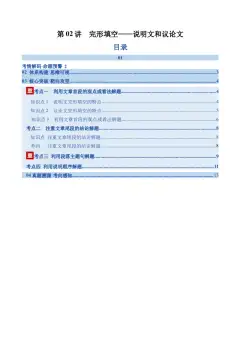
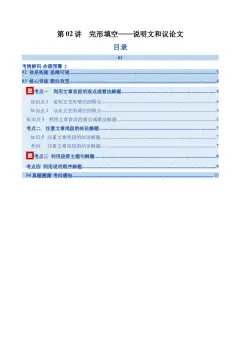
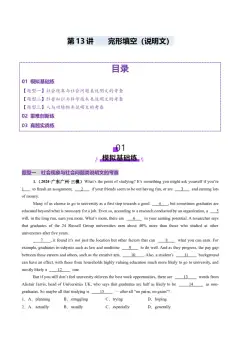
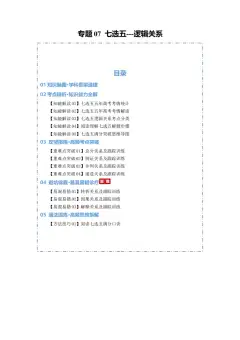
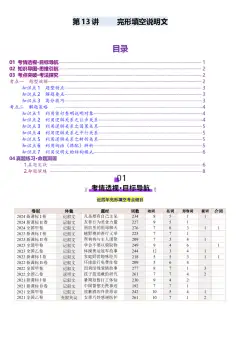
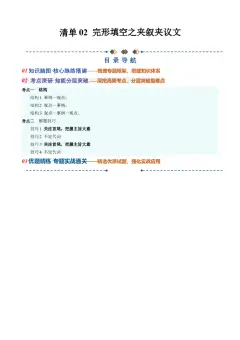
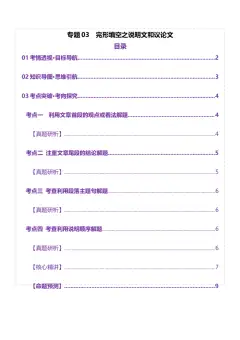
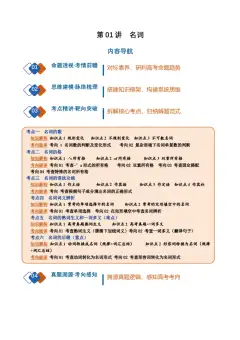
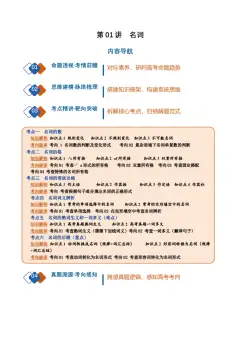
目 录 导 航
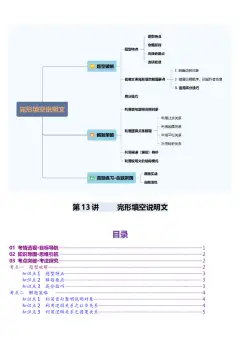
01知识脑图·核心脉络搭建——梳理专题框架,搭建知识体系
02 考点深研·知能分层突破——深挖高频考点,分层突破重难点
考点一 特点
知识点1 首句直接提出说明的对象;
知识点2 一般按一定的顺序展开;
知识点3 往往采用比较正式的文体,表述准确严谨;
知识点4 一般采用简练的语言;
知识点5 讲究条理性。
考点二 技巧点拨
技巧1 快速掌握文章大意
技巧2 理清说明顺序
技巧3 把握文章的组织结构和事实细节
技巧4 注重上下文语境
03优题精练·专题实战通关——精选优质试题,强化实战应用知识脑图·核心脉络搭建
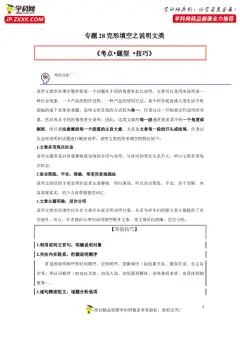
考点深研●知能分层突破
说明文往往围绕一个问题从不同的侧面来加以说明,通常结构严谨,句子结构复杂,因此也是高考完
形填空题中较难理解的一种文体。其主要特点为:1.作者一般在文章的首句直接提出说明的对象,这是掌
握说明细节的前提;2.一般按一定的顺序展开,理清文章的说明顺序,对于正确把握文意和上下文的逻辑
关系,选择正确答案具有重要意义;3.往往采用比较正式的文体,表述准确严谨,生词术语较多,句子较
长,结构较为复杂;4.一般采用简练的语言,按一定的方法介绍事物的类别、性质、特点、构造、成因、
关系或事物的运动变化、发展的过程及其规律;5.讲究条理性,一般采取时间顺序、空间顺序、逻辑顺序
或认知顺序来说明事物或事理。
技巧1. 快速掌握文章大意
对于此类文章我们结合选择项,进行粗读或略读,对文章的大意要先有一个大体的了解。说明文往往
生词较多,而题材又比较广泛,所以阅读时,首先要能够掌握文章的大意。
As children returned to school in Sweden last month, many of their teachers were putting new importance on
some traditional skills. These included reading printed books, quiet reading time and 1 practice. Teachers
were spending 2 time with digital devices, online research and typing skills.
The return to traditional ways of learning might be the 3 to criticism about dependence on
electronic technology in education. Critics 4 that students are not learning basic skills with the
introduction of tablets (平板电脑) in schools. They also claim that physical books are 5 for student
learning.
According to an international test, compared with other European countries, Sweden’s children 6
below average in 2023. This could partly 7 an overuse of electronic devices during school lessons, which
might cause kids to fall behind.
Digital learning tools in schools have 8 drawn widespread concern. There has been clear scientific
evidence that digital learning tools harm rather than 9 student learning. Moreover, information from
digital sources may not be 10 .
Parents always 11 that their children are spending too much time staring at screens, which they
believe can lead to 12 problems as well as neck and back strain(拉伤). They also fear that the constant13 to digital distractions may weaken their children’s ability to focus and learn effectively.
In response, schools begin to carry out policies and practices that 14 to reduce screen time and
promote more 15 learning environments.
1. A. pronunciation B. teaching C. handwriting D. translation
2. A. less B. better C. more D. worse
3. A. access B. answer C. topic D. ability
4. A. admire B. deny C. object D. argue
5. A. essential B. interesting C. demanding D. secondary
6. A. sought B. advanced C. cheated D. scored
7. A. lead to B. rule out C. result from D. focus on
8. A. only B. even C. still D. seldom
9. A. soften B. rescue C. enhance D. track
10. A. accurate B. specific C. global D. official
11. A. approve B. complain C. regard D. pretend
12. A. hearing B. heart C. sight D. mind
13. A. resistance B. addiction C. commitment D. exposure
14. A. refer B. aim C. suit D. agree
15. A. balanced B. diverse C. severe D. stable
技巧2. 理清说明顺序
把握了说明顺序,就能准确把握文章的脉络,加强对整篇文章的理解。
Young children across the globe enjoy playing games of hide and seek. For them, there’s something highly
exciting about 1 someone else’s glance and making oneself unable to be seen.
However, we all witness that preschool children are remarkably bad at hiding. They often cover only their
eyes with their hands, leaving the rest of their bodies 2 .
For a long time, this ineffective hiding method was 3 as evidence that children are hopelessly
“egocentric”(自我中心的) creatures. But our surprising research results in child developmental psychology 4
that idea.
We brought young children aged 2 — 4 into our Minds in Development Lab at USC. Each 5 sat
down with an adult who covered her own eyes or 6 . We then asked the child if she could 7 or
hear the adult. Surprisingly, children replied that they couldn’t. The same 8 happened when the adult
covered her own mouth: Now children said that they couldn’t 9 to her.
A number of 10 ruled out that the children misunderstood what they were being asked. The results
were clear: Our young subjects 11 the questions and knew exactly what was asked of them. Their 12
to the questions reflected their true belief that “I can see you only if you can see me, too.” They simply 13
mutual(相互的) recognition and regard. Our 14 suggest when a child “hides” by putting a blanket over
her head, it is not a result of egocentrism. In fact, children consider this method 15 when others use it.
1. A. following B. taking C. escaping D. directing
2. A. exposed B. examined C. untouched D. imbalanced
3. A. supported B. guaranteed C. imagined D. interpreted4. A. explained B. confirmed C. contradicted D. tested
5. A. parent B. child C. researcher D. doctor
6. A. feet B. nose C. hands D. ears
7. A. see B. help C. reach D. fool
8. A. event B. thing C. action D. accident
9. A. speak B. listen C. turn D. wave
10. A. instructions B. descriptions C. experiments D. assumptions
11. A. comprehended B. predicted C. explored D. ignored
12. A. approaches B. responses C. contribution D. sensitivity
13. A. hold back B. relate to C. insist on D. make up
14. A. limitations B. requirements C. theories D. findings
15. A. tentative B. impressive C. creative D. effective
技巧3. 把握文章的组织结构和事实细节
说明性的文章一般都是一篇完整的、意思表达清楚的、逻辑比较严密的短文。在阅读这类文章时,要
仔细研读文章的开头和结尾,从主题句着手,找出支持句,然后寻找文章的结论,不要被表面的一些细节
所迷惑,在理解细节的基础上,还要斟酌文字的内涵意义,从而对文章进行深层次的理解。
例3: In the quiet, dust-moted corners of the British Museum, a silent battle is being waged against the relentless
march of time. Here, the “restorers” work with a blend of scientific precision and artistic intuition. Their mission is
not to make ancient artifacts look new, but to stabilize them, preserving the 1 of history for future
generations.
One such artifact is a fractured Roman vase, shattered into hundreds of pieces. To the untrained eye, it is a
pile of 2 shards. To the restorer, it is a three-dimensional jigsaw puzzle waiting to be solved. The process
begins with meticulous cleaning. Every speck of dirt must be removed, not with harsh chemicals, but with gentle
solvents that respect the 3 material.
The most challenging phase is the reassembly. The restorer must hold the fragile pieces together, often
without adhesive at first, to understand the 4 structure. It requires a steady hand and immense patience. A
moment of 5 could result in irreversible damage. “You have to listen to the object,” says Elena, a senior
conservator. “It tells you where it wants to go.”
Once the structure is understood, a reversible adhesive is applied. The choice of glue is critical; it must be
strong enough to hold the weight but 6 enough to be removed by future conservators who might have
better technology. This principle of reversibility is the 7 of modern conservation ethics. We do not impose
our will on the past; we merely 8 it.
There are gaps, of course — missing pieces that were lost centuries ago. In the past, restorers might have
9 these gaps with new clay, trying to deceive the viewer. Today, the philosophy is different. Missing parts are
filled with a neutral material, clearly 10 from the original, so that the viewer can distinguish between the
ancient craft and the modern repair. Honesty, in this profession, is 11 .
The work is slow, often taking months for a single object. It is not a job for those seeking 12
gratification. The reward is subtle. It comes in the quiet satisfaction of seeing a broken object become whole again,
or in the knowledge that a piece of human heritage has been 13 from the jaws of oblivion.In a world that values speed and novelty, these restorers stand as guardians of 14 . They remind us
that while empires fall and civilizations crumble, the human touch — the fingerprint on the clay, the brushstroke on
the canvas — can 15 , if only we care enough to save it.
1. A. dignity B. weight C. length D. width
2. A. precious B. worthless C. decorative D. ancient
3. A. fragile B. rigid C. flexible D. solid
4. A. external B. internal C. original D. final
5. A. hesitation B. inspiration C. distraction D. determination
6. A. permanent B. soluble C. invisible D. durable
7. A. violation B. cornerstone C. outcome D. suspicion
8. A. facilitate B. dominate C. ignore D. evaluate
9. A. exposed B. bridged C. fabricated D. enlarged
10. A. inseparable B. indistinguishable C. distinguishable D. detachable
11. A. optional B. paramount C. subjective D. controversial
12. A. delayed B. spiritual C. immediate D. emotional
13. A. rescued B. isolated C. excluded D. erased
14. A. innovation B. efficiency C. profit D. permanence
15. A. fade B. endure C. vanish D. collapse
技巧4. 注重上下文语境
对特定的语境作深入的理解,克服“思维定势”,根据全文大意和词不离句、句不离文的原则逐项填
空。
After another meeting, the division head turned to Sally and said, “We can always count on you.” Weeks
later, when a project took a wrong turn, Sally’s boss 1 again. “You’re the only one I trust to fix this.”
Sally fixed the problem and was greeted with the phrases you’d expect: “ 2 work,” “We’d be lost
without you,” and “You’re the glue that keeps everything together.”
Sally was always praised for this type of work, but the 3 was that despite her excellence, she was
not 4 in her career. Each time she 5 a problem, she waited to be promoted. Months passed,
and then years. The 6 went to Sally’s co-workers who were described as “visionary,” “strategic,” and
“innovative.”
Why?
When someone hears words like “dependable,” those compliments(赞美) begin to 7 their
professional identity. Within organizations, it is your identity that guides how work gets 8 . If you are
often 9 with big ideas, leadership comes to mind. If you are the person who keeps everything 10
, moving you into a new role creates risk. Your 11 would leave a gap. So leaders, often unintentionally,
keep you 12 where you are. The praise continues, but the 13 do not.
High performers like Sally should think about how to make the way they and their work are described 14
them for the next level. Meanwhile, organizations should create growth paths for their most 15
performers.
1. A. pulled through B. turned back C. reached out D. rolled over2. A. Complicated B. Outstanding C. Regular D. Popular
3. A. belief B. promise C. interpretation D. problem
4. A. advancing B. cooperating C. behaving D. protesting
5. A. detected B. described C. solved D. encountered
6. A. discussions B. salaries C. interviews D. promotions
7. A. define B. block C. ruin D. replace
8. A. completed B. distributed C. evaluated D. simplified
9. A. impressed B. associated C. compared D. faced
10. A. functioning B. collapsing C. shifting D. emerging
11. A. intervention B. struggle C. performance D. absence
12. A. aimlessly B. occasionally C. exactly D. suddenly
13. A. negotiations B. comments C. outcomes D. opportunities
14. A. empty B. remember C. position D. forgive
15. A. innovative B. reliable C. strategic D. insightful
优题精练●专题实战通关
Passage 1
(2026届江西三九校联考高三联合质量检测英语试题)Vernacular architecture(乡土建筑), as a 1
of localized knowledge and environmental adaptation, exhibits remarkable diversity across global regions, with
each strategy tailored to specific climatic, cultural, and material contexts. By 2 passive design
techniques, vernacular structures optimize energy efficiency and occupant comfort, offering invaluable lessons for
contemporary sustainable architecture.
These strategies, deeply rooted in their respective climatic contexts, demonstrate a universal 3 of
vernacular design: the integration of local environmental dynamics with culturally informed construction practices
to achieve energy efficiency and resilience. In tropical zones, for instance, elevated floor plans and porous wall
systems 4 cross-ventilation, effectively dissipating trapped heat without mechanical aid. In arid regions,
thick earthen walls with narrow openings function as thermal mass, stabilizing indoor temperatures amid 5
diurnal fluctuations.
Critics once dismissed vernacular methods as outdated and 6 with modern urban density, but
recent research has 7 refuted this long-held assumption. A 2025 study from the Harvard Graduate School
of Design reveals that adapted vernacular strategies can reduce building energy consumption by up to 40 percent in
dense urban settings, 8 many high-tech sustainable solutions. The key lies in contextual sensitivity rather
than rigid 9 : designers extract core climatic principles and recombine them with modern materials and
structural engineering.
This revival of vernacular wisdom marks a profound 10 in architectural discourse, moving beyond
purely aesthetic trends toward environmentally rooted design. It challenges the notion that progress requires 11
tradition, instead framing heritage as a dynamic resource for addressing 21st-century climate challenges. 12
, as urbanization accelerates worldwide, embracing place-based design principles will prove 13 to
creating resilient, low-carbon built environments for future generations. Ultimately, this approach 14 acore truth: sustainable architecture does not arise from 15 technological complexity alone, but from
harmony with the natural world.
1. A. symptom B. symbol C. sample D. manifestation
2. A. dominating B. elevating C. leveraging D. generating
3. A. principle B. discipline C. formula D. hierarchy
4. A. accelerate B. facilitate C. accumulate D. calculate
5. A. ambiguous B. spontaneous C. simultaneous D. extreme
6. A. consistent B. compatible C. incompatible D. comparable
7. A. convincingly B. arbitrarily C. tentatively D. superficially
8. A. in line with B. in contrast to C. in place of D. superior to
9. A. regulation B. replication C. restriction D. recognition
10. A. peak B. barrier C. shift D. gap
11. A. preserving B. inheriting C. modifying D. abandoning
12. A. By contrast B. In turn C. At length D. On occasion
13. A. superficial B. arbitrary C. redundant D. indispensable
14. A. conceals B. violates C. reveals D. resolves
15. A. mere B. mutual C. marginal D. massive
Passage 2
(2026届浙江宁波市镇海中学高三模拟预测9英语试题)Most of us are bad at predicting what will make
us happy, including the world’s best athletes.
Four years ago, Swiss skier Mathilde Gremaud won gold at just 22 at the Beijing Winter Olympics. But
within a month, her joy had 1 . “There’s nothing left,” she said. “It was super 2 .”
Gremaud is far from an isolated case. Researchers have found that a significant number of Olympians 3
from a phenomenon called the post-Olympic blues — a(n) 4 crash following the Games. For decades,
scientists have sought to 5 why this happens. The answer starts with a simple but 6 fact: people are
really bad at predicting what will make them happy.
One of the main reasons for this is a cognitive 7 known as “focalism” — the tendency to focus 8
on big, life-changing events while 9 all the smaller, everyday aspects of life. When we imagine happiness,
we tend to think of 10 moments: a championship, a promotion, a dream vacation.
But here is what researchers have actually discovered: how good your experiences are doesn’t 11
nearly as much as how many good experiences you have. The 12 of small, positive moments is a far better
13 of overall happiness than the intensity of a single great event.
14 , happiness is not one big victory. It is the 15 of hundreds of small things.
1. A. disappeared B. multiplied C. lessened D. collapsed
2. A. tiring B. empty C. lonely D. meaningless
3. A. escape B. recover C. benefit D. suffer
4. A. emotional B. physical C. sudden D. financial
5. A. carry out B. point out C. figure out D. rule out
6. A. apparent B. surprising C. remarkable D. well-known7. A. bias B. ability C. error D. blindness
8. A. narrowly B. broadly C. briefly D. casually
9. A. balancing B. remembering C. ignoring D. overvaluing
10. A. memorable B. intense C. rare D. daily
11. A. differ B. matter C. improve D. bother
12. A. duration B. quality C. frequency D. variety
13. A. result B. cause C. reminder D. predictor
14. A. Fortunately B. Similarly C. Obviously D. Actually
15. A. mixture B. outcome C. sum D. achievement
Passage 3
(2025-2026学年河南省叶县高级中学高三期末6月英语考试)As a psychology professor, I’ve studied the
happiness curve for years. But looking at the 1 faces in my classroom, I felt my research wasn’t helping.
Young adults increasingly report lower levels of 2 than middle-aged and older adults.
One day, I tried something 3 . I asked my class: “Do you think the students around you are 4
?” Most hands went up. Then I asked: “Do you think others see you as cold too?” Nearly every hand 5 .
Then I showed them our survey results: 92% of those surveyed wanted deeper 6 , and 85% were
ready to help a classmate in need. The room went quiet. The results had surprised them. A girl whispered, “But
Professor, everyone wears headphones and always looks 7 .”
“We usually 8 how friendly and kind we all are,” I explained
So we 9 the Connection Project. We put posters up in dormitories and also 10 students
to take chances on each other. Mark, a silent freshman, dined with three unfamiliar 11 . Soon they became
a learning circle. “We weren’t really enjoying being alone — we were just too 12 to reach out,” Mark
told us. Six months later participants reported 30% higher happiness and, 13 , four new friends.
On the last day of my course, I closed my notebook and said, “Happiness isn’t a fruit you enjoy 14
, but a garden we grow together. We must jump into the social waters, even when staying on 15 is safer.”
1. A. excited B. blank C. angry D. smiling
2. A. anxiety B. pressure C. education D. happiness
3. A. fun B. different C. easy D. risky
4. A. cruel B. proud C. unfriendly D. smart
5. A. stayed up B. reached out C. pulled back D. went down
6. A. investigations B. connections C. thoughts D. learning
7. A. tired B. concerned C. busy D. alert
8. A. highlight B. wonder C. appreciate D. underestimate
9. A. supported B. modified C. designed D. launched
10. A. forced B. allowed C. encouraged D. challenged
11. A. volunteers B. professors C. classmates D. relatives
12. A. shy B. lazy C. modest D. polite
13. A. for instance B. in total C. as usual D. on average
14. A. alone B. most C. secretly D. freely15. A. stage B. shore C. site D. campus
Passage 4
(2026届河南信阳高级中学北湖校区高三考前模拟预测英语试题)We see different natural phenomena
around us every day, but few of us really understand why they 1 . From rainbows in the sky to seasons
changing, most natural phenomena are based on basic scientific 2 . Learning about them not only helps us
know the world better but also makes our life more 3 .
A rainbow is one of the most beautiful natural phenomena. It appears when sunlight passes through small
water 4 in the air, usually after rain. The light splits into different 5 , making a colorful arc in the
sky. Many people think rainbows can only be seen after rain, but in fact, they can also appear near waterfalls or on
sunny days with heavy mist.
Seasonal changes are another common phenomenon. The four seasons happen because the earth 6
around the sun. When part of the earth is closer to the sun, it is summer; when it is 7 away, it is winter. This
change also 8 the growth of plants and the activities of animals, forming a balanced natural cycle.
Many people are afraid of thunder and lightning, but they are also normal natural phenomena. Lightning is
caused by the movement of electric charges in clouds, and thunder is the 9 made by lightning heating the
air. We should stay away from open places and tall trees during thunderstorms to keep 10 .
Some other small phenomena, like water turning into ice in winter or leaves falling in autumn, are also 11
by scientific rules. We often take them for granted, but if we 12 carefully, we can find science
everywhere in our life.
Understanding natural phenomena teaches us to be curious and 13 the world. It helps us tell the
difference between science and superstition, and makes us think more 14 . We should keep observing and
learning to 15 the secrets of nature and science.
1. A. disappear B. happen C. die D. end
2. A. rules B. stories C. dreams D. mistakes
3. A. meaningless B. interesting C. boring D. tiring
4. A. stones B. drops C. trees D. hills
5. A. parts B. sizes C. shapes D. colors
6. A. turns B. runs C. travels D. moves
7. A. farther B. closer C. higher D. lower
8. A. stops B. influences C. harms D. destroys
9. A. light B. sound C. smell D. taste
10. A. safe B. dangerous C. warm D. cold
11. A. controlled B. broken C. stopped D. made
12. A. ignore B. observe C. forget D. hate
13. A. fear B. respect C. damage D. change
14. A. blindly B. wisely C. angrily D. sadly
15. A. discover B. hide C. cover D. lose
Passage 5
(2026届湖南部分学校高三下学期一模英语试题)A new year has arrived. It’s a fresh 1 . Youwake up determined to finally tackle that 2 challenge on your mind — whether it’s fighting climate
change, 3 wild animals, or helping your community.
But soon, 4 begin to whisper: “Where should I begin? And if I try, will it really make a 5
?”
Take climate change for example. Even top scientists find it 6 to solve. And here you are, just
trying to remember to 7 your own shopping bags to the supermarket.
Still, there is one small creature that might 8 us: the honeybee.
Marianne Gee, a beekeeper from Canada, says bees teach us something important — that small 9
can lead to big changes.
According to Gee, “a bee in her lifetime makes only 1/12th of a teaspoon of honey” — a tiny amount 10
the vast quantity of honey that a typical colony(蜂群) needs to survive. “The most 11 thing isn’t that she
does the work; it’s that she doesn’t even do it for herself,” she adds. A bee won’t directly 12 from the
honey she makes; instead, it will allow future generations to live and grow after she is gone.
In the same way, we can change the 13 — not by focusing on how much we contribute, but by
14 our efforts to those of others.
So 15 making honey. Your 1/12th of a teaspoon counts.
1. A. idea B. start C. greeting D. look
2. A. common B. small C. familiar D. big
3. A. protecting B. watching C. finding D. raising
4. A. beliefs B. arguments C. regrets D. doubts
5. A. promise B. mistake C. difference D. decision
6. A. possible B. hard C. unfit D. urgent
7. A. leave B. give C. bring D. send
8. A. inspire B. help C. amaze D. remind
9. A. actions B. wishes C. strategies D. movements
10. A. separated from B. coming from C. compared to D. connecting with
11. A. enjoyable B. remarkable C. reliable D. believable
12. A. distinguish B. suffer C. learn D. benefit
13. A. situation B. world C. rules D. purpose
14. A. passing B. showing C. introducing D. adding
15. A. consider B. imagine C. keep D. practice
Passage 6
(2025-2026 学年度辽宁重点高中下学期高三三模考试英语试题)It’s picking season at Christian
Nachtwey’s orchard(果园) in Germany. Workers are loading their cars with 1 apples, which will be
delivered to supermarkets all over Europe.
But Nachtwey’s orchard is not a 2 farm; Many of the apple trees grow beneath solar panels that
have been producing 3 during this year’s unusually sun-rich summer, while providing the fruit below with
much-needed 4 .
Setting up solar panels above farmland is becoming increasingly 5 in Europe and North America,as farmers 6 to make the most of their land and get a second source of income.
“Getting the right mix of crops and solar panels is 7 though, because modern fruit varieties need
8 growing conditions,” Nachtwey says. “Any 9 can disturb the balance and lead to the wrong color
or taste that consumers 10 .”
That’s why Nachtwey is 11 with researchers to test which apple varieties grow well under the
solar panels. To 12 the results, researchers say that they need at least two to three full years to record all
the weather conditions that might occur.
“We hope that the 13 will tell us which fruit tree grows well under solar panels. This could help
prevent renewable energy production from 14 for precious land with agriculture. It is a growing concern
for those trying to 15 rising costs and climate change,” says Juergen Zimmer, one of the experts who are
working with Nachtwey.
1. A. damaged B. ripe C. salty D. processed
2. A. profitable B. new C. conventional D. big
3. A. electricity B. fruit C. wine D. rice
4. A. light B. water C. wind D. shade
5. A. popular B. competitive C. costly D. easy
6. A. hesitate B. refuse C. seek D. claim
7. A. beneficial B. convenient C. harmful D. hard
8. A. particular B. adjusted C. traditional D. unknown
9. A. people B. change C. crop D. delay
10. A. pay B. dislike C. prefer D. need
11. A. arguing B. living C. collaborating D. joking
12. A. ignore B. mix C. accept D. compare
13. A. devices B. tests C. experts D. authorities
14. A. competing B. looking C. standing D. longing
15. A. give way to B. concentrate on C. deal with D. take care of