文档文本内容
时文语法填空——“九一八”事变
Test 1
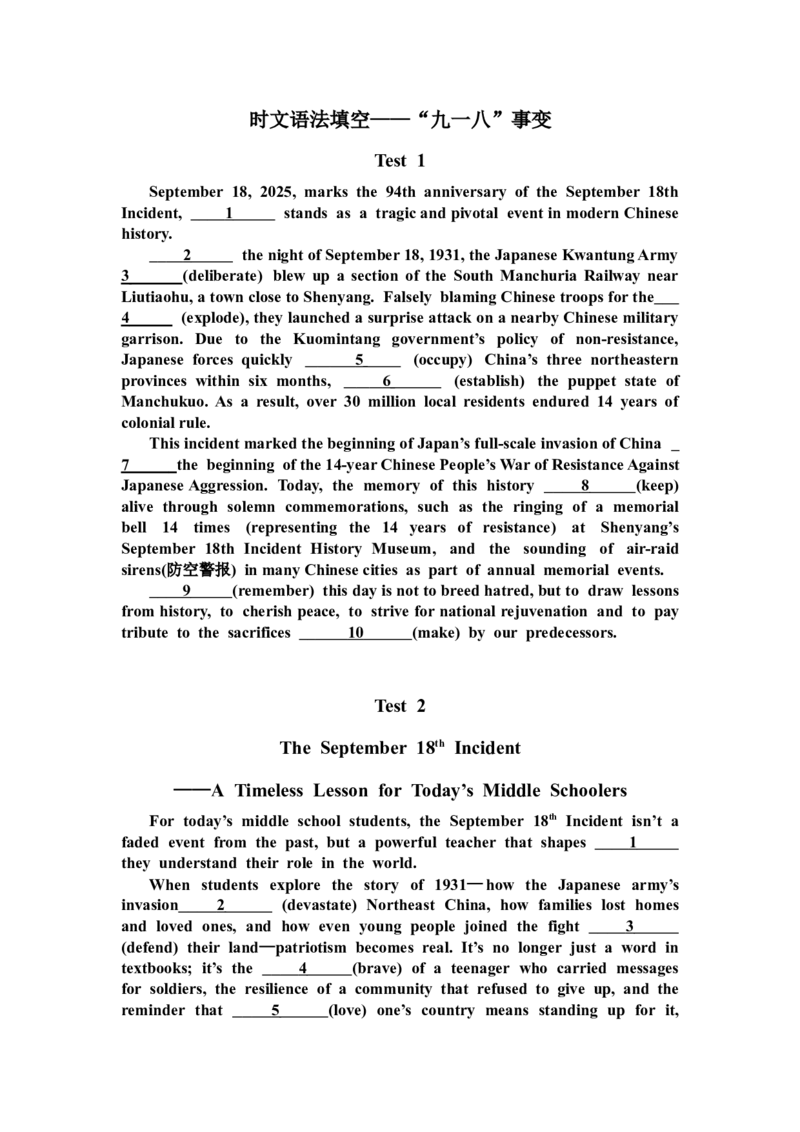
September 18, 2025, marks the 94th anniversary of the September 18th
Incident,
  1

  stands as a tragic and pivotal event in modern Chinese
history.

  2

  the night of September 18, 1931, the Japanese Kwantung Army
3

 (deliberate) blew up a section of the South Manchuria Railway near
Liutiaohu, a town close to Shenyang. Falsely blaming Chinese troops for the
4

  (explode), they launched a surprise attack on a nearby Chinese military
garrison. Due to the Kuomintang government’s policy of non-resistance,
Japanese forces quickly
  5

  (occupy) China’s three northeastern
provinces within six months,       6

  (establish) the puppet state of
Manchukuo. As a result, over 30 million local residents endured 14 years of
colonial rule.
This incident marked the beginning of Japan’s full-scale invasion of China
7

   the beginning of the 14-year Chinese People’s War of Resistance Against
Japanese Aggression. Today, the memory of this history
  8

 (keep)
alive through solemn commemorations, such as the ringing of a memorial
bell 14 times (representing the 14 years of resistance) at Shenyang’s
September 18th Incident History Museum, and the sounding of air-raid
sirens(防空警报) in many Chinese cities as part of annual memorial events.

  9

 (remember) this day is not to breed hatred, but to draw lessons
from history, to cherish peace, to strive for national rejuvenation and to pay
tribute to the sacrifices

 10


 (make) by our predecessors.
Test 2
The September 18th Incident
——A Timeless Lesson for Today’s Middle Schoolers
For today’s middle school students, the September 18th Incident isn’t a
faded event from the past, but a powerful teacher that shapes
  1


they understand their role in the world.
When students explore the story of 1931— how the Japanese army’s
invasion
  2

  (devastate) Northeast China, how families lost homes
and loved ones, and how even young people joined the fight
  3


(defend) their land—patriotism becomes real. It’s no longer just a word in
textbooks; it’s the
  4

 (brave) of a teenager who carried messages
for soldiers, the resilience of a community that refused to give up, and the
reminder that
  5

 (love) one’s country means standing up for it,
even when it’s hard. This understanding grows when they look at old
photos, listen to survivors’ stories, or work on projects about that era.
The incident also helps them connect past struggles to present peace
and
  6

 (stable). They start to realize that the safe, comfortable
lives they live now didn’t come
  7

  (easy)— they were built by
generations
  8

  sacrificed and struggled for decades. That makes
them think: if previous generations fought to safeguard the nation, what
can they do to keep it strong? For many, it means studying harder, caring
for others, or speaking up against unfairness.
Most importantly, it teaches them the value of peace. They see how
war tears apart lives, and they learn that peace isn’t something to take
9

  granted— it’s something to protect. For these students, the
September 18th Incident is more than history; it’s a commitment to honor
the past by building
  10


  more just and peaceful future.