时文语法填空——AI 破译甲骨文
Test 1
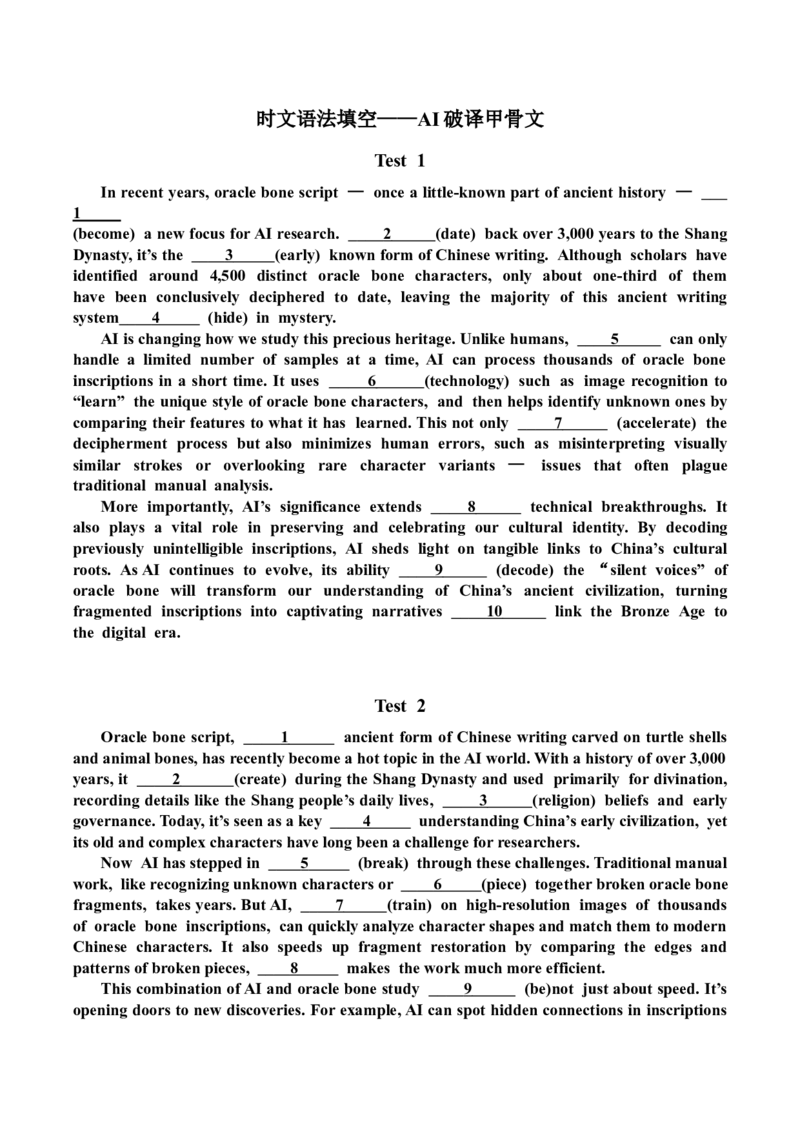
In recent years, oracle bone script — once a little-known part of ancient history —
1


(become) a new focus for AI research.
  2

 (date) back over 3,000 years to the Shang
Dynasty, it’s the
  3

 (early) known form of Chinese writing. Although scholars have
identified around 4,500 distinct oracle bone characters, only about one-third of them
have been conclusively deciphered to date, leaving the majority of this ancient writing
system
  4

  (hide) in mystery.
AI is changing how we study this precious heritage. Unlike humans,
  5

  can only
handle a limited number of samples at a time, AI can process thousands of oracle bone
inscriptions in a short time. It uses
  6

 (technology) such as image recognition to
“learn” the unique style of oracle bone characters, and then helps identify unknown ones by
comparing their features to what it has learned. This not only
  7

  (accelerate) the
decipherment process but also minimizes human errors, such as misinterpreting visually
similar strokes or overlooking rare character variants — issues that often plague
traditional manual analysis.
More importantly, AI’s significance extends
  8

  technical breakthroughs. It
also plays a vital role in preserving and celebrating our cultural identity. By decoding
previously unintelligible inscriptions, AI sheds light on tangible links to China’s cultural
roots. As AI continues to evolve, its ability
  9

  (decode) the “silent voices” of
oracle bone will transform our understanding of China’s ancient civilization, turning
fragmented inscriptions into captivating narratives
  10


  link the Bronze Age to
the digital era.
Test 2
Oracle bone script,
  1

  ancient form of Chinese writing carved on turtle shells
and animal bones, has recently become a hot topic in the AI world. With a history of over 3,000
years, it
  2

 (create) during the Shang Dynasty and used primarily for divination,
recording details like the Shang people’s daily lives,
  3

 (religion) beliefs and early
governance. Today, it’s seen as a key
  4

  understanding China’s early civilization, yet
its old and complex characters have long been a challenge for researchers.
Now AI has stepped in
  5

  (break) through these challenges. Traditional manual
work, like recognizing unknown characters or
  6

 (piece) together broken oracle bone
fragments, takes years. But AI,
  7

 (train) on high-resolution images of thousands
of oracle bone inscriptions, can quickly analyze character shapes and match them to modern
Chinese characters. It also speeds up fragment restoration by comparing the edges and
patterns of broken pieces,
  8

  makes the work much more efficient.
This combination of AI and oracle bone study
  9

  (be)not just about speed. It’s
opening doors to new discoveries. For example, AI can spot hidden connections in inscriptions
that humans might miss, helping researchers learn more about Shang Dynasty society. Even
with small problems like improving recognition
  10


 (accurate), this field holds great
promise for uncovering more of China’s ancient cultural secrets.
Test 3
Oracle bone script is the earliest mature type of Chinese writing, with
  1


history spanning over 3,000 years. It first appeared during the Shang Dynasty (about 1600–
1046 BCE) and was
  2

 (primary) carved on turtle shells and the shoulder bones of
oxen, from
  3

  it gets its name.
In the Shang Dynasty, rulers used this script for divination. They would carve questions on
the bones, such as “Will it rain during the harvest season?” or “Will our army win the
war?” Afterward, they heated the bones until cracks formed, and
  4

 (interpret)
these cracks as “ guidance from ancestors” to inform their political and military
decisions.

  5

  its long-standing history and significant role, the study of oracle bone
script still faces challenges. So far, we
  6

 (identify) a large number of distinct
characters from oracle bone script, yet many of them remain undecoded. Most of these
characters are pictorial or symbolic, and they have laid an essential foundation for the
Chinese characters we use now. Furthermore, the inscriptions offer
  7

 (value)
insights into the daily lives of Shang people, including their farming

 8

(practice), religious rituals and military campaigns.
First
  9

 (discover) in the Yin Ruins of Anyang, Henan Province in the late
1800s, oracle bone script is a precious treasure of Chinese culture. Nowadays, with the
assistance of AI technology, experts are accelerating their efforts
  10


  (understand)
unknown characters and restore broken bone pieces, helping us uncover more details
about China’s early civilization.