语法填空基础入门训练
Test A
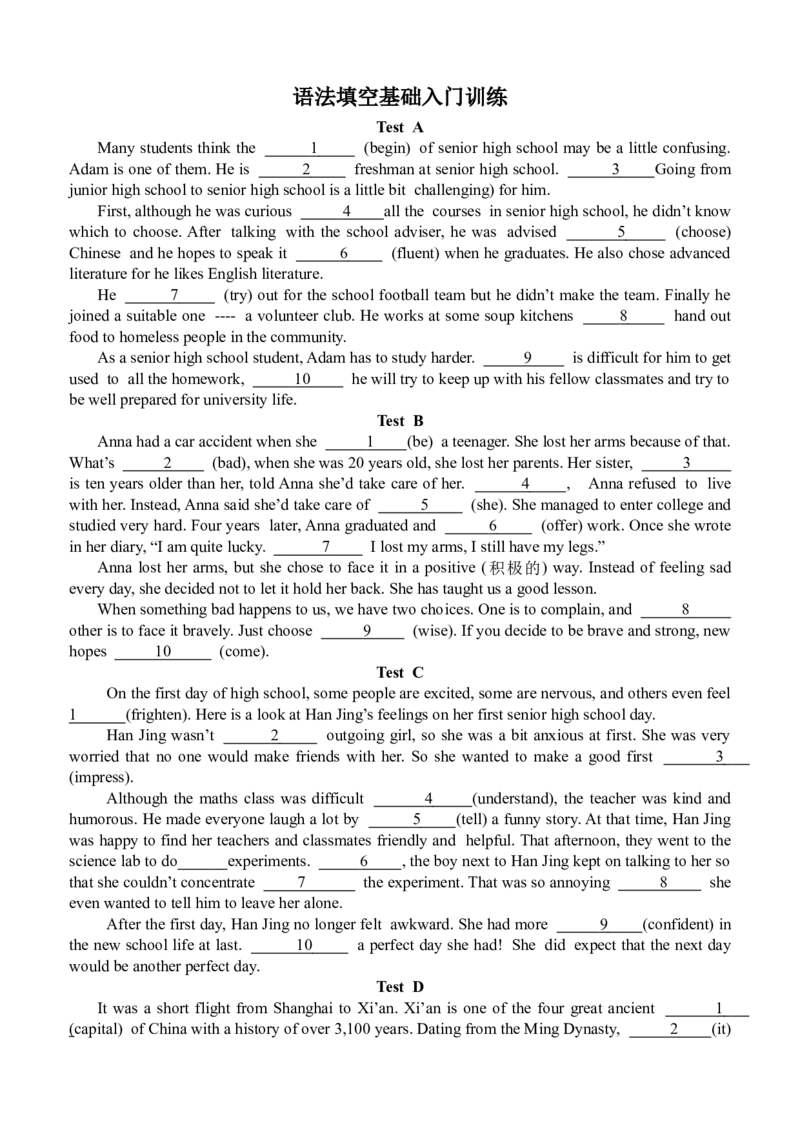
Many students think the

 1

  (begin) of senior high school may be a little confusing.
Adam is one of them. He is

 2

  freshman at senior high school.

 3

 Going from
junior high school to senior high school is a little bit challenging) for him.
First, although he was curious

 4

 all the courses in senior high school, he didn’t know
which to choose. After talking with the school adviser, he was advised

 5

  (choose)
Chinese and he hopes to speak it

 6

  (fluent) when he graduates. He also chose advanced
literature for he likes English literature.
He

 7

  (try) out for the school football team but he didn’t make the team. Finally he
joined a suitable one ---- a volunteer club. He works at some soup kitchens

 8

  hand out
food to homeless people in the community.
As a senior high school student, Adam has to study harder.

 9

  is difficult for him to get
used to all the homework,

 10


  he will try to keep up with his fellow classmates and try to
be well prepared for university life.
Test B
Anna had a car accident when she

 1

 (be) a teenager. She lost her arms because of that.
What’s

 2

  (bad), when she was 20 years old, she lost her parents. Her sister,

 3


is ten years older than her, told Anna she’d take care of her.

 4

 ,  Anna refused to live
with her. Instead, Anna said she’d take care of

 5

  (she). She managed to enter college and
studied very hard. Four years later, Anna graduated and

 6

  (offer) work. Once she wrote
in her diary, “I am quite lucky.

 7

  I lost my arms, I still have my legs.”
Anna lost her arms, but she chose to face it in a positive (积极的) way. Instead of feeling sad
every day, she decided not to let it hold her back. She has taught us a good lesson.
When something bad happens to us, we have two choices. One is to complain, and

 8


other is to face it bravely. Just choose

 9

  (wise). If you decide to be brave and strong, new
hopes

 10


  (come).
Test C
On the first day of high school, some people are excited, some are nervous, and others even feel
1

 (frighten). Here is a look at Han Jing’s feelings on her first senior high school day.
Han Jing wasn’t

 2

  outgoing girl, so she was a bit anxious at first. She was very
worried that no one would make friends with her. So she wanted to make a good first

 3
(impress).
Although the maths class was difficult

 4

 (understand), the teacher was kind and
humorous. He made everyone laugh a lot by

 5

 (tell) a funny story. At that time, Han Jing
was happy to find her teachers and classmates friendly and helpful. That afternoon, they went to the
science lab to do

     experiments.

 6

 , the boy next to Han Jing kept on talking to her so
that she couldn’t concentrate

 7
       the experiment. That was so annoying

 8

  she
even wanted to tell him to leave her alone.
After the first day, Han Jing no longer felt awkward. She had more

 9

 (confident) in
the new school life at last.

 10


  a perfect day she had! She did expect that the next day
would be another perfect day.
Test D
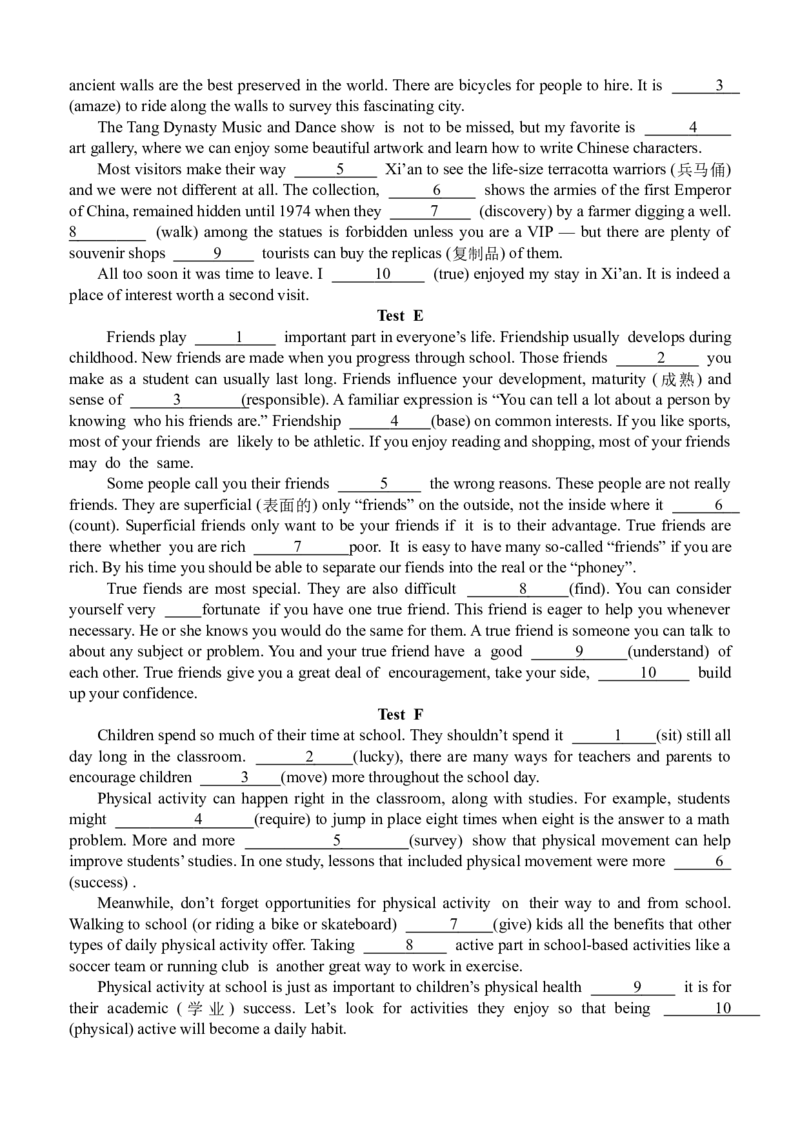
It was a short flight from Shanghai to Xi’an. Xi’an is one of the four great ancient

 1
(capital) of China with a history of over 3,100 years. Dating from the Ming Dynasty,

 2

 (it)
ancient walls are the best preserved in the world. There are bicycles for people to hire. It is

 3
(amaze) to ride along the walls to survey this fascinating city.
The Tang Dynasty Music and Dance show is not to be missed, but my favorite is

 4


art gallery, where we can enjoy some beautiful artwork and learn how to write Chinese characters.
Most visitors make their way

 5

  Xi’an to see the life-size terracotta warriors (兵马俑)
and we were not different at all. The collection,

 6

  shows the armies of the first Emperor
of China, remained hidden until 1974 when they

 7

  (discovery) by a farmer digging a well.
8


  (walk) among the statues is forbidden unless you are a VIP — but there are plenty of
souvenir shops

 9

  tourists can buy the replicas (复制品) of them.
All too soon it was time to leave. I

 10


  (true) enjoyed my stay in Xi’an. It is indeed a
place of interest worth a second visit.
Test E
Friends play

 1

  important part in everyone’s life. Friendship usually develops during
childhood. New friends are made when you progress through school. Those friends

 2

  you
make as a student can usually last long. Friends influence your development, maturity ( 成熟) and
sense of

 3

 ( responsible). A familiar expression is “You can tell a lot about a person by
knowing who his friends are.” Friendship

 4

 (base) on common interests. If you like sports,
most of your friends are likely to be athletic. If you enjoy reading and shopping, most of your friends
may do the same.
Some people call you their friends

 5

  the wrong reasons. These people are not really
friends. They are superficial (表面的) only “friends” on the outside, not the inside where it

 6
(count). Superficial friends only want to be your friends if it is to their advantage. True friends are
there whether you are rich

 7

 poor. It is easy to have many so-called “friends” if you are
rich. By his time you should be able to separate our fiends into the real or the “phoney”.
True fiends are most special. They are also difficult

 8

 (find). You can consider
yourself very     fortunate if you have one true friend. This friend is eager to help you whenever
necessary. He or she knows you would do the same for them. A true friend is someone you can talk to
about any subject or problem. You and your true friend have a good

 9

 (understand) of
each other. True friends give you a great deal of encouragement, take your side,

 10


  build
up your confidence.
Test F
Children spend so much of their time at school. They shouldn’t spend it

 1

 (sit) still all
day long in the classroom.

 2

 (lucky), there are many ways for teachers and parents to
encourage children

 3

 (move) more throughout the school day.
Physical activity can happen right in the classroom, along with studies. For example, students
might


 4

 (require) to jump in place eight times when eight is the answer to a math
problem. More and more


 5

 (survey) show that physical movement can help
improve students’ studies. In one study, lessons that included physical movement were more

 6
(success) .
Meanwhile, don’t forget opportunities for physical activity on their way to and from school.
Walking to school (or riding a bike or skateboard)

 7

 (give) kids all the benefits that other
types of daily physical activity offer. Taking

 8

  active part in school-based activities like a
soccer team or running club is another great way to work in exercise.
Physical activity at school is just as important to children’s physical health

 9

  it is for
their academic ( 学业) success. Let’s look for activities they enjoy so that being     10

(physical) active will become a daily habit.