时文语法填空——科技篇
Test 1
China’s 6G Achieves New Breakthrough
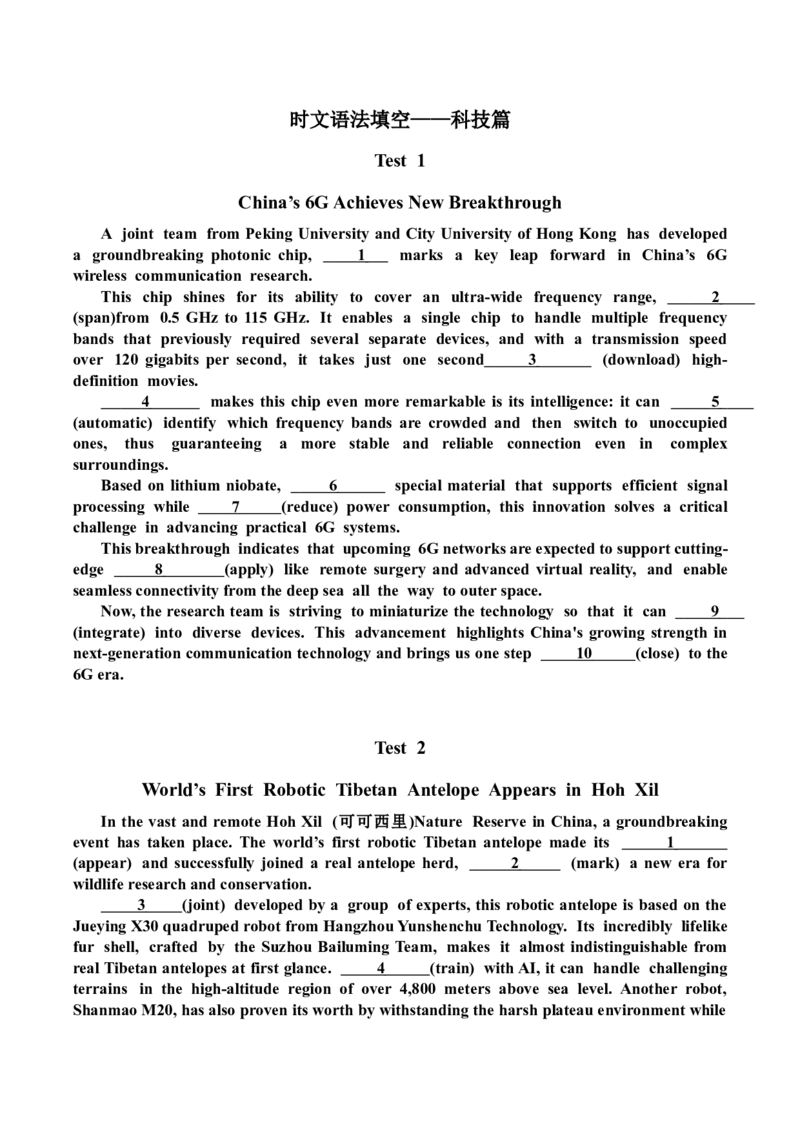
A joint team from Peking University and City University of Hong Kong has developed
a groundbreaking photonic chip,       1
   marks a key leap forward in China’s 6G
wireless communication research.
This chip shines for its ability to cover an ultra-wide frequency range,
  2

(span)from 0.5 GHz to 115 GHz. It enables a single chip to handle multiple frequency
bands that previously required several separate devices, and with a transmission speed
over 120 gigabits per second, it takes just one second
  3

  (download) high-
definition movies.

  4

  makes this chip even more remarkable is its intelligence: it can
  5

(automatic) identify which frequency bands are crowded and then switch to unoccupied
ones, thus
guaranteeing
a more stable and reliable connection even in complex
surroundings.
Based on lithium niobate,
  6

  special material that supports efficient signal
processing while
  7

 (reduce) power consumption, this innovation solves a critical
challenge in advancing practical 6G systems.
This breakthrough indicates that upcoming 6G networks are expected to support cutting-
edge
  8

 (apply) like remote surgery and advanced virtual reality, and enable
seamless connectivity from the deep sea all the way to outer space.
Now, the research team is striving to miniaturize the technology so that it can
  9
(integrate) into diverse devices. This advancement highlights China's growing strength in
next-generation communication technology and brings us one step
  10


 (close) to the
6G era.
Test 2
World’s First Robotic Tibetan Antelope Appears in Hoh Xil
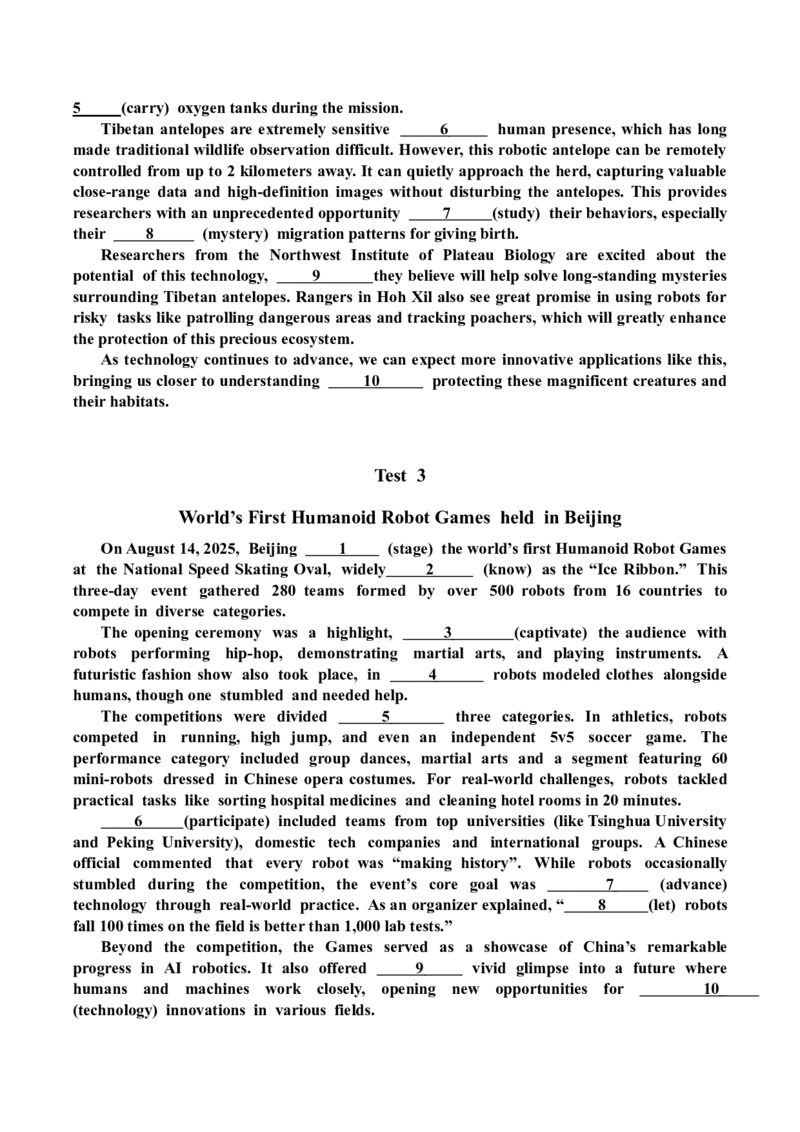
In the vast and remote Hoh Xil (可可西里)Nature Reserve in China, a groundbreaking
event has taken place. The world’s first robotic Tibetan antelope made its
  1


(appear) and successfully joined a real antelope herd,
  2

  (mark) a new era for
wildlife research and conservation.

  3

 (joint) developed by a group of experts, this robotic antelope is based on the
Jueying X30 quadruped robot from Hangzhou Yunshenchu Technology. Its incredibly lifelike
fur shell, crafted by the Suzhou Bailuming Team, makes it almost indistinguishable from
real Tibetan antelopes at first glance.
  4

 (train) with AI, it can handle challenging
terrains in the high-altitude region of over 4,800 meters above sea level. Another robot,
Shanmao M20, has also proven its worth by withstanding the harsh plateau environment while
5

 (carry) oxygen tanks during the mission.
Tibetan antelopes are extremely sensitive
  6

  human presence, which has long
made traditional wildlife observation difficult. However, this robotic antelope can be remotely
controlled from up to 2 kilometers away. It can quietly approach the herd, capturing valuable
close-range data and high-definition images without disturbing the antelopes. This provides
researchers with an unprecedented opportunity
  7

 (study) their behaviors, especially
their
  8

  (mystery) migration patterns for giving birth.
Researchers from the Northwest Institute of Plateau Biology are excited about the
potential of this technology,
  9

 they believe will help solve long-standing mysteries
surrounding Tibetan antelopes. Rangers in Hoh Xil also see great promise in using robots for
risky tasks like patrolling dangerous areas and tracking poachers, which will greatly enhance
the protection of this precious ecosystem.
As technology continues to advance, we can expect more innovative applications like this,
bringing us closer to understanding
  10


  protecting these magnificent creatures and
their habitats.
Test 3
World’s First Humanoid Robot Games held in Beijing
On August 14, 2025, Beijing
  1

  (stage) the world’s first Humanoid Robot Games
at the National Speed Skating Oval, widely
  2

  (know) as the “Ice Ribbon.” This
three-day event gathered 280 teams formed by over 500 robots from 16 countries to
compete in diverse categories.
The opening ceremony was a highlight,
  3

 (captivate) the audience with
robots performing hip-hop, demonstrating martial arts, and playing instruments. A
futuristic fashion show also took place, in
  4

  robots modeled clothes alongside
humans, though one stumbled and needed help.
The competitions were divided
  5

  three categories. In athletics, robots
competed in running, high jump, and even an independent 5v5 soccer game. The
performance category included group dances, martial arts and a segment featuring 60
mini-robots dressed in Chinese opera costumes. For real-world challenges, robots tackled
practical tasks like sorting hospital medicines and cleaning hotel rooms in 20 minutes.

  6

 (participate) included teams from top universities (like Tsinghua University
and Peking University), domestic tech companies and international groups. A Chinese
official commented that every robot was “making history”. While robots occasionally
stumbled during the competition, the event’s core goal was

 7

  (advance)
technology through real-world practice. As an organizer explained, “
  8

 (let) robots
fall 100 times on the field is better than 1,000 lab tests.”
Beyond the competition, the Games served as a showcase of China’s remarkable
progress in AI robotics. It also offered
  9

  vivid glimpse into a future where
humans and machines work closely, opening new opportunities for

 10


(technology) innovations in various fields.