定价:9.15元
批准文号:渝发改价格〔2024〕778号 举报电话:12315
物 流 码
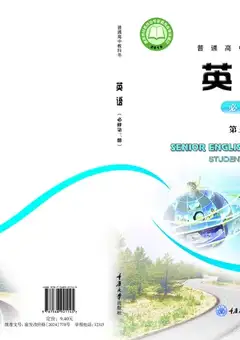
普通高中教科书
英 语
(选择性必修第一册)
主编 杨晓钰
责任编辑:张春花 版式设计:罗 亚
责任校对:夏 宇 责任印制:赵 晟
*
重庆大学出版社出版发行
出版人:饶帮华
社址:重庆市沙坪坝区大学城西路21号
邮编:401331
电话:(023)88617190 88617185(中小学)
传真:(023)88617186 88617166
网址:http://www.cqup.com.cn
邮箱:fxk@cqup.com.cn(营销中心)
全国新华书店经销
重庆俊蒲印务有限公司印刷
*
开本:890mm×1240mm 1/16 印张:8.25 字数:356千
2021年7月第1版 2022年7月第3次印刷
ISBN 978-7-5689-2506-8 定价:9.15元
本书如有印刷、装订等质量问题,本社负责调换
版权所有,请勿擅自翻印和用本书
制作各类出版物及配套用书,违者必究
副主编 黄学军 伍家文
编 者 张云建 郑加明 舒 伟
To the student
To the student
1
亲爱的同学,欢迎你随本书一起继续高中阶段的英语学习。我们希望充
满求知欲的你,能喜欢书中所提供的学习材料,喜欢各种鼓励探究和发展思
维、注重学习能力和学习习惯培养的教学设计。
高中英语学习是初中英语学习的延伸,同时也是新的英语学习生活的开
始。在这一阶段,提高基本语言运用能力极其重要,但提高用英语获取信
息、处理信息、分析和解决问题的能力,用英语进行思考和表达的能力,以
及跨文化交际的意识和基本的跨文化交际能力也必不可少;而掌握有效的英
语学习策略,提高自主学习能力,会帮助你更有效地学习,形成具有个性的
学习方法和风格,为将来进一步学习英语和终身发展打下良好基础。
关于本教材的使用,我们有以下建议:
1. 请仔细阅读每个主题前的 Guiding Page,它会帮助你熟悉该部分的主要
学习内容,激发你思考与之相关的问题,为本主题的学习做好必要的准备。
2. 只有充分了解了学习目标,你才能在学习中处于主动地位,发挥主体
作用,才能使自己的“学”与教师的“教”形成协调发展的合力,从而取得
最佳的学习效果。因此,各单元的学习从研读 Looking Ahead 开始,并在每
个单元学习后根据 Self-assessing 帮助自己反思学习效果,调整自己的学习目
标、学习方式和学习进程。
3. Activating and Predicting 旨在最大限度地激活你与所学内容相关的背景
知识,激发你学习的兴趣和动机,为进入下一步学习做好准备。在本板块的
学习中一定要勤于思考,积极参与,勇于表达。
4.“学而不思则罔,思而不学则殆”,没有思考、缺乏创造性的学习收
获甚少。建议你在进行 Reading,Thinking and Analysing 部分课文的学习
时,不要忽略了 Margin Notes 和 TIP,一定要边学边思,学思结合,掌握
策略,举一反三,这样你才能真正提高阅读能力,逐渐成长为高效的英语
阅读者。
5. Exploring and Using 将为你轻松化解阅读课文中的语言知识,引导你通
过观察和分析,了解语法形式,理解语法意义,发现语法规则。这将帮助你
2
在真实语境中运用所学语言知识来理解和表达意义,加强准确、得体地使用语言的意
识,深化对语言的理解。
6. 在进行了大量的听说和阅读后,你一定记住了许多优美的词句、漂亮的段落,
一定发现了英语文章与汉语文章在风格和组织结构上的异同,也一定跃跃欲试地想用
英语表达自己的所感所想。这的确是一件值得高兴的事!那么,请一定经常读一读、
听一听、说一说、记一记一些好的句子和美文,并认真完成每课的写作任务,这样,
你的英语写作就会不断进步,逐步达到“行文如流水,落笔如有神”的境界。
7. 在必修教材的 Recycling Time 和 Word Builder 板块,你已经学习了归纳所学内
容、在语境下猜测词义等策略,在选择性必修教材学习阶段,请主动应用和积极调试
所学策略,不断提高自主学习能力。Learning Individually 部分鼓励你主动做好阅读课
的预习,在 Question Corner 中提出自学中存在的疑惑,在 Learning Cooperatively 部
分,与同学和老师一起互动、探究、应用,并且在 Learning Reflectively 板块应用必修
教材的多维评价方式,提高反思的意识和能力。
8. 附录中的 Word Learning Booster 会引导你在学习新词汇的同时,注重对已学词
汇的定期复习,逐步养成良好的词汇学习习惯,记忆词汇也将不再是一件难事。
“学而时习之,不亦说乎?”古人告诉我们,学习要采取积极的态度,既要时
时、处处、事事地“学”,又要时时、处处、事事地“习”;于“学”中积累、丰
富、提高,于“习”中求巩固、受启发、得效益;争取日有所新,日有所获。这样你
的内心就能充满掌握英语学习真谛的愉悦。
我们衷心希望通过本教材的学习,能进一步激发你学习英语的热情和用英语交流
的欲望,最终能用英语了解、学习他国优秀文化,同时向世界介绍祖国灿烂的文化。
作为学习者,获取知识是一种乐趣,不断克服困难、不断创新也是一种乐趣。记
住永远对自己说:“I can do it!”。
愿你快乐地度过英语学习的每一阶段,享受克服困难的快乐,享受创新的快乐,
享受成功的快乐!
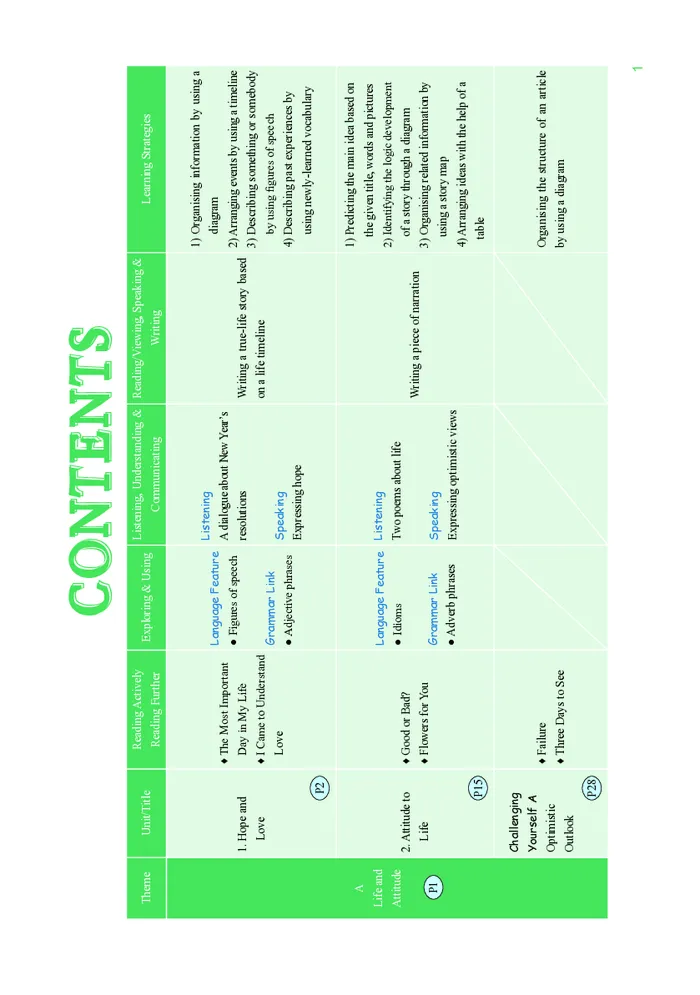
Theme
Unit/Title
Reading Actively
Reading Further
Exploring & Using
Listening, Understanding &
Communicating
Reading/Viewing, Speaking &
Writing
Learning Strategies
A
Life and
Attitude
P1
1. Hope and
Love
♦ The Most Important
Day in My Life
♦ I Came to Understand
Love
Language Feature
● Figures of speech
Grammar Link
● Adjective phrases
Listening
A dialogue about New Year’s
resolutions
Speaking
Expressing hope
Writing a true-life story based
on a life timeline
1) Organising information by using a
diagram
2) Arranging events by using a timeline
3) Describing something or somebody
by using figures of speech
4) Describing past experiences by
using newly-learned vocabulary
2. Attitude to
Life
♦ Good or Bad?
♦ Flowers for You
Language Feature
● Idioms
Grammar Link
● Adverb phrases
Listening
Two poems about life
Speaking
Expressing optimistic views
Writing a piece of narration
1) Predicting the main idea based on
the given title, words and pictures
2) Identifying the logic development
of a story through a diagram
3) Organising related information by
using a story map
4) Arranging ideas with the help of a
table
Challenging
Yourself A
Optimistic
Outlook
♦ Failure
♦ Three Days to See
Organising the structure of an article
by using a diagram
CONTENTS
P28
P15
P1
P2
1
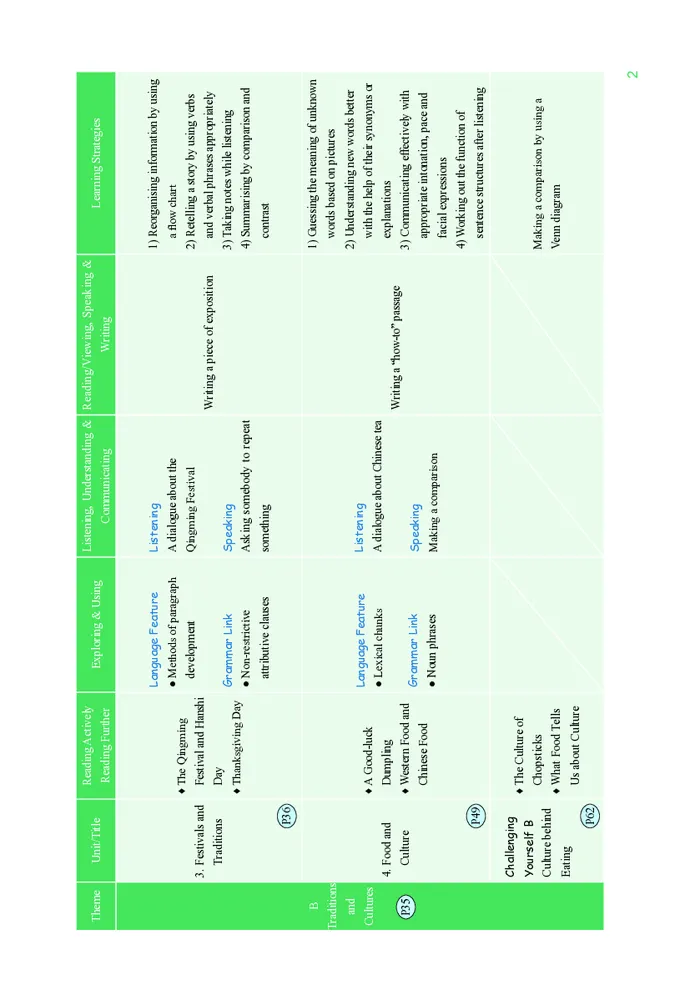
Theme
Unit/Title
Reading Actively
Reading Further
Exploring & Using
Listening, Understanding &
Communicating
Reading/Viewing, Speaking &
Writing
Learning Strategies
B
Traditions
and
Cultures
P31
3. Festivals and
Traditions
♦ The Qingming
Festival and Hanshi
Day
♦ Thanksgiving Day
Language Feature
● Methods of paragraph
development
Grammar Link
● Non-restrictive
attributive clauses
Listening
A dialogue about the
Qingming Festival
Speaking
Asking somebody to repeat
something
Writing a piece of exposition
1) Reorganising information by using
a flow chart
2) Retelling a story by using verbs
and verbal phrases appropriately
3) Taking notes while listening
4) Summarising by comparison and
contrast
4. Food and
Culture
♦ A Good-luck
Dumpling
♦ Western Food and
Chinese Food
Language Feature
● Lexical chunks
Grammar Link
● Noun phrases
Listening
A dialogue about Chinese tea
Speaking
Making a comparison
Writing a “how-to” passage
1) Guessing the meaning of unknown
words based on pictures
2) Understanding new words better
with the help of their synonyms or
explanations
3) Communicating effectively with
appropriate intonation, pace and
facial expressions
4) Working out the function of
sentence structures after listening
Challenging
Yourself B
Culture behind
Eating
♦ The Culture of
Chopsticks
♦ What Food Tells
Us about Culture
Making a comparison by using a
Venn diagram
P36
P49
P62
P35
2
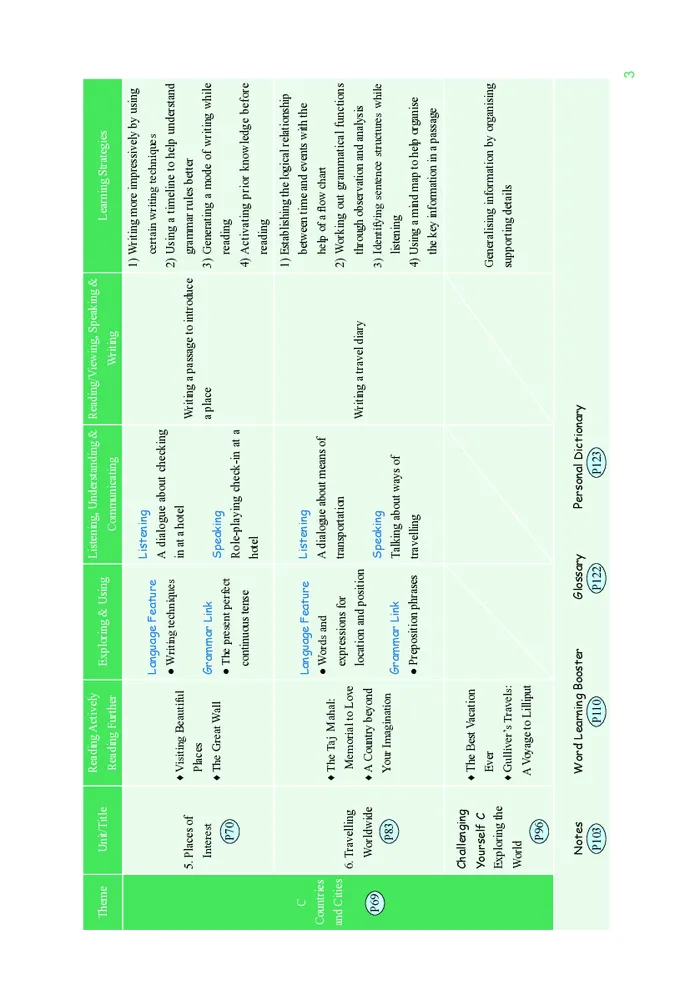
Theme
Unit/Title
Reading Actively
Reading Further
Exploring & Using
Listening, Understanding &
Communicating
Reading/Viewing, Speaking &
Writing
Learning Strategies
C
Countries
and Cities
P61
5. Places of
Interest
♦ Visiting Beautiful
Places
♦ The Great Wall
Language Feature
● Writing techniques
Grammar Link
● The present perfect
continuous tense
Listening
A dialogue about checking
in at a hotel
Speaking
Role-playing check-in at a
hotel
Writing a passage to introduce
a place
1) Writing more impressively by using
certain writing techniques
2) Using a timeline to help understand
grammar rules better
3) Generating a mode of writing while
reading
4) Activating prior knowledge before
reading
6. Travelling
Worldwide
♦ The Taj Mahal:
Memorial to Love
♦ A Country beyond
Your Imagination
Language Feature
● Words and
expressions for
location and position
Grammar Link
● Preposition phrases
Listening
A dialogue about means of
transportation
Speaking
Talking about ways of
travelling
Writing a travel diary
1) Establishing the logical relationship
between time and events with the
help of a flow chart
2) Working out grammatical functions
through observation and analysis
3) Identifying sentence structures while
listening
4) Using a mind map to help organise
the key information in a passage
Challenging
Yourself C
Exploring the
World
♦ The Best Vacation
Ever
♦ Gulliver’s Travels:
A Voyage to Lilliput
Generalising information by organising
supporting details
Notes Word Learning Booster Glossary Personal Dictionary
P70
P83
P96
P69
P110
P103
P122
P123
3
Theme A
Life and Attitude
Life is beautiful but not always easy. A person who has not met
with diffi culties in life can hardly achieve success. The challenge is how
you face diffi culties with love, hope, courage and a positive attitude.
As Walt Whitman puts it, “Keep your face always towards the sunshine,
and shadows will fall behind you.”
What did you do when you
faced failure in the past? What
should you do when you fail? And
how can you develop a positive
attitude towards life?
Unit 1
◊ read a story about
Helen Keller;
◊ learn more about
hope and love in
Helen Keller’s life;
◊ talk about hope and
love in life.
Unit 1
◊ appreciate stories about
loss and gain;
◊ understand how to take a
positive attitude towards
failure;
◊ learn to express optimistic
views.
Unit 2
Unit 2
Challenging
Yourself A
◊ learn more ways to
deal with failure.
Challenging
Yourself A
In this theme, you will:
Theme A Life and Attitude
2
Loɼʘʖnɒ Aȱeaɍ
By the end of this unit, you will be able to:
introduce the most important day of Helen Keller;
describe an important day or a person by using fi gures of speech;
recognise adjective phrases in context and use them appropriately;
express your hope in a dialogue;
write about your true-life story with the help of a life timeline;
convey your love for your beloved persons in appropriate ways.
No matter how dark the moment, love and hope are possible.
—George Chakiris
Unit 1
Hope and Love
Reading Actively
► Activating and Predicting
Read the following statements about Helen Keller and then match them with the
corresponding pictures.
A. In June 1904, Helen graduated from Radcliffe College with honours.
B. On March 3, 1887, Miss Sullivan came to Helen and became her private teacher.
C. The documentary Helen Keller in Her Story won the Oscar for Best Feature-length
Documentary Film at the 1955 Academy Awards.
D. On April 5, 1887, Helen’s soul was awakened beside a water pump.
2
( )
( )
( )
( )
Unit 1 Hope and Love
3
Based on the information in Activity 1 and the title of the text, discuss the following
questions with a partner.
1) Which day is Helen’s most important day?
2) Why do you think so?
► Reading, Thinking and Analysing
The Most Important Day in My Life
The most important day in
all my life was the one on which
my teacher, Anne Mansfield
Sullivan, came to me. It was the
third of March, 1887. Before
she came, I was like a ship in
a very heavy fog, and had no
way of knowing where the harbour was. “Light! Give me light!” was
the wordless cry of my soul, and the light of love shone on me on that
very day.
The morning after my teacher arrived she led me into her room
and gave me a doll. When I had played with it for a little while, Miss
Sullivan slowly spelled into my hand the word “d-o-l-l”. I was at once
interested in this finger play and tried to follow her. When I finally
succeeded in making the letters correctly, I was fl ushed with childish
pleasure and pride. I did not know that I was spelling a word; I was
simply imitating what my teacher did. In the following days, I learned
to spell many words in this uncomprehending way, among them,
“pin”, “hat”, “cup” and a few verbs like “sit”, “stand” and “walk”. But
my teacher had been with me several weeks before I understood that
everything has a name.
One day, we walked to the well-house. Someone was drawing
water and my teacher placed my hand under the spout. As the cool
stream fl owed over one hand, she spelled
into the other hand the word “water”, fi rst
slowly, then rapidly. I stood still. Suddenly
the mystery of language was fully made
known to me. I knew then that “w-a-t-e-r”
meant the cool and wonderful thing that
was flowing over my hand. That living
word awakened my soul, gave it light,
hope and joy, and set it free!
I left the well-house, eager to learn.
wordless (adj.) =
+
It means in
Chinese.
spout
uncomprehending=
un- + comprehend +
-ing
It means in
Chinese.
Guess the meaning of
well-house from the
context.
flush (vi.): (of a person’s
face) become red
Imitate (vt.) here
means .
A. copy
B. enjoy
Theme A Life and Attitude
4
Everything had a name, and each name gave birth to a new thought.
As we returned to the house, every object I touched seemed to be vivid
with life. That was because I saw everything with the strange, new
sight that had come to me.
I learned a great many new words that day. I do not remember
what they all were; but I do know that “mother”, “father”, “sister”,
“teacher” were among them―words that were to make the world
blossom for me. It would have been difficult to find a happier child
than I was as I lay in my bed at the close of that eventful day and lived
over the joys it had brought me, and for the fi rst time longed for a new
day to come.
► Comprehending, Integrating and Creating
Read the text carefully and complete the following diagram. Then check your work with a
partner.
Based on the above diagram, discuss the following questions.
1) What was Helen’s life like before and after Miss Sullivan came to her?
Long is a/an here.
A. adjective B. verb
Long for means
in English.
Close is a/an here.
A. adjective B. noun
It means in
English.
When Miss Sullivan came
It was day in Helen’s life.
Helen longed for to come.
• gave Helen a doll
• “doll” into
Helen’s hand
• for a while
• and in
spelling her fi rst word
the next day
• had been trying to
make Helen understand
everything has a name
• learned to spell many
words in a/an
way
in the following
days
• let Helen and
“water”
• understood the word
water fully
• was to learn
one day after
several weeks
aimless and
hopeless
happy
joyful
Before Miss Sullivan came
Helen was like and cried for .
Unit 1 Hope and Love
5
2) How did Miss Sullivan help Helen learn words step by step?
3) What do you think of Miss Sullivan’s teaching method?
4) How did Helen’s feelings change? Describe them and give your reasons.
5) Which day is Helen’s most important day? What evidence can you cite to justify it?
Work out Helen Keller’s personality based on her sayings below and the evidence from
the text.
The best and most beautiful things in the world cannot be seen or even touched. They
must be felt within the heart.
Self-pity is our worst enemy and if we yield to it, we can never do anything good in the world.
Character cannot be developed in ease and quiet. Only through experiences of trial
and suffering can the soul be strengthened, vision cleared, ambition inspired and
success achieved.
Personality
Evidence from the sayings
Evidence from the text
Read the text again and work out Miss Sullivan’s personality. How did her personality
infl uence Helen?
Work in pairs to act out the interview with Helen Keller at the 1955 Academy Awards.
Role A: A journalist Role B: Helen Keller
Do the activity by following the below steps.
Step 1 Select one of the topics below.
• If I were Helen Keller
• Inspiration from Helen Keller
• My most important day
Step 2 Note down your key ideas.
Step 3 Discuss with your classmates who have chosen the same topic.
Step 4 Write a short passage based on the discussion.
TIP
We may infer the personality of a character from what he/she says, does, thinks, and also
how he/she feels.
You may ask questions like this: What
would your life be like if Miss Sullivan
hadn’t come to you?
You may predict what questions will be
asked and think about the answers.
Theme A Life and Attitude
6
Exploring and Using
► Language Feature
Follow the example and mark the parts of speech of the coloured words. Then summarise
the common features they suggest.
· Example ·
Last Sunday I found the very book that I had wanted very much.
adj. adv.
1) I’ve been longing for a long vacation for a long time.
2) At the close of the meeting, he left the room and closed the door. Then he went to visit
his close friend.
3) She is drawing a picture of a football match which ended in a draw.
4) The soldier was ordered to stand still for half an hour, but an hour passed and he was
still standing there.
The common feature:
Read the sentences from the text and analyse them by following the example. Then discuss
how simile, metaphor and personification help you to better understand the change in
Helen’s feelings.
· Example ·
I was like a ship in a heavy fog.
1) The light of love shone on me on that very day.
2) That living word awakened my soul, gave it light, hope and joy, and set it free!
Write about the most important day or person in your memory by using the above fi gures
of speech.
TIP
• A simile makes a direct comparison by using “as” or “like”.
• A metaphor is an indirect comparison used to refer to something as being the same as
another thing by using “is”, “A of B”.
• Personifi cation is a fi gure of speech in which a thing is given human attributes.
Helen couldn’t see.
The ship sailed with
no clear direction.
“Like” is used to make a comparison.
The use of “simile” helps us
understand how aimless and
hopeless Helen was.
Unit 1 Hope and Love
7
► Grammar Link
Adjective Phrases
Understanding the meaning
Read the summary of the text and pay special attention to the meanings of the coloured
parts. What information can you get from them?
Helen felt that she was like a ship in a heavy fog. Then Miss Sullivan came into her
life and began to teach her. When she succeeded in spelling the fi rst word “doll”, Helen
was fl ushed with pleasure and pride. After that, she learned a great many words by simply
imitating, but she didn’t really understand them. One day, they walked to the well-house.
When the cool and wonderful water was fl owing over one of her hands, Miss Sullivan
spelled the word “water” into the other hand. At that moment, Helen suddenly understood
the mystery of language and knew that her soul was awakened. She found herself eager
to learn. She knew that the living word had set her soul free, and for the fi rst time, she
longed for a new day to come.
Discovering the rule
Study the following example and discuss what extra information you can know about
Helen Keller when an adjective or an adjective phrase is used.
· Example ·
Work in groups to match the functions with the corresponding adjective phrases. Then
explain how the adjective phrases help to better understand Helen Keller.
TIP
An adjective phrase is a group of words that functions as an adjective in a
sentence. It describes or determines a noun or pronoun and makes it more specifi c.
a ship in a heavy fog learned a great many words
an adjective an adjective phrase
Theme A Life and Attitude
8
Adjective Phrase Function
Applying the rule
Read the following sentences from the text and underline the adjective phrases. Then
explain how they are formed and help to understand Helen better. The patterns in the box
below in Activity 2 may help you.
1) The most important day in all my life was the one on which my teacher came to me.
2) I was at once interested in this fi nger play and tried to follow her.
3) As we returned to the house, every object I touched seemed to be vivid with life.
4) It would have been diffi cult to fi nd a happier child than I was as I lay in my bed at the
close of that eventful day.
Underline the adjective phrases in the following sentences and study how they are formed.
Then put the corresponding letters in brackets.
( ) 1) We lived in a small but comfortable apartment.
( ) 2) These facilities are modern and excellent.
( ) 3) Henry looked very disappointed at that moment.
( ) 4) I am sure of success if we don’t give up.
( ) 5) I’m sorry to say that we have terribly bad news for you.
Complete the following dialogue with adjective phrases by using the given words.
A: Have you watched the Disney musical, Frozen?
B: Yes.
A: Do you know why you can’t give Elsa a balloon?
B: You got me!
A: Because she will let it go.
B: That’s funny! By the way, how do you like Frozen?
A. adj. + and + adj. B. adv. + adj. C. adj. + but + adj.
D. adj. + to + v. E. adj. + preposition + n.
touching/educating
fascinating/successful
very/common
beautiful/detailed
loyal/supporting
full of/tuneful notes
1) be fl ushed with pleasure and pride
2) a great many words
3) the cool and wonderful water
4) found herself eager to learn
A. to show “how many”
B. to describe “what kind of”
C. to add information about “how one feels”
D. to describe “how one feels” and “why”
Unit 1 Hope and Love
9
A: The movie is . Although the theme is one of a/an
Disney princess tales, the story is still .
B: Indeed! It encourages young girls like us to be to each other. And
I especially like the ice castle in 3D.
A: And the song Let It Go is and wise words. (Let it go; let it go.
Can’t hold you back any more…) Oh, dear! I just missed the bus home!
B: Just let it go! Let’s walk home together.
Listening, Understanding and Communicating
Expressing Hope
Defi ne “New Year’s resolutions” after reading the following two examples. Then listen to
a dialogue to check your defi nition.
My New Year’s Resolutions
It’s the beginning of a new year. I have a lot
of new plans as my New Year’s resolutions. First
of all, I will practise speaking English more in
order to improve my spoken English. Moreover,
I am going to eat more healthy food and do more
exercise to keep myself fi t throughout the whole
year.
In addition, I’ll try to help my parents to do
some chores, including cleaning the house and
doing the dishes after dinner at weekends. In my
spare time, I’m going to read more English books
to enlarge my English vocabulary and widen my
knowledge. I sincerely hope that I can stick to my
resolutions and have a great year.
My defi nition of New Year’s resolutions: .
Listen again and complete the following table with the information you have got.
Name
New Year’s resolutions
Tian Ye
1) to more weight 3) to get a in English
2) to some money 4) to harder
A New Year’s resolution postcard
in the early 20th-century
Theme A Life and Attitude
10
Name
New Year’s resolutions
Henry
1) to have one of his articles
2) to spend less time on his
Jeff
1) to go to a nice place to
2) to again
3) might go to a in Hainan and do a few seascape
Listen for a third time and complete the sentence structures used to express hope.
1) to play a lot of sports in order to lose some weight, and I
I could save some money.
2) Well, a high mark in English. And I’m going to study harder.
3) Hmm…, having one of my articles published in our School Weekly.
4) going to a really nice place to practise painting.
5) see the sea again.
6) , I will do a few seascape paintings there.
Write down three New Year’s resolutions for the coming new year by using the above
sentence structures. Then have a dialogue with a partner to share your resolutions.
Resolution 1:
Resolution 2:
Resolution 3:
Reading, Speaking and Writing
Writing a True-life Story Based on a Life Timeline
Read the following short passage to understand what a life timeline is.
We understand that our experiences and personal history shape who we are. And
understanding our past may help us prepare for the future. So a life timeline with
infl uential dates, fi gures and events in time order is an excellent way to record our life
cycle, events and trends. It enables us to recognise our positive and negative experiences.
A timeline may be broken into several parts, such as Birth, Birthplace, Education,
Work Experience, Achievements, etc. All the important events that happened, the people
who infl uenced us at different stages, and the major decisions we made should be on the
time line. The life timeline starts with the earliest event we remember and moves forward
into the present. For each point, the date is recorded and the event is summarised in a few
words. Therefore, a timeline provides a visual representation of events which helps us
better understand the history of a person.
Unit 1 Hope and Love
11
Read a sample of Helen Keller’s life timeline and fi nd out how the important points about
her are organised.
All the important points are arranged according to .
Write about the true-life story of Helen Keller based on her life timeline. The following
words and expressions in the box may help you.
Make a timeline of yourself and write a true-life story based on it. Then share your story
with your classmates.
· Helen Keller ·
Birth:
June 27, 1880; full sight and hearing
Birthplace:
Tuscumbia, Alabama
Illness:
Caught scarlet fever at 19 months; deaf and blind
Early education: Anne Sullivan lived with the Kellers; very strict
with Helen; Anne spelled words into Helen’s palm
Further education:
1888 — attended Perkins Institute for the blind
1896 — entered the Cambridge School for young ladies
1900 — gained admission to Radcliffe College
1904 — graduated from Radcliffe as the fi rst deaf-blind person to earn a Bachelor of
Arts degree
Died:
June 1, 1968, at age 88
Best known as: World-famous activist, lecturer, author and educator who was blind
and deaf
The author of The Story of My Life
Founder and promoter of the American Foundation for the Blind
at first
as a result of
afterwards
in addition
in fact
at last
therefore
what’s more
TIP
Using linking words helps to connect your
ideas in a logical way and make yourself
better understood.
Theme A Life and Attitude
12
Reading Further
► Getting Ready
Write down the words which fl ash into your mind as soon as you see the word “love”.
Share with a partner what you have written and try to define“love”. Then read the
passage quickly to fi nd out how Miss Sullivan defi nes it.
Love means .
► Reading
I Came to Understand Love
I now had the key to all languages, and I was eager to learn to use it. But a little deaf child
must learn in a slow and often painful way.
I remember the morning when I first asked the meaning of the word love. I had found
a few fl owers in the garden and brought them to my teacher. She tried to kiss me, but at that
time I did not like to have anyone kiss me except my mother. Miss Sullivan put her arm gently
around me and spelled into my hand, “I love Helen.”
“What is love?” I asked.
She drew me closer to her and said, “It is here,” pointing to my heart. Her words puzzled me
very much because I did not understand anything at that time unless I touched it.
I smelt the fl owers in her hand and asked, half in words
and half in signs, a question, “Is love the sweetness of
fl owers?”
“No,” said my teacher.
I thought again. The warm sun was shining on us.
Pointing in the direction from which the warmth came, I asked
again, “Isn’t this love?”
It seemed to me that there could be nothing more
beautiful than the sun, whose warmth makes all things grow.
But Miss Sullivan shook her head, and I was greatly puzzled
and disappointed. I thought it was strange that my teacher
could not show me love.
LOVE
LOVE
teacher
learning
Unit 1 Hope and Love
13
A few days later, I tried to string beads of different sizes to make a necklace. When I was
thinking about how to arrange the beads in the right order, Miss Sullivan touched my forehead
and spelled “t-h-i-n-k” in my hand.
In a fl ash I realised that the word think was the name of the process that was going on in
my head. This was the fi rst time I understood something that I could not touch with my hand.
For a long time I was quiet—I was not thinking of the beads, but trying to fi nd a meaning
for love in the light of this new idea. The sun had been under a cloud all day, and there had
been brief showers; but suddenly the sun came out in all its splendour.
Again, I asked my teacher, “Isn’t this love?”
“Love is something like the clouds that were in the sky before the sun came out,” she
replied. Then in simpler words than these, she explained, “You cannot touch the clouds, you
know; but you feel the rain and know how glad the fl owers and the thirsty earth are to have it
after a hot day. You cannot touch love either; but you can feel the sweetness that it pours into
everything. Without love you would not be happy or want to play.”
The beautiful truth burst upon my mind. I felt that there were invisible lines stretched
between my spirit and the spirits of others.
► Comprehending
Read the passage carefully and complete the below table. Then work in groups to discuss
whether you agree with their ideas about “love”.
What is love?
Helen’s understanding
Miss Sullivan’s understanding
1) Love is of fl owers.
2) Love is of the sun.
3) Love is of the sun
coming out after a cloudy and rainy
day.
1) Love is something in the sky before
the sun came out.
2) Love is something that , but you can
feel the sweetness that it everything.
3) Love is something that makes you feel
and want to .
Read the following sayings about “love” and defi ne “love” by using some of the sentence
structures in the box. Then discuss what you can do to convey your love to your beloved
persons.
·Saying·
1) Love makes the world go round.
2) Love is a fruit in season at all times, and within the reach of every hand.
3) To love and to be loved is the greatest happiness of existence.
4) Love is something like water in your hands. The more tightly you squeeze it, the more
quickly it fl ows away.
Theme A Life and Attitude
14
5) Love is like a violin. The music may stop now and then, but the strings remain forever.
6) Life without love is like a tree without blossoms or fruit.
7) Where there is love, nothing is missing.
8) Hate is never conquered by hate. Hate is only conquered by love.
Our understanding of “love”
How we can express our love
•
•
•
to parents
to teachers
to friends
Have you ever experienced the same as Helen who came to understand something fully?
Describe your experiences by using some of the words and expressions in the box and
share them in class.
Sɰlɑ-aʽ esʣʖnɒ
Refl ect on your learning in this unit and rate each of the items according to the following
rating scales. Then decide what you should do for further progress.
5=Exceeding expectations 4=Meeting expectations 3=Approaching expectations
2=Partially meeting expectations 1=Not meeting expectations
Item
Rating
Improvement
• I can introduce the most important day of Helen Keller
with details.
• I can use fi gures of speech to describe an important event
or a person.
• I can recognise and use adjective phrases in context.
• I can express my hope in different events.
• I can write about my life story with a life timeline.
• I can convey my love for my beloved persons in appropriate
ways.
excited
wild (with joy)
happy
surprised
scared
frightened
sorry
disappointed
regretful
ashamed
guilty
unpleasant
anxious
angry
could not help (crying)
In a fl ash I realised...
could not hold my tears back
Suddenly I knew...
An idea came to me that...
My heart beat faster than usual.
It occurred to me that... It suddenly struck me...
Love is… Love is like… Love is something that…
Love can be thought of as… Love may be compared to…
Loɼʘʖnɒ Aȱeaɍ
By the end of this unit, you will be able to:
analyse the relationship between events and retell the story;
express ideas vividly with the help of idioms;
identify adverb phrases and use them to describe a picture;
express optimistic views in given situations;
write a piece of narration about an unforgettable event;
make some suggestions for dealing with failure.
Our attitude towards life determines life’s attitude towards us.
—Earl Nightingale
Unit 2
Attitude to Life
Reading Actively
► Activating and Predicting
Look at the following pictures and work in pairs to describe them with the help of the given
words and expressions.
Wait
and see.
Wait
and see.
Wait
and see.
1
2
3
4
5
run away, sorrowful
come home with a handsome horse
broken, unfi t to be a soldier
be thrown from the horse’s back
sit back and dream of his horses
It’s the good
in the bad,
and the bad
in the good.
15
Theme A Life and Attitude
16
► Reading, Thinking and Analysing
Good or Bad?
In ancient times in the northern grasslands of China, there lived
a young farmer who loved riding horses. One day, his favourite mare
ran away. The young man was extremely sorrowful. His friends and
neighbours sympathised with him over the loss. But his father just
smiled.
“It’s sad to lose one’s horse,”
said the old man, “but who knows
what blessing will come from this
misfortune. We must wait and see.”
Sure enough, a few weeks later,
the young man’s tears turned to joy,
for one day two horses galloped
over the grassland. The farmer’s mare was coming home, with a
handsome Mongolian stallion running beside her. The young man was
overjoyed. His friends and neighbours gathered round to share in his
good fortune. But his father shook his head sadly.
“Ah, yes,” he said, “this looks like good fortune, but who knows
what bad luck might come of it? We must just wait and see. ”
The young man was pleased to have his favourite mare back in
his stable alongside the magnifi cent stallion. “Now I shall enjoy life,”
he thought. So he began to spend more and more time riding and
less time farming. Then one day while he was out galloping, he was
thrown from the stallion’s back. His left thigh was broken and he could
hardly move. Once again his neighbours came to sympathise over his
misfortune. But his father sat back, looking content.
“Let us not be sad,” he said. “Who is to know what good luck is
on its way because of this accident? Wait and see. ”
“Wait and see!” exclaimed the other relatives. “Whoever heard of
good coming from an accident?”
Look at the title of the text and predict which of the following may be the main idea. Then read
the text to check your prediction.
A. Every pleasure has a pain.
B. There is the good in the bad and the bad in the good.
C. Every advantage has its disadvantage.
D. Misfortunes never come alone.
misfortune (n.) =
_______ + _______
It means _____ here.
A. bad luck
B. a lucky event
mare (n.): a female
horse
Mongolian stallion
蒙古种公马
thigh [] (n.)
Unit 2 Attitude to Life
17
They did not wait very long. Within a month enemies attacked
from the north, and all able-bodied men were called upon to join the
army. The battles were fi erce, and hundreds died on the fi eld of battle.
Out of every ten men, only one returned and the villages were fi lled
with the cries of widows and orphans.
The young farmer, however, was safe. His bad fall had left him
unfi t to be a soldier. When others had gone off to fi ght, he stayed at
home in comfort and safety.
The years went by and the young man too became a father.
Slowly his broken thigh mended, but it still ached whenever a cold
wind blew. Each time he felt the pain, it reminded him of his good
fortune in being alive.
“It’s the good in the bad, and the bad in the good,” he would say.
Then he would sit back and dream of his horses.
► Comprehending, Integrating and Creating
Read the text and complete the following diagram with the information you have learned.
Able-bodied means
_______.
A. talented
B. fi t and healthy
Guess the meaning
of widow and orphan
from the context.
Mend here means
_______.
A. repair B. heal
Reactions
The young man
Events
The young farmer’s
horse .
The horse
with a male horse.
The young man
from the
horse’s back and his
left thigh .
While all able-bodied men , the young man .
The neighbours
The father
was sorrowful
shook his head
sadly and waited
sympathised
with him again
Theme A Life and Attitude
18
Discuss the following questions in pairs based on Activity 1.
1) Which things were good and which were bad for the young man? How do you know?
2) Can you fi nd out the relationship between these events? Explain it.
3) How did the neighbours and the father react when each event happened?
4) What kind of person was the father? Do you agree with his attitude towards life?
5) If something extremely bad happens to you, will you say to yourself, “Wait and see”?
Why or why not?
Work in groups to rewrite the story into a play by using some of the following words and
expressions from the text. Then perform it in class. The fi rst act has been given as an example.
Work in groups to give your comments on the different reactions of the characters in the
story. Then discuss what lessons you can learn from them.
Our comments on
• the young man:
• the neighbours:
• the father:
The lessons we can learn from them
.
Do the activity by following the below steps.
Step 1 Tell your group members how you usually feel in the following situations. The
words in the box may help you.
Situations:
1) You have lost something that is very precious to you.
2) You have got a good grade in a mid-term exam.
Act I
Son: I feel so sad that my favourite mare has run away.
Gong Sun (A friend of the son): Don’t be so sorrowful. (Patting him on the
shoulder.) Maybe she will run back some day.
Neighbours: Yes, don’t be so sad.
Father: Sure, you are sad for losing your horse, but who knows what blessing will
come from this misfortune. Let’s wait and see. (Looking at the son and smiling.)
…
Words: grassland, sorrowful, misfortune, overjoyed, content, accident, exclaim,
relative, unfi t, comfort, ache
Expressions: run away, sympathise with sb. over sth., come from, turn to, be pleased
to do sth., go by, remind sb. of, dream of
Unit 2 Attitude to Life
19
3) You have been misunderstood or wronged by your friends/classmates.
4) You have been praised by your teachers/parents.
Step 2 Select one situation and tell your group members what you usually do in this
situation.
Step 3 Make comments on the behaviours of your group members and then give them
suggestions for taking a positive attitude.
Step 4 Write a journal about what attitude you should take.
Exploring and Using
► Language Feature
Study the following example and read the text again to fi nd out how the writer tries to
introduce the father’s attitude differently from the others when something happened.
·Example·
Now choose the conjunctions which may mean the same as “but”, and use some of them
to complete the following sentences about your attitude towards life.
1) Some people think life is about just waiting for storms to pass. .
2) Susan says that life is about fi nding yourself. .
3) John agrees that life is like a box of chocolates and you never know what you are going
to get. .
4) In Adam’s opinion, life is a game and we should play and enjoy it. .
however furthermore nevertheless in fact actually yet in other words
One day, his favourite mare ran away. The young man was extremely sorrowful.
His friends and neighbours sympathised with him over the loss. But his father just
smiled.
TIP
A conjunction is a word or a group of words that joins clauses or sentences. Such
conjunctions like “but” can be used to introduce something contrasting with what has
already been mentioned.
fearful
scared
satisfi ed
lonely
hopeful
ashamed
disappointed
confi dent
cheerful
delighted
nervous
excited
regretful
overjoyed
sorrowful
depressed
sad
guilty
Theme A Life and Attitude
20
Work in groups to complete each of the following idioms with one word in the below box.
1) 不眠之夜
night
2) 不遗余力
spare no
3) 马到成功
achieve victory
4) 茅塞顿开
be enlightened
5) 弄巧成拙
be too by half
6) 破釜沉舟
cut off all of retreat
7) 和气生财
Harmony brings .
8) 既往不咎
Let bygones be .
9) 爱屋及乌
Love me, love my .
10) 笨鸟先飞
A slow sparrow should make an start.
Now try to use the above idioms to talk about yourself. You may begin like this:
You know, I am not a very quick learner. So I don’t wish to achieve immediate
success. I believe a slow sparrow should make an early start...
► Grammar Link
Adverb Phrases
Understanding the meaning
Read the following passage and pay special attention to the coloured parts. Think about
what information you have got from them.
In the story, whatever happened, the father just smiled and said again and again. “Wait
and see.” Why? Because he clearly knew that fortune and misfortune always went hand
in hand. What is bad can be turned into what is good sometimes. For example, the young
man lost his favourite mare. But a few weeks later, his mare ran back over the grassland,
together with a handsome stallion. One day, when the young man was riding on the
stallion very happily, he was thrown down from its back and had his left thigh broken.
Then he could stay away from the fi erce battle, because he couldn’t move freely. So it’s
the good in the bad and the bad in the good. When you face something bad, try hard to
change it into something good.
TIP
An idiom refers to a group of words with a special meaning, which is different from
the ordinary meaning of each individual word in it. It must be learned as a whole unit.
immediate
early
smart
suddenly
white
bygones
dog
effort
wealth
means
Unit 2 Attitude to Life
21
Discovering the rule
Study the following examples to fi nd out how an adverb phrase is used. Then share your
ideas with a partner.
·Example·
Work in groups to match the functions with the corresponding adverb phrases. Then
explain how the adverb phrases help to add the necessary information.
Adverb Phrase Function
Applying the rule
Read the text again and underline all the adverb phrases. Then analyse them by following
the example.
·Example·
to have his favourite mare back in his stable (place)
Complete the following dialogue by using appropriate adverb phrases based on the given
words in brackets.
Ada: Hi, Jenny, could you please give me some advice on how to speak English
(correctly, fl uently)? You know, I speak English (slowly).
Jenny: Don’t worry, Ada. It is not always a bad thing to speak English slowly. You can
make others hear what you are saying (clearly). Speaking (fast)
may sometimes cause misunderstanding.
Ada: But I do wish I could speak (faster).
Jenny: Well, you can practise (hard) by imitating native speakers. Then take
every chance to speak English. For example, you can even practise speaking
TIP
An adverb phrase is a group of words, which functions as an adverb in a sentence. It
usually modifi es a verb, an adjective, another adverb, or even an entire clause.
1) went hand in hand
2) a few weeks later
3) run back over the grassland
4) was riding on the stallion very happily
A. place
B. manner
C. time
D. degree
He could stay away from the fi erce battle, because he couldn’t move freely.
One day, when the young man was riding on the stallion very happily, …
adverb
adverb phrase
Theme A Life and Attitude
22
English fast (home). In this way, I believe, you can speak fl uent English
(step).
Describe the below picture, using as many adverb phrases as possible. Then read your
description to your group members.
Listening, Understanding and Communicating
Expressing Optimistic Views
Work in pairs to make up as many sentences as possible orally by using the following
sentence structures. Then listen to a poem to check whether you have the same ideas about
“life”.
• Life can be .
• Life is .
• Life can mean .
Listen again and complete the poem.
Life can be ,
Life can be ,
Life is mostly ,
But sometimes .
Life can be ,
Life can be ;
Life can mean a person,
Sitting in court.
TIP
While you are reading your description, you may stress the adverb phrases in order to help
your group members to catch them more easily.
As is shown in the picture, ...
Unit 2 Attitude to Life
23
Life can be ,
Life can even be ;
But life is what you make it,
So try to make it .
Listen to another poem and answer the following questions.
1) Who will climb to the hilltop?
2) Who will stay at the bottom of the hill?
3) What should we say to ourselves if we face diffi culties? And why?
4) What would be the best title of the poem?
Work in pairs to express your optimistic views in the following situations. The sentence
structures in the box may help you.
Situation 1: You have got a really bad exam result.
Situation 2: You have failed in a very important competition.
Situation 3: You are suffering a serious setback in your life.
Reading, Speaking and Writing
Writing a Piece of Narration
Read the following paragraph and try to understand what narration is and what basic
elements are included in it.
In writing or speech, narration is the process of giving an account of a sequence of
events, real or imagined. It is also called storytelling. This may mean telling a fi ctional
story—one that is made up—or it may mean telling a real-life story in such a way that the
author follows a plot structure. The person who recounts the events is called a narrator.
A person who is involved in a story is called a character. The time and place in which the
story happens is called the setting. While telling a story, an author often uses descriptions
1) It will all turn out fi ne.
4) Our effort is bound to be successful.
2) Things will work out all right.
5) I’m sure we’ll win the match.
3) I am very optimistic about the outcome. 6) I feel quite sure that everything will be fi ne.
Theme A Life and Attitude
24
of scenery, buildings, seasons or weather to provide a strong sense of setting. Then, he
or she begins to arrange the events and the characters, sometimes including animals. A
series of events and character actions will be organised into a plot, telling the audience
how a confl ict will develop and then be resolved. The perspective from which a speaker
or writer recounts a narrative is called a point of view. The common types of point of
view include the fi rst person and the third person. With the fi rst-person point of view, the
narrator uses “I” (just one person) and follows the thoughts of just one person. With the
third person, the story can be limited to just one person or can show the thoughts of all
the characters.
Read the text again and complete the following story map with the related information.
Read the following sentences from the text, paying attention to the coloured parts. Then
try to fi nd out the common feature of these parts.
1) In ancient times in the northern grasslands of China, there lived a young farmer who
loved horses.
2) One day, his favourite mare ran away. The young man was extremely sorrowful.
3) Sure enough, within a few weeks the young man’s tears had turned to joy.
4) Then one day while he was out galloping, he was thrown from the stallion’s back.
5) Once again his neighbours came to sympathise over his misfortune.
The common feature is .
Recall an unforgettable event in your life and draw a story map by following the example
in Activity 2.
Write a piece of narration entitled “An Unforgettable Event in My Life” based on your
story map, using some of the adverbials of time that you have learned.
Title
Character
(Who)
Setting
(When/Where)
Plot
(What)
Feeling
(How)
/
1)
2)
3)
Unit 2 Attitude to Life
25
Reading Further
► Getting Ready
Classify the following words and phrases from the coming passage according to the given
items.
Based on your classifi cation, the title and the picture in the passage, predict what the
passage is mainly about. Then read to check your prediction.
► Reading
Flowers for You
Flowers should be presented to winners. Why
should they be given to this “disgraced” loser?
Since she fell on the mat from the horizontal
bar four days ago at the International Gymnastics
Championships, she had kept her beautiful and once
proud head bent. Now she was back at the Capital
Airport from abroad. Upon entering the lobby, she
wished she could hide her head under her collar.
She was ashamed to face the people who had come to welcome her right at the airport. She
was even afraid to see the warm-hearted stewardess—one of her admirers. Each time she went
abroad from the airport, this stewardess would rush up to help her with her luggage. What a
shame that she had absolutely failed!
Two years before, she took part in an international competition for the first time, and
unexpectedly she won two world titles. When she returned home that year, she was given
a warm welcome in the same lobby. During the past two years, she had taken part in many
international competitions and brought back one shining medal after another. What she got in
return was all smiles, fl owers and camera fl ashes. The more she won, the more obsessed she was
with the fear of losing. So her mind was in fact more burdened with success than with failure.
In order to avoid people at the airport, she trailed along behind the team. When she found
that very few people greeted her and reporters seemed to shun her, she felt hurt and deserted
and ashamed of herself.
All of a sudden, she saw a pair of shoes in front of her. Who could it be? Before her stood
athlete, competition, the horizontal
bar, fail, ashamed, loser, stewardess,
airport, welcome, a bunch of fl owers,
present
Who:
Where:
What:
Theme A Life and Attitude
26
the stewardess with her hands behind her back, speaking with a smile.
“I watched your performance on television. I knew you would come home today. So I am
here especially to welcome you.”
“I did very poorly.” She lowered her head again.
“No. You did your best.”
“But I failed.”
“Nobody can avoid failure. I believe failure is as important to you as success. Failure
belongs to the past, and victory belongs to the future.” The stewardess’ voice came gentle but
fi rm.
Hearing these words, the girl raised her head. The stewardess brought her hands out from
behind her back with a bunch of colourful fl owers, which she presented to the girl. The strong
fragrance seemed to turn into a powerful current that went through her body. She was moved to
tears.
Flowers are usually given to victorious heroes. Why to this “disgraced” loser?
► Comprehending
Read the passage again and complete the below table. Then share your answers with a
partner.
Situation
How she was treated
How she felt
When she won two world
titles for the fi rst time
When she brought back one
shining medal after another
When she failed at the
International Gymnastics
Championships
Work in groups to discuss the following questions and then share your ideas in class.
1) Why does the author repeat his view in the last paragraph?
2) Do you think fl owers should be given to a loser? Why or why not?
3) How do you understand the old saying, “Failure is the mother of success”?
4) In what ways do you think failures can help you?
5) Have you ever learned lessons from your failures? If yes, share your story.
6) Are there any differences between “I failed.” and “I am a failure”? If so, what are they?
Unit 2 Attitude to Life
27
Work in groups to do an interview about how your schoolmates usually feel and behave
when they face failures by following the below steps. Note down the important information
and then write a report based on it.
Sɰlɑ-aʽ esʣʖnɒ
Refl ect on your learning in this unit and rate each of the items according to the following
rating scales. Then decide what you should do for further progress.
5=Exceeding expectations 4=Meeting expectations 3=Approaching expectations
2=Partially meeting expectations 1=Not meeting expectations
Item
Rating
Improvement
• I can analyse the relationship between events and retell the
story.
• I can use idioms to help express my ideas vividly.
• I can identify and use adverb phrases to describe a picture.
• I can express optimistic views in given situations.
• I can write a piece of narration about an unforgettable
event.
• I can offer my suggestions for dealing with failure.
TIP
While doing an interview, you usually: 1) select your interviewees and design your
questions; 2) do the interview and get the answers; 3) analyse the answers and give your
comments or suggestions.
Purpose:
Interviewees:
Questions you ask:
Answers from your schoolmates:
The major fi ndings:
Your comments/suggestions:
Loɼʘʖnɒ Aȱeaɍ
After completing this project, you should be able to:
organise the information in the article with the help of the diagram;
express your ideas on failure with the help of pictures, diagrams, etc.;
develop questioning skills by asking relevant questions;
take part in group work actively by sharing your ideas;
refl ect on your achievements in Theme A based on the learning objectives.
Only those who dare to fail greatly can ever achieve greatly.
—Robert Kennedy
Only those who dare to f
Only those who dare to f
Self-directed
Learning Project
Challenging Yourself A
Optimistic Outlook
Learning Individually
Different people have different attitudes towards failure. Write down yours towards it.
Based on the following expressions, predict what the author’s attitude towards failure is
and then read the article to check your prediction.
28
I have failed three
times but I will
make it next time.
I have failed
three times. I
am a failure.
My attitude:
succeed in
fi nd the right way to do sth.
draw a useful lesson from
be confi dent in
try one’s best to do sth.
a step towards success
Challenging Yourself A Optimistic Outlook
29
► Reading and Thinking
Failure
Although everyone wants to succeed in what he or she tries to
do, sometimes failure can’t be avoided. In fact, failure itself is not
so terrible—the terrible thing is when we are afraid of it and give up
hope. As a popular saying goes, “Failure is the mother of success.”
Therefore, it would be wiser if we face it directly and fi nd out ways to
deal with it.
Why are many of us afraid of failure and don’t have the courage
to confront it? Quite simply because no one tells us how to fail. We
assume that everyone is either a success or a failure. Whenever one
fails in doing something, one tends to consider oneself to be a failure,
thus losing the confi dence to go on to do other things.
There is a world of difference between “I have failed three
times” and “I am a failure.” We forget that every person has the right
to fail. In fact, failure may be regarded as a step towards success.
The spider-story is often told as an example of this. Edison, the
inventor of the light bulb, made hundreds of models that failed
before he found the right way to make one.
So what can you do to deal with failure? First, always think about
your failure. Ask yourself what caused it, and what you can change so
that things will go right the next time.
Second, is the goal you are trying to reach the right one? Try to
do some thinking about what your real goals may be. Think about this
question: “If I am successful in this, what will it get me?” This may
help to prevent failure in things you shouldn’t be doing anyway.
The third thing to remember about failure is that it’s part of
life. Learn to live with yourself even though you may have failed.
Remember, “You can’t win them all.”
Faced, absorbed and accepted,
failure contributes to personal
growth. As Ralph Waldo Emerson
said long ago, “A man’s success
is made up of failures, … I have
heard that in horsemanship the
good rider is not the rider who
has never been thrown, but rather that a man will never be a good rider
until he is thrown.”
Why are success and
failure countable
nouns here?
A world of here
means .
A. a great deal of
B. a little
Goal here means
.
A. a place to go
B. something that you
hope to achieve
spider
light bulb
horsemanship (n.) =
+ +
It means the art of
riding on horseback.
Theme A Life and Attitude
30
► Analysing and Questioning
Read the article again and complete the diagram.
Read the article once more and tick the ideas that the author may agree with.
( ) 1) Failure may be regarded as a step towards success.
( ) 2) Giving up hope is more terrible than failure itself.
( ) 3) When we come across failure, we must be full of confi dence.
( ) 4) People should be afraid of failure.
( ) 5) Everyone is either a success or a failure.
( ) 6) Whenever one fails in doing something, he may consider himself to be a failure.
( ) 7) If someone can face failure and draw a lesson from it, failure is very likely to
become helpful.
( ) 8) A person cannot always be successful in everything he/she does.
Which ideas do you agree with?
Think about the following questions, noting down your answers for further group work in
class.
1) How do you understand the difference between “I have failed three times” and “I am a
failure”?
2) How do you understand the last sentence of the article? Do you agree with the author’s
viewpoint?
3) Read the spider-story and think about why the author mentions it in the article.
Topic:
the for
fearing failure
the to deal
with failure
think about
think about whether
your is right
bear in mind that
is part of
life
Challenging Yourself A Optimistic Outlook
31
Reflect on what you have learned from the article and write down questions or problems
for further group discussion in class. The questions can be anything about learning
strategies or the words, the sentences, the structure, the theme, etc.
·Question Corner·
Learning Cooperatively
Phase 1 Sharing the individual work
1) Check and discuss your answers in Learning Individually and improve
them.
2) Come up with your questions or problems and work on them with your
group members.
Phase 2 Exploring further
1) Discuss the following questions and work out more comprehensive answers
with group efforts.
TIP
When you come across a new word in reading, a dictionary may be your best teacher. You
may refer to the dictionary to help you with the diffi cult words or sentences.
1)
2)
…
The King and the Spider
Once upon a time, there was a king in Scotland. His name was Robert Bruce.
He fought many battles. Once, when he was defeated, he ran away from the fi eld and
hid himself in a cave, very disappointed and depressed.
There was a spider in that cave. The spider was trying to reach the roof of the
cave to its web, but it failed again and again. After every fall, the spider tried again
without losing heart. At last, the spider reached its web at the seventh attempt.
The spider taught King Bruce a great lesson—facing any failure with hope and
courage. Then King Bruce came out of the cave and gathered his forces. This time, he
fought bravely and succeeded in making his country free.
Theme A Life and Attitude
32
Question 1: How do you understand the quotation “A man’s success is made
up of failures”?
Question 2: The author has given three pieces of advice on failure. Do you
agree with him? What is your advice?
2) Listen to your teacher for his/her comments and suggestions.
Phase 3 Utilising resources
1) Watch the following movies in Video Bank on our website and get
inspiration from the following movies.
● The King’s Speech
● Homeless to Harvard
● Dangal
2) Read the autobiography of Helen Keller The Story of My Life in Reading
Box.
Learning Creatively
Look at the front cover of the book and predict what the book is mainly about. Then read
the following excerpt to check your prediction.
Three Days to See
All of us have read thrilling stories in which
the hero had only a limited and specifi ed time to live.
Sometimes it was as long as a year; sometimes as short
as twenty-four hours, but always we were interested in
discovering just how the doomed man chose to spend
his last days or his last hours. I speak, of course, of
free men who have a choice, not condemned criminals
whose sphere of activities is strictly delimited.
Such stories set us thinking, wondering what
we should do under similar circumstances. What
associations should we crowd into those last hours
as mortal beings? What happiness should we find in
reviewing the past, what regrets?
Sometimes I have thought it would be an excellent
rule to live each day as if we should die tomorrow.
Such an attitude would emphasize sharply the values of life. We should live each day with a
gentleness, a vigor, and a keenness of appreciation which are often lost when time stretches
before us in the constant panorama of more days and months and years to come. There are
those, of course, who would adopt the epicurean motto of “Eat, drink, and be merry,” most
people would be chastened by the certainty of approaching death.
In stories the doomed hero is usually saved at the last minute by some stroke of fortune,
Challenging Yourself A Optimistic Outlook
33
but almost always his sense of values is changed. He becomes more appreciative of the
meaning of life and its permanent spiritual values. It has often been noted that those who live,
or have lived, in the shadow of death bring a mellow sweetness to everything they do.
Most of us take life for granted. We know that one day we must die, but usually we
picture that day as far in the future. When we are in good health, death is all but unimaginable.
We seldom think of it. The days stretch out in an endless vista. So we go about our petty task,
hardly aware of our listless attitude towards life.
The same inactivity, I am afraid, characterizes the use of our natural abilities and senses.
Only the deaf appreciate hearing, only the blind realize the manifold blessings that lie in sight.
Particularly does this observation apply to those who have lost sight and hearing in adult
life. But those who have never suffered damage of sight or hearing seldom make the fullest
use of these blessed abilities. Their eyes and ears take in all sights and sound hazily, without
concentration, and with little appreciation. It is the same old story of not being grateful for what
we have until we lose it, of not being conscious of health until we are ill.
I have often thought it would be a blessing if each human being were stricken blind and
deaf for a few days at some time during his early adult life. Darkness would make him more
appreciative of sight; silence would teach him the joys of sound.
Now and then I have tested my seeing friends to discover what they see. Recently I was
visited by a very good friend who had just returned from a long walk in the woods, and I asked
her what she had observed. “Nothing in particular,” she replied. I might have shown disbelief
had I not been accustomed to such responses, for long ago I became convinced that the seeing
see little. How was it possible, I asked myself, to walk for an hour through the woods and
see nothing worthy of note? I who cannot see fi nd hundreds of things to interest me through
mere touch. In spring I touch the branches of trees hopefully in search of a bud, the fi rst sign
of awakening Nature after her winter’s sleep. I feel the delightful, velvety texture of a fl ower.
Occasionally, if I am very fortunate, I place my hand gently in a small tree and feel the happy
quiver of a bird in full song. I am delighted to have cool waters of a brook rush through my
open fi ngers.
At times my heart cries out with longing to see all these things. If I can get so much
pleasure from mere touch, how much more beauty must be revealed by sight. Yet, those who
have eyes apparently see little. The color and action that fi ll the world is taken for granted. It is
human, perhaps, to appreciate little that which we have and to long for that which we have not,
but it is a great pity that in the world of light, the gift of sight is used only as mere convenience
rather than as a means of adding fullness to life.
Oh, the things that I should see if I had the power of sight for three days!
Do the following activities.
1) Suppose you had only three days to live. Tell your group members what things or events you
would crowd into those last hours and why.
2) Think over how you can live your days more meaningfully and note your ideas down. Then
share your ideas with your classmates.
Theme A Life and Attitude
34
Learning Reflectively
Reflect on your learning by referring back to Guiding Page and Looking Ahead of this
theme. Write down your discoveries.
1) How well have I achieved the learning objectives and monitored my learning process
in this theme?
2) What should I do for further learning? List at least two points.
About the learning objectives:
About the further efforts:
◊ learn about the Qingming
Festival and Hanshi Day;
◊ understand the cultural
meaning of Thanksgiving
Day;
◊ learn about how to
express curiosity.
◊ read a story about a
good-luck dumpling;
◊understand a dialogue
about Western food
and Chinese food;
◊ talk about food and
its culture.
◊learn about the
culture behind
chopsticks.
Challenging
Yourself B
Unit 4
Unit 3
Theme B
Traditions and Cultures
What do you know about
Chinese traditional festivals?
What food and drink is
representative of Chinese
culture in your opinion?
The greatness of culture can be found at the dinner table, in
festivals, or in other aspects of life. It has been passed down from
generation to generation as traditions. Traditions help establish ties
among people and create memories of love, appreciation and reunion.
Our tradition is one of the products of our culture while our culture
resides and remains in our tradition.
In this theme, you will:
Theme B Traditions and Cultures
36
Traditions and Cultures
Loɼʘʖnɒ Aȱeaɍ
By the end of this unit, you will be able to:
introduce the cultural traditions of Chinese festivals and foreign ones;
identify and use some methods of paragraph development;
use non-restrictive attributive clauses in context;
express your curiosity with appropriate sentence structures;
write a piece of exposition about a Chinese traditional festival;
introduce the tradition of Thanksgiving Day.
Traditional festivals are the outstanding cultural heritage of a nation and the
precious spiritual wealth of mankind.
—Anonymous
Unit 3
Festivals and Traditions
Reading Actively
► Activating and Predicting
Read aloud the English version of a Chinese poem. Fill in the blanks and then share how
you feel with a partner.
Work in pairs to complete the following table and then read the text to check your ideas.
The Qingming Festival
Hanshi Day
Date
(Title)
(Dynasty) (Author)
A drizzling rain falls like tears on the Mourning Day;
The mourner’s heart is going to break on his way.
Where can a winehouse be found to drown his sadness?
A cowherd points to Apricot Flower Village faraway.
36
Unit 3 Festivals and Traditions
37
► Reading, Thinking and Analysing
The Qingming Festival and Hanshi Day
Qingming, which means clear and bright, is the day for mourning
the dead. It falls in early April every year, when people start spring
ploughing and sowing. It corresponds with the onset of warmer
weather when people start to go on family outings.
Before we talk about Qingming, we must say something about
another ancient event, Hanshi, which always comes one day before the
Qingming Festival.
It is said that in the seventh century B.C.E, during the Spring and
Autumn Period, Jie Zitui was
a good offi cial in the Jin State,
working for Prince Chong’er.
When the Jin State was in great
disturbance, Chong’er was
forced to leave for other states
with his faithful officials and
servants, including Jie Zitui.
For 19 years, Chong’er and his
followers went through all kinds of hardships and diffi culties. One day,
Chong’er was actually starving and close to death. Jie Zitui cut a slice
of fl esh from his own leg and served it to his master, thereby saving his
life.
Finally in 636 B.C.E, Chong’er managed to take the throne back.
Then he decided to reward the officials who had stayed with him
through his years of suffering. But he forgot about Jie Zitui who had
sacrifi ced the fl esh of his leg. Jie Zitui was heartbroken and went deep
into the mountains with his mother.
Later Chong’er felt so guilty that he went in person to the
mountains to look for Jie Zitui. Since it was impossible to find him
among the endless trees and hills, Chong’er ordered that the mountain
be set on fi re, so as to force Jie Zitui out. But he didn’t show up; he and
outing = out + -ing
Guess its meaning.
The Qingming Festival
Hanshi Day
Meaning
Purpose
Relationship
Thereby is used to
introduce the result of
the action mentioned.
What’s the action
mentioned here?
heartbroken = +
It means here.
Theme B Traditions and Cultures
38
Traditions and Cultures
his mother were found dead against a large tree, together with a note
written in blood: “I cut off my own fl esh and devoted it to you, only
wishing my king to be always upright and just.”
In order to keep the memory of Jie Zitui, Chong’er ordered that
no fi res be allowed on the anniversary of Jie Zitui’s death. So people
began to eat cold food on that day, or the day of Hanshi. In addition,
people began to visit Jie Zitui’s tomb and pay their respects.
It was not until the Qing Dynasty, about 300 years ago, that
the practice of Hanshi or eating cold food was replaced by that of
Qingming. And Qingming has now become an important occasion for
people to offer remembrances and sacrifi ces to their ancestors.
Nowadays, the Qingming Festival is not just a day to visit
ancestors’ tombs, it is also a day to celebrate the coming of spring,
often by going out for a picnic. With the coming of spring, nature
wakes up, dressing the world in green. All is new, clean and fresh.
► Comprehending, Integrating and Creating
Reconstruct the story of Hanshi Day by putting the corresponding letters of the below
statements in the boxes. Then check your ideas with a partner.
The Story of Hanshi Day
A. Chong’er managed to take the throne back and rewarded the faithful offi cials, but he
forgot Jie Zitui.
B. Chong’er ordered that the mountain be set on fi re to force Jie Zitui out because it was
impossible to fi nd him in the endless trees.
C. When Chong’er was starving to death, Jie Zitui cut a slice of fl esh from his own leg to
save him.
D. Chong’er was forced to leave his state and Jie Zitui followed him faithfully for 19 years.
E. Chong’er felt guilty and went to the mountains to look for Jie Zitui.
F. Chong’er ordered that no fi res should be allowed on the anniversary of Jie Zitui’s death
and people began to eat cold food on Hanshi Day.
G. Jie Zitui was heartbroken and went deep into the mountains with his mother because
Chong’er forgot about him.
H. Jie Zitui and his mother were found dead against a large tree.
Based on the above story, work in pairs to complete the table. Then discuss whose
personality you prefer and why.
Dynasty here means
in Chinese.
Practice here means
.
A. action B. custom
That here refers to
.
remembrance =
remember + -ance
It means in
Chinese here.
Unit 3 Festivals and Traditions
39
Personality
Supporting details
Chong’er
Jie Zitui
Work in groups to discuss the following questions.
1) According to the text, Jie Zitui was considered to be a “good” offi cial in the Jin State.
Do you think so? If yes, fi nd evidence from the text. If not, state your reasons.
2) What do you think of Jie Zitui’s act of cutting a slice of fl esh from his own leg to serve
it to his master?
3) What do you think of Chong’er’s order of setting fi re to the mountain to force Jie Zitui
out? If you were Chong’er, what would you do?
4) After reading the text, have you found the relationship between the Qingming Festival
and Hanshi Day? What is it?
Work in groups to retell how the Qingming Festival came into being based on the
information in Activity 1 and your previous discussion.
You may begin your retelling like this:
Before we talk about the Qingming Festival, we must say something about another
ancient event...
Do the activity by following the below steps.
Step 1 Work in groups to select another traditional festival in China that is closely
related to a certain person.
Step 2 Look for some information about this festival according to the checking list
below.
While you are retelling a
story, pay special attention to
verbs and verb phrases. They
can help to give a clearer idea
of the development of the
story.
TIP
Verbs from the text:
starve cut save sacrifi ce
reward devote order eat
Verb phrases from the text:
go through...
be close to...
serve sth. to sb.
stay with sb.
manage to do sth.
forget about...
feel so guilty that... set... on fi re
force... out
keep the memory of...
name
date
origin
celebrations
legend
symbol
development
change
literary works about it
artistic works related to it
similar festivals in other countries
Theme B Traditions and Cultures
40
Traditions and Cultures
Step 3 Write a short passage about the festival, and then select a reporter to introduce it
to the class.
Step 4 Discuss in class why some traditional festivals in China have continued to be
practised for so many years. Note down your ideas.
Reasons suggested by the text:
•
•
•
More reasons you may add:
•
•
•
Exploring and Using
► Language Feature
Read to understand what “inference” means. Then guess the meaning of the underlined
words by inferring.
·Def inition·
Inference is making guesses at the meaning of a word, a sentence, or any unfamiliar part
in a text, using whatever knowledge sources available.
·Example·
Qingming, which means clear and bright, is the day for mourning the dead.
·Strategies·
The word “mourn” is a new word. It may mean “to show sadness”. Here you can use
your knowledge about the English expression (the dead) and your general knowledge
about the festival (Qingming) to guess.
1) It corresponds with the onset of warmer weather when people start to go on family
outgoings.
2) When the Jin State was in great disturbance, Chong’er was forced to leave for other
states with his faithful offi cials and servants, including Jie Zitui.
3) One day, Chong’er was actually starving and close to death.
4) But he forgot about Jie Zitui who had sacrifi ced the fl esh of his leg.
You don’t have to understand every word while reading. The meaning of an
unknown word can be inferred from its context.
TIP
Unit 3 Festivals and Traditions
41
Read the following sentences from the text and match the methods of paragraph
development with them. Then use the same methods to improve the passage you have
written in Activity 5, Comprehending, Integrating and Creating.
1. Qingming, which means clear and bright, is the day for mourning the dead.
2. Before we talk about Qingming, we must say something about another ancient
event, Hanshi, which always comes one day before the Qingming Festival.
3. It is said that in the seventh century B.C.E during the Spring and Autumn Period, …
Finally in 636 B.C.E… Later…
4. In order to keep the memory of Jie Zitui, Chong’er ordered that no fires be allowed
on the anniversary of Jie Zitui’s death. So…
► Grammar Link
Non-restrictive Attributive Clauses
Understanding the meaning
Read the following passage and pay special attention to the coloured parts. Think about
what information you can get from them.
Nowadays, the Qingming Festival is a day when we celebrate the coming of the
spring. Actually, Qingming, which means clear and bright, is the day for mourning the
dead. On that day, we visit our ancestors’ tombs. It falls in early April, when people
start spring ploughing and sowing. It corresponds with the onset of warmer weather
which usually leads to family outings. Before we learn about Qingming, we must know
something about another ancient event, Hanshi, which always comes one day before the
Qingming Festival.
Discovering the rule
Study the following examples to fi nd out how a non-restrictive attributive clause is used.
Then share your ideas with a partner.
·Example·
A. cause and effect B. narration C. comparison and contrast D. defi nition
It falls in early April, when people start spring ploughing and sowing.
main clause
relative adverb
non-restrictive attributive clause
relative adverb
Nowadays, the Qingming Festival is a day when we celebrate the coming of the spring.
main clause
restrictive attributive clause
Theme B Traditions and Cultures
42
Traditions and Cultures
Study the following table and write down all the relatives used in the examples.
Example
Relative
Function
1) You can have a talk with Miss Wu, who is in her
offi ce now.
2) My uncle’s house, which he bought for $100,000 ten
years ago, is now worth $350,000.
3) The Dragon Boat Festival, whose other name is
the Duanwu Festival, is one of the most important
Chinese traditional festivals.
To give more
information about
somebody or
something
1) We will discuss the problem tomorrow, when you
calm down.
2) I live on the top fl oor, where I have a good view of
the city.
To add information
about time and place
He walked out of the room without a word, which
clearly shows his anger.
To give further
explaination about
the main clause
Applying the rule
Rewrite the following sentences from the text, using non-restrictive attributive clauses by
following the example.
·Example·
Jie Zitui was a good offi cial in the Jin State, working for Prince Chong’er. (who)
→ Jie Zitui, who worked for Prince Chong’er, was a good offi cial in the Jin State.
1) One day, Chong’er was actually starving and close to death. Jie Zitui cut a slice of
fl esh from his own leg and served it to his master, thereby saving his life. (who)
→
2) When he decided to reward the offi cials who had stayed with him through his years of
suffering, Chong’er forgot about Jie Zitui. Jie Zitui was heartbroken. (whose)
→
3) Jie Zitui went deep into the mountains with his mother. Chong’er felt so guilty that he
in person went to the mountains to look for Jie Zitui. (where)
Traditions and Cultures
A non-restrictive clause is usually separated from the main clause by a comma or
commas. It is usually used to add extra information about the antecedent.
TIP
Unit 3 Festivals and Traditions
43
→
4) Jie Zitui and his mother were found dead against a large tree. In order to keep the
memory of Jie Zitui, Chong’er ordered that no fi res be allowed on the anniversary of
Jie Zitui’s death. (who)
→
5) It was not until the Qing Dynasty about 300 years ago that the practice of Hanshi or
eating cold food was replaced by that of Qingming. And Qingming has now become
an important occasion for people to offer remembrances and sacrifices to their
ancestors. (which)
→
6) With the coming of spring, nature wakes up, dressing the world in green. (when)
→
Put each of the following clauses into the right numbered blank, adding an appropriate
relative pronoun or adverb.
The Duanwu Festival, 1) , is celebrated on the fi fth day of the fi fth
month of the lunar calendar. It is one of the most important Chinese traditional festivals,
2) .
The story of this festival concerns a famous Chinese scholar-statesman named
Qu Yuan, 3) . According to a legend, Qu Yuan plunged into the Milo River,
4) , on the fi fth day of the fi fth month in the year 278 B.C.E. The people,
5) , jumped into their boats and rushed out to search for him, but in vain.
Although they were unable to fi nd Qu Yuan, this tradition of boat racing has remained
unbroken for centuries. The boat racing, 6) , demonstrates the Chinese virtues
of cooperation and teamwork now.
Another activity of the festival, 7) , is the making and eating of a kind of
dumpling called Zongzi. When it became known that Qu Yuan was gone forever, people
threw cooked rice into the water as a sacrifi ce to their dead hero. Now, the Dragon Boat
Festival is an entertaining and enjoyable event, 8) .
Based on the given pictures, write about the Qingming Festival by using as many restrictive
and non-restrictive attributive clauses as possible. Share your writing in groups.
A. ... is in Hunan Province
B. ... also related to Qu Yuan
C. ... also include the Moon Festival and the Chinese New Year
D. ... lived in the area
E. ... gives us an opportunity to glimpse a part of the rich Chinese cultural heritage
F. ... is also known as the Dragon Boat Festival
G. ... was a good and respected man
H. ... symbolises the people’s attempt to save Qu Yuan then
Theme B Traditions and Cultures
44
Traditions and Cultures
Listening, Understanding and Communicating
Asking Somebody to Repeat Something
Based on the following lexical chunks from the coming dialogue, work in pairs to predict
the answers to the following questions. Then listen to check your predictions.
Listen again and complete the answers to the following questions.
1) What is today’s topic?
2) What are the seven Chinese traditional festivals?
3) What are the other names for the Qingming festival?
4) What is the purpose for the establishment of Hanshi Day?
5) What are the customary activities during the Qingming Festival?
the Theme Park of Chinese Customs
traditionally speaking
Chinese traditional festivals
the 24 solar terms
the so-called Cold Dinner Day
the establishment of ...
be offi cially appointed as
be in memory of...
customary activities
play on a swing
tug-of-war competition
planting trees
1) Before listening, you can look through all the questions and circle the key words.
2) Write down key facts, ideas, and details in your own words.
3) Develop your own system of signs and abbreviations. For example, “HD” for
“Hanshi Day”.
TIP
The Qingming Festival
planting trees
fl ying kites
going on outings
sweeping tombs
Who?
Where?
What?
Unit 3 Festivals and Traditions
45
Listen for a third time and complete the following sentences with the structures of asking
for repetition.
1) I didn’t quite hear what you said.
2) The clear and...
3) Hanshi Day?
4) Whom is this day in memory of?
5) Sorry, Xiao Liu.
Work in groups to role-play based on the given situation.
Situation: Suppose your school is holding Chinese Traditional Festival Week. Some of
you have volunteered to be the guide. Work in groups to do a role-play.
Reading, Speaking and Writing
Writing a Piece of Exposition
Read the following instructions of writing a piece of exposition and make sure you
understand them.
Exposition is used to give information. It shows or explains facts. When writing
your expository essay, follow the basic steps below:
1) Select a topic
Be sure the topic is narrow enough to make it manageable.
2) Select a method of development
The methods: definition, example, comparison and contrast, cause and effect,
classifi cation, “how-to”, process analysis, etc.
3) Collect detailed and concrete information
4) Write an introductory paragraph
An introductory paragraph should state the theme of the essay, introduce the
topic or purpose, and gain the interest of the reader.
5) Write topic sentences for the body paragraphs
6) Write the body paragraphs of the essay
Each body paragraph should develop supporting details for the topic sentence.
7) Write a concluding paragraph
Recall the theme and the key points of the essay.
Roles A, B...: Volunteer guides
1) Choose one of the seven Chinese
traditional festivals and get ready
to introduce it.
2) Use some information and
vocabulary you have just learned.
Roles C, D...: Students from other schools
1) Ask the guides to repeat what you
are not clear about.
2) Use some of the sentence structures
learned in Activity 3.
Theme B Traditions and Cultures
46
Traditions and Cultures
Read the text again and note down the key information on the lines.
What festival:
When people celebrate it:
Why people celebrate it:
How people celebrate it:
Its signifi cance:
Discuss with your group members what you are going to write about if you are introducing
a festival. List them out.
Write the draft individually by following the given steps in Activity 1.
Share your writing in groups and do peer correction. Then improve your writing.
Reading Further
► Getting Ready
Write down the information you know about Thanksgiving Day, and then share your ideas
in groups.
Tick the true descriptions about Thanksgiving Day in America. Then read the passage to
check.
□ Having a big meal with family or friends
□ Watching football games and parades on TV
□ Sharing food and candies with your neighbours
□ Giving thanks to family, to friends and to good things
□ Preparing a list for what you want from your family
► Reading
Thanksgiving Day
In America, Thanksgiving is celebrated every year on the fourth Thursday of November
in autumn, the season when crops are gathered. When the fi rst European settlers in America,
or the Pilgrims, gathered their crops, they celebrated and gave thanks for the success of the
harvest. Today Thanksgiving is not a religious holiday any more. Many people still give thanks
on this day, but it may not be for a good harvest.
time
food
reason
activity
Thanksgiving Day
Unit 3 Festivals and Traditions
47
For many American people, Thanksgiving is a day of reunions. So on this day, some of
them travel long distances to be with their families. They spend a whole day cooking and eating
together. One traditional food for the Thanksgiving meal is the turkey, and two traditional side
dishes are mashed potatoes and sweet potato casseroles. Not everyone, however, can return
home each Thanksgiving. Young people living in cities away from their hometowns sometimes
celebrate “Friendsgiving”— a Thanksgiving meal with their friends instead of their family.
They gather at someone’s apartment or house and have a “potluck”.
Besides, Thanksgiving is a big day for television. Many professional American football
games are played on that day. Fans of the sport enjoy relaxing and watching a game or two
after eating a big Thanksgiving meal. Many people also like to watch Thanksgiving Day
parades which take place every year in New York City. Big stores in several cities organize
these marches. The fi rst parade was organised in 1924 by employees of the Macy’s store. Many
of the workers were immigrants and wanted to hold a big parade like the ones in Europe.
Most importantly, Thanksgiving is a time to express thanks. It is a tradition for everyone
to say a few words about what they are most thankful for before the thanksgiving meal begins.
People also express their thanks in a special way. On this day, many people and service
organisations will donate some food to the food bank to provide holiday meals for the homeless
and the poor in a community.
Thanksgiving is a wonderful holiday. Whether
you are eating with family or friends or serving meals
for the poor, it is all about being thankful. People often
think about what they do not have, yet Thanksgiving
reminds us of the good things that we already possess
and the things that we should be grateful for.
► Comprehending
Read the passage again and complete the diagram below.
Thanksgiving
Day
Time
Gathering together: • •
Having a big meal: • • •
Watching TV: • •
Expressing thanks: • •
Signifi cance
Tradition
Origin
Theme B Traditions and Cultures
48
Traditions and Cultures
Compare the Mid-autumn Festival with Thanksgiving Day and complete the below
diagram. Then work in pairs to ask and answer questions about them.
Work in groups to create a Chinese Thanksgiving Day and make a poster to introduce it to
the class. You may refer to Activity 1.
Sɰlɑ-aʽ esʣʖnɒ
Refl ect on your learning in this unit and rate each of the items according to the following
rating scales. Then decide what you should do for further progress.
5=Exceeding expectations 4=Meeting expectations 3=Approaching expectations
2=Partially meeting expectations 1=Not meeting expectations
Item
Rating
Improvement
• I can introduce the cultural traditions of both Chinese and
foreign festivals.
• I can identify and use some methods of paragraph
development.
• I can use non-restrictive attributive clauses in context.
• I can use appropriate sentence structures to express my
curiosity.
• I can write a piece of exposition about a Chinese traditional
festival.
• I can introduce the customs of Thanksgiving Day.
Before making the poster, you’d better decide on its name, date, purpose, activity and
signifi cance.
TIP
The Mid-autumn Festival
Thanksgiving Day
Differences
reunion
Similarities
Time:
Food:
Activity:
Reason:
Time:
Food:
Activity:
Reason:
Differences
…
Loɼʘʖnɒ Aȱeaɍ
By the end of this unit, you will be able to:
interpret the culture behind food;
make up a story by using the newly-learned lexical chunks;
introduce food by using noun phrases in writing;
make a comparison while talking about dishes;
write a “how-to” passage about making a dish;
describe differences in the cultures behind Chinese food and Western food.
Food is not just what we put in our mouths to fi ll up; it is culture and identity.
—Anonymous
Unit 4
Food and Culture
Reading Actively
► Activating and Predicting
Look at the following pictures and guess the meanings of the words and expressions below
them.
weep bitterly, sob, with her trembling hands
1
make a mark, edge
2
3
Ouch!
4
switch, cry out
take a glance at, gaze at
49
49
50
Theme B Traditions and Cultures
► Reading, Thinking and Analysing
A Good-luck Dumpling
For a special reason, I was forced
to leave home to work on a faraway
farm. Both my mother and my wife
were so worried about me that I was
afraid they would leave me forever.
Fortunately they managed to survive.
I spent seven years away from
home. In the eighth year, on the eve of
the Spring Festival, I was unexpectedly permitted to return home.
As I stepped into the house, Mother looked me up and down with
unbelieving eyes before she threw herself on me and felt my face with
her trembling hands. She wept bitterly while my wife and children
sobbed nearby.
“Qiuhong, let’s start making dumplings!” Mother said to my wife.
Instantly the whole family gathered to make dumplings.
Just then an idea came to Mother. She suggested that we should
make a good-luck dumpling with a coin in it. Whoever ate it would be
blessed.
I agreed just to make Mother happy and hoped that the coin
would fall to her. With all my heart I wished her a long life.
Mother took out a copper coin from the Daoguang period (1821-
1851) and made a good-luck dumpling. She secretly made a mark
on the edge of the dumpling before she mixed it with the rest. She
pretended that nothing had happened, but the trick didn’t escape my
eyes. I kept the mark fi rmly in mind.
Mother boiled the dumplings all by herself. When the dumplings
were cooked, I spotted the dumpling at once.
Mother put the good-luck dumpling on top of the others in a
bowl, pushed the bowl to me and said,“Help yourself. Take as many
as you like while they are hot.” I wanted Mother to eat the good-luck
dumpling. But I didn’t know how to get her to eat it, for she could
easily recognise the dumpling. I then thought of my wife. When she
went to the kitchen for chilli oil, I put the good-luck dumpling into
Work in pairs to discuss what is happening in each picture in Activity 1 and predict what
the text “A Good-luck Dumpling” is mainly about. Then read and check your prediction.
faraway (adj.) = +
It means here.
unexpectedly (adv.) =
+ expect + +
It means in Chinese.
a copper coin from the
Daoguang period
unbelieving (adj.) =
+ + .
Guess its meaning.
chilli oil
Unit 4 Food and Culture
51
51
her bowl. Who could have expected that she would recognise the
dumpling as well! Back from the kitchen, she took a glance at her
bowl and then gazed at me with tears in her grateful eyes.
She kept silent and ate a few dumplings. Then she said, “These
dumplings have stuck together.” She stood up and shook the bowls one
after another while she switched hers with Mother’s. Obviously, Mother
didn’t notice it and went on eating with her eyes on me all the time.
“Ouch!” Suddenly she cried out. The coin had hurt her teeth.
“Oh, Granny is blessed! She got the good-luck dumpling!” My
wife shouted like a child.
“I... How come?” Mother was puzzled.
I joined my wife and children, “Granny is blessed! Mother is
blessed!”
Mother burst into laughter, and then into tears, as my wife and I
shared with her all her joy and sorrow.
► Comprehending, Integrating and Creating
Complete the following diagram with the information you have got from the text.
Complete the table with the information from the story. Then work in groups to check and
sum up each character’s personality.
Character
Description
Example
Personality
Mother
worrying about her son
loving her son
leading a hard life
Grateful here means
.
A. thankful
B. doubtful
I
Wife
Mother
wanted Mother to
eat it but
made a good-
luck dumpling
and it
to me
put it
recognised it and gazed
at me
switched her bowls
cried out “Ouch!” and
52
Theme B Traditions and Cultures
Character
Description
Example
Personality
I
loving my mother
loving my wife
leading a hard life
My wife
loving her husband
loving her mother-in-law
leading a hard life
Children
loving their granny
Work in groups to discuss the following questions.
1) At the beginning and the end of the story, the mother’s tears are described. What do the
tears suggest respectively?
2) Who is the most highly respected in the author’s family? Why do you think so?
3) What is the link among the family members? Why do you think so?
4) What is the symbolic meaning of the good-luck dumpling in the story?
5) Who would you like to make a good-luck dumpling for? And why?
Based on the diagram in Activity 1 and your discussion, work in groups of three to retell
the story by playing different roles.
Characterisation is the act or way of creating characters for a narrative. When an author
describes a character, he/she usually describes the character’s appearance, speech,
actions and thoughts.
TIP
01
03
02
Mother
Seven years later, my son
fi nally returned home...
Suddenly, ...
I
When my mother pushed a
bowl of dumplings to me...
Wife
After I came back from the kitchen, I...
Unit 4 Food and Culture
53
53
While retelling the story, you may use some adverbs from the text like bitterly, instantly,
secretly, fi rmly, obviously, fortunately, unexpectedly, etc. to show the personality of the
character. Pay attention to your intonation, facial expressions and pace of speech.
TIP
Do the activity by following the below steps.
Step 1 Read the passage “The Tradition of Making Good-luck Dumplings” in Reading
Box to know more about the meanings of good-luck dumplings.
Step 2 Work in groups to think of some other traditional Chinese foods that can express
good wishes.
Step 3 Select one kind of traditional Chinese foods you like best and surf the Internet for
more specifi c information and some stories related to it.
Step 4 Work in groups to note down some important information about it.
Step 5 Write your passage and introduce the food based on the above table in groups.
Step 6 Share your writing in class.
Exploring and Using
► Language Feature
Match the following verbs with their synonyms or explanations. Then use their appropriate
forms to complete the below sentences.
A. to give the appearance or feeling
E. to cry noisily, making loud gasps
B. to allow something
F. to notice or recognise something
C. to shake as a result of anxiety, cold, etc.
G. to cry
D. to begin doing something suddenly as an expression of a strong feeling
The food I like best:
Its history:
The good wishes it may express:
Interesting/moving stories about it:
permit
tremble
burst
pretend
spot
sob
weep
54
Theme B Traditions and Cultures
1) All of us openly when his death was announced.
2) The doctor doesn’t him to eat fatty food any more.
3) We mustn’t to know what we don’t know.
4) The little boy started to when he couldn’t f ind his mother.
5) I him in the crowd as soon as I saw him.
6) The poor girl into tears when she heard the bad news.
7) The room is warm now, but he is still .
Make up a story based on the following pictures, trying your best to use the lexical
chunks below them.
► Grammar Link
Noun Phrases
Understanding the meaning
Read the following passage and pay special attention to the coloured parts. Think about
what information you can get from them.
In China, it is traditionally believed that a person who has a good-luck dumpling
will be blessed. So a good-luck dumpling is a thing full of good wishes. The text tells
us a moving story. In the story, a good-luck dumpling with a copper coin inside is
passed on around the family. Finally the writer’s mother, wishing her son to be blessed,
is blessed herself. So the passing of the dumpling to give someone good luck is actually
an expression of the deep love in the family.
look sb. up and down, at a distance
all by oneself, be forced to do sth.,
gaze at sb. with tears, cry out
an idea occurs to sb., take out, take
a glance at, make a mark on
with all one’s heart, on the edge of, manage
to do sth., keep… in mind, share sth. with sb.
Unit 4 Food and Culture
55
55
Discovering the rule
Study the following example and fi nd out how a noun phrase is formed. Then work in
pairs to share your understanding.
·Example·
Find examples from the passage in Understanding the meaning to fi ll in the blanks. Then
share your answers in groups to know more about the forms of noun phrases.
A. determiner + head noun:
B. adjective + head noun:
C. determiner + modifi er + head noun:
D. head noun + adjective phrase:
E. head noun + -ing/-ed phrase:
F. head noun + infi nitive phrase:
G. head noun + preposition phrase:
H. head noun + relative clause:
Applying the rule
Read the fi rst three paragraphs of the text again and underline all the noun phrases. Then
analyse them by following the given example.
·Example·
Look at the picture carefully and complete the following joke by using noun phrases.
Then act it out, paying special attention to your intonation, tone
and facial expressions.
A: Look at !
B: Sorry?
A: What a/an ! Do you know on the
stage?
B: Yes, I do. She is .
Determiners include
the words like a/an,
the, this, two, my and
so on.
TIP
a special reason
dumpling a good-luck dumpling with a copper coin inside
noun
noun phrase
the head noun
A noun phrase is a group of words containing a head noun. It functions as a
noun.
TIP
56
Theme B Traditions and Cultures
A: Oh, I beg your pardon. In fact isn’t bad. It is . I wonder who wrote
song.
B: I did.
Select one of the following pictures and write a passage to introduce the food in it, using
as many noun phrases as possible. Then share your writing in groups.
Listening, Understanding and Communicating
Making a Comparison
Understand the meaning of the following key words from a dialogue and predict what it is
mainly about with the help of the picture. Then listen to check your prediction.
Listen again and choose the best answer to each of the following questions.
1) The most probable relationship between the two speakers is .
A. friends
B. teacher and student
C. employer and employee
Shen Nong
beverage
meditation
self-refl ection
legend
inspire
herbal
refreshening
tasty
You may use your imagination to make your conversation humorous and surprising.
TIP
Unit 4 Food and Culture
57
57
2) When A says, “What would you like, tea or coffee?”, he is making a/an .
A. request
B. offer
C. invitation
3) What is tea helpful for?
A. Meditation.
B. Refl ection.
C. Imagination.
4) What is Shen Nong considered as?
A. The father of agriculture.
B. The father of herbal medicine.
C. The father of both agriculture and herbal medicine.
5) Which beverage is drunk by the largest number of people in the world?
A. Tea.
B. Coffee.
C. Cocoa.
6) What may be the main idea of the dialogue?
A. The popularity of tea.
B. The most popular beverage.
C. The legend of discovering tea.
Listen for a third time and complete the following passage.
According to a popular , the f irst person to discover the of tea
was Shen Nong—the of agriculture and herbal medicine in China. Though
tea is a beverage, it is said to be for meditation and self-refl ection
and even perhaps someone’s imagination. Therefore, of the major
beverages of the world —tea, coffee and cocoa, tea is now consumed by the
number of people.
Read the below sentences and pay attention to the coloured parts. F ind out their functions
and then use them to talk about your favourite dishes.
1) In my opinion, honey is (not) as sweet as sugar.
2) I generally f ind Chinese food to be more delicious than Western food.
3) If you compare these two dishes, the one with red chilli is hotter.
4) Compared to beef, pork is much more popular in this city.
5) You just can’t compare ice-cream and pudding.
6) There is no way hamburgers are better than sandwiches.
7) Of all the dishes, this is the most tempting.
Their function is
Viewing, Speaking and Writing
Writing a “How-to” Passage
Look at the pictures and number the following steps for making dumplings in the correct
order.
58
Theme B Traditions and Cultures
Prepare dumpling wrappers.
Wrap up the mixture.
Put the dumplings in the boiling water.
Line them up one behind another on a plate.
Mix the meat with vegetables.
Put the mixture on the dumpling wrappers.
Read the following passage about how to make dumplings. Compare it with the above
steps and pay special attention to the underlined conjunctive adverbs.
How to Make Dumplings
My grandmother is teaching me how to make dumplings. First, we mix the meat
with vegetables and then we start putting it on the dumpling wrappers. We wrap it up and
line them up one behind another on a plate. We make a lot.
Next, I turn on the gas and light the stove. I pour water in the pot and wait until the
water boils. Then, I put in the dumplings. We have to wait for almost f ive minutes. When
the dumplings are done we start to eat them. Yummy!
Complete the recipe by fi lling in the blanks with the given verbs.
A Recipe for Tomato and Egg Soup
Ingredients:
• two tomatoes • two eggs • a little salt
Steps:
1) the skins of the tomatoes.
2) the tomatoes into thick slices.
3) the eggs and stir them.
4) some water and the tomatoes into a pot and
cook over a strong fi re.
5) the eggs into the soup lightly with a soup spoon when the water boils.
6) salt.
7) The soup is ready to .
Write a passage to introduce how to make tomato and egg soup, developing the above steps
by using some conjunctive adverbs. Then ask your partner to proofread your writing.
Do you have any other ways to make tomato and egg soup? Note the steps down and then
write a short passage based on them. Or you can write about making any dish you like
most.
→ → → →
cut
pour
add
remove
stir
serve
beat
Unit 4 Food and Culture
59
59
Reading Further
► Getting Ready
Classify the following food into typical Western food (W) and Chinese food (C). Then
check your ideas with a partner.
Work in pairs to make a list of the differences between Western food and Chinese food.
Then read the coming dialogue to check your ideas.
The differences:
•
•
•
► Reading
Western Food and Chinese Food
Susan:
Lin Ping, how long have you been here?
Lin Ping: A couple of months.
Susan:
How do you like our food then?
Lin Ping: Your food is so different from ours.
Susan:
Yeah, you can say that again. Cooking is
different from country to country, even
though the basic ingredients may be
very much the same. Every country has its own national dishes. And some of them
may be world-famous. Traditional English dishes are quite well-known abroad... like
roast beef, pudding, bacon, pie, fi sh and chips, and wine.
Lin Ping: Yeah, but some of the food you eat is so different from ours.
Susan:
Don’t make such a fuss. As the saying goes, one man’s meat is another man’s poison.
Lin Ping: I mean each nation has its typical foods.
Susan:
Sure.
Lin Ping: As you know, we Chinese live on rice, wheat, pork, etc. while Americans live on
cheeseburgers, hamburgers, coke, French fries, etc.
Susan:
By the way, what Western dishes do you particularly like? Or don’t you like any of
them?
Lin Ping: I’m fond of toast, sandwiches, the pudding and apple pie you make at home, and the
meat you cook is so tender.
roast beef pudding rice bacon apple pie dumpling
fi sh and chips noodles cheeseburger hamburger sandwich
sweet and sour ribs Sichuan style sliced pork hotpot
60
Theme B Traditions and Cultures
Susan:
It’s very nice of you to say so.
Lin Ping: What kind of Chinese food do you like?
Susan:
I like your sweet and sour ribs, sweet and
sour fish, Sichuan style sliced pork and
so on. Generally speaking, I like Chinese
food, especially sweet and sour stuff, and
deep-fried stuff, but not anything very
hot, especially the stuff with chilli.
Lin Ping: So you don’t like our hotpot?
Susan:
Some of us do, but not me. I’d rather have something raw.
Lin Ping: Oh, that reminds me of another difference. I think your food is, generally speaking,
cold while ours is cooked and hot, and you eat a lot of frozen food.
Susan:
Yeah. You Chinese spend a lot of time cooking while we eat frozen food to save time.
Lin Ping: But I don’t think frozen food is as tasty as fresh one.
Susan:
Yeah, but some of our foods are excellent, aren’t they?
► Comprehending
Scan the dialogue and complete the following table with the information about Susan and
Lin Ping. Then add your own information.
Food
Who
Likes
Dislikes
Chinese food
Western food
Chinese food
Western food
Susan
Lin Ping
You
Work in groups to discuss the following questions and then share your ideas in class.
1) Why is cooking different from country to country even though the basic ingredients
may be very much the same?
2) How do you understand “One man’s meat is another man’s poison”?
3) What’s your understanding of the saying “Food is the f irst necessity of the people”?
4) There are four main styles of Chinese food: Shandong style, Cantonese style, Sichuan
style, and Jiangsu style. What are the main characteristics of each one?
5) What is food culture in your opinion? What’s the relationship between food and
culture?
Unit 4 Food and Culture
61
61
Do the activity by following the below steps.
Step 1 You are going to invite a few American friends to have dinner at home. You plan
to make some dishes by yourself. Think about what dishes you will prepare.
Step 2 Ask the opinions of your group members.
Step 3 Make your decision on the dishes you will prepare by completing the following
diagram.
Step 4 Ask your group members to write down the recipe for a dish which you don’t know
how to make.
Step 5 Make the dish by following the recipe and then write a short passage on how
you made it.
Sɰlɑ-aʽ esʣʖnɒ
Refl ect on your learning in this unit and rate each of the items according to the following
rating scales. Then decide what you should do for further progress.
5=Exceeding expectations 4=Meeting expectations 3=Approaching expectations
2=Partially meeting expectations 1=Not meeting expectations
Item
Rating
Improvement
• I can interpret the culture behind food.
• I can use the newly-learned lexical chunks to make up a
story.
• I can use noun phrases to introduce food.
• I can make a comparison between different dishes.
• I can write a “how-to” passage about making a dish.
• I can describe differences in the cultures behind Chinese
and Western food.
The dishes I plan to make
The dishes my group members suggest
The dishes I fi nally decide to prepare
Loɼʘʖnɒ Aȱeaɍ
After completing this project, you should be able to:
introduce chopsticks from various aspects;
compare chopsticks with knives and forks with a Venn diagram;
deepen your sense of identity about Chinese culture after learning the cultural meanings of
chopsticks;
collect the information you need for discussion through different resources;
refl ect on the learning of the whole theme from the aspect of forming cross-cultural consciousness.
Learning Individually
Guess the following riddles about tableware and write down your answers.
Write down the aspects about chopsticks which you would like to introduce to foreign
friends. Then read the article to check.
The appearance of different tableware featured the coming of different
civilization, and later different food culture.
—Anonymous
The appearance of dif
The appearance of dif
Self-directed
Learning Project
Challenging Yourself B
Culture behind Eating
They are always partners.
One has pointed ends
to pick up food, and the
other is used to cut food.
They are twin brothers
with long and thin bodies,
and they like dishes rather
than soup.
If you want to eat ice
cream or soup, its round
end can help you a lot.
62
Challenging Yourself B Culture behind Eating
63
► Reading and Thinking
In the 17th century when a British businessman heard that there
were one hundred million people in China, he was determined to go
there and sell spoons. He thought even if he could earn one penny for
one spoon, he would still make one hundred million pennies. But to
his surprise, the Chinese people use chopsticks, not spoons.
Then, why do the Chinese people use chopsticks? Some people
did research on the origin of China’s chopsticks compared to that
of knives and forks in the West. One theory is that chopsticks were
very convenient for Chinese to use because China was an agricultural
society, relying mainly on vegetables for food. When we steamed
or boiled food, it was diffi cult for us to use spoons to dip vegetables
in the soup, so we cleverly invented chopsticks to pick food. The
westerners, on the other hand, travelled with their animals from place
to place and lived on meat. For them, knives and forks were more
practical.
Whatever the reasons, our ancestors said goodbye to those days
when they had to use hands to eat with the appearance of chopsticks.
Then, chopsticks featured the coming of different civilization, and
later different food culture.
Chopsticks reflect gentleness and kindness, the main moral
teaching of Confucianism. There are some taboos about using
chopsticks that you should pay great attention to, or you may be
laughed at or blamed for your bad table manners. First, don’t use it
to hit the side of your bowl or plate to make noises, because Chinese
people think only beggars would do this to beg for meals. Second,
don’t point at people with your chopsticks or stretch out your
index finger while using them, which would be regarded as a kind
of accusation against others. Third, it is thought to be an impolite
behavior when you suck the end of a chopstick. And at last, never stick
your chopsticks upright in the rice bowl, since that usually appears at
the funerals and is believed to be a curse to the host and the seniors
who are at the table.
Apart from being tableware, chopsticks can also be given as a
present with blessings in China. For example, a newly-married couple
will be very happy to accept them as their wedding gift as they read
“Kuaizi”, which means having sons soon. What’s more, Chinese
people also send pairs of chopsticks as a gift to their business partners.
Guess the meaning of
spoon.
Beggar means
in Chinese.
Suck means in
Chinese.
64
Theme B Traditions and Cultures
Since chopsticks should be used in pairs in Chinese culture, they stand
for close “cooperation” between two parties in business.
Today, chopsticks have become a typical part of Chinese culture,
symbolising the power of unity. Indeed, one chopstick is useless
and so delicate that it can be broken readily. However, ten pairs of
chopsticks possess strength, which is indestructible under almost any
circumstance. All Chinese people draw on this spirit, which always
inspires and encourages them to work hand in hand for a better future.
► Analysing and Questioning
Read the article and complete the fi rst two columns with the missing information. Then
search for the information you don’t know about knives and forks and complete the third
column.
indestructible = in- +
destruct + -ible
It means in
Chinese.
Chopsticks were very for
Chinese to eat vegetables, because
China was an society.
Cultural
meanings
As a , chopsticks refl ect
and kindness.
As a , chopsticks mean
having sons soon for newly-married
couples, and suggesting in
business.
Chinese people believe in the
power of represented by
of chopsticks.
Westerners lived on , so
knives and forks were more
for them.
For the information about knives and forks, you can search on the Internet or in
relevant books.
TIP
Answer the following questons based on your understanding of the article.
1) Why did the British businessman in the story fail to make money in China?
2) Why did Chinese people use chopsticks instead of knives and forks?
3) What are the taboos about using chopsticks as a tableware? How do you understand
that chopsticks refl ect gentleness and kindness?
Challenging Yourself B Culture behind Eating
65
4) How do you understand the below pictures? What can you learn from them?
Read the article again and write a proper title for it.
Refl ect on what you have learned from the article and write down questions or problems
for further discussion in class.
·Question Corner·
Learning Cooperatively
Phase 1 Sharing the individual work
1) Check and discuss your answers in Learning Individually and improve
them.
2) Come up with your questions or problems and work on them with your group
members.
Phase 2 Exploring further
1) Do the following activities and share your understanding. You can refer to
Activity 1 in Analysing and Questioning.
Activity 1: Work in groups and introduce the culture of chopsticks to your
group members, trying to cover as many aspects as possible.
Activity 2: Discuss the similarities and differences between chopsticks and
knives and forks. You can discuss the aspects of their uses,
taboos, etc.
When writing a title, you should cover the main contents of the article, which you
can fi nd in Activity 1. Then you should identify the key words and connect them in
a concise way. Try to make it attractive!
TIP
1)
2)
…
66
Theme B Traditions and Cultures
2) Listen to your teacher for his/her comments and suggestions.
Phase 3 Utilising resources
1) Watch the video Chopsticks: Chinese VS. Japanese VS. Korean in Video
Bank and better understand the implied meanings of chopsticks in China.
2) Read the article about bowls in Reading Box.
Learning Creatively
Think about the relationship between food and culture, and then read the following article to
check your ideas.
What Food Tells Us about Culture
Have you ever wondered what the food you eat every day can tell you about where
you come from? Have you ever wondered why people from different parts of the world eat
different types of food? Do you ever ask yourself why certain foods or culinary traditions are
so important to your culture? There is more of a connection between food and culture than you
may think.
On an individual level, we grow up eating the food of our cultures. It becomes a part of
who each of us is. Many of us associate food from our childhood with warm feelings and good
memories and it ties us to our families, holding a special and personal value for us. Food from
our family often becomes the comfort food we seek as adults in times of frustration and stress.
When I was sick as a kid, I couldn’t eat rice because I was too weak, so my mother would
cook soup and bring it to bed for me. The smell and taste of the soup became something very
familiar to me. Now, whenever I feel tired or stressed, I remember the soup my mom used to
make for me and I feel hungry for that soup.
On a larger scale, food is an important part of culture. Traditional cuisine is passed
down from one generation to the next. It also operates as an expression of cultural identity.
Immigrants bring the food of their countries with them wherever they go and cooking
traditional food is a way of preserving their culture when they move to new places. Continuing
to make food from their culture for family meals is a symbol of pride for their ethnicity and a
Chopsticks
Knives and forks
Differences
• convenient for eating
vegetables
•
…
Differences
• more practical for eating
meat
•
…
Similarities
Challenging Yourself B Culture behind Eating
67
means of coping with homesickness. Many
open their own restaurants and serve
traditional dishes. However, the food
does not remain exactly the same.
For example, some ingredients
needed to make traditional dishes
may not be readily available, so the
taste and fl avour can be different from
the taste and flavour of the dishes that
they would prepare in their home countries.
Additionally, when immigrants sell food in another
country, they do not only sell it to people from the same countries as them, but to people from
different countries. Therefore, they have to alter the original dishes to cater to a wider range of
customers with distinct tastes and fl avour preferences. Alterations to original dishes can create
new fl avours that still retain the cultural signifi cance of the dish.
What stays the same though is the extent to which each country or community’s unique
cuisine can refl ect its unique history, lifestyle, values, and beliefs.
In China, harmony is a vital trait in almost every aspect of life. This is reflected in
Chinese cuisine, where almost every fl avour (salty, spicy, sour, sweet, and bitter) is used in
a balanced way creating delicious dishes with flavours that go well together. Historically,
Chinese people have an ornate style, which can be seen in our architecture and costumes, as
well as in our food. We believe that food not only needs to be nutritious but also needs to look
appealing, so we put a lot of effort into decorating the dishes and making them look colourful,
with vibrant red as our traditional colour.
The cuisine of the United States refl ects its history. The European colonization of the
Americas yielded the introduction of European ingredients and cooking styles to the U.S.
Later in the 20th century, the infl ux of immigrants from many foreign nations developed a rich
diversity in food preparation throughout the country.
As the world becomes more globalized, it is easier to access cuisines from different
cultures. We should embrace our heritage through our culture’s food but we should also become
more informed about other cultures by trying their foods. It’s important to remember that each
dish has a special place in the culture to which it belongs, and is special to those who prepare it.
Food is a portal into culture, and it should be treated as such.
Do the following activities.
1) Work in groups to discuss what role Chinese food plays in introducing and spreading Chinese
culture around the world. Give some examples to illustrate your opinions.
2) Watch the short cartoon fi lm Bao and fi nd out some aspects of Chinese culture rooted in it. Then
share your fi ndings in class.
68
Theme B Traditions and Cultures
Learning Reflectively
Reflect on your learning by referring back to Guiding Page and Looking Ahead of this
theme. Write down your discoveries.
1) How well have I achieved the learning objectives with the awareness of the cultural
differences? List the approaches you have adopted: comparison and contrast, analysis,
appraisal or searching for more information, etc.
2) What puzzles do you have after learning? List them with possible solutions.
About the learning methods:
About the puzzles and solutions:
What is your most
unforgettable memory of
travelling? And what did you
learn from that experience?
Theme C
Countries and Cities
When we travel around everywhere through cities and countries,
we start reading the history of the place, getting into the local
culture and approaching the local people. When we return, we bring
home not only the amazing scenes and memorable experiences during
the trip but also a new viewpoint of ourselves and the world. Travel is
a part of education and exploration. Let‛s travel, discover and explore!
Unit 5
◊read journals about
travelling around the
world;
◊ learn more about the
Great Wall;
◊ get to know how to
check in at a hotel.
Unit 5
◊ get information about
the Taj Mahal;
◊ learn more about
Switzerland;
◊ talk about ways of
travelling.
Unit 6
Unit 6
◊ learn about Lisa’s
adventures in
New Zealand.
In this theme, you will:
Challenging
Yourself C
Loɼʘʖnɒ Aȱeaɍ
By the end of this unit, you will be able to:
introduce unforgettable trips to places of interest;
identify some writing techniques used to make writing more impressive;
make up a story by using the present perfect continuous tense;
role-play check-in at a hotel;
write a passage to introduce a place;
introduce the Great Wall to foreign friends.
One’s destination is never a place, but a new way of seeing things.
—Henry Miller
Unit 5
Places of Interest
Reading Actively
► Activating and Predicting
Match the given words with the pictures. Then predict which places of interest they are
about respectively.
1) sunshine, boatman, gondola, Marco Polo
2) Goddess Peak, the Yangtze River, twelve peaks
3) sunrise, Jinding Peak, glorious views
Work in pairs to predict what will impress the travellers most in those three places
respectively and then read the text to check your prediction.
70
( )
( )
( )
Unit 5 Places of Interest
71
► Reading, Thinking and Analysing
Visiting Beautiful Places
Oct. 7th, 2018
Sunny
The splendid scenery with
so much historical interest and
so many stories makes it a
world-famous tourist attraction.
When I travelled along by boat,
I could clearly see the peaks
on the banks. Many of the
mountains are as much as 500
metres high above the Yangtze
River that runs through them.
There are twelve very famous peaks, and each peak has been given a
vivid name. “Goddess Peak” is the most elegant and lively one. It is
so named because on the summit of the peak stands a stone that looks
like a beautiful young woman. It is said that she was the 23rd daughter
of the Goddess of Western Heaven, whose name was Yaoji. She once
gave a magic book to Yu the Great and helped him to get the flood
under control.
(by Gloria)
May 5th, 2017 Sunny
Steamboats, rowing boats and gondolas are the transportation
vehicles which serve either as “buses”
or “taxis” for this special city. The
most interesting thing about the trip
is that we took a tour by gondola,
a small narrow boat similar to our
dragon boat. It is made from eight
different wood species and 280
pieces. The gondola which we took
was beautifully equipped with bright
red chairs for five people. It was so
small and narrow that we had to be careful to keep our balance. The
boatman was a strong, handsome young guy. He continuously pointed
at the buildings we passed by and introduced them to us, and I noticed
there was one called “Marco Polo”. I think all Chinese know that
name. Bathing in the sunshine, watching the water softly kissing the
stones of the buildings, I felt harmony, peace and satisfaction. It was
gondola [ɒ]
(n.) : a kind of .
The summit of a place
is the ______ of it.
A. top
B. foot
What’s the Chinese
name for Yu the Great?
Bathe here means
in Chinese.
Theme C Countries and Cities
72
like a sweet dream. Whenever I think of this trip, a smile will appear
on my face.
(by Joan)
Sept. 3rd, 2018
Rainy
For years Mount Emei
had attracted my interest,
but for various reasons I
had never actually visited it.
When I finally started from
Baoguo Temple on a dark
and rainy evening with two
colleagues, I felt thrilled
about the coming night. Our desire at that moment was to arrive at
Jinding Peak before sunrise the next morning. In the beginning, we
had the impression that the rain was stopping and some very early
daylight seemed to be reaching us. Unfortunately, we were wrong. On
the summit, instead of enjoying the famous view of the sunrise, we got
chilled to the bone. However, when we fi nally found ourselves under
the highest layer of clouds, we saw glorious views of hills which had a
kind of unimaginable beauty.
(by Robin)
► Comprehending, Integrating and Creating
Scan the text and complete the following table with the information you have got.
Traveller
Place
Vehicle
Scenery
Activity
Gloria
Joan
Robin
Read Gloria’s diary and decide whether the following statements are true (T) or false (F).
Correct the false one(s).
1) The scenic spot is a world-famous tourist attraction.
2) There are 500 famous peaks along the Yangtze River that have been given vivid
names.
Guess the meaning
of chilled from the
context.
Glorious means ____.
A. beautiful
B. famous
Thrilled means ____.
A. troubled
B. very excited
Unit 5 Places of Interest
73
3) The most elegant and lively peak is Goddess Peak which is so called because a
beautiful young woman stands on the top of the mountain.
4) The Goddess of Western Heaven was called Yaoji.
5) Yaoji is said to have helped Yu the Great to control the fl ood.
Read Joan’s diary and complete the following mind map.
Read Robin’s diary and put the following statements in the correct order.
1) We found ourselves under the highest layer of clouds.
2) We enjoyed a beautiful view of the hills.
3) We set out at night.
4) We got to the summit but failed to see the sunrise.
5) We got chilled to the bone.
The correct order: □→□→□→□→□
Do the activity by following the below steps.
Step 1 Recall an unforgettable trip which you have taken and answer the following
questions.
Step 2 Write about your trip in the form of a journal.
Step 3 Work in groups to share your experience of travelling by reading your journal aloud
to your group members.
Step 4 Work in the same groups to discuss why more and more people prefer to visit
different countries and places around the world.
• We can enjoy some beautiful and interesting scenery.
1) Where did you visit? And when? With whom?
2) What activities did you do there?
3) What was the scenic spot like? How about the weather, people and culture?
4) How did you feel before, during and after the trip?
5) What impressed you most?
the trip in
When:
Who:
What:
Weather:
How:
Feelings:
Theme C Countries and Cities
74
• We can know more about other cultures.
•
•
•
Step 5 Share your opinions in class.
Exploring and Using
► Language Feature
Complete the following dialogue with the appropriate form of a word or phrase in the
box. Then read the dialogue aloud by playing the roles.
Ma Ming: Hi, how was your trip to Jiuzhaigou during the National Day holiday?
Li Hua:
Fantastic! We enjoyed very beautiful 1) all the way and I could
strongly feel the 2) between nature and human beings.
Ma Ming: Oh, really? Why did you choose to go there?
Li Hua:
3) , we planned to go to Hainan. As you know, it is a very good
place. But one of my 4) suggested we go there in winter. So for
5) reasons, we changed our mind.
Ma Ming: Then, when did you 6) your trip?
Li Hua:
Just on the fi rst day of October.
Ma Ming: Oh, I see. It sounds good. I will go there in the coming summer holiday.
Match the writing techniques with the corresponding sentences and then work in groups
to discuss how they help to make the writing more impressive.
1) Bathing in the sunshine, watching the water softly kissing the stones of the
buildings, I felt harmony, peace and satisfaction.
2) It was like a sweet dream.
3) The splendid scenery with so much historical interest and so many stories makes
it a world-famous tourist attraction.
Pay attention to the places where you should pause and the key words
which should be stressed.
TIP
A. using a simile
B. using fi gures
C. using adjectives
D. using personifi cation
E. using an inverted sentence order
F. using a parallel structure
G. making comparison
in the beginning harmony start colleagues scenery various
Unit 5 Places of Interest
75
4) Many mountains are as much as 500 metres high above the Yangtze River that
runs through them.
5) It is so named because on the summit of the peak stands a stone that looks like a
beautiful young woman.
6) On the summit, instead of enjoying the famous view of the sunrise, we got
chilled to the bone and rushed down in two hours.
7) When we finally found ourselves under the highest layer of clouds, we saw
glorious views of hills which had a kind of unimaginable beauty.
Now improve your journal in Activity 5 on Page 73 by using some of the techniques.
► Grammar Link
The Present Perfect Continuous Tense
Understanding the meaning
Read the following message sent by Robin to his good friend, Jimmy, paying special
attention to the coloured parts.
Discovering the rule
Study the following example to understand what the present perfect continuous tense
means. Then share your understanding in pairs.
·Example·
In order to make the writing more vivid and impressive, an author may use
a lot of methods and techniques such as similes.
TIP
Jimmy, I am so excited now. I have been on the top of Mount Emei and have
been under the highest layer of clouds. It seems that I have been fl oating in the clouds
since I climbed up. Unluckily, I am not enjoying the famous view of the sunrise
because it has been raining. You know I have been longing for this for ages. Anyhow,
I have witnessed the glorious views of hills with unimaginable beauty.
past
future
I have been on the top of Mount Emei
and have been under the highest layer
of clouds.
You know I have been longing for this for ages.
now
Theme C Countries and Cities
76
Read more examples and complete the below table. Then check your ideas in groups.
Example
Meaning
Feature
1) Bob has been writing his report for
three hours. He is still writing it now.
2) I have been teaching since 2000. I still
work as a teacher now.
started in the past →
continued until now
→ may in the
future
together with adverbs of
time such as “ ”
and “ ”.
1) Look at her eyes. I am sure she has
been crying.
2) They are so tired because they have
been playing basketball the whole
morning.
started in the past →
continued until now
→ finished now
together with a certain
result
Basic form:
Applying the rule
Ask questions by following the example, using the present perfect continuous tense.
·Example·
You see a little boy. His eyes are red and watery. (cry)
Why have you been crying?
1) You have just arrived to meet your friend who is waiting for you. (wait long)
2) Your friend comes in. His face and hands are very dirty. (do)
3) You see Bob and Bill wearing sweatshirts and carrying tennis rackets. (play tennis)
4) Your friend has just come back from the beach. He is suntanned. (lie in the sun)
5) You see two girls carrying bags and packages in a well-known department store. (shop)
Read the following thank-you note and correct six mistakes in the use of the present
perfect continuous tense. The fi rst mistake has already been corrected as an example.
Dear Uncle Joe,
Thank you so much for the basketball. My brother Tom and
I have been play for a whole day. So far, I have been winning. I
really like playing basketball. My father been trying to join us these
days, because he wants to keep fi t. Some of my friends were playing
ball games for months now. Jack and Tom enjoy football. They’s
playing
Unit 5 Places of Interest
77
been asking me to play with them. But I am been having too much
fun with my basketball. How have you been? I’ve been thought
about you a lot. I hope you can come to visit us soon.
Love,
Ben
Make up a story based on the pictures below by using both the present perfect tense and
the present perfect continuous tense.
Listening, Understanding and Communicating
Check-in at a Hotel
Put the following steps for checking in at a hotel in the right order, guessing the meanings of
the words in bold type. Then listen to a dialogue to check.
The receptionist and the customer greet each other.
The customer tells the receptionist his nationality.
The receptionist fi lls in the hotel registration form.
The customer tells the receptionist the number of his passport.
The customer tells the receptionist his name.
The receptionist registers the number of the customer’s room.
Listen again and choose the best answer to complete each of the following statements.
1) There are people in the dialogue.
A. two
B. three
C. four
D. fi ve
2) Mr. Clarke is talking to .
A. the manager
B. the receptionist
C. the operator
D. the waiter
3) Mr. Clarke plans to stay in the hotel for nights.
A. three
B. fi ve
C. seven
D. ten
4) Mr. Clarke is now.
A. in the hotel
B. in Singapore
C. at the airport
D. in London
5) Mr. Clarke’s nationality is , but he has just come from .
A. British; Beijing
B. Singaporean; London
C. Chinese; Singapore
D. British; Singapore
Theme C Countries and Cities
78
6) Mr. Clarke is going to ________.
A. London
B. Singapore
C. Beijing
D. New York
Listen for a third time and fi ll in the hotel registration form with the information you have got.
Role-play check-in at a hotel with a partner with the help of the given sentence structures.
Receptionist
Tourist
1) May I have your name, please?
2) Give me your ID card/passport, please. We
need it for registration.
3) Fill in this traveller’s form, please.
4) How many nights will you be staying?
5) What kind of room do you want?
1) I’ll stay from... to...
2) I want a room with... (Wi-Fi/TV/air
conditioner/bath...)
3) How much is it for one night?
4) Is there a charge for extra beds?
5) I’ll be leaving at...
Reading, Speaking and Writing
Writing a Passage to Introduce a Place
Read the following passage and put the key information in the correct boxes in the
diagram on P79, writing the corresponding letters in them.
The City of Cardiff
Cardiff is the capital of and the largest city in Wales, and it is also the Principality’s
main economic, industrial and cultural centre. It is situated on the southeast coast of
Wales, and three rivers, the Taff, the Ely and the Rhymney fl ow through it into the Bristol
Channel. Its current population is about 300,000.
Cathays Park is a large area of parkland near the centre of Cardiff, around which
Nirvana Hotel
Personal Details
Name:
Nationality:
Passport Number:
Room Required
□Single □Double Room Number: _______________
Arrival Date:
Departure Date:
Details of travel
From:
To:
Ways to pay
Unit 5 Places of Interest
79
many of the city’s major commercial buildings are found. The Civic Centre is also located
here, and this includes the Law Courts, the National Museum of Wales and Cardiff
University. Factories in Cardiff produce parts for cars, chemicals, electronic equipment,
engineering products and processed food. Modern rail and road communications link
Cardiff to the rest of Great Britain, and an airport lies outside the edge of the city.
Cardiff is now the political and commercial centre of Wales.
Read the passage again and note down some details on the lines.
Read the passage carefully and underline the words and sentence structures for describing
a city.
Write a passage to introduce your hometown by following the below steps.
Step 1 Look for some materials or information about your hometown and read them to
know more about it.
Step 2 Refer back to the diagram in Activity 1 and decide which aspects of your hometown
you’d like to introduce.
Step 3 Write your draft by using some words and expressions you have underlined in
Activity 3.
Step 4 Work in groups to do group editing.
Step 5 Polish your writing according to the suggestions from your group members, and
then proofread it.
A. products
B. famous places and buildings
C. location
D. population
E. status
F. transportation
General
introduction
Detailed
description
Conclusion
Theme C Countries and Cities
80
Reading Further
► Getting ready
Use the information in the box to complete the mind map about the Great Wall. You can
add more information in the “Others” box.
Tick the statements that you think are correct about the Great Wall. Then read the passage
to check.
1) The Great Wall winds its way eastward from the Yalu River to Jiayuguan in the
Gobi Desert.
2) In ancient times each principality in China constructed a “great wall” to defend
itself from enemies.
3) The Great Wall is different from ordinary city walls only because it extends
continuously for miles.
4) The Chinese name “Wan Li Chang Cheng” came into existence because the
length of the wall was 10,000 li when it was reconstructed.
5) The Great Wall is a symbol of the Chinese civilisation.
► Reading
The Great Wall
He who doesn’t reach the Great Wall is not a true man.
— Mao Zedong
The Great Wall, a memorable landmark, is the most popular tourist attraction in China. The
Great Wall has fascinated the minds of many in the world and it is one of the Seven Wonders of
the World. People from all over the world visit China to see the Great Wall because it is one of
the most appealing attractions in China.
Looking down at the Great Wall from the sky is truly amazing; the Great Wall resembles
A. the Spring and Autumn Period
E. Emperor Qin Shihuang
I. Lady Meng Jiang
B. a symbol of the Chinese civilisation
F. World Cultural Heritage
J. 10,000 li
C. the Yellow River/the Yalu River
G. the Ming Dynasty
K. the Qilian Mountain
D. the Seven Wonders of the World
H. a Chinese dragon
Importance
The Great Wall
History
Location
Others
Persons
Length
Unit 5 Places of Interest
81
a Chinese dragon circling the mountains. It winds its
way westwards over the vast land of China from the
banks of the Yalu River to the foot of snow-covered
Qilian Mountain. It climbs steep mountains and cuts
across grasslands and deserts. It includes difficult
engineering work and has a very long history. Such a
gigantic project is rare in China or indeed anywhere in
the world.
As early as the Spring and Autumn Period, each principality in China constructed its own
“great wall” in various places to defend itself from enemies. The Great Wall is different from
ordinary city walls in that it extends itself continuously for miles and does not encircle a city.
In the early days many a “great wall” was built—north, east, south and west—over the
vast land of China. Each extends several hundred li in length. The Chinese name “Chang
Cheng” or “Long Wall” came into existence because of the length of the wall. The Great Wall
was reconstructed in the Qin, Han and Ming Dynasties and its length was over 5,000 km (10,000
li). Hence it was called “Wan Li Chang Cheng” or “the Long Wall of 10,000 li”. Actually, the
Long Wall of 10,000 li is more than its commonly stated length. When the Great Wall was
reconstructed during the Ming Dynasty, it was over 7,300 km in length.
According to records put down in Chinese literature, as many as 20 principalities and
dynasties took part in reconstructing the Great Wall. If we add the length of the wall built in
each dynasty, the total comes to over 50,000 km. We find ruined sites of the Great Wall in
China’s northwest, northeast, various provinces of North China as well as the vast stretch of
land lying between the Yellow River and the Yangtze River. In Inner Mongolia, the Great Wall
reaches a length of 15,000 km (30,000 li) in all.
The Great Wall is a symbol of Chinese civilisation. It has been put down on the World
Heritage List. It is a wonder of the world and the pride of China.
► Comprehending
Read the passage and draw a mind map with the given words and the information from
the passage.
the Great Wall
looking from the sky
the purpose for building it
length
reconstruction
a symbol of the Chinese civilisation
Theme C Countries and Cities
82
Work in groups to discuss the following questions.
1) Do you agree that the Great Wall is the most popular tourist attraction in China? Why
or why not?
2) What makes the Great Wall one of the Seven Wonders of the World?
3) What does the fact that the Great Wall has been included on the World Heritage List
suggest to you?
4) What do you think of the historical event that Qin Shihuang had the Great Wall built?
5) How do you understand the saying “He who doesn’t reach the Great Wall is not a true
man”?
Do the activity by following the below steps.
Step 1 Suppose one of your foreign friends is going to visit the Great Wall and you
will go together with him/her. Draw a mind map to make it clear how you will
introduce it to him/her.
Step 2 Write a short passage based on the mind map you have drawn, using some words
and expressions you have got from the passage.
Step 3 Role-play with a partner.
Sɰlɑ-aʽ esʣʖnɒ
Refl ect on your learning in this unit and rate each of the items according to the following
rating scales. Then decide what you should do for further progress.
5=Exceeding expectations 4=Meeting expectations 3=Approaching expectations
2=Partially meeting expectations 1=Not meeting expectations
Item
Rating
Improvement
• I can introduce unforgettable trips to places of interest.
• I can introduce the Great Wall to foreign friends.
• I can role-play check-in at a hotel with my classmates.
• I can make up a story by using the present perfect continuous
tense.
• I can identify some writing techniques used to make
writing more expressive.
• I can write a passage to introduce a place.
Loɼʘʖnɒ Aȱeaɍ
By the end of this unit, you will be able to:
introduce a place with unique architecture;
identify and use words and expressions of location and position;
describe a photo by using preposition phrases;
talk about different ways to travel;
write a diary about one of your most unforgettable trips;
make a travel pamphlet about Switzerland.
The world is a book, and those who do not travel read only one page.
—Saint Augustine
Unit 6
Travelling Worldwide
Reading Actively
► Activating and Predicting
Study the following picture and choose the best answers to complete the following
statements. Then check your answers with a partner.
1) The building is in .
A. Thailand B. India
C. Pakistan D. Japan
2) It is .
A. a king’s palace
B. a national park with wild animals
C. a building to memorialise somebody
D. a museum
3) It can be considered as a symbol of .
A. love B. bravery
C. peace D. wealth and power
83
Theme C Countries and Cities
84
4) It was built for .
A. the king’s mother
B. the king’s ancestors
C. the king’s children
D. the king’s wife
5) It was built in the .
A. 600s
B. 900s C. 1600s
D. 1900s
Based on Activity 1, predict what will be mentioned about the building by completing the
fi rst two columns. Then skim the text and complete the last one. The items in the box may
help you.
What I have known
about it
What I want to know
about it
What I have learned
► Reading, Thinking and Analysing
The Taj Mahal: Memorial to Love
In the 1600s, a wonderful romance took place. At the age of
fi fteen, within the walls of the royal palace in Agra, Prince Shah Jahan
met a young girl called Mumtaz Mahal, who had unusual beauty. For
both, it was love at fi rst sight. Five years would pass before the lucky
day chosen for their wedding, and from that moment, they became
inseparable partners.
In 1631, in the fourth year of his rule, Shah Jahan set out with
his armies on a military journey. Even though Mumtaz Mahal was
in the ninth month of a pregnancy, she accompanied him as she had
done many times before. On a warm April evening in 1631, the queen
gave birth to their fourteenth child, but soon afterwards she was struck
down by disease and died.
With her dying breath, she
got a promise from her
husband: to build for her a
tomb more beautiful than
any the world had ever seen
before.
Agra: a city in north-
ern India, the site of
the Taj Mahal
Guess the meaning of
pregnancy from the
context.
A. a legend about why it was built
B. the building process
C. its layout
D. the high cost of building it
E. its beauty
F. its architecture
Guess the meaning of
tomb from the context.
Unit 6 Travelling Worldwide
85
Shah, who was left heart-broken, was determined to build the fi nest
monument in history. After about sixteen years, and with the work of
more than twenty thousand workers, the Taj, which was built on the
bank of the Jumna River in Agra, was fi nished in 1648.
At the main entrance of the Taj, most of which was made of white
marble, there is a wonderful gateway. It is about 100 feet high and
150 feet wide and has inlaid jewels in a fl ower design in white marble.
It symbolises the place of transition between the world of the senses
and the world of the spirit. It was through just such a gateway that
Muhammad entered heaven.
Through the gateway, a beautiful garden, which was a typical
Persian garden, spreads all the way to the foot of the Taj. In the centre
of the garden, there is a raised tank, which has been perfectly placed
to refl ect the Taj in its clear water. Four channels, which represent the
four rivers in the Islamic conception of heaven, all meet at the tank.
Then, there stands the 240 feet tomb, which is the central focus
of the entire complex of the Taj Mahal. It is a large and white marble
structure standing on a square base and is surrounded by four smaller
domes, with four slender towers standing at the corners. On both sides
of the Taj there are buildings made of red sandstone. The one on the
west is the Mosque, which is used for prayer. It faces towards Mecca,
as all mosques must do. Inside, the Mosque is decorated with words
from the Koran. To the East of the Taj is another building that looks
just like the Mosque.
The sky forms a backdrop curtain to the Taj. At night, when
the sky is black, this little marble jewel box stands shining in the
moonlight; in the early morning, when the sky is pink and orange, the
white marble refl ects those colours; and at sunset, it has a completely
different look. So the sky is as important as any of the physical details
around the Taj.
Whether you know anything about India or about Indian
architecture at all, it’s a beautiful building. It is here that Shah Jahan
came with his children to honour the memory of his beloved wife.
Here, at last, he found comfort.
Muhammad
[] :
the founder of Islam
We call him in
Chinese.
tank (n.): a pool or
pond to hold water
Mosque [ɒ]
清真寺
Mecca []
麦加,伊斯兰教第一
圣地
architecture (n.):
the art of designing and
constructing buildings
► Comprehending, Integrating and Creating
Read the fi rst three paragraphs and complete the fl ow chart about the legend of the Taj Mahal.
Theme C Countries and Cities
86
No.
Item
Description
The main
entrance
A gateway in a fl ower of white , about
high; wide
Garden A garden in style
Tank
A pool the Taj in its clear water; with four meeting here
Tomb
A and white structure
Mosque A building used for , decorated with
The sky A to the Taj
The Taj Mahal
Five years later
Shah Jahan and Mumtaz Mahal fell in love at fi rst sight.
Shah was determined to build the fi nest monument for her.
After Mumtaz Mahal died
In 1648
Time Event
Scan Paragraphs 4-7 and find the names of the numbered items on the map. Then
complete their descriptions.
Work in groups to discuss the following questions.
1) How do you understand the title of the text after knowing about the legend?
2) Why is the building called “the Taj Mahal”?
3) What is the symbolic meaning of the four channels?
4) What do you think of the design of the Taj Mahal? Find evidence from the text to
support your ideas.
5) What might be the author’s attitude towards the building and the love story? How do
you know?
①
②
③
④
⑤
⑥
Unit 6 Travelling Worldwide
87
Based on the information in Activities 1 & 2 and your discussion, work in groups to role-
play. The information in the box may help you.
Do the activity by following the below steps.
Step 1 Choose a place with unique architecture.
Step 2 Search for pictures and information about it.
Step 3 Work in groups to share your fi ndings.
Step 4 Work together to write a passage to introduce it, using some of the following
expressions and sentence structures from the text.
Step 5 Select a reporter to introduce the place to the class, using pictures and maps to
help if necessary.
Exploring and Using
► Language Feature
Study the following examples from the text and discuss how the -ing/-ed form helps to add
information to the nouns. Then discuss how you understand the lexical chunks in the box
and write out their Chinese meanings.
at the main entrance of...
It is about... feet high and... feet wide.
be made of...
Through..., ...
spread from... to...
In the centre of..., there is a...
Then, there stands...
be surrounded by...
On both sides of...
face towards...
Inside, ...
be decorated with...
To the east of... is...
Role A: a tourist guide
Roles B, C, D...: tourists
Situation: A group of tourists are visiting the Taj Mahal. The tourist guide is introducing it to
them, and the tourists may ask some questions about the Taj Mahal.
The Taj Mahal is to India what the Statue of Liberty is to America, the pyramids to
Egypt or the Leaning Tower of Pisa to Italy.
It is one of the wonders of the world. It is also the most romantic monument in the
entire world showing a man’s love for a woman.
The Taj Mahal communicates to visitors an immediate experience of magnifi cence
and perfection.
Do not miss the opportunity to enjoy the most unique and marvelous architectures
on your trip to the Taj Mahal.
The Taj Mahal or “the Crown Palace” is a beautifully crafted white marble monument
of India.
Theme C Countries and Cities
88
·Example·
1) with her dying breath 2) a raised tank
a well-written essay
a touching story
hard-earned money
running water
cut glass
a waiting room
the Forbidden City
ever-lasting friendship
Read Paragraphs 4-6 of the text again to find out all the words and expressions of
location and position and note them down. Then use some of them to describe a place in
your school.
► Grammar Link
Preposition Phrases
Understanding the meaning
Read the summary of the legend about the Taj Mahal, and pay special attention to the
coloured parts and the words in bold type.
At the age of fi fteen, Prince Shah Jahan met Mumtaz Mahal, a girl of great beauty,
and they fell in love with each other at fi rst sight. Five years later, they got married. In
1631, when Shah Jahan set out with his armies on a military journey, Mumtaz had been
in pregnancy for nine months. She still accompanied her husband to the battlefi eld. After
she gave birth to the baby, however, the queen suffered from a disease and died. At her
deathbed, Shah Jahan promised her he would build the most beautiful tomb in the world
for her. He acted on what he had promised and focused on how to build a tomb more
beautiful than any other tomb in the world. After about sixteen years, with the work of
more than twenty thousand workers, the Taj Mahal was fi nished in 1648. Now, anyone
who visits it may keep the love story between them in their memory.
Discovering the rule
Study the following example and fi nd out how a preposition phrase is formed. Then work
in pairs to share your understanding.
·Example·
Words and expressions for location and position:
object (a noun phrase)
of great beauty
preposition phrase
preposition
A preposition phrase is
composed of a preposition
and its object.
TIP
Unit 6 Travelling Worldwide
89
Study more examples and fi nd out the functions of the preposition phrases. Then share
your ideas in groups.
Example
Function
In 1631, when Shah Jahan set out with his armies on a military journey,
Mumtaz had been in pregnancy for nine months.
At her deathbed, Shah Jahan promised her that he would build the most
beautiful tomb in the world for her.
He acted on what he had promised and focused on how to build a tomb
more beautiful than anyone in the world.
Now, anyone who visits it may keep the love story between them in their
memory.
Applying the rule
Reread the passage in Understanding the meaning to fi nd out all the preposition phrases.
Then work in pairs to identify their functions.
Read the following passage and underline all the preposition phrases in it.
People enjoy travelling around the world during their holidays. Before travelling to
New York, you’d better know the following tips about how to travel freely.
Public transport. There’s a good bus and subway service. After planning to use the
subway, you should buy a subway ticket for ten journeys for yourself because of the
cheaper price. But you don’t have to use public transport—there are lots of places you
can go to on foot.
Hotels. There are lots of good hotels in New York. The best is the Plaza on 5th Avenue,
but you don’t have to pay a lot to stay in the city; there are lots of smaller hotels, and
the YMCA near Central Park is great for young people.
Eating out. There are many kinds of food in New York and you shouldn’t eat at
McDonalds every day. There are good restaurants in Chinatown, for example.
Shopping. Shopping in New York is fun. There are big shops on 5th Avenue. They are
open seven days a week. But be careful when you look at the prices; you have to pay a
special 8% tax on everything you buy in New York.
Places to see. Finally, there are a lot of places to see in New York—Times Square,
the Statue of Liberty. And you shouldn’t go home without climbing the Empire State
Building to enjoy the scenery of the city.
A. adverbial B. predicative C. indirect object D. attributive E. object complement
Theme C Countries and Cities
90
Post a photo of a scenic spot or a city which you took while you were travelling. Describe it,
using preposition phrases appropriately.
Listening, Understanding and Communicating
Talking about Ways of Travelling
Brainstorm types of vehicle and compare their advantages and disadvantages. Then listen
to a dialogue to check which types are mentioned.
Types of vehicle
Advantages
Disadvantages
Airplane
fast, ideal for long-distance
travel
expensive, being restricted by weather
conditions
Listen again and decide whether the following statements are true (T) or false (F).
1) Dora likes going to different places on holiday by plane because it is very exciting.
2) Tom never travels by air because he is afraid to take a plane.
3) Tom likes travelling by train and bus most.
4) Tom drives to work because he hates waiting for buses.
5) Both Dora and Tom go to work by bike because they think it has many advantages.
6) Tom agrees that travelling by bike is not only very cheap but also good for
the environment.
7) Dora thinks one of the good ways to keep fi t is travelling by bicycle.
Listen for a third time and complete the following sentences from the dialogue.
1) I like travelling , or going to different places .
2) And I enjoy travelling . It’s very and can send me
to different places .
3) I get on a plane, the palms of my hands start to sweat.
4) So of travelling is by train and by car.
Stick the photo here.
Unit 6 Travelling Worldwide
91
5) travelling to work?
6) Will you take a bus or ?
7) I waiting for buses or getting stuck in traffi c jams.
8) I drive to work, but now I go to work by bicycle.
9) For me, riding a bicycle is way of travelling apart from walking.
10) It is almost any other means of transportation.
Work in pairs to fi nd out the patterns of the above ten sentences and then use them to
make conversations in the following situations.
Situation 1: A has just moved house, which is a little far from A’s school. A is wondering
what is the best way to go to school each day.
Situation 2: B is planning to visit Chengdu, the “Heavenly State”. He/She is trying to decide
how to get there.
Reading, Speaking and Writing
Writing a Travel Diary
Read the following travel diary and then put the letters back in the appropriate boxes.
My Trip to the Great Wall
A. Date
B. Weather
C. Opening paragraph
D. Body paragraphs
E. Closing paragraph
August 20, 2018
Sunny
Today, my family took me to the Great Wall, and it was
really an eye-opening experience. As we know, the Great Wall
is an impressive architectural marvel, and it’s often described
as one of the seven greatest man-made wonders of the world.
After a quick breakfast in the hotel, we boarded a coach,
heading for the Great Wall. Two hours later, we got there. I
was so excited and couldn’t help starting the hike immediately
up to the top of the Great Wall. As a saying goes: “He who
doesn’t reach the Great Wall is not a true man!”
We started soon. But we found it was not easy. Ten
minutes later, we had to stop every now and then to catch our
breath. According to our tourist guide, the Great Wall, which
spans over 20,000 kilometers, was built from the 3rd to 17th
century, over many Chinese dynasties. Can you believe it? The
Great Wall isn’t really a single great wall. It is actually a series
Theme C Countries and Cities
92
Read the diary again and tick the information mentioned.
□ the place he travelled to
□ the time of the trip
□ people with whom he travelled together
□ the means of transportation
□ the reasons for the trip
□ a description of the Great Wall
□ basic information about the Great Wall
□ a description of the delightful tour
□ the majesty of the Great Wall
□ the feelings along the tour
Read it carefully and fi nd a typical example for each of the following features of a diary.
1) The events are recounted from the fi rst person point of view.
Example:
2) Conversational questions may be used.
Example:
3) Short sentences are usually used.
Example:
4) Interjections may be used.
Example:
5) Informal vocabulary and contractions can be found.
Example:
6) Vivid verbs, adjectives and adverbs are commonly found to give detailed descriptions.
Example:
Write a diary about one of your most unforgettable trips by following the below steps.
Step 1 Decide on a scenic spot/city that you have ever been to.
Step 2 Choose the aspect(s) to write about by referring back to Activity 2. You may add
more aspects.
More aspects I’d like to cover:
Step 3 Write your draft by following the format.
Step 4 Work in groups to do group editing, and check whether some of the features of a
of walls. It snakes its way across 15 provinces and extends
from Xinjiang, in the northwest, to the border of Korea in
the east. For three hours, we only hiked a small portion of it,
considering its length. Standing there, however, we could see
that the Great Wall was just like a gigantic dragon winding up
and down across the mountains. How great the Great Wall is!
Tired but delighted, we really enjoyed the trip. It’s such
a wonderful experience that I’ll never forget. A wonderful
Great Wall tour is a must for anyone who is having a trip to
Beijing, China.
Unit 6 Travelling Worldwide
93
diary have been covered.
Step 5 Improve your writing according to the suggestions from your group members.
Step 6 Share your diary in class.
Reading Further
► Getting ready
Look at the following pictures and tell your partner what country they are suggesting to
you. Then talk about what you would like to see if you go travelling there.
Look at the title of the coming passage and tick which of the following aspects about the
country is likely to be mentioned. Then read it to check your prediction.
□ geography □ landscape
□ policy □ history
□ people
□ language
□ celebrity
□ culture
□ food □ special products
□ education
□ transportation
► Reading
A Country beyond Your Imagination
Switzerland is a very attractive country
that lies in the centre of Europe. On its borders
are Italy, Austria, Germany, Liechtenstein, and
France. That’s why Switzerland consists of
three main linguistic and cultural regions that
include Italian, German, and French. Bern is
the capital city, and Zurich is its largest city.
Zurich and Geneva respectively rank as having the fi rst and second highest quality of life in the
world. Switzerland’s high mountains provide plenty of clear water. About 60% of Switzerland’s
electricity comes from dams. The mountains also help to protect Switzerland from potential
invaders. Because of its strict policy of neutrality, there are many international institutions
that have their headquarters in Switzerland, including the International Red Cross and the
International Olympic Committee.
Switzerland is famous for its watches, clocks, chocolate and beautiful scenery. For
centuries, the Swiss have made some of the fi nest watches and clocks in the world. The spirit of
Theme C Countries and Cities
94
excellent craftsmanship in the watch industry gives people a sense of trust and inheritance for
Swiss watches. Swiss timepieces are now more sought-after than ever. Although Switzerland
is not the only country to make good chocolate, Swiss chocolate is of high quality and is very
popular. The fi rst chocolate makers in Switzerland were two Italians, and the fi rst chocolate
shop in Switzerland opened in Bern in 1792. Today you can buy Swiss chocolate all over the
world.
Switzerland is one of the prettiest countries in the world. Many people feel that the scenery
is dramatic, with high, snow-capped mountains, green hills, deep valleys, and blue lakes.
Many mountain areas in Switzerland have a ski culture in the winter and a hiking culture in the
summer. Some areas have a recreational culture throughout the year. Over the years, it has been
praised by many famous people, “There is a beautiful order, a solidity, a gravity in this city,
which strikes one at fi rst sight and then never loses its effect.”
Switzerland is not only known for its natural landscape, the culture of its cities and the
lifestyle are also worth experiencing. Trams in the city, cafes on the road, restaurants by the
lake, summer music and the combination of natural beauty are all Swiss beauty labels. As a
country where diverse traditions and cultures meet and interact, Switzerland has been a melting-
pot in the heart of Europe. As in many other ways, Switzerland proves to be a real paradise for
contemporary art and culture. A vast range of attractions such as museums, galleries and festivals
of music, theatre and literature are concentrated
within a very small area.
Switzerland’s beautiful scenery and interesting
culture attract many tourists from all over the
world. With this wonderful combination of city and
nature, Switzerland will give you an unbelievable
experience, beyond your imagination. It is well
worth a visit.
► Comprehending
Read the passage and complete the following mind map.
Switzerland
geography
• watches and :
the spirit of
• : of high
quality and
• being
of
• a melting-pot in the
of Europe
• a for art
and culture
• mountains
• hills
• valleys
• lakes
status
policy
in the of Europe
Unit 6 Travelling Worldwide
95
Discuss the following questions in groups.
1) Why are many international institutions set up in Switzerland? List more institutions
you know of.
2) How do you understand “the spirit of excellent craftsmanship” ? Why are the watches
made in Switzerland considered the best?
3) Why does the author quote the sentence “There is a beautiful order, a solidity, a gravity
in this city, which strikes one at fi rst sight and then never loses its effect.” in Paragraph 3?
4) How do you understand “Switzerland has been a melting-pot in the heart of Europe”?
5) As for travelling in Switzerland, what attracts a tourist most? Talk about it according to
the mind map in Activity 1.
Work in groups to make a pamphlet about Switzerland by following the below steps.
Sɰlɑ-aʽ esʣʖnɒ
Refl ect on your learning in this unit and rate each of the items according to the following
rating scales. Then decide what you should do for further progress.
5=Exceeding expectations 4=Meeting expectations 3=Approaching expectations
2=Partially meeting expectations 1=Not meeting expectations
Item
Rating
Improvement
• I can introduce a place with unique architecture.
• I can identify and use words and expressions of location
and position.
• I can use preposition phrases to describe a photo.
• I can talk about different ways to travel.
• I can write a diary about one of my most unforgettable trips.
• I can make a travel pamphlet about Switzerland or other
countries.
Step 1 Search for more information or
materials about Switzerland, and read
them to know more about this country.
Step 2 Invent an advertising slogan as
the title of your pamphlet.
Step 3 Decide on what information
about Switzerland will be introduced in
the pamphlet, based on your title and the
mind map in Activity 1.
Step 4 Design your pamphlet.
Step 5 Share your pamphlet with other
groups. Then ask for some suggestions
for improvement.
Step 6 Improve your pamphlet.
Loɼʘʖnɒ Aȱeaɍ
After completing this project, you should be able to:
organise the information about the topic “travelling” with a mind map;
introduce Lisa’s trip to New Zealand with the help of her trip route;
cooperate with group members to solve your problems in learning;
show interest in group work by keeping eye contact and responding;
refl ect on your learning of the whole theme from the aspect of taking part in the learning
activities willingly.
Exploring the world is one of the best ways of exploring the mind.
—Rebecca Solnit
Learning Individually
Guess what country is represented by the following pictures and search for more
information to introduce it. The beginning has been given to you.
The country is . Its capital city is . And geographically, it
consists of the North Island, and the Island. …
Read the title of the coming article and predict the answer to the following questions.
Then read to check your answers.
1) What might be the elements of making a satisfactory vacation?
• Wonderful scenery
•
•
•
Exploring the world is on
Exploring the world is on
Self-directed
Learning Project
Challenging Yourself C
Exploring the World
96
Challenging Yourself C Exploring the World
97
•
•
2) In what ways will the author write the article?
• Follow the time order •
• •
► Reading and Thinking
The Best Vacation Ever
Hey Mum!
I am having the best time in New Zealand. I have been here for
a month, so I will try to tell you about all of my adventures. I think
you would love it here. I have seen mountains, rivers and beaches that
are better than any we have at home, and I have met so many friendly
people.
I fl ew to Dunedin on the South Island, and spent some time in
the most comfortable little hotel. I went to some clubs to see the local
bands. I think that the best restaurant in Dunedin is the Lonestar. I had
a steak that was bigger and less expensive than any I’ve had at home.
Later in the week, I visited the Dunedin Public Art Gallery. It had a
really wonderful collection, and I learned that it is the oldest gallery in
New Zealand.
I took a local bus to visit the Catlins, which is the largest forest
in the country, I spent almost the whole day watching sea lions and
feeding penguins. I actually saw penguins! I think they are the cutest
animals, but noisier than I had imagined.
Next I took a train to Fiordland, and visited the National Park.
It was very beautiful, with huge mountains and waterfalls. I even did
some mountain trekking along the Milford Track, which my guidebook
said was the best mountain trek in the world. The hotel I stayed at was
not very nice, but the cheapest of my whole vacation. Besides, the
breakfast every morning was the most delicious I had in New Zealand:
eggs, ham, toast, porridge and sausage.
Next was a quick trip to Queenstown, where I got to do some
white water rafting, the fastest rafting in the country. It was the most
exciting thing that I have done
in my time here. I also saw the
Franz Joseph Glacier, the biggest
glacier in New Zealand. I went to
Te Anau, the second-largest lake
in the country. I saw the deepest
Guess the meaning
of trekking from the
context.
rafting (n.): the sports
of travelling on rivers
or streams by raft.
A part of a river looks
white because the water
is moving .
A. very fast over rocks
B. very slow
Theme C Countries and Cities
98
caves I have ever seen, and I also saw whirlpools that are faster and
waterfalls that are higher than those at home.
I fl ew to Wellington on the North Island, and stayed with a family.
They were very nice and made better food than that in the restaurants.
I saw the Government Building, the largest of all wooden buildings
in New Zealand. I went to the National Library, which has the biggest
collection of books in this country.
I then took a beautiful train ride to Auckland. I stayed in the most
expensive hotel, with the biggest and cleanest room I have had on my
holiday. I spent a lot of time on Ninety Mile Beach, where the sand is
much softer than that on our beach. I think that Northland is the hottest
place in all of New Zealand. I even went to Poor Knights Islands
Marine Reserve to do some scuba diving. People say that it is one of
the best diving sites in the world.
I have had such a good time in New Zealand. I hope you can
come here too. You will love it. I will be home soon, and then I can
show you all my pictures.
Love,
Lisa
scuba [ˈskuːbə]:
self-contained
underwater breathing
apparatus
► Analysing and Questioning
Think about what contributes to “the best trip” and complete the following mind map.
Then read the article to check your ideas.
culture
activity
transportation
scenery
people
history
the best trip
people
helpful
friendly
Challenging Yourself C Exploring the World
99
Read the article again and fi nish the route of the author’s vacation in New Zealand.
Answer the following questions based on the article.
1) How did the author use adjectives to help introduce her trip to New Zealand?
2) Based on what she did in New Zealand, what do you think Lisa’s personality is?
3) Which places would you visit if you went to New Zealand someday?
Reflect on what you have learned from the article and write down questions or problems
for further group discussion in class. The questions can be anything about learning
strategies or the words, the sentences, the structure, the theme, etc.
·Question Corner·
Learning Cooperatively
Phase 1 Sharing the individual work
1) Check and discuss your answers in Learning Individually and improve
them.
2) Come up with your questions or problems and work on them with your group
members.
Phase 2 Exploring further
1) Do the following activities.
Activity 1: Introduce Lisa’s trip with a map of New Zealand.
Activity 2: Share your best/most unforgettable travel experience with a fl ow
1)
2)
…
• visited
• did some
• stayed at a hotel not
but
• did the fastest
• saw
• stayed in
• spent a lot of time
• did some
• stayed with
• saw
• went to
• stayed at a little hotel
• enjoyed but less
steak
• visited
Dunedin
Theme C Countries and Cities
chart or a map.
2) Listen to your teacher for his/her comments and suggestions.
Phase 3 Utilising resources
1) Watch the following movies in Video Bank and experience more exciting
trips.
• Up (2009)
• Journey to the Center of the Earth (2008)
2) Read the novel Around the World in 80 Days by Jules Verne in Reading
Box.
Learning Creatively
Look at the pictures inserted in the article and predict what the story is mainly about. Then
read the following excerpt and check your prediction.
Gulliver’s Travels: A Voyage to Lilliput
When I woke up the next morning, and tried to get up, I could not move. I was lying on
my back and my whole body, my arms and legs were strongly fastened to the ground. Even my
hair, which was long and thick, was tied to the ground. The sun began to grow hot, and I was
very uncomfortable. Soon I felt something alive moving along my leg and up my body to my
face, and when I looked down, I saw a very small human being, only fi fteen centimetres tall.
He had a bow and arrow in his hands, and there were forty more of these little men following
him. I was so surprised that I gave a great shout. They all jumped back, very frightened, and
some hurt themselves by falling off my body. Meanwhile, I was struggling to unfasten myself,
but just as I managed to pull my left arm free of the ropes, I felt a hundred arrows land on my
free hand, and more arrows on my face and body. This
was very painful, and made me cry aloud. I lay quietly,
to see what would happen next.
When they saw I was no longer struggling,
they quickly built a platform next to my head, and an
official climbed up there to speak to me. Although I
could not understand his language, I understood that
they would be friendly towards me—if I did not try to
harm them. By now I was extremely hungry, so I used
sign language to beg the offi cial for food. He seemed to
understand me, because immediately ladders were put
against my sides and little men climbed up with baskets
of food and drink. They were surprised at how much
I could eat and drink. In just one mouthful I ate three
100
Challenging Yourself C Exploring the World
101
of their meat dishes and three of their loaves of bread. I drank two of their barrels of wine,
and was still thirsty, because that was only half a litre. While they were bringing me food, I
wondered whether to pick up a handful of the little men and throw them to their death. But I
was afraid they would shoot at me again, and anyway I was grateful for their kindness in giving
me food and drink, so I did not move.
After some time, another offi cial climbed up to the platform and spoke to me. From his
signs I understood that they were going to move me. The King of this country (which was
called Lilliput) had ordered his people to carry me to the capital city, about a kilometre away. I
made signs to ask whether I could be untied, but the offi cial politely refused.
While I was eating, a platform had been prepared to carry me. The people of Lilliput,
known as the Lilliputians, are very intelligent and clever with their hands. For me, fi ve hundred
men built a special wooden platform with twenty-two wheels. Nine hundred of the strongest
men worked for about three hours to lift me on to the platform, and one thousand fi ve hundred
of the King’s largest horses (each eleven and a half centimetres high) pulled me to the capital. I
did not know about any of this, because they had put a sleeping powder in my wine, and I was
in a deep sleep.
The King had decided I would stay in the largest available building, just outside the city
gates. Its door was only a metre high and half a metre wide, so I could only just get inside
on my hands and knees. My guards put ninety-one chains on my left leg, so that I could not
escape. Then they cut the ropes that tied me and I was able to get to my feet. As I stood up,
I heard cries of astonishment all around me. I felt rather miserable, but at least I could walk
about now, in a two-metre circle. I was certainly an interesting sight for the Lilliputians, who
had come out of the city in crowds of several thousand to see me.
Now I had a good view of the countryside. The fi elds looked like fl owerbeds in a garden,
and even the tallest trees were only two metres high.
I was soon visited by the King himself. He has a strong, handsome face, and is very
popular among his people. He arrived with his Queen, his children, and his lords and ladies, all
dressed in beautiful gold and silver clothes. In order to make conversation easier, I lay on my
side so that my face was close to him. I spoke to him in all the languages I knew, but we still
could not understand each other.
Theme C Countries and Cities
102
The King ordered his people to make me a bed, using six hundred Lilliputian beds. It was
not very comfortable, but it was better than sleeping on the stone fl oor. He ordered the crowds
of sightseers to go back to their homes, so that the work of the country could continue and I
would not be annoyed. For a long time he discussed with his lords in private what should be
done with me. I was told all this later by a good friend of mine. Clearly, such a large person
could be a danger to his small people. At last it was decided that, as I had behaved so well up
to now, I would be kept alive. Food and drink would be brought to me every day from all the
villages, six hundred people would be my servants, three hundred men would make me a new
suit, and six teachers would teach me their language.
Do the following activities.
1) Work in pairs to discuss whether this excerpt is attractive to you and why.
2) Gulliver’s Travels is considered to be a satirical masterpiece. Then read the original novel to
fi nd evidence.
Learning Reflectively
Reflect on your learning by referring back to Guiding Page and Looking Ahead of this
theme. Write down your discoveries.
1) How well have I achieved the learning objectives after active participation in the learning
activities?
2) What further progress do you need to make in learning activities?
About the participation in learning activities:
About the further progress in learning activities:
103
Unit 1 Hope and Love
Reading Actively
1. The most important day in all my life was the one on which my teacher, Anne Mansfield
Sullivan, came to me.
我一生中最重要的一天就是我的老师安妮·曼斯菲尔德·苏利文走进我
生活中的那一天。
one在这里作代词,代替day。on which引导定语从句,其先行词为the one。
2. ... and the light of love shone on me on that very day. 正是在那一天,爱的光芒照到了我身上。
very在此句中是一个形容词,用来加强名词的语气,译为“恰恰是;正是”。例如:
These pills are the very thing for your cold. 这些药丸正是治你感冒的药。
3. It would have been difficult to find a happier child than I was as I lay in my bed at the close
of the important day, and lived over the joys it had brought me, and for the first time longed
for a new day to come.
当这重要的一天就要结束,我躺在自己的小床上,重温着它带给我的快
乐时,恐怕很难找出比我更快乐的孩子了。我生平第一次渴望着新的一天的来临。
would have been表示对过去事情的推测。例如:
Tom would have been alone yesterday. 汤姆昨天可能是一个人。
Reading Further
1. In a flash I realised that the word think was the name of the process that was going on in my
head. 刹那间,我明白了“思考”就是我脑子里进行的那个过程的名称。
that was going on in my head充当定语从句,修饰先行词process。
2. You cannot touch the clouds, you know; but you feel the rain and know how glad the flowers
and the thirsty earth are to have it after a hot day.
你知道你无法触摸云朵,但你能感觉到雨
滴;你明白在炎热的一天之后,鲜花和干渴的大地得到甘霖是多么地欣喜。
how glad the fl owers and the thirsty earth are是拟人手法。
Notes
Notes
104
Unit 2 Attitude to Life
Reading Actively
1. In ancient times, there lived in the northern grasslands of China a young farmer who loved
riding horses. 很久以前,在中国北方的大草原上住着一位年轻的爱骑马的农夫。
这是一个典型的故事开头句。该句使用了倒装句的句型结构,是全部倒装。某些“副词+不及物
动词+主语”的句式,需要全部倒装。常用的副词主要有:here, there, now, then, out, in, down,
up, away 等,表示强调。该句的自然语序应该是 In ancient times, a young farmer who loved
riding horses lived in the northern grasslands of China.
2. The farmer’s mare was coming home, with a handsome Mongolian stallion running beside her.
那匹走失的母马正跑了回来,而且旁边还有一匹雄壮的蒙古骏马。
with a handsome Mongolian stallion running beside her 是with的复合结构,“with+名词+
-ing”。例如:
The teacher walked into the classroom with a little girl following him.
老师走进教室,一个小女孩跟在他身后。
Reading Further
1. Each time she went abroad from the airport, this stewardess would rush up to help her with
her luggage.
每次她在这里乘飞机出国,这位女乘务员都会跑来帮她提行李。
句中 each time 是名词短语作连词用,引导时间状语从句,意为“每一次”,类似用法的短语还
有every time, the instant, the moment 等。例如:
Each time he cooks fish, he would like to add some sugar.
每一次煮鱼,他都喜欢加一点儿糖。
The moment they left the station, it began to rain.
他们一离开车站,天就下起了雨。
2. Before her stood the stewardess with her hands behind her back, speaking with a smile...
站在她面前的原来是那位女乘务员,她正背着双手含笑对她说……
句中Before her stood the stewardess... 是倒装句式。英语中当表示方位的介词短语或副词置于
句首时,常引起完全倒装,即把谓语动词放在主语前。例如:
In the village lives an old man.
这个村庄里住着一位老人。
Here comes the bus.
公共汽车开过来了。
另外,speaking with a smile 是现在分词作伴随状语,修饰主句动词 stood。例如:
The children all sat in the classroom, reading English books aloud.
孩子们都坐在教室里,大声地读着英语书。
Notes
105
Challenging Yourself A Optimistic Outlook
1. Faced, absorbed and accepted, failure contributes to personal growth. 如果我们能勇敢地面对、
接受失败并从中吸取教训,失败就会有助于个人的成长。
faced, absorbed, accepted均为“-ed”形式作状语。
2. As Ralph Waldo Emerson said long ago,“A man’s success is made up of failures, ... I have
heard that in horsemanship the good rider is not the rider who has never been thrown, but
rather that a man will never be a good rider until he is thrown.” 拉尔夫·瓦尔多·爱默生很
久以前就说过:“一个人的成功是由失败构成的,……我曾听说过,在学马术时,从未被摔下过
马背的骑手不是好骑手,而恰恰相反,只有等到他被摔下马背那天他才能成为好骑手。”
Ralph Waldo Emerson:拉尔夫·瓦尔多·爱默生(1803—1882),美国思想家、文学家、诗人。
Unit 3 Festivals and Traditions
Reading Actively
1. It corresponds with the onset of warmer weather, the start of spring ploughing and sowing, and
of family outings. 清明正逢气温回升之时,是春耕之始,是踏青之季。
2. But he didn’t show up; he and his mother were found dead against a large tree, together with a
note written in blood:“I cut off my own fl esh and devoted it to you, only wishing my king to
be always upright and just.” 但介子推始终没有出现,人们发现他和他母亲死在一棵大树旁,树
上有他用血写的遗言:“割肉奉君尽丹心,但愿主公常清明。”
only wishing… 为“-ing”形式作状语。
3. It was not until the Qing Dynasty about 300 years ago that the practice of Hanshi or eating
cold food was replaced by that of Qingming, which has now become an important occasion for
people to off er remembrances and sacrifi ces to their ancestors. 直到300多年前的清代,清明节
才取代了寒食节。现在清明节已经成为人们怀念祖先、供奉祭祀的一个重要日子。
此句中,which引导的是一个非限制性定语从句,补充说明其先行词Qingming。因此,在翻译的
时候,可以将其与主句分开。
Reading Further
1. They gather at someone’s apartment or house and have a “potluck”.
他们聚集在某人的公寓或房子里,吃一顿“家常便饭/百家饭”。
potluck: a shared meal consisting of food brought by the people who come to the meal. Guests
may bring in any form of food, ranging from the main course to desserts. 百家饭;便餐,便
Notes
106
餐会,百乐餐
2. Thanksgiving is a big day for television. Many professional American football games are
played on that day. Fans of the sport enjoy relaxing and watching a game or two after eating a
big Thanksgiving meal. Many people also like to watch Thanksgiving Day parades which take
place every year in New York City.
感恩节是看电视的大日子。那一天,许多美国职业橄榄球赛都在进行。这项运动的爱好者们在吃
了一顿感恩节大餐后,享受着放松和观看一两场比赛的乐趣。许多人也喜欢观看每年在纽约举行
的感恩节游行。
American football and the parade are two traditions of the American’s Thanksgiving
celebrations. 美国人过感恩节的两样传统:看橄榄球比赛和看梅西百货游行。
3. On this day, many people and service organizations will donate some food to the food bank to
provide holiday meals for the homeless and the poor in a community.
在这一天,许多个人和服务机构将向食品银行捐赠一些食物,为无家可归者和社区中的穷人提供
节日大餐。
food bank: a non-profi t, charitable organization that collects food that has been donated and
gives it to people who are poor or homeless 食物银行; 领取捐给穷人或无家可归者食物的地方
Unit 4 Food and Culture
Reading Actively
1. She suggested that we should make a good-luck dumpling.
她建议我们做一个大钱饺子。
suggest表示建议时,后接的宾语从句里谓语动词部分用should + v. (其中,should可以省略),
无论suggest是什么时态,无论宾语从句里的主语是第几人称都是如此。例如:
He suggested that we should plant more trees.
他建议我们多栽些树。
They suggested we study harder.
他们建议我们更加努力地学习。
2. Who could have expected that she would recognise the dumpling as well!
谁能料到她也能认出那个饺子来!
3. Obviously, Mother didn’t notice the shift and went on eating with her eyes on me all the time.
显然,母亲没有注意到这一变化,她继续吃饺子,眼睛一直盯着我。
with her eyes on me 在此做状语,表伴随。类似的表达法还有很多,有的也可表方式。例如:
She expressed her thanks to the old man with tears in her eyes.
她含着泪水向老人表达了谢意。
The teacher entered the classroom with a book in his hand. 老师手里拿着书进了教室。
He sometimes sleeps with glasses on. 他有时戴着眼镜睡觉。
4. “Oh, Granny is blessed! She got the good-luck dumpling!” My wife shouted like a child.
Notes
107
“奶奶最有福气了!吃到了大钱饺子!”妻子像个小孩一样喊道。
Reading Further
1. I mean... 口语中常用来纠正自己的说法或使自己的意思更清楚。
2. It’s very nice of you to say so. 你这么说真是太好了。
类似的表达法还有 It’s very kind of you to..., It’s very silly of me to...等。
3. So you don’t like our hotpot? 这么说来你不喜欢我们的火锅?
So 在此起承上启下的作用。
4. I think your food is, generally speaking, cold while ours is, generally speaking again, cooked,
and you eat a lot of frozen food.
我认为你们的食物总的来说是冷食,而我们的食物总的来说
是熟食。并且,你们吃很多冷冻食品。
Challenging Yourself B Culture behind Eating
1. One theory is that chopsticks were very convenient for Chinese to use because China was an
agricultural society, relying mainly on vegetables for food.
一种理论认为筷子方便中国人吃饭,因为中国是一个农业社会,以蔬菜为食。
One theory is that…引导的是一个表语从句,relying on vegetables for food则是伴随状语。
2. Chopsticks refl ect gentleness and kindness, the main moral teaching of Confucianism.
筷子的使用折射出谦和与仁爱,这也是儒家主要的道德思想。
儒家思想是以“仁为核心”、“人为贵”的思想体系,儒家的学说简称儒学,是中国最为重要的传
统文化,其九大核心思想:仁、义、礼、智、信、恕、忠、孝、悌更是对中国有着深远的影响。
3. Indeed, one chopstick is useless and so delicate that it can be broken readily. However, ten
pairs of chopsticks possess strength, which is indestructible under almost any circumstance.
事实上,一根筷子是无用和脆弱的,它很容易被折断。然而,十双筷子则是强有力的,几乎在任
何情况下都是坚不可摧的。
Unit 5 Places of Interest
Reading Actively
1. Bathing in the sunshine, watching the water softly kissing the stones of the buildings, I felt
harmony, peace and satisfaction.
沐浴在阳光下,看着水面轻吻着建筑的石块,我感到和谐、宁静和满足。
Notes
108
kissing the stones of the buildings 此处是“-ing”形式作宾语补足语,描述状态,补充说明
water。动词kiss是拟人的修辞手法。
2. On the summit, instead of enjoying the famous view of the sunshine, we got chilled to the
bone.
在山顶上,我们没有欣赏到著名景色“金顶霞光”,反而冷得要命。
enjoying是介词短语instead of 的宾语;chilled 是过去分词作get的表语。
Reading Further
1. It climbs steep mountains and cuts across grasslands and deserts.
它越过陡峭的山峰,跨过草原和沙漠。
“It”指the Great Wall.
2. The Chinese name “Chang Cheng” or “Long Wall” came into existence because of the
length of the wall. 因其长度,中文里开始有了“长城”的叫法。
come into existence
开始存在;成立。例如:
From then on this custom came into existence. 从那以后就有了这个风俗。
3. Actually, the Long Wall of 10, 000 li is more than its commonly stated length.
事实上,万里长城的实际长度比所称的“万里”还要长。
Unit 6 Travelling Worldwide
Reading Actively
1. Five years would pass before the lucky day chosen for their wedding...
五年很快就过去了,他们迎来了举办婚礼的吉日……
chosen 是过去分词作定语,修饰 the lucky day。
2. ... to build for her a tomb more beautiful than any the world had ever seen before.
more beautiful than any the world had ever seen before 作 tomb 的定语;而 the world had ever
seen before 又是定语从句,修饰 any。
3. At night, when the sky is black, this little marble jewel box stands shining in the moonlight.
夜幕降临,这个小巧别致的大理石宝盒在月光下闪烁。
this little marble jewel box 指的是泰姬陵。
4. It is here that Shah Jahan came with his children to honour the memory of his beloved wife.
It is... that...
这是强调句型,该句强调了状语here。
Notes
109
Reading Further
1. Switzerland comprises three main linguistic and cultural regions that include Italian,
German, and French.
瑞士包括三个主要的语言和文化区域:意大利语区、德语区和法语区。
2. Swiss timepieces are now more sought-after than ever.
现在瑞士表比以往任何时候都受人欢迎。
Swiss: adj. of or relating to Switzerland or its people or culture
sought-after: adj. wanted by a lot of people but rare or diffi cult to get 广受欢迎的,吃香的〔但
罕有或难以得到〕
3. “there is a beautiful order, a solidity, a gravity in this city, which strikes one at first sight and
then never loses its eff ect.”
这座城市秩序井然,坚不可破,人们第一眼就会被深深吸引而且永不会改变。
Challenging Yourself C Exploring the World
1. The Best Vacation Ever
ever: adv. (after comparatives and superlative) to emphasise the degree to which something is
true 以往任何时候 (用于形容词或副词的比较级和最高级之后)
2. I even did some mountain trekking along the Milford Track, which my guidebook said was the
best mountain trek in the world!
trek: v./n. you go on a journey across diffi cult country, usually on foot. (艰难地) 徒步旅行
hike: v./n. you go for a long walk in the country for pleasure. 远足
The Milford Track: a 53.5 km route located among mountains and temperate rain forest in
Fiordland National Park in the southwest of the South Island in New Zealand .
3. I saw the Government Building.
the Government Building: New Zealand’s largest and grandest wooden building housed the
country’s entire public service. This beautiful 1876 building was the offi ce building of New
Zealand’s government in the past and is now used as Victoria University of Wellington’s Law
Faculty ( 惠灵顿大学法学院).
110
Word Learning Booster
WordsforProduction的词汇为课标要求掌握的词汇;WordsforRecognition的词汇为只需要理解的词汇;绿色词汇为
根据构词法复现相关的初中或高中已学词汇
Unit1
ReadingActively
ⅠWordsforProduction
fog[fɒ]n.雾
(3)
foggy[ˈfɒI]adj.有雾的;模糊的
wordless[ˈwɜːdləs]adj.无言的;沉默的(3)
word[wɜːd]n.话语;单词
soul[səʊl]n.心灵;灵魂
(3)
childish[ˈtʃaIldIʃ]adj.孩子的;孩子气的(3)
imitate[ˈImIteIt]vt.模仿;效仿
(3)
uncomprehending[ʌnˌkɒmprIˈhendI]
adj.不理解的
(3)
comprehend[ˌkɒmprIˈhend]vi.理解
rapidly[ˈræpIdlI]adv.迅速地
(3)
still[stIl]adj.静止的;不动的
(3)
mystery[ˈmIstrI]n.奥秘;奥妙
(3)
living[ˈlIvI]adj.活生生的;有生命的(3)
cite[saIt]vi.引用
(5)
justify[ˈdʒʌstIfaI]vt.证明……是正当的(5)
saying[ˈseII]n.格言;谚语;警句
(5)
shadow[ˈʃædəʊ]n.影子
(1)
ease[iːz]n.舒适;安逸
(5)
trial[ˈtraIəl]n.磨炼
(5)
ambition[æmˈbIʃn]n.雄心;抱负
(5)
ⅡWordsforRecognition
harbour(harbor)[ˈhːbə]n.海港;港口(3)
doll[dɒl]n.玩偶;玩具娃娃
(3)
pin[pIn]n.大头针;别针
(3)
spout[spaʊt]n.管口;喷;(喷出的)水柱(3)
ⅢPhrasesandExpressions
havenowayofknowing
无法知道
(3)
shineon
(使)照射在……上
(3)
leadinto
把……领/带进
(3)
alittlewhile
不久;一会儿
(3)
spellinto
把(单词)拼写到……里
(3)
succeedin
在……中获得成功
(3)
beflushedwith
因……而脸红
(3)
inthefollowingdays
在接下来的日子里(3)
agreatmany
很多;许多
(4)
drawwater
汲水
(3)
flowover
从……上流过
(3)
setfree
释放;使……变得自由
(3)
givebirthto
孕育;产仔;引起;产生……(4)
atthecloseof
在……结束时;在……末(4)
longfor
渴望;向往
(4)
Exploring&Using
frozen[ˈfrəʊzn]adj.冻结的
(8)
Word Learning Booster
111
freeze[friːz]vt.使……冻结
Listening,Understanding&Communicating
resolution[ˌrezəˈluːʃn]n.决心
(9)
self⁃improvement[ˌselfImˈpruːvmənt]
n.自我改善;自我修养
(9)
atthebeginningof
在……的开始
(9)
Reading,Speaking&Writing
hearing[ˈhIərI]n.听力;听觉
(11)
further[ˈfɜːðə]adj.进一步的
(11)
institute[ˈInstItjuːt]n.学院;机构
(11)
BachelorofArts
文学学士
(11)
activist[ˈæktIvIst]n.积极分子
(11)
educator[ˈedʒʊkeItə]n.教育家
(11)
educate[ˈedʒʊkeIt]v.教育
founder[ˈfaʊndə]n.创始人;建立者
(11)
found[faʊnd]vt.创办;成立;建立
(11)
promoter[prəˈməʊtə]n.发起人
(11)
promote[prəˈməʊt]vt.促进;提升
foundation[faʊnˈdeIʃn]n.基金会;基础(11)
ReadingFurther
ⅠWordsforProduction
painful[ˈpeInfʊl]adj.痛苦的
(12)
puzzle[ˈpʌzl]vt.使困惑n.谜;难题
(12)
sweetness[ˈswiːtnəs]n.甜;芬芳
(12)
sweet[swiːt]adj.甜的
string[strI]vt.用线串n.线;细绳
(13)
necklace[ˈnekləs]n.项链
(13)
earth[ɜː]n.泥土;地球
(13)
pour[pɔː]vt.倾;倒
(13)
invisible[InˈvIzəbl]adj.看不见的;无形的
(13)
visible[ˈvIzəbl]adj.可见的;有形的
ⅡWordsforRecognition
bead[biːd]n.(空心)小珠子;水珠
(13)
splendour[ˈsplendə]n.光辉;壮丽
(13)
ⅢPhrasesandExpressions
putone’sarmsaroundsb.
用胳膊搂着某人
(12)
pointto
指向;指着
(12)
halfandhalf
一半……一半…… (12)
shakeone’shead
摇头
(12)
arrangeintherightorder
按正确顺序排列
(13)
inaflash
立刻;一瞬间
(13)
inthelightof
鉴于;由于;按照
(13)
pourinto
注入;倾入
(13)
burstupon
突然明白
(13)
Unit2
ReadingActively
ⅠWordsforProduction
grassland[ˈrːslænd]n.草场;草原(16)
sorrowful[ˈsɒrəʊfl]adj.伤心的;悲伤的(16)
neighbour[ˈneIbə]n.邻国;邻居
(16)
sympathise[ˈsImpəaIz]vi.同情
(16)
blessing[ˈblesI]n.福赐;祝福
(16)
bless[bles]vt.祝福;保佑
misfortune[mIsˈfɔːtʃuːn]n.不幸;灾祸(16)
fortune[ˈfɔːtʃuːn]n.运气;命运
overjoyed[ˌəʊvəˈdʒɔId]adj.欣喜若狂(16)
alongside[əˌlɒˈsaId]prep.在……旁边;
与……一起
(16)
content[kənˈtent]adj.满意的;满足的(16)
exclaim[IkˈskleIm]vt.惊呼
(16)
relative[ˈrelətIv]n.亲戚adj.相关的(16)
whoever[huːˈevə]pron.无论是谁
(16)
accident[ˈæksIdənt]n.意外;事故
(16)
battle[ˈbætl]n.战斗;斗争
(17)
unfit[ʌnˈfIt]adj.不合格的
(17)
soldier[ˈsəʊldʒə]n.士兵
(17)
comfort[ˈkʌmfət]n.舒适
(17)
Word Learning Booster
112
mend[mend]vt./vi.康复;痊愈;修理(17)
ache[eIk]vi./n.疼痛
(17)
ⅡWordsforRecognition
gallop[ˈæləp]vt./vi.奔驰;奔跑
(16)
stable[ˈsteIbl]n.马厩
(16)
magnificent[mæˈnIfIsnt]adj.雄壮的(16)
able⁃bodied[ˌeIblˈbɒdId]adj.健壮的(17)
fierce[fIəs]adj.激烈的;凶猛的
(17)
widow[ˈwIdəʊ]n.寡妇
(17)
orphan[ˈɔːfn]n.孤儿
(17)
ⅢPhrasesandExpressions
inancienttimes
在古代;很久以前
(16)
runaway
跑掉
(16)
sympathisewithsb.oversth.
因某事而
同情某人
(16)
comefrom
来自某处;源自……
(16)
sureenough
果然
(16)
turnto
变成……
(16)
gatherround
围过来
(16)
sharein
分享
(16)
bepleasedto
高兴;乐于(做某事)
(16)
onceagain
再一次
(16)
sitback
向后靠着坐;袖手旁观;放松
(16)
calluponsb.todosth.
号召某人做某事(17)
befilledwith
到处都是;充满……
(17)
gooff
离开;消失;变质
(17)
stayathome
待在家里
(17)
goby
逝去;过去
(17)
remindsb.of
让(某人)想起……
(17)
dreamof
梦想着
(17)
Listening,Understanding&Communicating
mostly[ˈməʊstlI]adv.主要地;多半地(22)
cheerful[ˈtʃIəfl]adj.快乐的;愉快的(22)
court[kɔːt]n.法院;球场
(22)
Reading,Speaking&Writing
narration[nəˈreIʃn]n.叙述;故事
(23)
narrate[nəˈreIt]vi.叙述;讲述
sequence[ˈsiːkwəns]n.顺序
(23)
narrator[nəˈreItə]n.叙述者;讲解员
plot[plɒt]n.情节
(24)
setting[ˈsetI]n.环境
(24)
author[ˈɔːə]n.作者;作家
(24)
scenery[ˈsiːnərI]n.风景;景色
(24)
resolve[rIˈzɒlv]vt.解决
(24)
ReadingFurther
ⅠWordsforProduction
present[prIˈzent]vt.给;赠;提出
(25)
bar[bː]n.棒;横木;酒吧;条
(25)
gymnastics[dʒImˈnæstIks]n.体操
(25)
championship[ˈtʃæmpIənʃIp]n.锦标赛
(常用复数)
(25)
champion[ˈtʃæmpIən]n.冠军
bend[bend]vt.使低垂
(25)
collar[ˈkɒlə]n.衣领;领
(25)
warm⁃hearted[ˌwɔːmˈhːtId]adj.热心肠的
(25)
admirer[ədˈmaIərə]n.仰慕者;羡慕者(25)
unexpectedly[ˌʌnIkˈspektIdlI]adv.意外地;
未料到地
(25)
unexpected[ˌʌnIkˈspektId]adj.意外的;想
不到的
expected[IkˈspektId]adj.预期的;预料的
expect[Ikˈspekt]vt.期望;指望
deserted[dIˈzɜːtId]adj.抛弃的;放弃的
(25)
desert[dIˈzɜːt]vt.抛弃;遗弃
poorly[ˈpʊəlI]adv.不好地;糟糕地
(26)
lower[ˈləʊə]vt.降低;降下
(26)
firm[fɜːm]adj.坚固的;坚硬的;坚实的(26)
colourful[ˈkʌləfl]adj.五彩缤纷的
(26)
current[ˈkʌrənt]n.电流adj.现在的;流通的
(26)
victorious[vIkˈtɔːrIəs]adj.获得胜利的;
战胜的
(26)
Word Learning Booster
113
victory[ˈvIktərI]n.胜利;成功
ⅡWordsforRecognition
disgraced[dIsˈreIst]adj.不体面的;可耻的
(25)
horizontal[ˌhɒrIˈzɒntl]adj.与地平线平
行的;平的;水平的
(25)
mat[mæt]n.垫子
(25)
lobby[ˈlɒbI]n.入口的厅堂;大厅
(25)
stewardess[ˌstjuːəˈdes]n.空中小姐;(客
机、客轮等)女服务员
(25)
steward[ˈstjuːəd]n.男服务员
obsess[əbˈses]vt.缠住;困扰
(25)
burden[ˈbɜːdn]vt.装载;使负担
(25)
trail[treIl]vt./vi.拖;拉;曵
(25)
shun[ʃʌn]vt.规避;避免
(25)
fragrance[ˈfreIrəns]n.香味;香气
(25)
fragrant[ˈfreIrənt]adj.香的;芳香的
ⅢPhrasesandExpressions
theInternationalGymnasticsChampionships
国际体操锦标赛
(25)
beashamedtodosth./of
羞于做……;
对……感到羞愧
(25)
beafraidtodosth.
不敢做……
(25)
goabroad
去国外
(25)
inreturn
作为回报
(25)
beburdenedwith
承受着……
(25)
allofasudden
突然
(25)
belongto
属于
(26)
abunchof
一束
(26)
turninto
变成
(26)
bemovedtotears
被感动得直流眼泪(26)
ChallengingYourselfA
ⅠWordsforProduction
assume[əˈsjuːm]vt.认为
(29)
model[ˈmɒdl]n.典型
(29)
cause[kɔːz]vt.导致
(29)
growth[rəʊ]n.发展
(29)
rider[ˈraIdə]n.骑手
(29)
spider[ˈspaIdə]n.蜘蛛
(30)
depressed[dIˈprest]adj.沮丧的
(30)
depress[dIˈpres]vt.使沮丧
quotation[kwəʊˈteIʃn]n.语录;引文(31)
quote[kwəʊt]vi.引用;报价
ⅡWordsforRecognition
lightbulb
灯泡
(29)
horsemanship[ˈhɔːsmənʃIp]n.骑术(29)
ⅢPhrasesandExpressions
succeedin
成功;有作为
(28)
beconfidentin
充满信心
(28)
drawausefullessonfrom
吸取教训
(28)
tryone’sbesttodosth.
尽全力去(做
某事)
(28)
asapopularsayinggoes
正如俗语所说
(29)
failindoingsth.
做(某事)失败
(29)
consideroneselfasafailure
把自己看成
一个失败者
(29)
loseone’sconfidenceindoingsth.
做(某事)失去信心
(29)
findtherightwaytodosth.
找到正确的
方法去做(某事)
(29)
eventhough
即使
(29)
contributeto
有助于
(29)
assay
正如……说过
(29)
bemadeupof
由……构成的
(29)
Unit3
ReadingActively
ⅠWordsforProduction
sow[səʊ]vi.播种
(37)
Word Learning Booster
114
correspond[ˌkɒrəˈspɒnd]vi.相符;一致
(37)
outing[ˈaʊtI]n.远足
(37)
official[əˈfIʃl]n.官员
(37)
state[steIt]n.国;诸侯国;州
(37)
disturbance[dIˈstɜːbəns]n.骚乱;纷乱(37)
disturb[dIˈstɜːb]vt.打扰;扰乱
faithful[ˈfeIfl]adj.忠诚的
(37)
follower[ˈfɒləʊə]n.追随者;属下
(37)
hardship[ˈhːdʃIp]n.困难;艰难险阻(37)
starve[stːv]vi.饥饿
(37)
asliceofflesh
一片肉
(37)
master[ˈmːstə]n.主人
(37)
reward[rIˈwɔːd]vt.奖赏n.报酬
(37)
sacrifice[ˈsækrIfaIs]n.供奉;祭品
vt.牺牲;献出
(37)
heartbroken[ˈhːtbrəʊkən]adj.悲伤的(37)
guilty[ˈIltI]adj.内疚的
(37)
devote[dIˈvəʊt]vt.奉献;致力于
(38)
upright[ˈʌpraIt]adj.正直的;诚实的(38)
just[dʒʌst]adj.公正的adv.只是;刚才;正好
(38)
dynasty[ˈdInəstI]n.王朝;朝代
(38)
remembrance[rIˈmembrəns]n.追忆(38)
ancestor[ˈænsestə]n.祖先
(38)
ⅡWordsforRecognition
mourn[mɔːn]vt.哀悼
(37)
springploughing
春耕
(37)
plough[plaʊ]vi.耕地
(37)
onset[ˈɒnset]n.开始;着手
(37)
prince[prIns]n.王子
(37)
thereby[ˌðeəˈbaI]adv.因此;从而
(37)
anniversary[ænIˈvɜːsərI]n.周年纪念日(37)
tomb[tuːm]n.坟墓
(38)
ⅢPhrasesandExpressions
correspondwith
与……符合/一致
(37)
Itissaidthat
据说……
(37)
ingreatdisturbance
大动乱
(37)
beforcedtoleavefor
被迫离开去……
(37)
beclosetodeath
濒临死亡
(37)
servesth.tosb.
(给某人)提供;给某人吃
某物
(37)
takethethroneback
夺回王位
(37)
godeepintomountains
躲进深山里
(37)
setthemountainonfire
放火烧山
(37)
soasto
为了;以致
(37)
showup
露面
(37)
togetherwith
和;连同
(38)
beuprightandjust
公正的
(38)
inmemoryofsb.
作为对某人的纪念
(38)
ontheanniversaryof
在……的纪念日上
(38)
inaddition
另外;此外
(38)
payone’srespects
凭吊
(38)
bereplacedby
被……所取代
(38)
gooutforapicnic
去野餐
(38)
Exploring&Using
anger[ˈæə]n.愤怒
(42)
Listening,Understanding&Communicating
traditionally[trəˈdIʃənəlI]adv.传统上(44)
traditional[trəˈdIʃənl]adj.传统的
tradition[trəˈdIʃn]n.传统
solarterm
节气
(44)
establishment[IˈstæblIʃmənt]n.建立(44)
establish[IˈstæblIʃ]vt.建立;创建
beburnedtodeath
被烧死
(44)
appoint[əˈpɔInt]vt.任命
(44)
reward[rIˈwɔːd]n.报到;酬谢
(44)
customaryactivities
传统的活动
(44)
swing[swI]n.秋千
(44)
Reading,Speaking&Writing
exposition[ekspəˈzIʃn]n.说明文
(45)
Word Learning Booster
115
manageable[ˈmænIdʒəbl]adj.可管理的(45)
definition[ˌdefIˈnIʃn]n.定义
(45)
classification[ˌklæsIfIˈkeIʃn]n.分类(45)
concrete[ˈkɒkriːt]adj.具体的
(45)
introductory[IntrəˈdʌktərI]adj.开端的(45)
paragraph[ˈpærərːf]n.段落
(45)
essay[ˈeseI]n.散文
(44)
ReadingFurther
ⅠWordsforProduction
gather[ˈæðə]vt.收割;聚集
(47)
settler[ˈsetlə]n.移居者;开拓者
(47)
reunion[riːˈjuːnjən]n.重聚;同学会
(47)
distance[ˈdIstəns]n.距离
(47)
distant[ˈdIstənt]adj.遥远的;冷漠的
apartment[əˈpːtmənt]n.公寓
(47)
professional[prəˈfeʃənl]adj.专业
的;职业的
(47)
profession[prəˈfeʃn]n.职业;专业
employee[ImˈplɔIiː]n.雇员
(47)
employ[ImˈplɒI]vt.雇用;采用
importantly[ImˈpɔːtntlI]adv.重要地(47)
homeless[ˈhəʊmləs]adj.无家可归的(48)
possess[pəˈzes]vt.拥有
(48)
possession[pəˈzeʃn]n.拥有
grateful[ˈreItfʊl]adj.感激的
(48)
ⅡWordsforRecognition
thePilgrims
清教徒
(47)
religious[rIˈlIdʒəs]adj.宗教的
(47)
sidedish
配菜
(47)
mashedpotatoes
土豆泥
(47)
potluck[ˈpɒtˈlʌk]n.百乐餐;家常便饭(47)
parade[pəˈreId]n.游行
(47)
immigrant[ˈImIrənt]n.移民
(47)
ⅢPhrasesandExpressions
gathercrops
收割庄稼
(47)
gavethanks(tosb.)forsth.
由于……对某
人表示感谢
(47)
notanymore
不再
(47)
spenddoingsth.
花……做某事
(47)
awayfrom
远离
(47)
gatheratsomeone’sapartment
聚集在某人
的公寓里
(47)
takeplace
发生
(47)
holdabigparade
举行大游行
(47)
expressthanks
表达谢意
(47)
remindof
使回想起
(47)
begratefulfor
对……心存感激
(47)
Unit4
ReadingActively
ⅠWordsforProduction
faraway[ˈfːrəweI]adj.遥远的;久远的(50)
unbelieving[ˌʌnbIˈliːvI]adj.难以置信的;
不相信的;怀疑的
(50)
weep[wiːp]vi.流泪;哭泣n.哭;哭泣(50)
bitterly[ˈbItəlI]adv.苦苦地;悲痛地(50)
bitter[ˈbItə]adj.苦的
instantly[ˈInstəntlI]adv.立即地
(50)
instant[ˈInstənt]adj.立即的
bless[bles]vt.祈祷;求神赐福于
(50)
secretly[ˈsiːkrətlI]adv.偷偷地;秘密地(50)
firmly[ˈfɜːmlI]adv.牢固地;坚定地
(50)
spot[spɒt]vt.认出;发现 n.现场;污渍(50)
switch[swItʃ]vt.调换;更换
(51)
obviously[ˈɒbvIəslI]adv.明显地
(51)
laughter[ˈlːftə]n.笑;笑声
(51)
laugh[lːf]vi.笑
ⅡWordsforRecognition
trembling[ˈtremblI]adj.发抖的
(50)
tremble[ˈtrembl]vi.发抖;颤抖
sob[sɒb]vt./vi.呜咽;哭泣;哭诉
(50)
copper[ˈkɒpə]n.铜;铜币
(50)
Word Learning Booster
116
gaze[eIz]vi.盯;凝视n.注视;凝视(51)
ouch[aʊtʃ]int.哎哟
(51)
granny[ˈrænI]n.奶奶
(51)
burst[bɜːst]vi.突然爆发;爆裂;迸裂(51)
ⅢPhrasesandExpressions
beforcedtodosth.
被迫做某事
(50)
managetodosth.
设法成功地做某事(50)
awayfromhome
离家
(50)
ontheeveoftheSpringFestival
除夕(50)
looksb.upanddown
上下打量某人
(50)
throwoneselfonsb.
依偎在某人身上(50)
atadistance
在远处
(50)
anideacomestosb.
某人突然想出一个主意
(50)
beblessed
有福
(50)
withallone’sheart
全心全意地
(50)
takeout
拿出
(50)
makeamarkon
在……上做记号
(50)
ontheedgeof
在……边上
(50)
mixwith
把……和……混合
(50)
keepinmind
把……记在心中
(50)
allbyoneself
全由自己做
(50)
takeaglanceat
匆匆看一眼
(51)
gazeatsb.withtears
泪眼蒙眬地凝视(51)
keepsilent
保持安静
(51)
switchwith
把……与……对调
(51)
cryout
哭出声来
(51)
Howcome?
怎么可能?
(51)
bepuzzled
被弄得很迷惑
(51)
burstintolaughter/tears
突然笑/哭起来(51)
sharesth.withsb.
和某人一起分享某事/物
(51)
Exploring&Using
stage[steIdʒ]n.舞台
(55)
Listening,Understanding&Communicating
beverage[ˈbevərIdʒ]n.饮料
(56)
meditation[ˌmedIˈteIʃn]n.沉思;默想(56)
self⁃reflection[ˌselfrIˈflekʃn]n.自省(56)
inspire[InˈspaIə]vt./vi.激励
(56)
legend[ˈledʒənd]n.传说
(56)
herbal[ˈhɜːbl]adj.草本植物的;药草的(56)
herb[hɜːb]n.草本植物;药草
tasty[ˈteIstI]adj.美味的;可口的
(56)
refreshening[rIˈfreʃnI]adj.使人焕然一
新的
(56)
freshen[ˈfreʃən]vt.使精神焕发
Viewing,Speaking&Writing
wrapper[ˈræpə]n.(饺子)皮
(58)
wrapup
包起来;裹起来
(58)
lineup
排成一行;排成直线
(58)
turnon
打开(煤气炉、电灯、收音机等)(58)
stove[stəʊv]n.火炉
(58)
ReadingFurther
ⅠWordsforProduction
well⁃known[welˈnəʊn]adj.有名的
(59)
roast[rəʊst]vt./vi.烤;烘烤
(59)
bacon[ˈbeIkən]n.火腿;咸肉
(59)
sliced[slaIst]adj.切成薄片的
(59)
pork[pɔːk]n.猪肉
(59)
fried[fraId]adj.油炸的
(60)
fry[fraI]vt.油炸n.油炸食品
raw[rɔː]adj.生的;未加工的
(60)
ⅡWordsforRecognition
ingredient[InˈriːdIənt]n.成分;因素(59)
chips[tʃIps]n.薯条;薯片
(59)
cheeseburger[ˈtʃiːzbɜːə]n.奶酪汉堡(59)
pudding[ˈpʊdI]n.布丁
(59)
tender[ˈtendə]adj.嫩的;温柔的
(59)
chilli[ˈtʃIlI]n.红辣椒
(60)
ⅢPhrasesandExpressions
acoupleof
两三个;几个
(59)
Word Learning Booster
117
makeafuss
大惊小怪;小题大做
(59)
liveon
以……为生;主要吃……
(59)
Frenchfries
炸薯条
(59)
befondof
喜爱
(59)
sweetandsourribs
糖醋排骨
(60)
slicedpork
猪肉片
(60)
generallyspeaking
一般来说
(60)
deep⁃friedstuff
油炸食品
(60)
savetime
节约时间
(60)
ChallengingYourselfB
ⅠWordsforProduction
businessman[ˈbIznəsmæn]n.商人
(63)
fork[fɔːk]n.叉
(63)
theory[ˈIərI]n.理论
(63)
agricultural[ˌærIkʌltʃərəl]adj.农业的(63)
agriculture[ˈærIkʌltʃə]n.农业
convenient[kənˈviːnIənt]adj.方便的(63)
convenience[kənˈviːnIəns]n.方便
steam[stiːm]vi.蒸
(63)
practical[ˈpræktIkl]adj.实用性的
(63)
appearance[əˈpIə]n.出现
(63)
appear[əˈpIə]vi.出现
gentleness[ˈdʒentlnəs]n.彬彬有礼
(63)
gentle[ˈdʒentl]adj.文雅的
kindness[ˈkaIndnəs]n.仁慈;善良
(63)
Confucianism[kəmˈfjuːʃənIzm]n.儒学;儒
家思想
(63)
accusation[ˌækjʊˈzeIʃn]n.谴责
(63)
accuse[əˈkjuːz]vt.控告;谴责
impolite[ˌIpəˈlaIt]adj.粗鲁的
(63)
wedding[ˈwedI]n.婚礼
(63)
readily[ˈredIlI]adv.容易地
(64)
circumstance[ˈsɜːkəmstəns]n.环境(64)
ⅡWordsforRecognition
penny[ˈpenI]n.便士
(63)
dip[dIp]vt.舀取
(63)
nip[nIp]vt.夹
(63)
tableware[ˈteIblweə]n.餐具
(63)
taboo[təˈbuː]n.禁忌
(63)
funeral[ˈfjuːnərəl]n.葬礼
(63)
delicate[ˈdelIkət]adj.易碎的
(64)
ⅢPhrasesandExpressions
bedeterminedtodosth.
决心做某事(63)
toone’ssurprise
让人吃惊的是
(63)
dosomeresearchonsth.
做……研究
(63)
relyon
依靠
(63)
beveryconvenientto
非常方便
(63)
inancienttimes
在古代
(63)
liveon
以……为食
(63)
begformeals
讨饭
(63)
stretchout
伸出
(63)
belaughedatfor
由于……被取笑
(63)
apartfrom
除……之外
(63)
drawonthisunityandspirit
利用这种团结
和精神
(64)
Unit5
ReadingActively
ⅠWordsforProduction
historical[hIˈstɒrIkl]adj.历史上的;有关
历史的
(71)
historic[hIˈstɒrIk]adj.历史性的
elegant[ˈelIənt]adj.文雅的;端庄的
(71)
steamboat[ˈstiːmbəʊt]n.汽船;轮船
(71)
transportation[ˌtrænspɔːˈteIʃn]n.交通;
运输
(71)
beautifully[ˈbjuːtIflI]adv.美好地;漂亮地
(71)
boatman[ˈbəʊtmən]n.船夫
(71)
transport[ˌtrænˈspɔːt]n.运输;运输机
bathe[beIð]vi.沐浴;洗澡
(71)
Word Learning Booster
118
bath[bː]n.洗澡;浴缸;沐浴用品
softly[ˈsɒftlI]adv.柔软地
(71)
temple[ˈtempl]n.寺院;庙宇
(72)
colleague[ˈkɒliː]n.同事
(72)
coming[ˈkʌmI]adj.将来临的;将来的(72)
sunrise[ˈsʌnraIz]n.日出
(72)
desire[dIˈzaIə]n.欲望;要求;心愿
(72)
daylight[ˈdeIlaIt]n.白天;日光;白昼(72)
unfortunately[ʌnˈfɔːtʃənətlI]adv.不幸地
(72)
unfortunate[ʌnˈfɔːtʃənət]adj.不幸的
ⅡWordsforRecognition
summit[ˈsʌmIt]n.最高峰;顶峰;顶点(71)
thrilled[rIld]adj.极为激动的
(72)
chilled[tʃIld]adj.冷的;冷冻的
(72)
layer[ˈleIə]n.层;阶层
(72)
glorious[ˈlɔːrIəs]adj.辉煌的;极好的(72)
glory[ˈlɔːrI]n.光荣;荣誉
ⅢPhrasesandExpressions
asmuchas
和……差不多;几乎等于
(71)
undercontrol
被控制住
(71)
serveas
作为……用;担任;起……作用(71)
takeatour
去旅行
(71)
similarto
与……相似;类似于……
(71)
beequippedwith
装备;配备;安装
(71)
becarefultodosth.
小心地做某事
(71)
keepone’sbalance
保持某人的平衡
(71)
pointout
指出
(71)
passby
路过;从……旁边经过;时间逝去(71)
forvariousreasons
出于各种原因
(72)
arriveat
到达
(72)
getchilledtothebone
冰冷彻骨
(72)
rushdown
冲下(山)
(72)
Listening,Understanding&Communicating
receptionist[rIˈsepʃənIst]n.接待员(77)
register[ˈredʒIstə]vt.登记;注册
(77)
nationality[ˌnæʃəˈnælətI]n.国籍
(77)
fillin
填写;填充;填满
(77)
registrationform
登记表
(77)
Singapore[ˌsIəˈpɔː]n.新加坡
(77)
checkout
退房;付账后离开
(77)
creditcard
信用卡
(77)
Reading,Speaking&Writing
economic[ˌiːkəˈnɒmIk]adj.经济的
(78)
industrial[InˈdʌstrIəl]adj.工业的
(78)
besituatedvt.位于
(78)
chemical[ˈkemIkl]n.化学的
(79)
chemist[ˈkemIst]n.化学家;药剂师
electronicequipment
电子设备
(79)
processedfood
加工食品;腌制食品
(79)
rail[reIl]n.铁轨
(79)
linkto
把……与……连接
(79)
political[pəˈlItIkl]adj.政治的
(79)
ReadingFurther
ⅠWordsforProduction
attraction[əˈtrækʃn]n.吸引力;吸引人的
事物
(80)
wonder[ˈwʌndə]n.奇迹
(80)
appealing[əˈpiːlI]adj.吸引人的
(80)
amazing[əˈmeIzI]adj.令人惊奇的
(80)
circle[ˈsɜːkl]vt.环绕
(80)
wind[waInd]vt.使弯曲
(80)
westward(s)[ˈwestwədz]adv.向西
(80)
vast[vːst]adj.巨大的;辽阔的
(80)
engineering[ˌendʒIˈnIərI]adj.工程的;
工程学的
(81)
engineer[ˌendʒIˈnIə]n.工程师;技师
construct[kənˈstrʌkt]vt.建造;构造
(81)
construction[kənˈstrʌkʃn]n.建筑;建筑物
defend[dIˈfend]vt.防护;防伪;辩护
(81)
defence[dIˈfens]vt.防御;防卫;答辩
continuously[kənˈtInjʊəslI]adv.不断地;
连续地
(81)
Word Learning Booster
119
encircle[Inˈsɜːkl]vt.环绕;包围
(81)
existence[IˈzIstəns]n.存在;出现
(81)
reconstruct[ˌriːkənˈstrʌkt]vt.重建
(81)
hence[hens]adv.因此;从此
(81)
stated[ˈsteItId]adj.所述的;指定的
(81)
ruined[ˈruːInd]adj.荒废的;毁灭的
(81)
northwest[ˌnɔːˈwest]n.西北方adj.西北的
(81)
northeast[ˌnɔːˈiːst]n.东北方adj.东北的
(81)
stretch[stretʃ]n.伸展;延伸
(81)
civilisation[ˌsIvəlaIˈzeIʃn]n.文明;文化;
文明社会
(81)
ⅡWordsforRecognition
landmark[ˈlændmːk]n.地标
(80)
fascinate[ˈfæsIneIt]vt.使着迷
(80)
resemble[rIˈzembl]vt.类似
(80)
steep[stiːp]adj.陡峭的;险峻的
(81)
gigantic[dʒaIˈæntIk]adj.巨大的
(81)
principality[ˌprInsIˈpælətI]n.诸侯国(81)
heritage[ˈherItIdʒ]n.遗产;传统
(81)
ⅢPhrasesandExpressions
lookdownat
俯瞰
(80)
windone’sway
沿蜿蜒曲折的路线前行(80)
atthefootof
在……的底部
cutacross
抄近路穿过
(81)
defendfrom
防御;防卫……以免于(81)
inthat
由于;因为
(81)
intheearlydays
古时候;在古代
(81)
inlength
长度上
(81)
comeintoexistence
开始存在;形成
(81)
accordingto
依照;根据
(81)
putdown
记下;记载
(81)
takepartin
参加;参与
(81)
avaststretchof
一大片……
(81)
aswellas
和;也
(81)
InnerMongolia
内蒙古
(81)
reachalengthofinall
总长度达到……
(81)
Unit6
ReadingActively
ⅠWordsforProduction
memorial[məˈmɔːrIəl]n.纪念碑
adj.纪念的
(84)
romance[rəʊˈmæns]n.冒险故事;浪漫史;
传奇文学
(84)
unusual[ʌnˈjuːʒʊəl]adj.不寻常的;与众不
同的
(84)
usual[ˈjuːʒʊəl]adj.通常的;平常的
inseparable[Inˈseprəbl]adj.不分
开的;不分离的
(84)
separable[sepərəbl]adj.可分离的
partner[ˈpːtnə]n.配偶
(84)
accompany[əˈkʌmpənI]vt.陪伴;伴随(84)
afterwards[ˈːftəwədz]adv.后来;然后(84)
dying[ˈdaII]adj.临终的
(84)
determined[dIˈtɜːmInd]adj.坚决的;决定
了的
(85)
gateway[ˈeItweI]n.门;通路
(85)
tank[tæk]n.池塘;储水池;坦克
(85)
channel[ˈtʃænl]n.通道;频道
(85)
conception[kənˈsepʃn]n.概念;开始(85)
focus[ˈfəʊkəs]n.焦点;中心
(85)
complex[ˈkɒmpleks]n.综合体;复合体(85)
structure[ˈstrʌktʃə]n.建筑物
(85)
base[beIs]n.底部
(85)
sandstone[ˈsændstəʊn]n.砂岩
(85)
prayer[preə]n.祈祷
(85)
moonlight[ˈmuːnlaIt]n.月光
(85)
sunset[ˈsʌnset]n.日落
(85)
physical[ˈfIzIkl]adj.物质的;符合自然
法则的
(85)
detail[ˈdiːteIl]n.细节
(85)
Word Learning Booster
120
architecture[ˈːkItektʃə]n.建筑;建筑学
(85)
architect[ˈːkItekt]n.建筑师
honour[ˈɒnə]vt.尊敬
(85)
ⅡWordsforRecognition
pregnancy[ˈprenənsI]n.怀孕
(84)
monument[ˈmɒnjʊmənt]n.纪念碑
(85)
marble[ˈmːbl]n.大理石
(85)
inlaid[InˈleId]adj.镶嵌的;嵌入的
(85)
jewel[ˈdʒuːəl]n.宝石;珠宝
(85)
transition[trænˈzIʃn]n.转变;转换;过渡(85)
dome[dəʊm]n.圆屋顶
(85)
slender[ˈslendə]adj.细长的
(85)
backdrop[ˈbækdrɒp]n.背景;背景幕(85)
beloved[bIˈlʌvd]adj.心爱的;挚爱的(85)
ⅢPhrasesandExpressions
attheageof
在……岁的时候
(84)
loveatfirstsight
一见钟情
(84)
setoutwith
与……一起出发
(84)
givebirthto
生;产生;引起;造成
(84)
bestruckdownbydiseases
罹患疾病(84)
bedeterminedto
下决心做
(85)
atthemainentranceof
在主入口
(85)
besurroundedby
环绕着
(85)
bedecoratedwith
装饰着
(85)
atsunset
日落时
(85)
Listening,Understanding&Communicating
getstuckintrafficjams
陷入交通堵塞(90)
getonaplane
乘飞机
(90)
palm[ˈpːm]n.手掌
(90)
sweat[swet]vi.出汗
(90)
apartfrom
除……之外
(90)
keepfit
保持……健康
(90)
Reading,Speaking&Writing
impressive[ImˈpresIv]adj.令人印象深刻的
(92)
architectural[ˌːkIˈtektʃərəl]adj.建筑学
上的
(92)
board[bɔːd]vt.上(车、飞机、船等)
(92)
coach[kəʊtʃ]n.长途汽车
(92)
hike[haIk]n./vt.运足;徒步旅行
(92)
everynowandthen
不时地;常常
(92)
catchone’sbreath
屏住呼吸
(92)
span[spæn]n.跨距
(92)
border[ˈbɔːdə]n.边境;边界vt./vi.接界
(92)
portion[ˈpɔːʃən]n.部分
(92)
delighted[dIˈlaItId]adj.高兴的
(92)
ReadingFurther
ⅠWordsforProduction
Switzerland[ˈswItsələnd]n.瑞士
(94)
Swiss[swIs]n.瑞士人adj.瑞士的
Italy[ˈItəlI]n.意大利
(94)
Italian[IˈtælIən]n.意大利人;意大利语
adj.意大利的
Austria[ˈɒstrIə]n.奥地利
(94)
Austrian[ˈɒstrIən]n.奥地利人adj.奥地利的
respectively[rIˈspektIvlI]adv.分别地;单
独地
(94)
respective[rIˈspektIv]adj.分别的;单独的
rank[ræk]vi.列为;排列n.等级
(94)
potential[pəˈtenʃl]adj.潜在的 n.潜能
(94)
institution[ˌInstIˈtjuːʃn]n.机构;制度
(94)
including[InˈkjuːdI]prep.包含;包括
dramatic[drəˈmætIk]adj.引人瞩目的;戏
剧的
(94)
recreational[ˌrekrIˈeIʃənl]adj.消遣的;娱乐
的;修养的
(94)
solidity[səˈlIdətI]n.坚固;凝固
(94)
solid[ˈsɒlId]adj.固体的
gravity[ˈrævətI]n.重力
(94)
Word Learning Booster
121
strike[straIk]vt.打动;敲打n.打击;罢工
(94)
combination[ˌkɒmbIˈneIʃn]n.结合;组合
(94)
combine[kəmˈbaIn]vt.使联合/结合
label[ˈleIbl]n.标签vt.标注
(94)
diverse[daIˈvɜːs]adj.多种多样的
(94)
interact[ˌIntərˈækt]vi.互相影响;互相作用
(94)
interaction[ˌIntərˈækʃn]n.相互作用;互动
contemporary[kənˈtemprərI]adj.当代的;
同时代的
(94)
gallery[ˈælərI]n.画廊
(94)
ⅡWordsforRecognition
linguistic[lIˈwIstIk]adj.语言的;语言
学的
(94)
dam[dæm]n.水坝
(94)
invader[InˈveIdə]n.侵略者
(94)
neutrality[njuːˈtrælətI]n.中立
(94)
neutral[ˈnjuːtrəl]adj.中立的
headquarters[ˌhedˈkwɔːtəz]n.总部
(94)
craftsmanship[ˈkrːftsmənʃIp]n.工艺;
技艺
(94)
inheritance[InˈherItəns]n.遗产;继承
(94)
timepiece[ˈtaImpiːs]n.钟表
(94)
sought⁃after[ˈsɔːtːftə]adj.受欢迎的;
很吃香的
(94)
snow⁃capped[ˈsnəʊkæpt]adj.积雪盖顶的
(94)
tram[træm]n.有轨电车
(94)
melting⁃pot[ˈmeltIpɒt]n.文化熔炉(94)
paradise[ˈpærədaIs]n.天堂
(94)
ⅢPhrasesandExpressions
lieinthecenterof
位于……的中心
(94)
onone’sborder
在……的边界上
(94)
plentyof
大量;许多
(94)
befamousfor
因……而著名
(94)
thanever
比任何时候;从来没有的
(94)
atfirstsight
乍一看;一看就
(94)
intheheartof
在……中央
(94)
asinmanyotherways
在很多其他方面
(94)
beconcentratedwithin
被集中在
(94)
beyondone’simagination
超越某人的想象
(95)
ChallengingYourselfC
ⅠWordsforProduction
NewZealand[njuːˈziːlənd]n.新西兰(97)
collection[kəˈlekʃn]n.收藏品;一群人
(97)
waterfall[ˈwɔːtəfɔːl]n.瀑布
(97)
guidebook[ˈaIdbʊk]n.指南;手册
(97)
ham[hæm]n.火腿
(97)
cave[keIv]n.洞穴;窑洞
(98)
wooden[ˈwʊdn]n.木质的
(98)
reserve[rIˈzɜːv]n.自然保护区vt.保留;
预约;预订
(98)
diving[ˈdaIvI]n.跳水;潜水
(98)
ⅡWordsforRecognition
porridge[ˈpɒrIdʒ]n.粥;糊
(97)
glacier[ˈlæsIə]n.冰川
(97)
whirlpool[ˈwɜːlpuːl]n.漩涡
(98)
ⅢPhrasesandExpressions
dosomemountaintrekking
在山上徒步
旅行
(97)
whitewaterrafting
极限漂流
(97)
takeatrainrideto
坐火车去
(98)
haveagoodtime
玩得开心
(98)
122
Glossary
The following list of special words from the tips, directions and Grammar Link are helpful
for your learning. They are arranged in alphabetic order and their Chinese meanings are given
for your reference.
adjective phrase
形容词短语
metaphor
暗喻
adverb phrase
副词短语
narration
记叙文
article
冠词
non-restrictive
attributive clauses
非限制性定语从句
cause and effect
因果
noun phrase
名词短语
characterisation
人物刻画
pamphlet
小册子
comma
逗号
paragraph development 段落展开方法
demonstrative
指示词
personifi cation
拟人
exposition
说明文
possessives
所有格
fi gure of speech
修辞
preposition phrase
介词短语
how-to passage
指南;入门方法介绍present perfect
continuous tense
现在完成进行时
idiom
成语;习语
restrictve relative
clause
限制性关系分句(从句)
inverted sentence
order
倒装
verb phrase
动词短语
123
Personal Dictionary
根据教育部制订的《普通高中英语课程标准》(2017版)、由重庆大学
出版社组织编写的普通高中教科书《英语》,得到了教育界诸多前辈、专家
和学者的热情帮助和大力支持。在高中英语教科书出版之际,我们衷心感谢
从教材修订工作伊始就一直支持我们的各位前辈、专家和学者,感谢各省市
的高中英语教研员及一线教师,感谢所有对本套教材提出修改意见、提供帮
助和支持的朋友们。
希望教师和同学们在使用本套教材的过程中与我们保持联系,及时反馈
在使用中发现的问题,提出宝贵的意见和建议,以利我们更好地完善教材。
让我们携手同行,为我国高中英语教材建设做出积极的贡献。
联系方式:
电话: 023-88617136
023-88617133
后 记
版权所有。未经许可,本书的任何部分
不得以任何方式在世界任何地区以任何
文字翻印、拷贝、仿制或转载。