ARTICLE · 1203863
爱国公益丨公益加速器(全面解读及合规说明)
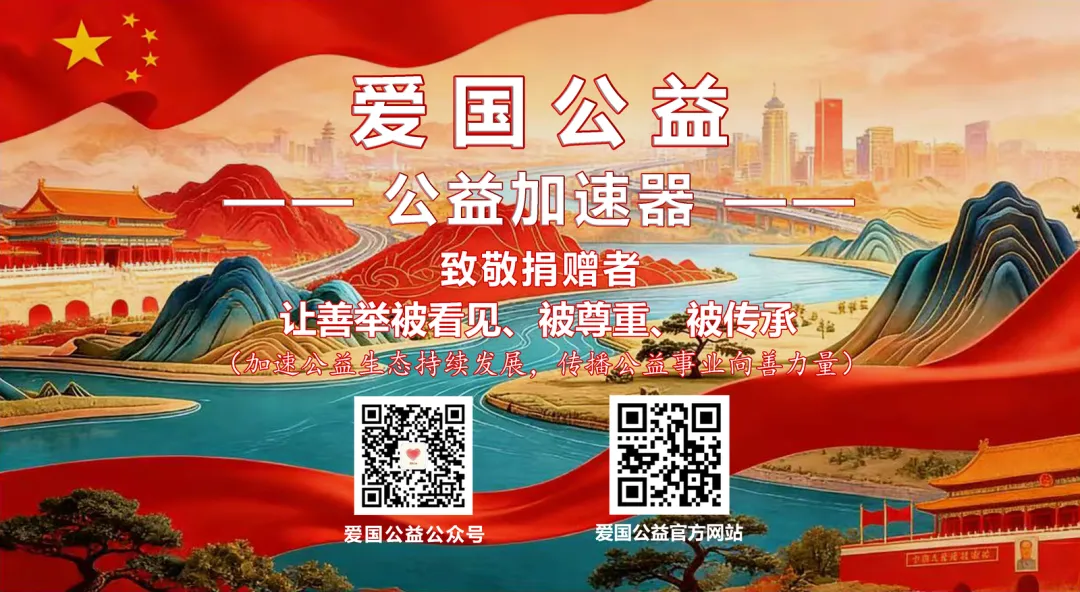
爱国公益丨公益加速器(全面解读与合规说明)
中英文版
一、平台定位(背景)
爱国公益,平台定位:中国首个专注"捐赠者服务"的平台。
通过首创的"公益丰碑"及媒体报道,致敬捐赠者——让善举被看见、被尊重、被传承。为捐赠行为赋予影响力、尊荣感及社会价值;加速公益生态持续发展,传播公益事业向善力量!
爱国公益并非基金会或募捐主体,不接受任何捐赠款项,所有捐赠均直接进入合作公益基金会账户,确保资金路径清晰、合规、可审计。
请注意:全国任何企业或个人,向全国任何公益项目或基金会累计捐赠现金达到10万元,可申请提供"公益丰碑"永久展示,无偿服务;不是限定只捐赠给爱国公益的公益项目。
二、公益加速器是什么
公益加速器是爱国公益平台与基金会联合发起的一个专项公益项目,专款专用,符合《慈善法》第五十四条。
这个项目的资金用途标准表述是:致敬捐赠者(媒体报道及善举记录),加速公益生态发展。
媒体报道:指三大媒体的公益专题报道,有采编制作成本,属于购买媒体的公益专题制作与传播服务,不是购买新闻版面
善举记录:即"公益丰碑",是一个网页,像书的目录一样,把媒体报道的信息整合归档,永久展示
公益加速器的专款,不是买米、买面,不是救灾——不用于《慈善法》第三条所列扶贫济困、扶老救孤恤病助残优抚、救助突发事件损害等物资救助类支出;专门用来做这件事——致敬捐赠者、做慈善文化传播。买的不是物资,是"被看见";救的不是急,是"被遗忘"。
三、传统公益与公益加速器的合规定位对照
既然公益加速器的专款不用于《慈善法》第三条所列的物资救助类支出,那它合法合规落在《慈善法》的哪一侧?传统公益项目与公益加速器,分别落在《慈善法》的不同侧,两者是互补关系而非替代关系。
传统公益的主要落点在《慈善法》第三条列举的慈善活动范围——扶贫、济困,扶老、救孤、恤病、助残、优抚,救助自然灾害等突发事件造成的损害。资金符合《慈善法》第五十四条专款专用:钱变为物资或服务,直接交付受助对象。它解决的是"受助者得到什么",这是"救助执行"的一侧。
公益加速器不做物资救助,用途方向符合新《慈善法》(2024年9月5日起施行)第九十七条的导向——"广播、电视、报刊、互联网等媒体应当积极开展慈善公益宣传活动,普及慈善知识,传播慈善文化"。用专款制作公益专题报道和善举记录(公益丰碑),把捐赠者点亮的受助方故事讲出去、把向善力量传开。而在钱的管理上,公益加速器同样符合《慈善法》第五十四条专款专用——不碰本金、不截留、不回报捐赠人本人,管理底座与传统公益一致。它解决的是"善举被多少人看见",这是"慈善文化传播"的一侧。
两侧不是对立关系:没有传统公益,受助者得不到帮助;没有传播,好人好事容易被遗忘。公益加速器补的是后一环——让善举被看见、被尊重、被传承。
四、公益加速器,符合《慈善法》第97条的导向
新修改《慈善法》(2024年9月5日起施行)第97条:
国家采取措施弘扬慈善文化,培育公民慈善意识……广播、电视、报刊、互联网等媒体应当积极开展慈善公益宣传活动,普及慈善知识,传播慈善文化。
这条立法的重心很清楚——国家鼓励把慈善文化传出去,鼓励媒体积极开展慈善公益宣传。公益不能只闷头捐钱,把善举讲出来、把好人好事传出去,本来就是慈善生态该有的环节。
公益加速器干的,就是把"传播"本身变成公益项目的一个正式用途:用基金会立项的专款,做公益专题报道和善举记录。不是捐赠人自掏腰包买软文,更不是"捐了就返你流量",是"因为你好事做得够格,所以你点亮的那些人被看见"。
别人用媒体曝光乱象,我们用媒体致敬善举。一个兜底监督,一个正向扬善,合起来才是完整的慈善舆论环境。
公益加速器的用途方向符合第97条的导向——通过公益专题报道感谢捐赠人的善举行为,不涉及公益项目的具体运作及受助方信息。捐赠人获得的是名誉表彰——这是慈善法允许的对慈善贡献的合理褒扬,不是利益对价。公益加速器通过这种克制的传播方式,让社会公众看到"有人在做好事",从而感召更多人参与公益,社会公众是最终的受益对象。
五、关于"捐赠换报道"的回应
在回应这个质疑之前,必须先讲清一条合规底线。
公益加速器的专款,不是用来"回报捐赠人自己"的——这是必须讲清的合规底线。
新《慈善法》明确慈善捐赠遵循自愿、无偿、非营利原则。公益加速器的专款,不是用来回报捐赠人自己的,而是用来致敬他帮扶的受助方、报道全中国的好人好事、传播慈善文化。
逻辑是反过来的:他捐了,我们用这笔专款把他这份善举记录下来、把受助者的故事讲出去、把"有人愿意做好事"这件事传开——这是对"善"本身的致敬,不是对捐赠人的利益兑换。
名誉表彰可以有,这是法律允许的合理获得感;利益对价不能有,这是底线。不返利、不回扣、不给捐赠人本人做商业宣传,只做一件事——把他捐出去的那份善意,转向去照亮别人。
基于这条底线,再来看外界的一个常见质疑:
有人问:你捐了钱,又给你做媒体报道和公益丰碑,这不就是"捐赠换报道"吗?
答案是:不是。 要理解为什么不是,需要把两条法律关系彻底分开看。
5.1 第一条法律关系:平台无偿服务
爱国公益平台面向的是全中国:任何企业或个人,向全中国的任何公益项目或基金会,累计捐赠现金达到10万元,平台可无偿提供三大媒体报道及"公益丰碑"永久展示。
请你注意这句话里的每一个词——
全中国的任何公益项目。 不是爱国公益自己的项目,不是爱国公益发起的项目,不是跟爱国公益有关联的项目。是水灾项目也好,敬老院项目也好,教育项目也好,环保项目也好——全中国任何一个合法备案的公益项目,都算。
全中国的任何基金会。 不是爱国公益合作的基金会,不是爱国公益指定的基金会,不是爱国公益发起的基金会。是中国的任何一家依法设立的公益基金会,你捐给谁都行。
任何企业或个人。 不分行业、不分规模、不分地域、不分身份。只要累计捐够10万,标准一样,服务一样。
你捐给全中国的任何公益项目或基金会,钱直接进入那些项目或基金会的账户,跟爱国公益平台一分钱关系都没有。那平台为什么要给你做报道?因为这就是它成立的目的——中国首个专注"捐赠者服务"的平台,成立的唯一目的就是服务捐赠者、致敬善举。你捐了,你符合了平台公开的标准,平台按标准给你无偿服务。不是你拿捐款"换"来的,是平台主动提供的。
这跟"捐赠换回报"有本质区别。平台提供无偿服务与捐赠行为之间,不存在利益对价关系。捐赠是企业家向善之心的体现,媒体报道是平台对其善举的致敬。他捐给谁、钱去哪了,跟平台毫无关系;平台给他报道,是因为平台的存在意义就是致敬这样的人。两件事独立发生,不是一笔交易。
这里必须强调:无偿服务不是免费。 媒体报道有采编成本,公益丰碑有制作成本。平台投入这些成本,不向捐赠者收取任何费用,这叫无偿服务。
5.2 第二条法律关系:公益加速器专款专用
企业家向公益加速器捐赠→钱进基金会专项账户→这笔钱按立项用途,用来做公益专题报道和善举记录→致敬的是受助方和好人好事,不是给捐赠人本人回报。
两层法律关系的性质完全不同:
第一层是平台无偿服务(平台承担成本,不向捐赠者收费)
第二层是专款专用做慈善文化传播(符合第97条的导向)
一个是"你捐了,我按标准致敬你";一个是"你捐的钱,用来致敬别人"。方向完全不同,但合在一起,构成了一个完整的向善生态。
5.3 合规边界补遗
除上述两条法律关系外,该模式还须满足以下合规条件:
真实自愿: 禁止摊派、强制,不得把捐赠作为获取其他利益的前提
凭证真实: 累计金额以受赠方出具的合法捐赠票据为准
宣传真实: 报道须有事实依据,涉及个人或企业形象需取得同意并保护隐私
个人信息处理合法: 公开姓名、企业信息等前须有明确授权,符合《个人信息保护法》
税务处理正确: 仅向具备资格的受赠主体、用于合规公益项目的真实捐赠,才可能依法申请税前扣除;荣誉服务本身不可抵扣
六、关于"媒体报道"的合规性
厘清了"不是捐赠换报道"之后,再单独看媒体报道这一环本身的合规边界:
6.1 新闻报道不能买卖
《关于禁止有偿新闻的若干规定》明确:新闻单位采集、编辑、发表新闻,不得以任何形式收取费用。《报纸出版管理规定》要求采编业务和经营业务严格分开。《广告法》第十四条规定:大众传播媒介不得以新闻报道形式变相发布广告。
这几条的意思是同一个——新闻采编和经营活动必须隔离,不能"你出钱、我发稿"。
6.2 公益专题报道有制作成本,可以出资支持
公益加速器购买的,不是"新闻报道",而是公益专题报道的制作与传播服务——类似央视拍摄一部慈善文化宣传片:有选题策划、采访拍摄、编辑制作、版面排播,这些环节本身就有成本。
《广告法》第七十四条:国家鼓励、支持开展公益广告宣传活动,大众传播媒介有义务发布公益广告。
《公益广告促进和管理暂行办法》第七条:企业出资设计、制作、发布或者冠名的公益广告,可以标注企业名称和商标标识。
也就是说——企业出资做公益专题、公益广告,是国家鼓励的;只要不伪装成新闻、不夹带商业推销、不回报捐赠人本人,就完全合规。
6.3 边界锁死
不做的事:
不向记者付费发新闻稿
不以新闻形式刊播广告
不标注商品服务、不写联系方式、不做商业引流
不用报道给捐赠人本人返流量、返利益
做的事:
用公益加速器专款,出资制作公益专题报道
报道对象是受助方、好人好事、向善故事
公益丰碑作为善举记录网页,把专题报道整合归档
符合《公益广告促进和管理暂行办法》对公益内容的界定
七、关于"加速公益生态持续发展,传播公益事业向善力量"的解读
关键在于"生态"和"事业"这两个词,它们说的是同一件事的两个不同切面。
7.1 从行业层面看:生态是系统,事业是行为,天然互补
"公益生态"讲的是整个行业的土壤和气候——基金会、捐赠者、受助方、媒体、监管、公众信任,这些要素之间怎么互相作用、怎么形成良性循环,这就是系统。系统不转,谁都干不好。
"公益事业"讲的是公益作为一种社会行动本身——有人捐钱、有人做事、有人受益,这是具体的行为,是千千万万人参与进来的实际行动。行为不活跃,系统就是空架子。
系统需要行为来激活,行为需要系统来支撑。一个讲结构,一个讲参与,缺一不可。
7.2 再往深一层看:生态是机制,事业是信仰
"加速公益生态持续发展"——"加速"和"持续发展"说的是效率问题、运转问题。怎么让这个系统转得更快、转得更顺?这就是机制。
公益加速器就是这套机制的发动机。当好人好事被报道、受助者的尊严被看见、公众信任建立了,更多人愿意参与——生态的循环就被激活了,机制就开始加速了。
"传播公益事业向善力量"——"传播"和"向善力量"说的是感召问题、认同问题。公益这件事之所以值得被传播,不只是因为它有效率、有机制,而是因为它承载着一种人类共同的价值追求——向善。这是一种信仰层面的东西。当一座"公益丰碑"立起来,当一次媒体报道发出去,传递的不只是一个人的善举,而是一个信号:善是有力量的,向善是值得的。 这是精神感召,是文化共识,是信仰的传递。
7.3 两句话合在一起,逻辑是完整的
前一句讲机制——公益加速器怎么通过致敬捐赠者(致敬的是他照亮的人),把公益生态的循环转起来,让它发展得更快;
后一句讲信仰——让公益这件事本身所承载的向善力量,被社会看见、被时代记住、被更多人信仰。
机制是骨架,信仰是灵魂。骨架撑起行业,灵魂感召人心。前后咬合,缺一不可。
八、关于受益人的思考
传统公益项目讲"受益人是谁"非常清晰——敬老院老人、灾区群众、失学儿童,钱变物资到了他们手里,一目了然。但公益加速器做的是慈善文化传播,有人会拿《慈善法》第三条的框架来问:"你这个项目的受益人是谁?"
公益加速器的受益对象,就是社会公众。而且这个定位比传统公益的受益人更"大"——不是几十个、几百个受助者,是全社会。
逻辑链是这样的:
第一,公益加速器用专款做公益专题报道,内容是感谢捐赠人的善举行为,不涉及公益项目的具体运作及受助方信息。捐赠人获得的是名誉表彰——这是慈善法允许的对慈善贡献的合理褒扬,不是利益对价。
第二,公众看到"有人在做好事"→ 受到正向感召。
第三,更多人愿意参与公益 → 更多人捐钱 → 更多受助者得到帮助。
第四,最终整个社会受益——慈善文化被传播了,向善氛围被营造了,社会信任度提升了。
这就是第97条导向的核心意图:通过传播慈善文化,让整个社会变得更好。受益对象不是某几个人,是社会公众整体。
怎么回应那些拿第三条框架来杠的人:
"传统公益落第三条,受益人是具体的受助者个体——这没问题。但公益加速器落的是第97条导向,它的慈善目的不是'救助特定对象',而是'传播慈善文化、培育公民慈善意识'。第97条本身就是面向全社会的——媒体宣传慈善文化,受益的是全体社会公众。你不能拿'救助类项目'的受益人标准,去套'文化传播类项目'。"
打个比方他们就懂了:
建一所希望小学 → 受益人是那所学校的孩子们(第三条逻辑)。
拍一部慈善文化宣传片说"知识改变命运" → 受益人是全社会观众,因为更多人被感召去关注教育(第97条导向逻辑)。
两种都是慈善,只是受益人形态不同——一个具体到一个群体,一个弥散到全社会。
本文基于新修改《中华人民共和国慈善法》(2024年9月5日起施行)及相关法规整理,供公益加速器项目说明及对外传播使用。
Patriotic Public Welfare | Charity Accelerator (Comprehensive Interpretation and Compliance Statement)
I. Platform Positioning (Background)
Patriotic Public Welfare is positioned as China's first platform dedicated to "donor services."
Through the original creation of the "Charity Monument" and media coverage, we pay tribute to donors—making good deeds visible, respected, and passed down. We endow the act of giving with influence, dignity, and social value; accelerating the sustainable development of the charitable ecosystem and spreading the positive power of philanthropy to society!
Patriotic Public Welfare is not a foundation or a fundraising entity. We do not accept any donated funds. All donations go directly into the accounts of partner charitable foundations, ensuring a clear, compliant, and auditable flow of funds.
Please note: Any enterprise or individual nationwide who has cumulatively donated cash totaling 100,000 RMB to any charitable project or foundation nationwide may apply for a permanent display on the "Charity Monument," provided as a pro bono service. This is not limited to projects initiated by Patriotic Public Welfare.
II. What Is the Charity Accelerator
The Charity Accelerator is a special charitable project jointly initiated by the Patriotic Public Welfare platform and partner foundations. It operates on the principle of special funds for designated purposes, in compliance with Article 54 of the Charity Law.
The standard description of this project's fund usage is: Paying tribute to donors (media coverage and documentation of good deeds), accelerating the development of the charitable ecosystem.
The parenthetical "media coverage and documentation of good deeds" is the standard expression for the Accelerator's fund purpose:
- Media coverage: Refers to feature reports on three major media outlets. These involve editorial and production costs and constitute the purchase of media's public-interest feature production and distribution services—not the purchase of news space.
- Documentation of good deeds: Namely the "Charity Monument"—a webpage that, like a table of contents in a book, archives and permanently displays information from media reports.
The special funds of the Charity Accelerator are not for buying rice or flour, nor for disaster relief—they are not used for material assistance expenditures listed in Article 3 of the Charity Law, such as poverty alleviation, elderly care, orphan support, disability assistance, or emergency disaster relief. These funds are dedicated exclusively to one purpose: paying tribute to donors and advancing charitable culture. What is purchased is not supplies, but "visibility"; what is saved is not an emergency, but "being forgotten."
III. Comparative Positioning of Traditional Charity and the Charity Accelerator Under the Law
Since the Accelerator's special funds are not used for material assistance listed in Article 3 of the Charity Law, on which side of the Charity Law does it legitimately fall? Traditional charitable projects and the Charity Accelerator fall on different sides of the Charity Law; they are complementary, not substitutive.
Traditional charity primarily falls within the scope of charitable activities enumerated in Article 3 of the Charity Law—poverty alleviation, elderly care, orphan support, disability assistance, disaster relief, etc. Funds comply with Article 54's principle of special funds for designated purposes: money is converted into supplies or services and delivered directly to beneficiaries. It addresses "what the beneficiary receives"—this is the "relief execution" side.
The Charity Accelerator does not provide material assistance. Its purpose aligns with the spirit of Article 97 of the newly revised Charity Law (effective September 5, 2024): "Radio, television, newspapers, the internet, and other media shall actively carry out charitable public-interest publicity, popularize charitable knowledge, and spread charitable culture." Special funds are used to produce public-interest feature reports and good-deed documentation (the Charity Monument), telling the stories of those illuminated by the donor's contribution and spreading the power of good. In fund management, the Accelerator equally complies with Article 54's special funds principle—no touching of principal, no misappropriation, no returns to the donor themselves—sharing the same management foundation as traditional charity. It addresses "how many people see the good deed"—this is the "charitable culture dissemination" side.
The two sides are not opposed: without traditional charity, beneficiaries receive no help; without dissemination, good deeds are easily forgotten. The Charity Accelerator supplements the latter link—making good deeds visible, respected, and passed down.
IV. The Charity Accelerator, in Alignment with the Spirit of Article 97 of the Charity Law
Article 97 of the newly revised Charity Law (effective September 5, 2024):
The state shall take measures to promote charitable culture and cultivate citizens' charitable awareness… Radio, television, newspapers, the internet, and other media shall actively carry out charitable public-interest publicity, popularize charitable knowledge, and spread charitable culture.
The legislative focus of this article is clear—the state encourages the dissemination of charitable culture and encourages media to actively carry out charitable public-interest publicity. Charity cannot simply consist of donating in silence; telling the stories of good deeds and spreading them is an essential part of the charitable ecosystem.
What the Charity Accelerator does is turn "dissemination" itself into a formal purpose of a charitable project: using specially allocated funds from a foundation to produce public-interest feature reports and good-deed documentation. This is not the donor paying out of pocket for soft articles, nor is it "donate and get traffic in return"—it is "because your good deeds meet the standard, those you have illuminated are seen."
Others use media to expose wrongdoing; we use media to pay tribute to good deeds. One provides oversight; the other promotes good—together they form a complete charitable public opinion environment.
The Accelerator's purpose aligns with the spirit of Article 97—expressing gratitude for the donor's benevolent actions through public-interest feature reports, without involving details of specific charitable projects or beneficiary information. What the donor receives is honorary recognition—a reasonable acknowledgment of charitable contribution permitted by the Charity Law, not a benefit in exchange. Through this restrained approach to dissemination, the Accelerator enables the public to see that "someone is doing good," thereby inspiring more people to participate in charity. The public at large is the ultimate beneficiary.
V. Response to the Question of "Donation in Exchange for Media Coverage"
Before addressing this question, a compliance bottom line must be clearly stated.
The special funds of the Charity Accelerator are not intended to "reward the donor themselves"—this is a mandatory compliance bottom line.
The new Charity Law clearly stipulates that charitable donations must follow the principles of voluntariness, gratuitousness, and non-profit. The Accelerator's special funds are not used to reward the donor, but to pay tribute to the beneficiaries they have supported, report on good deeds across China, and spread charitable culture.
The logic is reversed: when someone donates, we use these special funds to document their good deed, tell the beneficiary's story, and spread the message that "someone is willing to do good"—this is a tribute to "goodness" itself, not a benefit exchange for the donor.
Honorary recognition is permitted—this is a reasonable sense of gain allowed by law; benefit-for-value exchange is prohibited—this is the bottom line. No rebates, no kickbacks, no commercial promotion for the donor themselves. We do only one thing: redirect the goodwill the donor has given outward, to illuminate others.
Based on this bottom line, let us address a common external question:
Someone asks: You donate money, and then you get media coverage and a Charity Monument—isn't this exactly "donation in exchange for media coverage"?
The answer is: No. To understand why not, the two legal relationships must be clearly separated.
5.1 First Legal Relationship: Platform Pro Bono Service
The Patriotic Public Welfare platform serves all of China: any enterprise or individual who has cumulatively donated cash totaling 100,000 RMB to any charitable project or foundation nationwide may receive pro bono media coverage from three major outlets and permanent display on the "Charity Monument."
Please pay attention to every word in this statement:
Any charitable project in all of China. Not Patriotic Public Welfare's own projects, not projects initiated by Patriotic Public Welfare, not projects affiliated with Patriotic Public Welfare. Flood relief projects, nursing home projects, education projects, environmental projects—any legally registered charitable project in China counts.
Any foundation in all of China. Not a foundation partnered with Patriotic Public Welfare, not a foundation designated by Patriotic Public Welfare, not a foundation initiated by Patriotic Public Welfare. Any legally established public foundation in China—you may donate to whomever you choose.
Any enterprise or individual. Regardless of industry, size, region, or identity. As long as the cumulative donation reaches 100,000 RMB, the standard is the same and the service is the same.
When you donate to any charitable project or foundation in China, the money goes directly into those projects' or foundations' accounts—having nothing to do with the Patriotic Public Welfare platform. Then why does the platform provide you with media coverage? Because this is its purpose—China's first platform dedicated to "donor services," established solely to serve donors and pay tribute to good deeds. You donated, you met the platform's public standards, and the platform provides you with pro bono service according to those standards. This is not something "exchanged" with your donation; it is proactively offered by the platform.
This is fundamentally different from "donation in exchange for reward." There is no benefit-for-value relationship between the platform's pro bono service and the act of donation. Donation is an expression of an entrepreneur's goodwill; media coverage is the platform's tribute to their good deed. Where they donate and where the money goes have nothing to do with the platform; the platform covers them because its very purpose is to pay tribute to such people. The two things occur independently—not as a transaction.
It must be emphasized here: Pro bono service is not free. Media coverage involves editorial costs; the Charity Monument involves production costs. The platform invests these costs and does not charge the donor any fees—this is what pro bono service means.
5.2 Second Legal Relationship: Special Funds for Designated Purposes of the Charity Accelerator
An entrepreneur donates to the Charity Accelerator → funds enter the foundation's special account → the funds are used for their designated purpose: producing public-interest feature reports and good-deed documentation → paying tribute to beneficiaries and good deeds, not providing returns to the donor themselves.
The two layers of legal relationships are completely different in nature:
The first layer is the platform's pro bono service (the platform bears the costs and does not charge the donor) The second layer is special funds for designated purposes used for charitable culture dissemination (aligned with the spirit of Article 97)
One is "you donated, I pay tribute to you according to standards"; the other is "the money you donated is used to pay tribute to others." The directions are completely different, but together they form a complete ecosystem of goodwill.
5.3 Supplementary Compliance Boundaries
In addition to the above two legal relationships, this model must satisfy the following compliance conditions:
- Genuine voluntariness:
Prohibiting apportionment or coercion; donation may not be made a prerequisite for obtaining other benefits - Authentic documentation:
Cumulative amounts must be verified by valid donation receipts issued by the recipient - Truthful publicity:
Reports must be fact-based; consent must be obtained and privacy protected when involving personal or corporate images - Lawful personal information processing:
Explicit authorization must be obtained before disclosing names, corporate information, etc., in compliance with the Personal Information Protection Law - Correct tax treatment:
Only genuine donations made to qualified recipients for compliant charitable projects may be eligible for pre-tax deduction under applicable law; honorary services themselves are not deductible
VI. Compliance Regarding "Media Coverage"
Having clarified that "this is not donation in exchange for media coverage," we now examine the compliance boundaries of media coverage itself:
6.1 News Reporting Cannot Be Bought or Sold
The "Provisions on Prohibiting Paid News" clearly state that news units may not charge any fees for news gathering, editing, or publishing. The "Regulations on Newspaper Publishing" require strict separation of editorial and commercial operations. Article 14 of the Advertising Law stipulates that mass media may not publish advertisements in the form of news reports.
All these provisions convey the same principle—editorial and commercial activities must be isolated; "you pay, I publish" is prohibited.
6.2 Public-Interest Feature Reports Have Production Costs and May Be Supported by Funding
What the Charity Accelerator purchases is not "news reporting," but production and distribution services for public-interest feature reports—similar to CCTV producing a public-interest promotional film: there are topic planning, interview and filming, editing and production, and broadcast scheduling, all of which involve inherent costs.
Article 74 of the Advertising Law: The state encourages and supports public-interest advertising campaigns; mass media have an obligation to publish public-interest advertisements.
Article 7 of the "Interim Measures for the Promotion and Administration of Public-Interest Advertisements": Enterprises that fund the design, production, publication, or sponsorship of public-interest advertisements may display their enterprise name and trademark.
In other words—it is nationally encouraged for enterprises to fund public-interest features and advertisements; as long as they do not disguise them as news, do not include commercial promotions, and do not provide returns to the donor themselves, full compliance is achieved.
6.3 Locked Boundaries
What we do NOT do:
Pay journalists to publish press releases Broadcast advertisements in the form of news reports Label commercial products or services, include contact information, or conduct commercial traffic diversion Use reports to return traffic or benefits to the donor themselves
What we DO:
Use the Accelerator's special funds to finance the production of public-interest feature reports The subject of reports is beneficiaries, good deeds, and stories of goodwill The Charity Monument serves as a documentation webpage, archiving feature reports Comply with the definition of public-interest content under the "Interim Measures for the Promotion and Administration of Public-Interest Advertisements"
VII. Interpretation of "Accelerating the Sustainable Development of the Charitable Ecosystem, Spreading the Positive Power of Philanthropy to Society"
The key lies in the two words "ecosystem" and "cause"—they describe two different facets of the same thing.
7.1 From an Industry Perspective: Ecosystem Is System, Cause Is Action—Naturally Complementary
"Charitable ecosystem" describes the soil and climate of the entire industry—foundations, donors, beneficiaries, media, regulators, and public trust. How these elements interact and form a virtuous cycle constitutes the system. If the system does not function, no one can succeed.
"Charitable cause" describes charity as a social action itself—people donating money, people taking action, people benefiting. This is concrete behavior, the actual actions of millions of participants. If behavior is inactive, the system is an empty shell.
The system needs behavior to activate it; behavior needs the system to support it. One describes structure, the other describes participation—both are indispensable.
7.2 A Deeper Look: Ecosystem Is Mechanism, Cause Is Faith
"Accelerating the sustainable development of the charitable ecosystem"—"accelerating" and "sustainable development" address efficiency and operation. How to make the system turn faster and smoother? This is mechanism.
The Charity Accelerator is the engine of this mechanism. When good deeds are reported, when beneficiaries' dignity is seen, and when public trust is established, more people are willing to participate—the ecosystem's cycle is activated and the mechanism begins to accelerate.
"Spreading the positive power of philanthropy to society"—"spreading" and "positive power" address inspiration and identification. The reason philanthropy deserves to be spread is not only because it is efficient or mechanistic, but because it carries a common value pursuit of humanity—goodness. This is a matter of faith. When a "Charity Monument" is erected and a media report is published, what is conveyed is not just one person's good deed, but a signal: goodness has power, and choosing good is worthwhile. This is spiritual inspiration, cultural consensus, and the transmission of faith.
7.3 Together, the Two Sentences Form a Complete Logic
The first sentence speaks to mechanism—how the Charity Accelerator, by paying tribute to donors (tribute directed at those they illuminate), activates the ecosystem's cycle and accelerates its development;
The second speaks to faith—enabling the positive power inherent in philanthropy itself to be seen by society, remembered by the era, and believed in by more people.
Mechanism is the skeleton; faith is the soul. The skeleton supports the industry; the soul inspires people's hearts. The two interlock, each indispensable.
VIII. Reflections on Beneficiaries
In traditional charitable projects, "who are the beneficiaries" is very clear—elderly home residents, disaster victims, children deprived of education. Money becomes supplies and reaches their hands, straightforward and visible. But the Charity Accelerator engages in charitable culture dissemination. Some may apply the framework of Article 3 of the Charity Law to ask: "Who are the beneficiaries of your project?"
The beneficiaries of the Charity Accelerator are the public at large. And this positioning is "larger" than traditional charity beneficiaries—not dozens or hundreds of specific individuals, but all of society.
The logical chain is as follows:
First, the Accelerator uses special funds to produce public-interest feature reports, the content of which expresses gratitude for the donor's benevolent actions without involving the specific operations of charitable projects or beneficiary information. The donor receives honorary recognition—a reasonable acknowledgment of charitable contribution permitted by the Charity Law, not a benefit in exchange.
Second, the public sees "someone is doing good" → and is positively inspired.
Third, more people are willing to participate in charity → more people donate → more beneficiaries receive help.
Fourth, ultimately the entire society benefits—charitable culture is disseminated, an atmosphere of goodwill is cultivated, and social trust is enhanced.
This is the core intent of Article 97's spirit: by spreading charitable culture, society as a whole becomes better. The beneficiaries are not a few specific individuals, but the public at large collectively.
How to respond to those who apply Article 3's framework to challenge this:
"Traditional charity falls under Article 3, with beneficiaries being specific individuals—this is correct. But the Accelerator falls under the spirit of Article 97; its charitable purpose is not 'assisting specific objects' but 'disseminating charitable culture and cultivating citizens' charitable awareness.' Article 97 itself is oriented toward all of society—when media promote charitable culture, the beneficiaries are all members of the public. You cannot apply the beneficiary standards of 'relief-type projects' to 'culture-dissemination-type projects.'"
An analogy makes it clear:
Building a Hope Primary School → beneficiaries are the children at that school (Article 3 logic).
Producing a charitable culture promotional film saying "knowledge changes destiny" → beneficiaries are all viewers in society, because more people are inspired to care about education (Article 97 spirit logic).
Both are charity; only the form of beneficiaries differs—one specific to a group, the other diffused throughout all of society.
This document is compiled based on the newly revised Charity Law of the People's Republic of China (effective September 5, 2024) and related regulations, for use in explaining the Charity Accelerator project and external communications.