ARTICLE · 1434572
202608-202610各地联考阅读理解C 集合:试题+答案(文档可下载)
下载链接:
我用夸克网盘给你分享了「202608-202610各地联考阅读理解C 集合.pdf」,点击链接或复制整段内容,打开「夸克APP」即可获取。
链接:https://pan.quark.cn/s/ce72efa5b4e7
202608-202610各地联考模拟题阅读理解C
目录:
1.202608湖北圆创联盟联考
2.202608湖北省部分高中返校考
3.202608湖南长郡中学开学考
4.20260821浙江Z20联考
5.202608山东同心同德学校联盟开学考
6.20260827强基高三返校考
7.202608安徽十联考第一次教学质量测评
8.202608广东省第一次模拟考
9.202608湖北省云学联盟阶段训练
10.20260827七彩精诚金兰联考
11.202608巴蜀月考卷(一)
12.202608福建名校联盟开学考
13.202608浙江省A9协作体暑假返校学情诊断
14.202608湖南雅礼中学开学考
15.20260902名校协作体高三
16.202609 湖南省部分名校阶段检测
17.20260909嘉兴基测
18.202609山东济南市摸底考
19.202609山东名校考试联盟
20.202609南开中学月考(一)
21.202609南通市部分学校质量监测
22.202609青岛市期初调研
23.20260916镇江市期初考试
24.20260916苏州四市五区期初考试
25.20260917湖北武汉九调
26.202609广东省六校联盟
27.202609安徽省江南十校
28.202609杭州二中开学适应性考试-难
29.202609巴蜀中学适应性月考(二)-难
30.202609湖南省九校联盟第一次联考
31.20261007江浙皖共同体
32.20261007浙南名校
33.20261009天域协作体
34.20261009新阵地联盟
35.20261010强基联盟
36.202610杭州二中月考卷
37.202610九五高中协作体学习质量综合评估
38.202610山东省齐鲁名校联盟阶段性检测
39.202610山东实验中学第一次诊断
40.202610深圳市宝安区2开学教学质量检测
41.202610皖南八校
42.202610湘豫名校联考新高考适应性调研考试
43.202610湖南炎德英才第二次联考-难
44.202610广州市属十校顶尖联考适应性训练
45.202610巴蜀中学月考(三)
试题:
1.202608湖北圆创联盟联考
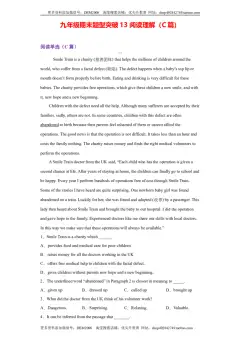
Summer comes, and mosquitoes constantly buzz and bite, leaving red marks and ruining our sleep.
To fight them, DEET (避蚊胺) is assumed to be the gold standard for preventing mosquito bites. Most researchers agree that a key part of its effectiveness is unpleasantness — the bugs just hate to be around it. However, some mosquitoes seem capable of overcoming their revulsion, leading to the theory that the insects might be getting used to the chemical.
Claudio Lazzari at the University of Tours set out to investigate, by running a version of the experiments made famous by Ivan Pavlov in the late 1800s where dogs were conditioned to associate sounds with food. In those experiments, Pavlov routinely rang a bell and then immediately fed the dogs. Eventually, when he made the sounds but didn’t provide food, he found the animals still salivated (流口水), as they would before a meal.
In his experiments, Dr Lazzari presented hungry mosquitoes with warm sheep’s blood while being exposed to a gentle breeze of ordinary air or of air blown past a piece of paper soaked in DEET. After many similar repeated experiments, the researchers then bravely presented their own hands to the insects. One hand was covered in DEET while the other was left untreated. To their frustration they watched as 60% of the mosquitoes that had been presented with blood while being exposed to DEET bit the hand coated in DEET. In contrast, all mosquitoes trained with ordinary air avoided it entirely.
Dr Lazzari’s conditioning in the laboratory was important for the mosquitoes in developing their fondness for DEET. But the chances are good that a similar scene is taking place in the real world, where the effects of DEET typically weaken over time, especially when people are sweating or not applying enough of the stuff in the first place.
In such circumstances, hungry mosquitoes are most likely to be able to tolerate the faint smell of DEET, bite a lightly protected person, begin connecting the smell with food and become more dangerous to those they encounter later in their lives.
28.What does the underlined word “revulsion” in paragraph 2 mean?
A. Dislike.B. Fondness.C. Desire.D. Curiosity.
29.Why was Pavlov’s experiment mentioned?
A. To prove DEET’s effect.B. To explain conditioning.
C. To honor early biologists.D. To analyze animal behavior.
30.What can we learn about the research from paragraph 4?
A. Sheep’s blood drove mosquitoes away. B. All mosquitoes weren’t thirsty for blood.
C. Ordinary air fueled mosquitoes’ appetite. D. Most mosquitoes were conditioned to DEET.
31.Why does DEET sometimes fail to keep mosquitoes away?
A. Sweat clears DEET completely. B. Mosquitoes associate it with food.
C. Its smell grows stronger over time. D. Human blood weakens the chemical.
2.202608湖北省部分高中返校考
When a Los Angeles hospital authorized handwriting courses for its doctors, it highlighted a modern contradiction: in an era of digital perfection, the simple act of writing by hand remains critically important. The chief of staff explained to Science Daily, "Many of our physicians don't write clearly." The consequences can be severe, as seen in an unfortunate case where a chemist's misreading of a doctor's prescription (处方) led to a patient's death.
Even though many medical records are now stored on computers, physicians still spend a lot of their time writing notes on charts or writing prescriptions by hand. Clarity in handwriting isn't merely an aid to communication. In some significant way, writing by hand primes the brain for learning to read. Psychologists Mueller and Oppenheimer found that "Laptop note takers' tendency to write down lectures verbatim (逐字地) rather than processing information and reframing it in their own words has a negative effect on learning". In their experiments, students typing notes processed information shallowly, while those writing by hand were forced to summarize, leading to better understanding. The slower pace of pen and paper acts as a cognitive filter, activating the brain for deeper comprehension.
Yet, the skill is fading rapidly. Researchers worry that abandoning the pen for the keyboard will lead to any number of unforeseen negative consequences. Anne Mangen, who studies how technology transforms literacy, notes that typing, being more "abstract and unconnected," could have profound implications; this decline is similar to a form of cultural pollution, a loss of a fundamental human capacity.
A common misconception is that we have simply traded an inefficient tool for a superior one. However, like the loss of face‑to‑face interaction, this trade for efficiency comes at a hidden cost. We are sacrificing irrecoverable ways of learning and knowing. Ultimately, a child who masters the keyboard but cannot sign their name is not a symbol of progress.
Handwriting is not a relic; it is a vital thread in the fabric of our cognition, and its wearing demands our immediate attention.
28.Why did the hospital introduce handwriting courses?
A. To follow the latest handwriting trend.B. To prevent potential medical accidents.
C. To improve doctors' handwriting skills.D. To promote the use of handwritten records.
29.What can we learn from Mueller and Oppenheimer's research?
A. Typing facilitates meaningful understanding.
B. Note‑taking blocks verbatim comprehension.
C. Keyboarding ensures higher learning efficiency.
D. Handwriting benefits deeper cognitive engagement.
30.What is the cost of abandoning handwriting?
A. The pollution of a traditional culture.B. The decline in communication efficiency.
C. The over‑reliance on modern technologies.D. The fading of an essential cognitive ability.
31.What does the author suggest we do?
A. Preserve handwriting as a tradition.B. Encourage keyboard use in education.
C. Value the crucial role of handwriting.D. Introduce handwriting courses widely.