2 0 2 5 年 全 国 教 师 资 格
主讲老师 安凉
粉笔教师教育 粉笔教师REVIEWREVIEW语法课——核心教学环节P23P23
Step 1 Presentation(呈现模板)
Step 1 Presentation (10 mins)
(1) Reading the passage and finding out the examples
Students will read through the passage to get the main idea and pick out the sentences which contain
_________ , and underline them. Then the teacher will ask students to observe the sentences and work in
groups of four to have a discussion about the basic structure and usage of this grammar. A few minutes later,
some students will be invited to share their results.
(2) Explaining the rules
The teacher will make a conclusion and explain the rules of this grammar, including its meaning,
structure and usage. Then the teacher will give some example sentences.
(Justification: Through the above activities, students can understand the meaning and usage of the new
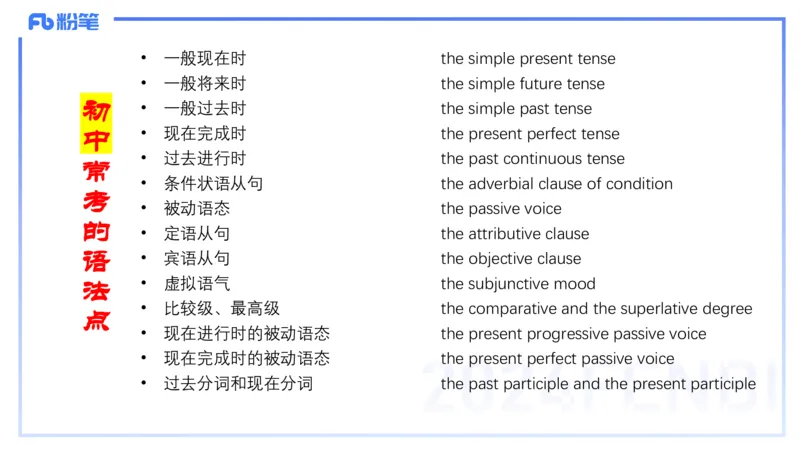
knowledge, express their opinions, and fully cultivate the skill of speaking.)• 一般现在时 the simple present tense
• 一般将来时 the simple future tense
初
• 一般过去时 the simple past tense
中
• 现在完成时 the present perfect tense
常 • 过去进行时 the past continuous tense
• 条件状语从句 the adverbial clause of condition
考
• 被动语态 the passive voice
的
• 定语从句 the attributive clause
语
• 宾语从句 the objective clause
法
• 虚拟语气 the subjunctive mood
点 • 比较级、最高级 the comparative and the superlative degree
• 现在进行时的被动语态 the present progressive passive voice
• 现在完成时的被动语态 the present perfect passive voice
• 过去分词和现在分词 the past participle and the present participle• 过去将来时 the past future tense
高
• 现在进行时 the present progressive tense
中
• 过去完成时 the past perfect tense
常
• 将来进行时 the future continuous tense
考
• 现在完成进行时态 the present perfect continuous tense
的
• 限定性定语从句 the restrictive attributive clause
语
• 非限制性定语从句 non-restrictive attributive clause
法
• 省略句 elliptical sentence
点
• 非谓语动词 the non-predicate verb
• 动词不定式 infinitive
• 过去分词和现在分词 the past participle and the present participle看课件
语言素材: An Accidental Invention
Did you know that tea, the most popular drink in the world (after water), was invented by accident?
Many people believe that tea was first drunk about 5,000 years ago. It is said that a Chinese ruler
called Shen Nong was the first to discover tea as a drink. One day Shen Nong was boiling drinking
water over an open fire. Some leaves from a tea plant fell into the water and remained there for some
time. It produced a nice smell so he tasted the brown water. It was quite delicious, and so, one of the
world's favorite drinks was invented.
A few thousand years later, Lu Yu, "the saint of tea", mentioned Shen Nong in his book Cha Jing.
The book describes how tea plants were grown and used to make tea. It also discusses where the finest
tea leaves were produced and what kinds of water were used.
It is believed that tea was brought to Korea and Japan during the 6th and 7th centuries. In England,
tea didn't appear until around 1 660, but in less than 100 years, it had become the national drink. The
tea trade from China to Western countries took place in the 19th century. This helped to spread the
popularity of tea and the tea plant to more places around the world. Even though many people now
know about tea culture, the Chinese are without doubt the ones who best understand the nature of tea.4.Major steps
Step 1 Presentation (10 mins)
(1) Reading the passage and finding out the examples
Students will read through the passage to get the main idea and pick out the sentences which contain the
passive voice of the simple past tense, and underline them. Then the teacher will ask students to observe the
sentences and work in groups of four to have a discussion about the basic structure and usage of this
grammar. A few minutes later, some students will be invited to share their results.
(2) Explaining the rules
The teacher will make a conclusion and explain the rules of this grammar, including its meaning,
structure and usage. Then the teacher will give some example sentences.
(Justification: Through the above activities, students can understand the meaning and usage of the new
knowledge, express their opinions, and fully cultivate the skills of listening,speaking, reading and writing.)P24
Step 2 Practice(练习模板)
Step 2 Practice (4 mins)
The teacher will ask students to finish the following exercises:
Fill in the blanks/ Translate/ True or false/ Choose the best choice/ Make sentences
(1)____________________________.
(2)____________________________.
A few minutes later, some students will be invited to share their answers. Then the teacher will give
corresponding feedback.
(Justification: Exercises can help students to consolidate the new knowledge, and achieve the purpose of
highlighting the key points. In addition, students can master the meaning and usage of this grammar point.)语言素材: An Accidental Invention
Did you know that tea, the most popular drink in the world (after water), was invented by accident?
Many people believe that tea was first drunk about 5,000 years ago. It is said that a Chinese ruler
called Shen Nong was the first to discover tea as a drink. One day Shen Nong was boiling drinking
water over an open fire. Some leaves from a tea plant fell into the water and remained there for some
time. It produced a nice smell so he tasted the brown water. It was quite delicious, and so, one of the
world's favorite drinks was invented.
A few thousand years later, Lu Yu, "the saint of tea", mentioned Shen Nong in his book Cha Jing.
The book describes how tea plants were grown and used to make tea. It also discusses where the finest
tea leaves were produced and what kinds of water were used.
It is believed that tea was brought to Korea and Japan during the 6th and 7th centuries. In England,
tea didn't appear until around 1 660, but in less than 100 years, it had become the national drink. The
tea trade from China to Western countries took place in the 19th century. This helped to spread the
popularity of tea and the tea plant to more places around the world. Even though many people now
know about tea culture, the Chinese are without doubt the ones who best understand the nature of tea.参考 1
4.Major steps
Step 2 Practice (4 mins)
The teacher will ask students to finish the following exercises:
Fill in the blanks
One of the world's favorite drinks ______ (invent) by accident.
Tea was first ______ (drink) by Shen Nong about 5,000 years ago.
A few minutes later, some students will be invited to share their answers. Then the teacher will give
corresponding feedback.
(Justification: Exercises can help students to consolidate the new knowledge, and achieve the purpose
of highlighting the key points. In addition, students can master the meaning and usage of this grammar
point.)参考 2
4.Major steps
Step 2 Practice (4 mins)
The teacher will ask students to finish the following exercises:
Rewrite the sentences using the passive voice.
They sold the fridge at a low price.
Somebody stole my camera from my hotel room.
A few minutes later, some students will be invited to share their answers. Then the teacher will give
corresponding feedback.
(Justification: Exercises can help students to consolidate the new knowledge, and achieve the purpose
of highlighting the key points. In addition, students can master the meaning and usage of this grammar
point.)P24
Step 3 Production(产出模板)
Step 3 Production (6 mins)
Group discussion/ Do a survey/ Make a dialogue
Students need to work in groups to discuss the following question/do a survey/ make a dialogue about
_______ by using this grammar. Several minutes will be given. When time’s up, several students will be
invited to share their results/ dialogue. Then the teacher will comment on students’ performances.
(Justification: Group activities will provide students with the opportunity to apply what they have
learned to practical use, improve their comprehensive language skills, boost their confidence in learning
English and enhance their sense of teamwork.)语言素材: An Accidental Invention
Did you know that tea, the most popular drink in the world (after water), was invented by accident?
Many people believe that tea was first drunk about 5,000 years ago. It is said that a Chinese ruler
called Shen Nong was the first to discover tea as a drink. One day Shen Nong was boiling drinking
water over an open fire. Some leaves from a tea plant fell into the water and remained there for some
time. It produced a nice smell so he tasted the brown water. It was quite delicious, and so, one of the
world's favorite drinks was invented.
A few thousand years later, Lu Yu, "the saint of tea", mentioned Shen Nong in his book Cha Jing.
The book describes how tea plants were grown and used to make tea. It also discusses where the finest
tea leaves were produced and what kinds of water were used.
It is believed that tea was brought to Korea and Japan during the 6th and 7th centuries. In England,
tea didn't appear until around 1 660, but in less than 100 years, it had become the national drink. The
tea trade from China to Western countries took place in the 19th century. This helped to spread the
popularity of tea and the tea plant to more places around the world. Even though many people now
know about tea culture, the Chinese are without doubt the ones who best understand the nature of tea.4.Major steps
Step 3 Production (6 mins)
Group discussion
Students need to work in groups to discuss the invention of potato chips by using this grammar. Several
minutes will be given. When time’s up, several students will be invited to share their dialogue. Then the
teacher will comment on students’ performances.
(Justification: Group activities will provide students with the opportunity to apply what they have
learned to practical use, improve their comprehensive language skills, boost their confidence in learning
English and enhance their sense of teamwork.)REVIEW词汇课——核心教学环节P24P24
Step 1 Presentation(呈现模板)
Step 1 Presentation (10 mins)
1. New words/phrases teaching
With the help of some pictures/ videos/ flashcards/ objects/ actions, the teacher will present the
meaning, usage, pronunciation and spelling of these new words/ phrases, including __________________.
2.Key sentence teaching
The teacher will show some pictures in the books, and let students describe the pictures firstly. Then
the teacher will introduce the key sentence and explain the meaning and usage of it.
【Justification】Students can understand the meaning and usage of new knowledge, express their
views correctly and fluently, and cultivate their speaking skills. In addition, students will also be more
interested in activities and more confident in learning English.语言素材: Full Moon, Full Feelings
Chinese people have been celebrating the Mid-Autumn Festival and enjoying mooncakes for centuries.
Mooncakes are in the shape of a full moon on the Mid-Autumn night. They carry people's wishes to the families
they love and miss.
There are many traditional folk stories about this festival. However, most people think that the story of
Chang'e is the most touching. Chang'e was Hou Yi's beautiful wife. After Hou Yi shot down the nine suns, a
goddess gave him magic medicine to thank him. Whoever drank this could live forever, and Hou Yi planned to
drink it with Chang'e. However, a bad man, Pang Meng, tried to steal the medicine when Hou Yi was not home.
Chang'e refused to give it to him and drank it all. She became very light and flew up to the moon. Hou Yi was so
sad that he called out her name to the moon every night. One night, he found that the moon was so bright and
round that he could see his wife there. He quickly laid out her favorite fruits and desserts in the garden. How he
wished that Chang'e could come back!
After this, people started the tradition of admiring the moon and sharing mooncakes with their families.语言素材: Full Moon, Full Feelings
Chinese people have been celebrating the Mid-Autumn Festival and enjoying mooncakes for centuries.
Mooncakes are in the shape of a full moon on the Mid-Autumn night. They carry people's wishes to the
families they love and miss.
There are many traditional folk stories about this festival. However, most people think that the story of
Chang'e is the most touching. Chang'e was Hou Yi's beautiful wife. After Hou Yi shot down the nine suns, a
goddess gave him magic medicine to thank him. Whoever drank this could live forever, and Hou Yi planned
to drink it with Chang'e. However, a bad man, Pang Meng, tried to steal the medicine when Hou Yi was not
home. Chang'e refused to give it to him and drank it all. She became very light and flew up to the moon. Hou
Yi was so sad that he called out her name to the moon every night. One night, he found that the moon was so
bright and round that he could see his wife there. He quickly laid out her favorite fruits and desserts in the
garden. How he wished that Chang'e could come back!
After this, people started the tradition of admiring the moon and sharing mooncakes with their families.4. Major steps
Step 1 Presentation (10 mins)
New words/phrases teaching
With the help of some pictures, the teacher will present the meaning, usage, pronunciation and
spelling of these new words: celebrate, mooncake, traditional.
(2) Key sentence teaching
The teacher will show some pictures in the books, then let students describe the pictures firstly. Then
the teacher will introduce the key sentence “How he wished that Chang'e could come back!” and explain the
meaning and usage of it.
【Justification】Students can understand the meaning and usage of new knowledge, express their views
correctly and fluently, and cultivate their speaking skills. In addition, students will also be more interested in
activities and more confident in learning English.P25
Step 2 Practice(练习模板)
Step 2 Practice (6 mins)
(1) Doing a matching task
Let students do a matching task to practice the new words. Students will be given one minute to match the
pictures with correct words. Then some of them will be invited to share their answers and the teacher will give
positive feedback.
(2) Make sentences
Students need to make some sentences using the new sentence pattern. For example, _______. A few
minutes later, some students will be invited to share their answers. Then the teacher will give corresponding
feedback.
【Justification】Practice by games can create a good classroom atmosphere and consolidate this lesson. In
addition, students can use words/phrases and sentence pattern more flexibly to improve their speaking ability.)Step 2 Practice (6 mins)
(1) Doing a matching task
Let students do a matching task to practice the new words. Students will be given one minute to match
the pictures with correct words. Then some of them will be invited to share their answers and get positive
feedback.
(2) Make sentences
Students need to make some sentences by using the new sentence pattern, such as How he wished that
she would fall in love with him! A few minutes later, some students will be invited to share their answers.
Then the teacher will give corresponding feedback.
(Justification: Practice by games can create a good classroom atmosphere and consolidate this lesson. In
the pair work, students can use phrases and sentences more flexibly to improve their oral expression ability.)P25
Step 3 Production(产出模板)
Step 3 Production (4 mins)
Group discussion/ Do a survey/ Make a dialogue
Students need to work in groups to discuss the following question/do a survey/ make a dialogue about
_______ by using the key words/phrases and sentences. Several minutes will be given. When time’s up,
several students will be invited to share their results/ dialogue. Then the teacher will comment on students’
performances.
(Justification: Group activities will provide students with the opportunity to apply what they have
learned to practical use, improve their comprehensive language skills, boost their confidence in learning
English and enhance their sense of teamwork.)Step 3 Production (4 mins)
Group discussion
Students need to work in groups to discuss the following question: “What other traditional folk stories
do you know?” by using the key words/phrases and sentences. Several minutes will be given. When time’s
up, several students will be invited to share their results/ dialogue. Then the teacher will comment on
students’ performances.
(Justification: Group activities will provide students with the opportunity to apply what they have
learned to practical use, improve their comprehensive language skills, boost their confidence in learning
English and enhance their sense of teamwork.)REVIEW语音课——核心教学环节P26
Step 1 Presentation (呈现模板)
Step 1 Presentation (10 mins)
1. Finding phonetic phenomenon
The teacher will read the words/ phrases/ sentences for the students. Students should listen carefully and
find out the similarity between them. Then the teacher will ask students to work in groups of four to have a
discussion about the rules of the phonetic phenomenon. A few minutes later, some students will be invited to
share their results.
2. Explaining the rules
The teacher will make a conclusion and explain the pronunciation rules of______ to the students.
(Justification: Students can understand the pronunciation rules, express their views correctly and fluently.
In addition, students will also be more interested in activities and more confident in learning English.)语言素材:
Berners Lee, 48, was named in the New Year's Honers list for "services to the
Internet"-- creating the system that has revolutionized computer use across the world.
He designed the system in his spare time in 1991 while working as a researcher at the
European research laboratory Cen, which is based in Switzerland.
Instead of patenting the system or restricting its use, Berners Lee gave away his
invention, making it possible for the Web to grow at fast rate.4. Major Steps
Step 1 Presentation (10 mins)
1. Finding phonetic phenomenon
The teacher will read the words for the students. Students should listen carefully and find out the
similarity between them. Then the teacher will ask students to work in groups of four to have a discussion
about the rules of the phonetic phenomenon. A few minutes later, some students will be invited to share their
results.
2. Explaining the rules
The teacher will make a conclusion and explain the pronunciation rules of the letter group “ed” to the
students.
(Justification: Students can understand the pronunciation rules, express their views correctly and fluently.
In addition, students will also be more interested in activities and more confident in learning English.)P26
Step 2 Practice(操练模板)
Step 2 Practice (4 mins)
Which order
The teacher will read out a group of words and the students will arrange them according to the sounds.
Several minutes later, the teacher will invite some students to share their answers in front of the whole class.
(Justification: Practicing the new knowledge through this activity can create a good class atmosphere and
help students consolidate what they have learned in this lesson. Students can also use the pronunciation rules
more flexibly and improve their speaking ability.)P26
Step 3 Production (产出模板)
Step 3 Production (6 mins)
Dubbing
Students need to work in groups to dub for a short cut of video which contains the pronunciation
rule they’ve learned. Several minutes will be given. When time’s up, several students will be invited to
share
their performances. Then the teacher will comment on students’ performances.
(Justification: Group activities provide students with more opportunities to express themselves,
improve students' comprehensive language ability, and enhance students' confidence in learning English.)REVIEW课型 Pre-listening While-listening Post-listening
1. Obstacle
1. Extensive listening
2. Prediction Discussion/Suvery/
听说课 2. Intensive listening
3. Topic discussion Role play/Debate
3. Listen and repeat
4. Background information
课型 Pre-reading While-reading Post-reading
1. Obstacle
1. Extensive/Global/Fast reading
2. Prediction Discussion/Suvery/
阅读课 2. Intensive/Detailed/Careful reading
3. Topic discussion Role play/Debate
3. Read after the audio
4. Background information
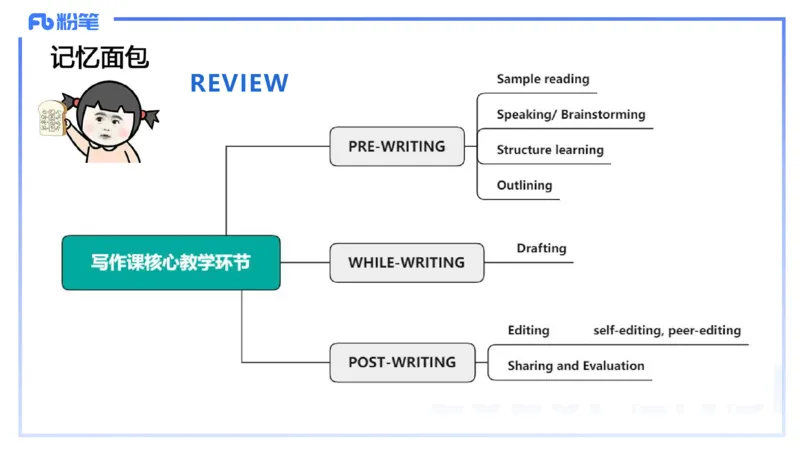
课型 Pre-writing While-writing Post-writing
1. Sampe reading
2. Brainstorming 1. Editing
写作课 Drafting
3. Structure learning
2. Sharing & Evaluation
4. Outlining
课型 Pre-speaking While-speaking Post-speaking
1. Reading after the audio
1. Listening/Reading
口语课 2. Group discussion/make a Sharing & Evaluating
2. Learning expressions
conversation/Do a survey课型 Presentation Practice Production
1. Reading the passage and Fill in the blanks/Translate/ Make
Discussion/Suvery/
语法课 finding out the examples sentences/Choose the best choice/
Make a dialogue
2. Explaining the rules True or False
1. Make a match
1. New words/phrases teaching Discussion/Suvery/
词汇课 2. Make sentences/Fill in the blanks/
2. Key sentence teaching Make a dialogue
True or False
Dubbing/Make a
1. Finding phonetic phenomena which order, bomb game, finger show, conversation/Group
语音课
2. Explaining the rules touch and say, voice game, missing game discussion/Do a
survey/Role-playQ & A粉笔教师教育 粉笔教师