延庆区 2020—2021 学年第二学期期中试卷
初 一 英 语
语言知识运用(共13分)
一、单项填空(共5分,每小题0.5分)
从下面各题所给的A、B、C、D四个选项中,选择可以填入空白处的最佳选项。
1. — Could you just tell ________ to call me back?
— Sure, no problem.
A. he B. she C. his D. him
【答案】D
【解析】
【详解】句意:——你能让他给我回个电话吗?——当然,没问题。
考查代词辨析。he他,人称代词主格;she她,人称代词主格;his他的,物主代词;him他,人称代词宾
格。此空位于动词tell后,用人称代词him作宾格,故选D。
2. — Is this bag ________, Betty?
— No, it’s not mine. It’s Lucy’s.
A. yours B. hers C. his D. theirs
【答案】A
【解析】
【详解】句意:——Betty,这个包是你的吗?——不,它不是我的。它是Lucy的。
考查代词辨析。yours你的;hers她的;his他的;theirs他们的。根据“No, it’s not mine”可知,此处询问是
否是“你的包”,问句用第二人称,故选A。
3. There is a bank ________ the hotel and the library.
A. on B. above C. between D. with
【答案】C
【解析】
【详解】句意:在旅馆和图书馆之间有一家银行。
考查介词辨析。on在……上;above在……之上;between在……之间;with带有。根据“the hotel and the
library”可知,此处用between…and表示“在……和……之间”,故选C。
4. After school, I play ________ piano again, usually for an hour.A. a B. an C. the D. /
【答案】C
【解析】
【详解】句意:放学后,我又弹钢琴,通常弹一个小时。
考查冠词辨析。演奏西洋乐器类,乐器前要加定冠词the,故选C。
5. We all like Jenny ________ she is kind and helpful.
A. and B. because C. but D. or
【答案】B
【解析】
【详解】句意:我们都喜欢Jenny,因为她很善良,乐于助人。
考查连词辨析。and和;because因为;but但是;or否则,或者。“她很善良且乐于助人”是“我们都喜
欢她”的原因,用because引导原因状语从句。故选B。
6. —________ book is this?
—It’s Mary’s.
A. What B. How C. Where D. Whose
【答案】D
【解析】
【详解】句意:——这是谁的书?——它是Mary的。
考查疑问词辨析。What什么;How怎样;Where在哪里;Whose谁的。根据“It’s Mary’s.”可知表示所属关
系,问是谁的书,用Whose符合语境。故选D。
7. — ________ are the potatoes?
— They are 7 yuan a kilo.
A. How long B. How old C. How much D. How many
【答案】C
【解析】
【详解】句意:——土豆多少钱?——它们是一公斤7元。
考查特殊疑问句。how long多久;how old多大;how much多少/多钱;how many多少。根据“They are 7
yuan a kilo”可知,此处询问多钱,故选C。
8. — When do you usually have history class?
— ________ Friday.
A. On B. To C. At D. In
【答案】A
【解析】【详解】句意:——你通常什么时候上历史课?——在周五。
考查介词辨析。On后接具体某一天、星期等;To朝,向;At后接具体时刻或节日等;In后接年、月、季
节等。根据“Friday”可知此处表示在周五上历史课,用介词On。故选A。
9. My grandfather ________ reading after supper every day.
A. liked B. is liking C. like D. likes
【答案】D
【解析】
【详解】句意:我爷爷每天晚饭后喜欢看书。
考查时态辨析及主谓一致。根据“every day”可知用一般现在时,主语“My grandfather”后接动词的第三人
称单数形式likes。故选D。
10. Look! Some of the children ________ football on the playground.
A. played B. are playing C. play D. plays
【答案】B
【解析】
【详解】句意:看!一些孩子正在操场上踢足球。
考查动词时态。根据提示语“look”可知此句应该用现在进行时,谓语动词是be+doing,故选B。
二、完形填空(共8分,每小题1分)
阅读下面的短文,掌握其大意,然后从短文后各题所给的A、B、C、D四个选项中,选择最
佳选项。
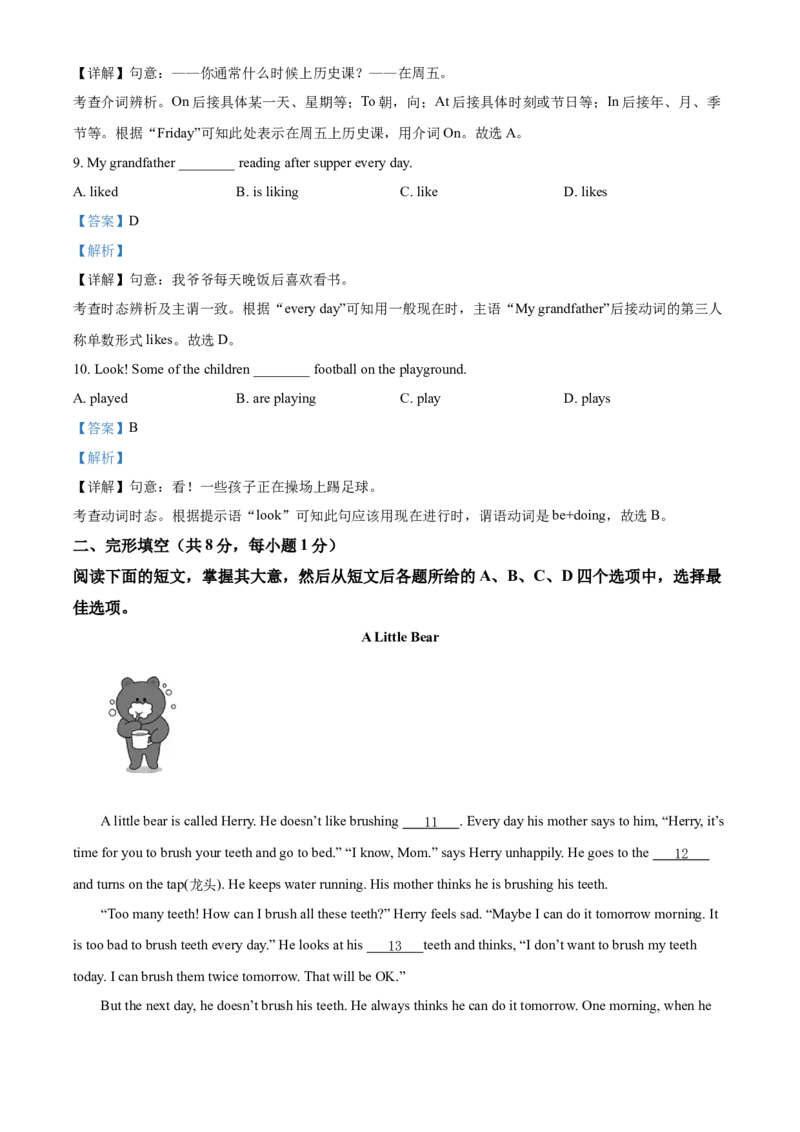
A Little Bear
A little bear is called Herry. He doesn’t like brushing ___11___. Every day his mother says to him, “Herry, it’s
time for you to brush your teeth and go to bed.” “I know, Mom.” says Herry unhappily. He goes to the ___12___
and turns on the tap(龙头). He keeps water running. His mother thinks he is brushing his teeth.
“Too many teeth! How can I brush all these teeth?” Herry feels sad. “Maybe I can do it tomorrow morning. It
is too bad to brush teeth every day.” He looks at his ___13___teeth and thinks, “I don’t want to brush my teeth
today. I can brush them twice tomorrow. That will be OK.”
But the next day, he doesn’t brush his teeth. He always thinks he can do it tomorrow. One morning, when hegets up, he finds all of his teeth have gone ___14___. He cries, “My teeth! My teeth! ” His mother comes into his
bedroom and says, “What’s ___15___?” “I don’t have any teeth now, Mom! I ___16___to brush my teeth every
day. ” He cries again and again. His mother takes him to see the ___17___. The doctor says, “Oh, little bear! I am
sorry to say you can’t eat any food now. There aren’t any teeth in your mouth.”
The little bear cries and cries ___18___. Suddenly he wakes up, “Oh, thank goodness! It is a dream. A terrible
dream.” He gets up at once and goes to brush his teeth. He tells himself to brush his teeth every day.
11. A. teeth B. shoes C. feet D. walls
12. A. study B. kitchen C. bathroom D. bedroom
13. A. clean B. dirty C. big D. tidy
14. A. drawing B. checking C. washing D. missing
15. A. wrong B. nice C. right D. good
16. A. remember B. forget C. want D. love
17. A. father B. driver C. teacher D. doctor
18. A. happily B. heavily C. sadly D. quickly
【答案】11. A 12. C 13. B 14. D 15. A 16. B 17. D 18. C
【解析】
【分析】本文主要讲述了一只小熊不爱刷牙,有一天他做了一个梦,发现自己的牙齿都不见了,他突然惊
醒,发现这原来是一个梦,他告诉自己以后要每天都刷牙。
【11题详解】
句意:他不喜欢刷牙。
teeth牙齿;shoes鞋;feet脚;walls墙。根据“it’s time for you to brush your teeth and go to bed”可知,他不
喜欢刷牙,故选A。
【12题详解】
。
句意:他去到浴室,打开水龙头
study书房;kitchen厨房;bathroom浴室;bedroom卧室。根据“it’s time for you to brush your teeth and go
to bed”及“I know, Mom”可知,是去浴室刷牙,故选C。
【13题详解】
句意:他看着自己的脏牙,想。
clean干净的;dirty脏的;big大的;tidy整洁的。他总是不喜欢刷牙,所以他的牙齿应是脏脏的,故选
B。
【14题详解】
句意:一天早上,当他起床的时候,他发现他所有的牙齿都不见了。drawing画画;checking检查;washing清洗;missing消失。根据“I don’t have any teeth now”可知,牙齿都
不见了,故选D。
【15题详解】
句意:怎么了?
wrong错误的;nice极好的;right正确的;good好的。根据“He cries, “My teeth! My teeth! ” ”可知,听到
他的哭声,妈妈询问怎么了,英文表达为“What’s wrong”,故选A。
【16题详解】
句意:我每天都忘记刷牙。
remember记得;forget忘记;want想要;love喜爱。根据“But the next day, he doesn’t brush his teeth. He
always thinks he can do it tomorrow”可知,每天都忘记刷牙,故选B。
【17题详解】
句意:他的妈妈带他去看医生。
father爸爸;driver司机;teacher老师;doctor医生。根据“The doctor says”可知,带着他去看医生,故选
D。
【18题详解】
。
句意:小熊哭啊,哭得很伤心
happily开心地;heavily沉重地;sadly难过地;quickly快速地。根据“The little bear cries and cries”可知,
是难过地哭泣,故选C。
阅读理解(共25分)
三、阅读下面的六篇短文,根据其内容,从短文后各题所给的A、B、C、D四个选项中,选
择最佳选项。(共20分,每小题1分)
A
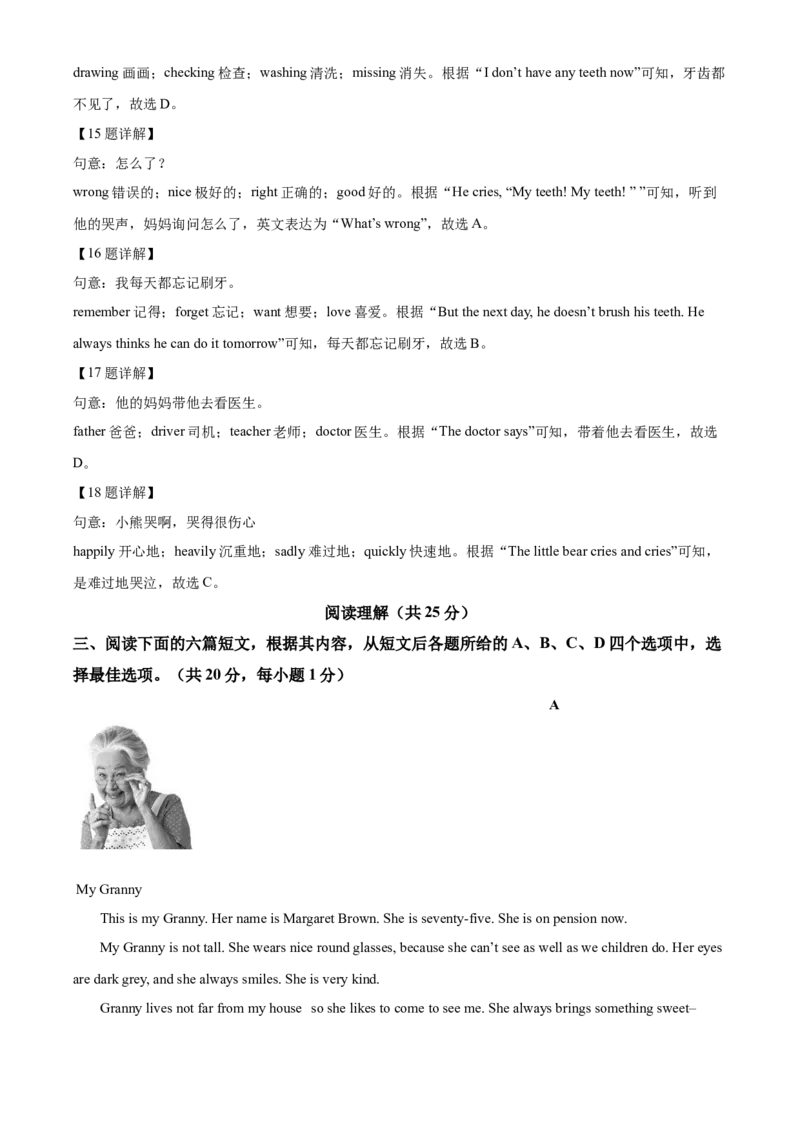
My Granny
This is my Granny. Her name is Margaret Brown. She is seventy-five. She is on pension now.
My Granny is not tall. She wears nice round glasses, because she can’t see as well as we children do. Her eyes
are dark grey, and she always smiles. She is very kind.
,
Granny lives not far from my house so she likes to come to see me. She always brings something sweet–biscuits or cakes. She likes to cook and she cooks very well. We play together, and she reads me fairy tales(童话故
事).
Granny has got a dog, Chuck. She likes to play with him in the garden. He knows many commands and can
bring you a newspaper or slippers, sit down or stand up and many others.
.
My Granny doesn’t like to watch TV She is active and always has something to do. She also doesn’t like to
gossip(闲话). She is an excellent woman!
19. How old is Margaret Brown?
A. Seventy. B. Seventy-five. C. Fifty. D. Fifty-seven.
20. Why does Granny wear glasses?
A. Because she can’t see as well as we children do. B. Because she likes to come to see me.
C. Because she always smiles. D. Because She is very kind.
21. Granny doesn’t like to________.
A. cook B. play with her dog C. watch TV D. read me fairy tales
【答案】19. B 20. A 21. C
【解析】
【分析】本文主要是作者介绍了自己奶奶的相关情况,介绍了她的年龄,外貌,爱好等信息。
【19题详解】
细节理解题。根据“She is seventy-five”可知,她75岁,故选B。
【20题详解】
细节理解题。根据“She wears nice round glasses, because she can’t see as well as we children do”可知,因为
她的视力不如我们孩子,故选A。
【21题详解】
细节理解题。根据“My Granny doesn’t like to watch TV”可知,她不喜欢看电视,故选C。
B
School Activities
My name is Emily Prince. I teach Chinese in No. 9 Middle School. There are two terms in a year in my
school. The first term is from March 1 to June 30. There is a sports festival this term. It’s on April 16. Students can
take part in the sports festival. They can also watch basketball games, soccer games and other ball games. These
games are wonderful. On May 14 and 15, we have an art festival. Students can watch different shows at the
festival.
The second term is from September 1 to January 29. School Day is on November 11. All parents can come to
the school then. They can have lessons and lunch with their children. Parents can talk to the teachers and take partin after-school activities, too. The New Year’s Party is on December 31. The party is from 3 pm to 5 pm. Students
can take their favorite food to the party. They all like the party very much. They hold the party to welcome the New
Year’s Day. They have fun at the party.
22. How many terms are there in a school year in Emily’s school?
A. One. B. Two. C. Three. D. Four.
23. The second term is from ________.
A. April 16 to December 31 B. November 11 to February 15
C. September 1 to January 29 D. March 1 to June 30
24. What can parents do on School Day?
A. They can take part in after-school activities and watch different shows.
B. They can take their favorite food to the party and have lunch.
C. They can talk to the teachers and watch basketball games.
D. They can have lessons and lunch with their children.
【答案】22. B 23. C 24. D
【解析】
【分析】本文是Emily介绍了自己所在学校的活动信息。
【22题详解】
细节理解题。根据“There are two terms in a year in my school”可知,有两个学期,故选B。
【23题详解】
细节理解题。根据“The second term is from September 1 to January 29”可知,第二学期从9月1日到1月29
日,故选C。
【24题详解】
细节理解题。根据“All parents can come to the school then. They can have lessons and lunch with their
children”可知,家长可以上课,和孩子们一起吃午饭,故选D。
C
Three students talk about their first year at a new school.
TOM: This is my first year at my new school. Each of my old friends in the elementary school goes to a
different school now and I don’t see them. But I’m still happy with my new school: I have some new friends here.
They are from different places. We talk to each other after class and we play games together.
MARY: I like my new school! There are many modern buildings in our school, and we have different classes
in different buildings: Art and Music classes in the art building, P.E. in the gym, and Computers and Biology in the
lab building. It’s so exciting! My favorite subject is Biology. My classmates and I grow beautiful flowers and smallplants in the lab.
STEVEN: I’m in the first year at my new school. I like my teachers and classmates, and they like me, too. Our
teachers are very nice. I enjoy classes. There are 45 students in my class, and most of them are very friendly. We
hold birthday parties for our classmates. At the parties we cheer, sing, and dance. We have a good time together.
25. What does Tom think of his new school?
A. He thinks his new school is beautiful. B. He is bored with his new school.
C. He is happy with his new school. D. He thinks his new school is different.
26. Where do Mary and her classmates have their P.E. classes?
A. In the lab building. B. In the gym.
C. In the playground. D. In the art building.
27. What do Steven and his classmates do at the birthday parties?
A. They talk to each other. B. They grow small plants.
C. They play games together. D. They cheer, sing, and dance.
28. What’s the passage mainly about?
A. Three students’ first year at new schools.
B. Three students’ buildings at new schools.
C. Three students’ classmates at new schools.
D. Three students’ favorite subjects at new schools.
【答案】25. C 26. B 27. D 28. A
【解析】
【分析】本文讲述了三个学生在新学校第一年的情况。
【25题详解】
细节理解题。根据“But I’m still happy with my new school: I have some new friends here…”可知,Tom对他的
新学校很满意。故选C。
【26题详解】
细节理解题。根据“Art and Music classes in the art building, P.E. in the gym, and Computers and Biology in the
lab building.”可知,Mary和同学们在体育馆上体育课。故选B。
【27题详解】
细节理解题。根据“At the parties we cheer, sing, and dance.”可知,在生日聚会上,Steven和同学们欢呼,
唱歌和跳舞。故选D。
【28题详解】
主旨大意题。根据“Three students talk about their first year at a new school.”及全文内容可知,本文主要讲了
三个学生在新学校第一年的情况。故选A。D
I have a rule for travel: Don’t take a map with you. I like to ask for directions. I can try speaking a new
language, meet new people, and learn new things. Every time I ask, “How can I get to the post office?” I get
different kinds of directions.
In Japan, most streets don’t have names. If I ask somebody for directions, the Japanese will say, “Go straight
down to the corner. Turn left at the big hotel and go past the fruit market. The post office is across from the bus
stop.”
In some places in America, there are no mountains, no towns or buildings for miles. When people tell you
directions, they will say, “Go north for two miles. Go east, and then go another mile.”
In Los Angeles, people often tell you the distance(距离) in time, not miles. “How far is the post office?” you
ask. “Oh, it’s about five minutes from here,” they answer. “But how many miles away is it?” They don’t know.
People in Greece do not often tell directions because tourists(旅游者) seldom understand their language. They
often say, “Follow me.” Then they will lead you to the post office.
29. ________, most streets don’t have names.
A. In Greece B. In Japan C. In Los Angeles D. In some places in
America
30. Which of the following is True?
A. In Greece, people seldom tell directions. B. In America, tourists don’t understand their language
at all.
C. In some places in Japan, there are no towns or buildings for miles.D. In Los Angeles, people often tell you the
distance in miles, not time.
31. What’s the best title of the passage?
A. Different Kinds of Languages B. Streets’ Names in Japan C. Mountains in America
D. Different Kinds of Directions
【答案】29. B 30. A 31. D
【解析】
【分析】本文主要讲述了作者在旅行中不喜欢带地图,他喜欢问路,本文详细地介绍了不同国家的人们是
如何回答不同的方向。
【29题详解】
细节理解题。根据“In Japan, most streets don’t have names”可知,在日本,大多数街道都没有名字,故选
B。
【30题详解】推理判断题。根据“People in Greece do not often tell directions because tourists(旅游者) seldom understand
their language”可知,希腊人不常指路,A表述正确,故选A。
【31题详解】
最佳标题。通读全文可知,本文主要地介绍了不同国家的人们是如何回答不同的方向,D选项“不同的方
向”符合,故选D。
E
Art of Coffee
What would you do if you spilled(使洒出)your coffee on your desk? Many of us would probably immediately
begin cleaning up the desk. German artist Stefan Kuhnigk, however, thinks differently. He has used coffee stains(污
渍) to create(创造) his world of art.
It all started in 2011. One day, Kuhnigk accidentally spilled his coffee on a piece of paper. Instead of(代替;而
不是) throwing the paper away, he looked at the coffee stain for a while. The stain seemed to look back at him. The
artist picked up his pen and started to draw. Half an hour later, his first coffee monster(怪物) was born.
Since then, Kuhnigk has never put his pen down. Over the last nine years, he has drawn more than 500
monsters. Some of them are lovely. But some have sharp(锋利的) teeth and look evil. Kuhnigk also writes a short
story for each of his monsters. Many people like Kuhnigk’s funny creations. They say the monsters and their stories
always make them laugh.
So the next time you spill your coffee or something else, don’t immediately clean it up. It’s your chance(机会)
to be an artist, too!
32. Sefan Kuhnigk________ after he spilled his coffee.
A. drew something with coffee stains B. ordered another cup of coffee
C. cleaned up the desk at once D. found coffee stains very dirty
33. The underlined word “evil” in Paragraph 3 probably means________.
A. very well B. friendly C. quietly D. very bad
34. From the third paragraph we know that________.
A. why some of the monsters are lovely B. what the monsters look like
C. how to draw monsters D. when the monsters were born
35. From the last paragraph, we can infer(推断) that the writer________.
A. thinks it’s not good to draw with coffee stains
B. wants us to use the coffee stains to draw monsters
C. believes that everyone can be an artist if you try it
D. hopes that you should keep your room clean all the time【答案】32. A 33. D 34. B 35. C
【解析】
【分析】文中讲述Sefan Kuhnigk不小心把咖啡洒在纸上,他没有丢弃而是用咖啡污渍创作艺术作品,他
还为他的每一个怪物写了一个短篇故事,许多人喜欢他的有趣的作品。作者觉得只要敢于尝试,每个人都
有机会成为艺术家。
【32题详解】
细节理解题。根据第二段“One day, Kuhnigk accidentally spilled his coffee on a piece of paper…his first coffee
monster was born”库尼克不小心把咖啡洒在了一张纸上,他拿起笔画了他的第一个咖啡怪兽;可知,Sefan
Kuhnigk在咖啡洒了后,用咖啡污渍画画。故选A。
【33题详解】
词义猜测题。根据第三段“But some have sharp teeth”有锋利的牙齿;可知,有些怪物长得不好看;故选D。
【34题详解】
推理判断题。根据第三段“…he has drawn more than 500 monsters. Some of them are lovely. But some have
sharp teeth and look evil…”他画了500多个怪物,其中有些很可爱,但有些牙齿锋利,看起来邪恶;可知,
我们知道怪物长什么样;故选B。
【35题详解】
推理判断题。文中讲述Sefan Kuhnigk在咖啡洒了后,用咖啡污渍创作;根据第四段“…It’s your chance to
be an artist, too!”可知,作者觉得只要敢于尝试,每个人都有机会成为艺术家;故选C。
F
Look at the picture carefully. Is the man wearing a pair of glasses a giant (巨人)? No, he isn’t. But why does
he look so big? It’s only because he is in a miniature (微缩的) model show.
The show fell on September 21 this year. So many people brought their own works to the show. Each work
shows a tiny scene (场景). For example, one shows a corner of a road that is no more than 15 cm long. Another
shows an office that is as small as an iPad. All of the people and animals in the scenes are as small as your
fingertips (指尖). It’s like a “Lilliput”. What a lovely Lilliput”!
Kevin Bellman from Illogan, Cornwall, won the “Best in Show”. It took him two and a half months to make
the scene.36. We can infer from the passage that ________.
A. many people spent a lot of time on their works
B. Kevin won the show because he made a lovely Lilliput
C. the show asked people to make the model on September 21
D. people brought their works to the show to make themselves look big
37. The underlined word “tiny” in Paragraph 2 means ________.
A. big B. beautiful C. interesting D. small
38. What’s the best title of the passage?
A. The Lovely Lilliput B. The Miniature Model Show
C. A Giant’s Big Scene D. A Giant’s Work Show
【答案】36. A 37. D 38. B
【解析】
【分析】这篇短文主要讲述了2019年英国举办微缩模型展的具体情况。
【36题详解】
细节理解题。根据文中“So many people brought their own works to the show.”及“Kevin Bellman from
Illogan, Cornwall, won the “Best in Show”. It took him two and a half months to make the scene.”可知,从这篇
文章中推断出许多人在作品上花了很多时间。故选A。
【37题详解】
词句猜测题。根据文中“For example, one shows a corner of a road that is no more than 15 cm long. Another
shows an office that is as small as an iPad.”可知,每幅作品都展示了一个小场景,tiny的意思是“小的,极
小的”,故选D。
【38题详解】
标题归纳题。通读整篇短文可知,这篇短文主要讲述了微缩模型展,在这些模型里,物体都非常小,故选
B。
四、阅读短文,根据其内容回答问题。(共5分,每小题1分)
Wang Huansheng is a young man with a handicap(残疾). He uses a wheelchair because he can’t walk. When
he was seven years old, he became ill. He lost the ability to walk.
At first, he tried to go to school like everyone else. But it was hard for him to travel to and from school. Then,
when he started middle school, it became harder and harder for him to keep up with his classmates. But he didn’t
quit(放弃) studying for his classes. He was not going to give up. People thought that he should get a private(私人
的) teacher. But a private teacher was too expensive.
Wang Huansheng’s mother looked at a newspaper one day and saw information about online schools. Thefamily bought a computer, and Wang Huansheng began to take classes online. The Beijing Online School let him
study for free. The school also helped him with his classes. He learned different computer skills, like how to use e-
mail and the Internet. He became very good at using the computer.
Wang Huansheng worked hard. His mother was happy because he got good grades in his subjects. He could
not have finished school without the online school. Thanks to computers, he got a good education. Thanks to his
“never-give-up” attitude(态度), he succeeded.
39. When did Wang Huansheng become ill?
_________________________________________________________
40. Was it easy for Wang Huansheng to travel to and from school?
_________________________________________________________
41. What did the Beijing Online School do for Wang Huansheng?
_________________________________________________________
42. Why was Wang Huansheng’s mother happy?
_________________________________________________________
43. What can you learn from Wang Huansheng?
__________________________________________________________
【答案】39. At Seven/When he was seven years old.
40. No. 41. The Beijing Online School let him study for free and also helped him with his classes.
42. Because he/ Wang Huansheng got good grades in his subjects.
43. We should work hard and never give up when we meet difficulties.
【解析】
【分析】本文讲述了残疾人王焕生的个人成长,成功经历。
【39题详解】
根据“When he was seven years old, he became ill.”可知,当王焕生7岁时生病了。故填At Seven/When he was
seven years old.
【40题详解】
根据“At first, he tried to go to school like everyone else. But it was hard for him to travel to and from school. Then,
when he started middle school, it became harder and harder for him to keep up with his classmates.”可知,对他来
说,往返学校很困难,当他上中学时,他越来越难跟上他的同学。故填No.
【41题详解】
根据“The Beijing Online School let him study for free. The school also helped him with his classes.”可知,北
京网络学校让他免费学习,学校还帮助他学习课程。故填The Beijing Online School let him study for free andalso helped him with his classes.
【42题详解】
根据第四段“His mother was happy because he got good grades in his subjects.”可知,他的妈妈很高兴,因为他
在他的科目中取得了好成绩。故填Because he/ Wang Huansheng got good grades in his subjects.
【43题详解】
根据第二段“But he didn’t quit(放弃) studying for his classes.”及“Wang Huansheng worked hard.”可知,王焕生
不放弃,工作努力,最终取得了成功,所以我们要学习他的这种精神。故填 We should work hard and never
give up when we meet difficulties.
书面表达(共22分)
五、根据提示,将下面的句子翻译成英文。(共12分,每小题2分)
44. 迈克总是去湖边钓鱼。 Mike, near the lake
__________________________________________________________.
【答案】Mike always goes fishing near the lake
【解析】
【详解】迈克:Mike;总是:always;去钓鱼:go fishing;湖边:near the lake,作地点状语,放在句末。
根据语境和“always”可知此句时态是一般现在时,Mike作主语,第三人称单数,谓语动词用三单形式。
故填Mike always goes fishing near the lake。
45. 他正在往窗外看。(window)
__________________________________________________________
【答案】He is looking out of the window.
【解析】
【详解】根据“正在”可知用现在进行时,其结构 为am/is/are doing。“他”译为he,作主语;“往……
外看”译为look out of;“窗”译为the window。he后用be动词is,句子开头首字母大写。故填 He is
looking out of the window.
46. 你需要多少肉?(meat, need)
__________________________________________________________
【答案】How much meat do you need?
【解析】
【详解】你:you;需要:need;肉:meat;多少:how much,后接不可数名词。本句是一般现在时、特
殊疑问句,主语you,助动词用do;故填How much meat do you need?
47. 我们的英语课经常以一首英文歌开始。often, English song
__________________________________________________________【答案】Our English class/lesson often begins with an English song.
【解析】
【详解】根据“经常”可知用一般现在时。“我们的英语课”Our English class/lesson;“经常”often;
“以……开始”begin with;“一首英文歌”an English song。主语是单数,谓语用动词的第三人称单数形
式。故填Our English class/lesson often begins with an English song.
48. 出去散步好吗?walk
__________________________________________________________
【答案】Shall we go out for a walk?/How/What about going out for a walk?
Shall we take a walk?/How/What about taking a walk?
【解析】
【详解】出去散步“go out for a walk/take a walk”;本句是表提议的疑问句,可用句式“Shall we do sth”;
或“How/What about doing sth”;故填Shall we go out for a walk?/How/What about going out for a walk?Shall
we take a walk?/How/What about taking a walk?
49. 我们必须尽最大努力保持教室清洁。must, clean
__________________________________________________________.
【答案】We must try our best to keep our classroom clean
【解析】
【详解】我们:we;必须:must;尽最大努力:try one’s best to do sth.;保持教室清洁:keep our classroom
clean, keep sth. adj.“保持某物是什么样子的”。主语是“we”,形容词性物主代词应用our;结合语境可
知此句应用一般现在时,情态动词must后面跟动词原形。故填We must try our best to keep our classroom
clean。
六、文段表达(10分)
50. 根据中文和英文提示,用英文写一封意思连贯、符合逻辑、不少于40词的文段。所给提示词语仅
供选用。请不要写出你的校名和姓名。开头已给出,不计入词数。
俗话说:“只学习,不玩耍,聪明的孩子也变傻。”假如你是李华,在红星中学学习。请以My After-
school Activities为题,介绍自己的课后活动,向校报投稿。内容包括:你都参加哪些课后活动,以及你为
什么参加。
提示单词和短语:play the piano, play football, look at the stars, relax, fun
提示问题: ●What after-school activities do you like to join?
●Why do you like to join?
My After-school Activities
I am Li Hua. I study at Hong Xing Middle School.____________________________________________________________________________________________
____________________________________________________________________________________________
____________________________________________________________________________________________
____________________________________________________________________________________________
____________________________________________________________________________________________
____________________________________________________________________________________________
____________________________________________________________________________________________
____________________________________________________________________________________________
________________________________
【答案】例文
My After-school Activities
I am Li Hua. I study at Hong Xing Middle School. I want to introduce some after-school activities that I’d like
to join.
I always play the piano at 7:00 p.m. every Monday because I like music very much. Every Tuesday afternoon,
I usually play football with my best friends as it can relax us. Sometimes, I look at the stars in the evening, for it’s a
lot of fun.
These are my after-school activities. You can join us.
【解析】
【详解】1.题干解读:题目要求根据提示以“My After-school Activities”为题写一篇短文介绍自己的课后活
动,需包含参加哪些活动及为什么参加。
2.写作指导:写作时要以第一人称为主,时态采用一般现在时。可分为三段式:第一段点题;第二段具体
介绍自己参加哪些课后活动及参加这些活动的原因;第三段收尾。要做到无单词拼写和语法错误。本试卷的题干、答案和解析均由组卷网(http://zujuan.xkw.com)专业教师团队编校出品。
登录组卷网可对本试卷进行单题组卷、细目表分析、布置作业、举一反三等操作。
试卷地址:在组卷网浏览本卷
组卷网是学科网旗下的在线题库平台,覆盖小初高全学段全学科、超过900万精品解析试题。
关注组卷网服务号,可使用移动教学助手功能(布置作业、线上考试、加入错题本、错题训练)。
学科网长期征集全国最新统考试卷、名校试卷、原创题,赢取丰厚稿酬,欢迎合作。
钱老师 QQ:537008204 曹老师 QQ:713000635