北京市朝阳区 2021~2022 学年度第二学期期末检测
第一部分
一、单项填空(每题0.5分, 共6分)
从下列各题所给的A、B、C、D四个选项中, 选择可以填入空白处的最佳选项。
1. —Lingling, is this your bag?
—Yes, it’s ________.
A. mine B. yours C. his D. hers
,
2. —Where were you born Meimei?
—I was born ________ Tianjin.
A. on B. to C. in D. for
3. Tony likes rock music ________ his father doesn’t like it at all.
A. because B. so C. but D. or
4. —Excuse me, ________ is the bank?
—It’s over there, near the shop.
A. what B. where C. why D. who
5. —________ you play the violin, Daming?
—Yes, I can.
A. Can B. May C. Shall D. Need
6. —This T-shirt looks nice. ________ is it?
—It’s 60 yuan.
.
A How many B. How much C. How old D. How long
7. —What are you going to do this weekend?
—I ________ a piano lesson on Saturday afternoon.
A. have B. has C. had D. am going to have
8. Machines ________ the heavy and difficult jobs in the future.
A. do B. does C. did D. will do
9. There ________ a small lake in the garden two years ago.
A. is B. are C. was D. were
10. I ________ this film last month. It’s very interesting.
A. see B. saw C. will see D. am seeing
11. —Where is Mary?
—Look! She ________ the flowers over there.A. waters B. watered C. will water D. is watering
12. We Chinese often ________ when we meet visitors.
A. smile B. smiled C. will smile D. are smiling
二、完形填空(每题1分, 共8分)
阅读下面的短文,掌握其大意,然后从短文后各题所给的A、B、C、D四个选项中,选择最
佳选项。
Life is always about ups and downs, but life can leach you to grow.
About two years ago, I was taking part in the first Table Tennis Championships (锦标赛). I was quite
____13____ about myself. My opponent (对手) was very short and thin. The thoughts in my head were something
like “She’s so short and of course I’ll ____14____”. When the match started, I found my opponent was really good
at playing table tennis. With a smile on her face, she scored three points in the first ten seconds. I was so surprised,
afraid and ____15____ everything my coach (教练) said. I only hoped not to lose the match. But the fact made me
sad. I lost 0-3. I had never lost before. From then on, I was afraid of the ____16____, and to me, her name was
connected with failure (失败).
The experience (经历) lasted with me. I worked and trained harder than before. I listened to my coach
carefully and made sure I was not overconfident (过于自信的). The following year, I ____17____ the same girl
once again at the championships. As the competition started, I wasn’t afraid like the past match but ____18____ to
my coach’s words. I did as my coach told me. The main thought in my head was not about winning or losing, but
doing my best.
Finally, I won. My hard work and listening to my coach worked. My opponent had the same thin shape, but
did not make me afraid anymore. She helped me find out who I ____19____ was.
From this experience, I learned not to be too proud (骄傲的). It is important to know the fact that there are
people better than you. But with this idea in mind, you can work hard to become that person who is better. This
experience also taught me not to judge (判断) others by their ____20____. We should learn more from others,
especially from our opponents.
13. A. sure B. busy C. bored D. worried
14. A. shout B. smile C. win D. knock
15. A. left B. brought C. caught D. forgot
16. A. school B. girl C. coach D. subject
17. A. changed B. noticed C. faced D. believed
.
18 A. waved B. tuned C. jumped D. listened
19. A. really B. perfectly C. quickly D. personally20. A. words B. looks C. hearts D. excuses
三、阅读理解(每题2分, 共26分)
阅读下列短文, 根据短文内容, 从短文后各题所给的A、B、C、D四个选项中, 选择最佳选项。
A
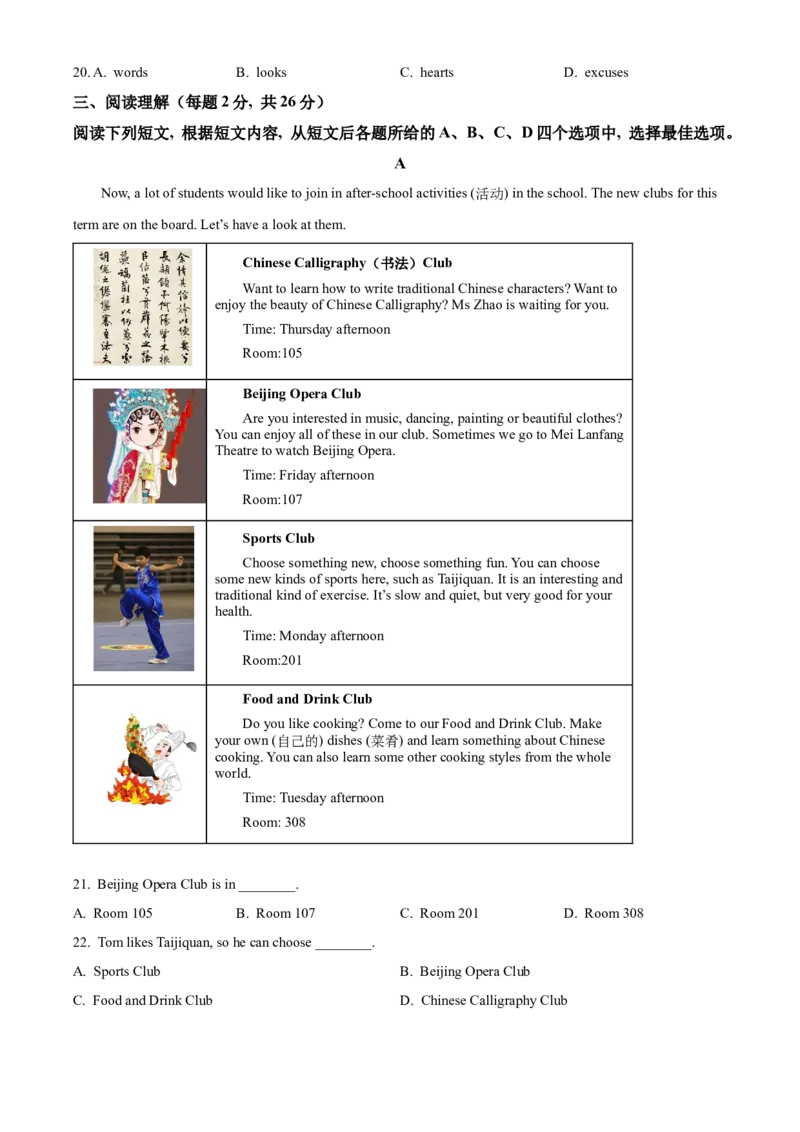
Now, a lot of students would like to join in after-school activities (活动) in the school. The new clubs for this
term are on the board. Let’s have a look at them.
Chinese Calligraphy(书法)Club
Want to learn how to write traditional Chinese characters? Want to
enjoy the beauty of Chinese Calligraphy? Ms Zhao is waiting for you.
Time: Thursday afternoon
Room:105
Beijing Opera Club
Are you interested in music, dancing, painting or beautiful clothes?
You can enjoy all of these in our club. Sometimes we go to Mei Lanfang
Theatre to watch Beijing Opera.
Time: Friday afternoon
Room:107
Sports Club
Choose something new, choose something fun. You can choose
some new kinds of sports here, such as Taijiquan. It is an interesting and
traditional kind of exercise. It’s slow and quiet, but very good for your
health.
Time: Monday afternoon
Room:201
Food and Drink Club
Do you like cooking? Come to our Food and Drink Club. Make
your own (自己的) dishes (菜肴) and learn something about Chinese
cooking. You can also learn some other cooking styles from the whole
world.
Time: Tuesday afternoon
Room: 308
21. Beijing Opera Club is in ________.
A. Room 105 B. Room 107 C. Room 201 D. Room 308
22. Tom likes Taijiquan, so he can choose ________.
A. Sports Club B. Beijing Opera Club
C. Food and Drink Club D. Chinese Calligraphy Club23. What can you do in Food and Drink Club?
A. Do different sports. B. Watch Beijing Opera.
C. Make our own dishes. D. Write traditional characters.
B
No more blues
Jason was practicing (练习) a new song on the piano. His father was sitting in the room, reading a book.
Suddenly Jason stopped and said to his father, “This song is too difficult! I don’t think I can learn it. It’s called ‘No
More Blues’.”
Jason’s father closed his book and said, “The word ‘blue’ means the feeling when a person is unhappy, so your
song is about not being unhappy anymore. Maybe you need a break from practicing. Let’s take a walk. It’s such a
nice sunny day.”
Jason and his father began walking down the street. They turned into a park near their home. It was a cold
autumn day, and the leaves on the trees began to turn yellow. A cool and gentle wind blew against Jason’s face.
An hour later, Jason and his father returned to the house. Jason sat down at the piano again and began to play.
His fingers moved more easily over the keys, and music filled the room. “I don’t understand why the same song
seems easier to play now,” he said.
“How did you feel before the walk?” Jason’s father asked. “Terrible,” Jason said with a frown (皱眉).
.
“And how do you feel now after taking a walk?” Jason’s father went on
“Great!” Jason answered, then he smiled. “Taking a walk helped me stop being unhappy. Just like the song, I
have no more blues! I think I’ll play the song again.”
24. What was Jason’s father doing at the beginning of the story?
A. Playing the piano. B. Talking with Jason. C. Taking a walk. D. Reading a book.
25. How does Jason feel after he takes a walk with his father?
A. Terrible. B. Blue. C. Unhappy. D. Great.
26. What can we learn from the story?
A. The best kind of exercise is to take a walk.
B. Learning to play a new song needs a cool day.
C. It can be good to have a rest from something difficult.
D. Reading a book can help people play the piano better.
C
Stop coffee and cola! Let’s drink another one of the world’s most popular drinks—tea on May 21 International
Tea Day. We all know that China is the birthplace of tea culture (文化). But do you know about the tea cultures ofsome other countries?
Tea was brought to Japan from China in the ninth century by a traveling monk (僧人). The custom (习俗) of
,
tea drinking later became an important part of Japanese culture. In Japan serving tea is an art. People use
beautiful tea bowls and enjoy the peace and calm of the tea room.
India is one of the largest tea producers (生产国) in the world. It also learned the art of tea-drinking from
China centuries ago. Tea is very popular in India. In fact, Indian people use 70% of the tea produced in India.
“Chai” is the Hindi (印地语) word for tea. Traditional Indian chai is a kind of black lea. But unlike Chinese black
tea, chai is put together with strong spices (香料) such as ginger (姜).
Turkey (土耳其) also has a tea culture. Tea was brought to the country from China in the nineteenth century.
The traditional Turkish tea cup looks like a flower. The tea is usually served very hot. Most often salty or sweet
biscuits called “kurabive” are served along with the tea.
27. Tea culture was born in ________.
A. China B. Japan C. India D. Turkey
28. What do you know about the tea culture of India?
A. Indian people use only ginger to make chai.
B. Indian people like having strong spices in their tea.
C. India doesn’t produce enough tea for its own people.
D. Indian people went to Japan to learn how to make chai.
29. Which of the following is true according to the passage?
A. International Tea Day falls on May 16. B. India produces 70% of the world’s tea.
C. Tea went to Turkey before it went to Japan. D. A traveling monk brought tea from China to Japan.
D
Qian Xuesen was born in Hangzhou, Zhejiang Province on December 11, 1911. He left Hangzhou at the age of
three when his father got a job in Beijing. He graduated(毕业) from the High School Affiliated to Beijing Normal
University and went to Shanghai Jiao Tong University.
After his graduation from Shanghai Jiao Tong University in 1934, he travelled across the Pacific Ocean to the
United States for further study. After he graduated, he became a professor(教授) to study rockets(火箭) and
missiles(导弹).
In 1949, when the news of the birth of the People’s Republic of China came to the United States. Qian Xuesen
and his wife decided to return to China. In 1950, when they were ready to return home, they were stopped by the
US government(政府). With the help of Chinese government and his friends, he finally returned home.
When he returned to China in 1955, our country’s space research(研究) was almost a blank. In 1956, he setup the first research institute of rockets and missiles. From then on, he was busy working on China’s missile, rocket
and spacecraft research programs. He was named “the Father of China’s Missiles”.
He died on October 31, 2009 at the age of 98, but he is a man who still encourages(激励) Chinese young
people. When someone said he could make much more money if he stayed in the United States, he laughed and
said. “My family name is Qian, but I don’t like qian.”
A Chinese film production, Qian Xuesen, was released on December 11, 2011 in both Asia and North
America, and on March 2, 2012 in China.
30. How old was Qian Xuesen when he graduated from Shanghai Jiao Tong University?
A. 20. B. 21. C. 23. D. 25.
31. The words “a blank” in Paragraph 4 probably mean “_____”.
A. a start B. a change C. an ending D. a success
32. Which of the following about Qian Xuesen is not true according to the passage?
A. He finished high school in Beijing. B. He and his wife returned home in 1949.
C. He died in October, 2009 when he was 98. D. He was named “the Father of China’s Missiles”.
33. What does the passage mainly talk about?
A. The life of Qian Xuesen. B. The Family of Qian Xuesen.
C. The film of Qian Xuesen. D. The research of Qian Xuesen.
第二部分
四、阅读表达(每题2分, 共10分)
阅读短文,根据短文内容回答问题。
AR(增强现实) is a new technology(技术) right now. AR lets us see the real-life environment(环境) right in
front of us-a pterodactyl(翼手龙) landing in the trees and the palaces in the past. Many of us know that AR is used
in mobile games. However, education(教育) is another important space where this technology can make a
difference.
AR brings science to life in education. In the past, teachers used 2D pictures and lifeless models(模型) to
teach science. With AR, science will become more lively. Students can use AR apps to learn different animals.
Students can also learn other subjects with AR. For example, in geography classes, students can see great natural
phenomena(自然现象) wherever they are. In history lessons, students could walk into buildings of last century or
talk with historical heroes. AR brings the real world to the classroom. AR is also useful for schools in villages and
small towns, where students can’t often go to museums in big cities. In the past, only students from rich families
could pay for the travel to famous places like the British Museum or the Louvre. Soon, with the help of AR
technology, students from around the world may be able to visit these places. In some ways, the AR experiencewould be even more exciting than a real trip to a museum because students could touch historical objects(物品)
freely.
AR in education is the future of all students. It will change the education for maybe a hundred years. With the
help of AR, the classrooms of the future may not look much like the classrooms of the past.
34. Is AR a new technology right now?
_____________________________________
35. What did teachers use to teach science in the past?
_____________________________________
36. What can students do in geography classes with the help of AR?
_____________________________________
37. Why would the AR experience be even more exciting than a real trip to a museum?
_____________________________________
38. What is the passage mainly about?
_____________________________________
五、文段表达(10分)
39. 根据中文和英文提示,完成一篇不少于50词的文段写作。文中已给出内容不计入总词数。所给提
示词语仅供选用。请不要写出你的校名和姓名。
腹有诗书气自华,最是书香能致远。读书有益于育德、励志、启智、明史。你校世界读书日的主题征
文活动“我最喜爱的作家”仍在继续,请你写一篇短文投稿。
内容包括:你最喜爱的作家是谁,你对这位作家的了解以及你对他/她的看法,
提示词语:be born, at the age of, begin, great
提示问题:
·Who is your favourite writer?
·How much do you know about him/her?
·What do you think of him/her?
Reading is very important in our
Life._________________________________________________________________________________________
____________________________________________________________________________________________
____________________________________________________________________________________________
____________________________________________________________________________________________
____________________________________________________________________________________________
______________________________________________________________________________________________________________________________________________________