The fourth period(第四课时)
Part B Let’s learn & Look and talk
▶ 教学内容与目标
课时教学内容 课时教学目标
Let’s learn 通过图片、动作、课件等学会听、说、读、写单词和短语“read a
book, saw a film, had a cold, slept, last weekend/night/Monday,
yesterday, the day before yesterday”。
熟练运用上述单词和短语询问过去某个时间对方做了什么事
情。
了解并掌握常用不规则变化的动词过去式及与一般过去时搭配
使用的时间状语。
Look and talk 能够运用句型“What did sb. do…?” “Did sb.…?”询问过去某个
时间他人做了什么事情。
▶ 教学重点
能够听、说、读、写“read a book, saw a film, had a cold, slept”和一些常与一
般过去时搭配使用的时间状语。
▶ 教学难点
能够运用句型“What did sb. do…?” “Did sb.…?”询问过去某个时间他人做了
什么事情。
▶ 教学准备
1. 预习《状元大课堂》《创优作业100分》《状元作业本》中本课时的相关内容。
2. PPT课件、课文音频、视频、绘本等。
▶ 教学过程
Step 1:Warm-up & Revision & Lead-in①
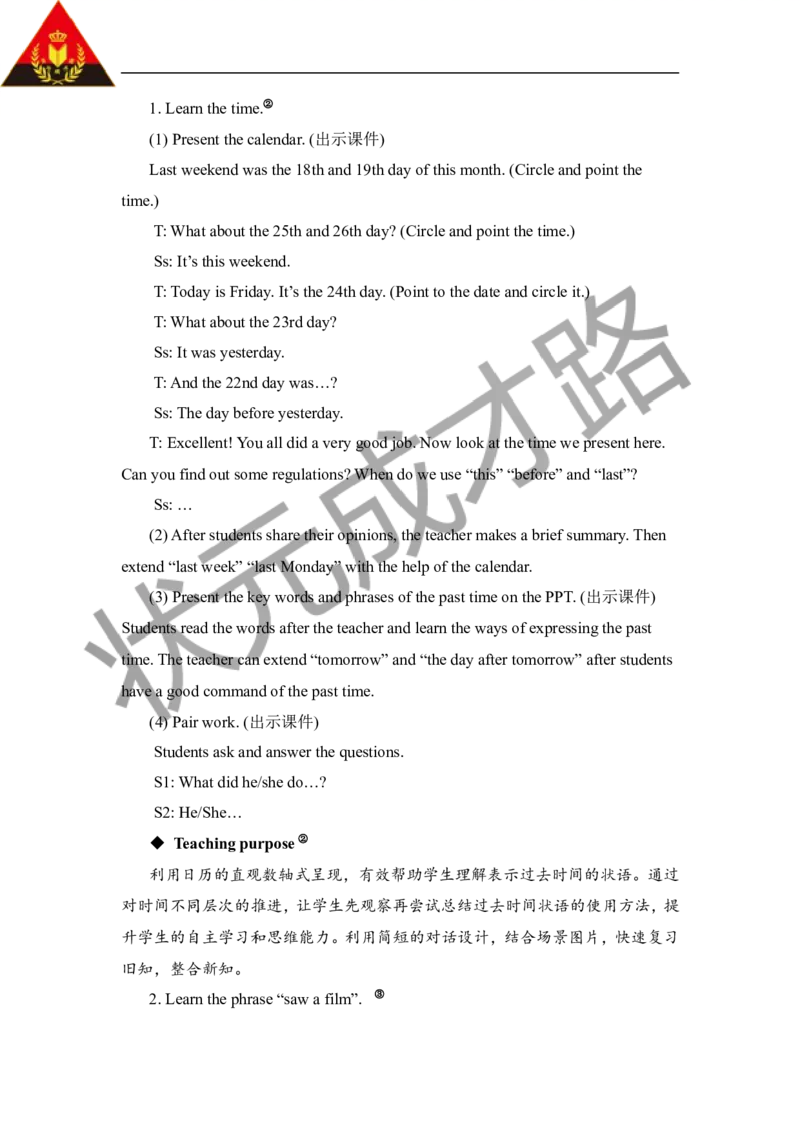
1. Greetings.2. Let’s chant.
3. Free talk.
T: How was your weekend?
Ss: It was interesting/great/boring/bad/…
T: What did you do last weekend?
Ss: I…
4. Lead-in.
Can you guess what I did last weekend?
Ss: Did you…?
T: No, I didn’t. / Yes, I did. I read a book last weekend. It’s Alice in Wonderland. I
liked it very much. It was great.
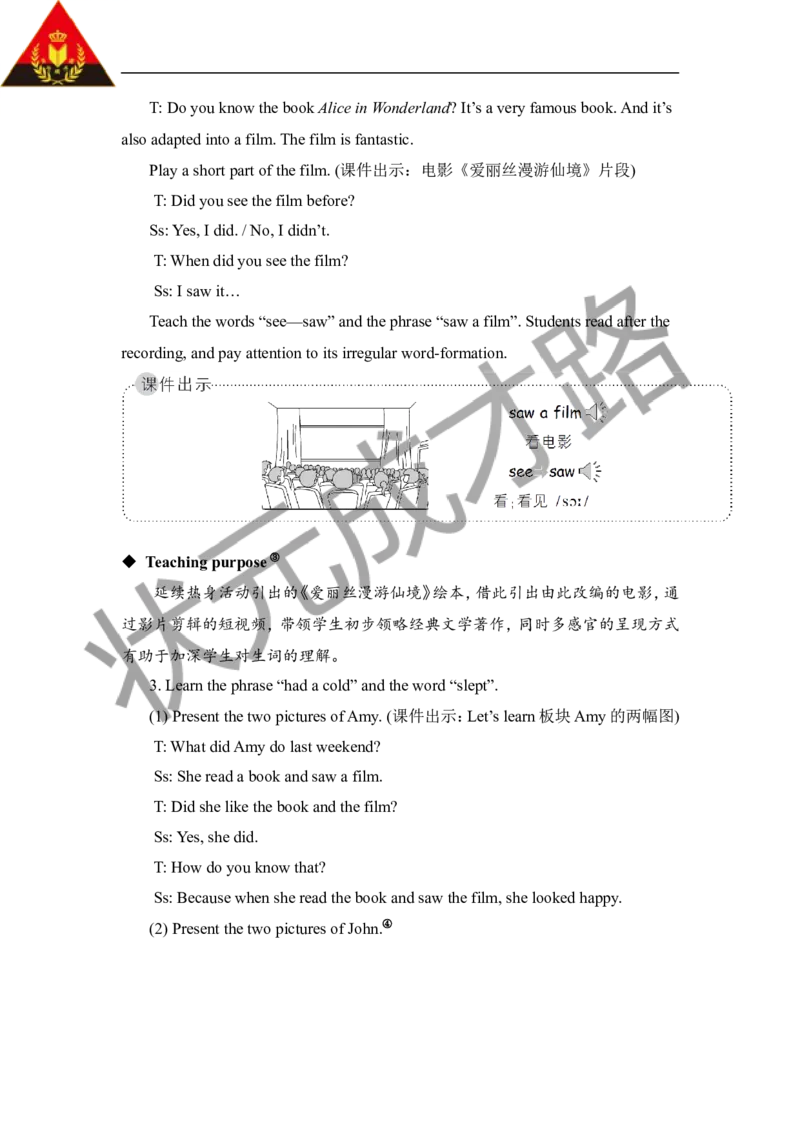
Give students several chances to guess the answer. Then present a picture of
“read a book”. Lead students to learn the new word “read” and pay attention to its
form and pronunciation. In the simple present tense and the past tense, it looks the
same, but pronounces in different ways.
◆ Teaching purpose①
歌谣热身能活跃课堂气氛,营造轻松的学习氛围。快速简短的自由对话和猜
答案游戏帮助增进师生间的交流,创造和谐的师生氛围,帮助复习本单元前三课
时所学的重点短语和句型,为后面的学习打好基础。
Step 2:Presentation1. Learn the time.②
(1) Present the calendar. (出示课件)
Last weekend was the 18th and 19th day of this month. (Circle and point the
time.)
T: What about the 25th and 26th day? (Circle and point the time.)
Ss: It’s this weekend.
T: Today is Friday. It’s the 24th day. (Point to the date and circle it.)
T: What about the 23rd day?
Ss: It was yesterday.
T: And the 22nd day was…?
Ss: The day before yesterday.
T: Excellent! You all did a very good job. Now look at the time we present here.
Can you find out some regulations? When do we use “this” “before” and “last”?
Ss: …
(2) After students share their opinions, the teacher makes a brief summary. Then
extend “last week” “last Monday” with the help of the calendar.
(3) Present the key words and phrases of the past time on the PPT. (出示课件)
Students read the words after the teacher and learn the ways of expressing the past
time. The teacher can extend “tomorrow” and “the day after tomorrow” after students
have a good command of the past time.
(4) Pair work. (出示课件)
Students ask and answer the questions.
S1: What did he/she do…?
S2: He/She…
◆ Teaching purpose②
利用日历的直观数轴式呈现,有效帮助学生理解表示过去时间的状语。通过
对时间不同层次的推进,让学生先观察再尝试总结过去时间状语的使用方法,提
升学生的自主学习和思维能力。利用简短的对话设计,结合场景图片,快速复习
旧知,整合新知。
2. Learn the phrase “saw a film”. ③T: Do you know the book Alice in Wonderland? It’s a very famous book. And it’s
also adapted into a film. The film is fantastic.
Play a short part of the film. (课件出示:电影《爱丽丝漫游仙境》片段)
T: Did you see the film before?
Ss: Yes, I did. / No, I didn’t.
T: When did you see the film?
Ss: I saw it…
Teach the words “see—saw” and the phrase “saw a film”. Students read after the
recording, and pay attention to its irregular word-formation.
◆ Teaching purpose③
延续热身活动引出的《爱丽丝漫游仙境》绘本,借此引出由此改编的电影,通
过影片剪辑的短视频,带领学生初步领略经典文学著作,同时多感官的呈现方式
有助于加深学生对生词的理解。
3. Learn the phrase “had a cold” and the word “slept”.
(1) Present the two pictures of Amy. (课件出示:Let’s learn板块Amy的两幅图)
T: What did Amy do last weekend?
Ss: She read a book and saw a film.
T: Did she like the book and the film?
Ss: Yes, she did.
T: How do you know that?
Ss: Because when she read the book and saw the film, she looked happy.
(2) Present the two pictures of John.④T: How did John feel?
Ss: He felt sad/bad/sick/tired… (Present the words “feel—felt”.)
T: Why did John feel so bad?
Ss: Because he had a cold. (Present the phrase “had a cold”.)
T: No wonder he slept. Maybe sleeping could help him feel better. (Present the
words “sleep—slept”.)
Teach the new words and the phrase. Lead students to read after the recording,
and pay attention to their irregular word-formation.
◆ Teaching purpose④
情境导入学习had a cold和slept,通过观察图片中人物的表情和状态,推测其
心理状态。在提高学生语言表达能力的同时,培养学生的观察能力。通过动词原
形和动词过去式的对比,引导学生关注和了解常见动词过去式的不规则形式。
Step 3: Practice
1. Game—Get down the stairs.(出示课件)
T: Can you read the words and the phrases presented on the steps correctly?
2. Read in roles.⑤
(1) Play the video of “Let’s learn”. (出示课件) Students read after the video and
pay attention to the pronunciation and the intonation.
◆ Teaching purpose⑤
引导学生通过视频跟读,能用正确的语音、语调及意群朗读对话,熟悉对话内
容,加深理解。
Make sure students can read the dialogue correctly, fluently and emotionally.
(2) Students read the dialogue in roles. Boys play the role of John, and girls playthe role of Amy.
3. Guess and say. ⑥(出示课件)
Can you guess what Amy and John did yesterday?
(1) The teacher makes a model with a student. Show students how to conduct the
conversation.
(2) Highlight the sentence structure. Teach students how to use it.
(3) Students look at the pictures. Guess and say: A student asks the question, and
the others answer it.
◆ Teaching purpose⑥
借助课本人物,创设语言情境,通过覆盖部分图片,引导学生观察并猜测,在
提高学生语言综合运用能力的同时,也能提升学生的学习兴趣和操练的趣味性。
Step 4: Consolidation & Extension
1. Yes or No.⑦
(1) Look at the pictures and complete the sentences.
The teacher makes a model first. Highlight the key points and show students how
to complete the sentence. Then let students complete the rest sentences.
(2) Pair work.
Work in pairs. Ask and answer the questions about what you did in the past time.2. Let’s play a game.
Present the words.
We’ll play like this:
S1: Last Sunday, I… (A)
S2: Last Sunday, I… (A & B)
S3: Last Sunday, I… (A & B & C)
S4: …
T: Let’s see who has the best memory.
Choose the winner.
◆ Teaching purpose⑦
通过“Yes or No”和记忆游戏环节,锻炼和培养学生的记忆能力,加深学生对
本课核心语言的理解和记忆。
3. Look and talk.⑧
(1) Divide students into several groups. Let students work in groups and look at
the table below for a few seconds, then cover it. Ask and answer. (课件出示:Look
and talk板块的表格)
(2) Show time.
Students show their dialogues. They can conduct the dialogue like this:
A: What did John do yesterday?
B: He slept.A: Did he have a cold yesterday?
B: Yes, he did.
◆ Teaching purpose⑧
学生能够正确使用本课所学的单词和短语与他人交流,描述过去时间做的事
情。
▶ 板书设计
▶ 作业设计
1. Remember the key words and phrases of this lesson, and read the dialogues
fluently.
2. Have a good command of the regulations of verbs in the simple past tense.
Find out more irregular forms.
3. Do the exercises.(见“状元成才路”系列丛书《创优作业100分》或《状元作
业本》对应课时作业)
▶ 教学反思
1. 充分利用图片、音频、歌曲、电影视频等多媒体手段,丰富学生的感官体验
加深和促进学生对单词和短语的理解与记忆。同时活跃了课堂气氛,有助于营造
轻松活跃的课堂氛围,激发学生的学习兴趣。
2. 利用日历的直观数轴式呈现,有效帮助学生理解表示过去时间的状语。通
过对时间不同层次的推进,让学生先观察再尝试总结过去时间状语的使用方法,
提升学生的自主学习能力和思维能力。3. 教学活动设计逐层深入,引导学生观察图片和动词形式,在提高学生语言
表达能力的同时,也能培养学生的观察力。操练过程注重新知与旧知的整合与运
用。
4. 通过各种方式创设语言情境,让学生词不离句,句不离境。鼓励学生在学习
的过程中试错,在不断尝试和体验中习得语言的表达规则。
▶ Teaching Contents & Teaching Aims
Let’s learn
Learn to listen, speak, read and write the words and the phrases“read a book,
saw a film, had a cold, slept, last weekend/night/Monday, yesterday, the day
before yesterday”.
Use the above words and phrases above to describe what activities people did in
the past time.
Understand and master the irregular verbs and some adverbial expressions of time
commonly used in the simple past tense.
Look and talk
Use the sentence structures learned in “Part B” to ask what people did in the past
time.
▶ Teaching Priorities
Learn to listen, speak, read and write the words and the phrases“read a book,
saw a film, had a cold, slept”and some adverbial expressions of time commonly
used in the past tense.
▶ Teaching Difficulties
Use the sentence structure learned in “Part B” to ask what people did in the past
time.
▶ Teaching ProceduresTeaching Stages Teacher’s Activities Students’ Activities Teaching Purposes
Warm-up 1. Greetings. 1. Greetings. The warm-up song can
help arouse the
& 2. Let’s chant. 2. Chant.
atmosphere of learning
Revision 3. Free talk. 3. Talk with the teacher. in class. Free talk and the
guessing game can help
& 4. Lead-in. 4. Guess what the teacher
review the words
did last weekend.
Lead-in students learned last
class.
Presentation 1. Teach the time. (1) Learn the time on the Enable students to
calendar. understand and master
(1) Present the calendar.
the adverbial expressions
(2) Learn the time in the
(2) Summarize and of time commonly used
simple past tense.
in the simple past tense.
extend.
(3) Read after the teacher. Let them observe and
(3) Teach the key words and summarize on their own
(4) Work in pairs.
phrases of the past time. first. Cultivate their
ability of independent
(4) Pair work.
thinking.
2. Teach the phrase Watch the short video. Use the book Alice in
Learn the words “see— Wonderland to lead in
“saw a film”.
saw” and the phrase “saw the film and the new
a film”. phrase “saw a film”.
Give students a chance to
feel the culture of
children’s classic
literature.
3. Teach the phrase “had a Observe the pictures and Lead in the new word
cold” and the word “slept”. answer the questions and phrase by creating a
about Amy and John. scene. Cultivate students’
ability of observation.
Lead students to learn to
acquire the irregular
forms of verbs by
comparing their original
forms with past forms.
Practice 1. Game—Get down the Read the words and the
stairs. phrases presented on the
steps correctly.
2. Read in roles. Read after the video. Make sure every student
can read the dialogue
Read in roles.
correctly, fluently and
emotionally.
3. Guess and say. Guess what Amy and John Lead students to observe
did yesterday. and predict. Promote
students’ comprehensiveability of English.
Consolidation 1. Yes or No. (1) Look at the pictures Lead students to
and complete the complete the task “Yes or
& (1) Make a model.
sentences. No”. Then use a memory
Extension (2) Pair work. game to help students
(2) Work in pairs.
remember the key
2. Let’s play a game. Play the memory game. phrases. Make sure
students can use the
3. Look and talk. (1) Work in groups.
target language correctly
(1) Divide students into (2) Show time. to describe things people
groups. did in the past time.
(2) Show time.
Homework 1. Remember the key words and phrases of this lesson, and read the dialogues fluently.
2. Have a good command of the regulations of verbs in the simple past tense. Find out
more irregular forms.
3. Do the exercises.