文档文本内容
The fourth period(第四课时)
Part B Let’s learn & Match and say
▶ 教学内容与目标
课时教学内容 课时教学目标
Let’s learn 通过图片、实物、课件等并结合孩子们郊游的情景,能够听、说、读、
写形容词的比较级形式“smaller,bigger,thinner,heavier,stronger”
等。
能够熟练运用上述单词描述人物和事物的特点。
能够了解部分形容词由原形变成比较级时需要双写词尾字母再加-
er或者变y为i再加-er这个规则。
Match and say 能够运用B部分所学的词汇与句型描述并比较小朋友们钓到的鱼
的特征,达到运用语言的目的。
▶ 教学重点
1. 能够听、说、读、写形容词的比较级形式“smaller,bigger, thinner,heavier,
stronger”等。
2. 能够灵活运用所学的形容词比较级描述人物和事物的特征差异。
▶ 教学难点
能够掌握单词heavy, thin和big的比较级的构成方式。
▶ 教学准备
1. 预习《状元大课堂》《创优作业100分》《状元作业本》中本课时的相关内容。
2. PPT课件、课文音频、视频、实物、纸鱼等。
▶ 教学过程
Step 1: Warm-up & Revision & Lead-in①
1. Greetings.
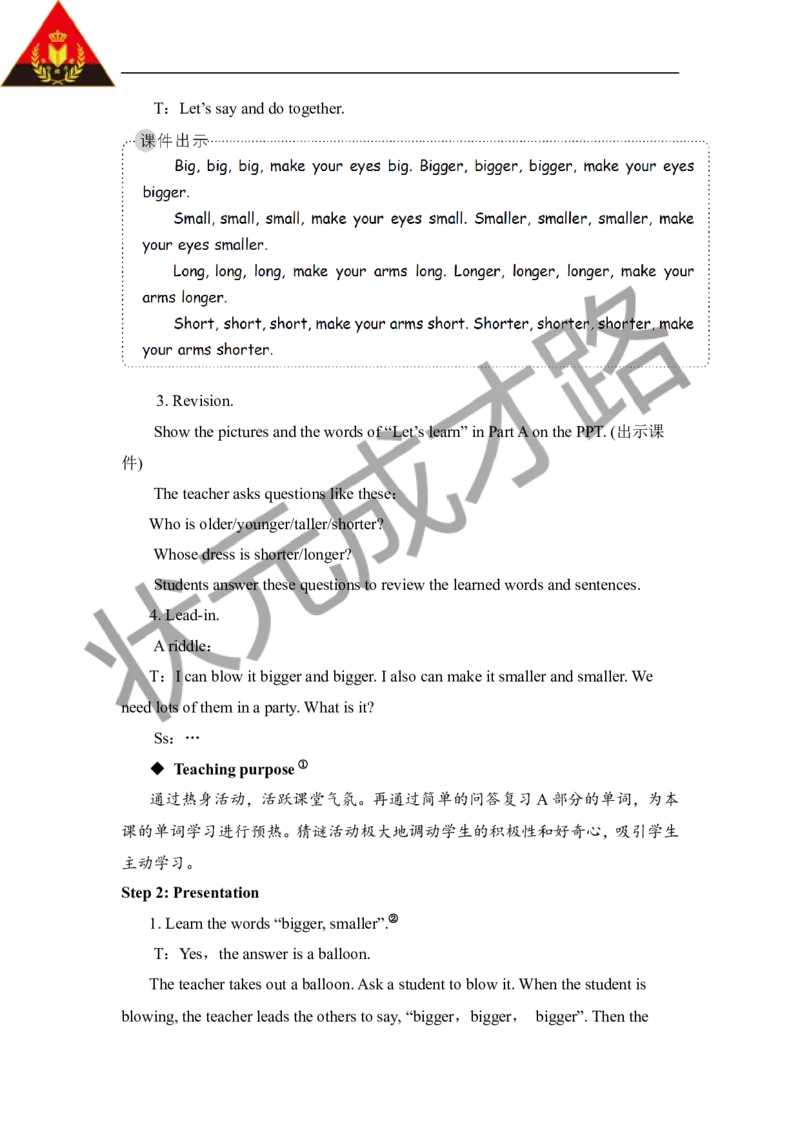
2. Let’s do.T:Let’s say and do together.
3. Revision.
Show the pictures and the words of “Let’s learn” in Part A on the PPT. (出示课
件)
The teacher asks questions like these:
Who is older/younger/taller/shorter?
Whose dress is shorter/longer?
Students answer these questions to review the learned words and sentences.
4. Lead-in.
A riddle:
T:I can blow it bigger and bigger. I also can make it smaller and smaller. We
need lots of them in a party. What is it?
Ss:…
◆ Teaching purpose①
通过热身活动,活跃课堂气氛。再通过简单的问答复习A部分的单词,为本
课的单词学习进行预热。猜谜活动极大地调动学生的积极性和好奇心,吸引学生
主动学习。
Step 2: Presentation
1. Learn the words “bigger, smaller”.②
T:Yes,the answer is a balloon.
The teacher takes out a balloon. Ask a student to blow it. When the student is
blowing, the teacher leads the others to say, “bigger,bigger, bigger”. Then theteacher writes down the words “big—bigger” on the blackboard.(Write “-ger” in red
chalk.)
When the balloon is big enough, the teacher takes it in hand carefully.
T:Look! I can make it smaller.
The teacher makes the balloon smaller and smaller, and then leads students to say,
“smaller, smaller, smaller”. At last,the teacher writes down the words “small—
smaller” on the blackboard. (Write “-er” in red chalk.)
Show the picture of Mike and Wu Yifan on the PPT. (出示课件)
T:They are looking at their feet. Whose feet are bigger?
S:Mike’s.
T:Yes. Mike’s feet are bigger than Wu Yifan’s. Wu Yifan’s feet are smaller than
Mike’s.
Lead students to read the words several times.
◆ Teaching purpose②
延续热身活动的谜语,拿出谜底物品,用气球来演示bigger和smaller,使学生
更加直观地理解这组形容词比较级的意义。
2. Learn the words “heavier, thinner”.③
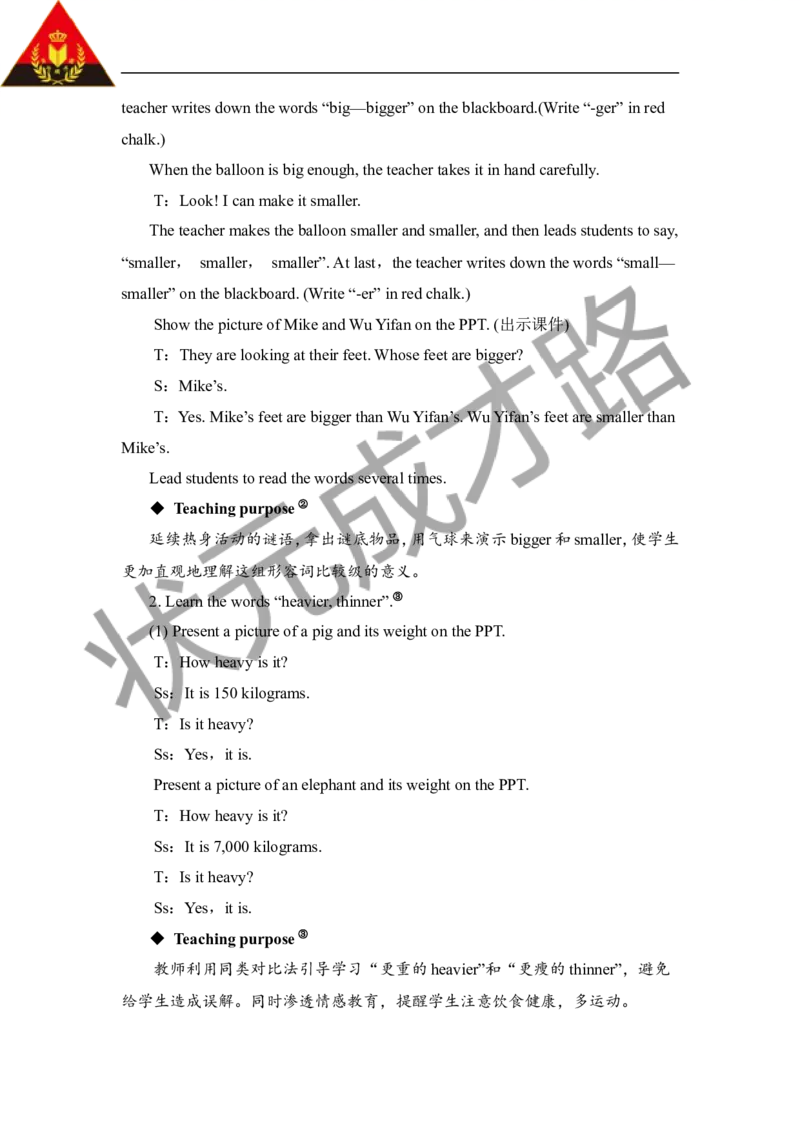
(1) Present a picture of a pig and its weight on the PPT.
T:How heavy is it?
Ss:It is 150 kilograms.
T:Is it heavy?
Ss:Yes,it is.
Present a picture of an elephant and its weight on the PPT.
T:How heavy is it?
Ss:It is 7,000 kilograms.
T:Is it heavy?
Ss:Yes,it is.
◆ Teaching purpose③
教师利用同类对比法引导学习“更重的heavier”和“更瘦的thinner”,避免
给学生造成误解。同时渗透情感教育,提醒学生注意饮食健康,多运动。T:Which animal is heavier,the pig or the elephant?
Ss:The elephant.
T:Great!
The teacher writes down the words “heavy—heavier” on the blackboard. (Write
“-ier” in red chalk.)
Lead students to read the words several times.
(2)The teacher chooses a thin student and asks him or her to stand up.
T:Do you think he/ she is heavy?
Ss:No,he/ she is thin.
T:Good answer. Can you find a thinner student in our class?
Ss:XXX is thinner than him/her.
T:Good! Who is thinner than XXX?
Ss:…
Find the thinnest student in the class in this way.
The teacher writes down the words “thin—thinner” on the blackboard. (Write “-
ner” in red chalk.)
Lead students to read the words several times.
Show the picture of Jim and John on the PPT. (出示课件)
T:How heavy is Jim?
Ss:He is 52 kilograms.
T:Who is thinner? And who is heavier?
Ss:John is thinner. Jim is heavier.
T:Do you know why Jim is heavier? Maybe he eats too much fast food. So we
should eat less fast food and exercise more. Then we’ll be more healthy.(Write down the key sentences “—How heavy are you? —I’m…kilograms.” on
the blackboard.)
Lead students to read the sentences several times.
3. Learn the word “stronger”.④
Show the picture of Zhang Peng and Sarah on the PPT. (出示课件)
T:Zhang Peng is a helpful boy. Look at this picture. Sarah’s bag is too heavy. She
can’t carry it. Zhang Peng helps her. Do you know why Zhang Peng can carry this
heavy bag?
Ss:…
T:Because he is strong. So who is stronger,Sarah or Zhang Peng?
Ss:Zhang Peng is stronger.
T:Wonderful! So if you are strong,you can help others, too.
The teacher writes down the words “strong—stronger” on the blackboard.(Write
“-er” in red chalk.)
Lead students to read the words for several times.
◆ Teaching purpose④
情景导入学习“strong—stronger”。同时,渗透情感教育,鼓励学生助人为乐,
尽自己的能力多帮助别人。
Step 3: Practice
1. Watch and read.
The teacher plays the cartoon of “Let’s learn”. Students watch the cartoon and try
to read after it.
2. Play games.⑤
(1) Work in pairs. Compare the size of school supplies or body parts.
Ask some pairs to show their works.The group which does a good job can get a paper fish.
(2) Find the differences and try to describe them.
The teacher makes a model:Lily is younger than Lucy.
The student who makes a sentence can get a paper fish.
◆ Teaching purpose⑤
设计以游戏为主的练习环节,不仅可以使学生在一段时间的学习过后放松下
来,还可以在愉悦的氛围里对所学知识进行练习与运用。
Step 4: Consolidation & Extension⑥
“Match and say”
1. Ask the students who get the paper fish to stand up and try to describe their
fish.
Make a model:
My paper fish is thin./ My paper fish is big./ …
T:You can find your fish in your book.
2. Finish the matching task.
T: Today,the children go fishing in a pool. Please observe the fish in the pool.
They are different. First,please help each child choose a fish. Match them with a line.
3. Ask students to compare each child’s fish.
Make a model:
Mike’s fish is bigger than Sarah’s./ Sarah’s fish is thinner than Chen Jie’s.
4. Show time.
Students stand up and say their own sentences.
◆ Teaching purpose⑥通过Match and say这个板块引导学生完成连线任务,并使用所学知识对不同
形态的鱼进行描述和对比,培养学生的语言综合运用能力。
▶ 板书设计
▶ 作业设计
1. Write down the key words in the exercise book.
2. Do the exercise. (见“状元成才路”系列丛书《创优作业100分》对应课时
作业P4第三题)
▶ 教学反思
1. 本节课充分运用动作演示法来导入新课,让学生在观察、比较和发现中去
学习新知识,真正体现了“学中用,用中学”的原则。
2. 采用创设真实场景、图片对比、实物展示等多种方式教学单词,注重学生学
习方法和学习策略的培养,引导学生自主学习。
3. 多个游戏活动的设计激发了学生的学习兴趣,调动了学生的学习热情,营
造积极的学习氛围,很好地吸引了学生的注意力。4. 整个课时环节紧密,流程清晰,能够很好地达成本课时的教学目标。
5. 充分利用身边的道具,让学生在体验中学习,在学习中体验,使他们在比较
中加深了对形容词比较级的理解,学习起来更加轻松。
▶ Teaching Contents & Teaching Aims
Let’s learn
Be able to listen,speak,read and write the comparative adjectives “smaller,
bigger,thinner,heavier,stronger” through pictures,actual objects courseware
and other methods.
Be able to use the words above to describe the characteristics of people and
things.
Understand the rules that some adjectives from the original form to the
comparative form require the double suffix letter and then plus “-er” or change
“y” into “i” and then plus “-er”.
Match and say
Use the words and sentence structures learned in Part B to describe and compare
the characteristics of the fish the children caught.
▶ Teaching Priorities
Be able to listen,speak, read and write the comparative adjectives “smaller,
bigger,thinner,heavier,stronger”.
Be able to flexibly use the comparative forms of adjectives to describe the
differences between people and things.
▶ Teaching Difficulties
Be able to master the comparative forms of the words “heavy,thin,big”.
▶ Teaching Procedures
Teaching Teacher’s Activities Students’ Activities Teaching PurposesStages
Warm-up 1. Greetings. 1. Greetings. Arouse students’ interest in
learning. Lead students to
& 2. Let’s do. 2. Say and do together.
review the adjectives they
Revision 3. Review. 3. Answer some questions. have learned in Part A.
Lead in the new lesson.
& 4. Lead-in. 4. Guess a riddle.
Lead-in
Presentation 1. Teach the words Watch the balloon get bigger. Use a balloon to show
“bigger,smaller”. “bigger” and “smaller”,
Watch the balloon get
and make students
smaller.
understand the meaning of
Learn the words. the adjectives intuitively.
2. Teach the words Learn the new word Use the comparison
“heavier, thinner”. “heavier” by observing the method to teach “heavier”
pictures and answering the and “thinner”.
questions.
Avoid misunderstanding.
Learn the new word
Emotional education: Pay
“thinner” by searching for the
attention to a healthy diet
thinnest student.
and do more exercise.
3. Teach the word Observe the picture and Learn new words in
“stronger”. answer the teacher’s context. Emotional
questions. education: Do the best to
help others.
Practice 1. Play the cartoon of Watch the cartoon and try to The design of a game-
“Let’s learn”. read after it. based practice can not only
help students relax after a
2. Play games. Work in pairs. Compare the
period of learning, but also
size of school supplies or
practice and apply the
body parts.
knowledge in a pleasant
Find the differences between atmosphere.
the two girls in the picture
and try to describe the
differences.
Consolidation “Match and say” 1. Stand up and try to Lead students to finish the
describe their fish. matching task. Let them
& 1. Ask the students
use the knowledge to
who get the paper 2. Finish the matching task.
Extension describe and compare
fish to stand up and
3. Compare each child’s fish. different forms of fish,so
try to describe their
as to cultivate students’
fish. 4. Stand up and say their own
comprehensive language
sentences.
2. Finish the matching using ability.
task.
3. Ask students to
compare eachchild’s fish.
4. Show time.
Homework 1. Write down the key words in the exercise book.
2. Do the exercise.