2024 年中考第二次模拟考试(江苏南京卷)
英语(全解全析)
(考试时间:90分钟 试卷满分:90分)
注意事项:
1.答卷前,考生务必将自己的姓名、准考证号填写在答题卡上。
2.回答第Ⅰ卷时,选出每小题答案后,用2B铅笔把答题卡上对应题目的答案标号涂黑。如需改动,
用橡皮擦干净后,再选涂其他答案标号。写在本试卷上无效。
3.回答第Ⅱ卷时,将答案写在答题卡上。写在本试卷上无效。
4.考试结束后,将本试卷和答题卡一并交回。
第Ⅰ卷
选择题(满分40分)
一、单项填空(共15小题,每小题1分,满分15分)
请认真阅读下列各题,从题中所给的 A.B.C.D四个选项中,选出最佳选项,并在答题卡上将该项
涂黑。
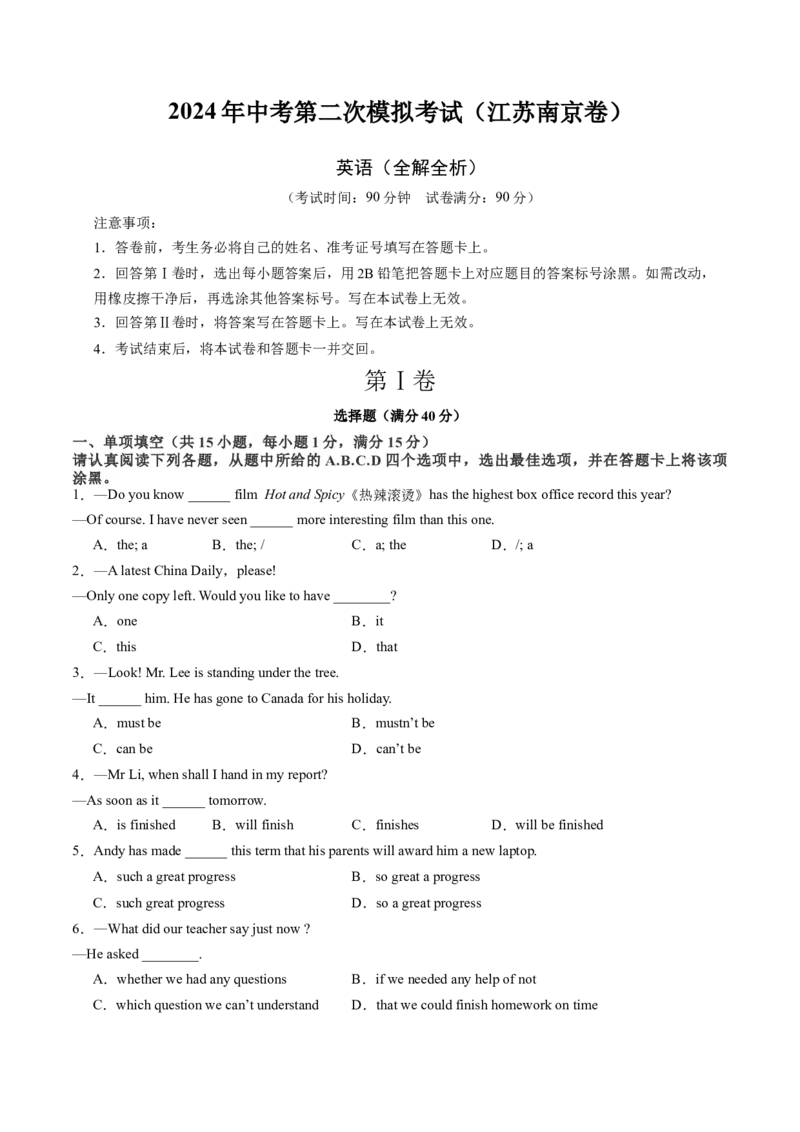
1.—Do you know ______ film Hot and Spicy《热辣滚烫》has the highest box office record this year?
—Of course. I have never seen ______ more interesting film than this one.
A.the; a B.the; / C.a; the D./; a
2.—A latest China Daily,please!
—Only one copy left. Would you like to have ________?
A.one B.it
C.this D.that
3.—Look! Mr. Lee is standing under the tree.
—It ______ him. He has gone to Canada for his holiday.
A.must be B.mustn’t be
C.can be D.can’t be
4.—Mr Li, when shall I hand in my report?
—As soon as it ______ tomorrow.
A.is finished B.will finish C.finishes D.will be finished
5.Andy has made ______ this term that his parents will award him a new laptop.
A.such a great progress B.so great a progress
C.such great progress D.so a great progress
6.—What did our teacher say just now ?
—He asked ________.
A.whether we had any questions B.if we needed any help of not
C.which question we can’t understand D.that we could finish homework on time7.This year’s Tomb-Sweeping Day, or known as “Qingming Festival” falls ________ April 4.
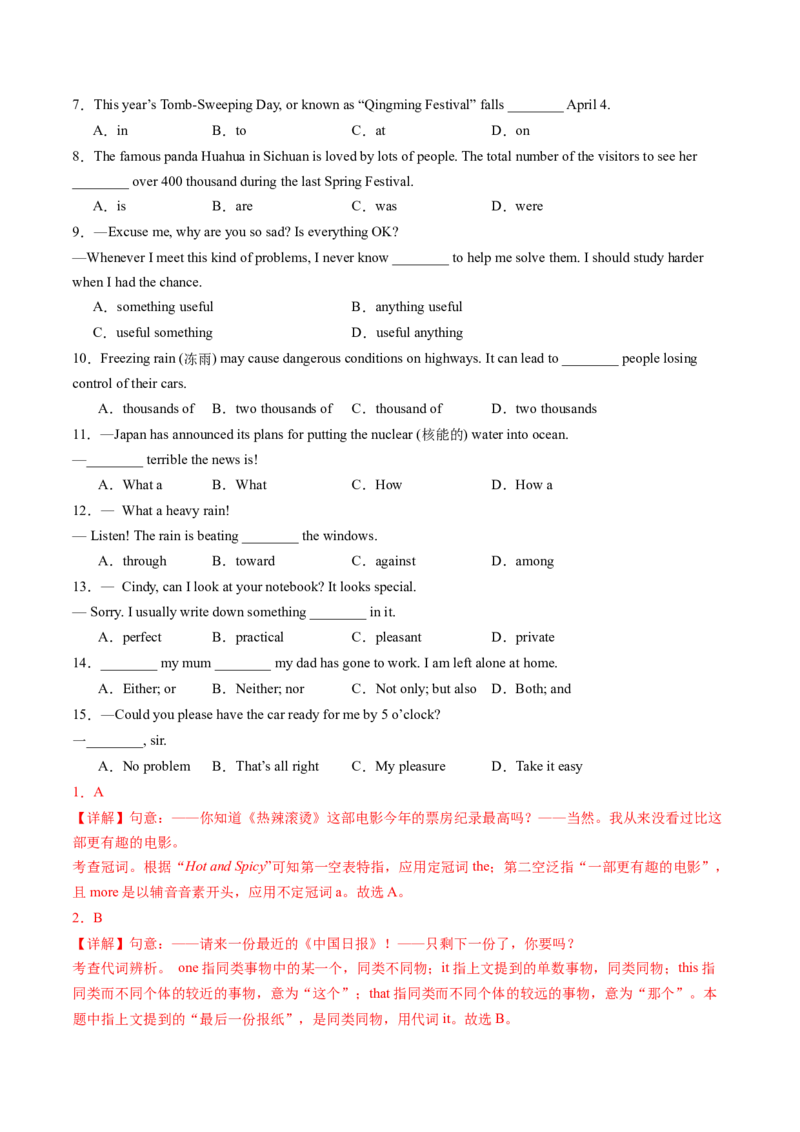
A.in B.to C.at D.on
8.The famous panda Huahua in Sichuan is loved by lots of people. The total number of the visitors to see her
________ over 400 thousand during the last Spring Festival.
A.is B.are C.was D.were
9.—Excuse me, why are you so sad? Is everything OK?
—Whenever I meet this kind of problems, I never know ________ to help me solve them. I should study harder
when I had the chance.
A.something useful B.anything useful
C.useful something D.useful anything
10.Freezing rain (冻雨) may cause dangerous conditions on highways. It can lead to ________ people losing
control of their cars.
A.thousands of B.two thousands of C.thousand of D.two thousands
11.—Japan has announced its plans for putting the nuclear (核能的) water into ocean.
—________ terrible the news is!
A.What a B.What C.How D.How a
12.— What a heavy rain!
— Listen! The rain is beating ________ the windows.
A.through B.toward C.against D.among
13.— Cindy, can I look at your notebook? It looks special.
— Sorry. I usually write down something ________ in it.
A.perfect B.practical C.pleasant D.private
14.________ my mum ________ my dad has gone to work. I am left alone at home.
A.Either; or B.Neither; nor C.Not only; but also D.Both; and
15.—Could you please have the car ready for me by 5 o’clock?
一________, sir.
A.No problem B.That’s all right C.My pleasure D.Take it easy
1.A
【详解】句意:——你知道《热辣滚烫》这部电影今年的票房纪录最高吗?——当然。我从来没看过比这
部更有趣的电影。
考查冠词。根据“Hot and Spicy”可知第一空表特指,应用定冠词the;第二空泛指“一部更有趣的电影”,
且more是以辅音音素开头,应用不定冠词a。故选A。
2.B
【详解】句意:——请来一份最近的《中国日报》!——只剩下一份了,你要吗?
考查代词辨析。 one指同类事物中的某一个,同类不同物;it指上文提到的单数事物,同类同物;this指
同类而不同个体的较近的事物,意为“这个”;that指同类而不同个体的较远的事物,意为“那个”。本
题中指上文提到的“最后一份报纸”,是同类同物,用代词it。故选B。3.D
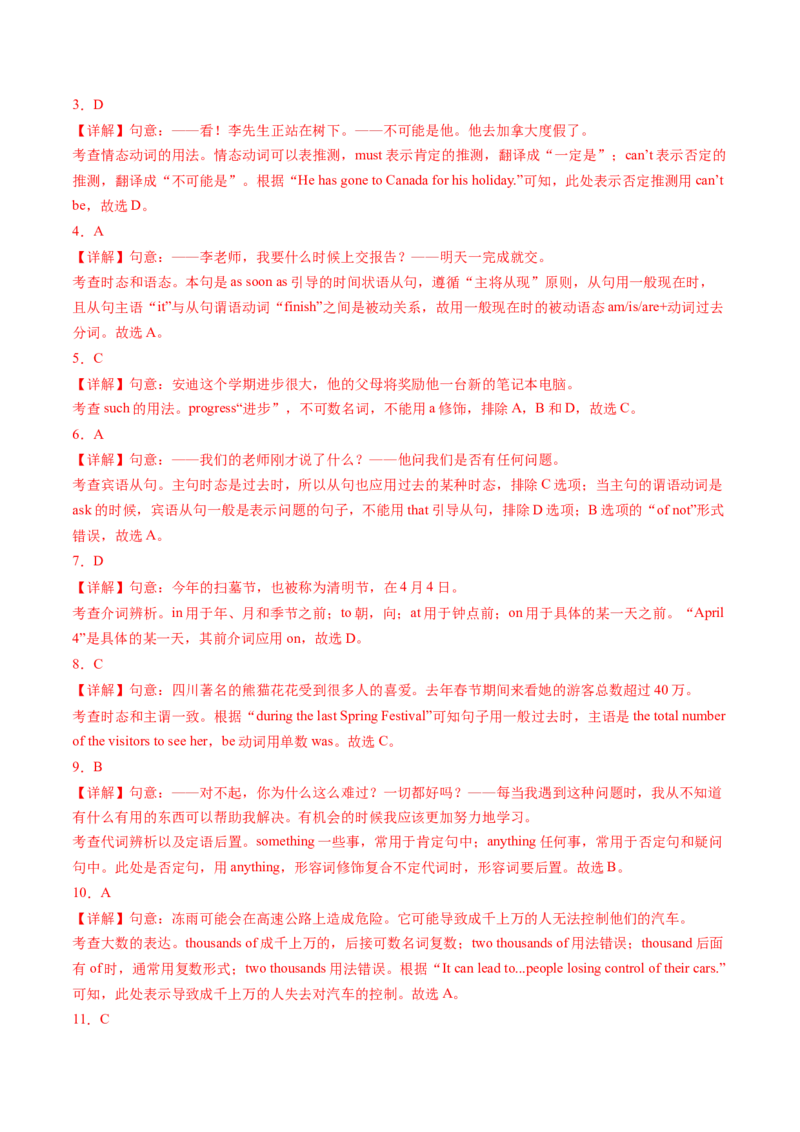
【详解】句意:——看!李先生正站在树下。——不可能是他。他去加拿大度假了。
考查情态动词的用法。情态动词可以表推测,must表示肯定的推测,翻译成“一定是”;can’t表示否定的
推测,翻译成“不可能是”。根据“He has gone to Canada for his holiday.”可知,此处表示否定推测用can’t
be,故选D。
4.A
【详解】句意:——李老师,我要什么时候上交报告?——明天一完成就交。
考查时态和语态。本句是as soon as引导的时间状语从句,遵循“主将从现”原则,从句用一般现在时,
且从句主语“it”与从句谓语动词“finish”之间是被动关系,故用一般现在时的被动语态am/is/are+动词过去
分词。故选A。
5.C
【详解】句意:安迪这个学期进步很大,他的父母将奖励他一台新的笔记本电脑。
考查such的用法。progress“进步”,不可数名词,不能用a修饰,排除A,B和D,故选C。
6.A
【详解】句意:——我们的老师刚才说了什么?——他问我们是否有任何问题。
考查宾语从句。主句时态是过去时,所以从句也应用过去的某种时态,排除C选项;当主句的谓语动词是
ask的时候,宾语从句一般是表示问题的句子,不能用that引导从句,排除D选项;B选项的“of not”形式
错误,故选A。
7.D
【详解】句意:今年的扫墓节,也被称为清明节,在4月4日。
考查介词辨析。in用于年、月和季节之前;to朝,向;at用于钟点前;on用于具体的某一天之前。“April
4”是具体的某一天,其前介词应用on,故选D。
8.C
【详解】句意:四川著名的熊猫花花受到很多人的喜爱。去年春节期间来看她的游客总数超过40万。
考查时态和主谓一致。根据“during the last Spring Festival”可知句子用一般过去时,主语是the total number
of the visitors to see her,be动词用单数was。故选C。
9.B
【详解】句意:——对不起,你为什么这么难过?一切都好吗?——每当我遇到这种问题时,我从不知道
有什么有用的东西可以帮助我解决。有机会的时候我应该更加努力地学习。
考查代词辨析以及定语后置。something一些事,常用于肯定句中;anything任何事,常用于否定句和疑问
句中。此处是否定句,用anything,形容词修饰复合不定代词时,形容词要后置。故选B。
10.A
【详解】句意:冻雨可能会在高速公路上造成危险。它可能导致成千上万的人无法控制他们的汽车。
考查大数的表达。thousands of成千上万的,后接可数名词复数;two thousands of用法错误;thousand后面
有of时,通常用复数形式;two thousands用法错误。根据“It can lead to...people losing control of their cars.”
可知,此处表示导致成千上万的人失去对汽车的控制。故选A。
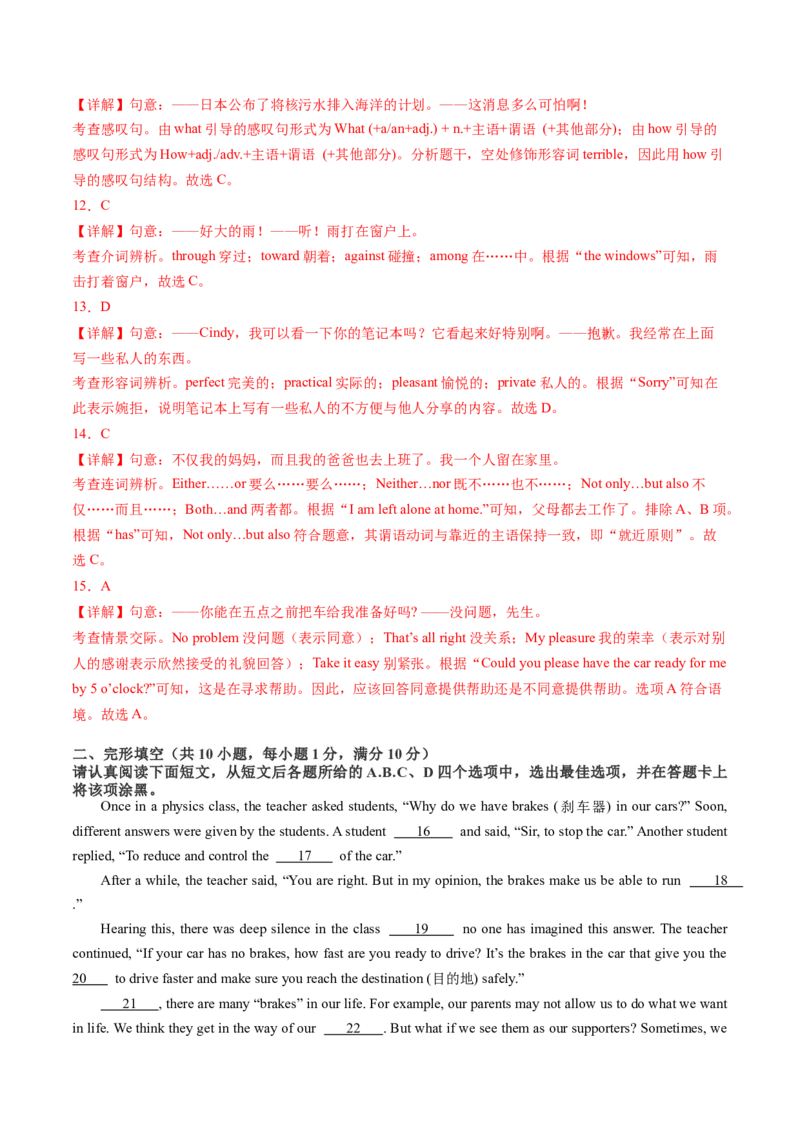
11.C【详解】句意:——日本公布了将核污水排入海洋的计划。——这消息多么可怕啊!
考查感叹句。由what引导的感叹句形式为What (+a/an+adj.) + n.+主语+谓语 (+其他部分);由how引导的
感叹句形式为How+adj./adv.+主语+谓语 (+其他部分)。分析题干,空处修饰形容词terrible,因此用how引
导的感叹句结构。故选C。
12.C
【详解】句意:——好大的雨!——听!雨打在窗户上。
考查介词辨析。through穿过;toward朝着;against碰撞;among在……中。根据“the windows”可知,雨
击打着窗户,故选C。
13.D
【详解】句意:——Cindy,我可以看一下你的笔记本吗?它看起来好特别啊。——抱歉。我经常在上面
写一些私人的东西。
考查形容词辨析。perfect完美的;practical实际的;pleasant愉悦的;private私人的。根据“Sorry”可知在
此表示婉拒,说明笔记本上写有一些私人的不方便与他人分享的内容。故选D。
14.C
【详解】句意:不仅我的妈妈,而且我的爸爸也去上班了。我一个人留在家里。
考查连词辨析。Either……or要么……要么……;Neither…nor既不……也不……;Not only…but also不
仅……而且……;Both…and两者都。根据“I am left alone at home.”可知,父母都去工作了。排除A、B项。
根据“has”可知,Not only…but also符合题意,其谓语动词与靠近的主语保持一致,即“就近原则”。故
选C。
15.A
【详解】句意:——你能在五点之前把车给我准备好吗? ——没问题,先生。
考查情景交际。No problem没问题(表示同意);That’s all right没关系;My pleasure我的荣幸(表示对别
人的感谢表示欣然接受的礼貌回答);Take it easy别紧张。根据“Could you please have the car ready for me
by 5 o’clock?”可知,这是在寻求帮助。因此,应该回答同意提供帮助还是不同意提供帮助。选项A符合语
境。故选A。
二、完形填空(共10小题,每小题1分,满分10分)
请认真阅读下面短文,从短文后各题所给的A.B.C、D四个选项中,选出最佳选项,并在答题卡上
将该项涂黑。
Once in a physics class, the teacher asked students, “Why do we have brakes (刹车器) in our cars?” Soon,
different answers were given by the students. A student 16 and said, “Sir, to stop the car.” Another student
replied, “To reduce and control the 17 of the car.”
After a while, the teacher said, “You are right. But in my opinion, the brakes make us be able to run 18
.”
Hearing this, there was deep silence in the class 19 no one has imagined this answer. The teacher
continued, “If your car has no brakes, how fast are you ready to drive? It’s the brakes in the car that give you the
20 to drive faster and make sure you reach the destination (目的地) safely.”
21 , there are many “brakes” in our life. For example, our parents may not allow us to do what we want
in life. We think they get in the way of our 22 . But what if we see them as our supporters? Sometimes, wehave to 23 and think twice, so that we can take a big step.
In fact, we should be 24 for the “brakes” in life. We could lose the right direction or get into dangerous
situations 25 them. Therefore, we need to understand that the “brakes” in our life are to make us move
forward faster.
16.A.gave up B.got up C.grew up D.stayed up
17.A.speed B.price C.weight D.space
18.A.faster B.earlier C.closer D.harder
19.A.but B.or C.and D.because
20.A.shame B.honor C.courage D.worry
21.A.Unluckily B.Finally C.Similarly D.Suddenly
22.A.development B.punishment C.experiment D.treatment
23.A.hide B.hurry C.stop D.laugh
24.A.fearful B.thankful C.useful D.regretful
25.A.among B.behind C.about D.without
16.B 17.A 18.A 19.D 20.C 21.C 22.A 23.C 24.B 25.D
【导语】本文讲述了老师在物理课上通过讲述刹车器的作用来告诉学生一个哲理:把生活中你所认为的阻
碍看成让我们积极向上奋斗的保障,它们的存在是为了让我们更好地前进。
16.句意:一个学生站起来说。
gave up放弃;got up起身;grew up长大;stayed up熬夜。根据“Once in a physics class, the teacher asked
students, ‘Why do we have brakes (刹车器) in our cars?’”可知,学生应是站起来回答老师的问题。故选B。
17.句意:为了降低和控制汽车的速度。
speed速度;price价格;weight重量;space空间。根据“Why do we have brakes (刹车器) in our cars?”可知,
刹车器有降低和控制速度的功能。故选A。
18.句意:但在我看来,刹车器使我们能够跑得更快。
faster更快;earlier更早;closer更近;harder更困难。根据“It’s the brakes in the car that give you the ... to
drive faster”可知,老师认为刹车器能使我们跑得更快。故选A。
19.句意:听到这里,全班陷入了深深的沉默,因为没有人想象过这样的答案。
but但是;or或者;and和;because因为。根据“there was deep silence in the class ... no one has imagined this
answer.”可知,空前后句是前果后因的关系,用because引导原因状语从句。故选D。
20.句意:正是车里的刹车器让你有勇气开得更快,确保你安全到达目的地。
shame羞耻;honor荣耀;courage勇气;worry担心。根据“It’s the brakes in the car that give you the ... to
drive faster”可知,是指刹车器给了你开得更快的勇气。故选C。
21.句意:同样,我们的生活中也有很多“刹车器”。
Unluckily不幸地;Finally最后;Similarly同样地;Suddenly突然。根据“there are many ‘brakes’ in our life.”
及前文介绍汽车上的刹车器可知,此处是由汽车的刹车器引申到生活中的“刹车器”,因此表示同样地,
生活中也有很多“刹车器”。故选C。22.句意:我们认为他们阻碍了我们的发展。
development发展;punishment惩罚;experiment实验;treatment治疗。根据“our parents may not allow us
to do what we want in life.”可知,父母可能不允许我们做自己想做的事,因此是认为他们阻碍了我们的发展。
故选A。
23.句意:有时候,我们不得不停下来再三思考,以便我们能跨出一大步。
hide隐藏;hurry匆忙;stop停下;laugh大笑。根据“and think twice”可知,是指停下来再想一想。故选
C。
24.句意:事实上,我们应该感谢生活中的“刹车器”。
fearful可怕的;thankful感激的;useful有用的;regretful遗憾的。根据“Therefore, we need to understand
that the ‘brakes’ in our life are to make us move forward faster.”可知,生活中的“刹车器”使我们更快地向前,
因此我们应该感谢它们。故选B。
25.句意:没有他们,我们可能会迷失正确的方向或陷入危险的境地。
among在……之中;behind在……后面;about关于;without没有。根据“We could lose the right direction
or get into dangerous situations”可知,是指没有这些生活中的“刹车器”,我们可能会迷失正确的方向或陷
入危险的境地,介词without符合语境。故选D。
三、阅读理解(共15小题,每小题1分,满分15分)
请认真阅读下列材料,从材料后各题所给的A.B.C、D四个选项中,选出最佳选项,并在答题卡上
将该项涂黑。
A
School Uniform Design (设计) Competition
★Host:
The High School Affiliated to Shaanxi Normal University
★Competitors:
All the students in the school can take part in the competition.
★Time:
Collecting designs: April 3rd to 16th.
The results will come out a month after the collecting.
★Prizes:
The first prize one: 1,000 yuan
The second prize two: 500 yuan
The third prize five: 200 yuan
★How to join:
Send your design and your personal information atsdfz@126.com.
26.According to the poster, ________ can take part in the competition.
A.teachers B.students
C.parents D.officers
27.The results of the competition will come out on ________.
A.April 3rd B.April 16th
C.May 3rd D.May 16th
28.If you get 200 yuan in the competition, you probably win ________.
A.the first prize B.the second prize
C.the third prize D.the fifth prize
26.B 27.D 28.C
【导语】
本文是一篇应用文。文章是一张学校服装设计比赛的海报。
26.细节理解题。根据“All the students in the school can take part in the competition.”可知,所以该校学生可
以参加比赛。故选B。
27.细节理解题。根据“Collecting designs: April 3rd to 16th. The results will come out a month after the
collecting.”可知,参赛时间是4月3日至16日,一个月后出比赛结果,即5月16日出比赛结果。故选D。
28.细节理解题。根据“The third prize five: 200 yuan”可知,三等奖5人,每人200元。故选C。
B
Widely used for thousands of years, Chinese fans not only are the perfect connection of use and beauty, but
also show Chinese people’s high respect for their wonderful history and culture. With the development of history,
there are many forms of fans.
The earliest Chinese fans, Zhang fan, which were big, appeared around the Shang Dynasty. The main use of
them was to keep out the strong sun and protect people from the rain.
Although appearing in the Zhou Dynasty, feather (羽毛) fans weren’t loved by most people until the Three
Kingdom Period. As is known to all, Zhuge Liang who was a smart and great man of Shu Han, was always holding
a feather fan. The feather fan is a symbol of wisdom and appears in literature and paintings nowadays.
During the Han Dynasty, the cattail-leaf fans (香蒲扇) were invented. The cattail-leaf grew in the south and
was a good material because it was not as expensive as feather fans. Even though it wasn’t beautiful, the cattail-leaf
fan was popularized among common people soon.
In the Song Dynasty, fans in the shape of the moon, called “round” fan, became the favourite of young ladies.
The fan was usually made of bamboo and white fine silk. Beautiful pictures were also embroidered (刺绣) on the
face of the moon shaped fan. Its popularity even helped the development of painting itself. From the Song Dynasty
on, fan painting became an independent art form.
29.How many forms of fans are mentioned in the text?
A.Two. B.Three. C.Four. D.Five.30.The writer mentions the ________ of each form of fans.
A.use B.history C.material D.shape
31.What’s the main purpose of the text?
A.To spread Chinese painting culture. B.To increase the sale of Chinese fans.
C.To introduce Chinese traditional fans. D.To explain why fans are popular in China.
29.C 30.B 31.C
【导语】本文是一篇说明文,讲述了扇子的发展历史。
29.细节理解题。根据“Zhang fan”,“feather (羽毛) fans”,“cattail-leaf fans”及“ ‘round’ fan”可知,文
章共提到了四种扇子,故选C。
30.细节理解题。根据“The earliest Chinese fans, Zhang fan, which were big, appeared around the Shang
Dynasty...”,“Although appearing in the Zhou Dynasty, feather (羽毛) fans weren’t loved by most people until
the Three Kingdom Period...”,“During the Han Dynasty, the cattail-leaf fans (香蒲扇) were invented...”及“In
the Song Dynasty, fans in the sh ape of the moon, called “round” fan, became the favourite of young ladies...”可知,
作者提到了每种扇子的发展历史,故选B。
31.推理判断题。通读全文可知,文章讲述了扇子的发展历史,主要目的是介绍中国传统扇子,故选C。
C
My First Marathon (马拉松)
A month before my first marathon, one of my ankles was injured and this meant not running for two weeks,
leaving me only two weeks to train. Yet, I was determined to go ahead.
I remember back to my 7th year in school. In my first P. E. class, the teacher required us to run laps and then
hit a softball. I didn’t do either well. He later informed me that I was “not athletic”.
The idea that I was “not athletic” stuck with me for years. When I started running in my 30s, I realized running
was a battle against myself, not about competition or whether or not I was athletic. It was all about the battle
against my own body and mind. A test of wills!
The night before my marathon, I dreamt that I couldn’t even find the finish line. I woke up sweating and
nervous, but ready to prove something to myself.
Shortly after crossing the start line, my shoe laces (鞋带) became untied. So I stopped to readjust. Not the start
I wanted!
At mile 3, I passed a sign “GO FOR IT, RUNNERS!”
By mile 17, I became out of breath and the once injured ankle hurt badly. Despite the pain, I stayed the course
walking a bit and then running again.
By mile 21, I was starving!
As I approached mile 23, I could see my wife waving a sign. She is my biggest fan. She never minded the
alarm clock sounding at 4 a.m. or questioned my expenses on running.
I was one of the final runners to finish. But I finished! And I got a medal. In fact, I got the same medal as the
one that the guy who came in first place had.
Determined to be myself, move forward, free of shame and worldly labels (世俗标签), I can now call myself a“marathon winner”.
32.A month before the marathon, the author ________.
A.was well trained B.felt scared
C.made up his mind to run D.lost hope
33.Why did the author mention the P.E. class in his 7th year?
A.To acknowledge the support of his teacher.
B.To amuse the readers with a funny story.
C.To show he was not talented in sports.
D.To share a precious memory.
34.How was the author’s first marathon?
A.He made it. B.He quit halfway.
C.He got the first prize. D.He walked to the end.
35.What does the story mainly tell us?
A.A man owes his success to his family support.
B.A winner is one with a great effort of will.
C.Failure is the mother of success.
D.One is never too old to learn.
32.C 33.C 34.A 35.B
【导语】本文讲述了作者第一次马拉松经历。
32.细节理解题。根据“Yet, I was determined to go ahead.”可知在第一次参加马拉松比赛的前一个月,一只
脚踝受伤了,但是作者还是下定决心要继续前进。故选C。
33.推理判断题。根据“The idea that I was ‘not athletic’ stuck with me for years. When I started running in my
30s, I realized running was a battle against myself”可知是为了显示他在体育方面没有天赋。故选C。
34.细节理解题。根据“I was one of the final runners to finish. But I finished!”可知做到了,故选A。
35.主旨大意题。根据“Determined to be myself, move forward, free of shame and worldly labels (世俗标签), I
can now call myself a ‘marathon winner’.”以及结合作者的经历,可知这个故事想告诉我们胜利者是意志坚强
的人。故选B。
D
Two Swedish students have invented a new kind of bicycle helmet (头盔). It’s invisible (隐形的) because you
cannot see it on a rider’s head.
The helmet is really a kind of airbag. It is inside a large collar (衣领). People wear it around their neck like a
scarf. When the rider falls off his or her bike, the collar quickly fills with air and an airbag appears around the head.
The two students, Anna Haupt and Terese Alstinat, wanted to change the way people ride bikes. They said,
“Bicycle helmets have always been the same. They’re so bulky, like a hard mushroom (蘑菇) on the head.” They
called their new invention the Hövding. The pair said it looked so cool that people would be happy to wear it.
The inventors started researching and developing the helmet a few years ago. They studied thousands ofaccidents. They wanted to find out how to make the safest helmet. They worked with a Swedish airbag company
called Alva. And then the invisible helmet came out. Today, the two inventors have their own company that sells the
new helmets. There are 17 workers in their company. They hope their helmet will change how people all over the
world ride bikes.
In their video, Haupt and Alstinat said, “Cars are so yesterday. Bikes are the future.” People can not only take
exercise but also experience the beauty of nature when they ride bikes. Now people can only buy the helmet online
in Europe. It sells for around $530. The company did not say when people in the rest of the world could buy it.
根据材料内容选择最佳答案。
36.What is special about the new helmet?
A.It is an airbag that looks like a mushroom. B.It is an airbag that is around the head all the time.
C.It is an airbag that can stop people falling down. D.It is an airbag that cannot be seen when it’s safe.
37.What is Paragraph 3 mainly about?
A.Why they invented the new helmet. B.How they invented the new helmet.
C.Where they invented the new helmet. D.When they invented the new helmet.
38.What did the inventors do to create the safest helmet?
A.They asked Alva for ideas. B.They worked in a bicycle factory.
C.They studied many traffic accidents. D.They researched how people ride bikes around the world.
39.What does the underlined sentence mean in the last paragraph?
A.Cars were invented earlier than bicycles.
B.In the future, people won’t drive cars any more.
C.Riding bikes will be more popular than driving cars.
D.Cars are more expensive than bikes so few people will buy cars.
40.Who can buy the helmet online now?
A.People in China. B.People in England.
C.People in America. D.People in South Africa.
36.D 37.A 38.C 39.C 40.B
【导语】
本文是一篇说明文。文章介绍了一种新型的隐形头盔。
36.细节理解题。根据第二段中的“The helmet is really a kind of airbag. It is inside a large collar (衣领).
People wear it around their neck like a scarf.”可知,隐形头盔实际上是一种安全气囊。它在一个大衣领里面。
人们把它像围巾一样戴在脖子上。因此在安全的时候,我们看不到这个气囊。故选D。
37.主旨大意题。通读第三段后可知,本段主要介绍了两个学生发明新型头盔的原因。故选A。
38.细节理解题。根据第四段中的“They studied thousands of accidents. They wanted to find out how to make
the safest helmet.”可知,他们研究了数千起事故,以此来找到制作最安全的头盔的方法。故选C。
39.句意猜测题。根据画线句及其后的“People can not only take exercise but also experience the beauty of
nature when they ride bikes.”可知,人们不仅可以锻炼,而且当他们骑自行车时也能体验到大自然的美丽。可见,Haupt 和 Alstinat 认为骑自行车有很多好处,他们推测未来自行车会比汽车更受欢迎。故选C。
40.推理判断题。根据最后一段中的“Now people can only buy the helmet online in Europe.”可知,现在在欧
洲,人们只能在网上购买头盔。由此可推知,现在英国人可以在网上买到这种头盔。故选B。
第II卷
非选择题(满分50分)
四、填空(共15小题,每小题1分,满分15分)
A)请根据括号中所给的汉语写出单词,使句子意思完整正确,并将答案填写相应横线上。
41.Keeping a (日记) is a good way to improve our writing skills.
42.This nature reserve is home to more than eight (百) kinds of animals and plants.
43.Eddie said to Hobo, “Don’t cut in on others, always wait (有礼貌地).”
44.She gave (严格的) instructions in order not to be disturbed at meetings.
45.China’s men’s soccer team (赢得) a ticket to this summer’s Asian Games in September.
41.diary
【详解】句意:记日记是提高写作技巧的好方法。根据中文提示可知,diary表示“日记”,keep a diary表
示“记日记”,故填diary。
42.hundred
【详解】句意:这个自然保护区是八百多种动植物的家园。 hundred“百”,基数词eight后面接数词的单
数形式,表示确切的数量,故填hundred。
43.politely
【详解】句意:Eddie对Hobo说:“不要打断别人,要有礼貌地等待。”politely有礼貌地,在句中修饰动
词wait,故填politely。
44.strict
【详解】句意:她给了严格的指示,以便会议上不被打扰。根据汉语提示和空后名词instructions,可知空
处应为形容词“严格的”strict。故填strict。
45.won
【详解】句意:中国男足赢得了今年9月夏季亚运会的入场券。win“赢得”,是动词,分析语境可知,此
处介绍过去发生的事情,应用一般过去时,故填won。
B)请根据句子意思,用括号中所给单词的适当形式填空,并将答索填写在相应横线上。
46.For a long time in history, people depended on horses to trade goods. (great)
47.Lucy is organized and her room always looks (tidy) than mine.
48.To our surprise, an 8-year-old girl became the of the dancing competition.(win)
49.Stop (lie)! I shall never believe you again.
50.I gave my lovely son a comic book as his (nine) birthday present.
46.greatly
【详解】句意:在很长一段时间的历史上,人们很大程度上依赖马来进行货物贸易。此处在句中修饰动词depend,用副词形式,故填greatly。
47.tidier
【详解】句意:露西很有条理,她的房间看起来总是比我的整洁。此处在句中作表语,根据“than”可知,
用形容词比较级形式,故填tidier。
48.winner
【详解】句意:令我们惊讶的是,一个8岁的女孩成为舞蹈比赛的获胜者。
根据句意理解可知,这里表达的是“获胜者”,且空格前有the修饰,所以空格需要的是一个名词,而所
给的词是动词,变成名词是winner,而句子主语是单数名词,所以空格应该用单数形式,故答案为
winner。
49.lying
【详解】句意:别撒谎了!我再也不会相信你了。根据句意可知,此处表达的是“停止做某事”,英语表
达为stop doing sth,故填lying。
50.ninth
【详解】句意:我送给我可爱的儿子一本漫画书作为他九岁的生日礼物。此处是指九岁生日,应用序数词
ninth,故填ninth。
C)请根据短文内容,从下面方框中选择适当的单词或短语填空,使短文内容完整正确,并将答案
填写在答题卡标号为51-55的相应横线上。
at least habit compared with delicious offers
I have never been a fan of vegetables. But my best friend loves them. “Eat your greens!” he always says. So I
decide to learn something more about them.
It is suggested to eat 51 five different vegetables every day. It’s a good 52 to make
vegetables a main part of each meal. However, some people think that vegetables are not so popular 53
meat, so when vegetables are served together with meat, they often choose meat instead of vegetables. Others think
vegetables are cooked in an unskillful way, making them not 54 .
In order to help me have a healthy diet, my friend 55 me good advice on how to cook tasty
vegetables. I am on my way to a healthier lifestyle.
51.at least 52.habit 53. compared with 54.delicious 55.offers
【导语】本文主要讲述了作者不喜欢吃蔬菜,但是吃蔬菜是一个好习惯,为了帮助他健康饮食,朋友教他
如何烹饪美味的蔬菜。
51.句意:建议每天至少吃五种不同的蔬菜。根据“It is suggested to eat...five different vegetables every day.”
及结合备选词汇可知,每天至少吃五种不同的蔬菜,at least“至少”,符合语境。故填at least。
52.句意:把蔬菜作为每餐的主要部分是一个好习惯。根据“make vegetables a main part of each meal”及结
合备选词汇可知,每餐都吃蔬菜这是个好习惯,habit“习惯”,空前有冠词a,所以空处填单数。故填
habit。
53.句意:然而,有些人认为蔬菜不如肉类受欢迎,所以当蔬菜和肉一起上桌时,他们通常选择肉而不是蔬菜。根据“when vegetables are served together with meat, they often choose meat instead of vegetables”可知,
空处是将蔬菜和肉进行比较,compare with“与……相比较”,空处需用过去分词表被动,作状语,故填
compared with。
54.句意:还有些人认为蔬菜的烹饪方式不够熟练,导致它们不够美味。根据“vegetables are cooked in an
unskillful way”及结合备选词汇可知,蔬菜的烹饪方式使蔬菜不美味,delicious“美味的”,符合语境。故填
delicious。
55.句意:为了帮助我拥有健康的饮食,我的朋友给我提供了如何烹饪美味蔬菜的好建议。offer sb. sth.“为
某人提供某物”,句子的时态为一般现在时,主语my friend是第三人称单数,所以空处用动词三单。故填
offers。
五、阅读填空(共20小题;每小题1分,满分20分)
A)请认真阅读下面短文,并根据所读内容在文章后表格中第 56- 65小题的空格里填入一个最恰
当的单词。注意:每个空格只填1个单词。请将答案填写在答题卡标号为56-65的相应横线上。
Listen! What can you hear? Birds outside? A car going by? Maybe your favorite music? Thanks to your ears,
you can hear it clearly.
The World Health Organization (WHO) reports that there are 360 million people in the world with hearing loss
problems. At least half of all cases of hearing loss are avoidable if you take care of your ears.
Protecting yourself from loud noise is a key part of ear care. Nowadays, it is common for people to listen to
music with headphones on while traveling to school or work. Remember to choose over-the-ear headphones. This
type can keep background noise out and allow you to have the volume lower. In-the-ear headphones are less
effective at keeping background noise out. Also, experts suggest a 60:60 rule: listen to your music at 60 percent of
the maximum volume (最大音量) for no more than 60 minutes a day. Want to know if your earphones are at a safe
volume? Ask people sitting near you if they can hear your music. If they can, it’s a sign that your hearing is being
damaged (损伤). Turn the volume down until other people can no longer hear it.
Do you clean your ears with cotton buds or fingernails? Think again. These things can push earwax (耳垢)
deeper into your ear, and hurt your ear canal (耳道). The ear is a self-cleaning organ (器官) and does not require
active cleaning, according to the WHO. If the earwax makes you uncomfortable, you can ask a doctor to deal with
it.
Take care of your ears when you are swimming. You can use earplugs (耳塞) to stop water getting into your
ears. Dry your ears with a towel (毛巾) after swimming or having a bath. If you feel there is water inside your ear,
shake your head a little bit to help get the water out.Hearing protection
Problem Millions of people are facing the problems of 56 hearing.
Reason Most of the cases are 57 because they don’t take care of their ears.
● Using over-the-ear headphones is a good
Protect yourself from loud 58 for you to keep background noise out.
noise ● You should enjoy your music at a safe
volume for at 59 an hour a day.
● The ear is a self-cleaning organ and does not
60 clean your ears require to be 61 .
Ways to protect with cotton buds or fingernails ● You can ask a doctor to solve the earwax
your hearing 62 it makes you comfortable.
● You can stop water 63 your ears
with earplugs.
Take care of your ears while ● Make your ears 64 with a towel after
swimming swimming or taking a bath.
● Shake your head a little bit to help get the
water out if 65 .
56.losing 57.caused 58.choice 59.most 60.Don’t/Never 61.cleaned 62.unless
63.entering 64.dry 65.necessary
【导语】本文主要讲了保护耳朵听力的几种措施和方法。
56.根据“there are 360 million people in the world with hearing loss problems.”可知,人们面临的是丧失听力
的问题,lose“失去”,介词of后面用动名词形式。故填losing。
57.根据“At least half of all cases of hearing loss are avoidable if you take care of your ears.”可知,如果你照
顾好你的耳朵,至少有一半的听力损失是可以避免的,由此可知,是因为他们没有照顾好耳朵才导致听力
问题的,cause“导致”,主语cases与cause之间是被动关系,结构为be+过去分词。故填caused。
58.根据“Remember to choose over-the-ear headphones. This type can keep background noise out and allow you
to have the volume lower.”可知,使用入耳式耳机是一个很好的选择,可以防止背景噪音,choice“选择”,
可数名词,a修饰用可数名词单数。故填choice。
59.根据“for no more than 60 minutes a day”可知,是每天最多60分钟,at most“最多”,固定搭配。故填
most。
60.根据“These things can push earwax (耳垢) deeper into your ear, and hurt your ear canal (耳道).”可知,不
要用棉签或指甲清洁耳朵,祈使句中用don’t或never表示否定,句首字母大写。故填Don’t/Never。
61.根据“The ear is a self-cleaning organ (器官) and does not require active cleaning”可知,耳朵不需要主动清洁,clean“清洁”,主语ear与clean之间是被动关系。故填cleaned。
62.根据“If the earwax makes you uncomfortable, you can ask a doctor to deal with it.”可知,如果耳垢让你不
舒服,你可以请医生来处理,用unless“如果不”引导条件状语从句。故填unless。
63.根据“You can use earplugs (耳塞) to stop water getting into your ears.”可知,你可以用耳塞阻止水进入耳
朵,enter“进入”,stop sth doing“停止做某事”,固定搭配,应用enter的动名词形式。故填entering。
64.根据“Dry your ears with a towel (毛巾) after swimming or having a bath.”可知,游泳或洗澡后用毛巾擦
干耳朵,dry“弄干”,make是使役动词,后面加省略to的动词不定式作宾语补足语。故填dry。
65.根据“If you feel there is water inside your ear, shake your head a little bit to help get the water out.”可知,
如果你觉得耳朵里有水,摇摇头帮助把水排出,necessary“必要的”,if it is necessary“如果有必要的话”,
if引导的条件状语从句,省略主语和谓语。故填necessary。
B)请根据短文内容及首字母提示,填写所缺单词,并将答案填写在答题卡标号为 66-75的相应位
置上。
By drawing pictures on a cup of tea, chabaixi, an ancient Chinese tea trick showed in a recent TV drama, has
become popular for its similarity to modern latte art (咖啡拉花艺术). However, ten years ago, this special skill was
close to disappearing completely. Zhang Zhifeng, an inheritor (传承人) of chabaixi, found many people showed
great interest in the s 66 of chabaixi in the drama.
Chabaixi can create different pictures such as bamboos and mountains. There are many s 67 , from
grinding (磨碎) tea, to pouring boiled water, stirring the mixture, and finally drawing the pictures. It is d 68
from making latte because people use clear water as the object to put into the cup instead of milk. But when the
water touches the tea, it turns into a white color and disappears in 20 minutes. The important process before
drawing is known as diancha. The quality of diancha m 69 whether pictures can be successfully
produced later.
“Chabaixi is one of the many forms of tea-making skills in China. The importance of chabaixi is not only this
skill is unique in the world, but also it gives us a window into people’s l 70 in the Song Dynasty. The
activities at that time in some ways are s 71 to what we have now,” Zhang said.
B 72 chabaixi was discovered by TV audiences, the skill was listed as part of China’s Intangible
Cultural Heritage in 2017. Zhang Zhifeng started researching the origins of chabaixi in the 1980s and brought the
skill b 73 in 2009 after years of testing and practice. Zhang thought that it was really m 74 .
“This skill is key to the tea culture of the Song Dynasty, and it would be a shame to let it d 75 . This
skill must be passed on so that more people can understand its history,” Zhang said.66.(s)cenes 67.(s)teps 68.(d)ifferent 69.(m)atters 70.(l)ifestyle 71.(s)imilar
72.(B)efore 73.(b)ack 74.(m)eaningful 75.(d)isappear
【导语】本文是一篇说明文,主要介绍了中国古代茶艺“茶百戏”因一部电视剧走红。这项技术于2017年
被列入中国非物质文化遗产,并介绍了这项非遗技艺的传承人章志峰为此所做的努力。
66.句意:茶百戏的传承人章志峰发现,很多人对剧中的茶百戏场景表现出极大的兴趣。根据“in the
drama”可知是指对剧中的茶百戏场景表现出极大的兴趣,scene“场景”,此空用复数形式,表泛指。故填
(s)cenes。
67.句意:茶百戏有很多步骤,从磨茶,到倒开水,搅拌混合物,最后画画。根据“from grinding (磨碎)
tea, to pouring boiled water, stirring the mixture, and finally drawing the pictures.”可知,磨茶、倒开水、搅拌混
合物、画画,这些是茶百戏的步骤,“步骤”step,many后加复数。故填(s)teps。
68.句意:这与制作拿铁不同,因为人们用清水代替牛奶放入杯子。根据“people use clear water as the
object to put into the cup instead of milk”可知,用清水代替牛奶放入杯子,说明这与制作拿铁不同,be
different from“与……不同”。故填(d)ifferent。
69.句意:点茶的质量关系到之后图片能否成功制作。根据“The quality of diancha…whether pictures can
be successfully produced later.”和首字母可知,点茶的质量关系到之后图片能否成功制作,matter“要紧”,
且主语quality是三单,时态为一般现在时,动词用三单形式。故填(m)atters。
70.句意:茶白戏的重要性不仅在于这项技艺在世界上很特殊,而且它为我们提供了一扇了解宋代人们生
活方式的窗户。根据“it gives us a window into people’s…in the Song Dynasty”可知,茶百戏为我们提供了一
扇了解宋代人们生活方式的窗户。lifestyle“生活方式”。故填(l)ifestyle。
71.句意:当时的活动在某些方面与我们现在的活动相似。be similar to“与……相似”,固定搭配。故填
(s)imilar。
72.句意:在茶百戏被电视观众发现之前,这项技艺于2017年被列入中国非物质文化遗产。根据
“chabaixi was discovered by TV audiences, the skill was listed as part of China’s Intangible Cultural Heritage in
2017.”和首字母可知,此处表示在发现之前,就已经被列为非物质文化遗产了。before“在……之前”,故
填(B)efore。
73.句意:章志峰从20世纪80年代开始研究茶百戏的起源,经过多年的测试和实践,于2009年将茶百戏
再度流行。bring sth. back“使恢复、使再度流行”,固定短语。故填(b)ack。
74.句意:章觉得这真的很有意义。根据本段可知,章认为使茶百戏再度流行起来是有意义的。
meaningful“有意义的”,故填(m)eaningful。
75.句意:这项技艺是宋代茶文化的关键,如果失传,那将是一种耻辱。根据“This skill must be passed
on”可知,这种技艺必须传递下去,不能让它消失。disappear“消失”,let sb. do sth.“让某人做某事”,此
处应是动词原形。故填(d)isappear。
六、书面表达(满分15分)
76.当我们身处这个社会大家庭中,总有一些人或事在深深地影响着我们。是怎样的一次快乐经历使
你感慨万千、收获良多?是怎样的一次冲突使你有所思考、突然长大?是怎样的一次交心之谈,使你克服困难、豁然开朗?是同学们、老师们、家人们还是身边的榜样模范们?说说你的一次经历,写一写你和他
们之间的故事。请根据下面的要点提示,写一篇词数在80左右的英语短文。
内容必须包括以下要点:
1. 你的一次难忘经历(时间、地点、人物、经过、结果)。
2. 你的感想。
注意:
1. 100词左右,已给出部分不计入总词数;
2. 可适当发挥,使短文连贯通顺;
3. 文中不得出现真实的人名、校名和地名。
I still remember what influenced me most that day. I will always cherish (珍藏) the moment deep in my heart.
____________________________________________________________________________________________
____________________________________________________________________________________________
____________________________________________________________________________________________
____________________________________________________________________________________________
____________________________________________________________________________________________
____________________________________________________________________________________________
____________________________________________________________________________________________
76.例文
I still remember what influenced me most that day. I will always cherish (珍藏) the moment deep in my heart.
When I was young, my grandmother often brought me to the mall and bought me presents. Once, there was a
man with dirty clothes outside the mall. I was a little terrified of him. But my grandmother smiled at him and gave
him 50 yuan to buy something to eat.
This kindness of grandmother influences me in my whole life. I always remember to be nice to people like her.
Be kind to others, and we will be happy in our hearts.
【详解】[总体分析]
① 题材:本文是一篇材料作文;
② 时态:时态为“一般现在时”和“一般过去时”;
③ 提示:根据所给提示完成写作,不能遗漏信息,包括影响最大的人是谁,什么事情对自己的影响大等。
[写作步骤]
第一步,引出话题;
第二步,具体介绍自己的一次难忘经历;
第三步,介绍你的感想。
[亮点词汇]
① be terrified of害怕
② smile at朝某人微笑
③ be nice to对……好[高分句型]
① When I was young, she often brought me to the mall and bought me presents.(when引导的时间状语从句)
② Be kind to others, and we will be happy in our heart.(祈使句, and+简单句)