文档文本内容
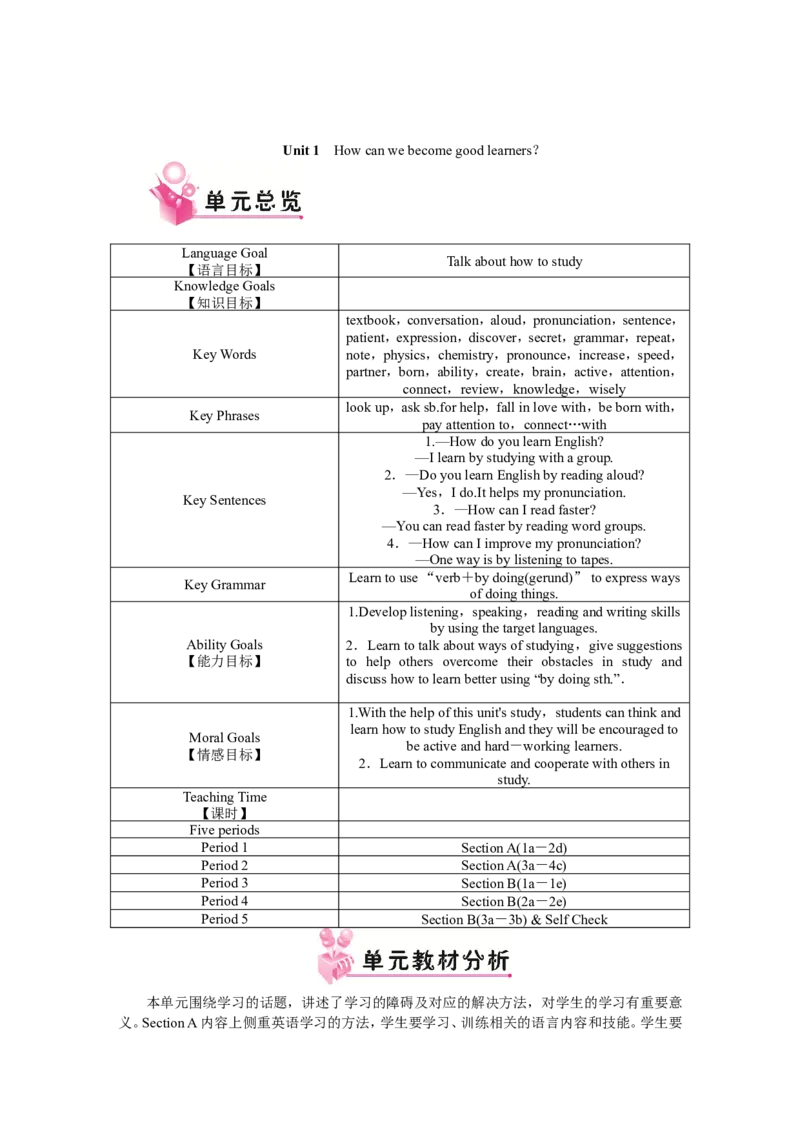
Unit 1 How can we become good learners?
Language Goal
Talk about how to study
【语言目标】
Knowledge Goals
【知识目标】
textbook,conversation,aloud,pronunciation,sentence,
patient,expression,discover,secret,grammar,repeat,
Key Words note,physics,chemistry,pronounce,increase,speed,
partner,born,ability,create,brain,active,attention,
connect,review,knowledge,wisely
look up,ask sb.for help,fall in love with,be born with,
Key Phrases
pay attention to,connect…with
1.—How do you learn English?
—I learn by studying with a group.
2.—Do you learn English by reading aloud?
—Yes,I do.It helps my pronunciation.
Key Sentences
3.—How can I read faster?
—You can read faster by reading word groups.
4.—How can I improve my pronunciation?
—One way is by listening to tapes.
Learn to use “verb+by doing(gerund)” to express ways
Key Grammar
of doing things.
1.Develop listening,speaking,reading and writing skills
by using the target languages.
Ability Goals 2.Learn to talk about ways of studying,give suggestions
【能力目标】 to help others overcome their obstacles in study and
discuss how to learn better using “by doing sth.”.
1.With the help of this unit's study,students can think and
learn how to study English and they will be encouraged to
Moral Goals
be active and hard-working learners.
【情感目标】
2.Learn to communicate and cooperate with others in
study.
Teaching Time
【课时】
Five periods
Period 1 Section A(1a-2d)
Period 2 Section A(3a-4c)
Period 3 Section B(1a-1e)
Period 4 Section B(2a-2e)
Period 5 Section B(3a-3b) & Self Check
本单元围绕学习的话题,讲述了学习的障碍及对应的解决方法,对学生的学习有重要意
义。Section A内容上侧重英语学习的方法,学生要学习、训练相关的语言内容和技能。学生要重点掌握并能熟练、正确地运用与学习主题相关的单词和各种表达学习方法的短语、功能及
句型结构How do you study/learn…?I study/learn…by…How can I…?You can…by…;以及学
会用“by+v.-ing形式”结构来表达方式方法。Section B在Section A谈论英语学习的基础
上,在话题上,从英语的学习困难及解决方案,拓展到优秀学习者的学习习惯;在语言上,巩固
和丰富了与学习相关的话题词汇;在技能上,将听、说能力综合,突出阅读训练,由读促写;在
策略上,引导学生关注优秀学生的学习方式,并借鉴运用;在情感上,鼓励学生面对困难,积极
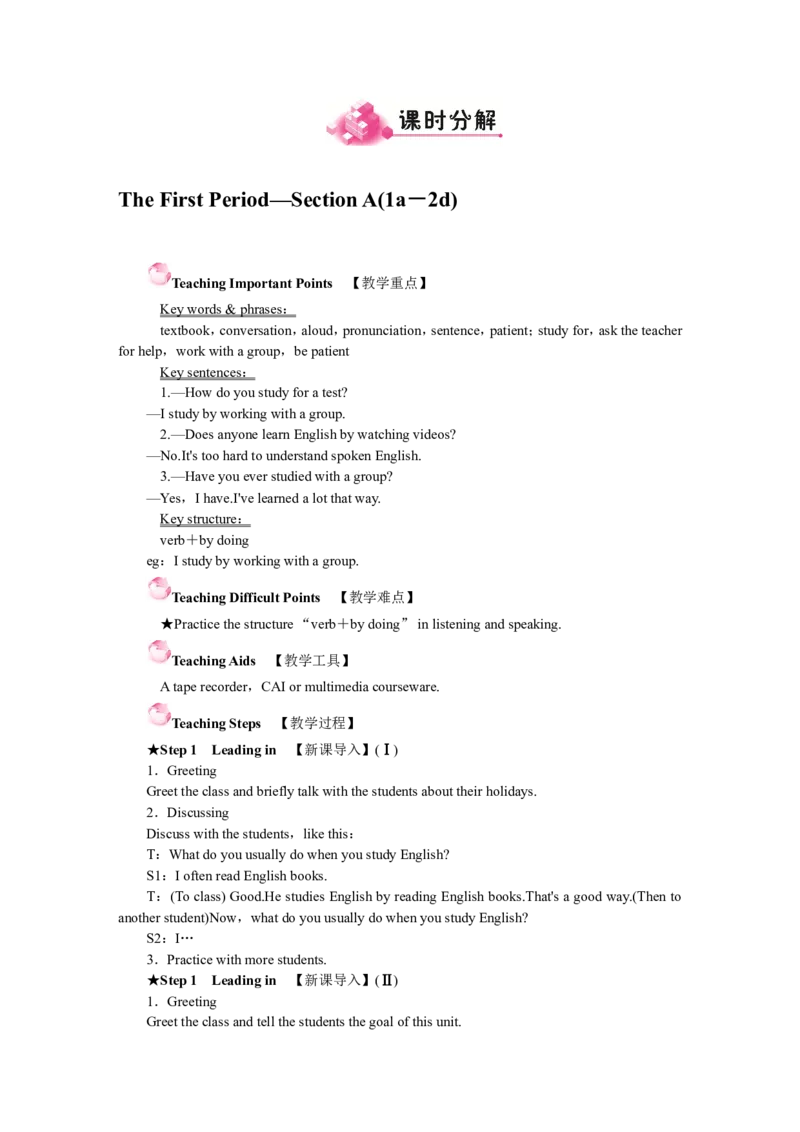
探索解决方案,不断改进学习方法,提高学习效率。The First Period—Section A(1a-2d)
Teaching Important Points 【教学重点】
Key words & phrases :
textbook,conversation,aloud,pronunciation,sentence,patient;study for,ask the teacher
for help,work with a group,be patient
Key sentences :
1.—How do you study for a test?
—I study by working with a group.
2.—Does anyone learn English by watching videos?
—No.It's too hard to understand spoken English.
3.—Have you ever studied with a group?
—Yes,I have.I've learned a lot that way.
Key structure :
verb+by doing
eg:I study by working with a group.
Teaching Difficult Points 【教学难点】
★Practice the structure “verb+by doing” in listening and speaking.
Teaching Aids 【教学工具】
A tape recorder,CAI or multimedia courseware.
Teaching Steps 【教学过程】
★Step 1 Leading in 【新课导入】(Ⅰ)
1.Greeting
Greet the class and briefly talk with the students about their holidays.
2.Discussing
Discuss with the students,like this:
T:What do you usually do when you study English?
S1:I often read English books.
T:(To class) Good.He studies English by reading English books.That's a good way.(Then to
another student)Now,what do you usually do when you study English?
S2:I…
3.Practice with more students.
★Step 1 Leading in 【新课导入】(Ⅱ)
1.Greeting
Greet the class and tell the students the goal of this unit.2.Preparation
T:Today we are going to talk about how to study.How do you study English?
Collect the students' answers and prepare the language items for this period.
★Step 2 Cooperative inquiry 【合作探究】
1.Finish the task in 1a
①Work in groups.Add more ways of studying English.
②Read these phrases in 1a.Tell them the usage of “by doing” phrases.
③Help students to say out their ways of studying.
2.Finish the task in 1b
①Read the instructions.
②Play the recording for the first time.Students only listen.
③Play the recording a second time.Ask them to match the ways with the names.
④Check the answers with the whole class.
3.Finish the task in 1c
①In groups,interview their partners about how they study for a test.
②One from each group reports to the class.
4.Finish the tasks in 2a-2b
①Use PPT or pictures for the students to learn the new words.Read the questions in 2a.
②Get the students to guess the answers in 2b.
③Play the recording for the first time.Students listen and check the questions.
④Play the recording again.Students listen and match the answers with the questions in 1a.
⑤Check the answers with the whole class.
5.Finish the task in 2c
①Show the pictures of the conversations.
②Students work in pairs.
③Ask three pairs to say out their conversations to the class.Show the PPT to help.
6.Finish the task in 2d
①Talk about the picture and scan the conversation.
②Ask the students to read aloud the conversation in 2d.Learn the new words and phrases.
③Ask these questions:
How does Jack feel at the very start?
What makes him feel like this(nervous)?
What's Jack's problem when he reads?And what does Annie suggest?
What's Jack's problem with words?And what's Annie's advice?
④Check the answers with individual students to see how well they understand.
⑤Play the recording and get the students to follow the teacher in the recording.Then ask two
pairs to act out the conversation.
★Step 3 Homework
1.Do a survey:How do you study for an English test?
2.Imagine that you are Jack and Annie.Make a conversation to talk about your English study.
3.Translate the following sentences into English.
(1)你是怎样学习英语的?我通过大量阅读来学习。
________________________________________________________________________
(2)理解这个问题对我来说太难了。________________________________________________________________________
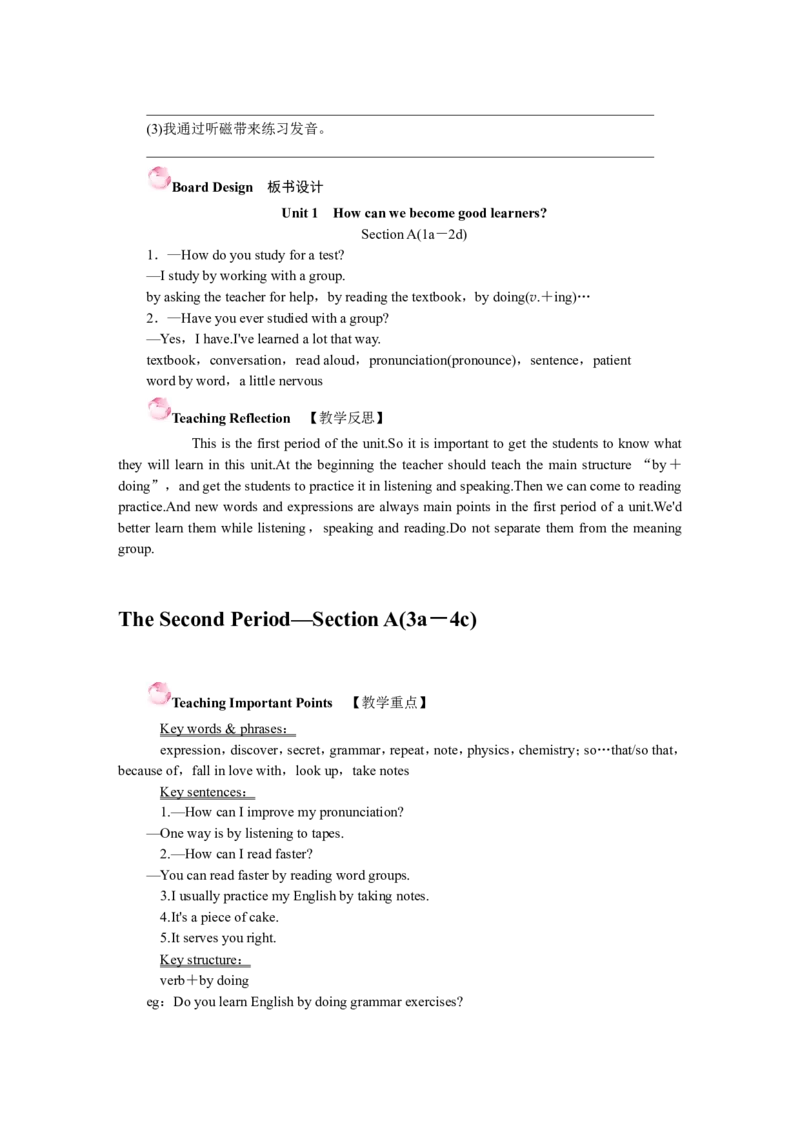
(3)我通过听磁带来练习发音。
________________________________________________________________________
Board Design 板书设计
Unit 1 How can we become good learners?
Section A(1a-2d)
1.—How do you study for a test?
—I study by working with a group.
by asking the teacher for help,by reading the textbook,by doing(v.+ing)…
2.—Have you ever studied with a group?
—Yes,I have.I've learned a lot that way.
textbook,conversation,read aloud,pronunciation(pronounce),sentence,patient
word by word,a little nervous
Teaching Reflection 【教学反思】
This is the first period of the unit.So it is important to get the students to know what
they will learn in this unit.At the beginning the teacher should teach the main structure “by+
doing”,and get the students to practice it in listening and speaking.Then we can come to reading
practice.And new words and expressions are always main points in the first period of a unit.We'd
better learn them while listening,speaking and reading.Do not separate them from the meaning
group.
The Second Period—Section A(3a-4c)
Teaching Important Points 【教学重点】
Key words & phrases :
expression,discover,secret,grammar,repeat,note,physics,chemistry;so…that/so that,
because of,fall in love with,look up,take notes
Key sentences :
1.—How can I improve my pronunciation?
—One way is by listening to tapes.
2.—How can I read faster?
—You can read faster by reading word groups.
3.I usually practice my English by taking notes.
4.It's a piece of cake.
5.It serves you right.
Key structure :
verb+by doing
eg:Do you learn English by doing grammar exercises?Teaching Difficult Points 【教学难点】
★Practice the structure “verb+by doing” in reading comprehension.
Teaching Aids 【教学工具】
A tape recorder,CAI or multimedia courseware.
Teaching Steps 【教学过程】
★Step 1 Leading in 【新课导入】(Ⅰ)
1.Greeting
2.Brainstorming
Quickly ask questions about their English studying,using “by doing”.
3.Ask pairs of students to act out the conversation in 2d.
★Step 1 Leading in 【新课导入】(Ⅱ)
1.Greeting
2.Revision
①Write the structure “by+doing” on the board and get the students to say some sentences
about their English learning,using the structure.
②Role-play the conversation in 2d.
★Step 2 Cooperative inquiry 【合作探究】
1.Finish the task in 3a
①Help the students to understand the demand in 3a and read the three questions.
②Quickly read the passage about Wei Fen and answer the three questions.
③Check and discuss the answers to the questions.
2.Finish the task in 3b
①Read the instructions.
②Read aloud the passage.
③Get the students to work by themselves and complete the sentences with what Wei Fen learn
from watching TV.
④Check the answers with the whole class.
3.Finish Grammar Focus
①Read aloud the sentences in the grammar frame until fluently.
②Find out the preposition phrases “by…”.
③Remind that we use “by doing…” to talk about how we study or learn.Practice some
sentences.
4.Finish the task in 4a
①Use PPT to show the six questions.
②Get the students to add more ways of learning English.
5.Finish the task in 4b
① Read the instructions and the sample sentence in 4b.Then ask a student to make a new
sentence as an example.
②Students work in groups.
③Ask one student from each group to say out the sentences to the class.
6.Finish the task in 4c①Check what the students do to learn English.
②Interview their partners.
③Write a report to tell what they do to learn English and report to the class.
★Step 3 Homework
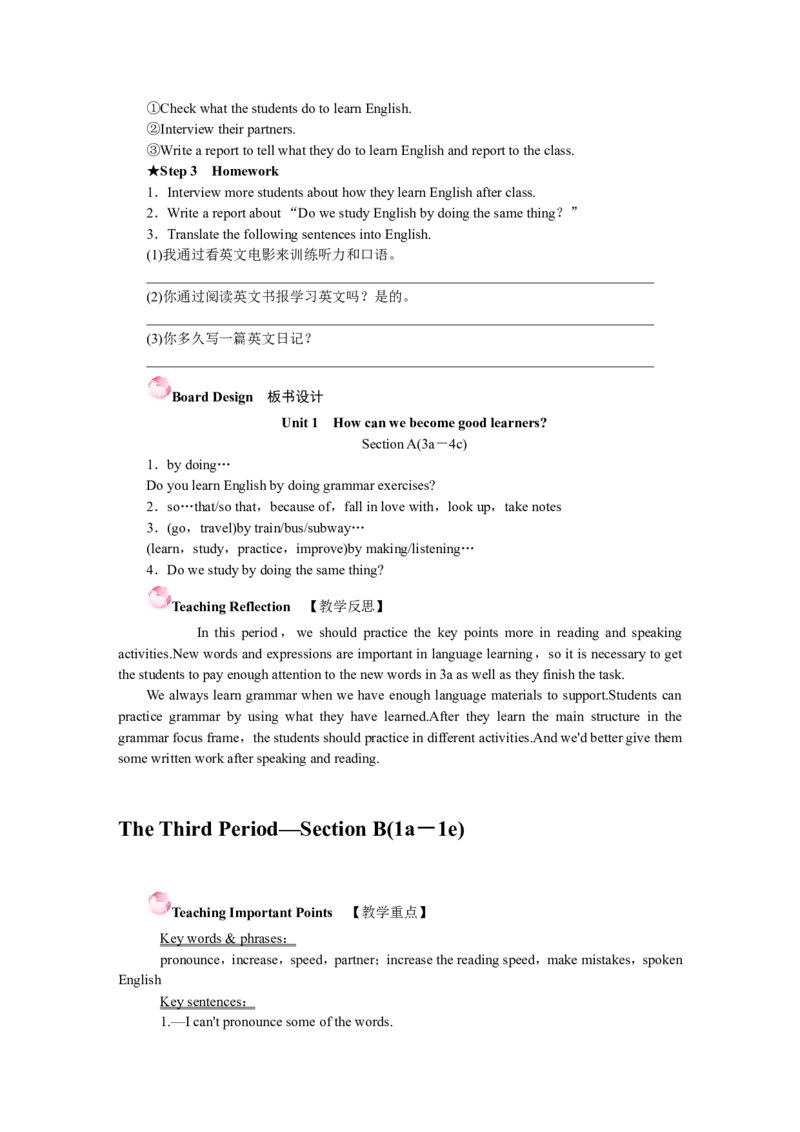
1.Interview more students about how they learn English after class.
2.Write a report about “Do we study English by doing the same thing?”
3.Translate the following sentences into English.
(1)我通过看英文电影来训练听力和口语。
________________________________________________________________________
(2)你通过阅读英文书报学习英文吗?是的。
________________________________________________________________________
(3)你多久写一篇英文日记?
________________________________________________________________________
Board Design 板书设计
Unit 1 How can we become good learners?
Section A(3a-4c)
1.by doing…
Do you learn English by doing grammar exercises?
2.so…that/so that,because of,fall in love with,look up,take notes
3.(go,travel)by train/bus/subway…
(learn,study,practice,improve)by making/listening…
4.Do we study by doing the same thing?
Teaching Reflection 【教学反思】
In this period,we should practice the key points more in reading and speaking
activities.New words and expressions are important in language learning,so it is necessary to get
the students to pay enough attention to the new words in 3a as well as they finish the task.
We always learn grammar when we have enough language materials to support.Students can
practice grammar by using what they have learned.After they learn the main structure in the
grammar focus frame,the students should practice in different activities.And we'd better give them
some written work after speaking and reading.
The Third Period—Section B(1a-1e)
Teaching Important Points 【教学重点】
Key words & phrases :
pronounce,increase,speed,partner;increase the reading speed,make mistakes,spoken
English
Key sentences :
1.—I can't pronounce some of the words.—Listening can help.
2.I don't know enough words to write well.
3.—I don't have a partner to practice English with.
—Maybe you should join an English club.
Key structure :
Express challenges and use “can” or “should” to give advice on the problems in English
learning.
—I don't know how to increase my reading speed.
—You should read more books and remember more words.
Teaching Difficult Points 【教学难点】
★How to express the challenges and give advice in the listening and speaking practice.
Teaching Aids 【教学工具】
A tape recorder,CAI or multimedia courseware.
Teaching Steps 【教学过程】
★Step 1 Leading in 【新课导入】(Ⅰ)
1.Greeting
Greet the class.
2.Brainstorming
Interview individual students,like this:
T:How do you practice speaking?
S1:By having conversations with friends.
T:Do you learn English by doing grammar exercises?
S2:Yes,I do.
T:How often do you do them?
S2:…
3.Practice with more students.
★Step 1 Leading in 【新课导入】(Ⅱ)
1.Greeting
Greet the class.
2.Revision
①Ask some questions about Wei Fen to review the passage in 3a.
②Dictate some new words and expressions in Section A.
★Step 2 Cooperative inquiry 【合作探究】
1.Finish the task in 1a
Students check the statements that are true for them.
2.Finish the task in 1b
①T:What other things are difficult for you?Add them to the list in 1b.
②Ask different students to say out their learning difficulties.
③Ask some pairs of students to do like this:
S1:I can't pronounce some of the words.
S2:Well,some of the words can be difficult to read.You could ask the teacher or otherclassmates for help.Another good way is by listening to a tape and often repeating the difficult
words and sentences.
3.Finish the task in 1c
4.Finish the task in 1d
5.Finish the task in 1e
①Read the sample conversation in 1e.
②Students work in pairs.Role-play.
③Ask three pairs to say out their conversations to the class.
⑤Get the students to write their conversations in the exercise book.
★Step 3 Homework
1.Make conversations with other students after class.
2.Write a conversation to talk about the challenges and solutions about learning English.
3.Translate the following sentences into English.
(1)我的笔友认为学习英语的最佳方法是通过大声朗读。(the best way to learn English is…)
________________________________________________________________________
(2)当别人跟他说话时,他不总是能懂。(can't always)
________________________________________________________________________
(3)常听能对你有帮助。
________________________________________________________________________
Board Design 板书设计
Unit 1 How can we become good learners?
Section B(1a-1e)
pronounce,increase,speed,partner;
increase the reading speed,spoken English,
make a mistake/mistakes
1.—I can't pronounce some of the words.
—Listening can help.
not always/usually/often/…
2.I don't know enough words to write well.
3.—I don't have a partner to practice English with.
—Maybe you should join an English club.
Teaching Reflection 【教学反思】
In this period,the students should try to express their English learning problems and
give advice to others when they have difficulties in learning.The teacher should get the students to
practice them in listening and speaking.They will improve their capacity of language organization
and oral output while listening and speaking practice.And new words and expressions are
needed.We'd better learn them while listening,speaking and reading.The teacher could give
examples and show how to use the new words and phrases.
We always believe that students must write something after they have learned the new
items.So we give them some written work to do after they do the listening practice and make
conversations.The Fourth Period—Section B(2a-2e)
Teaching Important Points 【教学重点】
Key words & phrases :
born,ability,create,brain,active,attention,connect,review,knowledge,wisely
be born with,depend on,in common,pay attention to,connect…with
Key sentences :
1.How can you become a successful learner?
2.He succeeded by trying many times and learning from his mistakes.
3.Practice makes perfect.
4.Knowledge comes from questioning.
Key structure :
verb+by doing
eg:He succeeded by trying many times and learning from his mistakes.
Teaching Difficult Points 【教学难点】
★Find the learning styles that are suitable and keep a good learning habit.
Teaching Aids 【教学工具】
A tape recorder,CAI or multimedia courseware.
Teaching Steps 【教学过程】
★Step 1 Leading in 【新课导入】(Ⅰ)
1.Greeting
Greet the class and briefly talk about their learning challenges and solutions.
2.Brainstorming
T:Today let's talk about learning habits.Do you preview before class?
S1:…
T:Are you active in thinking?
S2:…
Practice and prepare the new words for the coming reading.
★Step 1 Leading in 【新课导入】(Ⅱ)
1.Greeting
2.Revision and preparation
T:Today we are going to read about how to become a successful learner.Now I have some
problems in learning.Can you give me the solutions?
Collect the students' answers and prepare the new words for this period.
3.Show these learning styles on the board and ask the students to choose which are good:
be active in thinking,pay too much attention to the knowledge of grammar,connect
something new with knowledge and experience you already have,review well what you have
learned,lack concentration in class or when doing homework,feel nervous about makingmistakes…
★Step 2 Cooperative inquiry 【合作探究】
1.Finish the task in 2a
①Work in groups.What are good learning habits?
②Write down the learning habits we can think of.
2.Finish the task in 2b
①Read the passage quickly and see if there are any of the habits in our lists.Comprehend the
whole passage.
②Copy the habits appearing in the passage.And answer which four habits of successful
learners they can find.
③Read the passage again aloud.Learn the new words and expressions and show how to use
them.
④Discuss these habits.Get the class to use proper reading strategy-rapid or leaping reading.
3.Finish the task in 2c
4.Finish the task in 2d
5.Finish the task in 2e
★Step 3 Homework
1.Read aloud the passage in 2b three to five times until fluently and learn the new words and
expressions in it.
2.Make sentences with the words in 2d.Write them in the exercise books.
3.Translate the following sentences into English.
(1)每个人都生来就具有语言能力。
________________________________________________________________________
(2)成功的学习者普遍拥有一些良好的习惯。
________________________________________________________________________
(3)熟能生巧。
________________________________________________________________________
Board Design 板书设计
How can you become a successful learner?
be born with,depend on,in common,pay attention to,connect…with
He succeeded by trying many times and learning from his mistakes.
Use it or lose it.Practice makes perfect.
Knowledge comes from questioning.
You're never too old to learn.
Teaching Reflection 【教学反思】
In this period,the most important thing is reading.It is a good time to train the students'
ability of reading quickly and efficiently.Usually we do some work to deal with new words and
phrases before reading.While reading,students should learn to catch the main and the most
important ideas as quickly as they can.They must learn some new words and new language
items.They are supposed to be able to use dictionaries to look up the new words.They need to have
reading strategies and the teacher should teach them these.
After reading,we can talk about the reading passage and discuss some questions to check howwell the students learn from the passage.In this period,we can deal with these while we are
finishing the tasks.
The Fifth Period-Section B(3a-3b) & Self Check
Teaching Important Points 【教学重点】
Key words & phrases :
be stressed out,take notes,bit by bit,worry about,instead of(doing something)
Key sentences :
1.There are three good ways to learn English.
2.You could try to improve your English by reading a lot.
3.It is also a good idea to watch English movies because you can practice listening and
speaking.
Key structure :
verb+by doing
eg:I practice listening by listening to the tape over and over again until I can understand
everything.
He could increase his reading speed by learning rapid reading strategy.
Teaching Difficult Points 【教学难点】
★Use the words and structures to write a letter and give advice to someone about the best
way to learn English.
Teaching Aids 【教学工具】
CAI or multimedia courseware.
Teaching Steps 【教学过程】
★Step 1 Leading in 【新课导入】(Ⅰ)
1.Greeting
2.Discuss how to become a successful learner.Collect the students' good learning habits.
3.Ask and answer some questions to review the passage in 2b.
★Step 1 Leading in 【新课导入】(Ⅱ)
1.Greeting
2.Revision
①Read aloud the passage in 2b.
②Make sentences with “attention,review,ability and active”.
③Review the good habits about learning English.
★Step 2 Cooperative inquiry 【合作探究】
1.Finish the task in 3a
①Work in groups.Do a summary about good ways of learning English.
②Read the instructions in 3a.Students write three best ways and give their reasons.Then giveexamples.
③Ask them to fill in the chart on their own and the teacher should help them and encourage
the students to communicate with their classmates.
④The students exchange their work with their partners and exchange or discuss their ideas.
2.Finish the task in 3b
①Read the instructions.
②Write the letter.Use their notes in 3a.
③Exchange their writing work with each other.
④Check their work with the whole class.
3.Finish the tasks in Self Check
Activity 1
①Read the words in the box.Ask the students to tell the Chinese meanings of the words.
②Fill in the blanks on their own.
③In pairs,correct the work of each other.
④Show the result on the board and read aloud the passage until fluently.
Activity 2
Activity 3
★Step 3 Homework
1.Practice giving advice to their partners after class.
2.Jack reads slowly.He has to finish reading a book and give a report next Monday.So he feels
a little nervous.Write a letter to him and give him some advice.
3.Translate the following sentences into English.
(1)我是一个阅读速度很慢的人。
________________________________________________________________________
(2)你应该通过猜测词意和大量阅读的方法来提高阅读速度。(improve your reading speed)
________________________________________________________________________
(3)我可以怎样训练听力?
________________________________________________________________________
Board Design 板书设计
be stressed out,take notes,bit by bit,worry about,instead of(doing something)
1.There are three good ways to learn English.
2.You could try to improve your English by reading a lot.
3.It is also a good idea to watch English movies because you can practice listening and
speaking.
Teaching Reflection 【教学反思】
This is the last period of the unit.So it is important to get the students to use what they
have learned in the unit.We will do a lot of work to practice words and expressions about how to
learn well.So the students learn to give advice to someone who has problems in learning.Writing is
the most important in the period.The teacher could help the students write from oral practice.And
teach them to use the example sentence patterns.Unit 2 I think that mooncakes are delicious!
Language Goal
Give a personal reaction
【语言目标】
Knowledge Goals
【知识目标】
stranger,relative,pound,steal,lay,dessert,garden,
Key Words admire,tie,treat,Christmas,lie,novel,dead,business,
punish,warn,present,warmth,spread
put on,lay out,end up,Water Festival,Mid-Autumn
Key Phrases
Festival,Mother's Day,Father's Day
1.I think that the Water festival is really fun.
2.I wonder if they'll have the races next year.
3.I wonder whether June is a good time to visit Hong
Key Sentences Kong.
4.I believe that April is the hottest month in Thailand.
5.What fun the Water Festival is!
6.How pretty the dragon boats were!
1.Learn to use the objective clauses with that,if and
Key Grammar whether.
2.Learn to use the exclamatory statements.
1.Develop listening,speaking,reading and writing skills
by using the target languages to express one's personal
Ability Goals reaction.
【能力目标】 2.Learn to talk about different festivals in China and
western countries with the words and the exclamatory
statements.
1.With the help of this unit's study,students can learn some
Moral Goals
cultural knowledge about Chinese and Western festivals.
【情感目标】
2.Learn to be kind,generous and warm-hearted.
Teaching Time
【课时】
Five periods
Period 1 Section A(1a-2d)
Period 2 Section A(3a-4c)
Period 3 Section B(1a-1d)
Period 4 Section B(2a-2e)
Period 5 Section B(3a-3b) & Self Check
本单元介绍国内外不同节日,具有浓郁的文化气息,教学内容丰富。学生通过单元的学习,
除学会相关的语言知识外,还能学习到涉及中西方节日的文化和风俗习惯。Section A侧重介
绍我国的传统节日,学生在学习时,应该重点掌握由that,if/whether引导的宾语从句来表达自
己的态度和看法;并且能够使用由how和what引导的感叹句;学会与节日相关的词语(包括节
日的名称、与节日相关的专属用词)以及各种描述性词语(形容词及其习惯表达法)等。Section
B主要围绕西方的两个节日——Halloween和Christmas来展开,介绍西方国家的节日文化,
侧重节日的文化内涵,让学生更深层次地理解西方文化。教师要鼓励学生通过课外阅读、查阅相关书籍、杂志或网络信息了解西方节日文化,一方面可以拓展学生的视野,另一方面也可以
节省课堂的时间,同时也便于学生理解听力和阅读中的内容,减轻因背景文化积累不足所带
来的学习压力。语言方面,学生要学习与这两个节日相关的专属文化词汇,进一步强化本单元
的重点句型结构。技能方面,通过“听说入手→突出阅读→创写语篇”的过程培养学生的综
合语言技能;在策略上侧重训练学生对阅读的深层理解,即除了了解语言的表层含义外,还应
该培养学生的推断能力,能读懂字里行间的深层含义。文化意识和情感价值观方面,通过阅读
语篇探讨圣诞节的含义,讲述吝啬鬼Scrooge发生转变的故事教育学生要懂得:关爱、同情及
怜悯之心是人类社会的宝贵财富,应当继承和弘扬,要以爱心回报社会。The First Period—Section A(1a-2d)
Teaching Important Points 【教学重点】
Key words & phrases :
stranger,relative,pound,the Water Festival,the Dragon Boat Festival,the Chinese Spring
Festival,the Lantern Festival,put on,in two weeks
Key sentences :
1.I think that mooncakes are delicious.
2.Bill wonders whether they'll have zongzi again next year.
3.—What do you like best about the Dragon Boat Festival?
—I love the races.I think that they're fun to watch.
4.I wonder if it's similar to the Water Festival of the Dai people in Yunnan Province.
Key structure :
Objective clauses:verb+that/if/whether…
eg:I believe that April is the hottest month of the year there.
I wonder if it's similar to the Water Festival of the Dai people in Yunnan Province.
Teaching Difficult Points 【教学难点】
Practice the objective clauses with that,if and whether in listening and speaking.
Increase the students' vocabulary about the four Asian festivals and learn the culture about the
festivals.
Teaching Aids 【教学工具】
A tape recorder,CAI or multimedia courseware.
Teaching Steps 【教学过程】
★Step 1 Leading in 【新课导入】
1.Greet the class and do the duty report.
2.Discussing
Ask the students what festivals they know and talk about them in easy English.
T:Today we are going to talk about festivals and how you like these festivals.Which is the
biggest festival in China?
S1:The Spring Festival.
T : Yes.We Chinese people come back home from everywhere to spend the Spring
Festival.What do we do on that day?Do we have a big dinner and a party?
S2:Yes,we do.
T:How do you feel?
S3:…★Step 2 Cooperative inquiry 【合作探究】
1.Finish the task in 1a
①Use multimedia courseware to show pictures of different festivals.Ask questions about these
festivals and learn their English names.
②Read these names of the four festivals in 1a.
③Match the pictures with the descriptions.
2.Finish the task in 1b
3.Finish the task in 1c
4.Finish the tasks in 2a-2b
5.Finish the task in 2c
①Read aloud the model conversation in 2c.Then pairs of students role - play the
conversation.
②Students work in pairs.
③Ask some pairs to say out their conversations to the class.
6.Finish the task in 2d
★Step 3 Homework
1.Read aloud and role-play the conversation about their own vacation like that in 2c.
2.Read aloud the conversation in 2d.
3.Translate the following sentences into English.
(1)她长胖了两千克。
________________________________________________________________________
(2)我认为春节是一年中最重要的节日。
________________________________________________________________________
(3)他想知道他明年会不会有好运气。
________________________________________________________________________
Board Design 板书设计
Unit 2 I think that mooncakes are delicious!
Section A(1a-2d)
stranger,relative,pound
the Water Festival,the Dragon Boat Festival,the Chinese Spring Festival,the Lantern
Festival,put on
1.I think that mooncakes are delicious.
2.Bill wonders whether they'll have zongzi again next year.
3.I wonder if it's similar to the Water Festival of the Dai people in Yunnan Province.
Objective clauses:verb+that/if/whether+a clause
Teaching Reflection 【教学反思】
This is the first period of the unit.So it is important to get the students to know that
they will learn to give a personal reaction and express their strong feeling using exclamatory
sentences in this unit.At the beginning the teacher should lead the students to learn some festivals
and description words,and get the students to practice the target language in listening and
speaking.We learn new words and expressions in conversations.After the students have some
language practice,they can learn the new patterns and the objective clauses.New words andexpressions are also main points in the first period of a unit.We can learn them during practice.Do
not separate them from the meaning group.
The Second Period—Section A(3a-4c)
Teaching Important Points 【教学重点】
Key words & phrases :
steal,lay,dessert,garden,admire,tie,the Mid-Autumn Festival,fly up to,lay out
Key sentences :
1.There are many traditional folk stories about this festival.However,most people think that
the story of Chang'e is the most touching.
2.How he wished that Chang'e could come back!
3.What fun the Water Festival is!
4.What an interesting city!
5.How exciting the races are!
Key structure :
What+a/an+(adjective)+noun(countable,single)+S+V!
What+(adjective)+noun(uncountable/countable,plural)+S+V!
How+adjective/adverb+S+V!
eg:1.What a fine day it is!
2.What beautiful flowers these are!
3.How fantastic the dragon boat teams were!
Teaching Difficult Points 【教学难点】
★The objective clauses with if/whether.The exclamatory sentences followed by what/what
a(an)
Teaching Aids 【教学工具】
A tape recorder,CAI or multimedia courseware.
Teaching Steps 【教学过程】
★Step 1 Leading in 【新课导入】
1.Greeting
2.Brainstorming
Quickly review the festival words.Then show pictures and get the students to think of the
English for the Mid-Autumn Festival.
★Step 2 Cooperative inquiry 【合作探究】
1.Finish the task in 3a
①Help the students to understand the demand in 3a and read the questions.
T:Have you heard of the story “Chang'e flying to the moon”?Today we are going to read the
story about it.②Quickly read the story about the Mid - Autumn Festival.Discuss the questions and
comprehend the whole passage.
2.Finish the task in 3b
3.Finish the task in 3c
4.Finish Grammar Focus
5.Finish the task in 4a
①Make sentences and write them in the books.And correct them with the partners.
②The whole class read aloud the sentences.Help with the pronunciation and intonation.
6.Finish the task in 4b
①Read the instructions and know what to do.Then read the letter quietly and underline the
objective clauses.
②Check the answers and read out the sentences with objective clauses.
③Ask students to write their own sentences about Mother's Day and Father's Day.The teacher
shows:
I know…;I think…;I believe…;I wonder…
7.Finish the task in 4c(The students may finish it after class.)
①The teacher shows the chart:
Name Favorite festival Reasons
②Interview their partners.
③Write a report to tell the class.
★Step 3 Homework
1.Interview more students about their favorite festivals after class.
2.Write a report about the results of the interview.
3.Translate the following sentences into English.
(1)我知道你喜欢数学。
________________________________________________________________________
(2)这是个多么美好的夜晚啊!
________________________________________________________________________
(3)高铁好快呀!(high-speed train)
________________________________________________________________________
Board Design 板书设计
Unit 2 I think that mooncakes are delicious!
Section A(3a-4c)
the Mid-Autumn Festival,fly up to,lay out
S+V+that+objective clause
S+V+whether/if+objective clause
What+a/an+(adjective)+noun(countable,single)+S+V!
What a hot day it is today!
What+(adjective)+noun(uncountable/countable,plural)+S+V!
What fun the Water Festival is!(“fun” is a noun.)
How+adjective/adverb+S+V!How fantastic the dragon boat teams were!
Teaching Reflection 【教学反思】
In this period,we should provide students with reading practice using the target
language.Students have an opportunity to test their reading comprehension in 3b.They will learn
new words and expressions by reading practice.The culture of the traditional festival is very
important in the period.Students should know the origin of the Mid-Autumn Festival and use the
language to disseminate culture.
Learning grammar is an important task in this period.We always learn grammar when we have
learned enough language.Students can practice grammar by using what they have learned.After
they learn the structure of the objective clause and the exclamatory sentences in the grammar focus
frame,we give the students opportunity to use the grammar knowledge in writing activities.So
some written work is necessary after speaking and reading.
The Third Period—Section B(1a-1d)
Teaching Important Points 【教学重点】
Key words & phrases :
treat,trick or treat,dress up as…
Key sentences :
1.—What have you learned about Halloween?
—I know it's a popular festival in North America and it's on October 31st.
2.—What do you like most about this festival?
—I think it's fun to dress up as cartoon characters!
3.“Trick or treat” means kids will play a trick on you if you don't give them a treat.
Key structure :
Practice the objective clause in listening.
I know…;I think…;This means that…;I wonder if…
Teaching Difficult Points 【教学难点】
★Understand the story and learn the festival culture in the listening practice.
Teaching Aids 【教学工具】
A tape recorder,CAI or multimedia courseware.
Teaching Steps 【教学过程】
★Step 1 Leading in 【新课导入】
1.Greeting
2.Brainstorming
Show pictures of different festivals.Talk with the students to review the words and phrases in
this unit.★Step 2 Cooperative inquiry 【合作探究】
1.Finish the task in 1a
2.Finish the task in 1b
①Play the tape for the first time.Ask the students to master the whole conversation.Then
answer the questions in 1b.
②Discuss the questions and check the answers.
3.Finish the task in 1c
①Scan these sentences with blanks.
②Play the recording again.Remind them of the details.Students fill in the blanks.
③Play the recording for the third time and check the answers.Read aloud the sentences.
4.Finish the task in 1d
①Ask “What have you learned about Halloween?”
②Show the details of Halloween on the PPT.
③Discuss about Halloween with their partners.The teacher walks around and gives help.
④Ask some pairs to act out their dialogue in class.
★Step 3 Homework
1.Talk about Halloween with other students after class.
2.Write three sentences to talk about Halloween.
3.Translate the following sentences into English.
(1)我知道万圣节前夕是在10月31日。
________________________________________________________________________
(2)我觉得打扮成卡通人物很好玩。
________________________________________________________________________
(3)我想知道它会不会在中国流行。
________________________________________________________________________
Board Design 板书设计
Unit 2 I think that mooncakes are delicious!
Section B(1a-1d)
treat,trick or treat,dress up as…
jack-o'-lantern,mask,costume
I know…;I think…;This means that…;
I wonder if…
Teaching Reflection 【教学反思】
In this period,the students should learn something about Halloween in the listening
practice.The teacher should help them learn the new words and phrases about the festival.At the
same time,he will teach some knowledge about the festival culture.It is important to use the
language in communication.
The Fourth Period—Section B(2a-2e)Teaching Important Points 【教学重点】
Key words & phrases :
Christmas,lie,novel,dead,business,punish,warn,present,warmth,spread,the spirit of
Christmas,think of,end up,wake up,remind…of…
Key sentences :
1.Many would agree that when we think of Christmas,we probably think of gifts,
Christmas trees and Santa Claus.
2.He just cares about whether he can make more money and he hates Christmas.
3.He warns Scrooge to change his ways if he doesn't want to end up like him.
Key structure :
verb+that-clause;
verb(verb phrase)+whether-clause
eg:Many would agree that…
He just cares about whether he can make…
Teaching Difficult Points 【教学难点】
★Understand long sentences with an objective clause and learn to get an inferring meaning
between lines when reading.
Teaching Aids 【教学工具】
A tape recorder,CAI or multimedia courseware.
Teaching Steps 【教学过程】
★Step 1 Leading in 【新课导入】
1.Greeting
2.Brainstorming
Show some dates of the Chinese festivals and ask students to say the festivals.March 12th,
May 1st,June 1st,October 1st…
Then present some Western festivals.Practice and prepare the new words for the coming
reading.
★Step 2 Cooperative inquiry 【合作探究】
1.Discuss Christmas.What do you know about Christmas?
Ask about the date,the activities and something else about Christmas.
2.Finish the task in 2a
3.Finish the task in 2b
①Read the topic of the passage.Then ask students to scan the passage and underline the
proper nouns in the passage.
②Teach these proper nouns and at the same time present the new items in the reading passage.
③Read the first and second paragraphs,answer the three questions in 2b.
4.Finish the task in 2c
①Read the third paragraph.Then complete the chart in 2c.
②Discuss these questions and check the answers with the class.
5.Finish the task in 2d6.Finish the task in 2e
★Step 3 Homework
1.Read aloud the passage in 2b several times until fluently and recite the first and second
paragraphs.Learn the new words and expressions in the text.
2.Role-play the conversation between the three ghosts and Scrooge.
3.Translate the following sentences into English.
(1)我认为圣诞节的意义就是分享以及把爱和欢乐带给周围的人们。
________________________________________________________________________
(2)他不仅仅关心能否赚到钱。
________________________________________________________________________
(3)他充满善意和温暖地对待身边的每个人。
________________________________________________________________________
Board Design 板书设计
The spirit of Christmas
Christmas,Christmas Day/Eve,December 25th,Christmas trees,gifts,Santa Claus/Father
Christmas,Christmas carols/cards
Merry Christmas!
When we…,we probably…;Behind…;lies…;give love and joy to people around us;a…
novel written by…;treat others nicely,treat…with kindness and warmth;warn sb.to do…;expect
sb.to do…;take sb.back to…;remind sb.of his…days as a…;spreading love and joy everywhere
he goes;the true spirit of…
Teaching Reflection 【教学反思】
In this period,the most important thing is reading.It is a good time to train the students'
ability of reading quickly and efficiently.Usually we design tasks and get the students to gain skills
while finishing these tasks.We deal with the new words and expressions from the Chinese festivals
to Western festivals before reading the text.While reading,students should learn to read between
the lines to get the meanings that are not clearly stated in the text.Students are supposed to be able
to finish the tasks in each paragraph and then learn the whole passage and read aloud.They should
sum up the important language items.So the teacher will help them to make a summary of the key
points in this class.
After reading,we can do some oral practice according to this text.They have an activity to role
-play the conversation between the three ghosts and Scrooge.This will also help the students to
learn the text.I think the students should recite some paragraphs in order to remember the new
language items.
The Fifth Period-Section B(3a-3b) & Self Check
Teaching Important Points 【教学重点】
Key words & phrases :spread…around,between…and…,give out
Key sentences :
1.My favorite Chinese festival is…
2.It's celebrated in/on…
3.It's my favorite festival because…
4.It makes me feel…
Key structure :
Verb+that/if/whether-clause
Teaching Difficult Points 【教学难点】
★Use the words and structures to write a letter and tell about their favorite festival in
China.
Teaching Aids 【教学工具】
CAI or multimedia courseware.
Teaching Steps 【教学过程】
★Step 1 Leading in 【新课导入】
1.Greeting
2.A game
①The teacher describes a festival and gets the students to guess its English name.
②Students play the guessing game in small groups.
★Step 2 Cooperative inquiry 【合作探究】
1.Finish the task in 3a
①Ask the students to think of a festival and fill in the chart in 3a in English.
②Encourage them to ask questions if they need help.
2.Finish the task in 3b
①Read the instructions.Help the students to understand how to write the letter.
②Show the expressions on the board.Read and learn to use these expressions or sentence
patterns to finish the letter.
③Students write the letter in their seats.Remind them to use the expressions.
④Check their work with the whole class.
3.Finish the tasks in Self Check
Activity 1
①Simply introduce Easter.Ask the students to read the words in the box and understand the
Chinese meanings of the words.
②Read the passage and fill in the blanks on their own.
③Check the answers.
④Show the results on the board and read aloud the passage until fluently.
Activity 2
Activity 3
★Step 3 Homework
1.Practice telling a story about a Chinese festival or a Western festival after class.
2.Write a letter to a friend to introduce your favorite festival.3.Translate the following sentences into English.
(1)春节多么有趣。
________________________________________________________________________
(2)你的礼物好精美啊!
________________________________________________________________________
(3)我不知道他是否会帮助我。
________________________________________________________________________
Board Design 板书设计
spread…around,between…and…,give out
It's celebrated in/on…
How delicious…
What fun…
I wonder if/whether…
I wonder what he can say when they meet.
Twinkle,twinkle,little star,
How I wonder what you are!
Teaching Reflection 【教学反思】
This is the last period of the unit.Students will use what they have learned in the unit to
write some sentences and passages.We will practice words and expressions on festivals and review
exclamations and objective clauses.We will get the students to use the language points so they can
remember well.Writing is the most important in the period.The teacher can help the students when
they are writing and lead them to review the key languages in this unit.Unit 3 Could you please tell me where the restrooms are?
Language Goals
Ask for information politely;Follow directions
【语言目标】
Knowledge Goals
【知识目标】
restroom,stamp,beside,postcard,pardon,bathroom,
rush,suggest,grape,central,mail,east,convenient,
Key Words
corner,politely,request,direction,correct,polite,direct,
speaker,whom,impolite,address,underground,course
Key Phrases pass by,pardon me,parking lot
1.—Excuse me,do you know where I can get a dictionary?
—Sure.There's a bookstore down the street.
2.—Could you please tell me how to get to the post
office?
—Sorry,I'm not sure how to get there.
Key Sentences
3.—I wonder where we should go next.
—You should try that new ride over there.
4.—Could you tell us when the band starts playing this
evening?
—It starts at 8:00 p.m.
Key Grammar Learn the objective clauses with wh-questions.
1.Develop listening,speaking,reading and writing skills
Ability Goals by using the target languages.
【能力目标】 2.Learn to ask for information politely.
3.Be able to give and follow directions.
1.Students will learn to be polite when asking for things or
information in this unit.
Moral Goals
2.Tell the students that it is important to use polite words
【情感目标】
when using English to ask for things or information.Such
as,please,thank you,excuse me,could you…
Teaching Time
【课时】
Five periods
Period 1 Section A(1a-2d)
Period 2 Section A(3a-4c)
Period 3 Section B(1a-1e)
Period 4 Section B(2a-2d)
Period 5 Section B(3a-3b) & Self Check
本单元围绕游览出行这一话题展开学习。Section A以购物和去游乐园游玩等日常活动为
切入点,通过问路、指路的话语进行语言的操练和学习,学生可以通过模拟日常生活的场景来
体会、感受和领悟本单元的语言目标内容。在Section A部分,要求学生重点掌握并能熟练、正
确地运用以下内容:一、在语言功能和结构方面:(1)得体地运用礼貌语句问路及咨询信息,例如:Excuse me,do you know where I can… /Could you please tell me how to get to… /Can you
tell me… /I wonder where we should…;(2)礼貌地、得体地指路或提供信息,例如:Sure…或得
体地给予否定回答,如:Sorry,I'm not sure how to get there.二、在词汇方面:学会教材里呈现的
日常活动的短语和相关处所的名词,以及问路、指路及咨询、提供相关信息的短语等;(3)在语
法方面:学会带有wh-疑问词的宾语从句。The First Period—Section A(1a-2d)
Teaching Important Points 【教学重点】
Key words & phrases :
restroom,stamp,beside,postcard,pardon,bathroom,rush
go along,on your right,turn right/left,go past,no problem
Key sentences :
1.—Excuse me,do you know where I can buy some medicine?
—Sure.There's a supermarket down the street.
2.—Could you please tell me how to get to the bookstore?
—Sure,just go along Main Street until you pass Center Street.The bookstore is on your right,
beside the bank.
3.Sorry,I'm not sure how to get there.
Key structure :
verb+wh-word+objective clause
eg:Could you tell me where the restrooms are?
Teaching Difficult Points 【教学难点】
★Practice the structure “verb+wh-word+objective clause” in listening and speaking.
Teaching Aids 【教学工具】
A tape recorder,CAI or multimedia courseware.
Teaching Steps 【教学过程】
★Step 1 Leading in 【新课导入】
1.Greeting
2.Review
Briefly review the objective clauses with that and if/whether.
2.Preparation
Show pictures to review the words of different places in a city.Get the class to say the English
names of the places.
★Step 2 Cooperative inquiry 【合作探究】
1.Finish the task in 1a
①Show some stamps to the students and present the new sentences:Could you tell me where
I can buy some stamps?
And then talk about the other things.
②Read aloud the phrases in 1a.Match each thing with a place in the picture in 1a.
2.Finish the task in 1b①Read the instructions.
②Play the recording for the first time.Students only listen.
③Play the recording a second time.Ask them to complete the conversation in the picture.
④Check the answers with the whole class.Read the conversation in the picture.
3.Finish the task in 1c
①Read the model conversation in the box.
②Pair work.
③Ask some pairs of students to act out in class.
4.Finish the tasks in 2a-2b
①Show the picture.Talk about it with the students.Then read the instructions in 2a.Students
guess what they will do.
②Ask:What does the boy want to buy?Where can he buy it?
③Play the recording for the first time.Students listen with the two questions.
④Play the recording again.Students listen and finish the task in 2a.
⑤Read the requirement in 2b and play the recording a third time.Ask some more
questions.Finish the task in 2b.
5.Finish the task in 2c
6.Finish the task in 2d
①Ask the class to read the conversation.
②Explain some language points and the cultural knowledge.
③Play the tape.Students repeat.Read aloud the conversation.Learn the new words and
phrases.
④Practice and then ask two pairs to act out the conversation.
★Step 3 Homework
1.Collect the words of places in a city.
2.Make a conversation,asking for a place and giving directions with polite languages.
3.Translate the following sentences into English.
(1)打扰了,请问附近哪儿有银行?
________________________________________________________________________
(2)您能不能告诉我到书店怎么走?
________________________________________________________________________
(3)在银行和超市之间有一个花店。
________________________________________________________________________
Board Design 板书设计
Unit 3 Could you please tell me
where the restrooms are?
Section A(1a-2d)
1.Excuse me,do you know where I can…
Excuse me,could you tell me where I can…
Excuse me,could you tell me how to…
2.Pardon?Restroom?You already want to rest?
restroom,toilet,washroom,bathroom,W.C.
3.Go to the third floor.Turn left/right.
The supermarket is between the flower store and the bookstore.
Go past the bookstore.
Teaching Reflection 【教学反思】
This is the first period of the unit.Students should learn how to ask for information in
polite ways in this unit.The teacher should get them to learn the main structure-objective clause
with wh-word and get the students to practice it in listening and speaking.The class starts with
places in a city and things that people do in these places.Then help them come to oral practice
about asking the way and asking for information.At this step we usually don't tell them the
structure.Our focus is on language listening and speaking.
The Second Period—Section A(3a-4c)
Teaching Important Points 【教学重点】
Key words & phrases :
suggest,grape,central,mail,east
pass by,pardon me,walk up to…
Key sentences :
1.—I wonder where we should go next.
—You should try that new ride over there.
2.—Could you tell us when the band starts playing this evening?
—It starts at 8:00 p.m.
3.Do you know where we can get some good food quickly?
4.I suggest Water City Restaurant in Water World.
Key structure :
verb+wh- word+objective clause
eg:I wonder where we should go next.
Teaching Difficult Points 【教学难点】
★Practice the structure in reading comprehension.Learn to ask for information politely and
respond people.
Teaching Aids 【教学工具】
A tape recorder,CAI or multimedia courseware.
Teaching Steps 【教学过程】
★Step 1 Leading in 【新课导入】
1.Greeting
2.Brainstorming
Show different places in a city map.Ask students to make simple conversations by using politequestions to ask for ways to some places.
3.Ask pairs of students to say out the conversation in 2d.
★Step 2 Cooperative inquiry 【合作探究】
1.Finish the task in 3a
2.Finish the task in 3b
①Read the instructions.Get the students to scan the sentences to rewrite.
②Read aloud the passage.Ask students to underline the sentences with objective clauses.
③Get the students to rewrite by themselves.Check the answers and read aloud them.
④Get the students to say some sentences in other words.
3.Finish Grammar Focus
①Show on the board:
Where can I buy some medicine?
Excuse me,do you know where I can buy some medicine?
②Learn the polite questions.Read aloud the sentences in the grammar frame until fluently.
③Explain:
Excuse me…
Pardon me…
Remind them of the differences between a special question and a polite question.Show the
PPT again.Compare the two questions and get the students to learn them.
④Read aloud the grammar again.
4.Finish the task in 4a
①Use PPT to show the 4 questions.Read the questions aloud.Ask:Are these questions polite
or impolite?
②Students work and the teacher gives help if needed.
5.Finish the task in 4b
6.Finish the task in 4c
★Step 3 Homework
1.Make conversations between a tourist and a local person after class.
2.Write a conversation about “asking and telling the way to the museum” politely.
3.Translate the following sentences into English.
(1)我想知道在哪儿能买到花。
________________________________________________________________________
(2)对不起,请问您能否告诉我去博物馆怎么走?
________________________________________________________________________
(3)麻烦您一下,您知道附近有没有宾馆啊?
________________________________________________________________________
Board Design 板书设计
Unit 3 Could you please tell me
where the restrooms are?
Section A(3a-4c)
1.I wonder where we should go next.
2.Do you know where we can get some good food quickly?
3.Let's ask what time the band starts playing.4.Excuse me,could you tell me when the band starts playing this evening?
5.Pardon me,do you know if…
Teaching Reflection 【教学反思】
In this period,we should practice the key points more in reading and speaking
activities.And students should know the main structure in this unit.Remind them of the differences
between a special question and a polite question which usually has an objective clause.We can
show the differences on PPT and let the students compare them and then learn them.
After they learn how to make a polite question,students can practice grammar by using what
they have learned in different activities.And we'd better give them some written work after
speaking and reading.So as homework,we can ask them to write a conversation about “asking and
telling the way to the museum” politely.
The Third Period—Section B(1a-1e)
Teaching Important Points 【教学重点】
Key words & phrases :
convenient,corner,a good place to eat
Key sentences :
1.—Can you tell me where there's a good place to eat?
—Of course.What kind of food do you like?
2.The clerk tells him to go to Green Land.
Key structure :
Practice the target structure:
—Can you tell me where there's a good place to eat?
—Of course.…
Teaching Difficult Points 【教学难点】
★Use proper expressions to ask for information.
Teaching Aids 【教学工具】
A tape recorder,CAI or multimedia courseware.
Teaching Steps 【教学过程】
★Step 1 Leading in 【新课导入】
1.Greeting
Greet the class.
2.Brainstorming
Show pictures and get the class to say out some description words.Get ready for Section B 1a.
★Step 2 Cooperative inquiry 【合作探究】
1.Finish the task in 1a2.Finish the task in 1b
3.Finish the task in 1c
①Predict what we'll listen by the picture.
②Look through the sentences in 1c.
③Play the first conversation and pause for the students to fill in the blank.Then the second
and the third.
④Play the conversations again.Students check their written work.
4.Finish the task in 1d
①Ask some questions to help students finish the listening.
②Get the students to listen again.Finish the task in 1d.
5.Finish the task in 1e
①Read the sample conversation in 1e.
②Students work in pairs.Role-play.
③Ask some pairs to act out their conversations to the class.
★Step 3 Homework
1.Role-play the conversations with other students after class.
2.Write a similar conversation to talk about places in our city.
3.Translate the following sentences into English.
(1)你能告诉我哪儿有休息的地方吗?
________________________________________________________________________
(2)我家附近的购物街真是方便。
________________________________________________________________________
(3)这家饭店的饭菜味美价廉。
________________________________________________________________________
Board Design 板书设计
Unit 3 Could you please tell me
where the restrooms are?
Section B(1a-1e)
convenient,corner
in-words:inexpensive,indirect,informal…
un-words:uncrowded,unhappy,unfair…
a good place to eat,a room to sleep in
Can you tell me where there's a good place to eat?
Of course.
Teaching Reflection 【教学反思】
In this period,the students review and learn more adjectives to describe the places in
the city or other places.They should practice the adjective sentence pattern——to be +adj.
Listening and oral practice are important in this period.Students should develop a good listening
habit and they need to say out after they have heard something.Also I give them some written work
to do after they do the listening practice and make conversations.The Fourth Period—Section B(2a-2d)
Teaching Important Points 【教学重点】
Key words & phrases :
politely,request,direction,correct,polite,direct,speaker,whom,impolite,address,
underground,course;ask for help politely,in different situation,parking lot
Key sentences :
1.I wonder if you can help me.
2.I'm sorry to trouble you,but…
3.It is important to learn how to use the right language in different situations.
Key structure :
Long and indirect questions with objective clauses.
eg:Excuse me.Do you know when the school trip is?
Teaching Difficult Points 【教学难点】
★Learn to choose and use suitable language based on cultural knowledge in different
situations.
Teaching Aids 【教学工具】
A tape recorder,CAI or multimedia courseware.
Teaching Steps 【教学过程】
★Step 1 Leading in 【新课导入】
1.Greeting
Greet the class and briefly talk about their learning challenges and solutions.
2.Brainstorming
Orally use appropriate language to replace a direct question.
T:Today we'll read a passage about how to use suitable language in English.Now I say some
direct questions.Can you repeat them in a more polite way?
T:Where are the restrooms?
Ss:…
Practice and prepare for the coming reading.
★Step 2 Cooperative inquiry 【合作探究】
1.Finish the task in 2a
2.Finish the task in 2b
①Read the instructions and know what to do while reading.
②The teacher prepares the main topic sentence of each paragraph and shows them on the
screen or on the blackboard.Students read them and make sure they understand these sentences.
③Read the passage quickly and find the topic sentence for each paragraph.
④Read the passage again more slowly and carefully.
⑤Practice reading aloud by listening to the recording.3.Finish the task in 2c
4.Finish the task in 2d
①Read the instructions and tell the class what to do.
②Ask these requests one by one and ask the students to answer them in turn.
★Step 3 Homework
1.Read aloud the passage in 2b until fluently and learn the new words and expressions in it.
2.Finish the task in 2c.Write them in the exercise books.
3.Translate the following sentences into English.
(1)仅仅能正确地问出一个问题是不够的。
________________________________________________________________________
(2)当我们请求帮助时我们需要学会如何有礼貌。
________________________________________________________________________
(3)学会在不同的场合使用恰当的语言是很重要的。
________________________________________________________________________
Board Design 板书设计
Could you please…?
Excuse me…
I'm sorry to trouble you,but…
May I…
direct questions,polite requests,ask for help
It's not enough to…
It's important to learn how to be polite…
Teaching Reflection 【教学反思】
In this period,the most important thing is reading.And also we learn how to use
appropriate and polite requests as well as we make a request correctly.It is a good time to train the
students' ability of reading quickly and efficiently.Today's reading task is to find the topic sentences
for the paragraphs.So the teacher gives the topic sentences before they read the passage and then
gets them to read the passage and tell which sentence is for the paragraph.And students should
learn the culture and learn how to make polite requests after they have read the text.
After reading,we can talk about the reading passage and discuss some questions to check how
well the students learn from the passage.Students are given some written work to do after class.
The Fifth Period-Section B(3a-3b) & Self Check
Teaching Important Points 【教学重点】
Key words & phrases :
course,ask for information,look forward to,meet someone for the first time
Key sentences :1.I'll be coming to your school for…
2.I would like to thank you for…
3.I'm looking forward to your reply.
Key structure :
Politely ask for information.
Teaching Difficult Points 【教学难点】
★Language hospitality and language appropriacy in writing.
Teaching Aids 【教学工具】
CAI or multimedia courseware.
Teaching Steps 【教学过程】
★Step 1 Leading in 【新课导入】
1.Greeting
2.Read aloud the passage in 2b and get the students to read out their homework—the direct
questions and the polite requests in 2c.
★Step 2 Cooperative inquiry 【合作探究】
1.Finish the task in 3a
①Work in groups.
②Open the books.Read the instructions in 3a to see if they have the same topics to care about
as those in 3a.
③Ask them to fill in the chart on their own and the teacher help them to use polite,indirect
questions to talk about the topics.
④The teacher collects some good sentences on the blackboard for other students to learn to
use.
2.Finish the task in 3b
3.Finish the tasks in Self Check
Activities 1 & 2
①Keep the books closed and the teacher says the words in Chinese or says the
paraphrasing.Ask the students to say the English words.
②Open the books.Then read the words in the box.Finish the tasks in activity 1 and activity 2
on their own.
③Check their work,boys report activity 1 and girls report activity 2.They evaluate each
other's jobs and learn from each other.
④The teacher sums up the unit.
★Step 3 Homework
1.Practice polite,indirect requests and make short dialogue with your classmates after class.
2.You are planning to travel with a tourist agency.Write a letter to the agency asking for the
information you want to know.Use polite questions like those in 3b.
3.Translate the following sentences into English.
(1)我期待着您的回复。
________________________________________________________________________
(2)我要感谢您的陪伴(accompanying)和讲解(tour-guiding)。________________________________________________________________________
(3)你能否告诉我哪一个是我的最佳选择吗?
________________________________________________________________________
Board Design 板书设计
course,ask for information,look forward to,
meet someone for the first time
1.I'll be coming to your school for…
2.I would like to thank you for…
3.I'm looking forward to your reply.
Teaching Reflection 【教学反思】
This is the last period of the unit.Writing practice is the most important.Students will
use what they have learned to write a letter in polite,indirect requests.We will do some practice
about key words and structures.Students must learn to use the expressions and learn some cultural
knowledge about how to make polite requests in different situations.Unit 4 I used to be afraid of the dark.
Language Goal
Talk about what you used to be like
【语言目标】
Knowledge Goals
【知识目标】
humorous,silent,helpful,score,background,interview,
Asian,deal,dare,ton,private,guard,require,European,
Key Words African,British,speech,public,ant,seldom,influence,
absent,fail,examination,exactly,pride,proud,general,
introduction
from time to time,deal with,in public,in person,take
Key Phrases
pride in,be proud of
1.I used to be short.
2.I didn't use to be popular in school.
3.He used to be shy and quiet.
Key Sentences 4.—You used to be short,didn't you?
—Yes,I did./No,I didn't.
5.—Did he use to wear glasses?
—Yes,he did./No,he didn't.
Learn to use “used to” to describe or ask about things in
Key Grammar
the past.
1.Develop listening,speaking,reading and writing skills
Ability Goals by using the target languages.
【能力目标】 2.Learn to talk about how people have changed by using
“used to do/be”.
1.With the help of this unit's study,students can think
Moral Goals about how to achieve their self-improvement.
【情感目标】 2.Encourage the students to improve themselves and not
to be afraid of their negative personality.
Teaching Time
【课时】
Five periods
Period 1 Section A(1a-2d)
Period 2 Section A(3a-4c)
Period 3 Section B(1a-1e)
Period 4 Section B(2a-2f)
Period 5 Section B(3a-3b) & Self Check
本单元学习的话题是谈论过去的性格、外貌、特点和喜好,要求学会运用used to这一特
有的语言结构来表述过去的经历和习惯。Section A通过人物的性格特点和外貌特征的今昔对
比让学生感知这一新的语言内容,学习了解这一结构特征,体会它的用法。学生应该重点掌握
并且能够正确运用used to这一语言结构来描述同学曾经的性格特点和相貌;复习和学习新的
表现性格和外貌的词汇;学会used to…结构的肯定和否定陈述句、疑问句及其简略回答。Section B在Section A的话题基础上进行延伸和拓展,由描写人物的性格、外貌变化转向谈论
人物的行为习惯、爱好的改变;在语言上,除了进一步巩固Section A所学的重点语言内容外,
还复习巩固了有关行为习惯及爱好的短语,并且通过语篇呈现了其他词汇;在技能上,由听、
说转到综合性的听、读、写的训练;在策略上,训练学生利用上下文线索进行推导判断、确认语
句的位置、解读词语含义;在情感上,利用阅读部分所介绍的一位乡村少年的成长故事。对学
生进行教育,唤醒学生们的关爱之心,懂得体会亲情的可贵,理解父母的责任,并能在成长的
道路上注重心理的健康和成长。The First Period—Section A(1a-2d)
Teaching Important Points 【教学重点】
Key words & phrases :
humorous,silent,helpful,score
used to,from time to time,get good grades
Key sentences :
1.—You used to be short,didn't you?
—Yes,I did./No,I didn't.
2.—Did Mario use to be short?
—Yes,he did./No,he didn't.
3.Tina used to have long and straight hair.
Key structure :
used to+verb
eg:I used to be afraid of the dark.
Teaching Difficult Points 【教学难点】
★Practice the structure “used to+verb” to talk about the past appearance.
Teaching Aids 【教学工具】
A tape recorder,pictures,CAI or multimedia courseware.
Teaching Steps 【教学过程】
★Step 1 Leading in 【新课导入】
1.Greeting
2.Brainstorming
Bring some pictures of people's appearance and talk about the height,build and hair with the
students.Then show some persons and ask the students to think of descriptions.
3.Practice with students,listing as many words as possible.
★Step 2 Cooperative inquiry 【合作探究】
1.Finish the task in 1a
①Students fill in the blanks on their own first.Then work in groups.Add more ways of
describing people.
②Each group report their words.
③Read aloud the word lists.
2.Finish the task in 1b
①Read the instructions.Look at the main picture.Get the students to read the conversation in
the picture.And focus on the structure “used to”.②Before playing the recording,get the students to guess the words in the blanks.
③Play the recording.Ask them to check their guess and finish the filling.
④Play the recording again,repeat the conversation.
3.Finish the task in 1c
Read aloud the conversation.
4.Finish the tasks in 2a-2b
5.Finish the task in 2c
6.Finish the task in 2d
①Ask the students to read aloud the conversation in 2d in silence.
②Ask some questions about the conversation to help the students.
③Read aloud and learn the language items in the conversation.
④Practice in pairs and then act out the conversation.
★Step 3 Homework
1.Make a conversation with your classmate and talk about what has changed.
2.Write about what you used to be like in primary school and what you are like now.
3.Translate the following sentences into English.
(1)李华以前很矮,现在他长高了。
________________________________________________________________________
(2)她过去常留长发,是吧?是的。
________________________________________________________________________
(3)他以前常戴眼镜吗?不,不戴。
________________________________________________________________________
Board Design 板书设计
Unit 4 I used to be afraid of the dark.
Section A(1a-2d)
used to+be/do/have/…
didn't use to…
Did Mario use to be short?
such a great idea,change so much,turn red,good scores
Teaching Reflection 【教学反思】
This is the first period of the unit.Students will learn the main contents in this unit by
listening and speaking.We'd better review the words of appearance and personality in the former
units because in this unit they are repeated.We focus on the main structure-used to.Students must
learn the statement form,and question form.They should practice in listening and make enough
oral conversations.
The Second Period—Section A(3a-4c)
Teaching Important Points 【教学重点】Key words & phrases :
background,interview,Asian,deal,dare,ton,private,guard,require,European,African,
British,speech,public
deal with,in public,dare to,tons of,be prepared to give up…,make it to the top,care about
Key sentences :
1.I didn't use to be popular in school,but now I get tons of attention everywhere I go.
2.Candy told me that she used to be really shy and took up singing to deal with her shyness.
3.Many times I thought about giving up,but I fought on.
4.Only a very small number of people make it to the top.
5.Emily didn't use to eat a lot of vegetables,but now she loves carrots and tomatoes.
Key structure :
used to+be/do/have/…
eg:—Did he use to wear glasses?
—Yes,he did./No,he didn't.
Emily didn't use to eat a lot of vegetables,but now she loves carrots and tomatoes.
Teaching Difficult Points 【教学难点】
★Practice the structure “used to” in reading comprehension.
Teaching Aids 【教学工具】
A tape recorder,pictures,CAI or multimedia courseware.
Teaching Steps 【教学过程】
★Step 1 Leading in 【新课导入】
1.Greeting
2.Review
Quickly ask questions about their appearance in the primary school and get individuals to
describe themselves by using “used to”.
3.Read aloud the conversation in 2d.
★Step 2 Cooperative inquiry 【合作探究】
1.Finish the task in 3a
①Help the students to understand the demand in 3a.Talk about the girl in the picture and
discuss the title “From Shy Girl to Pop Star”.
②Scan the information in the box and learn the new words “article,paragraph and
background”.Quickly read the passage about Candy and finish the task.Do not mention the new
words and expressions at this time.
2.Finish the task in 3b
①Read the instructions.
②Read the article carefully and learn the details.
③Get the students to work by themselves and complete the sentences about Candy.
④Check the answers with the whole class.
⑤Read and learn.
3.Finish the task in 3c
Ask students to prepare questions for the interview.Then ask and answer in pairs.4.Finish Grammar Focus
5.Finish the task in 4a
①Students read and learn the first example sentence.Then write the others.
②Check and read aloud the sentences they write.
6.Finish the task in 4b(finish it after class as home-work)
7.Finish the task in 4c
①Tell the students what to do.
②Interview their partners.
③Write down their answers and fill in the “My partner” column.
★Step 3 Homework
1.Read the article “From Shy Girl to Pop Star”.
2.Write the sentences in 4b.
3.Translate the following sentences into English.
(1)我以前很害羞,现在再也不害羞了。
________________________________________________________________________
(2)Candy上学时不太受欢迎,是不是?
________________________________________________________________________
(3)只有极少数人出人头地。
________________________________________________________________________
Board Design 板书设计
Unit 4 I used to be afraid of the dark.
Section A(3a-4c)
deal with her shyness,dare to sing in front of…,all the time,get tons of/too much attention,
don't have too much private time any more,hang out with friends,be prepared to give up your
normal life,the road to success,only a small number of…,make it to the top,care about what he
says or does…
You used to…,didn't you?
didn't use to…
Did you use to…
Teaching Reflection 【教学反思】
In this period,reading practice is important.We learn a lot of new words and
expressions while we are reading.The students must pay enough attention to the new words in 3a as
well as they finish the task.It is a good idea to ask them write down the useful phrases in the
reading materials.They can learn from these models and copy them when writing their own articles.
We always learn grammar when we have enough language knowledge.When dealing with
grammar,we can get the students to conclude or sum up what they have learned in this unit and
then learn the structure and the pattern drills.After they learn the main structure in the grammar
focus frame,the students should practice in different activities.And we'd better give them some
written work after speaking and reading.The Third Period—Section B(1a-1e)
Teaching Important Points 【教学重点】
Key words & phrases :
ant,on the soccer team,be nervous about tests
Key sentences :
1.I didn't use to like tests.
2.I used to be nervous about tests all the time.
Key structure :
used to do/didn't use to do
eg:I used to hate P.E.Class.
I didn't use to like tests.
Teaching Difficult Points 【教学难点】
Practice talking about the things they used to like or hate or do in the childhood.
Teaching Aids 【教学工具】
A tape recorder,CAI or multimedia courseware.
Teaching Steps 【教学过程】
★Step 1 Leading in 【新课导入】
1.Greeting
2.Brainstorming & review
Ask free questions and get their answers about what they used to be like in appearance and
personality.Read the article in 3a.
3.Get the students to say about their changes in 4b.
★Step 2 Cooperative inquiry 【合作探究】
1.Finish the tasks in 1a and 1b
①Look at the pictures in 1a.The teacher asks questions to help students describe the
pictures.Use the structure “used to”.
②Get the students to write down the things they used to do when they were children.
③Discuss them with their partners.Then report in English.
2.Finish the task in 1c
①Read aloud the sentences in 1c.Make sure the students understand the meaning.
②Play the recording for the first time.Students check the sentences they hear.
3.Finish the task in 1d
4.Finish the task in 1e
★Step 3 Homework
1.Make more conversations to compare their past with now after class.
2.Write a conversation to talk about their changes.
3.Translate the following sentences into English.(1)我以前不喜欢体育。
________________________________________________________________________
(2)我10岁大的弟弟从前常考试非常紧张。
________________________________________________________________________
(3)我们现在考试都习惯了。(get used to)
________________________________________________________________________
Board Design 板书设计
Unit 4 I used to be afraid of the dark.
Section B(1a-1e)
ant,on the soccer team,be nervous about tests
1.I didn't use to like tests.
2.I used to be nervous about tests all the time.
used to+verb
be/get used to+noun/pronoun
Teaching Reflection 【教学反思】
In this period,the learning contents expand from talking about past appearance and
personality to talking about likes and dislikes in former time.So students practice many other words
in listening and speaking.The topic is still about their life in school.They will improve their
capacity of language organization and oral output while listening and speaking practice.As usual,
we can give them some written work to do after they practice listening and speaking.
We can give the work to use “get used to” and “used to” in order to get the students to
compare the differences between the two phrases.
The Fourth Period—Section B(2a-2f)
Teaching Important Points 【教学重点】
Key words & phrases :
seldom,influence,absent,fail,examination,exactly,pride,proud
in person,take pride in,be proud of,a normal 15-year-old boy,do well in,have
difficulties in,look for a job,take care of,become less interested in,be absent from school,fail the
examination,make friends,take a 5-hour bus ride,to be there for
Key sentences :
1.It is hard to believe that he used to have difficulties in school.
2.She advised them to talk with their son in person.
3.After that,his parents had much more communication with their son than they used to.
4.I work even harder than I used to.
Key structure :
used to do
eg:He studies harder than he used to.Teaching Difficult Points 【教学难点】
★While studying language items,learn how to improve oneself.Learn to use context to
guess the words' meaning.
Teaching Aids 【教学工具】
A tape recorder,CAI or multimedia courseware.
Teaching Steps 【教学过程】
★Step 1 Leading in 【新课导入】
1.Greeting
2.Brainstorming
Ask what they used to like or hate and what they used to do in primary school years.
Practice and prepare the new words for the coming reading.
★Step 2 Cooperative inquiry 【合作探究】
1.Finish the task in 2a
2.Finish the task in 2b
①Read the demand of 2b.
②Read aloud the passage one by one paragraph,including the missing sentences.
3.Finish the task in 2c
①Read the instructions in 2c.
②Discuss with the students.
4.Finish the task in 2d
①Give examples to show how to guess the meaning by using context.
②Get the students to guess the meaning of the new words in 2d.Ask them how they guess.
③Explain and teach some new words.
④Read the passage once more and get them to find the changes that Li Wen has before and
now.
⑤Copy some useful expressions.
5.Finish the task in 2e
①Read aloud the phrases in the box.
②Students work on their own and they can discuss in groups.
③Check the answers.
6.Finish the task in 2f
①Discuss what Li Wen and his parents may talk.Think of their questions and answers.
②Work in small groups.Role-play.
③Each group reports.
★Step 3 Homework
1.Read aloud the passage in 2b until fluently.And learn the useful expressions in it.
2.Make sentences with the expressions in the box of 2e.Write them in the exercise books.
3.Translate the following sentences into English.
(1)他的数学比以前好多了。
________________________________________________________________________
(2)他以前常旷课并且考试不及格。________________________________________________________________________
(3)我们取得成绩时,我们的父母都为我们感到骄傲。
________________________________________________________________________
Board Design 板书设计
He studies harder than he used to
in person,take pride in,be proud of,a normal 15-year-old boy,do well in,have
difficulties in,look for a job,take care of,become less interested in,be absent from school,fail the
examination,make friends,take a 5-hour bus ride,to be there for
Teaching Reflection 【教学反思】
In this period,students will learn and practice how to guess the new words' meaning
by using context while reading the story about Li Wen.It is a good time to train the students' ability
of reading quickly and efficiently.So we deal with new words and phrases by reading the passage
again and again.They must learn some new words and new language items.Reading strategies are
helpful and they must learn to use them.
Another important thing is to ask the students to learn from the character in the story and learn
to overcome their difficulties.
After reading,we can talk about the reading passage and discuss what Li Wen and his parents
may talk about.
The Fifth Period-Section B(3a-3b) & Self Check
Teaching Important Points 【教学重点】
Key words & phrases :
general,introduction
the changes in your life,in the last few years
Key sentences :
1.My life has changed a lot in the last few years.
2.The biggest change in my life was…
3.This is the most important change because…
Key structure :
used to
Teaching Difficult Points 【教学难点】
★Use the words and structures to write about how we have changed.
Teaching Aids 【教学工具】
Pictures of the past,CAI or multimedia courseware.Teaching Steps 【教学过程】
★Step 1 Leading in 【新课导入】
1.Greeting
2.Retell the story about Li Wen.
Ask a few students to talk about Li Wen.
★Step 2 Cooperative inquiry 【合作探究】
1.Finish the task in 3a
①Show pictures of the past and describe the changes that have taken place.
②In pairs,describe their changes as what the teacher does.
③Ask them to say their changes to their partners.
2.Finish the task in 3b
①Read and understand the instructions.
②Write on their own.
③Exchange their writing works with each other.
④Check their work with the whole class.
3.Finish the tasks in Self Check
Activity 1
①Read the words in the box.
②Fill in the blanks on their own.
③In pairs,correct the work of each other.
④Ask individual students to read out the sentences.
Activity 2
①Ask students to write the sentences on their own.
②Each student reads their sentences in groups.
③Ask some students to read out their sentences to the class.
★Step 3 Homework
1.Practice talking about their changes in appearance,personality and hobbies.
2.Write an e-mail to your friend about how you have changed in the last few years.
3.Translate the following sentences into English.
(1)我以前看电视看得太多,但是现在我不经常看电视。
________________________________________________________________________
(2)我生活中的最大变化就是我比以前更用功学习。
________________________________________________________________________
(3)你的变化好大呀!你过去不是这样的呀。
________________________________________________________________________
Board Design 板书设计
general,introduction
the changes in your life,in the last few years
1.My life has changed a lot in the last few years.
2.The biggest change in my life was…
3.This is the most important change because…
You've changed so much.You were not like this in the past.Teaching Reflection 【教学反思】
In the last period of the unit,we pay enough attention to writing practice.Try to get the
students to use what they have learned in the unit.The teacher should help the students to sum up all
the words and expressions they have learned.Give examples to them and let them have enough time
to practice.They must do a lot of work to practice words and expressions to talk about how they
have changed.They have to finish the work by themselves.Unit 5 What are the shirts made of?
Language Goal Talk about what products are made of and where they were
【语言目标】 made
Knowledge Goals
【知识目标】
chopstick,coin,fork,blouse,silver,glass,cotton,steel,
fair,grass,leaf(pl.leaves),produce,widely,process,
product,France,local,avoid,handbag,mobile,everyday,
Key Words
boss,Germany,surface,material,traffic,postman,cap,
glove,international,its,form,balloon,scissors,lively,
heat,complete
Key Phrases be known for,no matter,paper cutting
1.—Are your shirts made of cotton?
—Yes,they are.And they were made in the US.
2.—What's the model plane made of?
—It's made of used wood and glass.
Key Sentences
3.—How is tea produced?
—Tea plants are grown on the sides of mountains.When
the leaves are ready,they are picked by hand and then are
sent for processing.
Key Grammar Learn to use the passive voice with present tense.
1.Develop listening,speaking,reading and writing skills
Ability Goals by using passive voice.
【能力目标】 2.Learn to talk about what things are made of and where
they were made.
1.With the help of this unit's study,students can learn more
about Chinese traditional culture and deepen the love of
Moral Goals our motherland.
【情感目标】 2.Know something about the world's manufacturing
industry and see China's advantage and disadvantage in the
world economic competition.
Teaching Time
【课时】
Five periods
Period 1 Section A(1a-2d)
Period 2 Section A(3a-4c)
Period 3 Section B(1a-1e)
Period 4 Section B(2a-2e)
Period 5 Section B(3a-3b) & Self Check
本单元的话题是谈论日常生活用品是用什么材料制造的以及出产地是什么地方,要求学
生学习并掌握一些日常生活用品的名称和制造的材料的基本词汇,同时在语言学习训练中接
触并学习被动语态。Section A的教学重点是被动语态的结构和用法,教学难点是理解被动语态的功能和意义以及不规则动词的过去分词。在语言学习中渗透对资源的再生利用和环保教
育,培养学生的人文情怀。Section B在Section A的基础上进一步巩固和加深了本单元的话题
内容,重点介绍中国传统文化中具有代表性的风筝、孔明灯、剪纸和泥塑等,通过介绍中国传
统文化元素,了解与中国传统文化艺术有关的风俗习惯和文化背景,同时引导学生用英语正
确表达中国的传统艺术和相关名称,进一步巩固本单元目标语言结构——被动语态。在
Section B的教学中,重点要放在如何逐步培养学生运用所学的词汇和被动语态简单介绍某一
东西的特点,如制造材料、产地、用途或象征意义。教学难点仍然是掌握被动语态的用法和功
能。The First Period—Section A(1a-2d)
Teaching Important Points 【教学重点】
Key words & phrases :
chopstick,coin,fork,blouse,silver,glass,cotton,steel,fair,grass,leaf(pl.leaves),
produce,widely,process
be made of/from/in,environmental protection,be famous for,as far as I know,on the sides of
mountains,by hand
Key sentences :
1.—Is it made of silver?
—Yes,and it was made in Thailand.
2.—What is the model plane made of?
—It's made of used wood and glass.
3.—What is the beautiful painting made from?
—It's made from grass,leaves and flowers.
4.—Where is tea produced in China?
—It is produced in many different areas.
5.—How is tea produced?
—Tea plants are grown on the sides of mountains.When the leaves are ready,they are picked
by hand and then are sent for processing.
Key structure :
be made of/from/in
eg:What are the shirts made of?
Teaching Difficult Points 【教学难点】
★Learn and practice the passive voice in listening and speaking.
Teaching Aids 【教学工具】
A tape recorder,real things or pictures,CAI or multimedia courseware.
Teaching Steps 【教学过程】
★Step 1 Leading in 【新课导入】
1.Greeting
2.Warming-up
Tell the students that today we are going to talk about things and what they are made of.Then
prepare some riddles and get the class to guess.
★Step 2 Cooperative inquiry 【合作探究】
1.Finish the task in 1a2.Finish the task in 1b
①Read the instructions.
②Play the recording for the first time without pause.
③Play the recording a second time and pause at the important points of information.
④Check the answers with the whole class.
3.Finish the task in 1c
4.Finish the tasks in 2a-2b
①Read the demand in 2a.
②Play the recording for the first time.
③Get the students to read the questions in 2b.
④Play the recording once more and pause for the students to listen and repeat.
5.Finish the task in 2c
6.Finish the task in 2d
①Before reading the conversation,the teacher talks with the class about tea and presents the
new words in the conversation.
②Teach the new words in the conversation in 2d.
③Read aloud the conversation.
④Ask the students to find the sentences in the passive voice.
⑤Simply explain the passive voice.
⑥Ask students to read the conversation in pairs.
★Step 3 Homework
1.Read aloud and practice the conversation in 2d.
2.What is your hometown famous for?Make a conversation to talk about the product.
3.Translate the following sentences into English.
(1)这些衬衫是什么料子做的?它们是棉的。
________________________________________________________________________
(2)你的家乡产茶吗?是的。
________________________________________________________________________
(3)茶树生长在大山的山坡上。
________________________________________________________________________
Board Design 板书设计
Unit 5 What are the shirts made of?
Section A(1a-2d)
be made of/from/in,environmental protection,be famous for,as far as I know,on the sides of
mountains,by hand
What products are mentioned in the dialog?
What materials are they made of?
What countries were they made in?
Things :
________________________________________________________________________
Made of :
________________________________________________________________________
Made in :________________________________________________________________________
Teaching Reflection 【教学反思】
In this period,the most important thing is to get the students to know what is the
passive voice and how to say a sentence in passive voice.At the beginning the teacher should let the
students learn enough new words about the things and the materials these things are made of.When
they learn enough sentences in the passive voice,the teacher can teach the main structure “be made
of/from/in”,and get the students to practice it in listening and speaking.Then we can come to
reading practice.And they must learn and practice the new words and expressions again and
again.There are so many new words that we should spend plenty of time on to learn to use
them.How to compose the passive voice and how to use it are important and also difficult points.
The Second Period—Section A(3a-4c)
Teaching Important Points 【教学重点】
Key words & phrases :
product,France,local,avoid,handbag,mobile,everyday,boss,Germany,surface,
material,traffic,postman,cap,glove
no matter,avoid doing
Key sentences :
1.No matter what you may buy,you might think those products were made in those
countries.
2.He found it interesting that so many products in the local shops were made in China.
3.Children under 18 are not allowed to watch this show without their parents.
Key structure :
be+past participle verb+by…
eg:Tea is grown by people in Hangzhou.
Teaching Difficult Points 【教学难点】
★How to turn the active voice into the passive voice.
Teaching Aids 【教学工具】
A tape recorder,CAI or multimedia courseware.
Teaching Steps 【教学过程】
★Step 1 Leading in 【新课导入】
1.Greeting
2.Brainstorming
Quickly ask questions about famous things in their hometown.
3.Read aloud the conversation in 2d.
★Step 2 Cooperative inquiry 【合作探究】1.Finish the task in 3a
①Write the topic on the blackboard.
②Help the students to understand the demand in 3a and read the two questions.
③Encourage the students to answer the two questions when they find the answers in the text.
2.Finish the tasks in 3b & 3c
①Read the five questions.
②Read aloud the passage carefully to find the answers to the five questions.
③Get the students to say out the answers when they find them.
④Read aloud the article again.
3.Finish Grammar Focus
①Find out the sentences in the passive voice in Section A.
②Read aloud the sentences in the grammar frame and find how they are composed.
③Remind them to compare the passive voice with the active voice.
4.Finish the task in 4a
5.Finish the task in 4b
6.Finish the task in 4c
①See how the students have learned about the passive voice.Understand how to work.
②The teacher makes a model by asking:
What's this?What's it made of?Where was it made?What is it used for?
③Suggest that the students use real objects to practice.Then ask some pairs to act out in front
of the class.
★Step 3 Homework
1.Practice asking and answering about their things.
2.Write a dialog about their things using the passive voice.
3.Rewrite these sentences using the passive voice.
(1)We play soccer every afternoon.
________________________________________________________________________
(2)They produce cotton in Xinjiang.
________________________________________________________________________
(3)Farmers grow rice in the south of the country.
________________________________________________________________________
Board Design 板书设计
Unit 5 What are the shirts made of?
Section A(3a-4c)
be+past participle verb+by…
eg:People grow tea in Hangzhou.
Tea is grown(by people)in Hangzhou.
He found it interesting that so many products in the local shops were made in China.
Teaching Reflection 【教学反思】
In this period,after we practice the key points more in reading and speaking activities,
we pay much attention to the constructive of the passive voice.We get the students to sum up the
structures and then the teacher points out the key points and difficulties in learning.We learn whilewe practice.
We practice in different activities.The most helpful is to rewrite the sentences from active
voice to passive voice.And we'd better give them some written work after speaking and reading.
The Third Period—Section B(1a-1e)
Teaching Important Points 【教学重点】
Key words & phrases :
international,find out,fly a kite
Key sentences :
1.The international kite festival is held in Weifang every year.
2.Some of the kites were made of silk or paper.
3.Some were painted with colorful drawings.
Key structure :
be+past participle verb+…
eg:What are kites made of?
Teaching Difficult Points 【教学难点】
★Talk about what kites are made of in the listening and speaking practice.
Teaching Aids 【教学工具】
A tape recorder,pictures of kites and used materials,CAI or multimedia courseware.
Teaching Steps 【教学过程】
★Step 1 Leading in 【新课导入】
1.Greeting
2.Brainstorming
Show different things which kites can be made of/from.Help students to review and learn new
words.
3.Ask students to think of anything a kite may look like.
★Step 2 Cooperative inquiry 【合作探究】
1.Finish the task in 1a
①Think of different materials that can be used in making kites in English.
②Read aloud the words.
2.Finish the task in 1b
3.Finish the task in 1c
①Look at the five sentences with blanks in 1c.
②Play the recording for the second time.Students write L or Z in the blanks.
③Ask them to find the sentences having the same or similar meaning in the listening.
4.Finish the task in 1d
5.Finish the task in 1e①Read the sample conversation in 1e.
②Write some key words on the board to help.Students work in pairs.Role-play.
③Act out their conversations to the class.
④For the poor students,the teacher can help them with the questions.And get them to answer.
★Step 3 Homework
1.Role-play the conversation like that in 1e after class.
2.Write a short passage about Weifang kite festival.
3.Translate the following sentences into English.
(1)山东潍坊每年都举行国际风筝节。
________________________________________________________________________
(2)有些风筝是纸质的或丝绸的。
________________________________________________________________________
(3)他的脸被涂上一面小国旗。
________________________________________________________________________
Board Design 板书设计
Unit 5 What are the shirts made of?
Section B(1a-1e)
What materials are kites made of?
paper,silk,nylon,wood,bamboo,thread,plastic
1.The international kite festival is held in Weifang every year.
2.Some of the kites were made of silk or paper.
3.Some were painted with colorful drawings.
Teaching Reflection 【教学反思】
In this period,the students should expand the topic.They have a lot to say about their
favorite topic - flying kites.The students can practice the conversation in listening and
speaking.Before listening the teacher gets them to prepare new words on the topic and recycle the
material words and the passive voice.They learn the words while listening and speaking.After
listening,they practice orally to make conversations.
The Fourth Period—Section B(2a-2e)
Teaching Important Points 【教学重点】
Key words & phrases :
its,form,balloon,scissors,lively,heat,complete
special forms of traditional art,send out,ask for help when in trouble,paper cutting,by hand
Key sentences :
1.The most common things,from paper to clay to bamboo,are turned into objects of
beauty.
2.The paper,usually red,is folded before it is cut with scissors.3.The clay pieces are carefully shaped by hand.
Key structure :
be+past participle verb+by…
eg:According to Chinese history,sky lanterns were first used by Zhuge Kongming.
Teaching Difficult Points 【教学难点】
★Use the passive voice to describe things.
Learn how to write from general to specific.
Disseminate traditional Chinese culture and art in English.
Teaching Aids 【教学工具】
A tape recorder,pictures,CAI or multimedia courseware.
Teaching Steps 【教学过程】
★Step 1 Leading in 【新课导入】
1.Greeting
2.Brainstorming
T:Today let's read and talk about folk or traditional art.What kind of folk or Chinese
traditional art do you know?
Lead to learn the key points of the unit.Practice and prepare the new words for the coming
reading,such as sky lantern,paper cutting and clay.
★Step 2 Cooperative inquiry 【合作探究】
1.Finish the task in 2a
2.Finish the task in 2b
①Read the passage quickly and see if their answers are correct.And care for how the article is
composed.
②Read the strategy box.Ask:
Which paragraph gives general instructions?
Where can you find specific details?
③Scan to find the answers to these questions.And fill in the chart.
What are the common things?
What are the objects of beauty?
What are the objects thought of as symbols of?
④Read the passage again carefully.Learn more details.Learn the new words and expressions
and show how to use them.
3.Finish the task in 2c
4.Finish the task in 2d
5.Finish the task in 2e
★Step 3 Homework
1.Read aloud the passage in 2b until fluently and learn the new words and expressions in it.
2.Make sentences with the phrases in the box of 2d.Write them in the exercise books.
3.Translate the following sentences into English.
(1)剪纸大约有1500多年了。
________________________________________________________________________(2)这些剪纸作品被贴在门窗或墙壁上面。
________________________________________________________________________
(3)它们是祝福好运的象征。
________________________________________________________________________
Board Design 板书设计
Beauty in Common Things
bamboo,paper,clay
sky lantern,paper cutting,clay,
happiness and good wishes,
wishes for good luck and a happy new year
love for life and beauty,
special forms of traditional art,send out,ask for help when in trouble,paper cutting,by
hand,
traditional Chinese culture and art
Teaching Reflection 【教学反思】
In this period,the most important thing is to train the students' ability of reading.While
reading,students should learn how to give their points in an article.First we give the general
introduction,and then give the specific details and examples.On the one hand,we must learn the
new words and new language items;on the other hand,we must practice the language of this topic
with the words.And we ask and answer a lot of questions.And we practice the useful expressions in
many ways.
The Fifth Period-Section B(3a-3b) & Self Check
Teaching Important Points 【教学重点】
Key words & phrases :
be famous for…,be made of/from/with/by/in…,be known for…
Key sentences :
1.Our city is famous for china products.
2.Cheese is made from milk.
Key structure :
be+past participle+…
eg:Parents and students were invited to the school concert last night.
Teaching Difficult Points 【教学难点】
★Use the words and structures learned to write about the special things in our own city or
town.
Teaching Aids 【教学工具】CAI or multimedia courseware.
Teaching Steps 【教学过程】
★Step 1 Leading in 【新课导入】
1.Greeting
2.Discuss some cities or other places and the things they are famous for,using the language
we have learned in the unit.
3.Read aloud the article in 2b and review new words and phrases.
★Step 2 Cooperative inquiry 【合作探究】
1.Finish the task in 3a
①Read the instructions in 3a.
②Ask questions to get the words ready for the coming writing.
③Work in groups.Students fill in the chart.
2.Finish the task in 3b
①Show the expressions on the board.
②Correct their passages by themselves.
③Exchange their writing work with each other.
3.Finish the tasks in Self Check
Activity 1
①Do oral practice first.
②Ask the students to fill in the box and list the things on their own.
Activity 2
①Ask students to write their sentences.
②Read their complete sentences to their partners.
Activity 3
①Read the instructions and understand how to work.Review how to make sentences in the
passive voice.
②Students complete the sentences using correct forms of the given words in brackets.
③Check their answers and get students to read the full sentences.
④Review the grammar and discuss the usage and differences between active voice and
passive voice.
★Step 3 Homework
1.Practice asking and answering about the famous products in our hometown.
2.Write some sentences to introduce some famous things in the city.
3.Rewrite the following sentences using the passive voice.
(1)We clean the classroom every day.
________________________________________________________________________
(2)People need vegetables for their health.
________________________________________________________________________
(3)Workers make this kind of paper from straw.
________________________________________________________________________
Board Design 板书设计
The shirt is made of cotton.The shirt was made in China.
be+past participle(v.t.)
S+V.t.+O(active voice)
O+is/are+p.p.+(by+S)
Parents and students were invited to the school concert last night.
Our school(Our teacher)invited parents and students to the school concert last night.
Teaching Reflection 【教学反思】
The grammar in the unit is active voice and passive voice.And this is difficult for the
students.So in the last period of the unit,it is important to get the students to use what they have
learned.While we are practicing words and expressions about the main topic,the teacher should
help the students review the structure of the passive voice.Before the students begin to write,get
them to ask and answer in speaking practice.And tell them to do more practice after school.Unit 6 When was it invented?
Language Goal
Talk about the history of inventions
【语言目标】
Knowledge Goals
【知识目标】
style,project,pleasure,daily,website,pioneer,list,
mention,ruler,boil,remain,smell,national,trade,doubt,
Key Words fridge,low,somebody,translate,lock,ring,earthquake,
sudden,bell,biscuit,cookie,musical,instrument,sour,
customer,Canadian,divide,basket,hero,nearly
have a point,by accident,take place,without doubt,all of
Key Phrases a sudden,divide…into,not only…but also…,look up to,
the Olympics,by mistake
1.—When was the telephone invented?
—I think it was invented in 1876.
2.—I think the TV was invented before the car.
—Well,I think the TV was invented after the car.
3.—Who was it invented by?
Key Sentences
—It was invented by Whitcomb Judson.
4.—What is the hot ice-cream scoop used for?
—It's used for serving really cold ice-cream.
5.The telephone was invented by Alexander Graham Bell
in 1876.
Learn to use passive voice in past tense to talk about
Key Grammar
inventions.Learn the special questions and answers.
1.Develop listening,speaking,reading and writing skills
by using the target languages.
Ability Goals
2.Learn to talk about the history of inventions and ask
【能力目标】
when,who and what questions about the famous
inventions and answer them.
1.With the help of this unit's study,students can learn
Moral Goals about the important inventions and how they have changed
【情感目标】 the world and the life of human beings.
2.Learn from the inventors and work hard at our lessons.
Teaching Time
【课时】
Five periods
Period 1 Section A(1a-2d)
Period 2 Section A(3a-4c)
Period 3 Section B(1a-1e)
Period 4 Section B(2a-2e)
Period 5 Section B(3a-3b) & Self Check
本单元围绕“发明”这一话题,学习了解一些重要发明的历史,教学一般过去时的被动语态。Section A介绍了我们日常生活中的一些常见物品的发明历史,如电视、电话、拉链、茶
叶等。内容上包括谈论它们的发明时间、被什么人发明、它们的作用和发展等;从语言结构上,
学习被动语态的过去时,单元主题图由四副小图组成,呈现的是现代生活中的常见用品:电视、
电话、电脑和小汽车。从运用I think it was invented before/after…讨论图片中物品发明的先后
顺序开始,到听说训练本单元的重点语言结构:When was it invented?It was invented in…,
Who was it invented by?It was invented by…,What was/is it used for?It was/is used for…不断
深入学习,再进入阅读训练,训练学生的阅读技巧,学习拓展词汇和语言结构。Section A的重
点是培养学生运用被动语态的意识,掌握更多的动词过去分词形式。Section B依然围绕发明
创造这个话题,要求学生继续学习巩固相关的内容和语言知识。在语言技能方面,对听说读写
的专项训练和综合训练在本部分里都有体现。在语言策略上,提出让学生学习使用思维导图,
以加深对文章的理解和对知识的记忆。在听力训练过程中,需要学生运用反义词、信息综合判
断等,训练捕捉信息、处理信息的能力。在阅读训练中,需要学生学习和掌握如何利用思维导
图帮助理清、记忆阅读语篇中的相关信息,把获取的信息转换成图形来帮助记忆。积极运用阅
读策略有助于学生更好地掌握文章要点和细节等信息,降低语篇的学习难度,也有助于培养
学生主动学习的习惯。The First Period—Section A(1a-2d)
Teaching Important Points 【教学重点】
Key words & phrases :
style,project,pleasure,daily,website,pioneer,list,mention
think of,with pleasure,have a point
Key sentences :
1.I think the TV was invented before the car.
2.—When was the telephone invented?
—I think it was invented in 1876.
3.—What is it/are they used for?
—It's/They're used for…
Key structure :
S+was/were+past participle+…
eg:The telephone was invented in 1876.
Teaching Difficult Points 【教学难点】
★Practice passive voice in the past tense in listening and speaking.Learn when to use
passive voice.
Teaching Aids 【教学工具】
A tape recorder,pictures,CAI or multimedia courseware.
Teaching Steps 【教学过程】
★Step 1 Leading in 【新课导入】
1.Greeting
Greet the class and briefly talk with the students about their things.What is your shirt made of?
2.Discussing
Show pictures of the things.Discuss with the students,like this:
T:Where are Hongqi cars made?
S1:They are made in China.
Then talk about the computer,the TV,the telephone.
3.T:Today we are going to talk about these inventions.
Which one of these inventions was invented first?Can you guess?
★Step 2 Cooperative inquiry 【合作探究】
1.Finish the task in 1a
2.Finish the task in 1b
①Read the instructions.②Play the recording for the first time.
③Check the answers with the whole class.
④Play the recording a second time.
⑤Play the recording once more and students read after the teacher.
3.Finish the task in 1c
4.Finish the tasks in 2a-2b
①Use PPT or pictures.
②Play the recording for the first time.Students listen and number 1-3 in the order they hear.
③Tell the class to focus on the demand in 2b.
④Play the recording again.
⑤Complete the chart.
5.Finish the task in 2c
6.Finish the task in 2d
①Show a real zipper and teach the word.
②Ask the students to read the conversation in 2d with some who,when questions.
③Ask the class to read the conversation in roles,boys read Paul,and girls read Roy.Then
change the roles.
④Ask questions to see how well they understand.
⑤Then ask two pairs to act out the conversation.
★Step 3 Homework
1.Role-play the conversation in 2d and make a new one.
2.Write the sentences about the three inventions in 2a,using is/are used for.
3.Translate the following sentences into English.
(1)电话是1876年发明的。
________________________________________________________________________
(2)汽车是什么时候发明的?
________________________________________________________________________
(3)小发明改变了世界。
________________________________________________________________________
Board Design 板书设计
Unit 6 When was it invented?
Section A(1a-2d)
telephone:1876 car:1885
television:1927 personal computer:1971
I think it was invented before the car.
When was it invented?It was invented in…
What is it used for?
What are they used for?
have a point, It mentioned that…
Teaching Reflection 【教学反思】
This is the period for listening and speaking practice.Before listening,students talk
about the four common things and get the words ready for listening.Then students listen and makeconversations.The most important thing is to learn the passive voice in the past tense and teach
students past participle forms.We should learn some new words about this topic in 2d.We can get
the students to practice the structure “be used for…” “Who was it invented by?” and “It
was invented by…”
The Second Period—Section A(3a-4c)
Teaching Important Points 【教学重点】
Key words & phrases :
ruler,boil,remain,smell,national,trade,doubt,fridge,low,somebody,translate,lock,
ring,earthquake,sudden,bell,biscuit,cookie,musical,instrument
by accident,take place,fall into,make tea,less than,without doubt,all of a sudden
Key sentences :
1.Did you know that tea was invented by accident?
2.Most people believe that tea was first drunk about 5,000 years ago.
3.It is said that…
4.It is believed that…
5.In England,tea didn't appear until around 1660.
Key structure :
S+was/were+past participle+…
eg:One of the world's favorite drinks was invented by accident.
Teaching Difficult Points 【教学难点】
★Practice the passive voice in reading comprehension.Learn about Chinese tea culture.
Teaching Aids 【教学工具】
A tape recorder,CAI or multimedia courseware.
Teaching Steps 【教学过程】
★Step 1 Leading in 【新课导入】
1.Greeting
2.Brainstorming
Quickly ask questions.Like this:
When was…invented?What is it/are they used for?…
3.Ask pairs of students to act out the conversation in 2d and then see who can make their own
conversations.
★Step 2 Cooperative inquiry 【合作探究】
1.Finish the task in 3a
①Tell the class that today we are going to read about an accidental invention.Write “An
accidental invention” on the board.Ask:What does it mean?Can you think of an invention that
was invented by accident?Get the students to discuss.②Quickly read the passage and match the paragraphs with the main idea.Do not mention the
new words and expressions at this stage.
③Check the answers and ask why they think so.
2.Finish the task in 3b
3.Finish the task in 3c
①Read the instructions.Read the five sentences and the words beside them.
②Fill in the blanks by themselves.
③Get the students to learn the new items in the passage.
④Check the answers with the whole class.
4.Finish Grammar Focus
①Read aloud the sentences in the grammar frame until fluently.
②Find out the passive structure with students.
③Write the sentences in their active voice on the blackboard.Get the students to compare
them with passive voice.Ask the students about the changes of the subject,the verb forms and the
meanings.Practice some sentences by turning the active voice into the passive voice.
5.Finish the task in 4a
6.Finish the task in 4b
7.Finish the task in 4c
★Step 3 Homework
1.Try to retell the story how tea was invented.And retell the story about Bell and how he
invented the telephone.
2.Write a few sentences about tea and its story.
3.Rewrite the sentences using the passive voice.
(1)They made this machine long ago.
________________________________________________________________________
(2)The teacher told us the story.
________________________________________________________________________
(3)Did you finish your task at that time?
________________________________________________________________________
(4)The traders brought tea to many countries around the world.
________________________________________________________________________
Board Design 板书设计
Unit 6 When was it invented?
Section A(3a-4c)
An accidental invention
tea,the most popular drink,the brown water,national drink,one of the world's favorite
drinks,produce a nice smell
drink,taste,plant,trade,invent-invention,popular-popularity.
Active voice:S+v+O+…
Passive voice:O+be+past participle+by+S
Teaching Reflection 【教学反思】
In this period,we should learn and practice a lot of words and the key points more inreading and speaking activities.Besides the new words and expressions,students should learn the
grammar.We must practice the active voice and the passive voice by rewriting sentences and
remember the changes.
The Third Period—Section B(1a-1e)
Teaching Important Points 【教学重点】
Key words & phrases :
sour,customer
by mistake,in the end
Key sentences :
1.Potato chips were invented by mistake.
2.Potato chips were invented by a cook called George Crum.
Key structure :
S+was/were+past participle+by…
eg:Potato chips were invented by a cook called George Crum.
Teaching Difficult Points 【教学难点】
★Learn more participle verbs to say the passive voice.
Teaching Aids 【教学工具】
A tape recorder,CAI or multimedia courseware.
Teaching Steps 【教学过程】
★Step 1 Leading in 【新课导入】
1.Greeting
Greet the class.
2.Brainstorming
Quickly ask questions about how tea was invented.
3.Practice rewriting active sentences into passive voice.
★Step 2 Cooperative inquiry 【合作探究】
1.Finish the task in 1a
①Show pictures of potato chips,lemon,ice-cream,and salted duck eggs.Talk with the class
about these foods and ask students to describe their taste.
②Read and learn the new words.
2.Finish the task in 1b
①Do a brainstorming:
T:What other fruit is sweet/sour?What food is crispy/salty?Help them to write the words in
the list in 1b.
②Ask different students to write their lists on the blackboard.
③Ask some students:Do you like lemon?How about its taste?
Is the apple sweet?…
3.Finish the task in 1c
①Look at the sentences in 1c.Predict what we are going to hear.
②Play the recording for the first time.Students listen and try to get the rough meaning.
③Play the recording for the second time and students circle T or F.
④Play the tape once again.Check their answers.
4.Finish the task in 1d
①Look at the passage in 1d.Play the recording for the fourth time.Get the students to fill in
the blanks in 1d.
②Read aloud the passage to see how they work.
5.Finish the task in 1e
★Step 3 Homework
1.Make conversations with other students talking about how potato chips were invented after
class.
2.Write a conversation to talk about something else.
3.Translate the following sentences into English.
(1)薯片是怎么发明出来的?
________________________________________________________________________
(2)那种食物甜脆可口。
________________________________________________________________________
(3)太咸的食品不受欢迎。
________________________________________________________________________
Board Design 板书设计
Unit 6 When was it invented?
Section B(1a-1e)
How ware potato chips invented?
by mistake,by accident
sweet:
crispy:
salty:
sour:
Teaching Reflection 【教学反思】
When we talk about food,we should learn how to describe their taste.So we do a
brainstorming to practice the food names and their tastes.In this period,the students should practice
the passive voice in listening to the story about how potato chips were invented.And then get them
to listen and speak.In this way they can improve their capacity of language organization and oral
output while listening and speaking practice.Students must do some writing practice after they have
learned the new items.So we can give them some written work to do after they listen to the story
and learn the new words in the part.The Fourth Period—Section B(2a-2e)
Teaching Important Points 【教学重点】
Key words & phrases :
Canadian,divide,basket,hero
the Olympics,divide…into two teams,at the same time,stop…from doing sth.,not only…but
also,look up to,achieve their dreams
Key sentences :
1.Basketball is a much-loved and active sport that is enjoyed by many for fun and
exercise.
2.He was asked to think of a game that could be played in the winter.
3.Today,the popularity of basketball has risen around the world.
4.Basketball has not only become a popular sport to play,but it has also become a popular
sport to watch.
Key structure :
be+past participle
eg:When was the first basketball game in history played?
Teaching Difficult Points 【教学难点】
★Learning more passive voice sentences and past participles in the reading practice.
Teaching Aids 【教学工具】
A tape recorder,CAI or multimedia courseware.
Teaching Steps 【教学过程】
★Step 1 Leading in 【新课导入】
1.Greet the class and review the conversation about potato chips.
2.Brainstorming
Show pictures of Yao Ming,and ask what he is famous for.And then lead the class to talk
about basketball.
★Step 2 Cooperative inquiry 【合作探究】
1.Finish the task in 2a
①Ask the questions about basketball.
②Discuss these questions in pairs.
2.Finish the task in 2b
①What do you want to know about basketball?Now read the article about basketball.Find
the main idea of each paragraph.
②Students read the article quickly.Explain the reading strategy box-mind-mapping.Ask the
students to use mind maps to sum up the main idea of each paragraph.
History,development and popularity.
3.Finish the task in 2c4.Finish the task in 2d
5.Finish the task in 2e
★Step 3 Homework
1.Read aloud the passage enough times until we can tell the history,development and
popularity about basketball.
2.Write complete answers to the questions in 2d in the exercise books.
3.Translate the following sentences into English.
(1)篮球作为娱乐和锻炼受到许多人的喜爱。
________________________________________________________________________
(2)这些出名的篮球明星激励年轻人去努力学习以实现梦想。
________________________________________________________________________
(3)篮球运动于1936年在柏林成为奥运会的项目。
________________________________________________________________________
Board Design 板书设计
Do You Know When Basketball Was Invented
mind-mapping
popularity,game,development,
divide the class into three groups,
stop the wind from blowing away the clothes,
not only…but also…
The good things:
The difficult things:
Teaching Reflection 【教学反思】
This is a period in which students do more practice in reading.The teacher should
practice the students' ability of reading quickly and efficiently.While reading,help the students
learn how to catch the main idea and the most important ideas as quickly as they can by mind-
mapping.They learn some new words and new language items when they are finishing the tasks and
reading the article again and again.
Understanding how to use the passive voice is still the difficult point in this period.Students
can find the sentences in the passive voice and learn to use them when talking about the game.
The Fifth Period-Section B(3a-3b) & Self Check
Teaching Important Points 【教学重点】
Key words & phrases :
nearly
decide on,come up with the idea
Key sentences :
1.This pen was invented by Liu Jie.2.It is hard to tell who came up with the idea first.
Key structure :
be+past participle
eg:My watch was stolen by someone.
Teaching Difficult Points 【教学难点】
★Use the words and structures to write a letter and give advice to someone about the best
way to learn English.
Teaching Aids 【教学工具】
CAI or multimedia courseware.
Teaching Steps 【教学过程】
★Step 1 Leading in 【新课导入】
1.Greeting
2.Ask three students to retell the text.One about the history,another about the popularity and
the other about the development of basketball.
3.Read aloud the article in 2b.
★Step 2 Cooperative inquiry 【合作探究】
1.Additional activity
2.Finish the task in 3a
①Read the instructions in 3a.Students write their notes about their inventions.
②Think of their problems and inventions to help them.
3.Finish the task in 3b
①Read the instructions.Show the expressions they may use for the ad on the board.
②Write the ad in 15 minutes.
③Read their works to the class.They can learn from each other and help each other.
4.Finish the tasks in Self Check
Activity 1
①Read and review the words in the box.
②Fill in the blanks on their own.The teacher walks around.
③In pairs,correct the work of each other.
④Read aloud the passage until fluently.
Activity 2
①Ask students to say how to write a passive voice sentence simply.
②Ask five students to write the sentences on the blackboard.Other students rewrite the
sentences on their own.
③The class look at the blackboard and check.
④Read and translate them into Chinese.
Activity 3
①Read the instructions and understand how to work.
②The teacher leads the class to think back of the inventions in this unit.Quickly and simply
describe them.
③Ask students to choose one invention to finish the writing.★Step 3 Homework
1.Review the unit and read the contents in the whole unit.
2.Write about one invention they want.
3.Translate the following sentences into English.
(1)很难说清谁是第一个想出这个主意的人。(come up with)
________________________________________________________________________
(2)图书馆里一本书被人带回家了。(take…home)
________________________________________________________________________
(3)这支特殊的笔用于在黑夜里写字。(in the dark night)
________________________________________________________________________
Board Design 板书设计
a special car/key/bag/bowl/broom/…
be made of…;be used for…;looks like…;where be made of…;be used for…;looks like…;
where and when can be used;how much…
It was invented by…,It looks like…
Teaching Reflection 【教学反思】
This is the last period of the unit.It is important to get the students to use what they
have learned in the unit to write something.We will do a lot of work to review the words and
expressions about inventions.We can ask the students to make a summary of the passive voice.And
then do the exercises.Unit 7 Teenagers should be allowed
to choose their own clothes.
Language Goals
Talk about what you are allowed to do;Agree and disagree
【语言目标】
Knowledge Goals
【知识目标】
license,safety,smoke,tiny,cry,field,hug,lift,badly,
Key Words awful,regret,poem,community,chance,educate,
manage,society,support,enter,choice
talk back,keep…away from,make one's own decision,get
Key Phrases
in the way of
1.Teenagers should be allowed to choose their own clothes.
2.I don't think sixteen-year-olds should be allowed to
drive.
3.Teenagers should not be allowed to have part-time
Key Sentences jobs.
4.I agree.
5.I disagree.
6.I don't think so.
7.I don't agree with you.
Learn to use “should+be allowed to” to express the
Key Grammar
passive voice.
1.Develop listening,speaking,reading and writing skills
by practicing the target languages—passive voice with a
Ability Goals
model verb.
【能力目标】
2.Learn to talk about rules and what we are allowed to
do.Learn to express agreement or disagreement.
1.With the help of this unit's study,students can learn some
Moral Goals rules and how to be a good student in everyday activities.
【情感目标】 2.Get to know the differences about rules between China
and Western countries.
Teaching Time
【课时】
Five periods
Period 1 Section A(1a-2d)
Period 2 Section A(3a-4c)
Period 3 Section B(1a-1e)
Period 4 Section B(2a-2e)
Period 5 Section B(3a-3b) & Self Check
本单元围绕“规则”这个核心话题,讲述哪些事情是允许青少年做的,哪些事情是不允
许做的,对学生的成长有重要意义。Section A通过对话及讨论青少年驾车、自己选衣服、穿耳
洞戴耳环等介绍重点词汇和语言结构——含有情态动词的被动语态,紧接着出现训练同意和不同意的句子并在各种情景里训练本单元话题、语法和句型,让学生在语境中体会情态动词
后接被动语态的用法,学习并掌握should be allowed to do sth.同时,在情感上,让学生感到父
母对子女的关爱和教导。这部分的重点是情态动词后接被动语态的用法,难点是理解诗歌中
的语言和一些短语。Section B不仅进一步巩固了本单元的话题内容——青少年该做什么,不
该做什么,再现了重点语法和词汇,还回顾了前面单元的一般现在时和一般过去时的被动语
态,设置更多的真实语境再现其用法,巩固和拓展词汇,强化被动语态的运用意识。这部分的
重点是加强学生对被动语态的理解和认识,合理运用三种被动语态的句式,让学生通过阅读
语篇了解父母与孩子对待未来梦想的不同态度;难点是让学生学会正确运用阅读中所学的词
汇和句式。The First Period—Section A(1a-2d)
Teaching Important Points 【教学重点】
Key words & phrases :
license,safety,smoke
be allowed to do sth.,no way,be worried about…,part-time jobs,get one's ears pierced,be
excited about…
Key sentences :
1.Teenagers should not be allowed to smoke.
2.Students should not be allowed to have part-time jobs.
3.I don't think sixteen-year-olds should be allowed to drive.
4.I agree./I don't agree./I disagree.
Key structure :
should+be allowed to do sth.
eg:Teenagers should be allowed to choose their own clothes.
Teaching Difficult Points 【教学难点】
★Practice using the structure “should+be allowed to do sth.” in listening and speaking.
Teaching Aids 【教学工具】
A tape recorder,CAI or multimedia courseware.
Teaching Steps 【教学过程】
★Step 1 Leading in 【新课导入】
1.Greeting
Greet the class and briefly talk with the students using the passive voice.
2.Discussing
Discuss with the students about school rules.
Can you come to school late?Do you have to finish your homework?…
★Step 2 Cooperative inquiry 【合作探究】
1.Finish the task in 1a
2.Finish the task in 1b
①Before listening,ask the students to focus on the relationship between the two speakers.
②Play the recording for the first time.Students only listen to the main ideas.
③Play the recording a second time.Ask them to pay attention to the details.And circle T or F
by themselves.
④Play the recording again and get the students to read aloud the listening materials.
3.Finish the task in 1c①In pairs,read aloud the dialogue in 1c.
②Encourage them to use more expressions and give their reasons.
③Make more dialogue using the five sentences in 1a.
4.Finish the tasks in 2a-2b
①Use PPT or pictures to teach the new words.
②Play the recording for the first time.Students listen and finish the circle task.
③Play the recording again.Stop at the important places and let the students check their
choices.
④Read the instructions in 2b and scan the sentence list.Pre-order them.
⑤Play the recording again for the students to check their order.
⑥Ask some questions to help students practice the language items.Then read aloud the
conversation by following the recording.
5.Finish the task in 2c
6.Finish the task in 2d
①Talk about going to the museum with students and then play the recording for the class to
listen and compare with their ideas about visiting a museum.
②Ask the students to read aloud the conversation in 2d.
③Ask some questions to see how well they understand.
④Give examples and learn these items:be excited about,take photos,the famous painting by
Picasso.
⑤Play the recording and get the students to follow the teacher in the recording.Then ask some
pairs to act out the conversation.
★Step 3 Homework
1.Use the sentences in 1a to make up dialogue and give at least two reasons for each sentence.
2.Read and practice the conversation in 2d.
3.Translate the following sentences into English.
(1)我认为年轻人不应该允许工作到太晚。
________________________________________________________________________
(2)博物馆里不许拍照。
________________________________________________________________________
(3)我可以获准来参加晚会吗?
________________________________________________________________________
Board Design 板书设计
Unit 7 Teenagers should be allowed to
choose their own clothes.
Section A(1a-2d)
smoke,driver,have a part-time job,get ears pierced,choose their own clothes
be excited about,take photos,the famous painting by
should be allowed to…
may be allowed to…
must
Teaching Reflection 【教学反思】We can discuss the school rules in the passive voice.We teach the students to use
“should be allowed to do/should not be allowed to do” in this unit.They can learn by listening and
speaking about the rules they are familiar with.They have a lot to say and this can help them learn
fast.In this period,we can use reflecting and transforming strategy to lead the students to talk about
rules and practice oral ability.
The Second Period—Section A(3a-4c)
Teaching Important Points 【教学重点】
Key words & phrases :
tiny,cry,field,hug,lift,badly,awful,regret,poem,community,chance,educate,
manage,society
by my side,keep…away from,lift…up,talk back,shout back,think back to,regret doing
sth.,make one's own decision
Key sentences :
1.But I talked back loudly,“I should be allowed to eat some!Give it to me now!”
2.I regret talking back,not listening to Mom.
3.In many Western countries,teenagers are allowed to move out at eighteen.
4.That is why many Chinese adults continue to live with their parents.
Key structure :
model verbs+be+past participle
eg:Your bedroom must be cleaned every day.
Teaching Difficult Points 【教学难点】
★Learn the language items or expressions in the poem.
Teaching Aids 【教学工具】
A tape recorder,CAI or multimedia courseware.
Teaching Steps 【教学过程】
★Step 1 Leading in 【新课导入】
1.Greeting
2.Brainstorming
Quickly talk about the rules.
Do you think sixteen-year-olds should be allowed to drive?
Yes,I agree.…
3.Ask students to say some rules they agree or disagree.
★Step 2 Cooperative inquiry 【合作探究】
1.Finish the task in 3a
①Help the students to understand the demand in 3a and show the title on the board.Ask what
the title mean.②Quickly look at the picture and the text.Understand it's a poem and ask about the contents of
the poem.Get them to express their own ideas and teach the new words in the poem.
③Read the poem and answer:Who do you think wrote the poem?How old was the writer in
the poem?What did he write about/Why did he write the poem?
2.Finish the task in 3b
3.Finish the task in 3c
4.Finish Grammar Focus
①Ask two students to read aloud the sentences in the grammar frame.
②Get the students to look back at the sentences which are in the passive voice.Find out and
summarize the structure “should/may+be+done(p.p)…”.
③Review those in Units 5 & 6.Write these sentences on the blackboard to explain the
structure of the passive voice:
a.He cleans his bedroom every day.→
His bedroom is cleaned by him every day.
b.He cleaned his bedroom yesterday.→
His bedroom was cleaned by him yesterday.
c.He should clean his bedroom in the morning.→
His bedroom should be cleaned in the morning.
Get the students to sum up the changes.
5.Finish the task in 4a
6.Finish the task in 4b
7.Finish the task in 4c
①Get to know what to do.
②Assign tasks to each group and get them to think of rules for these activities.
③Each group reports their rules and others write down the points.
★Step 3 Homework
1.Try to tell the rules for an English club.
2.Write a story about “a time you did something even though your parent told you not to do
it”.
3.Rewrite the following sentences using the passive voice.
1.They play soccer after school on Friday.
________________________________________________________________________
2.We didn't see your watch on the table.
________________________________________________________________________
3.They must do homework in the evening.
________________________________________________________________________
Board Design 板书设计
Unit 7 Teenagers should be allowed to
choose their own clothes.
Section A(3a-4c)
poem,tiny,cry,field,hug,badly,awful,regret,community,chance,educate,manage,
society
by my side,keep…from danger,lift…up,talk back,shout back,think back to,regret doingsth.
1.But I talked back loudly,“I should be allowed to eat some!Give it to me now!”
2.I regret talking back,not listening to Mom.
move out,take care of,look after,the young,
It's common for sb.to do sth.
It's better for sb.to do sth.
That's why…
Teaching Reflection 【教学反思】
In this period,we should practice the key points more in reading and speaking
activities.New words and expressions are important in this period,so we should ask the students to
pay attention to them when they read the poem and the passage in 4b.
Grammar frame is the summary of the passive voice with model verbs.Students can practice
grammar by using what they have learned.So we can get them to review the former units and give
sentences in different tenses to change into the passive voice.And get them to sum up how to
change them.After they learn the main structure in the grammar focus frame,the students should
practice in different activities.And we'd better give them some written work after speaking and
reading.
The Third Period—Section B(1a-1e)
Teaching Important Points 【教学重点】
Key words & phrases :
worry about,fail a test,take a test,be strict with
Key sentences :
1.He isn't allowed to get to school late.
2.He should be allowed to take the test later.
3.Parents should not be too strict with teenagers.
Key structure :
Use “can” or “should” to talk about rules in school.
eg:He should be allowed to take the test later.
Teaching Difficult Points 【教学难点】
★How to express the school rules and agreement or disagreement.
Teaching Aids 【教学工具】
A tape recorder,CAI or multimedia courseware.
Teaching Steps 【教学过程】
★Step 1 Leading in 【新课导入】
1.GreetingGreet the class.
2.Brainstorming
①Ask some students to repeat the teacher's sentences.Change the active voice into the passive
voice.Remind them of the verbs and their tenses.
②Ask the students to tell their stories for homework in the last class.
★Step 2 Cooperative inquiry 【合作探究】
1.Finish the task in 1a
①Talk with the class about different activities in school life.And get them to think of more
words about school life.
②Look at the expressions in the frame.And ask the students to add some more.Write A,U,S
or N.
2.Finish the task in 1b
①In pairs,ask and answer about the activities in the list in 1a.
②Ask different students to act out their dialogue.
3.Finish the task in 1c
4.Finish the task in 1d
①Play the recording for the second time.Read the sentence parts.Remind the students of the
meaning groups.
②Get the students to match the parts to get complete sentences.
③Play the recording once more.Students repeat and check the matching work and learn the
new items.
5.Finish the task in 1e
★Step 3 Homework
1.Discuss another statement with your classmates after class.
2.What do you think of the rules for Peter?Write a few statements about him.
3.Translate the following sentences into English.
(1)我认为老师应该对学生要求严格。
________________________________________________________________________
(2)我实在不同意你的观点。
________________________________________________________________________
(3)我的观点是,应该允许彼得补考。
________________________________________________________________________
Board Design 板书设计
Unit 7 Teenagers should be allowed to
choose their own clothes.
Section B(1a-1e)
should/can/may/must+be+done
worry about,be worried about…
fail a test,fail in a test
take a test,take an examination
be strict with sb.,be strict in sth.
I think,I agree,I disagree,I'm afraid,I don't think so,in my opinion,I hope,…Teaching Reflection 【教学反思】
In this period,the students learn to express the school rules in English.The teacher
should get the students to practice them in listening and speaking.They will improve their capacity
of language organization and oral output while listening and speaking practice.When we find the
students have difficulty in speaking,ask some questions to help them.Do not allow them to look at
the materials when they are listening.
The Fourth Period—Section B(2a-2e)
Teaching Important Points 【教学重点】
Key words & phrases :
support,enter,choice
get in the way of,achieve dreams,be serious about…,spend time on…
Key sentences :
1.Should I be allowed to make my own decisions?
2.However,his parents won't allow him to train so much.
3.I think I should be allowed to decide for myself.
4.Only then will I have a chance to achieve my dream.
5.I'm serious about running.
Key structure :
Practice the structure learned in this unit.
Teaching Difficult Points 【教学难点】
★Correctly use the sentence patterns in the reading passage to express their own ideas.
Teaching Aids 【教学工具】
A tape recorder,CAI or multimedia courseware.
Teaching Steps 【教学过程】
★Step 1 Leading in 【新课导入】
1.Greeting
Greet the class and briefly talk about the school rules.
2.Interviewing
T:Do you agree that parents should not be too strict with teenagers?Think of it and then
report to the class.
Students think of it in groups and the teacher interviews individuals.
★Step 2 Cooperative inquiry 【合作探究】
1.Finish the task in 2a
2.Finish the task in 2b
①Read the instructions.And read the title of the passage.②Say “Yes” or “No”.
3.Finish the task in 2c
①Read the questions in 2c.
②Discuss some questions further.
4.Finish the task in 2d
5.Finish the task in 2e
★Step 3 Homework
1.Read aloud the passage in 2b until fluently and learn the new words and expressions to
express their own dreams.
2.Make sentences with the bold words in 2d.Write them in the exercise books.
3.Translate the following sentences into English.
(1)我的父母常常教育我说努力学习是多么重要。
________________________________________________________________________
(2)你需要将更多的时间用在功课上面。
________________________________________________________________________
(3)你应该认真对待你的兴趣。
________________________________________________________________________
Board Design 板书设计
Should I Be Allowed to Make My Own Decisions?
make one's own decision,
get in the way of,
achieve dreams,
be serious about…,
spend time on…
What will happen if…
My parents worry about…
Teaching Reflection 【教学反思】
In this reading period,we not only teach them how to use the new words and phrases,
but also talk with the students to practice their speaking.This can improve their oral English
organization ability.Students learn the language items while reading and get skills while finishing
the tasks in the activities.They must learn to use what they have learned to make their own
sentences.So,the teacher's well-designed questions will help them to fulfill the tasks.
After reading,we talk about our own dreams with the help of the reading passage.
The Fifth Period-Section B(3a-3b) & Self Check
Teaching Important Points 【教学重点】
Key words & phrases :
I could…if I…;No matter how many…Key sentences :
1.No matter how many difficulties we have,I believe all problems can be solved in the end.
2.Mobile phones should be kept off during the meeting.
3.Teenagers under eighteen must not be allowed to smoke or drink.
4.Many parents think going to school must be put first,so teenagers should not be
encouraged to work part-time.
Key structure :
Model verbs+be+past participle
eg:Mobile phones should be kept off during the meeting.
Teaching Difficult Points 【教学难点】
★Use the words and structures to write about rules and tell if you agree or disagree.
Teaching Aids 【教学工具】
CAI or multimedia courseware.
Teaching Steps 【教学过程】
★Step 1 Leading in 【新课导入】
1.Greeting
2.Ask some questions to review the passage in 2b.
3.Ask two students to share their dreams and tell what their parents have against their dreams.
4.Talk about their rules at home.Asking:
Do you have any rules at home?
★Step 2 Cooperative inquiry 【合作探究】
1.Finish the task in 3a
2.Finish the task in 3b
3.Finish the tasks in Self Check.
Activity 1
①Read the words in the box.Ask the students to match them and then make sentences.
②Fill in the blanks on their own.Then get the students to match more words with the verbs.
Activity 2
★Step 3 Homework
1.Practice rules using “modal verb+be+done” to tell their partners their rules at home
after class.
2.Write the rules they have in the class and tell if they agree with them and why.
3.Translate the following sentences into English.
(1)移动电话在阅览室里应该关机。
________________________________________________________________________
(2)我应该被允许晚上去同学家做作业。
________________________________________________________________________
(3)我认为应该鼓励中学生学习之后兼职。
________________________________________________________________________
Board Design 板书设计Rules at home
I do not agree with…
I think I should be allowed to…
I could…if I…
I'd like to…
No matter what/where/when/who/how many…
Teaching Reflection 【教学反思】
In the last period of the unit,the students should use the new items they have learned
to practice writing.And before writing practice,we should review the unit to practice words and
expressions.The students talk about rules at home and then say their ideas about these rules.When
they have enough oral practice,they begin writing the diary entry.Unit 8 It must belong to Carla.
Language Goal
Make inferences
【语言目标】
Knowledge Goals
【知识目标】
whose,truck,picnic,rabbit,attend,valuable,pink,
anybody,noise,policeman(policemen),wolf,laboratory,
Key Words coat,sleepy,land,suit,express,circle,Britain,receive,
leader,medical,purpose,prevent,energy,position,
victory,enemy,period
Key Phrases run after,at the same time,belong to
1.The magazine must belong to Deng Wen.He loves
rabbits.
2.The book must be Mary's.J.K.Rowling is her favorite
writer.
3.—Whose volleyball is this?
Key Sentences —It must be Carla's.She loves volleyball.
4.—Whose hair band is this?
—It could be Mei's hair band.Or it might belong to
Linda.They both have long hair.
5.—What did you see that night?
—I'm not sure,but it can't be a dog.
Learn to use must,might,could and can't for making
Key Grammar
inferences.
1.Develop listening,speaking,reading and writing skills
Ability Goals by using the target languages.
【能力目标】 2.Learn to make inferences according to the relative
information,using must,might,could and can't.
With the help of this unit's study,students learn to make
Moral Goals
proper inferences and have a correct attitude towards the
【情感目标】
mystery in nature.
Teaching Time
【课时】
Five periods
Period 1 Section A(1a-2d)
Period 2 Section A(3a-4c)
Period 3 Section B(1a-1d)
Period 4 Section B(2a-2e)
Period 5 Section B(3a-3b) & Self Check
本单元的话题是谈论神秘事件,要求学生能根据相关信息做推理和判断。Section A内容
上围绕“推测物品的归属”这一话题,集中呈现和学习表示推断的相关词汇和表达,还复习
与本话题相关的物品名词、表达观点的动词等。本单元的功能结构是情态动词表示推断。教学目标是学生能够听懂有关物品归属的对话,能够通过听和读获取相关信息,理解并掌握情态
动词must,could,might,can't表示推测的用法。A部分的重点是学习四个情态动词表示推测的
不同用法,学会用不同句式表达物品所属关系。本部分的难点是掌握情态动词must,could,
might,can't表示猜测的用法,如:The hair band must belong to Carla.It could/might be May's.It
can't be a dog.学生需要在大量语境中体验、感悟和实践,才能正确和熟练运用。Section B通过
对疑似外星人事件的讨论,过渡到对巨石阵的介绍,语言输入量较大,是对Section A的巩固、
拓展和提升。这部分的重点是进一步巩固和拓展情态动词表推测的用法及连接词的正确运用
难点是连接词在语言输出活动中的恰当使用,在教学中要多提供范例,供学生体会、模仿和参
考。The First Period—Section A(1a-2d)
Teaching Important Points 【教学重点】
Key words & phrases :
whose,truck,picnic,rabbit,attend,valuable,pink,anybody
belong to,hair band,the rest of
Key sentences :
1.The magazine must belong to Deng Wen.He loves rabbits.
2.The book must be Mary's.J.K.Rowling is her favorite writer.
3.—Whose volleyball is this?
—It must be Carla's.She loves volleyball.
4.—Whose hair band is this?
—It could be Mei's hair band.Or it might belong to Linda.They both have long hair.
Key structure :
must/could/might/can't+be+somebody's
must/could/might/can't+belong to+somebody
eg:—Whose volleyball is this?
—It must be Carla's.She loves volleyball.
—Whose hair band is this?
—It could be Mei's hair band.Or it might belong to Linda.They both have long hair.
Teaching Difficult Points 【教学难点】
★Use must/could/might/can't to make inferences.
Teaching Aids 【教学工具】
A tape recorder,CAI or multimedia courseware.
Teaching Steps 【教学过程】
★Step 1 Leading in 【新课导入】
1.Greeting
2.Brainstorming
In three groups,have a competition to write words,collecting words about clothing,fun
things and kitchen things.
Then ask three students to write their words on the blackboard.
3.Read aloud the words.
★Step 2 Cooperative inquiry 【合作探究】
1.Finish the task in 1a.
Ask students to look at the pictures and write things they see in the correct columns in thechart.
2.Finish the task in 1b
①Read the instructions.
②Play the recording for the first time.
③Play the recording a second time.Ask students to match the reasons with the things.
④Check the answers with the whole class.Play the recording again.
3.Finish the task in 1c
4.Finish the tasks in 2a-2b
①Ask the students to review the words of school things.Ask:What do you usually have in
your schoolbags?
②Play the recording for the first time.Students listen and fill in the words in 2a.
③Ask “Who do you think the schoolbag belongs to ? ” Get students to use
“could/might/must and can't” to answer.
④Play the recording for the second time.Students listen and fill in the blanks in 2b.
⑤Check the answers with the whole class.
5.Finish the task in 2c
6.Finish the task in 2d
①Ask continually about Linda to make a reasonable inference.
What might Linda feel?
②Ask the students to read aloud the conversation in 2d and find the sentences with
inferences.Learn the new words and phrases.
③Explain the sentences:
It might still be in the music hall.
So it can't be stolen.
I think somebody must have picked it up.
④Get the students to practice reading aloud.Then ask two pairs to role - play the
conversation.
★Step 3 Homework
1.Role-play the conversation in 2d.
2.Make a conversation to talk about things and their owners.And give the reasons of your
inferences.
3.Translate the following sentences into English.
(1)这本书肯定是李斌的,这是他的笔迹。(hand-writing)
________________________________________________________________________
(2)这双鞋不可能是马强的,它们对他来说太小了。
________________________________________________________________________
(3)这个时候他有可能在家。
________________________________________________________________________
Board Design 板书设计
Unit 8 It must belong to Carla.
Section A(1a-2d)
It can't be…'s. It can't belong to…
must/could/might/can't+be+somebody'smust/could/might/can't+belong to+somebody
—Whose volleyball is this?
—It must be Carla's.She loves volleyball.
It might still be in the music hall.
So it can't be stolen.
I think somebody must have picked it up.
Teaching Reflection 【教学反思】
This is the first period of the unit.The most important thing is to get the students to
learn and practice making inference.We use real things to help practice speaking and make
language situation for the students to learn and practice the target languages.We'd better teach new
words and structures while listening,speaking and reading.We should learn the modal verbs by
comparing them and getting the students to say them out.
The Second Period—Section A(3a-4c)
Teaching Important Points 【教学重点】
Key words & phrases :
noise,policeman(policemen),wolf,laboratory,coat,sleepy
in the neighborhood,have no idea
Key sentences :
1.I thought that it might be a dog.
2.I guess it can't be a dog.
3.Maybe it was a bear or a wolf.
4.There must be something visiting the homes in our neighborhood.
Key structure :
modal verb+be
eg:It can't be a dog.
Teaching Difficult Points 【教学难点】
★Practice the modal verbs in reading comprehension.
Teaching Aids 【教学工具】
A tape recorder,CAI or multimedia courseware.
Teaching Steps 【教学过程】
★Step 1 Leading in 【新课导入】
1.Greeting
2.Talk and review
Show a schoolbag and ask:
Whose schoolbag might it be?Ask different students and get their inferences.Review must/might/could/can't.
3.Ask pairs of students to role-play the conversation in 2d.
★Step 2 Cooperative inquiry 【合作探究】
1.Finish the tasks in 3a-3c
①Play a piece of sound and ask:
Did you hear anything unusual?What might be happening?(Students making inferences)
Then ask:How do you feel when you hear a strange noise?
②Ask:What's happening in the town?Read the passage about the town quickly and choose
the title for the passage.
③Read the passage and mark the language items they don't understand.Then learn
them.Finish the task in 3b.
④Read the passage again carefully.Then finish the task in 3c.Write what people think about
the strange noises.Then discuss the opinions and give their reasons.
⑤Retell the story about the small town with the help of contents in 3c.
2.Finish Grammar Focus
3.Finish the task in 4a
①Students finish the task in 4a.The teacher checks the answers.
②Get the students to read aloud these dialogue.
③Help students to learn to make inferences.
4.Finish the task in 4b
5.Finish the task in 4c
①Read the instructions and look at the picture.
②Work in groups.Make inferences and give reasons.
③Write the sentences on the blackboard:
It could be a girl's room because…
It might be a boy's room because…
★Step 3 Homework
1.Interview more students about the room in activity 4c.
2.Write their inferences and reasons.
3.Translate the following sentences into English.
(1)我原以为它可能是个动物,而它却是个小孩。
________________________________________________________________________
(2)一定有人躲(hide)在你的卧室里。
________________________________________________________________________
(3)它太大不可能是只猫。
________________________________________________________________________
Board Design 板书设计
Unit 8 It must belong to Carla.
Section A(3a-4c)
must,can't,might,could
1.I thought that it might be a dog.
2.I guess it can't be a dog.
3.Maybe it was a bear or a wolf.4.There must be something visiting the homes in our neighborhood.
It could be a girl's room because…
It might be a boy's room because…
Teaching Reflection 【教学反思】
In this period,we should practice making inferences with must,might,could and can't
in reading and the situation.Students must finish every activity by their own reading.The teacher
should let the students feel how to use these modal verbs instead of teaching and explaining.We
always get the students to learn grammar by summing up the sentences they have learned.Students
can practice grammar by using.After they know how to use these modal verbs to make inferences,
the students should practice in different activities.And we give them some written work after
speaking and reading.
The Third Period—Section B(1a-1d)
Teaching Important Points 【教学重点】
Key words & phrases :
land,suit
run after,catch a bus
Key sentences :
1.He could be running for exercise.
2.He might be running to catch a bus to work.
Key structure :
could/might/must+be+doing
eg:He could be running for exercise.
Teaching Difficult Points 【教学难点】
★How to make inferences.
Teaching Aids 【教学工具】
A tape recorder,CAI or multimedia courseware.
Teaching Steps 【教学过程】
★Step 1 Leading in 【新课导入】
1.Greeting
2.Discussing
Show a picture of a room.Then ask individual students like that in activity 4c,Section A.
★Step 2 Cooperative inquiry 【合作探究】
1.Finish the task in 1a
①Ask the students to read the words in the box.
②Ask the students to look at the pictures,then describe the pictures.③Use the words in the box to write a sentence about each picture.
a.A UFO is landing.
b.An alien is running after a man.
c.A man is running.
2.Finish the task in 1b
①Talk with the students about the three pictures in 1b.
②Play the recording for the students to check their prediction.
③Listen again and ask:What might happen next?Get the students to use target language to
predict the following things of the story.Share their views in class.
3.Finish the task in 1c
①Play the recording again and let students listen and fill in the blanks in 1c.
②Students check their sentences.
4.Finish the task in 1d
①Work in pairs and make conversations like that in 1d.
②Ask some students to act out their conversations.Other students listen and learn from them.
★Step 3 Homework
1.Make conversations about the UFO and make an end.
2.Write a few new sentences about the story.
3.Translate the following sentences into English.
(1)你觉得那个人为什么在跑?
________________________________________________________________________
(2)他可能是在跑着赶公共汽车。
________________________________________________________________________
(3)狗在追小白兔。
________________________________________________________________________
Board Design 板书设计
Unit 8 It must belong to Carla.
Section B(1a-1d)
UFO
land,take off,
run after,catch
could/might/must+be+doing
He could be running for exercise.
He could be running.He might be dancing.
He might be running to catch a bus to work.
Teaching Reflection 【教学反思】
In this period,the students should try to expand the topic and practice more in listening
and speaking.They will improve their capacity of language organization to make inferences by
using “could/might be doing”.Oral output is important.So we give them chance to say out
more.When they are practicing the conversation,get them to make their own imagination and
practice with their own words.The Fourth Period—Section B(2a-2e)
Teaching Important Points 【教学重点】
Key words & phrases :
express,circle,Britain,receive,leader,medical,purpose,prevent,energy,position,
victory,enemy,period
at the same time,stop…from becoming ill
Key sentences :
1.Stonehenge is not only one of Britain's most famous historical places but also one of its
greatest mysteries.
2.Another popular idea is that Stonehenge might be a kind of calendar.
3.Most historians believe it must be almost 5,000 years old.
Key structure :
modal verb+be
eg:Most historians believe it must be almost 5,000 years old.
Teaching Difficult Points 【教学难点】
★Practice making inferences and the use of linking words.
Teaching Aids 【教学工具】
A tape recorder,CAI or multimedia courseware.
Teaching Steps 【教学过程】
★Step 1 Leading in 【新课导入】
1.Greeting
2.Warming up
Show the picture of Section B,picture b.Ask:
T:What is the alien doing while the man is running?
S:It's running after the man.
T:Are they running at the same time?
S:Yes,the alien is running while the man is running.
T:Yes,not only the man is running but also the alien is running.Do both of them feel scared?
S:The man feels scared but the alien doesn't.
T:Why does the man feel scared?
S:The man feels scared because the alien is running after them.
3.Write down the linking words in your dialogue on the board.
★Step 2 Cooperative inquiry 【合作探究】
1.Finish the task in 2a
①Work in groups.What do these linking words mean and what are their purpose?
②Look at the frame in 2a.Match them and learn these words.
2.Finish the task in 2b①Look at the picture in 2b.Ask:Do you know the name of this place?Skim the passage for
the main ideas of this passage.
②Read the passage quickly again.Underline the linking words in the paragraphs and learn
how to use them.
③Read the passage carefully.Say the main meaning of each paragraph.Learn the new words
and expressions and show how to use them.
3.Finish the task in 2c
4.Finish the task in 2d
①Students use proper linking words to fill in the blanks.
②Get the students to repeat these sentences using another linking word.
5.Finish the task in 2e
★Step 3 Homework
1.Read aloud the passage in 2b fluently and learn the new words and expressions in it.
2.Make sentences with the linking words in 2a.Write them in the exercise books.
3.Translate the following sentences into English.
(1)锻炼能够防止人们生病(stop…from)。
________________________________________________________________________
(2)他能够成功是因为他努力学习。
________________________________________________________________________
(3)长城不仅是中国历史上的一个奇迹(wonder),而且是中国人的骄傲。
________________________________________________________________________
Board Design 板书设计
Stonehenge—Can Anyone Explain Why It Is There?
not only…but also…,
however,because,
while,as,but,
because,and,but
stop…from becoming ill
Stonehenge is not only one of Britain's most famous historical places but also one of its
greatest mysteries.
Teaching Reflection 【教学反思】
In this period,the most important thing is reading.It is a good time to train the students'
ability of reading quickly and efficiently.While reading,students should learn to catch the main and
the most important ideas as quickly as they can.They must learn some new words and new
language items.They practice the use of linking words.They need to learn some long sentences in
the reading passage.
After reading,we do some oral practice and discuss some questions to check how well the
students learn from the passage.The Fifth Period-Section B(3a-3b) & Self Check
Teaching Important Points 【教学重点】
Key words & phrases :
such things,a bit late,running shoes
Key sentences :
1.Now the mystery is solved.
2.There's no such thing.
Key structure :
modal verb+be
eg:That bright light can't be a UFO-there's no such thing.
Teaching Difficult Points 【教学难点】
★Use the modal verbs to make inferences in writing about a mystery.
Teaching Aids 【教学工具】
CAI or multimedia courseware.
Teaching Steps 【教学过程】
★Step 1 Leading in 【新课导入】
1.Greeting
2.Talk about the mysteries they can think about.
3.Retell the contents about Stonehenge.Review the words and expressions in the passage and
the linking words.
★Step 2 Cooperative inquiry 【合作探究】
1.Finish the task in 3a
①Read the passage in Section A 3a again.
②Each group reports and the class discuss.
③Ask the students to choose some ideas and fill in the column in 3a.
2.Finish the task in 3b
①Read the instructions.
②Write the story.
③Get some of the students to read aloud their passages.
3.Finish the tasks in Self Check
Activity 1
①Ask one student to tell how to use these modal verbs and review the grammar.
②Fill in the blanks on their own.The teacher walks around and check.
③Ask five students to read out the complete sentences.
Activity 2
①Read the instructions and the chart.
②Review “be one's” and “belong to sb.”.③Ask some students to read aloud their sentences.
★Step 3 Homework
1.Practice telling others about the imagination of the alien.
2.Write sentences using must,could/might,can't and explaining reasons.
3.Translate the following sentences into English.
(1)那个圆圆的东西不会是外星人——因为没有这样的事。
________________________________________________________________________
(2)他一定还在看书,你瞧他房间的灯在亮着。(on)
________________________________________________________________________
(3)那会不会是一条鱼呢?
________________________________________________________________________
Board Design 板书设计
Now the mystery is solved.
There's no such thing.
be Ray's—belong to Ray
1.Writing the background information of the mystery;
2.Writing how the mystery was solved;
3.Writing how the people in the neighborhood feel now.
Teaching Reflection 【教学反思】
This is the period for writing practice.In this period,we help the students to review the
unit and tell them how to write the story.Before the students write,they talk about the story so that
they have enough expressions to use.Then they learn what are in the first,second and third part of
the article.That is to get the students to write what they have learned in listening,speaking and
reading.Teach them how to use linking words to make their sentences longer.Unit 9 I like music that I can dance to.
Language Goal
Express preferences
【语言目标】
Knowledge Goals
【知识目标】
prefer,Australian,electronic,suppose,smooth,spare,
director,case,war,stick,down,dialog,plenty,shut,
Key Words
sense,sadness,pain,reflect,perform,pity,total,master,
praise,wound,painful
in that case,stick to,plenty of,shut off,once in a while,
Key Phrases
look up,in total
1.—What kind of music do you like?
—I like music that I can sing along with.
2.—What about you?
—I prefer music that has great lyrics.
3.—What kind of groups does Xu Fei like?
Key Sentences —He prefers groups that/which play quiet and slow songs.
4.—What kind of movies do you like?
—I prefer movies that/which give me something to think
about.
5.—What kind of musicians does Carmen like?
—She likes musicians who play different kinds of music.
Recognize and understand the attributive clauses with
Key Grammar that,who and which.Learn to use them in simple
sentences.
1.Develop listening,speaking,reading and writing skills
Ability Goals by using the target languages.
【能力目标】 2.Learn to use simple sentences with attributive clauses to
express preference.
Moral Goals With the help of this unit's study,students can express their
【情感目标】 preference and enjoy life.
Teaching Time
【课时】
Five periods
Period 1 Section A(1a-2d)
Period 2 Section A(3a-4c)
Period 3 Section B(1a-1d)
Period 4 Section B(2a-2e)
Period 5 Section B(3a-3b) & Self Check
本单元围绕谈论喜欢的音乐,自然地呈现本单元的重点语言结构——定语从句。Section
A要求学生掌握与音乐和电影相关词汇,能够通过听和读获取有关音乐和电影的相关信息,
了解以that,which,who引导的定语从句在不同语境中的功能和作用,并能用英语表达自己喜欢的音乐和电影。同时这部分还复习学生已经学过的有关音乐和电影方面的词汇以及表示喜
好或描述性词汇。Section A的教学重点是学会that,which,who引导的定语从句结构,并用来
完整地表达自己对音乐和电影的喜好。这部分的难点是让学生理解定语从句与先行词之间的
修饰关系。Section B在Section A的基础上进一步拓展话题,让学生能够运用所学结构谈论其
他喜好,阅读部分还涉及到中国的民间音乐及音乐家,也增添了与音乐相关的词汇和表达句
式。这部分的重点是运用noting supporting details的阅读策略对文本进行解读,了解音乐评价
类文章的特点。这部分的难点是运用具体信息描写事物。The First Period—Section A(1a-2d)
Teaching Important Points 【教学重点】
Key words & phrases :
prefer,Australian,electronic,suppose,smooth,spare,director,case
sing along with,dance to music,in that case,prefer…to…
Key sentences :
1.—What kind of music do you like?
—I like music that I can dance to.
2.I prefer music that has great lyrics.
3.Carmen likes musicians who play different kinds of music.
4.I prefer movies that give me something to think about.
5.I'll ask someone who likes serious movies.
Key structure :
noun/pronoun+that/which/who+…
eg:I prefer groups that play quiet and slow music.
Teaching Difficult Points 【教学难点】
★Practice the structure “noun/pronoun+that/which/who+…” in listening and
speaking.
Teaching Aids 【教学工具】
A tape recorder,CAI or multimedia courseware.
Teaching Steps 【教学过程】
★Step 1 Leading in 【新课导入】
1.Greeting
2.Warming up
Review some words and expressions about music.Asking:
T:What kind of music do you like?
S1:I like…
3.Collect some words about music,such as quiet,loud,slow,serious,sad,pop,folk,rap…
★Step 2 Cooperative inquiry 【合作探究】
1.Finish the task in 1a
①Ask:What kind of music do you like?Why do you like it?Then the teacher teaches the
sentences according to the students' answers,like this:
So you like music that can make you relax.
Write the sentences on the blackboard.②Look at the picture and read these sentences in the picture of 1a.Help students to learn the
structure:I like/prefer/love music that…
Learn the phrases:have great lyrics,sing along with,dance to the music
③Read aloud the sentences.Help students to say out their own sentences.Ask some students.
2.Finish the task in 1b
①Read the instructions.
②Play the recording for the first time and ask students to complete the chart.
③Play the recording a second time and check the answers.
3.Finish the task in 1c
4.Finish the tasks in 2a-2b
①Use PPT to show the four sentences.Read these sentences in 2a.Teach the new words in
them.And get students to underline the attributive clauses with that or who.
②Get the students to tell the meaning of these sentences.Read aloud these sentences.
③Play the recording for the students to finish the task in 2a.Then correct the wrong parts and
read out the right sentences.
④Scan the contents in the chart in 2b.Play the recording again.Students listen and fill in the
details.
⑤Check the answers with the whole class.Ask them to read out the full sentences.
5.Finish the task in 2c
6.Finish the task in 2d
①Talk about the weekend plan and get the students to enter the language situation.Introduce
the situation of the conversation.
②Ask some questions for the students to answer after they read the conversation.
③Learn the new items.
④Work in pairs and practice the conversation.
⑤Then ask two pairs to act out the conversation.
★Step 3 Homework
1.Do a survey:What kind of music or movies do you like?Why?
2.Write the sentences with attributive clauses to tell about their survey on music or movies.
3.Translate the following sentences into English.
(1)你喜爱哪种音乐?
________________________________________________________________________
(2)我喜欢有优美歌词的音乐。
________________________________________________________________________
(3)我的朋友更喜欢那些很伤感的电影。
________________________________________________________________________
Board Design 板书设计
Unit 9 I like music that I can dance to.
Section A(1a-2d)
the structure:I like/prefer/love music that…
the phrases:have great lyrics,sing along with,dance to the music
So you like music that can make you relax.
I'll just listen to this new CD I bought.I like smooth music that helps me relax after a long week at work.
I only like movies that are funny.
In that case,I'll ask someone who likes serious movies.
I prefer movies that give me something to think about.
Teaching Reflection 【教学反思】
This is the first period of the unit.So we'll spend a lot of time teaching the new
structure,sentences with attributive clauses with that,who,which.Students must do a lot of
practice in listening and speaking.Since it's the first period,listening and speaking are the most
important and then we read a short conversation.We must learn and recycle new words about music
and movies,so they can have something to say.Understanding how to use the attributive clauses
and the linking words is difficult for the students.
The Second Period—Section A(3a-4c)
Teaching Important Points 【教学重点】
Key words & phrases :
stick,down,dialog,plenty,shut
stick to,depend on,plenty of,shut off,sit back,once in a while
Key sentences :
1.When I am down or tired,I prefer movies that can cheer me up.
2.What do you feel like watching today?
3.I always bring a friend who isn't afraid of these kinds of movies,and it doesn't feel so
scary anymore.
Key structure :
noun/pronoun+that/which/who+…
eg:When I am down or tired,I prefer movies that can cheer me up.
Teaching Difficult Points 【教学难点】
★Practice the attributive clauses with that,who and which in reading comprehension.
Teaching Aids 【教学工具】
A tape recorder,CAI or multimedia courseware.
Teaching Steps 【教学过程】
★Step 1 Leading in 【新课导入】
1.Greeting
2.Brainstorming
Quickly ask the students to put the Chinese sentences into English.In this way,get the students
to review the attributive clauses with that/who/which.
3.Ask pairs of students to act out the conversation in 2d.★Step 2 Cooperative inquiry 【合作探究】
1.Finish the task in 3a
①Make conversation with students to present the new items.
②Quickly read the passage about movies and underline the different kinds of movies and
circle the names.
③Check and help students to learn the new items that may stop them from understanding.
2.Finish the task in 3b
3.Finish the task in 3c
①Get the students to scan the demands in 3c and fill in the chart on their own.
②Read aloud the article.Then ask students to make conversations to discuss movies.
4.Finish Grammar Focus
①Review the unit,asking:Do you remember what kind of music/groups/movies/musicians
Tony/Xu Fei like?
②Get the students to focus on the attributive clauses.
③Read the sentences in the grammar frame.
5.Finish the task in 4a
Get the students to make their own sentences first and then ask some to read out their
sentences.
6.Finish the task in 4b
①Read the instructions and the CD review in 4b.And make sure students understand the
review.Then ask them to write their clauses with that/which/who.
②Students work in groups.Write some phrases to help.
③Ask students to check in their groups.Then read out the sentences to check with the class.
7.Finish the task in 4c
★Step 3 Homework
1.Interview more students about what kinds of things they like and make more dialogs.
2.Write some sentences about their favorite music,movies,singers…with attributive clauses.
3.Translate the following sentences into English.
(1)我喜欢那些舒适的衣服。
________________________________________________________________________
(2)她不喜欢太咸的食物。
________________________________________________________________________
(3)你喜欢小鲜肉歌手吗?(fresh meat)
________________________________________________________________________
Board Design 板书设计
Unit 9 I like music that I can dance to.
Section A(3a-4c)
comedies,dramas,documentaries,action movies,…horror film,thriller,science fiction…
that/who 修饰人
singers that/who is intelligent
that/which 修饰物
music that/which I like bestTeaching Reflection 【教学反思】
In this period,we provide more materials for students to practice.The topics expand to
talk about the movies,the clothes,food,and many other things.Students will learn more words and
practice more about attributive clauses.
In the grammar frame,we can help students sum up and learn the structure of the attributive
clause.After they learn the main structure in the grammar focus frame,the students practice in
different activities.Students write some sentences with attributive clauses with that/who/which.And
we'd better give them some written work after speaking and reading.
The Third Period—Section B(1a-1d)
Teaching Important Points 【教学重点】
Key sentences :
He likes clothes that are unusual.
Key structure :
Practice more about the attributive clauses with that,who and which.
I like movies that are sad.
Teaching Difficult Points 【教学难点】
★Understand the linking words that,which,who in the attributive clauses.
Teaching Aids 【教学工具】
A tape recorder,CAI or multimedia courseware.
Teaching Steps 【教学过程】
★Step 1 Leading in 【新课导入】
1.Greeting
2.Brainstorming
T:What kind of music or other things do you like?I say a word,can you say a full sentences
with a clause?Tell us what you like.
T:clothes
S:I like clothes which are unusual to see.
…
3.Practice with more students.
★Step 2 Cooperative inquiry 【合作探究】
1.Finish the task in 1a
①Talk with the class about different activities they like to do in their spare time.
②Get students to finish the task in 1a.Review the expressions in Section A.
2.Finish the tasks in 1b-1c
①Look at the picture.② Play the recording for the first time.Students write the things in the “What Michael likes”
column.
③Play the recording again.Students write the clause in the “why he likes it” column.Check the
answers.
3.Finish the task in 1d
4.Show
①Ask pairs to say out their conversations to the class.Others comment on them.
②Get the students to write their conversations in the exercise books.
★Step 3 Homework
1.Make conversations with other students after class to talk about their favorite books,CDs,
or other things.
2.Write a conversation.
3.Translate the following sentences into English.
(1)他喜欢擅长描写人物的作家。
________________________________________________________________________
(2)学生们喜欢会讲故事的老师。
________________________________________________________________________
(3)我不喜欢过于伤感的书。
________________________________________________________________________
Board Design 板书设计
Unit 9 I like music that I can dance to.
Section B(1a-1d)
He likes clothes that are unusual.
I like movies that are sad.
He prefers writers who explain things well.
Teaching Reflection 【教学反思】
The main points in this period are to practice more on listening and speaking.The
students should try to practice more about their favorite things in listening and speaking.They will
improve their capacity of language organization and oral output while listening and speaking
practice.After listening,the students write their own dialogue to learn better.
The Fourth Period—Section B(2a-2e)
Teaching Important Points 【教学重点】
Key words & phrases :
sense,sadness,pain,reflect,perform,pity,total,master,praise,wound,painful
look up,get married,in total
Key sentences :
1.The piece which was played on the erhu especially moved me.2.It was one of the most moving pieces of music that I've ever heard.
3.The music was written by Abing,a folk musician who was born in the city of Wuxi in
1893.
Key structure :
The attributive clauses with that,who and which.
eg:Abing played music that could touch the hearts of people.
Teaching Difficult Points 【教学难点】
★Understand and learn to use the attributive clauses with that,who and which.
Teaching Aids 【教学工具】
A tape recorder,CAI or multimedia courseware.
Teaching Steps 【教学过程】
★Step 1 Leading in 【新课导入】
1.Greeting
2.Warming up
Show some Chinese instruments and famous music played on them.Asking:
Do you know any Chinese traditional instruments?
Do you know any of the music which is played on these instruments?
Write or show the English words of these names.Practice and prepare the new words for the
coming reading.
★Step 2 Cooperative inquiry 【合作探究】
1.Finish the task in 2a
Work in groups.List the names of Chinese instruments and the famous pieces of music played
on them.
2.Finish the task in 2b
①Scan the three questions in 2b.Look at the picture.Predict the answers to them.
②Read the passage quickly and see if they are right.
3.Finish the task in 2c
①Read the article carefully.Then finish the task in 2c by themselves.
②Check the answers.Learn some expressions in the passage.
4.Finish the task in 2d
①Finish the task in 2d from memory.
②Read the article.Check their answers with each other.
5.Finish the task in 2e
★Step 3 Homework
1.Read aloud the passage about Abing several times until fluently and learn the new words
and expressions in it.
2.Write a few sentences about Abing and his life.
3.Translate the following sentences into English.
(1)那段二胡演奏的音乐特别令我感动。
________________________________________________________________________
(2)这是我听过的最好听的歌。________________________________________________________________________
(3)他是一名生于2002年的小演员。
________________________________________________________________________
Board Design 板书设计
Sad but Beautiful
Chinese musical instruments:erhu,dizi(Chinese bamboo flute),guzheng
1.The piece which was played on the erhu especially moved me.
2.It was one of the most moving pieces of music that I've ever heard.
Chinese folk music,a folk musician,play many musical instruments,by age 17,be known
for,developed a serious illness,continue to do,during his lifetime,in total,become one of China's
national treasures,paint a picture of one's own life,sad or painful experiences
Teaching Reflection 【教学反思】
In order to practice the students' reading ability,we must do a lot of work and keep on
doing the same work.We usually help students to get the relative knowledge or new words and
expressions ready for the reading.And during reading,we use noting supporting details strategy and
read the passage again and again.Students read with tasks,finish the tasks and learn the new words
and expressions while reading.After that,they can use the information to retell the story.We should
train the students in this way.
The Fifth Period-Section B(3a-3b) & Self Check
Teaching Important Points 【教学重点】
Key words & phrases :
a time for spreading joy,have experience
Key sentences :
1.My favorite kind of music is…
2.I like…because…
3.The comedy has plenty of dialogs which are very humorous.
Key structure :
Practice using the attributive clauses with that,who and which in writing.
Teaching Difficult Points 【教学难点】
★Use the words and structures to write.
Teaching Aids 【教学工具】
CAI or multimedia courseware.
Teaching Steps 【教学过程】
★Step 1 Leading in 【新课导入】1.Greeting
2.Warming up
The teacher says some sentences in Chinese and asks students to put them into English.Like
this:
Moon Reflected on Second Spring is my favorite Chinese folk music which is played on erhu.
I like the piece of music that was played by Li Yundi.
3.Ask two students to retell the story about Abing in 2b.
★Step 2 Cooperative inquiry 【合作探究】
1.Finish the tasks in 3a-3b
①Ask students to read the questions in 3a.Then fill in the chart according to these questions.
②Lead the students to think of how to write the passage.
③Ask them to write their articles.Let them have ten minutes.Learn from the expressions in 3b.
④Check their work with the whole class.
2.Finish the tasks in Self Check
Activity 1
①Read the words in the box.Fill in the blanks on their own.
②Check the answers.
Activity 2
①Ask students to finish filling the blanks on their own.
②Check the answers with the class.
Activity 3
①Get the students to write their sentences.
②Ask some students to read out their sentences and others help to correct their mistakes.
★Step 3 Homework
1.Prepare for the survey “the favorite song”.
2.Write about:
What kind of movies do you like?How do you feel after watching them?Can you name one
of the movies you like?Who do you usually watch with?
3.Translate the following sentences into English.
(1)春节是一个家人团聚的时间。
________________________________________________________________________
(2)他是一位没有太多经验的新教师,但是他对学生帮助很大。
________________________________________________________________________
(3)这是我们俩都喜爱的一部电影。
________________________________________________________________________
Board Design 板书设计
people who/that
students who/that
movies which/that
music which/that
clothes which/that
I don't like music that is loud and noisy.
He is an actor who doesn't have much experience.Teaching Reflection 【教学反思】
When we get the students to practice writing,we should help them to use what they
have learned in the unit.We will lead them to practice words and expressions by organizing
activities.Students write their passages about their favorite songs/movies/…with the help of models
and the sentence structures.The teacher could help the students write from oral practice.
When dealing with self check ,let students sum up the grammar.Remind them of the
antecedents and the relative pronouns.Unit 10 You're supposed to shake hands.
Language Goal
Talk about customs and what you're supposed to do
【语言目标】
Knowledge Goals
【知识目标】
custom,kiss,greet,relaxed,value,capital,noon,mad,
passport,chalk,blackboard,northern,coast,season,
Key Words
knock,eastern,worth,manner,empty,basic,exchange,
granddaughter,behave,except,suggestion
drop by,after all,get mad,make an effort,clean…off,
Key Phrases take off,go out of one's way,make…feel at home,get
used to
1.—What are you supposed to do when you meet someone
for the first time?
—You're supposed to shake hands.
Key Sentences 2.—Am I supposed to wear jeans?
—No,you're expected to wear a suit and tie.
3.—Is it important to be on time?
—Yes,it's important to be on time.
Learn to use “be supposed/expected to+infinitive”;
Key Grammar
Learn to use “It is+adj.+to do sth.”
1.Develop listening,speaking,reading and writing skills
by using the target languages.
Ability Goals
2.Learn to talk about what you're supposed to do and what
【能力目标】
you're expected to do.Tell others it's
important/polite/impolite/…to do sth.
1.With the help of this unit's study,students can use the
structures to talk about customs and what you're supposed
Moral Goals
to do.
【情感目标】
2.Learn something about cultures in other countries.And
know how to perform in different cultures.
Teaching Time
【课时】
Five periods
Period 1 Section A(1a-2d)
Period 2 Section A(3a-4c)
Period 3 Section B(1a-1d)
Period 4 Section B(2a-2e)
Period 5 Section B(3a-3b) & Self Check
本单元围绕世界各国的礼仪和习俗,要求学生了解各国文化背景、礼仪习俗,学会在不同
场合的恰当表现,提升跨文化意识。Section A主要围绕“文化礼仪”这一话题展开,谈论在不
同国家在不同情境下的文化习俗,涉及的国家有the United States,Japan,Korea,Switzerland,
Brazil,Mexico等,其中表示行为举止的动词有kiss,meet,wear,arrive,behave。此外,还复习
了一些相关的形容词,如late,polite,impolite,strange等。Section A中要掌握的核心结构是besupposed/expected to及It's+adj.+to do sth.句型。该部分要求学生能够大致听懂有关国家文化
礼仪的简单介绍,能够在听、读中获取相关信息,并能模仿输入的语言,针对各国风俗习惯恰
当地进行表达。Section A的重点是了解各国礼仪方面的差异,学习用 be supposed to 和be
expected to 的句式询问习俗和表达建议。本部分的难点是正确运用 be supposed to 或be
expected to 句式对他人提出合理、可行的建议,如 You're supposed to shake hands.You're
expected to come later.等。Section B在Section A的基础上对礼仪习俗进行拓展,主要介绍不同
国家的餐桌礼仪。本部分还通过听说读写活动进一步巩固be supposed to 等结构的学习,让学
生了解和熟知不同国家人们的不同风俗习惯。这部分的重点是be supposed to 结构,教学难点
是借助做笔记和概括大意的形式来回顾文章。阅读文本涉及不同国家的餐桌礼仪,呈现了与
话题相关的表达,如a bit nervous,go out of one's way to do sth.,make sb.feel at home,be
comfortable doing sth.等,不仅拓展了单元目标语言,丰富了表达形式,还为后面口语和书面表
达提供了更加丰富的词汇。The First Period—Section A(1a-2d)
Teaching Important Points 【教学重点】
Key words & phrases :
custom,kiss,greet
be supposed to,shake hands,be expected to,hold out,to one's surprise
Key sentences :
1.—What are you supposed to do when you meet someone for the first time?
—You're supposed to shake hands.
2.That's how people in Japan are expected to greet each other.
3.In Maria's country,when you're invited for 7:00,you're expected to come a little later.
Key structure :
be supposed to do sth.,be expected to do sth.
eg:In Korea,people are supposed to bow when they meet for the first time.
In the United States,they're expected to shake hands.
Teaching Difficult Points 【教学难点】
★Use the structure “be supposed to do sth./be expected to do sth.” to make suggestions.
Teaching Aids 【教学工具】
A tape recorder,CAI or multimedia courseware.
Teaching Steps 【教学过程】
★Step 1 Leading in 【新课导入】
1.Greeting
2.Warming up
Talk with the students about customs in different countries in the world:
T:Today we're going to talk about customs in different countries.What countries do you
know?Can you tell me some?
3.We learn to say what you're supposed to do.We use “be supposed to do sth.” and “be
expected to do sth.”.
★Step 2 Cooperative inquiry 【合作探究】
1.Finish the task in 1a
①Talk with the class about the background knowledge.
②Read the words and the sentences in the picture.Match the countries and the customs in 1a.
2.Finish the task in 1b
①Play the recording and check their predictions.
②Write the key words on the blackboard.And then ask the students to say the sentences with“be supposed to” and “be expected to”.
3.Finish the task in 1c
4.Finish the tasks in 2a-2b
①Have a discussion with the class.
②Get the students to guess Maria's mistakes in 2a.
③Play the recording for the first time.Students listen and check Maria's mistakes.
④Play the recording again.Students listen and fill in the blanks in 2b.Focus on more details.
⑤Check the answers with the whole class.Read the full sentences.
5.Finish the task in 2c
6.Finish the task in 2d
①Talk about the picture and tell them John went to a welcome party for foreign students last
night.
②Ask the students to read the conversation in 2d.Learn the new words and phrases.
③Ask some questions to help students understand the conversation.
④Play the recording for the class to read aloud.
⑤Practice role-playing the conversation in pairs.
★Step 3 Homework
1.Talk about what people are supposed to do when they meet for the first time in China,
Japan,America,France,and Brazil.
2.Write the sentences about what people are supposed to do in the countries in 1a.
3.Translate the following sentences into English.
(1)在你们国家,人们第一次见面时该怎么做?
________________________________________________________________________
(2)美国人见面时握手。
________________________________________________________________________
(3)我昨晚犯错了。
________________________________________________________________________
Board Design 板书设计
Unit 10 You're supposed to shake hands.
Section A(1a-2d)
What are people supposed to do when they meet for the first time?
be supposed to;be expected to
shake hands,bow,kiss,greet
the welcome party,…happened,as soon as I held out my hand,to my surprise,on both sides
of my face
It's impolite if you don't bow.
I just stood there with my hand out.
Teaching Reflection 【教学反思】
This is the first period of the unit.So it is important to get the students to know the
main structure “be supposed to”,“be expected to”,and get the students to practice them in
listening and speaking.And we should learn the new words and expressions in the first period of the
unit.We'd better learn them by using them in listening,speaking and reading activities.And wealways learn them in the meaning group.
The Second Period—Section A(3a-4c)
Teaching Important Points 【教学重点】
Key words & phrases :
relaxed,value,capital,noon,mad,passport,chalk,blackboard,northern,coast,season,
knock,eastern,worth,manner
drop by,be on time,after all,get mad,no(not a)big deal,make an effort,clean…off,take off
Key sentences :
1.Where I'm from,we're pretty relaxed about time.
2.When we see each other,it's polite for boys to shake hands and for girls to kiss each other
on the side of the face.
3.It's very important to be on time.
4.—Is it impolite to keep others waiting?
—Yes,it's very impolite to keep others waiting.
Key structure :
It's+adj.+to do sth.
eg:It's important to be on time.
Teaching Difficult Points 【教学难点】
★Use the structure “It's+adj.+to do sth.” in reading comprehension.
Teaching Aids 【教学工具】
A tape recorder,CAI or multimedia courseware.
Teaching Steps 【教学过程】
★Step 1 Leading in 【新课导入】
1.Greeting
2.Brainstorming
Quickly ask questions:
What are people supposed to do in…
3.Ask pairs of students to read aloud or role-play the conversation in 2d.
★Step 2 Cooperative inquiry 【合作探究】
1.Finish the task in 3a
①Help the students to understand the demand in 3a and learn the names of the two countries
and their national flags.
②Quickly read the passage and answer the question.
2.Finish the task in 3b
3.Finish the task in 3c
4.Finish Grammar Focus①Ask the question:
What are you supposed to do when you go to the USA?
②Read aloud the sentences in the grammar frame until fluently.Summarize the structures and
patterns.
5.Finish the task in 4a
Students read the sentences and fill in the blanks by themselves.
6.Finish the task in 4b
Read the passage and fill in the blanks.Practice the target items by using them.
7.Finish the task in 4c
★Step 3 Homework
1.Make conversations to talk about customs after class.
2.Write a few suggestions to tell an exchange student in our country.
3.Translate the following sentences into English.
(1)守时在许多国家都是重要的。
________________________________________________________________________
(2)让别人等候是不礼貌的。
________________________________________________________________________
(3)在我们见面时,男孩子握手是讲礼貌的。
________________________________________________________________________
Board Design 板书设计
Unit 10 You're supposed to shake hands.
Section B(3a-4c)
value,capital,noon,mad,drop by,after all,get mad,make an effort
We're(not)supposed to…
It's important/impolite/polite…for a student to…
It's helpful to learn as many customs as possible.
Try to understand how people think.
Learn what you are supposed to do and not supposed to do in social situations.
Teaching Reflection 【教学反思】
In this period,we should practice the key points more in reading and speaking
activities.The key points are practicing the structure—it is+adj.+to do sth.
When we deal with the grammar focus,we ask the students to summarize the usage of the
structures and we practice after the learning.After they learn the main structure in the grammar
focus frame,the students should practice in different activities.And we'd better give them some
written work after speaking and reading.
The Third Period—Section B(1a-1d)
Teaching Important Points 【教学重点】Key words & phrases :
empty
stick…into,point at
Key sentences :
1.In India,you're supposed to eat with your hands.
2.In China,you're not supposed to stick your chopsticks into the food.
3.In Korea,the youngest person is expected to start eating first.
4.In China,it's impolite to use your chopsticks to hit an empty bowl.
Key structure :
be supposed/expected to do sth.;
It's+adj.+to do sth.;you should/shouldn't do sth.
eg:It's impolite to use your chopsticks to hit an empty bowl.
You shouldn't start eating first if there are older people at the table.
Teaching Difficult Points 【教学难点】
★Understand the structures and use them in the listening and speaking practice.
You're not supposed to stick your chopsticks into the food.
Teaching Aids 【教学工具】
A tape recorder,CAI or multimedia courseware.
Teaching Steps 【教学过程】
★Step 1 Leading in 【新课导入】
1.Greeting
2.Brainstorming
Interview individual students,like this:
T:If an exchange student comes to our school,what is your advice to him/her?
Remind them of the six points in 4c,Section A.
3.Practice with more students.
★Step 2 Cooperative inquiry 【合作探究】
1.Finish the task in 1a
①Talk about table manners in China with the class.
②Read the sentences in the frame.Students choose T or F.The teacher shows some pictures to
help them.
③Students read aloud the statements that are true.
2.Finish the task in 1b
①Look at the pictures in 1b.Discuss them.Get the students to describe the pictures,using the
structures they have learned.
What is wrong with the pictures?
②Listen to the recording and number the pictures in the order they hear.
③Ask students to say the expressions about the wrong points.
3.Finish the task in 1c
Play the recording for the second time.Students match the sentence parts.
4.Finish the task in 1d★Step 3 Homework
1.Search for the eating manners in America on the Internet.
2.Write down the eating manners in China.
3.Translate the following sentences into English.
(1)用筷子指着别人是不礼貌的。
________________________________________________________________________
(2)如果有年长者在餐桌旁边,小孩子不应该先开始吃饭。
________________________________________________________________________
(3)你不应该将筷子插进食物里。
________________________________________________________________________
Board Design 板书设计
Unit 10 You're supposed to shake hands.
Section B(1a-1d)
stick…into,point at/to
be supposed/expected to do sth.;
It's+adj.+to do sth.;you should/shouldn't do sth.
It's impolite to use your chopsticks to hit an empty bowl.
You shouldn't start eating first if there are older people at the table.
Teaching Reflection 【教学反思】
In this period,the students should try to express the eating manners in different
countries.The teacher should get the students to practice the key structures—be supposed to;
should/shouldn't;it's impolite to do sth.—in listening and speaking.They will improve their
capacity of language organization and oral output while listening and speaking practice.The teacher
should get them to do enough listening and oral practice before they can write some sentences.
We can ask them to surf the Internet to search for the information about manners in foreign
countries.It's useful to do that.
The Fourth Period—Section B(2a-2e)
Teaching Important Points 【教学重点】
Key words & phrases :
basic,exchange,granddaughter,behave,except
go out of one's way,make…feel at home,be comfortable doing sth.,be/get used to
Key sentences :
1.They go out of their way to make me feel at home.
2.I'm very comfortable speaking French now.
3.You're not supposed to put your bread on your plate.
4.Now I'm used to it.
5.I found it difficult to remember everything,but I'm gradually getting used to it.Key structure :
be supposed/expected to do sth.;
It's+adj.+to do sth.;
You should/shouldn't do sth.
Teaching Difficult Points 【教学难点】
★Understand the customs at the table in different countries.
Teaching Aids 【教学工具】
A tape recorder,CAI or multimedia courseware.
Teaching Steps 【教学过程】
★Step 1 Leading in 【新课导入】
1.Greeting
2.Brainstorming
Ask some students to report their searching about eating manners in America.
★Step 2 Cooperative inquiry 【合作探究】
1.Finish the task in 2a
2.Finish the task in 2b
①Read the passage quickly and answer the four key questions.
②Read the article one by one paragraph.Ask students to sum up or find the main topic
sentence of each paragraph.And find the sentences which support the main idea.
③Read the passage carefully.Learn the new words and expressions.
3.Finish the task in 2c
4.Finish the task in 2d
5.Finish the task in 2e
★Step 3 Homework
1.Read aloud the passage in 2b and learn the new words and expressions in it.Try to repeat
about the manners.
2.Write the manners in France and China in the exercise books.
3.Translate the following sentences into English.
(1)如果你经常练习说,你讲英语就会感到轻松自如。
________________________________________________________________________
(2)你很快就会习惯用筷子的。
________________________________________________________________________
(3)他的话让我有宾至如归的感觉。
________________________________________________________________________
Board Design 板书设计
Unit 10 You're supposed to shake hands.
Section B(2a-2e)
go out of one's way,make…feel at home,
They go out of their way to make me feel at home.be comfortable doing sth.
The high-speed railway has comfortable seats.
I'm comfortable speaking French now.
be/get used to
I'm gradually getting used to it.
Now Jack is used to eating with chopsticks.
Teaching Reflection 【教学反思】
In the reading practice,it is important to have students learn how to get the main ideas
quickly.It is a good time to train the students' ability of reading quickly and efficiently.We help the
students deal with new words and phrases while they are reading.And the students should learn to
catch the main and the most important ideas and find the supporting sentences.
After reading,students talk about the reading passage and discuss some questions to check
how well they learn from the passage.We can ask them to write the manners in France and China in
the exercise books.In this way they would pay more attention to the key points.
The Fifth Period-Section B(3a-3b) & Self CheckTeaching Important Points 【教学重点】
Key words & phrases :
suggestion
be excited about doing sth.,look forward to doing sth.,show up,knock on/at the door
Key sentences :
1.In many countries,it's impolite to show up at someone's house for the first time with
empty hands.
2.Have a safe trip.
3.I look forward to meeting you soon!
Key structure :
be supposed/expected to do sth.;It's+adj.+to do sth.;You should/shouldn't do sth.
Teaching Difficult Points 【教学难点】
★Use the words and structures to write a letter and tell your pen pal the important
information about customs and culture.
Teaching Aids 【教学工具】
CAI or multimedia courseware.
Teaching Steps 【教学过程】
★Step 1 Leading in 【新课导入】
1.Greeting
2.Ask students to repeat the manners in 2b,Section B.
3.Ask:What are the customs in France?
What are you supposed to do and not supposed to do?
★Step 2 Cooperative inquiry 【合作探究】
1.Finish the task in 3a
①Lead the class to prepare for writing.
②Read the instructions and the chart in 3a.Students write and give their advice.Ask them
about these orally first.
③Ask them to fill in the chart on their own.
2.Finish the task in 3b
①Read the instructions.Show the letter with blanks on the board.Read and get them to use
the information in 3a to finish the letter.
②Write the letter.
③Check their work with the whole class.
3.Finish the tasks in Self Check
Activity 1
Activity 2
①Do an example about the Chinese culture.
②Get the students to use the patterns to say out their sentences first.Then they can write
them down.
③Ask some students to read out their sentences.★Step 3 Homework
1.Practice telling others about our culture.
2.Your pen pal is going to Japan.He doesn't know the customs about eating and meeting
people.Write a letter to give him some advice.
3.Translate the following sentences into English.
(1)我期待着你的来信。
________________________________________________________________________
(2)不敲门就进别人的房间是不礼貌的。
________________________________________________________________________
(3)我不知道不同的情况下我该怎样做。
________________________________________________________________________
Board Design 板书设计
suggestion,be excited about doing sth.,
look forward to doing sth.
I look forward to meeting you soon!
show up,knock on/at the door
In my culture,when you're visiting your relatives during the Spring Festival,you're supposed
to bring a gift.
In my culture,when you are eating with an older person,it's impolite for you to start eating
first.
Teaching Reflection 【教学反思】
In the last period of the unit,it is important to get the students to use what they have
learned in the unit.Writing practice is the most difficult for most of the students.So the teacher will
get them to do some practice before writing.The teacher could help the students write from oral
practice and teach them to use the example sentence patterns.
In the last period,students should review all the things they have learned in this unit.We can
do this through some exercises.We can also ask and answer some questions to help them.