
文档内容
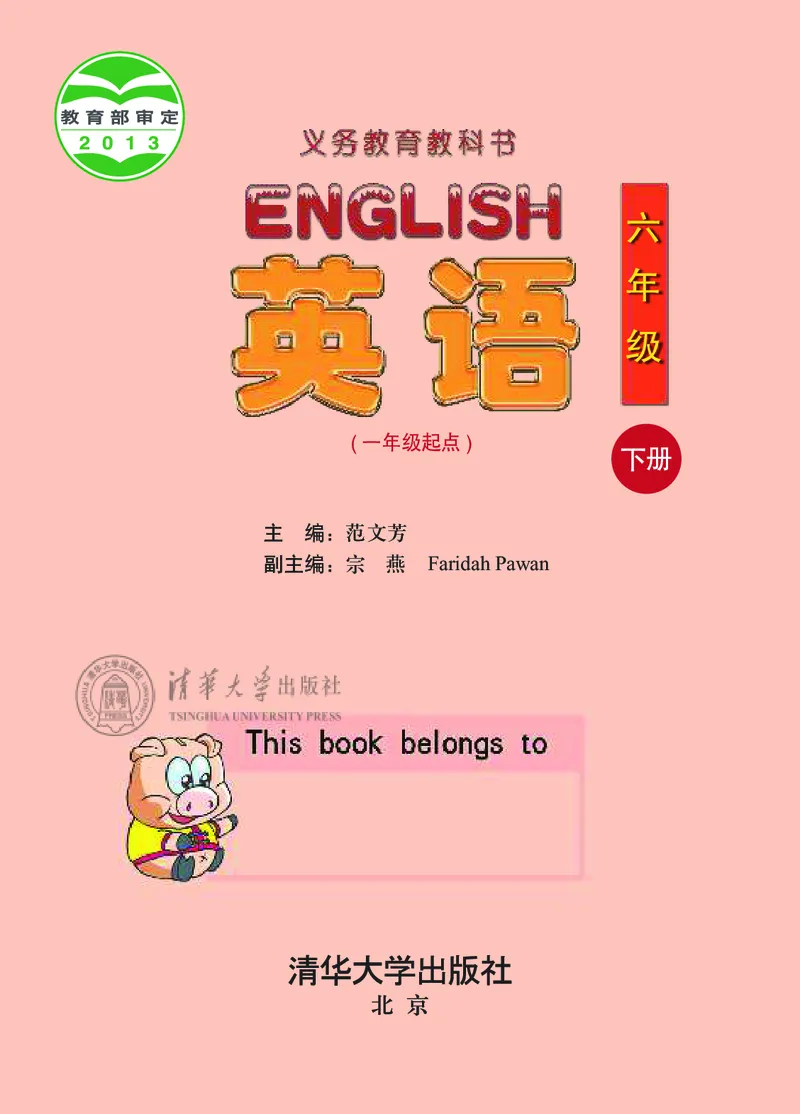
六
( 一年级起点 )
下册
主 编:范文芳
副主编:宗 燕 Faridah Pawan
年
级本书封面贴有清华大学出版社防伪标签,无标签者不得销售。
版权所有,侵权必究。侵权举报电话:010-62782989 13701121933
图书在版编目(CIP)数据
英语. 六年级. 下册 / 范文芳主编. — 北京 : 清华大学出版社, 2014
一年级起点
ISBN 978-7-302-35471-0
同学们,欢迎你们使用由清华大学 大、中、小学一条龙英语教学 研究
Ⅰ. ①英… Ⅱ. ①范… Ⅲ. ①英语课-小学-教材 Ⅳ. ①G624.311 与实践项目组编写的《英语》课本!
中国版本图书馆CIP数据核字(2014)第022981号 我们为什么要学习英语呢?
你们肯定知道,这是因为英语很重要。英语像汉语一样,能够描述丰富多
彩的世界,表达各种各样的思想。通过英语,我们可以更多地了解奇妙的世界,
了解世界上更多的人,同时也可以把中国介绍给世界上更多的人,让世界上更多
的人了解我们的祖国,了解我们自己。
在 世纪全球化的国际舞台上,英语已经成为国际交流中的一种重要工
责任编辑:宗 燕 具,因此,我们都要学好英语。但是,学好一门语言却不是一朝一夕的事情,而
责任校对:李 梅
是需要多年的努力。你们年纪小,模仿力强,记忆力好,正是学习英语的最佳时
责任印制:
期。希望你们努力学好英语,为长大成材打下基础。
出版发行:清华大学出版社
网 址:http://www.tup.com.cn, http://www.wqbook.com 我们要学习英语还有另外一个原因,那就是英语非常有趣!英语可以像积
地 址:北京清华大学学研大厦A座 邮 编:100084
木、玩具汽车、布娃娃、拼图、动画片一样,给我们带来无穷的乐趣!
社 总 机:010-62770175 邮 购:010-62786544
投稿与读者服务:010-62776969, c-service@tup.tsinghua.edu.cn
翻开清华大学 大、中、小学一条龙英语教学 研究与实践项目组为你们
质 量 反 馈:010-62772015, zhiliang@tup.tsinghua.edu.cn
课 件 下 载:http://www.wqbook.com/qhytl/ 编写的这套《英语》课本,你们肯定会被那令人赏心悦目的图画所吸引;听听课
印 装 者:
经 销:全国新华书店 文录音,你们也一定会喜欢那纯正的英语和优美的歌曲。
开 本:185mm×260mm 印 张:5
版 次:2014年11月第1版 印 次:2019年8月第1次印刷
定 价:5.30元
产品编号:040309-04——致同学
同学们,欢迎你们使用由清华大学“大、中、小学一条龙英语教学”研究
与实践项目组编写的《英语》课本!
我们为什么要学习英语呢?
你们肯定知道,这是因为英语很重要。英语像汉语一样,能够描述丰富多
彩的世界,表达各种各样的思想。通过英语,我们可以更多地了解奇妙的世界,
了解世界上更多的人,同时也可以把中国介绍给世界上更多的人,让世界上更多
的人了解我们的祖国,了解我们自己。
在21世纪全球化的国际舞台上,英语已经成为国际交流中的一种重要工
责任编辑:宗 燕 具,因此,我们都要学好英语。但是,学好一门语言却不是一朝一夕的事情,而
责任校对:李 梅
是需要多年的努力。你们年纪小,模仿力强,记忆力好,正是学习英语的最佳时
责任印制:
期。希望你们努力学好英语,为长大成材打下基础。
出版发行:清华大学出版社
网 址: , 我们要学习英语还有另外一个原因,那就是英语非常有趣!英语可以像积
地 址:北京清华大学学研大厦 座 邮 编:
木、玩具汽车、布娃娃、拼图、动画片一样,给我们带来无穷的乐趣!
社 总 机: 邮 购:
投稿与读者服务:
翻开清华大学“大、中、小学一条龙英语教学”研究与实践项目组为你们
质 量 反 馈:
课 件 下 载: 编写的这套《英语》课本,你们肯定会被那令人赏心悦目的图画所吸引;听听课
印 装 者:
经 销:全国新华书店 文录音,你们也一定会喜欢那纯正的英语和优美的歌曲。
开 本: 印 张:
版 次: 年 月第 版 印 次: 年 月第 次印刷
定 价: 元这套教材以你们感兴趣的话题为中心,选取的是与你们日常生活息息相关
的内容。教材中安排了你们喜欢的动物、食物以及你们喜欢的活动如游泳、踢
足球等,还有许多生动有趣的故事,相信你们会喜欢这套教材。在老师的指导
下,在听、说、唱、动、读、写中学会用英语说自己想说的话,写出自己的
心声。
英语很重要!英语很有趣!让我们共同努力,把英语学好!
作者
于清华园
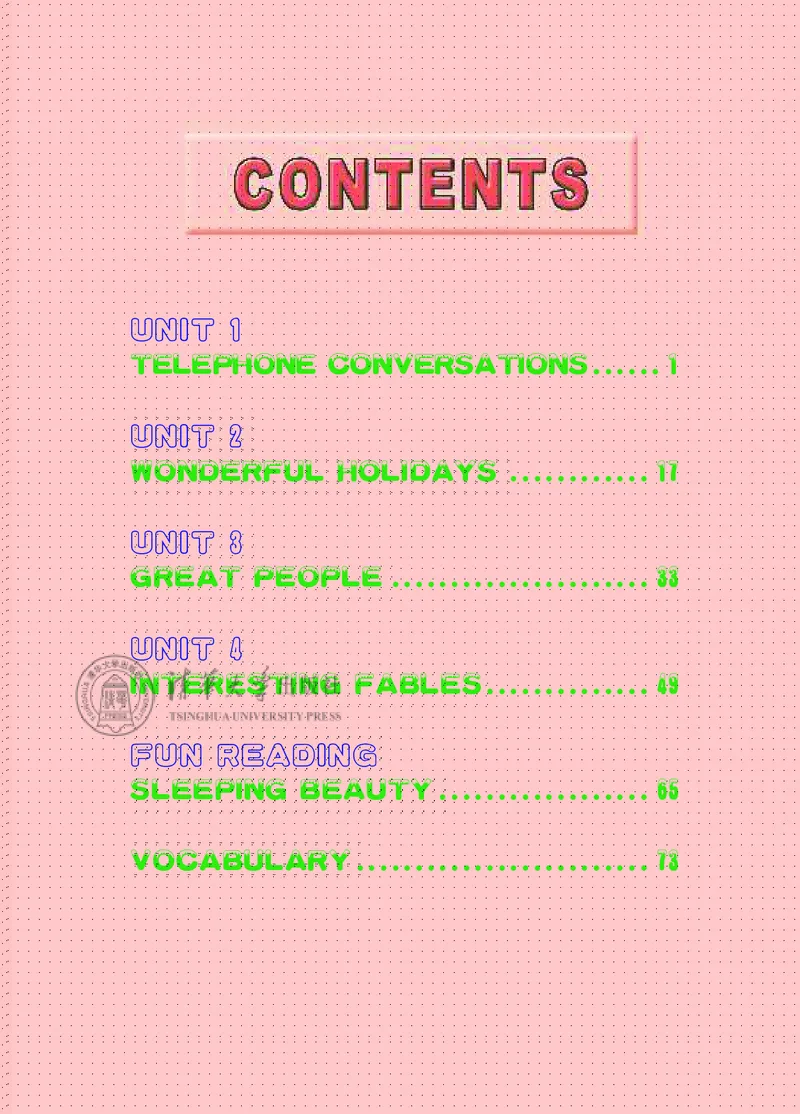
2012年12月UNIT 1
TELEPHONE CONVERSATIONS ...... 1
UNIT 2
WONDERFUL HOLIDAYS ............ 17
UNIT 3
GREAT PEOPLE ...................... 33
UNIT 4
INTERESTING FABLES .............. 49
FUN READING
SLEEPING BEAUTY .................. 65
VOCABULARY ......................... 73The telephone makes our
life easier. We can talk to our
friends when we want to.
Ⅳ06U N I T 1
TELEPHONE
CONVERSATIONS
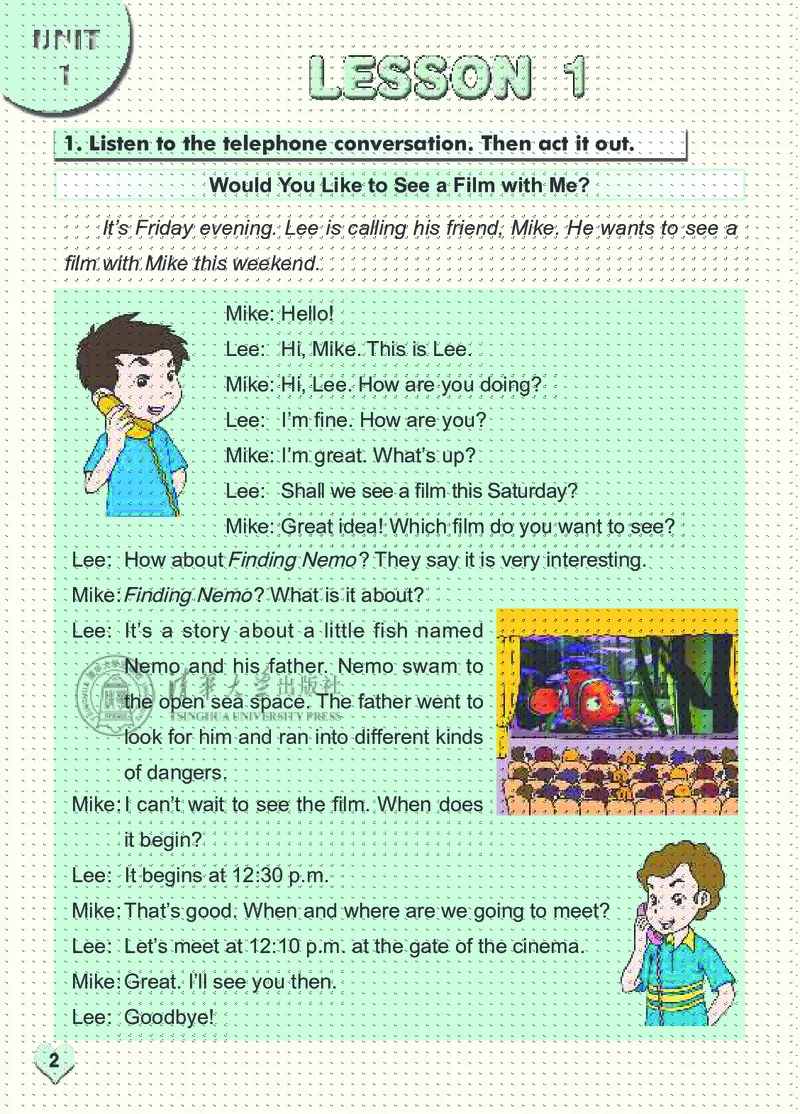
11. Listen to the telephone conversation. Then act it out.
Would You Like to See a Film with Me?
It’s Friday evening. Lee is calling his friend, Mike. He wants to see a
film with Mike this weekend.
Mike: Hello!
Lee: Hi, Mike. This is Lee.
Mike: Hi, Lee. How are you doing?
Lee: I’m fine. How are you?
Mike: I’m great. What’s up?
Lee: Shall we see a film this Saturday?
Mike: Great idea! Which film do you want to see?
Lee: How about Finding Nemo? They say it is very interesting.
Mike: Finding Nemo? What is it about?
Lee: It’s a story about a little fish named
Nemo and his father. Nemo swam to
the open sea space. The father went to
look for him and ran into different kinds
of dangers.
Mike: I can’t wait to see the film. When does
it begin?
Lee: It begins at 12:30 p.m.
Mike: That’s good. When and where are we going to meet?
Lee: Let’s meet at 12:10 p.m. at the gate of the cinema.
Mike: Great. I’ll see you then.
Lee: Goodbye!
22
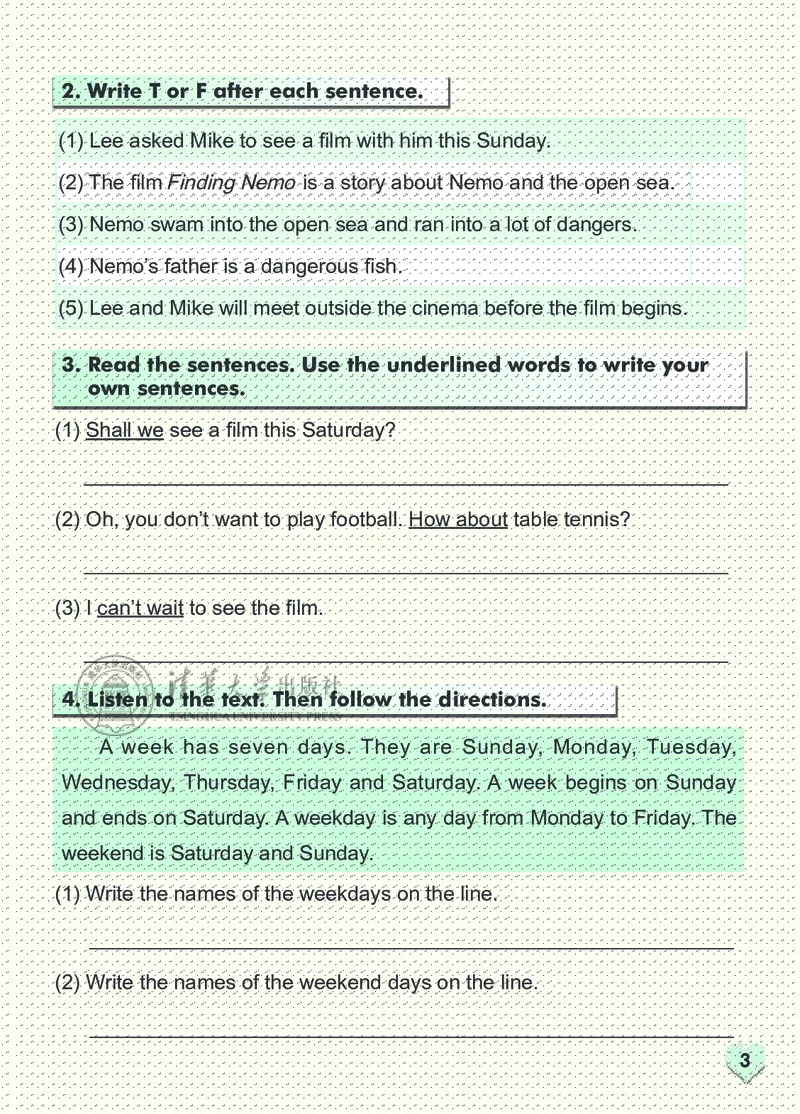
Mike2. Write T or F after each sentence.
(1) Lee asked Mike to see a film with him this Sunday.
(2) The film Finding Nemo is a story about Nemo and the open sea.
(3) Nemo swam into the open sea and ran into a lot of dangers.
(4) Nemo’s father is a dangerous fish.
(5) Lee and Mike will meet outside the cinema before the film begins.
3. Read the sentences. Use the underlined words to write your
own sentences.
(1) Shall we see a film this Saturday?
________________________________________________________
(2) Oh, you don’t want to play football. How about table tennis?
________________________________________________________
(3) I can’t wait to see the film.
________________________________________________________
4. Listen to the text. Then follow the directions.
A week has seven days. They are Sunday, Monday, Tuesday,
Wednesday, Thursday, Friday and Saturday. A week begins on Sunday
and ends on Saturday. A weekday is any day from Monday to Friday. The
weekend is Saturday and Sunday.
(1) Write the names of the weekdays on the line.
________________________________________________________
(2) Write the names of the weekend days on the line.
________________________________________________________
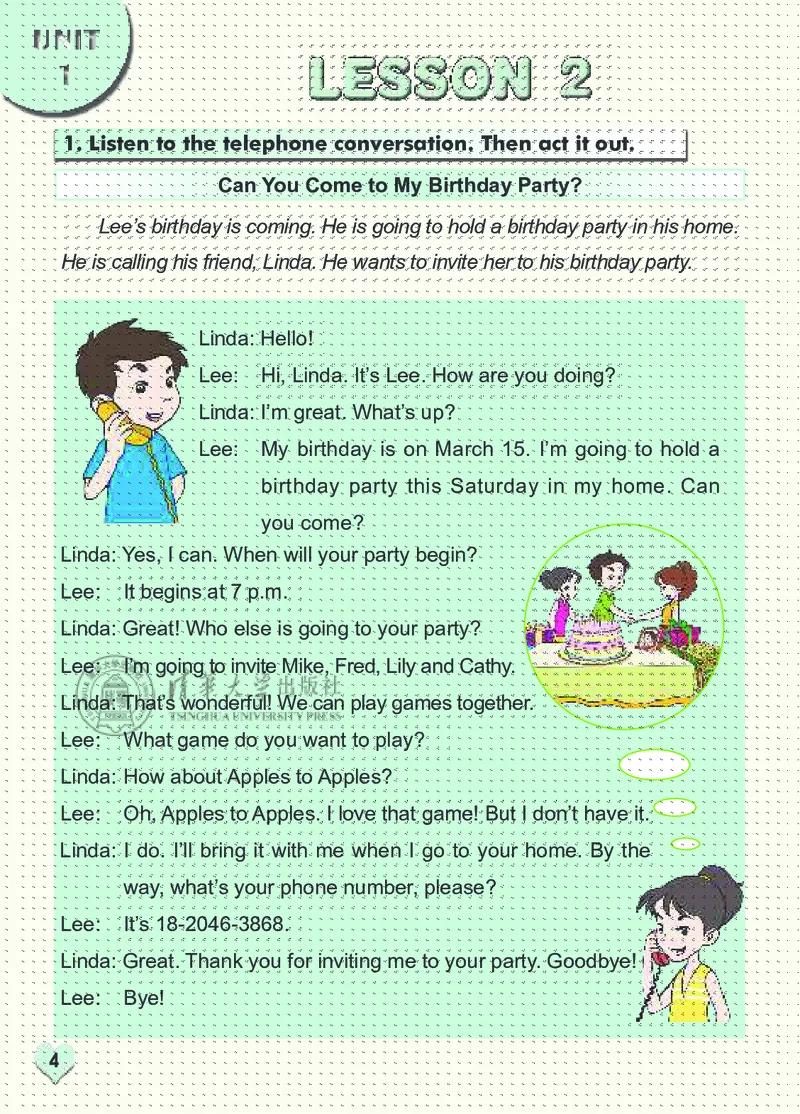
31. Listen to the telephone conversation. Then act it out.
Can You Come to My Birthday Party?
Lee’s birthday is coming. He is going to hold a birthday party in his home.
He is calling his friend, Linda. He wants to invite her to his birthday party.
Linda: Hello!
Lee: Hi, Linda. It’s Lee. How are you doing?
Linda: I’m great. What’s up?
Lee: My birthday is on March 15. I’m going to hold a
birthday party this Saturday in my home. Can
you come?
Linda: Yes, I can. When will your party begin?
Lee: It begins at 7 p.m.
Linda: Great! Who else is going to your party?
Lee: I’m going to invite Mike, Fred, Lily and Cathy.
Linda: That’s wonderful! We can play games together.
Lee: What game do you want to play?
Linda: How about Apples to Apples?
Lee: Oh, Apples to Apples. I love that game! But I don’t have it.
Linda: I do. I’ll bring it with me when I go to your home. By the
way, what’s your phone number, please?
Lee: It’s 18-2046-3868.
Linda: Great. Thank you for inviting me to your party. Goodbye!
Lee: Bye!
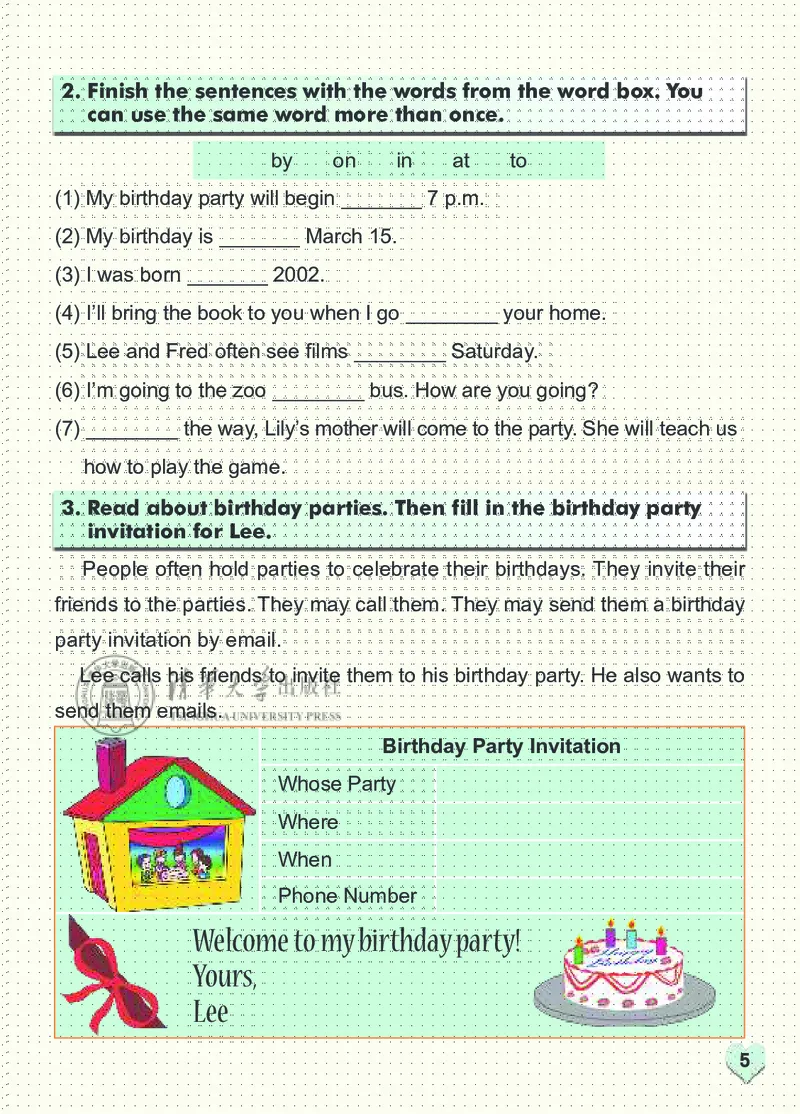
42. Finish the sentences with the words from the word box. You
can use the same word more than once.
by on in at to
(1) My birthday party will begin _______ 7 p.m.
(2) My birthday is _______ March 15.
(3) I was born _______ 2002.
(4) I’ll bring the book to you when I go ________ your home.
(5) Lee and Fred often see films ________ Saturday.
(6) I’m going to the zoo ________ bus. How are you going?
(7) ________ the way, Lily’s mother will come to the party. She will teach us
how to play the game.
3. Read about birthday parties. Then fill in the birthday party
invitation for Lee.
People often hold parties to celebrate their birthdays. They invite their
friends to the parties. They may call them. They may send them a birthday
party invitation by email.
Lee calls his friends to invite them to his birthday party. He also wants to
send them emails.
Birthday Party Invitation
Whose Party
Where
When
Phone Number
Welcome to my birthday party!
Yours,
Lee
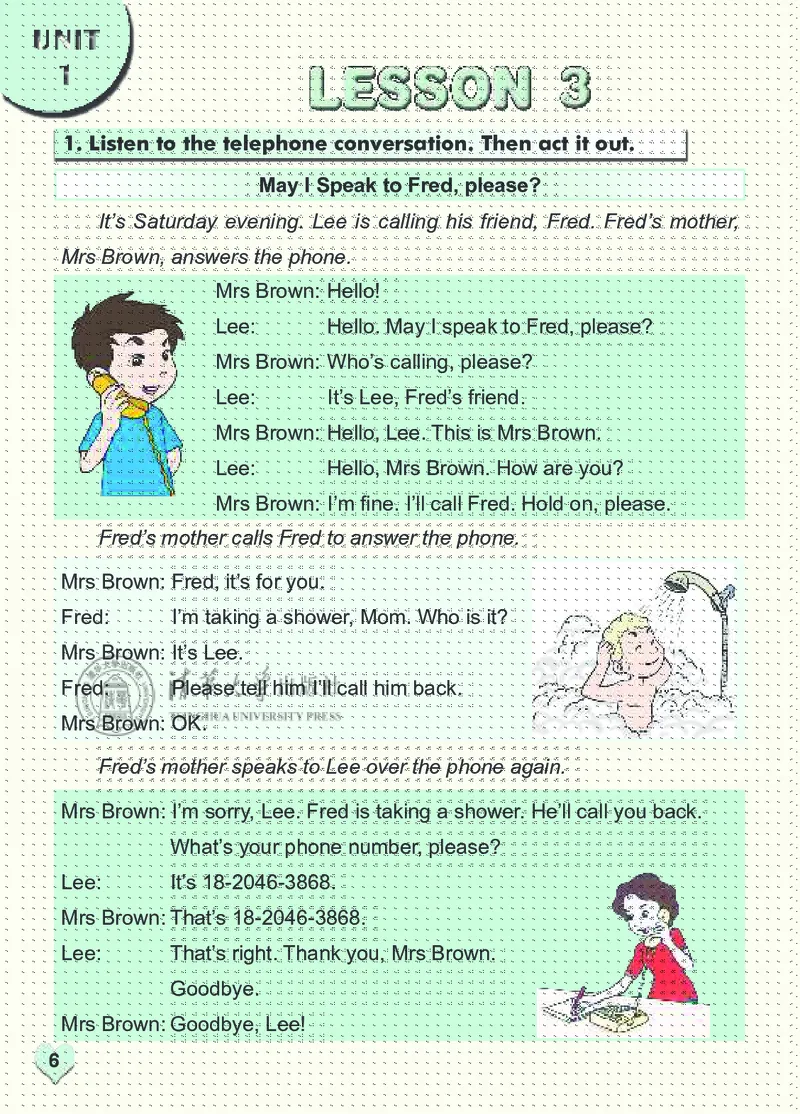
51. Listen to the telephone conversation. Then act it out.
May I Speak to Fred, please?
It’s Saturday evening. Lee is calling his friend, Fred. Fred’s mother,
Mrs Brown, answers the phone.
Mrs Brown: Hello!
Lee: Hello. May I speak to Fred, please?
Mrs Brown: Who’s calling, please?
Lee: It’s Lee, Fred’s friend.
Mrs Brown: Hello, Lee. This is Mrs Brown.
Lee: Hello, Mrs Brown. How are you?
Mrs Brown: I’m fine. I’ll call Fred. Hold on, please.
Fred’s mother calls Fred to answer the phone.
Mrs Brown: Fred, it’s for you.
Fred: I’m taking a shower, Mom. Who is it?
Mrs Brown: It’s Lee.
Fred: Please tell him I’ll call him back.
Mrs Brown: OK.
Fred’s mother speaks to Lee over the phone again.
Mrs Brown: I’m sorry, Lee. Fred is taking a shower. He’ll call you back.
What’s your phone number, please?
Lee: It’s 18-2046-3868.
Mrs Brown: That’s 18-2046-3868.
Lee: That’s right. Thank you, Mrs Brown.
Goodbye.
Mrs Brown: Goodbye, Lee!
6
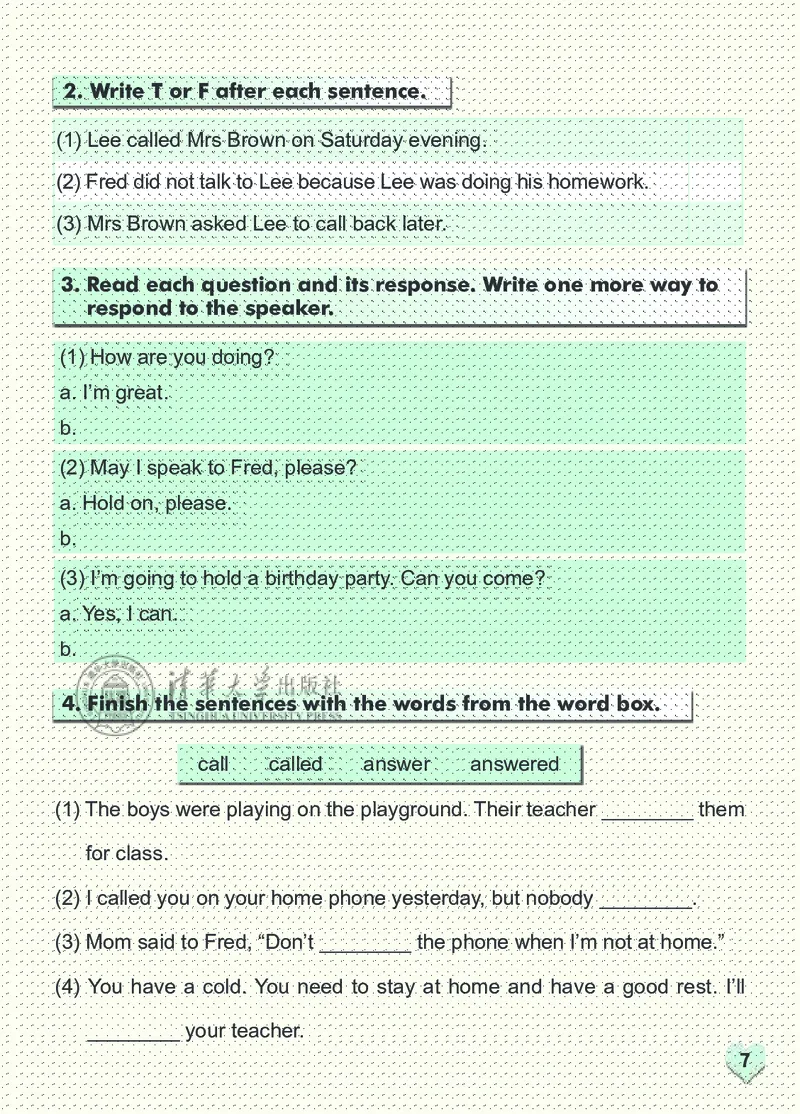
Mrs Brown2. Write T or F after each sentence.
(1) Lee called Mrs Brown on Saturday evening.
(2) Fred did not talk to Lee because Lee was doing his homework.
(3) Mrs Brown asked Lee to call back later.
3. Read each question and its response. Write one more way to
respond to the speaker.
(1) How are you doing?
a. I’m great.
b.
(2) May I speak to Fred, please?
a. Hold on, please.
b.
(3) I’m going to hold a birthday party. Can you come?
a. Yes, I can.
b.
4. Finish the sentences with the words from the word box.
call called answer answered
(1) The boys were playing on the playground. Their teacher ________ them
for class.
(2) I called you on your home phone yesterday, but nobody ________.
(3) Mom said to Fred, “Don’t ________ the phone when I’m not at home.”
(4) You have a cold. You need to stay at home and have a good rest. I’ll
________ your teacher.
71. Listen to the telephone conversation. Then act it out.
Can We Go to See a Sea Lion Show?
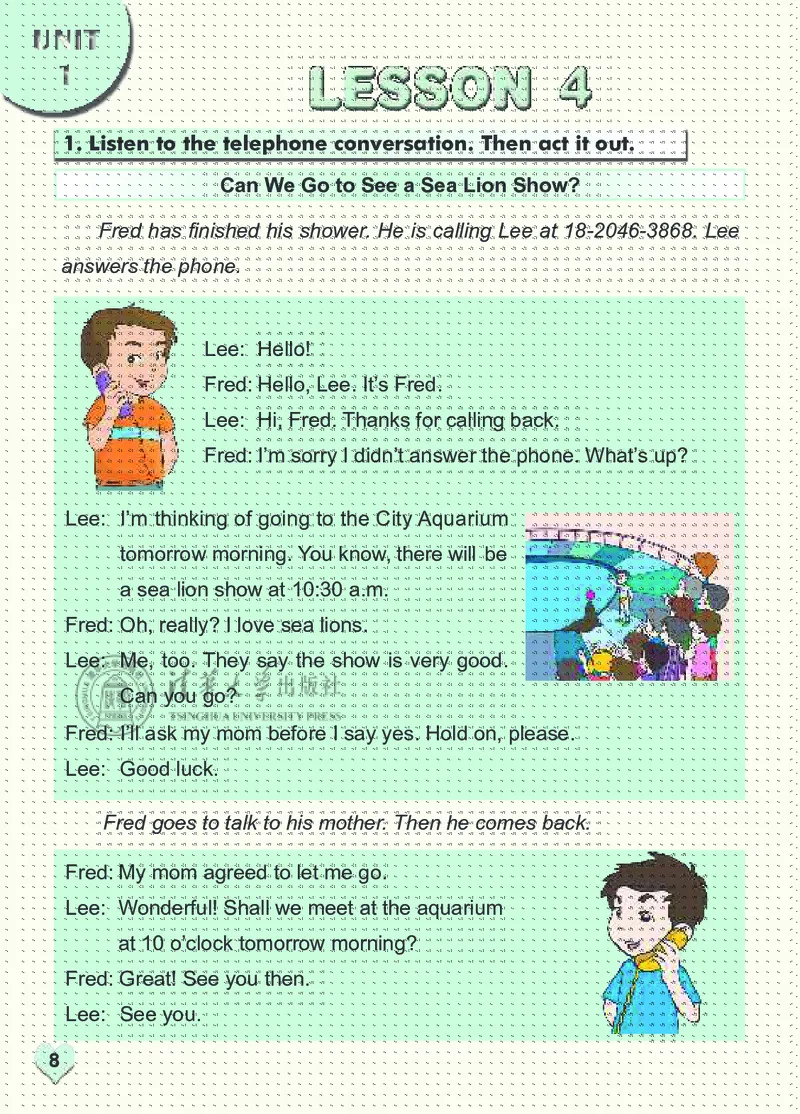
Fred has finished his shower. He is calling Lee at 18-2046-3868. Lee
answers the phone.
Lee: Hello!
Fred: Hello, Lee. It’s Fred.
Lee: Hi, Fred. Thanks for calling back.
Fred: I’m sorry I didn’t answer the phone. What’s up?
Lee: I’m thinking of going to the City Aquarium
tomorrow morning. You know, there will be
a sea lion show at 10:30 a.m.
Fred: Oh, really? I love sea lions.
Lee: Me, too. They say the show is very good.
Can you go?
Fred: I’ll ask my mom before I say yes. Hold on, please.
Lee: Good luck.
Fred goes to talk to his mother. Then he comes back.
Fred: My mom agreed to let me go.
Lee: Wonderful! Shall we meet at the aquarium
at 10 o’clock tomorrow morning?
Fred: Great! See you then.
Lee: See you.
82. Answer the questions.
(1) What did Fred do before he agreed to go to the aquarium with Lee?
_________________________________________________________
(2) Where will Lee and Fred meet to see the sea lion show?
_________________________________________________________
3. Listen, read and write.
aquarium __________ sea lion __________ show __________
agree __________ meet __________ really __________
4. Read the sentences. Use the underlined words to write your
own sentences.
(1) There will be a sea lion show in the zoo tomorrow morning.
________________________________________________________
(2) My mother agreed to let me go.
________________________________________________________
5. Listen to the text. Then write T or F after each sentence.
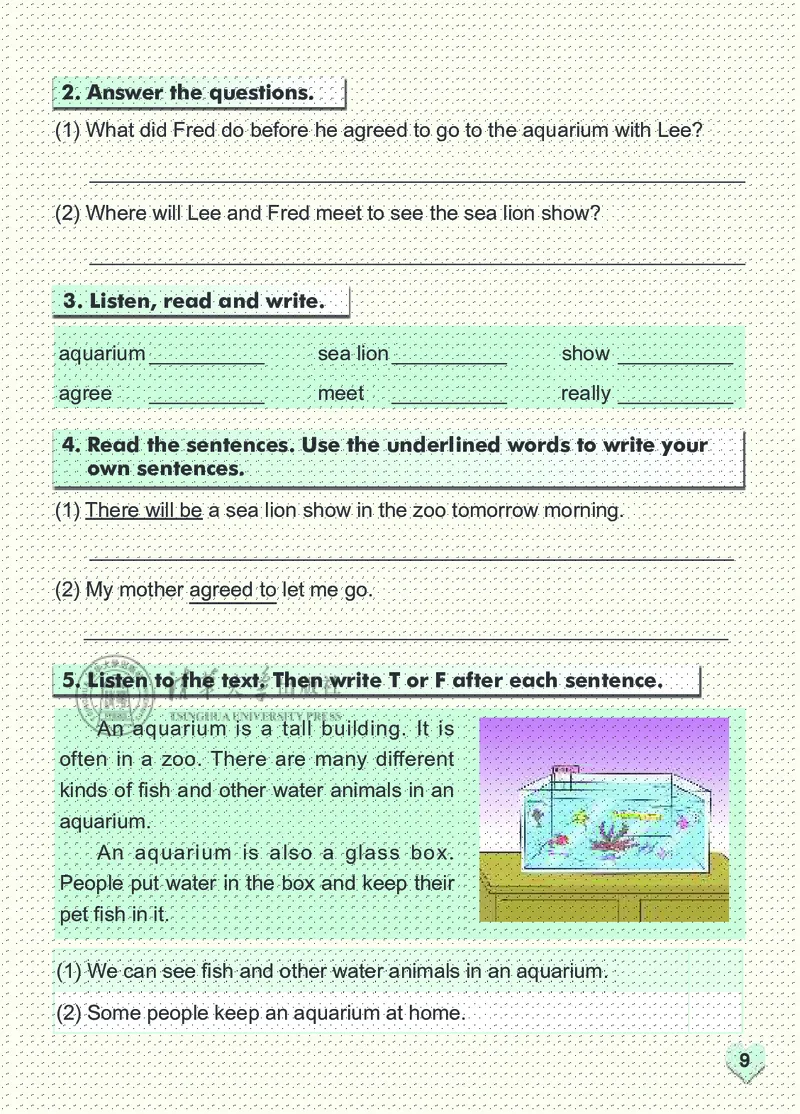
An aquarium is a tall building. It is
often in a zoo. There are many different
kinds of fish and other water animals in an
aquarium.
An aquarium is also a glass box.
People put water in the box and keep their
pet fish in it.
(1) We can see fish and other water animals in an aquarium.
(2) Some people keep an aquarium at home.
91. Listen to the telephone conversation. Then act it out.
My Favorite Football Team Won the Game!
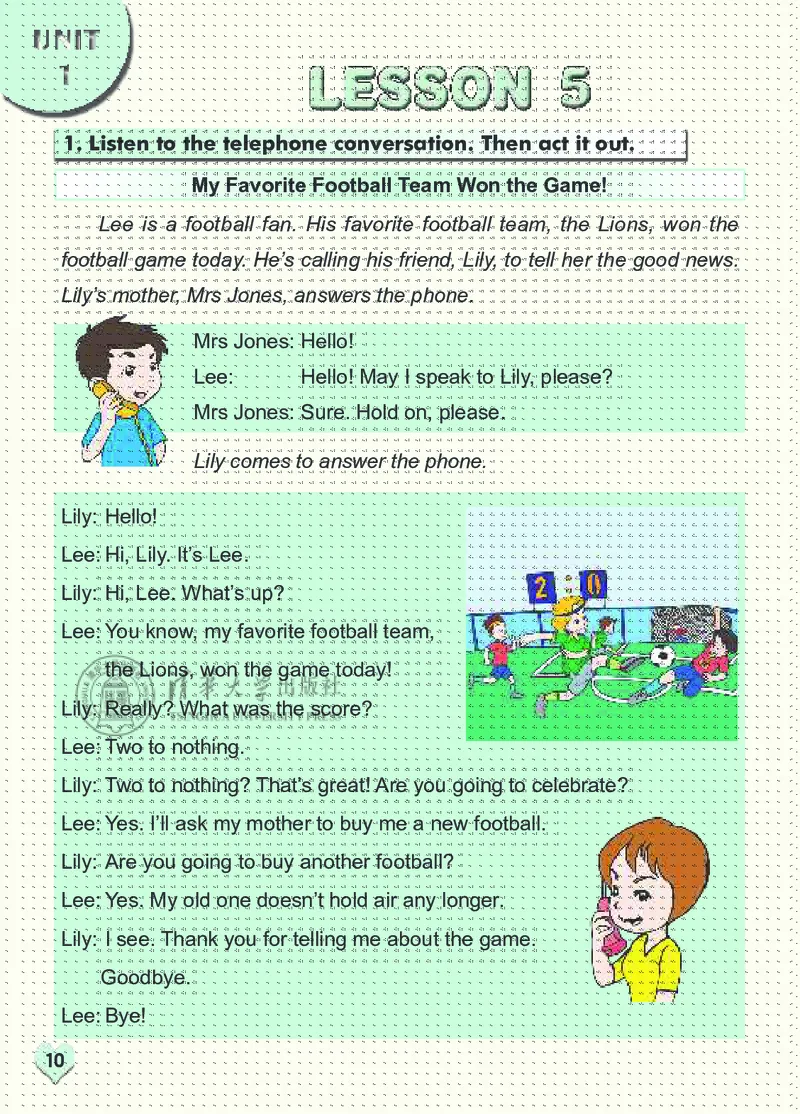
Lee is a football fan. His favorite football team, the Lions, won the
football game today. He’s calling his friend, Lily, to tell her the good news.
Lily’s mother, Mrs Jones, answers the phone.
Mrs Jones: Hello!
Lee: Hello! May I speak to Lily, please?
Mrs Jones: Sure. Hold on, please.
Lily comes to answer the phone.
Lily: Hello!
Lee: Hi, Lily. It’s Lee.
Lily: Hi, Lee. What’s up?
Lee: You know, my favorite football team,
the Lions, won the game today!
Lily: Really? What was the score?
Lee: Two to nothing.
Lily: Two to nothing? That’s great! Are you going to celebrate?
Lee: Yes. I’ll ask my mother to buy me a new football.
Lily: Are you going to buy another football?
Lee: Yes. My old one doesn’t hold air any longer.
Lily: I see. Thank you for telling me about the game.
Goodbye.
Lee: Bye!
102. Finish the sentences with words from the conversation.
(1) The Lions _______ the football game. The _______ was two to nothing.
(2) Thank you for telling me the good _______.
(3) The football does not hold _______ any longer.
(4) Lee can play football well. He is on the school football _______.
3. Listen, read and write.
team ___________ win (won) ___________ score ___________
nothing ___________ hold ___________ game ___________
4. Listen to the text. Then answer the questions.
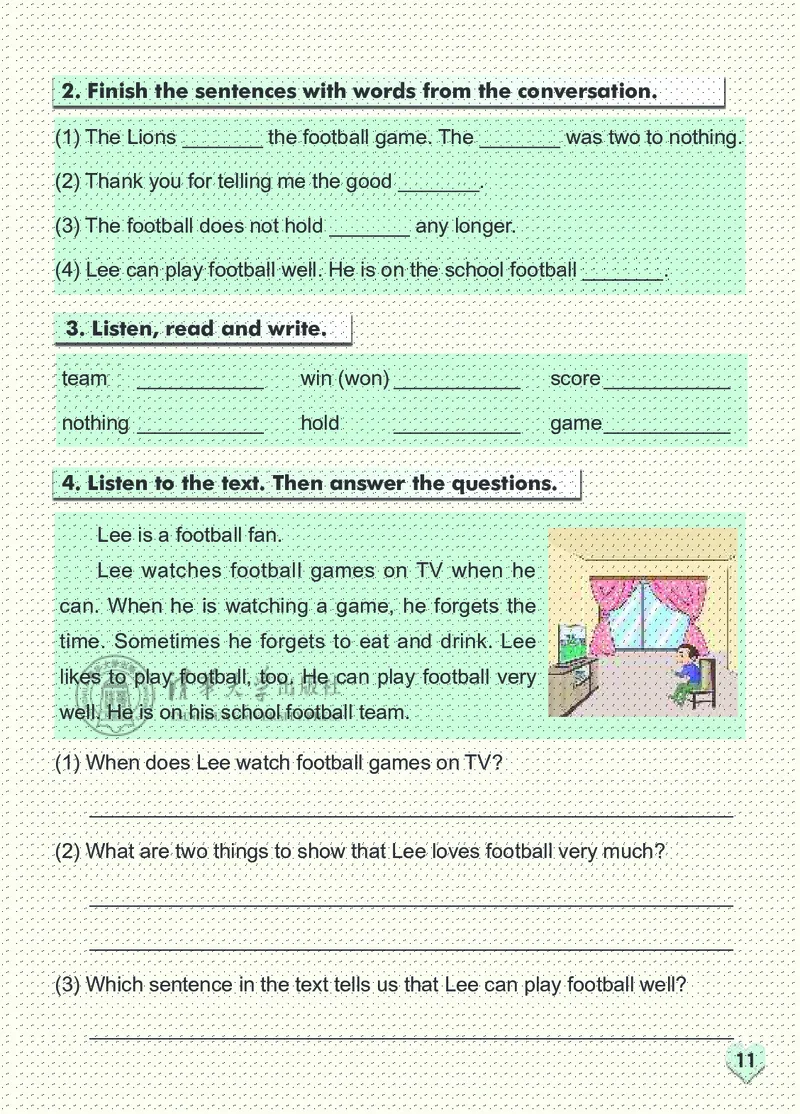
Lee is a football fan.
Lee watches football games on TV when he
can. When he is watching a game, he forgets the
time. Sometimes he forgets to eat and drink. Lee
likes to play football, too. He can play football very
well. He is on his school football team.
(1) When does Lee watch football games on TV?
_________________________________________________________
(2) What are two things to show that Lee loves football very much?
_________________________________________________________
_________________________________________________________
(3) Which sentence in the text tells us that Lee can play football well?
________________________________________________________
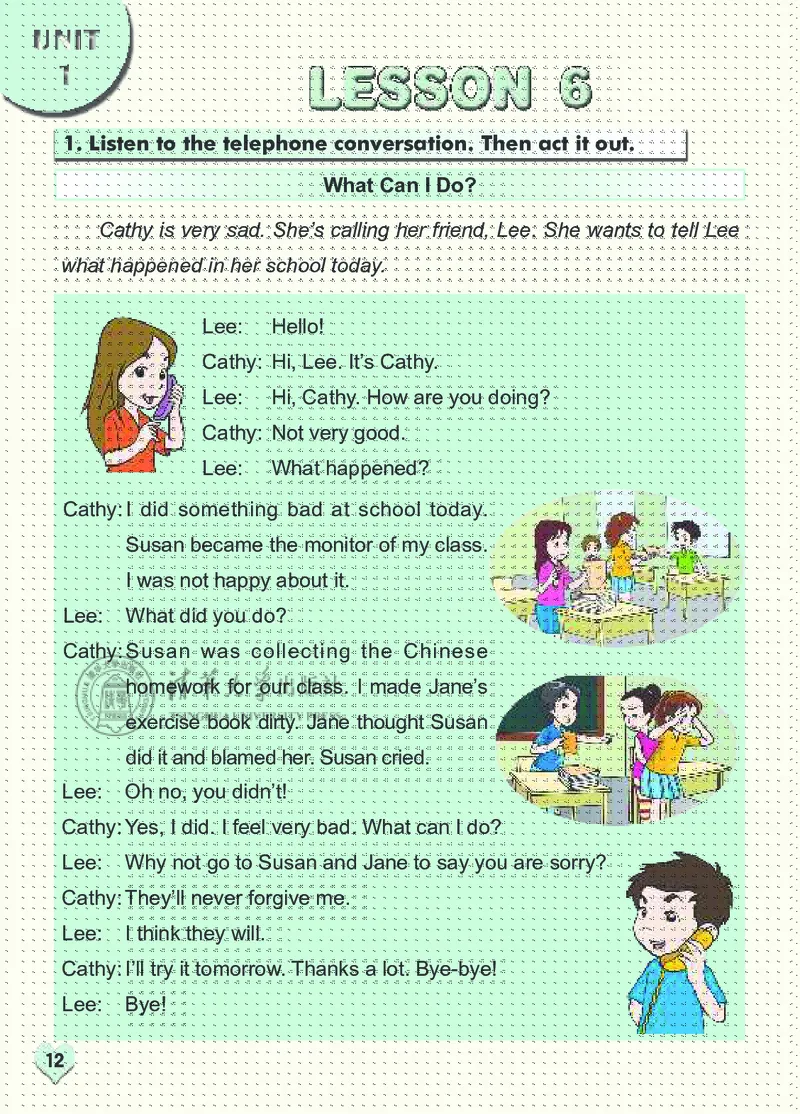
111. Listen to the telephone conversation. Then act it out.
What Can I Do?
Cathy is very sad. She’s calling her friend, Lee. She wants to tell Lee
what happened in her school today.
Lee: Hello!
Cathy: Hi, Lee. It’s Cathy.
Lee: Hi, Cathy. How are you doing?
Cathy: Not very good.
Lee: What happened?
Cathy: I did something bad at school today.
Susan became the monitor of my class.
I was not happy about it.
Lee: What did you do?
Cathy: Susan was collecting the Chinese
homework for our class. I made Jane’s
exercise book dirty. Jane thought Susan
did it and blamed her. Susan cried.
Lee: Oh no, you didn’t!
Cathy: Yes, I did. I feel very bad. What can I do?
Lee: Why not go to Susan and Jane to say you are sorry?
Cathy: They’ll never forgive me.
Lee: I think they will.
Cathy: I’ll try it tomorrow. Thanks a lot. Bye-bye!
Lee: Bye!
12
Lee2. Cathy is going to say she is sorry to Susan and Jane. Write their
conversation on the lines.
__________________________________________________________
__________________________________________________________
3. Listen, read and write.
happen ___________ collect ___________ blame ___________
forgive ___________ exercise ___________ never ___________
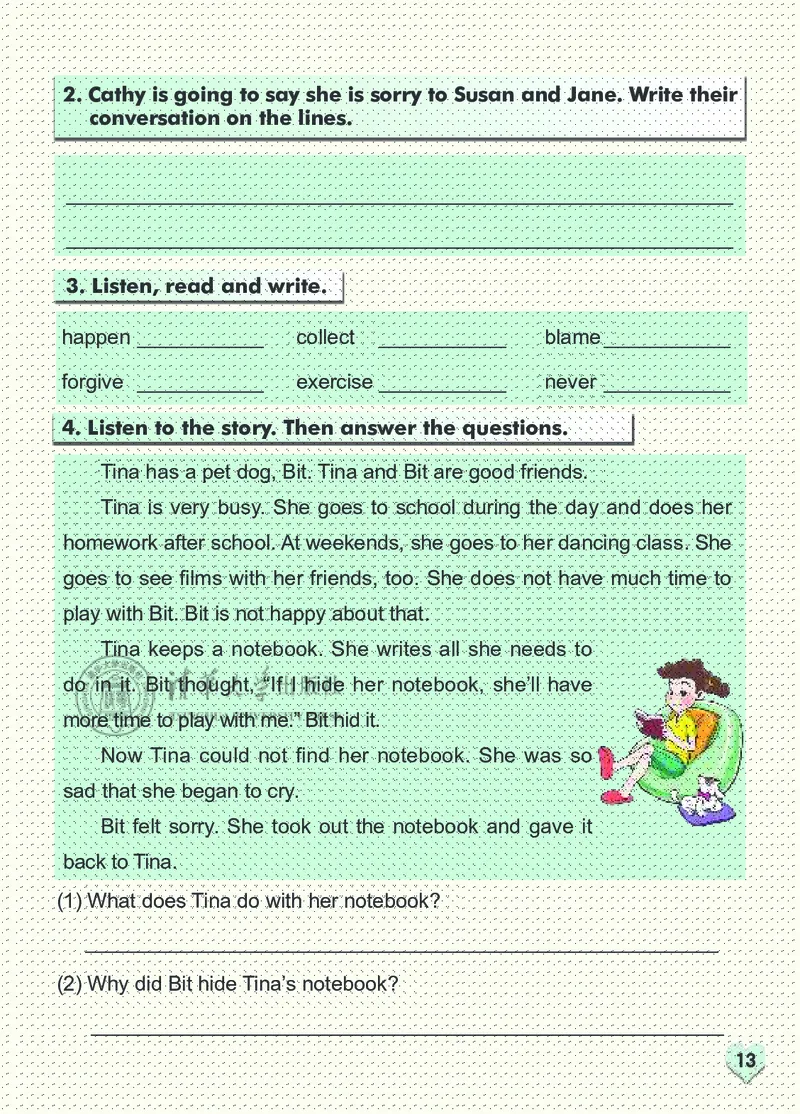
4. Listen to the story. Then answer the questions.
Tina has a pet dog, Bit. Tina and Bit are good friends.
Tina is very busy. She goes to school during the day and does her
homework after school. At weekends, she goes to her dancing class. She
goes to see films with her friends, too. She does not have much time to
play with Bit. Bit is not happy about that.
Tina keeps a notebook. She writes all she needs to
do in it. Bit thought, “If I hide her notebook, she’ll have
more time to play with me.” Bit hid it.
Now Tina could not find her notebook. She was so
sad that she began to cry.
Bit felt sorry. She took out the notebook and gave it
back to Tina.
(1) What does Tina do with her notebook?
_______________________________________________________
(2) Why did Bit hide Tina’s notebook?
_______________________________________________________
131. Listen to the sentences. Fill in the missing words.
(1) Give me your phone number, please. I’ll __________ you when I get home.
(2) Please don’t __________ the phone if you don’t know the number.
(3) I’m going to see a __________ in People’s Cinema tomorrow.
(4) Shall we __________ at the school gate?
(5) Tom is going to __________ a birthday party next week.
(6) I bought a new __________ yesterday.
(7) Cathy was not __________ when Susan became the monitor of her class.
(8) I’m sorry I got angry with you. Can you __________ me?
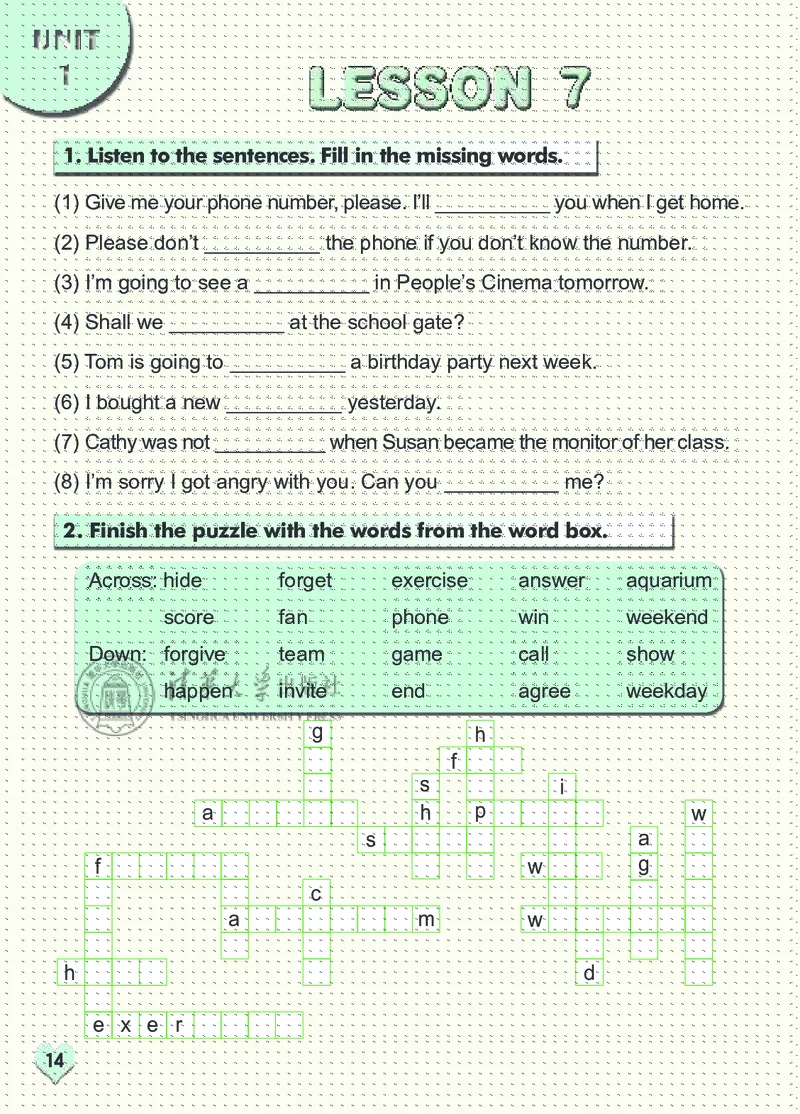
2. Finish the puzzle with the words from the word box.
Across: hide forget exercise answer aquarium
score fan phone win weekend
Down: forgive team game call show
happen invite end agree weekday
g h
f
s i
a h p w
s a
f w g
c
a m w
h d
ee x e r
143. Fun with words.
(1) Put the two short words together to make a longer word.
no + body = _________________ week + end = ________________
for + get = _________________ for + give = _________________
(2) Find two short words in the longer word. Write them on the lines.
something = ________ + ________ nothing = ________ + ________
weekday = ________ + ________ football = ________ + ________
(3) Find a short word in the longer word. Write it on the line.
team fan win call happen
___________ ___________ ___________ ___________ ___________
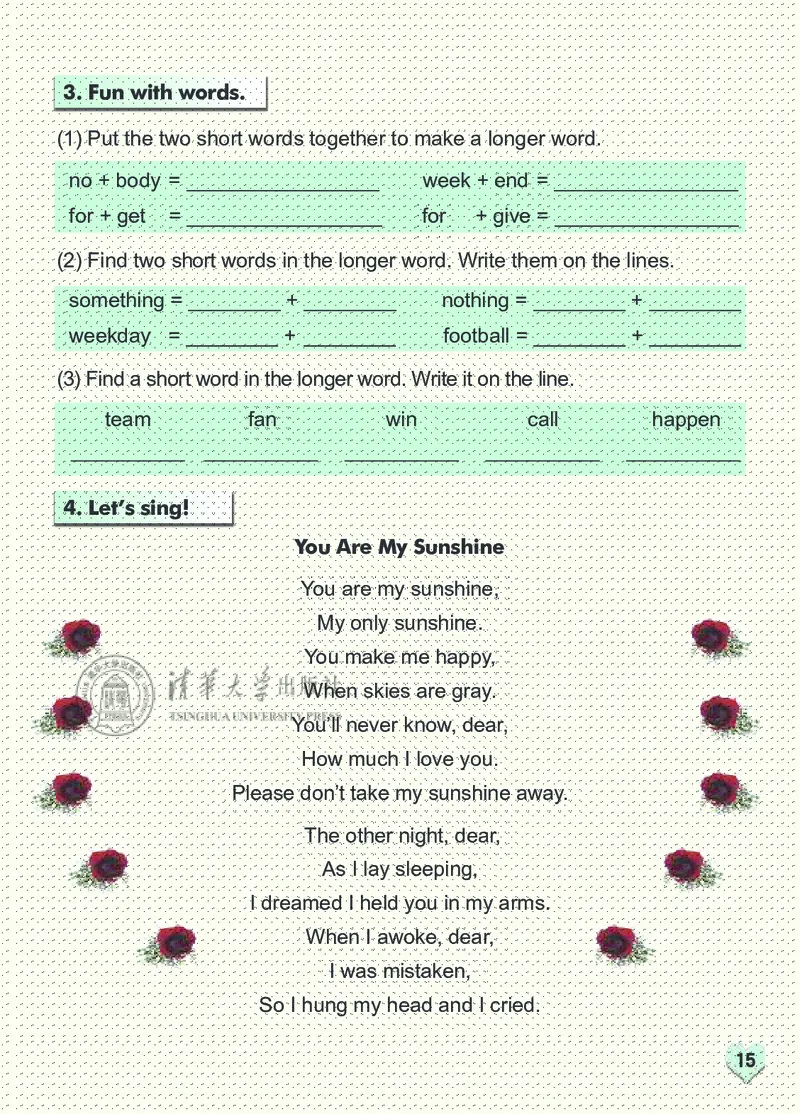
4. Let’s sing!
You Are My Sunshine
You are my sunshine,
My only sunshine.
You make me happy,
When skies are gray.
You’ll never know, dear,
How much I love you.
Please don’t take my sunshine away.
The other night, dear,
As I lay sleeping,
I dreamed I held you in my arms.
When I awoke, dear,
I was mistaken,
So I hung my head and I cried.
15Holidays come one after another.
What holiday will come next?
Please read to find out.
16
16U N I T 2
WONDERFUL
HOLIDAYS
171. Listen to the text. Then read it aloud.
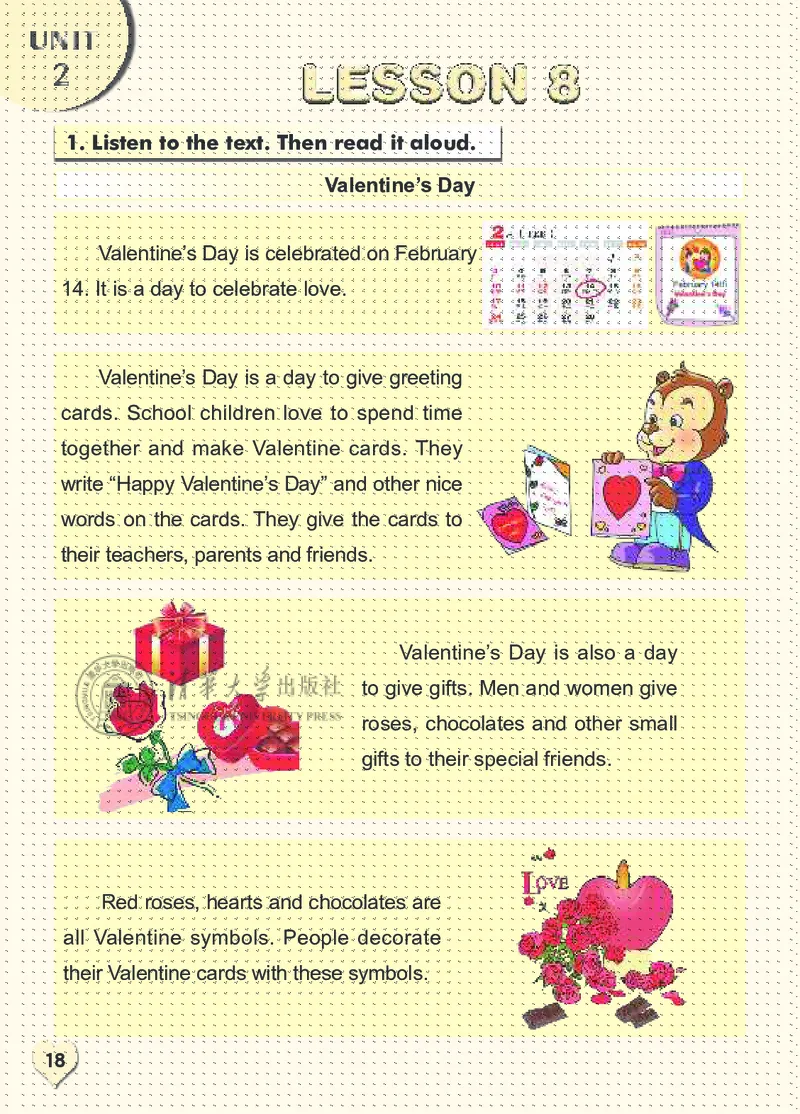
Valentine’s Day
Valentine’s Day is celebrated on February
14. It is a day to celebrate love.
Valentine’s Day is a day to give greeting
cards. School children love to spend time
together and make Valentine cards. They
write “Happy Valentine’s Day” and other nice
words on the cards. They give the cards to
their teachers, parents and friends.
Valentine’s Day is also a day
to give gifts. Men and women give
roses, chocolates and other small
gifts to their special friends.
Red roses, hearts and chocolates are
all Valentine symbols. People decorate
their Valentine cards with these symbols.
182. Answer the questions.
(1) When is Valentine’s Day?
__________________________________________________________
(2) Who gets Valentine cards on Valentine’s Day?
__________________________________________________________
(3) What are some Valentine’s Day symbols? Which one do you like best?
__________________________________________________________
3. Listen, read and write.
symbol ___________ gift ___________ Valentine’s Day ___________
rose ___________ heart ___________ Valentine card ___________
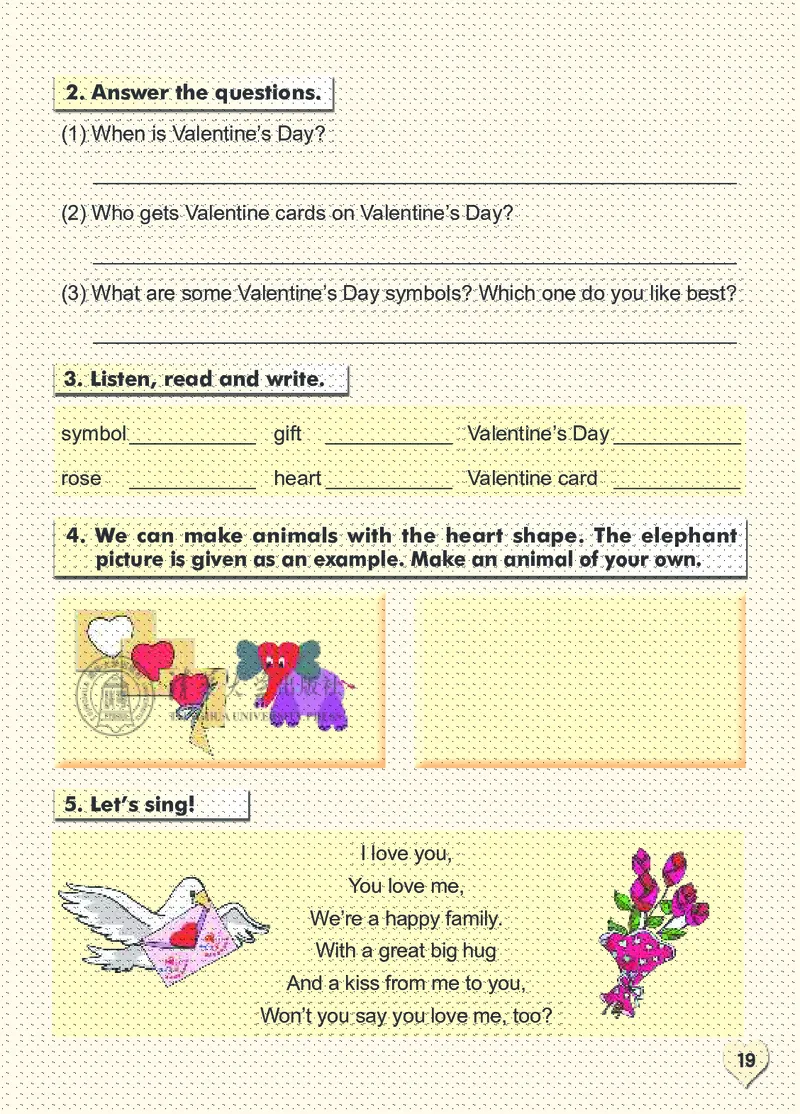
4. We can make animals with the heart shape. The elephant
picture is given as an example. Make an animal of your own.
5. Let’s sing!
I love you,
You love me,
We’re a happy family.
With a great big hug
And a kiss from me to you,
Won’t you say you love me, too?
191. Listen to the text. Then read it aloud.
Easter
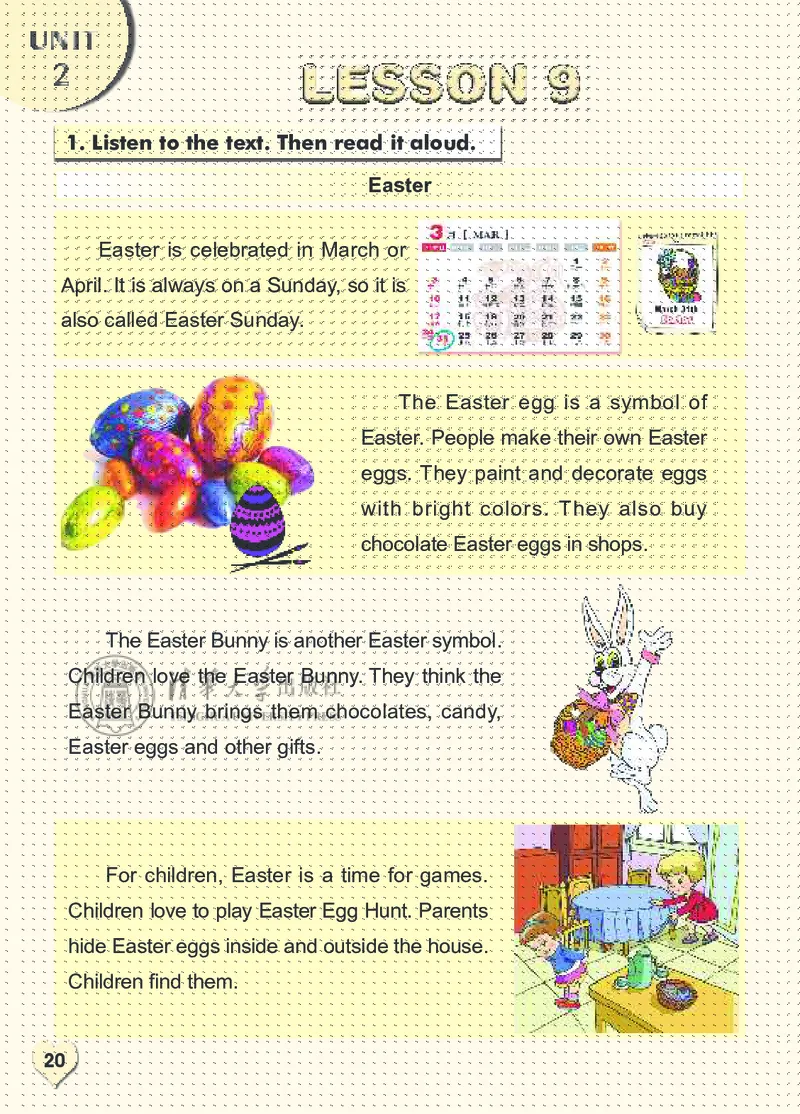
Easter is celebrated in March or
April. It is always on a Sunday, so it is
also called Easter Sunday.
The Easter egg is a symbol of
Easter. People make their own Easter
eggs. They paint and decorate eggs
with bright colors. They also buy
chocolate Easter eggs in shops.
The Easter Bunny is another Easter symbol.
Children love the Easter Bunny. They think the
Easter Bunny brings them chocolates, candy,
Easter eggs and other gifts.
For children, Easter is a time for games.
Children love to play Easter Egg Hunt. Parents
hide Easter eggs inside and outside the house.
Children find them.
202. Answer the questions.
(1) When is Easter?
__________________________________________________________
(2) What are the two Easter symbols?
__________________________________________________________
(3) Why do children love the Easter Bunny?
__________________________________________________________
3. Finish the sentences with the words from the word box.
bunny Egg Hunt brings bright
(1) A _________ is a rabbit. Children often use the word.
(2) Children think Santa Claus _________ them gifts on Christmas Eve.
(3) Easter _________ _________ is a fun game during Easter.
(4) On Easter, people paint eggs in bright colors. The _________ colors on
Easter eggs are a symbol of the new sunlight in spring.
4. Let’s say it.
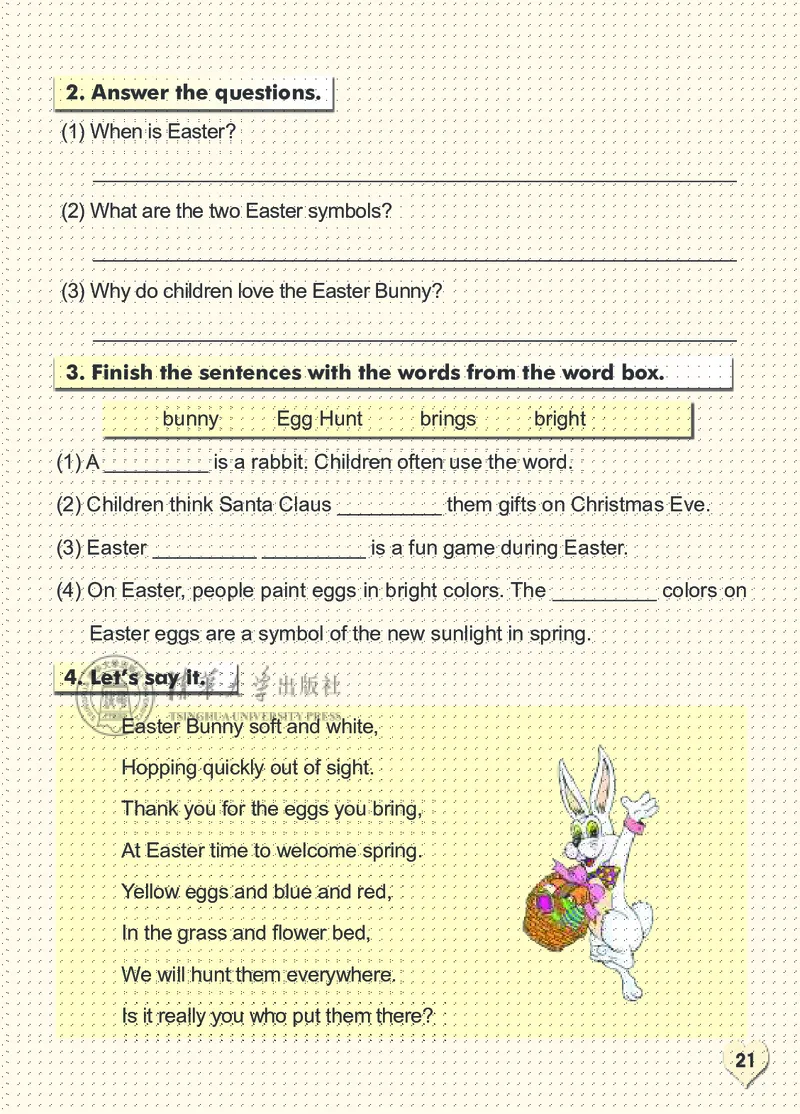
Easter Bunny soft and white,
Hopping quickly out of sight.
Thank you for the eggs you bring,
At Easter time to welcome spring.
Yellow eggs and blue and red,
In the grass and flower bed,
We will hunt them everywhere.
Is it really you who put them there?
211. Listen to the text. Then read it aloud.
The Dragon Boat Festival
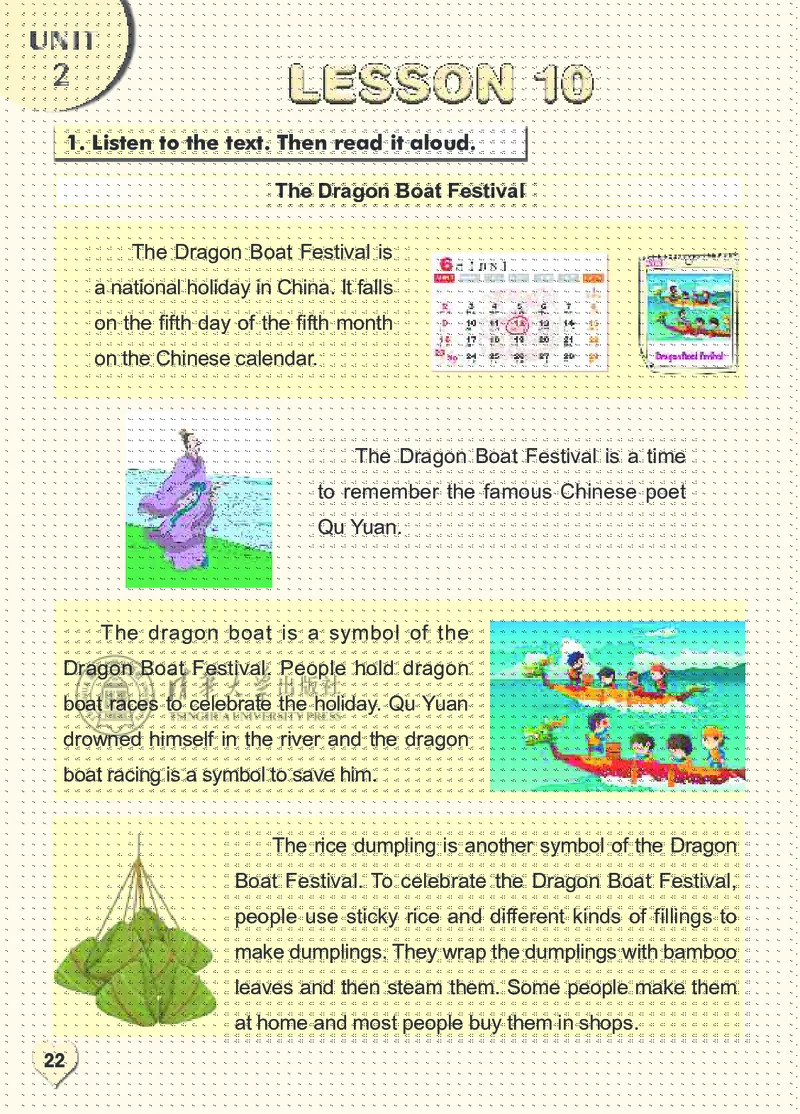
The Dragon Boat Festival is
a national holiday in China. It falls
on the fifth day of the fifth month
on the Chinese calendar.
The Dragon Boat Festival is a time
to remember the famous Chinese poet
Qu Yuan.
The dragon boat is a symbol of the
Dragon Boat Festival. People hold dragon
boat races to celebrate the holiday. Qu Yuan
drowned himself in the river and the dragon
boat racing is a symbol to save him.
The rice dumpling is another symbol of the Dragon
Boat Festival. To celebrate the Dragon Boat Festival,
people use sticky rice and different kinds of fillings to
make dumplings. They wrap the dumplings with bamboo
leaves and then steam them. Some people make them
at home and most people buy them in shops.
222. Finish the sentences with words from the text.
The Dragon Boat Festival is a national holiday in _______. It falls on
the _______ day of the fifth month on the Chinese calendar. It is a time to
remember the Chinese ________ Qu Yuan.
3. Answer the questions.
(1) What are the two symbols of the Dragon Boat Festival?
a. _______________________________________________________
b. _______________________________________________________
(2) What do you do to celebrate the Dragon Boat Festival?
_________________________________________________________
4. Listen, read and write.
dragon _________ calendar _________ poet __________
festival _________ remember ________ race __________
a national holiday ____________________ wrap _________
Dragon Boat Festival ____________________ steam _________
5. Draw a dragon boat and name it My Dragon Boat.
231. Listen to the text. Then read it aloud.
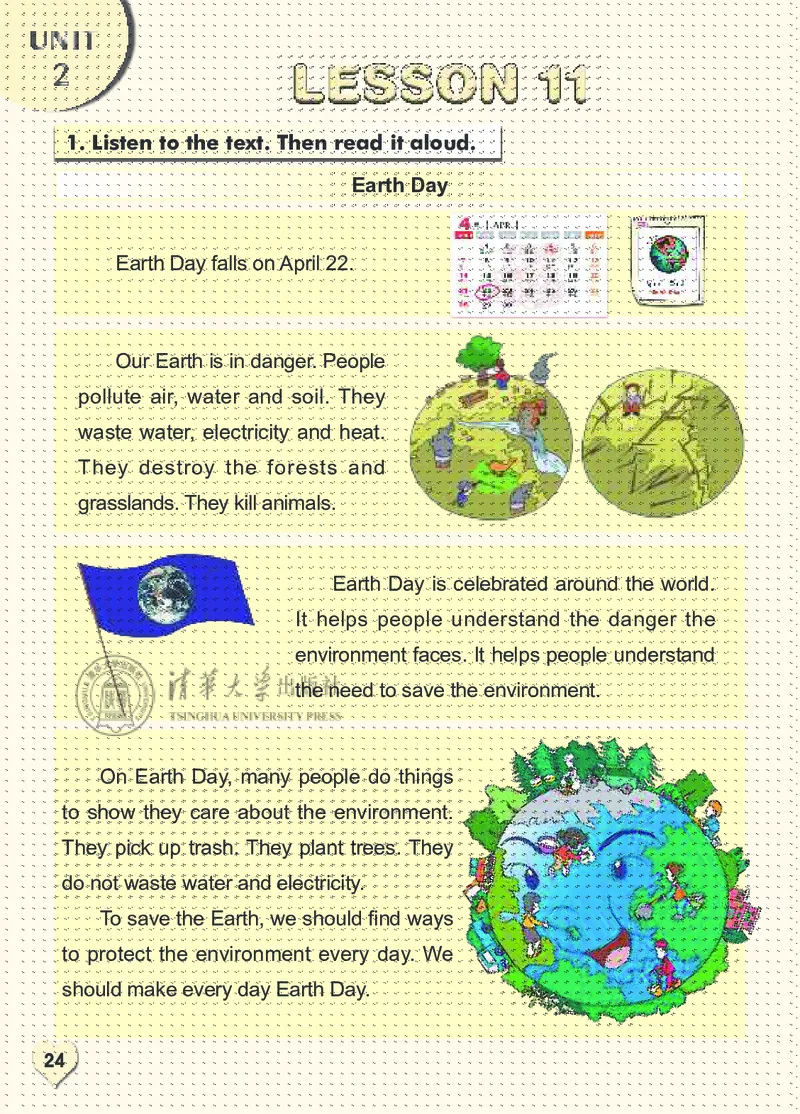
Earth Day
Earth Day falls on April 22.
Our Earth is in danger. People
pollute air, water and soil. They
waste water, electricity and heat.
They destroy the forests and
grasslands. They kill animals.
Earth Day is celebrated around the world.
It helps people understand the danger the
environment faces. It helps people understand
the need to save the environment.
On Earth Day, many people do things
to show they care about the environment.
They pick up trash. They plant trees. They
do not waste water and electricity.
To save the Earth, we should find ways
to protect the environment every day. We
should make every day Earth Day.
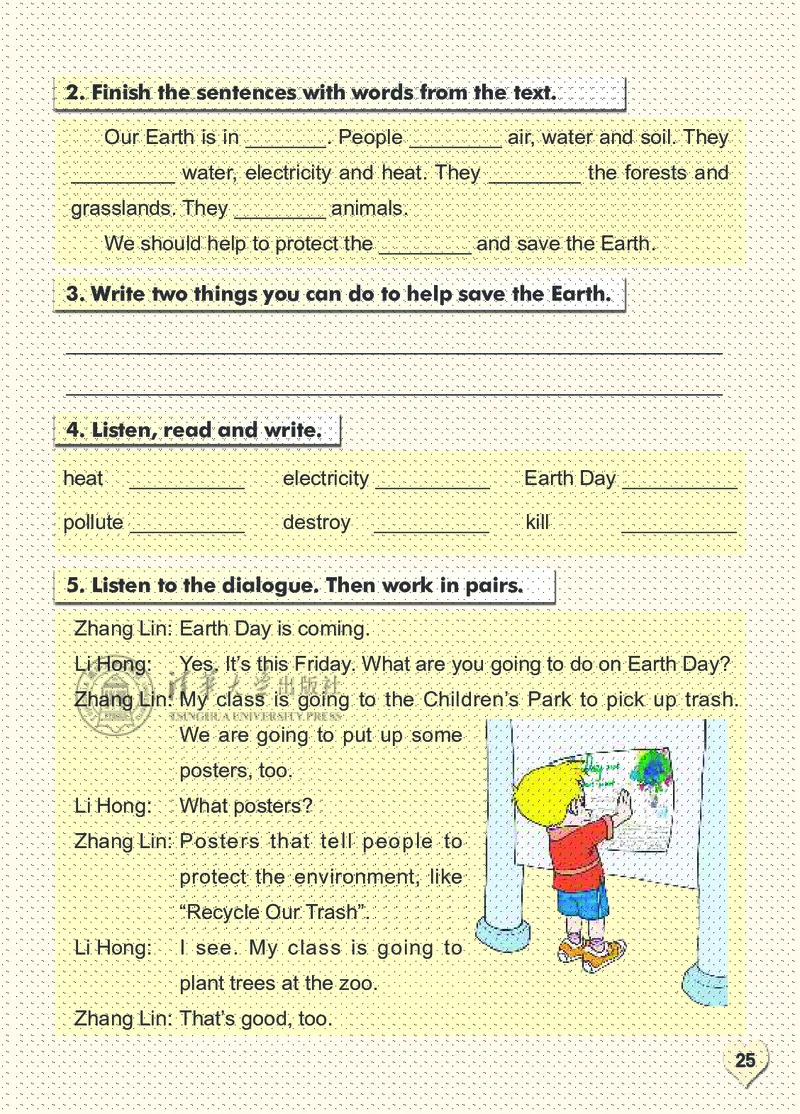
242. Finish the sentences with words from the text.
Our Earth is in _______. People ________ air, water and soil. They
_________ water, electricity and heat. They ________ the forests and
grasslands. They ________ animals.
We should help to protect the ________ and save the Earth.
3. Write two things you can do to help save the Earth.
_________________________________________________________
_________________________________________________________
4. Listen, read and write.
heat __________ electricity __________ Earth Day __________
pollute __________ destroy __________ kill __________
5. Listen to the dialogue. Then work in pairs.
Zhang Lin: Earth Day is coming.
Li Hong: Yes. It’s this Friday. What are you going to do on Earth Day?
Zhang Lin: My class is going to the Children’s Park to pick up trash.
We are going to put up some
posters, too.
Li Hong: What posters?
Zhang Lin: Posters that tell people to
protect the environment, like
“Recycle Our Trash”.
Li Hong: I see. My class is going to
plant trees at the zoo.
Zhang Lin: That’s good, too.
251. Listen to the text. Then read it aloud.
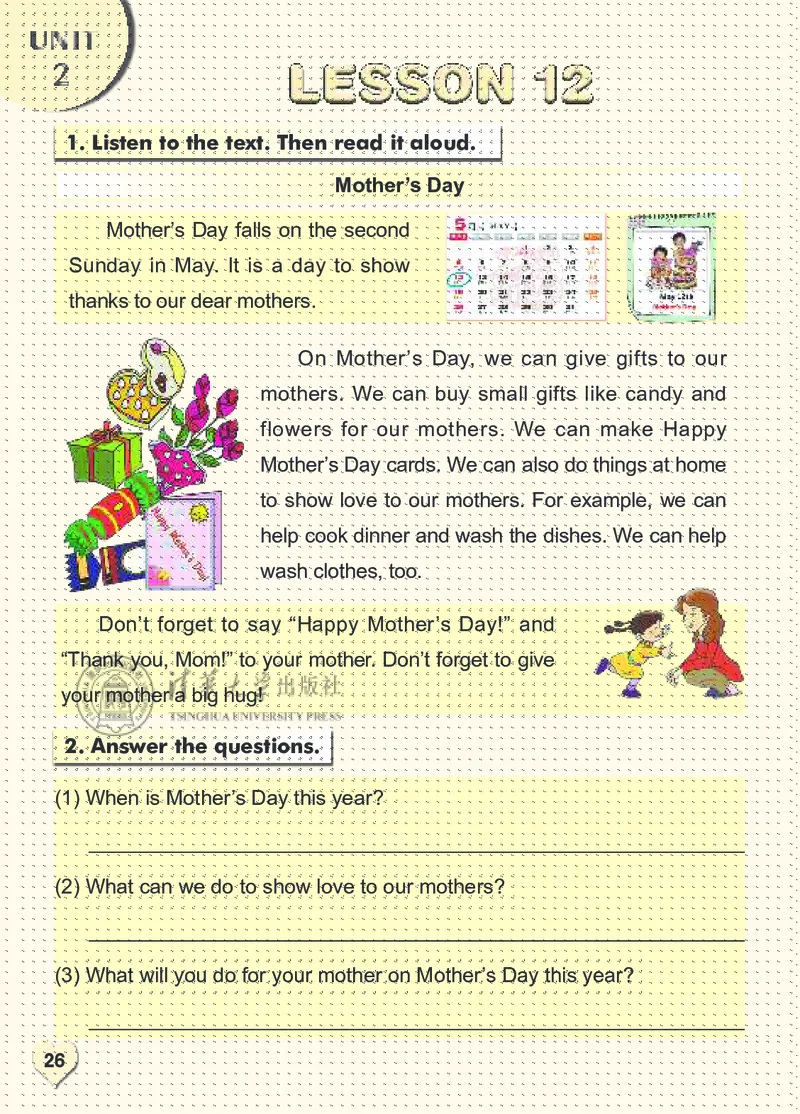
Mother’s Day
Mother’s Day falls on the second
Sunday in May. It is a day to show
thanks to our dear mothers.
On Mother’s Day, we can give gifts to our
mothers. We can buy small gifts like candy and
flowers for our mothers. We can make Happy
Mother’s Day cards. We can also do things at home
to show love to our mothers. For example, we can
help cook dinner and wash the dishes. We can help
wash clothes, too.
Don’t forget to say “Happy Mother’s Day!” and
“Thank you, Mom!” to your mother. Don’t forget to give
your mother a big hug!
2. Answer the questions.
(1) When is Mother’s Day this year?
_________________________________________________________
(2) What can we do to show love to our mothers?
_________________________________________________________
(3) What will you do for your mother on Mother’s Day this year?
_________________________________________________________
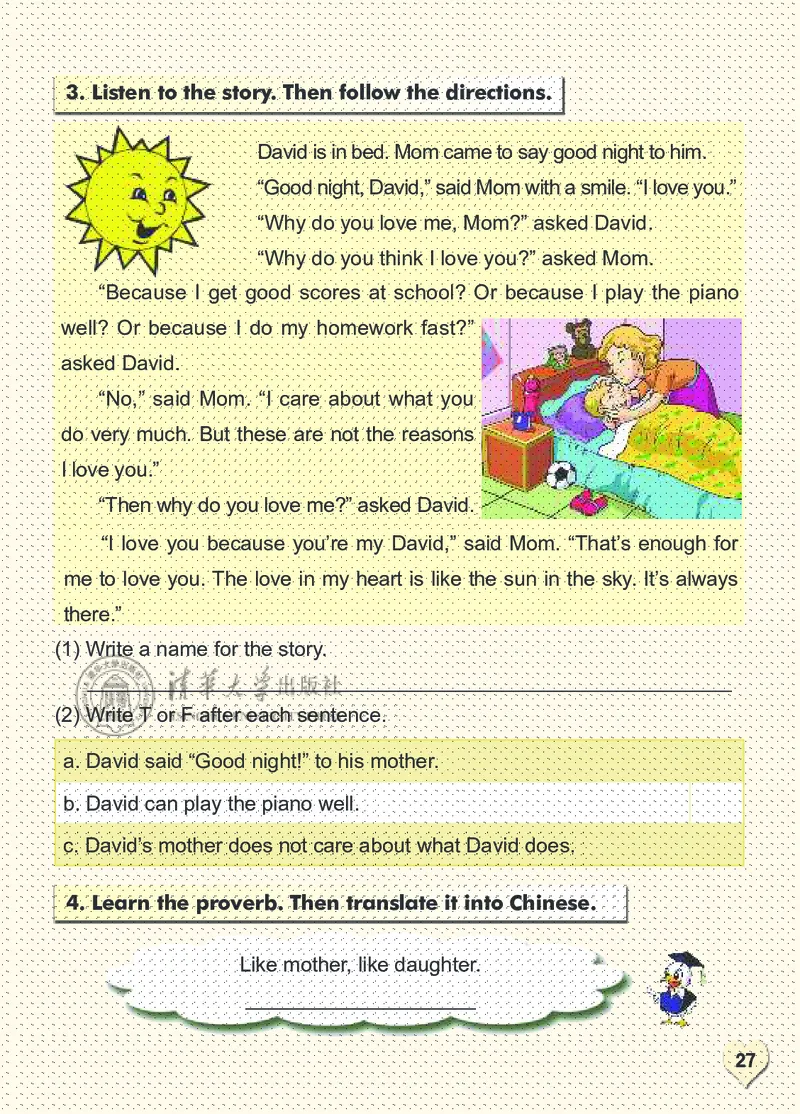
263. Listen to the story. Then follow the directions.
David is in bed. Mom came to say good night to him.
“Good night, David,” said Mom with a smile. “I love you.”
“Why do you love me, Mom?” asked David.
“Why do you think I love you?” asked Mom.
“Because I get good scores at school? Or because I play the piano
well? Or because I do my homework fast?”
asked David.
“No,” said Mom. “I care about what you
do very much. But these are not the reasons
I love you.”
“Then why do you love me?” asked David.
“I love you because you’re my David,” said Mom. “That’s enough for
me to love you. The love in my heart is like the sun in the sky. It’s always
there.”
(1) Write a name for the story.
________________________________________________________
(2) Write T or F after each sentence.
a. David said “Good night!” to his mother.
b. David can play the piano well.
c. David’s mother does not care about what David does.
4. Learn the proverb. Then translate it into Chinese.
Like mother, like daughter.
____________________
271. Listen to the text. Then read it aloud.
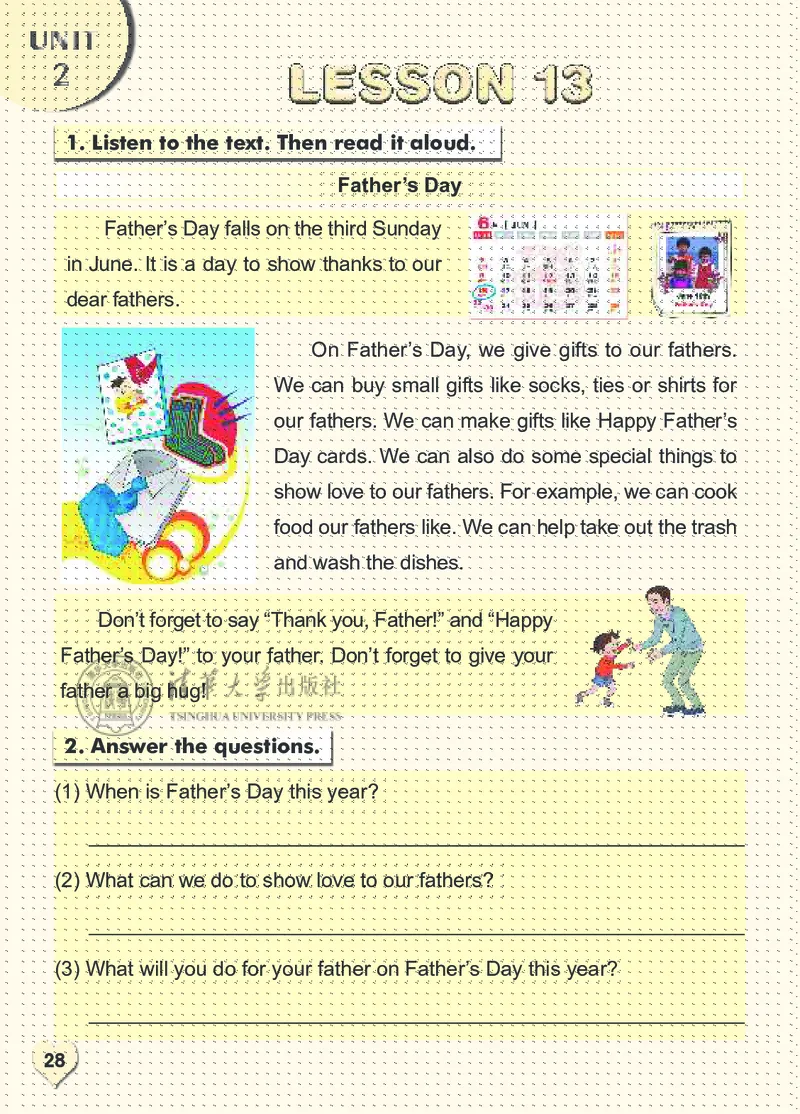
Father’s Day
Father’s Day falls on the third Sunday
in June. It is a day to show thanks to our
dear fathers.
On Father’s Day, we give gifts to our fathers.
We can buy small gifts like socks, ties or shirts for
our fathers. We can make gifts like Happy Father’s
Day cards. We can also do some special things to
show love to our fathers. For example, we can cook
food our fathers like. We can help take out the trash
and wash the dishes.
Don’t forget to say “Thank you, Father!” and “Happy
Father’s Day!” to your father. Don’t forget to give your
father a big hug!
2. Answer the questions.
(1) When is Father’s Day this year?
_________________________________________________________
(2) What can we do to show love to our fathers?
_________________________________________________________
(3) What will you do for your father on Father’s Day this year?
_________________________________________________________
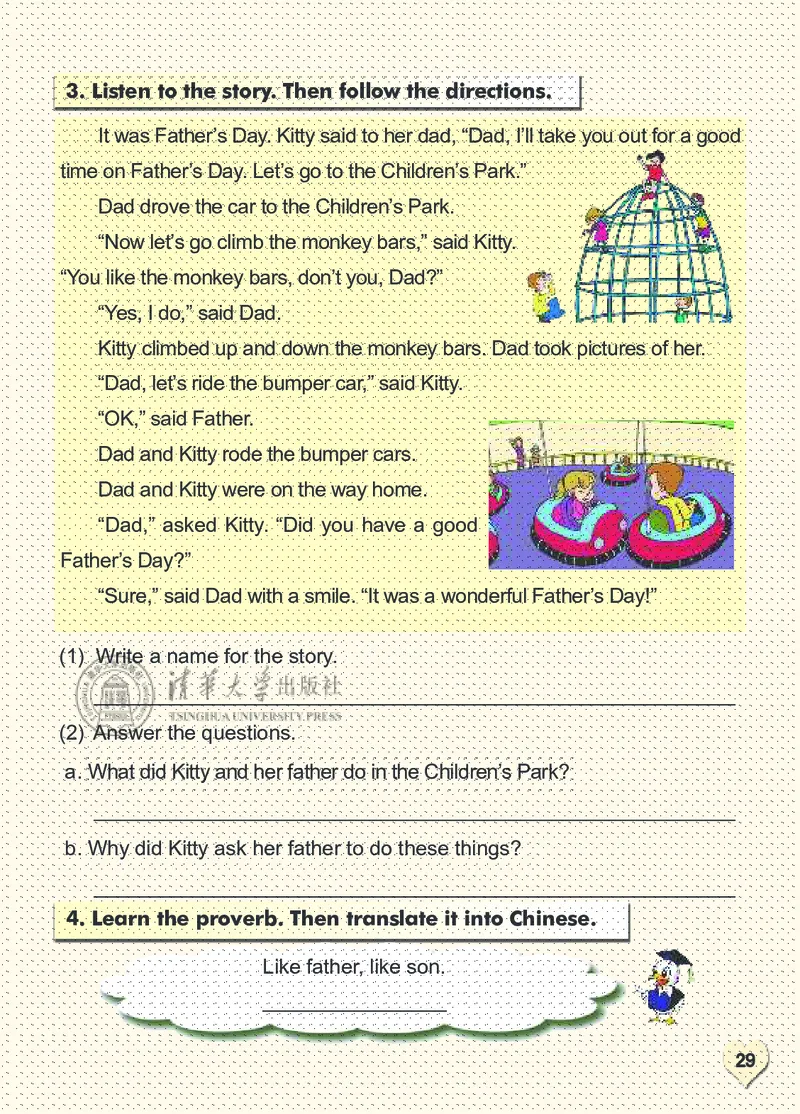
283. Listen to the story. Then follow the directions.
It was Father’s Day. Kitty said to her dad, “Dad, I’ll take you out for a good
time on Father’s Day. Let’s go to the Children’s Park.”
Dad drove the car to the Children’s Park.
“Now let’s go climb the monkey bars,” said Kitty.
“You like the monkey bars, don’t you, Dad?”
“Yes, I do,” said Dad.
Kitty climbed up and down the monkey bars. Dad took pictures of her.
“Dad, let’s ride the bumper car,” said Kitty.
“OK,” said Father.
Dad and Kitty rode the bumper cars.
Dad and Kitty were on the way home.
“Dad,” asked Kitty. “Did you have a good
Father’s Day?”
“Sure,” said Dad with a smile. “It was a wonderful Father’s Day!”
(1) Write a name for the story.
________________________________________________________
(2) Answer the questions.
a. What did Kitty and her father do in the Children’s Park?
________________________________________________________
b. Why did Kitty ask her father to do these things?
________________________________________________________
4. Learn the proverb. Then translate it into Chinese.
Like father, like son.
________________
291. Write a few sentences for each great holiday. The first one is
done for you.
_ _ V_a_l_e_n_ti_n_e_’s_ _D_a_y_ f_a_ll_s ___________________
o_n_ _F_e_b_r_u_a_r_y _1_4_._ I_t _i_s _a_ _s_p_e_c_ia_l _________________________
d__a_y_ _to_ _c_e_l_e_b_r_a_t_e_ _lo_v_e__. _R__e_d _________________________
r_o_s_e_s_,_ h_e__a_rt_s_ _a_n_d_ c_h_o__co__la_t_e_s _________________________
a_r_e_ V_a_l_e_n_ti_n_e_ s_y_m__b_o_ls_._______ _________________________
___________________ ___________________
_________________________ _________________________
_________________________ _________________________
_________________________ _________________________
_________________________ _________________________
2. Of the six holidays, which is your favorite? Why?
__________________________________________________________
__________________________________________________________
__________________________________________________________
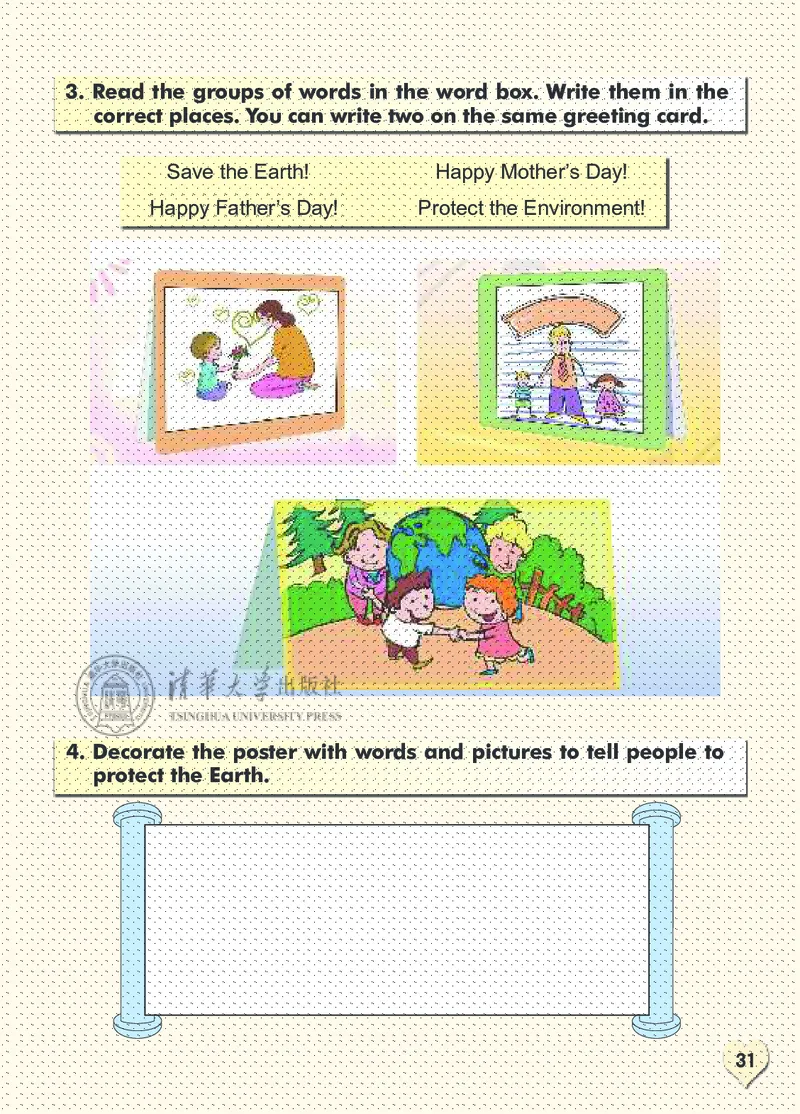
303. Read the groups of words in the word box. Write them in the
correct places. You can write two on the same greeting card.
Save the Earth! Happy Mother’s Day!
Happy Father’s Day! Protect the Environment!
4. Decorate the poster with words and pictures to tell people to
protect the Earth.
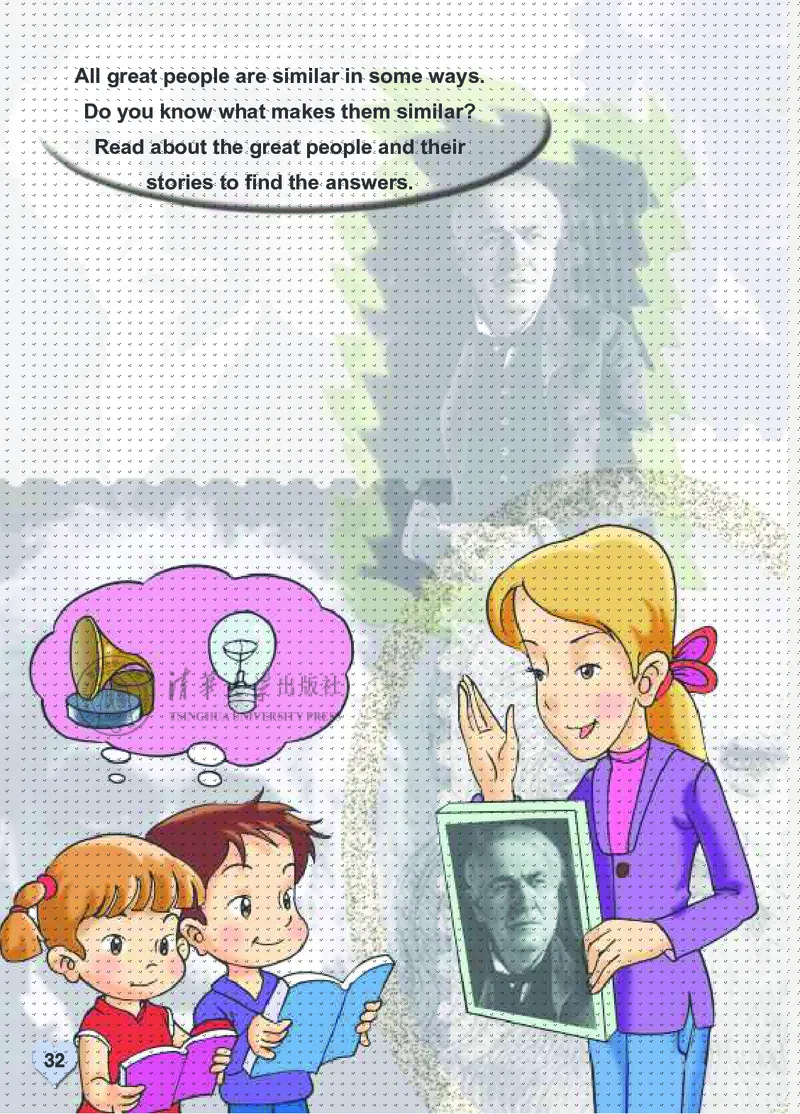
31All great people are similar in some ways.
Do you know what makes them similar?
Read about the great people and their
stories to find the answers.
32U N I T 3
GREAT PEOPLE
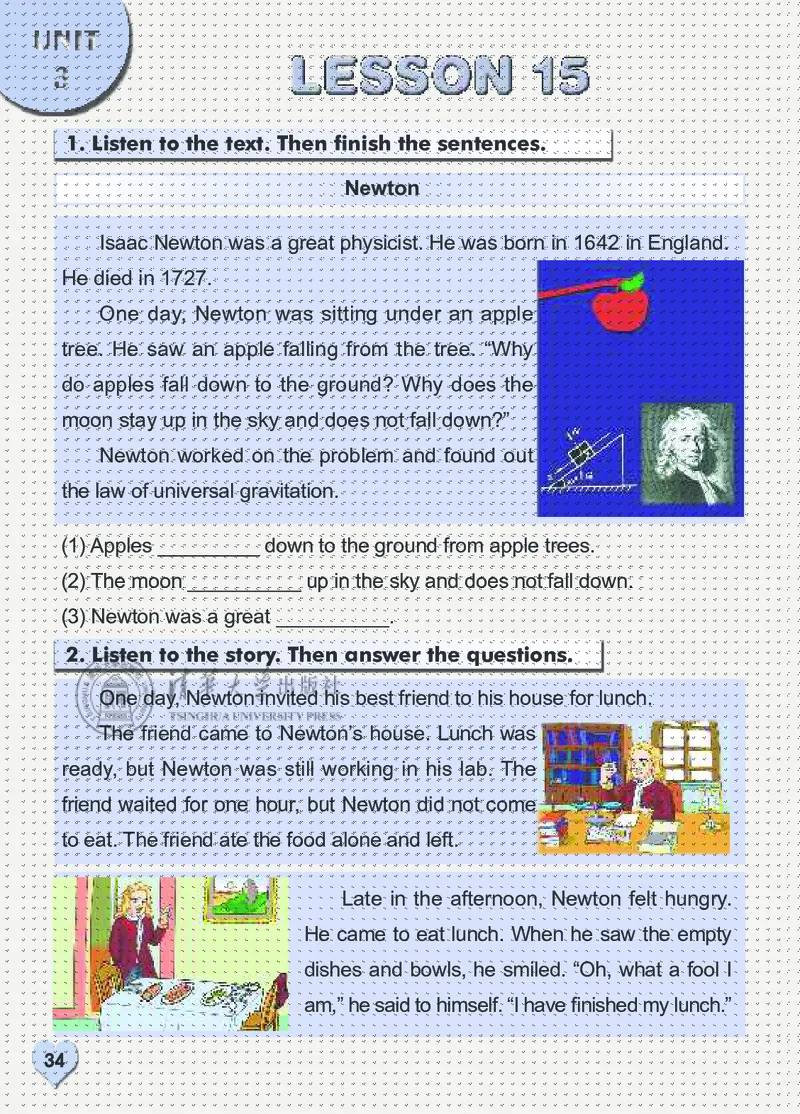
331. Listen to the text. Then finish the sentences.
Newton
Isaac Newton was a great physicist. He was born in 1642 in England.
He died in 1727.
One day, Newton was sitting under an apple
tree. He saw an apple falling from the tree. “Why
do apples fall down to the ground? Why does the
moon stay up in the sky and does not fall down?”
Newton worked on the problem and found out
the law of universal gravitation.
(1) Apples _________ down to the ground from apple trees.
(2) The moon __________ up in the sky and does not fall down.
(3) Newton was a great __________.
2. Listen to the story. Then answer the questions.
One day, Newton invited his best friend to his house for lunch.
The friend came to Newton’s house. Lunch was
ready, but Newton was still working in his lab. The
friend waited for one hour, but Newton did not come
to eat. The friend ate the food alone and left.
Late in the afternoon, Newton felt hungry.
He came to eat lunch. When he saw the empty
dishes and bowls, he smiled. “Oh, what a fool I
am,” he said to himself. “I have finished my lunch.”
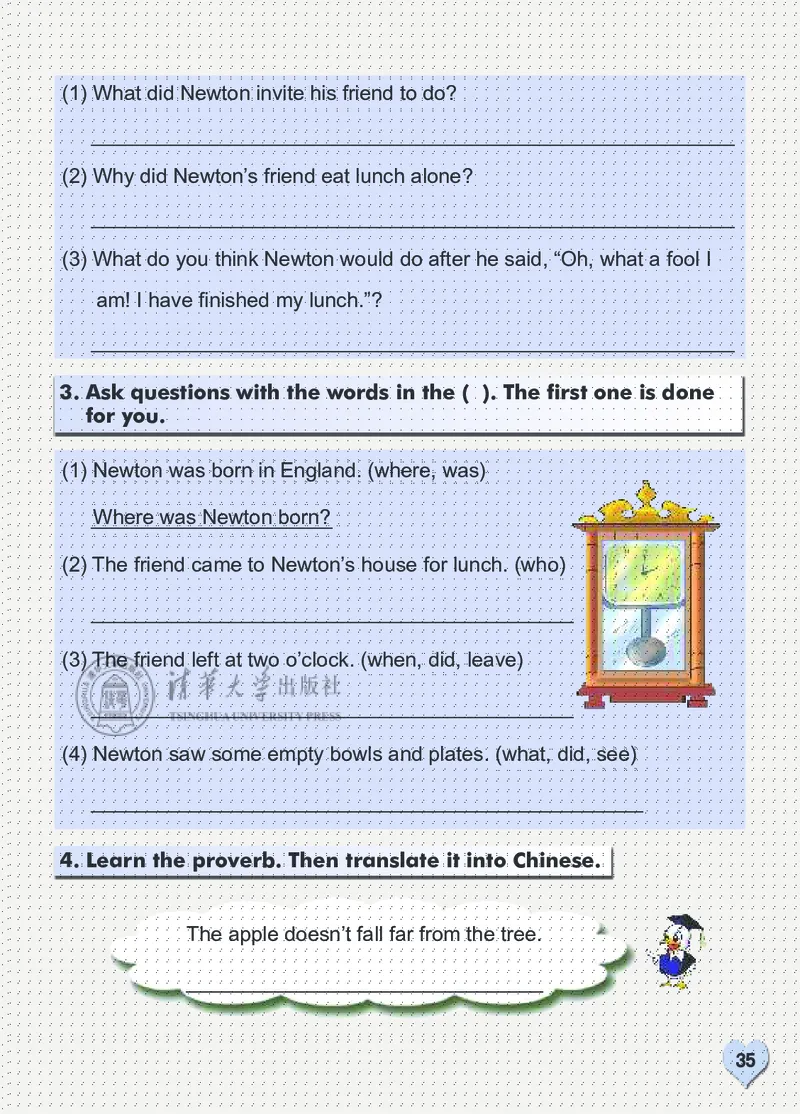
34(1) What did Newton invite his friend to do?
________________________________________________________
(2) Why did Newton’s friend eat lunch alone?
________________________________________________________
(3) What do you think Newton would do after he said, “Oh, what a fool I
am! I have finished my lunch.”?
________________________________________________________
3. Ask questions with the words in the ( ). The first one is done
for you.
(1) Newton was born in England. (where, was)
_W_h_e_r_e_ _w_a_s_ N__e_w_to_n_ _b_o_rn_?_
(2) The friend came to Newton’s house for lunch. (who)
__________________________________________
(3) The friend left at two o’clock. (when, did, leave)
__________________________________________
(4) Newton saw some empty bowls and plates. (what, did, see)
________________________________________________
4. Learn the proverb. Then translate it into Chinese.
The apple doesn’t fall far from the tree.
_______________________________
351. Listen to the text. Then answer the questions.
Edison
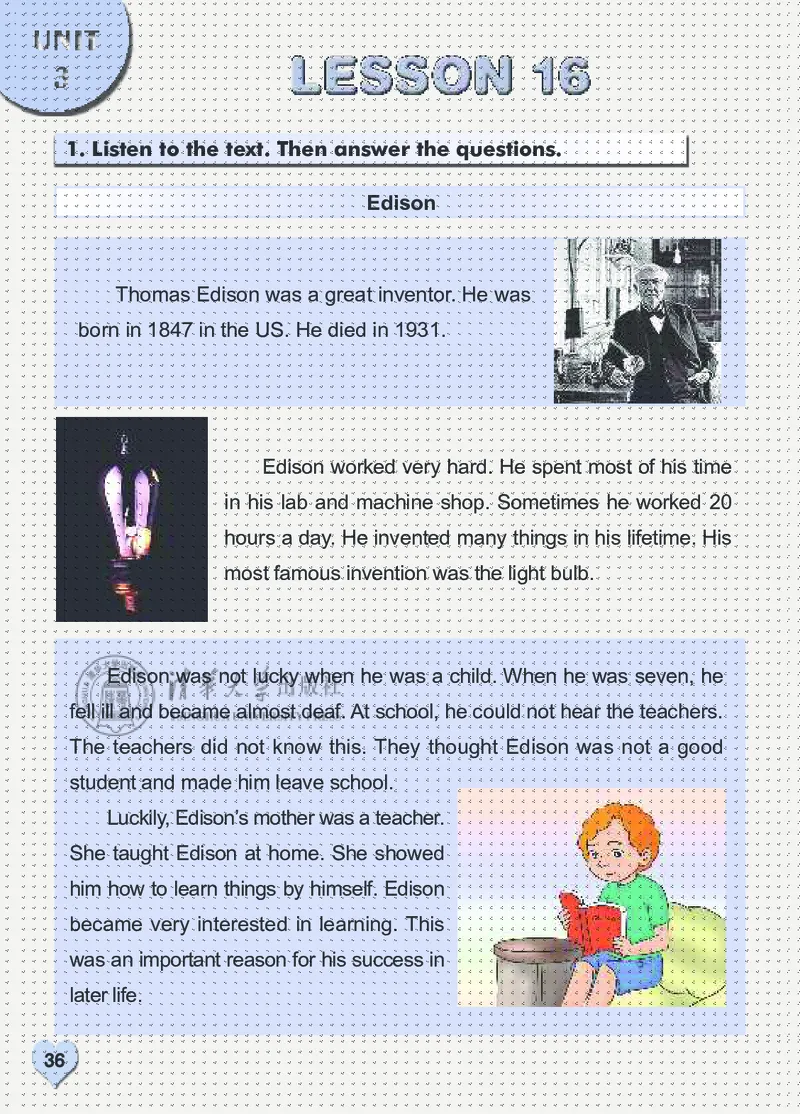
Thomas Edison was a great inventor. He was
born in 1847 in the US. He died in 1931.
Edison worked very hard. He spent most of his time
in his lab and machine shop. Sometimes he worked 20
hours a day. He invented many things in his lifetime. His
most famous invention was the light bulb.
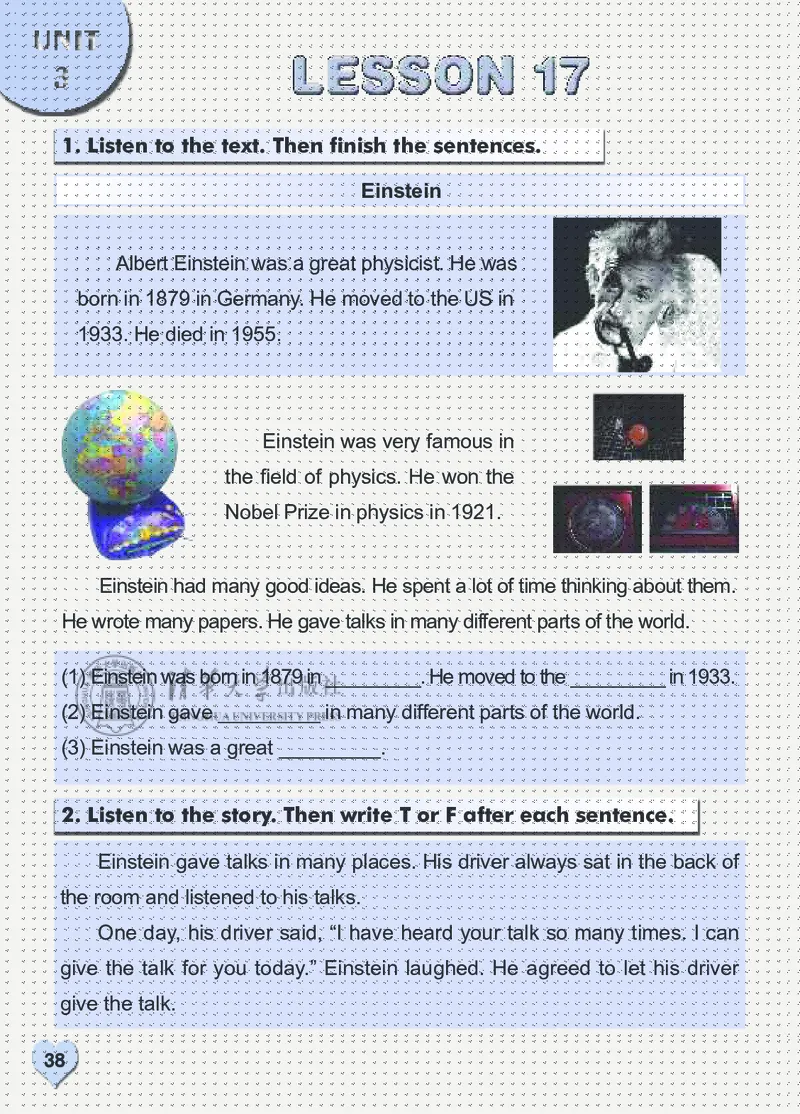
Edison was not lucky when he was a child. When he was seven, he
fell ill and became almost deaf. At school, he could not hear the teachers.
The teachers did not know this. They thought Edison was not a good
student and made him leave school.
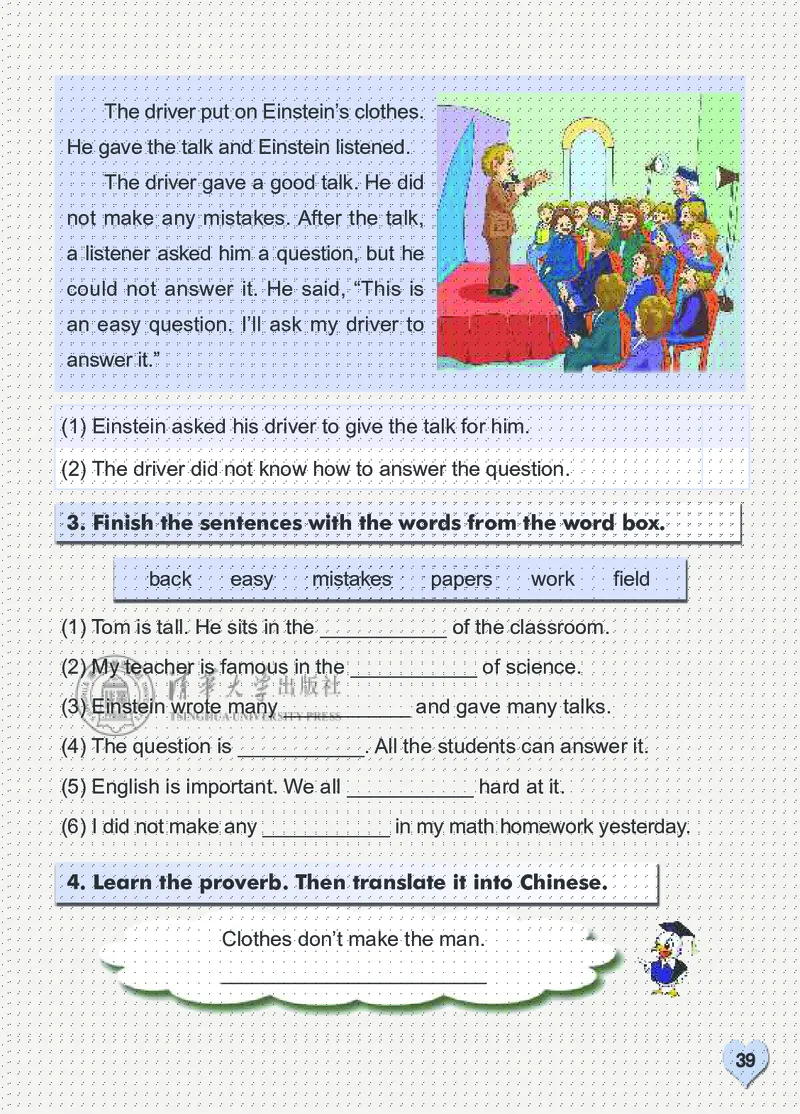
Luckily, Edison’s mother was a teacher.
She taught Edison at home. She showed
him how to learn things by himself. Edison
became very interested in learning. This
was an important reason for his success in
later life.
36(1) What was Edison’s most famous invention?
________________________________________________________
(2) What happened to Edison when he was seven years old?
________________________________________________________
(3) Why did the teachers make Edison leave school?
________________________________________________________
(4) Which sentence in the text tells us the important reason for Edison’s
success in later life?
________________________________________________________
2. Listen, read and write.
invent ___________ invention ___________ inventor ___________
success ___________ lifetime ___________ interested ___________
3. Below are questions with wh-words. Use the words in the ( )
to answer the questions. Then work in pairs.
(1) Where was Edison born? (was, in the US)
________________________________________
(2) What did Edison invent? (invented, the light bulb)
________________________________________
(3) Who taught Edison at home? (Edison’s mother)
________________________________________
(4) When did Edison die? (died, when he was 84 years old)
_____________________________________________
371. Listen to the text. Then finish the sentences.
Einstein
Albert Einstein was a great physicist. He was
born in 1879 in Germany. He moved to the US in
1933. He died in 1955.
Einstein was very famous in
the field of physics. He won the
Nobel Prize in physics in 1921.
Einstein had many good ideas. He spent a lot of time thinking about them.
He wrote many papers. He gave talks in many different parts of the world.
(1) Einstein was born in 1879 in _________. He moved to the _________ in 1933.
(2) Einstein gave _________ in many different parts of the world.
(3) Einstein was a great _________.
2. Listen to the story. Then write T or F after each sentence.
Einstein gave talks in many places. His driver always sat in the back of
the room and listened to his talks.
One day, his driver said, “I have heard your talk so many times. I can
give the talk for you today.” Einstein laughed. He agreed to let his driver
give the talk.
38The driver put on Einstein’s clothes.
He gave the talk and Einstein listened.
The driver gave a good talk. He did
not make any mistakes. After the talk,
a listener asked him a question, but he
could not answer it. He said, “This is
an easy question. I’ll ask my driver to
answer it.”
(1) Einstein asked his driver to give the talk for him.
(2) The driver did not know how to answer the question.
3. Finish the sentences with the words from the word box.
back easy mistakes papers work field
(1) Tom is tall. He sits in the ___________ of the classroom.
(2) My teacher is famous in the ___________ of science.
(3) Einstein wrote many ___________ and gave many talks.
(4) The question is ___________. All the students can answer it.
(5) English is important. We all ___________ hard at it.
(6) I did not make any ___________ in my math homework yesterday.
4. Learn the proverb. Then translate it into Chinese.
Clothes don’t make the man.
_______________________
391. Listen to the text. Then answer the questions.
Da Vinci
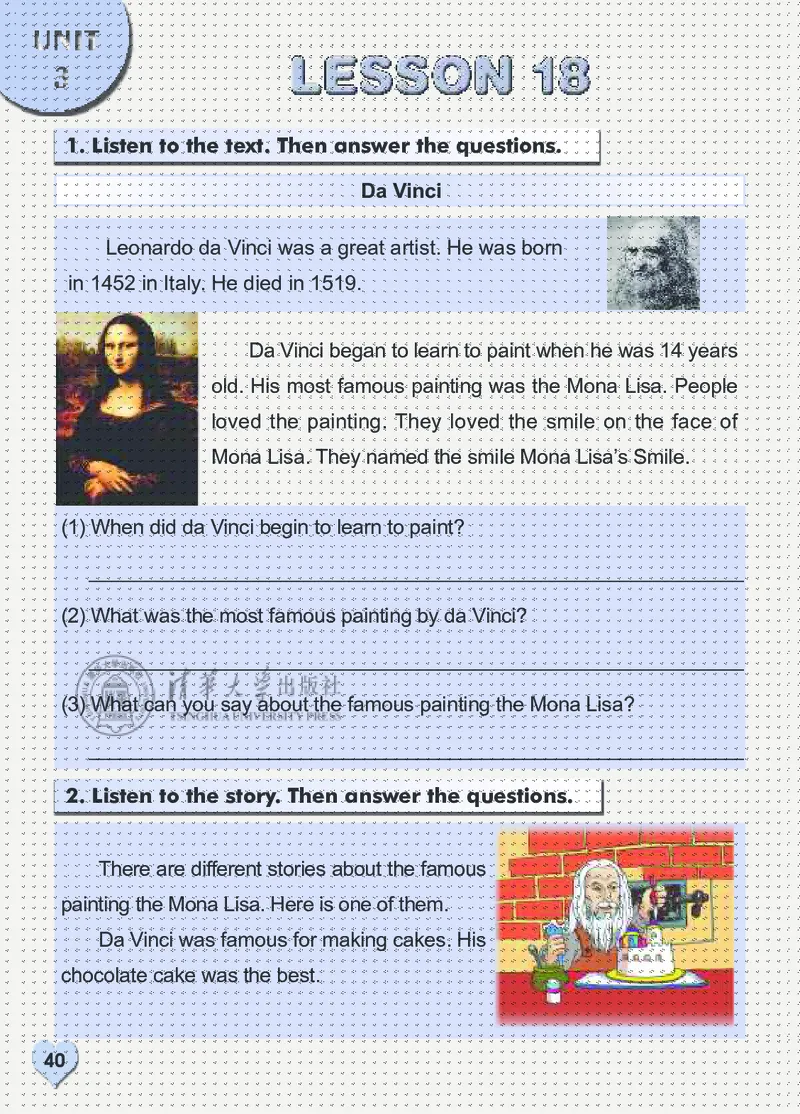
Leonardo da Vinci was a great artist. He was born
in 1452 in Italy. He died in 1519.
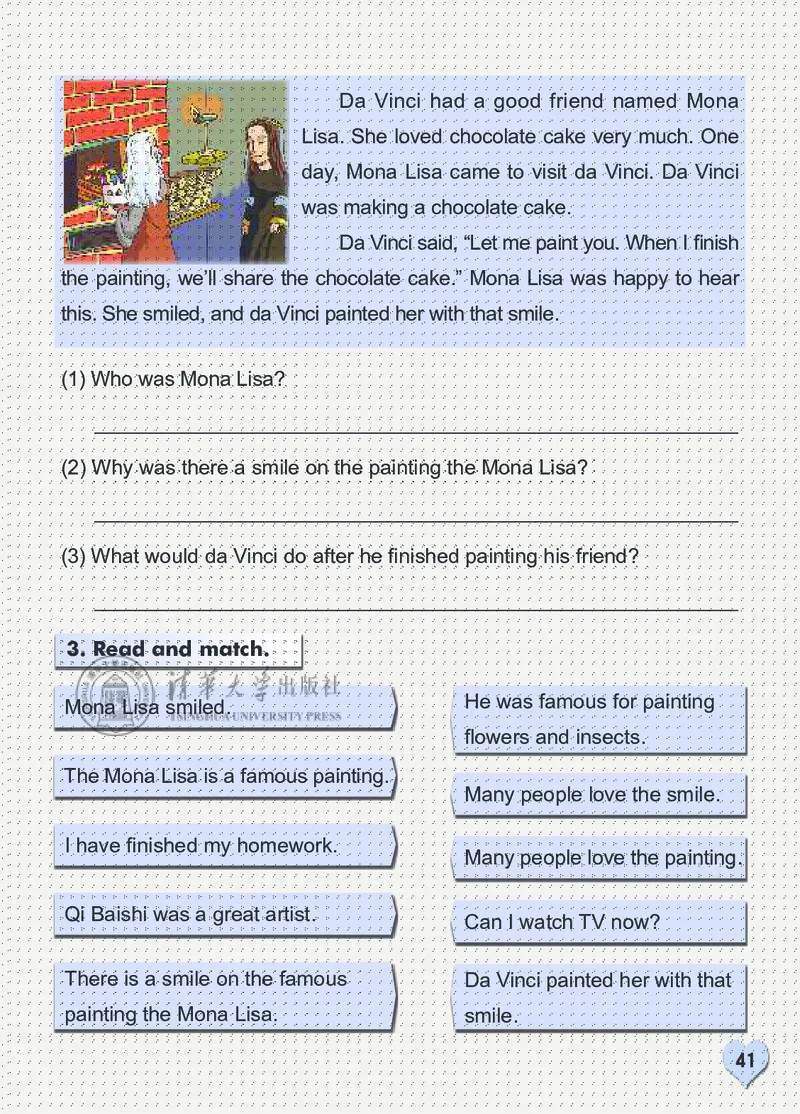
Da Vinci began to learn to paint when he was 14 years
old. His most famous painting was the Mona Lisa. People
loved the painting. They loved the smile on the face of
Mona Lisa. They named the smile Mona Lisa’s Smile.
(1) When did da Vinci begin to learn to paint?
__________________________________________________________
(2) What was the most famous painting by da Vinci?
__________________________________________________________
(3) What can you say about the famous painting the Mona Lisa?
__________________________________________________________
2. Listen to the story. Then answer the questions.
There are different stories about the famous
painting the Mona Lisa. Here is one of them.
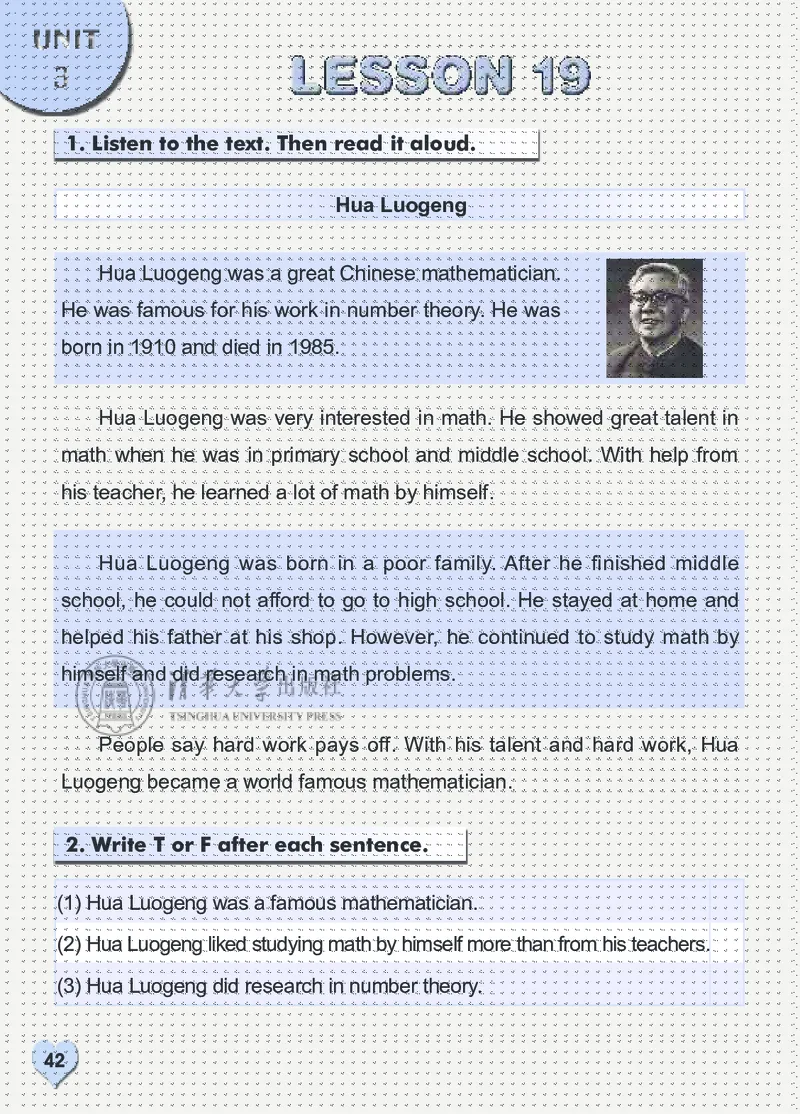
Da Vinci was famous for making cakes. His
chocolate cake was the best.
40Da Vinci had a good friend named Mona
Lisa. She loved chocolate cake very much. One
day, Mona Lisa came to visit da Vinci. Da Vinci
was making a chocolate cake.
Da Vinci said, “Let me paint you. When I finish
the painting, we’ll share the chocolate cake.” Mona Lisa was happy to hear
this. She smiled, and da Vinci painted her with that smile.
(1) Who was Mona Lisa?
_________________________________________________________
(2) Why was there a smile on the painting the Mona Lisa?
_________________________________________________________
(3) What would da Vinci do after he finished painting his friend?
_________________________________________________________
3. Read and match.
He was famous for painting
Mona Lisa smiled.
flowers and insects.
The Mona Lisa is a famous painting.
Many people love the smile.
I have finished my homework.
Many people love the painting.
Qi Baishi was a great artist.
Can I watch TV now?
There is a smile on the famous Da Vinci painted her with that
painting the Mona Lisa. smile.
411. Listen to the text. Then read it aloud.
Hua Luogeng
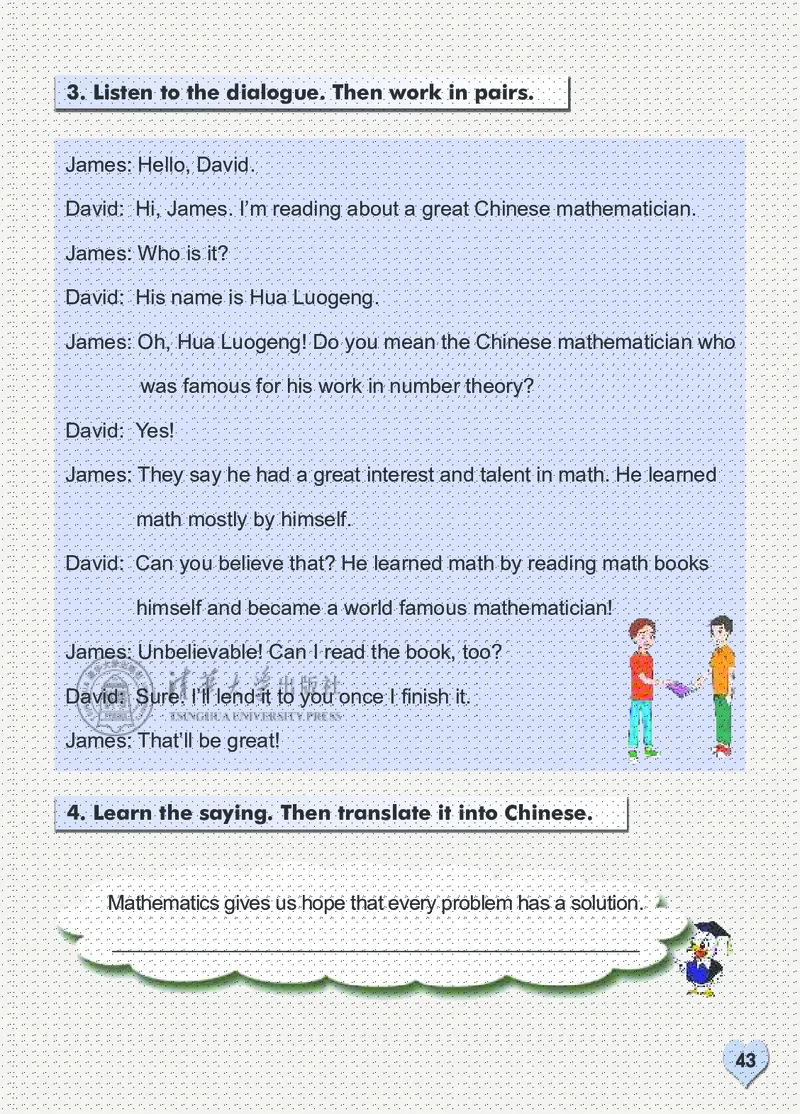
Hua Luogeng was a great Chinese mathematician.
He was famous for his work in number theory. He was
born in 1910 and died in 1985.
Hua Luogeng was very interested in math. He showed great talent in
math when he was in primary school and middle school. With help from
his teacher, he learned a lot of math by himself.
Hua Luogeng was born in a poor family. After he finished middle
school, he could not afford to go to high school. He stayed at home and
helped his father at his shop. However, he continued to study math by
himself and did research in math problems.
People say hard work pays off. With his talent and hard work, Hua
Luogeng became a world famous mathematician.
2. Write T or F after each sentence.
(1) Hua Luogeng was a famous mathematician.
(2) Hua Luogeng liked studying math by himself more than from his teachers.
(3) Hua Luogeng did research in number theory.
423. Listen to the dialogue. Then work in pairs.
James: Hello, David.
David: Hi, James. I’m reading about a great Chinese mathematician.
James: Who is it?
David: His name is Hua Luogeng.
James: Oh, Hua Luogeng! Do you mean the Chinese mathematician who
was famous for his work in number theory?
David: Yes!
James: They say he had a great interest and talent in math. He learned
math mostly by himself.
David: Can you believe that? He learned math by reading math books
himself and became a world famous mathematician!
James: Unbelievable! Can I read the book, too?
David: Sure. I’ll lend it to you once I finish it.
James: That’ll be great!
4. Learn the saying. Then translate it into Chinese.
Mathematics gives us hope that every problem has a solution.
________________________________________________
431. Listen to the text. Then read it aloud.
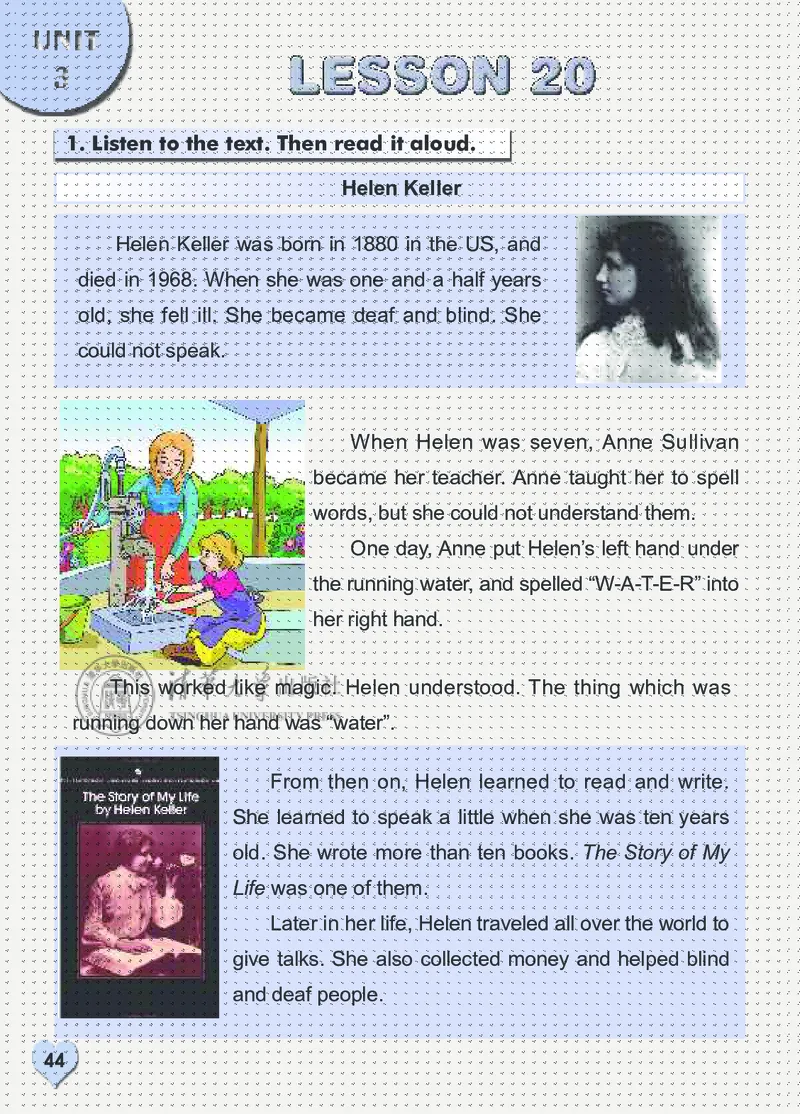
Helen Keller
Helen Keller was born in 1880 in the US, and
died in 1968. When she was one and a half years
old, she fell ill. She became deaf and blind. She
could not speak.
When Helen was seven, Anne Sullivan
became her teacher. Anne taught her to spell
words, but she could not understand them.
One day, Anne put Helen’s left hand under
the running water, and spelled “W-A-T-E-R” into
her right hand.
This worked like magic. Helen understood. The thing which was
running down her hand was “water”.
From then on, Helen learned to read and write.
She learned to speak a little when she was ten years
old. She wrote more than ten books. The Story of My
Life was one of them.
Later in her life, Helen traveled all over the world to
give talks. She also collected money and helped blind
and deaf people.
442. Write T or F after each sentence.
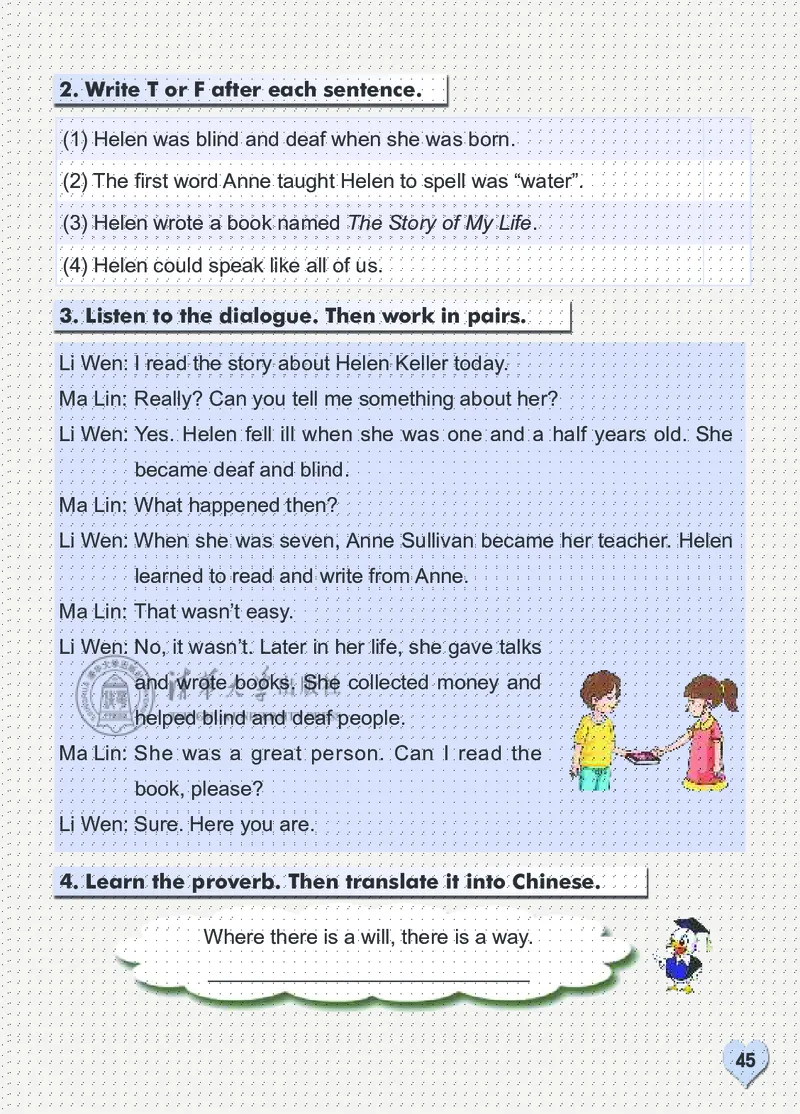
(1) Helen was blind and deaf when she was born.
(2) The first word Anne taught Helen to spell was “water”.
(3) Helen wrote a book named The Story of My Life.
(4) Helen could speak like all of us.
3. Listen to the dialogue. Then work in pairs.
Li Wen: I read the story about Helen Keller today.
Ma Lin: Really? Can you tell me something about her?
Li Wen: Yes. Helen fell ill when she was one and a half years old. She
became deaf and blind.
Ma Lin: What happened then?
Li Wen: When she was seven, Anne Sullivan became her teacher. Helen
learned to read and write from Anne.
Ma Lin: That wasn’t easy.
Li Wen: No, it wasn’t. Later in her life, she gave talks
and wrote books. She collected money and
helped blind and deaf people.
Ma Lin: She was a great person. Can I read the
book, please?
Li Wen: Sure. Here you are.
4. Learn the proverb. Then translate it into Chinese.
Where there is a will, there is a way.
____________________________
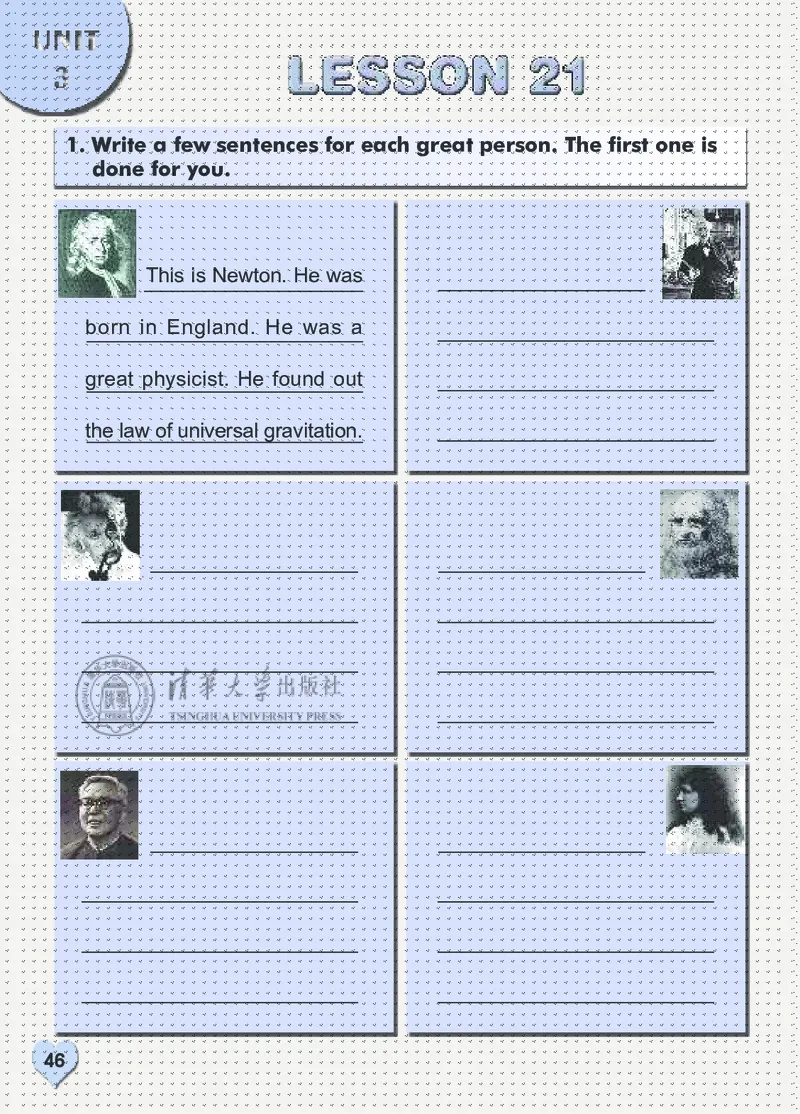
451. Write a few sentences for each great person. The first one is
done for you.
This is Newton. He was ___________________
b_o__rn_ _i_n_ E__n_g_la__n_d_. _H_e__ w__a_s_ _a
g_r_e_a_t_ p_h_y_s_i_c_is_t._ _H_e_ _fo_u_n_d_ _o_u_t
t_h_e_ l_a_w_ o_f_ u_n_i_v_e_rs_a_l _g_ra_v_i_ta_t_io_n_.
_
_
_
_
_
_
_
_
_
_
_
_
_
_
_
_
_
_
_
_
_
_
_
_
_
_
_
_
_
_
_
_
_
_
_
_
_
_
_
_
_
_
_
_
_
_
_
_
_
_
_
_
_
_
_
_
_
_
_
_
_
_
_
_
_
_
_
_
_
_
_
_
_
_
_
_
_
_
_
_
_
_
_
_
_
_
_
_
_
_
_
_
_
_
_
_
_
_
_
_
_
_
_
_
_
_
_
_
_
_
_
_
_
_
_
_
_
_
_
_
_
_
_
_
_
_
_
_
_
_
_
_
_
_
_
_
_
_
_
_
_
_
_
_
_
_
_
_
_
_
_
_
_
_
_
_
_
_
_
_
_
_
_
_
_
_
_
_
_
_
_
_
_
_
_
_
_
_
_
_
_
_
_
_
_
_
_
_
_
_
_
_
_
_
_
_
_
_
_
_
_
_
_
_
_
_
_
_
_
_
_
_
_
_
_
_
_
_
_
_
_
_
_
_
_
_
_
_
_
_
_
_
_
_
_
_
_
_
_
_
_
_
_
_
_
_
_
_
_
_
_
_
_
_
_
_
_
_
_
_
_
_
_
_
_
_
_
_
_
_
__________________
________________________
________________________
________________________
__________________
________________________
________________________
________________________
462. Let’s sing!
This land is your land, this land is my land
From California to the New York Island
From the redwood forest to the gulf stream waters
This land was made for you and me.
As I went walking that ribbon of highway
I saw above me that endless skyway
I saw below me that golden valley
This land was made for you and me.
This land is ...
I roamed and rambled, and I followed my footsteps
To the sparkling sands of her diamond deserts
All around me a voice was sounding
This land was made for you and me.
This land is ...
When the sun came shining, then I was strolling
And the wheat fields waving, and the dust clouds rolling
A voice was chanting as the fog was lifting
This land was made for you and me.
47What do you think
about fables? They are just amazing!
I cannot wait to read more...
48U N I T 4
INTERESTING FABLES
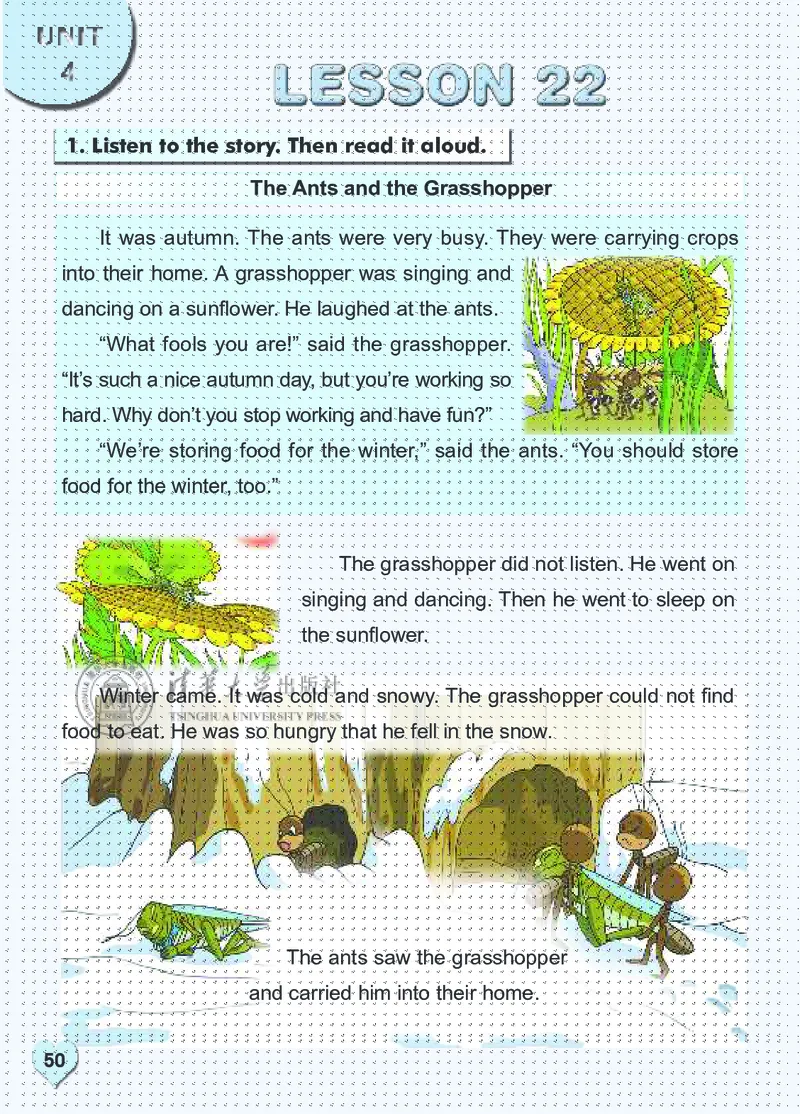
44991. Listen to the story. Then read it aloud.
The Ants and the Grasshopper
It was autumn. The ants were very busy. They were carrying crops
into their home. A grasshopper was singing and
dancing on a sunflower. He laughed at the ants.
“What fools you are!” said the grasshopper.
“It’s such a nice autumn day, but you’re working so
hard. Why don’t you stop working and have fun?”
“We’re storing food for the winter,” said the ants. “You should store
food for the winter, too.”
The grasshopper did not listen. He went on
singing and dancing. Then he went to sleep on
the sunflower.
Winter came. It was cold and snowy. The grasshopper could not find
food to eat. He was so hungry that he fell in the snow.
The ants saw the grasshopper
and carried him into their home.
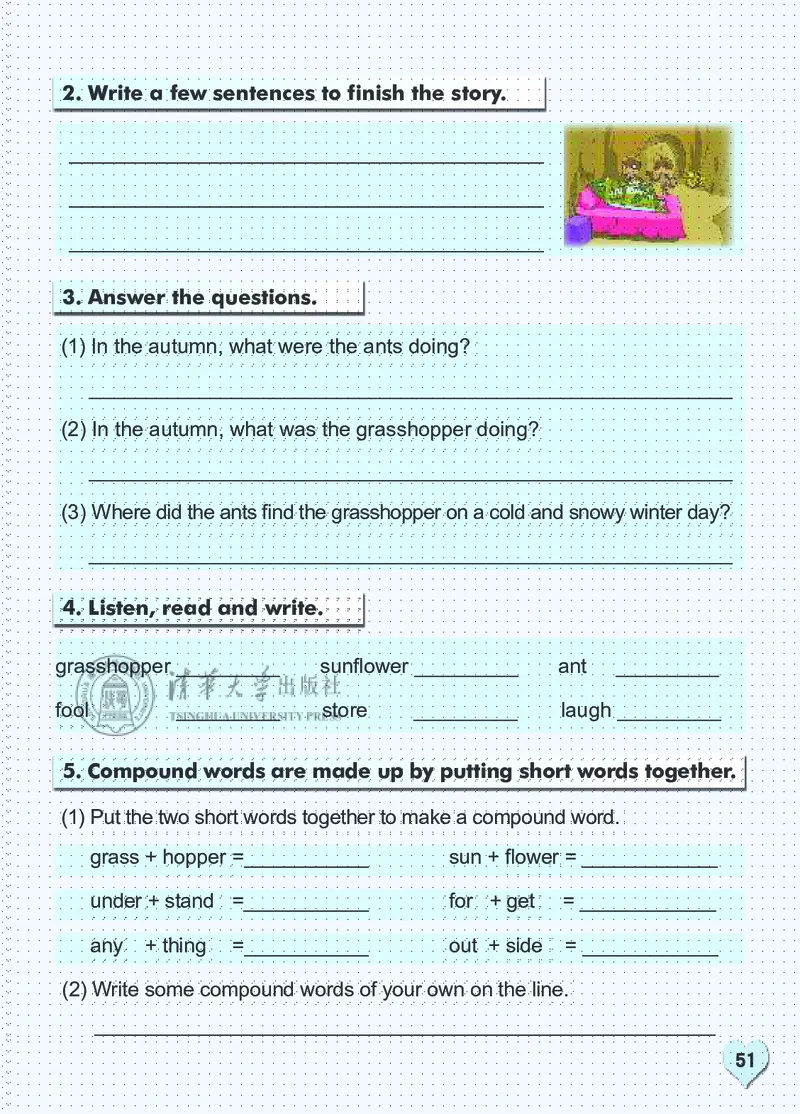
502. Write a few sentences to finish the story.
__________________________________________
__________________________________________
__________________________________________
3. Answer the questions.
(1) In the autumn, what were the ants doing?
_________________________________________________________
(2) In the autumn, what was the grasshopper doing?
_________________________________________________________
(3) Where did the ants find the grasshopper on a cold and snowy winter day?
_________________________________________________________
4. Listen, read and write.
grasshopper _________ sunflower _________ ant _________
fool _________ store _________ laugh _________
5. Compound words are made up by putting short words together.
(1) Put the two short words together to make a compound word.
grass + hopper =___________ sun + flower = ____________
under + stand =___________ for + get = ____________
any + thing =___________ out + side = ____________
(2) Write some compound words of your own on the line.
_______________________________________________________
511. Listen to the story. Then read it aloud.
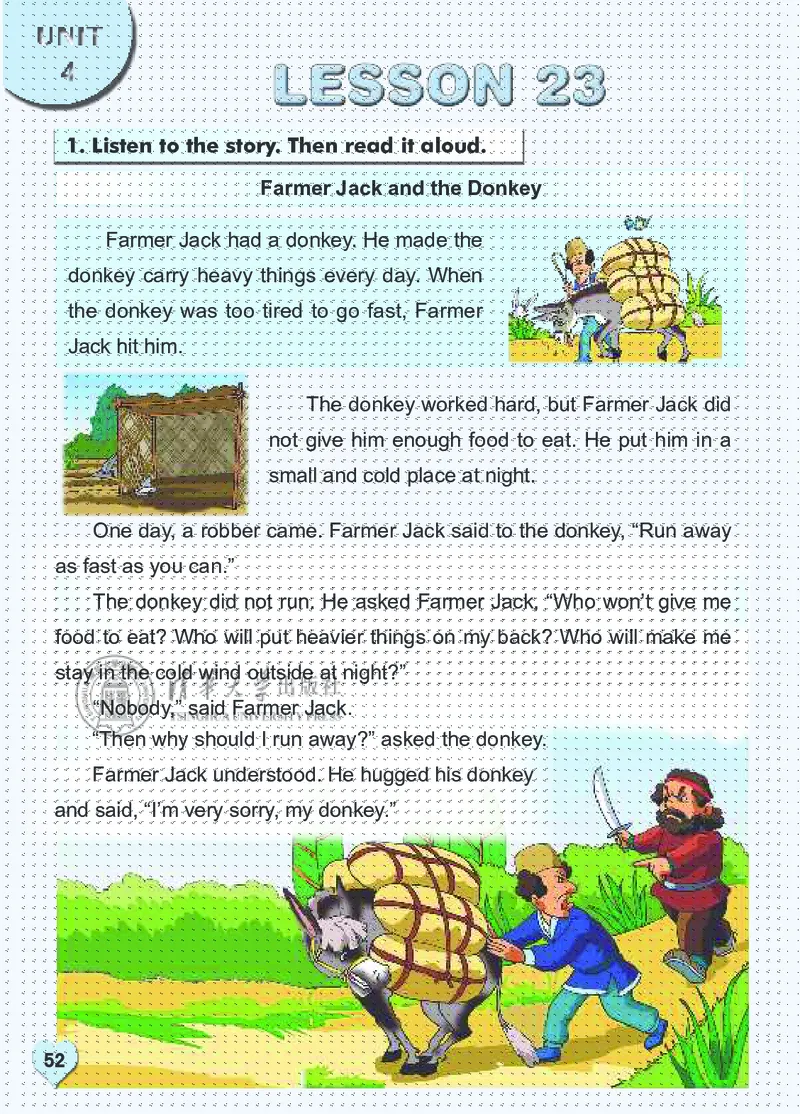
Farmer Jack and the Donkey
Farmer Jack had a donkey. He made the
donkey carry heavy things every day. When
the donkey was too tired to go fast, Farmer
Jack hit him.
The donkey worked hard, but Farmer Jack did
not give him enough food to eat. He put him in a
small and cold place at night.
One day, a robber came. Farmer Jack said to the donkey, “Run away
as fast as you can.”
The donkey did not run. He asked Farmer Jack, “Who won’t give me
food to eat? Who will put heavier things on my back? Who will make me
stay in the cold wind outside at night?”
“Nobody,” said Farmer Jack.
“Then why should I run away?” asked the donkey.
Farmer Jack understood. He hugged his donkey
and said, “I’m very sorry, my donkey.”
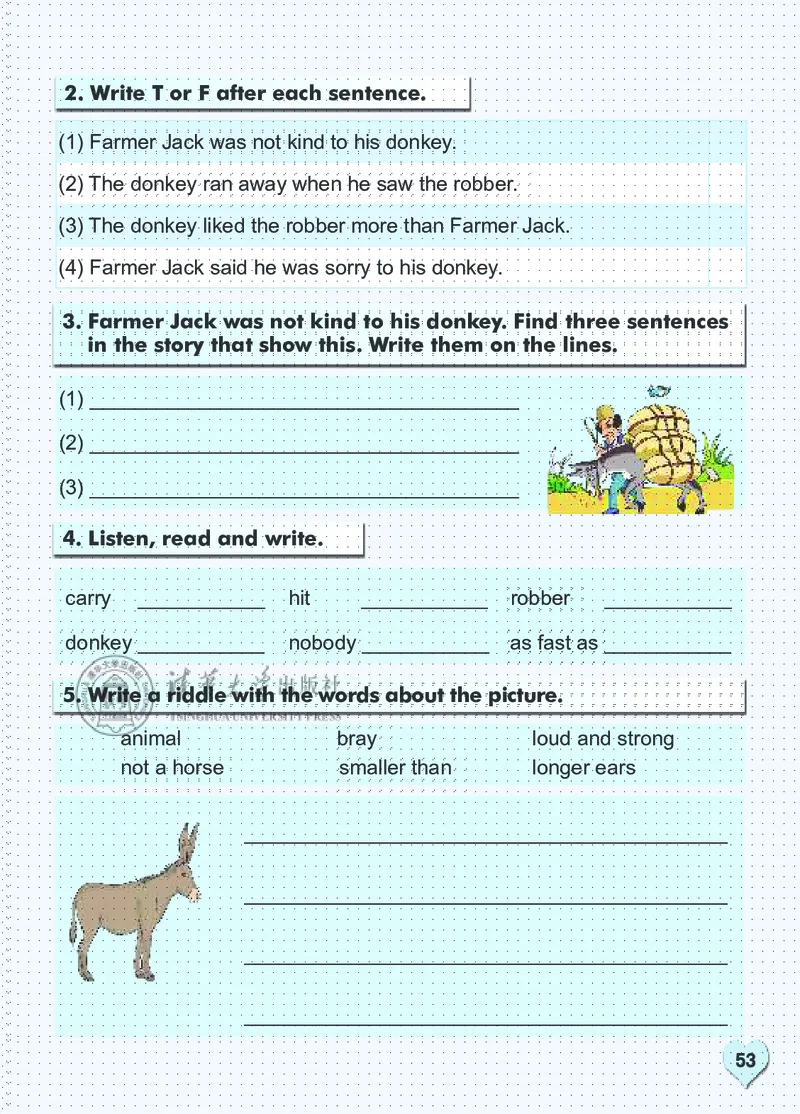
522. Write T or F after each sentence.
(1) Farmer Jack was not kind to his donkey.
(2) The donkey ran away when he saw the robber.
(3) The donkey liked the robber more than Farmer Jack.
(4) Farmer Jack said he was sorry to his donkey.
3. Farmer Jack was not kind to his donkey. Find three sentences
in the story that show this. Write them on the lines.
(1) ______________________________________
(2) ______________________________________
(3) ______________________________________
4. Listen, read and write.
carry ___________ hit ___________ robber ___________
donkey ___________ nobody ___________ as fast as ___________
5. Write a riddle with the words about the picture.
animal bray loud and strong
not a horse smaller than longer ears
__________________________________________
__________________________________________
__________________________________________
__________________________________________
531. Listen to the story. Then read it aloud.
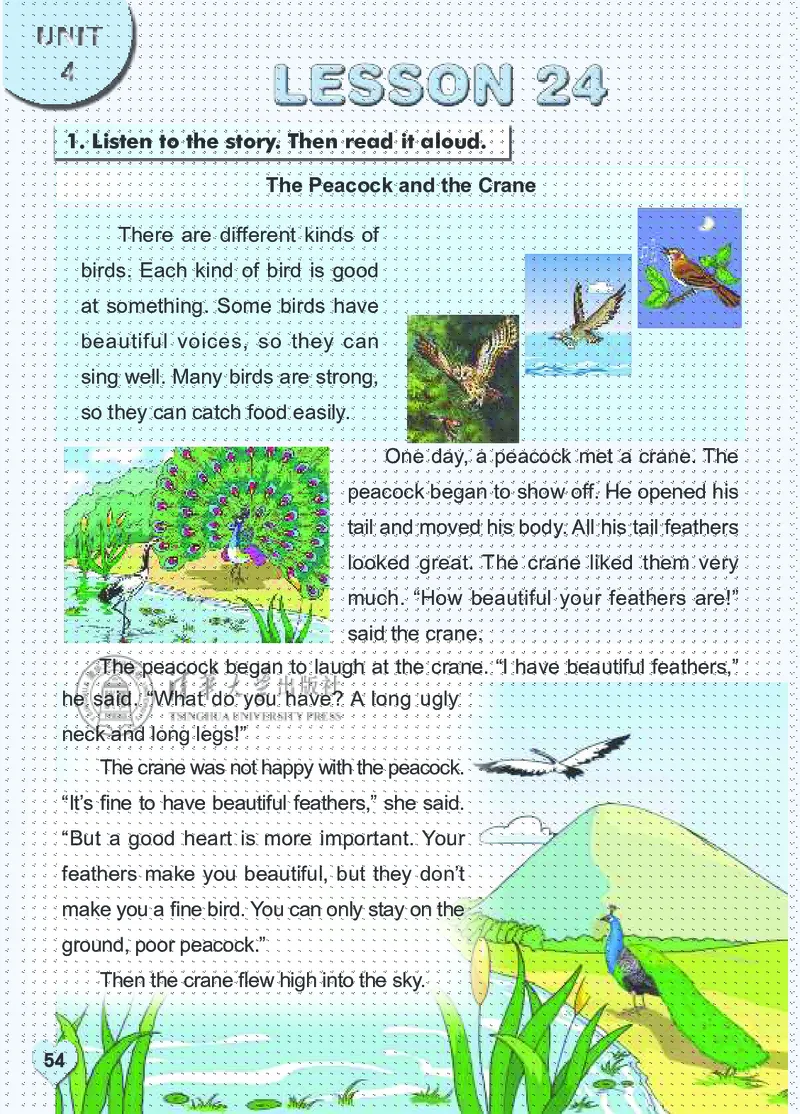
The Peacock and the Crane
There are different kinds of
birds. Each kind of bird is good
at something. Some birds have
beautiful voices, so they can
sing well. Many birds are strong,
so they can catch food easily.
One day, a peacock met a crane. The
peacock began to show off. He opened his
tail and moved his body. All his tail feathers
looked great. The crane liked them very
much. “How beautiful your feathers are!”
said the crane.
The peacock began to laugh at the crane. “I have beautiful feathers,”
he said. “What do you have? A long ugly
neck and long legs!”
The crane was not happy with the peacock.
“It’s fine to have beautiful feathers,” she said.
“But a good heart is more important. Your
feathers make you beautiful, but they don’t
make you a fine bird. You can only stay on the
ground, poor peacock.”
Then the crane flew high into the sky.
542. Answer the questions.
(1) What did the crane say about the peacock’s feathers?
_________________________________________________________
(2) In what way is the peacock not a fine bird?
_ ________________________________________________________
(3) What did you learn from the story?
_ ________________________________________________________
3. Listen, read and write.
feather _________ neck __________ look great ___________
peacock _________ crane __________ show off ___________
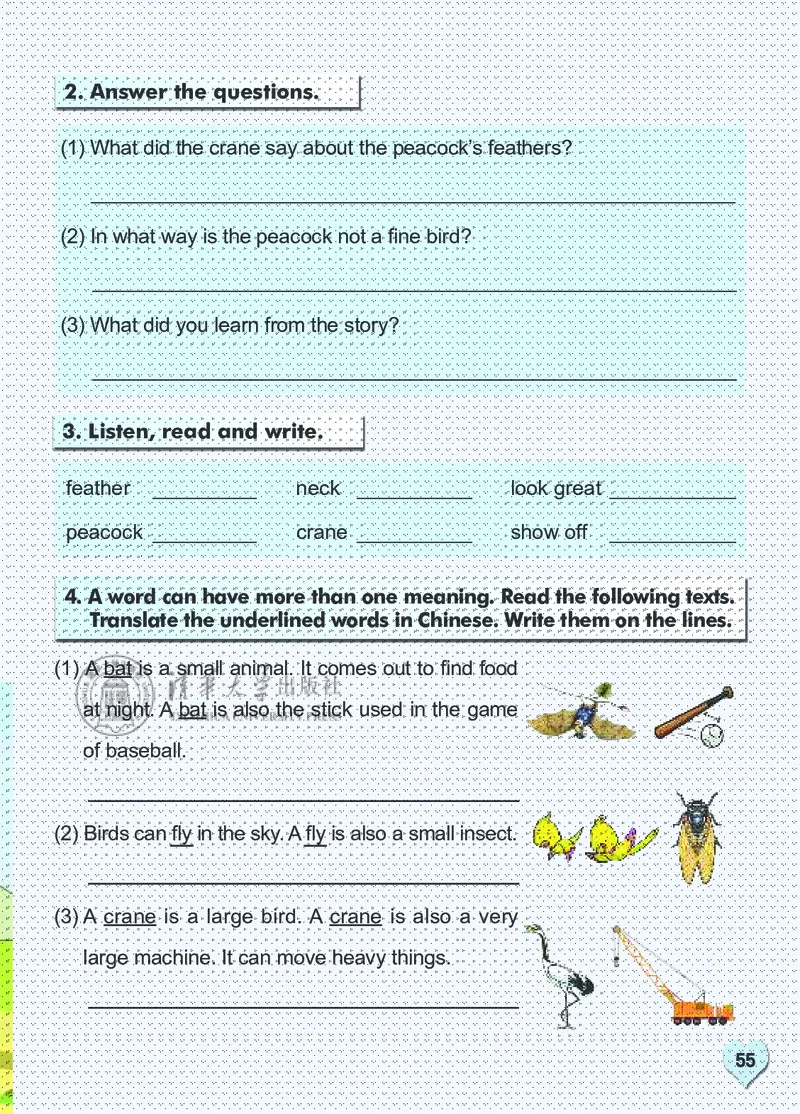
4. A word can have more than one meaning. Read the following texts.
Translate the underlined words in Chinese. Write them on the lines.
(1) A bat is a small animal. It comes out to find food
at night. A bat is also the stick used in the game
of baseball.
(2) Birds can fl y in the sky. A fl y is also a small insect.
(3) A crane is a large bird. A crane is also a very
large machine. It can move heavy things.
551. Listen to the story. Then read it aloud.
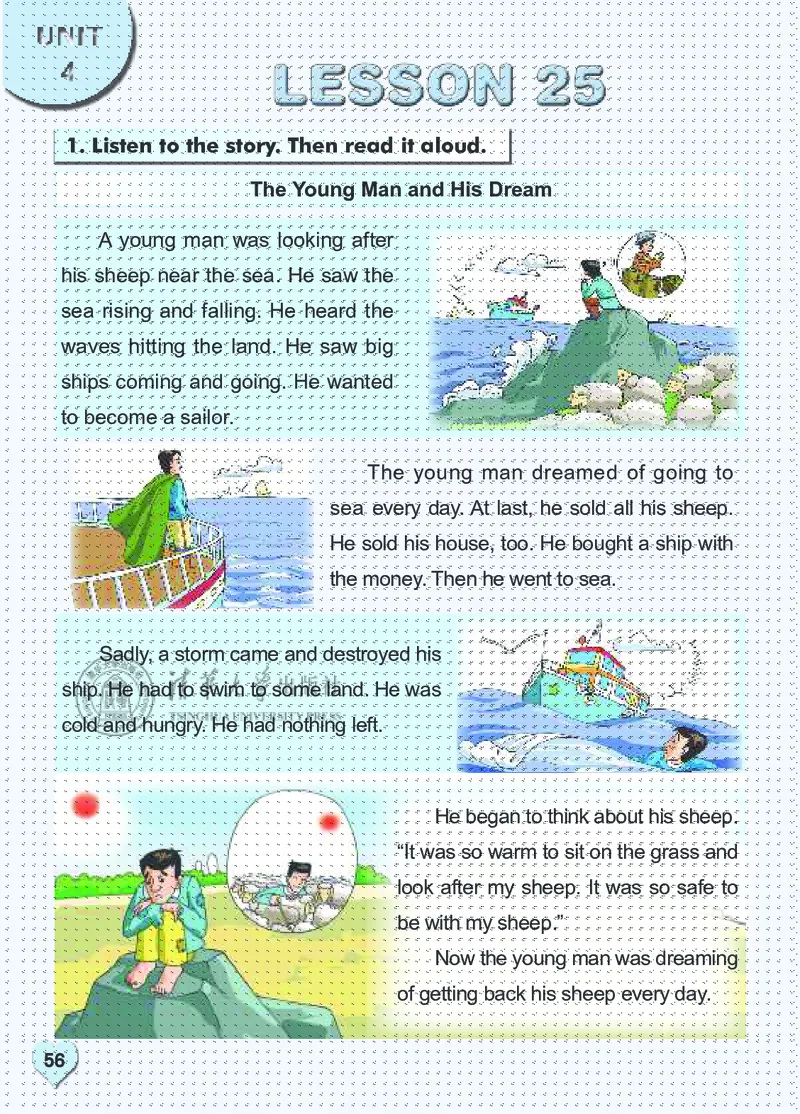
The Young Man and His Dream
A young man was looking after
his sheep near the sea. He saw the
sea rising and falling. He heard the
waves hitting the land. He saw big
ships coming and going. He wanted
to become a sailor.
The young man dreamed of going to
sea every day. At last, he sold all his sheep.
He sold his house, too. He bought a ship with
the money. Then he went to sea.
Sadly, a storm came and destroyed his
ship.He had to swim to some land. He was
cold and hungry. He had nothing left.
He began to think about his sheep.
“It was so warm to sit on the grass and
look after my sheep. It was so safe to
be with my sheep.”
Now the young man was dreaming
of getting back his sheep every day.
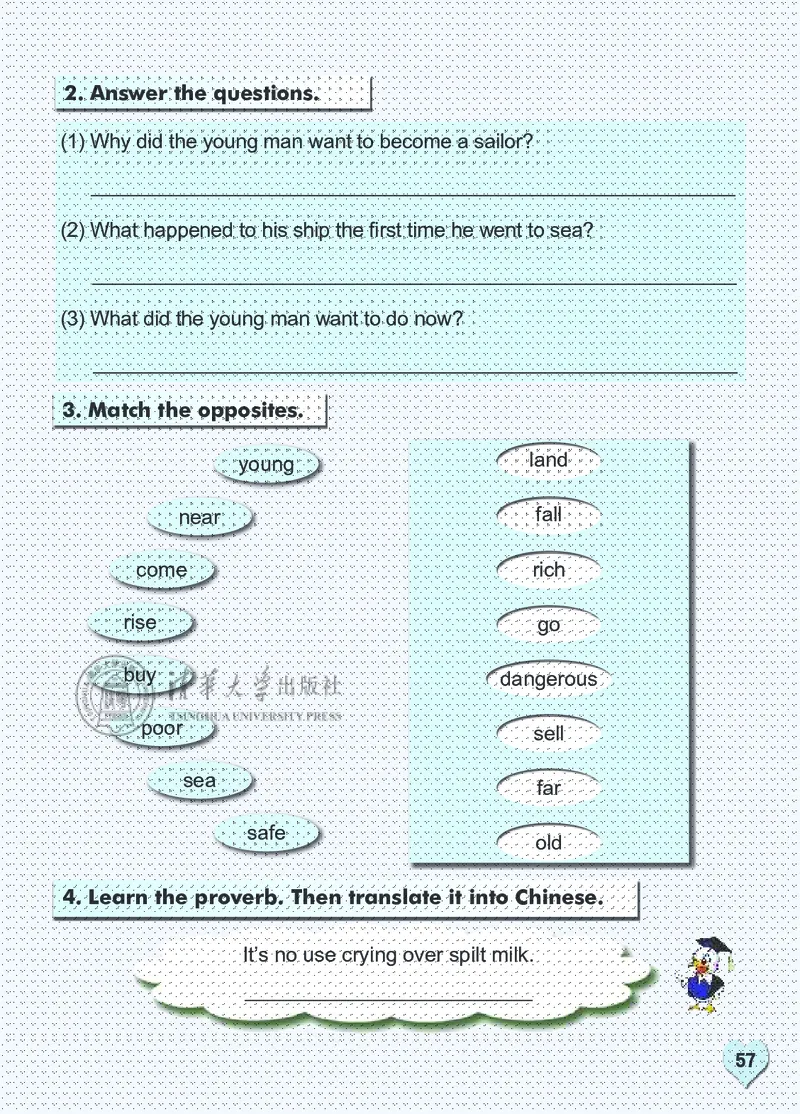
562. Answer the questions.
(1) Why did the young man want to become a sailor?
_________________________________________________________
(2) What happened to his ship the first time he went to sea?
_ ________________________________________________________
(3) What did the young man want to do now?
_ ________________________________________________________
3. Match the opposites.
young land
near fall
come rich
rise go
buy dangerous
poor
sell
sea
far
safe
old
4. Learn the proverb. Then translate it into Chinese.
It’s no use crying over spilt milk.
_________________________
571. Listen to the story. Then read it aloud.
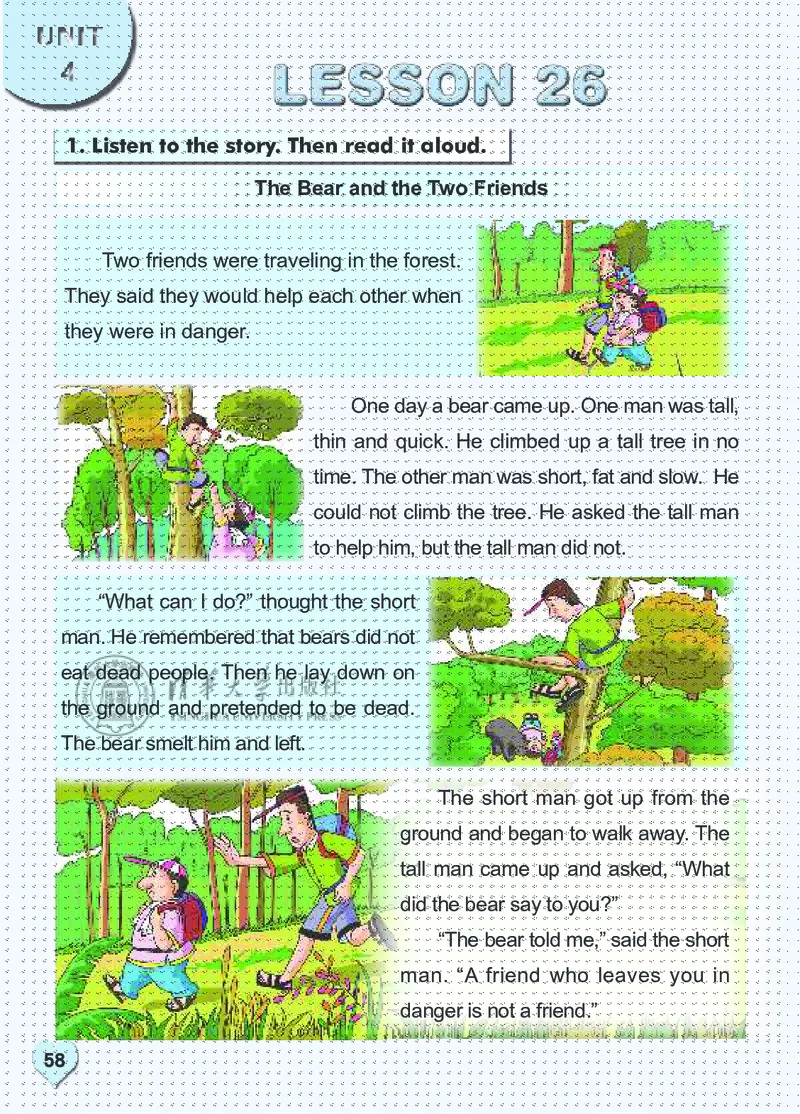
The Bear and the Two Friends
Two friends were traveling in the forest.
They said they would help each other when
they were in danger.
One day a bear came up. One man was tall,
thin and quick. He climbed up a tall tree in no
time. The other man was short, fat and slow. He
could not climb the tree. He asked the tall man
to help him, but the tall man did not.
“What can I do?” thought the short
man. He remembered that bears did not
eat dead people. Then he lay down on
the ground and pretended to be dead.
The bear smelt him and left.
The short man got up from the
ground and began to walk away. The
tall man came up and asked, “What
did the bear say to you?”
“The bear told me,” said the short
man. “A friend who leaves you in
danger is not a friend.”
582. Answer the questions.
(1) What did the two friends say they would do when they were in danger?
_________________________________________________________
(2) What did the tall man and the short man do when a bear came?
_________________________________________________________
3. Finish the sentences with the words from the word box.
smelt friends climbed traveling pretended lay
Two men were ___________ together.
One day, a bear came up. One man ___________ up a tree. The
other man could not climb. He ___________ down on the ground and
___________ to be dead. The bear ___________ him and left.
The two men were not ___________ any longer.
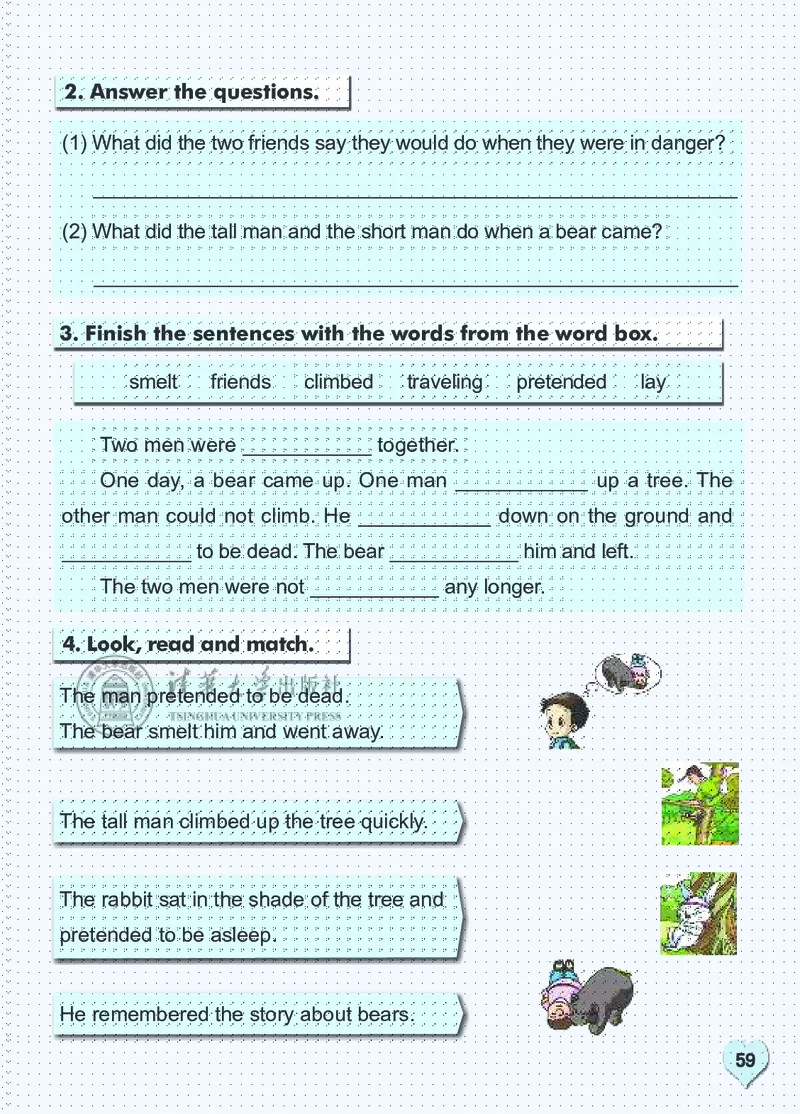
4. Look, read and match.
The man pretended to be dead.
The bear smelt him and went away.
The tall man climbed up the tree quickly.
The rabbit sat in the shade of the tree and
pretended to be asleep.
He remembered the story about bears.
591. Listen to the story. Then read it aloud.
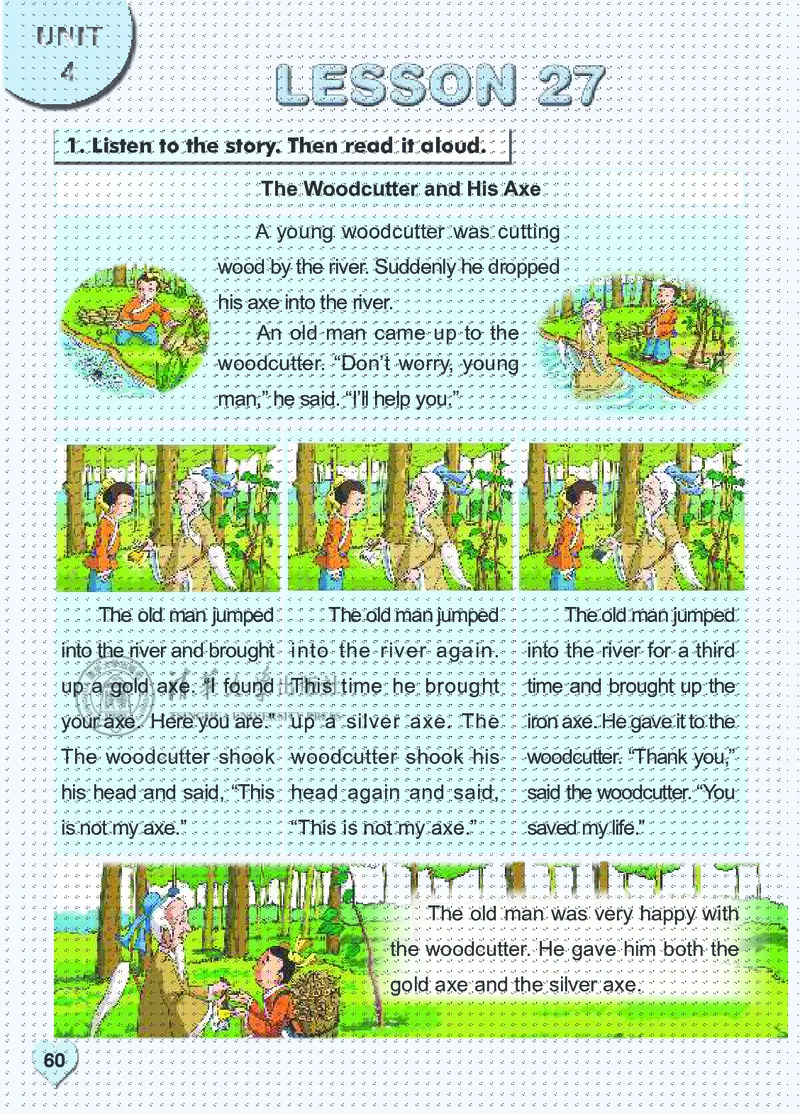
The Woodcutter and His Axe
A young woodcutter was cutting
wood by the river. Suddenly he dropped
his axe into the river.
An old man came up to the
woodcutter. “Don’t worry, young
man,” he said. “I’ll help you.”
The old man jumped The old man jumped The old man jumped
into the river and brought into the river again. into the river for a third
up a gold axe. “I found This time he brought time and brought up the
your axe. Here you are.” up a silver axe. The iron axe. He gave it to the
The woodcutter shook woodcutter shook his woodcutter. “Thank you,”
his head and said, “This head again and said, said the woodcutter. “You
is not my axe.” “This is not my axe.” saved my life.”
The old man was very happy with
the woodcutter. He gave him both the
gold axe and the silver axe.
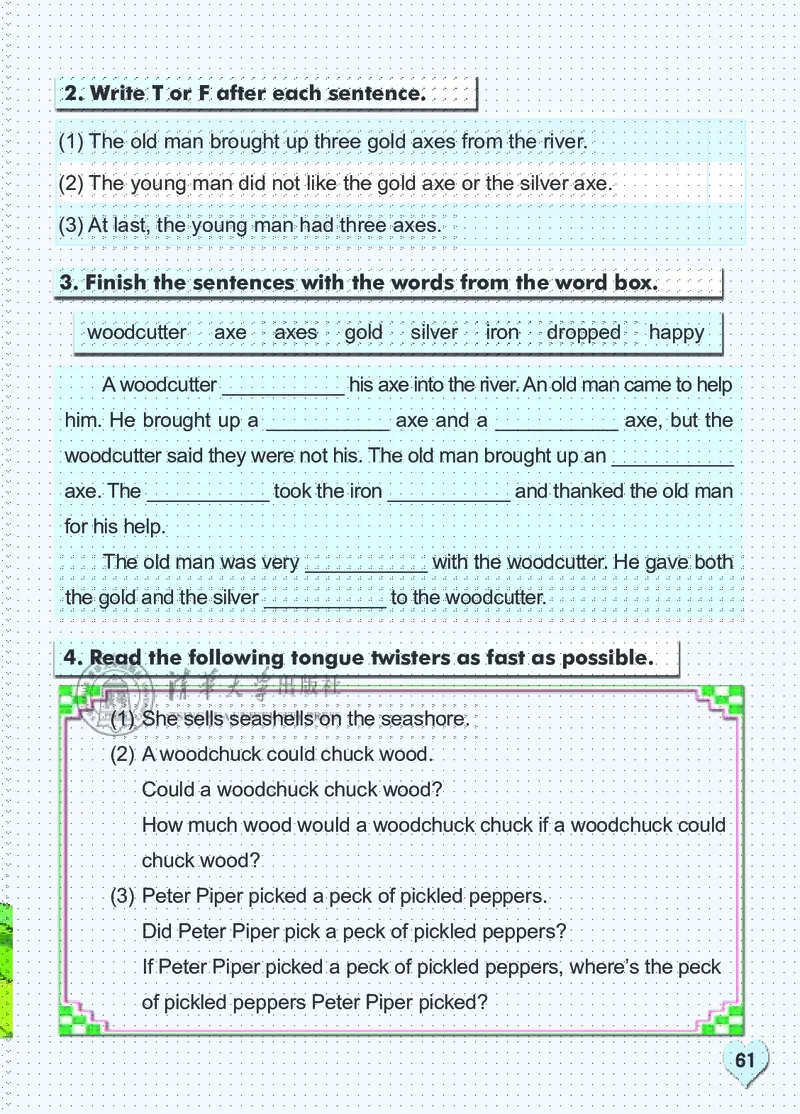
602. Write T or F after each sentence.
(1) The old man brought up three gold axes from the river.
(2) The young man did not like the gold axe or the silver axe.
(3) At last, the young man had three axes.
3. Finish the sentences with the words from the word box.
woodcutter axe axes gold silver iron dropped happy
A woodcutter ___________ his axe into the river. An old man came to help
him. He brought up a ___________ axe and a ___________ axe, but the
woodcutter said they were not his. The old man brought up an ___________
axe. The ___________ took the iron ___________ and thanked the old man
for his help.
The old man was very ___________ with the woodcutter. He gave both
the gold and the silver ___________ to the woodcutter.
4. Read the following tongue twisters as fast as possible.
(1) She sells seashells on the seashore.
(2) A woodchuck could chuck wood.
Could a woodchuck chuck wood?
How much wood would a woodchuck chuck if a woodchuck could
chuck wood?
(3) Peter Piper picked a peck of pickled peppers.
Did Peter Piper pick a peck of pickled peppers?
If Peter Piper picked a peck of pickled peppers, where’s the peck
of pickled peppers Peter Piper picked?
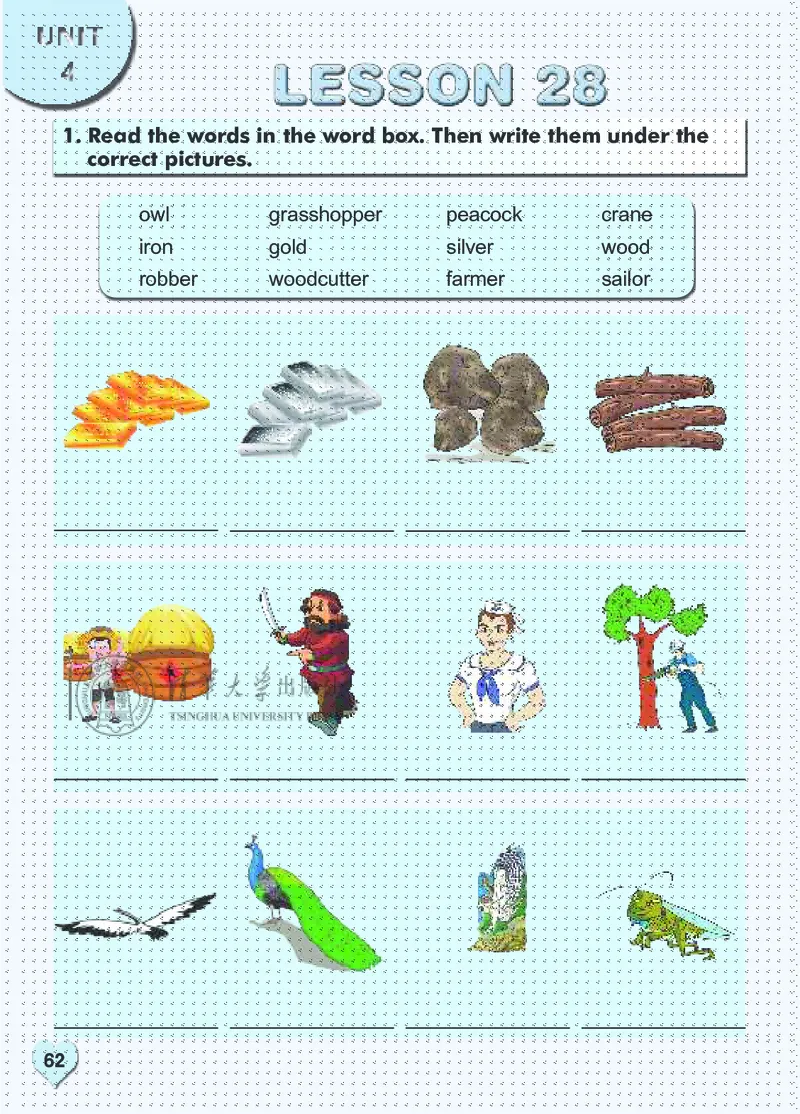
611. Read the words in the word box. Then write them under the
correct pictures.
owl grasshopper peacock crane
iron gold silver wood
robber woodcutter farmer sailor
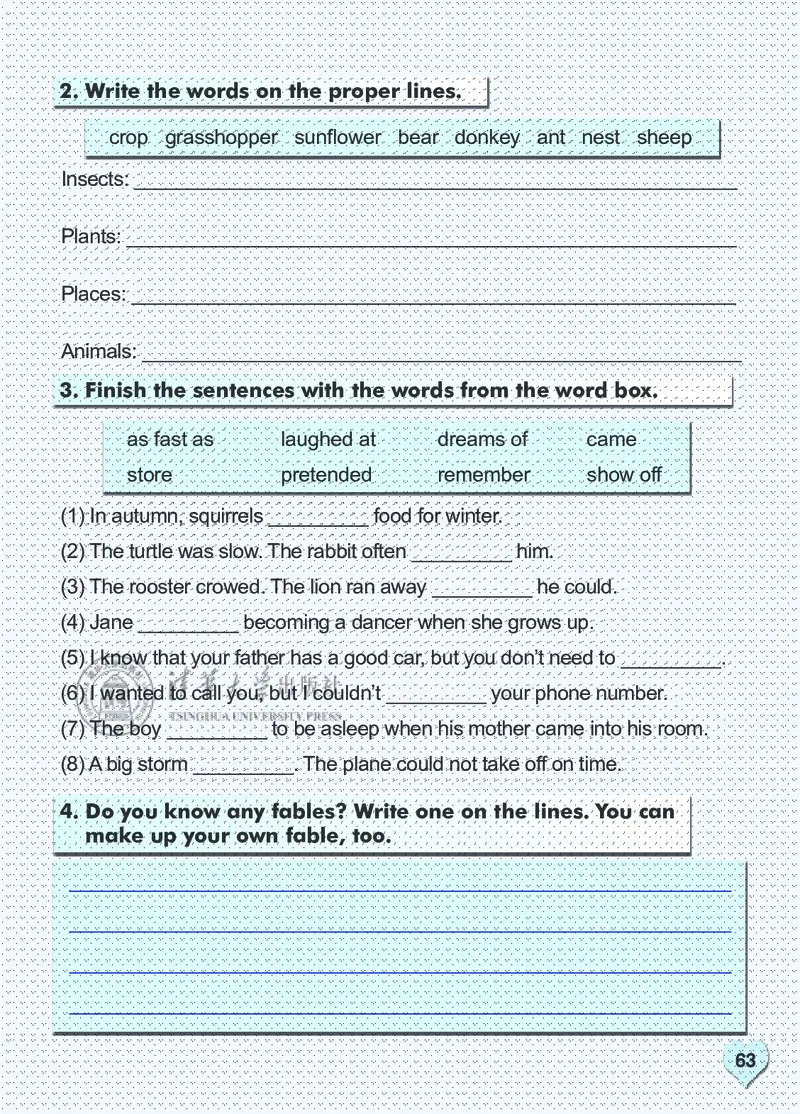
622. Write the words on the proper lines.
crop grasshopper sunflower bear donkey ant nest sheep
Insects: _______________________________________________________
Plants: _______________________________________________________
Places: _______________________________________________________
Animals: ______________________________________________________
3. Finish the sentences with the words from the word box.
as fast as laughed at dreams of came
store pretended remember show off
(1) In autumn, squirrels _________ food for winter.
(2) The turtle was slow. The rabbit often _________ him.
(3) The rooster crowed. The lion ran away _________ he could.
(4) Jane _________ becoming a dancer when she grows up.
(5) I know that your father has a good car, but you don’t need to _________.
(6) I wanted to call you, but I couldn’t _________ your phone number.
(7) The boy _________ to be asleep when his mother came into his room.
(8) A big storm _________. The plane could not take off on time.
4. Do you know any fables? Write one on the lines. You can
make up your own fable, too.
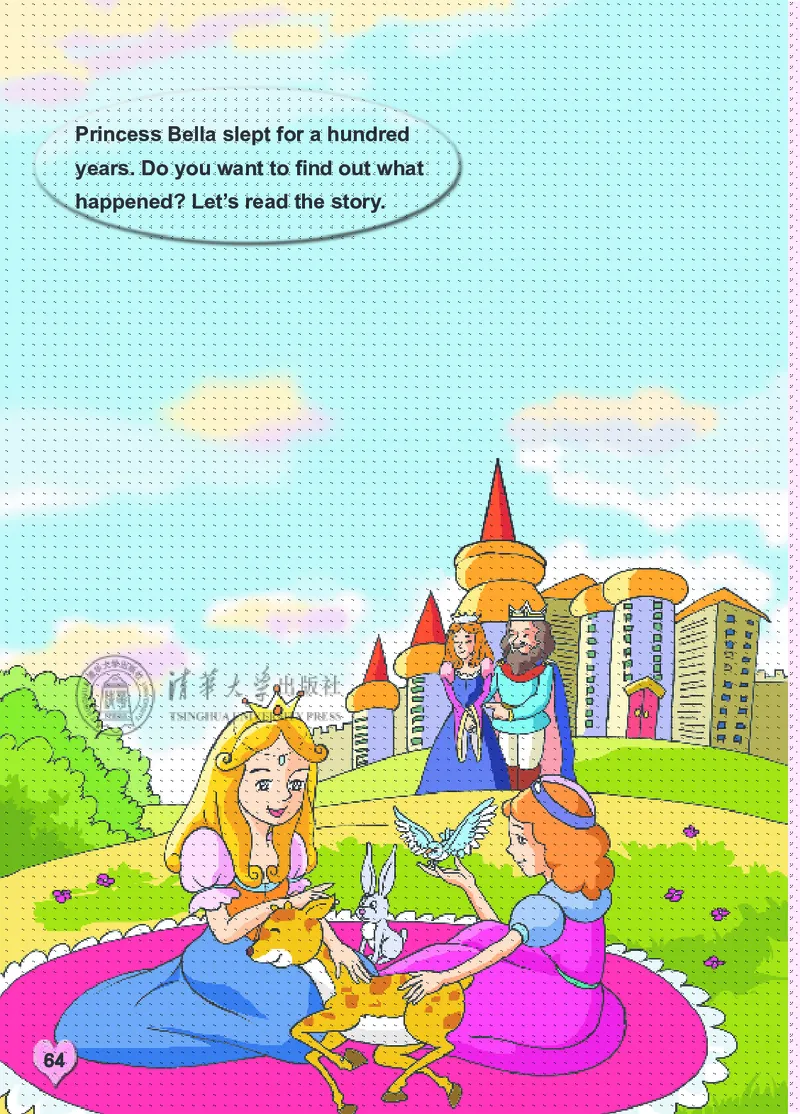
63PrincesPsr iBneclleas ssl eBpet lfloar a hundred
years. Dsloe ypot uf owra an th tuo nfidnrde odu t what
happenyeeda?r sL.e.t.’s read the story.
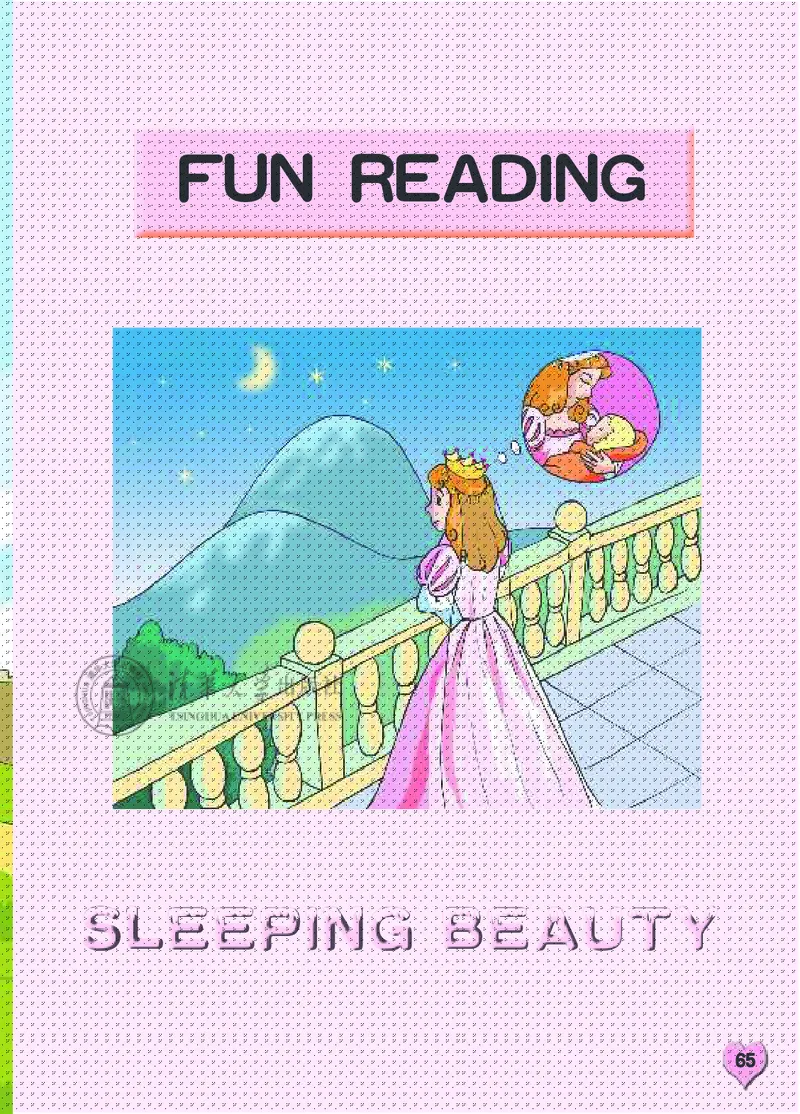
6644FUN READING
SLEEPING BEAUTY
6655Once upon a time, there lived a
king and his queen in a castle. The
castle was on the top of a magic
mountain. The king and queen were
unhappy because they had no children.
One night, the queen looked at
the moon and the stars. “Oh, I wish I
had a baby!” she thought.
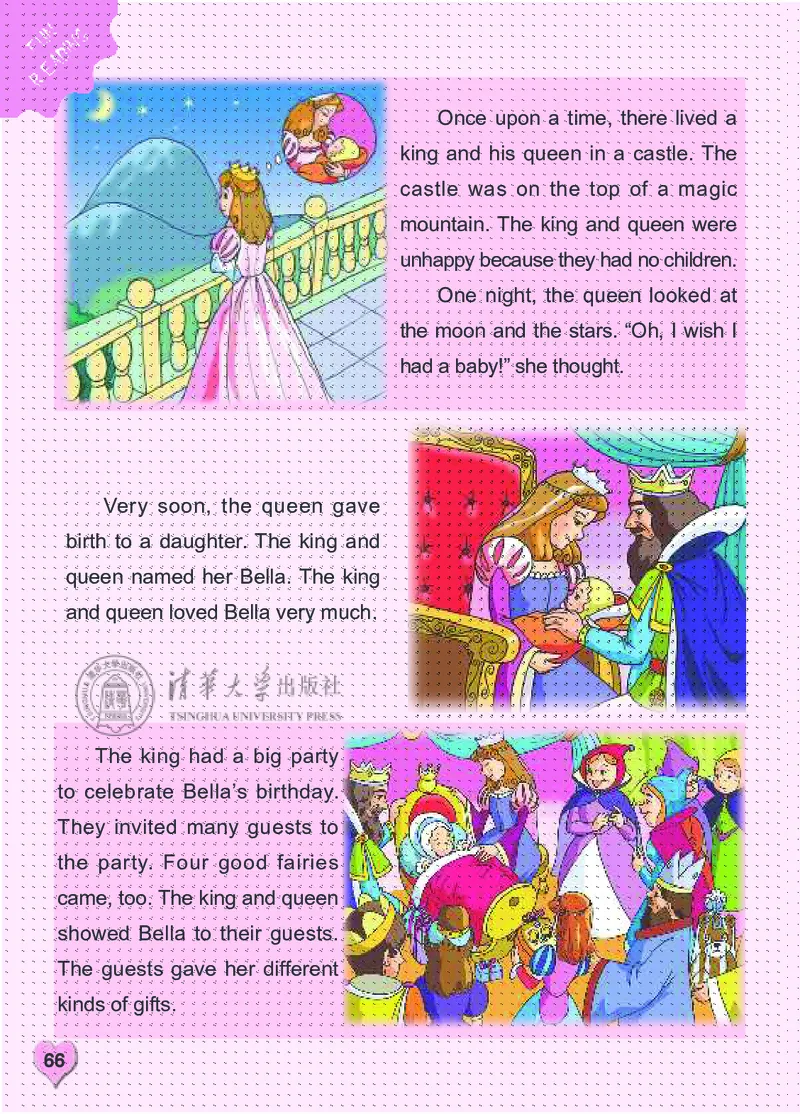
Very soon, the queen gave
birth to a daughter. The king and
queen named her Bella. The king
and queen loved Bella very much.
The king had a big party
to celebrate Bella’s birthday.
They invited many guests to
the party. Four good fairies
came, too. The king and queen
showed Bella to their guests.
The guests gave her different
kinds of gifts.
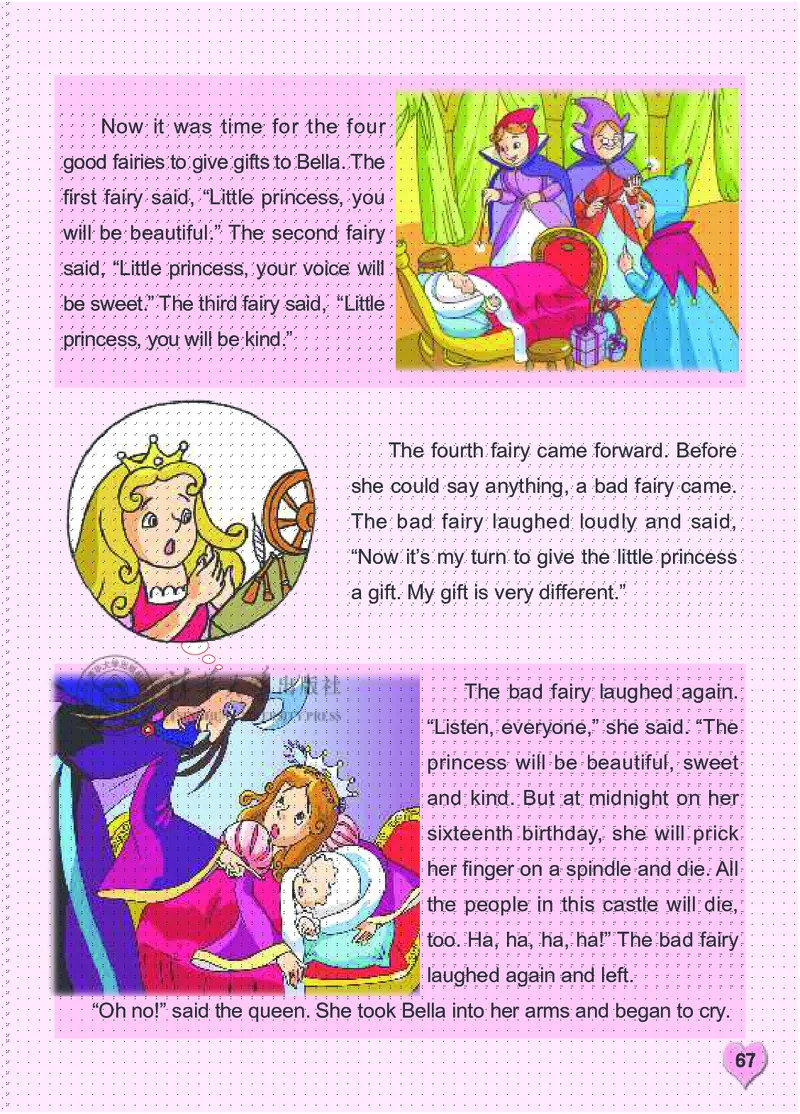
66Now it was time for the four
good fairies to give gifts to Bella. The
first fairy said, “Little princess, you
will be beautiful.” The second fairy
said, “Little princess, your voice will
be sweet.” The third fairy said, “Little
princess, you will be kind.”
The fourth fairy came forward. Before
she could say anything, a bad fairy came.
The bad fairy laughed loudly and said,
“Now it’s my turn to give the little princess
a gift. My gift is very different.”
The bad fairy laughed again.
“Listen, everyone,” she said. “The
princess will be beautiful, sweet
and kind. But at midnight on her
sixteenth birthday, she will prick
her finger on a spindle and die. All
the people in this castle will die,
too. Ha, ha, ha, ha!” The bad fairy
laughed again and left.
“Oh no!” said the queen. She took Bella into her arms and began to cry.
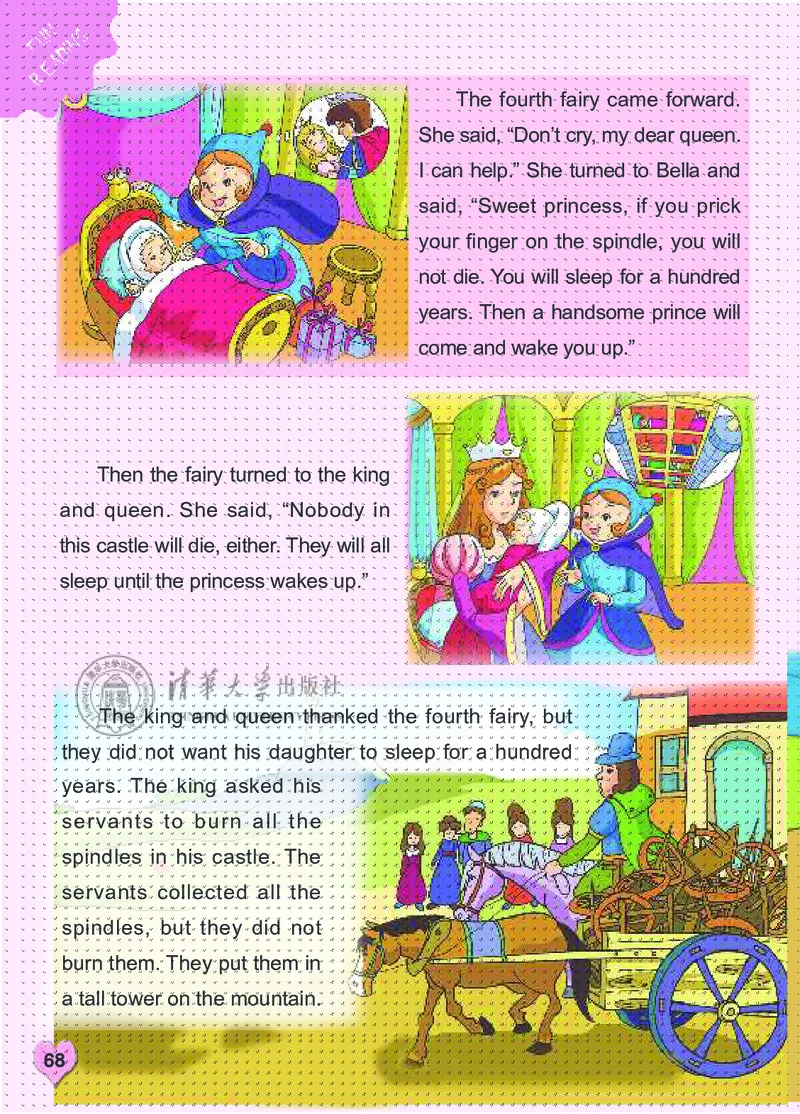
67The fourth fairy came forward.
She said, “Don’t cry, my dear queen.
I can help.” She turned to Bella and
said, “Sweet princess, if you prick
your finger on the spindle, you will
not die. You will sleep for a hundred
years. Then a handsome prince will
come and wake you up.”
Then the fairy turned to the king
and queen. She said, “Nobody in
this castle will die, either. They will all
sleep until the princess wakes up.”
The king and queen thanked the fourth fairy, but
they did not want his daughter to sleep for a hundred
years. The king asked his
servants to burn all the
spindles in his castle. The
servants collected all the
spindles, but they did not
burn them. They put them in
a tall tower on the mountain.
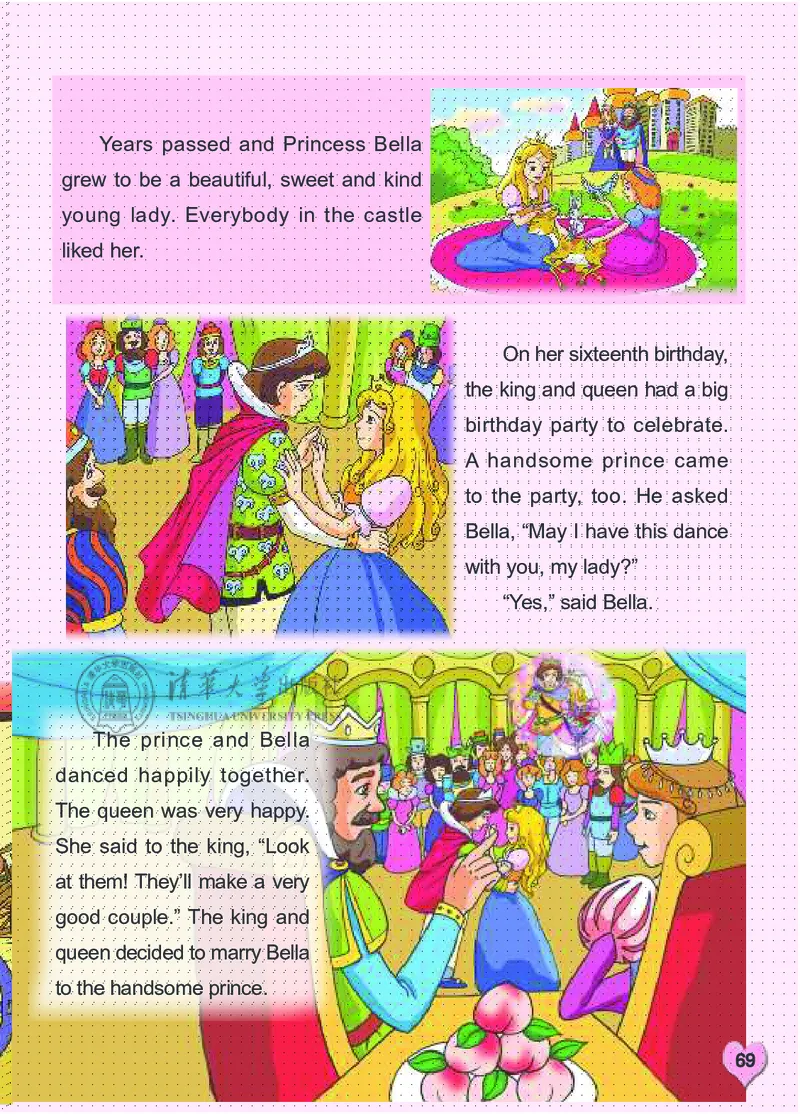
68Years passed and Princess Bella
grew to be a beautiful, sweet and kind
young lady. Everybody in the castle
liked her.
On her sixteenth birthday,
the king and queen had a big
birthday party to celebrate.
A handsome prince came
to the party, too. He asked
Bella, “May I have this dance
with you, my lady?”
“Yes,” said Bella.
The prince and Bella
danced happily together.
The queen was very happy.
She said to the king, “Look
at them! They’ll make a very
good couple.” The king and
queen decided to marry Bella
to the handsome prince.
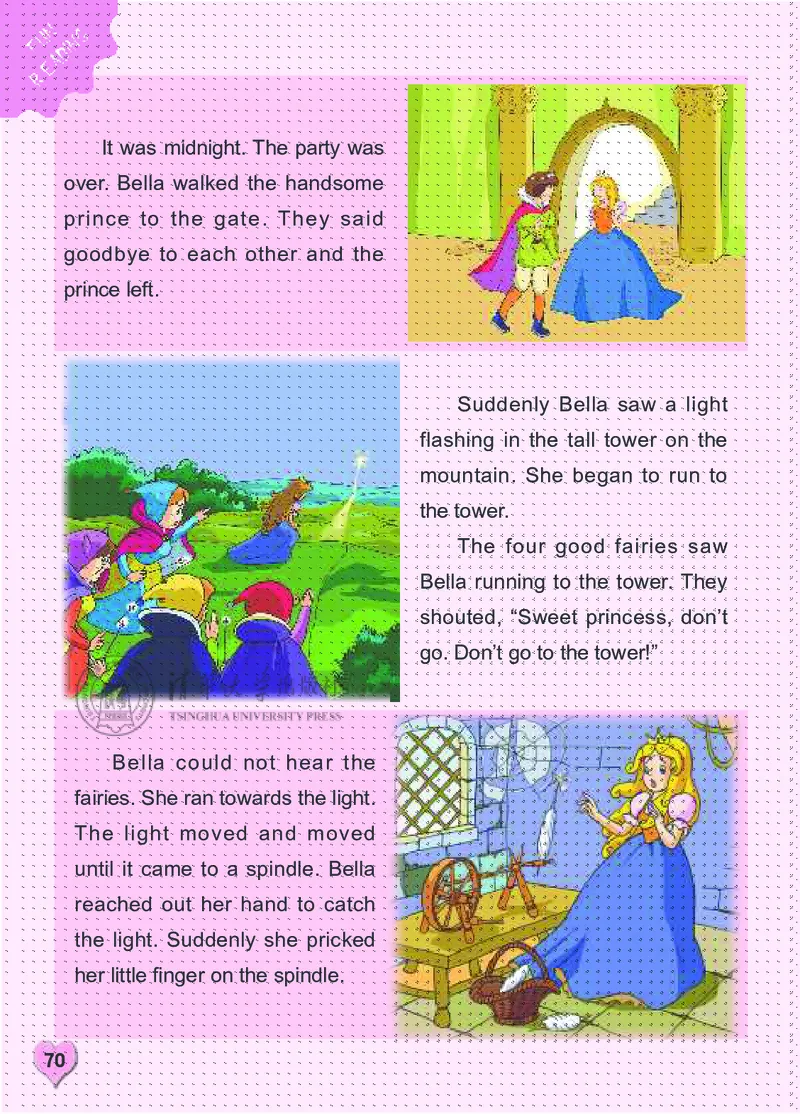
69It was midnight. The party was
over. Bella walked the handsome
prince to the gate. They said
goodbye to each other and the
prince left.
Suddenly Bella saw a light
flashing in the tall tower on the
mountain. She began to run to
the tower.
The four good fairies saw
Bella running to the tower. They
shouted, “Sweet princess, don’t
go. Don’t go to the tower!”
Bella could not hear the
fairies. She ran towards the light.
The light moved and moved
until it came to a spindle. Bella
reached out her hand to catch
the light. Suddenly she pricked
her little finger on the spindle.
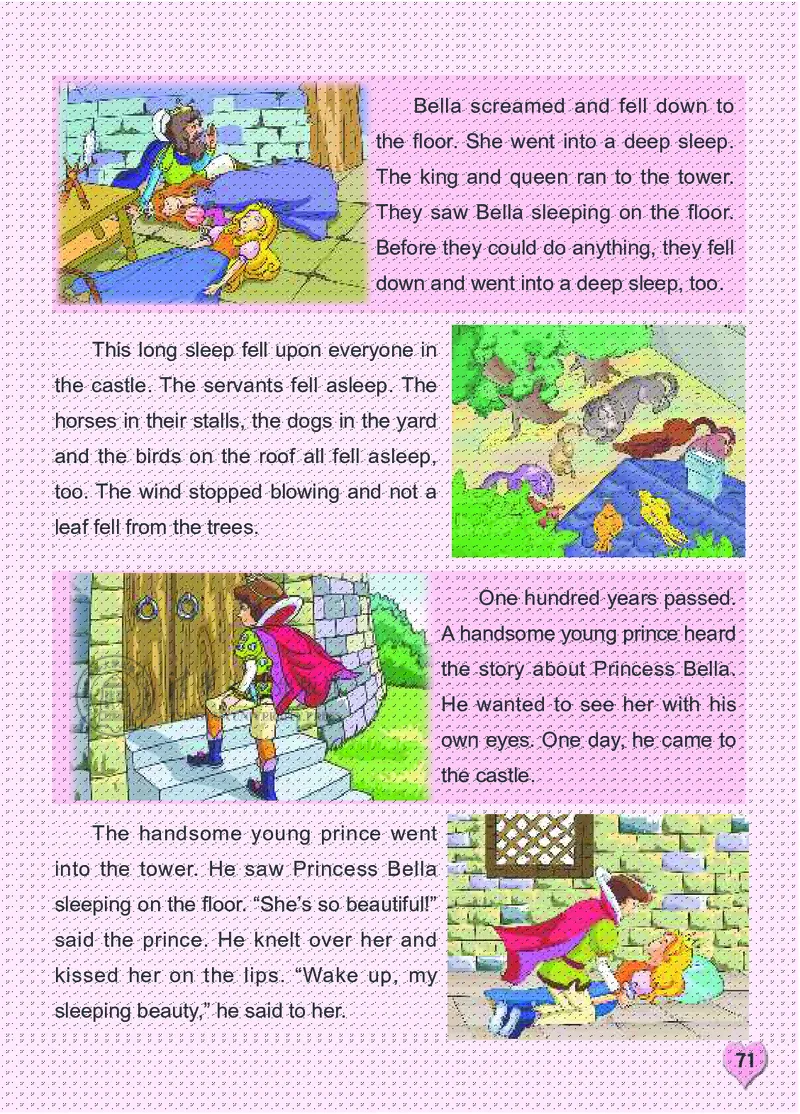
70Bella screamed and fell down to
the floor. She went into a deep sleep.
The king and queen ran to the tower.
They saw Bella sleeping on the floor.
Before they could do anything, they fell
down and went into a deep sleep, too.
This long sleep fell upon everyone in
the castle. The servants fell asleep. The
horses in their stalls, the dogs in the yard
and the birds on the roof all fell asleep,
too. The wind stopped blowing and not a
leaf fell from the trees.
One hundred years passed.
A handsome young prince heard
the story about Princess Bella.
He wanted to see her with his
own eyes. One day, he came to
the castle.
The handsome young prince went
into the tower. He saw Princess Bella
sleeping on the floor. “She’s so beautiful!”
said the prince. He knelt over her and
kissed her on the lips. “Wake up, my
sleeping beauty,” he said to her.
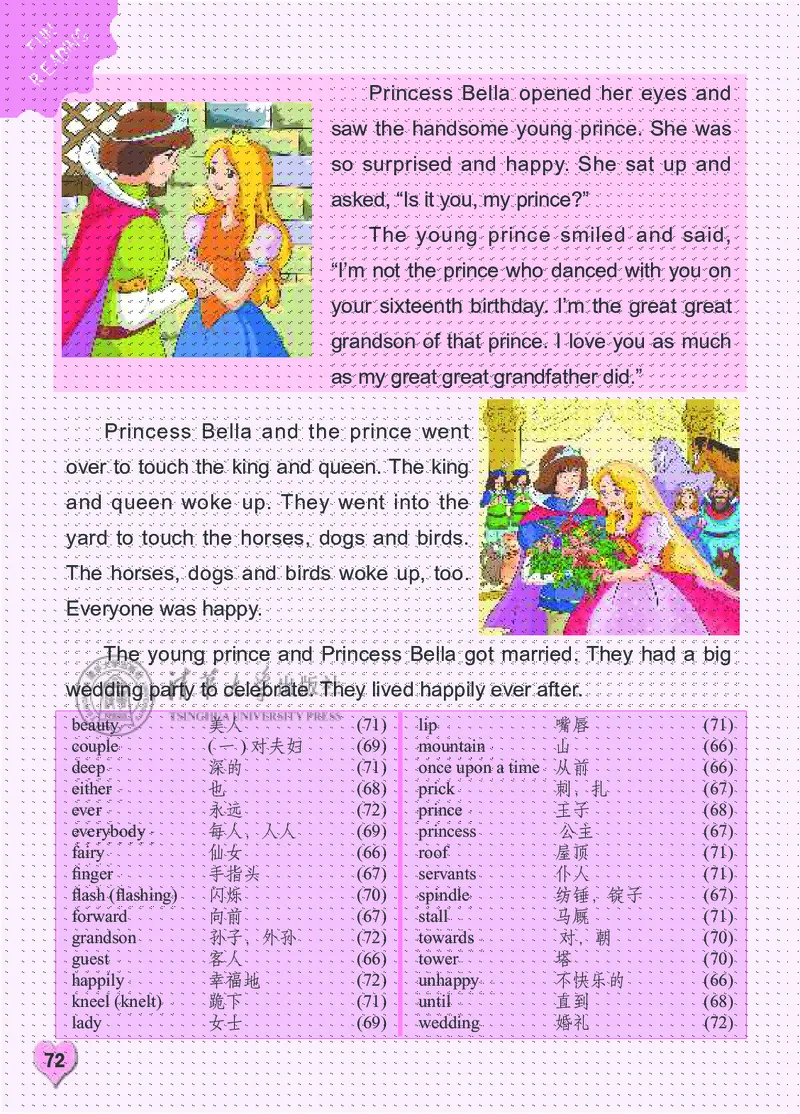
71Princess Bella opened her eyes and
saw the handsome young prince. She was
so surprised and happy. She sat up and
asked, “Is it you, my prince?”
The young prince smiled and said,
“I’m not the prince who danced with you on
your sixteenth birthday. I’m the great great
grandson of that prince. I love you as much
as my great great grandfather did.”
Princess Bella and the prince went
over to touch the king and queen. The king
and queen woke up. They went into the
yard to touch the horses, dogs and birds.
The horses, dogs and birds woke up, too.
Everyone was happy.
The young prince and Princess Bella got married. They had a big
wedding party to celebrate. They lived happily ever after.
beauty 美人 (71) lip 嘴唇 (71)
couple (一)对夫妇 (69) mountain 山 (66)
deep 深的 (71) once upon a time 从前 (66)
either 也 (68) prick 刺,扎 (67)
ever 永远 (72) prince 王子 (68)
everybody 每人,人人 (69) princess 公主 (67)
fairy 仙女 (66) roof 屋顶 (71)
finger 手指头 (67) servants 仆人 (71)
flash (flashing) 闪烁 (70) spindle 纺锤,锭子 (67)
forward 向前 (67) stall 马厩 (71)
grandson 孙子,外孙 (72) towards 对,朝 (70)
guest 客人 (66) tower 塔 (70)
happily 幸福地 (72) unhappy 不快乐的 (66)
kneel (knelt) 跪下 (71) until 直到 (68)
lady 女士 (69) wedding 婚礼 (72)
72VOCABULARY
A end 结束 (3)
afford 支付得起…… (42) England 英格兰 (34)
agree 同意 (8) F
almost 几乎,差不多 (36) famous 著名的 (36)
answer 回答 (6) *filling 馅 (22)
*aquarium 水族馆,鱼缸 (8) fine 好的 (2)
artist 画家,艺术家 (40) forget (forgot) 忘记 (11)
*axe 斧子 (60) forgive (forgave) 原谅,饶恕 (12)
B G
*bar 杆,架 (29) *Germany 德国 (38)
blame 责备,责怪 (12) gold 金子 (60)
blind 瞎的 (44) goodbye (bye) 再见 (2)
born 出生的 (5) grasshopper 蚱蜢 (50)
*bumper car 碰碰车 (29) greeting 问候,祝贺 (18)
*bunny 兔子 (20) H
bye (goodbye) 再见 (4) half 一半,半时 (44)
C hide (hid) 把……藏起来 (13)
continue 继续 (42) *however 然而 (42)
crane 鹤,起重机 (54) hug 拥抱 (26)
D hunt 搜寻,猎取 (20)
dead 死的 (58) I
deaf 聋的 (36) interested 感兴趣的 (36)
dear 亲爱的 (26) invention 发明,发明物 (36)
dragon 龙 (22) inventor 发明家 (36)
drop 使……落下 (60) *invitation 邀请 (5)
drown 淹死 (22) invite 邀请 (4)
E iron 铁;铁的 (60)
easily 容易地 (54) *Italy 意大利 (40)
*Easter 复活节 (20) L
electricity 电 (24) lab 实验室 (34)
else 其他的,另外的 (4) *law 定律; 法律 (34)
email 电子邮件 (5) lie (lay) 躺,位于 (58)
73lifetime 一生 (36) score 比分,分数 (10)
listener 听者,收听者 (39) send 寄,发送 (5)
longer 更长的,更久的 (10) show 表演;出示 (8)
not... any longer 不再 (10) shower 淋浴 (6)
luck 运气 (8) take a shower 洗澡 (6)
luckily 幸运地 (36) silver 银,银的 (60)
lucky 幸运的,碰巧的 (36) *solution 解决办法 (43)
M sometimes 有时 (11)
*mathematician 数学家 (42) space 空间,距离 (2)
*mathematics数学 (43) spell 拼写 (44)
mistake 错误 (39) steam 蒸 (22)
Mrs 太太,夫人 (6) sticky 粘的 (22)
N success 成功 (36)
national 国家的,全国性的 (22) sunflower 向日葵 (50)
nobody 没有人 (7) T
P talent 才华 (42)
phone 电话 (4) team 队 (10)
physicist 物理学家 (34) theory 理论 (42)
physics 物理 (38) U
plate 盘子 (34) ugly 丑陋的 (54)
poet 诗人 (22) *unbelievable 难以置信的 (43)
pollute 使污染 (24) understand 理解,明白 (24)
poster 海报 (25) universal gravitation 万有引力 (34)
pretend 佯装,假装 (58) V
prize 奖,奖品 (38) Valentine’s Day 情人节,爱心节 (18)
*Nobel Prize 诺贝尔奖 (38) W
problem 问题 (34) weekday 工作日 (3)
Q weekend 周末 (2)
quick 快的 (58) wood 森林,木材 (60)
R *woodcutter 伐木者 (60)
remember 记得,纪念 (22) wrap 包 (22)
research 研究 (42) Y
robber 抢劫者 (52) yours 你的,你们的 (5)
rose 玫瑰 (18)
S
注释:带*的单词不要求掌握,只需
sailor 海员,水手 (56)
要在上下文中理解。
74