初中英语
2025年⼴东省⼴州市越秀区中考⼀
模英语试卷
新东⽅教育科技集团2025年⼴东省⼴州市越秀区中考⼀
模英语试卷
⼀、语法选择
 语法选择
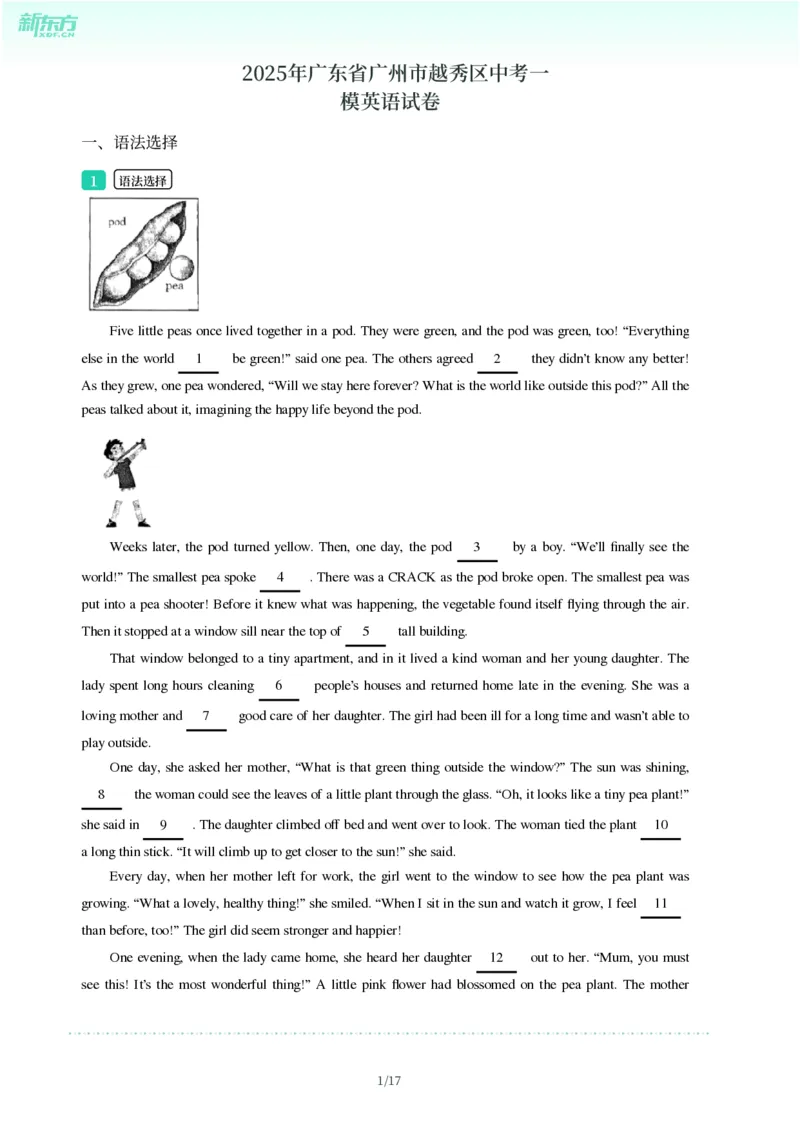
Five little peas once lived together in a pod. They were green, and the pod was green, too! “Everything
else in the world 1 be green!” said one pea. The others agreed 2 they didn’t know any better!
As they grew, one pea wondered, “Will we stay here forever? What is the world like outside this pod?” All the
peas talked about it, imagining the happy life beyond the pod.
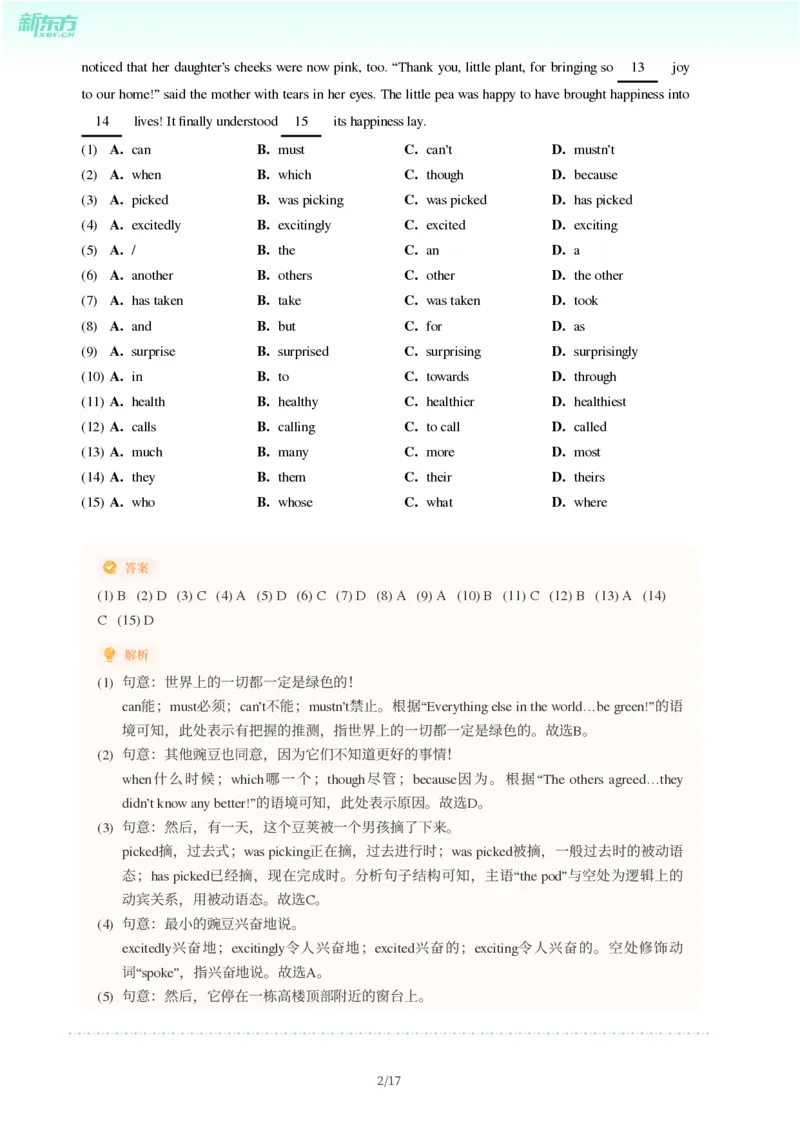
Weeks later, the pod turned yellow. Then, one day, the pod 3 by a boy. “We’ll finally see the
world!” The smallest pea spoke 4 . There was a CRACK as the pod broke open. The smallest pea was
put into a pea shooter! Before it knew what was happening, the vegetable found itself flying through the air.
Then it stopped at a window sill near the top of 5 tall building.
That window belonged to a tiny apartment, and in it lived a kind woman and her young daughter. The
lady spent long hours cleaning 6 people’s houses and returned home late in the evening. She was a
loving mother and 7 good care of her daughter. The girl had been ill for a long time and wasn’t able to
play outside.
One day, she asked her mother, “What is that green thing outside the window?” The sun was shining,
8 the woman could see the leaves of a little plant through the glass. “Oh, it looks like a tiny pea plant!”
she said in 9 . The daughter climbed off bed and went over to look. The woman tied the plant 10
a long thin stick. “It will climb up to get closer to the sun!” she said.
Every day, when her mother left for work, the girl went to the window to see how the pea plant was
growing. “What a lovely, healthy thing!” she smiled. “When I sit in the sun and watch it grow, I feel 11
than before, too!” The girl did seem stronger and happier!
One evening, when the lady came home, she heard her daughter 12 out to her. “Mum, you must
see this! It’s the most wonderful thing!” A little pink flower had blossomed on the pea plant. The mother
/noticed that her daughter’s cheeks were now pink, too. “Thank you, little plant, for bringing so 13 joy
to our home!” said the mother with tears in her eyes. The little pea was happy to have brought happiness into
14 lives! It finally understood 15 its happiness lay.
(1) A. can B. must C. can’t D. mustn’t
(2) A. when B. which C. though D. because
(3) A. picked B. was picking C. was picked D. has picked
(4) A. excitedly B. excitingly C. excited D. exciting
(5) A. / B. the C. an D. a
(6) A. another B. others C. other D. the other
(7) A. has taken B. take C. was taken D. took
(8) A. and B. but C. for D. as
(9) A. surprise B. surprised C. surprising D. surprisingly
(10) A. in B. to C. towards D. through
(11) A. health B. healthy C. healthier D. healthiest
(12) A. calls B. calling C. to call D. called
(13) A. much B. many C. more D. most
(14) A. they B. them C. their D. theirs
(15) A. who B. whose C. what D. where
答案
(1) B (2) D (3) C (4) A (5) D (6) C (7) D (8) A (9) A (10) B (11) C (12) B (13) A (14)
C (15) D
解析
(1) 句意:世界上的⼀切都⼀定是绿⾊的!
can能;must必须;can’t不能;mustn’t禁⽌。根据“Everything else in the world…be green!”的语
境可知,此处表⽰有把握的推测,指世界上的⼀切都⼀定是绿⾊的。故选B。
(2) 句意:其他豌⾖也同意,因为它们不知道更好的事情!
when什么时候;which哪⼀个;though尽管;because因为。根据“The others agreed…they
didn’t know any better!”的语境可知,此处表⽰原因。故选D。
(3) 句意:然后,有⼀天,这个⾖荚被⼀个男孩摘了下来。
picked摘,过去式;was picking正在摘,过去进⾏时;was picked被摘,⼀般过去时的被动语
态;has picked已经摘,现在完成时。分析句⼦结构可知,主语“the pod”与空处为逻辑上的
动宾关系,⽤被动语态。故选C。
(4) 句意:最小的豌⾖兴奋地说。
excitedly兴奋地;excitingly令⼈兴奋地;excited兴奋的;exciting令⼈兴奋的。空处修饰动
词“spoke”,指兴奋地说。故选A。
(5) 句意:然后,它停在⼀栋⾼楼顶部附近的窗台上。
//零冠词;the定冠词,表特指;an不定冠词,表泛指,⽤于以元⾳⾳素开头的单词前;a不
定冠词,表泛指,⽤于以辅⾳⾳素开头的单词前。根据“Then it stopped at a window sill near
the top of…tall building.”的语境可知,此处表⽰泛指的含义,tall以辅⾳⾳素开头。故选D。
(6) 句意:这位⼥⼠花了很⻓时间打扫别⼈的房⼦,晚上很晚才回家。
another另⼀个,泛指三者及以上;others其他⼈,other的复数形式,表⽰泛指;other其他,
后接复数名词;the other(两者中的)另⼀个。根据“…people’s houses”可知,此处指别⼈的
房⼦,other符合。故选C。
(7) 句意:她是⼀位慈爱的⺟亲,认真照顾她的⼥⼉。
has taken已采取,现在完成时;take拿,动词原形;was taken被带到,⼀般过去时的被动语
态;took拿,过去式。根据“was”可知,句⼦时态为⼀般过去时,且不含被动的含义。故选
D。
(8) 句意:阳光明媚,透过玻璃,⼥⼈可以看到⼀棵小植物的叶⼦。
and和; but但是;for为了;as作为。根据“The sun was shining…the woman could see the leaves
of a little plant through the glass”的语境可知,此处表⽰并列关系,and符合。故选A。
(9) 句意:“哦,它看起来像⼀株小豌⾖!”她惊讶地说。
surprise惊讶;surprised感到惊讶的;surprising令⼈惊讶的;surprisingly惊讶地。in surprise“惊
讶地”,是固定搭配。故选A。
(10) 句意:那⼥⼈把植物绑在⼀根细⻓的棍⼦上。
in在……⾥;to到;towards朝向;through穿过。tie…to…“把……绑到……”,是固定搭配。
故选B。
(11) 句意:当我坐在阳光下看着它⽣⻓时,我也感觉⽐以前更健康了!
health健康;healthy健康的;healthier更健康的;healthiest最健康的。根据“than”可知,此处
⽤⽐较级形式。故选C。
(12) 句意:⼀天晚上,当这位⼥⼠回家时,她听到⼥⼉在叫她。
calls叫,三单形式;calling叫,现在分词/动名词;to call叫,不定式;called叫,过去式。
hear sb. doing sth.“听到某⼈正在做某事”,表⽰正在进⾏的动作。故选B。
(13) 句意:谢谢你,小植物,为我们的家带来了如此多的欢乐!
much许多,修饰不可数名词;many许多,修饰可数名词的复数形式;more更多的;most
最。根据“Thank you, little plant, for bringing so …joy to our home!”的语境可知,此处指带来
了如此多的欢乐,“joy”为不可数名词,much符合。故选A。
(14) 句意:小豌⾖很⾼兴能给她们的⽣活带来幸福!
they她们,⼈称代词主格;them她们,⼈称代词宾格;their她们的,形容词性物主代词;
theirs她们的,名词性物主代词。分析句⼦结构可知,此处应⽤形容词性物主代词,修
饰“lives”。故选C。
(15) 句意:它终于明⽩了它的幸福在哪⾥。
who谁;whose谁的;what什么;where哪⾥。根据“its happiness lay”可知,此处表⽰地点,
where符合。故选D。
⼆、完形填空
/ 完形填空
阅读下⾯短⽂,掌握其⼤意,然后从16~25各题所给的A、B、C和D项中选出最佳选项,并在答题
卡上将该项涂⿊。
The Spring Festival has been added to the United Nations Educational, Scientific and Cultural
Organization’s (UNESCO) Intangible Cultural Heritage (⾮物质⽂化遗产) list. With this 1 addition,
China now has 44 items on UNESCO’s Intangible Cultural Heritage list.
“Spring Festival” here refers not to the Chinese New Year’s starting date, but to the cultural practices
kept by Chinese communities during this 2 . This tradition includes house-cleaning (da sao chu) before
New Year’s Eve, wearing new clothes, and decorating homes with red items. Festival activities like the family
reunion dinner and giving red packets with lucky money connect family better and 3 happy moments.
In 4 years, the Spring Festival has become a joyful event for the world. Several lively and fun
traditions rooted in the Chinese culture have grown on people outside China. For example, the dragon and
lion dances, which are believed to 5 bad luck and bring best wishes, have attracted people in many
different countries. The 6 that the festival shows are accepted by many countries. More and more
people are showing growing interest in 7 cultural heritage crafts such as paper-cutting and zodiac
animal stories like the Loong or snake.
UNESCO leaders say China does good work keeping traditions alive, and suggest that other countries
should follow China’s 8 in cultural protection.
The Spring Festival has received UNESCO’s honor for good reasons. It helps make sure that traditions
remain strong in 9 society, and also sets an example around the world in cultural protection.
UNESCO’s decision marks the beginning of a new stage. Along with other Chinese traditions, the Spring
Festival will 10 to raise our spirits now and in the future.
(1) A. perfect B. main C. lively D. fresh
(2) A. period B. year C. age D. stage
(3) A. begin B. believe C. create D. share
(4) A. coming B. recent C. future D. next
(5) A. take off B. putout C. think over D. scare away
(6) A. rules B. interests C. values D. benefits
(7) A. exploring B. sending C. inventing D. buying
(8) A. symbol B. relation C. fact D. example
(9) A. free B. modern C. local D. ancient
(10) A. begin B. choose C. continue D. try
答案
(1) D (2) A (3) D (4) B (5) D (6) C (7) A (8) D (9) B (10) C
/解析
(1) 句意:加上这个新成员,中国现在有44项⾮物质⽂化遗产列⼊联合国教科⽂组织的名录。
perfect完美的;main主要的;lively活泼的;fresh新鲜的。根据“China now has 44 items on
UNESCO’s Intangible Cultural Heritage list”可知,春节新列⼊⾮遗名录,故选D。
(2) 句意:这⾥的“春节”不是指中国新年的开始⽇期,而是指中国社区在此期间保留的⽂化习
俗。
period时期;year年;age时代;stage阶段。根据“but to the cultural practices kept by Chinese
communities”可知,春节期间的习俗,故选A。
(3) 句意:像团圆饭和发红包这样的节⽇活动让家⼈更好地联系在⼀起,分享快乐的时刻。
begin开始;believe相信;create创造;share分享。根据“happy moments”可知,分享快乐时
光,故选D。
(4) 句意:近年来,春节对于世界已成为⼀个快乐的事件。
coming即将到来的;recent最近的;future未来的;next下⼀个的。根据“the Spring Festival has
become a joyful event for the world”可知,近年来,与后⽂的完成时态形成对应,故选B。
(5) 句意:例如,舞⻰舞狮吸引了许多不同国家的⼈们,⼈们认为舞⻰舞狮可以驱走厄运,带
来最美好的祝愿。
take off脱下;起⻜;put out熄灭;发布;think over仔细考虑;scare away吓跑。根据“bad luck
and bring best wishes”可知,驱散厄运,故选D。
(6) 句意:这个节⽇所体现的价值观被许多国家所接受。
rules规则;interests兴趣;values价值观;benefits好处。根据“that the festival shows are accepted
by many countries”可知,节⽇所体现的价值观被接受,故选C。
(7) 句意:越来越多的⼈对探索剪纸和⻰蛇等⽣肖动物故事等⽂化遗产⼯艺表现出越来越⼤的
兴趣。
exploring探索;sending发送;inventing发明;buying购买。根据“cultural heritage crafts”可知,
对探索⼿⼯艺感兴趣,故选A。
(8) 句意:联合国教科⽂组织领导⼈表⽰,中国在保护传统⽅⾯做得很好,并建议其他国家在
⽂化保护⽅⾯效仿中国。
symbol象征;relation关系;fact事实;example榜样。根据“China does good work keeping
traditions alive”可知,联合国建议借鉴中国,故选D。
(9) 句意:它有助于确保传统在现代社会中保持强⼤,也为世界各地的⽂化保护树⽴了榜样。
free⾃由的;modern现代的;local当地的;ancient古⽼的。根据“society, and also sets an
example around the world in cultural protection.”可知,确保了传统在现代社会中的强⼤,故选
B。
(10) 句意:和其他中国传统⼀样,春节将在现在和将来继续振奋我们的精神。
begin开始;choose选择;continue继续;try尝试。根据“to raise our spirits now and in the
future”可知,春节将在现在和将来继续振奋我们的精神。故选C。
三、阅读理解
/ 阅读理解
What makes a great friend?
Some people find it easier to make and keep friends, while others wish they had closer
friendships or wonder why a friendship didn’t work out. In fact, to build strong, lasting friendships,
there are some important characters we should work on developing.
Quiz: What kind of friend are you?
1. I am trustworthy.
2. I am honest with others.
3. I am generally very dependable.
4. I am loyal to the people I care about.
5. I am easily able to trust others.
6. I am a good listener.
7. I am supportive of others in their good or bad times.
8. I am self-confident.
9. I am usually able to see the humor in life.
10. I am fun to be around.
Teens share: What’s the most important character in a friend?
Howie Lin, 15
“In my opinion, humor is a must-have quality in a friend. Having a friend with a good sense of
humor is like having a personal talk-show artist on call 24/7. I have a friend who always comes up
with creative jokes. With him around, even the saddest days feel better.”
Jasmine Cao, 13
“The most important thing I look for in a friend is having similar interests or hobbies to mine. I
think this matters because these interests or hobbies can help us build a deeper connection. We may
have a lot of fun memories together. For example, if we both love playing basketball, we can
practice together, cheer each other up during games, and help each other improve. A true friend is
someone who not only enjoys the same things as you but also stands by you, no matter what.”
Claire Tan, 11
“A true friend is important because he or she will be honest with you. If you do something
wrong, true friends will point that out right away and believe that you can do better. However, fake
ones will only talk about it behind your back. When you get hurt, true friends will care for you and
comfort you from the bottom of their hearts. They will always be there to protect you. Fake friends
may ask if you’re fine, but they don’t really care and will just walk away.”
Contact us:
Email: friendship@example.com
Phone: 123-456-7890
(1) Why does the writer introduce the “What kind of friend are you?” quiz?
A. To show types of characters people have.
B. To compare different characters of friends.
/C. To remind readers of characters for real friends.
D. To explain why people have different characters.
(2) If Claire Tan’s friend makes a mistake, what may Claire most probably do as a true friend?
A. Laugh at her friend in her mind.
B. Try not to say anything about it.
C. Tell her friend the mistake immediately.
D. Talk about the mistake with other friends.
(3) Where is the passage most probably from?
A. A book of fun quizzes for teenagers.
B. A science report about teenage growth.
C. A teenagers’ magazine on healthy habits.
D. An advice page for teenagers’ daily life.
答案
(1) C
(2) C
(3) D
解析
(1) 推理判断题。根据“In fact, to build strong, lasting friendships, there are some important characters
we should work on developing.”可知,真正的朋友要有⼀些重要品质,此处是为了提醒读者真
正朋友应具备的品质,故选C。
(2) 细节理解题。根据“If you do something wrong, true friends will point that out right away and
believe that you can do better.”可知,如果你做错了什么,真正的朋友会⻢上指出来,并相信
你可以做得更好。故选C。
(3) 推理判断题。根据全⽂内容和“Email: friendship@example.com”可知,本⽂主要讲述了如何成
为⼀个好朋友以及朋友关系中重要的品质,内容贴近⻘少年⽇常⽣活,故选D。
 阅读理解
As Simon walked home, he kept thinking about his science project. His parents were scientists, and
Simon dreamed of becoming one too. He had one week to complete his report on bees. He would work really
hard on it. It was a chance to study the behavior of bees, which he had always wanted to learn about.
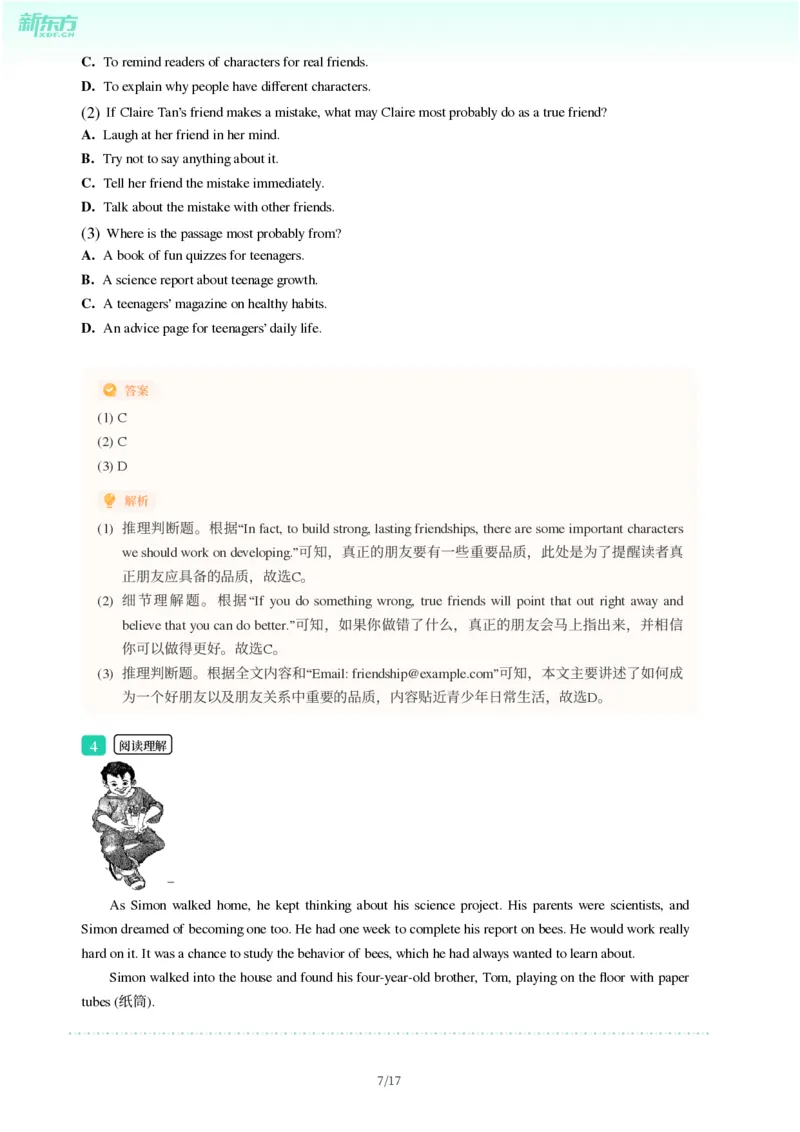
Simon walked into the house and found his four-year-old brother, Tom, playing on the floor with paper
tubes (纸筒).
/“Simon, help me build a city!” Tom said
“Sorry, I need to do a report on bees and I haven’t got any idea yet.” Simon replied. He walked into the
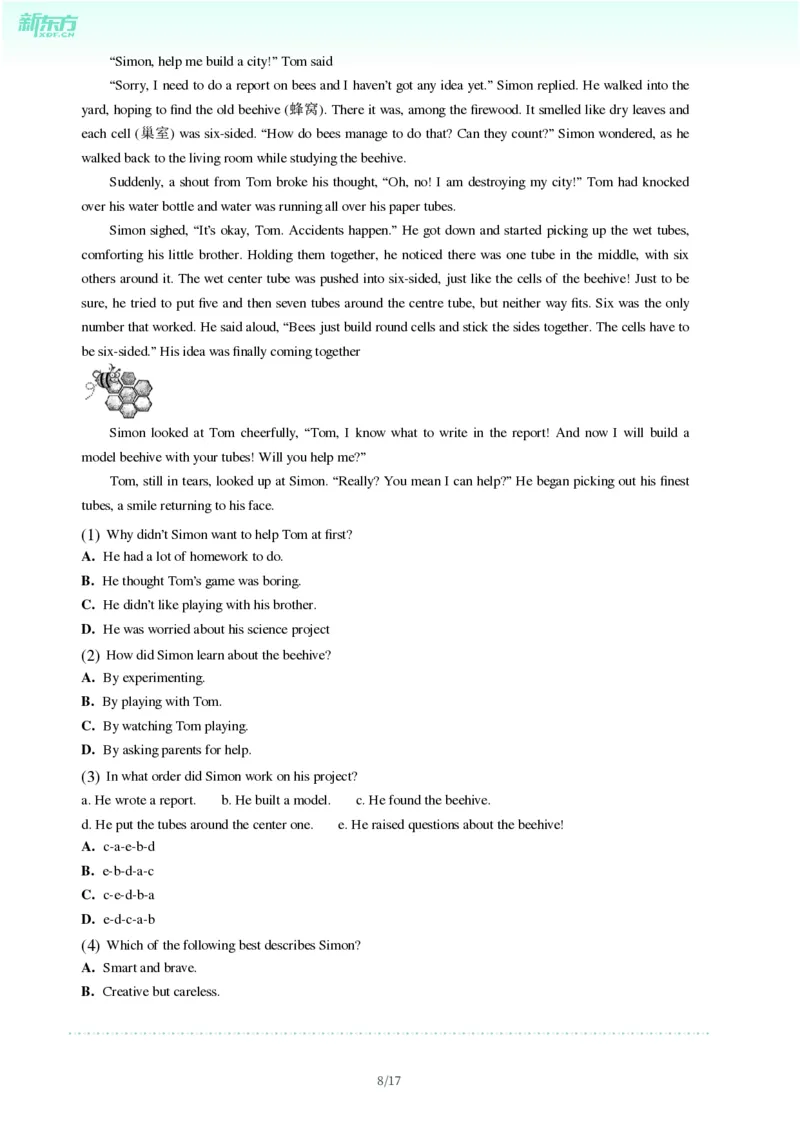
yard, hoping to find the old beehive (蜂窝). There it was, among the firewood. It smelled like dry leaves and
each cell (巢室) was six-sided. “How do bees manage to do that? Can they count?” Simon wondered, as he
walked back to the living room while studying the beehive.
Suddenly, a shout from Tom broke his thought, “Oh, no! I am destroying my city!” Tom had knocked
over his water bottle and water was running all over his paper tubes.
Simon sighed, “It’s okay, Tom. Accidents happen.” He got down and started picking up the wet tubes,
comforting his little brother. Holding them together, he noticed there was one tube in the middle, with six
others around it. The wet center tube was pushed into six-sided, just like the cells of the beehive! Just to be
sure, he tried to put five and then seven tubes around the centre tube, but neither way fits. Six was the only
number that worked. He said aloud, “Bees just build round cells and stick the sides together. The cells have to
be six-sided.” His idea was finally coming together
Simon looked at Tom cheerfully, “Tom, I know what to write in the report! And now I will build a
model beehive with your tubes! Will you help me?”
Tom, still in tears, looked up at Simon. “Really? You mean I can help?” He began picking out his finest
tubes, a smile returning to his face.
(1) Why didn’t Simon want to help Tom at first?
A. He had a lot of homework to do.
B. He thought Tom’s game was boring.
C. He didn’t like playing with his brother.
D. He was worried about his science project
(2) How did Simon learn about the beehive?
A. By experimenting.
B. By playing with Tom.
C. By watching Tom playing.
D. By asking parents for help.
(3) In what order did Simon work on his project?
a. He wrote a report. b. He built a model. c. He found the beehive.
d. He put the tubes around the center one. e. He raised questions about the beehive!
A. c-a-e-b-d
B. e-b-d-a-c
C. c-e-d-b-a
D. e-d-c-a-b
(4) Which of the following best describes Simon?
A. Smart and brave.
B. Creative but careless.
/C. Cheerful but forgetful.
D. Hard-working and patient.
答案
(1) D
(2) A
(3) C
(4) D
解析
(1) 细节理解题。根据“Sorry, I need to do a report on bees and I haven’t got any idea yet.”和“As
Simon walked home, he kept thinking about his science project.”可知,西蒙⼀开始不帮弟弟是因
为忙于科学项⽬,故选D。
(2) 推理判断题。根据“Just to be sure, he tried to put five and then seven tubes around the centre tube,
but neither way fits. Six was the only number that worked.”可知,通过反复尝试五个、七个纸筒
的摆放⽅式,得出“六”才最合适,因此他是通过亲⾃实验来发现蜂窝结构特点的。故选A。
(3) 细节理解题。根据“There it was, among the firewood.”;“How do bees manage to do that?”;“Just
to be sure, he tried to put five and then seven tubes around the centre tube, but neither way fits. Six
was the only number that worked.”;“And now I will build a model beehive with your
tubes!”和“Tom, I know what to write in the report!”可知,正确的顺序是c-e-d-b-a,故选C。
(4) 推理判断题。根据“It’s okay, Tom. Accidents happen.”可知,安慰弟弟,说明很有耐⼼;根
据“Just to be sure, he tried to put five and then seven tubes around the centre tube, but neither way
fits. Six was the only number that worked.”可知,对科学项⽬很投⼊,反复实验,说明很努
⼒,故选D。
 阅读理解
Have you ever asked yourself why people often have trouble learning English? I hadn’t, until one day my
five-year-old son asked me whether there was ham in a hamburger. There isn’t. This made me realize that
there’s no egg in an eggplant either. Neither is there pine nor apple in a pineapple. This got me thinking how
English can be a crazy language to learn.
For example, we can build a building and paint a painting, but we take a photo. And when we are
traveling, we say that we are in the car or the taxi, but on the train or bus! While we’re doing all this traveling,
we can get seasick at sea, airsick in the air and carsick in a car, but we don’t get homesick when we get back
home. And speaking of home, why aren’t homework and housework the same thing?
If “hard” is the opposite of “soft”, why are “hardly” and “softly” not an opposing pair? If harmless
/actions are the opposite of harmful actions, why are shameless and shameful behaviors the same?
When we look out of the window and see rain or snow, we can say “it’s raining” or “it’s snowing”. But
when we see sunshine, we can’t say “it’s sunshining”.
Even the smallest words can be confusing. When you see the capitalized “WHO” in a medical report, do
you read it as the “who” in “Who’s that?” What about “IT”?
You also have to wonder at the madness of a language in which a house can burn up as it burns down
and in which you fill in a form by filling it out!
English was invented by people, not computers, and it shows the imagination of our human beings. That
is why when I wind up my watch, it starts; but when I wind up this passage, it ends.
(1) What is the main purpose of the first paragraph?
A. To discuss strange mistakes.
B. To attract readers’ interest.
C. To provide some suggestions.
D. To show the rules of English words.
(2) What can we learn from the examples in the text?
A. “Burn up” is similar to “burn down”.
B. “Shameful” is the opposite of “shameless”.
C. “Wind up a passage” means to “start a passage”.
D. “It is sunshining” is used when we see sunshine.
(3) What does the writer want to tell us about English in the last paragraph?
A. It should be made easier to learn.
B. It is shaped by human creativity.
C. It is too hard for computers to learn.
D. It follows strict rules to build words.
(4) Which of the following can be the best title of the passage?
A. English, a crazy language
B. Why is English educational?
C. A practical language-English
D. How can we learn English well?
答案
(1) B
(2) A
(3) B
(4) A
解析
(1) 推理判断题。根据“This got me thinking how English can be a crazy language to learn.”可知,通
过⼀些有趣的单词来吸引读者的兴趣,故选B。
/(2) 细节理解题。根据“You also have to wonder at the madness of a language in which a house can
burn up as it burns down and in which you fill in a form by filling it out!”可知,房⼦可以烧毁,因
为它烧毁了,burn up与burn down意思相同,故选A。
(3) 推理判断题。根据“English was invented by people, not computers, and it shows the imagination of
our human beings.”可知,英语是⼈而不是电脑创造的,体现了⼈类的想象⼒与创造⼒,故选
B。
(4) 最佳标题题。根据全⽂内容可知,本⽂通过⼤量例⼦介绍了英语的独特和巧妙之处,选项A
更能概括全⽂主旨,故选A。
 阅读理解
Twenty years ago, when Andrew Westbrook was in college, he had a hard time fixing his mind on class.
He certainly had the ability to focus. For example, when he got lost in a good book, thinking felt easy. But
when it came to some other mental (脑⼒的) tasks, thinking was like pulling teeth and his attention was off.
Westbrook is now a scientist. His research is challenging old ideas about why we can’t keep our attention
on certain tasks.
For years, scientists thought that mentally tiring tasks like solving math problems required more energy
than easier ones like looking out of the window. As a result, these harder tasks would make us run out of
energy and lose focus more quickly.
However, Westbrook’s research suggests our brain is always working hard. Even when we are just
looking around a room, our brain is dealing with lots of information and using lots of energy. But we don’t
find these tasks tiring. The real problem is that difficult tasks require different brain regions to work together
in new patterns. The brain has to break out of its usual ways, which causes discomfort and makes these tasks
seem harder than they really are.
“Thinking about beginning a hard task feels harder than actually doing it,” Westbrook says. This early
mental hurdle can lead us to put off the task or even avoid it. “If we can get over this hurdle, thinking will
become easier,” he adds.
Westbrook’s team has found ways to help us do that. For one, he suggests focusing on the good results of
completing the task instead of how hard it will be. We can also try to get into “flow (⼼流)”. When people are
in “flow”, they seem not to care how hard the task is. One key to entering “flow” is to reduce uncertainty.
Before writing a book report, for example, you can set yourself a goal, like finishing it in 15 minutes. Finally,
it can help to make these mentally tiring tasks a habit. Try doing them at the same time and place every day
or week. After a few weeks, focusing on these tasks won’t just feel easier-it will be easier.
(1) What was Andrew Westbrook’s problem in college?
A. He was afraid of pulling teeth.
B. He failed to focus on some tasks.
C. He wasn’t smart enough to learn.
D. He had a hard time reading books.
(2) According to Westbrook, why do hard tasks cause discomfort?
A. They go against the brain’s habits.
B. They force the brain to work alone.
/C. They use more energy to an easy tasks.
D. They require to deal with lots of information
(3) What does the underlined phrase “mental hurdle” refer to?
A. The joy in breaking usual ways.
B. The worry about losing attention.
C. The fear of starting something hard.
D. The excitement over avoiding challenges.
(4) According to the text, how can we make mentally tiring tasks easier?
A. Change places regularly.
B. Work at different times.
C. Set every task for 15 minutes.
D. Consider the positive results.
答案
(1) B
(2) A
(3) C
(4) D
解析
(1) 细节理解题。根据“Twenty years ago, when Andrew Westbrook was in college, he had a hard time
fixing his mind on class.”可知,他很难把注意⼒集中在课堂上。故选B。
(2) 细节理解题。根据“Thinking about beginning a hard task feels harder than actually doing it”和“The
brain has to break out of its usual ways, which causes discomfort and makes these tasks seem harder
than they really are.”可知,⼤脑必须打破其通常的⽅式,这会导致不舒服,故选A。
(3) 词句猜测题。根据“Thinking about beginning a hard task feels harder than actually doing
it”和“This early mental hurdle can lead us to put off the task or even avoid it.”可知,开始⼀项艰巨
的任务⽐实际去做更难,这种早期的⼼理障碍会导致我们推迟任务,甚⾄逃避任务,此处
指“开始⼀项艰巨的任务⽐实际去做更难”,故选C。
(4) 细节理解题。根据“For one, he suggests focusing on the good results of completing the task instead
of how hard it will be.”可知,关注好的结果有利于让任务更容易,故选D。
 阅读还原
阅读短⽂及⽂后选项,选出可以填⼊空⽩处的最佳选项,并在答题卡上将该项涂⿊。
If you have a dog, you probably feel a strong bond (纽带) with it. (1) They found that this
bond may not only be important to kids, but also be important to dogs.
To do the study, they recruited (招募) 30 young people aged from 8 to 17, who had dogs to do an
experiment. (2) In the room, a kid was asked to walk around the huge space, sometimes stopping or
changing the direction. And the dog was left to do whatever the dog wanted to do.
But most of the time, the dog didn’t do anything else. (3) The dogs did this far more often than
/you would expect. What does this mean? (4) Dogs always stay close to kids, even though adults are
usually the ones who feed and care for them. The kid may play a sibling (兄弟姐妹) role in the life of the
dog. This shows that the relationship between kids and dogs is of great importance to the dogs.
(5) Researchers wonder if the animal-human bond is important to other kinds of pets as well.
Researchers say that more studies will be done.
A. So far, the study has just focused on dogs
B. The kids were asked to bring their dogs to an empty room.
C. Instead, it stayed close to its owner and moved similarly to its owner.
D. The study shows that this is a dog’s way of building a relationship with a human.
E. Recently, researchers at a university studied the relationship between kids and dogs.
答案
(1)E (2)B (3)C (4)D (5)A
解析
本⽂主要讲述了最近的⼀项研究发现,⼈和狗之间的联系可能对狗很重要。
根据“They found that this bond may not only be important to kids, but also be important to dogs.”可
知,此处this bond指的是⼉童与狗的联系,选项E“最近,⼀所⼤学的研究⼈员研究了孩⼦和狗
之间的关系。”符合语境,故选E。
根据“In the room, a kid was asked to walk around the huge space, sometimes stopping or changing the
direction.”可知,讲述实验要求,选项B“孩⼦们被要求带着他们的狗到⼀个空房间”符合语境,
故选B。
根据“But most of the time, the dog didn’t do anything else.”可知,此处讲述狗的⾏为,选项C“相
反,它会待在主⼈附近,并模仿主⼈的移动⽅式。”符合语境,故选C。
根据“What does this mean?”可知,回答这个问题,选项D“研究表明这是狗与⼈类建⽴关系的⼀
种⽅式。”符合语境,故选D。
根据“Researchers wonder if the animal-human bond is important to other kinds of pets as well.
Researchers say that more studies will be done.”可知,这项研究⽬前只在狗⾝上,其他动物没有
涉及,选项A“到⽬前为⽌,这项研究只关注了狗”符合语境,故选A。
四、短⽂填空
 ⾸字⺟填空
阅读下⾯短⽂,并根据短⽂⼤意及所给单词的⾸字⺟写出所缺单词。在填写答卷时,要求写出完整
单词(每空限填⼀词)。
This past Chinese New Year, 16 robots took center stage at the CCTV Spring Festival Gala (央视春晚)
/while dancing the Yangge. They moved smoothly and matched human dancers perfectly.
Robots all across China showed off their skills during the festival. In Beijing, a new robot-themed park
opened with tea-serving robots. A Shenzhen company’s robots wrote the Chines c (1) “fu” in a video.
They also cleaned homes, cooked tangyuan and even set off fireworks.
At an AI temple fair in Beijing, a Cai Shen Ye robot joked around with a kid. Everyone l (2) .
According to its creator, the robot gets better at answering questions over time as it is able to learn from
talking with people. Elsewhere at the temple fair, a robot made coffee with pretty coffee art l (3)
flowers and leaves. A 19-year-old student, Wang Yuyao, said it was his first time seeing such b (4)
coffee art from a robot. “It shows that robots and AI are developing f (5) ,” he said. “As a student
studying computer chips, I feel hopeful about the future.”
答案
(c)haracter ;(l)aughed ;(l)ike ;(b)eautiful ;(f)ast
解析
本⽂是⼀篇记叙⽂,主要讲述了在中国新年期间,16个⼈形机器⼈在央视春晚上表演秧歌,
展⽰了机器⼈技术的进步。
句意:深圳⼀家公司的机器⼈在视频中写下了“福”字。根据“fu”和⾸字⺟提⽰可知,洗了汉
字“福”字,character符合句意,故填(c)haracter。
句意:⼤家都笑了。根据“At an AI temple fair in Beijing, a Cai Shen Ye robot joked around with a
kid.”和⾸字⺟提⽰可知,⼤家都笑了,laugh“笑”,句⼦时态是⼀般过去时,laughed符合句
意,故填(l)aughed。
句意:在庙会的其他地⽅,⼀个机器⼈制作了带有漂亮咖啡艺术的咖啡,⽐如花朵和叶⼦。
根据“flowers and leaves”和⾸字⺟提⽰可知,⽐如花朵和叶⼦,like符合句意,故填(l)ike。
句意:19岁的学⽣王宇瑶说,这是他第⼀次看到机器⼈制作出如此美丽的咖啡艺术。根
据“coffee art”和⾸字⺟提⽰可知,如此美丽的咖啡艺术,beautiful符合句意,故填(b)eautiful。
句意:“这表明机器⼈和⼈⼯智能正在快速发展,”他说。根据“AI are developing”和⾸字⺟提⽰
可知,⼈⼯智能正在快速发展,fast符合句意,故填(f)ast。
五、完成句⼦
 完成句⼦
1926年3⽉,⻩旭华出⽣于⼴东省的⼀个医⽣家庭⾥。
Huang Xuhua March, 1926 to a family of doctors in Guangdong province.
答案
was ;born ;in
解析
/根据中英⽂对照可知,出⽣: be born;⽉份前⽤in。句⼦时态是⼀般过去时,主语是单数,
be动词⽤was。故填was;born;in。
 完成句⼦
⻩旭华是⼀位如此优秀的⼯程师以⾄于他在1958年被选中加⼊了中国第⼀艘核动⼒潜艇的设计团
队。
Huang was excellent engineer he was chosen to join the research team of designing
China’s first nuclear-powered submarine in 1958.
答案
such ;an ;that
解析
根据句意可知,so/such…that…“如此……以⾄于……”,修饰名词⽤such;excellent是元⾳⾳素
开头的单词,需⽤an表⽰“⼀个”。故填such;an;that。
 完成句⼦
当时他的团队没有任何计算机或数字计算器,所以他们使⽤算盘和尺⼦来解决问题。
At that time, his team didn’t have any computers or digital calculators, so they abacuses and rulers
problems.
答案
used ;to ;solve
解析
根据中英⽂对照可知,句⼦时态是⼀般过去时;使⽤: use,过去式是used;解决:solve,此
处动词不定式作⽬的状语,故填used;to;solve。
 完成句⼦
他们还发现很难找到技术参考资料,但是他们始终没有放弃。
They also found that very find technical reference materials, but they didn’t
give up.
答案
it ;was ;difficult ;to
解析
根据中英⽂对照可知,此处⽤句型“it is adj to do sth”,从句时态是⼀般过去时,困难的:
/difficult,故填it;was;difficult;to。
 完成句⼦
在⻓达三⼗多年的时间⾥,他⼀直坚持研究⼯作。他是多么伟⼤啊!
For over three decades, he stuck with his research work. he is!
答案
How ;great
解析
根据中英⽂对照可知,此处是感叹句,结构为:how+adj+主谓;伟⼤的:great。故填How;
great。
六、书⾯表达
 书⾯表达
初中三年是⼀段充满改变与成⻓的旅程。学校英⽂报以 “Growing with change” 为题向学⽣征
稿,请根据以下思维导图提⽰写⼀篇短⽂投稿,分享你在某⼀个⽅⾯的改变和成⻓。
注意:
1. 词数80-100词;开头已给出,不计⼊总词数。
2. ⽂中不得出现真实的校名和⼈名。
Growing with change
I have changed a lot during my three years in junior high school.
______________________________________________________________________________________
______________________________________________________________________________________
______________________________________________________________________________________
__________________
答案
例⽂:
I have changed a lot during my three years in junior high school. In the past, I was shy and afraid
to speak in public. For example, I always hid behind my classmates when we needed to make a
presentation. Now I feel confident because my English teacher encouraged me to practice speaking
every day. She also organized group activities that helped build my courage. I listened to her advice and
/opened up to my friends.
By volunteering to answer questions in class and joining speech contests, I learned to enjoy
expressing myself.
解析
[总体分析]
①题材:本⽂是⼀篇材料作⽂;
②时态:时态为⼀般过去时态;
③提⽰:写作要点已给出,考⽣应注意不要遗漏提⽰,并适当添加细节,注意字⺟⼤小写以及
标点符号。
[写作步骤]
第⼀步:承接开头,引出主题,表⽰⾃⼰发⽣了变化;
第⼆步:从过去和现在的对⽐之中,阐述⾃⼰的变化;
第三步:阐述是谁让我发⽣了改变以及做了什么事情来改变。
[亮点词汇]
①in the past在过去
②be afraid to do sth.害怕做某事
③in public在公共场合
④encouraged sb. to do sth.⿎励某⼈做某事
[⾼分句型]
①She also organized group activities that helped build my courage.(定语从句)
②Now I feel confident because my English teacher encouraged me to practice speaking every day.(原
因状语从句)
/