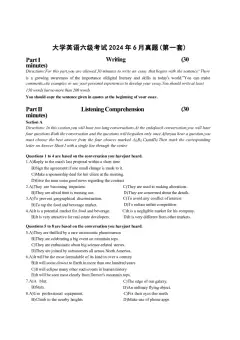
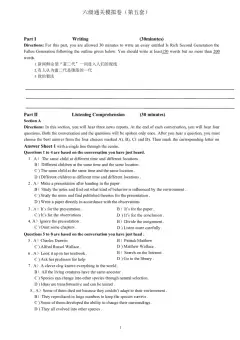
六级通关模拟卷(第一套)
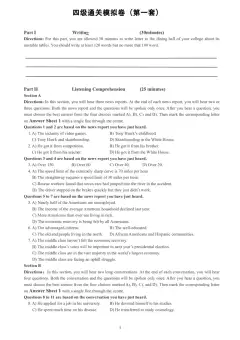
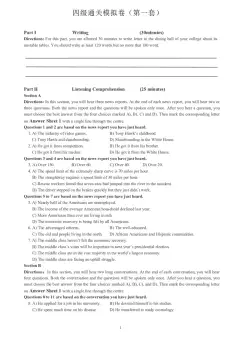
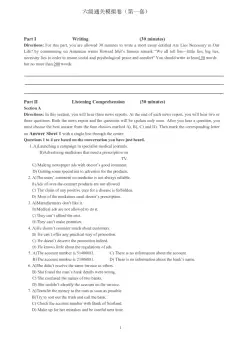
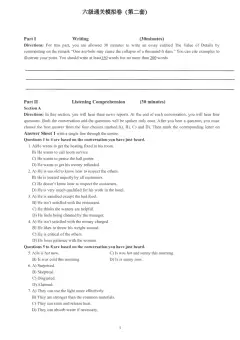
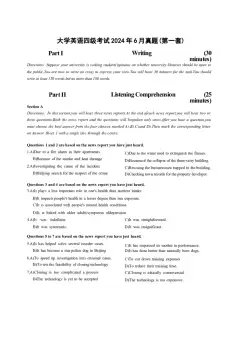
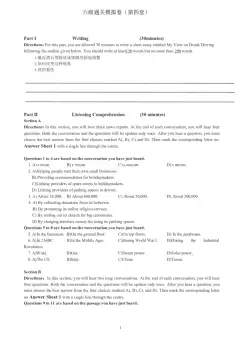
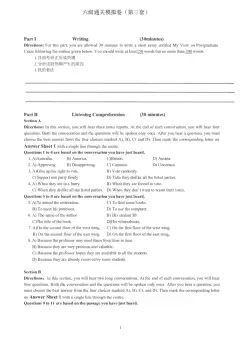
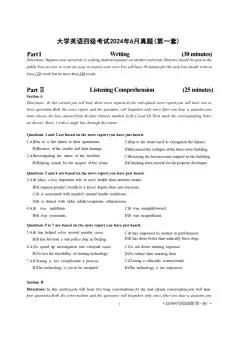
PartI Writing (30minutes)
Directions: For this part, you are allowed 30 minutes to write a short essay entitled Are Lies Necessary in Our
Life? by commenting on American writer Howard Mel’s famous remark “We all tell lies—little lies, big lies,
necessity lies in order to insure social and psychological peace and comfort” You should write at least150 words
butnomorethan200words.
PartII ListeningComprehension (30minutes)
SectionA
Directions: In this section, you will hear three news reports.At the end of each news report, you will hear two or
three questions. Both the news report and the questions will be spoken only once.After you hear a question, you
must choose the bestanswer from the four choices markedA), B), C) and D).Then mark the corresponding letter
onAnswerSheet1withasinglelinethroughthecentre.
Questions1to4arebasedontheconversationyouhavejustheard.
1.A)Launchingacampaigninspecialistmedicaljournals.
B)AdvertisingmedicinesthatneedaprescriptiononTV.
C)Makingnewspaperadswithdoctor’sgoodcomment.
D)Gettingsomespecialiststoadvertisefortheproducts.
2.A)Theusers’commentonmedicineisnotalwaysreliable.
B)Adsofover-the-counterproductsarenotallowed.
C)Theclaimofanypositivecureforadiseaseisforbidden.
D)Mostofthemedicinesneeddoctor’sprescription.
3.A)Manufacturersdon’tlikeit.
B)Medicaladsarenotallowedtodoit.
C)Theycan’taffordthecost.
D)Theycan’tmakepromises.
4.A)Hedoesn’tconsidermuchaboutcustomers.
B)Hecan’tofferanypracticalwayofpromotion.
C)Hedoesn’tdeservethepromotionindeed.
D)Heknowslittleabouttheregulationsofads.
Questions5to8rebasedontheconversationyouhavejustheard.
5.A)Theaccountnumberis51406881. C)Thereisnoinformationabouttheaccount.
B)Theaccountnumberis21406881. D)Thereisnoinformationaboutthebank’sname.
6.A)Shedidn’treceivethesameinvoiceasothers.
B)Shefoundtheman’sbankdetailswerewrong.
C)Sheconfusedthenamesoftwobanks.
D)Shecouldn’tidentifytheaccountontheinvoice.
7.A)Transferthemoneytothemanassoonaspossible.
B)Trytosortoutthetruthandcallthebank.
C)ChecktheaccountnumberwithBankofScotland.
D)Makeupforhermistakesandbecarefulnexttime.
18.A)Theyaremanagerandassistant. C)Theyarecustomerandmanager.
B)Theyarebusinesspartners. D)Theyarecoworkersofthesamecompany.
SectionB
Directions:In this section, you will hear two long conversations.At the end of each conversation, you will hear
four questions. Both the conversation and the questions will be spoken only once.After you hear a question, you
must choosethe bestanswer fromthe four choices markedA), B), C), andD).Then mark thecorresponding letter
onAnswerSheet 1withasinglelinethroughthecentre.
Questions9to12arebasedonthepassageyouhavejustheard.
9.A)Schoolsuseprivatedetectionservices.
B)Teachersdiscussessaytopicswiththeirstudents.
C)Teachersaskstudentstoturninearlydraftsofpapers.
D)Universitiesstopstudentsfrombuyingessays.
10.A)Thosethatareinvolvedinaspecificfield.
B)Thosethatareverydifficultandurgent.
C)Thosethatneedcooperationoftwowriters.
D)Thosewhosewritersarefromabroad.
11.A)Theirworkcanonlybeusedasamodel.
B)Mostoftheirwritersarepoorlypaid.
C)Mostwritershavedoctoratedegrees.
D)Studentsmayhandlethepaperastheywish.
12.A)Universitiesdon’tpaymuchattentiontoacademicachievement.
B)Professorsassigntoomuchworktostudentsinashorttime.
C)Communicationfailureappearsbetweenstudentsandprofessors.
D)Studentsdon’tknowtherulesofthecollegetheyareattending.
Questions13to15arebasedonthepassageyouhavejustheard.
13.A)Saltisquitenecessaryforpeople’shealth.
B)Eatingtoomuchsaltcoulddoharmtotheheart.
C)Thequantityofsaltvariesamongdifferentpeople.
D)Peoplearelaunchingacampaigntoeatlesssalt.
14.A)Eatingmoresaltmeansmoreheartattacks.
B)Lesssaltissuretoreducemanyheart-relateddiseases.
C)Eatinglesssaltmayleadtohighbloodpressure.
D)It’snotclearwhethereatinglesssaltwillhavegoodresults.
15.A)Mostpeopleconsumesimilaramountofsalt.
B)Americanseatlesssaltthantheothers.
C)Differentpeopleeatdifferentamountofsalt.
D)Saltisrelevanttopeople’shealth.
SectionC
Directions: In this section, you will hear three recordings of lectures or followed by three or four questions. The
recordings will be played only once. After you hear a question, you must choose the best answer from the four
choices marked A), B), C), D). Then mark the corresponding letter on Answer Sheet 1 with a single line
throughthecentre.
Questions16to19arebasedontherecordingyouhavejustheard.
16.A)Theyareabouttobemoreproductive.
B)Theytellustobemorephysicallyhealthy.
2C)Theyfocusontheimportanceofhabits.
D)Theyhelppeoplemakemoremoney.
17.A)Weshouldbehardworking.
B)Weareincontrolofourlife.
C)Wehaveagreatpotentialforeverything.
D)Wecanaccomplishtheresolutions.
18.A)Analyzethereasonsforfailure. C)Lookforsomeotheropportunities.
B)Trythesamethingonemoretime. D)Thinkabouthowtoimproveourselves.
19.A)Theydon’thavethedeadlinesfortasks.
B)Theyavoidbeingtoostressedatwork.
C)Theytendtothinkthereisplentyoftime.
D)Theythinktheywilldobetterthenextday.
Questions20to22arebasedontherecordingyouhavejustheard.
20.A)Theyarenotinahurrywhentheysaythingsoutloud.
B)Theyactasiftheyarereflectingoneverythingcarefully.
C)Theytendtothinkalotbeforetheysaysomethingout.
D)Theyenjoytherelaxedfeelingandneverrush.
21.A)Theywillfeelannoyed. C)Theywillfeelintimate.
B)Theywillbesurprised. D)Theywillbeimpressed.
22.A)Goodtalkerswillbeabletotalkaboutitforalongtime.
B)Itisagoodwaytoshowthetalker’splentifulknowledge.
C)Itcanbebroughtoutinaconversationandfascinateothers.
D)Mostpeoplecansaysomethingaboutpsychologyandsociology.
Questions23to25arebasedontherecordingyouhavejustheard.
23.A)Systematicmanagement.
B)Thetransportofgoods.
C)Customerservice.
D)Theconceptofbenefits.
24.A)Timing. C)Supportingservices.
B)Rawmaterials. D)Location.
25.A)Materialmanagement. C)Supplychainmanagement.
B)Physicaldistribution. D)Humanresourcemanagement.
PartⅢ Reading Comprehension (40minutes )
SectionA
Directions: In this section, there is a passage with ten blanks.You are required to select one word for each blank
from a list of choices given in a word bank following the passage. Read the passage through carefully before
making your choices. Each choice in the bank is identified by a letter. Please mark the corresponding letter for
each item on Answer Sheet 2 with a single line through the centre. You may not use any of the words in the
bankmorethanonce.
Questions26to35arebasedonthefollowingpassage.
Attention to detail is something everyone can andshould do—especially in a tightjob market. BobCrossley,
ahuman-resourceexpertnoticesthis inthejobapplicationthatcomesacrosshisdeskevery day.“It’s__26__how
3manycandidatescancelthemselves,”hesays.
“Resumes arrive with stains. Some candidates don’t __27___to spell the company’s name correctly. Once I
see a mistake, I __28__the candidate,” Crossley concludes. “If they cannot take care of these details, why should
wetrustthemwithajob?”
Can we pay too much attention to details?Absolutely. Perfectionists struggle over little things at the cost of
somethinglargertheyworktoward.“Tokeepfromlosingtheforestforthetrees,”saysCharlesGarfield,professor
atthe University ofCalifornia, San Francisco, “wemust__29__ask ourselves howthe details we’re workingon fit
intothelargepicture.”
Garfield __30__this process to his work as a computer scientist at NASA. “TheApollo Ⅱmoon__31__was
slightly off-course 90 percent of the time,” says Garfield. “But a successful landing was still likely because we
knew the__32__coordinates of our goal. This allowed us to make__33__as necessary.” Knowing where we want
togohelpsusjudgethesignificanceoftheeverytaskwe__34__.
Often we believe what accounts for other’s success is some special secret or a lucky break. But rarely is
successso__35__.Againandagain,weseethatbydoinglittlethingswithinourgraspwell,largerewardfollow.
A)abolish I)dominant
B)adjustments J)eliminate
C)administration K)launch
D)amazing L)mysterious
E)bother M)precise
F)compares N)probably
G)comprises O)undertake
H)constantly
SectionB
Directions: In this section, you are going to read a passage with ten statements attached to it. Each statement
containsinformationgiveninoneoftheparagraphs.Identifytheparagraphfromwhichtheinformationisderived.
You may choose a paragraph more than once. Each paragraph is marked with a letter. Answer the questions by
markingthecorrespondingletteronAnswerSheet2.
RisingInequalityIsHoldingBacktheU.S.Economy
[A]In announcing his run for the presidencylast month, Jeb Bush has set an ambitious goal of 4 percent real
growth in gross domestic product (GDP).This goal has been greeted with substantial skepticism from parts of the
economics establishment,while some economists havepraised itasa “worthy andviable aspiration”thatcouldbe
achieved with growth-oriented policies. Our recent research implies that a 4 percent growth goal for first term of
the next President is not only possible, but is what we should strive to achieve. Like Hubbard andWarsh, veteran
Republican economic policymakers, we agree that the U.S. needs policies that raise labor force participation,
accelerateproductivitygrowthandimproveexpectations.Wherewepartwaysisthetactics.
[B]Their recommendations focus on supply-side policies, such as tax reform, regulatory reform, reduced
tradefrictionandeducationandtraining.Ourresearchimpliesthataweakdemandsideexplainsthesluggish(萧条
的)recovery from the Great Recession, with the rise of income inequality as a central factor. Consequently, our
policy prescriptions revolve around increasing the take-home pay of the majority of American households. The
Great Recession, which began in December2007, was the most severe American economic downturn in
three-quarters of a century. Most economists did not anticipate ahead of time that this kind of thing couldhappen,
althoughwewarnedthat“itcouldgetuglyoutthere”inOctober2007.
[C] But as the severity of the recession became apparent in the dark days of late 2008 and early 2009, many
economists predicted a swift bounce-back, reasoning from historical evidence that deep downturns are followed
4by rapid recoveries. Sadly, that prediction was also incorrect. The growth path following the Great Recession has
been historically sluggish. Our recent research, supported by the Institute for New Economic Thinking, helps
explainwhy:Theeconomicdragfromdecadesofrisingincomeinequalityhasheldbackconsumerspending.
[D]Our work studies the link between rising income inequality and U.S. household demand over the past
several decades. From the middle 1980s until the middle 2000s, American consumers spent liberally despite the
fact that income growth stagnated(停滞)for most of the population. We show that the annual growth rate of
household income slowed markedly in 1980 for the bottom 95 percent of the income distribution, while income
growth for the top 5 percent accelerated at the same time. The result was the widely discussed rise of income
inequality.
[E]It is also well known that household debt grew rapidly during this period. Our work points out that the
buildup of debt relative to income was concentrated in the bottom 95 percent of the income distribution. Debt to
income for the top 5 percent bounced around with little clear trend:When the financial crisis hit, our work shows
thatthebottom95percentofAmericanscouldnolongergettherisingdebttheyneededtocontinuetospendalong
thetrendtheyestablishedintheyearsleadinguptothecrisis.Theresultwasasharpcutbackinhouseholddemand
relativetoincomethatcausedthecollapseoftheGreatRecession.
[F]What about the recovery? Household demand in 2013(the most recent observation we have because our
computations incorporate data that are released with a lag and are available at an annual frequency only)was a
stunning 17.5 percent below its pre-recession trend, with no sign of recovering back toward the trend. What
happened? Our research implies that the cutoff of credit for the group of households falling behind as income
inequalityrosepreventedtheirspendingfromrecoveringtoitspre-recessionpath.
[G]While there is no reason to necessarily expect that consumer spending will follow a constant trend over
long periods of time, the practical reality is that the U.S. economy needed the pre-recession trend of demand to
maintain adequate growth and at least a rough approximation of full employment prior to 2007. In the middle
2000s, there was no sign of excess demand in the U.S. economy. Inflation was tame and interest rates were low.
Wage growth was stagnant.Although some gradual slowing in long-term U.S. growth might have been predicted
as the large baby-boom generation ages, the overall labor force participation rate was actually rising prior to the
recession, so there was no reason to expect any significant decline in labor resources in the years immediately
following2007.
[H]Yes, the way manyAmericans were financing their demand was unsustainable, but there is no indication
thatbusinessescouldnotsustainablycontinuetoproducealongthepre-recessiontrendiftheyhadbeenabletosell
theoutput.Ourinterpretation ofthe evidenceis thatthe demanddragthat couldbe expected asthe resultof rising
inequality is, after a delay of a-quarter century, finally constraining the U.S. economy. Intuition, theory and
evidence predict that high-income people spend, on average, a smaller share of their income than everyone else
does. So as a higher share of income goes into the pockets of the well-to-do, the household sector as a whole is
likelytorecyclelessofitsincomebackintospending,whichslowsthepathofdemandgrowth.
[I]Apossible problemwith this prediction for the U.S. in recentyears is thatincome inequality began to rise
in the early 1980s, but household demand remained strong through 2006. Our argument is that the demand drag
fromrisinginequalitywaspostponedbythebuildupofdebt:Thebottom95percentborrowedratherthancutback
their spending when their income growth slowed. But as the crisis hit, lending to households collapsed, and the
trendofrisingdebtcouldnotcontinue.
[J]The effectof rising inequality has hitthe economy hard.As a result, today’s economy is underperforming.
No one can know precisely how much of the stagnation in household demand is due to the rise of inequality, but
our estimates imply that the current path of total demand in the economy is at least 10 percent below where it
would have been with the income distribution of the early 1980s. Where demand goes, so follows output and
employment. This analysis links to the call for 4 percent growth. Considering conventional estimates of the
long-term trendgrowth of theeconomy,a4 percentgrowthrate through the nextU.S. President’s firstterm would
go a long way toward closing the gap in output that opened with the collapse of household spending in the Great
5Recessionandhasyettobefilled.
[K]How can we move toward this goal? Our research strongly implies that the main problem is on the
demand side, not the supply side. The U.S. needs to find a way to boost demand growth by arresting, and
hopefully reversing, the dramatic rise of inequality, The basic argument is exceedingly simple: The economy
continues to beheldbackby insufficienthousehold spending, and ifthe income shareofAmericans outsideofthe
topsliver rises,householdspendingwillincrease.Policies thatraise theminimumwage andreducethetaxburden
oflow-andmiddle-incomehouseholdswouldhelp.
[L]In our view, however, the best method to achieve this objective would be to restore wage growth across
theincome distribution as occurredinthe decadesafterWorldWar Ⅱ.Meeting this objective is challenging fora
variety of reasons, including the fact that there remains no clear consensus about what has caused the rise of
American economic inequality. But the need to address inequality is not just a matter of social justice; it also is
importanttogettheeconomybackontherighttrackaftermorethansevenyearsofstagnation.Wecandobetter.
36.Americans were free with their money though their income growth mostly remained still from the late 20th
centurytotheGreatRecession.
37.Contrary to many economists claims, the U.S. economy didn’t experience rapid recoveries after the Great
Recession.
38.Laborresourceswerenotexpectedtosufferfromasharpfallintheyearsafter2007.
39.Reducingtheincomeinequalityisofsignificanceintermsofsocialjusticeandeconomicrecovery.
40. The author differs from some economic policymakers on the strategies the U.S. should take to boost the
economy.
41.The author estimates that the current demand should have been ten percenthigher if the income distribution
remainedthesameastheearly1980s.
42.Themajorityofthelow-incomeearnerscontinuedtotakeonmoreloansratherthancutexpenseswhentheir
incomegrowthhasbeenweakening.
43.Toachievethegoalof4%growthinGDP,thedemandgrowthshouldbeboostedbyraisingtheincomeshare
ofthebottom95%.
44.It’spredictedthathigh-incomeearnersgenerallyspendlessrelativetotheirincomethanothers.
45.Excepta little warning two months before the Great Recession, the majority of economists didn’t foresee its
coming.
SectionC
Directions: There are 2 passages in this section. Each passage is followed by some questions or unfinished
statements. For each of them there are four choices marked A), B), C) and D). You should decide on the best
choiceandmarkthecorrespondingletteronAnswerSheet 2withasinglelinethroughthecentre.
PassageOne
Questions46and50arebasedonthefollowingpassage.
Musicians—from karaokesingers toprofessionalviolinplayers—arebetterabletoheartargetedsoundsina
noisy environment, according to a piece of new research that adds to evidence that music makes the brain work
better.
“In the past ten years there’s been an explosion of research on music and the brain,” Aniruddh Patel, the
SeniorFellowattheNeurosciencesInstituteinSanDiego,saidtodayatapressbriefing.
Most recently brain-imaging studies have shown that music activates many diverse parts of the brain,
includinganoverlapwherethebrainprocessesmusicandlanguage.
Language is a natural aspect to consider in looking at how music affects the brain, Patel said. Like music,
languageis“universal,there’sastronglearningcomponent,anditcarriescomplexmeanings.”
Forexample,brainsofpeopleexposedtoevencasualmusicaltraininghaveanenhancedabilitytogenerate
6the brain wave patterns associated with specific sounds, be they musical or spoken, said study leader Nina Kraus,
directoroftheAuditoryNeuroscienceLaboratoryatNorthwesternUniversityinIllinois.
Kraus’ previous research had shown that when a person listens to a sound, the brain wave recorded in
response is physically the same as the sound wave itself. In fact, “playing” the brain wave produces a nearly
identicalsound.
But for people without a trained ear for music, the ability to make these patterns decreases as background
noise increases, experiments show. Musicians, by contrast, have subconsciously trained their brains to better
recognizeselectivesoundpatterns,evenasbackgroundnoisegoesup.
At the same time, people with certain developmental disorders, such as dyslexia(阅读障碍症),have a
harder time hearing sounds amid the noise—a serious problem, for example, for students straining to hear the
teacherinanoisyclassroom.
Musical experience could therefore be a key therapy for children with dyslexia and similar
language-relateddisorders,Kraussaid.
In a similar vein, Harvard Medical School neuroscientist Gottfried Schlaug has found that stroke patients
whohavelosttheabilitytospeakcanbetrainedtosayhundredsofphrasesbysingingthemfirst.
In his research, Schlaug demonstrated the results of intensive musical therapy on patients with lesions(损
伤)ontheleftsidesoftheirbrains,thoseareasmostassociatedwithlanguage.
Beforethetherapy,thesestrokepatientsrespondedtoquestionswithlargelyincoherentsoundsandphrases.
Butafter justafew minuteswith therapists, whoaskedthem tosingphrasesandtap theirhandstothe rhythm, the
patientscouldsing“HappyBirthday,”recitetheiraddresses,andcommunicateiftheywerethirsty.
“The underdeveloped systems on the right side of the brain that respond to music became enhanced and
changedstructures,”Schlaugsaid.
Overall, Schlaug said, the experiments show that “music might be an alternative medium for engaging
partsofthebrainthatareotherwisenotengaged.”
46.AccordingtoPatel,thefunctionoflanguageisusuallyunderconsiderationwhen______.
A)peopletendtostudytherelationbetweenmusicandthebrain
B)musicianstrytoexplaintheprofoundmeaningbehindapieceofmusic
C)scientistsdoexperimentsonthefunctionofdifferentpartsofthebrain
D)audienceparticipateinthediscussiononthecomplexityofmusic
47.Whycanmusicianshearselectivesoundpatternsinanoisyenvironment?
A.Becausetheyhavesubconsciouslytrainedtheirearstogetaccustomedtothosesoundpatterns.
B)Becausetheirbrainshavebeentrainedtorecognizespecificsoundpatternsinnoisybackground.
C)Becausetheycanproducethebrainwavepatternsthesameasthosesoundpatterns.
D)Becausetheirtrainedearsaresensitivetospecificsoundsnomatterwheretheyare.
48.AccordingtoKraus,thesignificanceofthelinkbetweenmusicandthebrainliesinthefactthat_____.
A)languageabilitycanbeenhancedbylisteningtomusic
B)allkindsofbraindisorderscanbecuredbylisteningtomusic
C)musicisthesolemethodtodealwithmentaldiseases
D)musiccanbeeffectiveintreatingpeoplewithlanguageproblems
49.HowcanstrokepatientsbetreatedinSchlaug’sfindings?
A)Theyshouldutteraphraseahundredtimesadaywhenstartingtherecoverytraining.
B)Theyshouldchantphrasesinsteadofsayingthematthebeginningstageofthetraining.
C)Doctorsshouldpersuadethemtosingsongseverydaytoregaintheirspeakingability.
D)Theyshouldpractisesingingthephrasesaftersayingthemhundredsoftimeseveryday.
750.Bysingingphrases,strokepatientsaretryingto______.
A)restorethelanguagefunctionofthedamagedsystemintheleftbrain
B)hinderthedamagedstructureinthebrainfromdeterioratingsharply
C)improvethestructuresoftheunderdevelopedsystemsintherightbrain
D)practisethepartsofthebrainwhichareunderconstantuse
PassageTwo
Questions51to55arebasedonthefollowingpassage.
Shyness is the cause of much unhappiness for a great many people.All kinds of people describe themselves
asshy:short,tall,dull,intelligent,young,old,slim,overweight.Shypeopleareanxiousandself-conscious;thatis,
they are excessively concerned with their own appearance and actions. Worrisome thoughts are constantly
occurring in their minds: What kind of impression am I making? Do they like me? Do I sound stupid? Am I
wearingunattractiveclothes?
It is obvious that such uncomfortable feelings must affect people adversely. A person’s self-concept is
reflected in the way he or she behaves, and the way a person behaves affects other people’s reactions. In general,
the way people think about themselves has a profound effect on all areas of their lives. For instance, people who
have a positive sense of self-worth or high self-esteem usually act with confidence. Because they do not need
constantpraise andencouragementfromothers to feelgood aboutthemselves. Self-confidentpeopleparticipatein
life enthusiastically and spontaneously. They are not affected by what others think they “should do”. People with
high self-esteem are not hurt by criticism; they do not regard criticism as a personal attack. Instead, they view a
criticismasasuggestionforimprovement.
Incontrast, shypeople,havinglowself-esteem, arelikelytobepassive andeasilyinfluencedbyothers.They
need reassurance that they are doing “the right thing”. Shy people are very sensitive to criticism; they feel it
confirms their inferiority. They also find it difficult to be pleased by compliments because they believe they are
unworthyofpraise.Ashypersonmayrespondto acomplimentwith a statementlike this one:“You’re justsaying
that to make me feel good. I know it’s not true.” It is clear that, while self-awareness is a healthy quality,
overdoingitisdetrimental,orharmful.
Can shyness be completely eliminated, or at least reduced? Fortunately, people can overcome shyness with
determined and patient effort in building self-confidence. Since shyness goes hand in hand with lack of
self-esteem, it is important for people to accept their weaknesses as well as their strengths. For example, most
people would like to be “A” students in every subject. It is not fair for them to label themselves inferior because
theyhavedifficulty insome areas.People’sexpectations ofthemselves mustberealistic. Living ontheimpossible
leadstoasenseofinadequacy.
Eachoneofusisaunique,worthwhileindividual.Weareinterestedinourownpersonalways.Thebetterwe
understandourselves,theeasieritbecomestoliveuptoourfullpotential.Let’snotallowourshynesstoblockout
chancesforarichandfulfillinglife.
51.Thefirstparagraphismainlyabout______.
A)thecharacteristicsofshypeople
B)thecauseofshyness
C)thequestionsinthemindsofshypeople
D)theeffectofshynessonpeople
52.Accordingtothewriter,self-awarenessis________.
A)harmfultopeople
B)aweakpointofshypeople
C)thecauseofunhappiness
D)agoodquality
853.Accordingtothepassage,theuncomfortablefeelingsofshypeople______.
A)havenoeffectonthem
B)haveafavourableeffectonthem
C)haveanunfavourableeffectonthem
D)canhardlybeovercome
54.Whatistheshypeople’susualreactiontoacompliment?
A)Theyarepleasedaboutit.
B)Theysuspectitisnottrue.
C)Theyareverysensitivetoit.
D)Theyfeelitconfirmstheirinferiority.
55.Wecaninferfromthepassagethatthewriterwouldfavor______.
A)ashyperson C)asensitiveperson
B)arealisticperson D)areservedperson
PartⅣ Translation (30 minutes)
Directions:Forthispart,youareallowed30minutestotranslateapassagefromChineseinto
English.YoushouldwriteyouransweronAnswerSheet2.
功夫(Kungfu)是一种典型的中国传统文化,它是一项既活动肌肉又活动大脑的运动。同时,功夫不仅
是一项体育运动,也是一种艺术形式。它被用来治病和自卫,而且是一种综合性的人体文化。功夫历史悠
久,在中国非常流行。肢体动作只是功夫的外部表现(externaldisplay),功夫绝对不受限于外部动作,它还强
调充分发挥内部气质(internaltemperament)、心理状态(mentalstate)和人类潜能。由于起源于传统的东方文
化,功夫的特点与魅力在其他国家受到越来越多的关注。
9