年北京市初中学业水平考试
第一部分
本部分共33题,共40分。在每题列出的四个选项中,选出最符合题目要求的一项。
一、单项填空(每题0.5分,共6分)
从下面各题所给的A、B、C、D四个选项中,选择可以填入空白处的最佳选项。
1.Marys birthday is coming. Weve decided to make a cake for .
A.him B.her C.you D.them
2.Space Day of China falls April 24th every year.
A.onB.byC.at D.in
3.— shall we meet for the picnic?
—At the school gate.
A.How B.When C.Why D.Where
4.—Sam, I join you in the community service?
—Of course you can.
A.can B.must C.should D.need
5.The doctors worked for ten hours, nobody took a break.
A.soB.for C.but D.or
6.The teacher is glad to see that Tony is than before.
A.carefulB.more careful
C.most careful D.the most careful
7.—Peter, what are you doing?
—Oh, I a report about national heroes.
A.will write B.am writing C.wrote D.have written
8.My parents and I trees last Sunday.
A.plant B.will plant C.are plantingD.planted
9.—Lily, what do you usually do after school?
—I exercise with my friends.
A.doB.did C.will doD.was doing
10.Mr. Smith Chinese for two years. Hes much better at it now.
A.learns B.was learning C.has learned D.will learn
11.Today, many winter Olympic sports even by children.
A.enjoyed B.enjoy C.were enjoyed D.are enjoyed
12.—Could you please tell me ?
—Next Thursday morning.
A.when we visited the Capital Museum
B.when did we visit the Capital Museum
C.when we will visit the Capital Museum
D.when will we visit the Capital Museum
二、完形填空(每题1分,共8分)
阅读下面的短文,掌握其大意,然后从短文后各题所给的A、B、C、D四个选项中,选择
最佳选项。The Picture of Peace
When Mike was seven, he knew his dream was to be a photographer. He kept
working on it for years. Recently, he was trying to take a picture of a sunset(日落) to
enter the school 13 competition.
“Mom, it has been cloudy these days. I dont think I can get this picture!” Mike
complained.
“Why not use one of your photos on the computer?” suggested Mom.
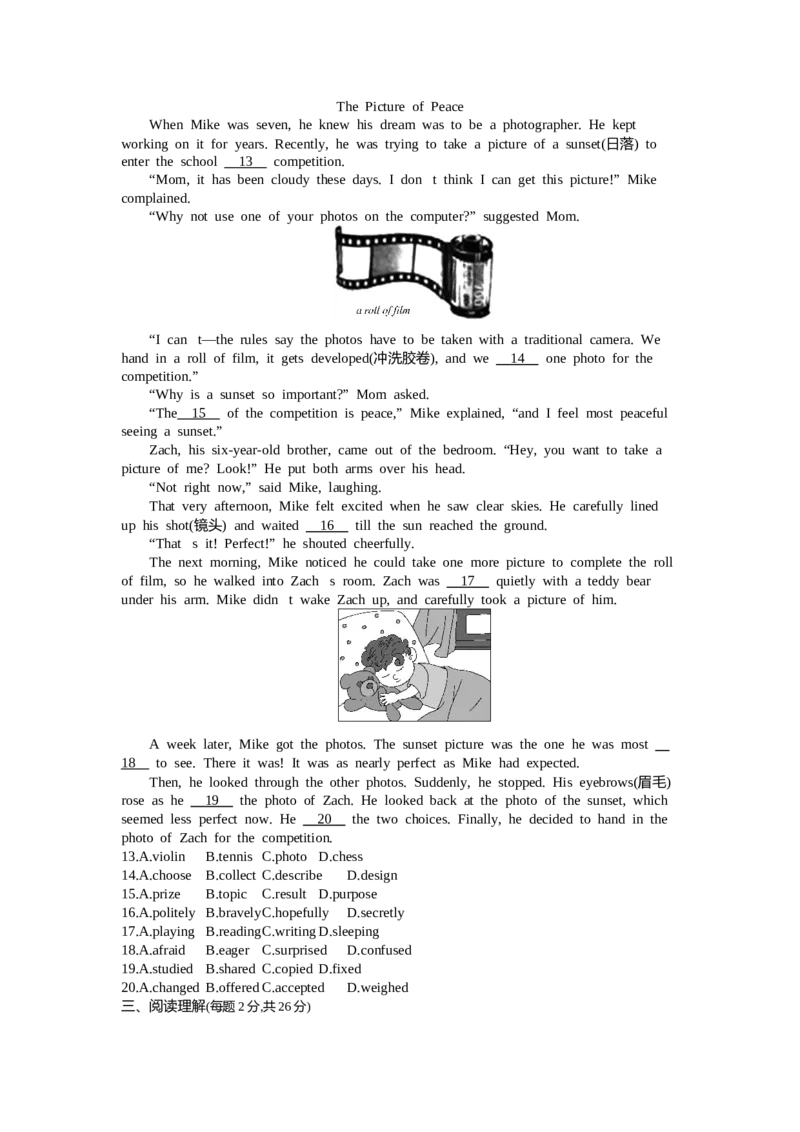
“I cant—the rules say the photos have to be taken with a traditional camera. We
hand in a roll of film, it gets developed(冲洗胶卷), and we 14 one photo for the
competition.”
“Why is a sunset so important?” Mom asked.
“The 15 of the competition is peace,” Mike explained, “and I feel most peaceful
seeing a sunset.”
Zach, his six-year-old brother, came out of the bedroom. “Hey, you want to take a
picture of me? Look!” He put both arms over his head.
“Not right now,” said Mike, laughing.
That very afternoon, Mike felt excited when he saw clear skies. He carefully lined
up his shot(镜头) and waited 16 till the sun reached the ground.
“Thats it! Perfect!” he shouted cheerfully.
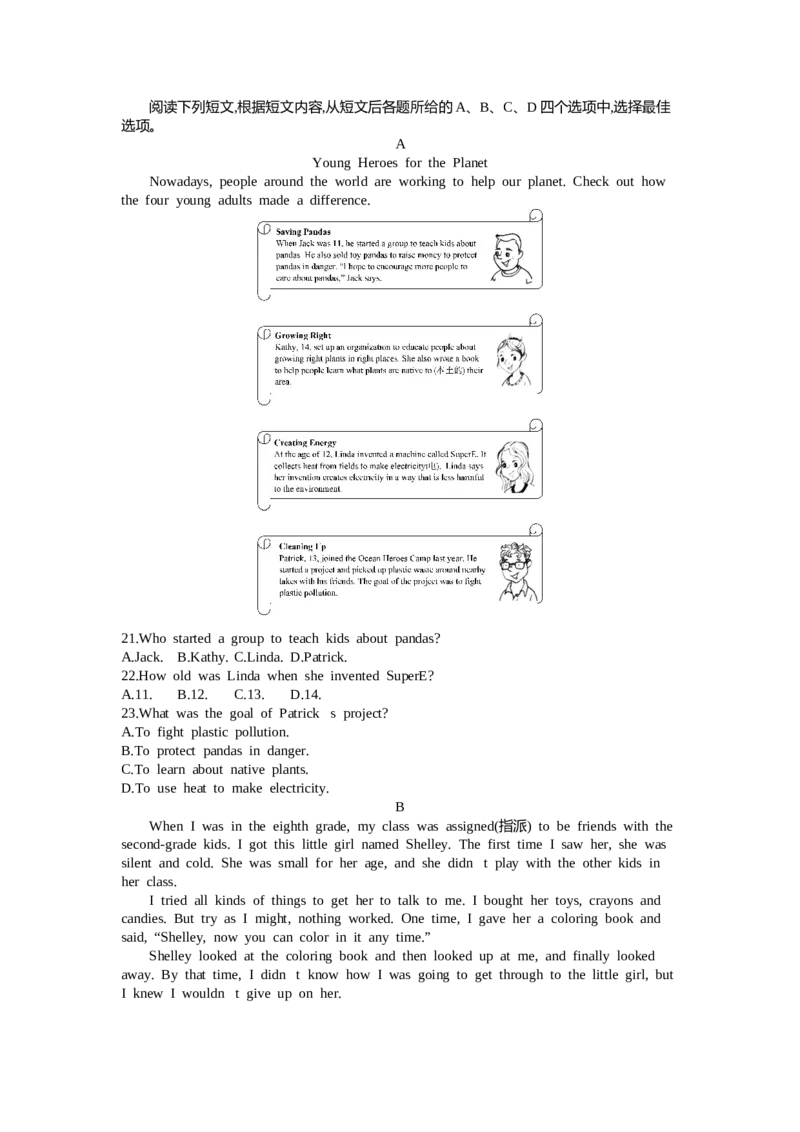
The next morning, Mike noticed he could take one more picture to complete the roll
of film, so he walked into Zachs room. Zach was 17 quietly with a teddy bear
under his arm. Mike didnt wake Zach up, and carefully took a picture of him.
A week later, Mike got the photos. The sunset picture was the one he was most
18 to see. There it was! It was as nearly perfect as Mike had expected.
Then, he looked through the other photos. Suddenly, he stopped. His eyebrows(眉毛)
rose as he 19 the photo of Zach. He looked back at the photo of the sunset, which
seemed less perfect now. He 20 the two choices. Finally, he decided to hand in the
photo of Zach for the competition.
13.A.violin B.tennis C.photo D.chess
14.A.choose B.collect C.describe D.design
15.A.prize B.topic C.result D.purpose
16.A.politely B.bravelyC.hopefully D.secretly
17.A.playing B.readingC.writingD.sleeping
18.A.afraid B.eager C.surprised D.confused
19.A.studied B.shared C.copied D.fixed
20.A.changed B.offeredC.accepted D.weighed
三、阅读理解(每题2分,共26分)阅读下列短文,根据短文内容,从短文后各题所给的A、B、C、D四个选项中,选择最佳
选项。
A
Young Heroes for the Planet
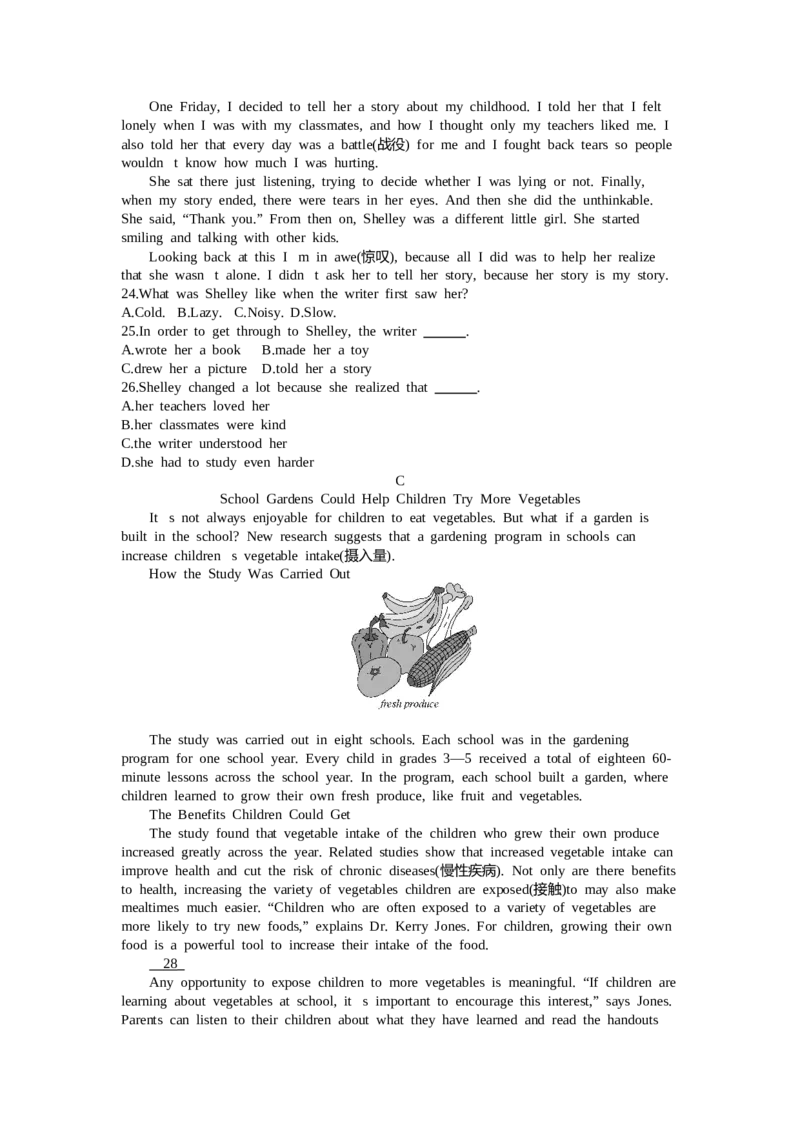
Nowadays, people around the world are working to help our planet. Check out how
the four young adults made a difference.
21.Who started a group to teach kids about pandas?
A.Jack. B.Kathy. C.Linda. D.Patrick.
22.How old was Linda when she invented SuperE?
A.11. B.12. C.13. D.14.
23.What was the goal of Patricks project?
A.To fight plastic pollution.
B.To protect pandas in danger.
C.To learn about native plants.
D.To use heat to make electricity.
B
When I was in the eighth grade, my class was assigned(指派) to be friends with the
second-grade kids. I got this little girl named Shelley. The first time I saw her, she was
silent and cold. She was small for her age, and she didnt play with the other kids in
her class.
I tried all kinds of things to get her to talk to me. I bought her toys, crayons and
candies. But try as I might, nothing worked. One time, I gave her a coloring book and
said, “Shelley, now you can color in it any time.”
Shelley looked at the coloring book and then looked up at me, and finally looked
away. By that time, I didnt know how I was going to get through to the little girl, but
I knew I wouldnt give up on her.One Friday, I decided to tell her a story about my childhood. I told her that I felt
lonely when I was with my classmates, and how I thought only my teachers liked me. I
also told her that every day was a battle(战役) for me and I fought back tears so people
wouldnt know how much I was hurting.
She sat there just listening, trying to decide whether I was lying or not. Finally,
when my story ended, there were tears in her eyes. And then she did the unthinkable.
She said, “Thank you.” From then on, Shelley was a different little girl. She started
smiling and talking with other kids.
Looking back at this Im in awe(惊叹), because all I did was to help her realize
that she wasnt alone. I didnt ask her to tell her story, because her story is my story.
24.What was Shelley like when the writer first saw her?
A.Cold. B.Lazy. C.Noisy. D.Slow.
25.In order to get through to Shelley, the writer .
A.wrote her a book B.made her a toy
C.drew her a picture D.told her a story
26.Shelley changed a lot because she realized that .
A.her teachers loved her
B.her classmates were kind
C.the writer understood her
D.she had to study even harder
C
School Gardens Could Help Children Try More Vegetables
Its not always enjoyable for children to eat vegetables. But what if a garden is
built in the school? New research suggests that a gardening program in schools can
increase childrens vegetable intake(摄入量).
How the Study Was Carried Out
The study was carried out in eight schools. Each school was in the gardening
program for one school year. Every child in grades 3—5 received a total of eighteen 60-
minute lessons across the school year. In the program, each school built a garden, where
children learned to grow their own fresh produce, like fruit and vegetables.
The Benefits Children Could Get
The study found that vegetable intake of the children who grew their own produce
increased greatly across the year. Related studies show that increased vegetable intake can
improve health and cut the risk of chronic diseases(慢性疾病). Not only are there benefits
to health, increasing the variety of vegetables children are exposed(接触)to may also make
mealtimes much easier. “Children who are often exposed to a variety of vegetables are
more likely to try new foods,” explains Dr. Kerry Jones. For children, growing their own
food is a powerful tool to increase their intake of the food.
28
Any opportunity to expose children to more vegetables is meaningful. “If children are
learning about vegetables at school, its important to encourage this interest,” says Jones.
Parents can listen to their children about what they have learned and read the handoutsthey bring home from school. Parents and children can also read books together. Younger
children can enjoy reading stories about vegetables with parents who offer useful message.
Older children may enjoy searching through cookbooks with parents to find new dinner
ideas to cook vegetables in a tasty way. Besides, a small planter box in a sunny part at
home can encourage children to understand more about where their food comes from.
Teaching children to grow their own produce is a great way to increase their
preference for the produce. If children are taught to enjoy vegetables early in life, they
will probably continue eating vegetables in the long term.
27.What did children do in the gardening program?
A.They did research on new plants.
B.They grew fresh produce at school.
C.They took home green vegetables.
D.They built gardens for their classes.
28.Which of the following would be the best heading for Paragraph 4?
A.Ideas to Encourage Children to Cook at Home
B.Ways to Expose Children to Vegetables at Home
C.Reasons Why Parents Should Understand Children
D.Suggestions Which Children Could Get from Parents
29.What can we learn from the program?
A.Parents support might improve childrens reading.
B.School programs could develop students creativity.
C.Doing studies can prepare students for future learning.
D.Hands-on experience may influence childrens preference.
D
Nature and culture are often seen as opposite ideas. What belongs to nature cannot
be the result of human activities and, on the other hand, cultural development is achieved
against nature. However, this is not the only opinion on the relationship between nature
and culture. Studies in the development of humans suggest that culture, whether taken as
an effort against nature or a natural effort, is part of the development of the human
species(物种).
Several modern writers saw the process of education as a struggle(斗争) against
human nature. We are born with wild natures, such as eating and behaving in a
disorganized way or acting selfishly. Education uses culture as a way to get us out of our
wildest natures;it is thanks to culture that the human species could learn to adapt(适应),
progress and raise itself above and beyond other species.
Over the past century and a half, however, studies in the history of human
development have shown that the formation of culture is part of the biological
adaptation.Consider, for example, hunting(打猎). It seems to be an adaptation, which
allowed humans to move into new and different areas, opening up the opportunity to
change living habits. At the same time, the development of weapons(武器) is related to
that adaptation—from rocks and stones to a set of hunting tools, and from hunting tools
to rules relating to the proper use of weapons. Hunting also seems to be responsible for a
whole set of bodily abilities, such as balancing on one foot. Just think of how this very
simple thing is closely related to dance, a key expression of human culture. It is then
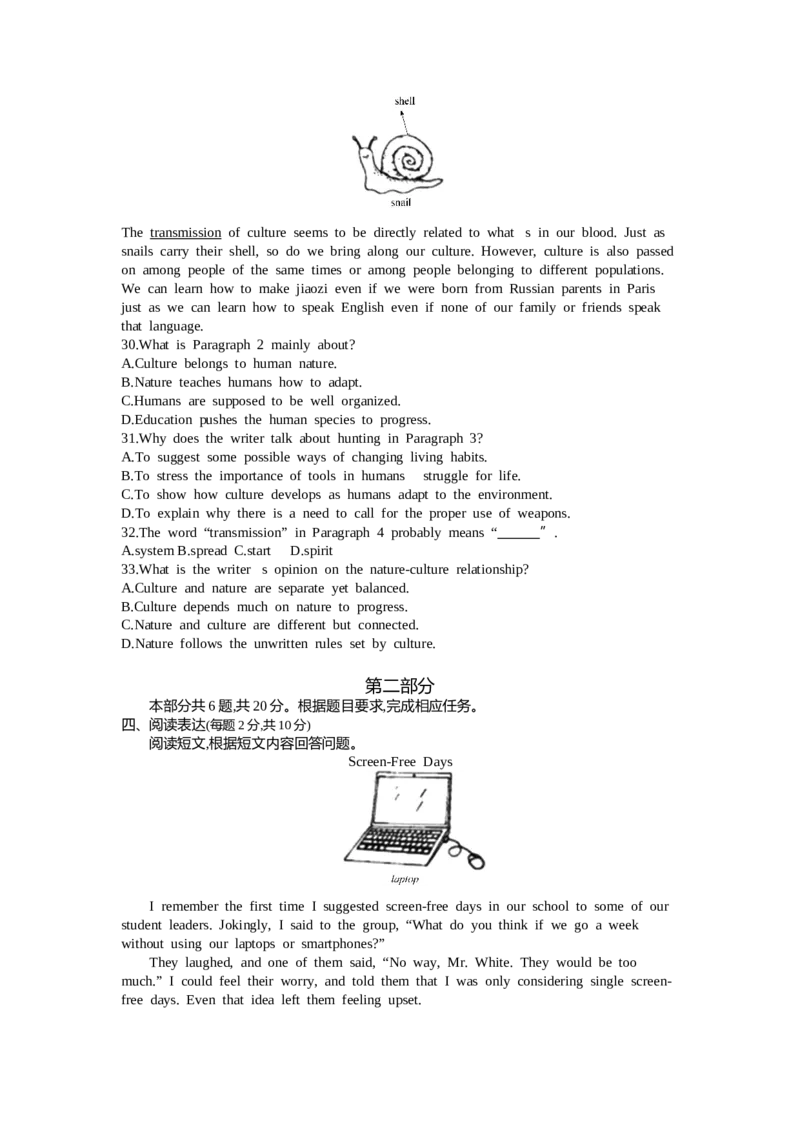
clear that biological development and cultural development are closely tied.The transmission of culture seems to be directly related to whats in our blood. Just as
snails carry their shell, so do we bring along our culture. However, culture is also passed
on among people of the same times or among people belonging to different populations.
We can learn how to make jiaozi even if we were born from Russian parents in Paris
just as we can learn how to speak English even if none of our family or friends speak
that language.
30.What is Paragraph 2 mainly about?
A.Culture belongs to human nature.
B.Nature teaches humans how to adapt.
C.Humans are supposed to be well organized.
D.Education pushes the human species to progress.
31.Why does the writer talk about hunting in Paragraph 3?
A.To suggest some possible ways of changing living habits.
B.To stress the importance of tools in humans struggle for life.
C.To show how culture develops as humans adapt to the environment.
D.To explain why there is a need to call for the proper use of weapons.
32.The word “transmission” in Paragraph 4 probably means “ ”.
A.systemB.spread C.start D.spirit
33.What is the writers opinion on the nature-culture relationship?
A.Culture and nature are separate yet balanced.
B.Culture depends much on nature to progress.
C.Nature and culture are different but connected.
D.Nature follows the unwritten rules set by culture.
第二部分
本部分共6题,共20分。根据题目要求,完成相应任务。
四、阅读表达(每题2分,共10分)
阅读短文,根据短文内容回答问题。
Screen-Free Days
I remember the first time I suggested screen-free days in our school to some of our
student leaders. Jokingly, I said to the group, “What do you think if we go a week
without using our laptops or smartphones?”
They laughed, and one of them said, “No way, Mr. White. They would be too
much.” I could feel their worry, and told them that I was only considering single screen-
free days. Even that idea left them feeling upset.According to a survey we did, most students in our school spend about six hours a
day on screens. Many of my students start their day by checking their smartphones. I
often see them looking at their phones when getting off the bus or at parent drop-off—
they cant use their own “screens” at school. They usually work on computers at school
for at least two hours during the day.
Its clear that our students spend a lot of time on screens. We do see the benefits
of technology. However, we teachers also want to make sure that students have balanced
learning and social experiences away from their screens. Thats why we have come up
with the idea of screen-free days.
During the course of the year, we have built in several screen-free days that require
us to make different plans for our students about how they will communicate with one
another and the world around them without “screens”. For some teachers, this means
bringing back a valuable lesson plan that has been put off for some time because it is
“out of date”. Others have designed something completely new.
Fun activities, for example, card games and room escape(密室逃脱) games, are
organized at school. In these activities, students socialize without smartphones and have
face-to-face communication without checking on “likes” theyve got online. These fun
activities also make it possible for the whole grade to enjoy the company of their friends
with no smartphones.
After our first screen-free day, students mentioned that they were surprised they
enjoyed it. Finding ways to help our students connect with one another is important.
While technology is already part of our world, it shouldnt play such an important role
in a learners life.
34.How many hours do most students in the school spend on screens every day?
35.Why have the teachers come up with the idea of screen-free days?
36.What fun activities can the students have at school?
37.How did the students feel after the first screen-free day?
38.What do you think of the idea of screen-free days? Why do you think so?
五、文段表达(10分)
39.从下面两个题目中任选一题,根据中文和英文提示,完成一篇不少于50词的文段写作。文
中已给出内容不计入总词数。所给提示词语仅供选用。请不要写出你的校名和姓名。
题目①
北京是一座蕴含着丰富文化的城市,这里的建筑、戏曲、美食、服饰、手工艺品等,都有
文化的印记。
假如你是李华,你校英语社团正在开展线上国际交流活动,其公众号计划做关于北京文化
的系列推送,现就 “Cultural Symbols of Beijing(北京文化标志)”这一话题在校内收集素材。
请你用英语给公众号留言,推荐一个你眼中的北京文化标志,对其作简要介绍,并说明推荐理
由。
提示词语:show, traditional, love, treasure, important
提示问题:●In your opinion, what is the cultural symbol of Beijing?
Please describe it.
●Why do you think it can be a symbol?
Im Li Hua, from Class 1, Grade 9.I hope my idea can be taken. Thanks!
题目②
现实中,大到自然环境和社会环境,小到个人生活和学习,变化无处不在。面对变化,唯有
积极适应,才能有所进步和收获。
某英文网站正在开展以“适应变化”为主题的征文活动。假如你是李华,请用英语写一
篇短文投稿,谈谈你生活中的一个变化。你是如何应对这个变化的,以及有什么收获。
提示词语:help, enjoy, new, challenge, take action
提示问题:●What is the change that happened in your life?
●How did you deal with it?
●What have you learned from the experience?
There are many changes in a persons life.
1 2021年北京市初中学业水平考试
1 2 3 4 5 6 7 8 9 10
B A D A C B B D A C
11 12 13 14 15 16 17 18 19 20
D C C A B C D B A D
21 22 23 24 25 26 27 28 29 30
A B A A D C B B D D
31 32 33
C B C
第一部分
一、单项填空
1.B 句意:玛丽的生日快到了。我们决定为她做一个蛋糕。本题考查人称代词宾格。根据
语境可知,设空处指代上文中的Mary,作介词for的宾语,故选B。
2.A 句意:每年的4月24日是中国的“航天日”。本题考查介词的用法。在具体的几月几
号的前面用介词on,故选A。
3.D 句意:——我们在哪里见面去野餐?——在学校门口。本题考查疑问副词用法。答句回
答的是地点,由此可知问句是在问“在哪”,故选D。
4.A 句意:——Sam,我可以加入你,一起做社区服务吗?——当然可以。本题考查情态动词的
用法。根据答语Of course you can.可知问句是在表示请求,要用can来提问,故选A。
5.C 句意:医生们工作了十个小时,但没有人休息一下。本题考查连词的用法。前面说“工
作了十个小时”,后面说“没有人休息”,前后有明显的转折关系,故选C。6.B 句意:老师很高兴看到托尼比以前更细心了。本题考查形容词比较级。根据空后的
than可知,应用形容词的比较级,故选B。
7.B 句意:——彼得,你在干什么?——哦,我正在写一篇关于民族英雄的报告。本题考查动
词的时态。由问句what are you doing可知,设空处要用现在进行时,故选B。
8.D 句意:我父母和我上周日种树了。本题考查动词的时态。由时间状语last Sunday可知,
设空处要用一般过去时,故选D。
9.A 句意:——莉莉,放学后你通常做什么?——我和我的朋友们做运动。本题考查动词的时
态。由问句的时间状语usually可知,设空处要用一般现在时,故选A。
10.C 句意:史密斯先生学汉语已经两年了。他现在汉语水平更高了。本题考查动词的时态。
由句子的时间状语for two years可知,设空处应用现在完成时,故选C。
11.D 句意:今天,许多冬季奥运会项目甚至受到孩子们的喜爱。本题考查一般现在时的被动
语态。根据时间状语Today可知应用一般现在时;sports与 enjoy之间是被动关系,故用被动
语态,故选D。
12.C 句意:——你能告诉我我们什么时候去参观首都博物馆吗?——下周四早上。本题考
查宾语从句。宾语从句要用陈述句语序,由答语Next Thursday morning.可知,设空处应用一
般将来时,故选C。
二、完形填空
[语篇解读] 本文是一篇记叙文。摄影爱好者Mike想要拍出一张理想照片参加摄影比赛。
摄影比赛主题是peace(平静),Mike想要拍一张日落的照片参赛。在Mike终于拍到日落照片
后,他又随机拍了一张弟弟睡觉时的照片。经过对比和思考,Mike决定用弟弟睡觉的照片参
赛。
13.C 根据上文中photographer、take a picture可知,Mike参加的是摄影比赛,故选C。
14.A 根据常识和语境,一卷胶卷有很多张照片,此处应该是从中挑选一张。故选A。
15.B 根据下文中Mike的解释,他认为日落就是最平静的事物,可推断此处表示“摄影比赛
主题”。
16.C 结合此处语境可知,Mike在等待日落时,应该是满怀希望的。故选C。
17.D 结合下文中Mike didnt wake Zach up可知Zach此时正在睡觉。故选D。
18.B 根据上文可知,Mike对日落照片充满期待,所以胶卷冲洗后,Mike应该是最渴望看到日
落照片。短语be eager to do sth. 表示“渴望做某事”,故选B。
19.A 设空处描述“看Zach的那张照片”这一动作,study有“审视,端详,细看”的意思,符
合此处语境,故选A。
20.D 上一句指出Mike看完弟弟熟睡的照片后,觉得日落的照片不那么完美了,由此可知此
句指Mike在思考如何选择。weigh有“认真考虑,权衡,斟酌”的意思,故选D。
三、阅读理解
A
[语篇解读] 本文为应用文,介绍了四个年轻人为保护地球所做的事情。
21.A 细节理解题。根据对第一个人的描述中的第一句可知,此题答案为A。
22.B 细节理解题。根据对第三个人的描述中的第一句可知,此题答案为B。
23.A 细节理解题。根据对第四个人的描述中的最后一句可知,此题答案为A。
B
[语篇解读] 本文是一篇记叙文,作者通过讲述自己的故事感动并帮助一个女孩儿变得开朗
阳光。24.A 细节理解题。根据第一段第三句“...she was silent and cold.”可知答案,故选A。
25.D 细节理解题。根据题干关键词“get through to Shelley”可定位到第三段最后一句,即
作者不知道如何让Shelley接受自己,但作者不会放弃。接下来第四段第一句说作者决定向
她讲述自己童年的故事,由此可知答案,故选D。
26.C 推理判断题。结合第四段作者给Shelley讲自己童年时的经历和最后一段中help her
realize that she wasnt a lone和her story is my story可推断出,Shelley是因为作者的理解
而改变了很多,故选C。
C
[语篇解读] 本文是一篇说明文,一个让孩子们自己动手在学校花园里种植蔬菜的项目表明,
实际动手经验会影响孩子们的偏好。
27.B 细节理解题。根据第二段的最后一句可知答案,故选B。
28.B 标题归纳题。第四段第一句指出,任何能让孩子更多地接触蔬菜的机会都是有意义的,
第二句到最后一句都在介绍学生在家可以通过哪些方式了解更多关于蔬菜的知识,从而爱上
蔬菜,故选B。
29.D 推理判断题。最后一段第一句指出,教孩子们种植自己的产品是一种很好的方式,这种
方式可以增加他们对这种产品的偏好。由此推断D选项(实际动手经验可能会影响孩子们的
偏好。)正确,故选D。
D
[语篇解读] 本文是一篇议论文,主要论述了自然与文化虽然不同,但有联系。
30.D 段落大意题。根据第二段最后一句可知,教育以文化这种方式,促使人类进步,故选
D。
31.C 推理判断题。第三段第一句指出,人类发展史方面的研究表明,文化的形成是生物适应
的一部分。随后举了打猎的例子,以及在适应打猎这项活动的过程中发展出来的文化,由此得
知谈论打猎是为了说明文化是如何在人类适应环境的过程中发展的,故选C。
32.B 词义猜测题。根据第四段第三句“However,culture is also passed on...”可猜测,第一
句中的“The transmission of culture”也是在说文化的传播,故选B。本题要注意关键词
also。
33.C 推理判断题。 文章第一段说文化和自然通常被认为是对立的,但是人类发展方面的
研究表明文化也是人类物种发展的一部分;后文论证了这一观点,由此推断作者认为文化与自
然虽然不同但有联系,故选C。
第二部分
四、阅读表达
[语篇解读] 本文是一篇说明文,作者指出了学生们每天在电子屏幕上耗费时间过长的问题,
并希望学生们能适当远离屏幕,通过其他方式与他人建立联系。
34.They spend about six hours on screens every day. 根据第三段第一句可知答案。
35.Because they want to make sure that students have balanced learning and social
experiences away from their screens. 根据第四段内容可知答案。
36.They can have fun activities like card games and room escape games. 根据第六段第
一句可知答案。
37.They were surprised they enjoyed it. 根据第七段第一句可知答案。
38.略。 本题属于开放型问题,答案不唯一,陈述观点有理有据即可。学生可根据自己对文
章的理解和想法进行回答。五、文段表达
39.
题目①
写作提示
1.体裁:应用文。
2.人称:第一人称和第三人称。
3.时态:以一般现在时为主。
4.要点提示:
1)具体描述你眼中的北京文化标志。
2)你推荐它作为北京文化标志的理由。
参考范文
Im Li Hua, from Class 1, Grade 9. I believe that Jingju is a cultural symbol of
Beijing. Jingju tells time-honored stories through singing and movements, showing us what
life was like in the past. The performers are in beautiful clothes and with colorful faces.
Jingju is a traditional art form loved by people of all ages. Besides,as a national
treasure,it plays an important role in Chinese culture. Thats why I think Jingju can be a
cultural symbol of Beijing.
I hope my idea can be taken. Thanks!
题目②
写作提示
1.体裁:记叙文。
2.人称:以第一人称为主。
3.时态:一般过去时和一般现在时。
4.要点提示:
1)你生活中的一个变化是什么。
2)你是如何应对这种变化的。
3)你的感想、收获。
参考范文
There are many changes in a persons life. When I entered middle school, I felt
lonely. I missed my old friends, but I knew I had to fit in. I offered help to my class,
joined in the after-school activities and invited my classmates to my birthday party.
Gradually,I made some friends and enjoyed the company of my new classmates.
From this experience,I get to know change brings challenges as well as opportunities.
When change comes, we should face it and take action.