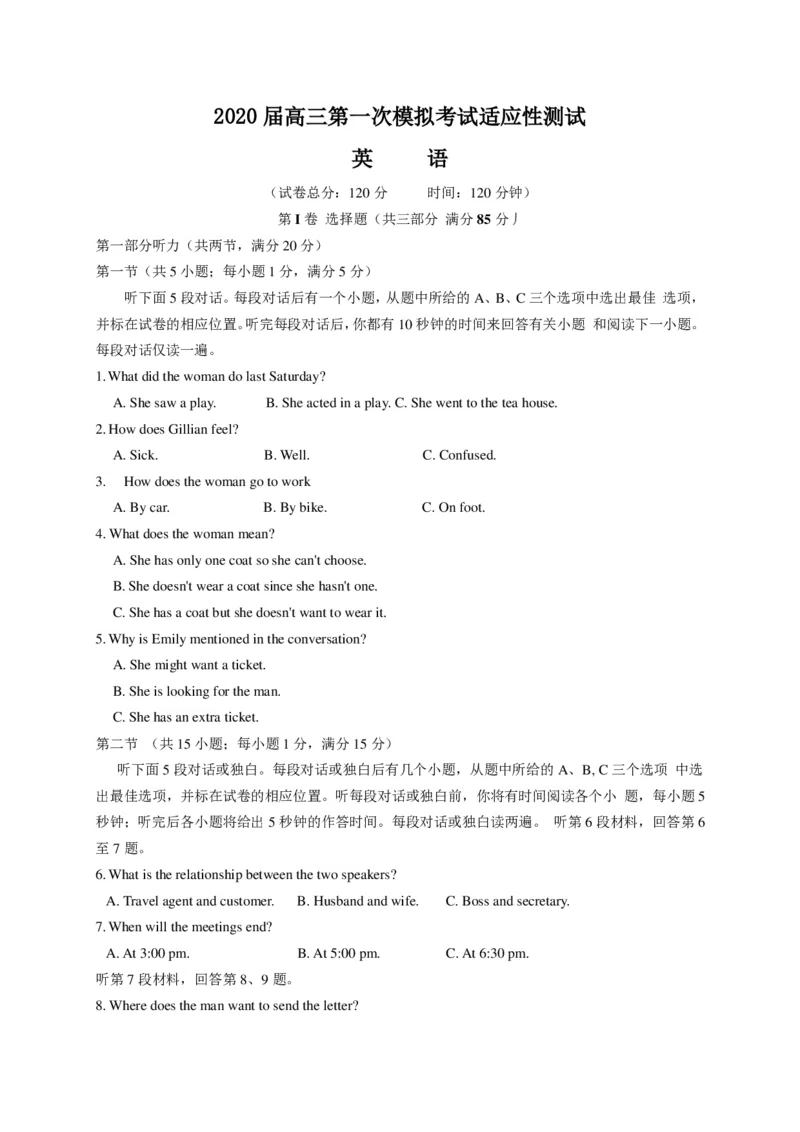
2020 届高三第一次模拟考试适应性测试
英     语
(试卷总分:120 分
时间:120 分钟)
第I 卷 选择題(共三部分 满分85 分丿
第一部分听力(共两节,满分20 分)
第一节(共5 小题;每小题1 分,满分5 分)
听下面5 段对话。每段对话后有一个小题,从题中所给的A、B、C 三个选项中选出最佳 选项,
并标在试卷的相应位置。听完每段对话后,你都有10 秒钟的时间来回答有关小题 和阅读下一小题。
每段对话仅读一遍。
1. What did the woman do last Saturday?
A. She saw a play.
B. She acted in a play. C. She went to the tea house.
2. How does Gillian feel?
A. Sick.
B. Well.
C. Confused.
3.
How does the woman go to work
A. By car.
B. By bike.
C. On foot.
4. What does the woman mean?
A. She has only one coat so she can't choose.
B. She doesn't wear a coat since she hasn't one.
C. She has a coat but she doesn't want to wear it.
5. Why is Emily mentioned in the conversation?
A. She might want a ticket.
B. She is looking for the man.
C. She has an extra ticket.
第二节 (共15 小题;每小题1 分,满分15 分)
听下面5 段对话或独白。每段对话或独白后有几个小题,从题中所给的A、B, C 三个选项 中选
出最佳选项,并标在试卷的相应位置。听每段对话或独白前,你将有时间阅读各个小 题,每小题5
秒钟;听完后各小题将给出5 秒钟的作答时间。每段对话或独白读两遍。 听第6 段材料,回答第6
至7 题。
6. What is the relationship between the two speakers?
A. Travel agent and customer.
B. Husband and wife.
C. Boss and secretary.
7. When will the meetings end?
A. At 3:00 pm.
B. At 5:00 pm.
C. At 6:30 pm.
听第7 段材料,回答第8、9 题。
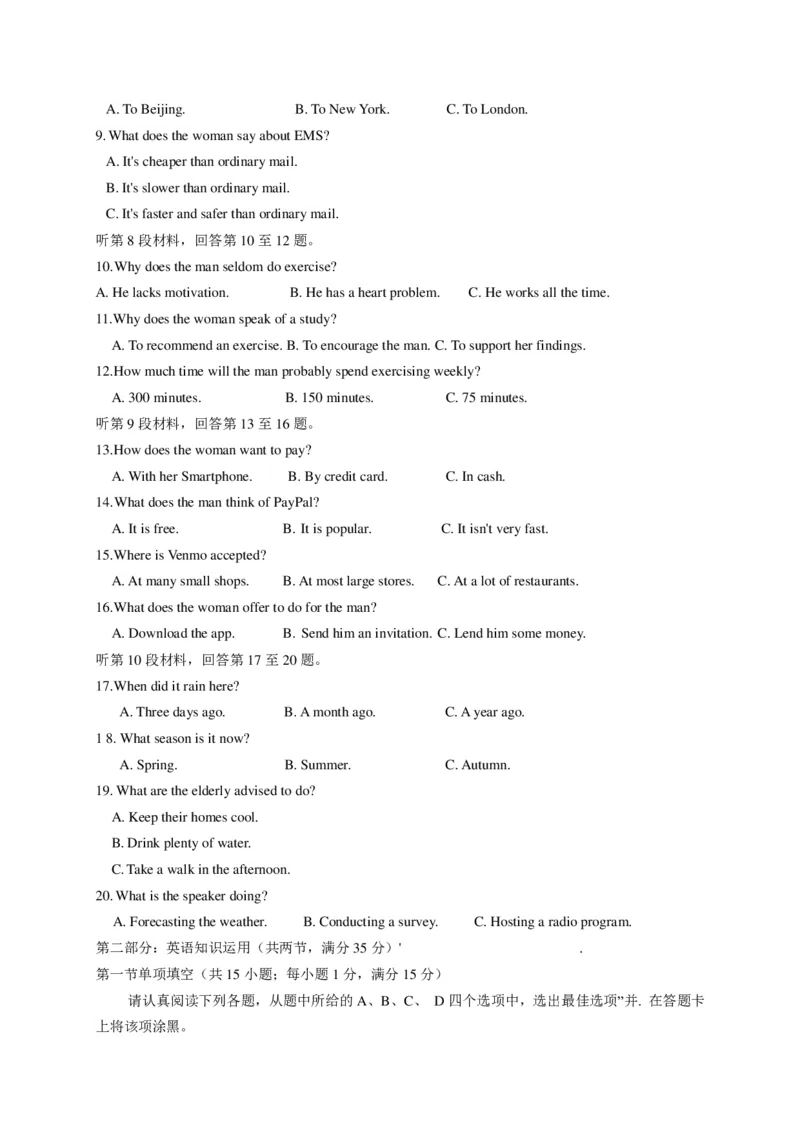
8. Where does the man want to send the letter?
A. To Beijing.
B. To New York.
C. To London.
9. What does the woman say about EMS?
A. It's cheaper than ordinary mail.
B. It's slower than ordinary mail.
C. It's faster and safer than ordinary mail.
听第8 段材料,回答第10 至12 题。
10. Why does the man seldom do exercise?
A. He lacks motivation.
B. He has a heart problem.    C. He works all the time.
11. Why does the woman speak of a study?
A. To recommend an exercise. B. To encourage the man. C. To support her findings.
12. How much time will the man probably spend exercising weekly?
A. 300 minutes.
B. 150 minutes.
C. 75 minutes.
听第9 段材料,回答第13 至16 题。
13. How does the woman want to pay?
A. With her Smartphone.     B. By credit card.
C. In cash.
14. What does the man think of PayPal?
A. It is free.
B. It is popular.
C. It isn't very fast.
15. Where is Venmo accepted?
A. At many small shops.
B. At most large stores.
C. At a lot of restaurants.
16. What does the woman offer to do for the man?
A. Download the app.
B. Send him an invitation. C. Lend him some money.
听第10 段材料,回答第17 至20 题。
17. When did it rain here?
A. Three days ago.
B. A month ago.
C. A year ago.
1 8. What season is it now?
A. Spring.
B. Summer.
C. Autumn.
19. What are the elderly advised to do?
A. Keep their homes cool.
B. Drink plenty of water.
C. Take a walk in the afternoon.
20. What is the speaker doing?
A. Forecasting the weather.     B. Conducting a survey.     C. Hosting a radio program.
第二部分:英语知识运用(共两节,满分35 分)'
.
第一节单项填空(共15 小题;每小题1 分,满分15 分)
请认真阅读下列各题,从题中所给的A、B、C、 D 四个选项中,选出最佳选项”并. 在答题卡
上将该项涂黑。
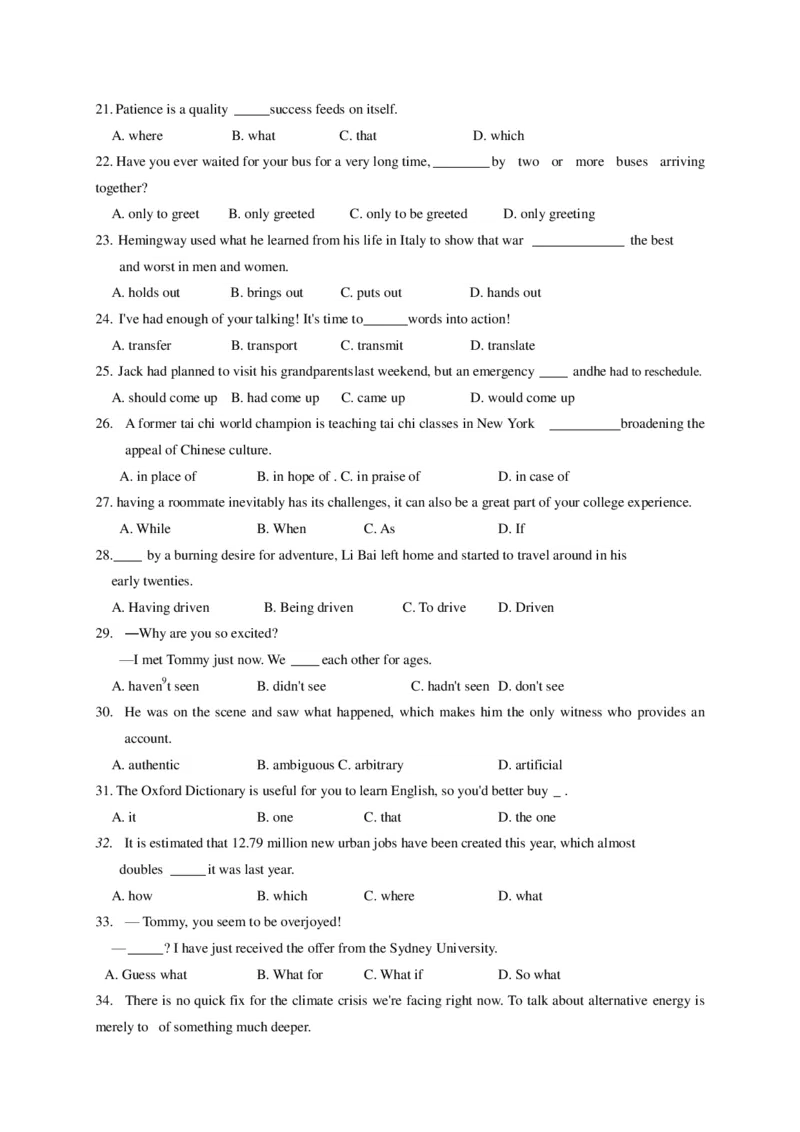
21. Patience is a quality _____success feeds on itself.
A. where
B. what
C. that
D. which
22. Have you ever waited for your bus for a very long time, ________ by two or more buses arriving
together?
A. only to greet    B. only greeted     C. only to be greeted     D. only greeting
23. Hemingway used what he learned from his life in Italy to show that war  _____________ the best
and worst in men and women.
A. holds out
B. brings out
C. puts out
D. hands out
24. I've had enough of your talking! It's time to
words into action!
A. transfer
B. transport
C. transmit
D. translate
25. Jack had planned to visit his grandparents last weekend, but an emergency ____ andhe had to reschedule.
A. should come up B. had come up
C. came up
D. would come up
26. A former tai chi world champion is teaching tai chi classes in New York            broadening the
appeal of Chinese culture.
A. in place of
B. in hope of . C. in praise of
D. in case of
27. having a roommate inevitably has its challenges, it can also be a great part of your college experience.
A. While
B. When
C. As
D. If
28. ____ by a burning desire for adventure, Li Bai left home and started to travel around in his
early twenties.
A. Having driven
B. Being driven       C. To drive
D. Driven
29. ―Why are you so excited?
—I met Tommy just now. We ____ each other for ages.
A. haven9t seen
B. didn't see            C. hadn't seen D. don't see
30. He was on the scene and saw what happened, which makes him the only witness who provides an

account.
A. authentic
B. ambiguous C. arbitrary
D. artificial
31. The Oxford Dictionary is useful for you to learn English, so you'd better buy _ .
A. it
B. one
C. that
D. the one
32. It is estimated that 12.79 million new urban jobs have been created this year, which almost
doubles _____ it was last year.
A. how
B. which
C. where
D. what
33. — Tommy, you seem to be overjoyed!
— _____ ? I have just received the offer from the Sydney University.
A. Guess what
B. What for
C. What if
D. So what
34. There is no quick fix for the climate crisis we're facing right now. To talk about alternative energy is
merely to  of something much deeper.
A. push the limits
B. give it the edge    C. scratch the surface   D. land on the feet
35. The actor lately released a new film, which has met with a mixed __ from his fans.
A. assumption
B. reception
C. composition
D. description
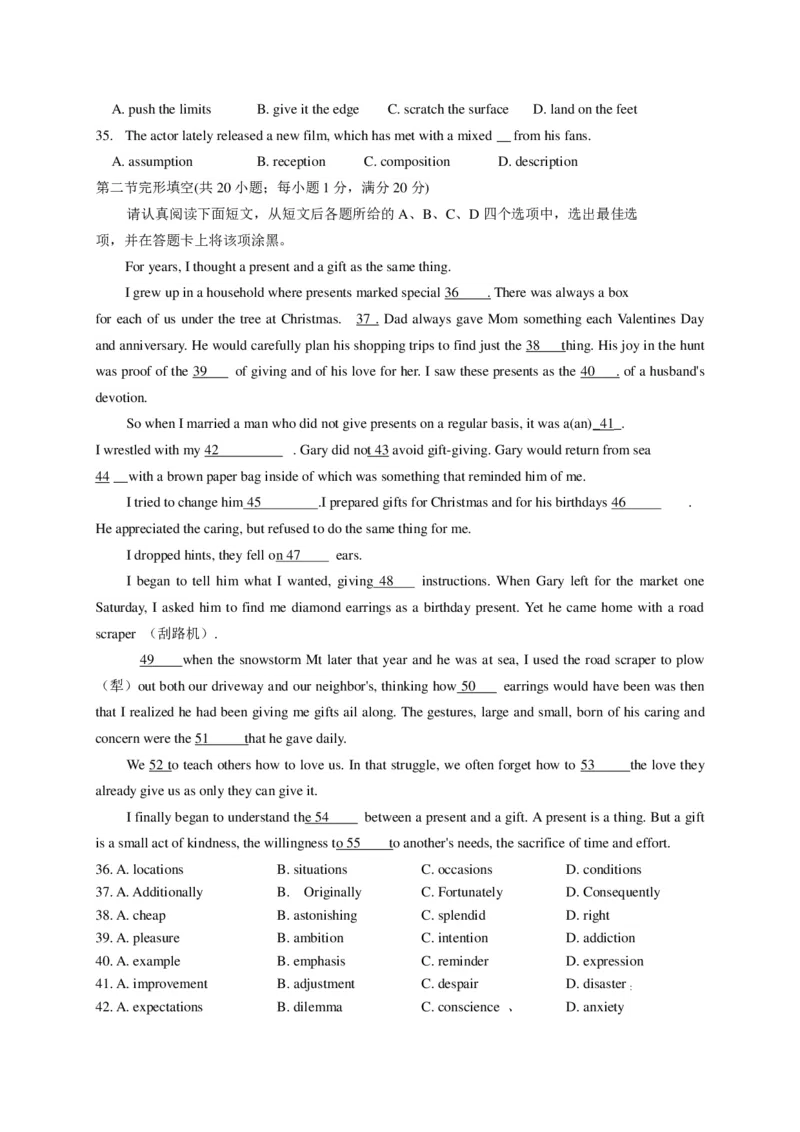
第二节完形填空(共20 小题;每小题1 分,满分20 分)
请认真阅读下面短文,从短文后各题所给的A、B、C、D 四个选项中,选出最佳选
项,并在答题卡上将该项涂黑。
For years, I thought a present and a gift as the same thing.
I grew up in a household where presents marked special 36    . There was always a box
for each of us under the tree at Christmas.  37 . Dad always gave Mom something each Valentines Day
and anniversary. He would carefully plan his shopping trips to find just the 38   thing. His joy in the hunt
was proof of the 39    of giving and of his love for her. I saw these presents as the 40   . of a husband's
devotion.
So when I married a man who did not give presents on a regular basis, it was a(an)_41_.
I wrestled with my 42          . Gary did not 43 avoid gift-giving. Gary would return from sea
44 __ with a brown paper bag inside of which was something that reminded him of me.
I tried to change him 45        .I prepared gifts for Christmas and for his birthdays 46
.
He appreciated the caring, but refused to do the same thing for me.
I dropped hints, they fell on 47     ears.

I began to tell him what I wanted, giving 48    instructions. When Gary left for the market one
Saturday, I asked him to find me diamond earrings as a birthday present. Yet he came home with a road
scraper (刮路机).
49    when the snowstorm Mt later that year and he was at sea, I used the road scraper to plow
(犁)out both our driveway and our neighbor's, thinking how 50    earrings would have been was then
that I realized he had been giving me gifts ail along. The gestures, large and small, born of his caring and
concern were the 51     that he gave daily.
We 52 to teach others how to love us. In that struggle, we often forget how to 53     the love they
already give us as only they can give it.
I finally began to understand the 54     between a present and a gift. A present is a thing. But a gift
is a small act of kindness, the willingness to 55    to another's needs, the sacrifice of time and effort.
36. A. locations
B. situations
C. occasions
D. conditions
37. A. Additionally
B.  Originally
C. Fortunately
D. Consequently
38. A. cheap
B. astonishing
C. splendid
D. right
39. A. pleasure
B. ambition
C. intention
D. addiction
40. A. example
B. emphasis
C. reminder
D. expression
41. A. improvement
B. adjustment
C. despair
D. disaster :
42. A. expectations
B. dilemma
C. conscience 、
D. anxiety
43. A. actively
B. willingly
C. intentionally
D. wholly
44. A. supplied
B. armed
C. decorated
D. filled
45. A. by tradition
B. by force
C. by example
D. by accident
46. A. on purpose
B. in order
C. at random
D. on time
47. A. sharp
B. big
C. deaf
D. sensitive
48. A. some
B. specific
C. brief
D. unusual
49. A. And
B. So
C. Though
D. But
50. A. precious
B. practical
C. useless
D. ugly
51. A. promises
B. gifts
C. blessings
D. instructions
52. A. struggle
B. fail
C. attempt
D. decide
53. A. express
B. appreciate
C. return
D. share
54. A. distance
B. similarity
C. difference
D. conflict
55. A. subscribe
B. take
C. connect
D. bend
第三部分:阅读理解(共15 小题;每小题2 分,满分30 分)
请认真阅读下列短文,从短文后各题所给的A、B、C、D 四个选项中,选出最佳选 项,并在
答题卡上将该项涂黑。
A
Below are four books of the 10 Best Books of 2019. Which one will you add to your booklist?

Exhalation (呼吸)
By Ted Chiang
■ Many of the nine deeply beautiful stories in this collection explore the material consequences of
time travel. Reading them feels, like sitting at dinner with a friend who explains scientific theory to you
without an ounce of condescension (傲慢).Each thoughtful, elegantly crafted story poses a philosophical
question; Chiang organizes all nine into a conversation that comes full circle, after having travelled
remarkab1e val1eys ,,, deserts and plains.
Lost Children Archivef(档案)))
By Valeria Luiselli
■ The Mexican author’s third novel — her first to be written in English — unfolds against a backdrop
of crisis: of children crossing borders, facing death, being confined, being deported unaccompanied by their
guardians.
The novel centers on a couple and their two children, who are taking a road trip from New York City
to the Mexican border; the couple's marriage is on the edge of collapse and the woman tries to help a
Mexican immigrant find her daughters, who've gone missing in their attempt to cross the border behind her.
The brilliance of Luiselli's writing stirs anger and pity. Acutely sensitive, Luiselli has delivered an
experimental book, one that is as much about storytellers and storytelling as it is about lost children.
The Yellow House
By Sarah Broom
■ In her first extraordinary, fascinating appearance, Broom pushes past the baseline expectations of
memoir to create an entertaining and inventive combination of literary forms. Part oral history, part urban
history, part celebration of a bygone way of life, "The Yellow House" is a full accusation of the greed,
discrimination, indifference and poor city planning that led her family's home to be wiped off the map.
Tracing the history of a single home in New Orleans East, from the ' 60s to Hurricane Katrina, this is an
instantly essential text, examining the past, present and possible future of the city of New Orleans, and a
true reflection of America.
No Visible Bruises
By Rachel Louise Snyder
■ Snyder's thoroughly reported book covers what the World Health Organization has called "a global
health problem of epidemic proportions."  In America alone, more
than half of all murdered women are killed by a current or former partner; domestic violence cuts across
lines of class, religion and race. Snyder exposes myths (restraining orders are the answer,: abusers never
change) and writes movingly about the lives of people on both sides of the equation. She doesn't give easy
answers but presents a wealth of information that is its own form of hope.
56. If you are a fan of science fiction, which book will you choose?
A. Exhalation
Lost Children Archive
C. The Yellow House
D. No Visible Bruises
57. According to the passage, which of the following sentences is TRUE?
A. In the book Exhalation, Ted Chiang describes a story told by his friend.
B. Lost Children Archive is Valeria Luiselli's first novel in English.
C. Several stories of literary forms make up the book, The Yellow House.
D. No Visible Bruises shows nothing but restraining orders are answers to family violence.
B
You are about to hear a strange but true story. Legend has it that, Harry Houdini, the master magician,
once claimed that he could break out of any jail cell in the world. All he had to do was walk into that jail
cell with his street clothes on. 'I will be out of there in one hour. No problem!' He said. A very old jail down
South heard about Houdini's claims and they accepted the challenge. On the day of the event, many people
gathered outside. Very confidently, Houdini walked into the jail and into the cell and they shut the metal
door behind him.
The first thing Houdini did was to take off his coat. Then, very strangely, he took off his belt. Secretly
hidden in Houdini's belt, was a ten-inch piece of steel; very tough and very flexible and Houdini started
working.
In about 30 minutes, that confident expression Houdini had when he walked in disappeared. In one
hour, he was bathed in sweat. And at the end of two hours, Houdini in defeat, collapsed against the door,
which then opened. It opened because you see, that door had never been locked. But that's not entirely true
is it? That door was locked. It was firmly and thoroughly locked in Houdini's mind, which meant it was
locked as if the best locksmith in the world had put his lock on it.
The mind is powerful. How many doors in your life do you think are locked but aren't? how many
times have you been stuck in the mental prison of over thinking something that really had a simple solution.
There is an ancient African proverb that says when there is no enemy within, the enemy outside can do us
no harm.
Your mind is the most powerful force you will ever face. It will tell you lies. It will tell you can't do
that. You're not meant for that. You're not good enough for that. You can't go on anymore. You don't have
the energy. You must thank it for its opinion and carry on. Because as Houdini showed us the only locked
doors that exist are in your own mind. The doors in reality are open and all you have to do is walk through.
58. Why couldn't Harry Houdini open the door within two hours?
A. Because he didn't open the door with his mind.
B. Because the door was locked by the best locksmith.
C. Because he had thought the door was locked.
D. Because he overestimated his own ability to open the door.
59. Which of the following story shows the "locked door," in our mind?
A. Bring the painted dragon to life by putting in the pupils of its eyes.
B. One tends to stand still and refuse to make progress.
C. The donkey has exhausted its skills against the tiger.
D. Lock the stable door after the horse has been stolen.
60. We can conclude from the passage EXCEPT _____ ?
A. The biggest enemy in your life is in fact the enemy in your mind.
B. If you walk through the door in mind, your potential will be unlimited.
C. Unless you defeat the enemy outside, you will not defeat your enemy inside.
D. Life is really simple, but we insist on making it rigid and complicated.
C
“Without trust,” writes Rachel Botsman, “society cannot survive, and it certainly cannot thrive."
Clearly, we are in trouble. Two-thirds of people surveyed last year in 28 countries expressed low levels
of trust in "mainstream institutions" of business, government and media.
In “Who Can You Trust?” Botsman, an Oxford lecturer offers a timely and accessible framework for
understanding what trust is, how it works, why it matters and how it is evolving. It is an important guidance
to the obstacles and opportunities we face as a society if we are to repair and redefine trust.
Through human history, trust has evolved in three basic stages: Local trust was enough when people
lived in small communities and everybody knew everybody else; industrialization and urbanization
required institutional trust so that people could trust complete strangers running governments, corporations,
and standards for international trade, commerce and finance. We are now living through a massive
global .shift of trust from institutions to individuals: distributed trust facilitated by high-tech platforms,
many of which are run by the private sector.
This shift is caused by several factors. First, accountability is unequal. Rich, powerful and
well-connected individuals have been able to accumulate vast quantities of often undocumented wealth by
avoiding tax and anti-bribery laws, while ordinary people are likely to be caught and punished for
lawbreaking. Second, people in power are no longer seen to deserve greater respect as the details of their
lives are exposed.
Botsman does not prescribe how we deal with that. But if the old ways of giving and cancelling trust
such as voting, markets and consumer choice are no longer functioning, then we must change or replace
them. Systems must be "driven democratically and rationally," become more "transparent, inclusive, and
accountable" and, most important, be designed to "put people first," which profit-driven platforms have
failed to do sufficiently.
Tech executives are responding to the trust crisis mainly with promises of more and better technology.
But Batsman warns that the responsibility for ensuring that the robots being used are trustworthy lies with
the human beings who design and use them. We have not thought through how we hold those people
accountable, let alone their robots. She warns against a natural tendency "to become over-reliant on
machines." Ideally machines should be programmed to "understand" their own limitations and even seek
human help or intervention.
A growing number of people hope that new trust mechanisms can be established through the use of
exciting new technologies such as the blockchain(区块链). In essence, blockchains are digital public
ledgers of transactions that cannot be changed, thereby creating greater transparency and accountability and
making corruption much harder.
However, Botsman warns that the blockchain is no panacea for human trust. Whether blockchain
systems lead to more accountable governance and a more just global economy will depend on their design
and the intentions of those who build them. There is no app for fixing trust.
"Who Can You Trust?" does make a clear case for why it is important for the companies, governments
and other institutions to be much more transparent and subject themselves to new mechanisms that can
credibly hold them accountable. It is the only way they can hope to earn and maintain trust in the future.
61. Which of the following orders of trust evolution is right?
A. institutional trust→ industrialized trust→ individual trust
B. urbanized trust→ local trust→ institutional trust
C. local trust→ institutional trust→ distributed trust
D. local trust→ urbanized trust →individual trust
62. What can we conclude from the passage?
A. Profit-driven platforms pay no attention to the importance of people.
B. It is the people who design and use technology that count in restoring trust.
C. New technologies, such as the blockchain can prevent corruption from happening.
D. People should rely on new technologies to create transparency and accountability.
63. What do the underlined words “no panacea" mean?
A. not a Herculean task B. a hard nut C. not a cure-all medicine D. a catch -22
64. What's the author's attitude toward the possibility of using technology to restore trust?
A. Supportive
B. Negative      C. Indifferent
D. Skeptical
D
Shelly hugged her husband."Be careful, Billy."
"Come on, Shell!" Bill rolled his eyes. "You worry too much, Honey. Me and the boys will be OK. It's
just a three — day trip. We'll catch enough halibut to be able to fix up the baby's room the way you want
it."
'
"Billy, I love you and worry every time you go to sea, especially in winter."
"Shell, I promise I'll be careful. I may be the youngest captain in this port, but I'm the most careful. I
learned at the helm of Daddy's boat, which I was practically raised on."
They hugged again. Bill planted a tender kiss on her cheek, rested his open palm on her slightly
swollen stomach, "Besides, I need to be here. Little Billy will need his daddy." Shelly slapped him on the
shoulder. "It's Billy Jean and you know it.”
Bill laughed, "Not on my watch, Girl. I gave you a boy to take over as captain."
Their laughter broke the tension. "I have to go, Shell. See you in a few days?" He turned to leave and
then turned back, reached into the pocket of his heavy coat and pulled out an envelope."I almost forgot.
Here's my letter?"
Shelly took the crisp envelope and slipped into the pocket of her dress. "Thanks,Billy.” It had been
their custom since they started dating. Billy gave her a note before he went to sea. She wasn't allowed to
open it until the next day. He usually wrote of love or sometimes something silly - both made her smile.
She wrote a reply and left it on the kitchen table for him. Reading her reply was the first thing he did when
he came home.
She watched as her husband walked the'length of the pier to where the forty-five foot “Shelly Girl”
and his crew waited. He gave a final wave and climbed aboard.
Shelly stood by their pickup truck and watched until the boat rounded the point and disappeared from
view. "I love you, Billy.” she whispered. "Be safe." ①
That evening, five hundred miles to the south, a small winter depression moved north along the
Atlantic coast of the USA. Experts found an unexpected change in the jet stream, which would make the
small depression become a raging winter storm. ②
Shelly woke in the morning and listened to the weather report on the battered radio sitting on kitchen
table. The phone rang."Hello."
“Shelly?"
"Hi, Gail!" She recognized the voice of her friend, who was the wife of one of Billy's crew. “Have you
heard the weather?"
"Hang on a second. I just turned the radio on." Shelly's face paled as she heard the weather person say
a major winter depression had moved into the area. "Oh crap!"
"That's what [ said too.”
"They'll be OK, Gail. They're experienced fishermen." Shelly said to Gail It was a _______ attempt to
convince herself that her man would be safe. ③
Off the south shore of Nova Scotia, Bill struggled to control the Shelly Girl in the growing waves.
Wind and water attacked Bill and his crew from all directions. The forty- and fifty-foot walls of water were
too much of a challenge for the young captain.
The force of the water flipped the boat over, tore the wheelhouse off and tossed Bill and his crew into
the icy Atlantic.
The water, only a few degrees above the freezing point, soon overcame Bill's will to live. “Shelly!
He took a last painful breath of salt water and slipped below the surface. ④
The crisp envelope bent beneath her fingers as she laid it on her lap and read. "Shelly, you are my life,,
my love and soon-to-be mother of our son 一 girl if that is what you really want. I'll always come home."
Shelly reached for the pen in her dress pocket. Tears dripped from her face and stained the paper she
wrote on, “ ___________________________ ."
Her note sits on their kitchen table still 一 never read.
65. Why was Shelly worried too much when Billy go to sea this time?
A. Because she and their baby Billy Jean needed Billy's protection and care.
B. Because she knew from the radio that a major winter depression would come.
C. Because she had a feeling that Billy would never return home.
D. Because she cared about Billy's safety in the sea, especially in winter.
66. What can we learn from the passage?
A. Billy could read Shelly's reply letter only when he returned home from the sea.
B. Billy and Shelly wrote letters to each other since they got married.
C. Shelly read Billy's letter eagerly each time she got his letter.
D. They exchanged their letters with each other every time Billy went out.
67. Which word can be filled in the blank in the passage?
A. weak
B. strong
C. hard
D. desperate
68. Where can the sentences "Shell sat in her favorite spot on the porch of their weathered beach house, the
salty air sticking to her heavy winter clothes. The oncoming storm blew sand across her winter boots.,"   be
put in?
A.①
B.②
C.③
D. ④
69. Which of the following may be Shelly's reply to Billy's letter?
A. Billy, you were so brave, I always knew.
B. Billy, I always knew the ocean was your home.
C. Billy, I always knew, you would come back.
D. Billy, I love you, I would always wait for you.
70. Which of the following can be the best title of this passage?
A. An unlucky Billy B. A storm in life
C. A broken Shelly
D. Never read
第II 巻非选择题(共两部分満分35 分丿
第四部分 任务型阅读(共10 小题;每小题1 分,满分10 分)
请认真阅读下列短文,并根据所读内容在文章后表格中的空格里填入一个最恰当的 单词。注意:
每个空格只填一个单词。
School lunches in Japan
Japan manages a rare achievement for a developed country when it comes to feeding its children ―
high scores for nutrition but very low obesity rates. One major key? School lunches.
A landmark report by the UN's children agency UNICEF released Tuesday shows Japan topping the
charts for childhood health indicators, with low rates of infant mortality and few underweight children.
Experts say there are various factors at work, including a health-conscious society and regularly
check-ups for children required by law, but a nationwide school lunch program also plays a key role.
"School lunches with menus that are created by nutritionists are provided to all primary schools and
the majority of junior high schools throughout Japan,," Mitsuhiko Hara, a pediatrician and professor at
Tokyo Kasei Gakuin University, told AFP.
The lunches are mandatory — no packed lunches allowed ― and while they are not free for most, they
are heavily subsidized 补助).Each meal is designed to have around 600-700 calories balanced between
carbohydrates, meat or fish and vegetables.
"School lunch is designed to provide nutrition that tends to be lacking in meals at home," Education
Ministry official Mayumi Ueda told AFP. "I think it contributes to the nutritional balance necessary for
children."
Unlike the cafeteria system operated in some Western countries, Japanese school lunches are usually
served in the classroom. Pupils frequently dish out the food to each other and clean
up the room afterwards. There is no choice of meal, and no concessions offered for vegetarians, or anyone
with religious restrictions.
The lunches are intended not only to feed children, but to teach them. "There's also a daily broadcast
at school to explain the nutritional elements contained in the school lunch of the day, and this is a good way
to educate kids,” Hara said.
"School lunch is positioned as part of education under the law,'? Ueda said. "It's not just about eating
food, but children learn to serve, and clean up on their own?"
The Japanese government studies nutrition and eating habits in Japan annually, and uses the results to
shape what goes into the school meals, she added.
And there are other factors at work, Hara acknowledged. "Because many Japanese are
health-conscious, they try to eat a variety of food, which is good," he said. "And we're taught to eat
seasonal food, which also contributes to good health. Japan is one of the rare countries that pay so much
attention to food that is associated with specific seasons," he added.
Hara said another factor in Japan is regularly mandated childcare health checks. Parents of infants
receive reminders from the local government, and children are given health checks at school, including
measuring height and weight.
Still, even Japan has not escaped entirely the growing trend toward overweight children and
childhood obesity, which in Japan, like elsewhere, tends to affect those from less wealthy families.
"Children in poverty are more likely to be overweight because families try to cut costs," Hara said.
"As a result, they eat less protein but consume more carbs and sugar, which leads to obesity."
School lunches are all the more important to children in such situations, he said.
School lunches in Japan
Introduction
As is reported by the UNICEF. Japan 71 ▲ high in childhood health: A
social awareness of health, regular and 72 ▲ check-ups for children and a
nationwide school lunch program are main 73 ▲ .
Details
of
school lunches
Regarding
health
•
Menus created by nutritionists and 74.  ▲   annually by
government
•
Meals 75  ▲    innutrition
•
Food of great 76  ▲       and seasonal food
Regarding
77 ▲
The lunches are intended to improve
•
students' service consciousness and 78  ▲     .
•
students' knowledge of nutritional elements.
Problems to be
solved
79 ▲ of less protein but more carbs and sugar in 80 ▲ families leads to the
increasing number of overweight children in Japan.
第五部分 书面表达(满分25 分)
81•请阅读下面图画及文字,并按照要求用英语写一篇150 词左右的文章。


[写作内容]
1. 用约30 个词概括上面图文所反映的社会现象。
2. 谈谈尊重他人的重要性。
3.举例说明在生活中你是如何尊重他人的。
【写作要求】..
.
1. 写作过程中不能直接引用原文语句;
2. 作文中不能出现真实姓名和学校名称;
3.不必写标题。
[评分标准「
内容完整,语言规范,语篇连贯,词数适当。