2026 秋人教PEP 六年级上册英语
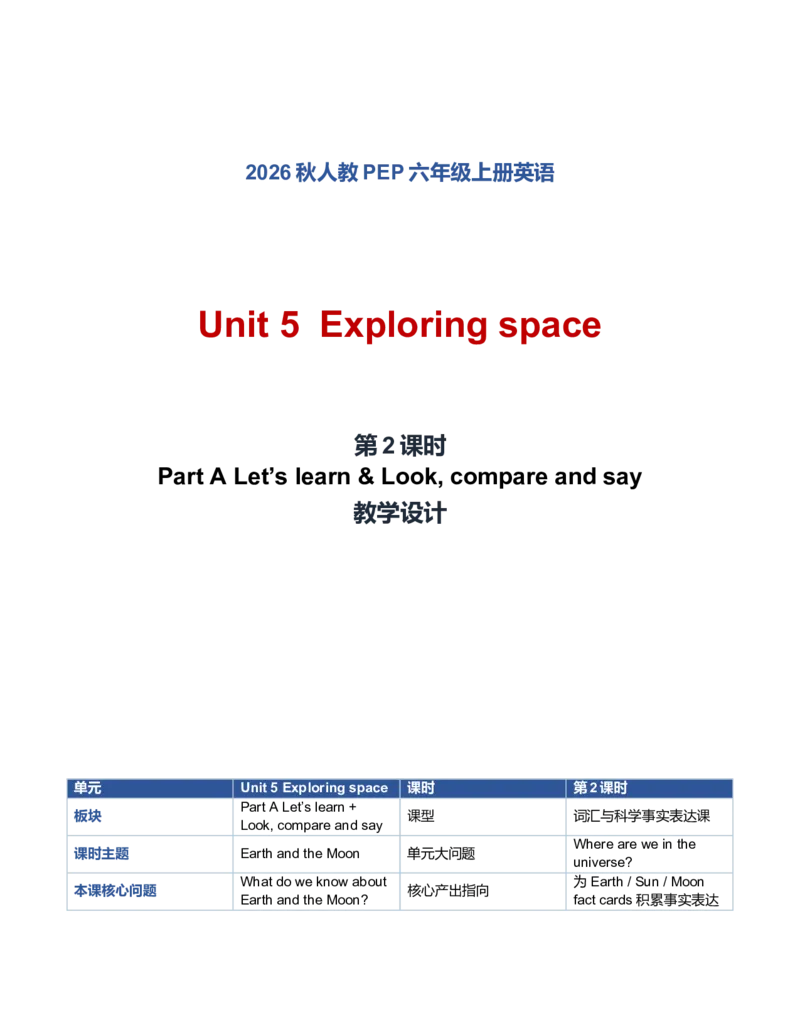
Unit 5  Exploring space
第2 课时
Part A Let’s learn & Look, compare and say
教学设计
单元
Unit 5 Exploring space
课时
第2 课时
板块
Part A Let’s learn +
Look, compare and say
课型
词汇与科学事实表达课
课时主题
Earth and the Moon
单元大问题
Where are we in the
universe?
本课核心问题
What do we know about
Earth and the Moon?
核心产出指向

为Earth / Sun / Moon
fact cards 积累事实表达
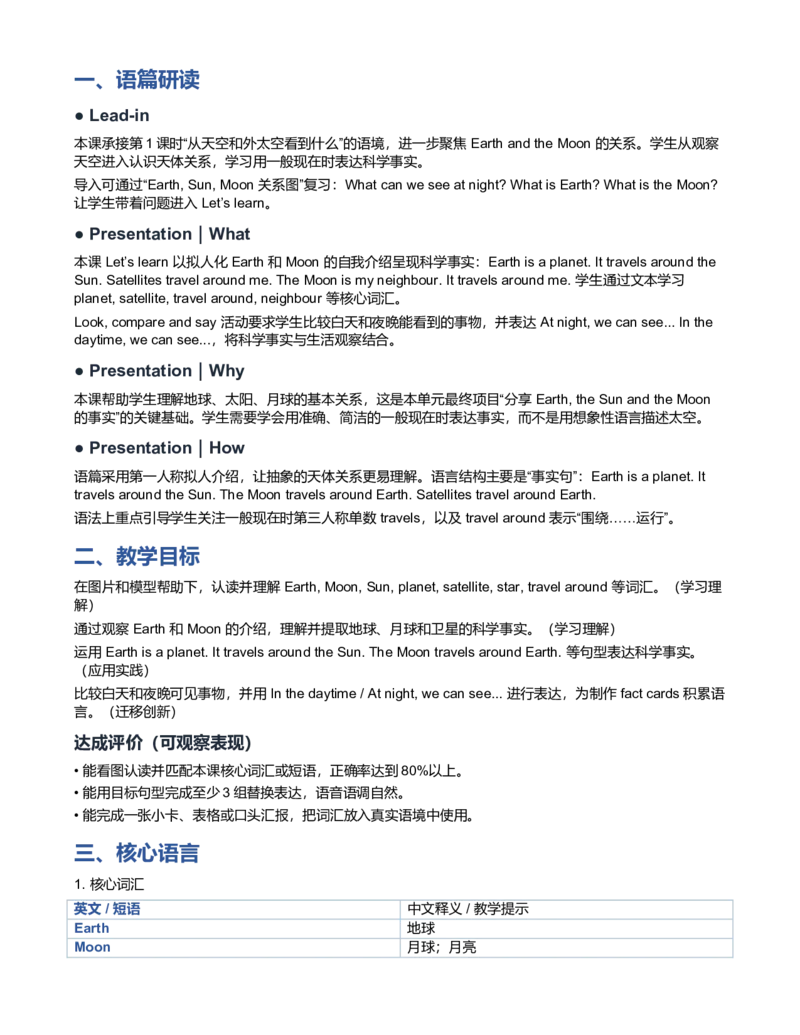
一、语篇研读
● Lead-in
本课承接第1
“
”

课时从天空和外太空看到什么的语境,进一步聚焦Earth and the Moon 的关系。学生从观察
天空进入认识天体关系,学习用一般现在时表达科学事实。
“
导入可通过Earth, Sun, Moon
”
关系图复习:What can we see at night? What is Earth? What is the Moon?

让学生带着问题进入Let’s learn。
● Presentation|What

本课Let’s learn

以拟人化Earth

和Moon 的自我介绍呈现科学事实:Earth is a planet. It travels around the
Sun. Satellites travel around me. The Moon is my neighbour. It travels around me.

学生通过文本学习
planet, satellite, travel around, neighbour 等核心词汇。
Look, compare and say

活动要求学生比较白天和夜晚能看到的事物,并表达At night, we can see... In the
daytime, we can see...,将科学事实与生活观察结合。
● Presentation|Why
“

本课帮助学生理解地球、太阳、月球的基本关系,这是本单元最终项目分享Earth, the Sun and the Moon
”
的事实的关键基础。学生需要学会用准确、简洁的一般现在时表达事实,而不是用想象性语言描述太空。
● Presentation|How
“
”
语篇采用第一人称拟人介绍,让抽象的天体关系更易理解。语言结构主要是事实句:Earth is a planet. It
travels around the Sun. The Moon travels around Earth. Satellites travel around Earth.

语法上重点引导学生关注一般现在时第三人称单数travels

,以及travel around
“
……
”
表示围绕
运行。
二、教学目标

在图片和模型帮助下,认读并理解Earth, Moon, Sun, planet, satellite, star, travel around 等词汇。(学习理
解)

通过观察Earth

和Moon 的介绍,理解并提取地球、月球和卫星的科学事实。(学习理解)

运用Earth is a planet. It travels around the Sun. The Moon travels around Earth. 等句型表达科学事实。
(应用实践)

比较白天和夜晚可见事物,并用In the daytime / At night, we can see...

进行表达,为制作fact cards 积累语
言。(迁移创新)
达成评价(可观察表现)
• 能看图认读并匹配本课核心词汇或短语,正确率达到80%以上。
• 能用目标句型完成至少3 组替换表达,语音语调自然。
• 能完成一张小卡、表格或口头汇报,把词汇放入真实语境中使用。
三、核心语言
1. 核心词汇

英文/ 短语

中文释义/ 教学提示
Earth
地球
Moon
月球;月亮
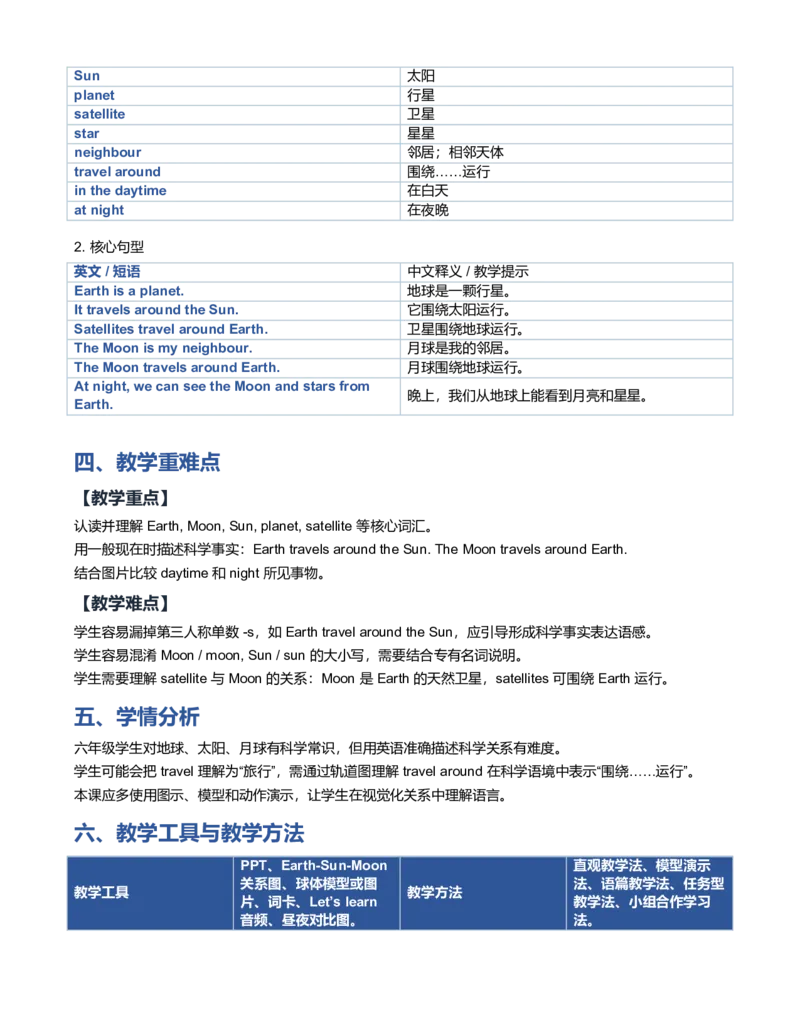
Sun
太阳
planet
行星
satellite
卫星
star
星星
neighbour
邻居;相邻天体
travel around
……
围绕
运行
in the daytime
在白天
at night
在夜晚
2. 核心句型

英文/ 短语

中文释义/ 教学提示
Earth is a planet.
地球是一颗行星。
It travels around the Sun.
它围绕太阳运行。
Satellites travel around Earth.
卫星围绕地球运行。
The Moon is my neighbour.
月球是我的邻居。
The Moon travels around Earth.
月球围绕地球运行。
At night, we can see the Moon and stars from
Earth.
晚上,我们从地球上能看到月亮和星星。
四、教学重难点
【教学重点】

认读并理解Earth, Moon, Sun, planet, satellite 等核心词汇。
用一般现在时描述科学事实:Earth travels around the Sun. The Moon travels around Earth.

结合图片比较daytime

和night 所见事物。
【教学难点】

学生容易漏掉第三人称单数-s

,如Earth travel around the Sun,应引导形成科学事实表达语感。

学生容易混淆Moon / moon, Sun / sun 的大小写,需要结合专有名词说明。

学生需要理解satellite

与Moon 的关系:Moon

是Earth 的天然卫星,satellites

可围绕Earth 运行。
五、学情分析
六年级学生对地球、太阳、月球有科学常识,但用英语准确描述科学关系有难度。

学生可能会把travel
“
”

理解为旅行,需通过轨道图理解travel around
“
……
”
在科学语境中表示围绕
运行。
本课应多使用图示、模型和动作演示,让学生在视觉化关系中理解语言。
六、教学工具与教学方法
教学工具
PPT、Earth-Sun-Moon
关系图、球体模型或图
片、词卡、Let’s learn
音频、昼夜对比图。
教学方法
直观教学法、模型演示
法、语篇教学法、任务型
教学法、小组合作学习
法。
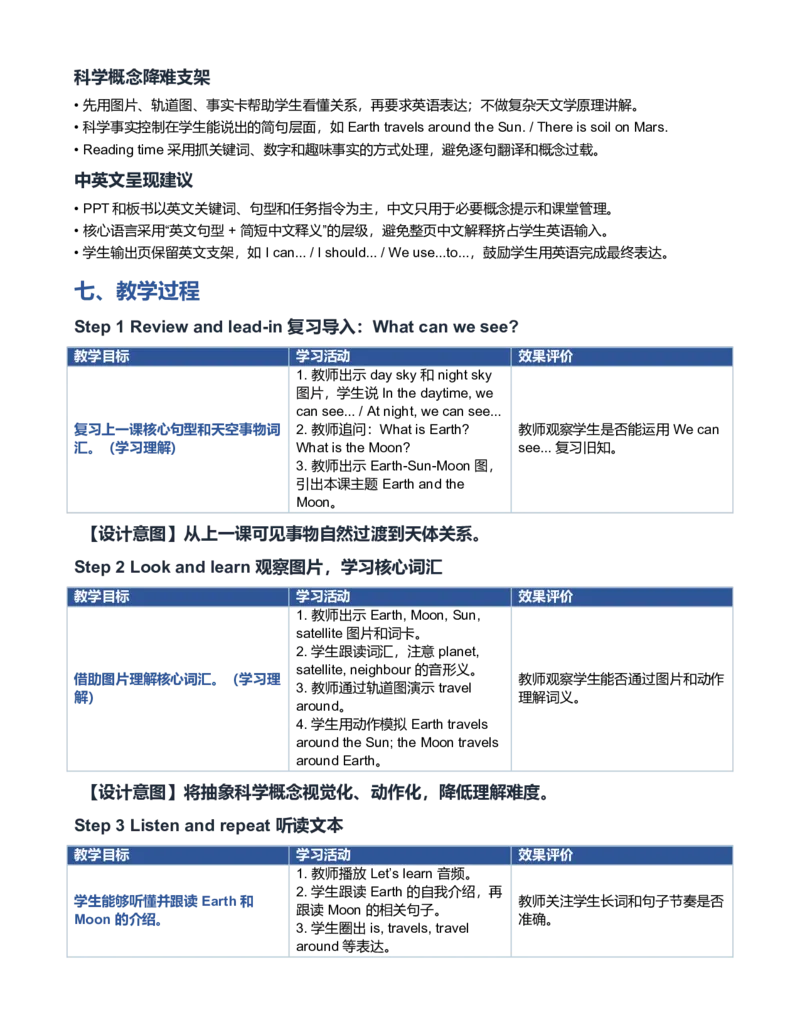
科学概念降难支架
• 先用图片、轨道图、事实卡帮助学生看懂关系,再要求英语表达;不做复杂天文学原理讲解。
•

科学事实控制在学生能说出的简句层面,如Earth travels around the Sun. / There is soil on Mars.
• Reading time 采用抓关键词、数字和趣味事实的方式处理,避免逐句翻译和概念过载。
中英文呈现建议
• PPT 和板书以英文关键词、句型和任务指令为主,中文只用于必要概念提示和课堂管理。
•
“

核心语言采用英文句型+
”
简短中文释义的层级,避免整页中文解释挤占学生英语输入。
•

学生输出页保留英文支架,如I can... / I should... / We use...to...,鼓励学生用英语完成最终表达。
七、教学过程
Step 1 Review and lead-in 复习导入:What can we see?
教学目标
学习活动
效果评价
复习上一课核心句型和天空事物词
汇。(学习理解)
1.

教师出示day sky

和night sky

图片,学生说In the daytime, we
can see... / At night, we can see...
2. 教师追问:What is Earth?
What is the Moon?
3.

教师出示Earth-Sun-Moon 图,

引出本课主题Earth and the
Moon。

教师观察学生是否能运用We can
see... 复习旧知。
【设计意图】从上一课可见事物自然过渡到天体关系。
Step 2 Look and learn 观察图片,学习核心词汇
教学目标
学习活动
效果评价
借助图片理解核心词汇。(学习理
解)
1.

教师出示Earth, Moon, Sun,
satellite 图片和词卡。
2.

学生跟读词汇,注意planet,
satellite, neighbour 的音形义。
3.

教师通过轨道图演示travel
around。
4.

学生用动作模拟Earth travels
around the Sun; the Moon travels
around Earth。
教师观察学生能否通过图片和动作
理解词义。
【设计意图】将抽象科学概念视觉化、动作化,降低理解难度。
Step 3 Listen and repeat 听读文本
教学目标
学习活动
效果评价

学生能够听懂并跟读Earth

和
Moon 的介绍。
1.

教师播放Let’s learn 音频。
2.

学生跟读Earth 的自我介绍,再

跟读Moon 的相关句子。
3.

学生圈出is, travels, travel
around 等表达。
教师关注学生长词和句子节奏是否
准确。
【设计意图】通过听读形成语音输入和句型感知。
Step 4 Read and find 提取科学事实
教学目标
学习活动
效果评价

学生能够从文本中提取Earth /
Moon 事实。
1.

学生阅读文本,完成Fact
chart:Name / What is it? / What
does it do?
2. Earth: planet / travels around
the Sun / satellites travel around
it。
3. Moon: neighbour / travels
around Earth。
4. 学生用完整句汇报。

教师检查学生是否能准确区分
Earth

和Moon 的事实。

【设计意图】用fact chart 为最终项目的事实卡结构做铺垫。
Step 5 Language focus 一般现在时表达科学事实
教学目标
学习活动
效果评价
学生能够理解科学事实常用一般现
在时。
1.

教师板书Earth travels around
the Sun. The Moon travels around
Earth.
2.

学生观察travel → travels,理
解第三人称单数。
3. 教师对比:I travel. Earth
travels.
4. 学生替换说句:Mars is a
planet. Satellites travel around
Earth.

教师及时纠正Earth travel / The
Moon travel 等错误。
【设计意图】在事实语境中理解一般现在时,避免机械语法讲解。
Step 6 Look, compare and say 比较白天和夜晚
教学目标
学习活动
效果评价

学生能够描述daytime

和night
可见事物。
1. 教师出示白天与夜晚天空图片。
2. 学生完成表格:In the daytime /
At night / We can see...
3. 两人一组对话:What can we
see in the daytime? We can see...
4. 拓展:We can see some
planets too.
教师观察学生是否能准确使用复数

形式clouds, stars, planets。
【设计意图】将科学事实与生活观察结合,提升语言运用。
Step 7 Make a mini fact card 制作迷你事实卡
教学目标
学习活动
效果评价
学生能够用2—3

句介绍Earth

或
Moon。
1.

学生选择Earth

或Moon。
2. 根据支架写句:Name: Earth. It
is a planet. It travels around the
教师评价事实是否准确、句子是否
完整。
Sun.
3.

同桌互读并检查facts 是否准
确。
【设计意图】为第6

课时fact cards 项目做微型准备。
Step 8 Think and share 回应单元大问题
教学目标
学习活动
效果评价
学生能够用本课事实回应宇宙位置
问题。
1. 教师提问:Where are we in the
universe?
2. 学生尝试回答:We live on
Earth. Earth travels around the
Sun. The Moon travels around
Earth.
3. 教师归纳:We are on planet
Earth in space.
教师关注学生是否能用事实句表达
主题理解。
【设计意图】帮助学生用科学事实回应单元大问题。
Step 10 Summary 课堂小结
Words: Earth, Moon, Sun, planet, satellite, star, travel around.
Facts: Earth is a planet. It travels around the Sun. The Moon travels around Earth.
Grammar: simple present for facts; travel → travels.
八、课堂练习
练习一:Read and match
Earth — planet
Moon — neighbour of Earth
Sun — star
satellite — travels around Earth
练习二:Choose and write
1. Earth ______ around the Sun. A. travel  B. travels
2. The Moon travels around ______. A. Earth  B. Mars
3. At night, we can see the ______ and stars. A. Moon  B. cloud
练习三:Complete the fact card
Name: ______
What is it? It is a ______.
Fact: It travels around ______.
九、课后作业
基础作业

听读Part A Let’s learn 三遍。
抄写核心句:Earth is a planet. It travels around the Sun. The Moon travels around Earth.
提高作业

完成一张Earth

或Moon

迷你fact card。
拓展作业

用纸球或图片制作Earth-Sun-Moon 关系图,并准备一句英文介绍。
十、板书设计
Unit 5 Exploring space
Part A Let’s learn
Earth and the Moon
Earth is a planet.
It travels around the Sun.
Satellites travel around Earth.
The Moon is Earth’s neighbour.
The Moon travels around Earth.
In the daytime, we can see...
At night, we can see...
十一、教学反思参考

本课以科学事实表达为核心,教师应通过图示和模型帮助学生理解travel around,而不是直接翻译。学生能

够较快掌握Earth, Moon, Sun

等词,但第三人称单数travels 仍需在后续课时中持续复现。

迷你fact card

活动能有效连接本课学习与单元最终项目。教学中应强调facts must be true,帮助学生形成
科学表达意识。