衔接点17
定语从句
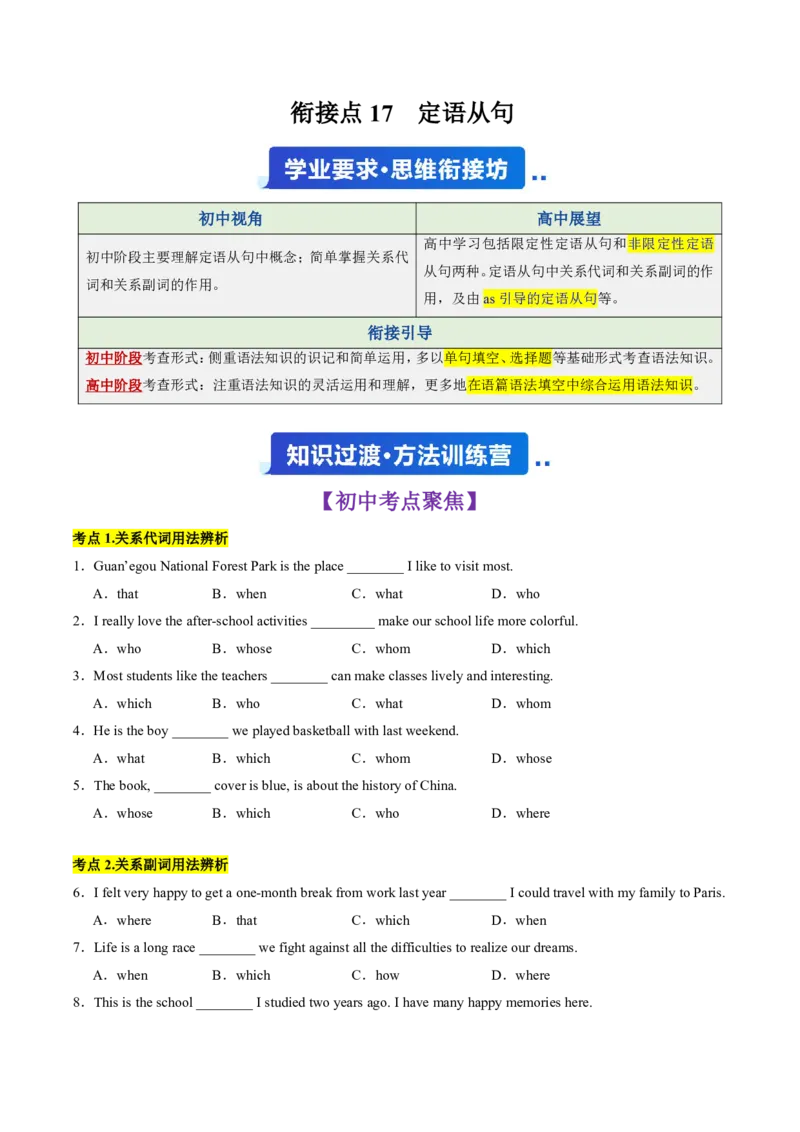
初中视角
高中展望
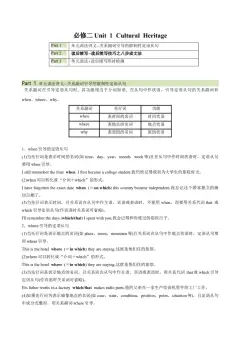
初中阶段主要理解定语从句中概念;简单掌握关系代
词和关系副词的作用。
高中学习包括限定性定语从句和非限定性定语
从句两种。定语从句中关系代词和关系副词的作
用,及由as 引导的定语从句等。
衔接引导
初中阶段考查形式:侧重语法知识的识记和简单运用,多以单句填空、选择题等基础形式考查语法知识。
高中阶段考查形式:注重语法知识的灵活运用和理解,更多地在语篇语法填空中综合运用语法知识。
【初中考点聚焦】
考点1.关系代词用法辨析
1.Guan’egou National Forest Park is the place ________ I like to visit most.
A.that
B.when
C.what
D.who
2.I really love the after-school activities _________ make our school life more colorful.
A.who
B.whose
C.whom
D.which
3.Most students like the teachers ________ can make classes lively and interesting.
A.which
B.who
C.what
D.whom
4.He is the boy ________ we played basketball with last weekend.
A.what
B.which
C.whom
D.whose
5.The book, ________ cover is blue, is about the history of China.
A.whose
B.which
C.who
D.where
考点2.关系副词用法辨析
6.I felt very happy to get a one-month break from work last year ________ I could travel with my family to Paris.
A.where
B.that
C.which
D.when
7.Life is a long race ________ we fight against all the difficulties to realize our dreams.
A.when
B.which
C.how
D.where
8.This is the school ________ I studied two years ago. I have many happy memories here.
A.which
B.where
C.that
D.when
9.I wonder the reason ________ you were late for school yesterday.
A.why
B.where
C.when
D.who
10.We will put off the picnic in the park until next week,
the weather may be better.
A.that
B.where
C.which
D.when
【高中考点聚焦】
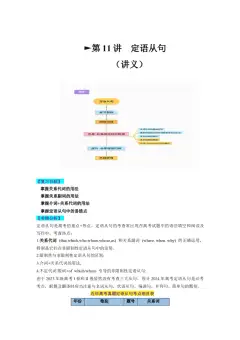
课标解读
▇定义及相关术语
一.什么叫定语从句?先行词、关系词?
1.定语从句:在复合句中,修饰名词或代词的句子。
2.特点:定语从句相当于形容词的作用,对前面的名词或代词进行修饰和限定。
3.先行词:被定语从句修饰的名词或代词,称为先行词。可以为一个词,短语,或整个主句。
4.关系词:引导定语从句的词称为关系词。关系词分为两类,即关系代词和关系副词。
5.关系代词有:that, which, who, whom, whose, as 等;
6.关系副词有:when, where, why 等
例1:This is the present which/that he gave me for my birthday.
例2:Do you know the man at the corner that/who came to the party last night?
例3:I still remember the night when I first came to the village?
例4:This is the place where Chairman Mao once lived.
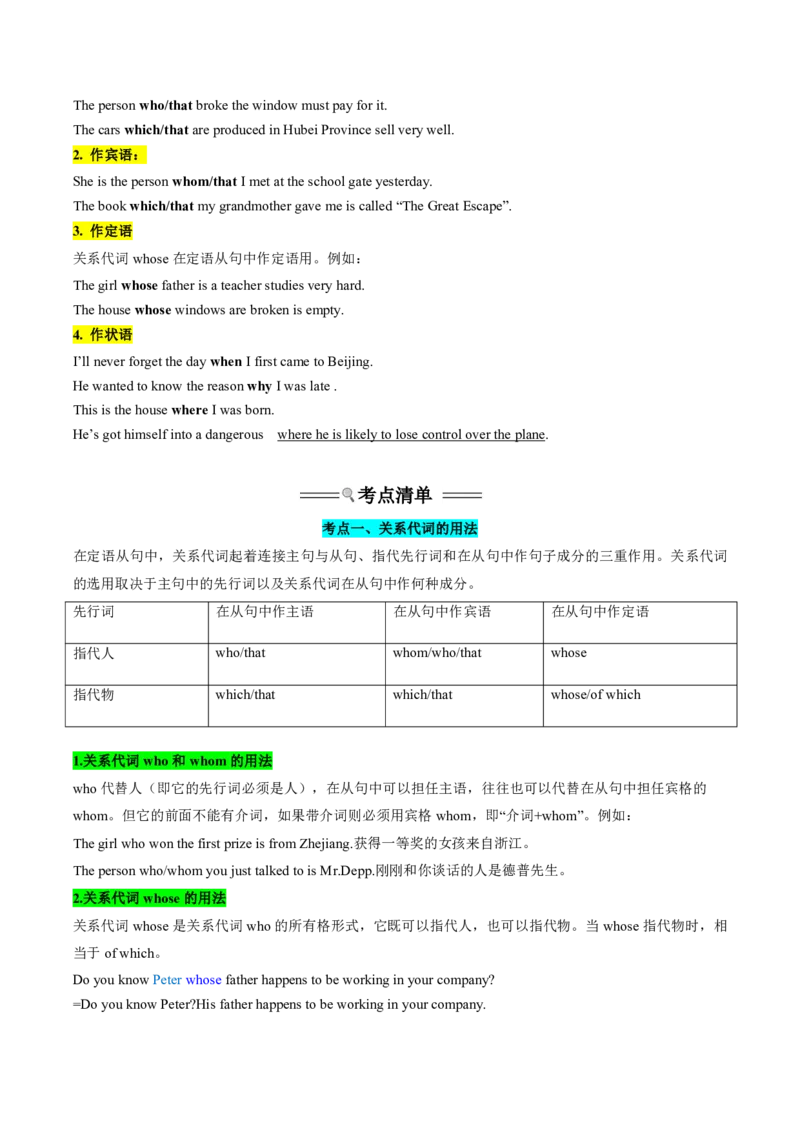
▇提示:关系词在定语从句中有三大作用
1.连接作用---连接先行词和定语从句。
2.替代作用---在定语从句中替代从句所修饰的先行词。
3.成分作用---在定语从句中作主语、宾语、定语或状语。
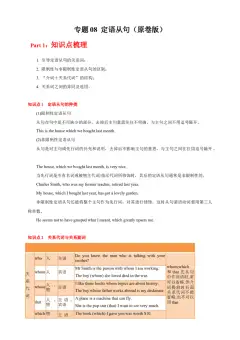
二. 关系代词的功用?
▇关系代词做主语,宾语,定语;关系副词作状语。
1. 作主语:
who
whom
that
which
whose
指人
指物
The person who/that broke the window must pay for it.
The cars which/that are produced in Hubei Province sell very well.
2. 作宾语:
She is the person whom/that I met at the school gate yesterday.
The book which/that my grandmother gave me is called “The Great Escape”.
3. 作定语
关系代词whose 在定语从句中作定语用。例如:
The girl whose father is a teacher studies very hard.
The house whose windows are broken is empty.
4. 作状语
I’ll never forget the day when I first came to Beijing.
He wanted to know the reason why I was late .
This is the house where I was born.
He’s got himself into a dangerous
where he is likely to lose control over the plane.
考点清单
考点一、关系代词的用法
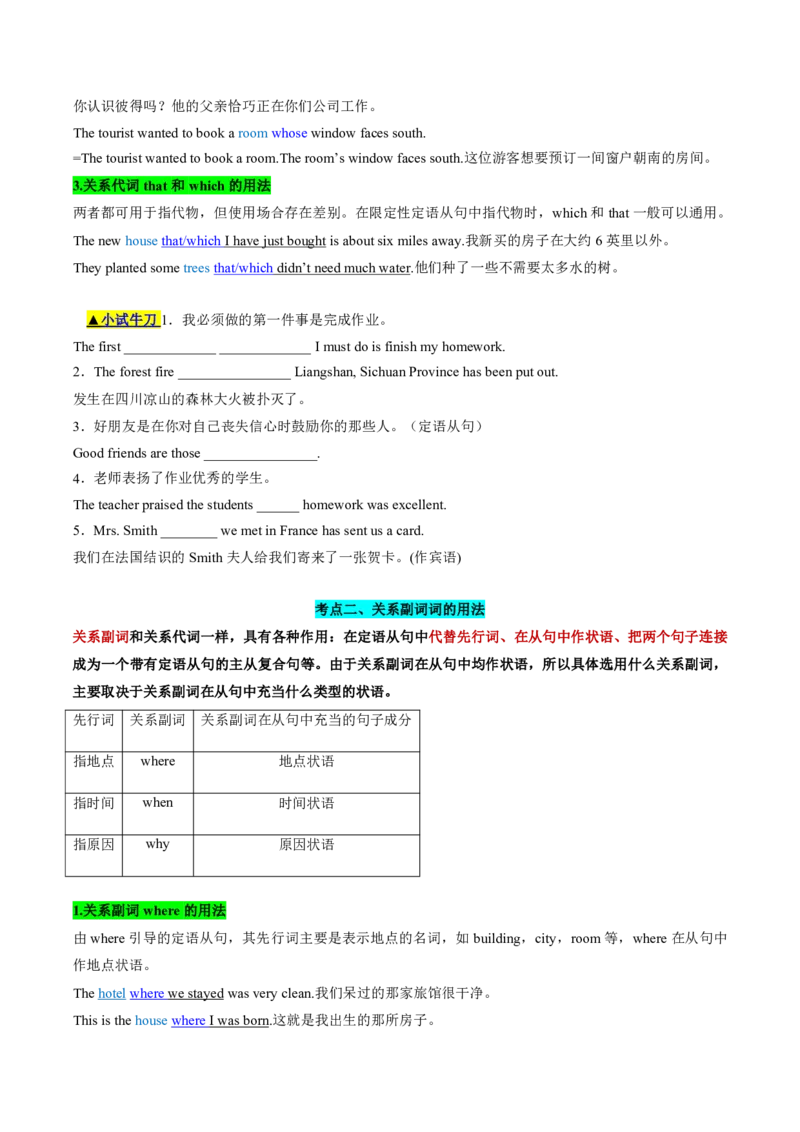
在定语从句中,关系代词起着连接主句与从句、指代先行词和在从句中作句子成分的三重作用。关系代词
的选用取决于主句中的先行词以及关系代词在从句中作何种成分。
先行词
在从句中作主语
在从句中作宾语
在从句中作定语
指代人
who/that
whom/who/that
whose
指代物
which/that
which/that
whose/of which
1.关系代词who 和whom 的用法
who 代替人(即它的先行词必须是人),在从句中可以担任主语,往往也可以代替在从句中担任宾格的
whom。但它的前面不能有介词,如果带介词则必须用宾格whom,即“介词+whom”。例如:
The girl who won the first prize is from Zhejiang.获得一等奖的女孩来自浙江。
The person who/whom you just talked to is Mr.Depp.刚刚和你谈话的人是德普先生。
2.关系代词whose 的用法
关系代词whose 是关系代词who 的所有格形式,它既可以指代人,也可以指代物。当whose 指代物时,相
当于of which。
Do you know Peter whose father happens to be working in your company?
=Do you know Peter?His father happens to be working in your company.
你认识彼得吗?他的父亲恰巧正在你们公司工作。
The tourist wanted to book a room whose window faces south.
=The tourist wanted to book a room.The room’s window faces south.这位游客想要预订一间窗户朝南的房间。
3.关系代词that 和which 的用法
两者都可用于指代物,但使用场合存在差别。在限定性定语从句中指代物时,which 和that 一般可以通用。
The new house that/which I have just bought is about six miles away.我新买的房子在大约6 英里以外。
They planted some trees that/which didn’t need much water.他们种了一些不需要太多水的树。
▲小试牛刀1.我必须做的第一件事是完成作业。
The first _____________ _____________ I must do is finish my homework.
2.The forest fire ________________ Liangshan, Sichuan Province has been put out.
发生在四川凉山的森林大火被扑灭了。
3.好朋友是在你对自己丧失信心时鼓励你的那些人。(定语从句)
Good friends are those ________________.
4.老师表扬了作业优秀的学生。
The teacher praised the students ______ homework was excellent.
5.Mrs. Smith ________ we met in France has sent us a card.
我们在法国结识的Smith 夫人给我们寄来了一张贺卡。(作宾语)
考点二、关系副词词的用法
关系副词和关系代词一样,具有各种作用:在定语从句中代替先行词、在从句中作状语、把两个句子连接
成为一个带有定语从句的主从复合句等。由于关系副词在从句中均作状语,所以具体选用什么关系副词,
主要取决于关系副词在从句中充当什么类型的状语。
先行词
关系副词
关系副词在从句中充当的句子成分
指地点
where
地点状语
指时间
when
时间状语
指原因
why
原因状语
1.关系副词where 的用法
由where 引导的定语从句,其先行词主要是表示地点的名词,如building,city,room 等,where 在从句中
作地点状语。
The hotel where we stayed was very clean.我们呆过的那家旅馆很干净。
This is the house where I was born.这就是我出生的那所房子。
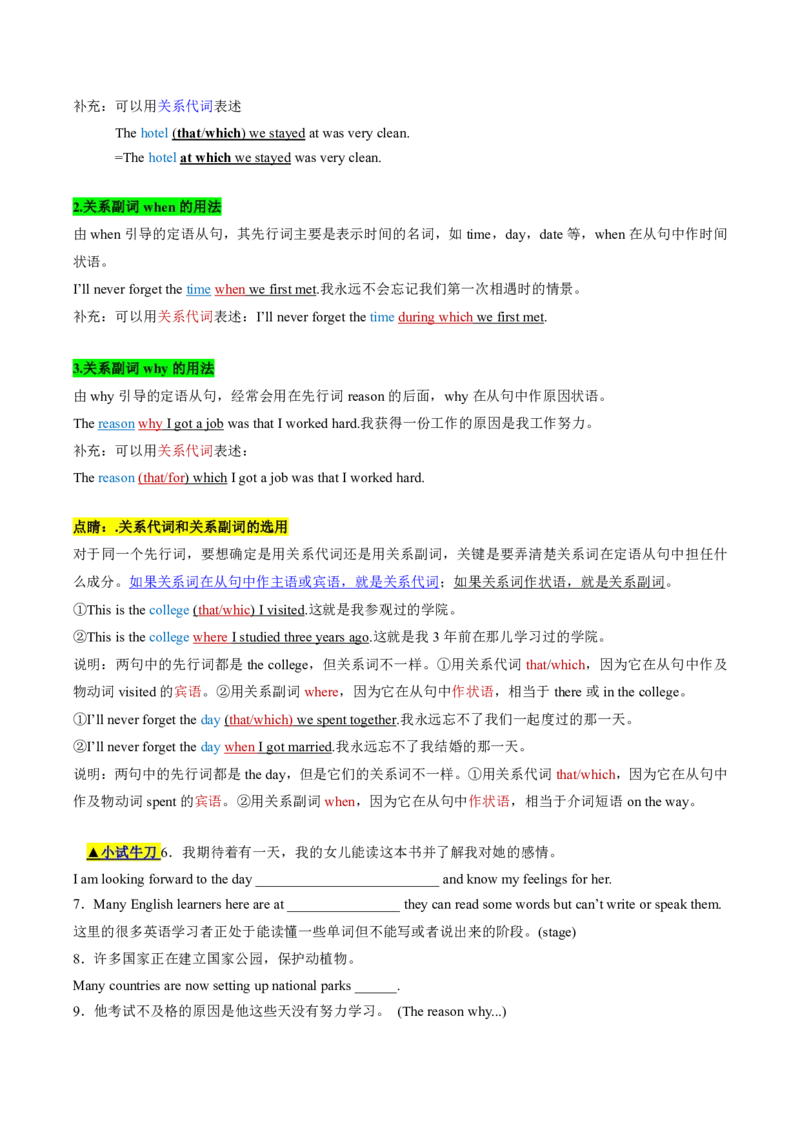
补充:可以用关系代词表述
The hotel (that/which) we stayed at was very clean.
=The hotel at which we stayed was very clean.
2.关系副词when 的用法
由when 引导的定语从句,其先行词主要是表示时间的名词,如time,day,date 等,when 在从句中作时间
状语。
I’ll never forget the time when we first met.我永远不会忘记我们第一次相遇时的情景。
补充:可以用关系代词表述:I’ll never forget the time during which we first met.
3.关系副词why 的用法
由why 引导的定语从句,经常会用在先行词reason 的后面,why 在从句中作原因状语。
The reason why I got a job was that I worked hard.我获得一份工作的原因是我工作努力。
补充:可以用关系代词表述:
The reason (that/for) which I got a job was that I worked hard.
点睛:.关系代词和关系副词的选用
对于同一个先行词,要想确定是用关系代词还是用关系副词,关键是要弄清楚关系词在定语从句中担任什
么成分。如果关系词在从句中作主语或宾语,就是关系代词;如果关系词作状语,就是关系副词。
①This is the college (that/whic) I visited.这就是我参观过的学院。
②This is the college where I studied three years ago.这就是我3 年前在那儿学习过的学院。
说明:两句中的先行词都是the college,但关系词不一样。①用关系代词that/which,因为它在从句中作及
物动词visited 的宾语。②用关系副词where,因为它在从句中作状语,相当于there 或in the college。
①I’ll never forget the day (that/which) we spent together.我永远忘不了我们一起度过的那一天。
②I’ll never forget the day when I got married.我永远忘不了我结婚的那一天。
说明:两句中的先行词都是the day,但是它们的关系词不一样。①用关系代词that/which,因为它在从句中
作及物动词spent 的宾语。②用关系副词when,因为它在从句中作状语,相当于介词短语on the way。
▲小试牛刀6.我期待着有一天,我的女儿能读这本书并了解我对她的感情。
I am looking forward to the day __________________________ and know my feelings for her.
7.Many English learners here are at ________________ they can read some words but can’t write or speak them.
这里的很多英语学习者正处于能读懂一些单词但不能写或者说出来的阶段。(stage)
8.许多国家正在建立国家公园,保护动植物。
Many countries are now setting up national parks ______.
9.他考试不及格的原因是他这些天没有努力学习。(The reason why...)
_______________ he didn’t work hard these days.
10.今天早晨我上课迟到的原因是我起床晚了。
____________________ (……的原因) I was late for class was that I got up late this morning.
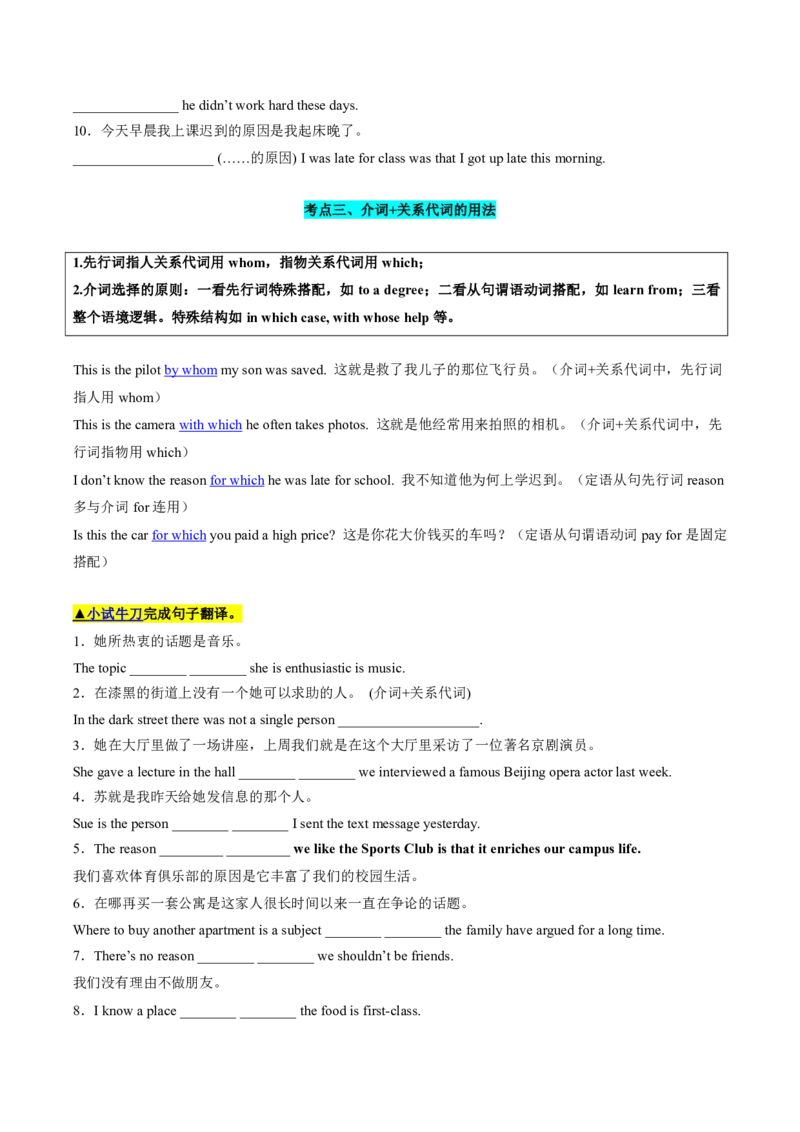
考点三、介词+关系代词的用法
1.先行词指人关系代词用whom,指物关系代词用which;
2.介词选择的原则:一看先行词特殊搭配,如to a degree;二看从句谓语动词搭配,如learn from;三看
整个语境逻辑。特殊结构如in which case, with whose help 等。
This is the pilot by whom my son was saved. 这就是救了我儿子的那位飞行员。(介词+关系代词中,先行词
指人用whom)
This is the camera with which he often takes photos. 这就是他经常用来拍照的相机。(介词+关系代词中,先
行词指物用which)
I don’t know the reason for which he was late for school. 我不知道他为何上学迟到。(定语从句先行词reason
多与介词for 连用)
Is this the car for which you paid a high price? 这是你花大价钱买的车吗?(定语从句谓语动词pay for 是固定
搭配)
▲小试牛刀完成句子翻译。
1.她所热衷的话题是音乐。
The topic ________ ________ she is enthusiastic is music.
2.在漆黑的街道上没有一个她可以求助的人。(介词+关系代词)
In the dark street there was not a single person ____________________.
3.她在大厅里做了一场讲座,上周我们就是在这个大厅里采访了一位著名京剧演员。
She gave a lecture in the hall ________ ________ we interviewed a famous Beijing opera actor last week.
4.苏就是我昨天给她发信息的那个人。
Sue is the person ________ ________ I sent the text message yesterday.
5.The reason _________ _________ we like the Sports Club is that it enriches our campus life.
我们喜欢体育俱乐部的原因是它丰富了我们的校园生活。
6.在哪再买一套公寓是这家人很长时间以来一直在争论的话题。
Where to buy another apartment is a subject ________ ________ the family have argued for a long time.
7.There’s no reason ________ ________ we shouldn’t be friends.
我们没有理由不做朋友。
8.I know a place ________ ________ the food is first-class.
我知道有一个品尝一流美食的地方。
9.I still remember the day ________ ________ I went to college.
我仍然记得我上大学的那一天。
10.毕业以后,他回到那个他长大的小镇上。
After graduation he returned to the small town ____________________________.
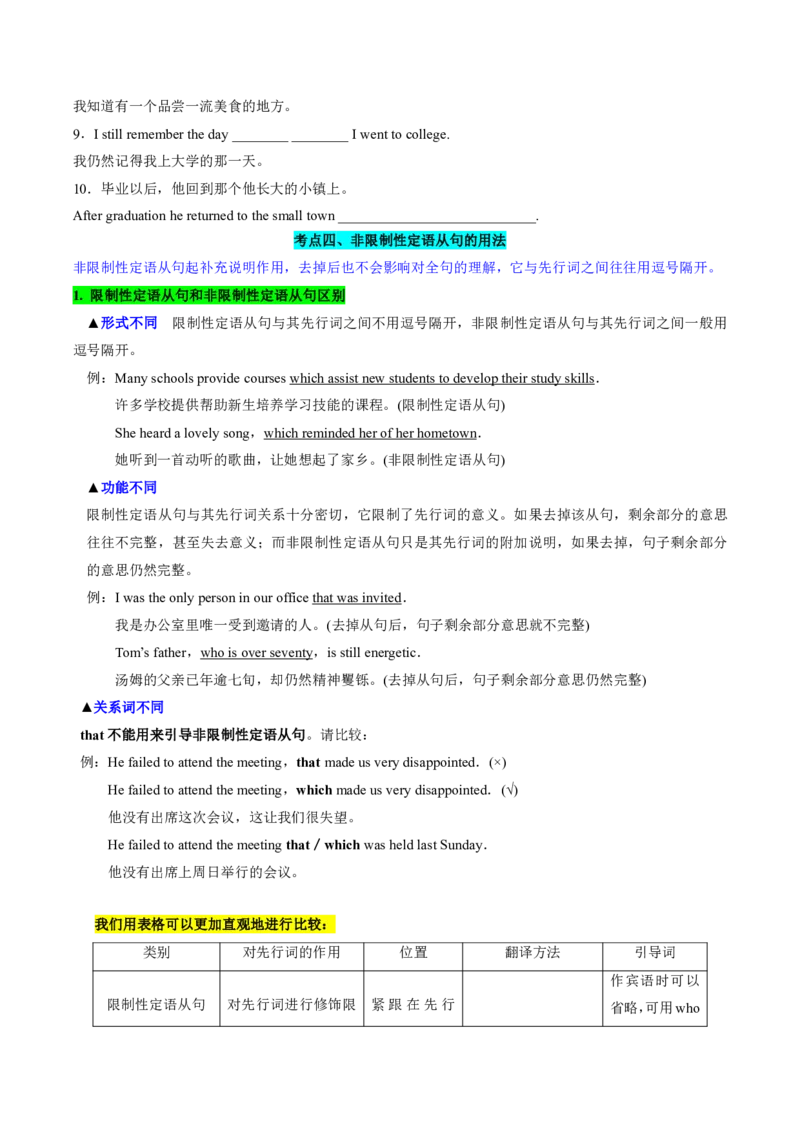
考点四、非限制性定语从句的用法
非限制性定语从句起补充说明作用,去掉后也不会影响对全句的理解,它与先行词之间往往用逗号隔开。
1. 限制性定语从句和非限制性定语从句区别
▲形式不同
限制性定语从句与其先行词之间不用逗号隔开,非限制性定语从句与其先行词之间一般用
逗号隔开。
例:Many schools provide courses which assist new students to develop their study skills.
许多学校提供帮助新生培养学习技能的课程。(限制性定语从句)
She heard a lovely song,which reminded her of her hometown.
她听到一首动听的歌曲,让她想起了家乡。(非限制性定语从句)
▲功能不同
限制性定语从句与其先行词关系十分密切,它限制了先行词的意义。如果去掉该从句,剩余部分的意思
往往不完整,甚至失去意义;而非限制性定语从句只是其先行词的附加说明,如果去掉,句子剩余部分
的意思仍然完整。
例:I was the only person in our office that was invited.
我是办公室里唯一受到邀请的人。(去掉从句后,句子剩余部分意思就不完整)
Tom’s father,who is over seventy,is still energetic.
汤姆的父亲已年逾七旬,却仍然精神矍铄。(去掉从句后,句子剩余部分意思仍然完整)
▲关系词不同
that 不能用来引导非限制性定语从句。请比较:
例:He failed to attend the meeting,that made us very disappointed.(×)
He failed to attend the meeting,which made us very disappointed.(√)
他没有出席这次会议,这让我们很失望。
He failed to attend the meeting that/which was held last Sunday.
他没有出席上周日举行的会议。
我们用表格可以更加直观地进行比较:
类别
对先行词的作用
位置
翻译方法
引导词
限制性定语从句
对先行词进行修饰限
紧跟在先行
作宾语时可以
省略,可用who
定
词后,无逗号
翻译在先行词前
代替whom
非限制性定语从
句
对先行词或主句进行
补充说明
和主句之间
用逗号隔开
翻译成主句的并列
句
不能省略,不
可以用that,不
可以用who 代
替whom
2.as 和which 引导的非限制性定语从句的区别
非限制性定语从句不仅可以修饰名词或代词,也可以修饰整个句子,这时关系代词用which。
例:The result of the experiment was very good,which we hadn’t expected.
实验的结果非常好,这一点出乎我们的意料。
Tom was elected Chairman of the Students’ Union.which made his family very proud.
汤姆被选为学生会主席,这件事让全家都感到骄傲。
如果非限制性定语从句放在主句之前,关系代词只能用as,不能用which。
例:As we all know,Taiwan has been part of China since ancient times.
众所周知,台湾自古以来就是中国的一部分。
As had been expected,he put forward his idea at the meeting.
as 有“正如”之意,而which 则意为“这(件事,一点)”,可用and this/that/it 来代替。
She heard a terrible noise, which brought her heart into her mouth.她听到可怕地声音,这让她把心都提到
嗓子眼了。
As is planned, we got there before eight. 正如计划,我们八点前到达了那儿。
as 多用于固定搭配中:as is often the case(这是常有的事),as was expected(不出所料),as often happens(正
如经常发生的那样),as is known to all(众所周知),as has been said before(如上所述),as is mentioned above(正
如上面所提到的)等。
Li Ming is late, as is often the case. 李明迟到了,这事是经常发生的。(不可用which)
3.用“介词+关系代词” 或“one of whom、some of which”等引导的非限制性定语从句
可以用数词或不定代词(如all/both/each/some/most/none 等)+of whom 或of which 来修饰或限定先
行词。
例:We interviewed 1 5 applicants for the post,none of whom we thought qualified.
我们面试了15 名求职者,但没有一人合格。
Seven passengers were injured in the car accident,two of whom were foreigners.
在车祸中有七人受伤,其中两名是外国人。
The engine consists of hundreds of parts,each of which has its importance.
这个引擎由数百个零件组成,每个零件都有其重要的作用。
▲小试牛刀1.I had my car parked in a car park,
I could get my car battery charged. (用适当的词
填空)
2.I won the first prize in the English speaking contest,
surprised my classmates. (用适当的词填空)
3.I’ll be talking to Dr Richard,
new book The New Age of Invention has just been published. (用适当的
词填空)
4.Children,
is always the case, love their mother. (用适当的词填空)
5.
is reported, Apple company will be launching a new tablet this time next month. (用适当的词填
空)
6.The old man has two daughters, both of
work as doctors. (用适当的词填空)
7.My best friend Julia will come to see me next July,
she won’t be so busy. (用适当的词填空)
8.She decided not to take a picnic with me,
made me really disappointed. (用适当的词填空)
9.The old man has two daughters, both of
work as doctors. (用适当的词填空)
10.Opposite the post office is a video shop,
you can buy any kind of music CD you like. (用适当的词填
空)
一、单句语法填空
1.It is widely accepted that the age
children can go to school is seven. (用适当的词填空)
2.Don’t get too close to the house
roof is under repair. (用适当的词填空)
3.There are only so many people with
you can be continuously texting. (用适当的词填空)
4.We climbed up to the ancient tower overlooking the Gan River, from
we can admire the breathtaking
view in the setting sun. (用适当的词填空)
5.Some experts think reading is the basic skill on
school education depends. (用适当的词填空)
6.We are in the era
there are great opportunities for those who are competent. (用适当的词填空)
7.Many families are not trapped in poverty, but in a subtle situation
emotional communication
gradually fades amid busy daily routines. (用适当的词填空)
8.This is the place
I lost my English notebook. (用适当的词填空)
9.I’ll never forget the days
I first met my best friend Amy. (用适当的词填空)
10.
is generally accepted, a balanced diet is important for maintaining good health. (用适当的词填空)
11.He failed the exam again,
made his parents very disappointed. (用适当的词填空)
12.Plates moving underground can cause an earthquake,
is a sudden shaking of the earth’s surface.
(用适当的词填空)
13.Wu Yize,
won the World Snooker Championship final, has set a new benchmark for young Chinese
players. (用适当的词填空)
14.The Forbidden City,
ancient Chinese emperors once lived and worked, is now open to the public.
(用适当的词填空)
15.The man, from
we learned a lot about environmental protection, is a renowned environmentalist.
(用适当的词填空)
16 .All kinds of traditional Chinese herbal medicine can be found, too, and there are Chinese tea stores,
visitors can taste and buy varieties of Chinese tea. (用适当的词填空)
17.Their primary school teachers and their lessons
they were fond of influenced their lives. (用适当的
词填空)
18.This is the digital library
every registered user has access to thousands of e-books and academic
journals. (用适当的词填空)
19.The young doctor faced a situation
he had to make a quick decision without enough information.
(定语从句关系词)(用适当的词填空)
20.Tony showed me his new cell phone,
screen was small but it could change colors in different
weather. (用适当的词填空)
二、完成句子
1.我绝不会忘记与她第一次相见的那一天。
I’ll never forget the day
I first met her.
2.
(正如你想的那样), there will be a variety of challenges in the future life.
3.我站在塔顶,从那儿我看到了这个城市的全景。
I stood at the top of the tower,
.
4.更糟糕的是,他的父亲在这段时间失去了工作并深陷悲痛之中。
Worse still, his father,
, lost his job at the same time.
5.在我们学校,大约有200 名教师,其中30%是男性。
In our school, there are about 200 teachers,
一、语法填空
阅读下面短文,在空白处填入1 个适当的单词或括号内单词的正确形式。
A few months ago, I left my hometown for Canada to study. I felt nervous because I was going to
1
new place with new people. What worried me at first was that I couldn’t speak English
2
(fluent), and I
also couldn’t understand
3
(they) customs. Everything was different
4
that in my own
country. I had to deal with everything alone.
It was a sad moment
5
I had to say goodbye to my family and friends at the airport. I felt sad
6
(leave) my hometown because I grew up there and had many wonderful
7
(memory) of the
familiar (熟悉的) place. However, I knew
8
(study) abroad was a decision that I made myself. I had to
9
(accept) the challenge.
By now I have gotten used to the new life here already, though I’m looking forward to
10
(spend)
the coming vacation with my old friends back home.
二、阅读理解
Music with a View
Summer may well be the favourite season of classical music lovers, with many festivals taking place
worldwide. And what’s better than enjoying a live performance of your favourite piece? Enjoying it in the great
outdoors, of course!
Edinburgh International Festival, Scotland
It’s Edinburgh’s arts offering, and in 2023 welcomes violinist Nicola Benedetti in her first year as festival
director. Picking up the baton (接力棒) from previous director Fergus Linehan, she is the first female festival
director since the Festival began in 1947. Benedetti will invite some popular symphony orchestras.
August 4 — August 27, eif.co.uk
Puccini Festival, Italy
Since 1930, it has been presenting Puccini’s masterpieces to crowds of thousands in beautiful Torre del Lago
every summer. We’re picturing hot Italian summer days closing with a gentle warmth, together with fine opera and
a cool glass of wine in hand and the waters of Lake Massaciuccoli.
July 14 — August 26, puccinifestival.it
Verbier Festival, Switzerland
One of the main reasons to visit it is that it’s a magical two-week celebration of classical music at the top of
the world. The festival has become known for attracting the biggest soloists (独唱者) in the world. The real magic
of Verbier is its ideas of connecting great musicians at the height of their careers with ambitious young artists.
July 14 — July 30, verbierfestival.com
Granada International Festival, Spain
Since 1952, it has been held in the palace to show opera, ballet, Spanish dance and more. In 2023, the
festival will team up with University of Granada to invite talented students to take part in the Manuel de Falla
Courses, which offer masterclasses in composition, musical analysis, performance and face-to-face talk with great
musicians including Víkingur Ólafsson and Daniil Trifonov.
June 21 — July 19, granadafestival.org
11.Who is the first female festival director of Edinburgh International Festival?
A.Fergus Linehan.
B.Nicola Benedetti.
C.Víkingur Ólafsson.
D.Daniil Trifonov.
12.What do Verbier Festival and Granada International Festival have in common?
A.They attract the biggest soloists.
B.They are themed on classical music.
C.They present Puccini’s masterpieces to the public.
D.They give the youth a chance to contact with musicians.
13.Which festival lasts the longest?
A.Puccini Festival, Italy.
B.Verbier Festival, Switzerland.
C.Granada International Festival, Spain.
D.Edinburgh International Festival, Scotland.