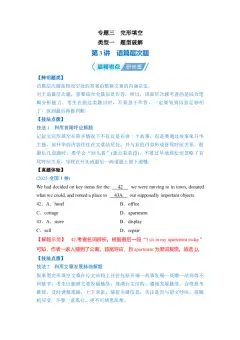
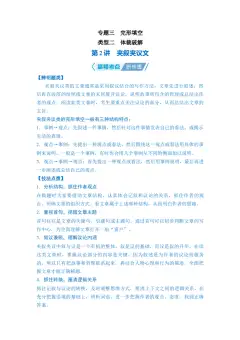
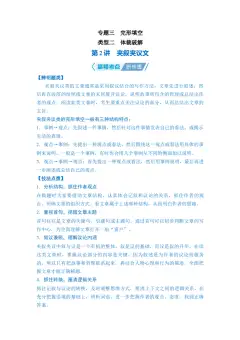
专题三 完形填空
类型二 体裁破解
第3 讲 说明文
【辨明题类】
说明文是以说明为主要表达方式,用来说明事物、阐明事理的一种文体。
它通过揭示概念来说明事物的特征、本质及其规律性,给人准确的科学知识或
传递某种思想。其基本模式是:观点—说明—总结。
说明文要通读全文,明确作者是针对哪一个说明对象从不同的角度和侧面对其
加以说明的。弄清说明顺序,把握作者态度。在说明的过程中作者会选择合理
的说明顺序对说明对象进行有条不紊地解说。把握了说明顺序,就能准确把握
文章的脉络,加深对整篇文章的理解。
【技法点拨】
1.快速通读全文,明确作者从什么角度和侧面对哪一个说明对象进行说明的。
2.把握每段的说明侧重点,厘清段落之间的逻辑关系,加深对说明对象的理
解。
3.清楚作者是按照时间顺序、空间顺序、逻辑顺序还是认知顺序来展开说明
的,进一步确定前后文的因果关系、先后主次、由此及彼、由浅入深、由局部
到整体、由客观到本质等。
4.抓住体现作者态度的关键词句,有利于掌握作者的写作情感和意图。
【真题体验】
(2022·全国乙卷改编)
Young children across the globe enjoy playing games of hide and seek.For them,
there's something highly exciting about   1   someone else's glance and making
oneself unable to be seen.
However, we all witness that preschool children are remarkably   2   at hiding.They
often cover only their eyes with their hands, leaving the rest of their bodies   3  .
For a long time, this ineffective hiding method was   4   as evidence that children
are hopelessly “egocentric(自我中心的)” creatures.But our   5   research
results in child developmental psychology contradicted that idea.
We brought young children aged 2- 4 into our Minds in Development Lab at
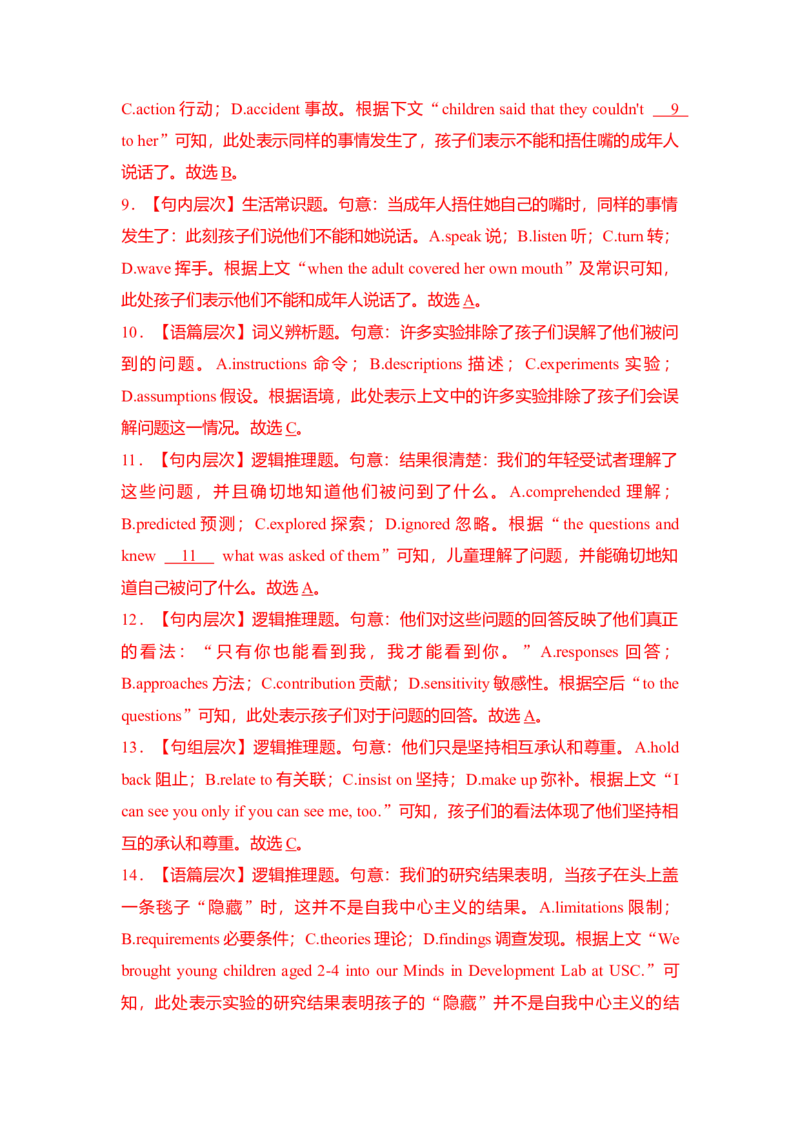
USC.Each   6   sat down with an adult who covered her own eyes or ears.We then
asked the child if she could   7   or hear the adult.Surprisingly, children replied that
they couldn't.The same   8   happened when the adult covered her own mouth:
Now children said that they couldn't   9   to her.
A number of   10   ruled out that the children misunderstood what they were being
asked.The results were clear: Our young subjects   11   the questions and knew
exactly what was asked of them.Their   12   to the questions reflected their true
belief that “I can see you only if you can see me, too.” They simply   13
mutual(相互的) recognition and regard.Our   14   suggest when a child “hides”
by putting a blanket over her head, it is not a result of egocentrism.In fact, children
consider this method   15   when others use it.
1.A.following
B.taking
C.escaping
D.directing
2.A.clever
B.bad
C.scared
D.quick
3.A.exposed
B.examined
C.untouched
D.imbalanced
4.A.supported
B.guaranteed
C.imagined
D.interpreted
5.A.disappointing
B.mixed
C.surprising
D.desired
6.A.parent
B.child
C.researcher
D.doctor
7.A.see
B.help
C.reach
D.fool
8.A.event
B.thing
C.action
D.accident
9.A.speak
B.listen
C.turn
D.wave
10.A.instructions
B.descriptions
C.experiments
D.assumptions
11.A.comprehended
B.predicted
C.explored
D.ignored
12.A.responses
B.approaches
C.contribution
D.sensitivity
13.A.hold back
B.relate to
C.insist on
D.make up
14.A.limitations
B.requirements
C.theories
D.findings
15.A.tentative
B.impressive
C.creative
D.effective
【解题示范】 第一步:速读全文,从宏观上把握说明文的说明对象,弄清说
明顺序,理清段落关系,把握写作意图,掌握文章大意
1.文章主旨:文章主要通过实验证明孩子们捉迷藏时,只遮住自己的眼睛并不
是自我中心主义的结果,而是孩子们坚持相互承认和尊重。
2.说明对象:孩子们捉迷藏时,常常只遮住自己的眼睛而身体其他部位却暴露
在外的现象。
3.说明顺序:按照认知顺序展开说明。
4.写作意图:通过实验说明孩子们捉迷藏时,只遮住自己的眼睛并不是自我中
心主义的结果,而是孩子们坚持相互承认和尊重这一现象的本质。
第二步:细读文章,从微观上破解三大层次题
依据说明对象、说明顺序,理清逻辑关系,抓住关键词句,运用语言知识、文
化背景、生活常识、上下文语境等作出选择。
【解析】
1.【句组层次】逻辑推理题。句意:对他们来说,避开别人的目光,让自己无
法被别人看到,这是一件非常令人兴奋的事情。A.following 跟随;B.taking 取
走;C.escaping 避开;D.directing 指导。根据上文“Young children across the
globe enjoy playing games of hide and seek.”可知,儿童喜欢玩捉迷藏,避开别
人的目光。故选C。
2.【句组层次】逻辑推理题。句意:然而,我们都看到学龄前儿童非常不善于
隐藏。A.clever 聪明的;B.bad 不擅长的;C.scared 害怕的;D.quick 快的。根据
下文“They often cover only their eyes with their hands, leaving the rest of their
bodies”可知,儿童不擅长隐藏,be bad at sth.为固定搭配,表示“不擅长某
事”。故选B。
3.【句内层次】逻辑推理题。句意:他们通常只用手遮住眼睛,其余的身体暴
露在外。A.exposed 无遮蔽的;B.examined 已检查过的;C.untouched 未受影响
的;D.imbalanced 失衡的。根据空前“They often cover only their eyes with their
hands, leaving the rest of their bodies”可知,儿童只是用手遮住了眼睛,身体的
其余部分无遮蔽,是暴露在外的。故选A。
4.【句内层次】逻辑推理题。句意:长期以来,这种无效的隐藏方法被解释为
儿童是无可救药的“自我中心”生物的证据。A.supported 支持;B.guaranteed
保证;C.imagined 想象;D.interpreted 解释。根据“as evidence that children are
hopelessly ‘egocentric(自我中心的)’ creatures”可知,此处表示这种无效的
隐藏方法被解释为证据,证明儿童是以自我为中心的。故选D。
5.【语篇层次】逻辑推理题。句意:但我们在儿童发展心理学方面令人惊讶的
研究结果与这一观点相矛盾。A.disappointing 令人失望的;B.mixed 混合的;
C.surprising 令人惊讶的;D.desired 渴望的。根据空后“research results in child
developmental psychology contradicted that idea”以及下文“Our   14   suggest
when a child ‘hides’ by putting a blanket over her head, it is not a result of
egocentrism.”可知,研究结果与之前的观点相矛盾,所以研究结果是令人惊讶
的。故选C。
6.【句组层次】逻辑推理题。句意:每个儿童都和一个成年人坐在一起,成年
人遮住自己的眼睛或耳朵。A.parent 父(母)亲;B.child 儿童;C.researcher 研究
员;D.doctor 医生。根据上文“We brought young children aged 2-4 into our Minds
in Development Lab at USC.”可知,儿童参加实验,此处表示每个儿童和一个
成年人坐在一起。故选B。
7.【句组层次】逻辑推理题。句意:然后我们问儿童是否能看到或听到成年人
的声音。A.see 看见;B.help 帮助;C.reach 到达;D.fool 欺骗。根据上文“an
adult who covered her own eyes”可知,成年人遮住了自己的眼睛,所以此处儿
童被询问是否能看见成年人。故选A。
8.【句内层次】逻辑推理题。句意:当成年人捂住她自己的嘴时,同样的事情
发生了:此刻孩子们说他们不能和她说话。A.event 大事;B.thing 事情;
C.action 行动;D.accident 事故。根据下文“children said that they couldn't   9
to her”可知,此处表示同样的事情发生了,孩子们表示不能和捂住嘴的成年人
说话了。故选B。
9.【句内层次】生活常识题。句意:当成年人捂住她自己的嘴时,同样的事情
发生了:此刻孩子们说他们不能和她说话。A.speak 说;B.listen 听;C.turn 转;
D.wave 挥手。根据上文“when the adult covered her own mouth”及常识可知,
此处孩子们表示他们不能和成年人说话了。故选A。
10.【语篇层次】词义辨析题。句意:许多实验排除了孩子们误解了他们被问
到的问题。A.instructions 命令;B.descriptions 描述;C.experiments 实验;
D.assumptions 假设。根据语境,此处表示上文中的许多实验排除了孩子们会误
解问题这一情况。故选C。
11.【句内层次】逻辑推理题。句意:结果很清楚:我们的年轻受试者理解了
这些问题,并且确切地知道他们被问到了什么。A.comprehended 理解;
B.predicted 预测;C.explored 探索;D.ignored 忽略。根据“the questions and
knew   11   what was asked of them”可知,儿童理解了问题,并能确切地知
道自己被问了什么。故选A。
12.【句内层次】逻辑推理题。句意:他们对这些问题的回答反映了他们真正
的看法:“ 只有你也能看到我,我才能看到你。” A.responses 回答;
B.approaches 方法;C.contribution 贡献;D.sensitivity 敏感性。根据空后“to the
questions”可知,此处表示孩子们对于问题的回答。故选A。
13.【句组层次】逻辑推理题。句意:他们只是坚持相互承认和尊重。A.hold
back 阻止;B.relate to 有关联;C.insist on 坚持;D.make up 弥补。根据上文“I
can see you only if you can see me, too.”可知,孩子们的看法体现了他们坚持相
互的承认和尊重。故选C。
14.【语篇层次】逻辑推理题。句意:我们的研究结果表明,当孩子在头上盖
一条毯子“隐藏”时,这并不是自我中心主义的结果。A.limitations 限制;
B.requirements 必要条件;C.theories 理论;D.findings 调查发现。根据上文“We
brought young children aged 2-4 into our Minds in Development Lab at USC.”可
知,此处表示实验的研究结果表明孩子的“隐藏”并不是自我中心主义的结
果。故选D。
15.【句组层次】逻辑推理题。句意:事实上,当其他人使用这种方法时,孩
子们认为它是有效的。A.tentative 实验性的;B.impressive 令人印象深刻的;
C.creative 创造性的;D.effective 有效的。根据上文“ They simply   13
mutual(相互的) recognition and regard.”可知,孩子们坚持相互承认和尊重,所
以当其他人使用这种方法时,孩子会认为它是有效的。故选D。
第三步 重读文章,从逻辑上修正错误
初选之后,代入答案,把违背上下文逻辑关系的错误改正过来。
A
(2025·内蒙古赤峰市高三三模)
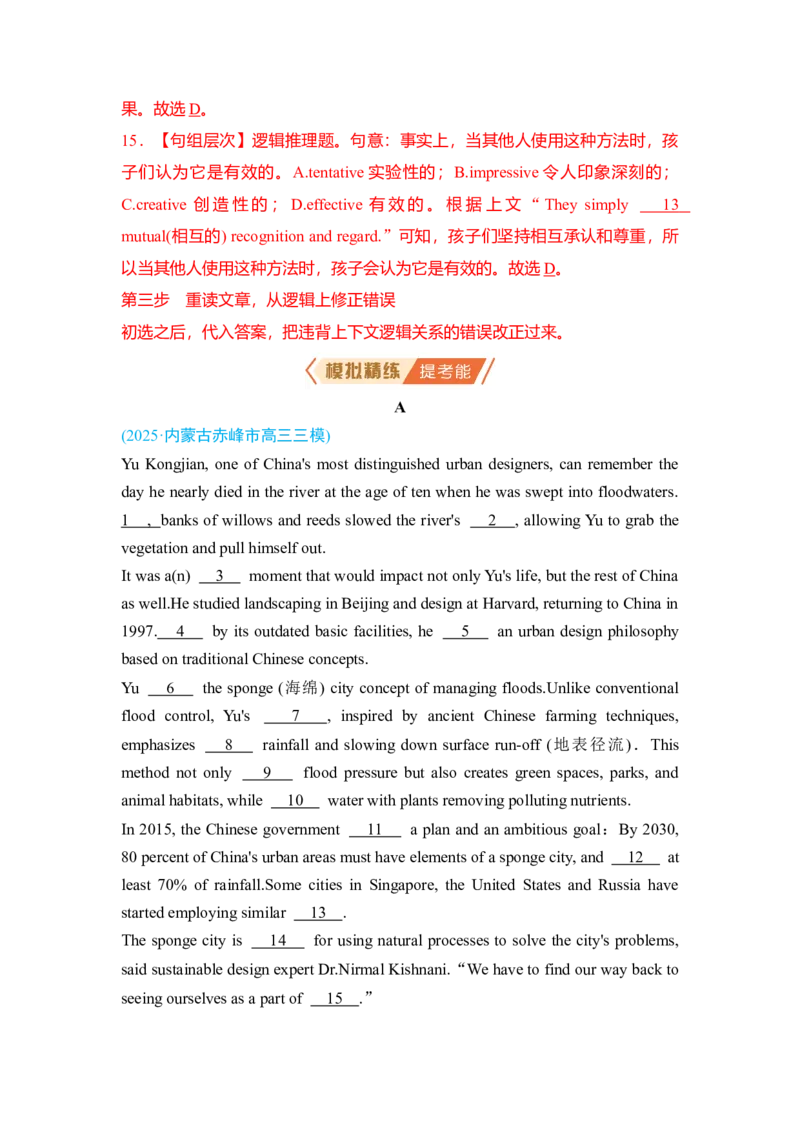
Yu Kongjian, one of China's most distinguished urban designers, can remember the
day he nearly died in the river at the age of ten when he was swept into floodwaters.
1  , banks of willows and reeds slowed the river's   2  , allowing Yu to grab the
vegetation and pull himself out.
It was a(n)   3   moment that would impact not only Yu's life, but the rest of China
as well.He studied landscaping in Beijing and design at Harvard, returning to China in
1997.  4   by its outdated basic facilities, he   5   an urban design philosophy
based on traditional Chinese concepts.
Yu   6   the sponge (海绵) city concept of managing floods.Unlike conventional
flood control, Yu's   7  , inspired by ancient Chinese farming techniques,
emphasizes   8   rainfall and slowing down surface run-off (地表径流).This
method not only   9   flood pressure but also creates green spaces, parks, and
animal habitats, while   10   water with plants removing polluting nutrients.
In 2015, the Chinese government   11   a plan and an ambitious goal:By 2030,
80 percent of China's urban areas must have elements of a sponge city, and   12   at
least 70% of rainfall.Some cities in Singapore, the United States and Russia have
started employing similar   13  .
The sponge city is   14   for using natural processes to solve the city's problems,
said sustainable design expert Dr.Nirmal Kishnani.“We have to find our way back to
seeing ourselves as a part of   15  .”
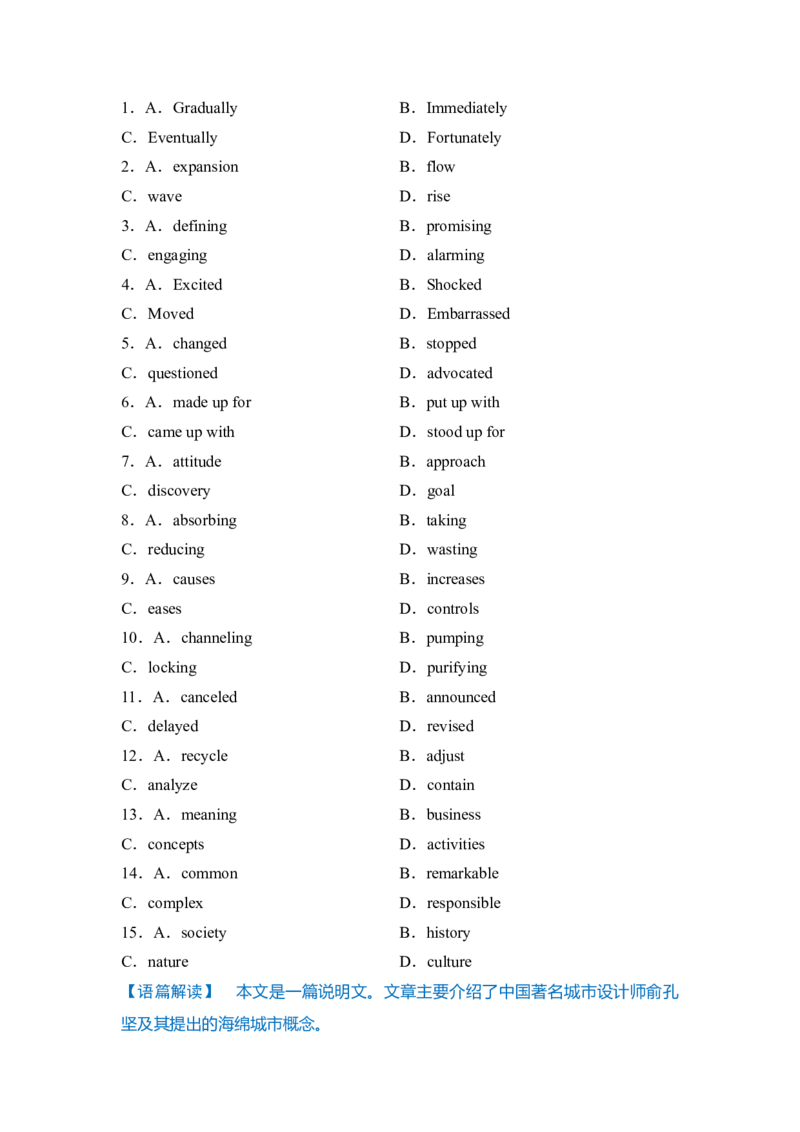
1.A.Gradually
B.Immediately
C.Eventually
D.Fortunately
2.A.expansion
B.flow
C.wave
D.rise
3.A.defining
B.promising
C.engaging
D.alarming
4.A.Excited
B.Shocked
C.Moved
D.Embarrassed
5.A.changed
B.stopped
C.questioned
D.advocated
6.A.made up for
B.put up with
C.came up with
D.stood up for
7.A.attitude
B.approach
C.discovery
D.goal
8.A.absorbing
B.taking
C.reducing
D.wasting
9.A.causes
B.increases
C.eases
D.controls
10.A.channeling
B.pumping
C.locking
D.purifying
11.A.canceled
B.announced
C.delayed
D.revised
12.A.recycle
B.adjust
C.analyze
D.contain
13.A.meaning
B.business
C.concepts
D.activities
14.A.common
B.remarkable
C.complex
D.responsible
15.A.society
B.history
C.nature
D.culture
【语篇解读】 本文是一篇说明文。文章主要介绍了中国著名城市设计师俞孔
坚及其提出的海绵城市概念。
【解析】
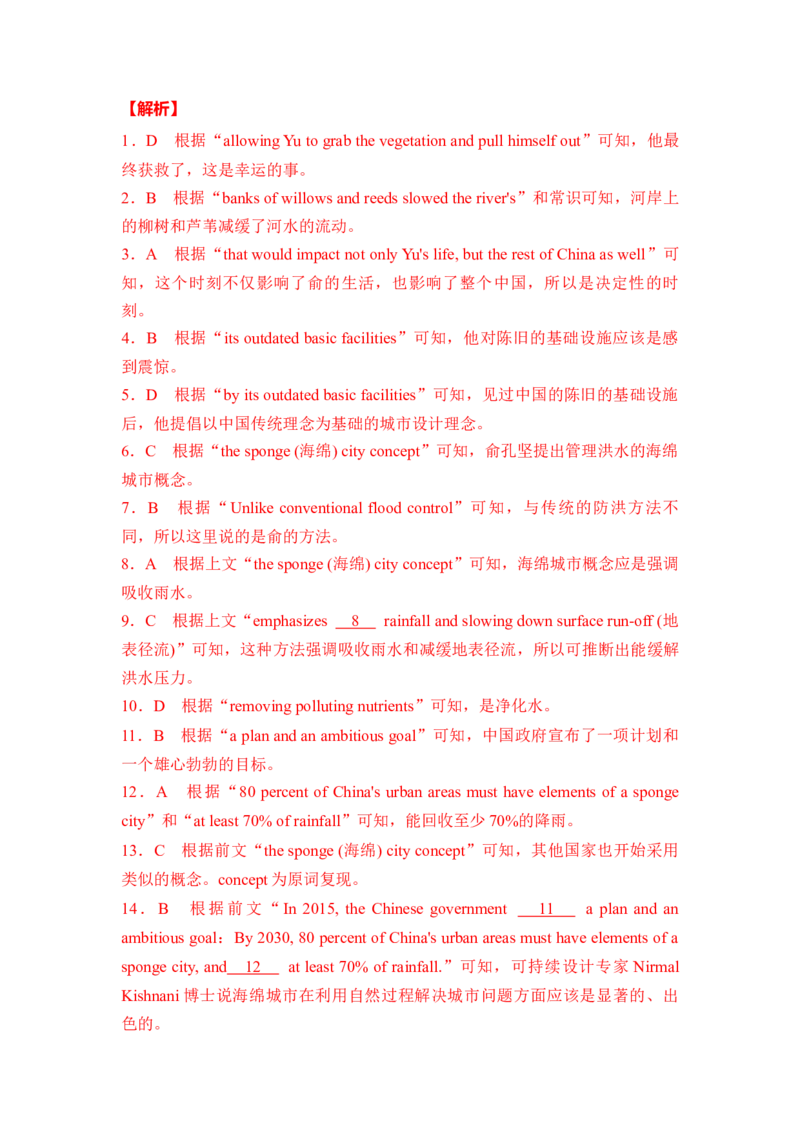
1.D 根据“allowing Yu to grab the vegetation and pull himself out”可知,他最
终获救了,这是幸运的事。
2.B 根据“banks of willows and reeds slowed the river's”和常识可知,河岸上
的柳树和芦苇减缓了河水的流动。
3.A 根据“that would impact not only Yu's life, but the rest of China as well”可
知,这个时刻不仅影响了俞的生活,也影响了整个中国,所以是决定性的时
刻。
4.B 根据“its outdated basic facilities”可知,他对陈旧的基础设施应该是感
到震惊。
5.D 根据“by its outdated basic facilities”可知,见过中国的陈旧的基础设施
后,他提倡以中国传统理念为基础的城市设计理念。
6.C 根据“the sponge (海绵) city concept”可知,俞孔坚提出管理洪水的海绵
城市概念。
7.B 根据“Unlike conventional flood control”可知,与传统的防洪方法不
同,所以这里说的是俞的方法。
8.A 根据上文“the sponge (海绵) city concept”可知,海绵城市概念应是强调
吸收雨水。
9.C 根据上文“emphasizes   8   rainfall and slowing down surface run-off (地
表径流)”可知,这种方法强调吸收雨水和减缓地表径流,所以可推断出能缓解
洪水压力。
10.D 根据“removing polluting nutrients”可知,是净化水。
11.B 根据“a plan and an ambitious goal”可知,中国政府宣布了一项计划和
一个雄心勃勃的目标。
12.A 根据“80 percent of China's urban areas must have elements of a sponge
city”和“at least 70% of rainfall”可知,能回收至少70%的降雨。
13.C 根据前文“the sponge (海绵) city concept”可知,其他国家也开始采用
类似的概念。concept 为原词复现。
14 .B  根据前文“ In 2015, the Chinese government   11   a plan and an
ambitious goal:By 2030, 80 percent of China's urban areas must have elements of a
sponge city, and  12   at least 70% of rainfall.”可知,可持续设计专家Nirmal
Kishnani 博士说海绵城市在利用自然过程解决城市问题方面应该是显著的、出
色的。
15.C 根据上文提到的利用自然过程解决城市问题,可知我们必须认识到自
己是自然的一部分。
B
(2025·甘肃省平凉市一中高三冲刺压轴卷)
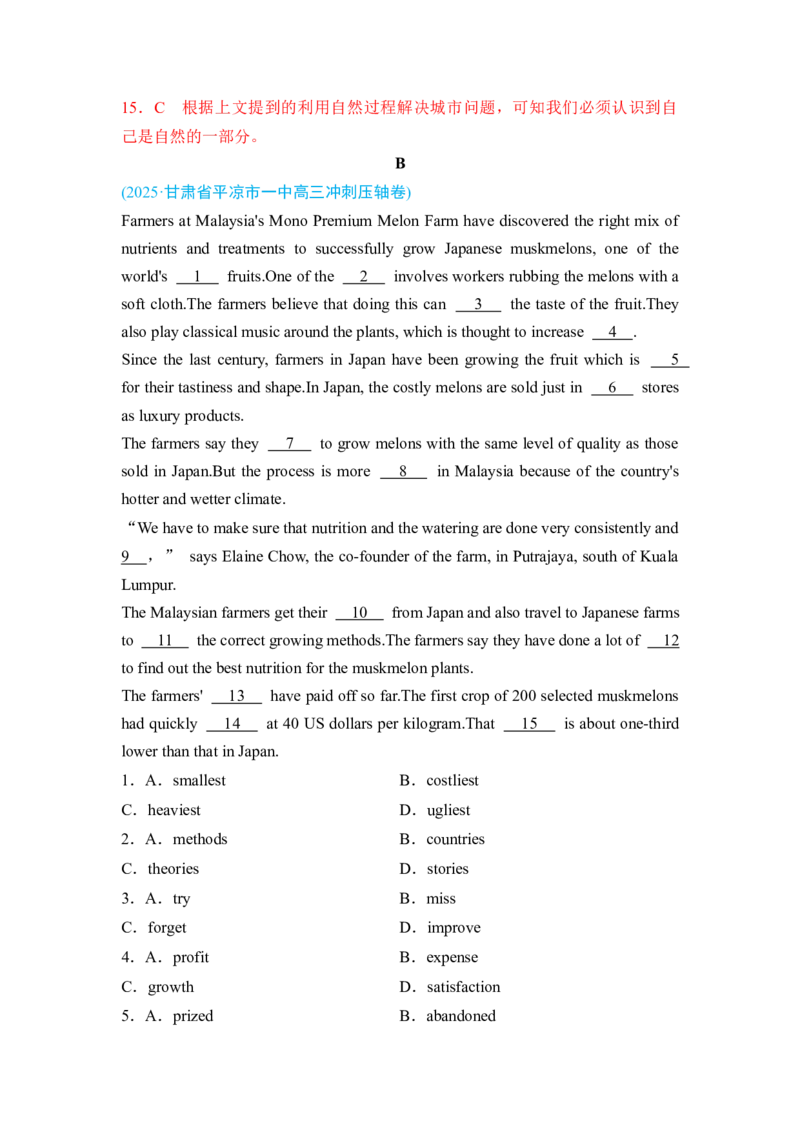
Farmers at Malaysia's Mono Premium Melon Farm have discovered the right mix of
nutrients and treatments to successfully grow Japanese muskmelons, one of the
world's   1   fruits.One of the   2   involves workers rubbing the melons with a
soft cloth.The farmers believe that doing this can   3   the taste of the fruit.They
also play classical music around the plants, which is thought to increase   4  .
Since the last century, farmers in Japan have been growing the fruit which is   5
for their tastiness and shape.In Japan, the costly melons are sold just in   6   stores
as luxury products.
The farmers say they   7   to grow melons with the same level of quality as those
sold in Japan.But the process is more   8   in Malaysia because of the country's
hotter and wetter climate.
“We have to make sure that nutrition and the watering are done very consistently and
9  ,” says Elaine Chow, the co-founder of the farm, in Putrajaya, south of Kuala
Lumpur.
The Malaysian farmers get their   10   from Japan and also travel to Japanese farms
to   11   the correct growing methods.The farmers say they have done a lot of   12
to find out the best nutrition for the muskmelon plants.
The farmers'   13   have paid off so far.The first crop of 200 selected muskmelons
had quickly   14   at 40 US dollars per kilogram.That   15   is about one-third
lower than that in Japan.
1.A.smallest
B.costliest
C.heaviest
D.ugliest
2.A.methods
B.countries
C.theories
D.stories
3.A.try
B.miss
C.forget
D.improve
4.A.profit
B.expense
C.growth
D.satisfaction
5.A.prized
B.abandoned
C.awarded
D.cared
6.A.remote
B.high-end
C.less-known
D.neighboring
7.A.hate
B.stop
C.aim
D.promise
8.A.peaceful
B.convenient
C.natural
D.difficult
9.A.frequently
B.annually
C.precisely
D.similarly
10.A.invitations
B.seeds
C.contracts
D.funds
11.A.popularize
B.check
C.demonstrate
D.learn
12.A.tasks
B.experiments
C.preparations
D.promotions
13.A.efforts
B.kindness
C.generosity
D.experiences
14.A.died out
B.shown up
C.sold out
D.grown up
15.A.weight
B.share
C.demand
D.price
【语篇解读】 本文是一篇说明文。文章主要介绍了马来西亚的Mono Premium
Melon Farm 的农民们找到了合适的养分和培育方法,成功种植出了日本甜瓜。
【解析】
1.B 根据下文“In Japan, the costly melons are sold just in   6   stores as
luxury products.”可知,这种甜瓜在日本作为奢侈品出售,价格昂贵。costliest
意为“最昂贵的”,亦为原词复现。
2 .A  根据上文“ Farmers at Malaysia's Mono Premium Melon Farm have
discovered the right mix of nutrients and treatments”可知,农民们发现了合适的
培育方法,这里是具体说明其中一种方法。
3.D 根据上文“One of the   2   involves workers rubbing the melons with a
soft cloth.”可知,工人们擦拭甜瓜这种行为,结合常理,应该是为了对甜瓜有
好的影响,提高其品质。
4.C 根据“They also play classical music around the plants”可知,播放音乐是
对植物的一种培育措施,从对植物本身的影响来看,应该是促进生长。
5 .A 根据下文“ the costly melons are sold just in   6   stores as luxury
products”可知,这种甜瓜很昂贵且作为奢侈品出售,说明它是被珍视的。
6.B 根据“as luxury products”可知,这种甜瓜是奢侈品,所以应该在高端商
店出售。
7 .C  根据上文“ Farmers at Malaysia's Mono Premium Melon Farm have
discovered the right mix of nutrients and treatments to successfully grow Japanese
muskmelons”可知,他们成功种植出了日本甜瓜,这里进一步说明他们对于种
植甜瓜的目标。
8.D 根据“because of the country's hotter and wetter climate”可知,马来西亚
的气候条件和日本不同,对种植甜瓜不利。
9.C 上文提到种植过程困难,所以对于营养和浇水的控制需要很精准,才能
种出好的甜瓜。
10.B 种植甜瓜首先需要种子,根据“from Japan”以及后文学习种植方法可
知,这里说的是获取种子。
11.D 因为他们要种植出和日本相同质量的甜瓜,所以去日本农场应该是学
习种植方法。
12.B 根据“to find out the best nutrition for the muskmelon plants”可知,要找
出最合适的养分,需要通过做实验来确定。
13.A 根据上文“The Malaysian farmers get their   10   from Japan and also
travel to Japanese farms to   11   the correct growing methods.The farmers say they
have done a lot of   12   to find out the best nutrition for the muskmelon plants.”
可知,上文提到他们采取了各种措施,如获取种子、学习方法、做实验等,这
些都是他们的努力。
14.C 根据上文“have paid off”以及“at 40 US dollars per kilogram”可知,
甜瓜有了好的销售成果,所以应该是售罄了。
15.D 根据上文“at 40 US dollars per kilogram”以及“is about one-third lower
than that in Japan”可知,这里比较的是价格。
C
(2025·河北省博野高三高考信息联考卷)
What price does the planet pay for a pair of jeans ?It's a question that Estonian
designer Reet Aus set off to find a   1  .
“I'm a fashion designer who loves my job,” Aus said.“But I'm   2   that we're
overproducing.” Fast fashion refers to   3  , trendy clothing, and it's the way of an
industry that always has a new collection for each season.
Fast fashion has increased clothing purchases by 400% in 20 years, with many clothes
4   in landfills(填埋场)where they don't decompose.Aus visited Bangladesh to see
the fabric waste and   5   found tons of materials being thrown away without
recycling processes.She also   6   that making one pair of jeans uses 10 cubic
meters of water and   7   chemicals that stay in the final product, affecting both the
environment and human health.
Aus believes consumers have the power to force   8   by demanding quality, long-
lasting clothes that   9   workers and the environment.Due to   10   the
challenge, she decided to make a   11   by upcycling, turning old materials into
new, unique clothing.Her upcycled T-shirt project with a major manufacturer was
successful,   12   90% less water and energy than traditional production.
While upcycled clothing can be more expensive, Aus emphasizes   13   our
possessions and the impact of our consumption.She is   14   to making small
changes in the industry and   15   others to do the same.
1.A.threat
B.secret
C.reply
D.solution
2.A.ashamed
B.curious
C.anxious
D.excited
3.A.handmade
B.cheap
C.traditional
D.costly
4.A.taking up
B.mixing up
C.ending up
D.dressing up
5.A.shockingly
B.occasionally
C.cautiously
D.frequently
6.A.ignored
B.learned
C.predicted
D.questioned
7.A.essential
B.natural
C.common
D.dangerous
8.A.design
B.alarm
C.change
D.intention
9.A.respect
B.affect
C.preserve
D.promote
10.A.overlooking
B.denying
C.avoiding
D.recognizing
11.A.living
B.plan
C.difference
D.profit
12.A.recovering
B.consuming
C.saving
D.protecting
13.A.valuing
B.replacing
C.storing
D.donating
14.A.addicted
B.exposed
C.opposed
D.committed
15.A.encourages
B.orders
C.allows
D.forces
【语篇解读】 本文是一篇说明文。文章通过设计师Reet Aus 的视角,揭示了
快时尚产业对环境造成的巨大负担,并介绍了她通过升级改造旧衣物来减少资
源浪费和环境污染的努力,倡导消费者选择质量高、耐用的衣物,共同推动时
尚产业的可持续发展。
【解析】
1.D 根据上文“What price does the planet pay for a pair of jeans?”及后文
Aus 对快时尚产业环境影响的调查和行动可知,她是在寻找这个问题的解决方
案。
2.C 根据下文“Fast fashion has increased clothing purchases by 400% in 20
years”可知,快时尚产业在20 年内使服装购买量增加了400%,所以Aus 担心
生产过剩。
3.B 根据常识和语境可知,快时尚产业以快速更新、价格低廉为特点。
4.C 根据“in landfills where they don't decompose”可知,许多衣物最终被扔
进了垃圾填埋场。
5 .A  根据“ found tons of materials being thrown away without recycling
processes”可知,Aus 对成吨的材料在没有回收过程的情况下被扔掉感到震
惊。
6.B 根据“that making one pair of jeans uses 10 cubic meters of water”可知,
这是Aus 了解到的事实。
7.D 根据下文“affecting both the environment and human health”可知,化学
品残留在衣物中对环境和人类健康有害,说明这些化学品是危险的。
8.C 根据“by demanding quality, long-lasting clothes”可知,Aus 认为消费者
可以通过要求质量高、耐用的衣物来推动时尚产业的改变。
9.A 根据“workers and the environment”可知,Aus 倡导的是尊重工人和环
境的衣物生产方式。
10.D 根据“the challenge”及上文对快时尚产业环境影响的描述可知,Aus
认识到了这一挑战。
11.C 根据“by upcycling, turning old materials into new, unique clothing”可
知,Aus 通过升级改造旧衣物来做出改变,make a difference 表示“有影响,做
出改变”。
12.B 根据“90% less water and energy than traditional production”可知,升级
改造T 恤项目比传统生产方式消耗的水和能源少了90%。
13.A 根据“our possessions and the impact of our consumption”可知,Aus 强
调要珍惜我们的财物和消费的影响。
14.D 根据“to making small changes in the industry”可知,Aus 致力于在时尚
产业中做出小改变。be committed to 表示“致力于”。addicted 上瘾的;exposed
暴露的;opposed 反对的;committed 尽心尽力的。
15.A 根据“others to do the same”可知,Aus 鼓励其他人也像她一样在时尚
产业中做出改变。
D
(2025·甘肃省平凉市一中高三冲刺压轴卷)
“Life is easy.Why do we make it so   1  ?” This was the question that   2
Jon Jandai to establish Pun Pun Center on nine acres of land outside of Chiang Mai in
2003.
The center is mainly an organic farm.Members of the   3   work on the farm for a
couple of hours a day, cook and eat collectively( 集体), and spend the rest of their
days having fun.Jandai, who   4   eating more than 100 different kinds of plants in
his youth, has even set up a seed bank to   5   the seeds of rare plants from
Thailand and around the world.
“We call ourselves ‘happiness farmers’ and   6   whatever we have had,”
Jandai says.“Although we earn less than Thailand's minimum wage, we are
economically   7   because we spend even less.”
When Jandai was a young adult, he worked as an engineer for seven years in
Bangkok, where he was   8   with long work hours, little pay and a   9
apartment.He returned to the remote village in Northeastern Thailand where he grew
up to   10   the agricultural life he missed.
In a country where more than 50% of the population now lives in cities and farmers
face falling crop prices, rising input costs and   11   debt, Jandai offers a(n)   12
that has attracted more than 10,000 people all over the country.
“It is a life of self-reliance that   13   building earthen homes, learning to farm
native Thai fruits and vegetables, and   14   more than enough food for ourselves in
a few hours of work a day ,” one of the “happiness farmers” tells
reporters.“Now, we have   15   time for post-lunch breaks, monthly festivals, and
self-reflection.”
1.A.short
B.pleasant
C.hard
D.rare
2.A.drove
B.referred
C.allowed
D.recommended
3.A.church
B.community
C.club
D.board
4.A.enjoys
B.avoids
C.keeps
D.remembers
5.A.preserve
B.produce
C.cook
D.hide
6.A.see
B.share
C.lose
D.sell
7.A.competitive
B.dependant
C.secure
D.impossible
8.A.attracted
B.threatened
C.blinded
D.disappointed
9.A.clean
B.luxury
C.crowded
D.destroyed
10.A.recreate
B.investigate
C.support
D.reflect
11.A.little
B.rocketing
C.forgiven
D.foreign
12.A.market
B.award
C.price
D.alternative
13.A.signs up for
B.dreams of
C.consists of
D.contributes to
14.A.buying
B.growing
C.taking
D.donating
15.A.plenty
B.tough
C.busy
D.brief
【语篇解读】 本文是一篇说明文。Jandai 放弃在曼谷的工作回到家乡,建立
了一个有机农场,吸引了很多人加入,这种“幸福农民”的生活方式给人们提
供了一种不同于城市生活的选择,文章介绍了这种生活方式的特点。
【解析】
1.C 根据前文“Life is easy.”可知,作者认为生活很容易,所以提出了“我
们为什么要把它变得这么难呢?”的疑问。
2.A 根据前文“Life is easy.Why do we make it so   1  ?”可知,正是这个
问题促使Jon Jandai 建立了Pun Pun Center。
3.B 根据前文“The center is mainly an organic farm.”及“work on the farm for
a couple of hours a day, cook and eat collectively, and spend the rest of their days
having fun”可知,Pun Pun Center 是一个团体,该团体的成员一起工作、吃
饭、娱乐。
4.D 根据“in his youth”可知,Jandai 年轻时记得吃过100 多种不同的植物。
5.A 根据“has even set up a seed bank”及“the seeds of rare plants from
Thailand and around the world”可知,建立种子库是为了保存种子。
6.B 根据后文“Although we earn less than Thailand's minimum wage, we are
economically   7   because we spend even less.”可知,虽然Jandai 等人收入很
少,但他们很知足,可推断他们分享自己所拥有的一切。
7.C 根据“because we spend even less”可知,因为支出更少,所以经济上是
安全的。
8.D 根据“with long work hours, little pay and a   9   apartment”可知,工
作时间长、工资低和公寓拥挤,这些情况会使人失望。
9.C 根据“he was   8   with long work hours, little pay”可知,工作时间
长、工资低,可推断公寓条件也不会很好,公寓拥挤符合语境。
10.A 根据“He returned to the remote village in Northeastern Thailand where he
grew up”及“the agricultural life he missed”可知,他回到了泰国东北部他长大
的偏远村庄,所以是重新过上了他怀念的农业生活。
11.B 根据“farmers face falling crop prices, rising input costs”可知,农作物价
格下跌、投入成本上升,可推断债务也会飙升。
12.D 根据“that has attracted more than 10,000 people all over the country”可
知,Jandai 提供了一种替代方案,吸引了很多人。
13 .C  根据“ building earthen homes, learning to farm native Thai fruits and
vegetables, and   14   more than enough food for ourselves in a few hours of work
a day”可知,这是对“自给自足的生活”的具体描述,所以设空处要表达
“由……组成”的意思。
14.B 根据“learning to farm native Thai fruits and vegetables”可知,学习种植
泰国本土的水果和蔬菜,所以是每天工作几个小时就能生产出足够多的食物。
15.A 根据前文“more than enough food for ourselves in a few hours of work a
day”可知,每天工作几个小时就能生产出足够多的食物,所以有足够的时间进
行午休、每月的节日和自我反思。