专题一 阅读理解
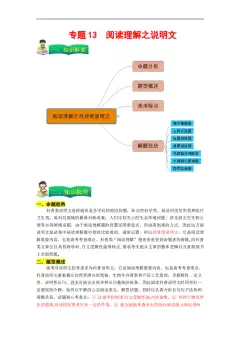
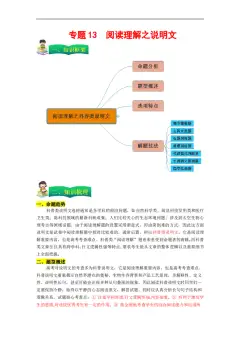
类型二 体裁破解
第3讲 说明文
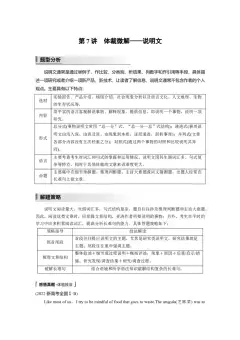
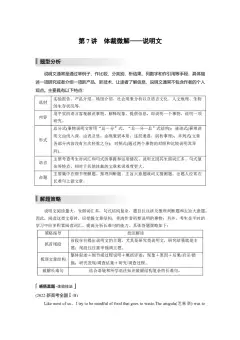
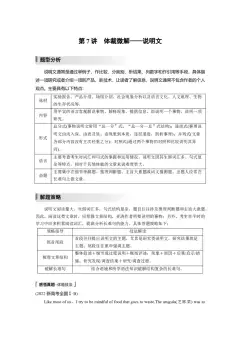
说明文通常运用举例子、作比较、分类别、析结果、列数字和作引用等手
法,描述一项研究或者介绍一项新产品、新技术,以及介绍场馆,分析社会现
象、语言文化、人文地理、生物的生存状况等,用平实的语言客观地说明事
物、解释现象。事物说明文常用“总—分”式或“总—分—总”式结构;事理
说明文采用由浅入深、由表及里、由现象到本质,逐层递进,剖析事理的递进
式结构;文章各部分内容没有主次轻重之分时常用并列式结构;如果需要通过
两个事物的对照和比较来说明其异同时常用对照式结构。说明文通常不包含作
者的个人观点。
【辨明题类】
说明文阅读理解主要考查考生对词汇和句式的掌握和运用情况,阅读量大,生
僻词汇多,句式结构复杂,题目往往涉及推理判断题和主旨大意题。因此,阅
读说明文时,应把握文章结构,弄清作者所要说明的事物;另外,考生在平时
的学习中应多积累阅读词汇,提高分析长难句的能力。
【技法点拨】
1.抓首尾段:首段往往提出文章的主题,尤其是研究类说明文,研究结果就是
主题;尾段往往重申强调主题。
2.细读重点:就原文而言,重点就是文章的基本结构、内容和态度;就答题而
言,重点就是问题所对应的题源句。以这个标准来衡量的话,需要重点阅读的
原文词句就不会很多了。
3.略读或跳读:在快速浏览题干、初步把握文章大意及结构的基础上,可大胆
进行有选择性地略读或跳读,这样不但可以加快阅读速度,还更容易地从总体
上把握全文。在略读过程中,要特别注意对解题有重要意义的词、句、段等,
并将其储存在大脑里,以免回头再查看时费时费力。
(1)繁琐的例证:为了说明问题,作者可能会借用形象的例子,有时候会比较繁
琐,需要花很多时间去阅读。如果例子所说明的问题不明了,可通过详读来理
解;若例子所说明的问题比较明了,则例子部分可一带而过。
(2)多项列举:有时许多功能相同的项目列举,那么只需读其中一两项即可。
(3)生僻词汇:阅读中经常会遇到一些生词,如果这些生词对理解全文没有影响或影响不大就可略过。
(4)较长的人名、地名:有许多较长的表示人名、地名等的专有名词,阅读时可
一扫而过或干脆用其首字母代替。
【真题体验】
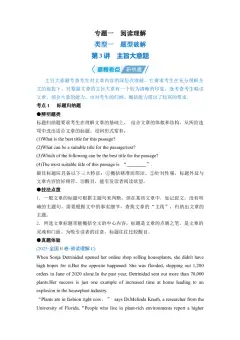
(2025·浙江1月卷·阅读理解D)
As new technologies take on increasingly humanlike qualities, there's been a push to
make them genderless.“People are stereotyping(形成刻板印象) their gendered
objects in very traditional ways , ” says Ashley Martin, a Stanford associate
professor of organizational behavior.Removing gender from the picture altogether
seems like a simple way to fix this.Yet as Martin has found in her work, gender is one
of the fundamental ways people form connections with objects, particularly those
designed with human characteristics.
In her study, Martin asked participants to rate their attachment to male, female, and
genderless versions of a digital voice assistant and a self-driving car known as
“Miuu”.It was found that gender increased users' feelings of attachment to these
devices and their interest in purchasing them.For example, participants said they
would be less likely to buy a genderless voice assistant than versions with male or
female voices.
While gendering a product may be good marketing, it may also strengthen outdated or
harmful ideas about power and identity.The stereotypes commonly associated with
men, such as competitiveness and dominance, are more valued than those associated
with women.These qualities, in turn, are mapped onto products that have been
assigned a gender.
Martin's study also found that creating a genderless object was difficult.For instance,
if an object's name was meant to sound genderless, like Miuu, participants would still
assign a gender to it—they would assume Miuu was a “he” or “she”.
Martin sees a silver lining, however:She believes that anthropomorphism(拟人化)
“provides an opportunity to change stereotypes” . When women are put into
positions of leadership like running companies, it reduces negative stereotypes about
women.Similarly, anthropomorphized products could be created to take on stereotype-
inconsistent roles—a male robot that assists with nursing or a female robot that helps
do calculations, for instance.
32.What is the purpose of making new technologies genderless?A.To reduce stereotypes. B.To meet public demand.
C.To cut production costs. D.To encourage competition.
33.What were the participants probably asked to do in the study?
A.Design a product. B.Respond to a survey.
C.Work as assistants. D.Take a language test.
34.Why is it difficult to create genderless objects?
A.They cannot be mass-produced.
B.Naming them is a challenging task.
C.People assume they are unreliable.
D.Gender is rooted in people's mind.
35.What does the last paragraph mainly talk about?
A.The quality of genderless products.
B.The upside of gendering a product.
C.The meaning of anthropomorphism.
D.The stereotypes of men and women.
【解题示范】 第一步:浏览全文,把握主旨大意:文章讲述了新技术呈现人
类特质时人们试图使其去性别化,但性别是人们与物体建立联系的基本方式,
且创造无性别物体很难,拟人化或能改变刻板印象。
第二步:细审题干,定位原文:
第32小题:根据题干信息new technologies genderless,定位到文章的第一段。
第33小题:根据题干信息 the participants were asked to do,定位到文章的第二
段。
第34小题:根据题干主要信息 difficult和create genderless objects,定位到文章
的第四段。
第35小题:根据题干主要信息last paragraph,定位到文章的最后一段。
第三步:仔细对比选项和原文信息,继而找出答案。
在文中找到信息区间后,再仔细对比各选项,确定答案。
A(2025·内蒙古自治区赤峰市高三一模)
An experimental screening method that paired the dogs with artificial intelligence was
able to detect the smell of cancer carried on patients' breaths.The canine(犬科的)-AI
pair was highly accurate and sensitive, successfully spotting four types of cancer in
94% of cases, according to a report published on November 15 in Scientific Reports.
“The screening worked just as well detecting early stage cancers as it did later stage
cancers,” says Assaf Rabinowicz, chief technology officer at SpotitEarly, the
company that developed the method.“That's crucial because early detection can
substantially contribute to increasing cancer survival rates.” The method employs
dogs' “amazing sense of smell”, Rabinowicz says.Canines can act like disease
detectives, finding faint smells that serve as cancer's smell signature.
For this study, Rabinowicz's team trained Labrador dogs to smell breath samples and
sit if they detected breast, lung, colorectal( 直 肠 的 ) or prostate( 前 列 腺 )
cancer.However, reading dogs' body language can be hard, so the researchers trained
an AI model using machine learning and computer vision to interpret the dogs'
signals.
The team partnered with medical centers in Israel to test their system on breath
samples from nearly 1,400 participants, 261 of whom had tested positive for one of
the four cancer types.With AI, the doggy detectors identified 245 cases with only 60
false positives out of 1,048 negative samples.
SpotitEarly is planning a larger clinical trial in the United States and aims to report
early results in 2026.The company is now working with Beagle dogs for cancer
detection, partly because they're smaller and easier to train.But the Labradors who
worked in the study are still top dogs and continue to contribute to research and
development, Rabinowicz says.
1.Which of the following best describes the screening method?
A.It cures four kinds of cancers.
B.It reduces cancer treatment costs.
C.It removes human involvement in testing.
D.It combines dogs and AI to detect cancer.
2.What is the basis of the screening method, according to Rabinowicz?
A.Cancer's visible signs. B.Dogs' sense of smell.
C.AI's calculating system. D.Patients' medical records.3.What can be inferred about the future of the detection system?
A.It will be widely promoted in 2026.
B.Bigger dogs will join in the research.
C.Further research is required to test the results.
D.It will replace traditional detection methods.
4.Where is this text probably taken from?
A.A dog-raising guide. B.A science magazine.
C.A medical textbook. D.A technology brochure.
B
(2025·河南省安阳市高三一模)
Most of us use too much laundry detergent (洗涤剂), which can present all kinds of
problems.Whatever amount of detergent you use, it must be completely rinsed(漂洗)
away.
There are so many variables.Generally, for a standard-size washing machine in areas
with soft water, use 1 tablespoon of high-efficiency detergent per wash load.If you
have hard water, use 2 tablespoons.
Then there comes the question, “How do I know if my water is hard or soft?”
Call your water company or go to its website to learn about the grains of hardness per
liter in your local water supply.If the water quality is a little bit hard and you want
precise control, use 1.5 tablespoons of high-efficiency detergent per load.
Another important variable is the machine capacity.If it's a super-size machine, you
need to adjust the amount of detergent accordingly.Check the instructions for
guidance.Also, you may need to use more or less detergent if you're running a heavily
soiled load or a very small load.
Above all, the most important thing to consider when it comes to laundry detergent is
whether or not the detergent gets completely rinsed away before that load of laundry
is finished.
The next time you do a load of wash, take a washcloth out of the dryer when it is
finished and put it in a warm dish of water.If the water remains clean, it means you
have not used too much detergent.If the water turns even slightly cloudy, it means all
the detergent has not been removed and you're using too much detergent.
Finding the exact amount of laundry detergent you need based on the hardness of yourwater, the size of your washing machine and the size of the laundry load may take
experimentation.But once you discover what's right for you—and you are getting all
that detergent out of the clothes, too—you're going to be pleasantly surprised by the
fantastic results.
5.How can one know the hardness of water in his area?
A.By counting the grains in the water.
B.By checking the water color.
C.By communicating with neighbors.
D.By consulting the water company.
6.What is the purpose of using a washcloth according to paragraph 6?
A.To see whether the dryer works well.
B.To show how to determine the load properly.
C.To judge whether the laundry detergent is totally rinsed away.
D.To prove water hardness influences how much water is used.
7.What conclusion can be drawn about laundry detergent?
A.The more, the cleaner.
B.More isn't necessarily better.
C.The users have the final say.
D.Quality is more important than quantity.
8.What can be the best title for the text?
A.The Science of Laundry Detergent
B.The Impact of Laundry Detergent on the Environment
C.How to Figure Out the Right Amount of Laundry Detergent
D.What to Take into Consideration When Choosing a Washing Machine
C
(2025·东北三省四市教研联合体高三模拟预测二)
Many of the astronauts going up to space are among the smartest people on the
planet.However, a new NASA study has found a surprising effect of space travel—it
may actually slow down the human brain.
Contrary to what you might expect, researchers discovered that while space travelers
orbit the Earth, they experience some temporary mental slowdowns, includingprocessing information slower and difficulties with attention and memory.
Luckily, the study also finds spending months in space doesn't permanently
scramble( 打 乱 ) an astronaut's cognitive( 认 知 的 ) abilities.Their overall brain
performance remains remarkably resilient(有适应力的).
The study examined 25 professional astronauts who spent an average of six months
aboard the International Space Station.Scientists tracked their cognitive performance
through a series of rigorous(谨慎的) tests designed to measure everything from
processing speed to memory and attention.“We show that there is no evidence of any
significant cognitive impairment or neurodegenerative decline in astronauts spending
six months on the ISS,” explains Dr.Sheena Dev, the study's lead researcher, in a
media release.
So what exactly changed?Think of it like your brain running in “low power
mode”.Astronauts completed tasks just as accurately as they would on Earth, but
they took slightly longer to process information.Processing speed, working memory,
and attention were the most affected cognitive fields—similar to how you might feel
after a stressful day without enough sleep.The most interesting but unusual finding is
how quickly the brain adapts.Some performance changes, like slower attention spans,
were only noticeable early in the mission.Others, like reduced processing speed, took
a bit longer to return to normal after the astronauts returned to Earth.
These insights are more than just scientific curiosity.As humanity looks toward
ambitious missions to the Moon and Mars, understanding how the human brain
responds to extreme environments becomes crucial.This research provides a baseline
for future space explorers, helping mission planners predict and reduce potential
cognitive challenges.
9.How may astronauts perform during space travel?
A.They take longer to respond to the tasks.
B.They complete tasks as quickly as on earth.
C.Their cognitive abilities are damaged heavily.
D.They spend years recovering their physical health.
10.What does the underlined word “impairment” in paragraph 4 probably mean?
A.Improvement. B.Damage.
C.Development. D.Change.
11.What can we learn from the passage?A.Astronauts' cognitive abilities remain stable wherever they are.
B.Astronauts' performance in space is much worse than that on Earth.
C.Astronauts' attention spans were always slower in the space.
D.Astronauts' brain performance can return to normal later.
12.What does the last paragraph mainly about?
A.The later plans for space missions.
B.The development of cognitive study.
C.The significance of the study.
D.The future of space exploration.
D
(2025·河北省沧州市运东五校联考高三二模)
A new study suggests people might like chatbot-produced poems for their simple and
straightforward images, emotions and themes.
In a recent experiment, the researchers tasked OpenAI's ChatGPT with generating
poems in the styles of famous poets, then presented 1,634 participants with ten poems
—five human-written and five chatbot-generated—and assessed how people rated the
poems based on 14 qualities, including rhythm and originality.Interestingly, they
tended to rate the AI-generated poems higher on average, suggesting a preference for
their straightforwardness and clarity.
Why readers seem to prefer AI-generated poetry is not entirely clear, but the
researchers' best guess is that the AI poems may be more appealing because they are
relatively straightforward and simple to comprehend.“Emily Dickinson sometimes
breaks the expected rhyme scheme(韵律) on purpose,” says Brian Porter, a
researcher at the University of Pittsburgh, “But the AI-generated poems in her style
never did that once.” Besides, modern readers don't seem to want to bother
themselves to read deep to think critically.Instead, they prefer texts giving them
instant answers.“When readers say they prefer AI poetry, they would seem to be
showing their frustration when faced with writing that does not yield to their
attention,” he adds.
While the findings raise concerns about AI potentially replacing human artists and
putting them out of work one day, Dorothea Lasky, the only living poet whose
writings were included in the experiments, says it's not necessarily a bad thing thatreaders enjoyed the AI-generated poems.“Poetry will always be necessary ,”
Lasky says, “If they read AI poems and like that poem better than a human-
generated poem, then that, to me, is beautiful.They have a good experience with a
poem, and I don't care who wrote it.I feel there is room for all poets—even robot
poets.”
This study provided a platform for the intersection of technology and creativity,
prompting reflection on the future of poetry and artistic expression.
13.Why did the researchers conduct the experiment?
A.To create a technique. B.To clarify a concept.
C.To detail an example. D.To confirm a finding.
14.What does the example of Emily Dickinson imply?
A.Robots are more complicated than humans.
B.AI meets modern readers' reading preference.
C.Chatbot is trained to write in creative patterns.
D.Classic poetry lacks unique charming features.
15.Which belief does Dorothea Lasky have about poetry?
A.All flowers bloom together.
B.No dish suits all tastes.
C.It's no use crying over spilt milk.
D.Time and tide wait for no man.
16.What can be a suitable title for the text?
A.Will Poets Be Lost in AI Era?
B.ChatGPT:a New Advancement
C.Fake or Real—a Concern about AI
D.ChatGPT or Dickinson, Who Is Better?
【限时训练】 (限时:60分钟)
说明文类
A
(2025·安徽省马鞍山市高三一模)Making fabric from waste potato plants could offer a more sustainable alternative to
pure cotton, as pressure grows on the fashion industry to reduce its environmental
impact.
Potatoes pose a headache for farmers.The tubers(块茎) are harvested and eaten, but
the above-ground plant contains solanine, which is poisonous, so it can't be used for
animal feed.Farmers usually remove this matter before potatoes are harvested.
Now, a UK startup company, Fibe, wants to avoid this waste by extracting(提取)
fibres from potato stems(茎) to make a sustainable fabric.In April, it introduced the
world's first potato thread(线), a mixture of 75 per cent cotton and 25 per cent potato
fibres.
The approach began as a project by a group of design engineering students, including
Gal-Shohet, at Imperial College London.Tasked with designing a sustainable business
concept, the group investigated using waste plants to create a more sustainable
alternative to cotton.The students chose potato plants because they are mass-produced
all over the world, are rich in fibres and their leaves have no other practical use.They
turned their idea into a business after graduating in 2022.
Fibe primarily uses non-biological process to extract the fibres.“Once raw fibres are
extracted, they are cleaned and graded to produce soft balls.The potato fibres are
similar in quality to cotton ,” says Gal-Shohet.However, because the land is
already being used to grow potatoes, potato fibres require 99.7 per cent less water and
produce 82 per cent fewer carbon emissions(排放), as well as needing no additional
land, according to Fibe's internal analysis.
Muhammad Tausif at the University of Leeds, UK, who has worked with Fibe, says
industry demand for sustainable fibres is growing, but the company will need to prove
its potato fibres have the “length, fineness and strength” to compete with
cotton.“For a fibre to be successful and to be made into a product, these are the key
factors,” he says.
1.What do the underlined words “this matter” in paragraph 2 refer to?
A.Pure cotton. B.The poisonous tuber.
C.Animal feed. D.The above-ground plant.
2.What does the author intend to do in paragraph 4?
A.Summarize the previous paragraphs.
B.Add some background information.C.Provide some advice for the students.
D.Introduce a new topic for discussion.
3.What does Fibe's internal analysis highlight about using potato fibres?
A.Its standard requirements.
B.Its environmental advantages.
C.Its technical barriers.
D.Its wide applications.
4.What does Tausif expect of Fibe?
A.It should demonstrate its fibres' competitive qualities.
B.It should secure business partners as soon as possible.
C.It should make a big difference to the fibre industry.
D.It should launch appealing products into the market.
B
(2025·东北三省三校高三二模)
“Is there a wife in a wife cake?” asked He Lixi, a local Cantonese.
“There is no actual wife in a wife cake, as it is just a traditional Hong Kong
pastry(酥皮糕点),” answered Sensechat, a ChatGPT-like product, in fluent
Cantonese.
He was impressed.Sensechat was the first artificial intelligence tool he had
encountered that had a profound understanding of Cantonese language and
culture.Many large language models(LLMs) from the mainland can't recognize
Cantonese accurately.Some Western-developed AI software can listen to Cantonese,
but cannot speak it well.
Created by a Hong Kong company, Sensechat is the world's first Cantonese
LLM.Cantonese pronunciation uses lots of modal particles(语气助词), which usually
go unnoticed by most AI tools, but Sensechat handles them effectively.Sensechat also
handles written form of Cantonese.
Training an LLM takes efforts, said Cao Jianrong, the chair professor at the
Department of Computing at Hong Kong Polytechnic University.It involves pre-
training using extensive data, followed by fine-tuning( 微 调 ) with high-quality
data.Later, more focused human input is needed to adjust the output of the LLM with
local culture, ethics, morals, laws and other rules.However, Cantonese web resources are limited in both quantity and quality.Most texts
come from online forums and social media, and often contain low-quality
language.Collecting clear speech data is also difficult, as many videos have
background noise.
Despite the challenges, there's a growing need for Cantonese-speaking AI.Nearly 120
million people worldwide speak the language, and 85.2 million are native Cantonese
speakers.Without Cantonese AI tools, this population might face challenges using new
technology in the future.
That's why local tech companies like Sensechat are stepping up to create these
tools.The Hong Kong Special Administrative Region government is also working
with local universities to create Cantonese LLMs.
5.What can be learnt about Sensechat?
A.It's the first AI tool in Hong Kong.
B.It has an insight into Cantonese culture.
C.It focuses only on spoken Cantonese.
D.It's designed to promote Cantonese food.
6.What challenge does the training of Sensechat meet?
A.A lack of data. B.Complex moral rules.
C.Limited audience. D.Unclear training process.
7.Why is developing Cantonese-speaking AI important?
A.To explore the future of LLMs.
B.To expand the Cantonese AI market.
C.To promote the Cantonese culture.
D.To meet the need of the Cantonese.
8.What does the text mainly talk about?
A.An impressive breakthrough in AI research.
B.A growing demand for AI language tools.
C.An innovative AI tool for Cantonese language.
D.A challenging case of Cantonese LLM training.
C
(2025·云南省曲靖市高三一模)Based on the manuscripts (手稿) found in Dunhuang, China, Xin Wen's The Kings
Road:Diplomacy and the Remaking of the Silk Road is an account of the
diplomatic missions that took place in eastern Eurasia between 800 CE and 1100 CE.
Rather than focusing on the political aspect of diplomatic relations, Xin Wen
concentrates on the practical aspects of relations in what he calls a “bottom-up
view” of diplomacy.The book is an excellent balance of detailed analysis of primary
sources while also showing the significance of those documents in a broad historical
context.This book shows Dunhuang's strategic importance since it lay at the heart of
the conflicts and trade routes among various states in eastern Eurasia.
This book is divided into three parts, and each part has its own guiding question.In
Part One, the author asks:who became diplomatic travelers?The book then spends
its first three chapters on this question.Chapter One introduces the Dunhuang
manuscript collection.Chapter Two gives an account of the extremely diverse people
who made up diplomatic missions.Chapter Three focuses on the commodities that the
diplomats carried with them, such as food, clothes, texts, animals, and luxury
items.Part Two poses the question:how did they travel?This question is answered
in the next four chapters.Chapter Four looks at the physical conditions of the road,
and Chapter Five deals with the social customs of travelers.Chapter Six explains the
important role of gift-giving in diplomatic exchanges, and Chapter Seven studies the
use of language.In Part Three, the author explores the inquiry regarding the types of
international connections that the travelers created.The next three chapters of the
book, which explore this question, respectively( 分别地 ) look at the economic,
political, and cultural consequences of the network of diplomatic travelers.
The book's overall argument is that, despite the decline of the Tang Dynasty, the Silk
Road continued to function as a mechanism for the exchange of people, goods, and
ideas in eastern Eurasia.This book is a remarkably in-depth analysis of an important
topic that has previously received little attention.As one might expect from such an
academic book, it is written in a very formal and scholarly tone with few maps and
illustrations.It would probably be a difficult book for a reader without some degree of
familiarity with the topic.To the field of Asian Studies, this book is a highly valuable
and insightful new contribution.
9.Where is the text most probably taken from?
A.An introduction to a book.B.A review of ancient manuscripts.
C.A guidebook to diplomatic relations.
D.An essay on the history of the Silk Road.
10.What does Xin Wen center on in The King's Road:Diplomacy and the
Remaking of the Silk Road?
A.The discovery of manuscripts.
B.The political aspect of diplomacy.
C.The practical aspect of diplomatic relations.
D.The conflicts of different states in Eurasia.
11.What is presented in Chapter Ten?
A.Types of commodities that travelers carry.
B.Economic consequences of the network of travelers.
C.Political influences of the diplomatic travelers.
D.Cultural connections that travelers created.
12.What is a feature of The King's Road:Diplomacy and the Remaking of the
Silk Road?
A.It offers a great analysis of an ignored topic.
B.It adopts a down-to-earth writing style.
C.It includes sufficient maps and illustrations.
D.It is intended for someone unfamiliar with the topic.