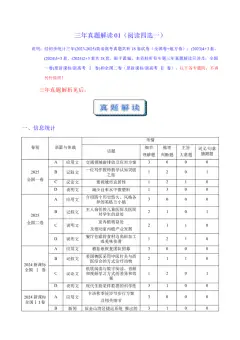
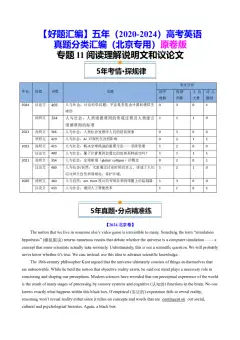
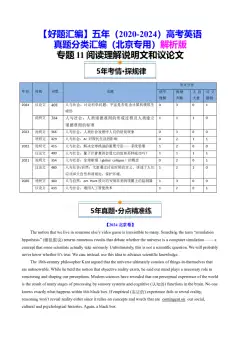
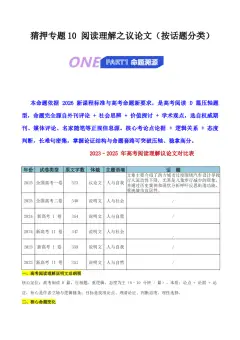
专题12 说明文、议论文(全国通用)

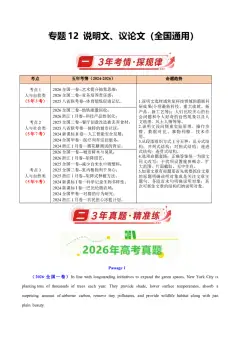
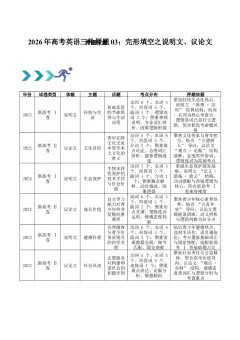
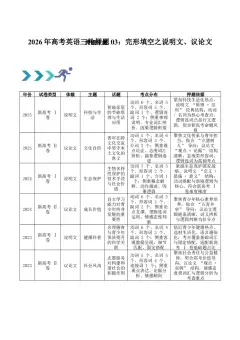
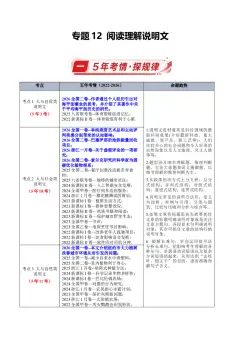
考点分类
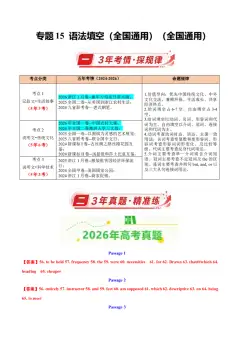
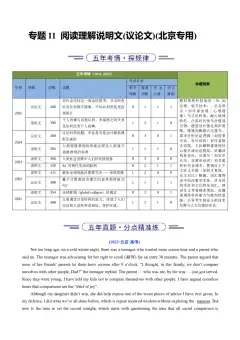
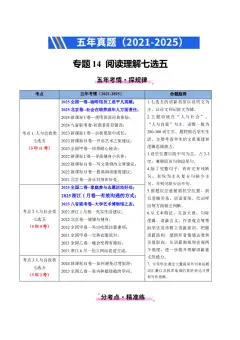
五年考情(2024-2026)
命题趋势
考点1
人与自我类
(5 年3 考)
2026 全国一卷--艺术提升抽象思维;
2026 全国二卷--家务培养责任感;
2025 八省联考卷--体育锻炼促进记忆。
1.说明文选材通常是科技领域的最新科
研成果(介绍最新科技、重大成就、新
产品、新工艺等);人们比较关心的社
会问题和令人好奇的自然现象以及人
文地理、风土人情等等。
2.说明文设问侧重实验原理、操作步
骤、数据对比、事物利弊、技术作
用。
3.从段落组织方式上分五种:总分式结
构;并列式结构;对照式结构;递进
式结构;连贯式结构。
4.选项命题套路:正确答案统一为原文
同义改写;干扰项设置偷换概念、扩
大范围、片面截取、无中生有。
5.如果文章有标题那首先就要抓住文章
的标题明确说明对象或是关注文章主
题句、各段首末句明确说明对象;其
次可抓住文章的结构归纳说明对象。
考点2
人与社会类
(5 年7 考)
2026 全国二卷--地铁能量回收;
2026 浙江1 月卷--科技产品性别化;
2025 全国二卷--餐厅创意改造被丢弃食材;
2025 八省联考卷—独特的城市社区;
2024 新课标II 卷—人工智能安全发展;
2024 全国甲卷—医疗列车巡回服务;
2024 浙江1 月卷—棉花糖测试的背后。
考点3
人与自然类
(5 年9 考)
2026 全国一卷---城市树木与臭氧;
2026 浙江1 月卷--矩阵园艺;
2025 全国一卷--减少自来水中微塑料;
2025 全国二卷--室内植物利于身心;
2025 浙江1 月卷--矩阵式种植方法;
2024 新课标I 卷—科学记录生物多样性;
2024 新课标I 卷—巴比伦微农场;
2024 全国甲卷—对猫的行为研究;
2024 浙江1 月卷—农民担心冰雹计划。
Passage 1
(2026· 全国一卷)In line with longstanding initiatives to expand the green spaces, New York City is
planting tens of thousands of trees each year. They provide shade, lower surface temperatures, absorb a
surprising amount of airborne carbon, remove tiny pollutants, and provide wildlife habitat along with just
plain beauty.
Something could go wrong, though, according to a new study. Oaks and sweetgums, which currently
account for a majority of the city's trees, produce huge amounts of a chemical substance called isoprene.
Harmless by itself, isoprene interacts rapidly with polluting nitrogen oxides released by vehicles, buildings and
industry to form ground- level ozone(臭氧)— a major factor in many breathing problems.
The research, carried out by scientists at the Columbia Climate School and other institutions, found
that if the city maintains past species patterns in new plantings, isoprene production in Manhattan in
coming decades will go up by about 140%, and resulting summer ozone levels as much as 30%.
"We're all for planting more trees. They bring so many good things," said study coauthor Róisín Commane.
"But if we're not careful, we could make air quality worse."
The Parks Department is not oblivious to the issue. A study carried out by some of its researchers several
years ago concluded that city trees did release isoprene. "We didn't make a big deal of that," said Novem
Auyeung, a Parks Department senior scientist. She said trees should not be viewed as the enemy: “We
could plant any trees we want to, if we just rethink our car-centric lifestyle," she said.
"We're not going to go cutting down any big old oaks," and neither will the department completely stop planting
new ones, said Auyeung. "You have to think about what you would lose if you do that." Oaks are keystone
species, she pointed out, providing food and habitat for native insects, birds and other animals.
28. What does the new study imply regarding oaks and sweetgums?
A. They affect the growth of other trees.
 B. They absorb less carbon than expected.
C. They harm people's health indirectly.
D. They raise the local temperature slowly.
29. Which of the following may Commane suggest based on their study?
A. Cutting down the isoprene-producing trees.
B. Suspending tree-planting for a few decades.
C. Changing the species of trees in new plantings.
D. Removing isoprene released by existing trees.
30. What does the underline phase "oblivious to" in paragraph 5 mean?
A. Honest about         B. Unaware of
C. Related to                 D. Optimistic about
31. What would Auyeung probably advocate?
A. Reducing car use in daily life.
B. Providing animals with new habitats.
C. Controlling population growth.
D. Doing more research on the problem.
Passage 2
(2026·全国一卷)A team of Cambridge psychologists conducted an experiment to compare the cognitive (认
知的) effects of merely seeing art with actively judging how beautiful it is.
In the study, 187 people were invited to visit Kettle's Yard gallery during an exhibition of handmade clay
objects. Participants were randomly divided into two groups: the "beauty" group was asked to actively consider and
then rate the beauty of each object they viewed, while the control group just matched a line drawing of
the object with the artwork itself. All participants were then tested on how they process information, and
whether it's in a more practical or abstract way.
Across all participants, those in the beauty group scored almost 14% higher on average than the control
group in abstract thinking. While they were told the study was about cognitive processes, participants
were asked about interests, with around half saying they had an artistic hobby. Among those, the effect
was greater: those with an artistic hobby in the beauty group scored over 25% higher on average for abstract
thinking than those with an artistic hobby in the control group.
Emotional states of participants were also measured by asking about their feelings while completing the
gallery task. Across all participants, those in the beauty group reported an average of 23% higher levels
of "transformative and self-transcendent feelings" — such as feeling moved, enlightened and inspired
— than the control group. Importantly, however, the beauty group did not report feeling any happier than
the control group, suggesting that it was the engagement with beauty that influenced abstract thinking,
rather than any overall positivity from the experience.
"We usually think in very concrete terms when doing something on a screen," said Simone Schnall, senior
author of the study. "It's becoming much rarer to zone out and just let the mind wander, but that's when
we think in ways that broaden our minds. Admiring the beauty of art may be the ideal way to initiate the
abstract cognitive processes."
32. What was the beauty group asked to do with the clay objects?
A. Draw their outlines.
B. Give each piece a rating.
C. Compare their prices.
D. Make a copy of each piece.
33. Which participants got the highest score on average in the test?
A. Beauty group, with an artistic hobby.
B. Beauty group, without an artistic hobby.
C. Control group, with an artistic hobby.
D. Control group, without an artistic hobby.
34. Why were the participants' emotional states measured?
A. To discover their attitudes towards art.
B. To identify their specific thinking patterns.
C. To examine the difficulty of the tasks.
D. To determine factors behind the test results.
35. What is the major finding of the study regarding the appreciation of art?
A. It enhances emotional ties.
B. It needs critical thinking skills.
C. It creates positive feelings.
D. It encourages abstract thinking.
Passage 3
(2026·全国二卷)The peak of Mount Qomolangma, 8,849 meters above sea level. Chimborazo, 6,263 m;
Mont Blanc, 4,806 m; Pradidali hut, at the foot of the Pala group in the Dolomites, 2,278 m. It is common practice
to provide the elevation (高度) of a place. Simple readings are now readily available on our phones and wearables.
But elevation is necessarily relative: only the choice of a reference point allows us to express numerically the
height of an object or a location.
The idea of sea level as a reference point for elevations has by now been around for so long as to go
essentially unnoticed — we mention it without even considering what it means. That the concept has a history is
easily ignored. We tend to forget that sea level is a product of technically and culturally determined assumptions. In
this book I tell a story of these assumptions.
Appropriately, the book took shape during a summer spent between sea and mountains. A month after visiting
the French Riviera and enjoying the sandy beaches of Nice and Menton, I went hiking with friends in the Pala
group. Resting on a pass near the Pradidali hut, we began discussing the readings offered by our altimeters ( 测高
仪). Why did they vary ever so slightly from one instrument to the next? This sense of uncertainty led me to think
about the meaning of zero. This is how I began my search for the conceptual history of sea level.
In this book I examine three crucial stages in the history of mean sea level. These stages mirror the
development of human conceptions of the sea. Since I began thinking about this project in August 2011, the issue
of sea-level rise and the need to place it historically have only become more urgent: between then and the end of
2022 the global sea rose by almost 5 centimeters, about half of the overall rise recorded by satellites since 1993.
28. What does the author point out at the beginning of the text?
A. Some mountains are getting higher.
B. Data on wearables are misleading.
C. The concept of elevation is relative.
D. The reference point is hard to locate.
29. What is paragraph 3 mainly about?
A. How the altimeter was invented.
B. What initiated the author’s research.
C. Why the digital readings varied.
D. Where the author spent his holiday.
30. What does the underlined word “it” refer to in the last paragraph?
A. The book.
B. The project.
C. The issue.
D. The development.
31. What can be the title of the book mentioned in the text?
A. The Altimeter: A Must-Have
B. Sea Level: A History
C. Meaning of Zero: Nothing or Everything
D. Mountains to Seas: Ups and Downs
Passage 4
(2026·全国二卷)The Barcelona subway pulls into the station, the doors slide open and passengers pour out
to go about their daily business. Little do they know that as they do so, a burst of energy is sent up to street level to
help charge an electric car.
Barcelona has put together a package of clean energy technologies to help public transportation go greener,
while also doing its part to tackle climate change and aid Europe’s difficult shift to the privately owned electric
vehicle market.
Sixteen stations of Barcelona’s subway system are part of its new MetroCharge project, whereby the energy
from the underground trains’ brakes ( 刹车) is used to power the trains and the stations themselves, while the
remainder is sent snaking through cables ( 电缆) to the surface to power plug-in stations for privately owned
vehicles.
Bernardo Espinoza, an engineer who takes the subway every day, owns an electric car. “I am pleasantly
surprised, because I am always looking for where to plug it in,” Espinoza said before catching the subway in a
working-class area of southern Barcelona. “And if it is from energy from the trains’ brakes, then even better.”
Regenerative brakes have been in trains for decades and are also used in some cars. They consist of an electric
motor which collects energy used in the braking action that would be lost as heat by conventional brakes. That
energy can be immediately used to accelerate (加速) the vehicle or, in the case of the Barcelona subway system,
sent along cables to supply electricity for the station or for electric car chargers.
Alvaro Luna, a professor of electrical engineering, said that the system is innovative in so far as it allows for
recycled energy to be redirected to specific local uses — in this case powering electric cars parked nearby. That, he
said, boosts efficiency.
32. Why does Barcelona launch the MetroCharge project?
A. To fuel the city’s economy.
B. To enhance passengers’ experience.
C. To promote green transportation.
D. To raise the quality of electric cars.
33. What is Espinoza’s concern?
A. How to cut his travel expenses.
B. Where to get a parking space.
C. How to avoid rush-hour traffic.
D. Where to find a charging point.
34. What aspect of regenerative brakes is discussed in paragraph 5?
A. Their operating conditions.
B. Their conventional standard.
C. Their potential risks.
D. Their working mechanism.
35. What did Luna say about the system?
A. It uses reclaimed energy creatively.
B. It improves workers’ efficiency.
C. It prioritizes the safety of trains.
D. It generates jobs for the locals.
Passage 5
(2026·浙江1 月卷)Human beings have always loved reviews: word of mouth has long been regarded as
one of the most valuable marketing tools available to a company. Consumers enjoy reading and giving reviews.
However, the problem is that a lot of the reviews are fake ( 假的). Shabnam Azimi and Alexander Krasnikov of
Loyola University of Chicago and Kwong Chan of Northeastern University recently published a study on fake
reviews.
The study used a dataset of 1,600 reviews of Chicago hotels. Some of them were real; others were fake. The
reviews were presented to 400 subjects. Each subject got eight reviews to read: a balanced set of two positive fake,
two positive real, two negative fake and two negative real, presented in a random order. The reviews were written
by real people who were given information about the hotel.
The results show that consumers generally trust negative reviews more than positive ones. Moreover, we
humans tend to assume that positive reviews might be fake. “Overall, negative reviews are less common. So, we
pay more attention to them. When a negative review is fake, we get tricked,” Azimi says.
When it came to faking a review, length was important to believability, as was detail. A long, negative review
of a hotel, complete with lots of information, tended to convince participants. A lengthy, positive review, on the
other hand, was regarded as suspicious, and participants tended to trust writers that kept their glowing reviews
short. Emotion was also important in convincing readers — or the lack of emotion, at least. Azimi says study
participants tended not to trust reviews where the writers expressed their feelings in a big way. The more
dispassionate that negative write-up, the more likely it was to take the reader in.
The fake reviews written for Azimi’s study were put together by humans, but increasingly, fake reviews are
being written by AI, which makes them look more real. Though many companies use algorithms ( 算法) to weed
out fake reviews, Azimi points out that the machines are programmed by humans, and given our limited ability to
spot fake reviews, this isn’t a good sign.
28. Which aspect of the study does paragraph 2 mainly talk about?
A. Its design.
B. Its findings.
C. Its purposes.
D. Its significance.
29. What does the underlined word “glowing” in paragraph 4 mean?
A. Funny.
B. Abusive.
C. Insightful.
D. Praising.
30. What kind of review would readers most likely trust?
A. A long, positive one.
B. An unemotional, negative one.
C. A short, negative one.
D. An enthusiastic, positive one.
31. What can be inferred from the last paragraph?
A. Many companies are producing fake reviews.
B. Writing fake reviews will be declared illegal.
C. Machines can detect fake reviews accurately.
D. It will be harder to recognize fake reviews.
Passage 6
(2026·浙江1 月卷)Carbon removal is crucial for fighting climate change. Scientists at Salk Institute are
making use of the natural capacity of plants to absorb carbon dioxide by enhancing their root systems. This
optimization (优化) aims to increase the amount of carbon stored and extend the duration of its storage.
To design these climate-saving plants, the scientists are using a research tool called SLEAP — an AI software
that tracks multiple features of root growth. Created by Salk Fellow Talmo Pereira, SLEAP was initially designed
to track animal movement in the lab. Now, Pereira has teamed up with plant scientist Professor Wolfgang Busch to
apply SLEAP to plants.
In a study published in Plant Phenomics, Busch and Pereira establish a new procedure for using SLEAP to
analyze plant root phenotypes — how deep and wide they grow, how massive their root systems become, and other
physical qualities. Prior to SLEAP, tracking the physical characteristics of both plants and animals required a lot of
labor that slowed the scientific process. SLEAP uses computer vision (the ability for computers to understand
images) and deep learning (an AI approach for training a computer to learn and work like the human brain) to help
researchers process images much more quickly.
The application of SLEAP to plants has already enabled researchers to establish the most extensive catalog (目
录) of plant root phenotypes to date. What’s more, tracking these physical root system characteristics helps
scientists find genes (基因) associated with those characteristics, as well as whether multiple root characteristics
are determined by the same genes or independently. This allows the Salk team to determine what genes are most
beneficial to their plant designs.
“Our cooperation is truly proof of what makes Salk science so special and impactful,” says Pereira. “We’re not
just ‘borrowing’ from different disciplines — we’re really putting them on equal footing in order to create
something greater than the sum of its parts.”
32. What do the scientists at Salk Institute hope to achieve?
A. Keeping more carbon in plants.
B. Optimizing the use of energy.
C. Enhancing biological diversity.
D. Reducing carbon absorption.
33. Why did Pereira create SLEAP?
A. To generate plant images.
B. To conduct research on animals.
C. To study climate patterns.
D. To track features of root growth.
34. What will SLEAP help the scientists do?
A. Pick out diseased plants in the forest.
B. Collect samples of plant root systems.
C. Identify genes for desirable plant roots.
D. Preserve the genes of endangered plants.
35. What can be inferred from Pereira’s words?
A. Academic disciplines are of equal importance.
B. Computer programming is a must for scientists.
C. Interdisciplinary approach promotes creativity.
D. Cooperation outweighs competition in research.
Passage 1
(2025·全国一卷)While safety improvements might have been made to our streets in recent years, transport
studies also show declines in pedestrian ( 行人) mobility, especially among young children. Many parents say
there’s too much traffic on the roads for their children to walk safely to school, so they pack them into the car
instead.
Dutch authors Thalia Verkade and Marco te Brömmelstroet are bothered by facts like these. In their new book
Movement: How to Take Back Our Streets and Transform Our Lives, they call for a rethink of our streets and the
role they play in our lives.
Life on city streets started to change decades ago. Whole neighbourhoods were destroyed to make way for
new road networks and kids had to play elsewhere. Some communities fought back. Most famously, a Canadian
journalist who had moved her family to Manhattan in the early 1950s led a campaign to stop the destruction of her
local park. Describing her alarm at its proposed replacement with an expressway, Jane Jacobs called on her mayor
(市长) to champion “New York as a decent place to live, and not just rush through.” Similar campaigns occurred in
Australia in the late 1960s and 1970s as well.
Although these campaigns were widespread, the reality is that the majority of the western cities were
completely redesigned around the needs of the motor car. The number of cars on roads has been increasing rapidly.
In Australia we now have over twenty million cars for just over twenty-six million people, among the highest rate
of car ownership in the world.
We invest a lot in roads that help us rush through, but we fail to account for the true costs. Do we really
recognise what it costs us as a society when children can’t move safely around our communities? The authors of
Movement have it right: it’s time to think differently about that street outside your front door.
25. What phenomenon does the author point out in paragraph 1?
A. Cars often get stuck on the road.
B. Traffic accidents occur frequently.
C. People walk less and drive more.
D. Pedestrians fail to follow the rules.
26. What were the Canadian journalist and other campaigners trying to do?
A. Keep their cities livable.
B. Promote cultural diversity.
C. Help the needy families.
D. Make expressways accessible.
27. What can be inferred about the campaigns in Australia in the late 1960s and 1970s?
A. They boosted the sales of cars.
B. They turned out largely ineffective.
C. They won government support.
D. They advocated building new parks.
28. What can be a suitable title for the text?
A. Why the Rush?
B. What’s Next?
C. Where to Stay?
D. Who to Blame?
Passage 2
(2025·全国一卷)Microplastics have become a common source of pollution across the Earth — they have
settled in the deep sea and on the Himalayas, stuck inside volcanic rocks, filled the stomachs of seabirds and even
fallen in fresh Antarctic snow. They are even appearing inside humans.
Now, new research suggests that a simple, cheap measure may significantly reduce the level of microplastics
in water from your tap (水龙头): boiling and filtering (过滤) it. In a study published Wednesday in Environmental
Science & Technology Letters, researchers from China found that boiling tap water for just five minutes — then
filtering it after it cools — could remove at least 80 percent of its microplastics.
Crucially, this process relies on the water containing enough calcium carbonate (碳酸钙) to trap the plastics.
In the study, boiling hard water containing 300 milligrams of calcium carbonate led to an almost 90 percent drop in
plastics. But in samples with less than 60 milligrams of calcium carbonate, boiling reduced the level of plastics by
just 25 percent. Additionally, the research didn’t include all types of plastics. The team focused only on three
common types — polystyrene, polyethylene and polypropylene — and they didn’t study other chemicals
previously found in water such as vinyl chloride.
Still, the findings show a potential path forward for reducing microplastic exposure — a task that’s becoming
increasingly difficult. Even bottled water, scientists found earlier this year, contains 10 to 1,000 times more
microplastics than originally thought.
Scientists are still trying to determine how harmful microplastics are — but what they do know has raised
concerns. The new study suggests boiling tap water could be a tool to limit intake. “The way they demonstrated
how microplastics were trapped through the boiling process was nice,” Caroline Gauchotte-Lindsay, an
environmental engineer of the University of Glasgow in Scotland who was not involved in the research, tells New
Scientist. “We should be looking into upgrading drinking water treatment plants so they remove microplastics.”
28. How does the author present the issue in the first paragraph?
A. By quoting an expert.
B. By defining a concept.
C. By giving examples.
D. By providing statistics.
29. What determines the effectiveness of trapping microplastics in water?
A. The hardness of water.
B. The length of cooling time.
C. The frequency of filtering.
D. The type of plastic in water.
30. What does the author try to illustrate by mentioning bottled water in paragraph 4?
A. The importance of plastic recycling.
B. The severity of the microplastic problem.
C. The danger in overusing pure water.
D. The difficulty in treating polluted water.
31. What is Gauchotte-Lindsay’s suggestion about?
A. Choice of new research methods.
B. Possible direction for further study.
C. Need to involve more researchers.
D. Potential application of the findings.
Passage 3
(2025·全国二卷)When Sonja Detrinidad opened her online shop selling houseplants, she didn’t have high
hopes for it. But the opposite happened: She was flooded, shipping out 1,200 orders in June of 2020 alone. In the
past year, Detrinidad sent out more than 70,000 plants. Her success is just one example of increased time at home
leading to an explosion in the houseplant industry.
“Plants are in fashion right now,” says Dr. Melinda Knuth, a researcher from the University of Florida.
“People who live in plant-rich environments report a higher life satisfaction rating, ” she says. “Adding more nature
to our environment can change our mood and how we think.” Plants can improve our state of mind in a few ways
but the biggest is by decreasing our level of cortisol, the stress hormone (激素) in our body.
“Students who are around plants perform better academically than students who are in a classroom without
plants,” says Knuth. “This productivity also translates into the workplace for adults. Our study showed that there
was a 30% decrease in sick leave for people who were in plant-rich workplaces.”
If you’re among the groups of people who are enjoying the mental and physical health benefits of surrounding
yourself with plants, don’t beat yourself up if one (or a few!) doesn’t make it. “Doctors practice medicine and
lawyers practice law and you should allow yourself the practice it takes to sustain a plant. Tending to plants is an
exercise in patience and learning. Be invested in taking care of it, but if it dies, go get another one,” Detrinidad
says.
28. How was Detrinidad’s business when it started?
A. It faced tough competition.
B. It suffered a great loss.
C. It got lots of financial support.
D. It went surprisingly well.
29. What is one of Knuth’s findings about plants?
A. They appeal more to students.
B. They purify the environment.
C. They raise the cortisol level.
D. They enhance productivity.
30. What does Detrinidad try to explain by mentioning doctors and lawyers?
A. The necessity of social skills.
B. The meaning of sustainability.
C. The importance of repeated efforts.
D. The value of professional opinions.
31. What can be a suitable title for the text?
A. Time to Replace Houseplants
B. Plants Boost Your Mood
C. Tips on Choosing Houseplants
D. Plants Brighten Your Home
Passage 4
(2025·全国二卷)Does your soul die a little every time you throw away unused food? Mine does. Maybe
that feeling comes from growing up in South Africa, where the phrase “there are children starving in Africa” was
more of an uncomfortable reminder of fact than a prayer at dinner time.
Food waste is a growing concern in the restaurant, supermarket, and supply chain industries. From
technological solutions to educational campaigns, food producers and sellers are looking for ways to use more of
what we’re already growing. But last month, one popular New York City restaurant tried a different way: It
changed its menu to exclusively (专门) offer food that would otherwise be thrown away.
For two weeks in March, Greenwich Village’s Blue Hill restaurant was renamed wastED, and served items
like fried skate cartilage, a juice pulp burger, and a dumpster diver’s vegetable salad. Each dish was tailor-made to
raise awareness regarding food waste.
A study by the Food Waste Alliance determined that the average restaurant generates 33 pounds of food waste
for every $1,000 in revenue (收入), and of that waste only 15.7% is donated or recycled. Up to 84.3% is simply
thrown out. Restaurants like Silo in the UK have experimented with zero-waste systems, but wastED took the
concept to its logical conclusion.
It should be noted that none of the items on wastED’s menu was technically made from garbage. Instead, all
the ingredients (配料) used were examples of meat cuts and produce that most restaurants would never consider
serving. Things like kale ribs, fish collars, rejected sweet potatoes, and cucumber butts were all re-appropriated
and, with the help of a number of good chefs, turned into excellent cuisine.
Though wastED received enthusiastic reviews, it was designed from the start as a short-lived experiment; Blue
Hill has since returned to its regular menu. Nevertheless, it serves as a reminder that there are many ways to
address problems of sustainability, and that you can make an amazing meal out of almost anything.
32. What can be inferred about the author’s early life?
A. He witnessed food shortage.
B. He enjoyed the local cuisine.
C. He donated food to Africans.
D. He helped to cook at home.
33. Why did Blue Hill carry out the experiment?
A. To customize dishes for guests.
B. To make the public aware of food waste.
C. To test a food processing method.
D. To improve the UK’s zero-waste systems.
34. What is paragraph 5 mainly about?
A. Why the ingredients were used.
B. Which dishes were best liked.
C. What the dishes were made of.
D. Where the ingredients were bought.
35. What can we learn about wastED?
A. It has ended as planned.
B. It is creating new jobs.
C. It has regained popularity.
D. It is criticized by top chefs.
Passage 5
(2025·浙江1 月卷)A novel design approach to gardening has been gaining in popularity worldwide.
Referred to as matrix planting, this approach aims for nature to do a lot more of the heavy lifting in the garden, and
even some of the designing. Eschewing fertilizers (化肥) and power tools, it’s based on an elegantly simple
principle: to garden more like nature does.
The concept was born when German city planners sought to plant large areas of parkland after World War II in
a reproducible way that would need minimal maintenance. Planners created planting mixes that could be used
modularly (模块化). In a matrix garden, plants with similar cultural needs are grouped so that they will grow
together above and below ground, forming a cooperative ecosystem that conserves water and discourages weeds.
Dutch plantsman and designer Piet Oudolf’s gardens popularized this style, adding artistic flavors to the
planting mixes while playing with color and form, including four-season interest and serving the needs of wildlife.
Beautiful year-round, they invite you to enjoy the smallest detail, from the sound of grasses in the gentle wind to
the sculpture of odd-looking seed heads.
It takes a lot of thought to look this natural. While matrix gardens appear wild, they are carefully planned, with
cultural needs the first consideration. Led by the concept of “right plant, right place,” they match plants that enjoy
the same soil, sun and weather conditions, and arrange them according to their patterns of growth.
The benefits are substantial for both gardener and planet. With human inputs dramatically reduced, the
garden’s ecology can develop well. Established matrix gardens should not need the life support we give most
gardens: fertilizer, dividing, regular watering. Compared to traditional garden plots, they increase carbon
absorption, reduce stormwater runoff and boost habitat and biodiversity significantly.
28. What does the underlined word “Eschewing” in the first paragraph mean?
A. Running out of.
B. Keeping away from.
C. Putting up with.
D. Taking advantage of.
29. Why was the idea of matrix planting introduced?
A. To control weeds in large gardens.
B. To bring in foreign species of plants.
C. To conserve soil and water resources.
D. To develop low-maintenance parkland.
30. Which of the following best describes Piet Oudolf’s gardens?
A. Traditional.
B. Odd-looking.
C. Tasteful.
D. Well-protected.
31. Which of the following can be a suitable title for the text?
A. The future of gardening is WILD.
B. Nature treats all lives as EQUALS.
C. Matrix gardens need more CARE.
D. Old garden plots work WONDERS.
Passage 6
(2025·浙江1 月卷)As new technologies take on increasingly humanlike qualities, there’s been a push to
make them genderless. “People are stereotyping (形成刻板印象) their gendered objects in very traditional ways,”
says Ashley Martin, a Stanford associate professor of organizational behavior. Removing gender from the picture
altogether seems like a simple way to fix this. Yet as Martin has found in her work, gender is one of the
fundamental ways people form connections with objects, particularly those designed with human characteristics.
In her study, Martin asked participants to rate their attachment to male, female, and genderless versions of a
digital voice assistant and a self-driving car known as “Miuu.” It was found that gender increased users’ feelings of
attachment to these devices and their interest in purchasing them. For example, participants said they would be less
likely to buy a genderless voice assistant than versions with male or female voices.
While gendering a product may be good marketing, it may also strengthen outdated or harmful ideas about
power and identity. The stereotypes commonly associated with men, such as competitiveness and dominance, are
more valued than those associated with women. These qualities, in turn, are mapped onto products that have been
assigned a gender.
Martin’s study also found that creating a genderless object was difficult. For instance, if an object’s name was
meant to sound genderless, like Miuu, participants would still assign a gender to it — they would assume Miuu was
a “he” or “she.”
Martin sees a silver lining, however: She believes that anthropomorphism (拟人化) “provides an opportunity
to change stereotypes.” When women are put into positions of leadership like running companies, it reduces
negative stereotypes about women. Similarly, anthropomorphized products could be created to take on stereotype-
inconsistent roles — a male robot that assists with nursing or a female robot that helps do calculations, for instance.
32. What is the purpose of making new technologies genderless?
A. To reduce stereotypes.
B. To meet public demand.
C. To cut production costs.
D. To encourage competition.
33. What were the participants probably asked to do in the study?
A. Design a product.
B. Respond to a survey.
C. Work as assistants.
D. Take a language test.
34. Why is it difficult to create genderless objects?
A. They cannot be mass-produced.
B. Naming them is a challenging task.
C. People assume they are unreliable.
D. Gender is rooted in people’s mind.
35. What does the last paragraph mainly talk about?
A. The quality of genderless products.
B. The upside of gendering a product.
C. The meaning of anthropomorphism.
D. The stereotypes of men and women.
Passage 7
(2025·北京卷)Not too long ago, on a cold winter night, there was a teenager who wanted more screen time
and a parent who said no. The teenager was advocating for her right to scroll ( 翻屏) for an extra 30 minutes. The
parent argued that none of her friends’ parents let them have screens after 9 o’clock. “I thought, in this family, we
don’t compare ourselves with other people, Dad?” the teenager replied. The parent — who was me, by the way —
just got served. Since they were young, I have told my kids not to compare themselves with other people. I have
argued countless times that comparisons are the “thief of joy”.
Although my daughter didn’t win, she did help expose one of the worst pieces of advice I have ever given. In
my defence, I did what we’ve all done before, which is repeat received wisdom without exploring the nuances. But
now is the time to set the record straight, which starts with questioning the idea that all social comparison is
unhealthy.
Social comparisons do, of course, often get us into emotional trouble. But they can be harnessed ( 利用) for
our betterment if we understand how they work. The social comparisons we make — ones that lead us to feel good
or bad about ourselves — are vital to our ability to thrive (成长). Science provides a guide we can use to harness
the way we perform these comparisons to reduce their negative emotional impacts.
Comparing yourself with someone who is outperforming you could result in feelings of envy if you focus on
the things they have and you don’t, or it can be energizing and inspiring if you use these comparisons as a source of
motivation, for example, “If they can achieve that, so can I.” Comparing yourself with someone who is doing worse
than you could result in fear and worry if you think about how you could fall into similar circumstances, or it can
draw out feelings of gratitude and appreciation if you use that comparison to broaden your views — for example,
“Wow, things could be much worse; I’m doing great.”
What I wish I taught my daughter earlier are these nuances. How we feel about ourselves rests not just on
whom we compare ourselves with but also on how we think about that comparison. That’s something we all have
control over.
28. How did the author feel about his daughter’s argument?
A. Excited.
B. Inspired.
C. Energized.
D. Relieved.
29. What does the word “nuances” underlined in Paragraph 2 most probably mean?
A. Major achievements.
B. Complex feelings.
C. Significant impacts.
D. Fine differences.
30. Which would be the best title for the passage?
A. Comparing Ourselves with Others Can Become a Healthy Habit
B. Comparing Ourselves with Others Can Strengthen Family Ties
C. Social Comparisons Can Get Us into Emotional Trouble
D. Social Comparisons Can Be Controlled by Science
Passage 8
(2025·北京卷)The call to “know yourself” has been there since ancient times, but our sense of self doesn’t
always match what others perceive. Considering the stories we tell about ourselves can help us to change our minds
for better.
For many years psychologists saw identity as a combination of someone’s values, beliefs, goals and social
roles. Then, in the 1980s, Bob Johnson created the life story model of identity, in which he proposes that, as we go
through life, these core features are built in with our memories to create a personal story through which we
understand our lives.
Our life story is something that starts coming together in our teenage years, when we begin to organise our
lives into chapters around key events or life changes, and begin to see ourselves as both the central character and, to
a varying extent, the story’s author. People with more consistent stories tend to have a stronger sense of identity,
and they feel their life has more meaning, direction and sense of purpose. Such people show greater overall life
satisfaction, too.
Johnson has also investigated the link between well-being and certain story themes. He discovered that
whether someone describes having had some control over events in their past is an important predictor of a person’s
mental health. Another key theme involves finding some kind of positive meaning after stressful events. “People
could talk about gaining knowledge or personal growth,” says Johnson. His research shows that this is often
missing for people with mental health conditions. The good news is that there is evidence we can learn to change
our own story.
Lisa Green, another researcher, sounds a few notes of caution (谨慎). For instance, hearing about the power of
redemptive (拯救性的) stories, many people may feel forced to find a positive angle on horrible events. She says
that Western culture already pushes people to look for the silver lining behind every cloud.
If you want to turn over a new leaf, though, one top tip is that it helps to choose a significant date that signals
the start of a new “chapter”. Contrary to popular doubt, resolutions made on I January are more effective for this
reason. So, whether your goal is saving money or getting fit, there is no better time to become the author of our
own destiny (命运).
31. What can be inferred about personal stories?
A. They are unrelated to health.
B. Consistent ones lead to stress.
C They are relevant to happiness.
D. Thematic ones hold back change.
32. What can we learn from this passage?
A. Talking about gains from failure is negative.
B. New Year resolutions are well received.
C. The West tends to overvalue optimism.
D. Social roles fail to be highlighted.
33. What does the author mainly do in this passage?
A. Clarify a goal.
B. Analyse an event.
C. Make a comparison.
D. Illustrate an approach.
34. What is the passage mainly about?
A. How self-identity works.
B. How story-tellers are made.
C. How personal stories raise doubts.
D. How timing affects personal identity.

Passage 1
(2024·新课标I 卷)In the race to document the species on Earth before they go extinct, researchers and
citizen scientists have collected billions of records. Today, most records of biodiversity are often in the form of
photos, videos, and other digital records. Though they are useful for detecting shifts in the number and variety of
species in an area, a new Stanford study has found that this type of record is not perfect.
 “With the rise of technology it is easy for people to make observations of different species with the aid of a
mobile application,” said Barnabas Daru, who is lead author of the study and assistant professor of biology in the
Stanford School of Humanities and Sciences. “These observations now outnumber the primary data that comes
from physical specimens (标本), and since we are increasingly using observational data to investigate how species
are responding to global change, I wanted to know: Are they usable?”
Using a global dataset of 1.9 billion records of plants, insects, birds, and animals, Daru and his team tested
how well these data represent actual global biodiversity patterns.
“We were particularly interested in exploring the aspects of sampling that tend to bias ( 使有偏差) data, like
the greater likelihood of a citizen scientist to take a picture of a flowering plant instead of the grass right next to it,”
said Daru.
Their study revealed that the large number of observation-only records did not lead to better global coverage.
Moreover, these data are biased and favor certain regions, time periods, and species. This makes sense because the
people who get observational biodiversity data on mobile devices are often citizen scientists recording their
encounters with species in areas nearby. These data are also biased toward certain species with attractive or eye-
catching features.
What can we do with the imperfect datasets of biodiversity?
“Quite a lot,” Daru explained. “Biodiversity apps can use our study results to inform users of oversampled
areas and lead them to places — and even species — that are not well-sampled. To improve the quality of
observational data, biodiversity apps can also encourage users to have an expert confirm the identification of their
uploaded image.”
32. What do we know about the records of species collected now?
A. They are becoming outdated.
B. They are mostly in electronic form.
C. They are limited in number.
D. They are used for public exhibition.
33. What does Daru’s study focus on?
A. Threatened species.
B. Physical specimens.
C. Observational data.
D. Mobile applications.
34. What has led to the biases according to the study?
A. Mistakes in data analysis.
B. Poor quality of uploaded pictures.
C. Improper way of sampling.
D. Unreliable data collection devices.
35. What is Daru’s suggestion for biodiversity apps?
A. Review data from certain areas.
B. Hire experts to check the records.
C. Confirm the identity of the users.
D. Give guidance to citizen scientists.
Passage 2
(2024·新课标II 卷)We all know fresh is best when it comes to food. However, most produce at the store
went through weeks of travel and covered hundreds of miles before reaching the table. While farmer’s markets are
a solid choice to reduce the journey, Babylon Micro-Farm (BMF) shortens it even more.
BMF is an indoor garden system. It can be set up for a family. Additionally, it could serve a larger audience
such as a hospital, restaurant or school. The innovative design requires little effort to achieve a reliable weekly
supply of fresh greens.
Specifically, it’s a farm that relies on new technology. By connecting through the Cloud, BMF is remotely
monitored. Also, there is a convenient app that provides growing data in real time. Because the system is
automated, it significantly reduces the amount of water needed to grow plants. Rather than watering rows of soil,
the system provides just the right amount to each plant. After harvest, users simply replace the plants with a new
pre-seeded pod (容器) to get the next growth cycle started.
Moreover, having a system in the same building where it’s eaten means zero emissions ( 排放) from
transporting plants from soil to salad. In addition, there’s no need for pesticides and other chemicals that pollute
traditional farms and the surrounding environment.
BMF employees live out sustainability in their everyday lives. About half of them walk or bike to work. Inside
the office, they encourage recycling and waste reduction by limiting garbage cans and avoiding single-use plastic.
“We are passionate about reducing waste, carbon and chemicals in our environment,” said a BMF employee.
28. What can be learned about BMF from paragraph 1?
A. It guarantees the variety of food.
B. It requires day-to-day care.
C. It cuts the farm-to-table distance.
D. It relies on farmer’s markets.
29. What information does the convenient app offer?
A. Real-time weather changes.
B. Current condition of the plants.
C. Chemical pollutants in the soil.
D. Availability of pre-seeded pods.
30. What can be concluded about BMF employees?
A. They have a great passion for sports.
B. They are devoted to community service.
C. They are fond of sharing daily experiences.
D They have a strong environmental awareness.
31. What does the text mainly talk about?
A. BMF’s major strengths.
B. BMF’s general management.
C. BMF’s global influence.
D. BMF’s technical standards.
Passage 3
(2024·新课标II 卷)Given the astonishing potential of AI to transform our lives, we all need to take action
to deal with our AI-powered future, and this is where AI by Design: A Plan for Living with Artificial Intelligence
comes in. This absorbing new book by Catriona Campbell is a practical roadmap addressing the challenges posed
by the forthcoming AI revolution (变革).
In the wrong hands, such a book could prove as complicated to process as the computer code ( 代码) that
powers AI but, thankfully, Campbell has more than two decades’ professional experience translating the heady into
the understandable. She writes from the practical angle of a business person rather than as an academic, making for
a guide which is highly accessible and informative and which, by the close, will make you feel almost as smart as
AI.
As we soon come to learn from AI by Design, AI is already super-smart and will become more capable,
moving from the current generation of “narrow-AI” to Artificial General Intelligence. From there, Campbell says,
will come Artificial Dominant Intelligence. This is why Campbell has set out to raise awareness of AI and its future
now-several decades before these developments are expected to take place. She says it is essential that we keep
control of artificial intelligence, or risk being sidelined and perhaps even worse.
Campbell’s point is to wake up those responsible for AI-the technology companies and world leaders-so they
are on the same page as all the experts currently developing it. She explains we are at a “tipping point” in history
and must act now to prevent an extinction-level event for humanity. We need to consider how we want our future
with Al to pan out. Such structured thinking, followed by global regulation, will enable us to achieve greatness
rather than our downfall.
AI will affect us all, and if you only read one book on the subject, this is it.
32. What does the phrase “In the wrong hands” in paragraph 2 probably mean?
A. If read by someone poorly educated.
B. If reviewed by someone ill-intentioned.
C. If written by someone less competent.
D. If translated by someone unacademic.
33. What is a feature of AI by Design according to the text?
A. It is packed with complex codes.
B. It adopts a down-to-earth writing style.
C. It provides step-by-step instructions.
D. It is intended for AI professionals.
34. What does Campbell urge people to do regarding AI development?
A. Observe existing regulations on it.
B. Reconsider expert opinions about it.
C. Make joint efforts to keep it under control.
D. Learn from prior experience to slow it down.
35. What is the author’s purpose in writing the text?
A. To recommend a book on AI.
B. To give a brief account of AI history.
C. To clarify the definition of AI.
D. To honor an outstanding AI expert.
Passage 4
(2024·全国甲卷)Animals can express their needs using a lot of ways. For instance, almost all animals have
distinct vocals (声音) that they rely on to either ask for help,  scare away any dangerous animals or look for shelter.
But cats are special creatures who possess amazing vocalization skills. They are able to have entire conversations
with humans using meows and you're able to interpret it. If a pet cat is hungry, it will keep meowing to attract
attention and find food. However, when a cat is looking for affection, they tend to produce stretched and soft
meows. Meowing starts as soon as a baby cat is brought to life and uses it to get the mother's attention and be fed.
Cats have many heightened senses, but their sense of smell is quite impressive. They use their noses to assess
their environment and look out for any signs of danger. They will sniff out specific areas before they choose a place
to relax. However, another way the cats are able to distinguish between situations is by looking for familiar smells.
Your cat will likely smell your face and store the smell in its memory and use it to recognize you in the future.
That's why most pet cats are able to tell immediately if their owners were around any other cats, which they don't
usually like.
Dogs are known for their impressive fetching habit, but cats take this behavior up a notch. Many cats will find
random objects outside and bring them to their owners. This is a very old habit that's been present in all kinds of
predators (食肉动物). Cats bring gifts for their owners to show they love you. These adorable little hunters are just
doing something that it's been in their nature since the beginning of time. So just go along with it!
24. What can be learned about cats' meowing from the first paragraph?
A. It's a survival skill.
B. It's taught by mother cats.
C. It's hard to interpret.
D. It's getting louder with age.
25. How does a pet cat assess different situations?
A. By listening for sounds.
B. By touching familiar objects.
C. By checking on smells.
D. By communicating with other cats.
26. Which best explains the phrase "take. . . up notch" in paragraph 3?
A. Perform appropriately.
B. Move faster.
C. Act strangely.
D. Do better.
27. What is a suitable title for the text?
A. Tips on Finding a Smart Cat
B. Understanding Your Cat's Behavior
C. Have Fun with Your Cat
D. How to Keep Your Cat Healthy
Passage 5
(2024·全国甲卷)The Saint Lukas train doesn’t accept passengers—it accepts only the sick. The Saint Lukas
is one of five government-sponsored medical trains that travel to remote towns in central and eastern Russia. Each
stop lasts an average of two days, and during that time the doctors and nurses on board provide rural( 乡
村)populations with basic medical care, X-ray scans and prescriptions.
“People started queuing to make an appointment early in the morning,” says Emile Ducke, a German
photographer who traveled with the staff of the Saint Lukas for a two-week trip in November through the vast
regions(区域)of Krasnoyarsk and Khakassia.
Russia’s public health care service has been in serious need of modernization. The government has struggled
to come up with measures to address the problem, particularly in the poorer, rural areas east of the Volga River,
including arranging doctor’s appointments by video chat and expanding financial aid programs to motivate doctors
to practice medicine in remote parts of the country like Krasnoyarsk.
The annual arrival of the Saint Lukas is another attempt to improve the situation. For 10 months every year,
the train stops at about eight stations over two weeks, before returning to the regional capital to refuel and
restock(补给). Then it starts all over again the next month. Most stations wait about a year between visits.
Doctors see up to 150 patients every day. The train’s equipment allows for basic checkups. “I was very
impressed by the doctors and their assistants working and living in such little space but still staying focused and
very concerned,” says Ducke. “They were the best chance for many rural people to get the treatment they want. ”
28. How is the Saint Lukas different from other trains?
A. It runs across countries.
B. It reserves seats for the seniors.
C. It functions as a hospital.
D. It travels along a river.
29. What can we infer from paragraph 3 about Krasnoyarsk?
A. It is heavily populated.
B. It offers training for doctors.
C. It is a modern city.
D. It needs medical aid.
30. How long can the Saint Lukas work with one supply?
A. About a year.
B. About ten months.
C. About two months.
D. About two weeks.
31. What is Ducke’s attitude toward the Saint Lukas’ services?
A. Appreciative.
B. Doubtful
C. Ambiguous.
D. Cautious.
Passage 6
(2024·浙江1 月卷)On September 7, 1991, the costliest hailstorm (花暴) in Canadian history hit Calgary’s
southern suburbs. As a result, since 1996 a group of insurance companies have spent about $2million per year on
the Alberta Hail Suppression Project. Airplanes seed threatening storm cells with a chemical to make small ice
crystals fall as rain before they can grow into dangerous hailstones. But farmers in east-central Alberta —
downwind of the hail project flights — worry that precious moisture (水分) is being stolen from their thirsty land
by the cloud seeding.
Norman Stienwand, who farms in that area, has been addressing public meetings on this issue for years
“Basically, the provincial government is letting the insurance companies protect the Calgary-Edmonton urban area
from hail,” Mr. Stienwan d says, “but they’re increasing drought risk as far east as Saskatchewan.”
The Alberta hail project is managed by Terry Krauss, a cloud physicist who works for Weather Modification
Inc. of Fargo, North Dakota. “We affect only a very small percentage of the total moisture in the air, so we cannot
be cousing drought.” Dr. Krauss says. “In fact, we may be helping increase the moisture downwind by creating
wetter ground.”
One doubter about the safety of cloud seeding is Chuck Doswell, a research scientist who just retired from the
University of Oklahoma. “In 1999, I personally saw significant tornadoes (龙卷风) form from a seeded storm cell
in Kansas,” Dr. Doswell says. “Does cloud seeding create killer storms or reduce moisture downwind? No one
really knows, of course, but the seeding goes on.”
Given the degree of doubt, Mr. Stienwand suggests, “it would be wise to stop cloud seeding.” In practice,
doubt has had the opposite effect. Due to the lack of scientific proof concerning their impacts, no one has
succeeded in winning a lawsuit against cloud-seeding companies. Hence, private climate engineering can proceed
in relative legal safety.
28. What does the project aim to do?
A. Conserve moisture in the soil.
B. Prevent the formation of hailstones.
C. Forecast disastrous hailstorms.
D. Investigate chemical use in farming.
29. Who are opposed to the project?
A. Farmers in east-central Alberta.
B. Managers of insurance companies.
C. Provincial government officials.
D. Residents of Calgary and Edmonton
30. Why does Dr. Doswell mention the tornadoes he saw in 1999?
A. To compare different kinds of seeding methods.
B. To illustrate the development of big hailstorms.
C. To indicate a possible danger of cloud seeding.
D. To show the link between storms and moisture.
31. What can we infer from the last paragraph?
A. Scientific studies have proved Stienwand right.
B. Private climate engineering is illegal in Canada.
C. The doubt about cloud seeding has disappeared.
D. Cloud-seeding companies will continue to exist.
Passage 7
(2024·浙江1 月卷)The Stanford marshmallow (棉花糖) test was originally conducted by psychologist
Walter Mischel in the late 1960s. Children aged four to six at a nursery school were placed in a room. A single
sugary treat, selected by the child, was placed on a table. Each child was told if they waited for 15 minutes before
eating the treat, they would be given a second treat. Then they were left alone in the room. Follow-up studies with
the children later in life showed a connect ion between an ability to wait long enough to obtain a second treat and
various forms of success.
As adults we face a version of the marshmallow test every day. We’ re not tempted (诱惑) by sugary treats, but
by our computers, phones, and tablets — all the devices that connect us to the global delivery system for various
types of information that do to us what marshmallows do to preschoolers.
We are tempted by sugary treats because our ancestors lived in a calorie-poor world, and our brains developed
a response mechanism to these treats that reflected their value — a feeling of reward and satisfaction. But as we’ve
reshaped the world around us, dramatically reducing the cost and effort involved in obtaining calories, we still have
the same brains we had thousands of years ago, and this mismatch is at the heart of why so many of us struggle to
resist tempting foods that we know we shouldn’t eat.
A similar process is at work in our response to information. Our formative environment as a species was
information-poor, so our brains developed a mechanism that prized new information. But global connectivity has
greatly changed our information environment. We are now ceaselessly bombarded (轰炸) with new information.
Therefore, just as we need to be more thoughtful about our caloric consumption, we also need to be more
thoughtful about our information consumption, resisting the temptation of the mental “junk food” in order to
manage our time most effectively.
32. What did the children need to do to get a second treat in Mischel’s test?
A. Take an examination alone.
B. Show respect for the researchers.
C. Share their treats with others.
D. Delay eating for fifteen minutes.
33. According to paragraph 3, there is a mismatch between ___________.
A. the calorie-poor world and our good appetites
B. the shortage of sugar and our nutritional needs
C. the rich food supply and our unchanged brains
D. the tempting foods and our efforts to keep fit
34. What does the author suggest readers do?
A. Absorb new information readily.
B. Be selective information consumers.
C. Use diverse information sources.
D. Protect the information environment.
35. Which of the following is the best title for the text?
A. Eat Less, Read More
B. The Bitter Truth about Early Humans
C. The Later, the Better
D. The Marshmallow Test for Grownups
Passage 8
(2024·新课标I 卷)Is comprehension the same whether a person reads a text onscreen or on paper? And are
listening to and viewing content as effective as reading the written word when covering the same material? The
answers to both questions are often “no”. The reasons relate to a variety of factors, including reduced
concentration, an entertainment mindset (心态) and a tendency to multitask while consuming digital content.
When reading texts of several hundred words or more, learning is generally more successful when it’s on
paper than onscreen. A large amount of research confirms this finding. The benefits of print reading particularly
shine through when experimenters move from posing simple tasks — like identifying the main idea in a reading
passage — to ones that require mental abstraction — such as drawing inferences from a text.
The differences between print and digital reading results are partly related to paper’s physical properties. With
paper, there is a literal laying on of hands, along with the visual geography of distinct pages. People often link their
memory of what they’ve read to how far into the book it was or where it was on the page.
But equally important is the mental aspect. Reading researchers have proposed a theory called “shallowing
hypothesis (假说)”. According to this theory, people approach digital texts with a mindset suited to social media,
which are often not so serious, and devote less mental effort than when they are reading print.
Audio (音频) and video can feel more engaging than text, and so university teachers increasingly turn to these
technologies — say, assigning an online talk instead of an article by the same person. However, psychologists have
demonstrated that when adults read news stories, they remember more of the content than if they listen to or view
identical pieces.
Digital texts, audio and video all have educational roles, especially when providing resources not available in
print. However, for maximizing learning where mental focus and reflection are called for, educators shouldn’t
assume all media are the same, even when they contain identical words.
28. What does the underlined phrase “shine through” in paragraph 2 mean?
A Seem unlikely to last.
B. Seem hard to explain.
C. Become ready to use.
D. Become easy to notice.
29. What does the shallowing hypothesis assume?
A. Readers treat digital texts lightly.
B. Digital texts are simpler to understand.
C. People select digital texts randomly.
D. Digital texts are suitable for social media.
30. Why are audio and video increasingly used by university teachers?
A. They can hold students' attention.
B. They are more convenient to prepare.
C. They help develop advanced skills.
D. They are more informative than text.
31. What does the author imply in the last paragraph?
A. Students should apply multiple learning techniques.
B. Teachers should produce their own teaching material.
C. Print texts cannot be entirely replaced in education.
D. Education outside the classroom cannot be ignored.
Passage 9
(2024·全国甲卷)“I didn’t like the ending,” I said to my favorite college professor. It was my junior year
of undergraduate, and I was doing an independent study on Victorian literature. I had just finished reading The Mill
on the Floss by George Eliot, and I was heartbroken with the ending. Prof. Gracie, with all his patience, asked me
to think about it beyond whether I liked it or not. He suggested I think about the difference between endings that I
wanted for the characters and endings that were right for the characters, endings that satisfied the story even if they
didn’t have a traditionally positive outcome. Of course, I would have preferred a different ending for Tom and
Maggie Tulliver, but the ending they got did make the most sense for them.
This was an aha moment for me, and I never thought about endings the same way again. From then on, if I
wanted to read an ending guaranteed to be happy, I’d pick up a love romance. If I wanted an ending I couldn’t
guess, I’d pick up a mystery (悬疑小说). One where I kind of knew what was going to happen, historical fiction.
Choosing what to read became easier.
But writing the end—that’s hard. It’s hard for writers because endings carry so much weight with readers. You
have to balance creating an ending that's unpredictable, but doesn’t seem to come from nowhere, one that fits
what’s right for the characters.
That’s why this issue (期) of Writer’s Digest aims to help you figure out how to write the best ending for
whatever kind of writing you’re doing. If it’s short stories, Peter Mountford breaks down six techniques you can try
to see which one helps you stick the landing. Elizabeth Sims analyzes the final chapters of five great novels to see
what key points they include and how you can adapt them for your work.
This issue won’t tell you what your ending should be—that’s up to you and the story you’re telling—bu it
might provide what you need to get there.
32. Why did the author go to Prof. Gracie?
A. To discuss a novel.
B. To submit a book report.
C. To argue for a writer.
D. To ask for a reading list.
33. What did the author realize after seeing Gracie?
A. Writing is a matter of personal preferences.
B. Readers are often carried away by character.
C. Each type of literature has its unique end.
D. A story which begins well will end well.
34. What is expected of a good ending?
A. It satisfies readers’ taste.
B. It fits with the story development.
C. It is usually positive.
D. It is open for imagination.
35. Why does the author mention Peter Mountford and Elizabeth Sims?
A. To give examples of great novelists.
B. To stress the theme of this issue.
C. To encourage writing for the magazine.
D. To recommend their new books.
Passage 1
(2026·四川成都·模拟预测)Someone hiked through a national park and stumbled across a herd of bison
(北美野牛). The wow of that moment, researchers discovered, would cement not just the magical experience in
the mind, but also lots of little, more ordinary events leading up to and away from it, like a rock spotted on the path.
What are the mechanisms for that?
While most of us know that special moments occupy a special spot in our memory banks, researchers have
been divided on concepts known as retroactive and proactive memory enhancement — the prioritization of
memories immediately before or after a significant event. Previous studies have disagreed on whether weaker
memories are stabilized through their association with a more notable one.
Robert M. G. Reinhart, an associate professor of brain sciences, says his latest project, which included nearly
650 participants across 10 individual studies and employed AI to analyze a broader dataset, is the first to
definitively demonstrate that such memory enhancement does occur. Many of his team’s experiments involved
showing participants dozens of images connected to varying reward levels, followed by a surprise memory test the
next day.
For things that occurred after a big event (proactive memory enhancement), the strength of recall depended
on the emotional impact of the event itself — the more enduring the big event, the more likely all subsequent
information was to be remembered. However, this pattern did not apply to memories from the period leading up to
the event (retroactive memory enhancement). Those memories were more likely to be consolidated if they shared
similarities, which connected them to the important moment. “For the first time, we show clear evidence that the
brain rescues weak memories in a graded fashion, guided by their high-level similarity to emotional events,” says
Reinhart. The researchers also found that if any secondary memories themselves carried emotional weight, the
enhancement effect was reduced. “The brain seems to prioritize fragile memories that would otherwise slip away,”
explains Reinhart.
Reinhart notes the discovery has broad implications for both theory and practice: In education, pairing
emotionally engaging material with fragile concepts could improve memory; in a clinical setting, it could
potentially help get back fading memories. On the other hand, the principle might also be reversed to help those
who wish to manage upsetting memories.
1.What does the underlined word “cement” in Paragraph 1 probably mean?
A.Erase.
B.Strengthen.
C.Maintain.
D.Fade.
2.What had researchers disagreed on before Reinhart’s study?
A.The value of ordinary moments
B.Memory length after key events.
C.The link between strong and weak memories.
D.AI’s role in memory experiments.
3.Which conclusion best summarizes the brain’s memory prioritization strategy?
A.It selectively rescues weak memories.
B.It strengthens all nearby memories equally.
C.It weakens fragile memories for focus.
D.It consolidates memories passively.
4.What is the passage mainly about?
A.Findings of memory experiments.
B.Ways to improve memory.
C.Mechanisms of memory enhancement.
D.Applications of memory research.
Passage 2
(2026·重庆·模拟预测)A photovoltaic (PV) cell, commonly called a solar cell, is a nonmechanical device
that turns sunlight directly into electricity. Some PV cells can turn artificial light into electricity.
Sunlight is composed of photons ( 光子), or particles ( 粒子) of solar energy. A PV cell is made of
semiconductor material. When photons strike a PV cell, they may reflect off the cell, pass through the cell, or be
absorbed by the semiconductor material. Only the absorbed photons provide energy to generate electricity. When
the semiconductor material absorbs enough solar energy, electrons are freed from the material’s atoms.
Special treatment of the material surface during manufacturing makes the front surface of the cell more
receptive to the free electrons so that the electrons naturally move to the surface of the cell. The movement of
electrons, each carrying a negative charge, toward the front surface of the cell creates an imbalance of electrical
charge between the cell’s front and back surfaces. This imbalance, in turn, creates a voltage (电压) potential like
the negative and positive terminals of a battery. Electrical conductors on the cell absorb the electrons. When the
conductors are connected in an electrical circuit to an external load, such as a battery, electricity flows in the circuit.
The PV cell is the basic building block of a PV system. Individual cells can vary in size from about 0.5
inches to about 4 inches across. However, one cell only produces 1 or 2Watts, which is only enough electricity for
small uses, such as powering calculators or wristwatches. To improve electricity-generating capacity, PV cells can
be electrically connected in a packaged, weather-tight PV module. PV modules can be connected in groups to form
a PV array, which can be installed (安装) quickly and be any size.
With experimental cells reaching nearly 50% proficiency, the potential for further improvement remains
enormous. The sun provides enough energy in one hour to meet global demand for an entire year. The solar cell,
once a niche product for calculators, is evolving into a cornerstone of modern power generation — brightening both
our homes and our planet’s future.
5.What can we learn about the PV cells?
A.PV cells are released by sunlight.
B.PV cells can’t take in all photons.
C.PV cells don’t react to artificial light.
D.PV cells provide energy to generate electricity.
6.Why is the material surface specially treated?
A.To create an electrical circuit.
B.To absorb photons more effectively.
C.To direct the movement of the electrons.
D.To free electrons from the material’s atoms.
7.How can PV technology meet larger electricity demands?
A.By making the size of the cells smaller.
B.By adapting it to various kinds of weather.
C.By increasing the number of connected cells.
D.By improving the efficiency of installation.
8.What does the last paragraph mainly talk about?
A.The prospects of PV technology.
B.The cornerstone of power generation.
C.The future development of our planet.
D.The stereotypes of new forms of energy.
Passage 3
(2026·安徽·模拟预测)A team led by Min Zhang and Dabao Zhang at the University of California,
Irvine’s Joe C. Wen School of Population & Public Health has developed the most comprehensive maps yet of
how genes directly influence one another in brain cells affected by Alzheimer’s disease. These maps reveal which
genes are actively controlling others across different cell types in the brain.
To accomplish this, the researchers created a powerful new AI-based system called SIGNET. Unlike
traditional tools that only detect genes that appear to move together, it is designed to uncover true causal (因果的)
connections. Using this approach, the team identified important biological pathways that may contribute to memory
loss and the gradual breakdown of brain tissue.
“Different types of brain cells play distinct roles in Alzheimer’s disease, but how they interact at the
molecular level has remained unclear,” said Min Zhang. “Our work provides cell type-specific maps of gene
regulation in the Alzheimer’s brain, shifting the field from observing correlations to uncovering the causal
mechanisms that actively drive disease progression.”
To build these exhaustive maps, the team analyzed single-cell molecular data from brain samples donated
by 272 participants. SIGNET was designed as a scalable, high-performance computing system that combines
single-cell RNA sequencing (测序) with whole-genome sequencing data.
Using this method, they constructed causal gene regulatory networks for six major brain cell types. This
made it possible to determine which genes are likely directing the activity of others, something conventional
correlation-based methods cannot reliably complete.
“Our approach takes advantage of information encoded (编码) in DNA to enable the identification of true
causal relationships between genes in the brain,” said Dabao Zhang, co-corresponding author and professor of
epidemiology.
The researchers found that the most significant gene disturbances occur in excitatory neurons — the nerve
cells that send activating signals — where nearly 6,000 cause-and-effect interactions revealed extensive genetic
rewiring as Alzheimer’s progresses.
The team also identified hundreds of “hub genes” that function as central regulators, influencing many other
genes and likely playing an important role in harmful changes in the brain. These hub genes could become valuable
targets for earlier diagnosis and future treatment.
9.What is the key advantage of SIGNET compared to traditional methods?
A.It focuses on identifying moving genes.
B.It can analyze data from lots of brain samples.
C.It can reveal true cause-and-effect gene relationships.
D.It tells RNA sequencing from whole-genome sequencing.
10.What does the underlined word “exhaustive” in paragraph 4 mean?
A.Detailed.
B.Rough.
C.Scientific.
D.Official.
11.How did the researchers find true causal relationships between brain genes?
A.By using a traditional computer system. B.By employing DNA-encoded data.
C.By detecting six major brain cell types. D.By interpreting nerve cells signals.
12.What can we know from the last paragraph?
A.Principles of gene function.
B.The severity of the brain diseases.
C.The role of gene changes.
D.Potential application of the “hub genes”.
Passage 4
(2026·湖北黄冈·模拟预测)Have you ever noticed people around you who always seem to be “creating
drama”? John always turns minor workplace disagreements into intense conflicts, describing them as if they were
plot twists in a horror movie. Emily on social media carefully selects every photo to present her life as a series of
idealized moments, each post framed as an essential scene in her personal story. Or consider Mark, who often
expects special treatment in group settings and reacts with visible disappointment when he isn’t given priority. In
doing so, they often struggle to genuinely understand or empathize with the experiences of those around them.
Such behavior is characteristic of what is commonly referred to as “main character syndrome”.
What causes this syndrome? Cultural and media influences, such as movies, books and TV shows centered
on a single character, shape people’s perception of their own life roles. Social media platforms like Instagram,
Facebook and TikTok further facilitate this tendency by rewarding self-presentation and attention-seeking
behaviors. Additionally, personalities like narcissistic tendencies or emotional struggles such as insecurity and low
self-esteem, as well as self-focused family upbringing, can increase the likelihood of developing such a mindset.
This mindset is not entirely negative, as framing oneself as life’s leading role can develop a strong sense of
purpose and motivation, encouraging individuals to pursue their goals with greater confidence and determination.
However, its potential downsides often outweigh these benefits: It breeds more than enough self-centeredness,
weakens interpersonal empathy, and ruins genuine relationships by reducing others to mere “supporting roles”
rather than equals in mutual interactions.
Since main character syndrome is not a formally recognized psychological disorder, there is no targeted
medical treatment for it. Nevertheless, practical approaches can effectively address its underlying issues: Cognitive
behavioral therapy (CBT) helps individuals adjust self-centered behaviors and address interpersonal relationships;
empathy training enhances the ability to understand and appreciate others’ feelings; mindfulness practices promote
a more grounded and less self-focused perspective; and social skills workshops develop collaborative and
empathetic interpersonal relationships. Together, these practices cultivate balanced self-awareness and fuel
meaningful personal growth.
13.How does the author illustrate the term “main character syndrome”?
A.By giving examples.
B.By defining a concept.
C.By quoting an expert.
D.By providing statistics.
14.Who is most likely to have the main character syndrome?
A.Students absorbed in social media.
B.Teenagers modelling roles in the movies.
C.People struggling with physical disabilities.
D.Children prioritized by overprotective parents.
15.What is the author’s attitude toward the main character syndrome?
A.Unclear.
B.Critical.
C.Favorable.
D.Dismissive.
16.What can be a suitable title for the passage?
A.Star of Your Own Story?
B.To Focus on Yourself or Others?
C.Acting in the Way You Wish?
D.Right to Be the Main Character?
Passage 5
(2026·河南·模拟预测)John Pendry, a physicist at Imperial College London, is famous for inventing the
theoretical basis for an invisibility cloak (斗篷). Over twenty years ago, he pioneered the science of metamaterials
( 超材料) — substances whose extraordinary properties come from their physical structure rather than their
chemical composition. By carving tiny patterns into ordinary materials, Pendry showed how they could bend and
control light in ways no natural material could.
Today, his groundbreaking ideas are finally reaching commercial maturity. Investors are using his patents to
transform various industries. For example, traditional thick glass materials are being replaced by paper-thin ones
that use tiny structures to shape light, perfect for lightweight virtual-reality headsets. Similarly, metamaterials are
changing self-driving cars by using flat electronic systems instead of weak, moving-around mirrors for detecting
objects. Some metamaterials can even control earthquake waves, moving them away from the bases of buildings.
Despite the potential multi-billion-dollar market, Pendry shows little interest in putting his inventions on the
market. “Developing products was not something I ever got excited about,” he admits. Finding the technology too
broad and unfocused for his tastes, he has left the application stage to engineers and the industry.
Instead, Pendry has moved on to a completely new challenge: time-related metamaterials. While traditional
metamaterials control how light moves through space, his current research explores how to control light as it moves
through time. By changing a material’s properties on super-fast timescales, he believes it is possible to change the
frequency of a light wave, turning red light into blue. These metamaterials could even provide scientists with a new
method to study the extreme physics of black holes right inside a lab.
For Pendry, the excitement lies in the unknown. Much like the colorful butterfly wings he uses to explain
metamaterials to beginners, he prefers not to focus on past breakthroughs, but rather disappear back into the lab to
discover something truly new.
17.What gives metamaterials their special properties?
A.Their tiny size.
B.Their ability to carve materials.
C.Their physical patterns.
D.Their unique chemical composition.
18.How does the author prove metamaterials are commercially mature?
A.By listing actual applications.
B.By showing complete systems.
C.By comparing different materials.
D.By displaying some of Pendry’s patents.
19.What is Pendry’s attitude toward the commercialization of his inventions?
A.Hopeful.
B.Uninterested.
C.Unconvinced.
D.Supportive.
20.What is the primary focus of Pendry’s current research?
A.To guide light as it travels.
B.To create artificial butterfly wings.
C.To invent another invisibility cloak.
D.To explain beginner-level metamaterials.
Passage 6
(2026·辽宁·模拟预测)Berries of all kinds are a delicious and healthy part of any diet. Now, researchers
in Finland have shown that these fruits are more than just a tasty treat. A spray (喷雾) made of berry extract has
been found to prevent deadly bacteria in wounds.
According to a press release from VTT Research in Finland, antibiotic (抗生素的) resistant bacteria are one
of the ten greatest world health challenges of our time. This type of bacteria can cause wound infections that are
very difficult to treat. But now a solution may have been found. VTT Research found a way to use the antimicrobial
properties of berries to make a spray that kills deadly bacteria without harming the useful microbes (微生物) that
live on the human skin.
This could avoid those very dangerous wound antibiotic resistant infections, and make it possible to use
fewer antibiotics while treating a patient. “The product could easily be used in hospitals as, say, a liquid to spray on
the skin before surgery,” Panu Lahtinen, Associate Professor and Senior Advisor at VTT said in the press release.
VTT has been researching the antimicrobial properties of berries for over two decades. While the data has
not yet been published, the researchers found that wild berry seeds of all kinds are naturally coated with
antimicrobial compounds. This helps prevent the growth of molds or other diseases before the fruit can shoot up.
“Our research has identified antimicrobial compounds in several wild berries,” Panu told Good News Finland.
The researchers developed a way to extract the useful compounds from berry cakes, a byproduct of juice
making that contains berry seeds and skins. A nanocellulose (纳米纤维素) film that is friendly to human skin is
bathed in the berry compound extracted from the berry cake. This makes their spray entirely bio-based.
What is remarkable is that VTT found a way to use the power of their local natural surroundings — wild
raspberries grow abundantly in Finland — to help humanity, all while also partaking in a circular economy by
using organic matter that would otherwise be considered a waste product. As the threat of antibiotic resistant
bacteria grows, it is good to know that the solution may be something so simple as a berry.
21.Which statement best describes the benefit of using berry spray?
A.It promotes faster surgical recovery.
B.It can reduce the number of surgeries.
C.It can free patients of pain in surgeries.
D.It reduces reliance on antibiotics in treatment.
22.How is the product made?
A.Making berries into berry cakes.
B.Making berry compounds hard enough.
C.Preventing aimed berries from getting affected.
D.Having berry compounds on nanocellulose material.
23.What is one most important fact about this product?
A.Benefiting local people’s health.
B.Protecting patients’ skin before surgery.
C.Promoting sustainable development.
D.Increasing the products of natural berries.
24.What can be the best title of the text?
A.Berry Spray Fights Bacteria.
B.Berries: A New Tasty Treat.
C.Antibiotic Resistant Bacteria.
D.Wild Berries Prove Powerful.
Passage 7
(2026·重庆·模拟预测)When visiting a doctor a few years from now, you can expect to be accompanied
by a virtual version of yourself.
This might seem like sci-fi, but the foundations are being laid. Researchers in the U. K. have already used
computer simulations of the hearts of patients to test different treatments for atrial fibrillation ( 心房颤动). With
other organs also being twinned by scientists, it seems likely that these digital organs will eventually link up to
form a virtual body.
The benefits extend far beyond health care. Digital twins are emerging across industries. For instance, they
are used to monitor jet engines on airliners, model Amazon’s vast supply chain to predict sales, and assist local
authorities in managing flooding. Automakers, too, are speeding up development by simuating crash tests and test
drives virtually.
Digital twins began as basic computer models of physical objects and systems. As computers have become
more powerful, twins have become more advanced accordingly. Complex design and modeling software means that
more physical objects take shape in the virtual world. Moreover, with AI in the mix, these twins are no longer
passive models. They can predict outcomes, perfect performance, and self-adjust based on new data. These
advanced models make it easier for humans to tackle complex problems. They allow people to look into the future,
spot problems and test wild ideas without real-world consequences.
However, with these promises come undeniable risks. Digital twins might go wrong when they are
programmed badly or hacked into. In addition, digital twins will consume mountains of data, some of which may
be wrong, or biased or raise privacy concerns. There is also the danger of tunnel vision if humans rely only on
digital twins and thus miss the big picture of what things really are.
These risks, however, are not specific to digital twins. They apply to all emerging technologies, as they
always have and always will. Such concerns need to be considered, as in the current debate over the use of AI. The
emergence of the digital mirror world will raise new questions, but its potential advantages are already plain to see.
25.What can we learn about digital twins?
A.They have been only used in hospitals by now.
B.They can create a complete virtual human body now.
C.They are applied in various fields beyond medicine.
D.They were originally developed for the auto industry.
26.What is a new feature of digital twins with the help of AI?
A.Replacing physical crash tests.
B.Being programmed to avoid risks.
C.Reducing the amount of data needed.
D.Adapting themselves using new data.
27.Which word can replace “tunnel vision” in the text?
A.Narrow-mindedness.
B.Data sensitivity.
C.Multitasking ability.
D.Broad perspective.
28.What does the development of digital twins tell us?
A.Better late than never.
B.The devil is in the details.
C.Every rose has its thorn.
D.Bite off more than you can chew.
Passage 8
(2026·山东·模拟预测)A new study offers fresh insight into how people assess the environmental impact
of the foods they eat, and the results suggest many are getting it wrong. These misunderstandings point to a clear
need for simple environmental impact labels to help guide better choices.
Researchers from the University of Nottingham’s School of Psychology asked 168 participants in the UK to
sort a wide variety of supermarket foods into environmental impact categories of their own making. Participants
were also shown scientific estimates of each product’s environmental impact and asked whether the results were
higher or lower than they expected.
The study found that people tend to assess the impact of food using two main factors: whether the food
comes from animals or plants, and how processed it is. In general, participants assumed that meat and dairy
products, as well as highly processed foods, are worse for the environment.
However, these assumptions sometimes belie reality. Many participants overestimated the environmental
impact of processed foods while underestimating the impact of water-intensive (高耗水的) products. They were
also surprised to learn how much higher the environmental impact of beef is compared to other meats like chicken.
Food production plays a major role in environmental issues, including greenhouse gases and biodiversity
loss. Encouraging more sustainable eating habits depends in part on understanding how people perceive the
environmental footprint of different foods.
Daniel Fletcher, lead author of the study, said, “We found participants would be willing to change their
purchasing behavior based on this task, but they may struggle to compare the environmental impact of animal-
based products and highly processed foods because they see their effects as too different to weigh against each
other. Environmental impact data on food products is opening up new possibilities for this research, and labels that
give foods a single overall grade (such as A-E) could help make these comparisons easier for consumers, thus
allowing people to make sustainable food choices.”
29.What do the researchers hope to find out about the participants?
A.Their understanding of food quality.
B.Their preferences for popular food.
C.Their methods for food categorization.
D.Their view of food’s ecological cost.
30.What does the underlined word “belie” in paragraph 4 mean?
A.Ignore.
B.Affect.
C.Disclose.
D.Mismatch.
31.What do consumers require according to Daniel Fletcher?
A.Change of shopping behavior.
B.A uniform grading system.
C.More data on food consumption.
D.A comparison of different foods.
32.What is the purpose of the text?
A.To advise on food choices.
B.To call for food eco-labels.
C.To advocate good eating habits.
D.To show dietary carbon footprint.
Passage 9
(2026·河南·三模)AI seems to be everywhere within education — a global survey found 86% of students
use AI in their studies, with nearly one in four using it daily. This can be beneficial if AI is used responsibly, in
accordance with school policy. There’s no doubt that large language models can be expert in breaking down
difficult concepts simply and clearly. A Nature article found that AI tutoring (辅导) outperforms in-class active
learning, with college students also feeling more engaged when the content is presented by AI.
However, there’s growing evidence that students ought to be cautious when choosing to use AI. A study from
MIT split subjects into three groups and asked them to write SAT essays: The group that had access to ChatGPT
had the lowest brain connectivity when writing, struggled to accurately quote their own work and “consistently
underperformed at neural, linguistic, and behavioral levels.” Another study found while students who used
ChatGPT to research a scientific topic did have a lower cognitive load, their reasoning was less thorough. These
studies start to paint a picture: AI has the potential to negatively impact our critical thinking and problem-solving
skills even while saving time.
Of course, one can reasonably argue that new technology has always led to some skills becoming dated. The
rise of calculators led to a decline in the importance of our ability to do mental arithmetic ( 算术). But AI differs
from these technologies. Working to reason out a problem or research a topic not only creates better topic
understanding, but it bolsters the problem-solving and critical thinking skills we use in every aspect of our daily
life. Thus, the harm of skipping this process with AI is more than simply a reduced understanding of an academic
concept or a skill not learned.
We should continue to research the effects of AI. Using AI for research, conceptual understanding or even
coding can help, but we should take a moment before using AI to determine if we actually need it.
33.What is a characteristic of AI tutoring?
A.It has gained wide recognition among teachers.
B.It excels in linking concepts to real-life situations.
C.It focuses on improving mental calculating ability.
D.It makes college students more involved in learning.
34.What do the studies in paragraph 2 find in common?
A.AI improves students’ writing accuracy greatly.
B.AI promotes active participation in academic research.
C.AI reduces mental pressure while strengthening memory.
D.AI weakens students’ thinking and problem-solving abilities.
35.What does the underlined word “bolsters” in paragraph 3 probably mean?
A.Restricts.
B.Reflects.
C.Sharpens.
D.Evaluates.
36.What is the author’s purpose in writing the text?
A.To advise on reasonable use of AI in study.
B.To stress the importance of critical thinking.
C.To show the popularity of AI among students.
D.To introduce the functions of AI in education.
Passage 10
(2026·四川德阳·模拟预测)In the digital age, we live in a world designed by recommendation engines.
From the music we stream to the news we read, clever software is constantly predicting what we might want next.
This “algorithmic (算法) system” promises to make our lives more efficient by removing the trouble of making
choices. In theory, it should make us more satisfied by delivering exactly what we like. In practice, however, it is
creating a “convenience trap” that gradually weakens our sense of self.
The fundamental problem with this digital culture is that it is naturally backward-looking. An algorithm
functions by analyzing your past behavior — what you clicked, watched, or liked — to suggest something similar.
This creates a “repetitive cycle” that strengthens our existing tastes rather than challenging them. If we only ever
see what we already like, we lose the chance for unexpected discoveries. We are no longer active explorers of
culture; we are merely consumers being fed back our own reflections.
Furthermore, this constant digital guidance has a deep psychological impact. As we rely more on machines
to make decisions for us, our ability to judge for ourselves begins to disappear. When an app tells us which
restaurant to visit or which route to take, we stop exercising our own minds. This leads to a state of “mental
autopilot,” where we drift through life following the easiest path provided by data. The personal will that once
defined the human experience — the conscious act of making a choice — is being replaced by a passive acceptance
of suggestions.
To resist this, we must reintroduce intentionality into our daily lives. This does not mean abandoning
technology, but making a deliberate effort to seek out the unknown. It might mean wandering into a bookstore
without a specific plan, or choosing a movie based on a friend’s suggestion rather than a “match” score. By
embracing the unexpected, we can reclaim the autonomy that the digital world takes away. The goal is to ensure
that technology remains a tool for our use, rather than a blueprint for who we are.
37.What is the primary function of algorithms?
A.To predict future preferences.
B.To provide digital security.
C.To record users’ past behavior.
D.To encourage creative thinking.
38.What does paragraph 2 mainly discuss?
A.The history of online behavior.
B.The restriction of repetitive cycles.
C.The benefits of personalized data.
D.The importance of cultural diversity.
39.What does the underlined part “mental autopilot” in paragraph 3 mean?
A.A skill for future life.
B.A result of excessive data.
C.A way to save time.
D.A loss of independence.
40.What can be a suitable title for the text?
A.Stay in Control of Our Digital Lives.
B.Reflect on the Algorithmic System.
C.Regain the Power of Cultural Tastes.
D.Escape from the Trap of Algorithms.