专题04 阅读理解(说明文)(一)
高频话题01 科学技术和科学研究
Passage 1
(2025 河北省秦皇岛市山海关区高三下学期第三次模拟)Solar panels(太阳能板) are by far the most
effective technology for changing solar energy into usable electricity. With the sun available to us all year around, it
is only reasonable to consider developing its energy for family use. Even so, the currently available photovoltaic(光
伏的) solar cell technology is still not as efficient as desired. The cells used in most solar panels have an efficiency
of about 15% to 20%. This means that only about20% of the sunlight that reaches the panel is converted to
electricity.
Despite the current inefficiencies of solar panels, they remain the most affordable source of renewable
energy. Additionally, solar panels can be installed on a small scale, such as residential households, which is not the
case for wind and geothermal( 地热的) renewable energy options. With this perspective in mind, individuals,
governments and policymakers continue to push for the use of solar panels to achieve the zero carbon emission
target.
Solar panels have applications beyond lighting. They can be used to heat water for family use and even
charge electric cars. Ideally, solar panels can perform all functions that your grid ( 电力网) connection does.
However, the functions performed by a solar panel will depend on the size of your panels and the location.
The solar panel industry has created millions of jobs. According to the United Nations, the renewable energy
sector created over 700,000 new jobs worldwide in 2022 alone. The U. K. expects to create up to 60, 000 new jobs
by 2035 in the solar energy industry alone. This goes to show that solar panels not only reduce carbon emissions
but also create employment.
Solar panels are considered one of the best clean energy sources despite the fact that they are not fully
recyclable. Most panels end up in garbage dumps once they come to the end of their lifespan. More concerning is
that they contain some harmful materials such as lead and cadmium that can harm the environment. However, solar
panels are mainly made up of silicon, which can be recycled. New findings now show that solar panel recycling is
possible if necessary steps are taken.
1. What can we infer from the current situation of most solar panels?
A. They are too expensive for most people to afford.
B. They still have room for improvement.
C. They are the only solution to achieving zero carbon emission target.
D. They are far superior to other forms of energy.
2. What does the underlined word “installed” mean in paragraph 2?
A. Consumed.
B. Repaired.
C. Positioned.
D. Produced.
3. What are some of the diverse uses of solar panels mentioned in the text?
A. Lighting and powering industrial machinery.
B. Charging electric cars and heating water.
C. Lighting and manufacturing silicon.
D. Producing electricity and irrigating crops.
4. What do the numbers in paragraph 4 mainly suggest?
A. Solar panels can decrease carbon emissions.
B. The sustainable energy sector is facing a labor shortage.
C. Solar panel industry is losing its popularity.
D. Solar panel industry can create job opportunities.
Passage 2
(2025 福建省厦门市高中毕业班第3 次质量检测)Eight-year-old S. Hariraj is a Foldscope devotee. He’s
used it to examine the milk from his family’s cows. Though the milk looks creamy, the Foldscope reveals a world
of microorganisms. “It has to be boiled and cooled before we can drink it,” he realized.
This incredible device is no ordinary microscope. Made from waterproof, tear-resistant paper, it comes in a
small bag with parts that can be attached in minutes. Magnets(磁铁) hold it together, and a tiny lens(透镜) allows it
to enlarge objects up to 140 times. Once built, it’s no larger than a bookmark, small enough to slip into a pocket.
And the best part? It costs just $2 to produce, and millions of children in low-income countries get them for free.
The idea for the Foldscope began with Manu Prakash, a professor at Stanford University, who grew up in
India. As a sixth grader, he and his classmates failed to draw a microscope in a test-none of them had ever seen one.
Microscopes were expensive, and not all schools could afford a well-equipped lab. “The spirit of exploration was
critical to the study of science,” says Prakash. “But in order to develop that spirit, you need the right tools.”
Determined to change the situation, Prakash spent years experimenting, even borrowing lenses from his brother’s
glasses. In 2014, he and his Ph.D. student finally developed the Foldscope, using paper-folding techniques to create
an alternative to traditional microscopes.
Young Hariraj encountered the Foldscope at Eden School in southern India, where it has transformed science
lessons. Children eagerly rush outdoors, searching for ants, flowers, and leaves to examine. “I just love the look of
amazement when kids look into the Foldscope,” says Indira Pandiarajan, the school principal. “When their eyes
light up, I know that’s the moment they will accept science enthusiastically and learning for the rest of their lives.”
1. Why does the author mention Hariraj in paragraph 1?
A. To introduce his hobby.
B. To describe his family life.
C. To explain milk’s components.
D. To show Foldscope’s practical use.
2. What is a feature of the Foldscope according to the text?
A. It is user-friendly.
B. It is magnetic-resistant.
C. It is intended for book lovers.
D. It provides step-by-step instructions.
3. What does paragraph 3 mainly talk about?
A. The importance of scientific tools.
B. The challenge of studying science.
C. The impact of technical cooperation.
D. The creation of an affordable microscope.
4. Which statement would Indira Pandiarajan probably agree with?
A. Scientific spirit unites researchers in India.
B. The Foldscope facilitates science learning.
C. The Foldscope eases teaching workload.
D. Scientific spirit fuels headmasters’ enthusiasm.
Passage 3
(2025 江西省江西师范大学附属中学高三下学期三模质量检测)In a world of music streaming services,
access to almost any song is just a few clicks away. Yet, the live concert lives on. People still fill sweaty basements
to hear their favorite musicians play. And now neuroscientists might know why.
Concerts are immersive social experiences in which people listen to and feel the music together. They are
also dynamic — artists can adapt their playing according to the crowd’s reaction.
It was this last difference that led neuroscientists, from Universities of Zurich and Oslo, to study the brain
responses of people listening to music. In the experiment, participants lay in an MRI(核磁共振) scanner listening
to the music through earphones, while a pianist was positioned outside the room. The pianist was shown the
participant’s real-time brain activity as a form of feedback. In the recorded condition, participants listened to pre-
recorded versions of the same tunes.
The scientists were interested in how live music affected the areas of the brain that process emotions. In the
live condition pianists were instructed to change their playing in order to drive the activity in one of these regions
known as the amygdala.
The results, just published in the journal PNAS, showed that live music had far more emotional impact.
Whether the music was happy or sad, listening to the pianist playing in a dynamic way generated more activity in
both the amygdala and other parts of the brain’s emotion processing network.
The study was far from reconstructing the real experience of a concert, and the authors noted that the live
music ended up sounding quite different from the recorded tracks, which may have driven some of the differences
in participant’s brain activity. Some musical acts now attempt to recreate the real concert experience with
everything but the artist — ABBA Voyage is a social, immersive show performed entirely by pre-recorded
hologram avatars(全息图). But without Benny’s (a member of the band) ability to read the mood of the room, it
will never quite match the real thing.
1. What caused the scientists to study music listeners’ brain response?
A. People’s preference to recorded music.
B. The important social function of concerts.
C. The changeable characteristic of live music.
D. The easy accessibility of streaming services.
2. How did the researchers carry out the experiment?
A. By clarifying a concept.
B. By making a comparison.
C. By analyzing previous data.
D. By referring to another study.
3. Why does live music feel better than recorded music?
A. It offers a more traditional and raw sound.
B. It engages the brain’s emotion centers more.
C. It fosters a sense of community and shared energy. D. It guarantees a deeper understanding of the music.
4. What do we know from the last paragraph?
A. The artists will be replaced by technology soon.
B. The immersive audio makes live music special.
C. The study recreated the experience of a real concert.
D. It is vital for musicians to read the audiences’ mind.
Passage 4
(2025 山东省春季高考济南市第三次模拟)Technology is helping people to give first aid. It helps save lives
faster. Technology not only makes our lives easier, it can also save lives. People who have sudden health
emergencies like heart disease or accidents may only have a few minutes to live unless they get help. We can use
technology to offer help faster. Let’s look at some technological inventions that are helping save lives.
Smart app
Some people in the US made an app called Pulse Point. It invites common people trained in CPR(心肺复苏
术) to use it. The app knows the users’ locations. If someone needs first aid nearby, a user will get a message asking
them to help.
Magic gel(凝胶)
The gel can stop someone bleeding in just 10 seconds. It is made from plants. It can stick to a wound and
help seal(密封) it. It was invented more than 10 years ago but was only allowed to be used on animals. Now in the
US, it has been allowed to be used on humans, too. And the person from the US was only 17 years old when he
invented it!
Flying aid
If people get injured or need help in hard-to-reach areas, drones(无人机) can be of great use. Because they
can fly, drones can often offer help faster than people. And they can also make helping people safer for rescuers (救
援者) working in dangerous conditions. The drones can have a camera that can watch your health. They can also
carry useful things, like blankets or a life jacket to save someone from drowning.
1. How many technological inventions are mentioned in the text?
A. Two.
B. Three.
C. Four.
D. Five.
2. What can we know from the text?
A. It’s hard for people to use the smart app.
B. A user of the smart app can send a message to someone in need.
C. The magic gel is a new invention.
D. The magic gel can be used on both animals and people.
3. What does the underlined word “injured” mean in the last paragraph?
A. Helpless.
B. Hopeless.
C. Excited.
D. Hurt.
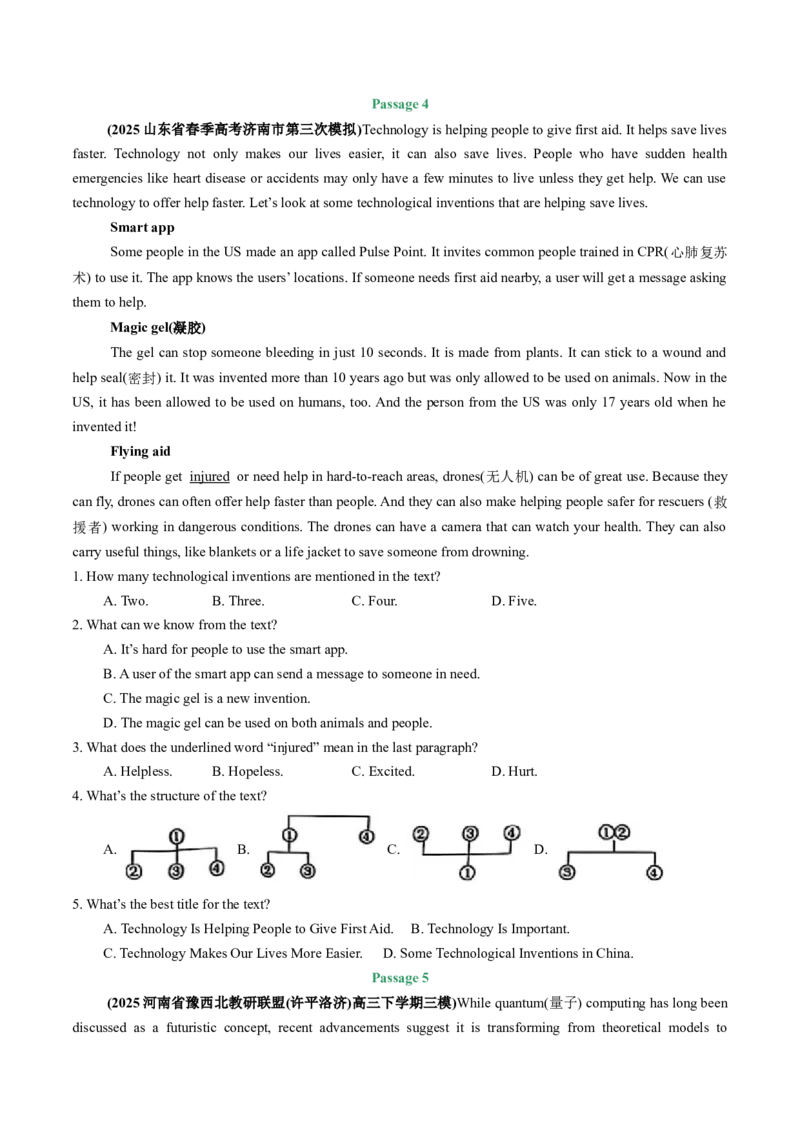
4. What’s the structure of the text?
A.
 B.
 C.
 D.
5. What’s the best title for the text?
A. Technology Is Helping People to Give First Aid.
B. Technology Is Important.
C. Technology Makes Our Lives More Easier.
D. Some Technological Inventions in China.
Passage 5
(2025 河南省豫西北教研联盟(许平洛济)高三下学期三模)While quantum(量子) computing has long been
discussed as a futuristic concept, recent advancements suggest it is transforming from theoretical models to
practical applications.
Unlike classical computers that process information in binary bits( 二进位) (0 or 1),quantum computers
use“qubits”( 量子比特) that can exist in multiple states at the same time through a phenomenon called
superposition. This allows them to perform complex problems.extremely faster. For example, a problem requiring
thousands of years for a supercomputer could theoretically be solved by a quantum machine in minutes.
However, significant barriers remain. Qubits remain highly sensitive to environmental changes, requiring
near-absolute-zero (-273℃) temperatures to maintain performance. Even minor environmental change can cause
errors. Moreover, developing error-correction codes for quantum systems has proven more complex than expected.
Researchers are experimenting with error-correcting codes and alternative materials like superconducting circuits to
address this.Yet, progress is gradual, and a fully functional quantum computer capable of real-world tasks remains
years away.
Moral concerns have begun to emerge. Quantum computing could break current coding methods, destroying
global data security. On the contrary, it might revolutionize fields like drug discovery at amazing speeds — a task
that would take traditional supercomputers decades.Such double-edged potential raises questions: Who should
control this technology? How can its risks be avoided without killing innovation?
Despite these challenges, investments from governments and tech companies show confidence. China’s $15
billion quantum initiative and the EU’s Quantum Flagship program prove state-level commitments. For example,
Microsoft and Honeywell are racing to commercialize quantum cloud services. As physicist Dr. Elena Torres notes,
“The quantum race isn’t about building a single machine; it’s about laying the groundwork for a new age of
computation.”
1. What is the difference between quantum computers and classical computers?
A. The stable states of“qubits”.
B. The data storage capacity.
C. The preference for complexity.
D. The data processing ability.
2. What can we infer about the quantum computing from paragraph 3?
A. It doesn’t need error-correction codes.
B. Alternative materials work well.
C. Its accuracy relates to conditions closely.
D. A universal computer is not far.
3. What does Dr. Elena Torres think about the quantum race?
A. It’s about making new computers.
B. Its development is slow.
C. It sets the basis for new computation.
D. It needs public support.
4. What is the author’s attitude towards quantum computing?
A. Objective.
B. Approving.
C. Negative.
D. Critical.
Passage 6
(2025 河北省秦皇岛市山海关区高三下学期第三次模拟考试)In The Singularity Is Nearer, Ray Kurzweil
builds upon the ideas he introduced in his earlier book, The Singularity Is Near (2005), updating his predictions
about the future of artificial intelligence (AI) and its integration with human life. Published in 2024, this sequel(续
篇) focuses on the speeding-up pace of technological advancement and its impacts on humanity, society, and the
evolution of intelligence. Kurzweil argues that we are rapidly approaching the point known as the singularity(奇点),
 a moment in history when AI will surpass(超越) human intelligence and lead to an unexampled period of
innovation and change. He predicts this crucial moment will occur by 2029, with full integration of AI and human
intelligence by 2045.
In this vision called singularity, humans and machines will combine through advancements in brain-
computer interfaces(界面), enabling people to improve their cognitive abilities, achieve extraordinary lifespans,
and overcome limitations of biology.
Kurzweil’s arguments are supported by a combination of historical analysis, current trends, and future
projections. His writing aims to inspire both excitement and thoughtful preparation for the great changes he
foresees. Ray Kurzweil’s prediction that AI will surpass human abilities in “every skill possessed by any human” by
2029 is certainly ambitious.
However, the technological challenges of copying human cognition across all areas are huge. Skills like
creativity, empathy, and moral reasoning, which are deeply tied to human experience and context, remain difficult
for AI to achieve. While AI can copy aspects of these qualities, achieving them in a way that matches or surpasses
human abilities across the board is significantly more complex.
In conclusion, while Kurzweil’s prediction is grounded in trends and historical foresight, achieving such an
all-covering landmark by 2029 seems unlikely. The claim is a vision of what might be possible at the frontiers of
our potential, but it has been affected by significant technological and social challenges that still need to be
addressed.
1. What is the main topic of The Singularity Is Nearer?
A. The timeline of AI surpassing and integrating with humans.
B. The predictable nature of industrial progress.
C. The dangers of human reliance on AI.
D. The historical evolution of technology.
2. What is the function of the singularity?
A. Mark the end of humans progress.
B. Lead to the decline of human creativity.
C. Allow humans to overcome biological limitations.
D. Mark AI less accessible to the general public.
3. What is Kurzweil’s primary purpose in writing the book?
A. To emphasize the strong power of AI.
B. To inspire people’s preparation for technological future.
C. To highlight the consequences caused by AI.
D. To warn against the combination of humans and machines.
4. Which of the following is a potential challenge to Kurzweil’s 2029 prediction?
A. AI already combined with humans.
B. AI struggles with tasks requiring creativity.
C. Humans are not interested in AI’s progress.
D. AI lack the ability to perform tasks.
Passage 7
(2025 河北省衡水中学高三下学期综合素质评价三)The ability to detect a nearby presence without seeing
or touching it may sound fantastical — but it’s a real ability that some creatures have. A family of African fish
known as Mormyrids are weakly electric, and have special organs that can locate a nearby target, even when it’s
hiding in the mud. Scientists have now developed an artificial sensor system modelled on the ability of these fish.
“We developed a new strategy for 3D motion positioning by electronic skin, bio-inspired by ‘electric fish’”,
says Dr. Xinge Yu, an associate professor in the Department of Biomedical Engineering at the City University of
Hong Kong. The team described their e-skin sensor in a paper published on November 14 in Nature.
The artificial sensor is multi-layered. One layer acts as a transmitter(发射器), which will generate an electric
field once activated, and another layer acts as a receiver to detect both the direction and the distance to an object. A
separate controller creates the driving signal to activate the transmitter. When an object comes within range, the
electric field around the sensor is disrupted(扰乱), which in turn can be detected by the receiver. This data is then
processed by a micro controller unit, which computes the position of the target object and sends that information to
a smartphone or other devices.
A special biogel(生物凝胶) is used in the sensor, which has the ability to transmit and receive electric
signals from a pattern of micro channels on the surface. The end result is a sensor that is thin, soft and flexible,
making it cosy to adapt to irregular surfaces, such as the human body. In contrast to the traditional sensor system
that needs a large number of sensors to achieve spatial positioning, the new system can locate an object precisely in
3D space using just a few sensors. This significantly reduces the power consumption of data collection,
transmission, and processing.
The researchers hope that this sensor could one day open up a new range of wearable technologies, including
sensors for human-machine interaction and thin, flexible e-skin.
1. What does paragraph 1 aim to show?
A. the special ability of African fish.
B. the inspiration for a new invention.
C. the big challenge of locating objects.
D. the reason for developing a sensor.
2. What does paragraph 3 mainly tell us about the sensor?
A. Its development process.
B. Its operating mechanism.
C. Its main layers.
D. Its environment impact.
3. What is an advantage of the new sensor system?
A. Its sensitivity to different stimulations.
B. Its adaptation to environmental changes.
C. Its efficiency in achieving 3D positioning. D. Its speed in data collection and processing.
4. What is the best title for the text?
A. Machine Detective “Wears” Flexible E-skin
B. Bio-inspired Sensor “Feels” Without Touching
C. E-Skin Sensor: The Future of Machine Learning
D. Electric Fields: The Frontier of Object Detection
Passage 8
(2025 江苏省南通市等苏北七市(宿迁、连云港、淮安、扬州、泰州、盐城、徐州)高三下学期第三次
调研)Go to any movie theater or sports venue, and it’s obvious there’s an invisible bond that forms from laughing,
crying, and simply feeling while brushing shoulders with others. Researches have long backed up this sense of
connection, but some aspects of the phenomenon remained unclear. Now, a new study is offering insight.
Writing in the journal Royal Society Open Science, Victor Chung of the École Normale Supérieure in France
and his team reported how they examined the matter by inviting strangers to watch videos together in same sex
pairs.
Pairs of strangers watched three types of videos together: positive, negative, and neutral ( 中性的) with a
curtain between them that was either open or closed. At the start of the experiment the researchers asked each
participant whether they’d like to meet the other member of their pair again. After watching each video, participants
reported their emotions and feelings of connectedness, and after seeing all three videos they were asked once again
about their feelings towards the other participant.
The results showed the emotional films generated stronger responses than the neutral film. Crucially, the
team said participants’ feelings of connectedness within the pairs was boosted when they experienced more intense
emotions. However, this was only the case when participants watched the films with the curtain between them
open. The researchers said that whether or not the pairs could see each other had no impact on how positively or
negatively they felt about the films.
“We found that silently watching emotional films together with another individual is associated with social
bonding, even when this person is a stranger and without any verbal(口头的) communication,” said Chung, the
study author.
The team added that the findings may help explain why people seek out group activities that generate strong
emotions, “even participating in sad memorials that cause negative emotions.” In other words, because emotion
bonds us, and humans have a fundamental desire to belong, we’re up for experiences one might think we’d
naturally want to avoid.
1. What does “the phenomenon” in paragraph 1 refer to?
A. Shared emotions bond people.
B. Physical touch helps tackle stress.
C. A chance encounter leads to a friendship. D. Entertainment is a crucial part of human life.
2. How did the researchers get their findings?
A. By analyzing participants’ emotions.
B. By comparing participants’ self-reports.
C. By documenting participants’ video responses.
D. By stimulating participants’ desire for interaction.
3. The study found that strong bonds were indeed created between pairs only when ______.
A. they were familiar with each other
B. they watched neutral films together
C. they were aware of the presence of each other D. they could see each other while watching the films
4. What is presented in the last paragraph of the text?
A. An interpretation of the findings.
B. Potential implication of the findings.
C. Supporting evidence for the findings.
D. The underlying logic behind the findings.
Passage 9
(2025 浙江省金华市义乌市高三下学期三模)When questions about children arise, many parents turn to the
internet and social media for advice on topics ranging from eating habits to children’s screen time. But what kind of
information are parents most likely to see and share?
A new study by NYU researchers, Erin O’Connor and Robin Neuhaus, examined how articles about screen
time resonated with parents, and found that articles combining attention-grabbing language with credible scientific
framing(表述) were the most likely to gain immediate and long-term attention on social media. O’Connor says:
“Parents deserve information that not only captures their attention, but also supports informed decision-making
about their children’s development.”
O’Connor and Neuhaus analyzed 136 articles published between 2016 and 2021. They used BuzzSumo, a
social media analytics tool, to track each article’s total social media shares across websites and its evergreen score
— to find how much attention the article continued to receive after its initial publication.
Each article was evaluated for two main factors: sensationalism( 煽动性) and scientific framing.
Sensationalism was measured by the presence of warning language (e. g., “alarming,” “skyrocket”, “irreversible(不
可逆转) damage”), while scientific framing was measured by how well the article explained findings, noted
limitations, and gave accurate reporting.
Their analysis revealed that articles with high sensationalism and strong scientific framing achieved the
highest immediate shares and long-term attention. In particular, articles that focused on younger children, with a
negative view of screen time, and published on popular websites showed stronger performance. Interestingly,
warning language alone boosted short-term sharing, but it was only when combined with strong scientific framing
that articles kept people interested over time. Additionally, longer articles with more detailed context were more
likely to achieve long-term attention.
1. What does the study focus on?
A. Children’s use of mobile phones.
B. Parents’ reliance on online advice.
C. Methods to improve parenting skills.
D. Features of popular screen-time articles.
2. How did researchers measure an article’s lasting influence?
A. By checking its shares in BuzzSumo.
B. By calculating its evergreen score.
C. By counting its total likes on websites.
D. By predicting its long-term growth.
3. Which expression increases an article’s sensationalism rating?
A. Experts suggest limiting screen time for better sleep quality.
B. Researchers noted that screen time effects vary by age group.
C. Constant screen time produces non-repairable damage in kids.
D. Parents can set an alarm to warn against too much screen time.
4. Which is a finding of the study?
A. Negative content gets shared the most.
B. Short articles attract more initial attention.
C. Emotional language alone drives article popularity.
D. Scientific framing influences articles’ long-term popularity.
Passage 10
(2025 浙江省强基联盟高三下学期三模)When babies are exposed to a variety of faces, they become more
adept in recognizing and appreciating diversity, which can help reduce biases and prejudices as they grow. This is
according to neuroscientist Saskia Koch of the Donders Institute and Radboud University.
Koch conducted her research using data from the Nijmegen longitudinal study. This study follows young
people from infancy(婴儿期). First, the researchers looked at how frequently the teenagers had attended day care as
babies. Then, the same youngsters were assigned the duty of playing a game when they reached the age of 17. In
the game, they had to work with another person they couldn’t see. Both players had the same goal:  find an object
on a gameboard. Only the 17-year-old knew where the item was. The 17-year-olds had to communicate this
location to each other without using words. They had to design communicative patterns that would assist the other
person in locating the object. This could be accomplished, for example, by performing specific movements.
The 17-year-olds were informed they were playing with a 5-year-old in one game and an adult in another,
despite the fact that it was the same individual each time. Initially, the 17- year-olds adjusted their communicative
patterns when they thought they were interacting with the child by placing more emphasis on their movements.
How quickly they abandoned this pattern depended on how much time they spent in day care. 17-year-olds who
had come into contact with many different people as infants were more likely to get over a stereotype(刻板印象).
They found out in the interaction that the “child” was also very good and then based their play on that.
According to the researcher this means that babies who have had more diverse social interactions can more
easily let go of a stereotype later in life. They are more sensitive to social interaction and can more quickly let go of
the image they have in their minds of their peers.  Koch says, “Gaining many diverse social experiences early in
life allows us to adapt better to the needs of our partners in social interaction. ”
1. What does the underlined word “adept” in paragraph 1 mean?
A. Forgetful.
B. Skillful.
C. Interested.
D. Disappointed.
2. What was the purpose of the game in the study?
A. To confirm the data from the Nijmegen study.
B. To test the impacts of early social interactions.
C. To enhance the youngsters’ cooperative ability.
D. To assess the effects of communicative patterns.
3. How did the 17-year-olds first respond to the “child” in the game?
A. They changed their fixed idea of a child. B. They adjusted the time spent on the game.
C. They performed more specific movements.
D. They employed verbal interactive patterns.
4. What helps babies with future social contacts according to Koch?
A. Interacting with various people.
B. Engaging with diverse peers.
C. Adapting to the needs of partners.
D. Letting go of the old images.
Passage  11
(2025 河北省衡水中学高三下学期综合素质评价三)Self-confidence is trusting in our abilities or qualities.
It’s usually seen as a good thing. But is it possible that we might benefit from a little less confidence in our beliefs?
For many years, Dr. Mark Leary, a neuroscientist at Duke University in Durham, N.C., has studied the role
of people’s beliefs in their behavior. He found overconfidence is very common, especially when it comes to what
people believe to be true, and can lead us to disastrous decisions. In 1986, NASA believed that the risk of loss for
any space flight was roughly 1 in 100,000. It was an overconfident belief and might have led to the explosion of the
Challenger. The good news is that there’s a “vaccine( 疫苗)” for overconfidence, and that’s what scientists call
“intellectual humility”— recognizing that your beliefs could be wrong.
A survey of 144 college students to measure their intellectual humility found that students who saw their
thinking could be wrong tended to be more curious and more likely to seek out new knowledge. They ended up
knowing more at the end of the day. But does it actually help you beyond that?
To find out more, Dr. Tenelle Porter at Ball State University conducted a series of studies with high school
students. She found that students with intellectual humility were much more likely to test themselves to see whether
they really understood the material and seek out potential holes in their understanding. When they got test scores,
they’d change their study strategics to improve their performance and master the material for the next test.
Students who didn’t see their knowledge could be wrong might instead just sail through their studying and
wouldn’t stop to ask themselves if they truly understood what they read, heard, or did. Such students thought they
got a subject down pat, but when asked to explain it on a test, they found they didn’t actually understand as much as
they had thought.
Although it might be good for you, researchers recognize that questioning your beliefs can be truly hard.
Still, it’s important to remember that questioning beliefs isn’t always about replacing old ones with new ones. If
you find it hard to question a belief, try taking “baby steps.”
1. Why does the author mention the explosion of the Challenger?
A. To express his sorrow for the loss.
B. To stress the high risk of space flights.
C. To show the result of wrong operation.
D. To give an example of overconfidence.
2. What do we know about intellectual humility according to Porter’s research?
A. It urged students to gain recognition.
B. It encouraged students to take exams.
C. It helped students to adjust learning methods.
D. It motivated students to memorize knowledge.
3. What do the underlined words “got a subject down pat” mean in paragraph 5?
A. Fully mastered a subject.
B. Put great effort into a subject
C. Really enjoyed a subject.
D. Benefited a lot from a subject.
4. What will probably be discussed in the following paragraphs?
A. Why questioning our belief is hard.
B. Why intellectual humility is helpful.
C. How to become a confident person.
D. How to practice intellectual humility.
Passage  12
(2025 浙江省温州市普通高中高三下学期第三次适应性考试)Surrounded by towering redwoods on one
side and the Pacific Ocean on the other, the coastal city of Santa Cruz, some 70 miles south of San Francisco, is a
great place for a young person to experience nature. That’s where Xinning Zhang, assistant professor of
geosciences and the Princeton Environmental Institute, spent her childhood. “Growing up there, you just can’t help
thinking and caring about the environment,” she said. One of the environmental questions Zhang is exploring is
why methane, a significant greenhouse gas, is increasing in the atmosphere.
Most of us are aware that cows release methane, but wetlands are also a major source of the gas. Wetlands
host a community of microbes(微生物), including Archaea, which generate methane as a byproduct when they
consume and digest components of organic matter. These microbes grow in oxygen-free environments like wet
soils, which typically occur in the wetlands’ deeper levels. However, researchers have been surprised to find that
quite a lot of methane comes from the oxygen-rich peat(泥炭) and soil near the surface.
To explore this phenomenon, Zhang and her team analyzed peat samples collected from a wetland in the
Northeast U.S. One set of samples received oxygen treatment followed by incubation( 培养) under oxygen-free
conditions. The other samples remained in an oxygen-free environment for the entire study period. Contrary to
expectations, the oxygen-treated peats produced a higher amount of methane than the peats maintained under
continuously oxygen-free conditions.
To find out why, the researchers analyzed all the microbes found in the peat samples. They found that
oxygen stimulated some microbes to break down harmful chemicals, which would otherwise threaten the entire
microbial community, including methane-producing Archaea.The result is the creation of far more methane than
expected.
Zhang’s work suggests that oxygen variability is an important control on wetland methane production. Her
team is also exploring further how oxygen variability for different lengths of time, and how different soil
chemistries influence microbial methane production.
1. What motivated Zhang to study environmental issues?
A. Her childhood experiences.
B. The adventure in nature.
C. Her educational background.
D. The pressure from fellows.
2. Why did Zhang analyze microbes in the wetland soil?
A. To examine the condition of surface soil.
B. To explore the impact of methane on microbes.
C. To study the role of oxygen in methane production.
D. To calculate the amount of methane released by cows.
3. How might the findings help reduce methane from wetlands?
A. By changing soil structures.
B. By introducing new microbes.
C. By blocking harmful chemicals.
D. By adjusting soil oxygen levels.
4. Which of the following can be the best title for the text?
A. How Does Methane Affect Climate Change?
B. What Drives Methane Production in Wetlands?
C. What Is the Link Between Oxygen and Methane?
D. How Do Wetlands Contribute to Microbial Diversity?
Passage 13
(2025 浙江省R6 联盟高三下学期4 月阶段性联考)In a pioneering achievement, scientists have
successfully transformed light into a “supersolid,” a state of matter that exhibits characteristics of both solids and
liquids in the meantime. This remarkable discovery, published in the journal Science, paves the way for novel
advancements in condensed-matter(凝聚态物) physics.
A supersolid is a unique state of matter governed by the principles of quantum mechanics. In this state,
particles form an organized, crystal structure like a solid, yet they can move freely and fluidly like a liquid without
stickness. The lack of stickness means that supersolids can quickly pipe themselves out of any containers.
Ordinary solids are typically static and do not move on their own. However, supersolids possess the ability to
change direction and density based on particle interactions while still keeping an orderly network structure. The
formation of supersolids requires extremely low temperatures, usually close to absolute zero (minus 459.67 degrees
Fahrenheit or minus 273.15 degrees Celsius).
While supersolids have been previously created from atomic gases, the recent research employed a novel
mechanism involving “polariton(极化子) “ systems. Polaritons are multiple particles formed by the strong coupling
of light and quasiparticles(准粒子) through electromagnetic interactions. These polaritons can concentrate into the
lowest possible energy state, similar to certain atomic gases. Namely, light is combined with matter, and together,
they can be condensed into a supersolid.
The study of supersolids is crucial because it allows us to observe the effects of tiny interactions between
particles without the interference of temperature. By examining the behavior and characteristics of supersolids, we
gain insights into the fundamental ways in which atoms and particles are organized. This knowledge helps us
understand the world at a basic level.
With further research and development, supersolids hold great potential for various applications. They could
be used in quantum computing, superconductors, frictionless oils, and potentially many other applications that we
have yet to imagine. The creation of a supersolid from light represents a significant leap forward in this field.
1. What is a supersolid according to the passage?
A. A state of matter that exists only at extremely high temperatures.
B. A state of matter that is both solid and liquid at the same time.
C. A state of matter that is completely solid without liquid properties.
D. A state of matter that is completely liquid without solid properties.
2. What is one of the unique characteristics of supersolids compared to ordinary solids?
A. Supersolids can move on their own.
B. Supersolids are always in a liquid state.
C. Supersolids require high temperatures to form.
D. Supersolids cannot change direction or density.
3. What is the role of polaritons in creating the supersolids in Paragraph 4?
A. Polaritons provide the necessary heat to form the supersolid.
B. Polaritons allow light to be condensed into a supersolid state.
C. Polaritons are used to create a stronger electromagnetic field.
D. Polaritons are used to increase the stickness of the supersolid,
4. What is the passage mainly about?
A. The importance of further research into supersolids.
B. The process of transforming light into a supersolid.
C. The features and potential applications of supersolids.
D. The history and potential value of supersolid research.
Passage 14
(2025 浙江省北斗星盟高三下学期三模)Researchers led by Josie Hughes in the CREATE Lab in EPFL’s
School of Engineering wanted to develop a robot that could go across diverse environments as skillfully as animals
by changing form on the fly. With GOAT (Good Over All Terrains) they have achieved just that—and created a new
model for robotic movement and control in the process.
“While most robots compute the shortest path from A to B, GOAT considers the travel pattern as well as the
path to be taken,” Hughes explains. “For example, instead of going around an obstacle like a stream, GOAT can
swim straight through. If its path is hilly, it can passively roll downhill like a ball to save both time and energy, and
then actively drive as a rover(漫游者) when rolling is no longer beneficial.”
To design their robot, the CREATE team took inspiration from across the animal kingdom, including spiders
and kangaroos. The team’s bioinspired approach led to a design that is highly compliant(顺应的), meaning it adapts
in response to interaction with its environment, rather than remaining unchangeable. This allows GOAT to actively
alter its shape to change its passive properties, which range from more flexible in its ‘rover’ model to stronger as a
ball.
CREATE Lab PhD student Max Polzin explains that compliance also allows GOAT to navigate with minimal
sensing equipment. With only a satellite navigation system and a device for measuring the robot’s own direction,
GOAT carries no cameras onboard. “It doesn’t need complex sensing. It can use the environment, even with very
limited knowledge of it, to find the best path,” Polzin says.
Future research includes improved algorithms( 算法) to help with GOAT’s design. Looking ahead, the
researchers see many potential applications for their device, from environmental monitoring to disaster response.
1. What key feature distinguishes GOAT?
A. Rolling downhill like a ball.
B. Calculating the shortest A-to-B path.
C. Navigating obstacles such as streams.
D. Efficient adaptation to varied terrains.
2. Where did GOAT’s designers find their solution?
A. From previous robots.
B. From other researches.
C. From other species.
D. From edging information.
3. In which field will GOAT probably be applied?
A. Education.
B. Climate.
C. Finance.
D. Medicine.
4. What would be the best title for the passage?
A. The Future Applications of GOAT
B. The Development of a New Robot: GOAT
C. GOAT: A Robot for Diverse Environments
D. How GOAT Saves Time and Energy in Travel
Passage15
(2025 安徽省蚌埠市高三下学期适应性考试)In the fast-developing landscape of education, technology has
been a game-changer, and DeepSeek, an advanced artificial intelligence, is making waves. DeepSeek’s applications
in education are diverse and impactful, bringing about a new era of learning experiences.
One of the primary ways DeepSeek benefits education is in personalized learning. Every student has a
unique learning pace and style. DeepSeek can analyze a student’s performance data, including test scores,
assignment completion times, and areas of difficulty. By processing this vast amount of information, it creates
customized study plans. For example, if a student struggles with algebra in math, DeepSeek can generate additional
practice problems, provide step-by-step video instructions, and even suggest alternative teaching methods that best
suit the student's learning style.
DeepSeek also serves as an intelligent coaching system. It is available around the clock, ready to answer
students’ questions instantly. Whether it’s a complex physics concept or a grammar issue in language learning,
DeepSeek can break down the problem, offer detailed explanations, and guide students through the solution
process. This immediate feedback not only helps students solve their current problems but also encourages them to
take initiative in learning.
Moreover, in the field of curriculum(课程) design, DeepSeek provides valuable assistance to educators. It
can analyze educational trends, emerging topics, and best practices from around the world. Based on this analysis,
it can offer suggestions for updating curricula, ensuring that students are learning relevant and up-to-date content.
For instance, in a rapidly changing subject like computer science, DeepSeek can help educators incorporate the
latest programming languages and technological advancements into the curriculum.
In addition, DeepSeek can enhance language learning. It can simulate real-life conversations, helping
students practice speaking and improve their pronunciation. Through voice recognition technology, it corrects
students’ pronunciation errors and provides instant feedback, much like having a personal language coach.
However, like any technology, DeepSeek also has its limitations. It lacks true human empathy ( 共情) and
emotional connection, which are important in the learning process. But overall, its potential to transform education
is undeniable.
1. How does DeepSeek help in personalized learning?
A. By offering one-on-one physical instructions.
B. By creating and providing tailored study plans.
C. By randomly assigning study materials to students.
D. By asking students to follow a fixed learning pattern.
2. How does DeepSeek assist in curriculum design?
A. It replaces educators in designing curricula.
B. It concentrates on traditional educational content.
C. It creates all the teaching materials for educators.
D. It gives suggestions based on its relevant analysis.
3. What does the underlined word “incorporate” in paragraph 4 mean?
A. Change.
B. Translate.
C. Develop.
D. Integrate.
4. What is the main idea of the passage?
A. The transformation of education by DeepSeek.
B. The application of DeepSeek in various fields.
C. DeepSeek’s limitations in improving education.
D. The development process of DeepSeek in education.
Passage 16
(2025 福建省三明市高考三模)Various influential claims about human happiness have stood the test of time.
One of the insights was that humans, in favour of genuine happiness, must develop an ability to delay gratification
— switching from the near-term enjoyment of satisfying desires like fame and wealth to longer-lasting pleasure in
life. It arises from the activities we authentically find rewarding and interesting. The challenge remains in the
digital age when online users are pushed towards seeking out short-term satisfactions such as likes and positive
comments.
To better understand the connections between delayed gratification and smartphone use, researchers at
Temple University administered questionnaires to 91 undergraduate students about their daily use of mobile social
media applications. Participants were asked how often they post public status updates and how often they check
their phones. They were also asked to make theoretical choices between a smaller sum of money offered right away,
and an increasingly large sum of money offered at six different time delays. These delays ranged from one day to
one year. At the one-year point, the participant could receive the maximum sum, $1000.
Those with higher mobile technology engagement were found to be less likely to delay gratification in favor
of later but larger rewards. After further analysis, researchers found that mobile technology habits associated with
lower tendencies to delay gratification seem to be driven by uncontrolled impulses (冲动).
Knowing about such connections is important as we all try to understand how best to create satisfying lives
in the present age. And those who struggle with uncontrolled impulse have a particularly strong reason to keep in
mind the point about seeking lasting rather than near-term pleasures. It’s best to put down the phone if it only
brings temporary uneasy satisfactions.
It is also true that younger generations are becoming accustomed to digital technology early in their lives.
This may increasingly become a primary means of their socialization. The digital generations of the future will
need help to hold back uncontrolled impulse. Otherwise, they may discover that they are completely lost in their
attempts to attain happiness in life.
1. Which is an example of delayed gratification?
A. Buying luxury items at will.
B. Saving money for further education.
C. Seeking daily social media likes.
D. Quitting jobs for temporary relaxation.
2. What did Temple University’s research reveal?
A. Higher phone use predicts poorer self-control.
B. Social media boosts youth socialization.
C. Students prefer $1000 immediate rewards.
D. Mobile using habits are driven by impulse.
3. What is suggested for those struggling with uncontrolled impulses?
A. Examine digital habits.
B. Seek professional help.
C. Install regulatory software.
D. Prioritize lasting pleasures.
4. What is the writer’s attitude towards the future digital generation?
A. Concerned.
B. Objective.
C. Pessimistic.
D. Appreciative.
Passage 17
(2025 河南省焦作市高三下学期三模英语试题)Virtual reality (VR) can, imperfectly, transport a user into
distant experiences. With a headset on, an everyday person can explore what it’s like to perform a surgery, tour the
Louvre, or even make an arrest. One thing VR can’t yet do, however, is simulate( 模拟) the experience of eating
lunch. But that could change thanks to a new “bio-integrated taste interface” device called “e-Taste”.
Researchers from Ohio State University detailed how their new device, “e-Taste”, works in Science
Advances. At the core of the device, a specialized pump combines chemicals in specific amounts to recreate flavors
like coffee, lemonade, or cake. The freshly created chemical liquid is pushed through a gel( 凝胶), letting users
experience the taste as a liquid with the device in their mouth, as researchers remotely control its intensity. Though
early test subjects found it tricky to tell flavors apart, the study suggests a future VR steakhouse experience might
not be as far-fetched as it sounds.
E-Taste works in three phases. First, sensors analyze food or drinks to identify key components like sugar
and salt that contribute to the five basic tastes: sweet, sour, salty, bitter, and meaty. This data is processed and
wirelessly delivered, enabling flavors to be shared remotely. In the second phase, a small pump mixes taste-related
chemicals in precise amounts to recreate the original flavor. Researchers can fine-tune the pump’ s timing to adjust
the flavor’ s intensity. The final mixture is turned into a gel, and water flowing through it carries the taste to the
user’ s mouth, letting them experience flavors without consuming real food or drinks.
Ohio State professor Jinhua Li stated that chemical dimensions are underrepresented in virtual and
augmented reality(增强现实), a gap their research is hopeful to fill.
The e-Taste researchers see potential beyond gaming. The device could let users virtually test-taste food
before ordering, help doctors identify taste loss as an illness sign, or help restore the sense of taste for individuals
with nerve disorders that reduce their ability to enjoy food.
“This concept is here, and it is a good initial step toward becoming a small part of the metaverse (元宇宙),” Li
said.
1. Why does the author mention VR in paragraph 1?
A. To compare it with e-Taste.
B. To prove its popularity in various fields.
C. To set the stage for introducing e-Taste.
D. To stress its powerful functions.
2. How does the e-Taste device recreate flavors?
A. By directly copying the taste from real food.
B. By adjusting the intensity of light to create different tastes.
C. By analyzing the smell of food and transforming it into taste.
D. By using a pump to mix specific chemicals in certain amounts.
3. What role does the gel play in the e-Taste device?
A. It controls the strength of the flavors remotely.
B. It delivers the chemical liquid to users for tasting.
C. It reproduces the taste of various foods and drinks.
D. It collects flavors from the chemical liquid for users.
4. What does Jinhua Li think of the e-Taste research?
A. It is a promising start.
B. It has some limitations.
C. It needs more investment to add more functions.
D. It is helpful for people to understand augmented reality.
Passage 18
(2025 届河南省豫东部分名校高三下学期三模英语试题)For decades linguists have argued over how
children learn language. Some think that babies are born as “blank slates” who pick up language simply from
experience-hearing, seeing and playing with the world. Others argue that experience is not enough and that babies’
brains must be hardwired to make acquiring language easy.
AI models such as GPT-4 have done little to settle the debate. The way these models learn language — by
trawling through reams of text data from millions of web pages — is vastly different to the experiences of babbling
babies.
A team of scientists at New York University examined the question by training an AI model on the
experiences of a single infant. A toddler called Sam wore a head-mounted camera for an hour a week. The camera
recorded everything he saw and heard while he played with toys, enjoyed days at the park and interacted with his
pet cats. The recordings and transcribed audio were fed into an AI, which was set up to know that images and
words that appeared at the same time were related, but was otherwise left to make sense of the mess of colors and
speech that Sam experienced.
Despite the limited training data, the AI was able to pick out objects and learn the matching words. The
researchers tested the model by asking it to identify objects that Sam had seen before. Given a list of four options,
the model picked the correct word 62% of all, far above the chance level of 25%. To the researchers’ surprise, the
model could also identify objects that Sam had never seen. The AI learned at least 40 different words, but it was far
from matching Sam’s vocabulary and language abilities by the end of the experiment.
The researchers argue that, to match words to objects, learning from experience may well be enough.
Sceptics, however, doubt that the AI would be able to learn abstract nouns or verbs, and question how similar the
learning processes really are. The mystery of language acquisition lives on.
1. What is the research aimed at?
A. Using AI model to settle the debate.
B. Finding how children learn language.
C. Training AI to model a baby’s behaviour. D. Guiding AI to match the objects with words.
2. What is paragraph 3 mainly about?
A. How the scientists trained AI.
B. How a baby learned language.
C. How AI identified the objects.
D. What a baby did in the research.
3. What is Sceptics’ attitude towards AI’s ability of learning language?
A. Optimistic.
B. Suspicious.
C. Indifferent.
D. Objective.
4. What can we infer from the passage?
A. AI has a similar learning process to learn language with a baby’s.
B. AI can match a baby’s vocabulary and language abilities by training.
C. GPT-4 model has done much to settle the debate of how a baby learn language.
D. We still need to do research on the mystery of language acquisition in the future.
Passage 19
(2025·湖北十堰·三模)Columbia scientists have found specialized neurons(神经元) in the brains of mice
that order the animals to stop eating. Though many feeding circuits(回路) in the brain are known to play a role in
monitoring food intake, the neurons in those circuits do not make the final decision to cease eating a meal.
How does the brain know when the body has had enough and how does it act on that information to stop
eating? Alexander Nectow, a physician-scientist at Columbia University Vagelos College of Physicians and
Surgeons and his team member, Srikanta Chowdhury, used new single-cell techniques that make it possible to peer
into a region of the brain and discern different types of cells that until now have been difficult to distinguish from
one another.
During their profiling of a brainstem(脑干) region known for processing complex signals, the researchers
spotted previously unrecognized cells that had similar characteristics to other neurons involved in regulating
appetite. To see how the neurons influenced eating,the researchers engineered the neurons so they could be turned
on and off by the researchers with light.
When the neurons were activated by the light, the mice ate much smaller meals. The intensity of the
activation determined how quickly animals stopped eating. “Interestingly, these neurons don’t just signal an
immediate stop; they help the mice to slow down their eating gradually,” said Chowdhury.
The researchers also looked at how other eating circuits and hormones affected the neurons. The researchers
found that the neurons were silenced by a hormone that increases appetite and activated by a GLP-1 agonist, a class
of drugs now popular for treating obesity and diabetes. These experiments found that these inputs helped the
neurons track each bite the mice took.
“Essentially, these neurons can smell food, see food, feel food in the mouth and in the gut ( 肠道), and
interpret all the gut hormones that are released in response to eating,” said Nectow. “And ultimately, they leverage
all of this information to decide when enough is enough.”
1. What is the main function of the specialized neurons found in mice’s brains?
A. Helping mice digest.
B. Making mice feel full.
C. Choosing what mice eat.
D. Monitoring mice’s energy intake.
2. What does the underlined word “discern” in paragraph 2 mean?
A. Illustrate.
B. Combine.
C. Recognize.
D. Analyze.
3. How did researchers know the effect of the new neurons on eating behavior?
A. By observing the mice’s eating habits.
B. By comparing the mice’s weight changes.
C. By engineering the neurons in the mice’s bodies.
D. By controlling the light connected to the neurons.
4. Which can be the best title for the text?
A. New Techniques in Brain Cell Research
B. The Impact of Light on Controlling Eating
C. The Role of Hormones in Appetite Regulation
D. Brain Cells Which Tell You When to Stop Eating
Passage 20
(2025 届湖北省多市高三下学期4 月调研考试(三模)Surgeons often emphasize that in the event of a heart
attack, time is crucial for saving heart muscle. The heart relies on a continuous supply of oxygen delivered by the
heart’s blood vessels(血管). When these vessels become blocked, the oxygen supply stops, and the heart's muscle
cells begin to die within minutes. Survivors of heart attacks frequently suffer from permanent heart failure, with a
worrying statistic showing that 50% of them may not survive beyond five years. “Eventually, their hearts become
so weak that they can't sustain sufficient blood flow, and they ultimately stop,” explains Sanjay Sinha, a
cardiologist at Addenbrooke’s Hospital in Cambridge.
However, within the next five years, there could be a new alternative — to grow live, beating “heart
patches”(补丁). Sinha, along with a team of biologists at the University of Cambridge’s Stem Cell Institute, is
working on this innovative approach. These heart patches are tiny, beating pieces of heart muscle. They are grown
in lab dishes over a month. The process begins by taking blood cells and reprogramming them into a specific type
of stem cell capable of developing into any cell type within the human body. Sinha is currently preparing to test
these patches, first in mice and then in pigs. If successful, he hopes to set up a human trial within five years.
In the United States, scientists from Stanford University are also working on creating heart patches. They
envision a future procedure where ultrasound and MRI(超声波和核磁共振) scans are used to identify damaged
sections. Based on the shape of the section, a custom heart patch would be 3D printed to fit perfectly. Surgeons
would then open the chest area and attach the patch directly to the heart.
The major challenge with this method is establishing “electrical connectivity” between the new patch and the
existing heart to ensure they beat in harmony. Additionally, the cost of developing and using these patches is
significant, which could impact accessibility. However, if these challenges can be overcome, Sinha is optimistic
that heart patches could transform the lives of millions worldwide.
1. What is the function of paragraph I?
A. To reveal a finding.
B. To offer a solution.
C. To present a problem.
D. To outline a research.
2. What is the first step in growing heart patches?
A. Launching a clinical trial in humans.
B. Testing the heart patches on animals.
C. Culturing heart patches in lab dishes.
D. Generating stem cells from blood cells.
3. What is the purpose of using ultrasound and MRI scans?
A. To create a 3D model of the heart.
B. To locate damaged areas in the heart.
C. To design the shape of the custom heart.
D. To provide real-time guidance for operations.
4. What is the major challenge in employing heart patches?
A. Promoting global accessibility.
B. Reducing production costs.
C. Securing functional integration.
D. Finding a suitable material.
高频话题02 历史,文化,经济和艺术
Passage 1
(2025 河北省秦皇岛市山海关区高三下学期第三次模拟考试)The stories of Africa’s wildlife and natural
heritage have long attracted audiences around the world, yet these stories have rarely been told by Africans.
Filmmakers and National Geographic Explorers Noel Kok and Pragna Parsotam-Kok witnessed the lack of
equity(公平) within the industry themselves and declared it was time to make a change. “One of the ways of trying
to change human behavior is by trying to change the story,” says Noel. “If the same storytellers have been making
the same story for so long, then maybe you need to change the storyteller.”
In 2017, Noel Kok and Pragna Parsotam-Kok co-founded Nature, Environment and Wildlife Filmmakers
(NEWF) which offers professional development, capacity building, instruction, and networking opportunities to
African filmmakers and storytellers. Over the years, they have built a community of emerging storytellers, called
NEWF Fellows, who gain access to the tools and skills needed to succeed within the industry. The Fellows have the
opportunity to participate in NEWF Labs that provide specialized training, such as dive certification,
cinematography (电影制片术), music composition, and science communication.
Since its founding, NEWF has grown to a network over 220 fellows from 25 countries across the African
continent. Many Fellows have long been leaders in their fields and have reached several achievements in their
diverse work: Marine ( 海洋的) biologist Jamila Janna from South Africa produced an award-winning film,
Zambian wildlife cinematographer Samson Moyo has worked on a number of films in Africa and founded his own
production company, and marine scientist and science communicator Nancy Iraba from Tanzania, now a National
Geographic Explorer, developed a youth education program that has reached more than 1,500 African students.
Thirty percent of NEWF Fellows today are marine scientists and storytellers.
“Storytelling has always been key,” African filmmaker Kirsten said. “With NEWF, we’ re changing how
stories are told. It gives African storytellers power and resources. Fellows have achieved much, and with its growth,
NEWF is set to make a huge impact.”
1. Why did Noel Kok and Pragna Parsotam-Kok establish NEWF?
A. To encourage more people to explore the nature in Africa.
B. To make better movies and documentaries in Africa.
C. To change people’s impression of Africa.
D. To enhance the professionalism of African storytellers.
2. What can we learn from paragraph 3?
A. All NEWF fellows have founded their own companies.
B. NEWF makes a very great impact on Africa.
C. There are exactly 220 fellows in NEWF at present.
D. Many film firms have been built in Africa.
3. What is Kirsten’s attitude towards NEWF’s future?
A. Objective.
B. Indifferent.
C. Supportive.
D. Doubtful.
4. What is the text mainly talk about?
A. The achievements of NEWF fellows in different fields.
B. The competition between African and international filmmakers.
C. The efforts to refocus African filmmakers and storytellers.
D. The global appeal of Africa’s wildlife stories.
Passage 2
(2025 河北省秦皇岛市山海关区高三下学期第三次模拟考试)Construction workers recently found the
ruins of a large pyramid beside a highway in Mexico. After discovering the site, researchers collected many ancient
objects that will be studied in their laboratories over the coming months. The structure was found in June 2024
during highway expansion work in Hidalgo, central Mexico. The discovery happened by chance as workers were
adding a third lane to the federal highway, showing how ancient structures can still be found during modern
construction projects.
Scientists from Mexico’s National Institute of Anthropology and History went to study the site. They used
drones to take pictures and collected 155 items, including pieces of pottery, stone tools, and shells. To protect the
old building, they built a large wall around the pyramid, which is 43 meters long and 11.7 meters high.
The pyramid is part of an old settlement called San Miguel, built between 650-1519 CE. The area was ruled
by the “Metzca lordship,” which influenced the region until the 1500s. People have lived in this region for a very
long time, with the oldest settlements dating back at least 14,000 years. This shows that many different groups of
people have lived here over thousands of years.
Scientists keep finding hidden ancient buildings in Mexico and other parts of the Americas. Many
discoveries are made using LiDAR, a technology that uses laser light to see things concealed under plants and
trees. This tool helps archaeologists (考古学家) find old structures that they couldn’t see just by looking at the
ground.
Last year, researchers used LiDAR to find an 18-kilometer road that connected ancient Maya cities over
1,200 years ago. In Guatemala, they also discovered a previously unknown Maya civilization with 964 settlements
connected by 177 kilometers of ancient roads. These findings show that the Americas had complex and thriving
societies long before European settlers arrived. The discoveries remind us how advanced these ancient civilizations
were, though their development was later interrupted by colonization. Each new discovery helps build a more
complete picture of these remarkable ancient societies.
1. What action did scientists take first after discovering the site?
A. They restored the pyramid.
B. They contacted local authorities.
C. They removed all artifacts.
D. They photographed the site.
2. What does the underlined word “concealed” in paragraph 4 probably mean?
A. Ancient.
B. Hidden.
C. Risky.
D. Connected.
3. What does the author convey in the last paragraph?
A. Maya civilization was primitive.
B. European settlers improved local life.
C. Ancient Americas had advanced societies.D. Modern technology surpasses ancient wisdom.
4. What’s the best title for the text?
A. Mexico builds new highways.
B. Ancient ruins need protection.
C. Unexpected discovery reveals past civilization. D. Modern technology helps archaeological work.
Passage 3
(2025 浙江省强基联盟高三下学期三模)Planetary geoarchaeology(地质考古学), the study of how cultural
and natural processes on Earth’s moon, on Mars, and throughout the solar system may be changing, preserving, or
erasing the material record of space exploration, has been proposed by two researchers from the Kansas Geological
Survey at the University of Kansas and their colleagues as a new scientific subfield.
“Until recently, we might consider the material left behind during the space race of the mid-20th century as
relatively safe, "said Justin Holcomb, researcher at the Kansas Geological Survey. “However, the material record
that currently exists on the moon is rapidly becoming at risk of being destroyed if proper attention isn’t paid during
the new space era.”
Applying geoarchaeological tools and methods to the movement of people into space and the solar system is
a natural extension of the study of human migration on Earth, the focus of the ODYSSEY Archaeological Research
Program directed by Holcomb’s co-author, Rolfe Mandel.
How planetary geoarchaeologists will determine whether an item is worth preserving is an open question.
“We feel that all material currently existing on extraterrestrial(地球外的) surfaces is space heritage and worthy of
protection, ”Holcomb said. “However, some sites,  such as the very first footprints on the moon represent the
material footprint of a long history of migration. ”Beyond those“firsts”, making decisions on a case-by-case basis
will be necessary to sort through the tens of thousands of pieces of debris(残骸) now in orbit or dropped across the
surfaces of the moon and Mars, which many people refer to as “trash” but Holcomb and his colleagues see as
heritage.
Holcomb thinks geoarchaeologists ought to be a part of upcoming NASA missions to ensure the security and
preservation of space history. As for being part of a space mission himself? “I’ll leave that to other
geoarchaeologists,” Holcomb said. “There’s plenty to do down here, but I do hope to see an archaeologist in space
before it’s all over.”
1. Why has planetary geoarchaeology been proposed?
A. To protect space heritage.
B. To study the solar system.
C. To resist space exploration.
D. To found a scientific field.
2. What do we know about the material record of space?
A. It threatens the movement of people into space.
B. It is the main focus of the ODYSSEY Program.
C. It shows the whole process of human migration.
D. It is not as safe as expected in the new space era.
3. What does paragraph 4 mainly talk about?
A. The methods of classifying space trash.
B. The first footprints on the moon and Mars.
C. The question of planetary geoarchaeologists.
D. The discussion on identifying space heritage.
4. What does Holcomb suggest other geoarchaeologists do?
A. Learn from scientists like him.
B. Lead upcoming NASA missions.
C. Participate in space exploration.
D. Ensure the security of astronauts.
Passage 4
(2025 浙江省R6 联盟高三下学期4 月阶段性联考)China’s population is shrinking and ageing, a process
that will quicken in 2025. The total fertility rate, or the average births per woman, has fallen to 1.1, far below the
2.1 needed to maintain a stable population. After a possible small post-pandemic uptick of births in 2024, the
auspicious year of the dragon, the birth rate is expected to resume its decline. Meanwhile the number of people over
60 is expected to grow from 300m in 2023 to more than 400m by 2035 — that is, from one fifth to nearly one-third
of the population. This bodes ill for China’s economy, with fewer young people working to support more old folks.
But state planners think they have found a silver lining: the “silver economy”.
In 2024 China’s State Council issued a policy document on promoting a “silver economy to improve the
well-being of the elderly”. It called for companies to invest in elder-friendly industries such as smart health care,
anti-ageing products, personal pensions and tourism. “Promote theme products such as nostalgic tours and youth
tours,” it recommended. The state has also called upon local governments to develop better services for old people,
such as meal deliveries, at-home health care and cultural enrichment activities.
The focus on silver-haired spenders makes sense. The ageing society will have massive needs — and the
coming generation of retirees will have money to spend. The UN estimates that the largest age group, aged 50 —
60, includes 230m people, most of whom will retire in the next decade. “They are the wealthiest sector of society,”
says Tim Lie of Quantasing, an educational-technology firm that pivoted to focus on the silver economy in 2022.
Older Chinese tend to be more frugal. But the growing groups of those in “new middle age” (45 — 60) and
“old age” (over 60) are in a sweet spot in the middle, says Mr Xie. They spent most of their working lives in
China’s boom years and are retiring with enough time to enjoy their savings. Quantasing has attracted 120m users
to its online courses, which help retired people develop hobbies such as calligraphy, meditation and piano. Only
400,000 are paying customers so far, but Quantasing expects that number to grow as it expands into wellness
products and tourism.
There are challenges to developing the silver economy. The elderly are susceptible to scams. They will need
consumer protection, even as the government encourages firms to sell them as much as possible. Chen Gong of
Peking University warns that too many firms may be piling in without enough thorough research. “Many policies
are shouting a lot but doing little,” he says. Cai Fang of the Chinese Academy of Social Sciences points out that
more welfare and social services for the elderly are needed. Silver-haired spending is bound to grow. It will be
tougher to make sure that the well-being of China’s old folks grows along with it.
1. Which of the following best describes the relationship between China’s population change and the “silver
economy”?
A. The decline in the birth rate directly leads to the emergence of the “silver economy”.
B. The “silver economy” is basically a result of the post-pandemic economic restructuring.
C. The “silver economy” aims to reverse the trend of population shrinking and ageing.
D. The growth of the elderly population and related challenges boost “silver economy”.
2. What does the underlined word “frugal” most likely mean in this context?
A. Economical.
B. Impulsive.
C. Generous.
D. Considerate.
3. What can be inferred from the fact that only 400,000 out of 120m Quantasing users are paying customers?
A. The online courses provided by Quantasing are not tailored to the needs of the elderly.
B. Retired people in China are generally not willing to subscribe to such courses.
C. Quantasing has great potential to increase its revenue by improving its business model.
D. The market for elder-friendly online courses is not promising in the predictable future.
4. Which of the following factors is least likely to contribute to the growth of the “silver economy” in China?
A. The continuous increase in the number of retirees with certain financial resources.
B. The measures to encourage young labour to apply themselves to support the elderly.
C. The improvement of the quality of life and consumption concepts of the elderly.
D. The effective implementation of policies to facilitate firms investing in elder-friendly industries.
Passage 5
(2025 浙江省北斗星盟高三下学期三模)Before the internet made book reviews widely accessible, where
would curious minds go to find information about a new novel’s subject matter or a plot?
If you lived in the Los Angeles area, you could reference the Los Angeles Public Library’s index of fiction
book review cards. The reviews, a collection of thousands of index cards, contain library staff members’ thoughts
and opinions about new fiction releases that the library carried. The library system started in the 1920s and into the
1980s.
Robert Anderson, who has worked as a librarian at the LAPL since 1980, says the staff review cards were a
handy tool that library staff used to answer specific questions the public had about different books. The reviews,
along with being a helpful public tool, also helped staff pick which books the LAPL would order for their shelves.
If a staff member reviewed a book favorably, they were more likely to carry the title and order multiple copies.
The review process was simple: On an index card, library staff would handwrite or type up an abstract of a
book they read and give their personal review of it. The cards offered adjectives that the reviewer could underline
to indicate how the story might affect readers emotionally. For example, for the library’s review of Virginia Woolf’s
1925 book Mrs. Dalloway, the reviewer underlined “wholesome,” “pleasant,” and “interesting.” Of the staff
member’s characterization of the book, Anderson said he wasn’t sure why the reviewer considered Woolf’s writing
— which deals with loneliness and other, often dark human experiences — to be healthy, “but they did.”
The Los Angeles Public Library’s index of staff review cards isn’t used regularly anymore. But the system
now serves as a historical record of both the books, some almost 100 years old, as well as the cultural views held by
the book-loving library staff of the time.
1. What could be found in the LAPL’s review cards?
A. Public opinions about the library’s services.
B. A list of all the books available in the library.
C. A summary of the most popular books in the library.
D. Librarians’ comments on newly added fiction books.
2. What was the purpose of the review cards for the public?
A. To provide free books.
B. To offer readers reference.
C. To promote new authors.
D. To help with book orders.
3. What can be inferred from paragraph 4?
A. The reviews’ comments were subjective.
B. Virginia Woolf’s books were difficult to understand.
C. The librarians made wrong judgements about the books.
D. The reviewers used some adjectives to describe the books.
4. What is the author’s attitude toward the review card system?
A. Critical.
B. Doubtful.
C. Appreciative.
D. Neutral.
高频话题03 公益活动/社会问题和社会现象
Passage 1
(2025 福建省泉州市高中毕业班4 月适应性练习卷)In Baltimore, Our Kids Read, a nonprofit offers three
free books to every child who walks into its bookstore. And unlike the library, the books are never expected back.
Kids “check out” at the front of the store, but instead of handing over cash, all they have to do is sign up for the
nonprofit’s Reading Buddy program, which matches young readers with adults who read with them once or twice a
week in 45-minute online meetings to promote literacy( 写能力). “Every child should have someone reading to
them at night.” said Jahmal Lake, executive director of Our Kids Read.
Lake established Our Kids Read in 2021. But he quickly realized that he needed to do more than just
distribute donated books. “1 think that the mistake a lot of nonprofits make, is that they think they can back up a
truck full of resources to the communities they want to serve and that they’re doing something.” Lake said. “But if
that community is not equipped to make good use of those resources. you might as well have given them a brick.”
On the bookshelves and across tables, there are books like “Black Boy Joy” and “Eyes That Kiss in the
Corners”, picture books in English and Spanish, poetry collections, and even graphic novels. The range of options
plays into Lakes’ vision of turning non-readers into bookworms by directing kids to books on subjects they already
love. Research shows kids are more likely to finish and love books they pick out themselves.
To promote the Reading Buddy program, Our Kids Read goes into elementary schools. Lake also plans to set
up several little free libraries to encourage reading. The Baltimore Community Foundation has given Our Kids
Read over $25,000. Vice President of Community Impact Crystal Harden-Lindsey said Our Kids Read is vital to
promoting literacy, the foundation for academic success, economic mobility and civic engagement.
1. What is a feature of Our Kids Read bookstore?
A. It offers free books to adults and kids.
B. It holds reading competitions weekly.
C. It engages kids in reading books to adults.
D. It requires kids to register for a program.
2. What does Lake think of merely donating books?
A. Insufficient.
B. Meaningful.
C. Motivating.
D. Unnecessary.
3. Why does the bookstore offer diverse books?
A. To expand kids’ reading range.
B. To develop students’ love for books.
C. To broaden kids’ visions on book selection.
D. To encourage kids’ interest in school subjects.
4. What is the main idea of the passage?
A. Bookstore offers kids free books to promote business.
B. Charity partners with schools to teach students reading.
C. Nonprofit boosts child literacy through multiple measures.
D. Program enhances family bond by shared reading activities.
Passage 2
(2025 安徽省合肥市庐阳区合肥市第八中学高三下学期三模)They were once popular mainly with hikers,
poor people, and students. No adult who cared even a little about fashion would be seen with one. But now,
backpacks have become more widely accepted. Young people are now choosing them over briefcases and tote bags.
Sales in America rose to a new high recently.
“Twenty years ago, you couldn’t wear a backpack into work,” says Taylor Welden, creative director at
Carryology, a platform for designers and writers who are enthusiastic about bags. That has changed. Andy
Fallshaw, a bagmaker, compares backpacks to sneakers. Once a niche product worn by athletes, sneakers now are
everywhere, even on fashion runways.
What changed? Workplaces have become more relaxed; at the same time backpacks are being designed to
look more fashionable. New materials make backpacks seem fancier than the old ones. Higher baggage fees might
have boosted backpack use: People want to carry more on the plane to avoid the cost, and it’s easier to carry weight
in a backpack than with a single shoulder bag. Longer trips to the office have also changed people into daily
“backpackers”.
People have carried things on their backs for thousands of years. Ötzi, a man who lived 5,300 years ago, had
a wooden backpack. In the early 1900s, an American added zippers( 拉链) to make them lighter. In the 1960s,
Murray and Jan created JanSport with new designs and sections.
A fresh generation of small, fancy bag makers is doing really well and experimenting with new, durable( 耐
用的) fabrics. Packolab, based in Ukraine, sells backpacks that cost around$400; they are so popular that the firm
has started using a lottery(彩票) system to manage demand. Fashion brands, from Chanel to Saint Laurent, have
taken notice, too. In 2023 Dior, partnered with Mystery Ranch, a bag designer in Montana best known for making
kit for firefighters, hunters and soldiers, to create a limited-edition backpack with a $4,000 price label. Even
established bagmakers are following the pack.
1. How did adults who were concerned with fashion previously perceive backpacks?
A. They viewed backpacks as stylish.
B. They regarded backpacks essential.
C. They considered backpacks practical.
D. They thought backpacks less fashionable.
2. What do the underlined words “a niche product” in Paragraph 2 probably mean?
A. A widely used item in daily life.
B. A fashionable item for everyone.
C. A specialized item with limited appeal.
D. A high-quality item with a luxury price label.
3. Which of the following would be the best title for the text?
A. The Future of Backpacks
B. The History of Backpacks
C. Backpacks: A Trendy Item for All Ages
D. Backpacks: From Hiking to High Fashion
4. From where is the text most likely sourced?
A. A fashion magazine.
B. A travel guidebook.
C. A history textbook.
D. A business report.
Passage 3
(2025·江西景德镇·三模)It seems we’ve officially reached peak smartphone, with a growing number of
Americans lining up for their very own “dumbphone(傻瓜机)”. Whether it’s nostalgia(怀旧) or an attempt to save
our mental health, there’s an obvious return in the longing to own a Nokia.
And it’s not just parents forcing dumbphones on their children, either. According to Fast Company,
dumbphone brands’ increase in demand is mostly driven by young users. With Gen Z’s love of the noughties (21 世
纪前十年) culture, part of the dumbphone appeal depends on the throwback novelty of the flip phone(翻盖手机).
But despite this fashionable feature, dumbphone users have one main goal: to reduce screen time, and ultimately
rescue their health. Many will know it as a “digital detox(排毒)”.
For younger generations, phone use has essentially become a part-time job in regard to time and labor.
According to a 2023 report by the nonprofit organization Common Sense, an average teen receives 237
notifications on their phone each day, spending around 4. 5 hours on the screen.
It’s no secret that scrolling( 上下滑动) on our phones is not a healthy pastime. A study found a direct
correlation between “doomscrolling” and mental and physical ill health. Doomscrolling is the continuous
consumption of sad, scary or negative news online. Meanwhile, a 2020 study revealed smartphone and social media
use in increased mental issues in young people.
“Smartphones compete for your attention and are designed to be addictive, so it’s not surprising that people
are looking for ways they can prevent or limit their smartphone use, ” the President of the Australian Psychological
Society, Dr Catriona Davis-McCabe, says.
Even the industry is meeting the demand. Nokia parent company HMD has seen sales for dumbphones
double in the US from 2022 to 2023, with the phone brand reportedly giving up its smartphone market in favor of
dumbphones. Meanwhile, other dedicated brands like Light Phone and Punkt have also entered the mobile market,
purely selling dumbphones.
1. What is the main reason for the increasing demand of dumbphones among youngsters?
A. Their parents’ force.
B. Their love for noughties culture.
C. The fashion of flip phones.
D. Their desire to reduce screen time.
2. What does “doomscrolling” in paragraph 4 refer to?
A. Constantly scrolling through social media posts.
B. Constantly using the phone to search for health-related information.
C. Continuously consuming negative news online.
D. Continuously spending a long time on the phone playing games.
3. The passage is organized in the following ways EXCEPT ________.
A. presenting a phenomenon
B. solving a problem
C. analyzing the reasons
D. listing research findings
4. What can we infer from the passage about the mobile phone industry?
A. Smartphone sales are increasing rapidly.
B. More and more companies are focusing on dumbphones.
C. Nokia has completely given up its smartphone business.
D. Dumbphone brands will replace smartphone brands in the future.
Passage 4
(2025 河南省部分学校高三下学期三模)On the surface, Pendle Food for All (PFFA) might seem like an
ordinary membership organization charity. But the liveliness the place has at its weekly Thursday opening times
sets it far apart. It’s a warm and welcoming environment with a unique feeling, offering a place for volunteers and
members alike to socialize, gain confidence, and make friends.
PFFA has a vital role to play in supporting the people of the local area, especially in these times of increasing
hardship. As is clear immediately upon walking inside, this isn’t a traditional food bank. In fact, it functions rather
like a supermarket, as trustee(受托人) Vicki Devonport is keen to explain.
“People get 10 points to spend, and most items are worth a point — things like meat, dairy, sanitary
products, as well as essentials such as bread, sugar and eggs,” says Vicki. “Because we want to encourage healthy
eating, there tends to be multiple fruits and vegetables per point, and, simply due to how expensive they have
become, we have to ration(定量供应) some items like oil by making them two points. It’s really good though,
people can get about £15-£20 worth of goods from us weekly! It gives our members a bit of choice, and that choice
brings an added sense of dignity.”
PFFA really is a brilliant project. Given the significant impact PFFA has had on local Pendle communities, it
is hardly a surprise that they won BBC Radio Lancashire’s Community Group Award back in December 2022. And
with that award will hopefully come well-deserved recognition and support.
The food club operates from 10:30 am to 2:30 pm on Thursday at The Zone, Nelson. Support is always
welcomed, and, with the inconsistent nature of business funding and commitment, every little really does help.
“Generally, we’re looking for people who can commit,” Vicki explains, “from trustees with skills in marketing and
social media, to businesses ready to make a monthly commitment.” Contact details can be found on the home page
of the PFFA website.
1. What can PFFA be compared to?
A. A community group.
B. A traditional food bank.
C. A charitable supermarket.
D. An ordinary organization.
2. What can we know about PFFA in paragraph 3?
A. It requires the food to be the same price.
B. It automatically delivers food to people.
C. It sets a higher price for meat than for oil.
D. It balances the choice of goods and healthy eating.
3. Why is the award mentioned in paragraph 4?
A. To inspire the official recognition.
B. To highlight PFFA’s great impact.
C. To introduce the local community.
D. To describe PFFA’s establishment.
4. What does the author intend to do in the last paragraph?
A. Call for more support.
B. Attract new members.
C. Promote the website.
D. Show the operation time.
Passage 5
(2025 河南省豫西北教研联盟(许平洛济)高三下学期三模)Under the soft light of a lamp, 37-year-old Ruan
Xiyue cautiously carves a child’s face onto an egg gourd(葫芦) with masterful precision. With each carving, she
clears away the shavings,ensuring that every detail is a faithful version of her initial drawing. Ruan has spent over a
decade perfecting her craft, which has been passed down through four generations of her family, lasting more than
80 years. The years of dedicated(专注的) carving have toughened her right hand,making it larger and rougher than
her left — a witness to her commitment to the art.
Carving is a particularly respected art in Lanzhou, where the technique has developed quickly and strongly
for over a thousand years. Favoring the thin-skinned egg gourds native to the region, the art form demands such a
skill that the slightest misstep can damage the entire piece, especially for micro-carving on the tiny, egg-sized local
gourds, which represents the peak of Lanzhou’s go urd carving skill. Yet, unlike her ancestors who favored
complexity, Ruan prefers the simplicity of drawing, reflecting her unique style and cultural philosophy.
“To truly preserve and stimulate traditional techniques, they must be integrated into everyday life, allowing
people to enjoy their favorite art in their homes, not just in galleries,”she explained. Initially, Ruan struggled to
sustain the weight of her family’s craft, but the popularity of the game “Travel Frog” among young people inspired
her to create a utopian(乌托邦) world with the frog’s image, engaging more young people.
As culture becomes a part of daily life and gains public appreciation, an increasing number of people are
learning Lanzhou gourd carving from Ruan. Since the beginning of this year, she has welcomed over 1,000 visitors
per week for study tours. Ruan Xiyue is now learning to use social media to connect with the younger generation.
“Culture is a collective effort,” she said.
1. Why does the author mention Ruan Xiyue’s right hand?
A. To recognize her artistic talent.
B. To stress her devotion to carving.
C. To prove the difficulty of the craft.
D. To show the demand of micro-carving.
2. What makes Lanzhou gourd carving highly-skilled?
A. The delicacy of egg gourds.
B. The shape of the gourds.
C. The integration into daily life.
D. The simplicity of drawing.
3. How has Ruan Xiyue attracted young people to gourd carving?
A. By sustaining traditional skills.
B. By displaying it on social media.
C. By combining popular elements.
D. By perfecting conventional designs.
4. What is the key to cultural promotion according to Ruan Xiyue?
A. Innovative ideas.
B. Joint participation.
C. Individual power.
D. Public appreciation.
Passage 6
(2025·河南郑州·三模)Cars produced today are essentially smartphones with wheels. For drivers, this means
many new features: automatic braking(刹车), turn-by-turn directions, and entertainment systems. But carmakers
are getting much more. They’re constantly collecting data from our vehicles, like how much we weigh, how fast we
drive, how many children we have and even financial information. But who owns and, finally, controls that data?
And what are carmakers doing with it?
The issue of ownership is not clearly known. Drivers usually sign away their rights to data. It’s not unlike
buying a smartphone. The difference is that most customers have no idea that vehicles collect data. We know our
smartphones collect data and we’ve come to accept that we trade personal information for convenience. With cars,
we have no such expectation.
What carmakers are doing with the collected data isn’t clear. We know they use it to improve car
performance and safety and that they have the ability to sell it to third parties they might choose. The data on your
driving habits could be valuable to insurance companies. You may or may not choose to share it with these services.
But while you can turn off location data on your cellphone, there is no opt-out feature for your car.
Carmakers use data to warn us when something needs repair or when our cars need to be taken in for service.
For almost a century, car owners have been able to take their vehicles to whichever shop they trust for maintenance
and repair. That may be changing. When carmakers control the data, they can choose which service centers receive
our information. They’re more likely to share our data only with their branded dealerships( 经销商) than with
independent repair shops which could have an advantage in price and convenience.
It is clear that because of its value — as high as 750 billion dollars by 2030 — carmakers are unlikely to
release control of the data collected from our vehicles. Policymakers, however, have the chance to give drivers
control — not just so that they can keep their data private but also so that they can share it with the people who
want to see it. This will let car owners maintain what they’ve had for a century: the right to decide who fixes their
cars.
1. How is paragraph 2 developed?
A. By expressing ideas.
B. By giving examples.
C. By exploring reasons.
D. By making comparisons.
2. What does the underlined part “opt-out feature” in paragraph 3 refer to?
A. A useful tool.
B. A special part.
C. A function to stop something.
D. A way to start something.
3. What might happen if carmakers control users’ data?
A. More repair shops will appear.
B. Carmakers will offer more repair shops.
C. Users will spend more on car maintenance.
D. Independent repair shops will earn higher profits.
4. What is the author’s attitude towards the future of vehicle data control?
A. Policies may help drivers gain control of their data.
B. Car owners will release control over their vehicle data.
C. Drivers should realize the value of their personal data.
D. Carmakers may share vehicle data with drivers in no way.
Passage 7
(2025·河南郑州·三模)Teacher burnout and student stress may be linked, according to a University of British
Columbia study. The study is the first of its kind to examine the connection between teacher burnout and students’
cortisol(皮质醇) levels, which are a biological indicator of stress.
Researchers collected saliva( 唾液) samples from over 400 elementary school children and tested their
cortisol levels. They found that in classrooms in which teachers experienced more burnout, or feelings of emotional
tiredness, students’ cortisol levels were increased. Higher cortisol levels in elementary school children have been
linked to learning difficulties as well as mental health problems.
“This suggests that stress spreading might be taking place in the classroom among students and their
teachers,” said Eva Oberle, the study’s lead author. Indeed, the relationship between student stress and teacher
burnout is a chicken- and-egg question. It’s unknown what came first-increased cortisol or teacher burnout. We
consider the connection between student and teacher stress a cyclical(循环的) problem in the classroom.
Oberle said a stressful classroom climate could be a result of insufficient support for teachers, which may
impact teachers’ ability to effectively manage their students. A poorly managed classroom can contribute to
students’ needs not being met and increasing stress. This could be reflected in raised cortisol levels in students.
Alternatively, stress could originate from students, who may be more challenging to teach because of
increases in worry, behavioral problems, or special needs. In this situation, teachers could feel very tired and report
higher levels of burnout.
“Our study is a reminder of the systemic issues facing teachers and educators as classroom sizes increase and
supports for teachers are cut,” said Oberle.
“It is clear from a number of recent research studies that teaching is one of the most stressful professions,
and that teachers need sufficient resources and support in their jobs in order to battle burnout and relieve stress in
the classroom,” said UBC education professor Kimberly Schonert -Reichl, the study’s co-author and director of
HELP. “If we do not support teachers, we risk the related damage of students.”
1. How did researchers measure students’ stress levels?
A. By testing cortisol levels in their saliva.
B. By observing their classroom behaviour.
C. By requiring students to report their feelings.
D. By asking teachers about students’ performance.
2. What can be concluded from paragraphs 4 and 5?
A. Students’ behaviors lead to teachers’ higher level of burnout.
B. Teacher burnout is the cause of the raised cortisol levels in students.
C. Students with higher stress are more likely to have learning difficulties.
D. Stress and burnout can be a two-way problem between teachers and students.
3. What does the author imply in the last paragraph?
A. Teachers can solve classroom problems alone.
B. Stressful classrooms are mainly caused by students.
C. Cutting resources for teachers has no negative effects.
D. Providing enough resources helps reduce student stress.
4. What is the best title for the passage?
A. Cortisol Levels and Learning: Biological Impacts
B. Teacher Burnout and Student Stress: A Hidden Link
C. Classroom Management and Stress: Practical Solutions
D. Student Health and Classroom Performance: Key Factors
高频话题04 人与动植物和宇宙探索
Passage 1
(2025 福建省三明市高考三模)In the vast symphony of human expression, few disciplines engage the mind
and stir the soul quite like music and physics. Surprisingly, these two areas are connected in ways that have been
recognized for centuries. Even the great Albert Einstein, whose ideas reshaped our understanding of the universe,
famously stated that had his path led him away from physics, he would have found joy in playing music.
As a scientist and musician, I’ve been privileged to journey between both disciplines, discovering the
profound connections beneath the surface. My journey began in the Bronx, where hip-hop culture and science came
together in exciting ways. Years later, at Imperial College London, I was once again immersed in a space where
creativity and inquiry integrated. I regularly stopped into the studio of the celebrated producer Brian Eno, where I
witnessed first-hand his unique combination of artistic expression and scientific exploration.
To bridge the gap between disciplines, I created The Jazz of Modern Physics course at Brown University in
Rhode Island, introducing students to the wonders of modern physics through the principles of music and sound.
The response was overwhelming, as students from diverse backgrounds embraced the opportunity to explore the
intersection of art and science in new and unexpected ways. They learned about the harmonics of string theory( 弦
理论) and the rhythms of quantum mechanics(量子力学) expressed through mathematics and melody.
My mission continued with the founding of the Sound+Science after-school program, aimed at students from
underserved communities. In this program, students use electronic music equipment to explore the physics of sound
waves and harmonics. They work alongside PhD students in music and physics, discovering the beauty of math and
the excitement of audio experimentation.
In the connection between music and physics, we see that we are not just observers of the universe but active
participants in its ongoing symphony. Let us embrace this harmony, where science and music come together to
unlock the mysteries of the universe and the depths of our souls.
1. Einstein’s statement is mentioned in paragraph 1 to highlight ______.
A. his deep insights into music
B. the challenges of career switching
C. his influence in the field of science
D. time-tested links between art and science
2. Why did the writer create The Jazz of Modern Physics course?
A. To teach classical music theory.
B. To combine music and physics.
C. To introduce quantum mechanics.
D. To explore diverse opportunities.
3. How does the writer mainly support his viewpoint?
A. By referring to historical events.
B. By presenting scientific definitions.
C. By comparing experimental results.
D. By sharing career-related experiences.
4. What would be the best title for the text?
A. Music’s Role in Scientific Discovery
B. A Journey through Music and Science
C. Harmonizing Science and Music
D. Exploring the Physics of Sound
Passage 2
(2025 江西省部分高中学校高三4 月联考检测)If you see an enormous, deadly funnel-web spider sitting on
her egg sac(卵袋), your first instinct might be to run away.
But the Australian Reptile Park (ARP) in New South Wales is urging residents of nearby Sydney to suppress
that fear, remain calm, and carefully collect both the spider and her eggs in a secure container so they can be used
to make life-saving antivenom(抗毒血清).
Funnel-webs, whose most dangerous species lives in and around Sydney, are known for their deadly, fast-
acting venom. Before the antivenom was introduced in 1981, 13 people died as a result of funnel-web bites. Since
its introduction, there have been no fatalities.
The Australian Reptile Park issues this callout to the public every November when the spiders’breeding
season begins and stresses its importance in helping to save lives. The zoo is the sole supplier of funnel-web spider
antivenom, which it produces by milking the spiders collected.
“With breeding season upon us and the weather creating ideal conditions, we rely on spider donations more
than ever,” the zoo’s spider keeper, Emma Teni, said in a statement. “Male funnel-web spiders have short lifespans,
and with approximately 150 spiders required to make just one small bottle of antivenom, we need the public’s help
to ensure we have enough venom to meet demand.”
The spiders frequent cool, damp areas with dense leaves, though the zoo warned that they can also be found
in homes — especially in places like piles of laundry, shoes left outside, swimming pools and debris in gardens.
People whose lives had been saved by the antivenom also urged the public to participate in the program.
“ARP and your antivenom program saved my life in 1994,” Nicole Webber commented on the Australian Reptile
Park’s Facebook post. “I can only thank you all. Please do support the program with safely captured spiders and
finance.”
1. What is the ARP asking residents to do with funnel-web spiders?
A. Run away from them.
B. Collect them in a container.
C. Display them in the park center.
D. Protect their endangered habitats.
2. What can we learn from Emma Teni’s words?
A. The zoo may lack antivenom without public help.
B. The breeding season is the best time to study spiders.
C. The public has shown less interest in donating spiders.
D. The high demand for antivenom is barely met every year.
3. What is the purpose of the last paragraph?
A. To show the popularity of the ARP.
B. To express gratitude to the government.
C. To inspire people to participate in the program.
D. To emphasize financial difficulties of the program.
4. Which can be the best title of the passage?
A. Funnel-Web Spiders: Most Dangerous Spider Species
B. Australian Reptile Park: A Call for Community Reflection
C. Saving Lives: Funnel-Web Spider Antivenom Production
D. From Fear to Rescue: The Urgent Spider Collection Drive
Passage 3
(2025 福建省福州市高三毕业班下学期第四次质量检测)Soratobu Medaka, a children’s book, tells the
story of tiny medaka fish riding on a bird to a distant pond. It has delighted children, but now it’s revealed to be
true.
Researchers have long struggled to explain how fish turn up in lakes far from other bodies of water, a
mystery even Charles Darwin noted in 1859, when he suggested that aquatic(水生的) hatchlings might stick to the
feet of birds, though his bright idea remained a theory.
In 2019, Yao Akifumi, a biology student then, wondered if Darwin might have been right and further
wondered if fish-hunting birds might transport egg-bearing aquatic plants stuck to their feet. To test this, he set up
two ponds one metre apart, one containing 36plants and the other without, both equipped with camera traps. After
six months, some plants had switched ponds, and one camera captured a bird flying away with a plant on its foot.
Next, Yao aimed to see if fish eggs could weather the journey being carried out of water. He attached tiny medaka
eggs to aquatic plants and removed them for zero to 24hours—at favorable hatching conditions — before returning
them.
In a paper in Science of Nature, Mr. Yao reports that the medaka eggs can successfully hatch after up to 18
hours out of the water. Eggs without a plant leaf to attach to rarely survived a few hours. The big drop in survival
was at 16.3 hours, when half the eggs became lifeless.
Whether any egg could survive that long, given that a bird’s average flight-speed is around 39kph, is
doubtful, says Mr Yao, since wind exposure during such a long journey would dry them out.
Shorter journeys, however, are certainly possible. And since many other medaka-like species are found
throughout Asia, the chances are high that hitchhiking( 搭便车) explains how they have ended up in lakes with
seemingly no connection to other water bodies. Yet again, it would seem, Darwin’s theories turn out to be correct.
1. Why does the author mention Darwin’s idea?
A. To introduce an academic term.
B. To provide research background.
C. To question a well-known theory.
D. To explore new research methods.
2. What evidence did Yao find to support his assumption?
A. Birds flying between ponds.
B. Fish eggs surviving on plants.
C. A plant growing in both ponds.
D. A bird carrying a plant on its foot.
3. What may increase medaka eggs’ survival?
A. Birds’ flying route.
B. Wind exposure.
C. Supporting leaves.
D. Longer journeys.
4. What is the main idea of the text?
A. Children’s book inspires research.
B. Origin of fish has been uncovered.
C. Fish’s hitch riding has been proven.
D. Eggs and plants have a close relation.
Passage 4
(2025 届江西省江西师范大学附属中学高三下学期三模质量检测英语试题)It is perhaps easy to accept
the statement that the universe is expanding. It is just some strange physics indicating that, as time goes on,
galaxies(星系) get further away from each other just like two cars racing away from
each other.
I personally don’t like it and prefer the balloon analogy. In this situation, there
are dots all over a balloon. When we blow it up in real life, the dots would increase in
size. In this analogy, let’s assume they don’t. What we are interested in is how the
distance between the dots on the surface of the balloon grows as we put more air into it.
The balloon analogy relies somewhat on our geometric sensibilities which refer to our sense of shapes and
how they change over time. At its core, what we are trying to develop a sense for is how we measure distances.
This concept is also the fundamental goal of general relativity, Einstein’s theory of gravity. In general relativity, the
most important piece of information is what we call the metric, an equation that describes how distances are
measured, and therefore also tells us about the shape space-time is taking.
The whole idea that space-time is expanding was first noticed as a mathematical consequence of general
relativity by Georges Lemaitre in 1927, when he solved Einstein’s equation and found a solution for the metric
showing that distances grow with time. His work provided a theoretical explanation:the standard for measuring
cosmic(宇宙的) distance was itself changing with time.
What is delightful is that it means we can quite reasonably say that universe’s expansion is a gravitational
effect. I enjoy this because it is so deeply counterintuitive to our usual understanding of gravity, which teaches us
that it is a force that always draws things together. But in this case where gravity is a geometric effect, we are
offered a broader range of gravitational possibilities.
It is worth noting that the geometric explanation of general relativity hasn’t been universally popular. The
late physicist Steven Weinberg wrote that the geometric explanation of the theory of gravitation has been reduced to
a mere analogy, but is otherwise not very useful. Another challenge with the balloon analogy and our reliance on
geometric explanation is to explain why gravity seems to pull things together in many situations, while universe is
expanding. This difference is resolved by acknowledging that local gravitational effects due to massive objects
dominate over large-scale expansion effects, leading to the formation of structures like stars, galaxies and,
eventually us.
In fact, the analogy where universe is only expanding and this is the only gravitational effect at play is a very
idealized situation where matter was initially spread out perfectly evenly across the universe.
1. The author presents the balloon analogy in Paragraph 2 mainly to  .
A. introduce a topic
B. draw a comparison
C. confirm a theory
D. evaluate a statement
2. What does the underlined word “counterintuitive” in Paragraph 5 probably mean?
A. Unchallenging. B. Contradictory.
C. Satisfying.
D. Relevant.
3. What can be inferred from the passage?
A. Universe’s expansion results in the creation of structures like galaxies.
B. Lemaitre’s work suggests the standard for cosmic distance is consistent.
C. A uniform distribution of matter can overcome the universe’s expansion.
D. The metric is key to sensing the shape of space-time in general relativity.
4. Which would be the best title for the passage?
A. Studying Galaxies — Has the Balloon Analogy Been Outdated?
B. Rethinking Gravity — Is it a Way to Make Sense of the Balloon Analogy?
C. Arguing against the Car Analogy — Does the Balloon Analogy Win Over?
D. Understanding Universe Expansion —  Is the Balloon Analogy Acceptable?
高频话题05 方法策略
Passage 1
(2025 河南省郑州市宇华实验学校高三下学期三模)“Can you finish the work by the end of the day?” This
question might cause anxiety for many employees. However, recent research indicates that shorter deadlines can
actually help some individuals to complete tasks more efficiently and perceive their workload as less frightening.
In a study focused on retirement planning, volunteers completed a brief online survey under two different
deadline conditions. One group had seven days to finish the survey, while the other was given 14 days. The
researchers discovered that those facing the longer deadline often viewed the task as more difficult. Although
participants with the extended deadline initially invested more time and resources, they were also more likely to
procrastinate and less likely to complete the assignment compared to those with shorter deadlines.
Recognizing that people frequently deal with multiple deadlines, researchers explored how individuals
manage various tasks at the same time. The findings found a mental tendency: individuals often delay important
tasks in favor of urgent but less significant ones. For example, many delay routine medical check-ups crucial for
health in favor of rushing to a store for a limited-time sale. This occurs because important tasks feel more complex
and distant, while urgent tasks provide immediate satisfaction.
These patterns have significant results for managers and others involved in setting deadlines, Understanding
these mental processes can help find strategies to enhance task completion rates. Short deadlines for urgent tasks
tend to draw attention more effectively, leading to higher completion rates and reduced procrastination. On the
other hand, longer deadlines can lead to excessive careful thought or distraction, resulting in incomplete work.
However, it’s essential to recognize that longer deadlines may still be necessary for complex tasks
particularly when external factors, such as resource availability or cooperation, require additional time for proper
completion. In such cases, a balanced approach is crucial: setting realistic deadlines that account for both urgency
and complexity can lead to improved outcomes. By recognizing the minor differences of human motivation,
individuals and organizations can develop effective strategies for task management.
1. What does the underlined word “procrastinate” in paragraph 2 mean?
A. Finish quickly.
B. Put off.
C. Start early.
D. Do carefully.
2. Why do people tend to delay important tasks for urgent ones?
A. Urgent tasks offer instant rewards.
B. Urgent tasks are more complicated.
C. Important tasks are less challenging.
D. Important tasks need multi-tasking.
3. How should managers set proper deadlines to improve outcomes?
A. Set all tasks with shorter deadlines.
B. Prioritize resources and cooperation.
C. Balance task urgency and complexity.
D. Extend deadlines for significant tasks.
4. What can be the best title for the text?
A. The Role of Urgency in Task Completion
B. Strategies for Managing Various Deadlines
C. Influences of Delay on Work Quality
D. The Power of Deadlines in Task Management
Passage 2
(2025 河南省开封市等2 地高三下学期三模)Lately, a common hiring practice has come under
examination: personality testing in the interview process. Someone believed that personality assessments shouldn’t
be used in hiring, but rather for team-building, leadership development and other non-selective purposes.
Does this mean we should stop using all personality assessments in hiring? In short, no. Personality
assessments can play a helpful, objective role in the hiring process, as long as the proper assessment is used,
findings are applied correctly and it’s not the only way you’re determining who to hire.
While many factors influence us, personality is a major force behind our habits, behaviors and attitudes. So
it’s not surprising that some personality assessments can be a strong predictor of job performance.
Think about two common work roles: sales and accounting. Why do salespersons and accountants tend to
have different personality characteristics? It’s about their duties. Employees are the most efficient when their
personalities and interests are in line with job requirements. Assessments that show this can be very helpful when
deciding who to offer the job to.
If you consider whether someone is likely to stay for the long-term and how hardworking they’ll be while
they’re at your company, these questions are most influenced by one simple factor: how much people enjoy their
job. And being satisfied in your career is also influenced by personality. Assessments can help pick out the right
individual for a work environment.
Organizations should be careful when using personality assessments for hiring. If the assessment isn’t
psychometrically( 心理测量学地) appropriate for hiring and selection, you can make poor decisions or find
yourself in legal trouble. In many cases, using a personality assessment for hiring when it wasn’t designed to be
used for hiring is not morally acceptable.
I’ll close by stressing that personality assessments shouldn’t be used as the only tool in hiring decisions.
When they’re just one part of a hiring process that includes interviews, references and more, they provide valuable
insight that can end in a great hiring decision.
1. What is the author’s idea in regard to personality assessments?
A. The results from them are usually wrong.
B. They are a key factor in the interview process.
C. They shouldn’t be used in the working environment.
D. They can be beneficial in hiring under certain conditions.
2. Why does the author mention salespersons and accountants in the fourth paragraph?
A. To tell the difference between sales and accounting.
B. To show that different personalities are suited to different jobs.
C. To stress that personality has nothing to do with job requirements.
D. To explain why people in different positions have different personalities.
3. What can be inferred from the last paragraph but one?
A. Personality assessments can be used for all candidates.
B. Appropriate personality assessments are necessary in hiring.
C. The use of personality assessments in hiring is against the law.
D. So far, there have not been any effective personality assessments for hiring.
4. Which of the following would be the best title for the text?
A. How Should We Prepare for Interviews?
B. How Do Personality Assessments Work in Hiring?
C. Should Personality Assessments Be Used in Hiring?
D. What Are the Advantages of Using Personality Assessments in Hiring?