题组【题型易-临门一脚】2025 年高考 考前冲刺
人与自我-做人与做事
学校:___________姓名:___________班级:___________考号:___________
题型&话题 查漏补缺
一、阅读理解:关于个人身份的哲学思考 +
词块积累1-2
艺术与医学结合
二、完形填空:远离电子产品亲近自然 词块积累3
三、书面表达:学习骑行的经历 词块积累4
一、阅读理解
A
(2025届广西壮族自治区贵港市等 2地高三三模英语试题)Growing up, my older
brother, a science enthusiast, shared fascinating facts with me, like how our cells are completely
new every seven years. This idea highlighted the concept of constant change in our selves,
meaning I'm a physically different person from the one I was years ago.
Today, I often wonder: Am I a story that's constantly being written? people have debated
this for a long time, with ancient Greeks arguing whether a thing's true essence lies in its
unchanging nature or its ongoing development.
Plato believed that natural science focuses on the changing physical world, while
philosophy, using intelligence and reason, explored the change less eternal (永恒). For instance,
veterinary science studies growing dogs, but philosophers question the idea of “Dog” itself.
Aristotle agreed that science explains what we see but argued that the material universe is in
constant change. He believed change is part of the true nature of things and your virtue is about
who you're turning into, not a fixed identity. As such, becoming was his focus, rather than some
perfect invisible being.
So, which is your view, and how does that guide the way you live? None of this is to say the
choice between Platonism and Aristotelianism is absolute. We all have some unchanging
characteristics, and we also change in many ways. The philosophical perspective you adopt will
depend on how you principally define yourself and what you choose to pay attention to as you
move through the world.
Are you more like a Platonist or an Aristotelian? It depends on whether you see yourself as
having a fixed identity or a changing story. Today’s culture often pushes you to be a Platonist,
defining yourself as a certain type of person. This can make you a repeat customer and give you a
sense of belonging. But it might also keep you in situations you don't like. Being more like an
Aristotelian can set you free.1. What did the author tell us about our cells in Paragraph 1?
A.The unchanging nature of our souls.
B.The ongoing transformation of our bodies.
C.The belief that our science and nature do not change.
D.The idea that we are the same person through our lives.
2. According to Aristotle, what is the focus of understanding a dog?
A.Its unchanging nature. B.Its determined essence.
C.Its stable identity. D.Its continuous development.
3. How does modem culture tend to influence personal identity, according to the text?
A.By pushing people to de fin c themselves into fix cd identities.
B.By suggesting that personal identity will be a mystery forever.
C.By encouraging individuals to accept constant change and growth.
D.By promoting that individual identity is deter min cd by belongings.
4. Which of the following could be the most suitable title for the passage?
A.Plate v. s. Aristotle: the Battle of Ideas.
B.The Philosophical Outlook: A Defined Personality.
C.Becoming v. s. Being: Viewpoint on Personal Identity.
D.The Unchanging Universe: A Philosophical Dilemma.
【答案】1. B 2. D 3. A 4. C
【导语】本文是一篇议论文。文章探讨关于个人身份的两种不同观点,即柏拉图主义强调
不变的本质和固定身份,亚里士多德主义注重持续变化和发展,并分析了这两种观点对人
们理解自我和生活方式的影响,同时指出现代文化对个人身份认知的影响。
1. 推理判断题。根据第一段“Growing up, my older brother, a science enthusiast, shared
fascinating facts with me, like how our cells are completely new every seven years. This idea
highlighted the concept of constant change in our selves, meaning I'm a physically different
person from the one I was years ago. (在成长过程中,我的哥哥是一个科学爱好者,他和我分
享了一些有趣的事实,比如我们的细胞每七年就会更新一次。这个想法强调了我们自我不
断变化的概念,这意味着我的身体与几年前的我不同。) ”可知,作者提到细胞每七年完全
更新一次,强调了我们自身的不断变化,故推断作者想告诉的是我们身体在持续转变。故
选B。
2. 细节理解题。根据第四段“Aristotle agreed that science explains what we see but argued that
the material universe is in constant change. He believed change is part of the true nature of things
and your virtue is about who you're turning into, not a fixed identity. As such, becoming was his
focus, rather than some perfect invisible being. (亚里士多德同意科学可以解释我们所看到的,
但他认为物质世界是不断变化的。他相信改变是事物本质的一部分,你的美德是关于你要变成什么样的人,而不是一个固定的身份。因此,成为是他关注的焦点,而不是某个完美
的无形存在。) ”可知,亚里士多德认为物质宇宙处于不断变化中,变化是事物的本质,他
关注的是 “成为”(变化)而不是固定的东西。所以理解一只狗的重点是它的持续发展。
故选D。
3. 细节理解题。根据最后一段“Are you more like a Platonist or an Aristotelian? It depends on
whether you see yourself as having a fixed identity or a changing story. Today's culture often
pushes you to be a Platonist, defining yourself as a certain type of person. (你是柏拉图主义者还
是亚里士多德主义者?这取决于你认为自己是一个固定的身份还是一个不断变化的故事。
今天的文化常常促使你成为柏拉图主义者,把自己定义为某种类型的人。) ”可知,现代文
化常常促使人们成为柏拉图主义者,将自己定义为某种类型的人,也就是把自己定义为固
定的身份。故选A。
4. 主旨大意题。通读全文,可知文章主要讨论了柏拉图和亚里士多德对于事物本质的不同
观点,柏拉图认为哲学探索不变的永恒,而亚里士多德认为变化是事物的本质,然后延伸
到个人身份,探讨了我们是具有固定身份(Being)还是一个不断变化的故事
(Becoming),所以C选项“成为与存在:关于个人身份的观点”符合文章大意,适合作
标题,故选C。
词块积累1-关于个人身份的哲学思考
1. personal identity:个人身份,是个体对自我的认知和定义,受多种因素影响,对个人
的行为和生活方式有重要作用。
2. constant change:持续变化,世界和个人都处于不断变化中,接受变化能更好地适应生
活,亚里士多德的观点强调了事物的持续发展。
3. fixed identity:固定身份,与持续变化相对,部分人倾向于用固定身份定义自己,但这
可能限制个人发展,现代文化常促使人们形成固定身份认知。
4. philosophical perspective:哲学视角,从哲学角度思考问题能提供不同的观点和方法,
帮助人们理解复杂的概念和现象,如看待个人身份的不同哲学观点。
5. define oneself:定义自己,明确自己的特点、价值观和目标,有助于个人成长和自我
实现,人们对自己的定义受哲学观点影响。
6. balance change and stability:平衡变化与稳定,在个人发展中,需要在接受变化和保持
一定稳定性之间找到平衡,以适应生活的各种挑战。
B
(2025届浙江省宁波市高三下学期二模英语试题)My fingers trembled as I signed the
pre-medical application form. The watercolor brushes on my desk stared back at me like
abandoned friends. I’m Lora, an 18- year-old who secretly drew brain diagrams on napkins while
classmate drew cartoons. “Art feeds the soul but starve the body,” Mom always said. Her words
haunted me as my biology textbooks slowly buried my drawing pads.Then came the school career fair that changed everything. Dr. Eleanor Whitman from
Harvard asked us to list our “hidden skills” My hand shook as I wrote “observing details”
something I’d learned from painting flower petals. “That’s medical research’s most needed skill!”
she exclaimed, sharing how a student turned microbiology notes into textbook illustrations. My
lab partner whispered, “Remember our photosynthesis (光合作用) comic?” For the first time, my
two worlds didn’t feel so separate.
The real surprise came during hospital volunteering. Watching surgeries, I noticed
something-the steady hands of doctors reminded me of my brush work. When a boy struggled to
describe his pain, I drew a fire-breathing dragon on his cast. “You made medicine speak,” the
nurse said. Slowly, my drawing pads filled with cells that looked like colored-glass art and X-rays
arranged like abstract paintings.
Mr. Dawson, our career counselor, helped connect these dots. On his white board, my
medical knowledge and art skills overlapped in a bright yellow circle labeled “Medical
Illustration” He showed me job li stings I never knew existed — graphic designers for science
alps, 3D modelers for anatomy (解剖) classes. “Your” impractical skill makes you stand out,” he
said, pointing to my dragon drawing now used in pain management workshops.
Today, my microscope and paintbrushes share the same desk. The same hands that once
hesitated between them now create 3D models of viruses for vaccine education. Sometimes I teach
young patients to draw their feelings instead of describing them. My story isn’t about heart and
reality cancelling each other out —they just multiply possibilities.
1. What can be inferred about Lora from paragraph 1?
A.She had given up the hobby of drawing.B.She was excited about studying medicine.
C.She felt torn between art and medical study. D.She regretted not practicing painting
earlier.
2. Dr. Eleanor thought of Lora’s “hidden skills” as______.
A.a plus B.a leisure C.a distraction D.a burden
3. How did Lora’s hospital experience influence her?
A.It helped develop her surgical skills. B.It directed her toward doctor training.
C.It boosted her enthusiasm for abstract art. D.It convinced her of art’s role in health
care.
4. What message does the author want to convey?
A.Follow the beaten track to success. B.A picture is worth a thousand words.
C.Don’t put all your eggs in one basket. D.Two strings to your bow light the way.
【答案】1. C 2. A 3. D 4. D
【导语】本文是一篇记叙文。文章讲述了Lora在艺术和医学研究之间徘徊,最终找到艺术和医学结合点——医学插画的故事。
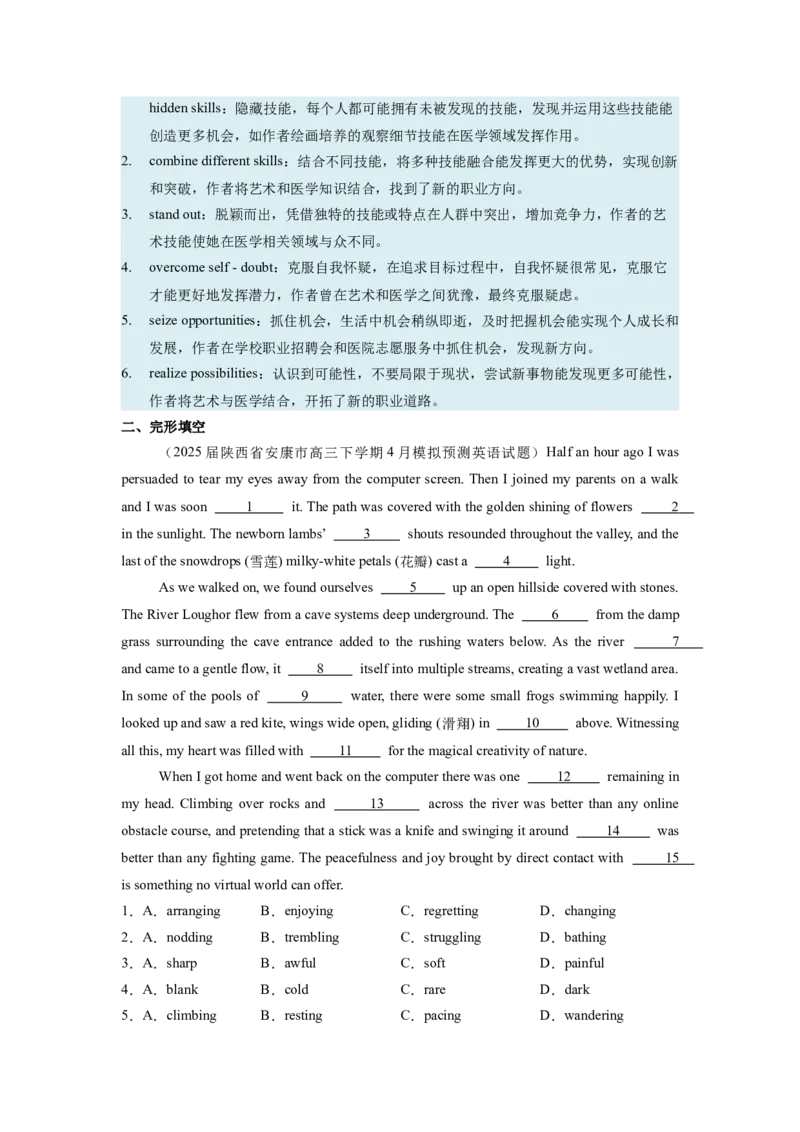
1. 推理判断题。根据第一段“My fingers trembled as I signed the pre-medical application
form. The watercolor brushes on my desk stared back at me like abandoned friends. (当我签署医
学院申请表时,我的手指在颤抖。我桌上的水彩笔像被遗弃的朋友一样盯着我。)”以及
““Art feeds the soul but starve the body,” Mom always said. Her words haunted me as my
biology textbooks slowly buried my drawing pads.(“艺术滋养灵魂,却让身体挨饿,”妈妈总
是说。当我的生物课本慢慢埋葬了我的绘图板时,她的话一直萦绕在我耳边。)”可推知,
Lora在艺术和医学研究之间左右为难。故选C。
2. 推理判断题。根据第二段“Dr. Eleanor Whitman from Harvard asked us to list our “hidden
skills” My hand shook as I wrote “observing details” something I’d learned from painting flower
pet a ls. “That’s medical research’s most needed skill!” she exclaimed, sharing how a student
turned microbiology notes into textbook illustrations.(来自哈佛大学的埃莉诺・惠特曼博士让
我们列出自己的 “隐藏技能”。我的手在写下 “观察细节” 时颤抖着,这是我从描绘花
瓣中学到的技能。“那可是医学研究中最需要的技能!” 她大声说道,并分享了一名学生
是如何把微生物学笔记转化为教科书插图的经历。)”可推知,埃莉诺博士认为萝拉的“隐
藏技能”是一个加分项。故选A。
3. 细节理解题。根据第三段“The real surprise came during hospital volunteering. Watching
surgeries, I noticed something-the steady hands of doctors reminded me of my brush work. When
a boy struggled to describe his pain, I drew a fire-breathing dragon on his cast. “You made
medicine speak,” the nurse said. Slowly, my drawing pads filled with cells that looked like
colored-glass art and X-rays arranged like abstract paintings.(真正的惊喜是在医院做志愿者时
出现的。看着手术,我注意到一些事情------医生们稳定的双手让我想起了我的画笔。当一
个男孩努力描述自己的痛苦时,我在他的石膏上画了一条喷火的龙。“你让医学说话
了,”护士说。慢慢地,我的绘图板上画满了看起来像彩色玻璃艺术的细胞和像抽象画的
X光片。)”可知,Lora的医院经历使她确信艺术在医疗保健中的作用。故选D。
4. 推理判断题。根据最后一段“Today, my microscope and paintbrushes share the same desk.
The same hands that once hesitated between them now create 3 D models of viruses for vaccine
education. Sometimes I teach young patients to draw their feelings instead of describing them. My
story in about heart and reality cancelling each other out — they just multiply possibilities. (今天,
我的显微镜和画笔共用一张桌子。曾经在这两者之间犹豫不决的双手,现在为疫苗教育创
造了病毒的3D模型。有时我教年轻病人画出他们的感受,而不是描述它们。我的故事是
内心和现实相互抵消——它们只是增加了可能性。)”可推知,作者想表达:多一种技能多
一条出路。故选D。
词块积累2-艺术与医学结合hidden skills:隐藏技能,每个人都可能拥有未被发现的技能,发现并运用这些技能能
创造更多机会,如作者绘画培养的观察细节技能在医学领域发挥作用。
2. combine different skills:结合不同技能,将多种技能融合能发挥更大的优势,实现创新
和突破,作者将艺术和医学知识结合,找到了新的职业方向。
3. stand out:脱颖而出,凭借独特的技能或特点在人群中突出,增加竞争力,作者的艺
术技能使她在医学相关领域与众不同。
4. overcome self - doubt:克服自我怀疑,在追求目标过程中,自我怀疑很常见,克服它
才能更好地发挥潜力,作者曾在艺术和医学之间犹豫,最终克服疑虑。
5. seize opportunities:抓住机会,生活中机会稍纵即逝,及时把握机会能实现个人成长和
发展,作者在学校职业招聘会和医院志愿服务中抓住机会,发现新方向。
6. realize possibilities:认识到可能性,不要局限于现状,尝试新事物能发现更多可能性,
作者将艺术与医学结合,开拓了新的职业道路。
二、完形填空
(2025届陕西省安康市高三下学期4月模拟预测英语试题)Half an hour ago I was
persuaded to tear my eyes away from the computer screen. Then I joined my parents on a walk
and I was soon 1 it. The path was covered with the golden shining of flowers 2
in the sunlight. The newborn lambs’ 3 shouts resounded throughout the valley, and the
last of the snowdrops (雪莲) milky-white petals (花瓣) cast a 4 light.
As we walked on, we found ourselves 5 up an open hillside covered with stones.
The River Loughor flew from a cave systems deep underground. The 6 from the damp
grass surrounding the cave entrance added to the rushing waters below. As the river 7
and came to a gentle flow, it 8 itself into multiple streams, creating a vast wetland area.
In some of the pools of 9 water, there were some small frogs swimming happily. I
looked up and saw a red kite, wings wide open, gliding (滑翔) in 10 above. Witnessing
all this, my heart was filled with 11 for the magical creativity of nature.
When I got home and went back on the computer there was one 12 remaining in
my head. Climbing over rocks and 13 across the river was better than any online
obstacle course, and pretending that a stick was a knife and swinging it around 14 was
better than any fighting game. The peacefulness and joy brought by direct contact with 15
is something no virtual world can offer.
1.A.arranging B.enjoying C.regretting D.changing
2.A.nodding B.trembling C.struggling D.bathing
3.A.sharp B.awful C.soft D.painful
4.A.blank B.cold C.rare D.dark
5.A.climbing B.resting C.pacing D.wandering6.A.plants B.sands C.falls D.drops
7.A.dried up B.calmed down C.broke off D.rushed on
8.A.gathered B.expanded C.divided D.maintained
9.A.dirty B.pure C.salty D.still
10.A.pairs B.circles C.groups D.rows
11.A.gratitude B.doubt C.fear D.guilt
12.A.thought B.image C.memory D.puzzle
13.A.flying B.leaping C.looking D.swimming
14.A.heavily B.constantly C.occasionally D.joyfully
15.A.curiosity B.history C.nature D.society
【答案】
1.B 2.D 3.C 4.B 5.A 6.D 7.B 8.C 9.D
10.B 11.A 12.A 13.B 14.D 15.C
【导语】这是一篇记叙文。作者暂别电脑与父母散步,沿途感受自然美景,回家后感悟自
然带来的宁静与快乐无可替代。
1.考查动词词义辨析。句意:然后我和父母一起去散步,很快我就沉浸其中。A. arranging
安排;B. enjoying享受;C. regretting后悔;D. changing改变。根据下文“The path was
covered with the golden shining of flowers”中对美丽景色的描述可知,作者享受散步过程,
enjoying符合语境。故选B项。
2.考查动词词义辨析。句意:小径上铺满了沐浴在阳光下的花朵发出的金色光芒。A.
nodding点头;B. trembling颤抖;C. struggling挣扎;D. bathing沐浴。根据下文“in the
sunlight”以及语境可知,这里考查bathing in the sunlight,形象地描绘出花朵在阳光下的状
态,与golden shining相呼应。故选D项。
3.考查形容词词义辨析。句意:新生羊羔的轻柔叫声在山谷中回荡。A. sharp尖锐的;B.
awful糟糕的;C. soft轻柔的;D. painful痛苦的。由下文“shouts resounded throughout the
valley”以及语境可知,新生羊羔的叫声通常是轻柔的,soft符合语境。故选C项。
4.考查形容词词义辨析。句意:最后的雪莲花乳白色的花瓣投下清冷的光。A. blank空白
的;B. cold冷的;C. rare罕见的;D. dark黑暗的。根据上文“milky-white petals”以及语境
可知, 雪莲花乳白色的花瓣给人一种清冷的感觉,cold light搭配恰当。故选B项。
5.考查动词词义辨析。句意:当我们继续走时,我们发现自己爬上了一个满是石头的开阔
山坡。A. climbing爬;B. resting休息;C. pacing踱步;D. wandering徘徊。根据下文
“hillside”以及语境可知,这里指是向上爬山坡,climbing符合语境。故选A项。
6.考查名词词义辨析。句意:洞穴入口周围潮湿的草地上的水滴汇入了下面湍急的水流中。
A. plants植物;B. sands沙子;C. falls瀑布;D. drops水滴。根据下文“damp grass”以及语
境可知,这里指草地上的水滴,drops符合语境。故选D项。7.考查动词短语辨析。句意:当河流平静下来,缓缓流淌时,它分成了多条小溪,形成了
一个广阔的湿地地区。A. dried up干涸;B. calmed down平静下来;C. broke off中断;D.
rushed on继续冲。根据下文“came to a gentle flow”以及语境可知,这里指河流流速变缓,
calmed down符合语境。故选B项。
8.考查动词词义辨析。句意:当河流平静下来,缓缓流淌时,它分成了多条小溪,形成了
一个广阔的湿地地区。A. gathered聚集;B. expanded扩大;C. divided分开;D. maintained
维持。根据下文“into multiple streams”以及语境可知,这里指河流分开成多条小溪。故选
C项。
9.考查形容词词义辨析。句意:在一些静止的水池里,有一些小青蛙在快乐地游泳。A.
dirty脏的;B. pure纯的;C. salty咸的;D. still静止的。根据上文“some of the pools”以及
语境可知,pools通常是静止的水域,still符合语境,与下文“小青蛙在快乐地游泳”形成
对比。故选D项。
10.考查名词词义辨析。句意:我抬头看到一只红风筝,翅膀张开,在空中盘旋滑翔。A.
pairs双;B. circles圈;C. groups组;D. rows排。根据上文“a red kite”以及语境可知,这
里考查in circles,表示“成圈地”,描述风筝在空中盘旋的状态,符合语境。故选B项。
11.考查名词词义辨析。句意:目睹这一切,我的心中充满了对大自然神奇创造力的感激
之情。A. gratitude感激;B. doubt怀疑;C. fear恐惧;D. guilt内疚。根据下文“for the
magical creativity of nature”以及语境可知,面对大自然的美景,作者心中应是充满感激,
gratitude符合语境。故选A项。
12.考查名词词义辨析。句意:当我回到家,回到电脑前,我的脑海中只剩下一个想法。
A. thought想法;B. image形象;C. memory记忆;D. puzzle难题。根据下文“Climbing
over rocks and 1 2 across the river was better than any online obstacle course”以及语境
可知,后文是作者关于亲近自然与虚拟世界的对比想法,thought符合语境。故选A项。
13.考查动词词义辨析。句意:翻越岩石,跳过河流比任何在线障碍课程都好。A. flying
飞;B. leaping跳;C. looking看;D. swimming游泳。根据下文“across the river”以及语境
可知,这里考查leaping across,表示“跳过”,符合跨越河流的语境。故选B项。
14.考查副词词义辨析。句意:假装一根棍子是一把刀,快乐地挥舞着它比任何战斗游戏
都好。A. heavily沉重地;B. constantly不断地;C. occasionally偶尔;D. joyfully快乐地。
根据下文“better than any fighting game”以及语境可知,这里在与游戏比较,而joyfully体
现出玩耍时的快乐。故选D项。
15.考查名词词义辨析。句意:与大自然直接接触所带来的宁静和快乐是任何虚拟世界都
无法提供的。A. curiosity好奇;B. history历史;C. nature自然;D. society社会。根据上文
“ Climbing over rocks and 13 across the river”以及语境可知,文章主要描述了作者在
自然中的经历和感受,nature符合语境。故选C项。
词块积累3-远离电子产品亲近自然1. take a walk:散步,是放松身心、接触自然的简单方式,能缓解压力、锻炼身体,如文
中作者和父母散步感受自然之美。
2. appreciate nature:欣赏自然,感受自然的美好与神奇,培养对自然的敬畏和热爱之情,
作者在散步中对自然的美景充满感激。
3. direct contact with nature:与自然直接接触,能带来宁静和快乐,增强对自然的认知和
理解,让人们更珍惜自然。
4. find joy in simple things:从简单事物中找到快乐,生活中很多简单的事物都蕴含快乐,
学会发现能提升幸福感,如作者从自然景色和玩耍中获得快乐。
5. disconnect from technology:远离科技产品,暂时放下电子设备,回归真实生活,有助
于人们关注周围世界,享受当下。
6. reflect on experiences:反思经历,通过反思能从生活经历中获取经验和感悟,促进个
人成长,作者回家后反思自然带给自己的感受。
三、读后续写
(2025届湖北省黄冈市黄梅县育才高级中学高三下学期核心模拟卷(三)英语试题)阅读
下面材料,根据其内容和所给段落开头语续写两段,使之构成一篇完整的短文。
Being an adult who didn’t know how to ride a bike became a joke about me. “Oh, that’s just
Hannah,” my friends would laugh. “Of course, she can’t. She’s so uncoordinated (不协调).” I
would usually laugh along with them. I lacked a good sense of balance. After all, it’s better to be
laughed with than laughed at. Actually, I’d tried to learn before. Well-meaning friends would offer
to teach me, and I would agree, only for the process to end up with me frightened and them
disappointed.
One day, my friends and I planned a trip to see a friend’s hometown in Sweden. We were
discussing the trip one morning when Jane cheered, “We can borrow bikes and do a tour through
the village. It’ll be so fun!” Suddenly, she realized I was there and turned toward me with a look
of pity. “Of course, walking will be just as nice.” “No, no, I’ll ride,” I replied. “I have plenty of
time to learn.”
That afternoon when I got home, I talked to my husband Matt, who was a good cyclist,
taking a deep breath as I faced him. “Can you teach me how to ride a bike?” He smiled, “Of
course.” The next few weeks, Matt fully accepted this role. He watched videos online, visited local
bike shops and purchased a helmet (头盔) for me.
Finally, the day came, and early that morning, we walked a bike to the local park. I won’t
lie:The negative self-talk came in. You would never be able to do this. You had gotten this far in
life not knowing how to do this, so why did you bother to learn now? I didn’t think I was ready to
step far out of my comfort zone although I had overcome many difficult things. When we got to
the park, the lesson began but nothing was working. I couldn’t master balance well. I was resistingeverything Matt said to me. Worse still, the pedal (踏板) scratched (擦伤) the back of my ankle
when I rolled on it, leaving me close to tears. “Wait here,” he said before jumping on the bike and
riding off. And I threw myself onto the grass with my head in my hands.
注意:1.续写词数应为150个左右;
2.请按如下格式在答题卡的相应位置作答。
However, as I sat on the grass, another train of thoughts flashed into my mind.__________
_______________________________________________________________________________
_______________________________________________________________________________
_______________________________________________________________________________
_______________________________________________________________________________
_______________________________________________________________________________
_______________________________________________________________________________
____________________________________________________
Matt returned with a screwdriver (螺丝刀) in his hand._____________________________
_______________________________________________________________________________
_______________________________________________________________________________
_______________________________________________________________________________
_______________________________________________________________________________
_______________________________________________________________________________
_______________________________________________________________________________
____________________________________________________
【答案】One possible version:
However, as I sat on the grass, another train of thoughts flashed into my mind. Who said you
couldn’t learn to ride? I was surprised by this thought. I thought consciously about what I was
thinking. I began exploring all the time when I had overcome things that were hard or different,
and how proud of myself I had been. The longer I sat there, the stronger my resolve grew. By the
time I saw Matt heading back towards me on the bike, I had been determined to accept the lesson
and try my best.
Matt returned with a screwdriver (螺丝刀) in his hand. He removed the pedals so that Icould practice rolling on the bike well to learn balance. By mid-morning, I could roll down the hill
with ease. By that afternoon, to my surprise but also with great pride, I was riding a bike. I was in
shock that I was doing something that had terrified me for much of my life. Meanwhile, I learnt
that I should be confident and courageous to step outside my comfort zone.
【导语】本文以作者学习骑自行车为线索展开,讲述了她作为一个成年人克服自身平衡感
差及外界质疑的故事,尽管朋友们的嘲笑和之前多次失败的经历让她心存疑虑,但在计划
瑞典之旅并决定加入朋友们的骑行时,作者定决心重新尝试。在丈夫Matt的耐心帮助和支
持下,她开始了这段挑战自我、突破舒适区的旅程。然而,初次练习遭遇挫折后,她的决
心再次受到考验。
【详解】1.段落续写:
①由第一段首句内容“然而,当我坐在草地上时,另一串思绪闪现在脑海中。”可知,第
一段可描写作者坐在草地上对自己过去学习骑自行车的反思和感悟。
②由第二段首句内容“Matt回来时手里拿着一把螺丝刀。”可知,第二段可描写Matt取来
螺丝刀的目的以及接下来作者学习骑自行车的进展以及作者的感悟。
2.续写线索:坐在草坪上——回忆过往练习经历——决定勤加练习——进展飞速——学会
骑自行车——感悟
3.词汇激活
行为类
①克服:overcome/get over
②返回:heading back/returned/make one’s way back
③卸掉:removed/take off/unscrew
情绪类
①惊讶:surprised/shocked/amazed/astonished
②自豪:with great pride/feeling proud
【点睛】[高分句型1] I thought consciously about what I was thinking.(运用了what引导的宾
语从句)
[高分句型2] The longer I sat there, the stronger my resolve grew.(运用了“the+比较
级…,the+比较级…”结构)
[高分句型3] I was in shock that I was doing something that had terrified me for much of my life.
(运用了that引导的定语从句修饰不定代词something)
词块积累4-学习骑行的经历
1. learn a new skill:学习新技能,提升自我能力的重要方式,过程中可能遇到困难,但
坚持就能取得进步,如作者学习骑自行车。
2. face challenges:面对挑战,生活中充满各种挑战,勇敢面对能锻炼意志,提升解决问
题的能力,作者克服平衡困难学习骑车。3. step out of one's comfort zone:走出舒适区,突破自我限制,尝试未知事物,能获得成
长和新的体验,作者决定学习骑车就是走出舒适区。
4. seek help from others:向他人寻求帮助,遇到困难时,他人的帮助和支持能让我们更
快地解决问题,作者向丈夫寻求帮助学习骑车。
5. persist in doing sth.:坚持做某事,学习新技能或面对困难时,坚持是成功的关键,作
者在学习骑车过程中虽遇挫折但坚持下来。
6. build confidence:建立自信,通过克服困难、取得进步,能增强自信心,让我们更勇
敢地面对未来挑战,作者学会骑车后变得更自信。