绝密★启用前
2026 年高考二轮信息必刷卷01(全国二卷)
英  语
考情速递
高考·新动向:参考历年高考真题变化趋势,高考真题在题型上与往年保持一致。选材上
阅读材料更加注重现实生活场景;命题更注重语篇的真实性、实用性与育人价值,强调在
真实语境中考查语言运用能力。阅读理解强化思维考查,细节理解与推理判断并重,长难
句分析成为核心能力测点;完形填空聚焦实词辨析与语境逻辑,弱化单纯语法考查,突出
语篇连贯理解;语法填空考点全面且灵活,侧重动词形态、词性转换及介词搭配,强调知
识在语篇中的应用。三类题型均凸显“五育融合”导向,渗透核心素养考查。
高考·新情境:在命题中,融合思想性和教育性,引导学生多角度思考。阅读题材涵盖旅
游指南、人物故事、科普环保等,贴近现实生活与时代热点;完形填空以个人成长、正能
量故事为载体,强化情感共鸣与价值引领;语法填空融入跨文化交流场景,如中外生活体
验、文化联结等,彰显文化自信。情境设计注重实用性与真实性,引导学生用英语解决实
际问题。
命题·大预测:高考将持续深化语境化考查,阅读推理题占比或提升,科普与传统文化题
材热度不减;完形填空将更侧重逻辑线索挖掘,固定搭配与语境结合更紧密;语法填空或
增加语篇理解类考点,减少孤立语法题。整体难度稳中有升,强调语言综合运用与思维品
质,建议强化限时训练与错题归因。
(考试时间:120 分钟  试卷满分:150 分)
注意事项:
1. 答题前,考生先将自己的姓名、准考证号码填写清楚,将条形码准确粘贴在条形码区域
内。
2. 选择题必须使用2B 铅笔填涂;非选择题必须使用0. 5 毫米黑色字迹的签字笔书写,字体
工整,字迹清楚。
3. 请按照题号顺序在答题卡各题目的答题区域内作答,超出答题区域书写的答案无效;在
草稿纸、试卷上答题无效。
4. 作图可先使用铅笔画出,确定后必须用黑色字迹的签字笔描黑。
5. 保持卡面清洁,不要折叠、不要弄破、弄皱,不准使用涂改液、修正带、刮纸刀。
第一部分  听力(共两节,满分 30 分)
做题时,先将答案标在试卷上。录音内容结束后,你将有两分钟的时间将试卷上的答案转
涂到答题卡上。
第一节(共5 小题;每小题1.5 分,满分7.5 分)
听下面5 段对话。每段对话后有一个小题,从题中所给的A、B、C 三个选项中选出最
佳选项。听完每段对话后,你都有10 秒钟的时间来回答有关小题和阅读下一小题。每段对
话仅读一遍。
1.When did the man go to Universal Beijing Resort?
A.Last summer.
B.Last winter.
C.Last autumn.
【答案】B
【原文】A: Did you visit Universal Beijing Resort last summer?
B: I couldn’t make it then, but I finally visited it during the Spring Festival. I plan to visit it again
this year.
2.How did screen addiction affect the woman?
A.It made her put on weight.
B.It made her eyesight worse.
C.It made her lose interest in real life.
【答案】C
【原文】W: I found too much screen time pulled all the color out of real life. I couldn’t see the
point of anything else. Luckily, it was all passed.
M: Yes. It ate up so much time! Getting it under control has been such a weight off my mind!
3.How does the woman feel about the man’s hobby?
A.It’s pleasing.
B.It’s nothing special.
C.It’s time-consuming.
【答案】A
【原文】W: I made those new chocolate chip cookies from the recipe you sent. My family loved
them.
M: That’s great! I’ve shared that recipe with lots of friends, and they all love it. There’s nothing
like the joy of baking.
W: Absolutely, it’s such a satisfying hobby.
4.When will Charlie have the interview?
A.Tomorrow.
B.In a week.
C.In two weeks.
【答案】B
【原文】W: So Charlie, have you heard back about the job you applied for last week?
M: Yes, I just got an email yesterday. I’m scheduled to have an interview with the manager a week
from today.
W: That’s great. What did they ask you to prepare for the interview?
M: They said nothing had to be prepared, but I need to dress up so I will do some shopping
tomorrow.
5.Why doesn’t the woman want to fly?
A.It’s too expensive.
B.It’s dangerous.
C.It’s uncomfortable.
【答案】B
【原文】W: How are you going to the meeting next week?
M: By plane. It’s fast and comfortable.
W: I’m afraid of flying. I don’t feel safe in a plane.
M: I understand. A lot of people feel that way.
第二节(共15 小题;每小题1.5 分,满分22.5 分)
听下面5 段对话或独白。每段对话或独白后有几个小题,从题中所给的A、B、C 三个
选项中选出最佳选项。听每段对话或独白前,你将有时间阅读各个小题,每小题5 秒钟;
听完后,各小题将给出5 秒钟的作答时间。每段对话或独白读两遍。
听第6 段材料,回答第6、7 题。
6.Who is the woman?
A.A parent.
B.A lecturer.
C.A student.
7.Which will the speakers probably see first?
A.The economics department.  B.The science buildings. C.The business department.
【答案】6.C    7.B
【原文】W: Hello, and welcome to our university open day. I’m Mel. I’m studying economics,
and I’ll be showing you and your parents around today.
M: Where will we be going first?
W: We’ll walk around the university campus to begin with. I’ll show you some of the students’
accommodation, and then we’ll head toward the different department buildings.
M: I’m looking to get a degree in business management. Will we be visiting the business
management department?
W: Yes, right after we visit the science buildings and then the economics department. I’ll show
you around the different rooms, offices, and halls. We’ll even meet some of the lecturers. You’ll be
able to ask them questions about your courses.
M: Great.
听第7 段材料,回答第8 至10 题。
8.What did Sarah tell Mark about?
A.A new project plan.
B.A new job opportunity.
C.A design competition.
9.What does Sarah hope to do?
A.To work from home.
B.To manage projects herself. C.To join a bigger team.
10.What is Mark’s position?
A.A team member.
B.A project leader.
C.A department head.
【答案】8.B    9.B    10.C
【原文】W: Mark, do you have a moment? I need to talk to you about something important.
M: Of course, Sarah, what’s on your mind?
W: Well, I’ve received a job offer from global design studio. They’re offering me a position as a
senior designer.
M: I see this is unexpected. You’ve been doing excellent work here at our studio.
W: Thank you. I’ve truly enjoyed my three years here and learned so much from the team.
However, this new role would allow me to lead my own projects, which is something I’m really
looking forward to.
M: I understand. When do you need to give them your answer?
W: They’ve asked for my decision by next Monday.
M: Let me discuss this with the management team. What if we could offer you the opportunity to
lead some projects here? Would that make a difference in your decision?
W: Actually, that would be wonderful. I’d be very happy to stay if I could take on more
responsibility.
M: Great, I’ll have an answer for you by this Friday. Will that work for you?
W: That would be perfect. Thank you for being so understanding.
听第8 段材料,回答第11 至13 题。
11.What is expected to do when visiting a German’s home?
A.Arrive on time.
B.Bring red roses.
C.Arrive a little early.
12.What should you do first if you’re over 15 minutes late?
A.Write a note.
B.Call the host.
C.Cancel the visit.
13.How does the man find the thank-you note?
A.Outdated.
B.Embarrassing.
C.Favorable.
【答案】11.A    12.B    13.C
【原文】M: Germany has many customs. Could you introduce some of being a guest there?
W: Well, when you’re invited to someone’s house, you can take flowers. But avoid red roses. They
are often associated with romantic love and not suitable for the situation.
M: OK. And when should I arrive? Is arriving a little early good?
W: No, never. You’re expected to arrive on time. Being on time matters a lot in Germany.
M: Oh, so being late is not allowed at all? What if something comes up and I can’t make it on
time?
W: If you’re going to be over 15 minutes late, you’d better call the host first. And there’s one more
thing — you should write a short thank-you note the next day.
M: I like that. I wish we do the same here more often. To me, it shows good manners.
听第9 段材料,回答第14 至17 题。
14.Where are the speakers talking?
A.In a home office.
B.In a coffee shop.
C.In an online meeting room.
15.What are the speakers mainly talking about?
A.Their business costs.
B.Their new workplace.
C.Their new work schedule.
16.How long did the man spend in meetings per day on average last month?
A.About 20 minutes.
B.About 1 hour.
C.About 2 hours.
17.What department does Alex probably work in?
A.Finance.
B.Marketing.
C.Technology.
【答案】14.C    15.C    16.B    17.A
【原文】M: Hi Claudia! Can you hear me?
W: Yes, all good! Please excuse me for changing my chat background image. My house is a mess!
M: Ha-ha! Why do you think I’ve come to a coffee shop? Anyway, shall we get started?
W: Yes! So, returning to yesterday’s discussion: I’m open to the idea of a four-day working week,
but I need to understand exactly how it would work.
M: The key will be to cut out wasted time and unnecessary labor. Firstly, we all know meetings
can be a huge time waster. Taking my own personal calendar as an example: In the past month, my
shortest meeting lasted about 20 minutes, the longest one went up to two hours, and I spent a total
of 30 hours in meetings.
W: That is crazy!
M: Sometimes they’re essential. But emails or shared documents are fine for general updates.
W: What about a “deep work” period each morning? No meetings or messages, just focused work.
M: Good thinking! A “commonly asked questions” section on the website would also free up our
support team, too.
W: Great! If you can finish your list of recommendations today and send it over, I’ll speak to Alex
about the money side of things.
M: Perfect. Will do!
听第10 段材料,回答第18 至20 题。
18.What is the speaker doing?
A.Recalling his youth life.
B.Promoting a TV studio.
C.Sharing his personal journey.
19.Who introduced the speaker to filming?
A.His friend’s father.
B.A camera operator.
C.His parents.
20.Which item were participants required to supply themselves?
A.Recording devices.
B.Power sources.
C.Editing equipment.
【答案】18.C    19.B    20.B
【原文】
M: Hello, everyone. I’m glad to be here with you today. My journey into video-making
started when a friend invited me to visit her father at work in a TV studio. During the visit, the
camera operator gave me a chance to try filming, and it was an incredible experience. Inspired by
this, I convinced my parents to sign me up for a film course. The course ran every Saturday from
10 a.m. to 2 p.m., from September to May with a break in December. In the final month, we had
extra sessions in the afternoons to prepare for our projects.
We worked together in groups. We used our small cameras and equipment to seize the
beauty around us, turning everyday moments into short videos that told stories. All the necessary
equipment, like computers and cameras, was provided for us. The only thing we had to bring was
batteries. At the end of the course, I received a certificate, which made all the hard work
worthwhile.
第二部分  阅读(共两节, 满分50 分)
第一节(共15 小题;每小题2.5 分, 满分37.5 分)
阅读下列短文, 从每题所给的A、B、C 和D 四个选项中选出最佳选项。
A
Talkspace
Why We Choose It
Talkspace, an online anger management platform, is a popular choice for people who look
for help with anger management problems. It’s affordable and accessible for those who may not
have much time for themselves.
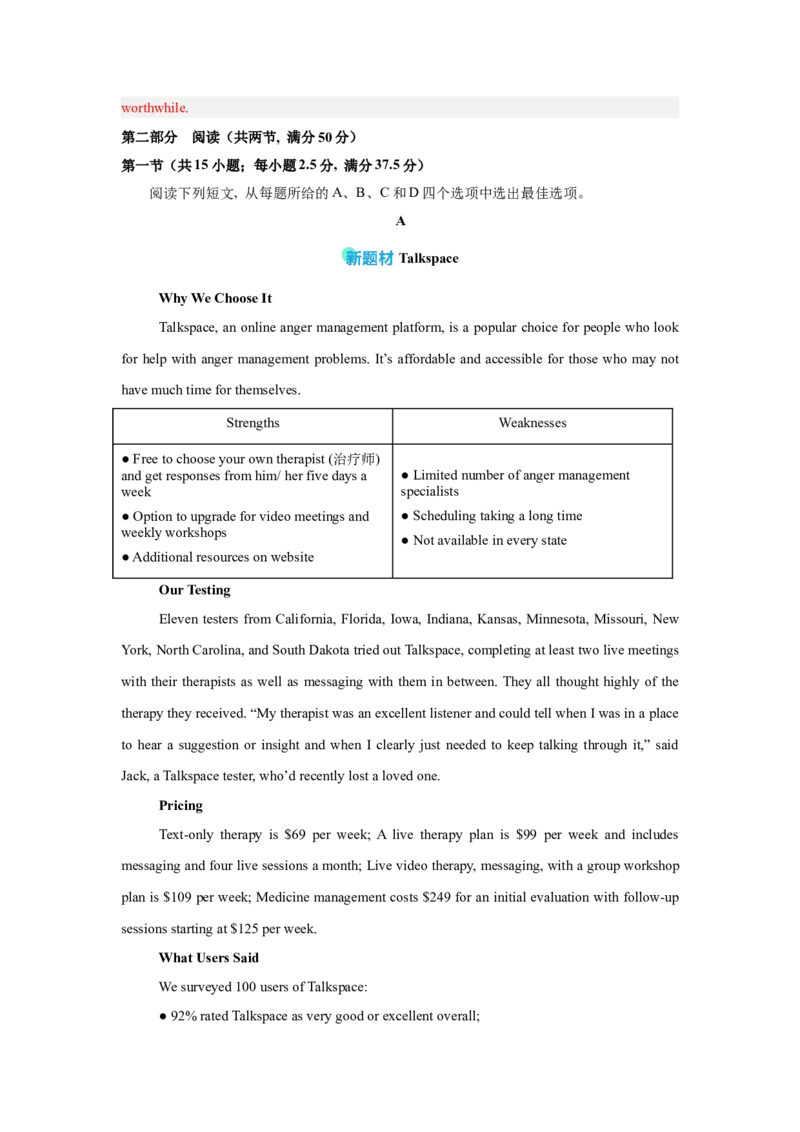
Strengths
Weaknesses
● Free to choose your own therapist (治疗师)
and get responses from him/ her five days a
week
● Option to upgrade for video meetings and
weekly workshops
● Additional resources on website
● Limited number of anger management
specialists
● Scheduling taking a long time
● Not available in every state
Our Testing
Eleven testers from California, Florida, Iowa, Indiana, Kansas, Minnesota, Missouri, New
York, North Carolina, and South Dakota tried out Talkspace, completing at least two live meetings
with their therapists as well as messaging with them in between. They all thought highly of the
therapy they received. “My therapist was an excellent listener and could tell when I was in a place
to hear a suggestion or insight and when I clearly just needed to keep talking through it,” said
Jack, a Talkspace tester, who’d recently lost a loved one.
Pricing
Text-only therapy is $69 per week; A live therapy plan is $99 per week and includes
messaging and four live sessions a month; Live video therapy, messaging, with a group workshop
plan is $109 per week; Medicine management costs $249 for an initial evaluation with follow-up
sessions starting at $125 per week.
What Users Said
We surveyed 100 users of Talkspace:
● 92% rated Talkspace as very good or excellent overall;
● 89% rated their therapists’ qualifications as very good or excellent;
● 95% said that most or all of their needs were met at Talkspace;
● 97% said they were very likely to suggest that a friend or someone like them turn to
Talkspace.
21.What is an advantage of Talkspace?
A.It allows users video meetings.
B.It has enough specialists.
C.It is available in all states.
D.It promises responses daily.
22.Which service costs most monthly?
A.Text-only therapy.
B.Live video therapy.
C.Medicine management.
D.A live therapy plan.
23.What is the percentage of the surveyed users willing to recommend Talkspace?
A.89%.
B.92%.
C.95%.
D.97%.
【答案】21.A    22.C    23.D
【解析】这是一篇应用文,主要介绍了在线愤怒管理平台Talkspace。
21.细节理解题。根据“Strengths”部分中的“Option to upgrade for video meetings and
weekly workshops(可选择升级进行视频会议和每周研讨会)”可知,Talkspace 的一个优势是
允许用户进行视频会议。故选A。
22.细节理解题。根据Pricing 部分“Text-only therapy is $69 per week; A live therapy plan is
$99 per week and includes messaging and four live sessions a month; Live video therapy,
messaging, with a group workshop plan is $109 per week; Medicine management costs $249 for
an initial evaluation with follow-up sessions starting at $125 per week.(纯文本治疗服务收费为
每周69 美元;实时治疗方案每周99 美元,包含即时通讯及每月四次直播会谈;含团体工
作坊的实时视频治疗与信息交流计划每周109 美元;药物管理服务首次评估费用为249 美
元,后续随访每周起价125 美元/周。)”可知,一个月按四周算,Text-only therapy 每月费用
约为69×4=276 美元;A live therapy plan 每月费用约为99×4=396 美元;Live video therapy
每月费用约为109×4=436 美元;Medicine management 首次评估加上后续三周跟进费用至少
为249+125×3=249+375=624 美元。所以每月费用最高的是Medicine management,故选C。
23.细节理解题。根据“What Users Said”部分中的“97% said they were very likely to
suggest that a friend or someone like them turn to Talkspace.(97%的人表示他们非常有可能建议
朋友或像他们这样的人求助于Talkspace。)”可知,愿意推荐Talkspace 的受访用户比例为
97%,故选D。
B
A new biography, Always Be Young: A Biography of Yang Chen-Ning, offers a
fresh look at the Nobel-winning physicist. The book's author, Lin Kailiang, was a doctoral student
when he first contacted Yang, never expecting it would lead to a deep friendship and the chance to
write the story of the great scientist's life. Officially authorized, the book aims to present Yang not
just as a scientific giant, but as a warm, relatable human being driven by curiosity and a love for
his homeland.
To make Yang's complex world accessible to young readers, Lin uses simple, everyday
examples. He shares stories of a young Yang solving classic math puzzles to sharpen his mind. For
Yang's more difficult scientific ideas, like the Yang-Baxter equation, Lin turns to a clever
metaphor: he compares it to the pattern of hair braiding. This visual comparison helps readers
appreciate the beauty of the science without needing to understand its difficult math. The book's
illustrator was so inspired that she even tried braiding hair for the first time, feeling that math was
no longer distant from life.
The title itself holds deep meaning. "Returned" refers to Yang's physical return to China in
his later years, fulfilling a promise to his father. It also reflects his view of life as a "great circle"
coming to completion. "Youth" is a tribute to his mindset; even as he aged, his thinking remained
vibrant and his sense of wonder never faded. This idea was inspired by a friend who once wished
him, "May you always be young (Yang)."
Beyond his public achievements, the book reveals Yang's private world. A particularly
touching story is about a family reunion in Geneva. There, Yang watched with deep satisfaction as
his elderly father and his young son discovered a "secret path" in a park, creating their own special
adventure. This simple moment shows the great physicist as an ordinary man, finding joy in
family connections. It is these personal details that make the legend relatable and remind us that
greatness is often rooted in genuine human qualities.
24. What is the main purpose of the book?
A. To show Yang's human side and inspire young readers.
B. To introduce Yang's complex scientific theories.
C. To describe the author's personal journey as a writer.
D. To explain why Yang returned to China.
25. Why is the hair-braiding metaphor mentioned?
A. To show that Yang was interested in everyday activities.
B. To prove that math is the foundation of all art.
C. To illustrate how science can connect with daily life.
D. To highlight the illustrator's creative skills.
26. What does the Geneva story reveal about Yang?
A. He regretted being away from his family for too long.
B. He was deeply concerned about his father's health.
C. He found great value in simple family moments.
D. He had a difficult relationship with his son.
27. What does "youth" in the book's title refer to?
A. The age at which Yang won the Nobel Prize.
B. Yang's ability to connect with young people.
C. Yang's early interest in mathematical puzzles.
D. His lasting curiosity and energetic mindset.
【答案】24.A  25.C  26.C  27.D
【解析】本文介绍了一本关于杨振宁先生的新传记。该书旨在通过个人轶事和生动的比
喻,展示杨振宁作为普通人温情、充满好奇心和年轻心态的一面,从而让年轻读者能够理
解并受到这位科学巨匠的人生哲学和人格魅力的启发。
24. 推理判断题。文章第一段明确指出,这本书的目标是“ present Yang not just as a
scientific giant, but as a warm, relatable human being”(展示杨振宁不仅是一位科学巨人,更
是一个温暖、亲切的人),并且通过他的故事激励读者。这与A 选项“展示杨先生人性化
的一面并激励年轻读者”完全吻合。
25. 细节理解题。文章第二段提到,用编发来比喻复杂的方程,是为了“ help readers
appreciate the beauty of the science without needing to understand its difficult math”(帮助读者
在不理解深奥数学的情况下欣赏科学之美),并且让插画家感到“ math was no longer
distant from life”(数学不再远离生活)。这表明该比喻是为了说明科学与日常生活可以紧
密联系。
26. 细节理解题。文章第四段描述,杨振宁看到年迈的父亲和年幼的儿子在公园里享受他
们的“秘密冒险”时,内心充满了“deep satisfaction”(深深的满足感)。这个故事的核心
在于展现这位伟大科学家对简单家庭时光的珍视。
27. 词义猜测题。文章第三段明确解释了“少年”的含义:“ 'Youth' is a tribute to his
mindset; even as he aged, his thinking remained vibrant and his sense of wonder never
faded.”(“少年”是对他心态的赞颂;即使年事已高,他的思维依然活跃,对世界的好奇
心也从未减退。)这与D 选项“他持久的好奇心和充满活力的心态”意思一致。
C
Scientists have discovered life in a place they once thought impossible. In a new
study, a research team explored how tiny living things, or microbes, manage to survive in one of
the planet's harshest underwater environments. The site has a very high pH level, making it one of
the most unfriendly places for life ever recorded. Because so few living cells exist there, it is often
impossible to find signs of life like DNA.
To overcome this challenge, researchers used a different approach. They analyzed special fat
molecules, known as chemical traces, which reveal biological activity. By studying these
molecules found in sediment samples, scientists were able to understand how microbes survive in
such extreme conditions. These fat molecules act as hidden clues to life, showing the survival
strategies of organisms that feed on substances like methane. This method is sensitive enough to
detect even the faintest signals from life.
These deep-sea microbial communities play an important role in the Earth's carbon cycle.
They get their energy not from sunlight, but from minerals in rocks and gases like carbon dioxide.
This process produces methane, a key greenhouse gas. This shows that these microbes operate in a
self-contained ecosystem, independent of the ocean above. Their existence proves that complex
life processes can occur in complete isolation from the sun's energy.
The discovery is highly significant. It proves that life can exist under extreme conditions,
such as high pH and low levels of organic material. Furthermore, these fat molecules can help
scientists tell the difference between modern, living cells and the remains of ancient life. This
provides valuable insights into how life persists in places with very few nutrients. Some scientists
even believe that similar environments could have been the birthplace of the earliest forms of life
on Earth.
The samples were collected from previously unknown underwater mud volcanoes during a
deep-sea research trip. Inspired by these findings, the team now plans to grow these microbes in
controlled lab environments. Their goal is to learn more about how these organisms get nutrients
and survive in such harsh conditions, further pushing the boundaries of our understanding of life
itself.
28. What did researchers use instead of DNA to find the microbes?
A. Special fat molecules.     B. Gases from the rocks.
C. Sunlight from the surface.  D. Remains of ancient life.
29. What is the energy source for the deep-sea microbial communities?
A. Sunlight and the ocean surface.
B. Minerals from rocks and gases.
C. Other living creatures in the sea.
D. Methane and the carbon cycle.
30. What does the phrase “a self-contained ecosystem” in paragraph 3 imply?
A. It produces its own oxygen.           B. It operates independently of the ocean above.
C. It is the only system of its kind on Earth.   D. It does not require any energy source.
31. What can be inferred from the discovery about the limits of life?
A. Life can only exist in environments with neutral pH.
B. Life is more adaptable than previously believed.
C. The deep sea is the only place for extreme life.
D. All microbes are capable of producing methane.
【答案】28.A  29.B  30.B  31.B
【解析】本文描述了科学家在一个pH 值极高的极端深海环境中发现微生物生命的突破性
发现。由于细胞稀少,研究人员通过分析特殊的脂肪分子来探测这些微生物。文章解释了
它们自给自足的生态系统、它们对全球碳循环的重要性,以及这一发现如何为了解生命的
极限和生命起源提供了见解。
28. 细节理解题。根据文章第二段,“To overcome this challenge, researchers used a different
approach. They analyzed special fat molecules, known as chemical traces, which reveal biological
activity.” 可知,由于DNA 难以检测,研究人员转而分析了特殊的脂肪分子来发现生命迹
象。选项A 直接对应原文内容。选项B(气体)是微生物的能量来源,而非探测方法;选
项C(阳光)是微生物不依赖的;选项D(古老生命遗迹)是他们能够区分的对象,而非
探测工具。
29. 细节理解题。根据文章第三段,“ They get their energy not from sunlight, but from
minerals in rocks and gases like carbon dioxide.” 可知,这些微生物的能量来源是岩石中的矿
物质和气体,而非阳光。因此,选项B 是正确的。选项A 与原文信息相反;选项C 和D 在
文中未被提及为能量来源。
30. 推理判断题。根据文章第三段,“ This shows that these microbes operate in a self-
contained ecosystem, independent of the ocean above.” 这句话明确指出,这个生态系统是
“独立于海洋上层”的。由此可以推断,它不需要来自海洋上层水体的物质或能量输入,
是独立运作的。选项B 是对“independent of the ocean above”的同义转述,是正确的推断。
选项A(产生氧气)文中未提及;选项C(地球上唯一的系统)过于绝对;选项D(不需
要能量)是错误的,它们需要从岩石和气体中获取能量。
31. 推理判断题。文章开篇即点明,科学家在一个“曾认为不可能”有生命的地方发现了
生命,并称其为“对生命最不友好的环境之一”。全文的核心在于证明生命可以在这种极
端条件下存在。这直接挑战了过去的认知,表明生命的适应能力比我们之前认为的要强。
因此,可以推断出“生命比以前认为的更有韧性”。选项A 与发现相矛盾;选项C 过于绝
对化;选项D 以偏概全,文中只提到特定微生物产生甲烷。
D
Medicines like Ozempic and Wegovy have become widely used for helping people
with weight loss. They work by imitating a natural hormone that signals the brain to reduce
hunger. While effective for many, these drugs have a significant drawback: up to 40% of users
experience side effects, with nausea and vomiting being the most common. This unpleasant
experience often leads people to stop their treatment, creating a major challenge for both patients
and doctors.
Scientists are now actively exploring how to separate the desired weight-loss effects from the
unwanted nausea. New research is offering promising directions. One study found that combining
a low dose of the medicine with oxytocin (催产素), a hormone known for its role in social
bonding, led to significant weight loss in animals without any signs of nausea(反胃). Another
important study identified a specific brain area that controls both weight loss and the feeling of
sickness, suggesting that future drugs could be designed to target only the weight-loss pathway.
The influence of these medicines goes beyond simply controlling hunger. Researchers have
discovered that they also affect the brain’s reward system. A key brain circuit related to pleasure
and craving is influenced by these drugs. When this circuit is activated, it reduces the desire for
highly enjoyable, often unhealthy, foods. This helps explain why the drugs can be so effective at
controlling not just general appetite, but also the powerful cravings for "comfort foods."
Interestingly, the effects of these drugs are even broader. Studies show they can also reduce
thirst by acting on different brain regions. This discovery highlights that the treatments have a
wide-ranging impact on the brain’s basic functions. Experts believe that by understanding these
complex brain pathways, scientists may not only create better weight-loss drugs with fewer side
effects but also develop new treatments for other conditions, such as binge eating and addiction,
which are also linked to the brain’s reward system.
Overall, this new wave of research provides great hope. By mapping the exact neural circuits
involved, the scientific community is moving closer to a new generation of treatments. These
future medicines aim to help more people achieve their health goals effectively and comfortably,
maximizing benefits while minimizing discomfort.
32. What is the main purpose of the text?
A. To advertise the benefits of weight-loss drugs.
B. To introduce new research on improving weight-loss drugs.
C. To compare the effectiveness of different weight-loss medicines.
D. To explain the chemical structure of a specific hormone.
33. What can be inferred from the second paragraph?
A. Oxytocin alone is more effective than weight-loss drugs.
B. The brain area causing nausea has no connection to weight.
C. There may be multiple scientific approaches to reduce side effects.
D. All patients will stop their treatment due to discomfort.
34. How do the medicines help control cravings according to the text?
A. By making healthy food taste better.
B. By reducing the pleasure from eating certain foods.
C. By increasing the feeling of being full after meals.
D. By stopping the brain from recognizing any hunger signals.
35. Why does the author mention the drugs' effect on thirst?
A. To warn users about a new and dangerous side effect.
B. To show the drugs have wide-ranging effects on the brain.
C. To prove that the drugs are unsafe for dehydrated people.
D. To suggest that users should drink more water daily.
【答案】32.B  33.C  34.B  35.B
【解析】本文介绍了关于Ozempic 等减肥药物的新研究进展。文章首先指出这些药物虽然
有效,但常伴有恶心等副作用。接着,文章重点阐述了科学家们如何通过研究大脑机制,
探索将减肥效果与副作用分离开来的方法,例如结合催产素或靶向特定大脑区域。最后,
文章提到这些药物对大脑奖励系统和口渴等功能的广泛影响,并展望了其在治疗成瘾等其
他相关疾病上的潜力。
32. 主旨大意题。文章开篇介绍减肥药物及其副作用,随后全文围绕“新研究”如何解决
这一问题展开,包括分离副作用的方法、对大脑奖励系统的影响以及未来的应用前景。选
项A“广告药物好处”过于片面,忽略了文章的核心问题(副作用)和研究内容。选项
C“比较不同药物效果”和选项D“解释激素化学结构”在文中均未涉及。选项B“介绍关于
改善减肥药物的新研究”最准确地概括了全文的核心内容。
33. 推理判断题。第二段提到了两种不同的研究方向:一是“结合低剂量药物和催产
素”,二是“识别出一个控制体重和恶心的特定大脑区域”。这两种方法都是为了减少副
作用,由此可以推断,减少副作用可能不止一种科学方法。选项A“催产素比减肥药更有
效”与原文“组合效果更好”不符。选项B“导致恶心的大脑区域与体重无关”与原文“控
制体重和恶心”相矛盾。选项D“所有病人都会因不适停止治疗”是对原文“高达40%”的
夸大。因此,选项C 是合理的推断。
34. 细节理解题。根据第三段“it reduces the desire for highly enjoyable, often unhealthy,
foods” 以及“ helps explain why the drugs can be so effective at controlling...the powerful
cravings for 'comfort foods'”,可知药物是通过降低对特定食物的愉悦感和渴望来控制食欲
的。选项A“让健康食物更好吃”和选项D“阻止大脑识别任何饥饿信号”在文中没有依
据。选项C“增加饱腹感”是药物的一个普遍作用,但问题专门针对“cravings”(渴望),
这与大脑的奖励系统有关,选项B 更精确地回答了问题。
35. 推理判断题。第四段在提到药物对“口渴”的影响后,紧接着用“This discovery
highlights that the treatments have a wide-ranging impact on the brain’s basic functions”这句话进
行总结,并引出其对治疗其他疾病(如成瘾)的潜在意义。这说明作者提及“口渴”是为
了举例说明药物对大脑的影响是多方面的,而不仅仅局限于食欲。选项A“警告新的副作
用”和选项C“证明对脱水者不安全”与文章的客观、积极的科学基调不符。选项D“建议
多喝水”虽然看似合理,但不是作者在科学论述中的主要意图。因此,选项B 最能体现作
者的写作目的。
第二节(共5 小题;每小题2. 5 分, 满分12. 5 分)
阅读下面短文, 从短文后的选项中选出可以填入空白处的最佳选项。选项中有两项为
多余选项。
I’ve been practising the art of detachment (超脱) for at least a year now. The aim
is to be actively involved in life but less attached.
Life is a series of experiences: a combination of states we go through. Where people fail is
that they get attached to a state of transition and define their lives by it. They get attached to how
things should be. If life doesn’t match their expectations, they get frustrated angry, depressed and
even lost.     36
Detachment doesn’t mean withdrawing from life. It’s showing up with your whole self
without needing to control the outcome. Psychologists talk about “secure attachment” versus
“anxious attachment.” The first one allows you to connect while maintaining independence.     37
Anxious attachment creates suffering because it ties your happiness to something external.
Detachment frees you to find peace within.
Holding on to people, outcomes, ideas, mental states, beliefs, or an emotional state feels
safe.     38     Because when you hold onto people or things, you attach your mood,
expectations and fears to them. But everything is in transition. Adapt when things change.
    39     It’s a tricky balance. But it works in your favour. That’s another truth I’ve
learned. Life happens for its own reasons, not always for yours. People leave. Plans fall apart. Pain
comes. None of these occurrences are centered on you. Life doesn’t happen to punish or reward
you. It just happens. What you do with it is what matters.     40     The more you let go, the
more you can actually enjoy life. Life isn’t happening to you. It’s happening through you. Let it.
A.This independence is what prevents unnecessary suffering.
B.That’s the pain of attachment.
C.Take life seriously, but don’t take it personally.
D.But it can also be your undoing or your suffering.
E.Engage fully in the moment, but learn to detach from the outcome.
F.It means maintaining a strong sense of self even in relationships.
G.Holding onto nothing is how you transition through the realities unfolding.
【答案】36.B    37.A    38.D    39.C    40.G
【解析】本文是一篇议论文。文章主要讨论了超脱的艺术,强调在生活中积极投入但不执
着于结果的重要性,分析了执着带来的痛苦和超脱带来的内心平静。
36.上文“Where people fail is that they get attached to a state of transition and define their lives
by it. They get attached to how things should be. If life doesn’t match their expectations, they get
frustrated angry, depressed and even lost. (世人常陷于这样的困境:将过渡状态误作永恒,以
此定义整个人生。他们执着于“事物应当如何”的预设蓝图,当现实与预期产生偏差,便
生出挫败、愤怒、抑郁,乃至在迷途中徘徊不前)”指出人们对于人生的错误认知导致当生
活不符合期望时便会产生负面情绪,B 选项“That’s the pain of attachment.(这便是执念之
痛)”是对上述不幸的总结,指出这些负面情绪是执着带来的痛苦,句中“attachment”与上
文“get attached to how things should be”相照应,上下文语意连贯。故选B 项。
37.上文“Psychologists talk about “secure attachment” versus “anxious attachment.” The first
one allows you to connect while maintaining independence.(心理学家将依恋模式分为“安全
型”与“焦虑型”。前者让你在建立联结时仍能保持独立人格)”提到安全型依恋模式能让
你在建立联结时仍能保持独立人格,A 选项“This independence is what prevents unnecessary
suffering.(这种独立可以防止不必要的痛苦)”承接上文,进一步解释这种独立的作用,即防
止不必要的痛苦,同时与下文“Anxious attachment creates suffering because it ties your
happiness to something external.(焦虑型依恋之所以带来痛苦,是因它将你的幸福系于外物)”
形成对比。故选A 项。
38.上文“Holding on to people, outcomes, ideas, mental states, beliefs, or an emotional state
feels safe.(紧握人事、执念结果、固守观念、沉溺心境、恪守信仰或缠绵情绪,总能予人虚
幻的安全感)”提到执着于某些人或事物会让人感到安全,D 选项“But it can also be your
undoing or your suffering.(但这执念亦可能成为你的劫难,或是苦痛的根源)”与上文构成转
折关系,提出执着也可能带来毁灭或痛苦,下文“Because when you hold onto people or
things, you attach your mood, expectations and fears to them.(因为当你紧握人或物时,便是将
心境、期待与恐惧都系于其上)”解释了执着带来痛苦的原因,上下文语意连贯。故选D 项。
39.下文“It’s a tricky balance. But it works in your favour. That’s another truth I’ve learned.
Life happens for its own reasons, not always for yours. People leave. Plans fall apart. Pain comes.
None of these occurrences are centered on you. Life doesn’t happen to punish or reward you. It
just happens.(这需要微妙的平衡,但最终对你有益——这是我领悟的另一个道理。生活自有
其轨迹,不总是按你的意愿展开。有人会离开,计划会落空,痛苦会来临。这些变化都不
是针对你个人。生活不是为了惩罚或奖赏你而存在,它只是自然发生)”提到要找到一个微
妙的平衡,同时,根据指代关系可推知,设空句会出现“it”所指代的对象。C 选项“Take
life seriously, but don’t take it personally.(认真对待生活,但别把什么事都往心里去)”提出了
一种平衡的方式,即认真对待生活,但不要执着于结果,与下文内容一致,同时也与“it”
构成指代关系。故选C 项。
40.上文“Life doesn’t happen to punish or reward you. It just happens. What you do with it is
what matters.(生活本身不是为了惩罚或奖赏你,它只是自然发生。而你如何应对,才是关
键所在)”强调如何应对生活才是关键所在,G 选项“Holding onto nothing is how you
transition through the realities unfolding.(不执着于任何事物,才能从容面对不断变化的现实)”
承接上文,直接给出应对生活的正确方法,即不执着于任何事物,下文“The more you let
go, the more you can actually enjoy life.(你越放手,你就越能真正享受生活)”进一步解释了
“不执着”,即放手的好处,上下文语意连贯。故选G 项。
第三部分 语言运用(共两节,满分30 分)
第一节(共15 小题,每小题1 分,满分15 分)
阅读下面短文, 从每题所给的A、B、C 和D 四个选项中选出可以填入空白处的最佳选
项。
When Sarah first arrived in the Caribbean for an infrastructure project, she was
met with local skepticism. “People saw us as outsiders with no real care for their lives,” she
recalled. The sense of     41     grew in her, and her team faced frequent rejections of their
plans; community meetings would burst into arguments.
One afternoon, Sarah visited a bookstore run by Mrs. Alvarez. They chatted, and the elderly
woman mentioned how the old harbor had been the community’s heart — until a storm     42
it years ago. “No one’s dared to     43     it since,” she said, her voice filled with regret.
Sarah saw a chance for the     44     of the growing distrust. She asked Mrs. Alvarez to
gather a few residents for a casual chat about the harbor’s past. To her     45    , over fifty
people came,     46     sharing old photos and memories. That day, Sarah’s team     47

their blueprints and just listened.
As stories emerged, the community’s     48     attitude softened. Residents offered
suggestions, and teens helped compile historical records. The final construction plan     49

a memorial wall with quotes from those stories — an idea born from listening.
Last month, the new harbor opened. Mrs. Alvarez placed a book of collected stories at the
entrance. “Infrastructure is steel and concrete,” she told Sarah, “but trust is     50     through
stories. You built a bond.”
Sarah now     51     her time between regions, teaching others to use storytelling. “It’s
about letting locals see their     52     in the plans.” she says. She’s even     53     a
handbook for the removal of cultural barriers.
This experience taught Sarah that genuine connection demands courage to     54     and
patience to nurture. “Every story is a brick,” she tells students. “Lay enough, and you’ll build an
unbreakable     55    .” Today, walking along the harbor, she sees proof that understanding
can bridge the deepest divides.
41.A.welcome
B.confidence
C.isolation
D.relief
42.A.protected
B.enlarged
C.surrounded
D.ruined
43.A.rebuild
B.visit
C.mention
D.paint
44.A.fade
B.pause
C.gain
D.end
45.A.disappointmentB.relief
C.surprise
D.regret
46.A.eagerly
B.hesitantly
C.formally
D.secretly
47.A.took over
B.handed out
C.referred to
D.set aside
48.A.friendly
B.defensive
C.indifferent
D.conservative
49.A.included
B.described
C.rejected
D.replaced
50.A.broken
B.woven
C.forgotten
D.questioned
51.A.splits
B.values
C.wastes
D.counts
52.A.rights
B.needs
C.dreams
D.voices
53.A.reviewed
B.authored
C.revised
D.sponsored
54.A.listen
B.speak
C.insist
D.leave
55.A.wall
B.harbor
C.bridge
D.ship
【答案】
41.C    42.D    43.A    44.D    45.C    46.A    47.D    48.B    49.
A    50.B    51.A    52.D    53.B    54.A    55.C
【解析】本文是一篇夹叙夹议文。文章讲述了Sarah 在加勒比地区进行基础设施建设项目
时,起初遭遇当地人的怀疑和抵制,后来她通过倾听当地人的故事,逐渐建立起信任,并
最终成功完成项目的故事。
41.考查名词词义辨析。句意:她心中越来越感到孤立,她的团队经常遭到计划的拒绝;
社区会议会引发争论。A. welcome 欢迎;B. confidence 自信;C. isolation 孤立;D. relief 减
轻。根据前文“she was met with local skepticism”和“People saw us as outsiders with no real
care for their lives”可知,当地人不相信Sarah 和她的团队,认为他们是外人,因此Sarah 会
感到被孤立。故选C 项。
42.考查动词词义辨析。句意:他们聊了起来,这位老妇人提到,旧港口曾经是社区的中
心——直到多年前的一场暴风雨摧毁了它。A. protected 保护;B. enlarged 扩大;C.
surrounded 包围;D. ruined 摧毁。根据前文“the old harbor had been the community’s heart”
和“a storm”可推知,旧港口曾经是社区的中心,但被暴风雨摧毁了。故选D 项。
43.考查动词词义辨析。句意:“从那以后,没有人敢重建它,”她补充说,声音里充满
了遗憾。A. rebuild 重建;B. visit 参观;C. mention 提及;D. paint 粉刷。根据后文“her
voice filled with regret”可推知,一直没有人敢去重建被暴风雨摧毁的港口,所以老人感到
遗憾。故选A 项。
44.考查名词词义辨析。句意:Sarah 看到了结束日益增长的不信任的机会。A. fade 褪色;
B. pause 暂停;C. gain 增加;D. end 结束。根据后文“She asked Mrs. Alvarez to gather a few
residents for a casual chat about the harbor’s past.”可知,Sarah 让Alvarez 夫人帮忙召集居民,
准备就港口的过去进行一次随意的交谈,因为她看到了通过倾听当地人的故事,结束之前
的不信任的机会。故选D 项。
45.考查名词词义辨析。句意:令她惊讶的是,五十多人来了,急切地分享着老照片和回
忆。A. disappointment 失望;B. relief 宽慰;C. surprise 惊讶;D. regret 遗憾。根据前文可知
当地人不相信Sarah 和她的团队,再结合后文“over fifty people came”可知,Sarah 原本可
能并没有期待会有这么多人来参加这次随意的交谈,因此她感到惊讶。故选C 项。
46.考查副词词义辨析。句意:令她惊讶的是,五十多人来了,急切地分享着老照片和回
忆。A. eagerly 急切地;B. hesitantly 犹豫地;C. formally 正式地;D. secretly 秘密地。根据
后文“sharing old photos and memories”可知,人们有备而来,所以是急切地分享带来的老
照片和回忆。故选A 项。
47.考查动词短语辨析。句意:那天,Sarah 的团队把他们的设计图放在一边,只是倾听。
A. took over 接管;B. handed out 分发;C. referred to 提到;D. set aside 把……放在一边。根
据第一段中“her team faced frequent rejections of their plans; community meetings would burst
into arguments.”可知,Sarah 和她团队本来有自己的重建计划,但遭到当地人的反对。结合
后文“and just listened”可知,这次Sarah 的团队只是倾听,所以把自己原来的计划和设计
图放在了一边。故选D 项。
48.考查形容词词义辨析。句意:随着故事的展开,社区的防御态度软化了。A. friendly
友好的;B. defensive 防御的;C. indifferent 冷漠的;D. conservative 保守的。根据第一段中
“When Sarah first arrived in the Caribbean for an infrastructure project, she was met with local
skepticism.”和“community meetings would burst into arguments”可知,之前当地人不相信
Sarah 和她的团队,社区会议经常引发争论,说明社区的态度是防御的,不信任的,现在这
种防御态度软化了。故选B 项。
49.考查动词词义辨析。句意:最终的建设方案包括了一面刻有这些故事引言的纪念墙
——这个想法源于倾听。A. included 包括;B. described 描述;C. rejected 拒绝;D. replaced
代替。根据后文“a memorial wall with quotes from those stories”可知,最终的建设方案包括
了一面纪念墙。故选A 项。
50.考查动词词义辨析。句意:“基础设施是钢铁和混凝土,”她告诉Sarah,“但信任是
通过故事编织起来的。你建立了一种联系。”A. broken 打破;B. woven 编织;C. forgotten
忘记;D. questioned 质疑。根据前文可知,Sarah 召集居民,就港口的过去进行一次随意的
交谈,通过听取他们的回忆获得了信任。结合后文“through stories”和“You built a bond.”
可知,他们之间的信任是通过故事编织起来的。故选B 项。
51.考查动词词义辨析。句意:Sarah 现在将时间分配在不同区域之间,向他人传授讲故事
的技巧。A. splits 分摊,分配;B. values 重视;C. wastes 浪费;D. counts 数数。根据后文
“between regions, teaching others to use storytelling”可知,Sarah 奔走于各个地区,把自己的
时间分配到不同地方,去教别人如何使用讲故事的方法。故选A 项。
52.考查名词词义辨析。句意:“这是为了让当地人看到他们的意见在计划中得到了体
现。”她说。A. rights 权利;B. needs 需要;C. dreams 梦想;D. voices 声音,意见。根据
前文可知,Sarah 召集居民进行一次随意的交谈,听取他们的回忆和意见,在建设方案加入
了一面纪念墙,解决了问题。再结合上文“teaching others to use storytelling”可推知,Sarah
教更多的人使用讲故事的方法,是为了让当地人表达自己的意见,让他们看到自己的意见
在计划中得到了体现。故选D 项。
53.考查动词词义辨析。句意:她甚至撰写了一本消除文化障碍的手册。A. reviewed 复习;
B. authored 撰写;C. revised 修改;D. sponsored 赞助。根据后文“a handbook for the
removal of cultural barriers”可知,她撰写了一本消除文化障碍的手册。故选B 项。
54.考查动词词义辨析。句意:这段经历告诉Sarah,真正的联系需要勇气去倾听,需要耐
心去培养。A. listen 听;B. speak 说;C. insist 坚持;D. leave 离开。根据前文“That day,
Sarah’s team  7  their blueprints and just listened”和后文“patience to nurture”可知,Sarah 的
团队把蓝图放在一边,只是倾听,这段经历告诉Sarah,真正的联系需要勇气去倾听,需要
耐心去培养。故选A 项。
55.考查名词词义辨析。句意:“每一个故事都是一块砖,”她告诉学生,“铺上足够的
砖,你就能建立起一个坚不可摧的桥梁。”A. wall 墙;B. harbor 港口;C. bridge 桥;D.
ship 船。通读全文,结合语境,再根据前文“It’s about letting locals see their  12  in the
plans.”和后文“Today, walking along the harbor, she sees proof that understanding can bridge the
deepest divides.”可推知,此处指Sarah 和她的团队通过倾听与沟通建立起了人与人连接的桥
梁。故选C 项。
第二节(共10 小题;每小题1.5 分 ,满分15 分)
阅读下面短文,在空白处填入1 个适当的单词或括号内单词的正确形式。
Over 200 young people from various countries those days 56.
(gather) in Jinan, the "City of Springs", for a special event. They came to explore how this historic
city balances its rich cultural past with rapid modern development. The visit offered them a unique
chance to experience both the old and the new of China, seeing firsthand a nation 57.

values its heritage while eagerly embracing the future.
One of the highlights was the hands-on experience with traditional culture. Dressed in
beautiful traditional Chinese clothing, the visitors tried their hand 58.         paper-cutting.
Under the guidance of local artists, they learned to create delicate designs, each carrying a special
meaning. Oceane from France shared her 59.       (excite), saying it was an amazing
experience.
The group also witnessed Jinan's commitment to innovation. They visited a new area that
has shown 60.         (impress) economic growth while focusing on green development. A key
attraction was a ride on a driverless smart bus. Traveling through the city streets, the bus offered a
smooth and safe journey, showcasing Jinan's advanced green transportation system. Maksat from
Turkmenistan was deeply impressed by the technology, which he had realized was so 61.

(advance).
Beyond sightseeing, the event included meaningful discussions. At a local university, the
international youth and Chinese students exchanged ideas on how to share Jinan's story with the
world. They talked about the importance of using stories to connect different cultures and build
62.         (understand). This dialogue helped the visitors see a deeper connection between
Jinan's past and its future. The journey concluded with a visit to the famous Baotu Spring, where
the natural beauty 63.         (leave) everyone in awe. An Indonesian participant noted that in
Jinan, he saw a unique "Chinese-style green wisdom". He believed that sustainability is not just
about technology, 64.         a way of life that flows from the past to the future, much like the
city's clear spring water, nourishing 65.         (we) all.
【答案】56. gathered  57. that/which  58. at  59. excitement  60. impressive
61. advanced  62. understanding  63. left   64. but  65. us
【解析】本文讲述了来自世界各地的青年代表齐聚“泉城”济南,参加一场文化交流活
动。文章通过描述他们体验剪纸、乘坐无人驾驶巴士等活动,生动展现了济南在传承优秀
传统文化的同时,在绿色发展和科技创新方面取得的巨大成就,体现了传统与现代和谐共
生的城市魅力。
56. 考查动词时态。根据上下文,描述的是过去发生的事情,且句中有时间状语 recently
(此处recently 与过去时连用表示“不久前”),因此使用一般过去时 gathered。
57. 考查从句引导词。分析句子结构可知,"___2___ values its heritage..."是一个定语从句,
修饰先行词 a nation。先行词指物,在从句中作主语,故用关系代词 that 或 which。
58. 考查介词。try one's hand at sth. 是一个固定搭配,意为“尝试做某事”,因此填介词
at。
59. 考查词形转换(名词)。此处需要一个名词作动词 shared 的宾语。excite 的名词形式
是 excitement,意为“激动,兴奋”,shared her excitement 意为“分享了她的激动之
情”。
60. 考查词形转换。分析句子结构可知,修饰名词growth 要用形容词,故填impressive。
61. 考查词形转换。分析句子结构可知,“was”后面缺少表语,故填advanced。
62. 考查词形转换(名词)。此处需要一个名词与 different cultures 并列,作动词 build
的宾语。understand 的名词形式是 understanding ,意为“ 理解,共识” 。build
understanding 意为“建立理解/共识”。
63. 考查动词的时态。根据前文中的concluded 可知此处要用一般过去时,故填left。
64. 考查并列连词。根据句意“可持续发展不仅仅是关于技术,______是一种生活方
式”,此处表示转折关系,应用并列连词 but。not just... but... 是常见搭配。
65. 考查代词。此处需要一个代词作动词 nourishing 的宾语,指代包括读者在内的“我
们”,因此用宾格代词 us。
第四部分  写作(共两节, 满分40 分)
第一节(满分15 分)
假定你是李华。你校外教Thomas 正在为学校网站征集关于“绿色校园”活
动的建议。请你用英文给他写一封邮件,内容包括:
1.你对活动的看法;
2.你的具体建议(如垃圾分类、节约用电等);
3.表达你希望参与活动的愿望。
注意:
1.词数80 左右;
2.可以适当增加细节,以使行文连贯;
4.开头和结尾已给出,不计入总词数。
Dear Thomas,


Yours sincerely,
Li Hua
【参考范文】
Dear Thomas,
I'm writing to share my ideas on the "Green Campus" initiative. I think it's a fantastic idea
that will surely make our school more environmentally friendly.
My suggestion is to place more recycling bins around campus. Also, we could launch a
campaign to encourage students to turn off lights and electronic devices when not in use. I'm eager
to participate in this meaningful activity and contribute my part. Looking forward to its success.
Yours sincerely,
Li Hua
【写作解析】
本题要求考生以外教Thomas 为对象,就“绿色校园”活动写一封建议性邮件。题目
清晰列出了三个内容要点,考生需逐一覆盖,并做到逻辑连贯。
1. 词汇策略
高级词汇替换:
good → fantastic, wonderful, meaningful, beneficial
do an activity → launch a campaign, organize an event, hold an activity
take part in → participate in, get involved in, contribute to
主题相关词汇:
环保类:environmentally friendly, sustainable, green, low-carbon
垃圾分类:recycling bins, sort waste, reduce waste
节约能源:save/conserve energy, turn off lights, unplug electronic devices
提高意识:raise awareness
2. 句型策略
提出建议的句型:
My suggestion is that we should... (我的建议是我们应该……)
I suggest that we (should) place more recycling bins. (我建议我们应该放置更多的回收
箱。)
It would be a good idea if we could... (如果我们能……会是个好主意。)
How about/What about doing...? (做……怎么样?)
表达目的的句型:
We can launch a campaign to encourage students to... (我们可以发起一场活动来鼓励学
生……) (使用不定式作目的状语)
复合句的运用:
I think it's a fantastic idea that will surely make our school more beautiful. (使用that 引导的
定语从句,使句子信息量更丰富)
过渡词的使用:
Also, Besides, In addition, 用于引出补充建议,使行文流畅。
第二节(满分25 分)
阅读下面材料,根据其内容和所给段落开头语续写两段,使之构成一篇完整的短文。
Kay was a 16-year-old high school student. Every morning, he rode his old bicycle to
school. His family was financially disadvantaged—his parents worked as cleaners and barely
made enough money to pay the bills. So Kay always tried to be careful with his things, afraid of
causing any extra trouble.
One Tuesday morning, the sky was gray and it looked like it would rain. Kay hurried on his
bicycle, worried about being late for class. As he turned a corner near the community park, a big
bus suddenly appeared from the opposite direction. It was coming so fast that Kay didn’t have
time to think. To avoid crashing into the bus, he quickly turned his bicycle to the right. But before
he could stop, his bike hit a small black car parked by the roadside with a loud “bang”.
Kay fell off his bike and scraped (擦伤) his knee. He stood up in a panic and checked the
car. Oh, no! The car’s left headlight was completely broken, and there was a long scratch (刮痕)
on the door. Kay’s heart started beating fast. He looked around—there was no one on the street,
and he didn’t see any security cameras nearby. “I could just leave,” he thought. “No one will know
it was me.”
But then he thought about the car’s owner. The owner must have spent a lot of money on
this car. If he left, the owner would have to pay for the repair all by himself. Kay looked into his
schoolbag. He found a piece of sticky note and a pen. He wrote: “Dear car owner, I’m Kay, a
student. I hit your car by accident this morning. I’m sorry. Please call 555–7890 so we can talk
about the repair.” He stuck the note on the car’s windshield (风挡) and then rode to school, feeling
a little nervous but also calm.
注意:
1. 续写词数应为150 左右;
2. 请按如下格式在答题卡的相应位置作答。
At night, Tina, the car owner, noticed the broken headlight first.
_______________________________________________________________________________
_______________________________________________________________________________
_______________________________________________________________________________
_______________________________________________________________________________
_______________________________________________________________________________
_________________________________________________________________
Contrary to what Kay might assume, Tina didn’t get angry.
_______________________________________________________________________________
_______________________________________________________________________________
_______________________________________________________________________________
_______________________________________________________________________________
_______________________________________________________________________________
_________________________________________________________________
【参考范文】
    At night, Tina, the car owner, returned to her car and noticed the broken headlight first. She was
shocked and annoyed when she saw the damage. “What on earth happened?” she murmured to
herself. Then her eyes caught the sticky note on the windshield. She read it carefully, learning
about Kay’s accident in detail. She took out her phone and dialed the number Kay had left without
hesitation.
Contrary to what Kay might assume, Tina didn’t get angry at all. When Kay answered the
phone, she said gently, “Hello, Kay. I’m Tina, the car owner. I saw your note. Accidents happen,
and I really appreciate your honesty. Don’t worry about the money for the repair. I can manage it
easily. You just focus on your studies.” Kay was extremely relieved and deeply grateful. He
thanked Tina repeatedly. From that day on, Kay learned that honesty was always the best choice,
and it could even bring unexpected kindness and understanding.
【写作解析】本文以人物为线索展开,讲述了家境贫寒的学生Kay 意外撞坏他人汽车后,
主动留下联系方式承担责任,车主因他的诚实选择不予追责的故事。
1.段落续写:
①由第一段首句内容“当晚,车主Tina 回到车旁,首先注意到了破碎的前灯。”以及第二
段首句内容“出乎Kay 的意料,Tina 一点也没生气。”可知,第一段可描写Tina 看到了
Kay 的留言,拨通了Kay 的电话。
②由第二段首句内容“出乎Kay 的意料,Tina 一点也没生气。”可知,第二段可描写Tina
原谅了Kay,让他不用偿还修理费,并表扬了他的诚实。
2.续写线索:Tina 看到了破碎的前灯,非常恼火——她看到了Kay 留下的便利贴——Tina
详细了解了Kay 的情况,并拨打了他的电话——电话接通后,Tina 并没有发火——她表扬
了Kay 的诚实,并表示不需要Kay 付维修费用——Kay 如释重负,非常感激Tina
3.词汇激活
行为类
①知道:learn/ know
②专注:focus on/ concentrate on
③成功做:manage it/ make it
情绪类
①恼怒的:annoyed/angry
②感激的:grateful/ thankful
【高分句型1】She was shocked and annoyed when she saw the damage.(运用了when 引导的
时间状语从句)
【高分句型2】From that day on, Kay learned that honesty was always the best choice, and it
could even bring unexpected kindness and understanding.(运用了that 引导的宾语从句)